Doing Business in the Adirondacks: True Tales of the Bizarre and Supernatural by Eugenia Macer-Story
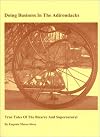
Well the title get's one thing right...It's bizarre, alright. Nonsensical is more accurate. After having read this book, I am unsure whether it's a work of fiction disguised as a poorly written, seeming delusional set of memoirs, or whether the author is indeed extremely paranoid.
According to Macer-Story, seeming everything that happens to her results from the actions of an evil cabal, which she calls Thanatos. Hearing a car start in the middle of the night? Thanatos has someone watching her. Trash in the yard? Curse by Thanatos.
Perhaps this book is useful as an inside look into the mind of someone suffering from paranoia. Otherwise, one to miss.
According to Macer-Story, seeming everything that happens to her results from the actions of an evil cabal, which she calls Thanatos. Hearing a car start in the middle of the night? Thanatos has someone watching her. Trash in the yard? Curse by Thanatos.
Perhaps this book is useful as an inside look into the mind of someone suffering from paranoia. Otherwise, one to miss.
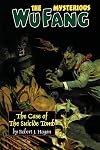
The Wu Fang stories--reprints of old pulps, are fun, escapist fiction, with a villian obviously derived from the Sax Rohmer's vile fiend, Fu Manchu. Once you can get beyond the take-off, the Wu Fang stories are much like the literary equivalent of candy corn--tasty in small amounts, cloying in large, and absolutely not filling.

Too a large degree, the Doc Savage stories are an acquired taste. I was introduced during my tour in Iraq, when some blessed soul had sent, in a care package of books, several Doc Savage novels to my FOB. I recognized the name from my interest in pulps, and snagged them to read.
They're most assuredly something from an earlier age--jazz era racism and cultural attitudes jar with modern mores. However, the adventures that Doc and his crew go on are rowsing, exciting, and generally fun.
Additionally, Doc Savage is not a modern sort of hero--he has no flaws, admirable in all ways. A lad could do a lot worse then aspire to be like Doc Savage when he grows up.
For exciting adventures, led by a true hero, one needs to look no further than Doc Savage.
They're most assuredly something from an earlier age--jazz era racism and cultural attitudes jar with modern mores. However, the adventures that Doc and his crew go on are rowsing, exciting, and generally fun.
Additionally, Doc Savage is not a modern sort of hero--he has no flaws, admirable in all ways. A lad could do a lot worse then aspire to be like Doc Savage when he grows up.
For exciting adventures, led by a true hero, one needs to look no further than Doc Savage.
As the father of small boy who all too often--at least until we moved to the country--would prefer the XBox 360 to more active pursuits, I regard The Dangerous Book for Boys as one of the best things to come along in ages. It's a book of concentrated 'boyness,' and contains activities my daughter enjoys as well.
Personally, I'm amazed that there are things in this book--like tying knots--that I didn't learn until I was in the Army.
Every father needs this book, and needs to share it with his kids.
Personally, I'm amazed that there are things in this book--like tying knots--that I didn't learn until I was in the Army.
Every father needs this book, and needs to share it with his kids.
The author's premise, that military decision makers rely on key metrics as indicators for the (in)effectiveness of courses of action is interesting. However, it ignores the influence of other factors, such as public opinion, personal bias, and political influence in the decision making process.
An intersting read, crisply written and enjoyable.
An intersting read, crisply written and enjoyable.
This book really brings home three points:
1) Unity of command--lack of a clear chain of command brings unneccesary friction to the battle field
2) Need for conventional forces on the battlefield; SOF is great--those guys can do amazing things. But the wish to keep US KIA low and substitute SOF and local troops prevented the US commander from achieving his objectives.
3) US Army fire support personnel need to be cross trained as Terminal Area Controllers in order to control close air support.
Great Book; really recommend it.
1) Unity of command--lack of a clear chain of command brings unneccesary friction to the battle field
2) Need for conventional forces on the battlefield; SOF is great--those guys can do amazing things. But the wish to keep US KIA low and substitute SOF and local troops prevented the US commander from achieving his objectives.
3) US Army fire support personnel need to be cross trained as Terminal Area Controllers in order to control close air support.
Great Book; really recommend it.

Nick Vaux's memoir of his experiences as a Commando (battalion level) commander during the Falklands Island War should be mandatory reading for anyone aspiring to tactical command. His book, well written and entertaining, provides valuable insight into the stresses and strains that affect the commander. Battle focused training, hasty planning, and the effects of the environment on combatants are also topics that he addresses.

John Master's second volume in his autobiography details his time during WWII as a British officer in the Indian Army. Masters--an eloquent writer with keen insight--spent most of the war as a staff officer, with time in command of one of the Chindit Brigades. Masters provides details on what it takes to be a staff officer, but also to command high-quality troops under extremely difficult conditions. Pay particular attention to the part of the book where Masters writes about ordering the mercy killing of several of his troops. Masters was forced to make a horrifically difficult decision, and would have to live with it for the rest of his life.
Yellow Smoke: The Future of Land Warfare for America's Military : The Future of Land Warfare for America's Military (Rol by Robert H. Scales
MG Scales is one of the great military thinkers of the modern age, and this book reflects the vast effort of thought he has put into military problems during his career. His thesis, that in limited-objectives warfare, technology enabled firepower is the key way to destroy the enemy, and that close-combat maneuver forces are for 'findin' em and fixin' em.' To some degree, I agree with his thesis, but note that my personal experiences in Iraq taught me that A) clese combat with the insurgents is the most efficient way to inflict mass casualties on the insurgents; B) the insurgent's capability of hiding themselves in the populace prevents the use of massed fires and target detection, not to mention the politically unpalatable possibility of collateral casualties. As usual, MG Scales writes well, and thoroughly understands his subject.
Defeat into Victory is simply the finest memoir by a GO that I have ever read, and one of the best ever. Slim manages to avoid any sense of self-justification, and instead clearly analyzes both his accomplishments as 14 Army Commander, and his shortcomings. For those interested in the Burma theater, I also recommend The Road Past Mandalay, by John Masters, who served as a staff officer and brigade commander during the British campaigns there.