
Maybe one of the best musicians biography ever wrote and certainly the definitive look into McKinley Morganfield's life.
After reading the boring, cliché foreword by Keith Richards and getting a few pages into the first chapter we immediately notice how much time and effort the author invested, doing a great work of investigation that becomes obvious when you see its almost 200 pages of appendixes, notes and bibliography.
This book discovered me some recordings that I, for some reason, managed to miss and many aspects of Muddy's life that I never heard of, Muddy's and many of his friends and "blues colleages" (Jimmy Rogers, Little Walter, Otis Spann and many more), because this book isn't only about Muddy, it's about the Blues and everything that come with it: about black people, musical legacy, the racist south, life in the delta, the Great Migration, industrial Chicago... etc. Also this biography talks not only about the character but the music as well. This may appears as a somehow dumb observation but, sadly, it's a very common practice in this kind of books to center exclusively in the persona and completely ignore the music, which is a main aspect in their lives.
I finished the book loving even more Muddy's legacy and with a renewed opinion about the character.
The only (small) thing I can complain about is the small amount of photos.
After reading the boring, cliché foreword by Keith Richards and getting a few pages into the first chapter we immediately notice how much time and effort the author invested, doing a great work of investigation that becomes obvious when you see its almost 200 pages of appendixes, notes and bibliography.
This book discovered me some recordings that I, for some reason, managed to miss and many aspects of Muddy's life that I never heard of, Muddy's and many of his friends and "blues colleages" (Jimmy Rogers, Little Walter, Otis Spann and many more), because this book isn't only about Muddy, it's about the Blues and everything that come with it: about black people, musical legacy, the racist south, life in the delta, the Great Migration, industrial Chicago... etc. Also this biography talks not only about the character but the music as well. This may appears as a somehow dumb observation but, sadly, it's a very common practice in this kind of books to center exclusively in the persona and completely ignore the music, which is a main aspect in their lives.
I finished the book loving even more Muddy's legacy and with a renewed opinion about the character.
The only (small) thing I can complain about is the small amount of photos.
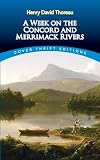
I've never read such a beautiful and gentle book...
In this book, writen during his time in Walden pond, Thoreau documents a boat trip he made with his brother, from Concord, Massachusetts to Concord, New Hampshire. A delightful journey immersing themselves (and the reader) fully into nature and a time where things were different, calmer, probably better. A wonderful narrative where Thoreau intercalates descriptions of the scenery and its inhabitants with observations and thoughts about poetry, religion, philosophy, friendship, literature and history among other topics, flowing effortlessly between the former and the later like the rivers themselves. The reader often feels in the same boat as the two brothers, sailing on the brown rivers or having supper in a small, human-free, green island only to be taken the next second over a thought-provoking essay about religion or a history lesson about the indian wars. Thoreau shows an unusual grasp of english and brilliant prose which shines on every page, making it a little bit difficult to read for the non-native english speaker like me, but it's absolutely worth the effort. This is probably the most erudite book I ever read. Henry David Thoreau is king.
In this book, writen during his time in Walden pond, Thoreau documents a boat trip he made with his brother, from Concord, Massachusetts to Concord, New Hampshire. A delightful journey immersing themselves (and the reader) fully into nature and a time where things were different, calmer, probably better. A wonderful narrative where Thoreau intercalates descriptions of the scenery and its inhabitants with observations and thoughts about poetry, religion, philosophy, friendship, literature and history among other topics, flowing effortlessly between the former and the later like the rivers themselves. The reader often feels in the same boat as the two brothers, sailing on the brown rivers or having supper in a small, human-free, green island only to be taken the next second over a thought-provoking essay about religion or a history lesson about the indian wars. Thoreau shows an unusual grasp of english and brilliant prose which shines on every page, making it a little bit difficult to read for the non-native english speaker like me, but it's absolutely worth the effort. This is probably the most erudite book I ever read. Henry David Thoreau is king.