The Odyssey by Homer
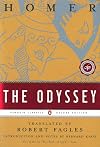
Since the story has lasted this long, it must be worth five stars, right? I had been reluctant to read this book fearing it would be a slog, but it proved to be an easy read and entertaining. I'm very glad I read it.
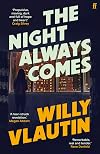
This book is half social commentary/half novella. I enjoyed it and it reads very quickly. If the events are a little over-the-top, Lynette's anguish and her determination to "do something" rings true. It might be a better book if the characters's voices were better distinguished. Towards the end, her mother sounds very much like Lynette and J.J., Cory and the repo guy all sound interchangeable. Still, it did resonate with me.
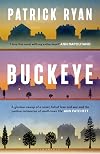
I've just come from the library book club where we discussed this book. Unlike the reviewers here (and Ann Patchett!?), we universally panned it. The general feeling was that the characterization was lacking and Ryan's grasp on history a bit shaky. Becky came in for some especially harsh words because people didn't believe she could communicate with the dead and argued she did it for self-aggrandizement. I cannot bring myself to agree that the book is well-written. I did find Felix's situation moving, and thought he was the best-drawn of the characters, but I cannot recommend it.
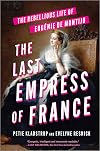
Eugenie's story is vividly told here. The authors convey a complex history clearly and succinctly. I have to admit that I know next to nothing about French history and yet was able to follow along with unflagging attention.
Listening to the Animals: Becoming The Supervet: A heartwarming gift for animal lovers (Noel Fitzpatrick The Supervet) by Noel Fitzpatrick
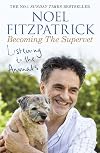
I found his story intriguing and his argument for One Medicine sound. I did think it a bit sentimental and a tad self-serving, but he was also quite frank about his personal life which was brave. I recently had to euthanize my dog who suffered from degenerative disc disease which, I believe, may have benefitted from some of the surgical techniques described in the book. It was helpful to me to be able to replay that situation in light of what he had to say about euthanasia and the difficulty balance you have to strike when making such a decision. If I had read this book before that situation arose, I might have asked more questions and paid for more expensive (thousands of dollars) testing, but I doubt that, in this case, there would have been a different outcome.
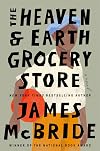
I had enjoyed McBride's Deacon King Kong so much I was really looking forward to this book, but found myself disappointed. I rarely give a book three stars or lower because I stop reading if I am not enjoying the book, but I kept on in the hopes that the story would pick up. This novel has all of the elements of a great read, but the plot is so loosely structured, it flops around until it reaches a too saccharine ending. While there should be enough detail to allow the reader to envision the action, here the action gets weighed down in great quantities of irrelevant detail. Sigh.
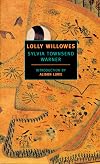
I found this book to be an absolute delight! Lolly is a long-suffering aunt who must constrain her actions and tastes to conform to long-standing family prejudices. Suddenly, she breaks free and moves to the country, only to be followed by her favorite nephew. This is too much for her and she makes a pact with the devil (a very pleasant fellow) and only then can she free herself from the demands to be other than her true self.
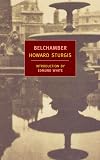
This book is an absolute romp! It is a social satire on the British upper classes before World War 1 and its protagonist, Sainty, is one of those introspective, self-centered individuals who weighs his every thought on a set of scales that ensure he feels badly. Still, he manages to be the only likable character in the entire novel.
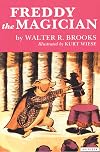
No one should take Freddy's disguise as an Indian chief seriously. Brooks makes that clear when he has Jinx refer to Freddy as "Chief Pretzel Tail." Magician isn't the funniest of the Freddy books, but it has its moments. Brooks frequently leans on exaggeration as a device for injecting humor and this is one of those times. Another example is Ollie Groper's use of the language. I remember clearly being impressed with the many "big words" when I read the book as a child.
I was intrigued to find out from the introduction that Comyns's work is considered outsider art. I would not have thought that because her descriptive power is so gorgeously rich and well-crafted. It is true that there is a quality of surrealism in all of her work, but her prose has an ethereal quality that is not in the least amateurish. She may or may not be an outsider, but she is definitely an artist. Her work reminds me of Leonora Carrington's writing. Just as (spoiler alert) Alice can truly levitate, Comyns can construct a world so utterly realistic in its terribleness that you cannot be blamed for thinking that levitation is a proper response.
I found this play to be engrossing and powerful. I read it decades ago in high school (my brother remembers me reading it). It must have made an impression on me then, but rereading it, I find it to be a very adult play in its characterizations. It's not that high school students wouldn't find the play stirring, but the play calls for an adult understanding of relationships between men and women and what is truly at stake.
A young friend told me he became a reader by reading this book. I can see its appeal to a young man. I wasn't quite so taken up by the novel as my friend and yet I did find it enjoyable. I'm not familiar with Murakami's fiction so I didn't realize how imaginative it would be. I was trying to guess how the two story lines -- Kafka's and Nakata's -- would merge and yet "talking to cats" was not one of my choices! Mr. Nakata and Mr. Hiroshino were my favorite characters. I understand that "everything is a metaphor," but that conclusion feels a little juvenile and perhaps too obvious. Why do the fish fall from the sky? Because something is fishy? It's supposed to be amusing, I know, and it is a bit amusing. Kafka and all of the sex felt a little juvenile to me as well. Of course, it is a story about a young man coming of age and it makes sense that he would have all of these sexual feelings, but it just felt like a bit much.
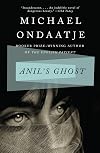
I tore through this book, devouring it in relief at having something so excellent to read. It's an extraordinary picture of life in Sri Lanka during the Civil War and the horrific impact of indiscriminate violence on ordinary people.
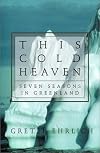
I learned so much from this book. Ehrlich writes of the time she spends in Greenland with the Inuit people and intersperses her experiences with those of Knud Rasmussen from the early twentieth century. Today, the Inuit are struggling to hang on to their old way of life as technology and economic pressures intrude. Ehrlich doesn't flinch from describing the horrors of child sex abuse and alcoholism that permeate the lives of the contemporary villagers, nor does she romanticize the lives of the hunters on the ice. What she does share, to great effect, is the beauty of the Far North, the changing nature of the ice and the desire of the Inuit hunters to retain their connections to their history. It's an extraordinary window into the shifting cultural patterns of Greenland at the end of the twentieth century and how life was like for these same people a hundred years ago. For anyone interested in polar history, this is a must read.

I enjoyed the story and especially loved the descriptions of the music which often included nature scenes. I had guessed the culprit from the beginning, but I appreciated the tension in Ray's desperate search for his violin. I also thought the Black history aspects were deftly handled. My chief criticism would be with the writing style which I found clumsy and over reliant on cliche. Still, it's a first effort and there was much to value here.
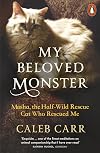
This book served to improve my relationship with my cat. It taught me to be more observant of her behavior and to allow her more freedom. She repaid me almost instantly and so I am grateful I read this book. I was moved especially by the book's conclusion as I have often found grief to be very difficult to navigate.
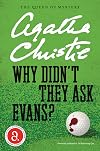
It's a shame to begin the New Year with a book rated only two stars, but here we are. I rarely give out such a low rating because I typically put a book down if I think so little of it, but I needed something light to read and so read on to the bitter end. The end is a letter from the villain explaining how he committed the crime. Yes, it is that bad. Like the Tommy and Tuppence novels, this one features a young couple who play off of one another in a rather amusing way, but not so successfully as in the Tommy and Tuppence books. She was trying for the silly plots of those books, but this time Christie couldn't even make absurd sense out of this mess. Well, we can only go up from here!
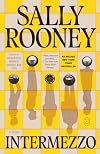
I ended up liking this book but I did not decide that until p. 169. I would not have read that far, but it is a book club pick so I wanted to give it a fair shake. Page 169 is the scene between Peter and Ivan at the restaurant. I thought that rang very true and it made me appreciate the technique Rooney uses of the internal monologue and continually shifting point of view. The effectiveness of this technique varies throughout the novel though and sometimes it was hard to tell which character we were hearing from. In particular, it was often difficult to distinguish between Naomi and Margaret. Still, the technique did serve to underscore that any relationship can be viewed differently depending on one's point of view at any particular moment. It's not a brilliant novel but it is a moving one. I was especially taken with the dog and how once Ivan acts to protect his dog, he views his mother in a much more positive light. You cannot move passively through life expecting other people to fix your problems. The book also seemed overly long to me. I'm afraid I skimmed the last few 25 pages or so and they were supposed to present the moving conclusion. Sigh.
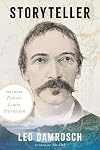
I was very moved by the ending of this book and have been thinking about Stevenson's life and his struggle to make meaning out of it for the past two days. I wish he had felt more peace of mind. I was surprised to learn he was such close friends with Henry James. James's tribute to Stevenson was very affecting.
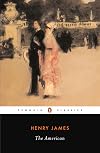
I enjoyed this book tremendously. The story roared along and, while it has the usual sad ending, I felt that Newman had made peace with his situation. The introduction says James thought the book's premise was flawed, and I can see his point, but I enjoyed Newman's struggle so much, it didn't matter to me.
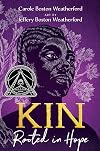
This is the Maryland One Read book for this year and it accomplishes everything the Humanities Council wants the One Read book to do. I learned more about Maryland history and it has piqued my interest in the Eastern Shore. Now I plan to visit Talbott County and the Wye Mansion. Most of all, I have a greater understanding of slavery and it's impact both in the past and now. The author is learning about her family's history as the book evolves and the reader is learning alongside her. You also learn about the Lloyd family which was absurdly wealthy from colonial times to the twentieth century and had enslaved the author's ancestors. Not all of them were evil, but they all benefited from an evil system. This is an emotionally difficult read, but it is a quick read.
The author organized this book by the month so you can find out the very different things that may be happening to the oak in your yard in April or September. I read this because I am trying to keep my oaks alive and healthy and so found the book useful. There was too much about caterpillars for me, but they pay a key role in the life cycle of your tree. He's an entomologist so it makes sense that he would have a bug focus.

I don't believe I have ever read a book quite like this one. It is a true original. I felt for both the man and his lady and found the ending painful, but true to life. I loved the illustrations. They added a delicate beauty to the scenes the author depicts and take a bit of the sting out of the events.
I always enjoy these humorous tales. I especially liked Joyce in this one and Pauline.

I loved the fable like nature of the story with everyone seeming both very real and also more than a little like fairytale characters. Even the wicked Bernard is really just a man who craves female adoration. I also liked to see Bella gradually evolving into her own person and the finality of the end when she goes back to see the juniper tree one last time. It just feels so very right.
It would be difficult to find a travel writer who surpasses Stevenson's skill in describing landscape. You will want to dwell over certain passages. I was unhappy over his treatment of the donkey and his many complaints in the first half of the book, but both improve over time.
In this series of essays, Andrea Barrett explores the transmutation (she discusses the difference between transmutation and translation) of fact into fiction which offers a greater understanding of the historical past. I especially enjoyed the essays, "The Floating Pants" and "Traveling Corpse," for how they showed that facts change depending on who is recording the facts, the life around them and myriad other influences on both the actor, the writer and the reader.
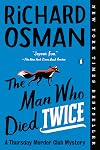
While I found this book very funny and I love the characters, I felt there was a troubling undercurrent. Elizabeth is very slow in recognizing the killer and, while I won't include any spoilers here, she allows two murders to happen that were unnecessary. In another story line, Ibrahim has been attacked and he philosophically states that the man who seeks revenge digs two Graves, yet the Club does extract revenge. Neither of these contradictions are explored in the narrative. Perhaps that degree of depth would be out of place in what really is a lighthearted work, but the lack of resolution of these contradictions made me uncomfortable. On the other
hand, I appreciated the thoughtfulness that went into the portrayal of Stephen's dementia and I loved the ending. Elizabeth does come through at the end.
hand, I appreciated the thoughtfulness that went into the portrayal of Stephen's dementia and I loved the ending. Elizabeth does come through at the end.
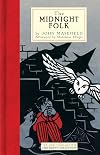
The Midnight Folk is said to be John Masefield's favorite book. That surprises me because I think The Box of Delights is more popular and may be the better book as the plot is more cohesive. It's a rollicking adventure, though, with lots of magic and gorgeously detailed descriptions of mermaid cities under water and so on. There are some realistic details, though, that I didn't care for -- like Bitem's dietary choices and the poisoning of the otter hounds. I know these things happen, but not in my fantasy books, please.

I am so struck by the ideas expressed here about his approach to travel and his humourous insights into human nature that I want to keep this book always with me. Stevenson seems to embody all of the wonderful traits of the heroes of Treasure Island and Kidnapped as they would be as grown men, including a self-deprecating awareness of his own flaws. The descriptions of nature and the minor incidents of the trip make rural France vivid to the imagination. There is much here worth revisiting again and again. It has had an effect on me beyond all anticipation.