
I got this as a review copy in LibraryThing Early Reviewers. Reading the reviews online, I wouldn't have bought the book.
The premise of the book as marketed hooked me in: Nicholas Pedrosa is a young graduate in a dead-end job in London. Quite unexpectedly, he's invited to join an archaeological dig on Santorini, lead by the enigmatic Prof. Huxley. Upon arriving at the site, he discovers there's been a death -- his predecessor has suffered a fatal fall from a scaffolding at the dig site. But the death occurs *after* Nicolas has been chosen as Prof. Huxley's new assistant. Is foul play involved?
I was expecting something in the way of Murder in Mesopotamia meets The Alchemist meets Raiders of the Lost Ark and got... nothing of those. The plot advances quite slowly. We meet the cast of characters, Nicholas does some investigating into the death/murder, but mostly it's just him waffling over whether Huxley is a brilliant archaeological genius or a murderer/hack/sexual deviant/whatever. By the time the plot gets to the society for near-death experiences (seriously), the book had completely lost me. I had to step away from it for a few months.
The plot keeps getting weirder and weirder with the discovery of House 34, and I couldn't make out if the book just took a sudden turn into scifi. That, at least, would have been interesting, unlike the incessant conversations the characters have over metaphysics. Mr. Azuski writes beautifully, and there were many a time when I just stopped show more and marveled over some sentence on the page. But what could have used much editing and paring down were the plot and pacing of it. In the end, I wasn't sure what I'd just read -- what really happened? But maybe that was his intention. show less
The premise of the book as marketed hooked me in: Nicholas Pedrosa is a young graduate in a dead-end job in London. Quite unexpectedly, he's invited to join an archaeological dig on Santorini, lead by the enigmatic Prof. Huxley. Upon arriving at the site, he discovers there's been a death -- his predecessor has suffered a fatal fall from a scaffolding at the dig site. But the death occurs *after* Nicolas has been chosen as Prof. Huxley's new assistant. Is foul play involved?
I was expecting something in the way of Murder in Mesopotamia meets The Alchemist meets Raiders of the Lost Ark and got... nothing of those. The plot advances quite slowly. We meet the cast of characters, Nicholas does some investigating into the death/murder, but mostly it's just him waffling over whether Huxley is a brilliant archaeological genius or a murderer/hack/sexual deviant/whatever. By the time the plot gets to the society for near-death experiences (seriously), the book had completely lost me. I had to step away from it for a few months.
The plot keeps getting weirder and weirder with the discovery of House 34, and I couldn't make out if the book just took a sudden turn into scifi. That, at least, would have been interesting, unlike the incessant conversations the characters have over metaphysics. Mr. Azuski writes beautifully, and there were many a time when I just stopped show more and marveled over some sentence on the page. But what could have used much editing and paring down were the plot and pacing of it. In the end, I wasn't sure what I'd just read -- what really happened? But maybe that was his intention. show less
 This review was written for LibraryThing Early Reviewers.
I signed up to review the novella on LibraryThing Early Reviewers not realizing it belonged in the middle of an ongoing series. The setting sounded interesting but had I been more familiar with the series, I might have gotten more out of it.
It's 1625 in an alternate-history London. Below the city, in secret, exists the Onyx Court, where Queen Lune of the Fae reigns with her mortal lover, Sir Michael Deven. Up above in a shady part of the city, a man is found dead in what is quickly judged a staged robbery. The murder victim is one Henry Ware, a young man groomed to be Sir Deven's successor in the Court. With the help of Ware's cynical brother, Sir Deven sets out to discover if the murderer is a mortal man or one of the faeries.
The chapters alternate between two timelines: the present, the murder investigation, and flashbacks of years earlier, when Ware was introduced to the city below. The murder investigation is the far more interesting of the two, with Sir Deven applying the help of faerie magicks and non-human creatures in discovering the truth. The past timeline revolves too much around 1500th century European politics and the succession for the English throne. You'd either have to be extremely interested or knowledgeable to follow along in Sir Deven and Henry's endless conversations. I wasn't.
And just when things start happening, it's over. The identity of the murderer is discovered a little too quickly, and the bigger threat behind the assassination thwarted too show more easily. Perhaps the author should have delved deeper into the world and creatures of the city below. Then again, maybe I should have started reading the series from the beginning. If the other books flesh out the characters and settings more in detail, I might go back to the Onyx Court. show less
It's 1625 in an alternate-history London. Below the city, in secret, exists the Onyx Court, where Queen Lune of the Fae reigns with her mortal lover, Sir Michael Deven. Up above in a shady part of the city, a man is found dead in what is quickly judged a staged robbery. The murder victim is one Henry Ware, a young man groomed to be Sir Deven's successor in the Court. With the help of Ware's cynical brother, Sir Deven sets out to discover if the murderer is a mortal man or one of the faeries.
The chapters alternate between two timelines: the present, the murder investigation, and flashbacks of years earlier, when Ware was introduced to the city below. The murder investigation is the far more interesting of the two, with Sir Deven applying the help of faerie magicks and non-human creatures in discovering the truth. The past timeline revolves too much around 1500th century European politics and the succession for the English throne. You'd either have to be extremely interested or knowledgeable to follow along in Sir Deven and Henry's endless conversations. I wasn't.
And just when things start happening, it's over. The identity of the murderer is discovered a little too quickly, and the bigger threat behind the assassination thwarted too show more easily. Perhaps the author should have delved deeper into the world and creatures of the city below. Then again, maybe I should have started reading the series from the beginning. If the other books flesh out the characters and settings more in detail, I might go back to the Onyx Court. show less
This review was written for LibraryThing Early Reviewers.
Unlike many management guidebooks, this one has years of research and hard data to back up the basic arguments. Still, the book is very approachable and illuminating, albeit it gets a bit repetitive at times. By the fifth chapter, you already know Christensen’s basic theses, yet he continues to elaborate on it for a better half of the book. But it never gets boring, and I found the industry examples particularly interesting. As a grad student just starting my dissertation on the diffusion of innovations, I was inspired by the book in my own work, and found many interesting research avenues one could take further. Highly recommended!

The overall plot is very Adamsian but the narrative is not quite up to his level. That isn't to say "The Last House in the Galaxy" is not entertaining, quite the contrary. It's a fast-paced and funny space adventure, with a very straightforward storytelling. The characters are perhaps a little too one-dimensional, almost comic-book like. Still, very enjoyable and a quick read.


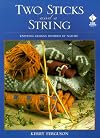
"Two Sticks and a String" is beautifully illustrated but for knitters looking for classic patterns, this isn't the book of choice. The garments are bulky and made of glaring colors. You don't want to be seen knitting them, let alone wearing them. There are *two* decent patterns (Aran Pullover on p. 31 and Aran Cardigan on p. 37), but I'd say even they demand some modifications. If you can get a hold of a copy from the librabry, do take the book home and browse it through. It can be used as a source of inspiration but I'd recommend against *buying* it. (And it's pricey.)