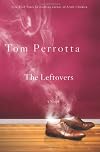
Tom Perrotta has made his mark with closely-observed and increasingly dark examinations of modern middle-class America. In The Leftovers he brings the same tools to the same subject-----after a supernatural catastrophe. Something like John Cheever taking on alien abductions. Pretty ballsy, right? And even better, it works. Really, really well.
The book is set after the Rapture. Or something like it. Millions have simultaneously disappeared, just as foretold in Revelation and eagerly awaited by the credulous. Except that lots----maybe most----of the vanished don’t seem to be particularly good Christians. Or Christian. Or good. Which causes a lot of what might be called cognitive dissonance in the Left Behind. Some----the Guilty Remnant cult---persist in the belief that the End Is Nigh and offer chain-smoking, silent reproach to their neighbors’ heedlessness. Another, furious that he didn’t get disappeared himself, publishes a tabloid exposing the secret sins of those who were. But others still try to get on with life as though nothing had happened, isolating the inexplicable in “the same place you hid the knowledge that you were going to die, so you could live your life without being depressed every minute of every day.” The principal characters include both the shattered and the merely shaken, and their painful and funny relationships drive much of the action. But in keeping with his gathering darkness, Perrotta’s narrative takes several unexpected, violent show more turns before ending on a note of cautious hope.
The author makes several interesting choices. First is to set the story several years after what he calls the Sudden Departure. For this reason the book revolves not around the singular event----which would suck all the oxygen out of the room---- but its human consequences. Second, he describes the Departure itself only peripherally. Those who’ve actually “witnessed” a disappearance seem to have looked away for a split second, or left the room for a glass of water, when the event occurred. Though in one memorable instance the witness is a young woman doing a reverse cowgirl on a frat boy when he’s called to Jesus----and even then, she wouldn’t have been facing him, would she? The cumulative effect of these decisions is to keep what is clearly the most astonishing event in history from overwhelming the story Perrotta wants to tell.
A novel whose animating idea is so audacious could easily have degenerated into slapstick or spookery. In Perrotta’s hands it is funny, humane, and deeply moving. This is an extraordinary book by an extraordinary writer. show less
The book is set after the Rapture. Or something like it. Millions have simultaneously disappeared, just as foretold in Revelation and eagerly awaited by the credulous. Except that lots----maybe most----of the vanished don’t seem to be particularly good Christians. Or Christian. Or good. Which causes a lot of what might be called cognitive dissonance in the Left Behind. Some----the Guilty Remnant cult---persist in the belief that the End Is Nigh and offer chain-smoking, silent reproach to their neighbors’ heedlessness. Another, furious that he didn’t get disappeared himself, publishes a tabloid exposing the secret sins of those who were. But others still try to get on with life as though nothing had happened, isolating the inexplicable in “the same place you hid the knowledge that you were going to die, so you could live your life without being depressed every minute of every day.” The principal characters include both the shattered and the merely shaken, and their painful and funny relationships drive much of the action. But in keeping with his gathering darkness, Perrotta’s narrative takes several unexpected, violent show more turns before ending on a note of cautious hope.
The author makes several interesting choices. First is to set the story several years after what he calls the Sudden Departure. For this reason the book revolves not around the singular event----which would suck all the oxygen out of the room---- but its human consequences. Second, he describes the Departure itself only peripherally. Those who’ve actually “witnessed” a disappearance seem to have looked away for a split second, or left the room for a glass of water, when the event occurred. Though in one memorable instance the witness is a young woman doing a reverse cowgirl on a frat boy when he’s called to Jesus----and even then, she wouldn’t have been facing him, would she? The cumulative effect of these decisions is to keep what is clearly the most astonishing event in history from overwhelming the story Perrotta wants to tell.
A novel whose animating idea is so audacious could easily have degenerated into slapstick or spookery. In Perrotta’s hands it is funny, humane, and deeply moving. This is an extraordinary book by an extraordinary writer. show less