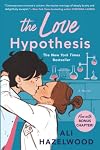
I like the concept, the reality of academia, and even the leads sometimes, but I really didn’t enjoy the writing. It surprised me that my biggest issue with this book was just the technical skill. I felt like I was just being told feelings with words instead of being shown with figurative language. And I’m talking basic stuff, like a good similar. For example, here’s a quote from page 327: “[he] smelled like himself, like *safe* and *home*.” This beckons the reader to use their sense of smell, but then we aren’t given anything tangible. We’re told she feels safe in his arms, but what does smelling “like safe” mean? The author could have done a lot more with lines like these to actually paint a picture of these characters and their feelings, e.g. saying he smelled like citrus scented dish soap or fabric softener, you know? Or for a proper simile it could be “his arms felt like sheets fresh out the dryer”. I would be satisfied with something really basic, I’m not looking for Virginia Woolf, but even when I flipped through this book looking for figurative language I couldn’t find anything like that. Here’s another line (page 306): “Something inside her—her heart, very possibly—was broken in several large pieces, not shattered as much as nearly snapped in half, and then in half again.” This is vague and abstract and doesn’t make me *feel* anything. It would be easy to say “was broken in several large pieces LIKE” and then compare it show more to something, anything. Large pieces of what? Hazelwood could even take the opportunity to tell an anecdote about Olive’s life in stem, imagine “several large pieces like when she dropped a beaker of formaldehyde in her undergraduate chemistry lab, how the glass laid neatly in a puddle instead of shattering…” And that’s not good (or realistic) and Hazelwood could do much better than what I came up with off the top of my head, but she just didn’t. These feelings and personal details in similes and analogies do a lot for a love story; it was like I was reading a skeleton instead of a novel… show less
Flapper: A Madcap Story of Sex, Style, Celebrity, and the Women Who Made America Modern by Joshua Zeitz

I loved this book; it’s the kind of nonfiction you can read with the same enjoyment and relaxation as a novel (to me anyway). It paints a picture of this time in a way that made me feel like I could step into it… I felt so connected to these individuals from a century ago. Will definitely reread in the future

I liked the comprehensive overview feel in the beginning of the book because it felt like I was building scaffolding for further study in specifics. The later periods focused heavily on the leaders and I didn’t feel like I could ground myself in the time period as much. Probably because we have so much information about it. Overall I wish there was more of an overarching narrative of that makes sense? Idk it’s past midnight and I’m reviewing a Russian history textbook
The Rise and Fall of Soviet Communism: A History of 20th-Century Russia [Audiobook]Great Courses Professor Gary Hamburg by Gary Hamburg

Professor Hamburg takes you through Soviet history through the lens of the top leaders and there wasn’t a lot of focus beyond that perspective. I would’ve liked to hear more about society and culture (the parts he touched on were very interesting) but that would probably double the length of this audiobook. Overall, I enjoyed this listen and I think it’s a good snapshot of the period. Hamburg acknowledges that as a historian he can’t narrate all the facets of history in words, only give certain scenes and vignettes to paint a fuller picture. I thought that was self aware and a good way to explain it.
Now these lectures are history too; we’re looking back on a time when people were more optimistic about Russia’s transition to a new system because the future was unknown. The last half hour or so was bittersweet to listen to. Maybe in the hands of better leaders we would have Russia as a powerful democracy on the world stage in 2024. It makes me miss the collaborative energy of Russo-American space projects in the 2000s… but that’s neither here nor there.
Now these lectures are history too; we’re looking back on a time when people were more optimistic about Russia’s transition to a new system because the future was unknown. The last half hour or so was bittersweet to listen to. Maybe in the hands of better leaders we would have Russia as a powerful democracy on the world stage in 2024. It makes me miss the collaborative energy of Russo-American space projects in the 2000s… but that’s neither here nor there.