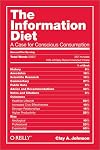
When I began rationing (and rationalizing) my internet usage because I was spending too much time on the Internet I realized this was fundamentally about how I process information - email, Facebook, and link hopping.
CAJ says to treat your information like food. In Part One he makes the argument of comparing information to food and why we enjoy consuming so much of both. My favorite part was that consuming the same 'junk' information will strengthen our 'reality dysmorphia,' a cognitive version of 'body dysmorphia.' He makes the case on why there is junk information in the first place (AOL Way, Big Tobacco), and how too much information can lead to very real physical side effects - being sedentary, email apnea (really - we breath more shallow when checking our email), loss of focus from notifications (increased heart rate after reading a text message), and a poor sense of time.
Part two is on how to have a healthy information diet - having data literacy (CAJ suggests data literacy in the future will be like knowing how to read a 100 years ago), a sense of humor, and a method of training to improve our executive functioning. There are many good quid bits here: 'Respect good content, disrespect advertisements,' 'Avoid over processed information,' and 'balance means keeping our desire for affirmation in check.'
CAJ says to treat your information like food. In Part One he makes the argument of comparing information to food and why we enjoy consuming so much of both. My favorite part was that consuming the same 'junk' information will strengthen our 'reality dysmorphia,' a cognitive version of 'body dysmorphia.' He makes the case on why there is junk information in the first place (AOL Way, Big Tobacco), and how too much information can lead to very real physical side effects - being sedentary, email apnea (really - we breath more shallow when checking our email), loss of focus from notifications (increased heart rate after reading a text message), and a poor sense of time.
Part two is on how to have a healthy information diet - having data literacy (CAJ suggests data literacy in the future will be like knowing how to read a 100 years ago), a sense of humor, and a method of training to improve our executive functioning. There are many good quid bits here: 'Respect good content, disrespect advertisements,' 'Avoid over processed information,' and 'balance means keeping our desire for affirmation in check.'
This autobiography has a personal, real, gritty, and at times incredibly mundane path of practicing zen and enlightenment. His prose is a stream of consciousness mixed with metaphor and full of implied description. It takea a dream-like quality with events and people phasing in and out, with no concrete beginning or end.
The author begins at a zen center that is embroiled with politics. He meets regular people, fellow practitioners with good qualities and neurotic tendencies. Throughout, money's always a concern. He's always on the lookout for work and plies his trade of general labor to, it seems, ultimately, to keep up his practice. A seminal moment occurs when, at the suggestion of a higher up, he does a solo 100 day retreat.
Later experiences include training as a zen monk in Korea, learning of the sheer quality that sexual desires holds in the everyday/everymoment, and disrobing to head back to the US. Throughout, he continues his 100 day winter retreats.
The ending has a wonderful tale of fruition, but no ending.
The author begins at a zen center that is embroiled with politics. He meets regular people, fellow practitioners with good qualities and neurotic tendencies. Throughout, money's always a concern. He's always on the lookout for work and plies his trade of general labor to, it seems, ultimately, to keep up his practice. A seminal moment occurs when, at the suggestion of a higher up, he does a solo 100 day retreat.
Later experiences include training as a zen monk in Korea, learning of the sheer quality that sexual desires holds in the everyday/everymoment, and disrobing to head back to the US. Throughout, he continues his 100 day winter retreats.
The ending has a wonderful tale of fruition, but no ending.
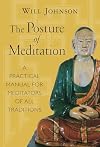
Will Johnson writes a wonderful book on the posture of meditation, and in the process delves into the act of meditation itself. Three gestures - alignment, relaxation, and resilience, combine to form a stable, relaxed, and open form capable of simply being aware. There are occasions where he describes patterns of sensations similar to that of insight meditation, which I found very understanding of the process. With my personal introductory experience with the Alexander Technique I've found this book to be extremely useful and complementary.

Picked this book up on a whim from the library and learned more than I expected on a symbol I didn’t know much about. The author takes a broad look at the fantastical creature of the Dog-Lion of Asia from a Buddhist perspective. It’s also known as the shishi in Japan, snow lion in Tibet, and the Fo dog in China. It seems that the benevolent Dog-Lion is hard to separate from Buddhism but the variety of ways the it was expressed culturally is enormous. She looks at the relationships China, Japan, and Tibet had with the real world counterpart of the Dog-Lion, the Lion-Dog (a distinction the author makes) with the breeds that were cultivated for that role (the Shih Tzu, Lhasa Apso, Tibetan Terrier, Tibetan Spaniel, and the Chin). What I found most fascinating was how the Dog Lion was represented in art. The roles it played according to its traits, the material it was made from (one chapter is devoted to Jade and China), and the legends surrounding its mystique. The book is short but sweet. If it were any longer I think it would be hard to sustain my interest on such a specific topic, but as it is I enjoyed it very much.
The Lady Who Liked Clean Rest Rooms: The Chronicle of One of the Strangest Stories Ever to Be Rumoured about Around New York by J. P. Donleavy
For being a short book there was a pretty involved conversation amongst my book club meetup regarding the virtues of the easily dislikable character, her actions, the plot line, and the author. There was some consensus within the group of how serious a novella this was with the story capable of being seen in a serial, trite perspective in spite of the surface level meaning. Although it is definitely a quick read it is also a contentious one due to the narrative and implied meaning when trying to pin down the overall merits among a group of people larger than yourself. Short story long, it isn't a classic but it can make you think.
Coming Apart: Why Relationships End and How to Live Through the Ending of Yours by Daphne Rose Kingma
An insightful and enriching book from a practicing psychologist for tough times. Daphne Kingma proposes that our traditional (default) views of relationships are antiquated. In reality our reasons in being in a relationship are selfish, not selfless, and the ending of relationships are normal. Does that make reality bitter and depressing? No, because she says relationships are more than a compatible parter but a transference of gifts. People come together because they meet each others needs originating from childhood, and fulfilling those needs is the exchange of Daphnes gifts. She provides plenty of examples of what is essentially people growing and evolving. This is what may be the real root of relationships (and I see a flavor of transactional analysis mingling here, as a TA fan). Does relationship loss hurt? Sure, the only thing worse is loss through death. Can it provide more than misery, pain, or regret? You betchya. There are always lessons to be learned and the act of selfishness can allow you to become a better, mature, and more wholesome being with the experience relationships can give you.
A truly informative book on the reality of war and its effects on people. The book is a quick read and incredibly interesting, with the text in a question-and-answer format. I found the arc of chapters clever as well, following the progression of a person from joining the military to questions of combat, wounds and injuries, dying, and life after the war.
The sections which caught my attention was how people adapt to combat. The vast majority of people do not like to kill other people. It's difficult. Media portrayals of combat show a sanitized reality of death and destruction, with whole bodies and peaceful expressions of death, but the truth is that bodies can be mutilated, disfigured, or burned, and soldiers can remain alive after being wounded.
Soldiers must be conditioned to kill. There's a quip from Lt. Col Grossman, who also wrote the book Killology, that "It is not too far off the mark to observe that there's something about continuous, inescapable combat which will drive 98 percent of all men insane, and the other two percent were crazy when they got there." The remaining two percent had aggressive psychopathic personalities which allows them to not be affected by the stresses of combat. That statistic reminds me of Daniel Goleman (who wrote 'Emotional Intelligence') that one percent of all people have a sociopathic personality who lack empathy for others and only think of themselves. Perhaps there is a correlation? For typical soldiers however, experiencing show more traumatic events in war can develop post-traumatic stress disorder (around fifty percent for WWII and Vietnam vets, and twenty percent for Gulf War I vets) which has real consequences on health and family.
Overall, the costs of war are more than material but human as well. Asking citizen-soldiers to go to war and experience death and destruction is no light task and re-affirms the responsibility of the executive branch to use their power wisely.
"War, the blood-swollen god, asks us to sacrifice our young. Beware of that sacrifice. Fear it." show less
The sections which caught my attention was how people adapt to combat. The vast majority of people do not like to kill other people. It's difficult. Media portrayals of combat show a sanitized reality of death and destruction, with whole bodies and peaceful expressions of death, but the truth is that bodies can be mutilated, disfigured, or burned, and soldiers can remain alive after being wounded.
Soldiers must be conditioned to kill. There's a quip from Lt. Col Grossman, who also wrote the book Killology, that "It is not too far off the mark to observe that there's something about continuous, inescapable combat which will drive 98 percent of all men insane, and the other two percent were crazy when they got there." The remaining two percent had aggressive psychopathic personalities which allows them to not be affected by the stresses of combat. That statistic reminds me of Daniel Goleman (who wrote 'Emotional Intelligence') that one percent of all people have a sociopathic personality who lack empathy for others and only think of themselves. Perhaps there is a correlation? For typical soldiers however, experiencing show more traumatic events in war can develop post-traumatic stress disorder (around fifty percent for WWII and Vietnam vets, and twenty percent for Gulf War I vets) which has real consequences on health and family.
Overall, the costs of war are more than material but human as well. Asking citizen-soldiers to go to war and experience death and destruction is no light task and re-affirms the responsibility of the executive branch to use their power wisely.
"War, the blood-swollen god, asks us to sacrifice our young. Beware of that sacrifice. Fear it." show less
emotions, meditation, mindfulness, personal development, attention, awareness, Buddhism, contemplation, eastern philosophy, healing, Health, inspiration, inspirational, meditation, personal development, Philosophy, psychology, self improvement, self-help, spirituality, zen