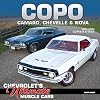
COPO is a legendary word in the world of Muscle Cars and this is a book that upholds that feeling and sense of awe and amazement. Beautifully bound with great photography throughout.
The author begins by explaining what COPO is and what it is all about then he delves into the history of the cars that were graced with the COPO titles. The vehicles he focuses on in this particular book are the Yenko Corvair Stinger, the 1967 Camaro 427 COnversions, the 1968 Yenko Super Camaro, the Gibb Chevy II Nova Super Sport, the ZL1 Camaro, The 1969 Camaro, the 1969 COPO Chevelle, the 1970 Yenko Deuce Nova, the 1970 and a half COPO Camaro, and the Vega Yenko Stinger. With each car he goes into its history and the process it took to bring such raw power to the roads. Plus the various laws that governed the automaker’s decisions regarding the way the engines were built such as the Clean Air Act of 1970.
One of the best things he added were two very detailed appendices for all of the 1969 ZL1 Camaros and 1968 Gibb Novas. For the Camaros he dives into the which car was produced by which factory, the various options it left the factory with, who it was ordered by, and who sold it. For the Novas he used the VIN to identify the factory color code, the official color description and the type of transmission it had.
Whether you are a collector, an avid enthusiast, or simply curious this book is wonderful and I do recommend it for anyone who enjoys the Muscle Car world.
The author begins by explaining what COPO is and what it is all about then he delves into the history of the cars that were graced with the COPO titles. The vehicles he focuses on in this particular book are the Yenko Corvair Stinger, the 1967 Camaro 427 COnversions, the 1968 Yenko Super Camaro, the Gibb Chevy II Nova Super Sport, the ZL1 Camaro, The 1969 Camaro, the 1969 COPO Chevelle, the 1970 Yenko Deuce Nova, the 1970 and a half COPO Camaro, and the Vega Yenko Stinger. With each car he goes into its history and the process it took to bring such raw power to the roads. Plus the various laws that governed the automaker’s decisions regarding the way the engines were built such as the Clean Air Act of 1970.
One of the best things he added were two very detailed appendices for all of the 1969 ZL1 Camaros and 1968 Gibb Novas. For the Camaros he dives into the which car was produced by which factory, the various options it left the factory with, who it was ordered by, and who sold it. For the Novas he used the VIN to identify the factory color code, the official color description and the type of transmission it had.
Whether you are a collector, an avid enthusiast, or simply curious this book is wonderful and I do recommend it for anyone who enjoys the Muscle Car world.
 This review was written for LibraryThing Early Reviewers.