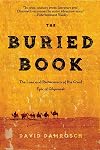
Interesting book that follow many paths leading to or from the ancient Epic of Gilgamesh: archaeology, Middle Eastern history/geography (both modern and ancient), literary history, linquistics (including the decipherment of an unknown language - Cuneiform), even Saddam Hussein's love story/political allegory (with a nod to Gilgamesh).
The author was ambitious in tackling so many different aspects of this ancient story and I thought it was a novel approach. Even though his execution was only mediocre, it held my interest.
I'll share a section that made me laugh. The author was explaining the role of scribes in making copies of everything from routine business transactions, to status reports for the king, to literary works. First the backdrop:
"Akkadian was being displaced by the language that would one day be Hormuzd Rassam's native tongue, Aramaic, written in an easy-to-learn phonetic alphabet, precursor of the Phoenician, Greek, and Roman alphabets, Despite its convenience, the scholarly specialists clung to the Akkadian language and its cuneiform script, in which their traditions had developed over the centuries; the common language was not for them. Scribal training was arduous, all the more so as students were made to learn both Akkadian and the even more obscure Sumerian, originally spoken by the inventors of cuneiform."
So far, a dry subject, but then he snuck this in...
"one student lamented, in Sumerian, in a Babylonian school text:
In between beatings, the teachers tried to instill a love of learning in their unhappy pupils. This was a struggle throughout the ancient Near East.
My favorites: "In between beatings, the teachers tried to instill a love of learning" (good luck with that) and "Your heart is denser than an obelisk" . Who knew the ancients were so funny? show less
The author was ambitious in tackling so many different aspects of this ancient story and I thought it was a novel approach. Even though his execution was only mediocre, it held my interest.
I'll share a section that made me laugh. The author was explaining the role of scribes in making copies of everything from routine business transactions, to status reports for the king, to literary works. First the backdrop:
"Akkadian was being displaced by the language that would one day be Hormuzd Rassam's native tongue, Aramaic, written in an easy-to-learn phonetic alphabet, precursor of the Phoenician, Greek, and Roman alphabets, Despite its convenience, the scholarly specialists clung to the Akkadian language and its cuneiform script, in which their traditions had developed over the centuries; the common language was not for them. Scribal training was arduous, all the more so as students were made to learn both Akkadian and the even more obscure Sumerian, originally spoken by the inventors of cuneiform."
So far, a dry subject, but then he snuck this in...
"one student lamented, in Sumerian, in a Babylonian school text:
The door monitor said, 'Why didshow more
you go out without my say-so?' and he beat me.
The water monitor said, 'Why did you help yourself to water without my say-so?' and he beat me.
The Sumerian monitor said, 'You spoke in Akkadian!' and he beat me.
My teacher said, 'Your handwriting is not at all good!' and he beat me.
In between beatings, the teachers tried to instill a love of learning in their unhappy pupils. This was a struggle throughout the ancient Near East.
'Your heart is denser than an obelisk,' one Egyptian instructor complained to his pupil. 'Though I beat you with every kind of stick, you do not listen.... Though I spend the day telling you 'Write,' it seems like a plague to you. Writing' -- the teacher sternly concluded -- 'is very pleasant!'"
My favorites: "In between beatings, the teachers tried to instill a love of learning" (good luck with that) and "Your heart is denser than an obelisk" . Who knew the ancients were so funny? show less

4+ stars for exceptional writing. I loved the book but, oddly, disliked the protagonist and most of the main characters. The book was originally (in 1830 France) sold as two volumes. The first volume has 30 chapters and the second has 45 chapters.
It took me a while to get the hang of Stendhal's style. Much time is spent inside the heads of the various characters. (In fact, I understand Stendhal is considered to be the creator of the psychological novel.) The style issue for me was that he jumped from one character's head to another's with little or no warning or transition. I would find myself befuddled when an inner dialogue that I was following with interest suddenly made no sense to me. Then I would realize that I was no longer inside the head I thought I was in. Once I learned to watch for these abrupt head trips I started to really enjoy this novel.
The main character is Julien Sorel, a peasant son of the owner of a small town's saw mill. Julien was abused by his father and brothers, intellectually gifted, socially unsophisticated, naive about relationships/love, vane, amoral, and incredibly ambitious. The rigid class structure of the time conspired against any chance of him fulfilling his ambitions. Normally I would feel compelled to cut someone like Julien some slack (after all, the deck was so stacked against him) but I couldn't muster much sympathy for him. Julien was vane and selfish. His conscience was rarely troubled by hurting others, or even by putting show more those that love him in danger. He embraced hypocrisy as a practical method of advancement in career and in relationships. Everything was only, and always, about Julien.
The other main characters were the two women in Julien's life, Madame de Rênal & Mathilde de la Mole. They were both willing to sacrifice everything for Julien. Joining these women in their emotional rollercoaster rides of "I love him/I loathe him" and "stay with me/leave me" was exhausting. Mathilde, especially, could run through the full gamut of emotions in a matter of minutes. I sympathized more with Madame de Rênal, who at least struggled with the ramifications of her choices (she was a married woman with children, he was studying for the priesthood). Mathilde garnered a little sympathy from me because of her tender age. But even if maturity might eventually draw down drama level a bit, it would probably reinforce her haughty sense of social superiority.
Subtexts of the novel were indictments of the post-Napoleon aristocratic society and a mostly corrupt church.
This is a meaty book that is much more than a coming of age story of a complicated protagonist. show less
It took me a while to get the hang of Stendhal's style. Much time is spent inside the heads of the various characters. (In fact, I understand Stendhal is considered to be the creator of the psychological novel.) The style issue for me was that he jumped from one character's head to another's with little or no warning or transition. I would find myself befuddled when an inner dialogue that I was following with interest suddenly made no sense to me. Then I would realize that I was no longer inside the head I thought I was in. Once I learned to watch for these abrupt head trips I started to really enjoy this novel.
The main character is Julien Sorel, a peasant son of the owner of a small town's saw mill. Julien was abused by his father and brothers, intellectually gifted, socially unsophisticated, naive about relationships/love, vane, amoral, and incredibly ambitious. The rigid class structure of the time conspired against any chance of him fulfilling his ambitions. Normally I would feel compelled to cut someone like Julien some slack (after all, the deck was so stacked against him) but I couldn't muster much sympathy for him. Julien was vane and selfish. His conscience was rarely troubled by hurting others, or even by putting show more those that love him in danger. He embraced hypocrisy as a practical method of advancement in career and in relationships. Everything was only, and always, about Julien.
The other main characters were the two women in Julien's life, Madame de Rênal & Mathilde de la Mole. They were both willing to sacrifice everything for Julien. Joining these women in their emotional rollercoaster rides of "I love him/I loathe him" and "stay with me/leave me" was exhausting. Mathilde, especially, could run through the full gamut of emotions in a matter of minutes. I sympathized more with Madame de Rênal, who at least struggled with the ramifications of her choices (she was a married woman with children, he was studying for the priesthood). Mathilde garnered a little sympathy from me because of her tender age. But even if maturity might eventually draw down drama level a bit, it would probably reinforce her haughty sense of social superiority.
Subtexts of the novel were indictments of the post-Napoleon aristocratic society and a mostly corrupt church.
This is a meaty book that is much more than a coming of age story of a complicated protagonist. show less

5 stars for the Holy Bible. 4 stars for the Kindle edition. WEB (World English Version) is a public domain version based on the American Standard Version. I'd prefer the New American Standard but the publisher was limited to public domain works and this is adequate for my portable version needs. Many (most?) of the Kindle Bibles are very difficult to navigate since you typically jump around, from verse to verse, rather than read from front to back. The OSNOVA Direct Verse Jump function makes navigating fairly easy. Kindle has it's own limitations: heavy note taking is cumbersome and no color coding is possible. Nothing compares to a print version for marking and margin notes but this publisher takes it as far as a Kindle version can go.