
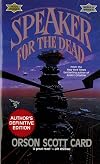
Orson Scott Card’s second book in the Ender’s Game series, Speaker for the Dead, starts off right where the first book began. Card maintains a similar writing style to that of Ender’s game, and this allows for a complete characterization of all the main characters. Instead of having just one sole narrator throughout the story, Card emphasizes the thoughts of all the main characters and implements them throughout the text of the book. While first picking up the book, it is difficult to notice this because of the smooth transitions between active dialog between characters and individual thoughts of just one character.
It is this reason that makes Speaker for the Dead difficult to stop reading. Because each character reveals such an elevated level of personal reflection, the reader really connects to the different characters. Speaker for the Dead, in comparison to Ender’s Game, dives even deeper into the realm of science fiction. The plotline of Speaker for the Dead begins on the colony of Lusitania, a small settlement on another world. It is here where the humans discover an alien race, which they refer to as the Piggies. These mammal-like creatures are fascinating because they are nowhere near the intellectual development of humans, yet they can still manage to communicate with the humans.
The book is about the struggle for the humans to interact with this alien species without interfering with their natural process of evolution. Several factors throughout the novel show more complicate this. For example, two of the people who are qualified to study the Piggies are brutally murdered by the alien species and the humans have no known cause as to why they were murdered. The book raises several important ethical questions that can be applied to talking with people of different cultures. One of the important qualities emphasizes throughout the novel is the importance of having strong relationships with the people around you.
Overall, Speaker for the Dead is a great read that will entertain even the most skeptical of audiences. It is extremely important to read Ender’s Game before picking up this novel, and the reader will undoubtedly want to read the next book in the series, Xenocide. show less
It is this reason that makes Speaker for the Dead difficult to stop reading. Because each character reveals such an elevated level of personal reflection, the reader really connects to the different characters. Speaker for the Dead, in comparison to Ender’s Game, dives even deeper into the realm of science fiction. The plotline of Speaker for the Dead begins on the colony of Lusitania, a small settlement on another world. It is here where the humans discover an alien race, which they refer to as the Piggies. These mammal-like creatures are fascinating because they are nowhere near the intellectual development of humans, yet they can still manage to communicate with the humans.
The book is about the struggle for the humans to interact with this alien species without interfering with their natural process of evolution. Several factors throughout the novel show more complicate this. For example, two of the people who are qualified to study the Piggies are brutally murdered by the alien species and the humans have no known cause as to why they were murdered. The book raises several important ethical questions that can be applied to talking with people of different cultures. One of the important qualities emphasizes throughout the novel is the importance of having strong relationships with the people around you.
Overall, Speaker for the Dead is a great read that will entertain even the most skeptical of audiences. It is extremely important to read Ender’s Game before picking up this novel, and the reader will undoubtedly want to read the next book in the series, Xenocide. show less
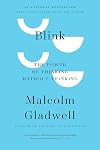
Malcolm Gladwell’s Blink offers a close-up analysis of the way we, as humans, make decisions. Gladwell researches and analyzes hundreds of different psychological studies in an attempt to better understand the methodology behind how people make decisions. The overall thesis of the book is that decisions are made in the first couple seconds of being presented with any situation.
As in the past, Gladwell successfully organizes his research in ways that are easy to follow by any audience. Gladwell continues his typical style of writing. Each chapter presents a new study demonstrating a different point involving his thesis. Instead of simply writing about the end-results of the experiment, he introduces each scientist as a person, making the reader feel more personally involved with the scenario.
Despite the author’s best interest to maintain a high level of attentiveness of the audience, at times it is easy to let your mind drift while reading Blink. This is ironic, because the book is a psychological analysis, but because the book is focused on such a narrow subject area, a few hundred pages it a lot of just one topic. Overall, it was an entertaining book to read little by little, however it would be extremely difficult to sit down and read 100 pages at a time.
To get used to Gladwell’s writing style, his book The Tipping Point covers a broader subject area and is overall more engaging than Blink. Even so, Blink provides an interesting outlook on a topic area that is show more commonly overlooked. show less
As in the past, Gladwell successfully organizes his research in ways that are easy to follow by any audience. Gladwell continues his typical style of writing. Each chapter presents a new study demonstrating a different point involving his thesis. Instead of simply writing about the end-results of the experiment, he introduces each scientist as a person, making the reader feel more personally involved with the scenario.
Despite the author’s best interest to maintain a high level of attentiveness of the audience, at times it is easy to let your mind drift while reading Blink. This is ironic, because the book is a psychological analysis, but because the book is focused on such a narrow subject area, a few hundred pages it a lot of just one topic. Overall, it was an entertaining book to read little by little, however it would be extremely difficult to sit down and read 100 pages at a time.
To get used to Gladwell’s writing style, his book The Tipping Point covers a broader subject area and is overall more engaging than Blink. Even so, Blink provides an interesting outlook on a topic area that is show more commonly overlooked. show less