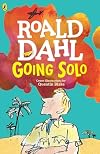
Going Solo Book Review
Roald Dahl’s Going Solo is a thrilling autobiography that is the sequel to Boy. This book transports us back into the era of World War II when Roald Dahl was a young adult and flying warplanes. He tells us about the many adventures he had whether they were funny, sad or happy. Some of the key adventures are his stay in Dar es Salaam, flying warplanes and using them to fight against the German troops and his plane crash in Libya. In each of these adventures there are at times unexpected twists and turns with a hint of humour to accompany them.
In this book Dahl uses many techniques to embellish and enhance his adventures. The techniques that I have identified are descriptive language, characterisation and suspense. To embellish the story he uses very descriptive language. Here are some examples from the book that show this. On page 4 Dahl wrote, “This time I sat up sharply. I wanted to get a better look of this leafless phantom of the sunrise...” and on page 11 he also wrote “I liked Miss Trefusis. She was impatient, intelligent, generous and interesting. I felt she would come to my rescue at any time, whereas Major Griffiths was vapid, vulgar, arrogant and unkind, the sort of man who’d leave you to the crocodiles.”
These lines are very descriptive and in mind I can clearly make out the scene he is portraying. He also uses characterisation very well. This is one of the many examples of his wonderful use of characterisation. On page 25 show more Roald Dahl wrote, “My boy was called Mdisho. He was a Mwanumwezi tribesman, which meant a lot out there because the Mwanumwezi was the only tribe who had ever defeated the gigantic Masai in battle. Mdisho was tall and graceful and soft-spoken, and his loyalty to me, his young white English master, was absolute. I hope, and I believe, that I was equally loyal to him.”
This sentence clearly conveys Mdisho’s personality and how he speaks in Roald Dahl’s point of view. Another technique he uses is suspense. An excellent example to show this is the Simba incident. The incident starts on page 35 with Mdisho (Roald’s humble servant) shouting out “Simba, bwana! Simba! Simba!” (A Simba is lion in their language) because he spots a lion. He then says that the lion has taken the cook’s wife which causes even more chaos and suspense as we aren’t sure if the lion has killed the cook’s wife. Then Roald Dahl increases the suspense by wasting time by adding unneeded details. Finally, 2 pages later, Roald Dahl reveals that the cook’s wife is fine and was playing dead. I believe that this scene is very suspenseful which makes the book even more interesting.
In this book I have many favourite moments but my favourite part would have to be when the lion takes the cook’s wife. Everybody thinks the wife is badly injured or dead but infact she turned out to be well and truly fine as she was playing dead in front of the lion. This is my favourite part as that part is humorous, is suspenseful from the beginning of the scene and also as the outcome is very unexpected. As this was very early in the book it gave me a rough idea of how the rest of the book may be like. I thought it may be humorous, suspenseful and very unexpected.
Overall I would rate this book 4 ½ stars out of 5 because it has many strengths that contribute to this wonderful story. These strengths are its descriptive language, characterisation and suspense and very good story line. I would recommend this book to 10 to 14 year old boys and girls as the level of vocabulary suits them. This is also a book for children seeking thrilling adventures, a laugh and some fun as this book is package that includes all 3 things. show less
Roald Dahl’s Going Solo is a thrilling autobiography that is the sequel to Boy. This book transports us back into the era of World War II when Roald Dahl was a young adult and flying warplanes. He tells us about the many adventures he had whether they were funny, sad or happy. Some of the key adventures are his stay in Dar es Salaam, flying warplanes and using them to fight against the German troops and his plane crash in Libya. In each of these adventures there are at times unexpected twists and turns with a hint of humour to accompany them.
In this book Dahl uses many techniques to embellish and enhance his adventures. The techniques that I have identified are descriptive language, characterisation and suspense. To embellish the story he uses very descriptive language. Here are some examples from the book that show this. On page 4 Dahl wrote, “This time I sat up sharply. I wanted to get a better look of this leafless phantom of the sunrise...” and on page 11 he also wrote “I liked Miss Trefusis. She was impatient, intelligent, generous and interesting. I felt she would come to my rescue at any time, whereas Major Griffiths was vapid, vulgar, arrogant and unkind, the sort of man who’d leave you to the crocodiles.”
These lines are very descriptive and in mind I can clearly make out the scene he is portraying. He also uses characterisation very well. This is one of the many examples of his wonderful use of characterisation. On page 25 show more Roald Dahl wrote, “My boy was called Mdisho. He was a Mwanumwezi tribesman, which meant a lot out there because the Mwanumwezi was the only tribe who had ever defeated the gigantic Masai in battle. Mdisho was tall and graceful and soft-spoken, and his loyalty to me, his young white English master, was absolute. I hope, and I believe, that I was equally loyal to him.”
This sentence clearly conveys Mdisho’s personality and how he speaks in Roald Dahl’s point of view. Another technique he uses is suspense. An excellent example to show this is the Simba incident. The incident starts on page 35 with Mdisho (Roald’s humble servant) shouting out “Simba, bwana! Simba! Simba!” (A Simba is lion in their language) because he spots a lion. He then says that the lion has taken the cook’s wife which causes even more chaos and suspense as we aren’t sure if the lion has killed the cook’s wife. Then Roald Dahl increases the suspense by wasting time by adding unneeded details. Finally, 2 pages later, Roald Dahl reveals that the cook’s wife is fine and was playing dead. I believe that this scene is very suspenseful which makes the book even more interesting.
In this book I have many favourite moments but my favourite part would have to be when the lion takes the cook’s wife. Everybody thinks the wife is badly injured or dead but infact she turned out to be well and truly fine as she was playing dead in front of the lion. This is my favourite part as that part is humorous, is suspenseful from the beginning of the scene and also as the outcome is very unexpected. As this was very early in the book it gave me a rough idea of how the rest of the book may be like. I thought it may be humorous, suspenseful and very unexpected.
Overall I would rate this book 4 ½ stars out of 5 because it has many strengths that contribute to this wonderful story. These strengths are its descriptive language, characterisation and suspense and very good story line. I would recommend this book to 10 to 14 year old boys and girls as the level of vocabulary suits them. This is also a book for children seeking thrilling adventures, a laugh and some fun as this book is package that includes all 3 things. show less