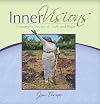
Reviewing a book built around photographs calls upon a slightly different skillset than does a text-only work. The difference, I believe is mainly a matter of pace. As I take up Jan Thrope’s book, Inner Visions: Grassroots Stories of Truth and Hope, I remind myself to linger on each photo and allow it to impact me fully. As a result, I find myself doing something I don’t do with other books: gazing at the cover for a good long while. In the photo Thrope has chosen for her cover, an African-American woman poses on a plot of land that appears to be in the process of being converted from a vacant lot to a neighborhood garden. Her white blouse is touched here and there by the soil she’s been working. In one arm, she holds two shovels. It occurs to me that perhaps the second shovel is for me – an invitation to take part in her struggle. Her free arm is flung upward, and her smiling face is turned heavenward. I imagine her praising God and seeking His blessing and assistance in her endeavor. As I slowly open the book, it is with the dual sense that in doing so, I am accepting the shovel - joining in on a worthy undertaking – and that this process will be to some extent a spiritual one.
I find that the Dedication, Foreword, and Introduction – pages I’m usually prone to breeze through – are, in this book, laden with meaning. Thrope uses this space to invoke a certain openness in her readers. She thanks us in advance for being willing “to see through others show more eyes.” It is clear to me from this very early point in the book that I am dealing with an author who recognizes the power of words to shape the reader’s experience. A wise guide, she is helping me to assume the proper attitude toward her work. In the same breath, she expresses appreciation for the people who are the subject of the book. She thanks them for “Their willingness to expose darkness to light so positive images can be developed.” This apt metaphor holds a warning – that her readers will encounter darkness – yet these words also reveal the process that will prove to be the book’s saving grace: the remarkable ability of this author to produce positive and inspiring messages out of that darkness.
Repeated images of butterflies in the opening pages of the book make me think of the ‘butterfly effect’ – how a simple, seemingly insignificant phenomenon (like the beating of a butterfly’s wing) can create a chain of cause-and-effect with ultimately momentous results. It strikes me as an instance of this principle in action that Thrope has captured many discrete, fleeting moments, each of which, taken alone, might seem practically meaningless, but which when gathered together with her admirable craft coalesce into a coherent portrait of poverty in action and of valiant efforts to overcome its many challenges – a portrait which possesses the power to inspire and motivate change – to have a real, positive impact on the world. Thrope writes of “the educational, employment, housing, health, nutrition, and legal” aspects of poverty. Clearly, she has developed an in-depth understanding. It is her gift to be able to make readily accessible to her readers this complex comprehension of her subject, and through the quality of her photographs to make it personal and human.
“Do You See What I See?” the author asks, as my eyes rest on a photograph of a homeless man begging for money. Do I see what Thrope sees? I ask myself, and I fear that the answer is “probably not.” But fortunately her arresting photographs are supported by words both poignant and informative. The text accompanying the photograph tells the story of a man whose pressing need is for clean clothing so that he can apply for a job. Where I might at first have seen bleak despair, Thrope has seen the hope of employment. With a little help, the man she writes of might change his situation for the better. Again and again in the course of this book, Thrope is able to give her readers such crucial understanding, to show us how with just a little help, lives can be profoundly altered.
Inner Visions approaches the problems poverty brings from many angles. Thrope takes her readers with her into a windowless inner city school where she tutors a 7-year-old boy named Rashawn, then proceeds to give us a harsh look at the neighborhood he calls home. As we take in this dark imagery, she calls upon us to remember the words of Ghandi: “You must make injustices visible.” In her own words, the author says she wants “to better understand how these images impact the foundational beliefs of a child in poverty.” She comes to understand the external world surrounding Rashawn as a mirror in which he sees himself reflected and which has a great impact on his beliefs about himself and the world.
Having given us a glimpse of the problem, Thrope moves on to focus on solutions. Investigating what resources are in place to help disadvantaged kids like Rashawn leads her to advocates and activists. We meet Ramone Foster, who mentors young students, attend a meeting of Mothers United Against Youth Violence, and feel the impact of the work of artist Donald Black Jr., who transforms dilapidated houses by covering them with motivational words. Her discussion of this admirable project broadens into public art in general, and she illustrates how artwork has the power to transform public spaces, creating a more inspiring atmosphere. Here, Thrope really hits her stride with the topic of public gardens. We see a vacant lot becoming an orchard and visit a chicken farm tucked between two storefronts.
The pattern the author establishes in the first half of the book is repeated several times in the second half. Again she shows us complex problems caused by poverty, again her photography and reportage effectively brings these problems to a personal level for us, and again she moves her focus to solutions in action. We are shown the multifaceted day-to-day struggles of several single mothers. We marvel at the perseverance of these impoverished women in the face of seemingly insurmountable hardship and celebrate their successes as Thrope shows us how with a little help – a transitional housing program, help getting a GED and vocational training or even a college degree – lives can be saved.
All proceeds from Inner Visions go to fund projects to improve life for residents of Cleveland. I haven’t even mentioned that this is a book about Cleveland! That’s probably because Thrope achieves an engagement with the issues arising from poverty which transcends locality. And she takes us places we would likely not otherwise go. We find ourselves behind the scenes in a homeless shelter. We talk to long-term victims of homelessness and learn how they scrape by. We visit food banks and learn dreadful statistics like that almost half of the people who use Cleveland’s hunger centers “have had to choose between paying a utility bill and paying for groceries.” For those of us who have a little left over at the end of the month, buying a copy of Inner Visions for twenty bucks from Amazon or Orange Frazer Press is a real value. Informative and moving, brave, insightful, and inspiring, this book is positive change in action. No wonder it won first place in non-fiction in the 2012 Next Generation Indie Book Awards!
Thrope is thorough. So much so that unlike most books in which photography is a large component, Inner Visions is not a flip-through kind of book. Rather, it is an exhaustive treatment of her topic. Each section is rich in facts and in personal detail. Visiting the health issues which go hand-in-hand with poverty, the author notes that obesity is caused in part by fast food being more accessible in some impoverished areas than healthier foods. She touches on high blood pressure, which can be caused by the stress of living on the financial edge and in unsafe conditions. She also discusses lead poisoning, which is more common in older, inner-city neighborhoods. We can rely upon Thrope, though, to develop the negatives into positives. She segues from run-down housing to reclamation and a project which carefully de-constructs abandoned houses, using the salvaged materials “to create up-scale flooring, tables, lamps, counter tops, bets, wine racks, etc.” – which is termed ‘up-cycling’.
The book’s final chapter – “Believing is Seeing” – continues to explore the ways in which creativity and positive thinking can lead to beneficial change. “The future is up to you,” one small business owner tells teens in her neighborhood. “If you want it to look different, you need to visualize a different picture and create it.” As a result, the teens paint a beautiful mural representing their neighborhood as “open to all and connected by a spiritual presence.” Thrope returns to the topic of successful public gardens and community kitchens, then forges on to the ambitious project of a woman named Barbara Anderson, who is working toward converting a vacant factory into a community center.
As Inner Visions draws to a close, Thrope devotes several pages to a program called Teen Enterprise, which is teaching teens business skills and even starting its graduates off with seed money to pursue business ventures. The book concludes with a profile of a very accomplished reformer named Yvonne Pointer – relating the personal hardships which led to her resolution to fight for change, and the impressive work she has since done to combat violence and strengthen community, including a program called Positive Plus, which helps women to improve themselves and their communities. The title of this final section is “No One is Too Small to Make a Big Difference” – a point which Pointer elucidates humbly and well, saying, “God is comical… He chooses people like me, because I’m not the sharpest knife in the drawer, to prove that what I do, anybody can do.” At the end of this stirring work, we are left feeling empowered to bring about change and instilled with a sense of great possibility. Thrope has taken us to dark places, but leaves us in the light.
Eugene Uttley 3/26/2013 show less
I find that the Dedication, Foreword, and Introduction – pages I’m usually prone to breeze through – are, in this book, laden with meaning. Thrope uses this space to invoke a certain openness in her readers. She thanks us in advance for being willing “to see through others show more eyes.” It is clear to me from this very early point in the book that I am dealing with an author who recognizes the power of words to shape the reader’s experience. A wise guide, she is helping me to assume the proper attitude toward her work. In the same breath, she expresses appreciation for the people who are the subject of the book. She thanks them for “Their willingness to expose darkness to light so positive images can be developed.” This apt metaphor holds a warning – that her readers will encounter darkness – yet these words also reveal the process that will prove to be the book’s saving grace: the remarkable ability of this author to produce positive and inspiring messages out of that darkness.
Repeated images of butterflies in the opening pages of the book make me think of the ‘butterfly effect’ – how a simple, seemingly insignificant phenomenon (like the beating of a butterfly’s wing) can create a chain of cause-and-effect with ultimately momentous results. It strikes me as an instance of this principle in action that Thrope has captured many discrete, fleeting moments, each of which, taken alone, might seem practically meaningless, but which when gathered together with her admirable craft coalesce into a coherent portrait of poverty in action and of valiant efforts to overcome its many challenges – a portrait which possesses the power to inspire and motivate change – to have a real, positive impact on the world. Thrope writes of “the educational, employment, housing, health, nutrition, and legal” aspects of poverty. Clearly, she has developed an in-depth understanding. It is her gift to be able to make readily accessible to her readers this complex comprehension of her subject, and through the quality of her photographs to make it personal and human.
“Do You See What I See?” the author asks, as my eyes rest on a photograph of a homeless man begging for money. Do I see what Thrope sees? I ask myself, and I fear that the answer is “probably not.” But fortunately her arresting photographs are supported by words both poignant and informative. The text accompanying the photograph tells the story of a man whose pressing need is for clean clothing so that he can apply for a job. Where I might at first have seen bleak despair, Thrope has seen the hope of employment. With a little help, the man she writes of might change his situation for the better. Again and again in the course of this book, Thrope is able to give her readers such crucial understanding, to show us how with just a little help, lives can be profoundly altered.
Inner Visions approaches the problems poverty brings from many angles. Thrope takes her readers with her into a windowless inner city school where she tutors a 7-year-old boy named Rashawn, then proceeds to give us a harsh look at the neighborhood he calls home. As we take in this dark imagery, she calls upon us to remember the words of Ghandi: “You must make injustices visible.” In her own words, the author says she wants “to better understand how these images impact the foundational beliefs of a child in poverty.” She comes to understand the external world surrounding Rashawn as a mirror in which he sees himself reflected and which has a great impact on his beliefs about himself and the world.
Having given us a glimpse of the problem, Thrope moves on to focus on solutions. Investigating what resources are in place to help disadvantaged kids like Rashawn leads her to advocates and activists. We meet Ramone Foster, who mentors young students, attend a meeting of Mothers United Against Youth Violence, and feel the impact of the work of artist Donald Black Jr., who transforms dilapidated houses by covering them with motivational words. Her discussion of this admirable project broadens into public art in general, and she illustrates how artwork has the power to transform public spaces, creating a more inspiring atmosphere. Here, Thrope really hits her stride with the topic of public gardens. We see a vacant lot becoming an orchard and visit a chicken farm tucked between two storefronts.
The pattern the author establishes in the first half of the book is repeated several times in the second half. Again she shows us complex problems caused by poverty, again her photography and reportage effectively brings these problems to a personal level for us, and again she moves her focus to solutions in action. We are shown the multifaceted day-to-day struggles of several single mothers. We marvel at the perseverance of these impoverished women in the face of seemingly insurmountable hardship and celebrate their successes as Thrope shows us how with a little help – a transitional housing program, help getting a GED and vocational training or even a college degree – lives can be saved.
All proceeds from Inner Visions go to fund projects to improve life for residents of Cleveland. I haven’t even mentioned that this is a book about Cleveland! That’s probably because Thrope achieves an engagement with the issues arising from poverty which transcends locality. And she takes us places we would likely not otherwise go. We find ourselves behind the scenes in a homeless shelter. We talk to long-term victims of homelessness and learn how they scrape by. We visit food banks and learn dreadful statistics like that almost half of the people who use Cleveland’s hunger centers “have had to choose between paying a utility bill and paying for groceries.” For those of us who have a little left over at the end of the month, buying a copy of Inner Visions for twenty bucks from Amazon or Orange Frazer Press is a real value. Informative and moving, brave, insightful, and inspiring, this book is positive change in action. No wonder it won first place in non-fiction in the 2012 Next Generation Indie Book Awards!
Thrope is thorough. So much so that unlike most books in which photography is a large component, Inner Visions is not a flip-through kind of book. Rather, it is an exhaustive treatment of her topic. Each section is rich in facts and in personal detail. Visiting the health issues which go hand-in-hand with poverty, the author notes that obesity is caused in part by fast food being more accessible in some impoverished areas than healthier foods. She touches on high blood pressure, which can be caused by the stress of living on the financial edge and in unsafe conditions. She also discusses lead poisoning, which is more common in older, inner-city neighborhoods. We can rely upon Thrope, though, to develop the negatives into positives. She segues from run-down housing to reclamation and a project which carefully de-constructs abandoned houses, using the salvaged materials “to create up-scale flooring, tables, lamps, counter tops, bets, wine racks, etc.” – which is termed ‘up-cycling’.
The book’s final chapter – “Believing is Seeing” – continues to explore the ways in which creativity and positive thinking can lead to beneficial change. “The future is up to you,” one small business owner tells teens in her neighborhood. “If you want it to look different, you need to visualize a different picture and create it.” As a result, the teens paint a beautiful mural representing their neighborhood as “open to all and connected by a spiritual presence.” Thrope returns to the topic of successful public gardens and community kitchens, then forges on to the ambitious project of a woman named Barbara Anderson, who is working toward converting a vacant factory into a community center.
As Inner Visions draws to a close, Thrope devotes several pages to a program called Teen Enterprise, which is teaching teens business skills and even starting its graduates off with seed money to pursue business ventures. The book concludes with a profile of a very accomplished reformer named Yvonne Pointer – relating the personal hardships which led to her resolution to fight for change, and the impressive work she has since done to combat violence and strengthen community, including a program called Positive Plus, which helps women to improve themselves and their communities. The title of this final section is “No One is Too Small to Make a Big Difference” – a point which Pointer elucidates humbly and well, saying, “God is comical… He chooses people like me, because I’m not the sharpest knife in the drawer, to prove that what I do, anybody can do.” At the end of this stirring work, we are left feeling empowered to bring about change and instilled with a sense of great possibility. Thrope has taken us to dark places, but leaves us in the light.
Eugene Uttley 3/26/2013 show less
In elaborating his title metaphor, drawn from Celtic Christian origins, Batterson is quick to point out the subtle yet crucial difference between a Wild Goose chase (a pointless endeavor) and the act of chasing the Wild Goose, by which he means seeking to know the Holy Spirit. Chasing the Goose, he says, allows God to work His plan for you, and is an adventuresome undertaking that can take you to new and rewarding places. He warns the reader that the adventure may be “unnerving or disorienting” – a warning which proves apt when he goes on to challenge institutionalized Christianity in a few ways, including what he calls inverted Christianity, in which the misguided wish for God to serve their purposes, instead of the other way around. He also holds a dim view of cut and paste Christianity, the practice of taking some parts of scripture and leaving others. But taking it all in is arguably, as warned, disorienting. And in the stories he tells about remarkable characters, both biblical figures and modern day people, who have taken great risks in the service of good, there too are unnerving moments - leaps of faith with potentially disastrous consequences.
Before recounting the extraordinary life choices of the individuals who are the meat of this book, Batterson takes us briefly to the Gallapagos islands, a locale he likens to Eden, where the abundance and variety of wild animals causes him to speculate about how challenging it must have been for Adam to follow God's show more command that he name them. Visiting a zoo after this trip, he is struck by the difference between the animals he saw in the wild and the caged animals on display. Gingerly, he brings this observation to his thinking on Christianity, proposing that maybe the church has a way of turning us into caged birds, removing the danger and challenge from our lives. To some extent, Batterson welcomes danger, even to be dangerous (to the Enemy). And the modern-day heroes he shows us do put themselves in harm's way in pursuit of ending injustice and human suffering. These are not caged birds, but wild goose-chasers!
Batterson identifies six types of cages to be avoided: responsibility, routine, assumptions, guilt, failure, and fear. He speaks out strongly against complacency in general, and he goes on to give some counsel on how to fight it. He wants us not to grow bored by allowing our daily responsibilities to supercede our obligation to follow the passion that God has given us. He states that he hopes reading his book will not be a casual experience, but will inspire us to action, to take chances, maybe even change our lives. This is an inspiring book. Yet if we all took the author's advice and followed God-ordained passions rather than pursuing a humble, responsible, routine career, I have to wonder who would keep the homefires burning, so to speak: do the simple if sometimes boring work that needs to be done. As in so many areas of life, it behooves one to seek balance. And if Batterson seems sometimes to be overbalanced on the side of adventure, perhaps he is just compensating for a day and age in which most of us are leaning fairly heavily the other way.
Within his framework of six cages, Batterson displays people whose lives stand as examples of overcoming the confining forces he warns against. The first of these practices responsible irresponsibility. The author is quite fond of such seemingly paradoxical language. He also talks about successful failures. And in addressing the second cage, routine, he says that the Holy Spirit both comforts the afflicted and afflicts the comfortable. Growing accustomed to such turns of phrase, we are not surprised when, addressing his third cage, assumptions, he points out the dual nature of God, being at once Most High and Most Nigh. Personally, I find Batterson's penchant for conflating what might be considered mutually exclusive concepts to be stimulating. Meanwhile, his many stories of heroic people flesh out the narrative and keep it moving along.
A skillful writer and motivator, Batterson keeps us a little off balance. Some of his admonitions are just what we expect from a pastor, and some are not. He reminds us not to point the finger of blame or judgment at our neighbors. He tells us that we are surrounded by miracles. These are pretty standard-issue assertions. But then he uses modern and sometimes scientific terms and metaphors, and throws in a dash of self-deprecating humor, mentioning, for example, picking up his dog's poop. Through it all, his crux exhortation to chase the Wild Goose rings clearly. He says that there is a time to pray, and then there is a time to stop praying and take action. Christianity, he says, is not a noun, but a verb. And an action verb at that. He tells us not to wait for a sign from God before acting, but to act first. God, he says, will sanctify our expectations. Simultaneously, yet somehow without seeming to contradict himself, he advises against rushing things. “Hurry,” he writes, “kills everything from compassion to creativity.” Don't wait around too long but don't make too much haste. Pace is important to Batterson, and in the cadence of his writing and his variations of voice, as well as the gist of his advice, there is a certain... syncopation.
Act spontaneously! Pray imaginitvely! Wade in! Throw down your staff! Everywhere in this book, Batterson challenges us to take chances and to challenge ourselves. Peppered throughout the text and arranged neatly at sections' ends are lists of questions for the reader, which I found a welcome aid in cementing concepts in mind and bringing Batterson's arguments home to my own circumstances and life. I could imagine responding to these questions in a small group environment, and indeed I think this book is designed to lend itself well to a study group or book club.
Three cages remain: guilt, failure, and fear. In offering means of escaping the fetters these emotions bind us with, Batterson writes of learning better to forgive oneself, of recognizing the transforming power present when things don't go our way or according to our plans, and of directing our natural trepidation into proper, productive channels such as fearing missed opportunities instead of fearing failure. As he continues to illustrate his points with examples of human heroism, we come to the unlikely story of a man named Mike Foster passing out bibles at a pornography convention in Las Vegas. The daring of the man! Batterson goes on to discuss the difference between dumb courage and smart courage, and I am impressed by a sense as the book draws to a close that this author has displayed a daring of his own, has taken some calculated risks with his prose and maybe even flown by the seat of his pants a little. The Wild Goose, he writes, is eternally elusive. It will not let us down. In the same spirit, I will say that with this brave, intelligent book, Batterson does not let his readers down.
Eugene Uttley 12/26/2012 show less
Before recounting the extraordinary life choices of the individuals who are the meat of this book, Batterson takes us briefly to the Gallapagos islands, a locale he likens to Eden, where the abundance and variety of wild animals causes him to speculate about how challenging it must have been for Adam to follow God's show more command that he name them. Visiting a zoo after this trip, he is struck by the difference between the animals he saw in the wild and the caged animals on display. Gingerly, he brings this observation to his thinking on Christianity, proposing that maybe the church has a way of turning us into caged birds, removing the danger and challenge from our lives. To some extent, Batterson welcomes danger, even to be dangerous (to the Enemy). And the modern-day heroes he shows us do put themselves in harm's way in pursuit of ending injustice and human suffering. These are not caged birds, but wild goose-chasers!
Batterson identifies six types of cages to be avoided: responsibility, routine, assumptions, guilt, failure, and fear. He speaks out strongly against complacency in general, and he goes on to give some counsel on how to fight it. He wants us not to grow bored by allowing our daily responsibilities to supercede our obligation to follow the passion that God has given us. He states that he hopes reading his book will not be a casual experience, but will inspire us to action, to take chances, maybe even change our lives. This is an inspiring book. Yet if we all took the author's advice and followed God-ordained passions rather than pursuing a humble, responsible, routine career, I have to wonder who would keep the homefires burning, so to speak: do the simple if sometimes boring work that needs to be done. As in so many areas of life, it behooves one to seek balance. And if Batterson seems sometimes to be overbalanced on the side of adventure, perhaps he is just compensating for a day and age in which most of us are leaning fairly heavily the other way.
Within his framework of six cages, Batterson displays people whose lives stand as examples of overcoming the confining forces he warns against. The first of these practices responsible irresponsibility. The author is quite fond of such seemingly paradoxical language. He also talks about successful failures. And in addressing the second cage, routine, he says that the Holy Spirit both comforts the afflicted and afflicts the comfortable. Growing accustomed to such turns of phrase, we are not surprised when, addressing his third cage, assumptions, he points out the dual nature of God, being at once Most High and Most Nigh. Personally, I find Batterson's penchant for conflating what might be considered mutually exclusive concepts to be stimulating. Meanwhile, his many stories of heroic people flesh out the narrative and keep it moving along.
A skillful writer and motivator, Batterson keeps us a little off balance. Some of his admonitions are just what we expect from a pastor, and some are not. He reminds us not to point the finger of blame or judgment at our neighbors. He tells us that we are surrounded by miracles. These are pretty standard-issue assertions. But then he uses modern and sometimes scientific terms and metaphors, and throws in a dash of self-deprecating humor, mentioning, for example, picking up his dog's poop. Through it all, his crux exhortation to chase the Wild Goose rings clearly. He says that there is a time to pray, and then there is a time to stop praying and take action. Christianity, he says, is not a noun, but a verb. And an action verb at that. He tells us not to wait for a sign from God before acting, but to act first. God, he says, will sanctify our expectations. Simultaneously, yet somehow without seeming to contradict himself, he advises against rushing things. “Hurry,” he writes, “kills everything from compassion to creativity.” Don't wait around too long but don't make too much haste. Pace is important to Batterson, and in the cadence of his writing and his variations of voice, as well as the gist of his advice, there is a certain... syncopation.
Act spontaneously! Pray imaginitvely! Wade in! Throw down your staff! Everywhere in this book, Batterson challenges us to take chances and to challenge ourselves. Peppered throughout the text and arranged neatly at sections' ends are lists of questions for the reader, which I found a welcome aid in cementing concepts in mind and bringing Batterson's arguments home to my own circumstances and life. I could imagine responding to these questions in a small group environment, and indeed I think this book is designed to lend itself well to a study group or book club.
Three cages remain: guilt, failure, and fear. In offering means of escaping the fetters these emotions bind us with, Batterson writes of learning better to forgive oneself, of recognizing the transforming power present when things don't go our way or according to our plans, and of directing our natural trepidation into proper, productive channels such as fearing missed opportunities instead of fearing failure. As he continues to illustrate his points with examples of human heroism, we come to the unlikely story of a man named Mike Foster passing out bibles at a pornography convention in Las Vegas. The daring of the man! Batterson goes on to discuss the difference between dumb courage and smart courage, and I am impressed by a sense as the book draws to a close that this author has displayed a daring of his own, has taken some calculated risks with his prose and maybe even flown by the seat of his pants a little. The Wild Goose, he writes, is eternally elusive. It will not let us down. In the same spirit, I will say that with this brave, intelligent book, Batterson does not let his readers down.
Eugene Uttley 12/26/2012 show less
Hi - Eugene Uttley here.
Five years ago, while teaching English as a Second Language in Korea, I developed late onset schizophrenia. The first signs of schizophrenia usually manifest in one's teenage years or early twenties. My case, occurring when I was in my thirties, is something of a rarity. Another unusual aspect of my case is that I went a whole year in acute psychosis without help or treatment. And a very long, wild year it was...
I have written two books about my experiences with schizophrenia. The first book is entitled Over the Transom: A True Tale of Late Onset Schizophrenia. It includes many stories from my life and especially deals with the year during which I traveled abroad and in the USA during my psychotic break. It is currently under consideration for publication by two small presses. As such, it is not yet available on Amazon.com. I have been offering the manuscript as a .doc file to any interested parties, and will continue to do so until it is published. Just send me an email at mruttleysz at gmail dot com if you would like a copy. The second book, The Boon: Thoughts of a Schizophrenic in Remission, is available now through the CreateSpace Estore and on Amazon.com as a paperback or (cheaper) for Kindle. It also includes experiences from my life and from my psychosis, but does not linger on ground covered in the first memoir. Instead, this second book focuses primarily on my recovery and my thinking now about understanding and languaging the disorder and show more how to go about the process of healing oneself. I've already sold a few copies, and really hope to continue to reach more readers.
Recently, hoping to find out how accessible information about my book(s) is to casual users of search engines, I 'googled' my name - Eugene Uttley. Although to my dismay I was not shown my CreateSpace or Amazon.com pages, I did have one wonderful surprise. In a forum dedicated to the computer game series Starcraft (of all places), I found a delightful posting about Over the Transom, which I would like to share with you here:
"While researching some more info on schizophrenia, I came across this memoir written by an author chronicling his battle with and recovery from schizophrenia. I figure, opportunities to learn about this rather mysterious mental illness this in-depth come few and far between, so any of our members interested in psychology might find this an interesting read... I was surprised to learn some new strategies for coping, that certain thoughts I have are actually common among schizophrenia, and that my strategies I already have for dealing with the disease are actually quite effective... If you are coping with the disease like myself, or know somebody who is, or are just interested in abnormal psychology, you'll find this an interesting read."
The person who wrote this post went on to provide a link to the memoir as a google .doc, which I had provided elsewhere. Responding to some replies to the initial post, he/she went on to say this:
"It's given me comfort and made me feel happy for a change... and for that I am grateful. Indeed, my psychotic symptoms have all vanished since. Not sure what to make of that... I strongly recommend anyone interested in mental illness and human psychology read this book... it truly helped me come to terms with my own mental state, and I'm sure those unafflicted by mental illness could learn something about a new, unusual perspective on life from it."
Obviously, this testimonial is my dream come true! I am thrilled to know that my work was meaningful (and apparently even therapeutic) to a fellow-sufferer. I have had other positive feedback on the manuscript in a forum for mental illness support. One person wrote, "I read this memoir and it was touching and well portrayed. Anyone who feels alone should read this. Anyone who needs to see that there is indeed hope should give this book a try." Reading reactions like this to my work is greatly gratifying and makes me feel like I am making a difference - one reader at a time.
I realize that it's a bit odd to post reader reactions to one book (Over the Transom) as a review for another (The Boon), but I feel that it is appropriate in that the two books are to some extent companion works. Again, while Over the Transom deals largely with my life experiences and the details of my psychotic break, The Boon expands on this material and explores my thinking on the disorder now that I have been stable for a number of years. The Boon is chock full of quotations and excerpts from poetry, prose, and song by some of my favorite thinkers and artists, and also contains and discusses material that I wrote (creatively) in the years building up to my onset.
So thank you for considering The Boon, and please let me know by email if you'd like to read Over the Transom for free!
Cheers,
Uttley
ps. use this promo code -- PS24ZV8E -- for a dollar off if you order from the CreateSpace Estore show less
Five years ago, while teaching English as a Second Language in Korea, I developed late onset schizophrenia. The first signs of schizophrenia usually manifest in one's teenage years or early twenties. My case, occurring when I was in my thirties, is something of a rarity. Another unusual aspect of my case is that I went a whole year in acute psychosis without help or treatment. And a very long, wild year it was...
I have written two books about my experiences with schizophrenia. The first book is entitled Over the Transom: A True Tale of Late Onset Schizophrenia. It includes many stories from my life and especially deals with the year during which I traveled abroad and in the USA during my psychotic break. It is currently under consideration for publication by two small presses. As such, it is not yet available on Amazon.com. I have been offering the manuscript as a .doc file to any interested parties, and will continue to do so until it is published. Just send me an email at mruttleysz at gmail dot com if you would like a copy. The second book, The Boon: Thoughts of a Schizophrenic in Remission, is available now through the CreateSpace Estore and on Amazon.com as a paperback or (cheaper) for Kindle. It also includes experiences from my life and from my psychosis, but does not linger on ground covered in the first memoir. Instead, this second book focuses primarily on my recovery and my thinking now about understanding and languaging the disorder and show more how to go about the process of healing oneself. I've already sold a few copies, and really hope to continue to reach more readers.
Recently, hoping to find out how accessible information about my book(s) is to casual users of search engines, I 'googled' my name - Eugene Uttley. Although to my dismay I was not shown my CreateSpace or Amazon.com pages, I did have one wonderful surprise. In a forum dedicated to the computer game series Starcraft (of all places), I found a delightful posting about Over the Transom, which I would like to share with you here:
"While researching some more info on schizophrenia, I came across this memoir written by an author chronicling his battle with and recovery from schizophrenia. I figure, opportunities to learn about this rather mysterious mental illness this in-depth come few and far between, so any of our members interested in psychology might find this an interesting read... I was surprised to learn some new strategies for coping, that certain thoughts I have are actually common among schizophrenia, and that my strategies I already have for dealing with the disease are actually quite effective... If you are coping with the disease like myself, or know somebody who is, or are just interested in abnormal psychology, you'll find this an interesting read."
The person who wrote this post went on to provide a link to the memoir as a google .doc, which I had provided elsewhere. Responding to some replies to the initial post, he/she went on to say this:
"It's given me comfort and made me feel happy for a change... and for that I am grateful. Indeed, my psychotic symptoms have all vanished since. Not sure what to make of that... I strongly recommend anyone interested in mental illness and human psychology read this book... it truly helped me come to terms with my own mental state, and I'm sure those unafflicted by mental illness could learn something about a new, unusual perspective on life from it."
Obviously, this testimonial is my dream come true! I am thrilled to know that my work was meaningful (and apparently even therapeutic) to a fellow-sufferer. I have had other positive feedback on the manuscript in a forum for mental illness support. One person wrote, "I read this memoir and it was touching and well portrayed. Anyone who feels alone should read this. Anyone who needs to see that there is indeed hope should give this book a try." Reading reactions like this to my work is greatly gratifying and makes me feel like I am making a difference - one reader at a time.
I realize that it's a bit odd to post reader reactions to one book (Over the Transom) as a review for another (The Boon), but I feel that it is appropriate in that the two books are to some extent companion works. Again, while Over the Transom deals largely with my life experiences and the details of my psychotic break, The Boon expands on this material and explores my thinking on the disorder now that I have been stable for a number of years. The Boon is chock full of quotations and excerpts from poetry, prose, and song by some of my favorite thinkers and artists, and also contains and discusses material that I wrote (creatively) in the years building up to my onset.
So thank you for considering The Boon, and please let me know by email if you'd like to read Over the Transom for free!
Cheers,
Uttley
ps. use this promo code -- PS24ZV8E -- for a dollar off if you order from the CreateSpace Estore show less