A quickly amusing dark tale by Fearsome Uncle Warren, Dead Pig Collector is tightly written and even whimsical. Ellis manages to fit exactly the right amount of detail in these 29 pages.
I bought this book as part of a Tomely bundle, and I'm quite divided about it! To me, there are strong pros and cons, and they're so connected, it's a bit hard to know where to start. Perhaps first, the plot itself. It is strikingly contrived - a series of fortunate events for the protagonist leads him to a new girlfriend, a series of new jobs, and perhaps a new appreciation for life. Many plots pay their mortgage regularly to coincidence and accident, and there's no reason this should be a negative, but in my reading there were one too many things going right for Connor to really be believed. That said, he responded quite believably within the confines of his own character. Both our protagonist and the woman he's interested in (met, naturally, in a chance encounter in the first pages) are severely limited human beings. He, too distracted by streaming information and social connectedness to be actually connected - and blind to his own preoccupation. He's also driven by a serious ambition that he isn't aware of until it's a bit too late in the book for the reader to not have already decided how he or she feels about his dissatisfaction and restlessness - by the time the author explained why and how Connor wanted to succeed, I had already formed my own explanation, which made me like him even less. As for the love interest, again, she reacts extremely genuinely within the confines of her own limitations. K is the kind of person who won't tell her lover what she wants or show more what she cares about, and then hates him for not being able to read her mind. She preaches living in the moment and connecting with people, but she, too, is incapable of real sharing or connection and she, too, flits from one thing to the next. If you were supposed to actually like either of these people, I completely failed - I found them annoying and often hateful; but, that said, I also found them completely believable in how and who they were.
This is potentially an interesting read for people who like to think about approaches to technology, failed relationships, ambition, or chance. But I can't recommend it too highly because I found the contrivances limiting and the characters distasteful. show less
This is potentially an interesting read for people who like to think about approaches to technology, failed relationships, ambition, or chance. But I can't recommend it too highly because I found the contrivances limiting and the characters distasteful. show less
I waffled back and forth on whether I thought this book ranked three or four stars - what tipped me over the edge is that I stayed up until three in the morning to finish it (I get up at seven for work) because I couldn't put it down - that's always a solid recommendation in my book!
So Say the Waiters is a "big idea" novel - but it's a big idea that fits pretty easily into the world we are currently existing in. In that way, it's not really fantasy or sci fi - it's the exploration of the impact on certain lives of a new product, in a world otherwise unchanged. Sounds consumer-based and simple, right? Except that the new product is a mobile app, subscription based, where you sign up to be kidnapped. You set the parameters - how long you can be kidnapped for, what you do and don't want to happen, safewords - and then wait to be "Taken." This is a brilliant freaking idea. And Sirois does a marvellous job of exploring several possible relationships and responses to this technology - from users, the business itself, and in the world in general. The novel explores our fascination with submission, with escape, and the way a tiny thing can make subtle but significant cultural changes.
There are places I feel that the novel didn't live up to my high expectations - some of the characters themselves feel a bit rote, or unexplored - a little thin. But the plot and the gestalt ideas more than keep you going.
I'd recommend this to fans of Gibson and Murakami, though he writes like show more neither, and anyone intrigued by the possibilities. I'd also recommend it to anyone who lives in Baltimore or has within the past ten years - that's where the story is set and it has real local colour. show less
So Say the Waiters is a "big idea" novel - but it's a big idea that fits pretty easily into the world we are currently existing in. In that way, it's not really fantasy or sci fi - it's the exploration of the impact on certain lives of a new product, in a world otherwise unchanged. Sounds consumer-based and simple, right? Except that the new product is a mobile app, subscription based, where you sign up to be kidnapped. You set the parameters - how long you can be kidnapped for, what you do and don't want to happen, safewords - and then wait to be "Taken." This is a brilliant freaking idea. And Sirois does a marvellous job of exploring several possible relationships and responses to this technology - from users, the business itself, and in the world in general. The novel explores our fascination with submission, with escape, and the way a tiny thing can make subtle but significant cultural changes.
There are places I feel that the novel didn't live up to my high expectations - some of the characters themselves feel a bit rote, or unexplored - a little thin. But the plot and the gestalt ideas more than keep you going.
I'd recommend this to fans of Gibson and Murakami, though he writes like show more neither, and anyone intrigued by the possibilities. I'd also recommend it to anyone who lives in Baltimore or has within the past ten years - that's where the story is set and it has real local colour. show less
This is the kind of love letter you would expect from your Jewish mother, I think - full of fondness, but also a clear perspective on how far Cleveland has fallen from its prime and how unclear the future of the city is. As a Cleveland native, there were parts of this book that seemed pulled directly out of the "Cleveland" entry in my brain - discursive bits of the city's history and pastiches of Cleveland attitude all wrapped up in some crank and gratitude. If you have feelings about the city, I think you'll enjoy this, but I'm not sure how it would play for those unfamiliar with the place.
Thieves of Book Row: New York's Most Notorious Rare Book Ring and the Man Who Stopped It by Travis McDade
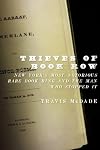
Thieves of Book Row is clearly well researched and supported, and the pages contain a pretty fascinating tale of a part of American East Coast history I'd bet few people know much about. McDade gives us an overview of the stolen book trade, intelligently discusses some of the economic factors behind it, and presents a great deal of information about particular thieves and particular thefts. I think the content has the potential to appeal to a broad variety of readers. However, to me, the book was profoundly lacking in organization. Whole paragraphs would appear to be out of synch - for example, a name with no reference would be introduced, only to have the person explained and discussed at length in a later section. Or the chronology of a tale would appear to jump around in the telling. I think McDade and his editors struggled with the best way to combine the 8,000 foot view with the details, and I think the book might lose readers who aren't willing to keep track mentally of where things go, or can become impatient with the jumping around. However, I think it's worth putting up with, and is likely overall to appeal to people who like history, Americana, and books about literature; I don't think it's likely to be as good a fit for mystery readers generally, especially those who are used to narrative plot consistency.
 This review was written for LibraryThing Early Reviewers.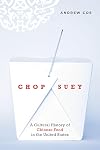
I picked this up hoping for an in-depth comparison between Chinese cuisine and American Chinese cuisine over time - which isn't exactly what this book delivers. Instead, it traces the history of Chinese food in American experience, from the first traders who visited China through a resurgence in Chinese restaurants when Nixon made his famous visit. The book explores the peaks and valleys of American Chinese eating throughout that history, and brings in parts of the Chinese immigrant experience and the reactions of other parts of American culture to it. It's pretty comprehensive, given its scope, and, in my experience especially as the book goes on, is an interesting tale. I did leave with a bit of a better understanding of how Chinese immigrants adapted their food to the American palate - and why - but I would have loved a bit more of a close look at specific dishes. That said, I think it's a great read for anyone interested in the subject and interested in the Chinese experience in America - it provides a unique look at this topic.
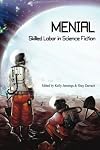
As many reviewers have noted, this book gives readers a peek into the behind-the-scenes lives of the folks who do regular labor to keep the futuristic universes we often read about moving. No galactic negotiations, new species or space battles here - here instead we have the garbage collectors, the repairmen, the harvesters, the fixer-uppers. The stories are uneven - some are very tightly written and compelling, others seem to wander. But overall, they present exactly the behind-the-scenes look promised. In some cases, the characters hint at larger events in the universe outside their daily orbits; in others, the focus of the story is on the smaller, personal events in a character's own life. Either way, the book delivers what it promises. Some stories were a bit short for me, and the book went rather quickly; if you like shorter reads and are curious about the subject matter, I think you're likely to enjoy it! But this is probably not a collection for fans of serious detail long-form SF only.
This review was written for LibraryThing Early Reviewers.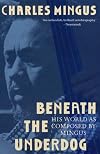
Like, apparently, every woman mentioned in these pages, I finished Mingus with equal parts amusement and dissatisfaction. It's sometimes charming, and sometimes annoying - just like the repetitive tales of a good man brought low by his times.
Many memoirs are nothing but vehicles for ego-stroking and self-aggrandizement - Beneath the Underdog certainly qualifies - but it is so just plain bizarre that I found it more entertaining than offensive.
For such a storied artist, Mingus doesn't seem to have a lot of experiences. There are two stories in this memoir, repeated ad infinitum. A) Mingus is seduced by some woman, struggles with his morals, but decides to cave into sex, and then feels badly about it. All women are sex-crazed fiends who can't get enough of him and insist on dragging the poor man down! (We have a few mentions of prostitutes, who don't apparently count as women for this purpose.)This shows, I think he thinks, that he is a better man than anyone else, no matter what his behavior would otherwise indicate.
B) Occasionally, he pops up with a strong stance on musical purity, diatribing at his father or friends, but this bad world and his bad friends are too cynical to let that stand, and he always finds himself having to compromise. This shows, I think he thinks, that he is a better man than anyone else, no matter what his behavior would otherwise indicate. Sound familiar?
ETA: a friend points out I'm being unfair - there is also substantial name-dropping of other show more musicians. Not much about them except to mention they loved the Mingus, but Famous Names of Jazz are strewn throughout. Noted!
Throughout, Mingus narrates his own life in a third-person voice, an omniscient narrator voice - you're not sure if it's meant to be some heavenly or diabolical intervention until late in the book, where he says that as a consequence of being dropped on his head as a child, he's always existed outside himself, in the third person.
I can't in good conscience recommend this one - if you want a memoir that tells you nothing, really, about the person in question, but is quirky, I'd recommend The Last Holiday instead. But if you do pick it up, you might find moments of enjoyment, despite yourself, as I did. show less
Many memoirs are nothing but vehicles for ego-stroking and self-aggrandizement - Beneath the Underdog certainly qualifies - but it is so just plain bizarre that I found it more entertaining than offensive.
For such a storied artist, Mingus doesn't seem to have a lot of experiences. There are two stories in this memoir, repeated ad infinitum. A) Mingus is seduced by some woman, struggles with his morals, but decides to cave into sex, and then feels badly about it. All women are sex-crazed fiends who can't get enough of him and insist on dragging the poor man down! (We have a few mentions of prostitutes, who don't apparently count as women for this purpose.)This shows, I think he thinks, that he is a better man than anyone else, no matter what his behavior would otherwise indicate.
B) Occasionally, he pops up with a strong stance on musical purity, diatribing at his father or friends, but this bad world and his bad friends are too cynical to let that stand, and he always finds himself having to compromise. This shows, I think he thinks, that he is a better man than anyone else, no matter what his behavior would otherwise indicate. Sound familiar?
ETA: a friend points out I'm being unfair - there is also substantial name-dropping of other show more musicians. Not much about them except to mention they loved the Mingus, but Famous Names of Jazz are strewn throughout. Noted!
Throughout, Mingus narrates his own life in a third-person voice, an omniscient narrator voice - you're not sure if it's meant to be some heavenly or diabolical intervention until late in the book, where he says that as a consequence of being dropped on his head as a child, he's always existed outside himself, in the third person.
I can't in good conscience recommend this one - if you want a memoir that tells you nothing, really, about the person in question, but is quirky, I'd recommend The Last Holiday instead. But if you do pick it up, you might find moments of enjoyment, despite yourself, as I did. show less
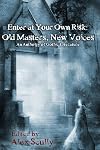
The stated purpose of this collection (and the competition that produced it) was to generate Gothic fiction which relied on more than just the "gross-out" (as Stephen King famously called his last resort) to horrify the reader. The introduction takes you on a brief tour of the history of Gothic fiction from Lewis' The Monk to Rebecca. And I think the collection does well with mirroring that broad a reference: some of the tales are more old-school Gothic, some are newer, with elements of sci fi and fantasy, and some are more mid-range. Like many collections, I found it uneven - there were a few tales I really enjoyed, a few I really didn't and a few in the middle. But I think modern Gothic does indeed often veer too far in the direction of gross rather than scary, and this collection provides a great modern complement to many older classics. Any student of Gothic literature or person who enjoys modern horror and is looking for a different experience of a scary read should enjoy this collection, as will fans of the Lovecraft mythos and darker fantasy.
This review was written for LibraryThing Early Reviewers.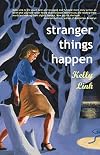
I bought this book as part of a Humble Bundle (a bundle of books, pay what you want, electronic delivery), and after reading the first story, I wished that I had given more money for the package; a good summation of how I feel about it.
Like fairy tales, these short stories take the supernatural for granted - each one has magical components that the characters accept as natural, while responding to the particulars of their situations. I think this is the sort of thing that can tend to get repetitive and predictable after a while. But Link has enough edginess to keep the stories from being saccharine and maintain interest all the way through, and I finished this book and was ready for her next. I should think many short story readers will enjoy this collection, as well as readers who might like to venture out in new directions.
Like fairy tales, these short stories take the supernatural for granted - each one has magical components that the characters accept as natural, while responding to the particulars of their situations. I think this is the sort of thing that can tend to get repetitive and predictable after a while. But Link has enough edginess to keep the stories from being saccharine and maintain interest all the way through, and I finished this book and was ready for her next. I should think many short story readers will enjoy this collection, as well as readers who might like to venture out in new directions.

Running for Women, like other books produced by Human Kinetics, is a book with serious exercise science. It gives a complete overview of how running affects your body, as a woman, and how women's bodies can enhance or complicate the activity - through structural differences in our pelvises and legs and hormonal ones at various stages in our lives and hormonal cycles. I found the book really informative, and, though heavy on the science, easy to understand. It might be most helpful for serious runners - I only run 1-2 times a week, and still have 5 miles as a goal I haven't hit (I run 3-4 miles a session), and so some of the information I wasn't quite sure that I could make use of, because I run so lightly. But even for the casual runner/jogger, I think the information is interesting and useful - understanding how running impacts my body has already changed the way I run in small and useful ways.
I would also recommend the imprint for anyone who has questions about how exercise impacts bodies - I have become really fond of Human Kinetics through the two books I have read: they are thorough, clear, and very informative!
I would also recommend the imprint for anyone who has questions about how exercise impacts bodies - I have become really fond of Human Kinetics through the two books I have read: they are thorough, clear, and very informative!
This review was written for LibraryThing Early Reviewers.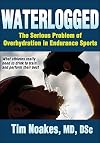
I read Waterlogged in between a couple of trips, and friends and family joked that it looked like I was back in school, lugging around a textbook. I can see why - at over 400 pages, and full of supporting evidence, including graphs and diagrams and charts, Waterlogged physically resembles a lot of the texts I slogged through as a highschooler. But this book was fascinating from start to finish and surpassed any expectations one might have developed based on its appearance.
Dr. Noakes presents a detailed look at the history of advice about drinking in endurance athletics and any athletics and then examines the basis for that advice. He reaches back into the historical roots of human beings and examines the evolutionary advantages conferred on human hunters by our ability to delay drinking for some time while we exercised - hunted - in the heat of day. He reviews, and carefully and thoughtfully explains, countless examinations of the impact of fluid intake at various times and in various amounts in connection with exercise, and presents the reader with a somewhat disturbing conclusion: while hydration is essential for health, and important to activity, the way in which we are advised to hydrate ourselves today, supported in large part by the marketing of the sports drink industry, does not correlate to what our bodies actually need before, during and after exercise.
How can this be interesting? Those friends and family asked me as I turned the pages. The story is compelling, show more and a little terrifying in itself - but Noakes also tells it through stories and the perspectives of those who have both followed and ignored the advice we are currently given. I disagree with the reviewer who said it is for the serious athlete only - I haven't run much more than 4 miles at a go myself, but I found this a fascinating book and I am confident any person who enjoys science and learning, and particularly who enjoys learning about the human body, will find this worth a read. show less
Dr. Noakes presents a detailed look at the history of advice about drinking in endurance athletics and any athletics and then examines the basis for that advice. He reaches back into the historical roots of human beings and examines the evolutionary advantages conferred on human hunters by our ability to delay drinking for some time while we exercised - hunted - in the heat of day. He reviews, and carefully and thoughtfully explains, countless examinations of the impact of fluid intake at various times and in various amounts in connection with exercise, and presents the reader with a somewhat disturbing conclusion: while hydration is essential for health, and important to activity, the way in which we are advised to hydrate ourselves today, supported in large part by the marketing of the sports drink industry, does not correlate to what our bodies actually need before, during and after exercise.
How can this be interesting? Those friends and family asked me as I turned the pages. The story is compelling, show more and a little terrifying in itself - but Noakes also tells it through stories and the perspectives of those who have both followed and ignored the advice we are currently given. I disagree with the reviewer who said it is for the serious athlete only - I haven't run much more than 4 miles at a go myself, but I found this a fascinating book and I am confident any person who enjoys science and learning, and particularly who enjoys learning about the human body, will find this worth a read. show less
This review was written for LibraryThing Early Reviewers.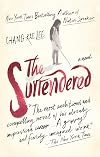
The Surrendered doesn't, in my opinion, live up to the rest of Lee's work. It has clearly drawn characters, who are human and very flawed - limited and hurt by their own mental constraints. In many cases, these limits and failures are responses to terribly traumatic pasts. Unlike some of the readers who disliked the book because the characters were flawed and limited, I don't think that is a failure here - many people are, indeed, damaged, hurtful, hurting and self-abnegating - these are believable people, to whom incredible things have happened. The past histories of these characters are also well done in the work - told in Lee's careful phrasing, with the right amount of detail - although these things don't happen often, they do indeed happen, and I couldn't find fault in the histories or how they connected to the development of the characters in the "present" of the novel. However, I was disappointed with some of what I saw as shortcuts inside of that "present". Things that happen in the "now" often seemed contrived, deus ex machina like, to move the plot forward - something I know from experience Lee doesn't need to rely on to make a great plot happen. And I felt that some of the present interiority of the characters - their self-reflections and thoughts and feelings - were sadly thin, or repetitive. I was disappointed that I didn't have the experience with this book that I'd had with The Gesture Life and others - that said, however, I think it is still a very solid show more work that most readers will enjoy (particularly if they read Lee's other books after The Surrendered, instead of before) as long as they do not need happy and kind people and positive outcomes. show less
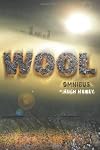
Wool is an interesting world - a fantastical setting proves dystopian over time, but the future holds some hope for change (the omnibus edition contains the entire set of stories to date). Howey has written believable and compelling characters - basic themes of love, friendship, loyalty - and what happens when loyalty conflicts with morality weave throughout the book. The plot has some surprises, and the narrative of the Wool universe unfolds over time. Readers who enjoy mystery and science fiction should appreciate the plot unfolding and the occasional bouts of mechanical or technical detail - however, Wool isn't as tech-heavy in the description as, say, Alastair Reynolds or the Red Mars trilogy, so you want to head into it realizing the focus here is really on the people. A very solid, enjoyable and occasionally surprising read.
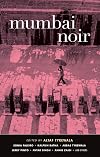
Mumbai Noir is a collection of stories set in or around Mumbai with a "noir" overtone - some are mysteries, some are personality stories, some center around tragic events. I find "noir" a bit hard to define - the introduction contextualizes is as a touch of seediness, darkness, and despair, which I think is appropriate - and if you accept that definition, Mumbai Noir belongs firmly in that category. The stories are mostly written in a sparse, efficient, Chandler-esque voice, as is much fiction in this genre, and the diction suits some stories better than others. I think there are one or two really solid gems, and one or two that I found rather poorly written, but most of them are solid, enjoyable short stories. I really appreciated in particular the gloss in the back of Hindi words used throughout; it can be hard to read fiction about India in English and feel like it has authenticity, and many writers throw in Hindi to help with the flavor, but without definitions, the reader ends up confused - the gloss here avoids that fate.
I think any readers who enjoy noir or short stories will appreciate this collection. I think readers who are devotees of fiction about India may be indifferent to it - the settings and characters seemed as Indian as many works by native authors (Mistry, Desai), and yet, to me, the noir aspect Westernized them somewhat. Some stories have a reasonable depth of character and interiority for their length; others are much more externally focused, which show more provides a nice range that should have some appeal to many types of reader, but is unlikely to be uniformly satisfying to any given reader. Overall, a pleasant if not stellar collection. show less
I think any readers who enjoy noir or short stories will appreciate this collection. I think readers who are devotees of fiction about India may be indifferent to it - the settings and characters seemed as Indian as many works by native authors (Mistry, Desai), and yet, to me, the noir aspect Westernized them somewhat. Some stories have a reasonable depth of character and interiority for their length; others are much more externally focused, which show more provides a nice range that should have some appeal to many types of reader, but is unlikely to be uniformly satisfying to any given reader. Overall, a pleasant if not stellar collection. show less
This review was written for LibraryThing Early Reviewers.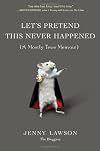
I will probably have an update to this once I've finished the book (I'm currently still in-progress), but I had to stop reading it initially after three pages because I was laughing out loud uncontrollably so hard after those first three pages that the people around me on the subway were edging away towards the doors. Not that I don't like additional space on the subway, but I was worried about what would happen when I got off. So I closed the thing, and then read a lot of the rest of it so hard when I got home that I forgot to eat dinner. Written with the Bloggess' trademark irreverence and silliness and zaniness and also moments of complete, disarming honesty - whether you know the blog or not (and you should), anyone with a sense of humor or a willingess to develop one should enjoy the hell out of this book.
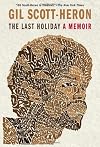
If you know Heron's work, you will recognize immediately that this memoir was written by the man himself; slightly discursive at times, full of wordplay (sometimes clever, and sometimes a little trite) full of a solid practicality and sense of fun. The book doesn't focus clearly on the campaign to adopt Martin Luther King Day as a national holiday; about 30% of it deals with that story and his respect and affection for Stevie Wonder at the heart of it all; the rest gives a quick overview of the life and times of Heron himself. I enjoyed almost every word.

An odd, slightly unsettling story with a hapless protagonist who reminds me a little bit of perspectives in George Trow's Bullies. The book is whimsical, occasionally discursive, but also bemusing and well worth a read. It's told by the protagonist in three sections, each of which is titled after a woman who figures prominently in terms of her impact on his life- but none of these impacts are positive, or even mostly-romantic. He's an introspective artist, and has a practical view of things - perhaps a little prone to sadness, but mostly alert to nonsense, though he strives hard to be respectful of other people to an amusing degree. Things happen around and to him, but the real pull of the story is what happens inside him - what he sees and how he feels about it. You can't help but chuckle at his gentle good humour and insistence on giving people the benefit of the doubt - even when it seems nearly impossible to do so.

The book is short, and very occasionally you hit something that feels a bit repetitive in terms of pacing - but it also manages to be the most emotionally uncomfortable book I've ever read, with a hell of an ending. Overall, I don't think the pace is laggy or too uneven. I actually had to put it down and take a few deep breaths sometimes as the protagonist continued to willfully ignore the input from other characters and cling ridiculously to his fantasies. A remarkable, uncomfortable book, and well worth a read.
A rather erratic collection - essays, short stories, and occasionally a piece that fell somewhere in between. I enjoyed a few of the pieces, but didn't think there were any really outstanding or compelling ones - many were pieces that I think could have used more polish for diction and flow. I think you'd be better off obtaining another collection.

Trow's stories are darkly whimsical - they all seem loosely set in a mouldy universe of hotel tenants, but there is a slipperiness about that setting, and in one or two cases, I wasn't sure the story was in the same place as the others. Some are morbidly hilarious - some are rather creepy and dark. I think some stories are stronger than others, but not enough to call it an uneven collection - it's unique, and curious, and certainly worth a read to fans of the short story, of cynicism and weirdness, and of a sort of bemused hopelessness about the human condition.
As I began reading the book, I thought - hm, I'm not going to like this one very much - and then I found myself, in the words of another reviewer "compulsively" reading it and unable to put it down. To me, that's pretty impressive!
The book is sparsely written - a story that doesn't spend a great deal of words on anything, interior or exterior, yet still manages to build characters with some depth and a compelling plot. While I'm normally a fan of novels that really are deep, I thoroughly enjoyed The Dispatcher for its compelling tale!
The book is sparsely written - a story that doesn't spend a great deal of words on anything, interior or exterior, yet still manages to build characters with some depth and a compelling plot. While I'm normally a fan of novels that really are deep, I thoroughly enjoyed The Dispatcher for its compelling tale!
This is a nice collection of Lovecraft-inspired stories - some are very close uses of the Cthulhu "Mythos", others are more fanciful or take elements of Lovecraft's style or attitude with less clear use of Cthulhu himself - which makes it a nice, varied collection. I think the editor also did a nice job with the arrangement, so that the stories flow well.
I will say that I was quite disappointed in the copyediting on this book, which was so bad that it interfered with my ability to enjoy the stories, because I kept having to stop and read around the copy errors to figure out what was going on. Fully 40% of the quotations are without start quotes or without end quotes, which can lead to confusion about when a quote exists and when it's narrative statement. Words are clearly missing from sentences, and there are misspellings - probably the worst offender of this was the use of "accept" for "except". Errors like these make a book rough going, and I don't know that many readers would keep slogging it out just to enjoy the stories. And that's a real shame, because the stories are compelling, and I found most of them enjoyable and clever! So, A+ for content, but D- for format. I think this may be a new or possibly independent publisher - if so, I hope that they can obtain some better help on proofreading, because it's a good product and a shame to have made it so unnecessarily difficult.
I will say that I was quite disappointed in the copyediting on this book, which was so bad that it interfered with my ability to enjoy the stories, because I kept having to stop and read around the copy errors to figure out what was going on. Fully 40% of the quotations are without start quotes or without end quotes, which can lead to confusion about when a quote exists and when it's narrative statement. Words are clearly missing from sentences, and there are misspellings - probably the worst offender of this was the use of "accept" for "except". Errors like these make a book rough going, and I don't know that many readers would keep slogging it out just to enjoy the stories. And that's a real shame, because the stories are compelling, and I found most of them enjoyable and clever! So, A+ for content, but D- for format. I think this may be a new or possibly independent publisher - if so, I hope that they can obtain some better help on proofreading, because it's a good product and a shame to have made it so unnecessarily difficult.
So, I have one complaint about The Rook, which is that I started reading it on vacation, and I had such a hard time putting it down that I was really torn between doing things I wanted to do outside of my hotel room and reading just one. . . more chapter. But it was such a thoroughly enjoyable and well-written book, I can forgive it. ;) The Rook is clever, and funny - I actually snorted out loud a few times while reading it - and you enjoy the characters.For all the fun and cleverness (i.e., a lot) - and whether he means to or not - I think that he poses interesting questions about our identity and our prior experiences. I think there is a suggestion that perhaps the protagonist's life is better, happier, without the memories she lost - and the corresponding personality - and that is an interesting, sobering thought indeed. Riddled with supernatural events and occurrences, O'Malley does a very Le-Carre-like job of presenting such things as just part of the job, and shows you how it might actually be to have to do all the paperwork surrounding those things. But that clever insight is only the background to a strong mystery that began with a really clever idea. I bought the book mainly because I wanted to see how the author did with his clever idea (which I read about on John Scalzi's blog) - and the answer to that is: fantastic! I'd recommend this to anyone who enjoys mystery, certainly, or paranormality - but also to anyone who likes writing with a bit of dry humour and show more characters you can really engage with. show less
While it's true that many of the stories involved no tentacular horror (and therefore might not fit the definition of "mythos"), I'd like to offer a different reader perspective - Lovecraft's style is not just the syntax, the goo and tentacles and darkness. It's also about leaving stories unfinished and only party told, about horrors only partially revealed and little understood, about the smallness of people in the face of the universe and the contradictory depth of their emotions and feelings. In some ways, I always found him to be making a point about how our own experiences will never cease to matter to us, no matter how big we understand the universe to be. When I read these stories, I found many of them to remind me of Lovecraft or be connected to him in their emotional senses and points about human beings. It's not unfair to say that these stories are, as described, inspirations - but at least some readers may find them more connected to that inspiration than not.
I am generally not a big fan of story collections, and I wasn't sure whether I would enjoy this book (a gift), especially as, while I truly enjoy Lovecraft, I tend to be picky about horror fiction. I was extremely pleasantly surprised! Almost without exception, I felt these stories were faithful to Lovecraft's ideas - and yet diverse from each other, and highly entertaining! Not every story will please every reader, but I think anyone who enjoys Lovecraft will enjoy at least some of the stories herein, and I'd recommend it strongly to all of those people! High marks for the editing selection and for almost all of the content!
I have read quite a bit of Dickens - and enjoyed them! - but found, after a while, that things were feeling a little predictable or similar. I put down my Dickens for a long time and figured that I would have the same reaction to other books of that time. I was prompted to read "The Woman In White", finally, after reading Drood - I'd certainly heard of the book, but felt like I'd read enough Victorian fiction for a while, but the mentions of the book throughout sparked my curiousity and prompted me to give it a read. I was really glad I did! I found this more engaging than the works I'd put down - perhaps because of a different voice - but the plot managed to surprise me in several areas, and I found the style an interesting attempt on the epistolary (if not always successful). I was surprised at how compelling a read I found it. I think lovers of Dickens will certainly enjoy this book - Trollope fans might find it too emotional - but also any fans of a good mystery and this era of writing should find it an enjoyable read. I will say the mystery itself wasn't all that surprising to my modern eye, but the book had surprises in other areas and well-drawn characters. A hat tip to Mr. Collins!
This review is based on an Advance Readers' Copy through the LibraryThing reviewers program. I will say with all respect to Henry Holt and Company, that the ARC was plagued with many errors - quotation marks that were never closed, funky capitalization, and sometimes sentences with clearly missing words - that I hope will be removed before the final printing, because they did detract somewhat from the flow of the novel.
That being said, Iago was a pleasant surprise and a mostly enjoyable read. The author has taken the story of Iago after the events of Shakespeare's Othello, and has envisioned the world of 16th century Venice as a launching pad. The hunt for Iago begins in Cyprus, of course, where relatives of Desdemona - some of her many powerful uncles - have come to restore order, defend against Turkish invasion - and learn the name of the villian and the true fate of their niece. The hunt begins there, but wanders back and forth between Cyprus, Venice, and eventually other Italian cities.
Several threads combine in the book, which is told from several points of view; on occasion, it's not initially clear who is speaking, but the author always offers sufficient clues that I never went more than a sentence or two without figuring it out. However, that format and the Italian phrases continually intermingled in the book may frustrate some readers who like more clarity and plain English - on the other hand, readers with some knowledge of Romance languages should be able to show more figure the phrases out and might enjoy the integration, finding it adds a little more local character to the tale.
The uncles of Desdemona are hunting Iago for simple vengeance. One of Venice's Inquisitors, from a family long at odds with Desdemona's, becomes keenly interested in Iago because he is an early sort of profiler - he is interested in what makes criminals tick, especially the intelligent and subtle ones. The book makes this point repeatedly, and gestures on occasion at satisfying the Inquisitor's curiosity; however, do not read Iago expecting a fully developed criminal profile or much in the way of theory. The book is mainly a fairly complex manhunt, set against a wily and intriguing villain and a whole host of peripheral characters who will be charming to some and perhaps a little too caricature like to others. Iago is caught and escapes several times during the story, and the denoument brought a bit of a chuckle of surprise to me.
Overall, I think Snodin does a nice job with setting the place and with drawing compelling characters. He may rely a little overmuch on devices like the use of Italian, to try and contextualize his story, but it is a pleasant and interesting read - although, at the end, I think Iago remains as much a mystery to the reader as he ever was. Snodin hints at explanations and depth, but doesn't reveal as much about the green-eyed monster as I might have initially expected. That doesn't make the book any less compelling - it's just one choice of many he could have made.
I think any readers who are fond of period pieces might like it, as will fans of Dan Simmons' Olympian worlds and even, probably, fans of Caleb Carr's Alienist and its relatives. Snodin isn't as deep as the other two mentioned, but the plot is engaging, and has enough action that readers who prefer action to interiority might still enjoy it as well as the reverse. show less
That being said, Iago was a pleasant surprise and a mostly enjoyable read. The author has taken the story of Iago after the events of Shakespeare's Othello, and has envisioned the world of 16th century Venice as a launching pad. The hunt for Iago begins in Cyprus, of course, where relatives of Desdemona - some of her many powerful uncles - have come to restore order, defend against Turkish invasion - and learn the name of the villian and the true fate of their niece. The hunt begins there, but wanders back and forth between Cyprus, Venice, and eventually other Italian cities.
Several threads combine in the book, which is told from several points of view; on occasion, it's not initially clear who is speaking, but the author always offers sufficient clues that I never went more than a sentence or two without figuring it out. However, that format and the Italian phrases continually intermingled in the book may frustrate some readers who like more clarity and plain English - on the other hand, readers with some knowledge of Romance languages should be able to show more figure the phrases out and might enjoy the integration, finding it adds a little more local character to the tale.
The uncles of Desdemona are hunting Iago for simple vengeance. One of Venice's Inquisitors, from a family long at odds with Desdemona's, becomes keenly interested in Iago because he is an early sort of profiler - he is interested in what makes criminals tick, especially the intelligent and subtle ones. The book makes this point repeatedly, and gestures on occasion at satisfying the Inquisitor's curiosity; however, do not read Iago expecting a fully developed criminal profile or much in the way of theory. The book is mainly a fairly complex manhunt, set against a wily and intriguing villain and a whole host of peripheral characters who will be charming to some and perhaps a little too caricature like to others. Iago is caught and escapes several times during the story, and the denoument brought a bit of a chuckle of surprise to me.
Overall, I think Snodin does a nice job with setting the place and with drawing compelling characters. He may rely a little overmuch on devices like the use of Italian, to try and contextualize his story, but it is a pleasant and interesting read - although, at the end, I think Iago remains as much a mystery to the reader as he ever was. Snodin hints at explanations and depth, but doesn't reveal as much about the green-eyed monster as I might have initially expected. That doesn't make the book any less compelling - it's just one choice of many he could have made.
I think any readers who are fond of period pieces might like it, as will fans of Dan Simmons' Olympian worlds and even, probably, fans of Caleb Carr's Alienist and its relatives. Snodin isn't as deep as the other two mentioned, but the plot is engaging, and has enough action that readers who prefer action to interiority might still enjoy it as well as the reverse. show less
This review was written for LibraryThing Early Reviewers.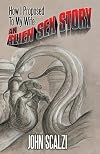
This was a clever short story, and very cute. Scalzi is clever , and a very enjoyable writer - any writer who can surprise me always is a winner in my book!
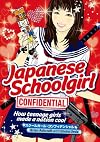
An interesting look at the Japanese schoolgirl as a cultural icon and a few ideas about why she might have come to be that way, this slim paperback is engaging but potentially in need of an edit, especially in the later pages (insets appear far after their subject matter is raised, and one whole section appears to be essentially a repeat of a previous). Ashcraft tackles many of the fora in which the Japanese schoolgirl as a character is explored and utilised, and spends a little bit of time on actual schoolgirls themselves. Enjoyable and thought-provoking, more of a starting-off point than a serious study.