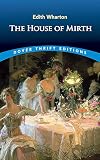
Thanks to Judy B. for Edith Wharton's _House of Mirth_ selection and the "House of Flavors" ice cream, berries and cookies.
It was difficult finding anyone who was ready to see Lily Bart as a role model worth emulating. Some representative observations: Deb: "I hated this woman. Chloral was the only answer to my pain."/Mike: "I would rather go to the prom with Sister Carrie. If Miss Alabaster Lily can't handle rejection, let her reach for the chloral."/Tamie: "Boring Babe. Thank God chloral was around back then."/Gary: "She needed to get a life, win the lottery, move to Terre Haute, give up the chloral and make meth her drug of choice. Then Mike might consider taking her to the prom!" ) And Judy B. and Susie D. were on the same track with some qualifications. For example, they both felt that the next movie made from this novel should star another Lilly as Lily. Specifically, Lilly Tomlin in her "One ringy dingy; Two ringy dingies." character would make a perfect snot-nose Bartwoman. Finally, Jo's comments were much missed. We speculated that Jo would have loved to see Lily start her life afresh, off perhaps with the characters and settings from that other favorite house of Jo's, _The House of Sand and Fog_. Sue B. and Diane B. were not available for comments. Both would no doubt have had new and interesting ways for Lily to use chloral.
Let's admit it, we were rather hard on Lily and her oh-so-rich friends. They are, however, a century distant in time and living in a show more social class we can only make sense of by studying the work of Thorstein Veblen. So, should we give Wharton some credit? She's hardly trying to make these characters admirable or worthy of sympathy. I guess if she opens the heavy drapes hiding their world she is doing the world a kind of service. Now if she does this in a tedious way, in language that is stilted to the point of turning the reader off, then her insights and descriptions will fail to penetrate our glazed eyes. However, after all that can be said that is negative has been said, I still give her high marks for relentlessly burrowing in on the limited choices available to women of Lily's class (and really, any class) at that time. Lily does prostitute herself in a genteel fashion because what she knows in a vague, flawed way what she wants. She has at her disposal only one way of getting it--her feminine charms. How is this so different from what women of any class and time must do if they are taught from birth, and reinforced through their childhood and adolescence, that Woman is to be wife and mother? It would be interesting to count the number of times the word "love" appears in this novel. I'm sure it does, but I can't remember when or in what context. Wharton seems to demystify the coupling dance by removing "love" from her character's lives. This makes her either a cynic or a very perceptive, hard-headed observer of life.
In the end, I wouldn't prescribe chloral for Wharton's works, even though this novel seemed to produce some of the effects of that compound on CARSDM readers. show less
It was difficult finding anyone who was ready to see Lily Bart as a role model worth emulating. Some representative observations: Deb: "I hated this woman. Chloral was the only answer to my pain."/Mike: "I would rather go to the prom with Sister Carrie. If Miss Alabaster Lily can't handle rejection, let her reach for the chloral."/Tamie: "Boring Babe. Thank God chloral was around back then."/Gary: "She needed to get a life, win the lottery, move to Terre Haute, give up the chloral and make meth her drug of choice. Then Mike might consider taking her to the prom!" ) And Judy B. and Susie D. were on the same track with some qualifications. For example, they both felt that the next movie made from this novel should star another Lilly as Lily. Specifically, Lilly Tomlin in her "One ringy dingy; Two ringy dingies." character would make a perfect snot-nose Bartwoman. Finally, Jo's comments were much missed. We speculated that Jo would have loved to see Lily start her life afresh, off perhaps with the characters and settings from that other favorite house of Jo's, _The House of Sand and Fog_. Sue B. and Diane B. were not available for comments. Both would no doubt have had new and interesting ways for Lily to use chloral.
Let's admit it, we were rather hard on Lily and her oh-so-rich friends. They are, however, a century distant in time and living in a show more social class we can only make sense of by studying the work of Thorstein Veblen. So, should we give Wharton some credit? She's hardly trying to make these characters admirable or worthy of sympathy. I guess if she opens the heavy drapes hiding their world she is doing the world a kind of service. Now if she does this in a tedious way, in language that is stilted to the point of turning the reader off, then her insights and descriptions will fail to penetrate our glazed eyes. However, after all that can be said that is negative has been said, I still give her high marks for relentlessly burrowing in on the limited choices available to women of Lily's class (and really, any class) at that time. Lily does prostitute herself in a genteel fashion because what she knows in a vague, flawed way what she wants. She has at her disposal only one way of getting it--her feminine charms. How is this so different from what women of any class and time must do if they are taught from birth, and reinforced through their childhood and adolescence, that Woman is to be wife and mother? It would be interesting to count the number of times the word "love" appears in this novel. I'm sure it does, but I can't remember when or in what context. Wharton seems to demystify the coupling dance by removing "love" from her character's lives. This makes her either a cynic or a very perceptive, hard-headed observer of life.
In the end, I wouldn't prescribe chloral for Wharton's works, even though this novel seemed to produce some of the effects of that compound on CARSDM readers. show less