I like Fagan and appreciate his ability as a scientist and writer. I wanted more, though. I feel guilty even saying this.
It's not that he doesn't write evocative passages about what life for Neanderthals and Cro-Magnons must have been like. And his science is as details-rich and thorough as one would hope.
It's an organization problem. Because there are so many gaps in the science, what we don't know is a huge problem for the best writer, and he is certainly one of those. He is left to repetition. I think a sequence and visual re-organization would fix this.
Every time he gets going on imagining scenes from 9,000, 15,000, 40,000 years ago, he veers abruptly back to facts and methods, artifacts and details. understand, not a bit of it is wrong or out of place. And I love both. It's just that I was left with a feeling of being in a '67 Jaguar E type chained to a rock. Revving, revving, then engine off.
See why I feel guilty? This book more than satisfies as time-travel and science. Brian knows this material, and there is no other book like it. I just wanted him to let 'er rip more. Perhaps every other chapter should have been "let me take you back".
It's not that he doesn't write evocative passages about what life for Neanderthals and Cro-Magnons must have been like. And his science is as details-rich and thorough as one would hope.
It's an organization problem. Because there are so many gaps in the science, what we don't know is a huge problem for the best writer, and he is certainly one of those. He is left to repetition. I think a sequence and visual re-organization would fix this.
Every time he gets going on imagining scenes from 9,000, 15,000, 40,000 years ago, he veers abruptly back to facts and methods, artifacts and details. understand, not a bit of it is wrong or out of place. And I love both. It's just that I was left with a feeling of being in a '67 Jaguar E type chained to a rock. Revving, revving, then engine off.
See why I feel guilty? This book more than satisfies as time-travel and science. Brian knows this material, and there is no other book like it. I just wanted him to let 'er rip more. Perhaps every other chapter should have been "let me take you back".
 This review was written for LibraryThing Early Reviewers.
I post on Open Salon, the source of one of the selections in this superb collection. Most of the pieces here are similar to the best of OS: personal, original, well-crafted, and first-person. I also comment extensively on OS, supporting my fellow writers for every good and true thing they offer.
So it is important for me to distinguish this book. While I am a "supportive" fellow writer -- I ignore grammar, syntax, and care far more for Voice and authenticity -- I take a different position when reviewing books. If published, work(s) should be polished to a fare-thee-well, and when collected they must be brilliant choices.
This is all of that and more. I am simply astonished at the quality of writing in BCNF v.3. So much so that I will return here to write brief reviews of nearly every piece. I am too busy reading this for enjoyment to parse things for others.
There is a special place we reach as writers, even if our own prose is not-quite-there, or limited in scope or imagination, or even if we are simply, forever, pedestrian talents. The special place is: we know the real thing when we read it. Anguish, rapture, raw pain, high comedy, keen and unadorned by excess artfulness, that flows from a writer who has hit a groove, who has Something to say, is unmistakable.
This collection is a testament to the editors and their rare skills, and to each of the essentially undiscovered writers who pour their guts out. You will love the peculiar, fascinating and amazing stories they show more share.
I must stop and re-group. I will sound too effusive. And this collection deserves my sharp focus, so you will see why each piece shines. This isn't just great: it's a new kind of great. Deeply personal, independent stylists, who break away from the few, narrow categories of what is Good Essay or Nice Story. This book soars.
More soon. show less
So it is important for me to distinguish this book. While I am a "supportive" fellow writer -- I ignore grammar, syntax, and care far more for Voice and authenticity -- I take a different position when reviewing books. If published, work(s) should be polished to a fare-thee-well, and when collected they must be brilliant choices.
This is all of that and more. I am simply astonished at the quality of writing in BCNF v.3. So much so that I will return here to write brief reviews of nearly every piece. I am too busy reading this for enjoyment to parse things for others.
There is a special place we reach as writers, even if our own prose is not-quite-there, or limited in scope or imagination, or even if we are simply, forever, pedestrian talents. The special place is: we know the real thing when we read it. Anguish, rapture, raw pain, high comedy, keen and unadorned by excess artfulness, that flows from a writer who has hit a groove, who has Something to say, is unmistakable.
This collection is a testament to the editors and their rare skills, and to each of the essentially undiscovered writers who pour their guts out. You will love the peculiar, fascinating and amazing stories they show more share.
I must stop and re-group. I will sound too effusive. And this collection deserves my sharp focus, so you will see why each piece shines. This isn't just great: it's a new kind of great. Deeply personal, independent stylists, who break away from the few, narrow categories of what is Good Essay or Nice Story. This book soars.
More soon. show less
This review was written for LibraryThing Early Reviewers.
When I was young I read every Ripley's Believe it or Not paperback I could find. As I grew up I was drawn to things like The Book of Lists and other compendiums of the unusual, forgotten, and just plain bizarre. My interest drifted; none satisfied my maturing tastes.
Until now. Alien Hand Syndrome is the most original, erudite, adult, and fascinating "book o stuff" I have ever read. A complete delight from end to end.
It takes a lot to surprise me. I read voraciously, But 80% of this book is new to me. The world's largest bore hole in Russia might just be the USSR's greatest scientific achievement, but is largely unknown. Ethyl poisoning, a horror indeed, was caused by additives crowed about in lavish advertising for decades. The Nucleon was a nuclear powered car that persisted as a project for decades, ohmygod.
Evolutionary (self-evolving) circuitboards! Vaseline, a gelid waste product, becomes a ubiquitous and useless staple! How to control your dreams!
For me, the most moving and amazing of all is the study of and revelations about humor, and laughing. But the book is chock full of what smart people want to know. These aren't gee-whiz, ain't-it-weird blurbs, but well-written, sharply focused essays by pros.
I like the skeptical tone, nicely underplayed.
More, please. Make this a series. Ripley's for grown-ups, with humanity, excellent selections, wicked humor, and respect for human foibles and frailties woven through-out. A home-run.
Until now. Alien Hand Syndrome is the most original, erudite, adult, and fascinating "book o stuff" I have ever read. A complete delight from end to end.
It takes a lot to surprise me. I read voraciously, But 80% of this book is new to me. The world's largest bore hole in Russia might just be the USSR's greatest scientific achievement, but is largely unknown. Ethyl poisoning, a horror indeed, was caused by additives crowed about in lavish advertising for decades. The Nucleon was a nuclear powered car that persisted as a project for decades, ohmygod.
Evolutionary (self-evolving) circuitboards! Vaseline, a gelid waste product, becomes a ubiquitous and useless staple! How to control your dreams!
For me, the most moving and amazing of all is the study of and revelations about humor, and laughing. But the book is chock full of what smart people want to know. These aren't gee-whiz, ain't-it-weird blurbs, but well-written, sharply focused essays by pros.
I like the skeptical tone, nicely underplayed.
More, please. Make this a series. Ripley's for grown-ups, with humanity, excellent selections, wicked humor, and respect for human foibles and frailties woven through-out. A home-run.
This review was written for LibraryThing Early Reviewers.
During the mid 1800’s, some escaped slaves reached out to their former masters. In letters that rend the heart, they expressed an understanding that is both pitiless and generous, to the men and women who sold their parents, wives, and children, who abused and tormented them, worked them to death, and justified it in the name of a loving God.
They are the real thing, these letters: forgiveness, rage, acceptance, stern judgment, Because they are written in the gracious, formal manner of the 19th century, they combine dignity, moral outrage and positive purpose that is impossible to find today.
We cannot imagine the lives of American slaves, the heroic, deadly work of traveling a thousand miles to Canada. That they should survive, make a new life, travel back, return with family, and yet still reach out across that immeasurable distance to connect with and confront their abusers is proof, like no other, of the healing power of freedom.
Freedom is the principal theme of “Voices of a People’s History,” Howard Zinn’s illuminating anthology of first-person, eyewitness, and creative accounts. And surprising unknown details are what make this book special, invaluable.
During the colonial period, pre- and post-, there were hundreds of insurrections; after the war many disenfranchised merchants saw the landed gentry as essentially British, and the rebellions (Shay’s, et al) were continuing the good fight to make the promise of equal opportunity real. It was messy. These show more frontline dispatches, some decades later, underscore how pragmatic our founding Fathers really were. Pat Robertson notwithstanding, self-satisfied piety was a detriment when fair play was being legislated one bloody detail at a time. Understanding the Founding Documents as defensive writings, intended to channel universal revolutionary fervor, is a new perspective for most of us.
It’s such a rich volume. I can create a litany of its better pieces: the horrified officer’s letters during the “War” with Mexico; Robinson’s “Factory Girls”; the bread riot descriptions that reveal a south ripped by profiteers and landowner abuses during the Civil War; the astonishing, pivotal strike in Flint in 1936-7, that elevated Reuther, enabled mainstream Unions, and saw the police fire point-blank into unarmed strikers. Genora Dollinger’s account of her baptism under fire as a Union speaker, where she calls for the strikers families to bravely walk past the police lines, backs to the guns, in order to save their husbands, is unforgettable. This was not long ago, far away. The unions, its members, made us a better country. Reagan’s grandstanding with the air traffic controllers was the refined tactic of the thugs of yesterday. They don’t make it so easy for us now, no brutal face. But the campaign to diminish worker protections and disenfranchise unions continues, and Zinn reminds us of its tradition and context.
Some should be read aloud every year, perhaps an Americans Day (as opposed to America Day, July 4th). In every public square, high school, let’s temporarily interrupt the Rush lie fest on our public airwaves. Let’s take turns and read aloud from this volume: Truth’s “Ain’t I a woman?”; Starr’s “Back of the Yards”; Ali’s refusal to fight in Vietnam. Most of all, we need Dalton Trumbo (Zinn’s excerpt from “Johnny Got His Gun” is perfect). Many of these selections speak with immediacy about our current adventurism overseas, but Trumbo’s is rabble-rousing, heartbreaking literature that wakes us up.
There are annoyances: in his intro, absurdly, “…there is no such thing as a pure fact, innocent of interpretation"; introducing Mumia Abu-Jamal without a mention of the legit controversies about his murder conviction. But Zinn has made an important, immensely readable, and timely contribution to our self-understanding. show less
They are the real thing, these letters: forgiveness, rage, acceptance, stern judgment, Because they are written in the gracious, formal manner of the 19th century, they combine dignity, moral outrage and positive purpose that is impossible to find today.
We cannot imagine the lives of American slaves, the heroic, deadly work of traveling a thousand miles to Canada. That they should survive, make a new life, travel back, return with family, and yet still reach out across that immeasurable distance to connect with and confront their abusers is proof, like no other, of the healing power of freedom.
Freedom is the principal theme of “Voices of a People’s History,” Howard Zinn’s illuminating anthology of first-person, eyewitness, and creative accounts. And surprising unknown details are what make this book special, invaluable.
During the colonial period, pre- and post-, there were hundreds of insurrections; after the war many disenfranchised merchants saw the landed gentry as essentially British, and the rebellions (Shay’s, et al) were continuing the good fight to make the promise of equal opportunity real. It was messy. These show more frontline dispatches, some decades later, underscore how pragmatic our founding Fathers really were. Pat Robertson notwithstanding, self-satisfied piety was a detriment when fair play was being legislated one bloody detail at a time. Understanding the Founding Documents as defensive writings, intended to channel universal revolutionary fervor, is a new perspective for most of us.
It’s such a rich volume. I can create a litany of its better pieces: the horrified officer’s letters during the “War” with Mexico; Robinson’s “Factory Girls”; the bread riot descriptions that reveal a south ripped by profiteers and landowner abuses during the Civil War; the astonishing, pivotal strike in Flint in 1936-7, that elevated Reuther, enabled mainstream Unions, and saw the police fire point-blank into unarmed strikers. Genora Dollinger’s account of her baptism under fire as a Union speaker, where she calls for the strikers families to bravely walk past the police lines, backs to the guns, in order to save their husbands, is unforgettable. This was not long ago, far away. The unions, its members, made us a better country. Reagan’s grandstanding with the air traffic controllers was the refined tactic of the thugs of yesterday. They don’t make it so easy for us now, no brutal face. But the campaign to diminish worker protections and disenfranchise unions continues, and Zinn reminds us of its tradition and context.
Some should be read aloud every year, perhaps an Americans Day (as opposed to America Day, July 4th). In every public square, high school, let’s temporarily interrupt the Rush lie fest on our public airwaves. Let’s take turns and read aloud from this volume: Truth’s “Ain’t I a woman?”; Starr’s “Back of the Yards”; Ali’s refusal to fight in Vietnam. Most of all, we need Dalton Trumbo (Zinn’s excerpt from “Johnny Got His Gun” is perfect). Many of these selections speak with immediacy about our current adventurism overseas, but Trumbo’s is rabble-rousing, heartbreaking literature that wakes us up.
There are annoyances: in his intro, absurdly, “…there is no such thing as a pure fact, innocent of interpretation"; introducing Mumia Abu-Jamal without a mention of the legit controversies about his murder conviction. But Zinn has made an important, immensely readable, and timely contribution to our self-understanding. show less
John Darnton has done a near-impossible thing: craft a thriller, using Darwin as a foil, yet sidestep the current religious brouhaha about evolution. Well, not entirely. By the end of the book it's clear that science and common sense are still safe, even as Darwin himself is peeled open as a near-plagiarist, possible murderer, and all-around nervous wreck.
It's hard to tell, though, if the scholarship and historical theorizing that saturate this story constitute some meaningful ideas on the author's part, or if it's just there to serve the story. The book is flat-out engrossing, and deftly weaves present-day amateur detectives, young Darwin's voyage of discovery, and his last, troubled days. I was lured in by the prospect of exposing Darwin the brilliant thinker, the heroic disruptor of sacred cows (turns out they're just cows!), as -- a VILLAIN. I admit I was worried (is this thickly-disguised anti-scientism?), but ultimately it's just a tease. The mystery's the thing, and it's jim-dandy.
Of course, few fundamentalists will be taken in. Anything short of out-right refutation and denunciation of evolution is seen as coddling poor Charlie, but a few might be fooled by the title, and will squirm with delight as the clues pile up and Darwin's own daughter begins to revile him. Have at thee, rationality! Even so, materialistic science is not undone.
The description of the original voyage of the Beagle, with shipboard details, revelatory jungle excursions, bug discoveries, and show more professional jealousies, is memorable, even thrilling. The sleuthing sub-plot has his "lesser" daughter emerging from dim history and struggle to reconcile the father she idolizes with his accomplishments, and possible crimes. It's highly effective, but relies on a literary device that's problematic.
Evoking this young girl (and then woman), tracing the arc of her tragic life, her filial devotion and unappreciated brilliance, is an original and plausible way to enter Darwin's life and times. All the right things are said, even when she is merely advancing the plot. Darnton wisely shows feminist subtext sparingly, and without demagoguery. But the author (male, middle-aged) attempts a Herculean task: writing as a 19th century girl, one from a literary, well-heeled family. It was a time when well-formed sentences were expected, even from females. Juggling all this requires exquisite balance and excruciating word choices. While she is credible overall, and effective as an ensemble character, she doesn't quite come through as an adolescent girl. I wanted to see a few just-so stumbles in that formidable syntax, some juvenile choices in her diary prose, something to reveal the stifled inner life and emotional depth of such a unique character. There is none of the occasional panic that accompanies the transit to womanhood in any age. At no time is Darnton wrong with her voice, but she carries too much of the story to remain at arm's length.
We need this book. Darwin changed everything, deflating our conceit about human importance and elevating our knowledge. His careful observations turned pieties about "God's creation" into a rich, ever-evolving, as it were, engagement with the natural world. He was not, even so, a "god", or even dem-iurge, and "The Darwin Conspiracy" elevates his accomplishment while examining, with Darwinian attention to detail, his feet of clay.
show less
It's hard to tell, though, if the scholarship and historical theorizing that saturate this story constitute some meaningful ideas on the author's part, or if it's just there to serve the story. The book is flat-out engrossing, and deftly weaves present-day amateur detectives, young Darwin's voyage of discovery, and his last, troubled days. I was lured in by the prospect of exposing Darwin the brilliant thinker, the heroic disruptor of sacred cows (turns out they're just cows!), as -- a VILLAIN. I admit I was worried (is this thickly-disguised anti-scientism?), but ultimately it's just a tease. The mystery's the thing, and it's jim-dandy.
Of course, few fundamentalists will be taken in. Anything short of out-right refutation and denunciation of evolution is seen as coddling poor Charlie, but a few might be fooled by the title, and will squirm with delight as the clues pile up and Darwin's own daughter begins to revile him. Have at thee, rationality! Even so, materialistic science is not undone.
The description of the original voyage of the Beagle, with shipboard details, revelatory jungle excursions, bug discoveries, and show more professional jealousies, is memorable, even thrilling. The sleuthing sub-plot has his "lesser" daughter emerging from dim history and struggle to reconcile the father she idolizes with his accomplishments, and possible crimes. It's highly effective, but relies on a literary device that's problematic.
Evoking this young girl (and then woman), tracing the arc of her tragic life, her filial devotion and unappreciated brilliance, is an original and plausible way to enter Darwin's life and times. All the right things are said, even when she is merely advancing the plot. Darnton wisely shows feminist subtext sparingly, and without demagoguery. But the author (male, middle-aged) attempts a Herculean task: writing as a 19th century girl, one from a literary, well-heeled family. It was a time when well-formed sentences were expected, even from females. Juggling all this requires exquisite balance and excruciating word choices. While she is credible overall, and effective as an ensemble character, she doesn't quite come through as an adolescent girl. I wanted to see a few just-so stumbles in that formidable syntax, some juvenile choices in her diary prose, something to reveal the stifled inner life and emotional depth of such a unique character. There is none of the occasional panic that accompanies the transit to womanhood in any age. At no time is Darnton wrong with her voice, but she carries too much of the story to remain at arm's length.
We need this book. Darwin changed everything, deflating our conceit about human importance and elevating our knowledge. His careful observations turned pieties about "God's creation" into a rich, ever-evolving, as it were, engagement with the natural world. He was not, even so, a "god", or even dem-iurge, and "The Darwin Conspiracy" elevates his accomplishment while examining, with Darwinian attention to detail, his feet of clay.
show less
Gunpowder: Alchemy, Bombards, and Pyrotechnics : The History of the Explosive That Changed the World by Jack Kelly
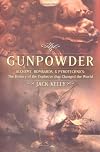
Gunpowder
In his richly detailed and fast-paced history “Gunpowder”, local writer Jack Kelly, manages to break your heart and excite your mind. With fascinating anecdotes and thorough research, he reveals how instrumental gunpowder has been to the development of civilization.
Before we understood anything about how it worked, we had gunpowder. We in fact, assume a scientific industry where none existed. Until recently, gunpowder was the inherited secret of artisan families, royal patent holders, and isolated manufacturies. For almost 900 years it relied on the cultivation and collection of root and manure for one ingredient (saltpeter), crude mining for another (sulfur) and mere fire for the charcoal that bound it all together.
Gunpowder predates the Enlightenment, the Renaissance, Protestantism, Colonialism, Industrial Development – even science itself. And it was pivotal to, if not largely responsible for, all of these.
It’s Kelly’s particular insight that the use of gunpowder meant the inevitable end of feudalism. A disgruntled serf, with a crude rocket, made short work of wealthy lords. Grand suits of armor and expensive horseflesh were no match for “leaden messengers” propelled by powder.
Harrowing battles are recounted, from Medieval Japan’s 10,000 arqubusiers to hellish killing pits in the Civil War. The arc of development of powder itself, cannons, firearms and explosives is well described, too, but the book’s real charm, is in Kelly’s ability to show more find significance in surprising places. It seems obvious, when carefully presented, that the French Nationalization and methodical organization of gunpowder manufacturing in the 1700s prefigures the assembly line but it’s a perspective not usually found in histories of industrialization. Arms yes, powder no.
The concept of even the boundaries for, Modern Nations are also a result of what powder wrought. Castle walls fell only to the wealthiest, largest armies until cannons came into widespread use in the 1500s. Loose association and feudal alliances suddenly needed fortresses, with fields of fire and impact absorbing construction. Ultimately, though any fortress could fall, battered from without or exploded from below, so power and wealth consolidated.
Alchemy was disdained by even the early powder developers. A sober, practical point of view was requisite when small errors blew everything up.
Ironies abound. Powder enlarged war, making it vastly more deadly, yet the gun made modern revolution viable, ensuring the advancement of freedom in Europe and America. Benjamin Robins who essentially founded the science of ballistics in 1742, making gunnery accurate by “rifling” the bores, was a Quaker. His gyroscopic spin, caused by spiral grooves, stabilized the flight of bullets. His innovation also increased the deadly toll of guns. The year he published his manual, “New Principles of Gunnery”, the Prussians estimated they fired 260 rounds for every Austrian killed in battle.
The most melancholy part of the book is the refinement, in 1584 by the Dutch leader Maurice of Nassau, of the “firing line”. His method achieved by endless drill, was in use through World War I and made hamburger of soldiers in the name of efficient firepower.
Francis Bacon, Da Vinci, the DuPont family, and scores of others intersect with “the pernicious art” of gunpowder. Kelly never slows down to pad their stories or overstate their importance, making judicious use of his sources. The result feels like a long weekend with an erudite and fascinating house guest. His short book has depth nonetheless, and challenges the liberal reader with the complexities of our dark, explosive history. show less
In his richly detailed and fast-paced history “Gunpowder”, local writer Jack Kelly, manages to break your heart and excite your mind. With fascinating anecdotes and thorough research, he reveals how instrumental gunpowder has been to the development of civilization.
Before we understood anything about how it worked, we had gunpowder. We in fact, assume a scientific industry where none existed. Until recently, gunpowder was the inherited secret of artisan families, royal patent holders, and isolated manufacturies. For almost 900 years it relied on the cultivation and collection of root and manure for one ingredient (saltpeter), crude mining for another (sulfur) and mere fire for the charcoal that bound it all together.
Gunpowder predates the Enlightenment, the Renaissance, Protestantism, Colonialism, Industrial Development – even science itself. And it was pivotal to, if not largely responsible for, all of these.
It’s Kelly’s particular insight that the use of gunpowder meant the inevitable end of feudalism. A disgruntled serf, with a crude rocket, made short work of wealthy lords. Grand suits of armor and expensive horseflesh were no match for “leaden messengers” propelled by powder.
Harrowing battles are recounted, from Medieval Japan’s 10,000 arqubusiers to hellish killing pits in the Civil War. The arc of development of powder itself, cannons, firearms and explosives is well described, too, but the book’s real charm, is in Kelly’s ability to show more find significance in surprising places. It seems obvious, when carefully presented, that the French Nationalization and methodical organization of gunpowder manufacturing in the 1700s prefigures the assembly line but it’s a perspective not usually found in histories of industrialization. Arms yes, powder no.
The concept of even the boundaries for, Modern Nations are also a result of what powder wrought. Castle walls fell only to the wealthiest, largest armies until cannons came into widespread use in the 1500s. Loose association and feudal alliances suddenly needed fortresses, with fields of fire and impact absorbing construction. Ultimately, though any fortress could fall, battered from without or exploded from below, so power and wealth consolidated.
Alchemy was disdained by even the early powder developers. A sober, practical point of view was requisite when small errors blew everything up.
Ironies abound. Powder enlarged war, making it vastly more deadly, yet the gun made modern revolution viable, ensuring the advancement of freedom in Europe and America. Benjamin Robins who essentially founded the science of ballistics in 1742, making gunnery accurate by “rifling” the bores, was a Quaker. His gyroscopic spin, caused by spiral grooves, stabilized the flight of bullets. His innovation also increased the deadly toll of guns. The year he published his manual, “New Principles of Gunnery”, the Prussians estimated they fired 260 rounds for every Austrian killed in battle.
The most melancholy part of the book is the refinement, in 1584 by the Dutch leader Maurice of Nassau, of the “firing line”. His method achieved by endless drill, was in use through World War I and made hamburger of soldiers in the name of efficient firepower.
Francis Bacon, Da Vinci, the DuPont family, and scores of others intersect with “the pernicious art” of gunpowder. Kelly never slows down to pad their stories or overstate their importance, making judicious use of his sources. The result feels like a long weekend with an erudite and fascinating house guest. His short book has depth nonetheless, and challenges the liberal reader with the complexities of our dark, explosive history. show less
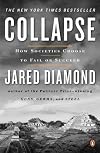
"Collapse" is about human societies' ability -- or failure -- to recognize, engage with, and avoid catastrophic failure. The author focuses on resource and environmental failure in particular.
You will be hearing a lot about this book. Jared Diamond has been compared to Darwin. His previous Pultzer-winning book, "Guns, Germs and Steel", debunked racial explanations for cultural success, and was deemed one of the most important scientific works ever written. His works are strikingly original, carefully researched, and free of polemic. An antidote to both the know-nothing corporate boosterism and denial on the right, and the wishful thinking and anti-science of the left, his ideas are criticized/lauded by both sides.
In "Collapse", success or failure as a society depends primarily on its management of resources. To analyze historic and modern societies, Diamond establishes 5 criteria: environmental damage, climate change, hostile neighbors, friendly trade partners (any of which can be significant), and a society's response to environmental problems (always significant).
Diamond writes for an educated general audience. He is a superb guide for his world tour, tracking the fates of Montana, Easter Island, Greenland, New Guinea, Japan, the Anasazi and more, applying his five criteria to explain failure and success. Stories unfold of unappreciated success (prehistoric New Guinea's invention of silviculture), societal self-transformation (Japan has reforested over 70% of their show more islands), and brute force success (China's enforced family planning achieved an enviable 1.3% population growth).
It is also the most coldly sobering book on the environment ever written. China is a train wreck, environmentally. Average blood lead levels exceed western limits for developmental impairment, they have a small fraction of their viable agricultural land left, they will have plowed under their largest wetland within a decade, and their seacoast fisheries are nearly gone from siltification and pesticide buildup. There is little hope for change.
Australia, facing similar agricultural failures, is making headway but slowly, inconsistently. Salinification (salting) of soils will take 500 years to self-repair if they stop certain practices now. They haven't.
Every society has the resources it was dealt, geographically, and natural weakness (poor soil, slow tree growth, inadequate water, etc.). Diamond demonstrates that similar societies meet different fates -- or not -- based on their willingness to adapt, or their hubris in refusing to do so. All societies have in common, however, a certainty that they are doing enough. Diamond gives us the means to test that optimism. show less
You will be hearing a lot about this book. Jared Diamond has been compared to Darwin. His previous Pultzer-winning book, "Guns, Germs and Steel", debunked racial explanations for cultural success, and was deemed one of the most important scientific works ever written. His works are strikingly original, carefully researched, and free of polemic. An antidote to both the know-nothing corporate boosterism and denial on the right, and the wishful thinking and anti-science of the left, his ideas are criticized/lauded by both sides.
In "Collapse", success or failure as a society depends primarily on its management of resources. To analyze historic and modern societies, Diamond establishes 5 criteria: environmental damage, climate change, hostile neighbors, friendly trade partners (any of which can be significant), and a society's response to environmental problems (always significant).
Diamond writes for an educated general audience. He is a superb guide for his world tour, tracking the fates of Montana, Easter Island, Greenland, New Guinea, Japan, the Anasazi and more, applying his five criteria to explain failure and success. Stories unfold of unappreciated success (prehistoric New Guinea's invention of silviculture), societal self-transformation (Japan has reforested over 70% of their show more islands), and brute force success (China's enforced family planning achieved an enviable 1.3% population growth).
It is also the most coldly sobering book on the environment ever written. China is a train wreck, environmentally. Average blood lead levels exceed western limits for developmental impairment, they have a small fraction of their viable agricultural land left, they will have plowed under their largest wetland within a decade, and their seacoast fisheries are nearly gone from siltification and pesticide buildup. There is little hope for change.
Australia, facing similar agricultural failures, is making headway but slowly, inconsistently. Salinification (salting) of soils will take 500 years to self-repair if they stop certain practices now. They haven't.
Every society has the resources it was dealt, geographically, and natural weakness (poor soil, slow tree growth, inadequate water, etc.). Diamond demonstrates that similar societies meet different fates -- or not -- based on their willingness to adapt, or their hubris in refusing to do so. All societies have in common, however, a certainty that they are doing enough. Diamond gives us the means to test that optimism. show less
Irreligion: A Mathematician Explains Why the Arguments for God Just Don't Add Up by John Allen Paulos
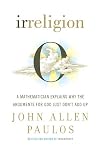
Surprisingly thin. Paulos' earlier works are meaty, slim volumes on innumeracy. This one covers the territory but rambles; enjoyable if taken as the notes from an interesting dinner conversation with a smart guy, but isn't structured well enough for the lay reader. And the omission of Popperian falsifiability is astonishing.
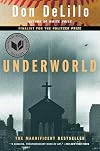
The description of the baseball game (with Frank Sinatra, Jackie Gleason, and J. Edgar Hoover sitting together in the stands, apparently based on reality) near the beginning is one of the most thrilling and well-crafted descriptive pieces I have ever read, anywhere. For fans of Thomas Wolfe's life-affirming, details-rich prose, DeLillo will be a revelation.
Better known for his "The God Delusion" and his aggressive atheism, this book is actually what Dawkins does for a living: good science, well-described. But it is like no other science book. He works his way back down (up?) the tree of life, identifying each significant branching, and uses as his literary structure Chaucer's Canterbury Tales. It gives each unique change and animal character a short, sweet description, making this long book a very zippy read.
Astonishing and delightful. The Greek Athenaeus, born in Egypt and writing for a 2nd century Roman audience, uses the structure of a seemingly endless banquet of itinerant scholars who compete and revel in their erudition about classical authors. Ribald, full of wit and beauty, its quotations are all we have left of hundreds of writers and books from ancient times. To read it is to be amazed and deeply saddened for our loss, simultaneously, on nearly every page. The Loeb books are the best available.