
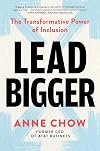
The book advances a simple principle: that an inclusive approach to leadership is better for businesses and for human beings.
She proposes a framework that accounts for all kinds of all-too-familiar business missteps (such as her examples of “leading small” behaviors) and offers guidance for avoiding or overcoming them. She gives real-world examples from all levels of business, including just enough quantity and quality to illustrate how the principles can apply. The interviews with Stanley McChrystal, Arianna Huffington, and Adam Grant at the end of the book are a nice bridge between the book and the real world.
I like the realism of acknowledging that “belonging” is a high ideal for a workplace, but paired with the optimism that there’s a whole continuum of inclusiveness on which we can place ourselves and move forward. I like that these principles apply to individuals trying to do work that matters; you can benefit even without an enlightened leader maintaining the framework over your whole workplace.
Although it forays into similar philosophical ground, this book manages to sidestep the vitriol of the culture war around diversity, equity, and inclusion. I can imagine a reader of any political philosophy seeing the wisdom and value of treating people like human beings, seeking win-win solutions, and being personally reflective—while appreciating Chow’s nuance beyond truisms in these directions. Like any honest treatment of diversity, it’s not a flattened show more view of people as “just” LGBTQ, Millennial, religious, Caucasian, etc., but a whole range of innate and acquired characteristics, priorities, and preferences, and all of these things represent opportunities for perceived exclusion or deep belonging.
I see myself returning to this book as I progress in my career and want to have more and better influence to improve my workplace and help grow the people around me. show less
She proposes a framework that accounts for all kinds of all-too-familiar business missteps (such as her examples of “leading small” behaviors) and offers guidance for avoiding or overcoming them. She gives real-world examples from all levels of business, including just enough quantity and quality to illustrate how the principles can apply. The interviews with Stanley McChrystal, Arianna Huffington, and Adam Grant at the end of the book are a nice bridge between the book and the real world.
I like the realism of acknowledging that “belonging” is a high ideal for a workplace, but paired with the optimism that there’s a whole continuum of inclusiveness on which we can place ourselves and move forward. I like that these principles apply to individuals trying to do work that matters; you can benefit even without an enlightened leader maintaining the framework over your whole workplace.
Although it forays into similar philosophical ground, this book manages to sidestep the vitriol of the culture war around diversity, equity, and inclusion. I can imagine a reader of any political philosophy seeing the wisdom and value of treating people like human beings, seeking win-win solutions, and being personally reflective—while appreciating Chow’s nuance beyond truisms in these directions. Like any honest treatment of diversity, it’s not a flattened show more view of people as “just” LGBTQ, Millennial, religious, Caucasian, etc., but a whole range of innate and acquired characteristics, priorities, and preferences, and all of these things represent opportunities for perceived exclusion or deep belonging.
I see myself returning to this book as I progress in my career and want to have more and better influence to improve my workplace and help grow the people around me. show less
 This review was written for LibraryThing Early Reviewers.