NKJV, Cultural Backgrounds Study Bible, Hardcover, Red Letter: Bringing to Life the Ancient World of Scripture by Zondervan
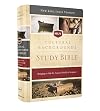
Available for several different translations of the Bible, this series provides context for the books of the Bible based on scholarly research in archaeology, history, religious studies, and ancient linguistics. It also includes a concordance and cross-reference resources too, making it a valuable resource for reading and studying the Bible. As you read the Bible, there are footnotes at the bottom of the page that point out details like which rhetorical patterns were used that were common in that time period or in oral traditions; where it overlaps with themes found in other Middle Eastern, Greek, or Roman cultures; ways that the passages might be translated or understood differently; and how it connects historically or through internal allusions to other books in the Bible. These details help the modern reader understand the Bible as listeners would have heard and understood the stories at the time of writing, or in the early years of the church, from both Christian and Jewish traditions. This context can be vital to understanding the meaning of any particular passage, whether you read the Bible as literature or holy scriptures, so that we are not reading modern assumptions and worldviews into the texts that were written with completely different meanings or contexts for the authors and listeners.
The Day They Hanged Old Brown: The Making of Celebrity and Martyrdom in the Civil War Era by John R. Van Atta
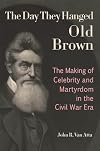
A concise summary of Brown as man and legend. If you are not familiar with the story of John Brown and the various biographies written about him in the first 50 years following the events of Harpers Ferry, this would be a good primer to understand both history and historiography on the topic. If you are more familiar with John Brown, then the book provides an interesting perspective on the legend of John Brown and how it was cultivated by mass media and speeches during his trial and execution to serve (and further) the cultural and political worldviews of both sections at that time.
Summarizing the essential arguments: Brown’s heroic sacrifice helped abolitionism appeal to some moderates amid a broader re-casting of how masculinity was understood in the “North,” namely that Brown became a symbol of rugged manhood and defense of one’s ideals (up to the ultimate sacrifice of one’s life). Brown’s legend then helps provide meaning to emancipation, and an archetypical heroic model to lend context for the sacrifices of thousands of Union soldiers during the subsequent war. At the same time, in the “South” Brown became the paramount example of Yankee aggression that threatened the very fabric of southern society. Brown was a white man coming into the South to incite slave rebellions, and his villainous actions provided tangible evidence of northern hostility that swayed moderate southerners towards a stronger defense of southern society. In short, Brown’s show more legend was crafted by newspaper editors and sectional ideologues, transforming a man of ideas and actions that most people understood to be extreme for the time into a legend that furthered their cultural and political worldviews on the eve of the Civil War. Brown the idea or legend continued to serve these ends during and after the war, and in many ways continues to be debated by Americans because Brown the idea still speaks to our conceptions of heroism, villainy, and fighting for a cause.
I use “North” and “South” in quotations here to highlight that these terms are shorthand for very diverse geographic regions and sets of ideas—and while Van Atta also acknowledges this variation, the book’s arguments still lapse at times into painting the sections in broad strokes while trying to fit events into the lenses of celebrity, heroism, and villainy in the nineteenth century. Similarly, reading the present-day “cancel culture” into the past is a stretch, although readers can skip the introduction chapter and still find a reasonably concise exploration of John Brown’s life and legend. show less
Summarizing the essential arguments: Brown’s heroic sacrifice helped abolitionism appeal to some moderates amid a broader re-casting of how masculinity was understood in the “North,” namely that Brown became a symbol of rugged manhood and defense of one’s ideals (up to the ultimate sacrifice of one’s life). Brown’s legend then helps provide meaning to emancipation, and an archetypical heroic model to lend context for the sacrifices of thousands of Union soldiers during the subsequent war. At the same time, in the “South” Brown became the paramount example of Yankee aggression that threatened the very fabric of southern society. Brown was a white man coming into the South to incite slave rebellions, and his villainous actions provided tangible evidence of northern hostility that swayed moderate southerners towards a stronger defense of southern society. In short, Brown’s show more legend was crafted by newspaper editors and sectional ideologues, transforming a man of ideas and actions that most people understood to be extreme for the time into a legend that furthered their cultural and political worldviews on the eve of the Civil War. Brown the idea or legend continued to serve these ends during and after the war, and in many ways continues to be debated by Americans because Brown the idea still speaks to our conceptions of heroism, villainy, and fighting for a cause.
I use “North” and “South” in quotations here to highlight that these terms are shorthand for very diverse geographic regions and sets of ideas—and while Van Atta also acknowledges this variation, the book’s arguments still lapse at times into painting the sections in broad strokes while trying to fit events into the lenses of celebrity, heroism, and villainy in the nineteenth century. Similarly, reading the present-day “cancel culture” into the past is a stretch, although readers can skip the introduction chapter and still find a reasonably concise exploration of John Brown’s life and legend. show less