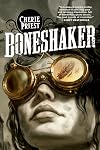
Boneshaker, I will admit, had me doubtful at first. It’s a book about a city taken over by zombies, which is a genre I have not previously explored much, and the beginning is slow. Once the story picks up, however, it becomes far more interesting and exponentially harder to put down. I will admit that this came at the point that the main characters had to shoot zombies in the face, but hey, that’s just me. There is also a steampunk feel to it, which I was dubious about but now I think I could get pretty into it. It’s an interesting genre to read about.
The main story revolves around a boy trying to find the truth behind the creation of the zombies, which many people blame his father for. At the beginning I was mentally shrugging and going along with this, but as the story progressed I grew more and more interested in the truth. The story and the characters are so well fleshed out and three-dimensional that it’s hard to believe the events didn’t happen in reality. Speaking of, I am impressed by the amount of realism in this book—the author had obviously done her research. It is set in the era of the Civil War, on the west coast away from the action. There are several strays from history, but they are small and only done for the purpose of, for example, increasing the population of the town. There is also the matter that several questions go unanswered, as is so often the case in real life. The zombification of the town, for example, is attributed to a volcanic show more gas released by a drill. What this gas is or why it turns people into zombies is never addressed, and this doesn’t matter in the reader’s mind because none of the characters care either. Everyone in the town has given up on trying to cure the Blight, as they call it, and some of them have in fact begun to make drugs out of it. This seems to me a particularly well thought-out point, as people have always searched for ways to make money from other’s hardships. Along the same line is that the drug, called lemon sap, causes people to develop gangrene and rot over time and yet people keep taking it. It is their only escape from their world, which honestly gave me goosebumps. The village would honestly be a dark place to live, but it never struck me as a particularly depressing place. It was more like people had gotten used to their world and, in their way, did what they had to do. There was little to no feeling of despair or apathy in the book because the people had no time to do either—they had to work day and night to get by. Because of that, I sympathized more with them than I would have if they were just depressed. All in all, this book was definitely one I would put in my favorites, given the development and realism involved. show less
The main story revolves around a boy trying to find the truth behind the creation of the zombies, which many people blame his father for. At the beginning I was mentally shrugging and going along with this, but as the story progressed I grew more and more interested in the truth. The story and the characters are so well fleshed out and three-dimensional that it’s hard to believe the events didn’t happen in reality. Speaking of, I am impressed by the amount of realism in this book—the author had obviously done her research. It is set in the era of the Civil War, on the west coast away from the action. There are several strays from history, but they are small and only done for the purpose of, for example, increasing the population of the town. There is also the matter that several questions go unanswered, as is so often the case in real life. The zombification of the town, for example, is attributed to a volcanic show more gas released by a drill. What this gas is or why it turns people into zombies is never addressed, and this doesn’t matter in the reader’s mind because none of the characters care either. Everyone in the town has given up on trying to cure the Blight, as they call it, and some of them have in fact begun to make drugs out of it. This seems to me a particularly well thought-out point, as people have always searched for ways to make money from other’s hardships. Along the same line is that the drug, called lemon sap, causes people to develop gangrene and rot over time and yet people keep taking it. It is their only escape from their world, which honestly gave me goosebumps. The village would honestly be a dark place to live, but it never struck me as a particularly depressing place. It was more like people had gotten used to their world and, in their way, did what they had to do. There was little to no feeling of despair or apathy in the book because the people had no time to do either—they had to work day and night to get by. Because of that, I sympathized more with them than I would have if they were just depressed. All in all, this book was definitely one I would put in my favorites, given the development and realism involved. show less
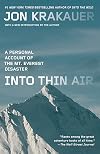
Into Thin Air is the story of the 1996 Mount Everest disaster as told by a reporter who was part of the expedition. Over the course of the climb down the side of Everest, twelve people lost their lives. Into Thin Air details exactly how they died to the best of Krakauer’s ability.
The book is, obviously, written in such a way that one knows from the beginning that specific people are going to die. That knowledge is what inspires the morbid fascination that kept me glued to this book for hours on end. Mountaineering, admittedly, is not something I am particularly interested in, and at times I did find it difficult to understand why on Earth anyone would want to climb up a mountain when there was obviously so much danger involved. I suppose that its thrill is similar to that of gambling, only the people climbing are betting not only money but also their lives on whether or not the mountain will kill them.
I mentioned a feeling of fascination coupled with morbidity, and this book did inspire a certain amount of anxiety, if not fear, in me, for I was reading about men- and women- who are now dead. Who staked everything on their ability to survive, on their guides’ ability to make decisions when thin air makes rational thinking all but impossible. Who gambled and lost. And their companions had to leave them behind.
One of the more frightening parts of this book is how Krakauer describes the death of each of these people in depth, whether they died of disease or froze in show more the snow. I did find that the descriptions that frightened me the most were those of Ngawang Topche and Yasuko Namba. Ngawang fell ill early on in the book but his death was no small matter. He had contracted HAPE, a dangerous high-altitude disease, which was made more dangerous by some pre-existing pulmonary condition. He was shuttled down the mountain and brought to the doctors as quickly as possible, but he still died after struggling for days. Yasuko made it to the top of Everest, but was trapped with the others when that fateful storm blew in. She and another member were separated from the group and lost their way trying to find the camp. When searchers found them they were both alive, both breathing, but it was evident that Yasuko had gone beyond the point where the doctors could save her. By some miracle those two had survived in the cold, and the expedition had to leave her behind anyway. If they hadn’t, there would have been more death.
Walking hand in hand with that reality is Everest, spreading its message that mountains are not things to be trifled with, no matter how skilled the climber. In the end, the mountain is the one that decides whether climbers live or die. The smallest storm on top of that mountain can kill a man easily. The truth is , as it says in the book, that getting to the top of a mountain is easy. It’s getting down that matters.
To tell the truth, just thinking about that freaks me out. To be on top of a mountain, where the air is thin enough that bottled oxygen is necessary, and there’s no promise of returning to the ground, and the wind slices through layers of cloth like a knife. I know that I’d never be able to climb up that high, no matter how euphoric the experience may be. For one thing, I’m afraid of heights, and for another I just don’t like the chances. I’m not very fond of gambling. show less
The book is, obviously, written in such a way that one knows from the beginning that specific people are going to die. That knowledge is what inspires the morbid fascination that kept me glued to this book for hours on end. Mountaineering, admittedly, is not something I am particularly interested in, and at times I did find it difficult to understand why on Earth anyone would want to climb up a mountain when there was obviously so much danger involved. I suppose that its thrill is similar to that of gambling, only the people climbing are betting not only money but also their lives on whether or not the mountain will kill them.
I mentioned a feeling of fascination coupled with morbidity, and this book did inspire a certain amount of anxiety, if not fear, in me, for I was reading about men- and women- who are now dead. Who staked everything on their ability to survive, on their guides’ ability to make decisions when thin air makes rational thinking all but impossible. Who gambled and lost. And their companions had to leave them behind.
One of the more frightening parts of this book is how Krakauer describes the death of each of these people in depth, whether they died of disease or froze in show more the snow. I did find that the descriptions that frightened me the most were those of Ngawang Topche and Yasuko Namba. Ngawang fell ill early on in the book but his death was no small matter. He had contracted HAPE, a dangerous high-altitude disease, which was made more dangerous by some pre-existing pulmonary condition. He was shuttled down the mountain and brought to the doctors as quickly as possible, but he still died after struggling for days. Yasuko made it to the top of Everest, but was trapped with the others when that fateful storm blew in. She and another member were separated from the group and lost their way trying to find the camp. When searchers found them they were both alive, both breathing, but it was evident that Yasuko had gone beyond the point where the doctors could save her. By some miracle those two had survived in the cold, and the expedition had to leave her behind anyway. If they hadn’t, there would have been more death.
Walking hand in hand with that reality is Everest, spreading its message that mountains are not things to be trifled with, no matter how skilled the climber. In the end, the mountain is the one that decides whether climbers live or die. The smallest storm on top of that mountain can kill a man easily. The truth is , as it says in the book, that getting to the top of a mountain is easy. It’s getting down that matters.
To tell the truth, just thinking about that freaks me out. To be on top of a mountain, where the air is thin enough that bottled oxygen is necessary, and there’s no promise of returning to the ground, and the wind slices through layers of cloth like a knife. I know that I’d never be able to climb up that high, no matter how euphoric the experience may be. For one thing, I’m afraid of heights, and for another I just don’t like the chances. I’m not very fond of gambling. show less