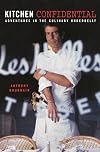
I remember a couple years ago watching Anthony Bourdain's show, No Reservations, and being repulsed by the guy. I found him cocky, irritating and at times the show seemed to go nowhere. So when I would see him on, I'd turn the channel. I don't know when it happened or how it happened, but I started liking the guy. I started liking his show. Maybe it's like the first time you see a new model of car, and you think it's ugly. Sometime later you find yourself dreaming about buying one. At any rate I decided to read his book, Kitchen Confidential: Adventures In The Culinary Underbelly. I'm glad I did. This book chroniclesBourdain's relationship with food from the time he was a kid to becoming chef at Les Halles. It's well written, interesting, funny and as the subtitle states, one gets a look at the "culinary underbelly" from Bourdain's perspective. Bourdain started out in a privileged family but struck out on his own, landed a job as a dishwasher to pay bills, and his culinary career was born. From there you get to see both his humiliations and triumphs as he works his way up. He doesn't seem to pull any punches, he lays it all out, the drugs, the hard times and the fun he had. I think just about anyone would find this a good read, but if you're interested in what it's like working in a professional kitchens, I think you'll like it a lot.
I was looking forward to reading this book, but came away a little disappointed. It was good but it didn't wow me. I suspect if I pick up the book at the right time, in the future, I'd like it a lot.
Brain Training For Runners: A Revolutionary New Training System to Improve Endurance, Speed, Health, andResults by Matt Fitzgerald
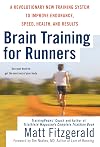
I kind of have a love hate relationship with this book. It's both intriguing, annoying and perplexing at the same time.
What's intriguing about it is his brain centered focus on training. How many times have you heard someone explain how the lack of glycogen causes muscle fatigue? It's text book right? Well, according to Matt Fitzgerald that's the wrong way to look at it. According to him, research shows that fuel is still available in the muscles when fatigue sets in. In actuality, whats happening, is the brain perceives a drop in fuel levels, and begins to slow the body down (fatigue) in an attempt to preserve it's self. There are many moments in this book where Mr. Fitzgerald turns conventional wisdom on end.
What's perplexing is, why does this matter? When you look at his training program, it looks very similar to many other training programs out there: base runs, intervals, tempo runs, cross-training, etc. Maybe I just didn't get it.
The book annoyed me in two ways. First, phrases like "recent research shows," and there are a lot of them, have no citation. It's one of my pet peeves, please cite the research. Not only does it add credibility to the work, some of us actually like to do some follow up research of our own. Second, there was a kind of tonal undercurrent throughout the book that smacked of arrogance.
But I did really like this book, and I'll be rereading sections of it from time to time. He's got some real good advice on, "How to Outsmart Injuries," show more chapter 9. I also liked the chapter on handling discomfort and pain. He nails it on the head on page 156, "Pain encompasses the raw sensations of discomfort associated with fatigue: screaming muscles, burning windpipe, and so forth. Suffering, on the other hand, is a layer of emotional unpleasantness that emerges from the runner's conscious reaction to pain." Of course Buddhists have been saying that for years :)
All in all this was a great book. The training programs are a little too advanced for me at this stage, but at some point I'd like to give it a go. I'm certainly going to incorporate some of the suggestions in the book, such as the strengthening methods and using proprioceptive cues to improve running form. show less
What's intriguing about it is his brain centered focus on training. How many times have you heard someone explain how the lack of glycogen causes muscle fatigue? It's text book right? Well, according to Matt Fitzgerald that's the wrong way to look at it. According to him, research shows that fuel is still available in the muscles when fatigue sets in. In actuality, whats happening, is the brain perceives a drop in fuel levels, and begins to slow the body down (fatigue) in an attempt to preserve it's self. There are many moments in this book where Mr. Fitzgerald turns conventional wisdom on end.
What's perplexing is, why does this matter? When you look at his training program, it looks very similar to many other training programs out there: base runs, intervals, tempo runs, cross-training, etc. Maybe I just didn't get it.
The book annoyed me in two ways. First, phrases like "recent research shows," and there are a lot of them, have no citation. It's one of my pet peeves, please cite the research. Not only does it add credibility to the work, some of us actually like to do some follow up research of our own. Second, there was a kind of tonal undercurrent throughout the book that smacked of arrogance.
But I did really like this book, and I'll be rereading sections of it from time to time. He's got some real good advice on, "How to Outsmart Injuries," show more chapter 9. I also liked the chapter on handling discomfort and pain. He nails it on the head on page 156, "Pain encompasses the raw sensations of discomfort associated with fatigue: screaming muscles, burning windpipe, and so forth. Suffering, on the other hand, is a layer of emotional unpleasantness that emerges from the runner's conscious reaction to pain." Of course Buddhists have been saying that for years :)
All in all this was a great book. The training programs are a little too advanced for me at this stage, but at some point I'd like to give it a go. I'm certainly going to incorporate some of the suggestions in the book, such as the strengthening methods and using proprioceptive cues to improve running form. show less
This is a book has three sections: How to run, Smarter training and Damage limitation. The first section covers: running form, warming up, cooling down, stretching and feet/shoes. The second section contains information about: how to train, core strengthening, cross-training and nutrition. Section three is all about identifying and recovering from injury. There's not a lot of superficial text in this book, which is nice. The material is presented as supported by science and multiple views are brought forth. The one drawback to the book is, none of the research they mention is cited. I realize most people aren't going to seek out and read medical studies, but at minimum it certainly adds credibility to a work. I checked this book out from the library, but I'm going to purchase a copy. I'll put it on the shelf with, "Injury Prevention," by Dagny Scott Barrios, my other favorite injury prevention book.
In this book Gina Kolata takes an honest look at popular thinking about health and exercise. Some of the questions that are examined: How much exercise is required to obtain health benefits? Is there really a heart rate zone beneficial for burning fat? Is there a runner's high and what might possibly cause it?. In answering these questions, she looks for and presents respected research. Or if respected research is lacking, she presents that as well. At times this book is sobering as it excises many cherished exercise myths. Gina also takes us into the training regimes of world class athletes, and reveals what the fitness business is like. The backdrop from which this story is told, is Gina's personal relationship with exercise. The only negative I'll say about this book, is occasionally, in order to support a point, the book gets bogged down in reiteration. After reading this book I'll certainly look upon health claims, and exercise modalities, with a more critical eye.
If someone asked me to write a review of this book using one word, the word would be -- Inspirational. I picked this book up while suffering from hamstring tendinitis. After reading "Ultramarathon Man," I felt like a real wimp for being sidelined because of a little tendinitis. Dean Karnazes has expanded my outlook on what is possible for a human being to accomplish. Not only is this an inspirational story but it's written quite well. This isn't a howto manual. It's a book about Dean's experience as he runs the Western States 100 for the first time. You get to go along during Badwater, a 135-mile romp through Death Valley, a marathon in Antarctica, and his 199 mile relay race. You also get glimpses of ultramarathon culture, Dean's personal life, and philosophical musings about life. I'm not going to go out and run 50+ miles tomorrow, or anytime soon, but this book certainly will be in my mind, as I run and find my own limits. This book was great.
I loved this book. The book contains a smorgasbord of topics about running: running history, running lore, personal autobiography, health issues and more. The author, Benjamin Cheever, is a writer by trade and it shows in this book. I found the book informative, intriguing and entertaining. I found myself laughing out loud several times while reading this book, which rarely happens to me. I like how much of the book is written from a personal level, about his experiences with the different aspects of running. He takes you to a military base and you learn how important running is to the military. He takes you to Kenya and you learn about Kenyans and running in their culture. And during these "trips" the stories are as much about the people you meet , as running. The only downside I experienced with the book, is I inhaled it so quickly I can't remember chunks of it. Which means at some point, I'll have to pick it up and read it again. I look forward to it!
The first half of this book covers the role of the body and mind with regard to injury, injury prevention, and the reasons injuries happen. The second half of the book is comprised of an injury troubleshooter's guide, with a diagnostic chart. The first half of the book I didn't find organizationally put together that well. There were nuggets of information I found valuable, such as the sections on shoes, what to look for in a doctor, and the chapter on non-site-specific bone and muscle injuries. But overall this isn't a book I found valuable for organizing my training to avoid injury. I think part of the problem is, the first half of the book is just too short for the subject matter. The second half of the book is organized very well, and the diagnostic chart makes it easy to quickly find information on specific injuries. Within the troubleshooter's guide, each injury is broken into sections such as, diagnosis, cause, treatment, etc.; making it easy to locate the information you seek. Overall I'm glad I read this book. My opinion is that this book is more valuable as a reference, than a general guide to injury prevention.
Runner's World Guide to Injury Prevention: How to Identify Problems, Speed Healing, and Run Pain-Free (Runner's World Guides) by Dagny Scott Barrios
I picked this book up after sustaining an injury and found it to be very informative. It really helped me take a step back and assess my training. Or should I say, overtraining. Among other topics the book covers: how we become injured, how to avoid getting injured, treating injury, and the emotional side of injury. I found the second chapter on how to train properly, to be particularly helpful. Within this chapter she defines five laws of preventing injury:
1. Increase mileage gradually.
2. Increase intensity incrementally.
3. Increase mileage and intensity separately.
4. Alternate hard efforts with rest.
5. Pay attention to early warnings.
Those five laws seem pretty simple don't they? The problem is many of us don't educate ourselves enough about running, before we start running. Or we do educate ourselves and then don't listen to our new found knowledge. If more runners read and actually followed the author's advice, we'd have much fewer running injuries out there. I wish I would have read this book prior to starting my exercise regime, and followed her suggestions. I'm certainly going to now.
1. Increase mileage gradually.
2. Increase intensity incrementally.
3. Increase mileage and intensity separately.
4. Alternate hard efforts with rest.
5. Pay attention to early warnings.
Those five laws seem pretty simple don't they? The problem is many of us don't educate ourselves enough about running, before we start running. Or we do educate ourselves and then don't listen to our new found knowledge. If more runners read and actually followed the author's advice, we'd have much fewer running injuries out there. I wish I would have read this book prior to starting my exercise regime, and followed her suggestions. I'm certainly going to now.
This book is now in it's second edition and one of the most widely distributed books on the subject of running. This is a comprehensive book covering, history, physiology, training, motivation, racing, nutrition, injuries, equipment and more. Jeff's approach to running could be characterized as being on the conservative side. What I mean by that, is his main focus is to get people out exercising for health. This isn't a book for someone focused on pushing their body to the edge of physical endurance. In order to exercise for health you don't need to kill yourself training. For example his book strongly advocates taking planned walk breaks, during training and while racing. Jeff calls this, "Galloway's Run Walk Run" method. This doesn't mean one has to give up on achieving speed goals. In fact he provides in the book anecdotal evidence that many people have increased there race times by switching to his running method. I think this is a great book to help those who want to start running for the first time, or those who are starting back up after an extended layoff. Jeff's method will also help you keep, Running Until You're 100, the title to one of his other books. One nagging feeling I did have while reading the book, is the lack of research based citations. When someone says, "research has shown," I like to see what research. I'm not 100% sold on everything that is said in this book, but I'm rarely 100% sold on anything. At any rate, I enjoyed this book and felt I gained show more a more comprehensive view of the issues with which a runner is faced. show less
When I picked up this book I was expecting a anthropological and biological look at running. What I got was several chapters of the author's history, which was interesting, but not what I was in the mood for at the time. Finally in the seventh or eighth chapter the book took a turn more to my liking. I found parts of this book extremely interesting. Especially the biological adaptations contrasted in the pronghorn antelope and the camel. Also the theory of why we came to run, namely "persistence scavenging" (my term) and "persistence hunting." The book made me laugh a couple times as well. It ends with a description of his training for an ultramarathon and experience of the subsequent race. Both descriptions left me with respect for the author and an insight into the grit it takes to be a runner.
I must say this book wasn't entirely what I had expected. The subtitle is, "A guide to Running and Staying Fit after 40." I expected more of a typical guide in terms of training, but for an older crowd, and nothing more. This book does give advice on all the major aspects of training, but it's done using the backdrop of masters competitive history, in which Higdon was intimately involved. You end up learning just as much about how the masters program started and grew, as how to train. Higdon describes both his mistakes, as well as his successes in training and competition. As a result, one comes away with a good sense of what it takes to become a masters competitor, and more importantly, tools for sustaining oneself as a masters competitor. I enjoyed this book, learned from the book, and recommend it. The author has a website at http://www.halhigdon.com/
Runner's World Run Less, Run Faster: Become a Faster, Stronger Runner with the Revolutionary FIRST Training Program (Runners World) by Bill Pierce
I found this book a very interesting read and I'm going to do their 5-K novice program. The "run less" part stems from utilizing only three runs per week. The program utilizes three types of runs: track repeats, tempo, and long runs. The purpose of the track runs is to improve max VO2. Tempo runs improve endurance by raising lactate threshold. The long run improves endurance. In addition to the three runs, at least two cross-training days are required. Cross-training has to be non-impact such as swimming or cycling. These workouts are goal oriented, highly structured, and tailored to your current fitness level. The training program was created by FIRST (Furman Institute of Running & Scientific Training). FIRST tracked three groups of runners utilizing their program and found a very significant increase in: max VO2, pace at lactate threshold and pace at max VO2. If you're interested, there's more information at their website. http://www.furman.edu/first/index.htm

I don't read much fiction but this book pulled me in from the start. It's been a long time since I've started a book I didn't want to put down. The first 80% of the book was great. I found the plot and characters interesting. His description of the setting was enjoyable. The only problem I had with the book was the story seemed truncated in the last 5 to 10%. I wished the author would have added one to two hundred more pages and closed the book out in a more gradual manner. The movie "No Escape" was based on this book. The book is much better.