
glorious! Seems like a big chunk of christian philosophy is laid out here. Very inspiring and not what i thought christianity was about

Incredibly frustrating and difficult to follow, especially since I really enjoyed parmenides concept of the one from a different book

not enough depth. Why are we where we are? What are the mechanisms that support inequality? I want to udnderstand

An epic panorama of life, struggling for survival looked at through the lense of mutual aid

I wish i could be more like the main character. To think more about myself, the immediate context, the moment. To let go all the complexity you can't control anyway. Reading the slightly detached thoughts of the character feels like flying on a fresh breeze along a sandy shore.

themes of poverty, race and cast conflict didn't resonate with me
Similar to "design patterns" by gang of four. Author shares insights into game industry and game programming in a slightly humorous and warm way.
Style: 4/5 - examples and humour
Density: 3/5 - some is new, some is old
Relevancy: 1/5 - can be relevant to current job and future game programming but examples are tied to c
If i ever build a big game i might remember about this book.
Style: 4/5 - examples and humour
Density: 3/5 - some is new, some is old
Relevancy: 1/5 - can be relevant to current job and future game programming but examples are tied to c
If i ever build a big game i might remember about this book.

Outdated and badly written.
Reminds me that i would like to know something about modelling and animation. But this is not the book.
Reminds me that i would like to know something about modelling and animation. But this is not the book.
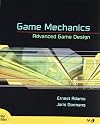
Liked the chapters about systems and emergence. Machinations tool breaks games into economic systems and i might use it some day.
Style: 2/5
Density: 3/5
Relevancy: 5/5
Style: 2/5
Density: 3/5
Relevancy: 5/5

He doesnt care about endings - stories just stop.
He doesnt care about character development - most stories have the same several generic cliche chars with the same faces.
He doesnt care about realism - things are silly and characters often act silly. Explanations to mysterious events are scarce.
But it all doesnt matter. Junji concentrates on a cool scary disgusting idea, runs with it for a while until it has some steam and then just stops the story. Its as if youre reading a collection of pitches for stories. They are raw, undetailed, unfinished, just conveying the one main idea.
And it works. Love it.
He doesnt care about character development - most stories have the same several generic cliche chars with the same faces.
He doesnt care about realism - things are silly and characters often act silly. Explanations to mysterious events are scarce.
But it all doesnt matter. Junji concentrates on a cool scary disgusting idea, runs with it for a while until it has some steam and then just stops the story. Its as if youre reading a collection of pitches for stories. They are raw, undetailed, unfinished, just conveying the one main idea.
And it works. Love it.
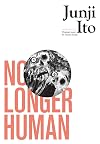
Painful to read. He lies, he runs away, he betrays, he pays for it all, people die. Spirits haunt him. Despicable people haunt him. Torturous existence. A glimpse of hope - a bucket of suffering. He gives up - it doesn't work. He finds love - it withers. He achieves solace - he loses it. Hurt. Bitterness. Unbearable addiction. Loss. Betrayal. Hopelesness.
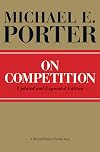
Strategy strategy strategy! Got strategy? Since i started reading this book i began using the word "strategy" every day in all kinds of conversations. Porter really got to me.
The way he talks about strategy is somehow different from the other authors i've read. With this book i can feel the need for strategy, the risks are real. You either set a viable strategy and claw your way to differentiation or you die a slow death of price wars and endless efficiency optimizations that are matched by competitors almost instantly. Porter paints a gruesome picture and it made me really think.
But all that is just the beginning of the book, probably the first couple of chapters. After reading those and feeling closure i wondered what was in the remaining dozen chapters. He talks about all sorts of subjects: the effect of the emergence of the internet on industries, corporate strategy in terms of mergers and acquisitions, competition across locations, globalization, competition of nations, policy, philantropy, social responsibility and ends with advice for new CEOs. Man, i did not expect that i would thorougly enjoy reading about each and every one of those subjects. But i did and it was amazing.
The way he talks about strategy is somehow different from the other authors i've read. With this book i can feel the need for strategy, the risks are real. You either set a viable strategy and claw your way to differentiation or you die a slow death of price wars and endless efficiency optimizations that are matched by competitors almost instantly. Porter paints a gruesome picture and it made me really think.
But all that is just the beginning of the book, probably the first couple of chapters. After reading those and feeling closure i wondered what was in the remaining dozen chapters. He talks about all sorts of subjects: the effect of the emergence of the internet on industries, corporate strategy in terms of mergers and acquisitions, competition across locations, globalization, competition of nations, policy, philantropy, social responsibility and ends with advice for new CEOs. Man, i did not expect that i would thorougly enjoy reading about each and every one of those subjects. But i did and it was amazing.

Along the story's winding path it was not obvious how the heroine would find her way. She had to overcome loneliness and poverty in a foreign country; the clutch of the fundamentalist regime in her home country. Then came numerous dissapointments, dead ends and losses. How did she not give up completely? She had a rebelious resolve but that was often shaken and only gave her grief at times. She had her parents but sometimes they were far away or couldn't really help her. She didn't really have stable friends. It seems she had nothing constant in her life, nothing that permeated from childhood into adulthood that i could pinpoint as the reason she overcame all the trouble.
While reading this comics i was rooting for her while having no answers to her problems. It's weird because usually when i read fiction i feel like i know the solution that i'd like to shout at the hero. But not here. Here the heroine taught me how to deal with all this life stuff. Cool.
While reading this comics i was rooting for her while having no answers to her problems. It's weird because usually when i read fiction i feel like i know the solution that i'd like to shout at the hero. But not here. Here the heroine taught me how to deal with all this life stuff. Cool.
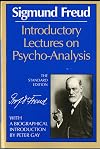
Wow, such a fascinating text. It read like a detective story with a lot of uncovering of mysteries. Every lecture brought out into light a new aspect of the crime and in the end it was all tied together into a coherent believable system of understanding the dynamics of the psyche.
I haven't yet read any criticism of Freud so what i have at this point is just my amazement and excitement with the models he proposes. He shone a bright light on my understanding of dreams, neurotic symptoms and generally the condition of mental suffering. I am very greatful for that and i want to know more.
This book also provides a glimpse into the history of psychoanalysis, namely the problems that Freud and early psychoanalysts had to encounter while developing theory and practice, ironing out the details and then dealing with the protesting reactions of the public. They faced a lot of hate and it was interesting to read how they dealt with it and how they felt about it.
I haven't yet read any criticism of Freud so what i have at this point is just my amazement and excitement with the models he proposes. He shone a bright light on my understanding of dreams, neurotic symptoms and generally the condition of mental suffering. I am very greatful for that and i want to know more.
This book also provides a glimpse into the history of psychoanalysis, namely the problems that Freud and early psychoanalysts had to encounter while developing theory and practice, ironing out the details and then dealing with the protesting reactions of the public. They faced a lot of hate and it was interesting to read how they dealt with it and how they felt about it.

Even though he purports to sweep the slate clean and start from scratch it doesn't feel like it. He starts with "I think therefore i am" and i am quite content with that but then out of nowhere he produces perfection, imperfection, dependency, composition and other concepts which without first analysing and defining he uses to construct God and other things. That really baffled me for it didn't feel at all like a rigorous approach. Though when i think about it it doesn't seem possible to define things without having some things already defined so the whole clean slate approach is not possible in the absolute. He had to start somewhere, with some precepts but i just don't like the precepts he chose for start. Too much was presupposed for my liking.
Still the book was delightful especially for the glimpses into Rene's life and his struggles around philosophising and publication.
Still the book was delightful especially for the glimpses into Rene's life and his struggles around philosophising and publication.
Origin of Wealth: Evolution, Complexity, and the Radical Remaking of Economics by Eric D. Beinhocker
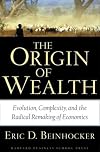
This book is packed with ideas and anecdotes circling around the topics of evolution without an end state and bottom-up modeling. It felt like an economic theory book, a history book, a management book, a politics book, a biology book, even a self-help and relationship advice book. While the diversity of applications for the core ideas is plentiful the author manages to keep statements grounded in research and is wary of slippery paths leading to hot air speculation. It was a delight to see how meticulously he constructs each argument, sometimes building the foundation for several long chapters before laying out a conclusion. A very carefully written and edifying book.
While reading i was eager to apply the ideas to my own life. How do i manage my own evolution? Do i have an optimal portfolio of experiments as well as exploit the familiar turf for sustenance? How can i explain the bitterness inducing blotches on the processes at my job? What role can i play in the development of culture around me? Why is our government the way it is?
Things are not set in stone and are not evolving towards a predetermined perfect equilibrium state. We are all in a car, endlessly moving, wheeling our way around pitfalls, reacting, learning and we each get to turn the wheel a tiny bit.
While reading i was eager to apply the ideas to my own life. How do i manage my own evolution? Do i have an optimal portfolio of experiments as well as exploit the familiar turf for sustenance? How can i explain the bitterness inducing blotches on the processes at my job? What role can i play in the development of culture around me? Why is our government the way it is?
Things are not set in stone and are not evolving towards a predetermined perfect equilibrium state. We are all in a car, endlessly moving, wheeling our way around pitfalls, reacting, learning and we each get to turn the wheel a tiny bit.

The stories in this collection often had a peculiar twist that exploded suddenly into a vast plane of possibilities and nuances. While reading the twist you can feel the physical effect on your brain - it goes from a calm cozy contemplation to a violent combustion of grappling and grasping for explanations and boundaries. It's a stimulating ride at the end of which you tilt your head back and quietly whisper: "wtf".


Diminishing marginal returns lead to collapse when there is power vacuum because parts of the society are less motivated to support the system rather than detach from it or even sabotage it.
It's a believable idea. But it's hard for me to grasp the reasons for the inevitability of diminishing marginal returns.
Tainter explains that people grasp for the lower hanging fruit first so what's left after that is harder to get fruit - so you move from high marginal return to lower marginal return. But as a general metaphor for all kinds of processes it's hard to swallow.
- Oil companies develop easier to get oil wells first.
- Education provides general knowledge first which has a higher marginal return than specialized knowledge because it can be applied to more situations.
- Scientists discover easier knowledge first.
- Socio-political structure of a society is less complex first.
I can sense that there is truth to these examples. Over time those processes do seem to become more complicated and brittle. But i also feel like there could be counter examples. What about the notion of critical mass or breakthroughs? Like when you move from coal to oil, isn't there a big spike in marginal utility? I don't know. Perhaps Tainter accounts for such local spikes and talks more about the big picture where the trend is for diminishing.
Besides this complication with diminishing returns I learned a lot from this book. A glimpse into how and why societies are born and collapse.
It's a believable idea. But it's hard for me to grasp the reasons for the inevitability of diminishing marginal returns.
Tainter explains that people grasp for the lower hanging fruit first so what's left after that is harder to get fruit - so you move from high marginal return to lower marginal return. But as a general metaphor for all kinds of processes it's hard to swallow.
- Oil companies develop easier to get oil wells first.
- Education provides general knowledge first which has a higher marginal return than specialized knowledge because it can be applied to more situations.
- Scientists discover easier knowledge first.
- Socio-political structure of a society is less complex first.
I can sense that there is truth to these examples. Over time those processes do seem to become more complicated and brittle. But i also feel like there could be counter examples. What about the notion of critical mass or breakthroughs? Like when you move from coal to oil, isn't there a big spike in marginal utility? I don't know. Perhaps Tainter accounts for such local spikes and talks more about the big picture where the trend is for diminishing.
Besides this complication with diminishing returns I learned a lot from this book. A glimpse into how and why societies are born and collapse.
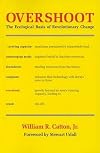
This is my first ecology book. I had no idea things were so bad. I guess i was a believer in limitless progress. It's fascinating to me that until recently i could ignore all the information about the limits of the earth and the climate crisis. I believed there were lots of smart people working on solutions and everything is under control or will be shortly. I believed that top managers of our civilization are not avoiding the most important issues. But now i have doubts.
Avoidance is abundant. Is it because people in their mass are so greedy and shortsighted that we cannot sacrifice anything for the future? Or is the main problem that if one person sacrifices and another doesn't then the second one will just take over the sacrifice of the first and there will be no point in the sacrifice after all. Something like a game theory problem.
Perhaps there is a solution to this in a new belief system that values the act of sacrifice even if there are greedy bastards exploiting it. Current belief system emphasises personal gain and limitless consumption. Advertising tells us we should spend more and want more. Employers tell us we should increase the profits of the companies no matter what and that there is no greater value than increasing profits. Friends and family tell us we should strive to increase our income so we are more safe. Therapists tell us we should not avoid our needs and wants because it is unhealthy to limit yourself.
You only live once. Let go and enjoy show more yourself. If you don't look after yourself nobody will. You deserve more. You have a right to a comfortable life. You earned it. You've suffered enough, now treat yourself. Other people are adults and can take care of themselves. People are not all bad, they are both good and bad, so don't think about their actions too much, do your own thing. It is not healthy to worry about the fate of the Earth and civilization. A person must think first about his own life and then about others. Protect your family. Creating a new life is a miracle and the highest goal everyone should strive for. Living in comfort is normal, living ascetically means something is wrong with you. If you can't fight them, join them. You can't solve the world's problems, solve your own. To sustain youself you have to compromise and work for the companies that only think about profit, there is no benefit to avoiding participating in the economy. You are just a worker, not the owner of the business so you have no moral responsibility for what the company does. You can't bear the moral burden of the society just on your shoulders - it is madness. It is the job of presidents and scientists to solve our societal and ecological problems. Are you willing to devote your whole life to environmentalism? Is it really your calling? Perhaps you better do something you really enjoy in the short span of your lifetime.
There is a barrage of pressure and convincing arguments against doing anything about the global problems. Perhaps most of those who show signs of avoidance of global issues were ones open to them but felt the immense pressure against doing anything and were left with painful helplessness, so they had to resort to a defense mechanism - avoidance. Are we doomed to change only after a catastrophic collapse? show less
Avoidance is abundant. Is it because people in their mass are so greedy and shortsighted that we cannot sacrifice anything for the future? Or is the main problem that if one person sacrifices and another doesn't then the second one will just take over the sacrifice of the first and there will be no point in the sacrifice after all. Something like a game theory problem.
Perhaps there is a solution to this in a new belief system that values the act of sacrifice even if there are greedy bastards exploiting it. Current belief system emphasises personal gain and limitless consumption. Advertising tells us we should spend more and want more. Employers tell us we should increase the profits of the companies no matter what and that there is no greater value than increasing profits. Friends and family tell us we should strive to increase our income so we are more safe. Therapists tell us we should not avoid our needs and wants because it is unhealthy to limit yourself.
You only live once. Let go and enjoy show more yourself. If you don't look after yourself nobody will. You deserve more. You have a right to a comfortable life. You earned it. You've suffered enough, now treat yourself. Other people are adults and can take care of themselves. People are not all bad, they are both good and bad, so don't think about their actions too much, do your own thing. It is not healthy to worry about the fate of the Earth and civilization. A person must think first about his own life and then about others. Protect your family. Creating a new life is a miracle and the highest goal everyone should strive for. Living in comfort is normal, living ascetically means something is wrong with you. If you can't fight them, join them. You can't solve the world's problems, solve your own. To sustain youself you have to compromise and work for the companies that only think about profit, there is no benefit to avoiding participating in the economy. You are just a worker, not the owner of the business so you have no moral responsibility for what the company does. You can't bear the moral burden of the society just on your shoulders - it is madness. It is the job of presidents and scientists to solve our societal and ecological problems. Are you willing to devote your whole life to environmentalism? Is it really your calling? Perhaps you better do something you really enjoy in the short span of your lifetime.
There is a barrage of pressure and convincing arguments against doing anything about the global problems. Perhaps most of those who show signs of avoidance of global issues were ones open to them but felt the immense pressure against doing anything and were left with painful helplessness, so they had to resort to a defense mechanism - avoidance. Are we doomed to change only after a catastrophic collapse? show less

Go into yourself and examine the depth. Write out of necessity. Seek solitude. Hold fast to what is difficult. Unhappiness transforms you, let it happen. School your doubts until they become constructive critics, request arguments from them.
Rilke gives wise advice like these. But more than that I enjoyed seeing his poetic mind reasoning. He sees the world differently, more sensually, more metaphorically. He trusts the world and all that is happening. There is little cliche or tradition in his thinking, he constructs everything himself.
Rilke is a brave, bright and kind soul. In this book he tries to help another soul deal with hardship and fears that so often besiege a young poet or perhaps any person of any age.
Rilke gives wise advice like these. But more than that I enjoyed seeing his poetic mind reasoning. He sees the world differently, more sensually, more metaphorically. He trusts the world and all that is happening. There is little cliche or tradition in his thinking, he constructs everything himself.
Rilke is a brave, bright and kind soul. In this book he tries to help another soul deal with hardship and fears that so often besiege a young poet or perhaps any person of any age.

Dark, dirty, bitter and funny. A man struggling with morality and losing his mind in the process. Beautiful filth. I need to have a bath now.
Also some of the sentences were so compelling that i had to reread them a bunch of times and savour their delicate composition.
Also some of the sentences were so compelling that i had to reread them a bunch of times and savour their delicate composition.

I think the gimmick of time stopping only detracts from this comic. It has a solid casual romance story: two weirdoes with shitty jobs meet up, fall in love, explore their suprising sexual compatability, try to avoid fucking everything up. I mean, do you really need to add time stopping orgasms to that? Oh well.

Tender, brutal, fun and warm. A story about a little girl surviving among toxic people. The headmistress at her school reminded me of a terrible coworker that i struggled with. I guess i'm not a little girl and i should know better how to stand strong against toxicity but it turns out to be quite a challenge even for an adult. Now that i've read Matilda i'm ready. Bring it on!

Can't say i understood it completely. It was like a dream about the sea, ships, docks, cranes, pirates and pirate cruelty. I was very confused along the way and couldn't feel a definite feeling, things merged one into another. At some point the narrator begged to be smashed into things so that he could get closer to them. Perhaps my confusion is actually the intended effect of the poem? I can't really say. In the end i was intrigued enough the want to read some of Pessoa's prose.

I like stories that don't have a grand conflict. They just flow like life does. At first i wonder where it is going but then i accept it the way it is and try to enjoy the little things - the same way i do with life.