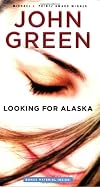
“I go to seek a Great Perhaps.” and is in search of his Great Perhaps that Miles decides to attend the Culver Creek Boarding School where he hopes to start fresh. There he makes friends with his roommate Chip, aka “the Colonel” (who immediately starts calling Miles, Pudge) , a guy named Takumi and their best friend, a girl called Alaska Young. Alaska is the wild, beautiful, intelligent, moody, mysterious, unattainable girl whom Miles falls irrevocably in love with.
The book is divided between Before and After and I did not know (for a change I went in completely unspoiled) what is going to be the pivotal point of divide until it hits but there is an inescapable sense of dread as the days pass, building the After. The event is indeed calamitous and it’s only when it happens that the different between the Before and After becomes oh, so clear. The Before is made up of routine, of monotony, of mundane happenings: kids going to classes, coming up with pranks, drinking, smoking, doing stupid things, hooking up and talking to each other about Stuff like Simón Bolívar’s last words:
‘How will I ever get out of this labyrinth!”
So what’s the labyrinth?’ I asked her…
That’s the mystery, isn’t it? Is the labyrinth living or dying? Which is he trying to escape- the world or the end of it?”
This “labyrinth” becomes a central discussion encompassing all characters at one point, when the After comes. That’s when the book loses the mundane and reaches show more the momentous. And it is a grave, serious, painful and genuine journey until we are able to close the book.
At one point, Miles thinks (with regards to Alaska):
So I walked back to my room and collapsed on the bottom bunk, thinking that if people were rain, I was drizzle and she was a hurricane.
And I think this is an apt way of describing John Green’s books as well. Most books are drizzle but John Green’s are totally hurricanes.
Quotes-
What the hell is instant? Nothing is instant. Instant rice takes five minutes, instant pudding an hour. I doubt that an instant of blinding pain feels particularly instantaneous.
We were kissing.
I thought: This is good.
I thought: I am not bad at this kissing. Not bad at all.
I thought: I am clearly the greatest kisser in the history of the universe.
Suddenly she laughed and pulled away from me. She wiggled a hand out of her sleeping bag and wiped her face. “You slobbered on my nose,” she said, and laughed. show less
The book is divided between Before and After and I did not know (for a change I went in completely unspoiled) what is going to be the pivotal point of divide until it hits but there is an inescapable sense of dread as the days pass, building the After. The event is indeed calamitous and it’s only when it happens that the different between the Before and After becomes oh, so clear. The Before is made up of routine, of monotony, of mundane happenings: kids going to classes, coming up with pranks, drinking, smoking, doing stupid things, hooking up and talking to each other about Stuff like Simón Bolívar’s last words:
‘How will I ever get out of this labyrinth!”
So what’s the labyrinth?’ I asked her…
That’s the mystery, isn’t it? Is the labyrinth living or dying? Which is he trying to escape- the world or the end of it?”
This “labyrinth” becomes a central discussion encompassing all characters at one point, when the After comes. That’s when the book loses the mundane and reaches show more the momentous. And it is a grave, serious, painful and genuine journey until we are able to close the book.
At one point, Miles thinks (with regards to Alaska):
So I walked back to my room and collapsed on the bottom bunk, thinking that if people were rain, I was drizzle and she was a hurricane.
And I think this is an apt way of describing John Green’s books as well. Most books are drizzle but John Green’s are totally hurricanes.
Quotes-
What the hell is instant? Nothing is instant. Instant rice takes five minutes, instant pudding an hour. I doubt that an instant of blinding pain feels particularly instantaneous.
We were kissing.
I thought: This is good.
I thought: I am not bad at this kissing. Not bad at all.
I thought: I am clearly the greatest kisser in the history of the universe.
Suddenly she laughed and pulled away from me. She wiggled a hand out of her sleeping bag and wiped her face. “You slobbered on my nose,” she said, and laughed. show less