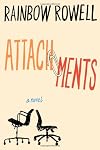
The review that led me to Attachments also made me a bit wary; the setup with protagonist Lincoln, employed to read email in order to police company policy, sounded absurd and ridiculous, like a potentially non-endearing gimmick. I am also leery of stories told through email exchanges (see Meg Cabot's insufferable Boy Meets Girl).
But absurd and ridiculous turned out to be the point of career-confused, career student Lincoln's stupid job. Rowell really sells the improbable setup to bring together two endearing characters. Email dialogs are wryly funny, with a minimum of cute, and the newsroom jargon is real. Not googled-it real, but the-author-is-a-reporter real, which gives these potentially chick-lity women characters real jobs to do.
But absurd and ridiculous turned out to be the point of career-confused, career student Lincoln's stupid job. Rowell really sells the improbable setup to bring together two endearing characters. Email dialogs are wryly funny, with a minimum of cute, and the newsroom jargon is real. Not googled-it real, but the-author-is-a-reporter real, which gives these potentially chick-lity women characters real jobs to do.

Nineteen days of procrastination, and the library wanted its book back the next morning. Columbine is fascinating, morbidly enthralling, intensely sad--it is not bedtime reading. Do not procrastinate, library readers.
The reporting: Cullen makes a powerful case that by framing the immediate social and media urge to frame the story of shooting in standard high school mythology set up a lasting misperception of the killers' and their motives. Neither young man was a withdrawn dweeb, tortured by jocks. FBI profiles paint Eric Harris as a classic psychopath and Dylan Klebold as an easily led depressive.
Cullen maintains momentum and intensity by dipping into the thoughts of the killers and the victims. He dips into the thoughts of the dead, people he could not have interviewed, an entertaining technique that makes me profoundly uneasy. (And he does it all in punchy, news-style sentences. That quickly got on my nerves).
The cover: haunting, beautifully laid out. Read about the design process. http://henryseneyee.blogspot.com/2009/03/columbine.html
The reporting: Cullen makes a powerful case that by framing the immediate social and media urge to frame the story of shooting in standard high school mythology set up a lasting misperception of the killers' and their motives. Neither young man was a withdrawn dweeb, tortured by jocks. FBI profiles paint Eric Harris as a classic psychopath and Dylan Klebold as an easily led depressive.
Cullen maintains momentum and intensity by dipping into the thoughts of the killers and the victims. He dips into the thoughts of the dead, people he could not have interviewed, an entertaining technique that makes me profoundly uneasy. (And he does it all in punchy, news-style sentences. That quickly got on my nerves).
The cover: haunting, beautifully laid out. Read about the design process. http://henryseneyee.blogspot.com/2009/03/columbine.html
I want to thank the editors for introducing me to Ted Chiang ("Exhalation"), who doesn't write novels. I also enjoyed the very different and funny Stross that preceded it ("Rogue Farm"), and selections from Butler, Bester and Gunn. The editors of Wesleyan's scholarly journal Science Fiction Studies preface each story dry but interesting background. They've put together a nice selection that includes more of the female perspective than a token LeGuin story. Unfortunately, I didn't come close to finishing this beast before the library wanted it back.
The protagonist, Harry Dresden, has a cop sidekick who is both female and interesting, and accessory that I greatly appreciate in my geekboy fantasy. Storm Front has a YA feel. Harry is very Put Upon by the Powers that Be, and people just don't understand him. He's broke and has troubles with Girls. On the other hand, he can do magic, which is pretty great. He narrates the story in first person, always a tricky maneuver in my opinion, but makes a good companion for this fun twist on the PI genre.