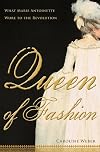
To think that the gorgeous gaulles worn by the Queen precipitated the French Revolution would be a bit of a stretch. Caroline Weber, in her book "Queen of Fashion: What Marie Antoinette Wore to the Revolution" notes that the kingdowm showed signs of terminal illness well before Marie Antoinette left Vienna to marry Louis Auguste. Symptoms including, but not limited to; a depleted financial state and national ego brought about, in part, by The Seven Years' War, the backing of the colonists in the American Revolution, poor harvests that set the stage for the Flour Wars, the over taxation of the Third Estate made even worse by the King's lits de justice and autocratic manner, the usual malcontents at Versailles and in the Palais Royal, as well as the ostentatious and sumptuous behavior of the ancien regime in general. Though Marie Antoinette, by her very nature and breeding, may have been understandable out of touch with her subjects, by being so became an icon for the corrupt and incompetent monarchy, still she cannot be held responsible for the Revolution. And, I believe, no one really thinks she was.
In fact she gave up (those may not be the right words) quite a lot as the Dauphine and later Queen. Yet, what she removed from her royal body; paniers, her grand corps, the satorial robe a la francaise, the grand habit de cour, she replaced with less formal but equally as expensive gaulles, chemises, chapeaus a la mode and, of course, the pouf. So in the end not only did she show more do nothing to releave the working-class and lower-class of their justifiable perception of a world in decline, but she also challenged their tratitional ideas of how the monarchy should appear, both literally and figuratively.
Caroline Weber presents a Marie Antoinette more comfortable in English muslin, linen and ribbons then in French silk, velvet and jewels. Though a woman of fine taste, a true trend-setter with a good fashion sense and eye, she was moving stylistically in a direction few could fallow. Yet, Caroline Weber makes the ironic point that by dressing in a manner keeping with a certain Rousseauian ethos she was, through fashion, consciously or not, bridging a gap between the people and the royalty they despised. One wonders, would they even if they could, accept a new fashion aesthetic? Style, with a capital "S," was not yet in the minds of the working and lower classes and given the hard times, could hardly be other wise. Another interesting parallel is between her, as a woman with no real power at court(at least at the start) and the Third Estate's lack of polictical power.
In the end what the Queen wore to the Revolution would make no difference. Again, I don't think Caroline Weber is saying it would. She is only and delightfully describing one woman's (admittedly the Queen of France) experience with haute couture and its regrettable political and social consequences. Something was rotten in Paris and Marie Antoinette would have been damned and decapitated regardless.
I truly loved this book and took it everywhere I went for the last week. Caroline Weber has drawn upon a wealth of sources from the 18th to the 21st century and the notes are fabulous. "Queen of Fashion" is one of those few books that are equal parts scholarship and a joy to read. show less
In fact she gave up (those may not be the right words) quite a lot as the Dauphine and later Queen. Yet, what she removed from her royal body; paniers, her grand corps, the satorial robe a la francaise, the grand habit de cour, she replaced with less formal but equally as expensive gaulles, chemises, chapeaus a la mode and, of course, the pouf. So in the end not only did she show more do nothing to releave the working-class and lower-class of their justifiable perception of a world in decline, but she also challenged their tratitional ideas of how the monarchy should appear, both literally and figuratively.
Caroline Weber presents a Marie Antoinette more comfortable in English muslin, linen and ribbons then in French silk, velvet and jewels. Though a woman of fine taste, a true trend-setter with a good fashion sense and eye, she was moving stylistically in a direction few could fallow. Yet, Caroline Weber makes the ironic point that by dressing in a manner keeping with a certain Rousseauian ethos she was, through fashion, consciously or not, bridging a gap between the people and the royalty they despised. One wonders, would they even if they could, accept a new fashion aesthetic? Style, with a capital "S," was not yet in the minds of the working and lower classes and given the hard times, could hardly be other wise. Another interesting parallel is between her, as a woman with no real power at court(at least at the start) and the Third Estate's lack of polictical power.
In the end what the Queen wore to the Revolution would make no difference. Again, I don't think Caroline Weber is saying it would. She is only and delightfully describing one woman's (admittedly the Queen of France) experience with haute couture and its regrettable political and social consequences. Something was rotten in Paris and Marie Antoinette would have been damned and decapitated regardless.
I truly loved this book and took it everywhere I went for the last week. Caroline Weber has drawn upon a wealth of sources from the 18th to the 21st century and the notes are fabulous. "Queen of Fashion" is one of those few books that are equal parts scholarship and a joy to read. show less

When one hears the name Henry Miller one thinks of the “Tropics” and “The Rosy Crucifixion” and rightfully so. Though he may have had antecedents (if genius has antecedents) in Cendrars and Celine, he broke new ground in American writing and was truly revelatory for readers half a century ago. Readers like myself who lived near Big Sur and couldn’t get enough of his, at times, bombastic and bellicose prose. But there is nothing bombastic in “The Colossus of Maroussi” and perhaps for that reason it’s the one book of his I have the greatest affection for. In the “The Colossus” everything is clear. Water becomes an event, light is transcendent. This is not so much a book about Greece (though, as one reviewer noted, it is one of the greatest travel books of all time), but about a modern man who rediscovers himself in the cradle of Western civilization. Miller feels everything about Greece; the heat, dust, the people, the space and its’ ambiance. It feels as though everything came together for him in this book; a grand coalescence, if you will. It is about the spirit of a place and mans place in the infinity of being.

Oskar von Wertheimer's fictional biography (what else could a story about Cleopatra be?) is a wondeful example of how this literary genre was handled in the first half of the twentieth century. Like Emil Ludwig's book on the same subject, plublished some six years later, it is a masterful blend of fiction, psychology and historical research. Jacob Wassermann's "biography" of Alexandar the Great comes also to mind. The writing is superb and the black & white plates scattered through-out add even more depth and interest. Subject, Substance and Style, what more could one ask for?