group read: White Heat, Dickinson/Higginson Friendship
Talk 75 Books Challenge for 2011
Join LibraryThing to post.
This topic is currently marked as "dormant"—the last message is more than 90 days old. You can revive it by posting a reply.
1labwriter
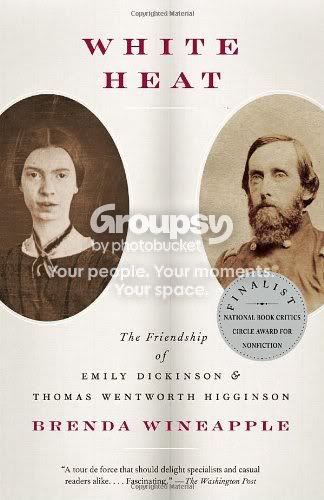
Lucy and I are doing a group read on the Emily Dickinson/Thomas Wentworth Higginson friendship. The book is White Heat by Brenda Wineapple.
We've been at this a week or so and the first posts for this can be found over in the group "Book Talk"--here. I've switched the thread over here to Group 75 just for the sake of convenience, to make it easier for people here to follow along if interested.
Lucy & I are finding this to be an excellent read. We're only at about Chapt. 6, which is 101/318, so if anyone would care to join us, please feel free. I'm sure there are a lot of people here at 75 who know more about Emily Dickinson than I do, so please post your thoughts if something here strikes your fancy. We're reading this at a pretty slow pace (summer pace, right Lucy?--ha), so we may skip some days.
We've been at this a week or so and the first posts for this can be found over in the group "Book Talk"--here. I've switched the thread over here to Group 75 just for the sake of convenience, to make it easier for people here to follow along if interested.
Lucy & I are finding this to be an excellent read. We're only at about Chapt. 6, which is 101/318, so if anyone would care to join us, please feel free. I'm sure there are a lot of people here at 75 who know more about Emily Dickinson than I do, so please post your thoughts if something here strikes your fancy. We're reading this at a pretty slow pace (summer pace, right Lucy?--ha), so we may skip some days.
2labwriter
I think in the posts from yesterday we had both expressed some bewilderment at Chapt. 6 and how it fits into the narrative of the book as a whole. Halfway through the chapter, I'm a bit confused, so I went back to the first page of the chapter and here's Wineapple's first sentence: "Emily Dickinson stops my narrative" (101). So maybe that's really all the explanation needed.
In this chapter, W-apple all of a sudden seems to want to discuss the poems..."And when we turn to her poems, we find that they, too, like her life, stop the narrative. Lyric outbursts, they tell no tales about who did what to whom in the habitable world. Rather, they whisper their wisdom from deep, very deep, within ourselves" (101).
I admit to being flummoxed most of the time when I'm reading ED's poems. Insights into what she was doing in them don't come naturally to me. I find myself actually unnerved by all the dashes--they put me off (OK, that's a sight joke, lame).
Anywho, I guess I'll just go along with Wineapple here with her stopped narrative of Chapt. 6 and finish reading the thing ("thing" = chapter, not book).
In this chapter, W-apple all of a sudden seems to want to discuss the poems..."And when we turn to her poems, we find that they, too, like her life, stop the narrative. Lyric outbursts, they tell no tales about who did what to whom in the habitable world. Rather, they whisper their wisdom from deep, very deep, within ourselves" (101).
I admit to being flummoxed most of the time when I'm reading ED's poems. Insights into what she was doing in them don't come naturally to me. I find myself actually unnerved by all the dashes--they put me off (OK, that's a sight joke, lame).
Anywho, I guess I'll just go along with Wineapple here with her stopped narrative of Chapt. 6 and finish reading the thing ("thing" = chapter, not book).
3labwriter

This is the Homestead, the house where ED spent most of her life.
I found a YouTube clip which takes the viewer in through the front door, up the steps, and into ED's bedroom, the room where she wrote most of her poems.
4sibylline
This is great! Thanks for moving us back to where we belong!
She wrote her poems on a teeny tiny table, looks Shakerish. They don't have the original (Harvard does, I think????) but they have one 'just like it'.
I'm still reading 6 too. I think Wineapple is partly doing this to make sure we have the opportunity to see what exactly ED's achievement is. That someone so apparently isolated, really was quite connected to the world outside, aware of what was happening and also opinionated about it. There is Higginson out in the world with his activism and here is ED at her tiny desk with her verbal activism. She IS unnerving, so you are getting it, B! Never fear. I think ED should be the patron saint of all of us introverts, that alone at your desk or in yr. garden, at your loom, your potting wheel, whatever it is, because you like it that way can lead to miracles of achievement. Sorry about the gush!
She wrote her poems on a teeny tiny table, looks Shakerish. They don't have the original (Harvard does, I think????) but they have one 'just like it'.
I'm still reading 6 too. I think Wineapple is partly doing this to make sure we have the opportunity to see what exactly ED's achievement is. That someone so apparently isolated, really was quite connected to the world outside, aware of what was happening and also opinionated about it. There is Higginson out in the world with his activism and here is ED at her tiny desk with her verbal activism. She IS unnerving, so you are getting it, B! Never fear. I think ED should be the patron saint of all of us introverts, that alone at your desk or in yr. garden, at your loom, your potting wheel, whatever it is, because you like it that way can lead to miracles of achievement. Sorry about the gush!
5labwriter

I snagged this photo of the desk in her bedroom from the YouTube clip. Imagine, doing all of your writing at such a small space. I'm glad you've been to the Homestead recently, Lucy, and you can share what you learned. There's something about the physical "stuff" of a writer that really captures my interest. I guess that's one reason I like biographies.
Evidently she did a good bit of writing at night, when the rest of the family was sleeping.
6BookAngel_a
I've wishlisted this book! I haven't read Emily Dickinson in years, but I loved her poetry as a teenager. There's something about her that's always fascinated me.
7sibylline
Thanks for stopping by! We were a bit lonely over on that non-75 place. Thank heavens Becky took the initiative and brought us over here.
8phebj
Just wanted to let you know I'm following along and will definitely be on the lookout for White Heat. I love when you and Becky really delve into a book and I appreciate all the extras you post like the information about Dickinson's house. I doubt if I'll get to White Heat anytime soon but I've got this thread starred for the future.
9sibylline
I finished Chapter 6 -- it made more sense to me by the end -- I think Wineapple was trying to help us see ED the way Higginson might have???? How unusual she really was?
10BookAngel_a
What Pat said in #8! :)
11labwriter
>9 sibylline:. Yes, I agree with what you're saying here, Sib. "Dickinson had thrown down the glove, daring him to watch her perform" (117).
I like W'apple's description of ED's room: "slipped into the southwest corner was the small cherry desk (only seventeen and a half inches square) on which she conducted a vast correspondence and composed almost eighteen hundred poems. 'Sweet hours have perished here, / This is a timid room--,' she wrote. It was not" (118).
Then there's Chapt. 7, which I have to say again, leaves me perplexed. I'm just not sure I care about Higginson's every minute spent as a colonel of the First South Carolina Volunteers, "the first federally authorized regiment of freed slaves" (123). I get it. He's a radical, activist abolitionist. I'm only halfway through the chapter or so, I think, so like Chapt. 6, maybe the point will be made clear by the time the chapter is finished, but I'm beginning to think the point of this chapter is to flesh out a short book. Not that she's done a bad job with the material; it's just that I don't see how it particularly fits this book.
I like W'apple's description of ED's room: "slipped into the southwest corner was the small cherry desk (only seventeen and a half inches square) on which she conducted a vast correspondence and composed almost eighteen hundred poems. 'Sweet hours have perished here, / This is a timid room--,' she wrote. It was not" (118).
Then there's Chapt. 7, which I have to say again, leaves me perplexed. I'm just not sure I care about Higginson's every minute spent as a colonel of the First South Carolina Volunteers, "the first federally authorized regiment of freed slaves" (123). I get it. He's a radical, activist abolitionist. I'm only halfway through the chapter or so, I think, so like Chapt. 6, maybe the point will be made clear by the time the chapter is finished, but I'm beginning to think the point of this chapter is to flesh out a short book. Not that she's done a bad job with the material; it's just that I don't see how it particularly fits this book.
12sibylline
I'm part way through it --- I guess I would say it has the same purpose as the previous chapter, to show how different they were, and yet, how similar, radical activists each in their chosen spheres. It also serves, maybe, to graphically illustrate what was going on at the time -- many many of Emily's poems are about death and death, especially of young men, was in the air constantly. Apparently there was a train line on the.....(I think) East side of the house (that would be to the left in the picture you posted), that passed by the house at the bottom of the garden -- she watched the funeral trains, filled with the dead, on their way to rest in Vermont and New Hampshire. (This is something the docent mentioned on our tour -- those trains went by a lot). Higginson's activities would have added to that intensity for her?
Higginson was a complicated dude, and this illustrates that complexity certainly. Neither one of them adhered fully to the usual gender definitions? Higginson did all sorts of manly things, but more than once his prose is described as 'womanly' -- Ed is almost the opposite with her gingerbread baking and bold 'masculine' writing.
Writing a 'dual' biography, the bio of a relationship more than about each individual is obviously tricky. I'll wait and see where she's headed for now.
Higginson was a complicated dude, and this illustrates that complexity certainly. Neither one of them adhered fully to the usual gender definitions? Higginson did all sorts of manly things, but more than once his prose is described as 'womanly' -- Ed is almost the opposite with her gingerbread baking and bold 'masculine' writing.
Writing a 'dual' biography, the bio of a relationship more than about each individual is obviously tricky. I'll wait and see where she's headed for now.
13sibylline
I'm back to say I finished this Chapter and I agree overall with you that it does feel as though it goes 'off-topic' -- so much detail about Shaw et al which really has little to do with Higginson. Maybe she did so much research she couldn't bear to leave it out? It may, however, have some bearing in future chapters, as regards his state of mind.
14labwriter
That's a poignant story about Dickinson watching (and hearing, even if she didn't watch) the funeral trains passing by the house. It's simply not possible to overestimate how much those trains would have been in her head if the tracks were near her house--they would have been very loud. It would be interesting to know how many trains a day went through the town during the Civil War. Those are the kinds of stories that, for me anyway, make her poetry more meaningful--or rather, more understandable. I know not everyone reads with the author in mind, but I can't help myself.
In the used copy of this book that I bought, cut out from the paper, is a copy of a review of the book published in The New York Times Book Review. Evidently Wineapple has also written a biog of Nathaniel Hawthorne--Hawthorne: A Life, published in 2004. This is an interesting coincidence, since I've been wondering the past few days if there's been a new Hawthorne biog written since the one I have on my shelf--Salem Is My Dwelling Place by Miller, published in 1991. I can see another book in my future--haha. Complaints aside about Chapt. 7, W'apple is everything I like in a biographer, and I would happily dive into her book on Hawthorne.
OK--so I just ordered Wineapple's Hawthorne. The reader reviews at Amazon are over-the-top positive about this book.
Regarding the "why" of Chapt. 7, I have the impression that one of the things W'apple was wanting to accomplish with this chapter is to put the Emancipation Proclamation into some context that involved Higginson, since that must have been a seminal event in his life (New Year's 1863). Plus it would seem that she wanted to reveal more of his personality--"considered too sensitive for an important command" (141). Looking at her notes for the chapter, her research comes from a diverse list of sources. She's very good; however, at the end of this chapter, I'm left feeling about Higginson that I wish I knew more about him--or less. Does that make sense? Because what she does is raise questions about him that I don't think she's going to answer.
In the used copy of this book that I bought, cut out from the paper, is a copy of a review of the book published in The New York Times Book Review. Evidently Wineapple has also written a biog of Nathaniel Hawthorne--Hawthorne: A Life, published in 2004. This is an interesting coincidence, since I've been wondering the past few days if there's been a new Hawthorne biog written since the one I have on my shelf--Salem Is My Dwelling Place by Miller, published in 1991. I can see another book in my future--haha. Complaints aside about Chapt. 7, W'apple is everything I like in a biographer, and I would happily dive into her book on Hawthorne.
OK--so I just ordered Wineapple's Hawthorne. The reader reviews at Amazon are over-the-top positive about this book.
Regarding the "why" of Chapt. 7, I have the impression that one of the things W'apple was wanting to accomplish with this chapter is to put the Emancipation Proclamation into some context that involved Higginson, since that must have been a seminal event in his life (New Year's 1863). Plus it would seem that she wanted to reveal more of his personality--"considered too sensitive for an important command" (141). Looking at her notes for the chapter, her research comes from a diverse list of sources. She's very good; however, at the end of this chapter, I'm left feeling about Higginson that I wish I knew more about him--or less. Does that make sense? Because what she does is raise questions about him that I don't think she's going to answer.
15sibylline
I think what you say makes perfect sense. W-apple does demonstrate, via the behavior of the other officers, just what Higginson refused to do, which cost him promotion, for certain. What is shown is what a consistently principled person he was.... He couldn't quite follow the logic of emancipating a group of people, but then treating them as badly if not worse than their former owners had. I think he saw this behavior as illogical, while most of the others, w/exceptions like Gen. Saxton saw his behavior as incomprehensibly soft and unmanly. Saxton must have been remarkably adept, since he survived, principles and all. But he was also a West Pointer and so inner circle; evidently he had proved himself sufficiently to be allowed his eccentricities? But that is for another biography and set of inquiries than this one!
16labwriter
Well, the neighbor's dog woke me up this morning at 5:30 a.m. (housesitter let the dog out and let him sit out there and bark--something the neighbors don't normally do, thank goodness), so here I am.
Chapt. 7 I don't know that I have any more to say about that one. It doesn't sound like Higginson's radical abolitionist views translated very well to Army life: "his faith in the military as a great equalizer was waning" (144). After 18 months in the Army, he resigned his command and headed north.
Chapt. 8, "Agony Is Frugal"
So here we learn that brother Austin, when he was drafted into the Army during the Civil War, like a lot of people of his class, paid a substitute to fight in his place--$500. W'apple reports, "Likely she approved..." (149). And unlike the subject of the war, the biographer says Dickinson confronted the subject of slavery more conventionally (151), suggesting she didn't share Higginson's radical stance.
I love this description of Dickinson: "Dickinson stayed angry, witty, agnostic, pantheistic, madcap--although committed as he {Higginson} was, to the salutary power of art" (157).
This was about 1863, the same time she was having trouble with her eyes. She couldn't read--how horrible. W'apple suggests she had rheumatic iritis--pain, tearing, light sensitivity, and blurred vision are commonly the symptoms. One website says that symptoms generally clear up within about 8 weeks. W'apple says "causes unknown," although this often occurs as a symptom of a disease that is affecting other organs. She suggests diabetes; likely instead this was due to some sort of chronic autoimmune disease, and it may have been one of the early symptoms. It almost certainly wasn't due to an attack of rhematic fever or rheumatoid arthritis, as the "rheumatic" part suggests. One website says that the condition often affects people who are otherwise healthy, so that might be her case as well. And it generally affects young and middle-aged people. Anyway, poor Emily, and maybe the worst part of it for her was having to go to Boston for treatment.
Chapt. 7 I don't know that I have any more to say about that one. It doesn't sound like Higginson's radical abolitionist views translated very well to Army life: "his faith in the military as a great equalizer was waning" (144). After 18 months in the Army, he resigned his command and headed north.
Chapt. 8, "Agony Is Frugal"
So here we learn that brother Austin, when he was drafted into the Army during the Civil War, like a lot of people of his class, paid a substitute to fight in his place--$500. W'apple reports, "Likely she approved..." (149). And unlike the subject of the war, the biographer says Dickinson confronted the subject of slavery more conventionally (151), suggesting she didn't share Higginson's radical stance.
I love this description of Dickinson: "Dickinson stayed angry, witty, agnostic, pantheistic, madcap--although committed as he {Higginson} was, to the salutary power of art" (157).
This was about 1863, the same time she was having trouble with her eyes. She couldn't read--how horrible. W'apple suggests she had rheumatic iritis--pain, tearing, light sensitivity, and blurred vision are commonly the symptoms. One website says that symptoms generally clear up within about 8 weeks. W'apple says "causes unknown," although this often occurs as a symptom of a disease that is affecting other organs. She suggests diabetes; likely instead this was due to some sort of chronic autoimmune disease, and it may have been one of the early symptoms. It almost certainly wasn't due to an attack of rhematic fever or rheumatoid arthritis, as the "rheumatic" part suggests. One website says that the condition often affects people who are otherwise healthy, so that might be her case as well. And it generally affects young and middle-aged people. Anyway, poor Emily, and maybe the worst part of it for her was having to go to Boston for treatment.
17sibylline
I have occasional eye trouble so I couldn't be more sympathetic. (They don't tear properly or else they won't stop). So far I've never had to take more than a couple of days off from reading.
In Chapter (8) W-apple did a smoother job at combining and going back and forth between their lives, although the reason is simple, W-apple uses the letters themselves, and happily ED sometimes quote H back to himself. Her almost petulance at his departure without letting her know is squashed by a serious reply, she apologizes, sends him poems about end of summer crickets, a favorite of mine, and poems inspired by his own writing. Perhaps feeling emboldened she submits some poems for publication and they are well-received. W-apple makes it clear that while ED is sensitive to the deaths of so many young men, she is removed from Higginson's core concerns, possibly considers them extreme.
Because of Ch 6 and 7 I may well have been better prepared to absorb the contents of this chapter.
In Chapter (8) W-apple did a smoother job at combining and going back and forth between their lives, although the reason is simple, W-apple uses the letters themselves, and happily ED sometimes quote H back to himself. Her almost petulance at his departure without letting her know is squashed by a serious reply, she apologizes, sends him poems about end of summer crickets, a favorite of mine, and poems inspired by his own writing. Perhaps feeling emboldened she submits some poems for publication and they are well-received. W-apple makes it clear that while ED is sensitive to the deaths of so many young men, she is removed from Higginson's core concerns, possibly considers them extreme.
Because of Ch 6 and 7 I may well have been better prepared to absorb the contents of this chapter.
18labwriter
I'll do a bit of Chapt. 9 this morning before the day gets going. This has been a long "weekend," considering that it seemed to start last Thursday. I don't "do" holidays well as a general rule. And, forgetting what a sacred holiday this is (/sarc), I forgot to go to the grocery store which is closed today. Consequently, although we have plenty of food in the house, it's going to be a day of pot luck--literally.
I've been curious about Higginson's wife, Mary. She was mentioned in the beginning of the book as a difficult sort of personality who evidently had rheumatism or something. At any rate, she was an invalid who at this point "could not so much as clutch a pen in her gnarled fingers" (9). She's mentioned again in this chapter, "poor unhappy Mary," who sat in her chair day after day "forgivably querulous and upset" (162). So his invalid wife was evidently the reason it took Higginson so long to meet ED, since of course Emily wouldn't travel anywhere to meet him: "He would never antagonize Mary with a special trip to see the poetess his wife regarded as crazy" (169). This is a sort of hilarious line. Mary's personality probably would have been "difficult" under any circumstances, but with her illness she must have been very hard to live with. "'Why do the insane cling to you so?' Mary had crossly asked" (169).
"I must omit Boston," Emily tells Higginson. "Father prefers so" (163). She was 33 years old at the time. One of the frustrating things about so focused a biog is that I don't know enough about ED's relationship with her father to be able to judge what was going on there.
So after the war, Higginson finds himself living in a boarding house with Mary in Newport, of all places--the Newport of the rich summer people, inlcuding "the perky widow Helen Hunt" (171). Uh-oh, trouble? Obviously Hunt knows the Higginsons, since we are told that "good-hearted" Helen tried to entertain Mary, who would sit in her chair, amusing herself with her "crusty maxims" and "innumerable barbs" about people and books (172). Unfortunately W'apple doesn't give us a resource for that. I find myself wanting to find a biog about Higginson just to find out more about Mary.
Anyway, that's as far as I've gotten this morning. So we're being set up to understand how important this relationship was, not only to Dickinson, but also to Higginson as well. You can well imagine how much he looked forward to ED's writing on an envelope.
I've been curious about Higginson's wife, Mary. She was mentioned in the beginning of the book as a difficult sort of personality who evidently had rheumatism or something. At any rate, she was an invalid who at this point "could not so much as clutch a pen in her gnarled fingers" (9). She's mentioned again in this chapter, "poor unhappy Mary," who sat in her chair day after day "forgivably querulous and upset" (162). So his invalid wife was evidently the reason it took Higginson so long to meet ED, since of course Emily wouldn't travel anywhere to meet him: "He would never antagonize Mary with a special trip to see the poetess his wife regarded as crazy" (169). This is a sort of hilarious line. Mary's personality probably would have been "difficult" under any circumstances, but with her illness she must have been very hard to live with. "'Why do the insane cling to you so?' Mary had crossly asked" (169).
"I must omit Boston," Emily tells Higginson. "Father prefers so" (163). She was 33 years old at the time. One of the frustrating things about so focused a biog is that I don't know enough about ED's relationship with her father to be able to judge what was going on there.
So after the war, Higginson finds himself living in a boarding house with Mary in Newport, of all places--the Newport of the rich summer people, inlcuding "the perky widow Helen Hunt" (171). Uh-oh, trouble? Obviously Hunt knows the Higginsons, since we are told that "good-hearted" Helen tried to entertain Mary, who would sit in her chair, amusing herself with her "crusty maxims" and "innumerable barbs" about people and books (172). Unfortunately W'apple doesn't give us a resource for that. I find myself wanting to find a biog about Higginson just to find out more about Mary.
Anyway, that's as far as I've gotten this morning. So we're being set up to understand how important this relationship was, not only to Dickinson, but also to Higginson as well. You can well imagine how much he looked forward to ED's writing on an envelope.
19labwriter
I was just now nosing around on the internet, looking up Higginson, and I found The Complete Civil War Journal and Selected Letters of Thomas Wentworth Higginson, ed. by Christopher Looby, 1999. Long parts of this book are posted as a Google book, but not all of it is there. It looks like it would be a worthwhile book, but it's $8.95 used, and I'm not quite interested enough to pay that much for it. There are good long exerpts of it posted as a Google book.
One of the letters he writes during the war, I think in 1863 to his wife Mary, includes this revealing bit: "I never feel the smallest desire to write anything for print here & have not written a word with that intention since I left home; it seems a sort of profaning this experience & mixing incompatible lives." I find that an interesting comparison with ED, who didn't want to appear in print either. So did he understand that about her? We'll see.
Although Looby points out, further down the page, that his mind seems to be on publication even while he was still part of the Army, "and the alacrity with which he began to publish writing about his military career also sustain{s} this judgment" (7). I think I remember W'apple discussing the fact that he didn't really like writing about his soldiering experiences, stories about which he rather frequently published in The Atlantic. So he seems to have had quite an ambivalent attitude towards publishing. On the other hand, especially when he was in Newport, what income was he living on besides that of his writing? I'm not sure. Maybe there was family money.
One of the letters he writes during the war, I think in 1863 to his wife Mary, includes this revealing bit: "I never feel the smallest desire to write anything for print here & have not written a word with that intention since I left home; it seems a sort of profaning this experience & mixing incompatible lives." I find that an interesting comparison with ED, who didn't want to appear in print either. So did he understand that about her? We'll see.
Although Looby points out, further down the page, that his mind seems to be on publication even while he was still part of the Army, "and the alacrity with which he began to publish writing about his military career also sustain{s} this judgment" (7). I think I remember W'apple discussing the fact that he didn't really like writing about his soldiering experiences, stories about which he rather frequently published in The Atlantic. So he seems to have had quite an ambivalent attitude towards publishing. On the other hand, especially when he was in Newport, what income was he living on besides that of his writing? I'm not sure. Maybe there was family money.
20labwriter
Well, I thought I was done for today on this, but just one more. I also found Letters and Journals of Thomas Wentworth Higginson, ed. by Mary Thacher Higginson. Was this his sister? It obviously isn't his wife, since she was Mary Channing Higginson, and I doubt she lived so long--right, she died in 1877. Unfortunately there isn't even so much as an introduction to this book. It was published in 1921 and is posted as a Google book.
Seriously, Sib, I had no idea that Higginson was such an interesting fellow. He is so seriously conflicted in so many ways. He seems to have been rather jokingly contemptuous of "everyday" women, and yet he is able to deal with them on some level when they are women of "genius." Here's what he had to say about Harriet Beecher Stowe, shortly after Uncle Tom's Cabin was published: "Will nobody stop these Beechers? Here is Mrs. Stowe getting into trouble again....Jesus of Nazareth was a dangerous innovator in his day, but what is he to Mrs. Stowe?"
Added: Mary Thacher Higginson was his second wife. Huh.
Seriously, Sib, I had no idea that Higginson was such an interesting fellow. He is so seriously conflicted in so many ways. He seems to have been rather jokingly contemptuous of "everyday" women, and yet he is able to deal with them on some level when they are women of "genius." Here's what he had to say about Harriet Beecher Stowe, shortly after Uncle Tom's Cabin was published: "Will nobody stop these Beechers? Here is Mrs. Stowe getting into trouble again....Jesus of Nazareth was a dangerous innovator in his day, but what is he to Mrs. Stowe?"
Added: Mary Thacher Higginson was his second wife. Huh.
21sibylline
Great sleuthing Becky! You have been digging up some good stuff. Higginson IS quite an absorbing fellow. I was a deep James Boswell reader for many years (I'm behind now, many more of his later journals have come out which I have not read - yet) and he reminds of of Jamie, in that, he was unable to 'hide' his conflicts and ambivalences, anyone who knew him at all became aware of them, thus I'm sure many of his military colleagues considered him a bit unsteady in the head, even if in his actions he was exemplary -- once you know some dirt on a person it can, unfortunately, affect how you think of them in terms of their capabilities.... quite often unfairly. Anyhow, Jamie had this effect on people, and interestingly, he associated himself with a more famous person and only much much later (this last century) has emerged as a subject of tremendous interest in his own right.
While I'm writing a sudden onslaught of jet engines, a pack of military planes flying low and loud -- must be heading for some airshow/parade to buzz somewhere. So loud! My sister is probably up there today buzzing around, but in Western NYS, not here.
While I'm writing a sudden onslaught of jet engines, a pack of military planes flying low and loud -- must be heading for some airshow/parade to buzz somewhere. So loud! My sister is probably up there today buzzing around, but in Western NYS, not here.
22sibylline
I should add -- as you research the Boswell-Johnson relationship it becomes clear how much Johnson enjoyed Boswell's company, what a fun person he was to be with, bright and funny, but he also knew that being associated with someone so diligent, with such a prodigious memory and ability to write well, was going to make him live - forever. A symbiosis, in other words -- Dickinson and Higginson feel a bit that way to me, not as extreme, but that archetype at least.
23sibylline
I've finished Chapter 9 -- I read it quite breathlessly, the pace seemed to pick up, somehow. Many fascinating things, from Higginson's sense of weird alienation from his army experience, to his meeting w/ Emily at long last at the end of the chapter. I'm particularly interested that her intensity was 'too much' for him. What do you think that means Becky? I know that very intense people often repel others -- but usually that is when it is coupled with a kind of neediness too. Maybe that is what he sensed? His wife was already a handful that way -- and clearly he was attracted to women who were complicated and not shy about it.
The comment about pudding in his notes " 'people must have puddings' this very dreamily, as if they were comets.." cracked me up. She was obviously so witty, so perceptive and funny that you couldn't get away with a thing around her. Maybe that was too scary -- you couldn't fake a thing, she'd see right through it.
The comment about pudding in his notes " 'people must have puddings' this very dreamily, as if they were comets.." cracked me up. She was obviously so witty, so perceptive and funny that you couldn't get away with a thing around her. Maybe that was too scary -- you couldn't fake a thing, she'd see right through it.
24labwriter
you couldn't get away with a thing around her. Maybe that was too scary -- you couldn't fake a thing, she'd see right through it.
Oh wow, I think you absolutely hit it on the head there, Sib.
Also, maybe he was so drawn to her that he felt a need to distance himself--so that the distance he could maintain through a written correspondence felt OK to him, whereas face-to-face would have been too much. What complex people they were!
Oh wow, I think you absolutely hit it on the head there, Sib.
Also, maybe he was so drawn to her that he felt a need to distance himself--so that the distance he could maintain through a written correspondence felt OK to him, whereas face-to-face would have been too much. What complex people they were!
25labwriter
I understand what you mean about the pace of the book picking up. I just finished Chapt. 10, and here are some random musings:
Predictably, ED's reaction to her father's death is extreme--she dreams of him every night, and then wanders during in the day, thinking about, without his body, where he might have gone (202). I find it interesting that this "pillar of village affairs" was 70 years old when he died and yet he died intestate--with a wife and two dependent daughters left behind. Good grief.
W'apple mentions a poem that Higginson had written and sent to Emily at one point or another. Imagine sending her a poem. Oh, and I like this: "Dickinson was telling the truth when she told Jackson she was incapable of publishing her poems. Like her, they would not cross her father's ground" (209).
OK, sometimes this woman is so obscure, I just simply run out of patience with her. I have the same reaction to her poetry a lot of the time. She wrote this to Higginson in response to his poem: "The broadest words are so narrow we can easily cross them,--but there is water deeper than those which has no Bridge" (203). I suppose if I work at it I can tease some sort of meaning out of that string of words (or make something up as if I have), but --seriously. I just more often than not find that I don't "speak" Emily Dickinson.
I love W'apple's descriptions of people. Here's Helen Hunt Jackson: "Enthusiastic, bighearted, brisk, and a little pushy" (204). And this: "the unstoppable 'H. H.' rushed in where diplomatic, well-bred Brahmin men dared not tread" (210).
I find this possibly one of the best explanations of them all for the reason she didn't publish her poems, something that W'apple takes from Emily's own words: "She did not want her mind used for the World" (204). And how fascinating that the one poem HHJ persuaded her to publish, "the literary public assumed the poem was Emerson's" (211). Ha!
It's clear she wanted him to come to Amherst again, badly, and yet he wouldn't do it. I like what W'apple has to say about that: "likely that {the fact that he didn't come to Amherst} was better for both of them. Imagination kept them strong and constant and truthful, after Dickinson's fashion....letters drew them together as solid flesh could not" (208).
Predictably, ED's reaction to her father's death is extreme--she dreams of him every night, and then wanders during in the day, thinking about, without his body, where he might have gone (202). I find it interesting that this "pillar of village affairs" was 70 years old when he died and yet he died intestate--with a wife and two dependent daughters left behind. Good grief.
W'apple mentions a poem that Higginson had written and sent to Emily at one point or another. Imagine sending her a poem. Oh, and I like this: "Dickinson was telling the truth when she told Jackson she was incapable of publishing her poems. Like her, they would not cross her father's ground" (209).
OK, sometimes this woman is so obscure, I just simply run out of patience with her. I have the same reaction to her poetry a lot of the time. She wrote this to Higginson in response to his poem: "The broadest words are so narrow we can easily cross them,--but there is water deeper than those which has no Bridge" (203). I suppose if I work at it I can tease some sort of meaning out of that string of words (or make something up as if I have), but --seriously. I just more often than not find that I don't "speak" Emily Dickinson.
I love W'apple's descriptions of people. Here's Helen Hunt Jackson: "Enthusiastic, bighearted, brisk, and a little pushy" (204). And this: "the unstoppable 'H. H.' rushed in where diplomatic, well-bred Brahmin men dared not tread" (210).
I find this possibly one of the best explanations of them all for the reason she didn't publish her poems, something that W'apple takes from Emily's own words: "She did not want her mind used for the World" (204). And how fascinating that the one poem HHJ persuaded her to publish, "the literary public assumed the poem was Emerson's" (211). Ha!
It's clear she wanted him to come to Amherst again, badly, and yet he wouldn't do it. I like what W'apple has to say about that: "likely that {the fact that he didn't come to Amherst} was better for both of them. Imagination kept them strong and constant and truthful, after Dickinson's fashion....letters drew them together as solid flesh could not" (208).
26sibylline
What a great entry Becky! I read it most absorbedly (wd??).
It is a bit shocking that there was no will. No excuse for that!
ED's attachment to her father -- I think he was like an anchor to her, the family boat in a snug secluded harbor with all of his quirks and foibles and rules shaping their days. She worked inside of that, made the decision at some point, to make his wishes paramount. I suspect at first she used him as 'an excuse' not to do things she didn't want to do or felt ambivalent about, and then became the way it was, if you know what I mean and he got used to it too and became quite tyrannical. So, when he dies, she has to re-order her universe drastically.
As for not publishing and being neurotically unable to go about it rationally. Wellllllll... that would describe me exactly. I totally get that aspect of ED.
Only this year I am finally beginning to 'get' Emily Dickinson -- My daughter did this independent study for English and worked with a 'real' poet outside of school this winter/spring and he showed her how to read ED line by line -- almost word by word and listening to him take my dau through one of her poems was like having someone turn the lights on in a dark room. Not only am I reading her poetry 'better' but other poetry looks and sounds different -- ED does something to your head, for sure. In essence, it involves absorbing as opposed to linear meaning -- it truly is more like, say, putting something in yr. mouth that at first doesn't taste like much, but then reveals more the longer you stick with it. So you take one line, read it, look at the words in it.... See what metaphor she's working with. Think of some other meanings and implications the words she chooses might have too, just in case you need them. As you read a line, go back to the line before and connect it -- I find you can read two lines together, then take the second line and read it with the next line and so forth. Look for a pattern in the poem that then takes on a sort of shape in your mind, somewhat non-verbally.
That second poem on p. 76 is a stunner that way. You can trust that she has thought deeply on whatever she writes about, that she turns it around and around and around. It's beautiful too what W-A quotes ED as saying about Jesus. Because of reading Oldtown Folks I feel that I have a much deeper grasp on just how deeply the New England person grappled with issues of faith-- and how painful it was when they came up empty-handed, as I think ED did. The 'poet's rule' poem on p. 68 reflects that as well. I think it possible that her awareness of her position on religious matters might have also made her timid or uncertain about publishing and being public about her worldview? That just occurred to me.
The revelatory part for me has been just taking her poems in small bits -- using those dashes as a sign to pause internally -- that she is starting the next thought or bit, or something like that.
I hope I'm not being obnoxious -- I've been quite excited to feel that I have a way into ED's poems - reading WH is definitely helping, for, like many poets she does work with certain concepts and gravitates to certain types of metaphor. I just read one poem at a time normally (although in this book context I kept moving along -- reading W-A's commentary.)
I'm not quite done w/ ten. I'll be back!
It is a bit shocking that there was no will. No excuse for that!
ED's attachment to her father -- I think he was like an anchor to her, the family boat in a snug secluded harbor with all of his quirks and foibles and rules shaping their days. She worked inside of that, made the decision at some point, to make his wishes paramount. I suspect at first she used him as 'an excuse' not to do things she didn't want to do or felt ambivalent about, and then became the way it was, if you know what I mean and he got used to it too and became quite tyrannical. So, when he dies, she has to re-order her universe drastically.
As for not publishing and being neurotically unable to go about it rationally. Wellllllll... that would describe me exactly. I totally get that aspect of ED.
Only this year I am finally beginning to 'get' Emily Dickinson -- My daughter did this independent study for English and worked with a 'real' poet outside of school this winter/spring and he showed her how to read ED line by line -- almost word by word and listening to him take my dau through one of her poems was like having someone turn the lights on in a dark room. Not only am I reading her poetry 'better' but other poetry looks and sounds different -- ED does something to your head, for sure. In essence, it involves absorbing as opposed to linear meaning -- it truly is more like, say, putting something in yr. mouth that at first doesn't taste like much, but then reveals more the longer you stick with it. So you take one line, read it, look at the words in it.... See what metaphor she's working with. Think of some other meanings and implications the words she chooses might have too, just in case you need them. As you read a line, go back to the line before and connect it -- I find you can read two lines together, then take the second line and read it with the next line and so forth. Look for a pattern in the poem that then takes on a sort of shape in your mind, somewhat non-verbally.
That second poem on p. 76 is a stunner that way. You can trust that she has thought deeply on whatever she writes about, that she turns it around and around and around. It's beautiful too what W-A quotes ED as saying about Jesus. Because of reading Oldtown Folks I feel that I have a much deeper grasp on just how deeply the New England person grappled with issues of faith-- and how painful it was when they came up empty-handed, as I think ED did. The 'poet's rule' poem on p. 68 reflects that as well. I think it possible that her awareness of her position on religious matters might have also made her timid or uncertain about publishing and being public about her worldview? That just occurred to me.
The revelatory part for me has been just taking her poems in small bits -- using those dashes as a sign to pause internally -- that she is starting the next thought or bit, or something like that.
I hope I'm not being obnoxious -- I've been quite excited to feel that I have a way into ED's poems - reading WH is definitely helping, for, like many poets she does work with certain concepts and gravitates to certain types of metaphor. I just read one poem at a time normally (although in this book context I kept moving along -- reading W-A's commentary.)
I'm not quite done w/ ten. I'll be back!
27sibylline
I found a note I wrote saying p.183 'How sibs don't see you as others do' -- In some ways it is remarkable that her family respected her pursuits as much as they did, mostly families have a way of cutting a person down to fit the family dynamic, whatever and however accomplished etc. they might be outside of the family context. It's like they suspected she was above the ordinary and were proud of that, but didn't want it to inconvenience them or draw attention to them unduly. Gah. anyhow, Austin doesn't impress me much, so anything he says about ED I take w/ many grains of salt.
28sibylline
The bouquet she held on H's 1973 visit (193)-- a flowering winter evergreen -- Daphne odora - here's a link: here
Hmmm I finished Ch 10 but don't seem to have anything to add -- although I have had friends in my life who were almost exclusively epistolary ones, seeing them in person was never quite the same. It is poignant really: Dickinson's internal life burning with intensity, while she leads an outwardly retiring life, and in a way Higginson's life is the opposite.
That Wind poem is just great -- very accessible (191).
Hmmm I finished Ch 10 but don't seem to have anything to add -- although I have had friends in my life who were almost exclusively epistolary ones, seeing them in person was never quite the same. It is poignant really: Dickinson's internal life burning with intensity, while she leads an outwardly retiring life, and in a way Higginson's life is the opposite.
That Wind poem is just great -- very accessible (191).
29labwriter
Oh dear, I seem to have lost my last post. I was in the middle of writing the post when Jack the Dog asked to go outside. He's such an old dear-o that I can seldom say no. So, out we went, I got involved in "something" in the garden, and when I came back in--presto! my computer had re-booted. Where was I? Humph. Later...
30labwriter
>26 sibylline:. OK, I'm back and I can sort of recreate the lost post. What I mostly wanted to say was I so enjoyed your discussion of "getting" Dickinson's poetry. I am such a clueless sod when it comes to poetry, in general. I think I know bad poetry when I see it (think: Emmeline Grangerford--haha); I'm not sure, however, that I always know great poetry. In the past, I've had a lot of trouble with Dickinson, just plain figuring out--what's the big deal here? I see that as a lack in myself, not in her poetry.
I need to try some again, and I will. Anything about her poetry you want to post here would be welcome and HUGELY helpful! It sounds like your daughter was very fortunate to be able to have someone to walk her through the poems. I'm sure your expertise was also very helpful to her.
So if I don't "get" her poems, then why am I interested in reading her biography? Probably because she really is a fascinating person--not for the big events of her life, of which there were almost none, but for her own personality as an acknowledged genius, as a woman living and working at her art in the 1850s when that wasn't something that women normally or easily did, as a person from a New England family living through the American Renaissance.
Plus I also find the Dickinson family dynamics to be fascinating. I just received a book in the mail, Lives Like Loaded Guns, by Lyndall Gordon. I have no idea whether this book is pure drama, an academic stretching the "facts" of Dickinson's life in order to write a provocative book, or if it's on the level. I'll give Gordon the benefit of the doubt until I've read the thing. What I've read of the family dynamics is that these people were, in a word, whacko, although if their personalities and views of the world are put into the context of their time, then maybe they all make a little bit more sense. We'll see.
The one biog that I would absolutely recommend to anyone interested in Dickinson's family and the details of her life is the one that's been around forever: Richard Sewall's The Life of Emily Dickinson. I like the way he approaches her life, chapter by chapter, discussing the people in her life. It's a 2-volume biog, but you can find it in a one-volume edition, published 1980. My copy is the 4th edition, 1987, so I guess that's when I first read the Sewall book. That was at a time when I was still living in Denver, working as a nurse, and wouldn't have had a clue about the place or time. Yet I remember enjoying the biography hugely.
>27 sibylline:. Austin doesn't impress me much, so anything he says about ED I take w/ many grains of salt.
Oh, I absolutely agree! In fact, don't you think there's even a "creepiness factor" where Austin is concerned? One of the things I like very much about the Sewall biog is the many illustrations in the book. He has several pics of Austin. In every single one, his expression is exactly the same. The only thing that changes is that, as he ages, the lines around his mouth turn down in an inverted "U". He has the kind of looks that are good on someone young and formidable on someone old. Or maybe it's just that, more and more, his life is etched in his face. I don't like him, not a bit.
It's beautiful too what W-A quotes ED as saying about Jesus.
Yes, yes! I meant to mark that, and now I can't find it. Do you know what page it's on?
I need to try some again, and I will. Anything about her poetry you want to post here would be welcome and HUGELY helpful! It sounds like your daughter was very fortunate to be able to have someone to walk her through the poems. I'm sure your expertise was also very helpful to her.
So if I don't "get" her poems, then why am I interested in reading her biography? Probably because she really is a fascinating person--not for the big events of her life, of which there were almost none, but for her own personality as an acknowledged genius, as a woman living and working at her art in the 1850s when that wasn't something that women normally or easily did, as a person from a New England family living through the American Renaissance.
Plus I also find the Dickinson family dynamics to be fascinating. I just received a book in the mail, Lives Like Loaded Guns, by Lyndall Gordon. I have no idea whether this book is pure drama, an academic stretching the "facts" of Dickinson's life in order to write a provocative book, or if it's on the level. I'll give Gordon the benefit of the doubt until I've read the thing. What I've read of the family dynamics is that these people were, in a word, whacko, although if their personalities and views of the world are put into the context of their time, then maybe they all make a little bit more sense. We'll see.
The one biog that I would absolutely recommend to anyone interested in Dickinson's family and the details of her life is the one that's been around forever: Richard Sewall's The Life of Emily Dickinson. I like the way he approaches her life, chapter by chapter, discussing the people in her life. It's a 2-volume biog, but you can find it in a one-volume edition, published 1980. My copy is the 4th edition, 1987, so I guess that's when I first read the Sewall book. That was at a time when I was still living in Denver, working as a nurse, and wouldn't have had a clue about the place or time. Yet I remember enjoying the biography hugely.
>27 sibylline:. Austin doesn't impress me much, so anything he says about ED I take w/ many grains of salt.
Oh, I absolutely agree! In fact, don't you think there's even a "creepiness factor" where Austin is concerned? One of the things I like very much about the Sewall biog is the many illustrations in the book. He has several pics of Austin. In every single one, his expression is exactly the same. The only thing that changes is that, as he ages, the lines around his mouth turn down in an inverted "U". He has the kind of looks that are good on someone young and formidable on someone old. Or maybe it's just that, more and more, his life is etched in his face. I don't like him, not a bit.
It's beautiful too what W-A quotes ED as saying about Jesus.
Yes, yes! I meant to mark that, and now I can't find it. Do you know what page it's on?
31labwriter
>25 labwriter:. I marked this post as musings about Chapt. 10, but checking out the page numbers, clearly this was about Chapt. 11. So on to Chapt. 12!
32labwriter
Just for fun, here's my Dickinson collection. I had no idea I owned so many books about her until I started reading Wineapple's book, although I guess a couple are recent acquisitions. The one photo of her that appears on four out of six of these books that is positively ED was taken when she was 16 or 17 years old. That photo is in the possession of Amherst College.

There's a fascinating blog post about a "new" Emily Dickinson photograph, My Hunt for Emily Dickinson.
And here's another story about a find of a new photo of Dickinson by Philip F. Gura that really might be genuine: "How I Met and Dated Miss Emily Dickinson: An Adventure on eBay." It's a fun read; Gura is a professor of AmLit at the U of NC at Chapel Hill. I'm glad he was the person who acquired the photo, since he was able to go to amazing lengths in an attempt to verify the authenticity of the image.

There's a fascinating blog post about a "new" Emily Dickinson photograph, My Hunt for Emily Dickinson.
And here's another story about a find of a new photo of Dickinson by Philip F. Gura that really might be genuine: "How I Met and Dated Miss Emily Dickinson: An Adventure on eBay." It's a fun read; Gura is a professor of AmLit at the U of NC at Chapel Hill. I'm glad he was the person who acquired the photo, since he was able to go to amazing lengths in an attempt to verify the authenticity of the image.
33sibylline
Thank you for your kind words about my exegisis of ED -- I don't, by any means, 'get' all her poems. I have a poet brother and many poet friends and frankly, I feel like an impostor around them most of the time, I sort of nod and look wise and keep quiet, and then go and try to read whoever, whatever again. Every once in a while a poem leaps out and grabs me by the throat and indeed, bad poetry seems to have a certain energy signature that gives it away...... but for the most part, with most poetry, I just let it flow over me, try to get the idea, don't worry about it. I almost think that is how it is meant to be read -- in one slim volume of so and so's poems, for ex, you might really only love one, but the others guide you to that one, into the 'language' that poet uses. If you didn't read the others, you might not get as much out of the one that really hits you.
I think that the way poetry is taught in schools is so terrible that it should be actionable. It is obfuscated and made into something 'difficult' that has to be 'interpreted' and 'taken apart' like an engine or something, when it is more like seeing a bird on a branch leap off and fly away. But that is one of my hobbyhorses and I will spare you. My whole family groans and sticks earplugs in when this sort of topic comes up!
You can't 'measure' whether a kid has flown up into the sky with the bird, now can you?
That photo is in White Heat on p 261 which you probably know already. One thing I always always do with bios because I can't help myself is look at all the photos, first thing, and then I look at them over and over as I learn more. I like this second photo a lot -- added to the first it gives you a better idea of what a 'pixie' she was.
Your collection IS impressive!
I did wonder what I had missed when her father was still alive at the end of Ch 10. But now I have finished 11 and he is dead and also Mary Channing Higginson. Noteworthy too is the fact that TWH like ED is undone by the death of this difficult person to whom he had been caretaker. For him, as ED's father was to her, Mary 'protected' him from many emotional entanglements. I would guess that TWH was the sort of man who truly loved being with, talking to and knowing women intimately, but not sexually, to be blunt. I am guessing that he and ED shared that -- part of the reason their correspondence is so charged in fact -- sexual energy tends to be released one way or another from reasonably healthy adults! Anyhow, now he is on the loose, and that might have felt very exposed and scary -- plus I think Mary, when not in pain, etc. was a real companion to him.
I think that the way poetry is taught in schools is so terrible that it should be actionable. It is obfuscated and made into something 'difficult' that has to be 'interpreted' and 'taken apart' like an engine or something, when it is more like seeing a bird on a branch leap off and fly away. But that is one of my hobbyhorses and I will spare you. My whole family groans and sticks earplugs in when this sort of topic comes up!
You can't 'measure' whether a kid has flown up into the sky with the bird, now can you?
That photo is in White Heat on p 261 which you probably know already. One thing I always always do with bios because I can't help myself is look at all the photos, first thing, and then I look at them over and over as I learn more. I like this second photo a lot -- added to the first it gives you a better idea of what a 'pixie' she was.
Your collection IS impressive!
I did wonder what I had missed when her father was still alive at the end of Ch 10. But now I have finished 11 and he is dead and also Mary Channing Higginson. Noteworthy too is the fact that TWH like ED is undone by the death of this difficult person to whom he had been caretaker. For him, as ED's father was to her, Mary 'protected' him from many emotional entanglements. I would guess that TWH was the sort of man who truly loved being with, talking to and knowing women intimately, but not sexually, to be blunt. I am guessing that he and ED shared that -- part of the reason their correspondence is so charged in fact -- sexual energy tends to be released one way or another from reasonably healthy adults! Anyhow, now he is on the loose, and that might have felt very exposed and scary -- plus I think Mary, when not in pain, etc. was a real companion to him.
34sibylline
Adding this practical note -- I will be working at a conference next week and have decided I want to finish this before. I have 7 more chapters and six more days, I think you might be one chapter ahead of me anyway, so I will try to double up one day with a finish target date of Tuesday.
I have put the Carlos Baker into my tbr shelf -- but I think the week after I want to concentrate on the David Foster Wallace essays, after that, I would love to tackle the Baker. What are you thinking of next?
I have put the Carlos Baker into my tbr shelf -- but I think the week after I want to concentrate on the David Foster Wallace essays, after that, I would love to tackle the Baker. What are you thinking of next?
35labwriter
That sounds fine about the W'apple. I think I'm averaging about a chapter a day with the reading; I might not be able to keep up with posting at that rate, but that's no big deal.
Mainly, I'm still trying to finish the history of the Herald Tribune, so when I have time to read during the day, that's what I'm working on. I'm reading the Dickinson stuff at night which is why I'm reading zero fiction right now and feeling very fiction-deprived.
Also, I want to read Wineapple's biography of Hawthorne while I still have all of these Transcendentalists in my brain. I'm probably going to finish the biography before I tackle any of his fiction. I'm looking forward to Blithedale.
I would like to read the Baker book about Emerson after I'm finished with Hawthorne. H-thorne is first because his wife was one of the Peabody sisters, so I want to finish up with him.
That's my plan, anyway. It's sort of horrifying to think that that might carry me to the end of the summer. Yikes! I still don't know whether or not Don is going to Colorado to go fishing with his cousin. If he does that, then I'll stay home with the dogs and I will have plenty of reading time. Heh.
Mainly, I'm still trying to finish the history of the Herald Tribune, so when I have time to read during the day, that's what I'm working on. I'm reading the Dickinson stuff at night which is why I'm reading zero fiction right now and feeling very fiction-deprived.
Also, I want to read Wineapple's biography of Hawthorne while I still have all of these Transcendentalists in my brain. I'm probably going to finish the biography before I tackle any of his fiction. I'm looking forward to Blithedale.
I would like to read the Baker book about Emerson after I'm finished with Hawthorne. H-thorne is first because his wife was one of the Peabody sisters, so I want to finish up with him.
That's my plan, anyway. It's sort of horrifying to think that that might carry me to the end of the summer. Yikes! I still don't know whether or not Don is going to Colorado to go fishing with his cousin. If he does that, then I'll stay home with the dogs and I will have plenty of reading time. Heh.
36sibylline
That sounds perfect -- you can dive into the Hawthorne (which I would love to read sometime, but not now) and then maybe we'll get back together over Blithedale and/or Baker in a couple of weeks? Like the 26-7 July?
Summer IS for some fun fiction!!!! I hope something comes along and grabs you!
Summer IS for some fun fiction!!!! I hope something comes along and grabs you!
38-Cee-
Just want you both to know - I am too busy to keep up with your progress in this book, but I am LOVING all your comments as I follow behind at a respectable distance. Of the books I am into right now, this is grabbing my attention most. It helps flesh out the little I knew about ED and places her life in historical context.
Thanks for sharing your thoughts and observations. ED and her poetry (some strikes a chord, some just impossible) are fascinating.
I feel like I should be paying a tuition for this thread! lol
Thanks for sharing your thoughts and observations. ED and her poetry (some strikes a chord, some just impossible) are fascinating.
I feel like I should be paying a tuition for this thread! lol
39labwriter
Thanks for your kind words, Claudia.
>33 sibylline:. Great comments about ED's father's death, Higginson's wife's death, and the implications for the relationship between these two very different, difficult (odd) people. Nice. I can forgive Emily her oddities because she was clearly genius material; for Higginson--not.
I think I'm on Chapt. 12.
>33 sibylline:. Great comments about ED's father's death, Higginson's wife's death, and the implications for the relationship between these two very different, difficult (odd) people. Nice. I can forgive Emily her oddities because she was clearly genius material; for Higginson--not.
I think I'm on Chapt. 12.
40sibylline
That's an interesting point about forgiveness -- clearly something one could debate many aspects of from what constitutes genius to whether one knows one is a genius, to whether that does put behavior into another 'bracket' -- provided it isn't beyond the bounds of basic morality etc. (another viper pit, but most agree on basics). Higginson has one claim to genius -- that he recognized Dickinson for what she was - a genius! Or rather, he knew she was something, and he was big enough to encourage her. A smaller genius, but nonetheless.
41labwriter
Oh, I think we've all known genius, in some form or another. Mine was David Schrader, in my fourth grade class. We were always assigned seats in rows in alphabetical order (R,S), so I inevitably ended up in front or behind him. When he was in front of me, it was "difficult" (haha, I was going to say it was "fourth grade hell") because he simply couldn't help himself from turning around and talking to me. He was so odd that not many of the kids would talk to him, but I liked David. He was constantly getting me into trouble, though, because he could never shut up. His particular genius is music, although he also has a photographic memory as well. Plus a gift for languages that is almost creepy, which I guess comes from his ear. When he was 11 years old, he had a better Spanish accent than most natives, I think, but of course when we were learning our fifth-grade TV Spanish, David was laughed at for the way he sounded (for his perfect accent), and I can still remember the confusion in his eyes when the kids would do that. I think if he were 10 years old today, Dave would clearly be diagnosed with some form of Asperger's syndrome. Despite it all, he's done very well for himself (Google "David Schrader"). There's a picture of him on his website--and I'm serious, he looked exactly like that in the fourth grade. Imagine. David was how I met DH, btw--they were roommates in the dorm. Dave had trouble getting along with his original roommate (the guy thought he was odd) and DH traded because he thought David was interesting. I think I loved DH "on the spot," just for that alone. ...But I digress. Life is strange, isn't it?
From knowing David when we were both kids, I would say that there's absolutely no question that "genius" puts behavior in some other bracket, as you say--I don't think there's any debate on that one. Maybe you took my word "forgive" too literally. Or maybe I should have used a better word--overlook, maybe? Make allowances for? That's probably closer to what I meant.
From knowing David when we were both kids, I would say that there's absolutely no question that "genius" puts behavior in some other bracket, as you say--I don't think there's any debate on that one. Maybe you took my word "forgive" too literally. Or maybe I should have used a better word--overlook, maybe? Make allowances for? That's probably closer to what I meant.
42sibylline
What a marvelous story! I'm glad I brought up the issue just to get that anecdote! The 'puzzled' look in his eye, yes yes, I think the hardest thing about seeing the world 'differently' is how harsh others are. You and DH had the grace to see who Dave really was, but most people are just threatened by those who are wired differently, up or down the spectrum.
An interesting chapter indeed is 12 -- after the death of wife #1 Higginson travels a bit and then comes home to marry someone 22 years younger and not at all like the feisty women he usually befriended. He wanted a home and a family, children, the things he had longed for. Well, people do these things. Family and friends always get this idea that they 'know' all about you, but do they? On the other hand, Emily's passion for Mr. Lord does not surprise me -- she liked being safe, within protected boundaries, and Lord would have provided that. Just spending time with him probably felt reassuring and flattering in some way. It was a familiar pattern. Perhaps somewhere in Higginson's past was a pattern that Minnie recalled too -- who knows?
I did come away feeling less critical of Austin in these two chapters -- he seems present and very much part of family things in them. The dynamic of the three makes me think of the Brontes. And we can see, on Austin and Sue's horizons as well as ED's some catastrophic events looming that will make the parents' death look like a rehearsal for grief.
An interesting chapter indeed is 12 -- after the death of wife #1 Higginson travels a bit and then comes home to marry someone 22 years younger and not at all like the feisty women he usually befriended. He wanted a home and a family, children, the things he had longed for. Well, people do these things. Family and friends always get this idea that they 'know' all about you, but do they? On the other hand, Emily's passion for Mr. Lord does not surprise me -- she liked being safe, within protected boundaries, and Lord would have provided that. Just spending time with him probably felt reassuring and flattering in some way. It was a familiar pattern. Perhaps somewhere in Higginson's past was a pattern that Minnie recalled too -- who knows?
I did come away feeling less critical of Austin in these two chapters -- he seems present and very much part of family things in them. The dynamic of the three makes me think of the Brontes. And we can see, on Austin and Sue's horizons as well as ED's some catastrophic events looming that will make the parents' death look like a rehearsal for grief.
43sibylline
I TAKE IT ALL BACK! I'm not squeamish or judgmental about people falling in love, it happens and no one can help it but.... Austin and Mabel shared, I think, this sense that life 'ought' to offer them more, the 'Is this all there is?' syndrome that leads to so much trouble but so many good plots! (Emily, on the other hand, found too muchness in small doses of what there was!). But clearly Austin -- with his lavender trousers and all, was a bit of a drama-Queen himself, so the idea of a clandestine affair and all that excitement, undoubtedly made him feel alive.
That said, Mabel is like one of Hardy's more impetuous and foolish heroines (think Eustacia Vye!) brought to life. Young and utterly foolish and innocent, but also very aggressive,calculating and unscrupulous, albeit with little understanding of the consequences of her actions. I can see how the Dickinson family would be utterly vulnerable to her -- in their own insular way they are/were innocents. Mabel and David strike me as forerunners of the bohemians of the 90's, then the 20's.... and so on, through the 'hippy' movement -- people who felt free to 'experiment' with social taboos - the vanguard of a new sort of American, not squeamish or prudish about sexual matters, full of ambitions albeit incoherent.... Anyhow, she just rolled right over them all as far as I can tell. The Dickinsons were so 18th century! To Mabel, who is awful, don't mistake my tolerance for approval, but to Mabel the Dickinsons must have seemed like something from a fairytale, meant to be explored and modernized...... It's just that these things happen, the outsider, with outlandish ideas comes in and throws a wrench into a quiet and innocent household, such an archetype! Sue did it a little bit herself when she first arrived, but she ran out of steam.
Anyhow. Terrible too, what happened to Gib. Had he lived, it does seem more possible Austin would better equipped to resist Mabel.
I also love thinking of Emily cuddling in Mr. Lord's lap and being found by Sue! Delicious!
That said, Mabel is like one of Hardy's more impetuous and foolish heroines (think Eustacia Vye!) brought to life. Young and utterly foolish and innocent, but also very aggressive,calculating and unscrupulous, albeit with little understanding of the consequences of her actions. I can see how the Dickinson family would be utterly vulnerable to her -- in their own insular way they are/were innocents. Mabel and David strike me as forerunners of the bohemians of the 90's, then the 20's.... and so on, through the 'hippy' movement -- people who felt free to 'experiment' with social taboos - the vanguard of a new sort of American, not squeamish or prudish about sexual matters, full of ambitions albeit incoherent.... Anyhow, she just rolled right over them all as far as I can tell. The Dickinsons were so 18th century! To Mabel, who is awful, don't mistake my tolerance for approval, but to Mabel the Dickinsons must have seemed like something from a fairytale, meant to be explored and modernized...... It's just that these things happen, the outsider, with outlandish ideas comes in and throws a wrench into a quiet and innocent household, such an archetype! Sue did it a little bit herself when she first arrived, but she ran out of steam.
Anyhow. Terrible too, what happened to Gib. Had he lived, it does seem more possible Austin would better equipped to resist Mabel.
I also love thinking of Emily cuddling in Mr. Lord's lap and being found by Sue! Delicious!
44sibylline
I'm adding that I intend to finish Part 2 today, as part of the push to finish on Tuesday. 3 incredibly short chapters, so I only have 20 pages to read.
45labwriter
>43 sibylline:. I rolled on the floor, laughing at what you wrote. Isn't the description of Austin's outfit just screaming? I also read somewhere that in later life he wore a wig--which is how it was described--not a toupee.
I'm cooking today for an early afternoon "thing" with some people. I hope to be free later to get some reading done. I'm finished reading Chapt. 13, ready to start 14, so I loved your post--hilarious. From the very start, "I TAKE IT ALL BACK," I was grinning from ear to ear.
I'm cooking today for an early afternoon "thing" with some people. I hope to be free later to get some reading done. I'm finished reading Chapt. 13, ready to start 14, so I loved your post--hilarious. From the very start, "I TAKE IT ALL BACK," I was grinning from ear to ear.
46sibylline
Glad you enjoyed it B -- I greatly enjoyed writing it, I have to admit.
So due to my brain not being able to retain much at a time, I'll probably write a squib about each of these chapters as I read them, otherwise they will simply run together in a blur.
14 is about Higginson's activities during this same period -- he returns to the theme that has always gripped him -- can one person be both a dreamer and a person capable of action? It is a great question, not easily answered. It seems, on the whole, not. Serendipitously again, the novel I am reading, examines this same q a little -- Red Mars. The one and only psychologist of the First One Hundred souls chosen to start the first colonies on Mars realizes that there are as few as five introverts chosen as the ideal personality profile the 'choosers' were looking for were both extroverted and 'sanguine', that is calm by nature. Everyone who made it who wasn't actually that way naturally, then, was a consummate liar! Himself included! Lots of fun-- it is true too -- I don't think a single introverted person has gone up into space yet. Anyhow, I do think Higginson was a bit unusual in that he really did think deeply about ideas but also wanted very much to be part of implementing them. W-A concludes that Higginson may be running out of steam himself, he seems to be withdrawing from the new struggles for suffragism and etc. He wants, maybe, to live the rest of his life less stressfully, to which he is certainly entitled. Even if he was dissatisfied, for my part, I admire and respect him.
So due to my brain not being able to retain much at a time, I'll probably write a squib about each of these chapters as I read them, otherwise they will simply run together in a blur.
14 is about Higginson's activities during this same period -- he returns to the theme that has always gripped him -- can one person be both a dreamer and a person capable of action? It is a great question, not easily answered. It seems, on the whole, not. Serendipitously again, the novel I am reading, examines this same q a little -- Red Mars. The one and only psychologist of the First One Hundred souls chosen to start the first colonies on Mars realizes that there are as few as five introverts chosen as the ideal personality profile the 'choosers' were looking for were both extroverted and 'sanguine', that is calm by nature. Everyone who made it who wasn't actually that way naturally, then, was a consummate liar! Himself included! Lots of fun-- it is true too -- I don't think a single introverted person has gone up into space yet. Anyhow, I do think Higginson was a bit unusual in that he really did think deeply about ideas but also wanted very much to be part of implementing them. W-A concludes that Higginson may be running out of steam himself, he seems to be withdrawing from the new struggles for suffragism and etc. He wants, maybe, to live the rest of his life less stressfully, to which he is certainly entitled. Even if he was dissatisfied, for my part, I admire and respect him.
47sibylline
Oh -- and that reference you asked for wayyyyyyy back to Jesus is on p 76 just below the relevant poem.
48sibylline
Chapter 15
This tiny chapter covers the last couple of years of Emily's life - she loses heart, so many she has loved have died, and then she suffers some strange convulsions and collapses, not possible for us to know the cause, and for which, then, there was no cure.... even the indomitable Helen Hunt Jackson dies -- and soon after Emily, the 'Myth' as she was apparently called by townspeople. Wineapple makes the point though, that Emily remained enlivened by observing the natural world, probably right to the end and shared that bond with Higginson, especially.
Chapter 16
Higginson attends the funeral. The burial sounds itself, the outdoor staff of men carrying the coffin across the meadow to a flower lined site -- sounds dignified and very lovely.
Wineapple sums up their friendship thus: "...based on absence, geographic distance, and the written word. They had exchanged letters in which they invented themselves and each other, performing for each other in the words that filled, maintained, and created the space between them." 267
This tiny chapter covers the last couple of years of Emily's life - she loses heart, so many she has loved have died, and then she suffers some strange convulsions and collapses, not possible for us to know the cause, and for which, then, there was no cure.... even the indomitable Helen Hunt Jackson dies -- and soon after Emily, the 'Myth' as she was apparently called by townspeople. Wineapple makes the point though, that Emily remained enlivened by observing the natural world, probably right to the end and shared that bond with Higginson, especially.
Chapter 16
Higginson attends the funeral. The burial sounds itself, the outdoor staff of men carrying the coffin across the meadow to a flower lined site -- sounds dignified and very lovely.
Wineapple sums up their friendship thus: "...based on absence, geographic distance, and the written word. They had exchanged letters in which they invented themselves and each other, performing for each other in the words that filled, maintained, and created the space between them." 267
49labwriter
>46 sibylline:. re: Chapt 14. I also like what W'apple said at the end of this chapter: that Higginson felt no need to take up the battles of the new generation. He had fought his, let the rising generation fight their own.
Chapt. 17
As with a lot of biographies, the death of the principal subject is an anticlimax, which is how Dickinson's death feels in this one. Quite abrupt, as well. Interesting that Higginson finally made it back to Amherst after Emily was "safely" dead. I really do think theirs was a relationship of the written word, as you point out. She was fortunate to have this friend she could turn to who understood her, at least as much as he was able.
I'm having a hard time imagining brother Austin and his relationship with Mrs. Todd--the two of them carrying on their adulterous relationship in this small village. The fact that Higginson was "ignorant of the village scuttlebutt" makes his meeting with the surviving threesome--Lavinia, Sue, and Austin--an interesting one to contemplate.
And then there's the sister. Lavinia is never satisfyingly fleshed out in this book. Maybe there just isn't any way to know much about her. Or maybe W'apple wasn't particularly interested in her, since the focus of the book is Dickinson/Higginson. Do her letters survive? Have they been collected? It looks like there are a couple of repositories of her papers: at Harvard and at Amherst College. I guess if I want to know something more about Lavinia I can read the chapter about her in Richard Sewall's biog of Dickinson, The Life of Emily Dickinson.
It would seem that the Mabel Loomis Todd/Higginson relationship, after Dickinson's death, would be an important one to understand. There always seems to be some sort of triangular "thing" going on in ED's world, even after she was dead, in this case Mrs. Todd, Higginson, and Lavinia. Higginson was committed to seeing the poems published, Vinnie was impatient, and Mabel seems to have been leading the way with her pedestrian ideas about editing the poems. And W'apple indicates that Higginson "went along" with her edits (281). Awful. W'apple, though, seems to be sympathetic to the problems of editing/publishing the poems: "as if any of us, had we lived over one hundred years ago, might not have floundered in similar ways" (282).
I like what W'apple says here: "Both of them {Higginson and Todd} were guilty of saddling Dickinson's complex, subtle, and tricky work with unwieldy headings that read like monosyllabic penny dreadfuls: 'Almost!' 'The Secret,' 'Dawn,' 'Real,' 'Setting Sail', 'Too Late,' 'Why?' and 'In Vain'" (283).
Once the book was finally printed, Higginson "realized, in dismay" that ED's letters to him contained poems as good as the ones printed. As she ends this chapter, W'apple tells us that "Higginson turned in relief to the cunning and unsinkable Mrs. Todd"--that sounds fraught with all sorts of issues. "Stay tuned"--heh.
Chapt. 17
As with a lot of biographies, the death of the principal subject is an anticlimax, which is how Dickinson's death feels in this one. Quite abrupt, as well. Interesting that Higginson finally made it back to Amherst after Emily was "safely" dead. I really do think theirs was a relationship of the written word, as you point out. She was fortunate to have this friend she could turn to who understood her, at least as much as he was able.
I'm having a hard time imagining brother Austin and his relationship with Mrs. Todd--the two of them carrying on their adulterous relationship in this small village. The fact that Higginson was "ignorant of the village scuttlebutt" makes his meeting with the surviving threesome--Lavinia, Sue, and Austin--an interesting one to contemplate.
And then there's the sister. Lavinia is never satisfyingly fleshed out in this book. Maybe there just isn't any way to know much about her. Or maybe W'apple wasn't particularly interested in her, since the focus of the book is Dickinson/Higginson. Do her letters survive? Have they been collected? It looks like there are a couple of repositories of her papers: at Harvard and at Amherst College. I guess if I want to know something more about Lavinia I can read the chapter about her in Richard Sewall's biog of Dickinson, The Life of Emily Dickinson.
It would seem that the Mabel Loomis Todd/Higginson relationship, after Dickinson's death, would be an important one to understand. There always seems to be some sort of triangular "thing" going on in ED's world, even after she was dead, in this case Mrs. Todd, Higginson, and Lavinia. Higginson was committed to seeing the poems published, Vinnie was impatient, and Mabel seems to have been leading the way with her pedestrian ideas about editing the poems. And W'apple indicates that Higginson "went along" with her edits (281). Awful. W'apple, though, seems to be sympathetic to the problems of editing/publishing the poems: "as if any of us, had we lived over one hundred years ago, might not have floundered in similar ways" (282).
I like what W'apple says here: "Both of them {Higginson and Todd} were guilty of saddling Dickinson's complex, subtle, and tricky work with unwieldy headings that read like monosyllabic penny dreadfuls: 'Almost!' 'The Secret,' 'Dawn,' 'Real,' 'Setting Sail', 'Too Late,' 'Why?' and 'In Vain'" (283).
Once the book was finally printed, Higginson "realized, in dismay" that ED's letters to him contained poems as good as the ones printed. As she ends this chapter, W'apple tells us that "Higginson turned in relief to the cunning and unsinkable Mrs. Todd"--that sounds fraught with all sorts of issues. "Stay tuned"--heh.
50sibylline
B has summed up this chapter so well that all I need to add is that I liked the 'poetry of the portfolio' concept -- I've heard it before, but forgot about it -- work written by and for the person for 'relief' with little thought of publication.
The three witches over the cauldron of Emily's poems, with Higginson stalking around them, sort of rubbing his hands and trying to keep the lid on it -- that's how I see Mabel, Vinnie, and Sue!
Mabel IS ghastly, but -- I agree with W'apple -- she did the work, she did the best she could, I'm sure of that -- and the one thing W'apple has quoted of her which struck a chord was this: "They {the poems} seemed to open the door into a wider universe than the little sphere surrounding me.... " -- then of course, she relates it all to herself and how it helped her blablabla -- she certainly relates every little thing in the universe to herself personally!
The three witches over the cauldron of Emily's poems, with Higginson stalking around them, sort of rubbing his hands and trying to keep the lid on it -- that's how I see Mabel, Vinnie, and Sue!
Mabel IS ghastly, but -- I agree with W'apple -- she did the work, she did the best she could, I'm sure of that -- and the one thing W'apple has quoted of her which struck a chord was this: "They {the poems} seemed to open the door into a wider universe than the little sphere surrounding me.... " -- then of course, she relates it all to herself and how it helped her blablabla -- she certainly relates every little thing in the universe to herself personally!
51sibylline
Ch 18 Covers the period after ED's death when Vinnie, Sue and Mabel vied over who was going to collect, edit and publish the poems...... what a huge mess it was too. Both Mabel and Higginson felt free (Higginson less so) to tidy up Dickinson's messy meter and odd usages -- from our pov these are extreme transgressions, but the 19th century mentality was different enough from ours that it is hardly worth being critical, modern western culture was so sure of its superiority to everything else that they 'could do no wrong' so they cheerfully dug up bones and artefacts with amateurish enthusiasm, recorded the tunes of older cultures and rewrote them to sound good on the pianoforte, did bizarre things to 'restore' venerable paintings and frescoes, etcetera - luckily the Dickinson originals survived all that -- so we can get back to the originals without too much difficulty. I did like how Wineapple shows, through printing up some of the the tampered with poems, the strength of D's metaphors, which come through despite changes.
I did gasp though at some of the liberties Mabel took. The thing is that Mabel seems to have had one thing that the other two women didn't have, which was energy, and a lot of it was necessary to collect, edit etc. the poems and Mabel did work extremely hard. One can only wonder what would have happened had ED's work NOT been published at that time, in no matter what form; I'm inclined to think it was overall way better to publish in any reasonable form than not at that time, to bring her work to the public.
I did gasp though at some of the liberties Mabel took. The thing is that Mabel seems to have had one thing that the other two women didn't have, which was energy, and a lot of it was necessary to collect, edit etc. the poems and Mabel did work extremely hard. One can only wonder what would have happened had ED's work NOT been published at that time, in no matter what form; I'm inclined to think it was overall way better to publish in any reasonable form than not at that time, to bring her work to the public.
52labwriter
Mabel Loomis Todd worked hard to bring Emily Dickinson's work to the public--and then she got mad and she got even, locking her collection of ED's poems and letters in a trunk where they stayed locked for the next 50 years, their ownership a source of legal contention (301).
And that's all Wineapple has to say about the locked chest in Chapt. 18. "Stay tuned," I guess, for 19. What a soap opera this whole thing became.
And that's all Wineapple has to say about the locked chest in Chapt. 18. "Stay tuned," I guess, for 19. What a soap opera this whole thing became.
53labwriter
Since Lucy posted on Chapt. 18, I guess it's my turn to post on the next one, which also is the last one. So here it is, Chapt. 19: "Because I Could Not Stop," some random thoughts.
There's a good bit at the beginning of the chapter about Higginson's antipathy towards Henry James. James would have been part of the turn into Modernism--away from Romanticism--that for some reason I was discussing on my thread the other day. W'apple also mentions George Santayana, a fascinating fellow. He attended Harvard and studied under William James. I have a biog of him that I've been meaning to get to forever: George Santayana: A Biography by John McCormick. W'apple mentions a lecture he gave in California in 1911, five months after Higginson's death, that influenced an entire generation of moderns. He criticized "those soggy writers who floated in the 'backwater' of an abstract, fatuous transcendentalism. Longfellow, James Russell Lowell, Whittier, Bryant, and Holmes (the so-called fireside poets) toppled from the canonical mantel on which they had been enshrined--and Higginson sank with them into a sea of obscurity" (312).
We learn that after Sue's death, in 1913, her daughter, Martha Dickinson Bianchi, inherited ED's poems that were in her mother's possession. She was able to secure the rights to them because Lavinia had died in 1899. I don't think W'apple says what happened to the poems that were in the locked trunk belonging to Mabel Todd. I guess that's a story for another day (another book).
I was impressed by the "good end" made by Higginson. He never stopped writing, continuing on with his causes. He donated his huge collection of literature by and about women to the Boston Public Library. "As he aged," Wineapple says, "he did not visibly sadden or tire. Or withdraw from the present. He did not condemn technology or mass culture: 'The old times were good, but the new times are better'" (315).
--the end--
So how did Wineapple do? What do you think, Lucy?
There's a good bit at the beginning of the chapter about Higginson's antipathy towards Henry James. James would have been part of the turn into Modernism--away from Romanticism--that for some reason I was discussing on my thread the other day. W'apple also mentions George Santayana, a fascinating fellow. He attended Harvard and studied under William James. I have a biog of him that I've been meaning to get to forever: George Santayana: A Biography by John McCormick. W'apple mentions a lecture he gave in California in 1911, five months after Higginson's death, that influenced an entire generation of moderns. He criticized "those soggy writers who floated in the 'backwater' of an abstract, fatuous transcendentalism. Longfellow, James Russell Lowell, Whittier, Bryant, and Holmes (the so-called fireside poets) toppled from the canonical mantel on which they had been enshrined--and Higginson sank with them into a sea of obscurity" (312).
We learn that after Sue's death, in 1913, her daughter, Martha Dickinson Bianchi, inherited ED's poems that were in her mother's possession. She was able to secure the rights to them because Lavinia had died in 1899. I don't think W'apple says what happened to the poems that were in the locked trunk belonging to Mabel Todd. I guess that's a story for another day (another book).
I was impressed by the "good end" made by Higginson. He never stopped writing, continuing on with his causes. He donated his huge collection of literature by and about women to the Boston Public Library. "As he aged," Wineapple says, "he did not visibly sadden or tire. Or withdraw from the present. He did not condemn technology or mass culture: 'The old times were good, but the new times are better'" (315).
--the end--
So how did Wineapple do? What do you think, Lucy?
54sibylline
Oh I think this is a five-star bio -- I'm not going to be stingy. Not only did I enjoy it, but I enjoy it more as I kept reading. I also feel significantly more enlightened about Emily Dickinson and W'apple illuminates the figure of Higginson, someone I knew literally nothing about, into someone very sympathetic, very understandable and admirable.
I got a kick out of the James stuff in the beginning of the last chapter - astonished though that he didn't care for Thoreau, well, of course he wouldn't, how could he? Why use one word when one hundred will suffice?
Yes, what about that trunk? That's one of the few 'balls' she seems to have dropped - but perhaps that is the basis of another book? I'm not sure how it could be. I can't think of anyone I'd less rather read about than Mabel Loomis Todd......
I had some other brilliant thing to say, but it is 90 degrees out -- cooling at last now -- but it was a scorcher for us here.
As always I had a wonderful time reading with you. We will get back together in a couple of weeks for the Baker? I'm looking forward to it!
I got a kick out of the James stuff in the beginning of the last chapter - astonished though that he didn't care for Thoreau, well, of course he wouldn't, how could he? Why use one word when one hundred will suffice?
Yes, what about that trunk? That's one of the few 'balls' she seems to have dropped - but perhaps that is the basis of another book? I'm not sure how it could be. I can't think of anyone I'd less rather read about than Mabel Loomis Todd......
I had some other brilliant thing to say, but it is 90 degrees out -- cooling at last now -- but it was a scorcher for us here.
As always I had a wonderful time reading with you. We will get back together in a couple of weeks for the Baker? I'm looking forward to it!
55sibylline
Oh yes -- I was going to say I got sort of teary over Higginson's send-off -- he certainly got the tribute he deserved and it was wonderful to think of his former troops carrying the coffin and the color guard and all the Boston toffs and bigwigs.
56labwriter
It's 95 degrees here still at 10:00 p.m. No way to cool off a house when it stays so hot at night. I don't do well with this kind of heat. Yes, I agree with you, 5 star. She did an excellent job. I have her book about Hawthorne right here, Hawthorne A Life, and I'm really looking forward to it. Thanks for reading with me, Lucy. It was fun, as always.

