labwriter starts 2012, Chapt. 1
This topic was continued by labwriter turns the page, Chapt. 2.
Talk 75 Books Challenge for 2012
Join LibraryThing to post.
This topic is currently marked as "dormant"—the last message is more than 90 days old. You can revive it by posting a reply.
1labwriter

A neighbor gave me this card today. So kind. She wrote: "If there are no dogs in heaven, I don't want to go there." That's exactly what I said to my vet.
And so begins my third year in the 75 group. You're a great bunch of people, and although I don't often post comments on other people's threads, I do follow many of the threads here. I invite any and all comments here and hope I'll hear from many of you.
Here's a word or two about what I hope to focus on in 2012.
In 2011 I decided that one of my goals would be to read and re-read more American literature. I was pretty happy with what I accomplished in that regard in 2011, so much so that I decided I would continue reading AmLit in 2012; however, this year I also want to include Canadian lit and a few things from Latin America.
Other genres I'll be reading will undoubtedly be my other favorites: biography, memoir, and letter collections. Added to those will probably be books that I plan to read for my current genealogy projects. Also gardening. And a bit of cooking.
Here's to a great New Year in 2012 for everyone!
I plan to see the old year out at my 2011 thread, which is here.

Books Read in January
1. 11/22/63, by Stephen King. 4.5 stars
2. Finding Sand Creek, by Jerome Greene and Douglas D. Scott. 2 stars
3. Ethan Frome, by Edith Wharton. 3.5 stars
4. In My Time: A Personal and Political Memoir, by Dick Cheney. 3 stars
5. Battle at Sand Creek: The Military Perspective, by Gregory F. Michno. 5 stars
6. The Janus Stone by Elly Griffiths. 3.5 stars Second in the Ruth Galloway series.
7. The House at Sea's End by Elly Griffiths. 3.5 stars Third in the Ruth Galloway series.
8. Extraordinary, Ordinary People: A Memoir of Family, by Condoleezza Rice. 3 stars
9. Why Read Moby-Dick?, by Nathaniel Philbrick. 2 stars
10. Billy the Kid: A Short and Violent Life, by Robert M. Utley. 3.5 stars
Books Read in February
11. Summer by Edith Wharton. 3 stars I thought Ethan Frome was a far superior book.
12. Quiet: The Power of Introverts in a World That Can't Stop Talking, by Susan Cain. An ER book. 3 stars
13. The Days of Henry Thoreau, by Walter Harding. 3 stars
14. Deconstructing Obama, by Jack Cashill. 4 stars
15, Clover Adams: A Gilded and Heartbreaking Life. 3 stars
16. Refinements of Love, by Sarah Booth Conroy. A novel about the last days of Clover Hooper Adams. 4.5 stars
17. The Assassins: A Novel, by Oliver North with Joe Musser. Good reading during a cold that was making me feel brain-dead. Actually it held my interest.3 stars
2alcottacre
Glad to see you back with us again, Becky!
3ChelleBearss
Hi Becky! dropping in to leave my star 

4sjmccreary
I've been thinking about those piles of compost all day! Glad we're here together for another year.
5labwriter
Here are the AmLit titles I read in 2011. One reason why I didn't get to more literature was because I got off on a huge Civil War reading jag. One thing leads to another . . . oh well. I guess I'm too right-brained for my own good, and I have a lot of trouble following a set schedule of reading--or really anything else, for that matter. I read 14 books that I consider to be in this category, which is pretty good--better than a book a month. If I get 8 or 10 of them read in 2012, that would be about what I would expect, since I'm predicting that 2012 will be a year of less reading rather than more. I had no particular plan for this reading, other than wanting it to be some sort of American lit.
Huckleberry Finn, by Mark Twain.
Absalom, Absalom!, by William Faulkner. My favorite book of the entire year.
Peyton Place, by Grace Metalious. Don't laugh. This is included in the list more as a classic American novel than as AmLit, but I had to include it.
Oldtown Folks, by Harriet Beecher Stowe. Arguably a greater book than Uncle Tom's Cabin.
Andersonville, by MacKinlay Kantor. Published in 1955 and won the Pulitzer Prize for fiction.
My Wars Are Laid Away in Books: The Life of Emily Dickinson, by Alfred Habegger. I also wanted to include some biographies of American writers in the list.
Hawthorne: A Life, by Brenda Wineapple.
The Habit of Being: Letters of Flannery O'Connor, ed. by Sally Fitzgerald. I couldn't let my AmLit year go by without reading a letter collection from an American author. I absolutely loved these letters by F. O'C.
Flannery: A Life of Flannery O'Connor, by Brad Gooch.
Emerson Among the Eccentrics: A Group Portrait, by Carlos Baker.
Elsie Venner, by Oliver Wendell Holmes.
Manhattan Transfer, by John Dos Passos.
Katharine and E.B. White: A Memoir, by Isabel Russell.
Death Comes for the Archbishop, by Willa Cather.
Huckleberry Finn, by Mark Twain.
Absalom, Absalom!, by William Faulkner. My favorite book of the entire year.
Peyton Place, by Grace Metalious. Don't laugh. This is included in the list more as a classic American novel than as AmLit, but I had to include it.
Oldtown Folks, by Harriet Beecher Stowe. Arguably a greater book than Uncle Tom's Cabin.
Andersonville, by MacKinlay Kantor. Published in 1955 and won the Pulitzer Prize for fiction.
My Wars Are Laid Away in Books: The Life of Emily Dickinson, by Alfred Habegger. I also wanted to include some biographies of American writers in the list.
Hawthorne: A Life, by Brenda Wineapple.
The Habit of Being: Letters of Flannery O'Connor, ed. by Sally Fitzgerald. I couldn't let my AmLit year go by without reading a letter collection from an American author. I absolutely loved these letters by F. O'C.
Flannery: A Life of Flannery O'Connor, by Brad Gooch.
Emerson Among the Eccentrics: A Group Portrait, by Carlos Baker.
Elsie Venner, by Oliver Wendell Holmes.
Manhattan Transfer, by John Dos Passos.
Katharine and E.B. White: A Memoir, by Isabel Russell.
Death Comes for the Archbishop, by Willa Cather.
6alcottacre
I need to get hold of the Isabel Russell book one of these days. Thanks for the reminder!
7labwriter
Stasia, Sandy, & Chelle: Thanks for visiting!
Here are some of the AmLit and/or Classic American books I'm considering for 2012. The books considered to be "literature" on this list are re-reads from my days as a literature student 15 or so years ago. I've also thrown in some that no one at the university teaches--evah. Like Edna Ferber--what a hoot she is.
Ethan Frome and Summer by Edith Wharton. I really do need to get some Wharton into this list.
Country of the Pointed Firs by Sarah Orne Jewett.
Main Street by Sinclair Lewis. That's a maybe--or even a probably not, but it's worth putting on the list.
The Battle Ground, by Ellen Glasgow.
Giant by Edna Ferber.
A Death in the Family, by James Agee.
Their Eyes Were Watching God, by Zora Neal Hurston.
BUtterfield 8, by John O'Hara.
Delta Wedding, by Eudora Welty.
The Complete Short Stories, by Ernest Hemingway. The Finca Vigia Edition.
You Can't Go Home Again, by Thomas Wolfe.
By Love Possessed, by James Gould Cozzens.
Women and Thomas Harrow, by John P. Marquand.
The Sound and the Fury, by William Faulkner. I also plan to re-read Absalom, Absalom! from 2011.
Invisible Man, by Ralph Ellison.
Native Son, by Richard Wright.
Fahrenheit 451, by Ray Bradbury.
A Separate Peace, by John Knowles.
Slaughterhouse Five, by Kurt Vonnegut.
The Caine Mutiny, by Herman Wouk.
Rabbit, Run, by John Updike.
One Flew Over the Cuckoo's Nest, by Ken Kesey.
To Kill a Mockingbird, Harper Lee.
The Godfather, by Mario Puzo.
I'd like to get through U.S.A. by John Dos Passos, but I'm afraid if I started that book, I wouldn't get anything else read on this list.
I'm sure I'll read some from this list, but it's highly likely that I'll read other books. It might be interesting to see how many of my AmLit choices for the year come from this list.
A few I overlooked:
Gentlemen Prefer Blondes, by Anita Loos.
The Best of Ring Lardner, ed. by David Lodge.
Steinbeck: A Life in Letters, ed. by Elaine Steinbeck and Robert Wallsten. I had to get at least one letters collection onto the list.
I also said I was going to include Canadian and Latin American lit, so I'll start the list with:
One Hundred Years of Solitude, by Gabriel Garcia Marquez.
2666, by Roberto Bolano.
Oryx and Crake, by Margaret Atwood.
Here are some of the AmLit and/or Classic American books I'm considering for 2012. The books considered to be "literature" on this list are re-reads from my days as a literature student 15 or so years ago. I've also thrown in some that no one at the university teaches--evah. Like Edna Ferber--what a hoot she is.
Ethan Frome and Summer by Edith Wharton. I really do need to get some Wharton into this list.
Country of the Pointed Firs by Sarah Orne Jewett.
Main Street by Sinclair Lewis. That's a maybe--or even a probably not, but it's worth putting on the list.
The Battle Ground, by Ellen Glasgow.
Giant by Edna Ferber.
A Death in the Family, by James Agee.
Their Eyes Were Watching God, by Zora Neal Hurston.
BUtterfield 8, by John O'Hara.
Delta Wedding, by Eudora Welty.
The Complete Short Stories, by Ernest Hemingway. The Finca Vigia Edition.
You Can't Go Home Again, by Thomas Wolfe.
By Love Possessed, by James Gould Cozzens.
Women and Thomas Harrow, by John P. Marquand.
The Sound and the Fury, by William Faulkner. I also plan to re-read Absalom, Absalom! from 2011.
Invisible Man, by Ralph Ellison.
Native Son, by Richard Wright.
Fahrenheit 451, by Ray Bradbury.
A Separate Peace, by John Knowles.
Slaughterhouse Five, by Kurt Vonnegut.
The Caine Mutiny, by Herman Wouk.
Rabbit, Run, by John Updike.
One Flew Over the Cuckoo's Nest, by Ken Kesey.
To Kill a Mockingbird, Harper Lee.
The Godfather, by Mario Puzo.
I'd like to get through U.S.A. by John Dos Passos, but I'm afraid if I started that book, I wouldn't get anything else read on this list.
I'm sure I'll read some from this list, but it's highly likely that I'll read other books. It might be interesting to see how many of my AmLit choices for the year come from this list.
A few I overlooked:
Gentlemen Prefer Blondes, by Anita Loos.
The Best of Ring Lardner, ed. by David Lodge.
Steinbeck: A Life in Letters, ed. by Elaine Steinbeck and Robert Wallsten. I had to get at least one letters collection onto the list.
I also said I was going to include Canadian and Latin American lit, so I'll start the list with:
One Hundred Years of Solitude, by Gabriel Garcia Marquez.
2666, by Roberto Bolano.
Oryx and Crake, by Margaret Atwood.
8alcottacre
What a terrific list, Becky, and a ton of good reading from which to choose! I hope you enjoy your foray through AmLit this year.
9Donna828
I'll be following along with you again in 2012, Becky. Great job on the AmLit books read. You will probably inspire me to join in on some of your proposed reads for the new year. I'm glad to see Edith Wharton on the list.
14scaifea
Oh, you've got some wonderful reads ahead of you this year! I look forward to reading what you think of them.

16LizzieD
HAPPY NEW YEAR, dear Becky!
I"m bringing a star and a hope that 2012 bests 2011 in wonderful books and conversation!
I"m bringing a star and a hope that 2012 bests 2011 in wonderful books and conversation!
17alcottacre
Happy New Year, Becky!
20sandykaypax
Hello! I followed all of your threads in last year's 75 group, but never posted...I truly enjoy reading your threads.
I especially loved the posts on the Mitford sisters last year. One of my closest friends was a great fan of Nancy Mitford's work, and he turned me on to it. He died in March, and reading the posts was comforting to me, as a love of reading was one of the many things that we shared. We used to quote from The Pursuit of Love and Love in a Cold Climate all the time, to the annoyance of everyone else!
Looking forward to seeing what you will be reading this year!
Sandy K
I especially loved the posts on the Mitford sisters last year. One of my closest friends was a great fan of Nancy Mitford's work, and he turned me on to it. He died in March, and reading the posts was comforting to me, as a love of reading was one of the many things that we shared. We used to quote from The Pursuit of Love and Love in a Cold Climate all the time, to the annoyance of everyone else!
Looking forward to seeing what you will be reading this year!
Sandy K
22labwriter
Hi Everyone, thanks to everyone for visiting.
I've been meaning to post something about the new Stephen King book I've been reading, 11/22/63. I think I could have predicted where I would be with this book with 10% to go about 750 pages ago. I've been a King fan as long as he's been writing. I love the beginnings of his books; I happily go along with him through the long, crazy ride of the middle of his books; but then . . . well, when we get towards the last 10% of his books, that's where I lose faith in King as a storyteller. I have my fingers crossed on this one. I'm certainly hoping that maybe this time he did a little plotting out beforehand. But let's face it, the guy is--how old now, and how many books has he published? He's not really going to fundamentally change at this point, is he?
Right now I'm at 762/849. I thought I would finish this thing last night, but I fell asleep. That's after being up until 2:00 or 3:00 a.m. reading 200 or so pages a night three nights in a row--not a particularly good sign, that I didn't stay awake and charge my way to the end.
I don't want to give anything away here. I'll just say that this book is fundamentally what we've come to expect from King--maybe a little bit less on the creepy side than usual. I think he really likes spending time in the 1950s, early 1960s, and I love hanging out there with him. He's also superb when it comes to the first-person narrator. Writers who think they want to use first-person ought to go to school on this guy. At this point, I'm gonna give him the benefit of the doubt on this ending, but I'm pretty sure I have it figured out. King is big on repetition, and even a reader who is only half awake pays attention when he repeats about 50 times: "The past is obdurate." OK, Steve, I get it. I think.
I do love the cameos from earlier books that he slips in here. You rascal, you.
Here's the scary old dude, talking about his book. You can see a video at Amazon.com.

I've been meaning to post something about the new Stephen King book I've been reading, 11/22/63. I think I could have predicted where I would be with this book with 10% to go about 750 pages ago. I've been a King fan as long as he's been writing. I love the beginnings of his books; I happily go along with him through the long, crazy ride of the middle of his books; but then . . . well, when we get towards the last 10% of his books, that's where I lose faith in King as a storyteller. I have my fingers crossed on this one. I'm certainly hoping that maybe this time he did a little plotting out beforehand. But let's face it, the guy is--how old now, and how many books has he published? He's not really going to fundamentally change at this point, is he?
Right now I'm at 762/849. I thought I would finish this thing last night, but I fell asleep. That's after being up until 2:00 or 3:00 a.m. reading 200 or so pages a night three nights in a row--not a particularly good sign, that I didn't stay awake and charge my way to the end.
I don't want to give anything away here. I'll just say that this book is fundamentally what we've come to expect from King--maybe a little bit less on the creepy side than usual. I think he really likes spending time in the 1950s, early 1960s, and I love hanging out there with him. He's also superb when it comes to the first-person narrator. Writers who think they want to use first-person ought to go to school on this guy. At this point, I'm gonna give him the benefit of the doubt on this ending, but I'm pretty sure I have it figured out. King is big on repetition, and even a reader who is only half awake pays attention when he repeats about 50 times: "The past is obdurate." OK, Steve, I get it. I think.
I do love the cameos from earlier books that he slips in here. You rascal, you.
Here's the scary old dude, talking about his book. You can see a video at Amazon.com.
23labwriter
The other book I'm working through is Quiet: The Power of Introverts in a World That Can't Stop Talking, by Susan Cain. She's making a good case for how and why extroverts rule the world these days. I think she also has some good insights--also some that are fairly horrifying, at least to me. She reports seeing a sign in a fourth-grade classroom: YOU CAN'T ASK A TEACHER FOR HELP UNLESS EVERYONE IN YOUR GROUP HAS THE SAME QUESTION. Good Lord. That right there is why every parent should attend Back to School night, and pay attention to what is hanging up on the walls. I would simply love to hear that teacher's defense of her rule. Are you kidding me?
I wouldn't say that I love the book--I have to make myself carve out time to read it, and I feel duty-bound to read it and write a review since it's an ER book. But then I don't read a lot of self-help books, so it was sort of predictable that I would have to more or less make myself read this one. I signed up for it because of the topic--introverts--and also because I loved the title--*in a World That Can't Stop Talking*. Now that I've finished the Willa Cather book I was reading, I have more reading time to give to this one. Especially if the weather keeps feeling like winter. It's windy and cold outside, so I'm having no trouble staying indoors.
This is a book I would recommend to every extrovert who believes, in their heart of hearts, that introverts would just love to be extroverts if they could only figure out how.
I wouldn't say that I love the book--I have to make myself carve out time to read it, and I feel duty-bound to read it and write a review since it's an ER book. But then I don't read a lot of self-help books, so it was sort of predictable that I would have to more or less make myself read this one. I signed up for it because of the topic--introverts--and also because I loved the title--*in a World That Can't Stop Talking*. Now that I've finished the Willa Cather book I was reading, I have more reading time to give to this one. Especially if the weather keeps feeling like winter. It's windy and cold outside, so I'm having no trouble staying indoors.
This is a book I would recommend to every extrovert who believes, in their heart of hearts, that introverts would just love to be extroverts if they could only figure out how.
24Chatterbox
I confess I have much less interest in compost than in books. So I hope you'll forgive me if I concentrate on the latter!
I would be v. interested to hear what you think of Main Street, which I read eons ago and relished, and Invisible Man, which I just finished last week. I believe that at least 2/3 of the latter flew right over my head, and I'm going to have to read something about him and his book before trying again.
And do try Edith Wharton. I may venture into some of her novels of which I've only seen filmed versions -- The Age of Innocence and the House of Mirth. Warning: Ethan Frome is bleak, bleak, bleak. Hide any rusty razor blades before reading!
I would be v. interested to hear what you think of Main Street, which I read eons ago and relished, and Invisible Man, which I just finished last week. I believe that at least 2/3 of the latter flew right over my head, and I'm going to have to read something about him and his book before trying again.
And do try Edith Wharton. I may venture into some of her novels of which I've only seen filmed versions -- The Age of Innocence and the House of Mirth. Warning: Ethan Frome is bleak, bleak, bleak. Hide any rusty razor blades before reading!
25sibylline
You can read Helen Humphreys as she is Canadian! -- I thought she was British, silly me, just read the blurb on the back of the book and realized that! Probably you already knew this.
26labwriter
Suzanne, I think Ethan Frome is going to be next. I've read it before, but it's been a long time.
Oh good, Sib, in that case Humphreys falls into my 2012 reading scheme.
I just finished the Stephen King book, 11/22/63. I had to laugh because in the Afterword he says that his son, who writes as novelist Joe Hill, thought up a new & better ending. I'm laughing because my main heartburn about King has always been his horrible, horrible endings (usually he just blows up the world), and I thought this one was good--really good. Ha--thank you, Joe!
I would give 99% of the book a 5-star rating (so sue me, I'm a fan). Those people who give King points off for writing long--get over it, because it's just not ever going to happen that any editor anywhere is going to get King to write shorter; either you can tolerate the way he writes or you can't, and if you can't then why read the thing and give it 2 stars? The 1% of it that disappointed me was his insertion of his own Left-wing politics, which would have been fine with me--it's his book, after all--but I don't understand his apparent need to at the same time give the Right a black eye. And King--please--Doris Kearns Goodwin?? Give me a break.
So let's see: 99% is a 5 and 1% is a goose-egg, so I guess that adds up, if we're rounding, to 4.5 stars. I don't have a 4.5 in my rating strategy, but for some reason that makes a 4.5 seem just exactly right for this book.
Oh good, Sib, in that case Humphreys falls into my 2012 reading scheme.
I just finished the Stephen King book, 11/22/63. I had to laugh because in the Afterword he says that his son, who writes as novelist Joe Hill, thought up a new & better ending. I'm laughing because my main heartburn about King has always been his horrible, horrible endings (usually he just blows up the world), and I thought this one was good--really good. Ha--thank you, Joe!
I would give 99% of the book a 5-star rating (so sue me, I'm a fan). Those people who give King points off for writing long--get over it, because it's just not ever going to happen that any editor anywhere is going to get King to write shorter; either you can tolerate the way he writes or you can't, and if you can't then why read the thing and give it 2 stars? The 1% of it that disappointed me was his insertion of his own Left-wing politics, which would have been fine with me--it's his book, after all--but I don't understand his apparent need to at the same time give the Right a black eye. And King--please--Doris Kearns Goodwin?? Give me a break.
So let's see: 99% is a 5 and 1% is a goose-egg, so I guess that adds up, if we're rounding, to 4.5 stars. I don't have a 4.5 in my rating strategy, but for some reason that makes a 4.5 seem just exactly right for this book.
27alcottacre
I am glad to see you ended up liking the ending of the book, Becky, in spite of your reservations that you would not!
28sibylline
HAPPY THINGAVERSARY BECKY!!!!!!!!!!!
This was the day I found LT, but I had to 'think about it' for two days before I joined!!!!
Any ideas about your three books? (2 birthday, one to grow on, apparently!)
This was the day I found LT, but I had to 'think about it' for two days before I joined!!!!
Any ideas about your three books? (2 birthday, one to grow on, apparently!)
29ChelleBearss
HI Becky. Glad you ended up enjoying 11/22/63. I was pretty impressed with this one compared to some of his recent work. He is repetitive and long winded, but I love reading him anyway. He is one of my guilty pleasure reads
Happy Thingaversary!
Happy Thingaversary!
30markon
Becky, I'm going to have to watch for Quiet: The power of introverts at my local library.
32labwriter
Thank you for the Thingaversary good wishes. I've bought enough books lately that I don't think I'm going to add to the pile, even to celebrate the Thinga. This is a great website with such great people, and I feel so fortunate to have found it.
33labwriter
I'm starting a book tonight, Finding Sand Creek: History, Archeology, and the 1864 Massacre Site, by Jerome A. Greene and Douglas D. Scott. The battle was a very disturbing and still controversial event in our history. My gggrandfather, Alonzo Baxter, was an 1868 homesteader on the land that surrounded the site. His son, my gguncle, was a rancher and amateur historian in the same area of Colorado (amateur only in that he wasn't paid for his work--nothing amateur about the work itself). The good genealogy angels that watch over collections like the one that he put together have seen fit to get the collection into my hands. Pictures, letters, newspaper articles, family bibles--the collection is simply amazing. So I'm going to be working on learning as much about the area and its history as I can. This book is a good start.
34alcottacre
Your Finding Sand Creek project sounds terrific, Becky. I hope that you learn a lot through the both the collection and the book.
36sjmccreary
Becky, it sounds fascinating - your chance to combine family history with an event in national history. Please keep us updated as you learn more details.
37thornton37814
It does sound really good! I've added it to my wish list -- probably for ILL.
38Donna828
I think Stephen King is getting less scary looking as he ages. I remember him pulling up to the bookstore I worked at in Colorado Springs riding his Harley on one of his rare promo trips (to market Insomnia) in the mid 90s. I still haven't read my signed copy of the book!
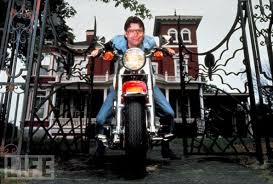
Becky, I rarely intrude on other people's threads with pictures and will be happy to delete this one after you've seen it. I just couldn't resist!
I'll probably read his latest book in November for my monthly theme read.
Becky, I rarely intrude on other people's threads with pictures and will be happy to delete this one after you've seen it. I just couldn't resist!
I'll probably read his latest book in November for my monthly theme read.
39labwriter
Hi Donna--No, please, I love the pic. Wow, I didn't know he did the promotional tours, ever. How fun that you have a signed copy. I read Insomnia but I don't remember much about it--or was that Thinner? I honestly don't know. I've probably given the impression here that I'm the biggest King fan alive; I'm actually not, but I have enjoyed some of his stuff. Misery was pretty amazing, and Kathy Bates was perfect in the movie.
40LizzieD
OH, Becky. I'm sorry that I missed your Thingaversary!! I hope it was a good one!! And I also am anxious to hear what you will treat yourself to - mine is tomorrow. Yay!
About King - I'm a closet reader who rereads The Shining from time to time and some of the other early ones. I also thought Misery was pretty amazing. My only King anecdote involves my envy of a friend who was working the late night shift at our Burger King on I-95 when King walked in. This was in the late '80's. He talked with William for a good hour or so since at that time Wm. was an aspiring writer. Amazingly generous!
About King - I'm a closet reader who rereads The Shining from time to time and some of the other early ones. I also thought Misery was pretty amazing. My only King anecdote involves my envy of a friend who was working the late night shift at our Burger King on I-95 when King walked in. This was in the late '80's. He talked with William for a good hour or so since at that time Wm. was an aspiring writer. Amazingly generous!
41catarina1
As I was scanning the intro thread, I noted your interest in geneology - which is one of mine too. How lucky you are to have a relative who has preserved papers. None of mine did, nor did they ever talk about their lives. so I'm doing this "from scratch". I did not know that the 1940 census is being released, but that makes sense. I'm eager for it too. I'll be starring your thread for any hints.
42labwriter
>41 catarina1:. Well, never say never. My mother "never" talked about any of these people in her family. I think she knew very little about them. Nor did my grandmother talk about them, nor anyone else. In fact, my mother would bemoan every single holiday because she didn't have any family. I've been using Ancestry.com for about 10 years, putting information into my family trees, hoping that this sort of "genealogy miracle" would happen to me--somehow. I thought my "miracle" was the collection of negatives I found in a ratty old box that somehow got saved when my mother threw out everything else when she moved. That was really something--I will never know how those things escaped the dust bin, both hers and her mother's.
But this new collection is amazing, and I can't even go into the convoluted way it came to me, except suffice it to say that a huge box of "stuff" sat in some guy's garage for years. He evidently didn't feel right about throwing it out, so he gave it to someone in the family who he knew has an interest in genealogy. Sadly for her, none of it had anything to do with her husband's family, but she decided to try Ancestry.com and see if she could find someone there who was connected to these people--and that someone was me. So you never know what's out there, even if no one in your family ever talked about any of it.
But this new collection is amazing, and I can't even go into the convoluted way it came to me, except suffice it to say that a huge box of "stuff" sat in some guy's garage for years. He evidently didn't feel right about throwing it out, so he gave it to someone in the family who he knew has an interest in genealogy. Sadly for her, none of it had anything to do with her husband's family, but she decided to try Ancestry.com and see if she could find someone there who was connected to these people--and that someone was me. So you never know what's out there, even if no one in your family ever talked about any of it.
43labwriter
>40 LizzieD:. Peggy, that's so cool. My closest brush with King is that my neighbor across the street was his roommate in college their freshman year. Ayuh. King used his name in one of his novels (he killed him off almost immediately), and also one time long ago the neighbor and his wife went out to dinner with "Steve." I was cross-eyed jealous, since the wife couldn't have picked King out of a lineup if her life depended on it. Heh. So I guess my anecdote involves envy as well. He ought to write a book--*Envy*-haha.
44qebo
42: Wow! I've met a couple of 4th-5th cousins through Ancestry, but nothing so... lucrative.
41: And I agree, keep asking around, and posting on Ancestry etc... Some years ago I asked my father about his mother's family, and he gave me some names, but had no idea about origins. I wrote to his cousin, the oldest of the surviving relatives in the town of interest, asking whether there were any old letters or photos etc. The cousin replied with the same names my father had already given me, nothing further, and added that he'd never cared about the past because he couldn't change it. The end, no encouragement, not the slightest expression of interest. Well... about five years later my father got a phone call from this cousin's son. The cousin had died, the son had discovered a bunch of old letters and photos, including my letter, and including several letters from the early 1900s, i.e. exactly the sort of thing I'd asked about, IN THE SAME BOX. Apparently my great-grandfather, who as far as my father knew had severed all ties to his family of origin, had actually kept up correspondence with various scattered relatives for decades, and the letters from relatives were filled with chatty anecdotes and names, enough to confirm a speculation and trace back three generations.
41: And I agree, keep asking around, and posting on Ancestry etc... Some years ago I asked my father about his mother's family, and he gave me some names, but had no idea about origins. I wrote to his cousin, the oldest of the surviving relatives in the town of interest, asking whether there were any old letters or photos etc. The cousin replied with the same names my father had already given me, nothing further, and added that he'd never cared about the past because he couldn't change it. The end, no encouragement, not the slightest expression of interest. Well... about five years later my father got a phone call from this cousin's son. The cousin had died, the son had discovered a bunch of old letters and photos, including my letter, and including several letters from the early 1900s, i.e. exactly the sort of thing I'd asked about, IN THE SAME BOX. Apparently my great-grandfather, who as far as my father knew had severed all ties to his family of origin, had actually kept up correspondence with various scattered relatives for decades, and the letters from relatives were filled with chatty anecdotes and names, enough to confirm a speculation and trace back three generations.
45ffortsa
It is quite cool to be able to go back before the people you actually knew. My relatives all came from Russia, and there are no remaining ties with that part of the world, but I do know my grandfathers' Russian names. A cousin of mine traced one branch of the family to San Francisco (we knew about them - my father had met them many years ago, but didn't maintain a connection), and then back to the shtetl in Russia.
My mother's father came from the Kiev area, and we know he had at least one niece there who survived WWII, but no contact since about 1950 or so. And everyone in between is gone now.
The best I have is one picture, without names, from Poland. I don't know who it is, or even which side of the family it belongs to. Sad, really. I'd like to know just a little.
My mother's father came from the Kiev area, and we know he had at least one niece there who survived WWII, but no contact since about 1950 or so. And everyone in between is gone now.
The best I have is one picture, without names, from Poland. I don't know who it is, or even which side of the family it belongs to. Sad, really. I'd like to know just a little.
46labwriter
>44 qebo:. That's a great story. That's the thing--sometimes you run across people who want to tell more than they know; other people are like your cousin, they say they know nothing, but they know more than they say. It was nice that he saved the letters. One of the reasons I make it a point to find everyone I can connected to my family tree is that you never know who is going to be the person in the family who has the cache of letters or pictures or whatever. Genealogists tend to be big-hearted folks, in my experience, and they like to share what they know.
>45 ffortsa:. You probably have more clues there than you think; if you really want to find out something about your family, you might consider hiring someone who is an expert in Russian genealogy. People tend to specialize that way. I suppose there are all kinds of ways to find a researcher, but if I were looking for one, I would consider going to Ancestry.com and looking into their "find an expert" section.
>45 ffortsa:. You probably have more clues there than you think; if you really want to find out something about your family, you might consider hiring someone who is an expert in Russian genealogy. People tend to specialize that way. I suppose there are all kinds of ways to find a researcher, but if I were looking for one, I would consider going to Ancestry.com and looking into their "find an expert" section.
47thornton37814
>45 ffortsa:, 46 - You can also look at the lists of professional genealogists at Association of Professional Genealogists (http://www.apgen.org), Board of Certification for Genealogists (http://www.bcgcertification.org), and the International Association for the Accreditation of Genealogists (http:/www.icapgen.org). Several of these lists allow you to search by specialty. If you are looking for Russian and/or Polish, don't forget to go a bit broader and seek "Eastern Europe" as well.
48labwriter
>47 thornton37814:. Good tips, Lori.
It's 67 degrees right now (!!) so I'm outside in the garden. Nice.
It's 67 degrees right now (!!) so I'm outside in the garden. Nice.
49labwriter
Last night I finished Finding Sand Creek, by Jerome Greene and Douglas Scott, published in 2004. This was a book about the National Park Service search to verify the location of the site of the 1864 Sand Creek Massacre. This is a fairly technical book. The subtitle is, "History, Archeology, and the 1864 Massacre Site." Congress directed the parks service to verify this site as a step towards creating a national historic site. I'm not sure who the audience for this book is. It doesn't seem to be the general reader, one who has an interest in the subject. I found it to be very dry and plodding. However, I suppose that the authors did what they set out to do, so for that reason I'll give it 3 stars instead of 2.
My disappointment with the book was with the first chapter where the authors told the story of the Sand Creek Massacre (it's been termed a "Massacre" ever since December of 1864). It seems to me that the authors had a conclusion and wrote backwards to meet that conclusion. There was no sense that their discussion was meant to be anything other than a presentation of the standard storyline that a person could get from watching the 1970 movie, Soldier Blue, the Hollywood production that came out same year that the My Lai Massacre occurred. I believe the truth of the story of Sand Creek is far more complex than the one-sided standard apologetic treatment presented here.
One place where I've found a different story of Sand Creek is in Irving Howbert's 1925 book, Memories of a Lifetime in the Pike's Peak Region. Howbert gives a 2-chapter discussion of Sand Creek, and his description of the events puts a completely different spin on what happened that day. I plan also plan to read a book by Gregory Michno, Battle at Sand Creek: The Military Perspective.
I'll say here that I don't ever expect the official standard story line to change: that the evil, stupid U.S. soldiers mindlessly butchered the kind, peaceful Native Americans. However, it's distrubing to me that Greene and Scott in this "History," which I'm sure is sold in every National Park gift shop, is so one-sided, when they had available to them hundreds of records, including first-hand accounts, that suggest to the fair-minded that there is another side to the story of Sand Creek. On second thought, I'm going to give the book 2 stars.
My disappointment with the book was with the first chapter where the authors told the story of the Sand Creek Massacre (it's been termed a "Massacre" ever since December of 1864). It seems to me that the authors had a conclusion and wrote backwards to meet that conclusion. There was no sense that their discussion was meant to be anything other than a presentation of the standard storyline that a person could get from watching the 1970 movie, Soldier Blue, the Hollywood production that came out same year that the My Lai Massacre occurred. I believe the truth of the story of Sand Creek is far more complex than the one-sided standard apologetic treatment presented here.
One place where I've found a different story of Sand Creek is in Irving Howbert's 1925 book, Memories of a Lifetime in the Pike's Peak Region. Howbert gives a 2-chapter discussion of Sand Creek, and his description of the events puts a completely different spin on what happened that day. I plan also plan to read a book by Gregory Michno, Battle at Sand Creek: The Military Perspective.
I'll say here that I don't ever expect the official standard story line to change: that the evil, stupid U.S. soldiers mindlessly butchered the kind, peaceful Native Americans. However, it's distrubing to me that Greene and Scott in this "History," which I'm sure is sold in every National Park gift shop, is so one-sided, when they had available to them hundreds of records, including first-hand accounts, that suggest to the fair-minded that there is another side to the story of Sand Creek. On second thought, I'm going to give the book 2 stars.
50alcottacre
I am sorry to hear that Finding Sand Creek was not as good a read as you had hoped, Becky. I hope that the Michno book is a better one at telling the entire story, not just a one-sided version.
51labwriter
>50 alcottacre:. Hi Stasia!
I just finished a re-read of Ethan Frome, by Edith Wharton. I've ordered Summer, since that's one of hers I haven't read. I was trying to think what else of hers I've read. Maybe The Age of Innocence, published in 1920 and winner of the Pulitz Surprise. The House of Mirth I think is another one.
Zenobia Frome is quite the character: she has always been what people call "sickly"; she talks in a flat whine, and when she speaks it's only to complain; she makes the "familiar gesture" of adjusting her false teeth before she eats; the "odd sound" coming from her is a laugh--Ethan can't ever remember hearing that before. I think her age is set as somewhere around 37 years old when the main action of the book happens, yet she has clearly made herself into an old woman. With her as his wife, Ethan Frome can't be anything but a sympathetic character, no matter what he does.
I love the whole business with the scarlet pickle dish--that's probably my favorite part of the book.
The book is an unusual departure for Wharton, depicting the Massachusetts rural working class. "Starkfield" is what she calls the town--clearly upper-class Edith doesn't find much to admire, and I'm not quite sure what she possibly could have known about such people in real life. The flat, flat characters of this story make it more of a fairy tale or allegory than a novel. Actually, it's so short, I think it could almost be classified as a novella. I think the reason this one is taught in the schools is not that it's in any way representative of Wharton's fiction, but because it's short. Don't get me wrong, it's a fine book; however, this isn't typical Wharton.
The biography of Wharton that I have on my shelf is Shari Benstock's No Gifts from Chance. I remember that it was quite good, although, published in the early 1990s, it's definitely a biography "of its time" in that Benstock's take on Wharton is strictly from a feminist perspective. Wharton's dates: 1862-1937. She was born in fashionable New York; her mother was a society matron and her father a gentleman of leisure. I think this one fits into the 3.5-star category.
I just finished a re-read of Ethan Frome, by Edith Wharton. I've ordered Summer, since that's one of hers I haven't read. I was trying to think what else of hers I've read. Maybe The Age of Innocence, published in 1920 and winner of the Pulitz Surprise. The House of Mirth I think is another one.
Zenobia Frome is quite the character: she has always been what people call "sickly"; she talks in a flat whine, and when she speaks it's only to complain; she makes the "familiar gesture" of adjusting her false teeth before she eats; the "odd sound" coming from her is a laugh--Ethan can't ever remember hearing that before. I think her age is set as somewhere around 37 years old when the main action of the book happens, yet she has clearly made herself into an old woman. With her as his wife, Ethan Frome can't be anything but a sympathetic character, no matter what he does.
I love the whole business with the scarlet pickle dish--that's probably my favorite part of the book.
The book is an unusual departure for Wharton, depicting the Massachusetts rural working class. "Starkfield" is what she calls the town--clearly upper-class Edith doesn't find much to admire, and I'm not quite sure what she possibly could have known about such people in real life. The flat, flat characters of this story make it more of a fairy tale or allegory than a novel. Actually, it's so short, I think it could almost be classified as a novella. I think the reason this one is taught in the schools is not that it's in any way representative of Wharton's fiction, but because it's short. Don't get me wrong, it's a fine book; however, this isn't typical Wharton.
The biography of Wharton that I have on my shelf is Shari Benstock's No Gifts from Chance. I remember that it was quite good, although, published in the early 1990s, it's definitely a biography "of its time" in that Benstock's take on Wharton is strictly from a feminist perspective. Wharton's dates: 1862-1937. She was born in fashionable New York; her mother was a society matron and her father a gentleman of leisure. I think this one fits into the 3.5-star category.
52alcottacre
I have not read Summer either, even though I downloaded it to my Nook at least a year ago. Thanks for the reminder that I need to get to it, Becky.
53labwriter
One of the reasons my book total was relatively low for 2011 was because I had started several doorstoppers and spent a lot of time reading them but hadn't finished any them. This is one that I've been reading since about July, and I finally finished it: In My Time: A Personal and Political Memoir, by Dick Cheney.

I like memoirs and I like politics, so I try to read political memoirs as they're published. No one will accuse Cheney of not writing this one--he writes just like he talks. He's been in Washington for 40 years, so it was interesting to follow his long career. I had forgotten all the major positions he's held in the different presidential administrations. He's an interesting fellow--the ultimate Washington insider, yet I don't think he ever lost his Wyoming roots.
The books about politics I really miss are the ones by Theodore H. White: The Making of the President series. Where's the Teddy White of our time? I read those when I was a kid, and loved reading about all of that insider stuff. I suppose they haven't stood the test of time, but generations of readers younger than me probably don't "get" to what degree those were far less cynical times--not the politicians, necessarily, but certainly Teddy White's audience.
I think I'd give this one about 3 stars. It was hard to get through, mainly because it was just so ploddingly written; however, the subject was interesting, and it was particularly interesting to see these events through Cheney's eyes.
The long "review" of this book that tops the review list at LT this morning is simply stunning--and exemplifies how much some people truly hate this man--viscerally. I wish LT would give us a "thumbs-down" option for the reviews. If they're gonna give us a thumbs-up button, then they ought to give us a thumbs-down as well.

I like memoirs and I like politics, so I try to read political memoirs as they're published. No one will accuse Cheney of not writing this one--he writes just like he talks. He's been in Washington for 40 years, so it was interesting to follow his long career. I had forgotten all the major positions he's held in the different presidential administrations. He's an interesting fellow--the ultimate Washington insider, yet I don't think he ever lost his Wyoming roots.
The books about politics I really miss are the ones by Theodore H. White: The Making of the President series. Where's the Teddy White of our time? I read those when I was a kid, and loved reading about all of that insider stuff. I suppose they haven't stood the test of time, but generations of readers younger than me probably don't "get" to what degree those were far less cynical times--not the politicians, necessarily, but certainly Teddy White's audience.
I think I'd give this one about 3 stars. It was hard to get through, mainly because it was just so ploddingly written; however, the subject was interesting, and it was particularly interesting to see these events through Cheney's eyes.
The long "review" of this book that tops the review list at LT this morning is simply stunning--and exemplifies how much some people truly hate this man--viscerally. I wish LT would give us a "thumbs-down" option for the reviews. If they're gonna give us a thumbs-up button, then they ought to give us a thumbs-down as well.
54sibylline
Wharton did spend some significant time in Western Massachusetts and W.R.B. Lewis explains that she was surprised and horrified and fascinated by the poverty and narrowness of the lives of many of the local people. I have a feeling that Frome is inspired, in part, by some story she heard -- but I'm not entirely sure about that..... Anyhow she liked to take her car way up in the hills where she'd find these hamlets and she did 'study' them as well as trying here and there to help. Summer is set in the same milieu. When James visited it drove him half-mad that she wanted to pot about like Toad in her big car all day. He loathed doing that, of course!
55labwriter
Hi Sib. Well, I'm sure Wharton "studied" these people and was also horrified and fascinated, as you say, about the poverty and "narrowness" of the lives of a class of people she could have known first-hand only from her chauffeur or maid or gardener--and then she could have known them only as employees, not as people who lived real lives. I think she was predisposed to see their "narrow' lives as bleak. She certainly succeeded with Ethan Frome.
I've read the W.R.B. Lewis, Edith Wharton: A Biography, but it's been years, probably when it first came out in paperback in 1985. (An aside, I see I gave it 5 stars when I put it into my LT library, but I didn't review the book.). She confessed to someone as being in "a state of fatuous satisfaction" over her "novelle" when she was writing Ethan Frome (297).
I've read the W.R.B. Lewis, Edith Wharton: A Biography, but it's been years, probably when it first came out in paperback in 1985. (An aside, I see I gave it 5 stars when I put it into my LT library, but I didn't review the book.). She confessed to someone as being in "a state of fatuous satisfaction" over her "novelle" when she was writing Ethan Frome (297).
56sjmccreary
Becky, are you going to post your own review of the Cheney book, to counterbalance the one already there?
57Chatterbox
All this discussion of genealogy reminds me I need to get back to my book proposal...
I had an e-mail just today from a distant cousin on my mother's side; we know we are descended from Tunis Sanders, who lived in Pennsylvania circa 1800, but where he came from we have absolutely no idea! It's interesting, while my parents know or think they know turns out to be incomplete or even quite different from reality!
I had an e-mail just today from a distant cousin on my mother's side; we know we are descended from Tunis Sanders, who lived in Pennsylvania circa 1800, but where he came from we have absolutely no idea! It's interesting, while my parents know or think they know turns out to be incomplete or even quite different from reality!
58labwriter
>56 sjmccreary:. Sandy, I don't think I'm going to review the book.
>57 Chatterbox:. Suzanne, it's so true that people often "misremember" what they're sure they know. My mother is one for telling interesting stories about her family that turn out not to be true--although they always have a germ of truth to them. She tells the story about a woman her father knew who was shot and killed, the implication being that my grandfather (or maybe even my grandmother) was responsible. I spent hours (actually years) tracking that one down, and found out that the woman was "shot by her lover" as part of a messy divorce triangle, but fortunately the man who shot her was not my grandfather. He shot himself along with her, in front of her house in broad daylight, and naturally that story made the front page of the small town paper. At least that was one of my mother's tales that I could put to rest.
>57 Chatterbox:. Suzanne, it's so true that people often "misremember" what they're sure they know. My mother is one for telling interesting stories about her family that turn out not to be true--although they always have a germ of truth to them. She tells the story about a woman her father knew who was shot and killed, the implication being that my grandfather (or maybe even my grandmother) was responsible. I spent hours (actually years) tracking that one down, and found out that the woman was "shot by her lover" as part of a messy divorce triangle, but fortunately the man who shot her was not my grandfather. He shot himself along with her, in front of her house in broad daylight, and naturally that story made the front page of the small town paper. At least that was one of my mother's tales that I could put to rest.
59labwriter
I'm reading another book about Sand Creek--Battle at Sand Creek: The Military Perspective, by Gregory Michno. Michno is clearly in the minority with his take on the affair at Sand Creek (unlike almost everyone else, he does not use the word "massacre"). He writes on this period of American history for numerous western history publications, and he's written other western histories, like Lakota Noon: The Indian Narrative of Custer's Defeat. He seems to be a guy who sincerely believes that the events at Sand Creek have never had a fair hearing; in fact, that's exactly what he says in the introduction:
The Sand Creek affair was not a stellar event in American history, but the fight, the surrounding events, and the people involved did not get a fair hearing. The perspective of this study is that of the white soldiers and civilians of Colorado Territory in the 1860s. It is not the Indian side of the story. It does not attempt to apologize for the Indians' actions. It does not attempt to condone the military actions, but it does find some justification for them. We of the 21st Century generally take a different perspective while complacently looking back in judgment through a comfortable cushion of time.I'll probably have more to say when I'm finished. I've got a ways to go yet.
If one has any regard for fair play, it is difficult to read the testimony of the Sand Creek affair without some resentment. Two Congressional investigations and a military court of inquiry were conducted after the fight. Hearsay evidence was allowed into the record, given by avowed enemies of the central figure, Col. John M. Chivington. Lt. Col. Samuel F. Tappan, Chivington's chief antagonist, sat as president in judgment over his court of inquiry. The Congressional hearings were foregone conclusions, with results established even before the hearings began. Witnesses who had the gall to speak out in favor of the Colorado soldiers were given little credence. Those who testified in favor of Chivington were called liars, while those against him were believed. Subsequently, authors and historians, having agendas of their own, used the testimony selectively, or ignored it totally, when it did not support their hypotheses.
60countrylife
Fascinating introduction. I especially liked this part: "We of the 21st Century generally take a different perspective while complacently looking back in judgment through a comfortable cushion of time." My favorite reading is historical fiction; one of my gripes is when an author does that very thing in their story, changing the realities of the past into their own vision of how-it-should-have-been.
This one sounds like a very interesting non-fiction. Can't wait to hear what you think of it.
This one sounds like a very interesting non-fiction. Can't wait to hear what you think of it.
61labwriter
I'm still reading Quiet: The Power of Introverts in a World That Can't Stop Talking, by Susan Cain. This was my ER book for November, received in December, and one that I hope to finish in January. I've had to resort to the "10 pages per day" strategy; otherwise, I don't think I would finish this thing. I want to give the book a fair reading. I think I'm having trouble with it not so much because it's not interesting, but rather because I just don't feel particularly motivated to read the book. This book might have been immeasurably helpful to me 30 or 40 years ago, but at this point, most of what she's saying is what I've been living all my life.
Who is her audience for this book? I'm not sure, but somehow I'm afraid it won't be read by people who might actually make a difference if they understood what she's talking about here. She shows clearly that group work, the kind that most of today's classrooms are so enamored with, just doesn't work all that well, regardless of whether someone is introverted or extroverted. Cain goes into great detail, citing study after study that demonstrate the reduced productivity of open-plan offices or that explain the failure of group brainstorming ("social loafing" is one of my favorite reasons why brainstorming is less effective than individual problem solving).
It's an interesting read, but I'm afraid she's preaching to the choir. Although perhaps if someone is an introverted 20-something, then what she has to say here might at least validate the feelings that introverts experience in an extroverted world. However, how we're ever going to buck the trend of groupthink in our schools or open-space offices in business is beyond me. Her discussion is found in a chapter titled, "When Collaboration Kills Creativity." I guess books like this are at least a start.
Who is her audience for this book? I'm not sure, but somehow I'm afraid it won't be read by people who might actually make a difference if they understood what she's talking about here. She shows clearly that group work, the kind that most of today's classrooms are so enamored with, just doesn't work all that well, regardless of whether someone is introverted or extroverted. Cain goes into great detail, citing study after study that demonstrate the reduced productivity of open-plan offices or that explain the failure of group brainstorming ("social loafing" is one of my favorite reasons why brainstorming is less effective than individual problem solving).
It's an interesting read, but I'm afraid she's preaching to the choir. Although perhaps if someone is an introverted 20-something, then what she has to say here might at least validate the feelings that introverts experience in an extroverted world. However, how we're ever going to buck the trend of groupthink in our schools or open-space offices in business is beyond me. Her discussion is found in a chapter titled, "When Collaboration Kills Creativity." I guess books like this are at least a start.
62ffortsa
Collaboration can kill creativity, but in my work (systems analysis and design), if the atmosphere is open-minded, I find it a great help. The challenge is getting the quiet ones to speak up - they almost always have interesting insights and ideas. I think it's because they are not as concerned to push themselves forward (my besetting sin) and thus have time to think about the issues.
So if I keep myself from dominating the conversation, I learn a lot from my quieter teammates!
So if I keep myself from dominating the conversation, I learn a lot from my quieter teammates!
63labwriter
>61 labwriter:. "The challenge is getting the quiet ones to speak up." I wonder if anyone would ever say, "The challenge is getting the pushier ones to shut up." Probably not. And I'm sure you didn't mean to be condescending: they almost always have interesting insights and ideas. {{rolls eyes}}
Cain doesn't call for an end to face to face collaboration. What she suggests is a refinement of approach: "settings in which people are free to come and go--to disappear into their own personal workspaces when they want to focus or simply be alone."
From my own experience as a dyed-in-the-wool introvert, I become extremely fatigued in meetings where I am a captive audience to extroverted blah-blah. In that environment, I simply shut myself off.
Cain doesn't call for an end to face to face collaboration. What she suggests is a refinement of approach: "settings in which people are free to come and go--to disappear into their own personal workspaces when they want to focus or simply be alone."
From my own experience as a dyed-in-the-wool introvert, I become extremely fatigued in meetings where I am a captive audience to extroverted blah-blah. In that environment, I simply shut myself off.
64qebo
61: group work
Aaaaaaaaagh! Hated it in school. Not so much because of the introvert / extrovert thing, but because if one person cares about the result, and other people don't, well, guess who does the work, and it'd be easier to do without the socializing. The claim is that it's preparation for the modern world of collaboration at work, but at at work everyone's more invested.
62: The challenge is getting the quiet ones to speak up
As one of the "quiet ones", I'll say that my trouble isn't with collaboration, I agree it can be useful, but that my style is to mull and sketch and experiment until the pieces fall together, and chatter is extremely distracting. Once I've tried this and that, and have a sense of where the problems or questions are, THEN it's useful to talk to other people. I HATE when people try to extract thoughts from me prematurely.
Aaaaaaaaagh! Hated it in school. Not so much because of the introvert / extrovert thing, but because if one person cares about the result, and other people don't, well, guess who does the work, and it'd be easier to do without the socializing. The claim is that it's preparation for the modern world of collaboration at work, but at at work everyone's more invested.
62: The challenge is getting the quiet ones to speak up
As one of the "quiet ones", I'll say that my trouble isn't with collaboration, I agree it can be useful, but that my style is to mull and sketch and experiment until the pieces fall together, and chatter is extremely distracting. Once I've tried this and that, and have a sense of where the problems or questions are, THEN it's useful to talk to other people. I HATE when people try to extract thoughts from me prematurely.
65labwriter
>64 qebo:. I agree--sometimes it's the process that gets me down more than anything. I have my own creative process, and I don't think that's something that other people should try to mess with.
I was once in an English lit class, taught by a very tough professor but one whom I liked very much, who had us all write a thesis sentence in class that we might use for a paper. This was a Jr/Sr level class, so we weren't just a bunch of freshmen learning how to write a thesis sentence. He gave us 5 minutes, and I did what I normally do when faced with a creative task--I wrote down some words, connected them in sort of a web, doodled around with that, wrote a phrase or two--and the 5 minutes were up.
Then, to my horror, he started going down the rows, having everyone read theirs. Oh the erudite, complete sentences that rolled off my fellow students' tongues. When he came to me, I'm sure the look I gave him was the deer-in-the-headlights thing. I stuttered. He said, "Read." I looked at him, and then I said, "No, I won't read this." I couldn't believe what was coming out of my mouth. This guy scared me worse than the thought of meeting St. Peter at the Pearly Gates, and here I was refusing to go along with his class plan. He kept prodding and I kept refusing. Finally, he gave up and went on to the person behind me, and she refused to read hers. Oh Snap! I wanted to disappear. He looked at me with steely eyes that told me I was a menace to his teaching process and I'd better not expect to pass his class. Fortunately, the class was soon over and I beat it out of there. I wish now instead of sitting there mute I had talked a little bit about the creative process. Haha.
I was once in an English lit class, taught by a very tough professor but one whom I liked very much, who had us all write a thesis sentence in class that we might use for a paper. This was a Jr/Sr level class, so we weren't just a bunch of freshmen learning how to write a thesis sentence. He gave us 5 minutes, and I did what I normally do when faced with a creative task--I wrote down some words, connected them in sort of a web, doodled around with that, wrote a phrase or two--and the 5 minutes were up.
Then, to my horror, he started going down the rows, having everyone read theirs. Oh the erudite, complete sentences that rolled off my fellow students' tongues. When he came to me, I'm sure the look I gave him was the deer-in-the-headlights thing. I stuttered. He said, "Read." I looked at him, and then I said, "No, I won't read this." I couldn't believe what was coming out of my mouth. This guy scared me worse than the thought of meeting St. Peter at the Pearly Gates, and here I was refusing to go along with his class plan. He kept prodding and I kept refusing. Finally, he gave up and went on to the person behind me, and she refused to read hers. Oh Snap! I wanted to disappear. He looked at me with steely eyes that told me I was a menace to his teaching process and I'd better not expect to pass his class. Fortunately, the class was soon over and I beat it out of there. I wish now instead of sitting there mute I had talked a little bit about the creative process. Haha.
66ffortsa
Well, I'd be properly shut up if that were ever entirely possible. Of course it's important to get us inveterate talkers to be quiet. And I didn't mean to be the least condescending.
Some people don't say anything because they don't have anything to say, and that's fine. They usually don't appreciate being forced to contribute, and are often embarrassed when pressed.
Then, there are plenty of people I've worked with who don't want anything to do with the creative part of the work - they just want to be given the most detailed specs possible and left alone. They're important to the outcome, but not the collaborative scene I was trying to paint.
Then there are people who are very creative, or insightful, or both, who just won't put up with the noise and push themselves forward. We people of the loud, enthusiastic persuasion have to learn that, since it's foreign to our nature. It takes some of us longer than others.
I found out just recently, in fact, that I was being much louder and pushier than I had ever imagined, because I finally had a boss who, when I asked her to describe what I did, did so in detail. I needed specifics. Although I never feel I've done anything alone, and am always eager to give and share credit, it's not always the way I am perceived. So her response was a help. It's rarely enough to tell someone to stop being pushy, if the person doesn't know how they come across, just as it's no help to tell someone to speak up, when other people don't understand the barriers they encounter.
The point about different modes of creativity is quite important, but sometimes a problem isn't suited to, or solvable by, one person alone. Not every problem is 'crowd-source-able', of course, as not every problem is resolvable by one person. Sometimes the same problem needs different methods at different stages of solution. We need to find the right fit, for people and problems.
Well, that sounds like enough defensiveness for now!
Some people don't say anything because they don't have anything to say, and that's fine. They usually don't appreciate being forced to contribute, and are often embarrassed when pressed.
Then, there are plenty of people I've worked with who don't want anything to do with the creative part of the work - they just want to be given the most detailed specs possible and left alone. They're important to the outcome, but not the collaborative scene I was trying to paint.
Then there are people who are very creative, or insightful, or both, who just won't put up with the noise and push themselves forward. We people of the loud, enthusiastic persuasion have to learn that, since it's foreign to our nature. It takes some of us longer than others.
I found out just recently, in fact, that I was being much louder and pushier than I had ever imagined, because I finally had a boss who, when I asked her to describe what I did, did so in detail. I needed specifics. Although I never feel I've done anything alone, and am always eager to give and share credit, it's not always the way I am perceived. So her response was a help. It's rarely enough to tell someone to stop being pushy, if the person doesn't know how they come across, just as it's no help to tell someone to speak up, when other people don't understand the barriers they encounter.
The point about different modes of creativity is quite important, but sometimes a problem isn't suited to, or solvable by, one person alone. Not every problem is 'crowd-source-able', of course, as not every problem is resolvable by one person. Sometimes the same problem needs different methods at different stages of solution. We need to find the right fit, for people and problems.
Well, that sounds like enough defensiveness for now!
67ffortsa
>65 labwriter: I wonder what would have happened if you had read what you'd written, saying that that was the way you generally started your thought process. Maybe he would have supported it? I would have been interested to hear what you'd come up with.
68labwriter
>66 ffortsa:. I like your points, especially the one about the same problem needing different methods at different stages of solution. I don't think you sound defensive.
The key question is: how do you tap into those people who are reticent to engage in groupthink? Agreed, there are those people who want the specs and that's it--and they code to the spec, and those aren't the people you want to enlist in the creative process.
But if someone wants to work effectively with the "quiet" creative types, how do you do that? One approach that's been shown to be effective is to work with them one-on-one, on a white board, and LISTEN to them. That requires the listener to put their ideas and prejudices on the shelf; the quiet, creative ones will find the holes in their plan if they're allowed to talk their way through it--they generally don't need the holes pointed out to them. They just need someone to listen--"just"--it's huge. Most people can't pull that off.
Unfortunately, that process takes time, and too often, the guy ("guy" is myspeak for person) with the first answer--wins.
I think people who are enthusiastic, like yourself, can be most effective with the quiet ones when they can listen and then pitch the ideas--listen, synthesize, and be a champion for the quiet, creative people. Asking an introvert to pitch his or her idea is a recipe for failure. People often make the mistake of equating the talent of the pitch with the validity of the plan.
It's been shown (and I can't cite the study, but it might be from Peopleware: Productive Projects and Teams by DeMarco and Lister) that talented people like the ones I describe who are in an environment where they are valued for their talent and not judged for not being "enthusiastic" are 2.5 times as productive as the same talented people who are more or less forced to work in a groupthink community. Environments matter.
The key question is: how do you tap into those people who are reticent to engage in groupthink? Agreed, there are those people who want the specs and that's it--and they code to the spec, and those aren't the people you want to enlist in the creative process.
But if someone wants to work effectively with the "quiet" creative types, how do you do that? One approach that's been shown to be effective is to work with them one-on-one, on a white board, and LISTEN to them. That requires the listener to put their ideas and prejudices on the shelf; the quiet, creative ones will find the holes in their plan if they're allowed to talk their way through it--they generally don't need the holes pointed out to them. They just need someone to listen--"just"--it's huge. Most people can't pull that off.
Unfortunately, that process takes time, and too often, the guy ("guy" is myspeak for person) with the first answer--wins.
I think people who are enthusiastic, like yourself, can be most effective with the quiet ones when they can listen and then pitch the ideas--listen, synthesize, and be a champion for the quiet, creative people. Asking an introvert to pitch his or her idea is a recipe for failure. People often make the mistake of equating the talent of the pitch with the validity of the plan.
It's been shown (and I can't cite the study, but it might be from Peopleware: Productive Projects and Teams by DeMarco and Lister) that talented people like the ones I describe who are in an environment where they are valued for their talent and not judged for not being "enthusiastic" are 2.5 times as productive as the same talented people who are more or less forced to work in a groupthink community. Environments matter.
69qebo
66: The point about different modes of creativity is quite important, but sometimes a problem isn't suited to, or solvable by, one person alone.
Of course. The reason there's a company is that one person can't do it alone. Components of problems may be solvable in isolation, but those components have to be coordinated. I was reacting to "The challenge is getting the quiet ones to speak up". I find it difficult, despite years of effort, to insert myself into rapid free form conversation. I'm OK if there's designated space for each person, e.g. around the room status report / concerns / questions / ideas. If there's a truly important issue that I think is being missed, and that needs a public airing, then I will wave my hand or say excuse me to get it out there. Otherwise, it's not that I'm sitting there in my own private world. I'm listening, but I haven't yet had a chance to sort through my thoughts and arrive at a statement that can be articulated on demand at that moment. After the meeting is when I can think, and then I'll have followup conversations, during which I often discover that different people have different memories of what was decided in the meeting.
65: I wish now instead of sitting there mute I had talked a little bit about the creative process.
Yeah, and maybe you would now. And one hopes that a professor would've been interested in your web of words and phrases.
Of course. The reason there's a company is that one person can't do it alone. Components of problems may be solvable in isolation, but those components have to be coordinated. I was reacting to "The challenge is getting the quiet ones to speak up". I find it difficult, despite years of effort, to insert myself into rapid free form conversation. I'm OK if there's designated space for each person, e.g. around the room status report / concerns / questions / ideas. If there's a truly important issue that I think is being missed, and that needs a public airing, then I will wave my hand or say excuse me to get it out there. Otherwise, it's not that I'm sitting there in my own private world. I'm listening, but I haven't yet had a chance to sort through my thoughts and arrive at a statement that can be articulated on demand at that moment. After the meeting is when I can think, and then I'll have followup conversations, during which I often discover that different people have different memories of what was decided in the meeting.
65: I wish now instead of sitting there mute I had talked a little bit about the creative process.
Yeah, and maybe you would now. And one hopes that a professor would've been interested in your web of words and phrases.
70Chatterbox
I tend to think out loud, which helps me sometimes to even formulate what it is that I'm thinking. What I need to realize is how that can sound to others...
My online moniker, Chatterbox, originated years ago when a headhunter warned me not to be too much of a chatterbox when I went in for an interview. I was taken aback, as I don't really think of myself as being one! If I am, it's probably partly a defense mechanism as I often feel awkward in social settings, so chatter can cover that. It's also a skill I've had to learn -- as a journalist I have to cold call interview subjects, and the way to do that that makes me more comfortable (and seems to help them as well) is to treat an interview as if it were a conversation. Which means I chatter as well as ask questions, so that the interviewee doesn't feel on the spot. But I still dread cold calling, to the point where I will procrastinate endlessly...
That said, I do feel like an introvert. An introverted Chatterbox?? Well, why not? Because someone can chat away in a social setting doesn't mean that they don't, at heart, prefer to be much less social. Often, I'm relieved to get home and be on my own, regardless of how good a time I've had. And I need lots of time on my own. I'm not at all unnerved by the fact that when I'm here in St Croix, I can end up not speaking to anyone for two or three days at a time.
My online moniker, Chatterbox, originated years ago when a headhunter warned me not to be too much of a chatterbox when I went in for an interview. I was taken aback, as I don't really think of myself as being one! If I am, it's probably partly a defense mechanism as I often feel awkward in social settings, so chatter can cover that. It's also a skill I've had to learn -- as a journalist I have to cold call interview subjects, and the way to do that that makes me more comfortable (and seems to help them as well) is to treat an interview as if it were a conversation. Which means I chatter as well as ask questions, so that the interviewee doesn't feel on the spot. But I still dread cold calling, to the point where I will procrastinate endlessly...
That said, I do feel like an introvert. An introverted Chatterbox?? Well, why not? Because someone can chat away in a social setting doesn't mean that they don't, at heart, prefer to be much less social. Often, I'm relieved to get home and be on my own, regardless of how good a time I've had. And I need lots of time on my own. I'm not at all unnerved by the fact that when I'm here in St Croix, I can end up not speaking to anyone for two or three days at a time.
71labwriter
Suzanne, I think you've just described what it means to be an introvert. It's not that introverts can't or won't speak up--they're not even necessarily "quiet." When I was on the vestry at my church, I was usually one of the most outspoken people in a 20-person group. But that sort of interaction cost me. An extrovert goes to a party, has a great time, chats with 30 or 40 people, and feels jazzed up and ready to go--batteries recharged. An introvert goes to the same party, has a great time, chats with 3 or 4 people, and then goes home where it's quiet to recharge.
72labwriter
I'm still reading Gregory Michno's Battle at Sand Creek: The Military Perspective. The detail of this book is exhausting. The book is set up like a textbook: it's oversized with small print and two columns per page, so I don't even want to think about how many tens of thousands of words I'm reading. The publisher chose to put the reference notes at the end of each page. I think for this book that was a good choice. The book is heavily referenced, and clearly Michno has done exhaustive research. I'm exhausted reading it. This book has opened my eyes about what it meant to make the choice to be a homesteader in 1864.
I'm at 240/282 after spending hours on this thing. I'm gonna need a real fluff read when I'm done with this one.
I'm at 240/282 after spending hours on this thing. I'm gonna need a real fluff read when I'm done with this one.
73labwriter
OK, so I've officially gone a little batty (I know, I've been there already for a long time) and I'm making an exception to my North and South American literature in 2012 plan--one little exception can't hurt, right? This morning I found the 75 group read of Clarissa, and I just can't pass it up. I read the Riverside abridged edition years ago and ran out when I was finished and bought the Penguin Classics edition--1499 pages worth. It's been sitting on my shelf for about 10 years, and every time I look at the thing I think--I really gotta read that one of these days.
The group read is brilliantly set up, since we are reading the letters by date, starting with Jan 10, the first letter. So we'll read slowly and steadily through this thing and finish up somewhere around Dec. 18.
If anyone is interested in joining, you can find the group read by going to the 75 Wiki page.
Now if I just don't go blind reading this darned Penguin edition. Haha.
Happy Saturday.
The group read is brilliantly set up, since we are reading the letters by date, starting with Jan 10, the first letter. So we'll read slowly and steadily through this thing and finish up somewhere around Dec. 18.
If anyone is interested in joining, you can find the group read by going to the 75 Wiki page.
Now if I just don't go blind reading this darned Penguin edition. Haha.
Happy Saturday.
75markon
Kudos to you for sticking with the Michno Sand Creek book! Sounds like there is a lot of information there.
76thornton37814
I think I've already added 2 of your Sand Creek books to my TBR list.
77labwriter

I'm giving this one 5 stars. Gregory Michno's story of the Battle of Sand Creek (aka Sand Creek Massacre) is a comprehensive history of the period surrounding 1864 and the Indian wars during that time particularly along the Santa Fe Trail through Kansas and Colorado. He comes to very different conclusions than the standard history of an event that has always been called a massacre, ever since the very first Congressional investigation that began only months after the incident. His book is exhaustively sourced with footnotes and sources on almost every page.
Politics and "a handful of vindictive little men out for revenge" plus the hyperbole of eastern newspapers ("entirely pacific Indians," "two hundred families of Cheyennes murdered without provocation"--negative publicity that was in the eastern papers less than a month after the incident) helped to bring about the Congressional inquiry. The battle took place 26 Nov 1864; by 4 Jan 1865, stories were published that the Committee on the Conduct of the War, which hadn't heard a word of evidence yet, would be investigating "a wholesale massacre of Indians in Colorado for no just cause, so far as is known at the Indian Bureau."
The Indians in the village on Sand Creek were not peaceful. They had captured and held white women and children, and the prisoners were in the village the entire time negotiations for peace were being held.
The Indians were not under the protection of the soldiers of Fort Lyon.
There is no evidence the Indians flew an American flag in their camp the morning of the battle, a "fact" that is repeated again and again to this day when the story of that day is being told.
The soldiers did not ride through the village, mowing down the sleeping Indians. Most of the fighting took place up the stream bed, up to two miles away from the village, indicating that the Indians had time to get away. If the action happened the way it is depicted in oral histories and contemporary movies, the battle wouldn't have lasted for most of one day--it would have been over in minutes.
The chiefs of the village did not die stoically, arms folded, singing their death songs in front of their lodges. The casualties on both sides (there were almost as many soldier dead and wounded as Indian--about 100 on each side, not the 500 and more Indians killed that is often offered as part of the history of that day) clearly indicate that Sand Creek was a battle, not a massacre. The Indians were outnumbered and outgunned, but they gave the Colorado Volunteers all they could ask for. A six-hour fight is no massacre. Sand Creek was more costly to the whites than 99.6% of all the other battles.
Dead Indians were mutilated. Dead soldiers were mutilated. As Michno says, "They were not acts that either side can be proud of." Relatively few of the soldiers participated--perhaps 1 to 3%, based on what was observed by those who were actually at the scene, rather than the heresay evidence accepted by the Congressional hearings.
Sand Creek was not the spark that set off 25 years of Indian warfare; 1865 was not the bloodiest year on the plains because of Indian retaliation. The most violent time on the Santa Fe Trail was in 1864, before Sand Creek.
Michno calls for a "balanced interpretation of a hard-fought battle. Let us use the opportunity to put an end to the centrifugal forces of divisiveness that grow when we express our history in terms of victims and villains."
79ffortsa
just a note on our group/solitary discussion, from the NYTImes:
http://www.nytimes.com/2012/01/15/opinion/sunday/the-rise-of-the-new-groupthink....
http://www.nytimes.com/2012/01/15/opinion/sunday/the-rise-of-the-new-groupthink....
80LizzieD
A wave as I pass by, but glad that you found a Sand Creek history that seems balanced and accurate.
I'm not even tempted to join the Clarissa group, I don't think..... That Penguin is the emperor of all, isn't it?
I'm not even tempted to join the Clarissa group, I don't think..... That Penguin is the emperor of all, isn't it?
81sibylline
79 - What a great article !- like this quote -- makes me think of LT!
"The one important exception to this dismal record is electronic brainstorming, where large groups outperform individuals; and the larger the group the better. The protection of the screen mitigates many problems of group work. This is why the Internet has yielded such wondrous collective creations. Marcel Proust called reading a “miracle of communication in the midst of solitude,” and that’s what the Internet is, too. It’s a place where we can be alone together — and this is precisely what gives it power."
Privacy AND immediate community!
"The one important exception to this dismal record is electronic brainstorming, where large groups outperform individuals; and the larger the group the better. The protection of the screen mitigates many problems of group work. This is why the Internet has yielded such wondrous collective creations. Marcel Proust called reading a “miracle of communication in the midst of solitude,” and that’s what the Internet is, too. It’s a place where we can be alone together — and this is precisely what gives it power."
Privacy AND immediate community!
82labwriter
>80 LizzieD:. Oh, Peggy, I know you're tempted....haha.
>79 ffortsa:, 81. I was reading the article and thought, Wow, that's exactly what Susan Cain says in her book, Quiet: The Power of Introverts in a World that Can't Stop Talking; then I scrolled to the bottom and realized that the article was written by Susan Cain. Ha.
>79 ffortsa:, 81. I was reading the article and thought, Wow, that's exactly what Susan Cain says in her book, Quiet: The Power of Introverts in a World that Can't Stop Talking; then I scrolled to the bottom and realized that the article was written by Susan Cain. Ha.
84ffortsa
The advantage of internet brainstorming is that everyone speaks at the same volume and no one can actually interrupt (although you can of course post in overlapping real time). The weakness of it is that when tempers do flare, it can get really ugly. On one of my financial websites, insults sometimes distract from the main discussion; the results only reveal the childishness of the posters.
85labwriter
Wow, we had a tornado warning at 3:00 a.m. last night--blasted out of bed by the sirens. That was followed by torrential rain and hail. It wasn't a good night for sleeping. I kept an eye on the TV weatherpeople and the forecast so that DH could go back to sleep--not because I'm so terribly altruistic, but mainly because once I'm awake, that's it for the night. My dogs kept me company.
I started The Janus Stone, by Elly Griffiths. This is the second book in the series with her character, forensic anthropologist Ruth Galloway. The first one is The Crossing Places. I enjoy the setting and the main character. Ruth Galloway is a 40-something single woman whose parents are something of a challenge because they've FOUND GOD. She is also challenged by her weight, bless her heart. She teaches at the University of North Norfolk and lives with her two cats on an isolated stretch of coastland called the Saltmarsh. I'm hugely enjoying this read, as I did the first one.
I started The Janus Stone, by Elly Griffiths. This is the second book in the series with her character, forensic anthropologist Ruth Galloway. The first one is The Crossing Places. I enjoy the setting and the main character. Ruth Galloway is a 40-something single woman whose parents are something of a challenge because they've FOUND GOD. She is also challenged by her weight, bless her heart. She teaches at the University of North Norfolk and lives with her two cats on an isolated stretch of coastland called the Saltmarsh. I'm hugely enjoying this read, as I did the first one.
86ChelleBearss
Sounds like a scary night! Glad you didn't end up getting a tornado!
87LizzieD
Man, I hate to hear about tornado season starting so soon. Elly Griffiths sounds good too - maybe more appealing than Richardson!
88Donna828
Hi Becky, we were supposed to get overnight thunderstorms, but nothing happened and I slept like a baby! I hate the sound of sirens in the middle of the night.
The book about The Sand Creek Massacre looks very good. Maybe one of these days...
The book about The Sand Creek Massacre looks very good. Maybe one of these days...
89labwriter
Thanks for visiting everyone. I guess the tonado conditions came from the unseasonably warm weather crashing into a cold front. I hope we're done with those for awhile--you're right, it's way too early.
>87 LizzieD:. Peggy, seriously, I love Clarissa. I read one of the abridged editions (Riverside) about 10 years ago or more for a class. It was one of those books that I hated to see end. I went right out and bought the unabridged version (1499 pages, one of those horrible Penguin Classic things with the tiny, tiny font), and it's been sitting on my shelf ever since. This group read is exactly what I've been needing to get to it. I'm a little over 50 pages into it and having no trouble remembering why I loved it. I don't know how Richardson got exactly the right bitchy/gossipy tone for Clarissa's letters, but he did.
>87 LizzieD:. Peggy, seriously, I love Clarissa. I read one of the abridged editions (Riverside) about 10 years ago or more for a class. It was one of those books that I hated to see end. I went right out and bought the unabridged version (1499 pages, one of those horrible Penguin Classic things with the tiny, tiny font), and it's been sitting on my shelf ever since. This group read is exactly what I've been needing to get to it. I'm a little over 50 pages into it and having no trouble remembering why I loved it. I don't know how Richardson got exactly the right bitchy/gossipy tone for Clarissa's letters, but he did.
90labwriter
I'm a little bit conflicted about the recent group read I joined, Clarissa. The original plan was to read and post about the letters on the same day they were written. Since the novel covers one year, January through December, that seemed like an excellent strategy. However, we quickly discovered that Clarissa spends over a fortnight with her main correspondent, Miss Howe, so for a month, from now until the 20th of February, there are no letters. It doesn't take a math whiz to figure out that if you skip an entire month of a 1500-page book, then there will be other weeks where you're going to be reading hundreds of pages at a whack.
I've got a nice start on the book--the first 60 pages flew by--so I don't want to stop for a month. Consequently, I guess I'm going to keep on reading the book, maybe take some notes, and then at the end of February see if anyone returns to the group read.
I think one of the difficult issues with this group read is that several people are reading the book on their e-readers, and they honestly didn't or don't realize the extreme length of this book. I have that problem sometimes on my Kindle. When I start out reading something, it's not always easy to tell how long the book is and how fast I'm getting through the thing. On the other hand, the font of my darned Penguin Classic edition is so small! Ach.
I've got a nice start on the book--the first 60 pages flew by--so I don't want to stop for a month. Consequently, I guess I'm going to keep on reading the book, maybe take some notes, and then at the end of February see if anyone returns to the group read.
I think one of the difficult issues with this group read is that several people are reading the book on their e-readers, and they honestly didn't or don't realize the extreme length of this book. I have that problem sometimes on my Kindle. When I start out reading something, it's not always easy to tell how long the book is and how fast I'm getting through the thing. On the other hand, the font of my darned Penguin Classic edition is so small! Ach.
91markon
Glad you had no tornado in spite of the warning Becky. And thanks for the reminder about Elly Griffiths. I need to get The Janus stone for my next long weekend.
92labwriter
>91 markon:. Hi Ardene. I'm enjoying this new Elly Griffiths, although I guess I would say that the story is somewhat on the thin side. I picture her having an outline for the main story, and then having a bit of trouble fleshing it out with a secondary story or back story for some of these characters. However, it's a nice book just to relax with and enjoy. I like her main character, forensic anthropologist Ruth Galloway. I think the reason I liked the first one better was because she emphasized the setting more. The saltmarsh of the English coast is something that is completely new to me, so I enjoyed that part of it very much. She also had some funny interactions between Ruth and her best friend. This time there's less of that interplay.
It looks as though Griffiths has been busy. She has a third one in the series, The House at Sea's End and then the fourth one, A Room Full of Bones.
It looks as though Griffiths has been busy. She has a third one in the series, The House at Sea's End and then the fourth one, A Room Full of Bones.
93thornton37814
I started The House at Sea's End today. It's the one that was just released here in the U.S.
94LizzieD
I have the same giant Penguin as you, Becky. That's why I'm daunted about giving Clarissa a try. If you keep talking about it, I may have to. I think I read a little when I bought the thing (remaindered and 50¢) and was not motivated to go on. I just can't look at it right now while I'm still doing Mama duty 2 or 3 hours a day. Oh dear. Oh dear.
95labwriter
>93 thornton37814:. Lori, I hope you like it!
>94 LizzieD:. I completely understand, Peggy, you have to be in the right frame of mind to read this book. How is your mother doing?
This book has slumped on my shelf without being opened for at least 10 years. For some reason, I just feel in the mood to get at it, and I'm finding myself having such a good time laughing at Clarissa, this young woman who thinks so highly of herself.
Clarissa and her sister Arabella don't get along, not even a little. In today's letter (that is, the letter I'm reading today, since I've abandoned the schedule of the group read since I don't want to come to a dead stop for a month), she writes to her friend, Miss Howe, that "poor Bella has, as you know, a plump, high-fed face, if I may be allowed the expression--you, I know, will forgive me for this liberty of speech sooner than I can myself"--haha.
One of the interesting challenges of the book is to figure out how Richardson wants us to view these people. So far most of the letters are written by Clarissa to her friend Miss Howe, so most of what we're getting is from Clarissa's point of view only. The trap we know we can't fall into is to take everything she says at face value--so how skeptical should we be? Richardson also gives some thumbnail sketches of the characters at the beginning of the book, and it's hard to say at this early stage how much we're meant to depend even on those. His description of Clarissa sounds suspiciously over-the-top to me:
>94 LizzieD:. I completely understand, Peggy, you have to be in the right frame of mind to read this book. How is your mother doing?
This book has slumped on my shelf without being opened for at least 10 years. For some reason, I just feel in the mood to get at it, and I'm finding myself having such a good time laughing at Clarissa, this young woman who thinks so highly of herself.
Clarissa and her sister Arabella don't get along, not even a little. In today's letter (that is, the letter I'm reading today, since I've abandoned the schedule of the group read since I don't want to come to a dead stop for a month), she writes to her friend, Miss Howe, that "poor Bella has, as you know, a plump, high-fed face, if I may be allowed the expression--you, I know, will forgive me for this liberty of speech sooner than I can myself"--haha.
One of the interesting challenges of the book is to figure out how Richardson wants us to view these people. So far most of the letters are written by Clarissa to her friend Miss Howe, so most of what we're getting is from Clarissa's point of view only. The trap we know we can't fall into is to take everything she says at face value--so how skeptical should we be? Richardson also gives some thumbnail sketches of the characters at the beginning of the book, and it's hard to say at this early stage how much we're meant to depend even on those. His description of Clarissa sounds suspiciously over-the-top to me:
Miss Clarissa Howe, a young lady of great delicacy, mistress of all accomplishments, natural and acquired, that adorn the sex, having the strictest notions of filial duty.I've decided to read one letter a day, and if the letter is short, then I'll read two. At that rate I'll finish before the end of the year, how soon before I don't honestly know.
96labwriter
I'm getting more reading done these days because it's so darned cold outside. I just finished The Janus Stone by Elly Griffiths, a good-enough read in the Ruth Galloway series. 3.5 stars
I downloaded the next one to my Kindle because I'm looking forward to a lazy Friday evening at home: The House at Sea's End.
I downloaded the next one to my Kindle because I'm looking forward to a lazy Friday evening at home: The House at Sea's End.
97alcottacre
#77: I am glad to see that Battle of Sand Creek: The Military Perspective turned out to be such a good read for you, Becky!
99labwriter
Hi Stashia & Sib!
I guess third time was a charm for the Sand Creek book. There's a professor named Carey or some such from D.U. (sorry--U of Denver) who was working back in the 1950s and 1960s who did a good deal of research about the Colorado 3rd Volunteer Cavalry--that they weren't the bar trash and misanthropes they've been made out to be. If our state university library hadn't slashed its hours to almost nothing, I'd have my hands on this guy's articles by now. Budget cuts, don't you know--and naturally they start with the library. Grrrrr.
I'm just loving Clarissa. I probably won't be able to hold myself to just one letter a day, but that doesn't seem like a problem. It's a shame that the group read already seems to have fizzled; some of them seemed far too happy about having a month off after just getting started. One of them said that he/she wanted to read more classic fiction, so this person decided to start with Clarissa--the longest novel in the English language. Maybe not the best strategy. It's too bad, because I was looking forward to reading this book with a group.
I guess third time was a charm for the Sand Creek book. There's a professor named Carey or some such from D.U. (sorry--U of Denver) who was working back in the 1950s and 1960s who did a good deal of research about the Colorado 3rd Volunteer Cavalry--that they weren't the bar trash and misanthropes they've been made out to be. If our state university library hadn't slashed its hours to almost nothing, I'd have my hands on this guy's articles by now. Budget cuts, don't you know--and naturally they start with the library. Grrrrr.
I'm just loving Clarissa. I probably won't be able to hold myself to just one letter a day, but that doesn't seem like a problem. It's a shame that the group read already seems to have fizzled; some of them seemed far too happy about having a month off after just getting started. One of them said that he/she wanted to read more classic fiction, so this person decided to start with Clarissa--the longest novel in the English language. Maybe not the best strategy. It's too bad, because I was looking forward to reading this book with a group.
101labwriter
I'm trying to figure out who has written about Clarissa in a way that I might find useful and that might make the novel more--well, more. I need a map for this book, not so that I can mindlessly follow the trails, but instead so that at least I'll know where the trails are and where they lead. Some of them will be interesting to follow and some I don't care so much about.
Terry Castle has written a book (1982) that I'd like to get my hands on called Clarissa's Ciphers, although a used copy at Amazon is over $100. Our library doesn't have it, but I guess I could get it through interlibrary loan. Maybe the university library has it, I would hope so, although {see post #99}.
Here's a quote from the dustjacket: "All the letter writers are engaged in a continual process of interpretation, attempting, through the letters, to impose their own constructions of events on others." That point of view seems exactly right to me.
Richardson seems largely to disappear into these letters--there is no authorial comment, except what the reader is able to construct for herself. Someone else has called it "unsupervised" reading that gives the reader final responsibility for resolving or construing meaning.
I just found a cheap used copy of another book that sounds interesting: The Paradox of Privacy: Epistolary Form in Clarissa by Christina Marsden Gillis. This is another one published sometime in the 1980s, when there seems to have been something of a Clarissa critical resurgence--or insane blowout, depending on your point of view. "Christina Gillis carefully teases out the writer-to-recipient-to-reader relation in this strange epistolary world, seeking authenticity {or how about "authority"} in a bewilderment of text.
This is good, what looks like a thoughtful and intelligent website of commentary about studies of Clarissa.
Here's a comment I like and intend to try to keep in mind.
Terry Castle has written a book (1982) that I'd like to get my hands on called Clarissa's Ciphers, although a used copy at Amazon is over $100. Our library doesn't have it, but I guess I could get it through interlibrary loan. Maybe the university library has it, I would hope so, although {see post #99}.
Here's a quote from the dustjacket: "All the letter writers are engaged in a continual process of interpretation, attempting, through the letters, to impose their own constructions of events on others." That point of view seems exactly right to me.
Richardson seems largely to disappear into these letters--there is no authorial comment, except what the reader is able to construct for herself. Someone else has called it "unsupervised" reading that gives the reader final responsibility for resolving or construing meaning.
I just found a cheap used copy of another book that sounds interesting: The Paradox of Privacy: Epistolary Form in Clarissa by Christina Marsden Gillis. This is another one published sometime in the 1980s, when there seems to have been something of a Clarissa critical resurgence--or insane blowout, depending on your point of view. "Christina Gillis carefully teases out the writer-to-recipient-to-reader relation in this strange epistolary world, seeking authenticity {or how about "authority"} in a bewilderment of text.
This is good, what looks like a thoughtful and intelligent website of commentary about studies of Clarissa.
Here's a comment I like and intend to try to keep in mind.
People seek to validate present experience by citing role models. This seems to me to distort the writer's original intentions, which I am chary of. It often seems to me the reading is highly anachronistic; we are turning the text into one we would prefer rather than what is there. I do not believe we should judge books by whether we think they condone immoral or moral behavior which really is a matter of deciding whether a book is great in accordance whether it presents behavior we like or can identify with, a vision that is congenial to us.
102labwriter
>100 sibylline:. No, no, not impossibly long. You've read In Search of Lost Time (7 volumes), right? Well, Richardson's book was published, I think, in 9 volumes. It's like reading a long series--most of us have the patience to read 8 or 10 volumes of a series by an author we enjoy, right? Well, think of it that way. Or at least that's another way of looking at it.
The Penguin Classic edition is evidently printed from the first "and most concise" edition. There's an argument to be made that it should be read in the (longer) third edition. Sigh.
Here's another quote from the commentary website I found that I like: "I think the danger for the twentieth century reader, especially in reading the book a second time, is to be too rigorously suspicious of Clarissa." The commenter says that Terry Castle's book is a "helpful antidote" for that tendency.
I hope people don't get too bored with my overlong Clarissa notes. Maybe I should put something like Clarissa Warning at the top of the posts where I discuss reading the book.
The Penguin Classic edition is evidently printed from the first "and most concise" edition. There's an argument to be made that it should be read in the (longer) third edition. Sigh.
Here's another quote from the commentary website I found that I like: "I think the danger for the twentieth century reader, especially in reading the book a second time, is to be too rigorously suspicious of Clarissa." The commenter says that Terry Castle's book is a "helpful antidote" for that tendency.
I hope people don't get too bored with my overlong Clarissa notes. Maybe I should put something like Clarissa Warning at the top of the posts where I discuss reading the book.
103sibylline
I, for one, won't be bored, so write on!
Had to come back here to fix a weird typo.... sometimes my fingers seem to write something quite different from what I am intending them to write!
Had to come back here to fix a weird typo.... sometimes my fingers seem to write something quite different from what I am intending them to write!
104labwriter
OK, well, thanks Sib. I sort of like the idea of the Clarissa Warning though.
Someone at the website (I guess they're going to be my "virtual group" to replace the people of the LT group read) asks the question early on, "Who do we sympathize with?" What a great question. I think perhaps the reason people are "overly suspicious" of Clary is because when you read the book a first time, probably the tendency is to give her too much of a pass--too much authority for telling "the truth" about her family in these early letters. The book definitely benefits from close reading (which is why reading the book in "real time" is a great idea, although not if you use the down time just to go away, which evidently is what most in the group are planning to do).
I think that's a good question to moodle around with while I go do my Saturday cooking.
Happy Saturday everyone!
Someone at the website (I guess they're going to be my "virtual group" to replace the people of the LT group read) asks the question early on, "Who do we sympathize with?" What a great question. I think perhaps the reason people are "overly suspicious" of Clary is because when you read the book a first time, probably the tendency is to give her too much of a pass--too much authority for telling "the truth" about her family in these early letters. The book definitely benefits from close reading (which is why reading the book in "real time" is a great idea, although not if you use the down time just to go away, which evidently is what most in the group are planning to do).
I think that's a good question to moodle around with while I go do my Saturday cooking.
Happy Saturday everyone!
105LizzieD
I'm not bored, but I don't know how much longer I can read this good stuff about Clarissa without joining in - and I wouldn't do you any good, Becky, because you're way ahead and I'm not likely to read even a letter a day. I want to read other things more, but you are awfully tempting. And I just finished one, so now would be a good time to start in theory. Oh shoot.
106labwriter
Peggy, I love you, you're so conflicted. It's OK not to start and to read it another time. Although I really am reading at a rather glacial pace here. If you have a couple of hours, maybe even less, you could catch up. I'm betting that if you were to give the book an hour or so, you would be hooked.
I just came here to say, as I'm planning my football TV-watching finger food for tomorrow, that anyone is invited to comment here about Clarissa--or anything else, for that matter.
I just came here to say, as I'm planning my football TV-watching finger food for tomorrow, that anyone is invited to comment here about Clarissa--or anything else, for that matter.
107labwriter
I just came here to say that I'm hugely enjoying my third Elly Griffiths, The House at Sea's End. In this one instead of going straight for the story of the mystery and giving us pretty much nothing else, like she did in her second one, The Janus Stone, she's sort of all over the place and making the story more complex, which I appreciate. Anyway, that's my nighttime read, and it's good to have a book to relax with that I'm enjoying this much.
I'm still trying to finish Quiet: The Power of Introverts in a World that Can't Stop Talking, by Susan Cain. I'm obliged to read and review this book because it's an ER book. It's an interesting subject, and she's done a fine job of setting out many of the issues ("Is Temperament Destiny"; "Beyond Temperament" are the two chapters I'm trying to get through at the moment). However, anyone picking this one up and expecting an anecdote-filled, easy, self-help read will be disappointed. Frankly I'm finding it a bit of a slog, although I hate to say that. One of the blurbs on the back of the book is from Naomi Wolfe (The Beauty Myth), who calls the book a "readable page-turner." That's pretty much exactly what I wouldn't call this book, although I think it's an important book with good information. I also think it will be the kind of book that people will buy and even praise, but they won't necessarily read.
I'm still only at 125/261, so that's not even halfway yet, which is pretty discouraging. I'm starting to get that feeling: "Life is too short." When I'm forcing myself to read it, then I like it well enough. Maybe this is the sort of book that would do well if used as a textbook. I seem to lack the motivation to get through this thing.
I'm still trying to finish Quiet: The Power of Introverts in a World that Can't Stop Talking, by Susan Cain. I'm obliged to read and review this book because it's an ER book. It's an interesting subject, and she's done a fine job of setting out many of the issues ("Is Temperament Destiny"; "Beyond Temperament" are the two chapters I'm trying to get through at the moment). However, anyone picking this one up and expecting an anecdote-filled, easy, self-help read will be disappointed. Frankly I'm finding it a bit of a slog, although I hate to say that. One of the blurbs on the back of the book is from Naomi Wolfe (The Beauty Myth), who calls the book a "readable page-turner." That's pretty much exactly what I wouldn't call this book, although I think it's an important book with good information. I also think it will be the kind of book that people will buy and even praise, but they won't necessarily read.
I'm still only at 125/261, so that's not even halfway yet, which is pretty discouraging. I'm starting to get that feeling: "Life is too short." When I'm forcing myself to read it, then I like it well enough. Maybe this is the sort of book that would do well if used as a textbook. I seem to lack the motivation to get through this thing.
108sibylline
Too bad about the Cain -- I am a bit curious though as to what she is saying in all these chapters...... I get the feeling you aren't reading anything that surprises you much, thus the lack of engagement???
I fixed my strange typo up there in my last comment.....
I fixed my strange typo up there in my last comment.....
109labwriter
>107 labwriter:. Hi Sib. Maybe it's because I'm waiting for the other shoe to drop. Somehow I'm just sure that she's going to conclude that yes, you really can change yourself to adapt to an extroverted world, and here's how. Maybe that's unfair. Maybe that's not where she's going with this. It just feels that way.
110labwriter
>107 labwriter:. What does Cain have to say? Well, in the chapter about "Why Cool Is Overrated" (using as her comparison examples, FDR and Eleanor), she sites the work of Dr. Elaine Aron, a research psychologist, whose work on sensitivity (sometimes called "negativity" or "inhibition" by other researchers) is "very new." Here's one of her conclusions: "Sensitive types think in an unusually complex fashion. It also helps explain why they're so bored by small talk." My reaction to that is: Well, duh.
Maybe she's written this book to explain introverts to the world, rather than to explain introverts to themselves. If that's the case, few will care. I think her best audience will be young introverts for whom her information is a revelation.
Maybe she's written this book to explain introverts to the world, rather than to explain introverts to themselves. If that's the case, few will care. I think her best audience will be young introverts for whom her information is a revelation.
111labwriter
I made this recipe today for those in the family who are sitting in front of the football games on TV. There was a fight over this food--I'm not kidding. If you have teenagers, make this the next time a group of them congregate at your house. You will be a hero.
This is from My Mother's Southern Kitchen, by James Villas and his mother, Martha Pearl Villas.
Paper-Bag Barbecued Chicken
The bbq sauce for this recipe is thick and delicious. The chicken cooks in a paper bag for an hour and a half at 400 degrees. It's the best food I've had in ages. The only time I shop at Whole Foods is to buy chicken.

Out of the oven. Make sure you supervise the platter, or the chicken will disappear. Well, it will disappear anyway. I recommend lottery tickets.

This is from My Mother's Southern Kitchen, by James Villas and his mother, Martha Pearl Villas.
Paper-Bag Barbecued Chicken
The bbq sauce for this recipe is thick and delicious. The chicken cooks in a paper bag for an hour and a half at 400 degrees. It's the best food I've had in ages. The only time I shop at Whole Foods is to buy chicken.
Out of the oven. Make sure you supervise the platter, or the chicken will disappear. Well, it will disappear anyway. I recommend lottery tickets.
112labwriter
I finished the third Elly Griffiths book, The House at Sea's End. It was another solid effort from her, worth spending time with if you're looking for an entertaining read. I still like her main character, 40-something Ruth Galloway, whose life in this book has become immensely more complicated, but mainly in a good way (no, she doesn't get a new puppy--haha). My favorite character in this series is Ruth's good friend Cathbad, a self-styled Druid, amateur archeologist, and sensitive soul who wears a purple cape and shows up at the most improbably right times. I wish she would let Cathbad have a more front-and-center role in a future book. Anywho, it gets 3.5 from me.
January is my month for trying to finish books that have been lingering on my desk since the fourth quarter of 2011. One of those is a memoir by Condoleezza Rice, Extraordinary, Ordinary People: A Memoir of Family. Born in 1954, Rice grew up in Birmingham, Alabama and lived there during the dark days of the church bombings in the early 1960s. Her parents were both educators, and they quite literally gave their only child every advantage. At one point in the book when they were living in Denver where he father was an assistant dean at the University of Denver, she says that someone he worked with encouraged him to buy a house. His reply: "Condoleezza is our house." No kidding. Her parents took out a $13,000 loan for a grand piano for their daughter at about the same time my parents took out a comparable loan for a house. Her story is quite interesting. She says her father was a Republican because the Democrats in Jim Crow Alabama in 1952 would not register him to vote. The Republicans did.
January is my month for trying to finish books that have been lingering on my desk since the fourth quarter of 2011. One of those is a memoir by Condoleezza Rice, Extraordinary, Ordinary People: A Memoir of Family. Born in 1954, Rice grew up in Birmingham, Alabama and lived there during the dark days of the church bombings in the early 1960s. Her parents were both educators, and they quite literally gave their only child every advantage. At one point in the book when they were living in Denver where he father was an assistant dean at the University of Denver, she says that someone he worked with encouraged him to buy a house. His reply: "Condoleezza is our house." No kidding. Her parents took out a $13,000 loan for a grand piano for their daughter at about the same time my parents took out a comparable loan for a house. Her story is quite interesting. She says her father was a Republican because the Democrats in Jim Crow Alabama in 1952 would not register him to vote. The Republicans did.
113sibylline
I am going to try this recipe next time I cook a chicken. Thank you thank you, it looks fantastic.
114labwriter
>113 sibylline:. That chicken is so easy, and yet I guarantee you will get high praise. Be sure to secure the top of the bag with a scewer skewer (I knew that word didn't look right). I used a piece of metal clothes hanger. And Martha Pearl says: Don't even think about opening the bag until it's done. Also, the bag looks greasy because you have to grease the inside of the bag before putting the chicken in the bag. Otherwise, you'll end up with a messy bunch of chicken bits stuck to the bag. I used Martha Pearl's favorite, Crisco.
115labwriter
I'm checking out a book that Peggy gave me a heads up on the other day, on sale at {{the store that cannot here be named}} for about 95 cents, I think, downloaded to the Kindle: The Fall of the Roman Empire: A New History of Rome and the Barbarians, by Peter Heather. The hardback edition is 608 pages, so that doesn't seem exceptionally burdensome for a book of this type. I'm just sort of in the mood for this kind of thing. It's too cold to even think about working outside.
I was a bit concerned when I saw in the front a list of maps. That's the sort of book I tend to avoid reading on the Kindle, because I'm a very visual person and I love maps and they tend to be too small to be useful on an e-reader. However, the price is right for this thing, so I can't be too picky. I can always find the maps or something like it online.
If it seems readable, I may give it a whirl.
I was a bit concerned when I saw in the front a list of maps. That's the sort of book I tend to avoid reading on the Kindle, because I'm a very visual person and I love maps and they tend to be too small to be useful on an e-reader. However, the price is right for this thing, so I can't be too picky. I can always find the maps or something like it online.
If it seems readable, I may give it a whirl.
116sibylline
I love your new photograph. I was just reading about Nome Alaska where they were running out of fuel oil. They are having a terrible winter out there, while so far ours has been (relatively) mild - temps up and down but so little snow.... (I'm knocking wood and all those things as I write!).
117PaulCranswick
Becky, still salivating over your chicken. Just delurking to say how much I am enjoying your thread.
118labwriter
Hi Paul, thanks for visiting. I was just over at your thread and it was so much like every extroverted party I've ever been to that my head began to spin and I had to leave--haha.
Reporting in on Clarissa--I'm still managing to read a letter every morning, which is working out pretty well. My website virtual friends, after much back and forth, have decided that the most probable year that Richardson had in mind for his book seems to be 1732 (the book was published in 1748).
Here's the full title of Richardson's book, in case you're interested: Clarissa or, the History of a Young Lady: Comprehending the Most Important Concerns of Private Life and Particularly Showing the Distresses that May Attend the Misconduct Both of Parents and Children, in Relation to Marriage.
Wow, that's a mouthful.
I'm at 145/261 of my ER book for November, Quiet: The Power of Introverts in a World That Can't Stop Talking, by Susan Cain. Very discouraging. My goal was/is to finish this thing before the end of January and get it off my desk (I almost wrote off my back). I don't think I'm going to do the ER book thing again very soon. I haven't enjoyed this book, probably wouldn't have finished it, yet feel obliged to finish it and review it because it's an ER. I'm constitutionally incapable of skimming books, so that's not an option.
And last night I started a very small book, a monograph titled Why Read Moby-Dick by Nathaniel Philbrick, which as far as I'm concerned could be subtitled Why Jab Yourself in the Eye Several Times a Day with a Sharp Stick. Philbrook's book is OK, and probably will give the first-time reader some insights into what Melville was trying to do. I do think he's a little bit over-the-moon on the whole thing. I agree with him when he says that among the handful of novels that are considered American classics, Moby-Dick is probably the most reluctantly read. I've read it twice: once when I was 19 in a freshman seminar (which doesn't count--I was completely taken with the blue eyes of the grad student who was teaching our small group and that's all I remember about the class) and then again about 15 or 20 years ago with Dr. Dick Cook, in whose class I made the very dumb rookie mistake of a student letting a professor know she doesn't like the book (as in, "Your baby is ugly"), and he therefore proceeded to make my life a living hell throughout the whole experience. Although thumbing through the book I used for Dr. Dick Cook's class, it appears that I was quite engaged--but probably only out of a sense of self-preservation. So maybe I haven't exactly given the book a good try. Since 2012 is supposed to be my second year of focusing on AmLit, then sometime in this year, a re-read of MD is a must. Oh woe.
Haha--I just noticed this from Philbrook: "It is too long and too maddeningly digressive to be properly appreciated by a sleep-deprived adolescent. . . . The book is so encyclopedic and detailed that space aliens could use it to re-create the whale fishery as it once existed on the planet Earth in the middle of the nineteenth century." Amen to that, brother.
I'm thinking about starting this thing in July, maybe. No way can I do this in the dead of winter. I need sunshine to get myself through this book.
Reporting in on Clarissa--I'm still managing to read a letter every morning, which is working out pretty well. My website virtual friends, after much back and forth, have decided that the most probable year that Richardson had in mind for his book seems to be 1732 (the book was published in 1748).
Here's the full title of Richardson's book, in case you're interested: Clarissa or, the History of a Young Lady: Comprehending the Most Important Concerns of Private Life and Particularly Showing the Distresses that May Attend the Misconduct Both of Parents and Children, in Relation to Marriage.
Wow, that's a mouthful.
I'm at 145/261 of my ER book for November, Quiet: The Power of Introverts in a World That Can't Stop Talking, by Susan Cain. Very discouraging. My goal was/is to finish this thing before the end of January and get it off my desk (I almost wrote off my back). I don't think I'm going to do the ER book thing again very soon. I haven't enjoyed this book, probably wouldn't have finished it, yet feel obliged to finish it and review it because it's an ER. I'm constitutionally incapable of skimming books, so that's not an option.
And last night I started a very small book, a monograph titled Why Read Moby-Dick by Nathaniel Philbrick, which as far as I'm concerned could be subtitled Why Jab Yourself in the Eye Several Times a Day with a Sharp Stick. Philbrook's book is OK, and probably will give the first-time reader some insights into what Melville was trying to do. I do think he's a little bit over-the-moon on the whole thing. I agree with him when he says that among the handful of novels that are considered American classics, Moby-Dick is probably the most reluctantly read. I've read it twice: once when I was 19 in a freshman seminar (which doesn't count--I was completely taken with the blue eyes of the grad student who was teaching our small group and that's all I remember about the class) and then again about 15 or 20 years ago with Dr. Dick Cook, in whose class I made the very dumb rookie mistake of a student letting a professor know she doesn't like the book (as in, "Your baby is ugly"), and he therefore proceeded to make my life a living hell throughout the whole experience. Although thumbing through the book I used for Dr. Dick Cook's class, it appears that I was quite engaged--but probably only out of a sense of self-preservation. So maybe I haven't exactly given the book a good try. Since 2012 is supposed to be my second year of focusing on AmLit, then sometime in this year, a re-read of MD is a must. Oh woe.
Haha--I just noticed this from Philbrook: "It is too long and too maddeningly digressive to be properly appreciated by a sleep-deprived adolescent. . . . The book is so encyclopedic and detailed that space aliens could use it to re-create the whale fishery as it once existed on the planet Earth in the middle of the nineteenth century." Amen to that, brother.
I'm thinking about starting this thing in July, maybe. No way can I do this in the dead of winter. I need sunshine to get myself through this book.
119sjmccreary
#118 Not even if the dead of winter feels depressingly like spring? Love the snowy picture up top. Wish WE were getting that weather! (Although those heavy, gloomy clouds would only be tolerated for a day or two before the sun must come out again.)
Moby Dick is the one book that I've always felt I ought to read. I've begun it twice, I think, but reading it alone - as opposed as for an assignment in class - I've never made it very far before running out of steam. Maybe one of these years.
Moby Dick is the one book that I've always felt I ought to read. I've begun it twice, I think, but reading it alone - as opposed as for an assignment in class - I've never made it very far before running out of steam. Maybe one of these years.
120PaulCranswick
Becky - hahaha ~ please take a deep breath and try again....you'll find we are very friendly over at my place; books even get the occasional mention!
121sibylline
Didn't Woody Allen make a whole movie about a fellow who is either avoiding or pretends to have read Moby Dick?????
I love Melville's OTHER novels -- Omoo and Typee are great reads and I think help whet the appetite and prepare one for the rigors of MD. The thing is to read all the whaling stuff very very very fast, sort of squinting a little. A lot like the battles in War and Peace? What fascinates me is that these writers get away with what is basically considered a fictional no-no, interrupting the narrative with a lot of boring stuff!
I love Melville's OTHER novels -- Omoo and Typee are great reads and I think help whet the appetite and prepare one for the rigors of MD. The thing is to read all the whaling stuff very very very fast, sort of squinting a little. A lot like the battles in War and Peace? What fascinates me is that these writers get away with what is basically considered a fictional no-no, interrupting the narrative with a lot of boring stuff!
122labwriter
>119 sjmccreary:. Hi Sandy. I guess those gloomy clouds are pretty much always with them, at least during what passes for winter out there. Last year my brother went to Hawaii for a couple of weeks, and he said it was the first time in 20 years that he's really been warm. I guess they can tolerate rainy, perpetually overcast, and "never warm," but snow seems to send them into crazyville. My brother is always throwing their "nice" weather up to me in the winter when we're having ice and snow. This year the snowshoe is definitely on the other foot.
>120 PaulCranswick:. Will do!
>121 sibylline:. Sib, you made me google Woody Allen to find out. He said that he was reading Moby-Dick while he was in Budapest filming Love and Death, which is of course his satire of Russian literature. He says he would go back to his hotel every evening, and since there was nothing to do in Budapest, he spent the time reading Moby-Dick, and says he loved the book.
Although he was obviously having some fun with the media one day in an interview:
Interviewer: If you could live your life over again, Mr. Allen, what would you do differently?
Woody Allen: I wouldn't read Moby-Dick. Probably his real answer would be, "I wouldn't do interviews with idiots like you."
I think the one you're thinking of is Zelig (1983) about a guy who has been a chameleon ever since he first lied about having read Moby-Dick just so he could fit in at a party. I haven't seen that one, but it's the one where he uses all the real footage, like a documentary.
>120 PaulCranswick:. Will do!
>121 sibylline:. Sib, you made me google Woody Allen to find out. He said that he was reading Moby-Dick while he was in Budapest filming Love and Death, which is of course his satire of Russian literature. He says he would go back to his hotel every evening, and since there was nothing to do in Budapest, he spent the time reading Moby-Dick, and says he loved the book.
Although he was obviously having some fun with the media one day in an interview:
Interviewer: If you could live your life over again, Mr. Allen, what would you do differently?
Woody Allen: I wouldn't read Moby-Dick. Probably his real answer would be, "I wouldn't do interviews with idiots like you."
I think the one you're thinking of is Zelig (1983) about a guy who has been a chameleon ever since he first lied about having read Moby-Dick just so he could fit in at a party. I haven't seen that one, but it's the one where he uses all the real footage, like a documentary.
124sjmccreary
#122 I've heard that gloomy cloudy skies are normal for that area. I doubt I could stand it for long. I need to see the sun at least every 3rd day! I've heard that Seattle has the highest suicide rate in the country and it wouldn't surprise me if it were true. So even though we're not getting much cold this winter, at least we have the sun so I'll stop complaining.
Have a wonderful Thursday, Becky.
Have a wonderful Thursday, Becky.
125labwriter
I finished up a couple of books last night.
I've been reading this one off and on since about November: Extraordinary, Ordinary People: A Memoir of Family, by Condoleezza Rice. I was surprised that Rice's writing wasn't better. Maybe that's not fair. I think I already said on the thread somewhere that she admits she's never been much of a reader. Reading and writing go hand in hand, so I'm not hugely surprised, I guess, that the writing for this book is just so-so. She has a very strong "I" voice in this book. What comes through to me most is that she seems to have a huge sense of entitlement, which clearly was instilled in her by her parents who literally gave over their lives to their only child. She never married, so her sense of "family" never changed--she was always at the center of a very tight threesome. I don't know how many grown women continue to call their fathers "Daddy" throughout their adult lives. Condoleezza did; my sister-in-law did. Maybe that comparison colors my opinion of Rice a little bit--as long as her father was alive, DH's sister was always "Princess Pat" in the family; she was the apple of "Daddy's" eye. I gave the book 3 stars. It was an interesting read, seeing how she went from a child of the 1950s, growing up in segregated Birmingham, Alabama, to earning a PhD in International Affairs, or whatever it was, to being a tenured professor at Stanford, to being part of the National Security Council for GHWBush's administration, to being provost at Standford, and then continuing on as part of George Bush's presidential campaign staff and then Sec. State, etc. Quite a resume.
I also finished a short book called Why Read Moby-Dick?, by Nathaniel Philbrick. I gave this one 2 stars. Nat (which is what he calls himself on his blog) couldn't seem to decide (or maybe I was the one who couldn't decide) who his audience was for this thing: someone who has already read the book and agrees that this is the GREATEST CLASSIC EVAH; someone who needs to be encouraged to read the book but who might be scared away by what they've heard about it; or someone who would never, ever think of reading the book, but by reading his 127 pages will feel like they've read the book and can therefore check it off the list. That last one sounds about right.
Can you tell I didn't like it much? Actually, I think the best audience for this thing is probably the person who has never read the book and who needs some encouragement. The problem with that is that Nat has included several serious spoilers throughout this thing. Now maybe he thinks that no one would ever come to the book without knowing the basics of the plot--I really don't know. Anyone who wants to read the book, hasn't read it yet, and is sensitive to spoilers, should definitely not read Nat's book. Unfortunately, he doesn't mention anywhere that he's going to tell you all the basic plot points before he does it. So I'm guessing his real audience for this book is someone who had the book inflicted on them when they were very young and therefore needs some coaxing to try the book again.
As an aside, Philbrick is the author of Mayflower: A Story of Courage, Community, and War. I got about halfway through that book, I think it was in 2010, and I set it aside. I didn't realize he was the same Philbrick until I got the MD book in the mail.
Oh, and P.S. I'm sorry to say that I feel less motivated to read Moby-Dick after reading this book.
I've been reading this one off and on since about November: Extraordinary, Ordinary People: A Memoir of Family, by Condoleezza Rice. I was surprised that Rice's writing wasn't better. Maybe that's not fair. I think I already said on the thread somewhere that she admits she's never been much of a reader. Reading and writing go hand in hand, so I'm not hugely surprised, I guess, that the writing for this book is just so-so. She has a very strong "I" voice in this book. What comes through to me most is that she seems to have a huge sense of entitlement, which clearly was instilled in her by her parents who literally gave over their lives to their only child. She never married, so her sense of "family" never changed--she was always at the center of a very tight threesome. I don't know how many grown women continue to call their fathers "Daddy" throughout their adult lives. Condoleezza did; my sister-in-law did. Maybe that comparison colors my opinion of Rice a little bit--as long as her father was alive, DH's sister was always "Princess Pat" in the family; she was the apple of "Daddy's" eye. I gave the book 3 stars. It was an interesting read, seeing how she went from a child of the 1950s, growing up in segregated Birmingham, Alabama, to earning a PhD in International Affairs, or whatever it was, to being a tenured professor at Stanford, to being part of the National Security Council for GHWBush's administration, to being provost at Standford, and then continuing on as part of George Bush's presidential campaign staff and then Sec. State, etc. Quite a resume.
I also finished a short book called Why Read Moby-Dick?, by Nathaniel Philbrick. I gave this one 2 stars. Nat (which is what he calls himself on his blog) couldn't seem to decide (or maybe I was the one who couldn't decide) who his audience was for this thing: someone who has already read the book and agrees that this is the GREATEST CLASSIC EVAH; someone who needs to be encouraged to read the book but who might be scared away by what they've heard about it; or someone who would never, ever think of reading the book, but by reading his 127 pages will feel like they've read the book and can therefore check it off the list. That last one sounds about right.
Can you tell I didn't like it much? Actually, I think the best audience for this thing is probably the person who has never read the book and who needs some encouragement. The problem with that is that Nat has included several serious spoilers throughout this thing. Now maybe he thinks that no one would ever come to the book without knowing the basics of the plot--I really don't know. Anyone who wants to read the book, hasn't read it yet, and is sensitive to spoilers, should definitely not read Nat's book. Unfortunately, he doesn't mention anywhere that he's going to tell you all the basic plot points before he does it. So I'm guessing his real audience for this book is someone who had the book inflicted on them when they were very young and therefore needs some coaxing to try the book again.
As an aside, Philbrick is the author of Mayflower: A Story of Courage, Community, and War. I got about halfway through that book, I think it was in 2010, and I set it aside. I didn't realize he was the same Philbrick until I got the MD book in the mail.
Oh, and P.S. I'm sorry to say that I feel less motivated to read Moby-Dick after reading this book.
126labwriter
After reading Philbrick's book, I was happy to go back to the West, so I picked up a sort of strange biography, Billy the Kid: A Short and Violent Life, by Robert M. Utley. I have absolutely no idea where, when, or why I bought this book, but it's been sitting on my shelf for awhile now. I've been working with some papers that are from my gggrandfather, Alonzo Baxter, an original homesteader in Colorado. His son George mentions that he remembers the day that Billy the Kid rode through the town that was near their ranch. I checked the dates to see if that was even possible. The Kid died in New Mexico in 1881 at the age of 21 (thus the "Short" of the title). George would have been about 10 years old in 1881. People were always traveling from that part of Colorado to Santa Fe, since their ranch was within a rock's throw of the Santa Fe Trail. So yeah, I guess it's possible that George could have a memory of Billy the Kid riding through the area.
I picked up the book with zero expectations, and to my delight I found that Robert M. Utley tells a great story.
As an aside, Philbrick gets the West completely wrong in his book: "We Americans love our wilderness: that empty space full of beckoning dreams, the unknown land into which we can disappear, only to return years later, wiser, careworn, and rich." Seriously? Maybe that's your family's experience of the West, Nat, but it's not mine. Maybe you should either read a book about something West of the Mississippi, or, failing that, you should stick to writing about Nantucket.
Here's a photo of a group in Prowers County, Colorado, c.1891. George Baxter is the handsome one sitting in the back row, the one with the dark hat, dark shirt, and attitude. Hey Nat, do these people look careworn and rich to you?? The only thing I can't figure out is this: where are their guns and why would they take a picture without them? I hope to learn the story of this photo one of these days.
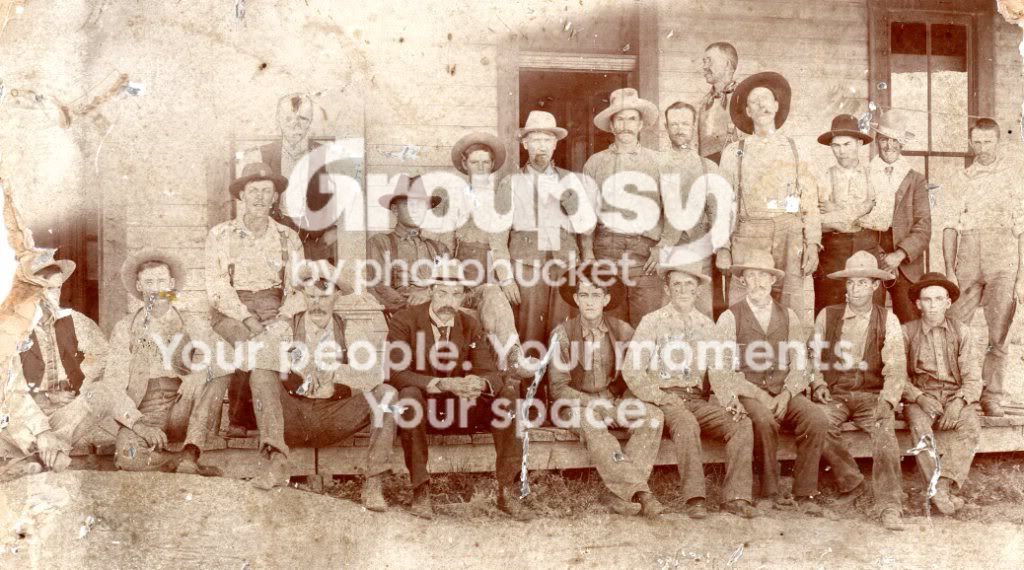
I picked up the book with zero expectations, and to my delight I found that Robert M. Utley tells a great story.
As an aside, Philbrick gets the West completely wrong in his book: "We Americans love our wilderness: that empty space full of beckoning dreams, the unknown land into which we can disappear, only to return years later, wiser, careworn, and rich." Seriously? Maybe that's your family's experience of the West, Nat, but it's not mine. Maybe you should either read a book about something West of the Mississippi, or, failing that, you should stick to writing about Nantucket.
Here's a photo of a group in Prowers County, Colorado, c.1891. George Baxter is the handsome one sitting in the back row, the one with the dark hat, dark shirt, and attitude. Hey Nat, do these people look careworn and rich to you?? The only thing I can't figure out is this: where are their guns and why would they take a picture without them? I hope to learn the story of this photo one of these days.
127ffortsa
What a great picture. George Baxter does indeed look handsome, especially in this company!
128sibylline
Look at in his dark shirt and hat, what a stand out.
I didn't finish that Mayflower book either, I think I was listening to it and suddenly from one moment to the next 'had enough.'.
We don't always see eye to eye, B, but that remark of Philbrick's is indeed fatuous.
I didn't finish that Mayflower book either, I think I was listening to it and suddenly from one moment to the next 'had enough.'.
We don't always see eye to eye, B, but that remark of Philbrick's is indeed fatuous.
129PaulCranswick
Great photo Becky - doesn't look like the local library club does it?
130labwriter
Hi Judy, Lucy, & Paul.
I just finished a book that I think describes the lifestyle found in that photo pretty well--Billy the Kid: A Short and Violent Life, by Robert M. Utley. I still want to know where their guns are, since I can't imagine men like these going anywhere without at least their Colt six-shooters.
The book gives a fascinating glimpse of what it was like to run cattle (and rustle cattle) in the late 1870s in the West. I'm giving it 3.5 stars.
Last night I started Edith Wharton's Summer, the companion book to Ethan Frome.
I don't think I'm going to be able to finish my ER book, Quiet: The Power of Introverts in a World that Can't Stop Talking, by Susan Cain. I still have, to my horror, another 100 pages to read (160/261). I've been reading this thing since November, and I'm sick of it. I'm looking at a long upcoming chapter titled "When Should You Act More Extroverted?" and I just don't think I can do it. We'll see.
I also am working on Richardson's Clarissa, at the rate of about one letter a day. That's not a bad strategy for reading this thing.
I've been doing a lot of genealogy work lately, so the reading has been largely set aside. My sweet Labrador Jack is also having some major "old dog" health issues, so I'm pretty much distracted with that as well. "Distraction" seems to be the word of the week.
I just finished a book that I think describes the lifestyle found in that photo pretty well--Billy the Kid: A Short and Violent Life, by Robert M. Utley. I still want to know where their guns are, since I can't imagine men like these going anywhere without at least their Colt six-shooters.
The book gives a fascinating glimpse of what it was like to run cattle (and rustle cattle) in the late 1870s in the West. I'm giving it 3.5 stars.
Last night I started Edith Wharton's Summer, the companion book to Ethan Frome.
I don't think I'm going to be able to finish my ER book, Quiet: The Power of Introverts in a World that Can't Stop Talking, by Susan Cain. I still have, to my horror, another 100 pages to read (160/261). I've been reading this thing since November, and I'm sick of it. I'm looking at a long upcoming chapter titled "When Should You Act More Extroverted?" and I just don't think I can do it. We'll see.
I also am working on Richardson's Clarissa, at the rate of about one letter a day. That's not a bad strategy for reading this thing.
I've been doing a lot of genealogy work lately, so the reading has been largely set aside. My sweet Labrador Jack is also having some major "old dog" health issues, so I'm pretty much distracted with that as well. "Distraction" seems to be the word of the week.
131scaifea
Oh, I hope it's nothing too serious with Jack - sending healthy dog vibes his way...
See, now that's why I don't request ER books (well, that's one of the reasons; the other is that if I feel that I *have* to read something and that there's a deadline attached, suddenly I really don't want to read it): I'm afraid I'll hate it! Good luck with yours!
See, now that's why I don't request ER books (well, that's one of the reasons; the other is that if I feel that I *have* to read something and that there's a deadline attached, suddenly I really don't want to read it): I'm afraid I'll hate it! Good luck with yours!
132labwriter
>131 scaifea:. Hi Amber. Thanks for your good thoughts.
I agree with you about the ER books. I owe them a review, and I owe the author a reasonable effort, which I think I've given the book. The book came out a couple of weeks ago, and it gets rave reviews on Amazon. I do think it's going to be one of those books that people will buy and not read--or maybe it's just me. I should finish the thing. Sigh.
I agree with you about the ER books. I owe them a review, and I owe the author a reasonable effort, which I think I've given the book. The book came out a couple of weeks ago, and it gets rave reviews on Amazon. I do think it's going to be one of those books that people will buy and not read--or maybe it's just me. I should finish the thing. Sigh.
133sibylline
Too bad about the ER book -- I've been avoiding them lately. I've only read one out of --- six or seven -- that was worth my time, really.....
All best for you and for Jack -
All best for you and for Jack -
134-Cee-
Hi Becky,
Hugs for you and Jack - hope all is resolved before too long and he is better.
Too bad about your ER book hanging over you for so long. I'd say you have certainly given it a fair chance and don't need to agonize over the rest of it. Unless... you are a stubborn cuss like me and insist on finishing even the most loathsome books. I do think I am getting a wee bit better there.
I'm beginning to be disenchanted with ER books myself. I don't get the ones I really want anymore. (LT seems to think I only want to read books on dogs.) Then I've had trouble even receiving the books I won. Lately I haven't seen too many that interest me and the odds are sometimes quite overwhelming. If there are 20 books available and over 1000 requests - I can pretty much figure it's a lost cause. Whatever...
"I'm sorry to say that I feel less motivated to read Moby-Dick after reading this book."
Really? Should I just skip it do you think - and just dive into MD again for another try? This might be a book I never finish :(
Hugs for you and Jack - hope all is resolved before too long and he is better.
Too bad about your ER book hanging over you for so long. I'd say you have certainly given it a fair chance and don't need to agonize over the rest of it. Unless... you are a stubborn cuss like me and insist on finishing even the most loathsome books. I do think I am getting a wee bit better there.
I'm beginning to be disenchanted with ER books myself. I don't get the ones I really want anymore. (LT seems to think I only want to read books on dogs.) Then I've had trouble even receiving the books I won. Lately I haven't seen too many that interest me and the odds are sometimes quite overwhelming. If there are 20 books available and over 1000 requests - I can pretty much figure it's a lost cause. Whatever...
"I'm sorry to say that I feel less motivated to read Moby-Dick after reading this book."
Really? Should I just skip it do you think - and just dive into MD again for another try? This might be a book I never finish :(
135sibylline
This is what comes of reading TOO MANY THREADS! I swear earlier today I read on someone's thread how they loved the Philbrick and can't wait to reread Moby Dick. Think think think, I feel like Winnie the Pooh. Oh dear.
136phebj
Lucy, I think it was Suzanne.
Becky, I'm sorry to hear about Jack. I'm hoping he has more good days than bad.
Becky, I'm sorry to hear about Jack. I'm hoping he has more good days than bad.
137labwriter
>134 -Cee-:. Unless... you are a stubborn cuss like me and insist on finishing even the most loathsome books.
That made me laugh out loud.
>134 -Cee-:. (LT seems to think I only want to read books on dogs.)
Ditto. Another laugh.
Maybe you should get a second opinion on Why Read Moby-Dick?. I tend to be even more curmudgeonly than usual these days.
>135 sibylline:. Sib, the one who sucked me into reading the Moby-Dick Philbrick book was JBD1, someone who does a blog or something for LT.
I don't necessarily disagree with this from his review; I just wasn't as enamored as he was about the book:
That made me laugh out loud.
>134 -Cee-:. (LT seems to think I only want to read books on dogs.)
Ditto. Another laugh.
Maybe you should get a second opinion on Why Read Moby-Dick?. I tend to be even more curmudgeonly than usual these days.
>135 sibylline:. Sib, the one who sucked me into reading the Moby-Dick Philbrick book was JBD1, someone who does a blog or something for LT.
I don't necessarily disagree with this from his review; I just wasn't as enamored as he was about the book:
Even if you don't agree with all of Philbrick's particular interpretations of the novels events and themes, this little book will at least make you think about Melville's novel in a new light, and maybe, just maybe, you'll reach over and pluck that copy off your bookshelf and read a chapter or two. It's going to snow this afternoon ... I think I may do just that.
138labwriter
I finally reviewed Susan Cain's book Quiet: The Power of Introverts in a World That Can't Stop Talking. It's a fairly crabby review, although I don't think it's an unfair review. I'm surprised that the book is getting such positive reviews. Oh well. Ultimately I ended up giving the book 3 stars, although I probably should have given it less. My review is here if you're interested.
I finished Summer last night by Edith Wharton. This is billed as a companion book to Ethan Frome. Well, that's a stretch. In my opinion, Ethan Frome is a far superior book. This one seems dated to me in a way that Ethan Frome doesn't. Wharton was obviously working to present what she knew would be seen as a "shocking" portrait of a young girl's sexual awakening (some sexual awakening--good grief). Frankly, I didn't like the book all that much. Taking the the social context of the time (published 1917) into account, I guess Charity Royall's personality makes more sense, the "New Woman" sort of thing. However, if read outside of that context, Charity just seems smart-alecky, common, and not very likeable. It's hard to care very much about what happens to her. I'm very aware that Elaine Showalter would take me to task for my shortsighted comments. Heh.
I finished Summer last night by Edith Wharton. This is billed as a companion book to Ethan Frome. Well, that's a stretch. In my opinion, Ethan Frome is a far superior book. This one seems dated to me in a way that Ethan Frome doesn't. Wharton was obviously working to present what she knew would be seen as a "shocking" portrait of a young girl's sexual awakening (some sexual awakening--good grief). Frankly, I didn't like the book all that much. Taking the the social context of the time (published 1917) into account, I guess Charity Royall's personality makes more sense, the "New Woman" sort of thing. However, if read outside of that context, Charity just seems smart-alecky, common, and not very likeable. It's hard to care very much about what happens to her. I'm very aware that Elaine Showalter would take me to task for my shortsighted comments. Heh.
139sjmccreary
#138 Thumbs up on the review of Quiet from me. Even though it wasn't a positive review, it was helpful because you explained what you liked and didn't like about it. I'm still planning to read it, but my expectations are lower than before.
140PaulCranswick
Becky best wishes to faithful old Jack. Labradors are wonderful companions and I hope he continues to grow older gracefully.
141LizzieD
I'm glad to find you again, Becky, but sorry to hear that Jack is having the troubles of old age. I hope that you are able to get some good help for him - I do love old dogs so much.
I had meant to hunt you out earlier to say that I heard your Ms. Cain on NPR the other afternoon. She was talking about the difference between introversion and shyness, and then I had to get out of the car. I thumbed your review too, and I think it must be pretty fair. (I'm interested in what a reviewer below you means by writing that something was "chalk full" of something else. I'm having trouble picturing that.)
O.K. I am one who loved Moby-Dick more or less and would have reread it a couple of years ago except that I found LT and have limited rereading since. Melville has me at "damp, drizzly November in my soul," and never really lets go. But then, I also ended up appreciating Mayflower too.
Oh! And "Daddy." Well, I called my daddy "Daddy" until he died. I think maybe it's a Southern thing to do. "Dad" and "father" always seem affected to me. He and his brothers called his daddy "Pappy."
I had meant to hunt you out earlier to say that I heard your Ms. Cain on NPR the other afternoon. She was talking about the difference between introversion and shyness, and then I had to get out of the car. I thumbed your review too, and I think it must be pretty fair. (I'm interested in what a reviewer below you means by writing that something was "chalk full" of something else. I'm having trouble picturing that.)
O.K. I am one who loved Moby-Dick more or less and would have reread it a couple of years ago except that I found LT and have limited rereading since. Melville has me at "damp, drizzly November in my soul," and never really lets go. But then, I also ended up appreciating Mayflower too.
Oh! And "Daddy." Well, I called my daddy "Daddy" until he died. I think maybe it's a Southern thing to do. "Dad" and "father" always seem affected to me. He and his brothers called his daddy "Pappy."
142labwriter
Sandy, Paul, and Peggy: Hi, hi, and hi. Thanks for visiting and thank you all for your good words about dear old Jack. And thanks to all the "thumbs" for my review. It wasn't one of my better ones, but I felt like however it was done it was time to get the book off my desk.
Peggy, I'm so glad to hear someone with good words about Moby-Dick. I have a feeling that if I were to try the book again, I would see it in a different light this time. I'm quite sure I owe Prof. Dick Cook an apology. We'll see what the summer brings. You know, I was doing OK on Mayflower and then got distracted with something else, and I never felt compelled to go back to it. It's not that I hated it exactly, and the subject really is fascinating.
I haven't read a biography for a while, and sometime last year when I was on an Emerson and his group jag I bought a biography of Henry Thoreau--The Days of Henry Thoreau: A Biography by Walter Harding. This is an old one (c.1965) that was republished (1992). It seems pretty readable. When I was reading the Emerson group biog (Emerson Among the Eccentrics, by Carlos Baker) I found myself really liking Thoreau and wanting to know more about him. Thus this book.
Reporting in on my progress with Clarissa: I set it aside for awhile (I knew I couldn't keep up the "one letter per day" strategy--I'm just not put together that way), but today I made some good progress in it. There's something about the epistolary form that I'm drawn to, especially in the way character is revealed, little by little, in these letters. At the beginning, the letters are largely between Miss Clarissa Harlowe and her very good friend Miss Anna Howe. Poor Clarissa, she's so conflicted, having just flamed her entire family in an attempt to defend herself to her friend Anna:
Peggy, I'm so glad to hear someone with good words about Moby-Dick. I have a feeling that if I were to try the book again, I would see it in a different light this time. I'm quite sure I owe Prof. Dick Cook an apology. We'll see what the summer brings. You know, I was doing OK on Mayflower and then got distracted with something else, and I never felt compelled to go back to it. It's not that I hated it exactly, and the subject really is fascinating.
I haven't read a biography for a while, and sometime last year when I was on an Emerson and his group jag I bought a biography of Henry Thoreau--The Days of Henry Thoreau: A Biography by Walter Harding. This is an old one (c.1965) that was republished (1992). It seems pretty readable. When I was reading the Emerson group biog (Emerson Among the Eccentrics, by Carlos Baker) I found myself really liking Thoreau and wanting to know more about him. Thus this book.
Reporting in on my progress with Clarissa: I set it aside for awhile (I knew I couldn't keep up the "one letter per day" strategy--I'm just not put together that way), but today I made some good progress in it. There's something about the epistolary form that I'm drawn to, especially in the way character is revealed, little by little, in these letters. At the beginning, the letters are largely between Miss Clarissa Harlowe and her very good friend Miss Anna Howe. Poor Clarissa, she's so conflicted, having just flamed her entire family in an attempt to defend herself to her friend Anna:
But whither roves my pen? How dare a perverse girl take these liberties with relations so very respectable and whom she highly respects? --What an unhappy situation is that which obliges her, in her own defence as it were, to expose their failings?We all need a good friend like Anna Howe, one who will tell us the truth, even when it's exactly what we don't want to hear. "He has qualities, in short, that may make him a tolerable creature on the other side of fifty; but God help the poor woman to whose lot he shall fall till then!" Ha.
143Donna828
Becky, I enjoyed your "crabby" review. Having written one myself last night for a book that didn't work for me, I appreciate the effort to be fair to a "meh" book. My review turned out to be as flat and lifeless as the book itself!
I agree that Summer wasn't of the same caliber as Ethan Frome, but I did enjoy the nature scenes in it.
The Missouri Readers will be reading the bio of Rose Wilder Lane this month. Huh, I had no idea that she was the ghostwriter behind the Little House books. I hope you can join us in the mid-month discussion on The Ghost in the Little House.
Hugs to you and Jack!
I agree that Summer wasn't of the same caliber as Ethan Frome, but I did enjoy the nature scenes in it.
The Missouri Readers will be reading the bio of Rose Wilder Lane this month. Huh, I had no idea that she was the ghostwriter behind the Little House books. I hope you can join us in the mid-month discussion on The Ghost in the Little House.
Hugs to you and Jack!
145labwriter
Hi Donna and Lucy.
Tonight we're grieving the loss of our dear black Lab, Jack. He was the kindest dog I've ever known. He was also so smart and knew so many words. He was a complete joy, every day of his life. Jack has a younger brother (same mother, different father) named Docker who, although so different from Jack, is also very dear to us. Helping Docker adjust to the loss of his brother will also help me come to terms with my own loss. One day at a time. Love never dies.
Tonight we're grieving the loss of our dear black Lab, Jack. He was the kindest dog I've ever known. He was also so smart and knew so many words. He was a complete joy, every day of his life. Jack has a younger brother (same mother, different father) named Docker who, although so different from Jack, is also very dear to us. Helping Docker adjust to the loss of his brother will also help me come to terms with my own loss. One day at a time. Love never dies.
146labwriter
I love to cook, and when I'm sad like I am today, I especially love to cook. I'm cross-posting this message from a cooking thread in another group:
Is anyone making anything special for the Super Bowl? I found a Better Homes and Gardens Special Interest mag all about Mexican food. The recipes all look so good that I decided to have a Mexican themed Super Bowl party. All of these recipes are new to me, and several require ingredients that I had to search for, but they all look absolutely amazing. I bought it just this week at my grocery store, so it should still be on sale.
I'm making conchinita pibil (barbecued pork); meatballs in chipotle sauce; frijoles rancheros--a fabulous-looking dip; a tangy mustard cole slaw that is from another cookbook; Mexican-style twice-baked sweat potatoes with orange crema; and Ancho chile truffles. There will be lots of corn and flour tortillas and all the fixings to make to-die-for tacos using that pork. And of course margaritas and beer. I guess I'd better get busy--ha. We're smoking the pork today out in the back yard, so I'm hoping the rain/snow mix we had yesterday will stay away.
Is anyone making anything special for the Super Bowl? I found a Better Homes and Gardens Special Interest mag all about Mexican food. The recipes all look so good that I decided to have a Mexican themed Super Bowl party. All of these recipes are new to me, and several require ingredients that I had to search for, but they all look absolutely amazing. I bought it just this week at my grocery store, so it should still be on sale.
I'm making conchinita pibil (barbecued pork); meatballs in chipotle sauce; frijoles rancheros--a fabulous-looking dip; a tangy mustard cole slaw that is from another cookbook; Mexican-style twice-baked sweat potatoes with orange crema; and Ancho chile truffles. There will be lots of corn and flour tortillas and all the fixings to make to-die-for tacos using that pork. And of course margaritas and beer. I guess I'd better get busy--ha. We're smoking the pork today out in the back yard, so I'm hoping the rain/snow mix we had yesterday will stay away.
147PaulCranswick
Love Mexican food Becky. Can't take the pork but substitute beef and I buy a gross of the meatballs!
148SandDune
Backy, been lurking but not posted before. Just to say how sorry I am on the loss of your dog. We lost our dog last weekend so can appreciate what you're going through. Sounds like he had a long and happy life.
149sibylline
Your superbowl food sounds extraordinary! Wow! I am in awe of you.
Back to say, what a lovely photo of you w/yr boys!
Back to say, what a lovely photo of you w/yr boys!
150scaifea
I so sorry to hear about your dog - it's so hard to say goodbye to those friends, I know. I hope the cooking does help - it's one of my chosen therapies too. And I agree that all that Mexican food sounds wonderful!
151phebj
Becky, I'm so sorry to hear about Jack. I know how much you loved him. I didn't realize Docker was his brother. It must be nice to have that connection between them at a time like this. Dogs are the best and my heart goes out to you.
152ChelleBearss
Sorry for the loss of your dog! Losing a pet is such a horrible feeling. Hope you are doing ok!
154Copperskye
Becky, I'm so sorry to read of the loss of your Jack. It's so heartbreaking to lose a good dog.
I grew up with a black lab named Jet and your photos reminded me of him.
I grew up with a black lab named Jet and your photos reminded me of him.
155labwriter
You are all dears, and I thank you so much for your kind good words about dear Jack. I'll say this--and it sounds like sort of a dumb remark, but it's how I feel today--I'm simply stunned at how much I miss Jack. It helps so much to have Docker to focus on. My son said we might need to think about putting Docker on suicide watch--that was black humor, but nonetheless, he does seem very sad. But he's eating and he gets very happy when I tell him we're going for a walk. I think he's going to be fine, and so are we all. It's important to honor the time it takes for each one of us to grieve at his/her own pace.
The pork is on the smoker--something which makes me happy. I think that the DNA of human beings is hard-wired to gravitate towards fire and meat. There's something so fundamental about that.
>147 PaulCranswick:. Paul, I just finished the meatballs. These are 1/2 pork, 1/2 beef, but they could easily be made from 100% beef. DH was exclaiming! over the meatballs before I had the sauce made--good sign.
Now I'm off to make ancho chile truffles--swoon!
The pork is on the smoker--something which makes me happy. I think that the DNA of human beings is hard-wired to gravitate towards fire and meat. There's something so fundamental about that.
>147 PaulCranswick:. Paul, I just finished the meatballs. These are 1/2 pork, 1/2 beef, but they could easily be made from 100% beef. DH was exclaiming! over the meatballs before I had the sauce made--good sign.
Now I'm off to make ancho chile truffles--swoon!
156Donna828
Oh Becky, that is sad news about your Jack. Give Docker some extra love and cook away. I know there will be an empty feeling in your heart for some time. I love that picture of the furkids in happier days.
157sjmccreary
Very sorry to hear about Jack, Becky. He was such a sweetie. Docker may not really need a suicide watch, but he will surely appreciate extra love and comfort. And hopefully, he will give the same to you and your DH.
158labwriter
Donna & Sandy--thanks so much. Docker and I are walking, walking. He's always been so good on the leash. He's a dog who loves to please. He gets very happy when that leash comes out.
I went Kindle-book shopping yesterday, and from their list of "100 books, $3.99 or less," I bought 2 books for $1.99. What a deal.
The first one goes along with the biog I'm reading of Henry Thoreau: Walking. Thoreau was quite the walker, and this was a talk that he gave, maybe at a lyceum somewhere. It's very short, but it's sure to be good. This one cost me $0.00--my favorite price.
The second one is The Secret of Letting Go, by Guy Finley. I'm not much for self-help books, but I saw this one and it looked good. It's all about letting go of the emotional baggage that drags us down. I'm big on holding onto things, so if this book could help me out with that, I think it would be quite a revelation. This book is about getting rid of those negative habitual thought patterns that are hurtful and that keep us down. Who knows--I might hate this thing or it might be useful.
I'm making decent progress on Clarissa, and I have to say I'm very glad I'm not using the strategy of trying to read this in real time--each letter read on the date it was written. That's what the people in the group read have decided to do, and I hope they're prepared for spending HOURS on this thing around the first of March. Right now they're into a month of "not reading" since Clarissa was visiting her friend Anna during this time--thus no letters.
I wondered how I would respond to this book the second time around. I read it about 15 years ago in the abridged edition and loved it. Well, I love it this time just as much. Richardson is brilliant in his characterization of young women and family dynamics. I don't know anything about his life, but he must have spent a good amount of time around 19-year-old women. Both Clarissa and her friend Anna are fascinating characters--real and rounded.
I went Kindle-book shopping yesterday, and from their list of "100 books, $3.99 or less," I bought 2 books for $1.99. What a deal.
The first one goes along with the biog I'm reading of Henry Thoreau: Walking. Thoreau was quite the walker, and this was a talk that he gave, maybe at a lyceum somewhere. It's very short, but it's sure to be good. This one cost me $0.00--my favorite price.
The second one is The Secret of Letting Go, by Guy Finley. I'm not much for self-help books, but I saw this one and it looked good. It's all about letting go of the emotional baggage that drags us down. I'm big on holding onto things, so if this book could help me out with that, I think it would be quite a revelation. This book is about getting rid of those negative habitual thought patterns that are hurtful and that keep us down. Who knows--I might hate this thing or it might be useful.
I'm making decent progress on Clarissa, and I have to say I'm very glad I'm not using the strategy of trying to read this in real time--each letter read on the date it was written. That's what the people in the group read have decided to do, and I hope they're prepared for spending HOURS on this thing around the first of March. Right now they're into a month of "not reading" since Clarissa was visiting her friend Anna during this time--thus no letters.
I wondered how I would respond to this book the second time around. I read it about 15 years ago in the abridged edition and loved it. Well, I love it this time just as much. Richardson is brilliant in his characterization of young women and family dynamics. I don't know anything about his life, but he must have spent a good amount of time around 19-year-old women. Both Clarissa and her friend Anna are fascinating characters--real and rounded.
160-Cee-
Becky,
How very sad for you and your family - incl Docker. Jack will always be in your hearts. Dogs just don't live long enough. It seems you just begin to appreciate how great they are - and they are too soon taken away. I'm so sorry.
I am not surprised that the hurt is so enormous. When our last dog died, I was constantly aware of the actual pain in my heart and how it truly felt like it was breaking.
{{{{HUGS}}}}
How very sad for you and your family - incl Docker. Jack will always be in your hearts. Dogs just don't live long enough. It seems you just begin to appreciate how great they are - and they are too soon taken away. I'm so sorry.
I am not surprised that the hurt is so enormous. When our last dog died, I was constantly aware of the actual pain in my heart and how it truly felt like it was breaking.
{{{{HUGS}}}}
161Chatterbox
So sad to hear about Jack.... Pet-less people sometimes don't understand that fur-people are just as much part of our families as humanoids. I literally thought I'd slit my wrists when Clea (former cat) died, and I was nearly demented when Jasper lapsed into whatever it was that afflicted him. The cats are just part of the fabric of my life and (since I'm an introvert!), sometimes the only 'people' I connect with on a regular basis.
(On the other hand, Tigger just slashed my foot with his claws wide open just to get my attention... sigh.)
I may read about the introverts, just because. But it will be a library book.
Reading about yr comments on Clarissa reminded me that in the mid-late 1980s there was a BBC miniseries on Masterpiece Theater. Dunno if that sparked the revival in interest in the book that you noted, or whether it's the other way around, or whether there's no link at all. It might be worth seeking out if you're curious -- I remember it as excellent.
(On the other hand, Tigger just slashed my foot with his claws wide open just to get my attention... sigh.)
I may read about the introverts, just because. But it will be a library book.
Reading about yr comments on Clarissa reminded me that in the mid-late 1980s there was a BBC miniseries on Masterpiece Theater. Dunno if that sparked the revival in interest in the book that you noted, or whether it's the other way around, or whether there's no link at all. It might be worth seeking out if you're curious -- I remember it as excellent.
162labwriter
Hi Lucy, Claudia, & Suzanne. Ach. I'm finding that I miss talking to Jack. He was so smart and alert, and he was always up for a conversation. Docker, on the other hand, seems to be overwhelmed (or maybe underwhelmed--ha) by too many words. Instead of having a conversation about the relative merits of a walk, what the weather is like, who we might encounter on the walk ("Let's ignore the black cat this time, OK?"), etc., I just say to Docker, "Where's your leash?" and "Let's go for a walk" and try let it go at that. I'm trying to keep communication with him simple and uncluttered, hoping maybe to teach him some new words. He took so many of his cues from Jack. Docker is the perfect follower, so I'm going to have to be a better leader and be more intentional in the way I communicate with him. He's hugely empathetic, and I think he's sad for himself and he's also picking up on my moods as well.
Suzanne, thanks for the mention of the BBC miniseries re: Clarissa. I'm going to have to look for that.
Not too much reading going on--getting the office cleaned up, rearranging the books upstairs now that the ones downstairs are in good order. Exciting stuff--ha. I know I'll do better when the weather warms up enough to work outside.
Suzanne, thanks for the mention of the BBC miniseries re: Clarissa. I'm going to have to look for that.
Not too much reading going on--getting the office cleaned up, rearranging the books upstairs now that the ones downstairs are in good order. Exciting stuff--ha. I know I'll do better when the weather warms up enough to work outside.
163Whisper1
Becky
You are I are walking a similar journey. I'm so sorry to learn that your beloved Jack is no longer with you. We lost our 12 year old Sheltie, Simon, yesterday.
Like you, I'm surprised at the level of pain and grief and how very much he is missed. When we returned from the vet after transitioning Simon, I saw his large pillow and held it and cried and cried and cried for about an hour.
I stayed home from work yesterday and cried all day. Will was so upset that he could not be in the room when the vet gave Simon the shot. I stayed and it was ever so difficult.
How are you today my dear?
You are I are walking a similar journey. I'm so sorry to learn that your beloved Jack is no longer with you. We lost our 12 year old Sheltie, Simon, yesterday.
Like you, I'm surprised at the level of pain and grief and how very much he is missed. When we returned from the vet after transitioning Simon, I saw his large pillow and held it and cried and cried and cried for about an hour.
I stayed home from work yesterday and cried all day. Will was so upset that he could not be in the room when the vet gave Simon the shot. I stayed and it was ever so difficult.
How are you today my dear?
164markon
Becky, adding my condolences on the loss of Jack. I'm glad you have Docker to walk with - my house was much too empty and quiet for awhile after I lost my dog Wendy several years ago.
Your superbowl food sounded wonderful! I've been cooking a bit myself, and surprised myself by creating a lemon chicken collard greens dish from the memory of a recipe the other day. It turned out pretty well, if I do say so myself.
Your superbowl food sounded wonderful! I've been cooking a bit myself, and surprised myself by creating a lemon chicken collard greens dish from the memory of a recipe the other day. It turned out pretty well, if I do say so myself.
165labwriter
Linda and Ardene, thank you so much. So, so sorry about Simon, Linda. I told someone today that I feel guilty because my life is so much easier now. Jack couldn't do stairs anymore, so I had to move my office to the dining room table--for the past year or so--so that he wouldn't have to go up to the second floor. Inconvenient, but worth it to have my Jack beside me during the day.
Oh of course, it was Lucy who said, "that feeling of relief and guilt." She really nailed it. As she said, it feels wrong and disturbing to realize that life is easier without the old dear. But it is so, and yet the realization doesn't diminish by one jot how much I love and miss my dear Jack.
Oh of course, it was Lucy who said, "that feeling of relief and guilt." She really nailed it. As she said, it feels wrong and disturbing to realize that life is easier without the old dear. But it is so, and yet the realization doesn't diminish by one jot how much I love and miss my dear Jack.
166LizzieD
You are both very wise. That's how it is.
How I wish I were in cleaning-up distance of any of that Mexican feast that you worked on! I suspect that you didn't have much left over. *sigh*
How I wish I were in cleaning-up distance of any of that Mexican feast that you worked on! I suspect that you didn't have much left over. *sigh*
167labwriter
Hi Peggy. One of the best things turned out to be the twice-baked Mexican sweet potatoes--made just about the way you would expect, except with a little added cumin. Sweet potato and cumin--delicious.
At night I'm reading through the Thoreau biography--The Days of Henry Thoreau by Walter Harding. I'm at 212/478, and I think he's about 25 years old--ha. He had, of course, a short life, and we are going through every bit of it.
When a person has such a compact life such as Thoreau's, I think the best sort of biography (although it's not exactly a biography, although the good ones read that way) is a documentary log. This sort of book uses original documentation to compile a chronology of the person and his work. It's not written in narrative form--it's almost like a diary of days using letters or whatever else might be available. One of the best of these, IMO, is The Crane Log, by Stanley Wertheim, about Stephen Crane. Others include Melville Log by Jay Leyda and The Poe Log by Dwight Thomas.
If you're ever reading the works of one of these authors, this sort of thing can be a handy and interesting go-to reference.
Poking around a little bit, and not to my surprise, it turns out that there is such a thing available for Thoreau: The Thoreau Log by Raymond R. Borst. Unfortunately this one doesn't seem to have made it into paperback, so the cheapest used copy I see is about $85. The one about Poe has been put online by the Edgar Allan Poe Society of Baltimore.
At night I'm reading through the Thoreau biography--The Days of Henry Thoreau by Walter Harding. I'm at 212/478, and I think he's about 25 years old--ha. He had, of course, a short life, and we are going through every bit of it.
When a person has such a compact life such as Thoreau's, I think the best sort of biography (although it's not exactly a biography, although the good ones read that way) is a documentary log. This sort of book uses original documentation to compile a chronology of the person and his work. It's not written in narrative form--it's almost like a diary of days using letters or whatever else might be available. One of the best of these, IMO, is The Crane Log, by Stanley Wertheim, about Stephen Crane. Others include Melville Log by Jay Leyda and The Poe Log by Dwight Thomas.
If you're ever reading the works of one of these authors, this sort of thing can be a handy and interesting go-to reference.
Poking around a little bit, and not to my surprise, it turns out that there is such a thing available for Thoreau: The Thoreau Log by Raymond R. Borst. Unfortunately this one doesn't seem to have made it into paperback, so the cheapest used copy I see is about $85. The one about Poe has been put online by the Edgar Allan Poe Society of Baltimore.
168labwriter
I'm falling off my chair laughing, dipping into Tony Hoagland's book of poems, What Narcissism Means to Me. Laughing is good.
Phone Call
Maybe I overdid it
when I called my father an enemy of humanity.
That might have been a little strongly put,
a slight overexaggeration,
an immoderate description of the person
who at the moment, two thousand miles away,
holding the telephone receiver six inches from his ear,
must have regretted paying for my therapy.
Phone Call
Maybe I overdid it
when I called my father an enemy of humanity.
That might have been a little strongly put,
a slight overexaggeration,
an immoderate description of the person
who at the moment, two thousand miles away,
holding the telephone receiver six inches from his ear,
must have regretted paying for my therapy.
169labwriter
I'm looking at this one as one of my next books. I saw Rick Hanson interviewed on some show or other recently. The only thing I'm sure of is that it wasn't NPR. I really liked him in the interview, enough to make a note that I ought to get the book: Buddha's Brain: The Practical Neuroscience of Happiness, Love, and Wisdom.
"Your brain is 3 pounds of tofu-like tissue." I like this guy already. Let's not take ourselves too seriously, shall we not?
"Your brain is 3 pounds of tofu-like tissue." I like this guy already. Let's not take ourselves too seriously, shall we not?
170Chatterbox
The problem being when it starts behaving like tofu... just sitting there and wobbling aimlessly.
Which happens to me all too frequently, I fear.
Which happens to me all too frequently, I fear.
171Donna828
Becky, that was a thoughtful card from your neighbor. What a lovely image of Jack the constellation. I'm living and breathing C.S Lewis now and he was a believer of animals going to heaven. It would certainly make it a more heavenly place. (((more hugs)))
172labwriter
Hi Suzanne & Donna!
Donna, my take on it is that it doesn't hurt me at all to think that our animals are in a place where we might find them again. I respect C.S. Lewis as a thinker and a writer. Who knows what awaits us after this life, and since I don't subscribe to the idea that there is "Nothing" beyond this life, then I might as well believe that dear Jack is waiting somewhere for us.
I'm working through Thoreau's biog--The Days of Henry Thoreau, by Walter Harding. I wouldn't call this a "popular" biography, if I can make that distinction. This is a biography that is important for Thoreau scholars, but it's somewhere between tedious and mind-numbing, depending on your tolerance for this sort of thing, if you're simply an interested reader. Let's face it, Thoreau spent about 95% of his life (or more) in or around Concord. He spent a lot of time writing in his journal. He spent about four to six hours a day walking in the woods that surrounded Concord. The day-to-day report of his life simply isn't all that fascinating.
Donna, my take on it is that it doesn't hurt me at all to think that our animals are in a place where we might find them again. I respect C.S. Lewis as a thinker and a writer. Who knows what awaits us after this life, and since I don't subscribe to the idea that there is "Nothing" beyond this life, then I might as well believe that dear Jack is waiting somewhere for us.
I'm working through Thoreau's biog--The Days of Henry Thoreau, by Walter Harding. I wouldn't call this a "popular" biography, if I can make that distinction. This is a biography that is important for Thoreau scholars, but it's somewhere between tedious and mind-numbing, depending on your tolerance for this sort of thing, if you're simply an interested reader. Let's face it, Thoreau spent about 95% of his life (or more) in or around Concord. He spent a lot of time writing in his journal. He spent about four to six hours a day walking in the woods that surrounded Concord. The day-to-day report of his life simply isn't all that fascinating.
{he} was bothered with requests from his neighbors who wished to join him on his walks. That he felt he could not allow, as he explained in his journal: 'They do not consider that the wood-path and the boat are my studio, where I maintain a sacred solitude and cannot admit promiscuous company. . . . Ask me for a certain number of dollars if you will, but do not ask me for my afternoons.'
173Chatterbox
LOL, I first read that as "Thoreau's blog", and had one of those moments where nothing makes sense and everything is disconnected -- as in, it made perfect sense to me that Thoreau would have a blog...
174labwriter
>173 Chatterbox:. I love it. Thoreau would be the perfect blogger, from his mother's attic, of course. Haha.
175Chatterbox
In fact, I'm almost tempted to set up a pseudo-blog under his name. "Hmm, I've been thinking about heading out to Walden Pond and living in a cabin, but I'm a bit worried about Internet access..."
176PaulCranswick
Loved the Hoagland poem - I wonder if he knows my dad?
Hope you are having fun with Docker and that you have a lovely weekend.
Hope you are having fun with Docker and that you have a lovely weekend.
177Whisper1
Becky
I'm a believer that animals meet us when we transition. I like to think that Jack and Simon will be there for us. And, as you indicate, it does no harm to think/feel this way.
Donna, please tell me more about C.S. Lewis and his belief that animals have an afterlife.
I'm enjoying all this conversation about Thoreau. I've visited Walden Pond a number of times. I love New England, Concord, Boston and Lexington. Sadly, the last time I visited Walden Pond there was a very ugly trailer park nearby.
I had a wonderful American Lit prof in college. He made me laugh when he told the class to remember that Thoreau was not a hermit in the woods. He went home to eat his momma's apple pie rather frequently.
I'm a believer that animals meet us when we transition. I like to think that Jack and Simon will be there for us. And, as you indicate, it does no harm to think/feel this way.
Donna, please tell me more about C.S. Lewis and his belief that animals have an afterlife.
I'm enjoying all this conversation about Thoreau. I've visited Walden Pond a number of times. I love New England, Concord, Boston and Lexington. Sadly, the last time I visited Walden Pond there was a very ugly trailer park nearby.
I had a wonderful American Lit prof in college. He made me laugh when he told the class to remember that Thoreau was not a hermit in the woods. He went home to eat his momma's apple pie rather frequently.
178sibylline
He also lived with the Emersons for extended periods of time -- making himself useful to the family. He liked alone time but he wasn't at all a loner.
179labwriter
I find myself fascinated by writers and their reputations, and Thoreau has an interesting story.
James Russell Lowell, one of the "Fireside" poets of New England, was also the editor of The Atlantic Monthly a magazine established in 1857. Lowell asked Emerson to persuade Thoreau to submit a piece to the new magazine. Thoreau did so, but then he became incensed at Lowell because one of the editors had removed a sentence from the article he submitted. He wrote Lowell an angry letter, which Lowell ignored; Lowell also failed to fix the omission, and to add insult to injury, he was slow in paying for the aritcles he had accepted from Thoreau. Consequently, Thoreau refused to have anything more to do with the Atlantic as long as Lowell was associated with the magazine.
Lowell never forgave Thoreau for his wounding letter, according to Thoreau's biographer, and he got his revenge after Thoreau died in his review of Thoreau's posthumous books for the North American Review. By this time Lowell was one of the most influential American critics; his negative reviews, including "Thoreau as mere imitator of Emerson," set back a general appreciation of Thoreau and his writing for many decades.
James Russell Lowell, one of the "Fireside" poets of New England, was also the editor of The Atlantic Monthly a magazine established in 1857. Lowell asked Emerson to persuade Thoreau to submit a piece to the new magazine. Thoreau did so, but then he became incensed at Lowell because one of the editors had removed a sentence from the article he submitted. He wrote Lowell an angry letter, which Lowell ignored; Lowell also failed to fix the omission, and to add insult to injury, he was slow in paying for the aritcles he had accepted from Thoreau. Consequently, Thoreau refused to have anything more to do with the Atlantic as long as Lowell was associated with the magazine.
Lowell never forgave Thoreau for his wounding letter, according to Thoreau's biographer, and he got his revenge after Thoreau died in his review of Thoreau's posthumous books for the North American Review. By this time Lowell was one of the most influential American critics; his negative reviews, including "Thoreau as mere imitator of Emerson," set back a general appreciation of Thoreau and his writing for many decades.
180PaulCranswick
Becky interesting info on Lowell, Thoreau and Emerson all of course influential in their respective ways. Have a lovely weekend.
181labwriter
Hi Paul. Have a great weekend yourself! Today is "cooking day" for me--something I thoroughly enjoy. Friends & family getting together for a meal. Nice.
182PaulCranswick
Sounds great Becky...my ears always prick up when good food and conversation gets brought up.
184ffortsa
Sorry to hear about the dogs so recently loved and lost. It is a wrench to let them go. When our last family dog, Ben, died, many years ago, my father came home and said the house suddenly felt empty Ben had not been doing much more than breathing by that time in his life, but he somehow animated the home just by being there.
185Donna828
177: For Becky, Linda, and others who have loved and lost a beloved pet:
And so, in Lewis’ vision of heaven, the pets I had as a child - and indeed those I have now or may come to have later - may well be caught up in my experience of the heavenly realm when I die. The best expression of this idea is found in Lewis’ theological fantasy, The Great Divorce. Here he describes a woman in heaven surrounded by a train of young children, angels, and - significantly - birds and beasts. The following dialogue makes explanation:
‘What are all these animals? A cat - two cats - dozens of cats. And all those dogs ... why, I can’t count them. And the birds. And the horses.’
‘They are her beasts.’
‘Did she keep a sort of zoo? I mean, this is a bit too much.’
‘Every beast and bird that came near her had its place in her love. In her they became themselves. And now the abundance of life she has in Christ from the Father flows over into them.’
And so, in Lewis’ vision of heaven, the pets I had as a child - and indeed those I have now or may come to have later - may well be caught up in my experience of the heavenly realm when I die. The best expression of this idea is found in Lewis’ theological fantasy, The Great Divorce. Here he describes a woman in heaven surrounded by a train of young children, angels, and - significantly - birds and beasts. The following dialogue makes explanation:
‘What are all these animals? A cat - two cats - dozens of cats. And all those dogs ... why, I can’t count them. And the birds. And the horses.’
‘They are her beasts.’
‘Did she keep a sort of zoo? I mean, this is a bit too much.’
‘Every beast and bird that came near her had its place in her love. In her they became themselves. And now the abundance of life she has in Christ from the Father flows over into them.’
186labwriter
Did she keep a sort of zoo?
I love that line.
>184 ffortsa:. Exactly. Jack was pretty much the same way, especially the last few weeks, just sleeping and "breathing" much of the day. Even so, he continued to be such a presence. It sounds mundane to say that it's not the same without him, but that's pretty much where I'm at these days. His younger brother Docker took his cues from Jack, and I have the feeling he often feels somewhat lost and doesn't really know why.
I finished the biography I was reading, The Days of Henry Thoreau, by Walter Harding. I ended up giving it 3 stars, and maybe that's not fair at least for a couple of reasons: 1) Harding accomplished what he set out to do with this book, which was to write a scholarly, detailed, well-cited reference for Thoreau scholars. It wasn't meant to be a "popular" biography; and 2) --oh heck, I can't remember what #2 was supposed to be. Doesn't matter.
I think Thoreau is best tackled in the sort of group biography that I read last year--Emerson Among the Eccentrics by Carlos Baker. Thoreau's life in Concord is simply too constricted to carry a biography, unless the biographer works harder than Harding did to bring in some of the context of the times, people, etc.
It wasn't a bad biography, and I'm glad I read it, but I'm also glad to be finished with it.
I love that line.
>184 ffortsa:. Exactly. Jack was pretty much the same way, especially the last few weeks, just sleeping and "breathing" much of the day. Even so, he continued to be such a presence. It sounds mundane to say that it's not the same without him, but that's pretty much where I'm at these days. His younger brother Docker took his cues from Jack, and I have the feeling he often feels somewhat lost and doesn't really know why.
I finished the biography I was reading, The Days of Henry Thoreau, by Walter Harding. I ended up giving it 3 stars, and maybe that's not fair at least for a couple of reasons: 1) Harding accomplished what he set out to do with this book, which was to write a scholarly, detailed, well-cited reference for Thoreau scholars. It wasn't meant to be a "popular" biography; and 2) --oh heck, I can't remember what #2 was supposed to be. Doesn't matter.
I think Thoreau is best tackled in the sort of group biography that I read last year--Emerson Among the Eccentrics by Carlos Baker. Thoreau's life in Concord is simply too constricted to carry a biography, unless the biographer works harder than Harding did to bring in some of the context of the times, people, etc.
It wasn't a bad biography, and I'm glad I read it, but I'm also glad to be finished with it.
187labwriter
On the heels of the Thoreau biog (that's biog, not blog--haha) I've started another one: Clover Adams: A Gilded and Heartbreaking Life, by Natalie Dykstra (good Frisian name). This one is definitely a "popular" biography, and it's a ripping good read as well as being well-researched.
In 2010 Lucy (sibyx) and I read The Education of Henry Adams together. Henry was Clover Hooper Adams' husband (her real name was Marion, but I don't think anyone ever called her that). She was born in Boston in 1843, the third child (of 3) of a wealthy family. Her mother, a fascinating woman in her own right--Ellen Sturgis Hooper--adored Clover, but sadly she died of TB when Clover was only five years old. When Clover was old enough, she was educated at Elizabeth Agassiz's school in Cambridge, where she received a very robust education, including Greek, math, botany, and zoology. That was another biography I read in 2010--Adventurous Alliance: The Story of the Agassiz Family of Boston, by Louise Hall Tharp, an old one but the subject is so fascinating, it doesn't matter.
To go along with this biog, I also have a copy of The Letters of Mrs. Henry Adams that I've been wanting to get to forever. Instead of going to church, Clover wrote every Sunday to her father, and many of those letters are published in this book. I think that her husband burned the letters she wrote to him, and after Clover committed suicide, I don't think he spoke about her very much to anyone. Lucy and I were struck by the fact that there was no mention of Clover in the Education book.
Anywho, this book is hugely readable and I'm enjoying it greatly even though I'm not getting much reading done these days due to other projects.
Happy Monday!
In 2010 Lucy (sibyx) and I read The Education of Henry Adams together. Henry was Clover Hooper Adams' husband (her real name was Marion, but I don't think anyone ever called her that). She was born in Boston in 1843, the third child (of 3) of a wealthy family. Her mother, a fascinating woman in her own right--Ellen Sturgis Hooper--adored Clover, but sadly she died of TB when Clover was only five years old. When Clover was old enough, she was educated at Elizabeth Agassiz's school in Cambridge, where she received a very robust education, including Greek, math, botany, and zoology. That was another biography I read in 2010--Adventurous Alliance: The Story of the Agassiz Family of Boston, by Louise Hall Tharp, an old one but the subject is so fascinating, it doesn't matter.
To go along with this biog, I also have a copy of The Letters of Mrs. Henry Adams that I've been wanting to get to forever. Instead of going to church, Clover wrote every Sunday to her father, and many of those letters are published in this book. I think that her husband burned the letters she wrote to him, and after Clover committed suicide, I don't think he spoke about her very much to anyone. Lucy and I were struck by the fact that there was no mention of Clover in the Education book.
Anywho, this book is hugely readable and I'm enjoying it greatly even though I'm not getting much reading done these days due to other projects.
Happy Monday!
188Whisper1
Hello Dear One
I'm simply stopping by to see how you are.
Donna, many thanks for the information regarding C.S. Lewis and his beliefs re. animals.
I'm simply stopping by to see how you are.
Donna, many thanks for the information regarding C.S. Lewis and his beliefs re. animals.
190Chatterbox
I'd prefer Clover to Marion, too! That's a name one NEVER hears any more -- Clover -- although wasn't she one of the Five Little Peppers in the book of the same name??

192sibylline
I went to high school with a Clover and I have a sister named Marion. Her nickname was/is Merry, but I've noticed that many people outside the family really do call her Marion.
193labwriter
Claudia, that's such a gorgeous Valentine, thank you. Sib, I think Marion Hooper was nicknamed Clover by her mother because she was a "lucky" baby. Why lucky? I'm not sure, except I think the biographer thought that her mother believed she was lucky to have a third child in spite of her illness, which sadly was TB. She certainly was besotted with that child.
I finished many pages of Clarissa today due to a knee thing that's keeping me out of the gym. This week I finished 50 pages, so I'm currently at 150/1499. The first letter in the book is dated January 10, so that's when I started this, which means, oh my, I've been at it for over a month. However, I did 90 pages the first three weeks, and now 60 pages in this past week, so I've picked up the pace a bit. I could very happily read this thing all day long, but life isn't structured that way, and that's probably a good thing. If I'm going to finish by mid-December, then I have to average, from here on out, 135 pages per month, or about 30-some pages per week. That's doable. While I was reading today, I kept saying, "Just one more letter"--a good sign.
Richardson was a genius, and I wonder if he were alive today and writing novels what they would be like. Too tired for much else, and it's time for my nighttime reading. Clover and her new husband Henry Adams have just returned from their year-long marriage trip abroad. Clarissa did a little bit of shopping for her new home while she was abroad: "The ship carrying all they'd collected on their honeymoon {uh, oops, I don't believe Clover would have used such a dreadful term for it}--twenty-five wooden crates packed with rugs, linens, glass, china, silver, paintings, drawings, and various kitchen things--arrived in mid-October, shortly after they moved into their new home." How fun it must have been to open those crates!
I'm also reading Clover's letters along with the biography. They are bright and intelligent, but she wasn't a natural writer and it doesn't seem as though she enjoyed writing letters. She hated her own handwriting, which sounds odd, believing it to be an ugly scrawl.
I finished many pages of Clarissa today due to a knee thing that's keeping me out of the gym. This week I finished 50 pages, so I'm currently at 150/1499. The first letter in the book is dated January 10, so that's when I started this, which means, oh my, I've been at it for over a month. However, I did 90 pages the first three weeks, and now 60 pages in this past week, so I've picked up the pace a bit. I could very happily read this thing all day long, but life isn't structured that way, and that's probably a good thing. If I'm going to finish by mid-December, then I have to average, from here on out, 135 pages per month, or about 30-some pages per week. That's doable. While I was reading today, I kept saying, "Just one more letter"--a good sign.
Richardson was a genius, and I wonder if he were alive today and writing novels what they would be like. Too tired for much else, and it's time for my nighttime reading. Clover and her new husband Henry Adams have just returned from their year-long marriage trip abroad. Clarissa did a little bit of shopping for her new home while she was abroad: "The ship carrying all they'd collected on their honeymoon {uh, oops, I don't believe Clover would have used such a dreadful term for it}--twenty-five wooden crates packed with rugs, linens, glass, china, silver, paintings, drawings, and various kitchen things--arrived in mid-October, shortly after they moved into their new home." How fun it must have been to open those crates!
I'm also reading Clover's letters along with the biography. They are bright and intelligent, but she wasn't a natural writer and it doesn't seem as though she enjoyed writing letters. She hated her own handwriting, which sounds odd, believing it to be an ugly scrawl.
194VioletBramble
Ah! -here's your thread. I'm caught up now.
I'm so sorry about the loss of your dog Jack. The card from your neighbor is beautiful. I hope that you, and Docker, are able to find some peace.
I'm so sorry about the loss of your dog Jack. The card from your neighbor is beautiful. I hope that you, and Docker, are able to find some peace.
195labwriter
Thank you, Kelly. Good to see you here. So sorry about your fall.
Clover was a trump--one of the words in her lexicon. Clearly she didn't like much about the year-long wedding trip to Europe and ultimately the Nile River that she took with Henry, but instead of complaining she blamed herself for not being able to appreciate the travel. I'm reading the letters she wrote home during that trip that are published in The Letters of Mrs. Henry Adams. Most of the letters so far are written to her father; a few are to her older sister. In letter after letter, she apologizes for having so little to tell him. At one point he tells her that he is reading her letters out loud to family and friends, which horrifies her:
One thing about these letters to her father from abroad that strikes me is how rarely she has anything to say about her new husband, Henry Adams.
Clover was a trump--one of the words in her lexicon. Clearly she didn't like much about the year-long wedding trip to Europe and ultimately the Nile River that she took with Henry, but instead of complaining she blamed herself for not being able to appreciate the travel. I'm reading the letters she wrote home during that trip that are published in The Letters of Mrs. Henry Adams. Most of the letters so far are written to her father; a few are to her older sister. In letter after letter, she apologizes for having so little to tell him. At one point he tells her that he is reading her letters out loud to family and friends, which horrifies her:
My reputation as an intelligent woman must be utterly lost; or rather, the painful fact of idiocy must be plain to your auditors.After that she regularly asked him, please don't read my letters to anyone. She had a hard time with traveling in general, and I can only think, who wouldn't when the travels lasted for a year. She said more than once that traveling would be fine if one could go home at night.
I must confess I hate the process of seeing things which I am hopelessly ignorant of, and am disgusted at my want of curiosity. I like to watch pyramids, etc., from the boat, but excursions for hours in dust and heat have drawbacks to people who are so painfully wanting in enthusiasm as I am.They spent nine weeks on a small boat sailing up and then floating down the Nile, and she seems to have become overwhelmed or depressed or something. She told her father that she couldn't seem to straighten out her thoughts, and "I have become utterly demoralized about writing and I know Mrs. Adams {her new mother-in-law, who had yet to warm up to the idea of this wife for her Henry} and Mary must think it very strange, but I cannot write except to you who are used to my stupidity and shortcomings."
One thing about these letters to her father from abroad that strikes me is how rarely she has anything to say about her new husband, Henry Adams.
196sibylline
By an odd coincidence, McCullough, in the The Greater Journey about Americans in Paris was just mentioning their wedding trip today (I'm listening to it on the drive home from school) -- Adams did not care for Paris in 1867 (too full of the newly rich for his refined tastes) but they have to hang around endlessly waiting for all the clothes Clover ordered from Worth etc.
I think I've mentioned that my gg-father (or is it gggfather?) William Biddle who we think maybe had Huntington's went on a Nile trip 'for his health' and then around the Holy Land..... I have her journal of it and some letters home..... sadly they aren't very literary, mostly about how much they miss the thought of peaches from home..... They were taking the trip just a couple of years later, 1869-70.
I think I've mentioned that my gg-father (or is it gggfather?) William Biddle who we think maybe had Huntington's went on a Nile trip 'for his health' and then around the Holy Land..... I have her journal of it and some letters home..... sadly they aren't very literary, mostly about how much they miss the thought of peaches from home..... They were taking the trip just a couple of years later, 1869-70.
197labwriter
>196 sibylline:. That is quite a coincidence, no? Except that Clover and Henry were in Paris in 1873.
It sounds like I should also be reading the letters of Henry Adams. Nowhere do either of the books I'm reading mention hanging around endlessly in Paris waiting for Clover's clothes to be ready. She didn't have Betty with her, who was the personal maid who took care of her clothes and helped to dress her hair, etc. She mentions many times that she feels disheveled and even "dirty" without Betty to take care of her, and in every letter she says to give her love to Betty, among others, and implores her father to tell Betty to write. One wonders why she didn't take Betty along with her, or maybe that wasn't done on a wedding trip--obviously I have no idea.
They didn't go through Paris on the front end of the trip. They stayed there in April of 1873 on the second leg, coming back north. Here's what Clover wrote to her father: "Our rooms are small, but we get them en suite for eighteen francs a day and I've put plants in the balcony and water colours on the walls, and it is nice to settle down for two weeks and a halt, which we haven't done since {a year ago} last June." She signs off that they are to meet someone for dinner: "I must go and array my carcase." Honestly, she doesn't ever sound like most women of her time and economic class who are constantly and morbidly concerned about their dress.
In another letter she writes, "The weather continues vile--several snow squalls and cold as Greenland. Henry has been laid up for three days and now I'm down--a nasty cold. As I must postpone clothes, etc., we shan't get off to England Thursday."
There's a gap in the letters between that one, April 27th, and the next one when they are in London, May 14. According to the internals of the letter, they had been there for a week.
All I can say is, Henry was a bit of an old grouch if he begrudged his young wife buying Worth gowns when she was in Paris, especially since she brought more family money to the marriage than he did.
The book of Henry Adams' letters that's on my shelf isn't a very good one--not very complete, that is--Henry Adams and His Friends, collected by Harold Dean Cater. No mention of Paris.
I wonder if one of the real "issues" with Paris was the visit of Henry's older brother, Charles Francis Adams Jr. I found this discussed in Clover: The Tragic Love Story of Clover and Henry Adams and Their Brilliant Life in America's Gilded Age, by Otto Friedrich, which seems in some ways to be a much more lively book than the one I'm reading, published in 1979:
I'm starting to wonder what new material this new biog about Clover by Natalie Dykstra has contributed to the scholarly conversation. She's not offering much analysis so far, and that begs the question--What then is the point? If you are the latest resident expert for a person having spent years reading through their unpublished papers--and you don't offer any analysis about what you find there--then why have you bothered to write this biography?
I wrote a review for the Friedrich biog about Clover, something I used to do much more regularly than I do now, and here's the last line:
It sounds like I should also be reading the letters of Henry Adams. Nowhere do either of the books I'm reading mention hanging around endlessly in Paris waiting for Clover's clothes to be ready. She didn't have Betty with her, who was the personal maid who took care of her clothes and helped to dress her hair, etc. She mentions many times that she feels disheveled and even "dirty" without Betty to take care of her, and in every letter she says to give her love to Betty, among others, and implores her father to tell Betty to write. One wonders why she didn't take Betty along with her, or maybe that wasn't done on a wedding trip--obviously I have no idea.
They didn't go through Paris on the front end of the trip. They stayed there in April of 1873 on the second leg, coming back north. Here's what Clover wrote to her father: "Our rooms are small, but we get them en suite for eighteen francs a day and I've put plants in the balcony and water colours on the walls, and it is nice to settle down for two weeks and a halt, which we haven't done since {a year ago} last June." She signs off that they are to meet someone for dinner: "I must go and array my carcase." Honestly, she doesn't ever sound like most women of her time and economic class who are constantly and morbidly concerned about their dress.
In another letter she writes, "The weather continues vile--several snow squalls and cold as Greenland. Henry has been laid up for three days and now I'm down--a nasty cold. As I must postpone clothes, etc., we shan't get off to England Thursday."
There's a gap in the letters between that one, April 27th, and the next one when they are in London, May 14. According to the internals of the letter, they had been there for a week.
All I can say is, Henry was a bit of an old grouch if he begrudged his young wife buying Worth gowns when she was in Paris, especially since she brought more family money to the marriage than he did.
The book of Henry Adams' letters that's on my shelf isn't a very good one--not very complete, that is--Henry Adams and His Friends, collected by Harold Dean Cater. No mention of Paris.
I wonder if one of the real "issues" with Paris was the visit of Henry's older brother, Charles Francis Adams Jr. I found this discussed in Clover: The Tragic Love Story of Clover and Henry Adams and Their Brilliant Life in America's Gilded Age, by Otto Friedrich, which seems in some ways to be a much more lively book than the one I'm reading, published in 1979:
Charles was enraged from the start because two sisters-in-law had failed to meet him, because he could speak no French, and because the Adamses were offering him a room 'about the size of a kennel.'Haha, what a horse's ass that man must have been.
Charles wrote to his wife that he found Henry 'sitting over a bowl of gruel . . . in a state of cold and general debility and very depressed and Clover in bed with 'grippe' and fever. . . . They talked in weak, watery voices, until I wanted to shake some strength into them, and then they offered me--to me, a tired, disappointed traveller--a cup of Turkish coffee. Damn their Turkish coffee! . . . . My brother has grown to be a damned, solemn, pompous little ass, and his wife is an infernal bore. They are the most married couple I have yet seen; and when I came into the room I found (oh, Lord, how I hate her!--she talks in a low voice, and prances along like a palfrey--bah! . . .)--well, I found them sitting together and she holding his hand, and then she makes cups of Turkish coffee and makes everyone drink them, even me. . . ."
I'm starting to wonder what new material this new biog about Clover by Natalie Dykstra has contributed to the scholarly conversation. She's not offering much analysis so far, and that begs the question--What then is the point? If you are the latest resident expert for a person having spent years reading through their unpublished papers--and you don't offer any analysis about what you find there--then why have you bothered to write this biography?
I wrote a review for the Friedrich biog about Clover, something I used to do much more regularly than I do now, and here's the last line:
I would rate this book as 4-star. There were draggy places where I wished that Friedrich hadn't gotten so bogged down in politics. Overall, however, it was a fascinating book, and it left me wishing that someone in 2010 would write a new biography of this fascinating woman.So it's been done, but it seems so far that Dykstra's biog is much like Clover's letters to her father: determined to be cheerful. So far it's rather weak tea, and I think Clover and I both would prefer Turkish coffee.
198labwriter
{Last Clarissa report, #193.}
Clarissa is rather slow going these days, taking somewhere around 5-7 pages per hour, so I'm not exactly burning through the book. What Richardson is doing, to get more correspondents into the mix, is to have Clarissa send to Anna, her best friend and main correspondent, letters which she writes to her family and the responses she gets from them. So that means there might be 6 or 7 letters to read for one date. It's considerably slowing down the pace, because the letters are frequently published out of order, and while one refers to another, you have to find the one being referenced, etc. Richardson is weaving a complicated web of he-said, she-said, what she was told vs. other versions of what actually happened, etc. This is not bedtime reading: you have to pay attention. We have also finally been introduced to "the villain," Lovelace, who is writing letters to his friend and confidante. So now his point of view has been added, which is complicated by: what actually happened, what Lovelace tells his friend, what he tells Clarissa, etc. We're also trying to figure out Lovelace's true character from his letters. We know what other people say about him; now we are finally able to hear Lovelace in his own voice. 181/1499.
If I want to finish by mid-December (2012--haha), then I should be somewhere around page 250 about now. Oh snap! I guess my group will start again sometime around February 20, where they are on page 55. Good luck to them.
Clarissa is rather slow going these days, taking somewhere around 5-7 pages per hour, so I'm not exactly burning through the book. What Richardson is doing, to get more correspondents into the mix, is to have Clarissa send to Anna, her best friend and main correspondent, letters which she writes to her family and the responses she gets from them. So that means there might be 6 or 7 letters to read for one date. It's considerably slowing down the pace, because the letters are frequently published out of order, and while one refers to another, you have to find the one being referenced, etc. Richardson is weaving a complicated web of he-said, she-said, what she was told vs. other versions of what actually happened, etc. This is not bedtime reading: you have to pay attention. We have also finally been introduced to "the villain," Lovelace, who is writing letters to his friend and confidante. So now his point of view has been added, which is complicated by: what actually happened, what Lovelace tells his friend, what he tells Clarissa, etc. We're also trying to figure out Lovelace's true character from his letters. We know what other people say about him; now we are finally able to hear Lovelace in his own voice. 181/1499.
If I want to finish by mid-December (2012--haha), then I should be somewhere around page 250 about now. Oh snap! I guess my group will start again sometime around February 20, where they are on page 55. Good luck to them.
199labwriter
Clover Adams: A Gilded and Heartbreaking Life by Natalie Dykstra is another of my main reads. Clover and Henry Adams returned from their year-long wedding trip and then spent about six years alternating between their home in Boston and her father's summer home in Beverly, Mass. Later they built their own summer home near her father. Since she was her father's neighbor during that time, there are no letters for that period in the Letters book.
After that time, Clover and Henry moved to Washington, D.C. where he could use the archives to work on a biography, his Life of Gallatin. Clover was in her element, entertaining in this highly charged atmosphere. She took her responsibilities, as she saw them, seriously: to protect Henry's work time by managing the house and by coordinating their social life: It was "polite society, what Edith Wharton later called a 'hieroglyphic world,' required steely nerve and an exquisite ability to read subtle clues and gestures." Clover was a master of this environment.
When she and Henry went to Europe for 18 months so that Henry could work in the archives, researching his manuscript which became, in 9 volumes, History of the United States During the Administrations of Thomas Jefferson and James Madison, Clover spent part of almost every day with Henry James; Henry James and Clover were the same age and had grown up together in Boston and Cambridge. It was 1879, and he was in the midst of his plans for The Portrait of a Lady. Dykstra goes just up to the line of saying that Clover helped influence James's character Isabel Archer--but she doesn't put her foot over that line: "Did Henry James talk with Clover about what he was writing? Neither one said. But surely these two confirmed raconteurs exchanged stories, chitchat, turns of phrase." When the book came out, James sent her a copy, and Clover wrote to her father, "It's very nice, and {there are} charming things in it, but I'm aging faster and prefer what Sir Walter {Scott} called the 'big bow-wow style.'" Her often repeated comment about James went something like this: It isn't that James bites off more than he can chew, but he chews more than he bites off. Hilarious--and right on the money, IMO.
After that time, Clover and Henry moved to Washington, D.C. where he could use the archives to work on a biography, his Life of Gallatin. Clover was in her element, entertaining in this highly charged atmosphere. She took her responsibilities, as she saw them, seriously: to protect Henry's work time by managing the house and by coordinating their social life: It was "polite society, what Edith Wharton later called a 'hieroglyphic world,' required steely nerve and an exquisite ability to read subtle clues and gestures." Clover was a master of this environment.
When she and Henry went to Europe for 18 months so that Henry could work in the archives, researching his manuscript which became, in 9 volumes, History of the United States During the Administrations of Thomas Jefferson and James Madison, Clover spent part of almost every day with Henry James; Henry James and Clover were the same age and had grown up together in Boston and Cambridge. It was 1879, and he was in the midst of his plans for The Portrait of a Lady. Dykstra goes just up to the line of saying that Clover helped influence James's character Isabel Archer--but she doesn't put her foot over that line: "Did Henry James talk with Clover about what he was writing? Neither one said. But surely these two confirmed raconteurs exchanged stories, chitchat, turns of phrase." When the book came out, James sent her a copy, and Clover wrote to her father, "It's very nice, and {there are} charming things in it, but I'm aging faster and prefer what Sir Walter {Scott} called the 'big bow-wow style.'" Her often repeated comment about James went something like this: It isn't that James bites off more than he can chew, but he chews more than he bites off. Hilarious--and right on the money, IMO.
200labwriter
>196 sibylline:. they have to hang around endlessly waiting for all the clothes Clover ordered from Worth etc.
I think that happened in this second trip to Europe, Sib. Clover had met Isabella Stewart Gardner in Washington, the woman everyone knew as "Mrs. Jack." When they were in Paris, Mrs. Jack introduced Clover to Charles Frederick Worth. It was on their way home, in 1880, that she ordered several dresses from Worth. Dykstra presents Henry's comments in a letter to his friend in sort of a teasing way: "15,361 gowns and other articles of dress have thus far been delivered, and there remain only 29,743 to come."
Isabella Stewart Gardner is another one of those not-very-well-known (today, that is) people of that era who is simply fascinating. Born in 1840, she and Clover were only three years apart in age. The biography I have on her on my shelf is old (1965) but very readable--Mrs. Jack: A Biography of Isabella Steward Gardner, by Louise Hall Thorpe.
I think that happened in this second trip to Europe, Sib. Clover had met Isabella Stewart Gardner in Washington, the woman everyone knew as "Mrs. Jack." When they were in Paris, Mrs. Jack introduced Clover to Charles Frederick Worth. It was on their way home, in 1880, that she ordered several dresses from Worth. Dykstra presents Henry's comments in a letter to his friend in sort of a teasing way: "15,361 gowns and other articles of dress have thus far been delivered, and there remain only 29,743 to come."
Isabella Stewart Gardner is another one of those not-very-well-known (today, that is) people of that era who is simply fascinating. Born in 1840, she and Clover were only three years apart in age. The biography I have on her on my shelf is old (1965) but very readable--Mrs. Jack: A Biography of Isabella Steward Gardner, by Louise Hall Thorpe.
201sibylline
Hmmm - the McCullough can occasionally be hard to follow since he jumps around a bit -- and I see that although Adams MET Clover in Paris in 1867 or 8 they did not marry and honeymoon in Egypt until a bit later..... hard to get it all straight when you are listening not reading.
The brother's letter is so funny and awful. Interestingly in the McCullough Stanford White, of essentially the same time period) is equally snarky about the St. Gaudens -(Gus and Gussie) and repeatedly disses Gussie as she is too plain, and they are too married and boring and so on.
The James quote is priceless and reveals Clover at her witty best, I think.
The brother's letter is so funny and awful. Interestingly in the McCullough Stanford White, of essentially the same time period) is equally snarky about the St. Gaudens -(Gus and Gussie) and repeatedly disses Gussie as she is too plain, and they are too married and boring and so on.
The James quote is priceless and reveals Clover at her witty best, I think.
203labwriter
>202 Whisper1:. Hi Linda! All is well. My Docker seems to be doing extremely well, and that was one of the issues that concerned me--how would he do without Jack? He relishes his walks, and one of the neighbors said that he's had a personality change--he's so calm. I think it's because on the walks he's not defending his own territory, but she can think what she likes. She's a nice person and actually owns a dog that is a nephew of Jack's--bought from the same breeder.
If we didn't have Docker, I don't know, but I think I would be responding to this quite differently. I definitely think, overall, that having Docker helps with all the feelings of loss about Jack. And I think I would probably think about getting another dog sooner rather than later. How about you? Are you considering another one? Of course you're not replacing Simon, but you would be welcoming another dog into your life and heart. I know that I'm going to need to think about another dog in the not-too-distant future, because Docker is 10 years old and he can't last forever. But he seems to be enjoying his status of "only dog" right now, so I don't feel compelled to change any of that--at least not in the near future. The breeder where I got both of these guys is having a litter in the Spring, but I don't think I'm ready.
I'm here to report that I finished Clover Adams: A Gilded and Heartbreaking Life by Natalie Dykstra, published in 2012. I would say that I enjoyed this book, with reservations. I might have more to say about the book later, but what I'll say here now is that Dykstra obviously made a choice to smooth over the "edges" of Clover's personality. You see that over and over again in the letters that she quotes when those are compared to the letters published in The Letters of Mrs. Henry Adams, edited by the husband of one of Clover's nieces. I don't know why she made the decision to make Clover into someone who is perhaps "nicer" or less abrasive, but she did, and that was her choice.
My other comment about the Dykstra biog is that she evidently wanted to use Clover's photographs, the ones she took the last three years of her life, as some sort of "new" window into the mystery of the last years of Clover's life. The problem with that approach is that Clover took these photos only during her last three years--so how does Dykstra deal with the rest of her life? It seems to me like a strategy for a new take on Clover Hooper Adams's life that didn't really work.
I gave the book 3 stars. Had I not read the earlier biography by Otto Friedrich, Clover: The Tragic Love Story of Clover and Henry Adams and Their Brilliant Life in America's Gilded Age, then I probably would have given this one 4 stars.
If we didn't have Docker, I don't know, but I think I would be responding to this quite differently. I definitely think, overall, that having Docker helps with all the feelings of loss about Jack. And I think I would probably think about getting another dog sooner rather than later. How about you? Are you considering another one? Of course you're not replacing Simon, but you would be welcoming another dog into your life and heart. I know that I'm going to need to think about another dog in the not-too-distant future, because Docker is 10 years old and he can't last forever. But he seems to be enjoying his status of "only dog" right now, so I don't feel compelled to change any of that--at least not in the near future. The breeder where I got both of these guys is having a litter in the Spring, but I don't think I'm ready.
I'm here to report that I finished Clover Adams: A Gilded and Heartbreaking Life by Natalie Dykstra, published in 2012. I would say that I enjoyed this book, with reservations. I might have more to say about the book later, but what I'll say here now is that Dykstra obviously made a choice to smooth over the "edges" of Clover's personality. You see that over and over again in the letters that she quotes when those are compared to the letters published in The Letters of Mrs. Henry Adams, edited by the husband of one of Clover's nieces. I don't know why she made the decision to make Clover into someone who is perhaps "nicer" or less abrasive, but she did, and that was her choice.
My other comment about the Dykstra biog is that she evidently wanted to use Clover's photographs, the ones she took the last three years of her life, as some sort of "new" window into the mystery of the last years of Clover's life. The problem with that approach is that Clover took these photos only during her last three years--so how does Dykstra deal with the rest of her life? It seems to me like a strategy for a new take on Clover Hooper Adams's life that didn't really work.
I gave the book 3 stars. Had I not read the earlier biography by Otto Friedrich, Clover: The Tragic Love Story of Clover and Henry Adams and Their Brilliant Life in America's Gilded Age, then I probably would have given this one 4 stars.
204sibylline
I will, at the very least, pick up the Dykstra and sit and look at it at the bookstore........
I'm so glad that Docker is a comfort and that he is enjoying the attention. I am finding that I have moments when I miss Evan so much, but Miss Posey is very much her own self, very different, and that difference makes all the difference.
I'm so glad that Docker is a comfort and that he is enjoying the attention. I am finding that I have moments when I miss Evan so much, but Miss Posey is very much her own self, very different, and that difference makes all the difference.
205labwriter
>204 sibylline:. Right. I don't expect to "get over" Jack in the very near future. He was my very special dog. I picked up his ashes at the vet's, and I'm waiting for spring weather to find a good spot for them in my garden. Our other dog from years ago, Max the German Shepherd, is also out back, but since we had him put to sleep at home, we buried him in the back yard. That's what I intend to do with any animals, going forward, and where I live it's undoubtedly illegal to dig a hole and bury them, and I couldn't care less. Max was a one-man dog--DH's dog--and he made it very clear where I fell in the pecking order, even though I was the one who spent countless hours training him during his first year. Jack was different. I don't think Labs have the "one person thing" that the shepherds do.
If anyone is interested, there's a study out that indicates that reading a favorite book the second (or more) time around is actually a different experience than reading it the first time, since the second time around we tend to engage with the book more emotionally. So re-reading books can have positive mental health benefits--who knew? Here's the link.
If anyone is interested, there's a study out that indicates that reading a favorite book the second (or more) time around is actually a different experience than reading it the first time, since the second time around we tend to engage with the book more emotionally. So re-reading books can have positive mental health benefits--who knew? Here's the link.
206sjmccreary
Glad to hear that you're bringing Jack home to stay. We had a dog when the kids were little who died at home. I was the City Clerk and knew for a fact that it was illegal in our town to bury an animal in the yard. But I did it anyway. What else was I supposed to do? Some rules just beg to be ignored. RIP, Jack.
207labwriter
Hi Sandy. Ha--I agree with you about the rule thing. I've never been much of a rule person anyway.
I needed a book to take me out of my head, entertain, and require NOTHING of me. I know that a lot of people here like anti-utopian lit and alternative history/fantasy stuff. In a way, this book falls into those categories, although this one is from a right-of-center worldview: The Assassins by Oliver North. He has a guy who works with him on these novels--Joe Musser--and he must be pretty good. This is the second Oliver North novel I've read, and it's very engaging--just what I'm looking for.
Since Jack died, I've had a cold sore on my lip, tendonitis in my knee that's keeping me out of the gym, and now today a cold that's making me feel like, I swear, I'm drowning. Stress, do ya think? Delayed stress. I'm very good when things are happening around me and I need to keep going and deal with things, but then when the crisis is over, I fall apart, usually with dumb physical symptoms like these--or even dumber accidents. I'm going to go to bed and read.
I needed a book to take me out of my head, entertain, and require NOTHING of me. I know that a lot of people here like anti-utopian lit and alternative history/fantasy stuff. In a way, this book falls into those categories, although this one is from a right-of-center worldview: The Assassins by Oliver North. He has a guy who works with him on these novels--Joe Musser--and he must be pretty good. This is the second Oliver North novel I've read, and it's very engaging--just what I'm looking for.
Since Jack died, I've had a cold sore on my lip, tendonitis in my knee that's keeping me out of the gym, and now today a cold that's making me feel like, I swear, I'm drowning. Stress, do ya think? Delayed stress. I'm very good when things are happening around me and I need to keep going and deal with things, but then when the crisis is over, I fall apart, usually with dumb physical symptoms like these--or even dumber accidents. I'm going to go to bed and read.
208SandDune
I don't think that your reaction is at all unusual. When our dog Lulu was killed three weeks ago my husband spent the first week just dealing with the practicalities and supporting me and my son. He spent the next week getting a bout of flu which he thinks is probably a reaction to the stress and only really started to come to terms with it this week. And that was only after owning Lulu for a couple of months.
209ChelleBearss
Sorry to hear you aren't doing well! Hopefully you can get some comfy bedtime reading in!
Feel better soon!!
Feel better soon!!
210sibylline
Take care of yourself, hope there is some indulgence that always makes you feel a little bit better.
211labwriter
Hi Rhian and Chelle and Lucy. Oh dear, so sorry about Lulu. It's simply amazing how fast these animals find a way to your heart, isn't it?
I'm feeling much better today and glad that I had the time yesterday to back off and take some downtime. I also found a book that I LOVED. It's a very, very naughty novel about the "what ifs" in Clover Hooper Adams's life called Refinements of Love, by Sarah Booth Conroy. It was published in 1993, so it's been out there for awhile. It was the perfect time to read this since I just read Clover's biography and I'm still reading her letters, The Letters of Mrs. Henry Adams. The letters book is ancient, published in 1936. I was very lucky to find a copy at a reasonable price. I bought it when I was reading The Education of Henry Adams a couple of years ago. The letters book cries out for some academic somewhere to put together a new unexpurgated volume of her letters.
But back to the novel by Conroy. She goes to some "what if" places that are fun:
What if Clover wrote the two novels attributed to Henry Adams, Democracy and Esther: A Novel?
What if Clover's death wasn't a suicide?
What if Henry Adams had GOOD REASON to want Clover out of his life? And why, by the way, did he burn all of her letters, journals, photos of her, and never mention her again as long as he lived? That doesn't seem like grief to me. It's something, but I'm not quite sure what. Conroy thinks it's guilt.
I was pretty much prepared to thoroughly dislike this novel, since I normally dislike revisionist, fictionalized history. However, Conroy did such a wonderful job with Clover's character, plus it's clear that she did a lot of research into the period and into Washington society in the 1880s. It was a very fun book.
I'm not so sure I buy her thesis that Clover's death wasn't a suicide. She's convinced of it, largely because of the letters Clover was writing at the time. Or maybe she's convinced of it because it makes a great story, who knows. Some of those late letters are published in the Mrs. Henry Adams letter book, and I haven't gotten that far yet in that book. Clearly because of Adams' stature in Washington, D.C., Clover's death was never investigated, although evidently from the beginning there has been speculation that events didn't happen as they appeared--or as he said they did.
What is a bit more convincing is the idea that Clover wrote the two novels attributed to Henry. I guess I'm going to have to add those to my reading list. I also want to go back to Leon Edel's biog of Henry James and see what if anything Edel has to say about Clover.
I blasted through this book in half a day, since I was under the weather and did nothing but read. I'm giving it 4.5 stars. Whatever the truth surrounding the last months of Clover's life, this was a thoroughly engaging novel. Sarah Booth Conroy--Sarah Booth to people who knew her, Mrs. Conroy to people who didn't--died in 2009. She worked for the Washington Post, covering Washington parties, social life, and Washington history.
If you read this, I hugely recommend reading one of the Clover or Henry Adams biographies first--it will be much more fun if you have some context for the people she's writing about. The one that Sarah Booth Conroy particularly recommends is one that I have on my shelf but haven't read yet: The Five of Hearts, by Patricia O'Toole. Here's a blurb from the back of the book:
I'm feeling much better today and glad that I had the time yesterday to back off and take some downtime. I also found a book that I LOVED. It's a very, very naughty novel about the "what ifs" in Clover Hooper Adams's life called Refinements of Love, by Sarah Booth Conroy. It was published in 1993, so it's been out there for awhile. It was the perfect time to read this since I just read Clover's biography and I'm still reading her letters, The Letters of Mrs. Henry Adams. The letters book is ancient, published in 1936. I was very lucky to find a copy at a reasonable price. I bought it when I was reading The Education of Henry Adams a couple of years ago. The letters book cries out for some academic somewhere to put together a new unexpurgated volume of her letters.
But back to the novel by Conroy. She goes to some "what if" places that are fun:
What if Clover wrote the two novels attributed to Henry Adams, Democracy and Esther: A Novel?
What if Clover's death wasn't a suicide?
What if Henry Adams had GOOD REASON to want Clover out of his life? And why, by the way, did he burn all of her letters, journals, photos of her, and never mention her again as long as he lived? That doesn't seem like grief to me. It's something, but I'm not quite sure what. Conroy thinks it's guilt.
I was pretty much prepared to thoroughly dislike this novel, since I normally dislike revisionist, fictionalized history. However, Conroy did such a wonderful job with Clover's character, plus it's clear that she did a lot of research into the period and into Washington society in the 1880s. It was a very fun book.
I'm not so sure I buy her thesis that Clover's death wasn't a suicide. She's convinced of it, largely because of the letters Clover was writing at the time. Or maybe she's convinced of it because it makes a great story, who knows. Some of those late letters are published in the Mrs. Henry Adams letter book, and I haven't gotten that far yet in that book. Clearly because of Adams' stature in Washington, D.C., Clover's death was never investigated, although evidently from the beginning there has been speculation that events didn't happen as they appeared--or as he said they did.
What is a bit more convincing is the idea that Clover wrote the two novels attributed to Henry. I guess I'm going to have to add those to my reading list. I also want to go back to Leon Edel's biog of Henry James and see what if anything Edel has to say about Clover.
I blasted through this book in half a day, since I was under the weather and did nothing but read. I'm giving it 4.5 stars. Whatever the truth surrounding the last months of Clover's life, this was a thoroughly engaging novel. Sarah Booth Conroy--Sarah Booth to people who knew her, Mrs. Conroy to people who didn't--died in 2009. She worked for the Washington Post, covering Washington parties, social life, and Washington history.
If you read this, I hugely recommend reading one of the Clover or Henry Adams biographies first--it will be much more fun if you have some context for the people she's writing about. The one that Sarah Booth Conroy particularly recommends is one that I have on my shelf but haven't read yet: The Five of Hearts, by Patricia O'Toole. Here's a blurb from the back of the book:
The Five of Hearts, who first gathered in Washington in the Gilded Age, included Henry Adams, historian and scion of America's first political dynasty; his wife Clover, gifted photographer and tragic victim of depression; John Hay, ambassador and secretary of state; his wife, Clara, a Midwestern heiress; and Clarence King, pioneering geologist, entrepreneur, and man of mystery. They knew every president from Abraham Lincoln to Theodore Roosevelt and befriended Henry James, Mark Twain, Edith Wharton, and a host of other illustrious figures on both sides of the Atlantic.I went ahead with a review for the book because it had no reviews and one lonely one-star evaluation, plus the tag "stupid" attached to the book. Both Sarah Booth Conroy and Clover Hoover Adams deserve better than that.
212-Cee-
Hi Becky,
So sorry you are having bouts of illness. I would tend to think stress and grief are a big part of it.
Would you be inclined to seek out and attend a support group for those who have lost pets recently? Jack was such a huge part of your life and love. It might help to talk about it instead of trying to suppress it...
I find when I try to repress my emotions - physical ailments pop out everywhere. It's so annoying. I just exchange one pain for another and nothing gets resolved.
I'm sure time will help... it's just getting through this acute awareness that's tough.
{{{Becky}}}
So sorry you are having bouts of illness. I would tend to think stress and grief are a big part of it.
Would you be inclined to seek out and attend a support group for those who have lost pets recently? Jack was such a huge part of your life and love. It might help to talk about it instead of trying to suppress it...
I find when I try to repress my emotions - physical ailments pop out everywhere. It's so annoying. I just exchange one pain for another and nothing gets resolved.
I'm sure time will help... it's just getting through this acute awareness that's tough.
{{{Becky}}}
213sibylline
You got me!!!!! I've wishlisted the Conroy and the O'Toole! There is, w/o doubt something unexplained about Clover's death - I remember thinking 'hunh?' when I first read the description of it and Adams subsequent behaviour.
I'm so glad you found a great book to keep your body resting and your mind busy!
I'm so glad you found a great book to keep your body resting and your mind busy!
214labwriter
Hi Claudia, Thanks so much for your good words. There's a support website (maybe lots of them, but this is one that I was looking at some time ago) for people who have lost pets. I might check that out--thanks for reminding me of that. This physical response to stress just seems to be the way I roll--sprained ankle, frozen shoulder (2 of them), broken wrist, etc. and now tendonitis of my knee. I was thinking today that I haven't felt this sad about someone dying since my father-in-law died in 1998. And then I immediately thought--Oh jeeze, is it OK to feel like that, since it's sort of equating the death of my dear FIL with my dog? It's surprising to me, in a way, how sad I've felt about Jack--but I wouldn't say that I'm trying to suppress my feelings. I'm just trying to work my way through them.
Hi Lucy! WARNING, WARNING. I think you might hate the Conroy, but I won't tell you why. I loved about 98% of it, and my response for the 2% was sort of, "Oh dear, I can't believe she went there." But that's not to say that her conclusions are necessarily wrong. Conroy used the format of a "journal" that Clover supposedly kept--a journal addressed to "Miss Posterity," or some such. Of course that's completely fictionalized, since if she kept a journal, then definitely Henry destroyed it. But we don't even know that she kept one. I love the format, though.
I picked up the O'Toole just to "have a look" and ended up reading 200 pages--ha. Obviously DH is out of town. I've been living on soup all week, so that frees up a whole lot of time for reading. :)
Hi Lucy! WARNING, WARNING. I think you might hate the Conroy, but I won't tell you why. I loved about 98% of it, and my response for the 2% was sort of, "Oh dear, I can't believe she went there." But that's not to say that her conclusions are necessarily wrong. Conroy used the format of a "journal" that Clover supposedly kept--a journal addressed to "Miss Posterity," or some such. Of course that's completely fictionalized, since if she kept a journal, then definitely Henry destroyed it. But we don't even know that she kept one. I love the format, though.
I picked up the O'Toole just to "have a look" and ended up reading 200 pages--ha. Obviously DH is out of town. I've been living on soup all week, so that frees up a whole lot of time for reading. :)
215Whisper1
Becky
I second Claudia's suggestion about a support group for those who have lost pets.
The vet hospital where we took Simon has a support group. I went there the week after Simon died. It was very helpful to be with others who understand the loss of a beloved family member.
The faciliatator is a bereavement counselor and is excellent!
The group meets the first Monday of every week and members come and go according to their need to attend. One woman has attended for twelve sessions. She still grieves the loss of her dog.
I'm sorry you aren't feeling well. I understand the body and the reaction to stress.
Much Love
I second Claudia's suggestion about a support group for those who have lost pets.
The vet hospital where we took Simon has a support group. I went there the week after Simon died. It was very helpful to be with others who understand the loss of a beloved family member.
The faciliatator is a bereavement counselor and is excellent!
The group meets the first Monday of every week and members come and go according to their need to attend. One woman has attended for twelve sessions. She still grieves the loss of her dog.
I'm sorry you aren't feeling well. I understand the body and the reaction to stress.
Much Love
217labwriter
We're watching The Tudors at night on TV. The series is into the fourth season, but we started watching Season 1, so it will be awhile before we're ready for Season 4. I'm hugely enjoying the series. I particularly like Jonathan Rhys Meyers as Henry VIII.
Since we're watching this series, I decided to do a re-read of Margaret George's The Autobiography of Henry VIII. I originally bought this book in Washington, D.C. when I needed something to read on the train going back home to St. Louis. I read this book straight through--loved it--but maybe I didn't get everything out of it I could have. I love her writing in this book, although I haven't loved everything she does. I didn't finish her book Mary Called Magdalen. I see that on March 27 the paperback edition of her book about Elizabeth I will be out--Elizabeth I: A Novel. It's looking more and more like my second year of reading American books & authors might be taking a few detours. Oh well.
I'm still reading Clarissa (I hope this isn't going to be The Year of the Long Books, although it's looking that way--ha), but I haven't picked it up for about a week now. When I had a cold I just didn't feel like putting that much effort into my reading. The other thing that happened was that I got all taken up with Clover Hooper Adams. Now that's over, so I can get back to the young English lady again.
Since we're watching this series, I decided to do a re-read of Margaret George's The Autobiography of Henry VIII. I originally bought this book in Washington, D.C. when I needed something to read on the train going back home to St. Louis. I read this book straight through--loved it--but maybe I didn't get everything out of it I could have. I love her writing in this book, although I haven't loved everything she does. I didn't finish her book Mary Called Magdalen. I see that on March 27 the paperback edition of her book about Elizabeth I will be out--Elizabeth I: A Novel. It's looking more and more like my second year of reading American books & authors might be taking a few detours. Oh well.
I'm still reading Clarissa (I hope this isn't going to be The Year of the Long Books, although it's looking that way--ha), but I haven't picked it up for about a week now. When I had a cold I just didn't feel like putting that much effort into my reading. The other thing that happened was that I got all taken up with Clover Hooper Adams. Now that's over, so I can get back to the young English lady again.
218labwriter
Oh dear, Clarissa has the sister from hell. There's a wonderful Richardson scholar who blogs about the letters who says that Bella (the sister) simply "crackles with bitchery." Isn't that perfect? Clarissa is prettier than her sister and she's been favored by their grandfather by being left his estate, so Bella's bitchery is fueled by envy. Bella is probably also jealous because Clarissa, the younger sister, is being courted by Mr. Lovelace who was initially courting Bella until he realized he had the "wrong sister."
I love the words Richardson puts into Bella's mouth (remembering always that this is Clarissa reporting Bella's behavior to her best friend Anna): your whining tricks, your bewitching meek pride and humble significance, your dirty motives and blandishing ways. Bella hisses with hatred, and it's clear that this envy is a product of years of silent repression. Bella is finally getting her revenge on her prettier, younger, favored sister.
I'm a bit behind in my schedule of pages, since I put the book aside for a whole week. The letters for March 21 go on forever, so if my friends in the group read continue reading this in "real time," they will need to set aside entire days for this thing in March.
I love the words Richardson puts into Bella's mouth (remembering always that this is Clarissa reporting Bella's behavior to her best friend Anna): your whining tricks, your bewitching meek pride and humble significance, your dirty motives and blandishing ways. Bella hisses with hatred, and it's clear that this envy is a product of years of silent repression. Bella is finally getting her revenge on her prettier, younger, favored sister.
I'm a bit behind in my schedule of pages, since I put the book aside for a whole week. The letters for March 21 go on forever, so if my friends in the group read continue reading this in "real time," they will need to set aside entire days for this thing in March.
219sibylline
It is an interesting way to read a book! - But I've always had a pleasant frisson when I'm reading and the date of some occurrence matches the day it actually is.
220labwriter
Hi Sib. Yes, I thought it would be fun to read it that way, and it would be if I had a schedule that would allow any amount of reading on a given day and also the discipline to do it that way. I find with this book that I really enjoy reading 20 or so pages at once (which is a lot, considering this &%^*# Penguin font). Then I like to set it aside for awhile, to let it sort of simmer.
Peggy has inspired me with her Dickens-a-Day quotes. I won't do a Clarissa-a-Day, but I will leave this one here. This is from Anna, Clarissa's best friend (and my favorite character) to Clarissa:
Heh. Stopping for the day at 210/1499. I thought I'd never see page 200.
Peggy has inspired me with her Dickens-a-Day quotes. I won't do a Clarissa-a-Day, but I will leave this one here. This is from Anna, Clarissa's best friend (and my favorite character) to Clarissa:
{either} that all men are monkeys more or less, or else that you and I should have such baboons as these to choose out of is a mortifying thing, my dear.Anna is hilarious--so droll.
Heh. Stopping for the day at 210/1499. I thought I'd never see page 200.
221Chatterbox
Loving your comments about both Clover & Clarissa...
Yes, stress and illness are linked. And as for ties to the animals in our lives, well, they are with us a lot more constantly and unambivalently (is that a word???) than most of the humans we know, absent spouses/children. They never make faces that force us to ask, "what's that about" and then duck giving a clear answer, etc. etc. If I could develop opposaible thumbs and the ability to pull a book of the shelves and read it, I swear I'd want to come back to life as a pampered lap cat.
Yes, stress and illness are linked. And as for ties to the animals in our lives, well, they are with us a lot more constantly and unambivalently (is that a word???) than most of the humans we know, absent spouses/children. They never make faces that force us to ask, "what's that about" and then duck giving a clear answer, etc. etc. If I could develop opposaible thumbs and the ability to pull a book of the shelves and read it, I swear I'd want to come back to life as a pampered lap cat.
222LizzieD
WHoa! Congratulations on the 210, Becky! At a guess I'd say that's the equivalent of anywhere from 315 to 420 of a normal Penguin. And Anna is a hit.
You have me thinking about Clover Adams again too (with a thumb for the Conroy review). I also have a copy of The Five of Hearts that I pick up and put down at least once a month. Instead, I started the second volume of the LBJ bio, and I think I'll have to read it first. (I have declared in my own tiny mind that I'm going to read what I want when I want to and not sign up for any more group reads or TIOLI or anything that's keeping my nose to a literary grindstone. So there. That means that things like God's Philosophers get put on the back burner --- and I noticed that Hannam is one of the authors of the day.) Anyway, persevere!
I'm sorry that your missing Dock is coming out in physical symptoms. Do be careful with yourself. I know that there are days when I take the long way driving in order to avoid left turns across what passes for bad traffic here. (We don't have the volume of a city, but we have the craziness of our less than savvy natives - of whom I'm one - to worry about.) I guess that it was to Linda that I was reminiscing about when our first dog Tricks died. We got Cubbie in less than a year, and I held it against her for months that she wasn't Tricks. After Sierra we waited a year, and I was ready for a dog, but DH still wanted only Sierra. We looked at May in the shelter in July, but it was November before he was ready to go back to get her. You'll know when you're ready, and I know that you'll pay attention to yourself.
You have me thinking about Clover Adams again too (with a thumb for the Conroy review). I also have a copy of The Five of Hearts that I pick up and put down at least once a month. Instead, I started the second volume of the LBJ bio, and I think I'll have to read it first. (I have declared in my own tiny mind that I'm going to read what I want when I want to and not sign up for any more group reads or TIOLI or anything that's keeping my nose to a literary grindstone. So there. That means that things like God's Philosophers get put on the back burner --- and I noticed that Hannam is one of the authors of the day.) Anyway, persevere!
I'm sorry that your missing Dock is coming out in physical symptoms. Do be careful with yourself. I know that there are days when I take the long way driving in order to avoid left turns across what passes for bad traffic here. (We don't have the volume of a city, but we have the craziness of our less than savvy natives - of whom I'm one - to worry about.) I guess that it was to Linda that I was reminiscing about when our first dog Tricks died. We got Cubbie in less than a year, and I held it against her for months that she wasn't Tricks. After Sierra we waited a year, and I was ready for a dog, but DH still wanted only Sierra. We looked at May in the shelter in July, but it was November before he was ready to go back to get her. You'll know when you're ready, and I know that you'll pay attention to yourself.
223labwriter
Hi Suzanne. Yes, stress and illness are linked. Ain't it the truth. And sometimes the stress not only the illness but also, "I am never going to get better," which is the nasty place I found myself last week.
Then I got a phone call from my older brother who lives a very secluded life in Sequim, Washington and who calls me about twice a year. He asked me about my spinning, and I told him I've been sidelined because of a knee thing. He diagnosed the problem after 3 words were out of my mouth--"Sounds like you have tendonitis." He himself is a crazy bicycler, and I should have thought sooner about asking him. He says he's had it forever, but it comes and goes and usually he's able to ride with no trouble. He gave me a few suggestions about treating it, most of which I was already doing. But just hearing from my "big brother" that what I had won't sideline me forever had the effect of an almost miraculous cure. My knee started feeling better almost within the hour. "Big brother"--haha, I'm 60 years old, but that's how I'll always think of him. I guess it's a thing that transcends merely the idea of a number of years--as in, he's 3 years older than me. He will always be smarter and cooler than me, living beyond me in a way that will never allow me to catch up. But that's good--it's good to have a big brother.
Then I got a phone call from my older brother who lives a very secluded life in Sequim, Washington and who calls me about twice a year. He asked me about my spinning, and I told him I've been sidelined because of a knee thing. He diagnosed the problem after 3 words were out of my mouth--"Sounds like you have tendonitis." He himself is a crazy bicycler, and I should have thought sooner about asking him. He says he's had it forever, but it comes and goes and usually he's able to ride with no trouble. He gave me a few suggestions about treating it, most of which I was already doing. But just hearing from my "big brother" that what I had won't sideline me forever had the effect of an almost miraculous cure. My knee started feeling better almost within the hour. "Big brother"--haha, I'm 60 years old, but that's how I'll always think of him. I guess it's a thing that transcends merely the idea of a number of years--as in, he's 3 years older than me. He will always be smarter and cooler than me, living beyond me in a way that will never allow me to catch up. But that's good--it's good to have a big brother.
224labwriter
Hi Peggy! I have declared in my own tiny mind that I'm going to read what I want when I want to and not sign up for any more group reads or TIOLI or anything that's keeping my nose to a literary grindstone --oh, I am so there with you!
I hope you love the LBJ. Let's see, #2 is The Years of Lyndon Johnson: The Means of Ascent. I enjoyed that hugely, but my favorite is the third volume, The Years of Lyndon Johnson: Master of the Senate. I learned so much about how Washington works, and while Congress has a single-digit approval rating these days, it's still fascinating to see a real master politician at work. I would like LBJ to come back for about an hour and tell us what he thinks of today's Washington.
Oh these dogs (and other furry critters)--they sure wrap themselves around our hearts, don't they? I know what you mean. I get sad sometimes because Docker, Jack's younger brother, doesn't know words. Jack knew them all. I'm trying to do things with Docker that I didn't do with Jack. Docker is perfectly behaved on the leash, which is a real blessing on our walks. Jack was a crazy man on the leash, so stubborn, pulling me all the time unless I focused on him constantly. So Docker is a much nicer walking companion, and he gets boatloads of praise--"Docker the Walker."
I hope you love the LBJ. Let's see, #2 is The Years of Lyndon Johnson: The Means of Ascent. I enjoyed that hugely, but my favorite is the third volume, The Years of Lyndon Johnson: Master of the Senate. I learned so much about how Washington works, and while Congress has a single-digit approval rating these days, it's still fascinating to see a real master politician at work. I would like LBJ to come back for about an hour and tell us what he thinks of today's Washington.
Oh these dogs (and other furry critters)--they sure wrap themselves around our hearts, don't they? I know what you mean. I get sad sometimes because Docker, Jack's younger brother, doesn't know words. Jack knew them all. I'm trying to do things with Docker that I didn't do with Jack. Docker is perfectly behaved on the leash, which is a real blessing on our walks. Jack was a crazy man on the leash, so stubborn, pulling me all the time unless I focused on him constantly. So Docker is a much nicer walking companion, and he gets boatloads of praise--"Docker the Walker."
225sibylline
I've been thinking the same thing....... the group reads can be so tempting, and yet..... they make trying to stir things up on my stagnant bookshelves impossible....
I'm glad you are enjoying your walks!
I'm glad you are enjoying your walks!
226Chatterbox
Interesting about how different animals can be... Molly tends to get less attention than the other cats do, and I think that it's because she's a cat's cat. If you try to go up to her, she freezes, ducks and runs. Then occasionally, she'll come up behind me on the sofa, lean against the back of my neck, and purr like a demented creature, then crawl down into my lap with the purr going at full speed & full volume. Strictly on her own terms. On the other hand, Jasper is Mr. Congeniality, just loves being with people. Cassie, for her part, won't go to sleep if she isn't curled up right beside me, or using my ankle as a pillow, or something like that. This has caused some problems on occasion...
I suppose with Docker, as you know, it comes down to appreciating what it is he brings to the menage; over time, what he isn't and can't offer won't matter as much.
What I like about TIOLI is that it does push me to read more stuff that I might not otherwise try or that might go unread. The tradeoff, of course, is that other stuff that I want to read does go unread, too often longer books.
I wouldn't mind hearing from Jefferson and Adams on today's Washington, too. They could also rule on what they were thinking when they drafted and signed the constitution and put an end to this nonsense for at least a few decades. Oh, and while I'm at it, let's put in a request for Lincoln. He's gotta have some thoughts on the lack of civility in public discourse...
I suppose with Docker, as you know, it comes down to appreciating what it is he brings to the menage; over time, what he isn't and can't offer won't matter as much.
What I like about TIOLI is that it does push me to read more stuff that I might not otherwise try or that might go unread. The tradeoff, of course, is that other stuff that I want to read does go unread, too often longer books.
I wouldn't mind hearing from Jefferson and Adams on today's Washington, too. They could also rule on what they were thinking when they drafted and signed the constitution and put an end to this nonsense for at least a few decades. Oh, and while I'm at it, let's put in a request for Lincoln. He's gotta have some thoughts on the lack of civility in public discourse...
227LizzieD
Just back to acknowledge that I am an idiot. You don't and never did have a dog named, "Dock" as far as I know. It came naturally since DH's last dog before me (hmmm. That doesn't sound quite right.) was Doc. Jack and Docker. Jack and Docker. Got it.
I could surely do with a political giant or two of any stripe.
I'm off to read enough of Barnaby Rudge so that I can finish tomorrow!
I could surely do with a political giant or two of any stripe.
I'm off to read enough of Barnaby Rudge so that I can finish tomorrow!
This topic was continued by labwriter turns the page, Chapt. 2.

