This topic is currently marked as "dormant"—the last message is more than 90 days old. You can revive it by posting a reply.
1edwinbcn
I am sure there will be many interesting books published in the year 1913, which may merit discussion on a general thread, here, rather than extensive group discussion.
2edwinbcn
001. The Google Book
Finished reading: 3 January 2013

Published in 1913, The Google Book is a picture book with short poems about imaginary birds. The illustrations consist of exquisite water colours. The book must be a joy for children, and their parents alike. Wonderful!

FAR! FAR away, the Google lives, in a land which only children can go to. It is a wonderful land of funny flowers, and birds, and hills of pure white heather.
The Google's Garden (Looking West):
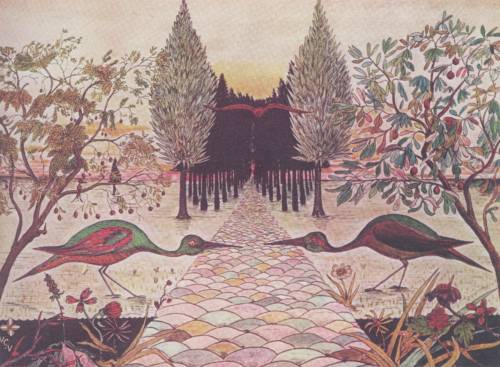
You can never see these birds anywhere except in Google land which is far far away, and only children can go there; and even they must be nearly – but not quite – asleep.
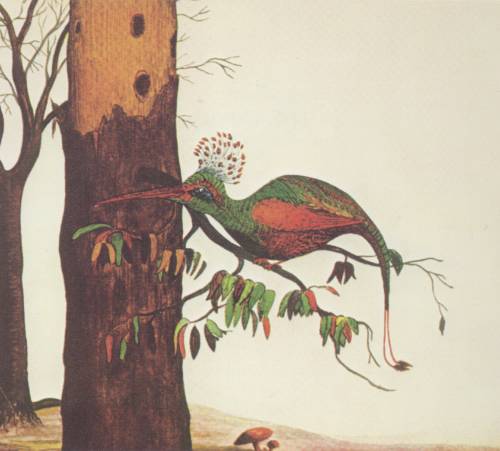
The Lesser Nockit
How can one describe this remarkable bird
Which no one has seen and which everyone's heard;
It hammers and knocks on the trees and the rocks,
And batters and raps at the windy,
And rattles old bones and shuffles the stones
And kicks up a terribly shindy
And hullaballoo!
It never stops still and it makes people ill
With its nerve-racking ear-splitting cry,
Which it utters they say both by night and by day,
And really I cannot think why!
No more can you!
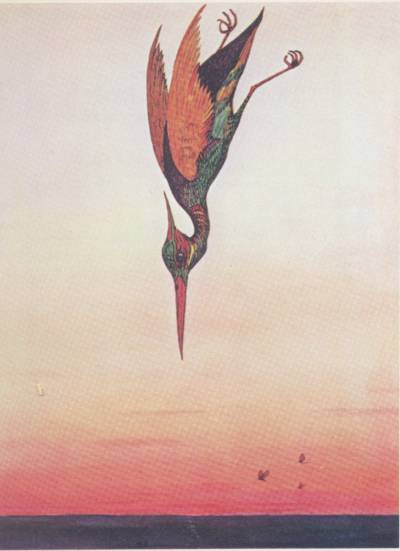
The Junket
The little Junket spots his food
From almost any altitude,
Volplanés from an awful height
And plunges almost out of sight!
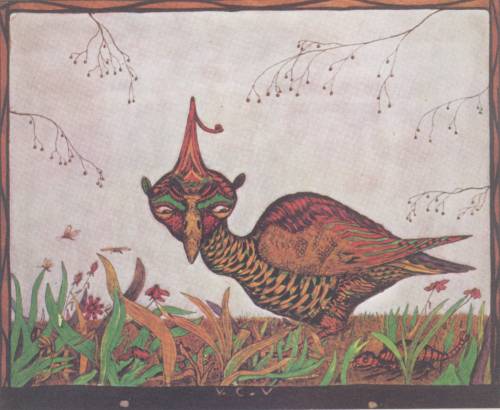
The Swank
The Swank is quick and full of vice,
He tortures beetles also mice.
He bites their legs off and he beats them
Into a pulp, and then he eats them.
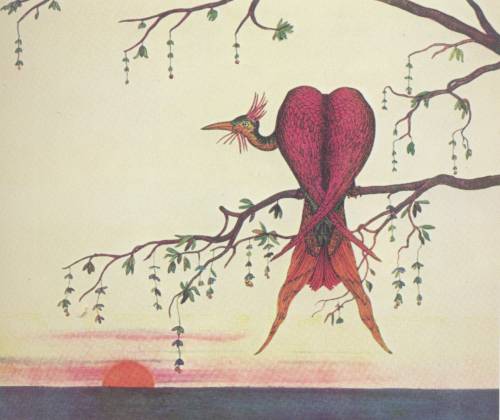
The Mirabelle
Old sailors have a tale they tell,
How once the song of a Mirabelle
Enticed a ship upon the rocks
Where perished all the crew.
I think it most improbable
That such a bird would cast a spell
Upon a ship, don't you?
The Google
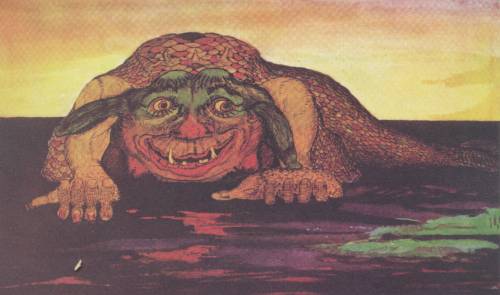
The Google has a beautiful garden which is guarded night and day. All through the day he sleeps in a pool of water in the center of the garden; but when the night comes, he slowly crawls out of the pool and silently prowls around for food.
The sun is setting –
Can't you hear
A something in the distance
Howl!!?
I wonder if it's –
Yes!! it is
That horrid Google
On the prowl!!!
Finished reading: 3 January 2013

Published in 1913, The Google Book is a picture book with short poems about imaginary birds. The illustrations consist of exquisite water colours. The book must be a joy for children, and their parents alike. Wonderful!

FAR! FAR away, the Google lives, in a land which only children can go to. It is a wonderful land of funny flowers, and birds, and hills of pure white heather.
The Google's Garden (Looking West):
You can never see these birds anywhere except in Google land which is far far away, and only children can go there; and even they must be nearly – but not quite – asleep.
The Lesser Nockit
How can one describe this remarkable bird
Which no one has seen and which everyone's heard;
It hammers and knocks on the trees and the rocks,
And batters and raps at the windy,
And rattles old bones and shuffles the stones
And kicks up a terribly shindy
And hullaballoo!
It never stops still and it makes people ill
With its nerve-racking ear-splitting cry,
Which it utters they say both by night and by day,
And really I cannot think why!
No more can you!
The Junket
The little Junket spots his food
From almost any altitude,
Volplanés from an awful height
And plunges almost out of sight!
The Swank
The Swank is quick and full of vice,
He tortures beetles also mice.
He bites their legs off and he beats them
Into a pulp, and then he eats them.
The Mirabelle
Old sailors have a tale they tell,
How once the song of a Mirabelle
Enticed a ship upon the rocks
Where perished all the crew.
I think it most improbable
That such a bird would cast a spell
Upon a ship, don't you?
The Google
The Google has a beautiful garden which is guarded night and day. All through the day he sleeps in a pool of water in the center of the garden; but when the night comes, he slowly crawls out of the pool and silently prowls around for food.
The sun is setting –
Can't you hear
A something in the distance
Howl!!?
I wonder if it's –
Yes!! it is
That horrid Google
On the prowl!!!
3rebeccanyc
Love it!
4absurdeist
That is awesome, edwin.
5amandameale
What a beautiful book.
6edwinbcn
Pollyanna
Finished reading: 30 January 2013

Pollyanna (1913) by Eleanor H. Porter is now mainly read as a children's book, but is wasn't written or intended as such. It was an immediate bestseller and influenced many people and popular culture during the first quarter of the twentieth century.
The story is about a young girl, who, as an orphan, is sent to live with her aunt, the stern Miss Polly. Pollyanna's father has taught her a game, which consists of always seeing things and situations in a positive light, and always being delighted with anything, in short, always be glad. The young, bright, innocent Polyanna spreads this belief, and starts influencing the people around her.
Within a few months she has made friends with most people in the community, even people, such as Mr Pendleton, who was considered to be unapproachable. Her unlimited optimism cheers up all the people around her, and brings people together, who were separated through years of miserly sorrow and anguish.
Underlying Polyanna's "glad game" lies the idea that everyone should be happy with small things. There are subtle suggestions that money is not the most important thing in life, and that apart from money there are many other things that may make people happy. The novel also suggests that Americans should care for each other before caring for others, far away, as there were still many poor and needy people within the US, at that time.
To the modern reader the book may appear repetitive and very simple, probably why it is now seen as a children's book. Because of its young protagonist, and its message, the novel also seems aimed at children. However, it is likely that children will merely focus on the superficial and rather simplistic message about being happy with anything, while missing the more subtle criticism on a society which is increasingly ruled by money, turning people in miserly Scrooges, having a lot of money, but unable to find happiness in life.

Finished reading: 30 January 2013

Pollyanna (1913) by Eleanor H. Porter is now mainly read as a children's book, but is wasn't written or intended as such. It was an immediate bestseller and influenced many people and popular culture during the first quarter of the twentieth century.
The story is about a young girl, who, as an orphan, is sent to live with her aunt, the stern Miss Polly. Pollyanna's father has taught her a game, which consists of always seeing things and situations in a positive light, and always being delighted with anything, in short, always be glad. The young, bright, innocent Polyanna spreads this belief, and starts influencing the people around her.
Within a few months she has made friends with most people in the community, even people, such as Mr Pendleton, who was considered to be unapproachable. Her unlimited optimism cheers up all the people around her, and brings people together, who were separated through years of miserly sorrow and anguish.
Underlying Polyanna's "glad game" lies the idea that everyone should be happy with small things. There are subtle suggestions that money is not the most important thing in life, and that apart from money there are many other things that may make people happy. The novel also suggests that Americans should care for each other before caring for others, far away, as there were still many poor and needy people within the US, at that time.
To the modern reader the book may appear repetitive and very simple, probably why it is now seen as a children's book. Because of its young protagonist, and its message, the novel also seems aimed at children. However, it is likely that children will merely focus on the superficial and rather simplistic message about being happy with anything, while missing the more subtle criticism on a society which is increasingly ruled by money, turning people in miserly Scrooges, having a lot of money, but unable to find happiness in life.

7edwinbcn
Erzählungen (Die grosse Erzähler-Bibliothek der Weltliteratur)
Finished reading: 22 December 2013

When Christian Friedrich Hebbel was born in 1813, his hometown was part of Denmark, now Germany, but all of his works are written in the German language. Hebbel grew up in poverty, and his existence remained difficult throughout most of his life. In his youth he often witnessed violent rows between his parents.
Hebbel is mainy remembered for his drama. The volume Erzählungen (Die grosse Erzähler-Bibliothek der Weltliteratur) ("Stories") offers a representative selection of his prose works.
In "Meine Kindheit" (My Youth Hebbel describes how he grew up, but this prose fragment omits any references to violent scenes, as Hebbel wrote it down in the spirit of Goethe like an idyll "Wer sein Leben darstellt, der sollte (...) nur das Liebliche, Schöne, das Beschwichtigende und Ausgleichende, das sich auch noch in den dunkelsten Verhältnissen auffinden läßt, hervorheben und das Übrige auf sich beruhen lassen." Thus, "Meine Kindheit" is a very calm and balanced description of growing up in a village during the first quarter of the Nineteenth century.
However, the violence which so much must have impressed Hebbel's young mind found a place in his short stories. While the work of other authors of that period in Germany are dominated by descriptions of love and finer sensibilities, the short stories of Hebbel are dominated by violent emotions, such as hatred, envy, suspicion and anger. In "Barbier Zitterlein" the conflict between a father and his daughter's lover leads to the father's madness, while in "Anna' envy leads to a violent death. In the short story "Eine nacht im Jägerhause" the false impression of evil and mutual suspicion are the ingredients of the story. These oddly aggressive story elements make Hebbel's short stories unique among the literature of the Age of Sentiment.
In his early years, Hebbel worked on a novel, which he later reduced and edited, to be published as a novella in 1848, here included as "Schnock", also known as "Meister Schnock" or "Schnock: ein niederländisches Gemälde". The sub-title of the novel "A Dutch Painting" suggests the reader to imagine a scene in a public house such as by such as (Gerard) Douw or Jan Steen, paintings usually displaying a chaotic tableau of details. The story is not set in the Netherlands, but in a non-descript German town. It is a frame narrative in which the main character Schnock tells about his life, which is full of capricious events and details. Hebbel's novella is of interest, as it form a literary equivalent of Kunstkammer or "Cabinet of curiosities" reflecting the capricious style of taste in the early Nineteenth Century all over Europe.
Included in this collection is also the fairy-tale "Der Rubin" (The Ruby), in which the style of Wilhelm Hauff can be recognized, a contemporary of Hebbel whom he met in Stuttgart on the way to Munich. Biographers have pointed out Hebbel's obsession with gemstones from his prolonged poverty, as the find or the loss of a single stone could alter a life's destiny. Hebbel later transformed this story into a play "Der Rubin" (The Ruby) (1851), and has written another play with the title "Der Diamant" (The Diamond) (1841).
Hebbel's stories have a medieval feel to them, probably because of their focus on poverty, and the capricious violence.

Finished reading: 22 December 2013

When Christian Friedrich Hebbel was born in 1813, his hometown was part of Denmark, now Germany, but all of his works are written in the German language. Hebbel grew up in poverty, and his existence remained difficult throughout most of his life. In his youth he often witnessed violent rows between his parents.
Hebbel is mainy remembered for his drama. The volume Erzählungen (Die grosse Erzähler-Bibliothek der Weltliteratur) ("Stories") offers a representative selection of his prose works.
In "Meine Kindheit" (My Youth Hebbel describes how he grew up, but this prose fragment omits any references to violent scenes, as Hebbel wrote it down in the spirit of Goethe like an idyll "Wer sein Leben darstellt, der sollte (...) nur das Liebliche, Schöne, das Beschwichtigende und Ausgleichende, das sich auch noch in den dunkelsten Verhältnissen auffinden läßt, hervorheben und das Übrige auf sich beruhen lassen." Thus, "Meine Kindheit" is a very calm and balanced description of growing up in a village during the first quarter of the Nineteenth century.
However, the violence which so much must have impressed Hebbel's young mind found a place in his short stories. While the work of other authors of that period in Germany are dominated by descriptions of love and finer sensibilities, the short stories of Hebbel are dominated by violent emotions, such as hatred, envy, suspicion and anger. In "Barbier Zitterlein" the conflict between a father and his daughter's lover leads to the father's madness, while in "Anna' envy leads to a violent death. In the short story "Eine nacht im Jägerhause" the false impression of evil and mutual suspicion are the ingredients of the story. These oddly aggressive story elements make Hebbel's short stories unique among the literature of the Age of Sentiment.
In his early years, Hebbel worked on a novel, which he later reduced and edited, to be published as a novella in 1848, here included as "Schnock", also known as "Meister Schnock" or "Schnock: ein niederländisches Gemälde". The sub-title of the novel "A Dutch Painting" suggests the reader to imagine a scene in a public house such as by such as (Gerard) Douw or Jan Steen, paintings usually displaying a chaotic tableau of details. The story is not set in the Netherlands, but in a non-descript German town. It is a frame narrative in which the main character Schnock tells about his life, which is full of capricious events and details. Hebbel's novella is of interest, as it form a literary equivalent of Kunstkammer or "Cabinet of curiosities" reflecting the capricious style of taste in the early Nineteenth Century all over Europe.
Included in this collection is also the fairy-tale "Der Rubin" (The Ruby), in which the style of Wilhelm Hauff can be recognized, a contemporary of Hebbel whom he met in Stuttgart on the way to Munich. Biographers have pointed out Hebbel's obsession with gemstones from his prolonged poverty, as the find or the loss of a single stone could alter a life's destiny. Hebbel later transformed this story into a play "Der Rubin" (The Ruby) (1851), and has written another play with the title "Der Diamant" (The Diamond) (1841).
Hebbel's stories have a medieval feel to them, probably because of their focus on poverty, and the capricious violence.

8baswood
Pollyanna was a popular children's film back in the early 1960's, starring Halley Mills and John Mills I think. Nice review Edwin as I didn't realise that the book was written in 1913.
9edwinbcn
At the end of Pollyanna, Pollyanna has a car accident. In my subsequent reading of My life and hard times by James Thurber, although published in 1933, all the stories are set in the 1910s and one 1913, I became aware of the significant emergence of automobile, which just then started appearing as a novelty on the streets.


10StevenTX
In my reading of Pilgrimage by Dorothy Richardson, which encompasses the 1880s to roughly 1910, I was struck by how quickly it seemed the automobile went from being a novelty to an accepted part of London life. Suddenly, it seemed, all the omnibuses and cabs were gas powered instead of horse drawn, and everyone took it in stride (except perhaps the horses).
11edwinbcn
158. A selection of prose pieces
Finished reading: 22 December 2013

Yang Shuo 杨朔 is an almost completely forgotten Chinese author, barely known to readers outside China. Born in 1913, Yang Shuo met a tragic death, killing himself with an overdose of sleeping tablets in 1968, at the height of the Cultural Revolution. Born in Penglai, in Shandong Province, Yang Shuo studied English Language and Literature in Harbin, which brought him into contact with Western literature, and subsequently studied Law and Political Science, while simultaneously studying classical Chinese Literature. His early poetry was written in traditional style, but during the 1930s he enthusiastically embraced communism, joining the Eighth Route Army and settling to work at Mao Zedong's revolutionary base in Yan'an. Starting from 1937, he wrote a number of novels describing the soldiers and the people in Yan'an, celebrating the glorious Chinese revolution, in novels such as The Spur of the Pamirs, Scars and Wounds, The Red Stone Hill, a novel about Chinese miner's struggle against the Japanese invaders. In just about three decades, and very harsh circumstances, Yang Shuo wrote 11 novels, besides short stories, prose and poetry.
A selection of prose pieces collects 14 short stories and pieces of prose, all written between 1949 and 1963.
The prose pieces written in the 1950s are almost all very positive, celebrating the glorious achievement of the Chinese revolution. "March on, Army of Steel!" (1949) is a jubilant description of the Red Army entering and taking possession of Beiping (now Beijing). Later stories, describe life in the first Communist decade, during which China developed at a high speed, approaching some of the utopian ideals, which were so brutally smashed during the following decade. This leads to some curious passages, as for example the following fragment from "The Fairyland of Penglai" (1959):
At the end of our casual chat, my sister found out that I was being put up at the office of the county Party committee and asked me to come to dinner the next day. I did not want to come because I was afraid that she might not have enough food. But she said, "You must come. What are you afraid of?" Then, pointing to the dry wheat in her basket, she continued with a smile, "Look, this is what we just got. Isn't it enough for you? Last year we did fairly well because of the success of the Great Leap Forward. This year the wheat harvest is better than ever. Do you think you could still eat enough to make me poor?"
I had to agree to come. On the next day, contrary to what I thought would be an ordinary family dinner, my sister treated me as an honored guest with the most extravagant four dishes of our hometown: fish sauteed with soy sauce, scrambled eggs, pan-fried potato strips and vermicelli made from bean-starch. Noodles were served as the last dish with shrimp that had been newly sun-dried.
"You live pretty well," I could not help saying.
My sister replied, smiling nonchalantly: "We do. We have whatever we want." (p. 50-51).
A description like that seems very representative for the success of the early years of Communism in China, as people might have felt and experienced life in 1952-1957, but the odd reference to the Great Leap Forward makes one wonder whether the story is not actually more than a piece of propaganda.
However, during the mid-1950s, Yang Shuo prose increasingly incorporates beautiful descriptions of scenes of natural beauty around Beijing, such as in "Red Leaves on Xiangshan" (1956) and "Baihuashan" (1957), but these stories still mostly take the achievements and anecdotes of soldiers of the People's Liberation Army as their main focus, against the backdrop of beautiful descriptions. In the early 60s, the stories become even lyrical, while the focus shifts to describing common people, and natural beauty in its own right, such as in the prose pieces "Lychee Honey" (1960), and "Ode to the Camellia" (1961).
The last two pieces in the collections bear the sub-title "A Series od Lyrical Essays on the Jinggang Mountains". The first of these stories, "The Hai Luo Fir" records anecdotes about Chaiman Mao's residence at the heart of the Jinggang Mountains, as told by an old local, and observed by an old fir tree. The second piece "Xi Jiang Yue" is an essay which ties the poetry of Mao Zedong to the age-old tradition of Chinese poetry.
The lyrical style of A selection of prose pieces present a style of writing in post-revolutionary Chinese writing which is quite unique. Written before China's dark decade, it describes the achievements of Chinese communism with a heart-felt optimism, while attempting to create a new style of writing, mixing traditional lyrical elements with a revolutionary style of writing.
A selection of prose pieces was translated and published in 1980, by the Foreign Languages Press.
Finished reading: 22 December 2013

Yang Shuo 杨朔 is an almost completely forgotten Chinese author, barely known to readers outside China. Born in 1913, Yang Shuo met a tragic death, killing himself with an overdose of sleeping tablets in 1968, at the height of the Cultural Revolution. Born in Penglai, in Shandong Province, Yang Shuo studied English Language and Literature in Harbin, which brought him into contact with Western literature, and subsequently studied Law and Political Science, while simultaneously studying classical Chinese Literature. His early poetry was written in traditional style, but during the 1930s he enthusiastically embraced communism, joining the Eighth Route Army and settling to work at Mao Zedong's revolutionary base in Yan'an. Starting from 1937, he wrote a number of novels describing the soldiers and the people in Yan'an, celebrating the glorious Chinese revolution, in novels such as The Spur of the Pamirs, Scars and Wounds, The Red Stone Hill, a novel about Chinese miner's struggle against the Japanese invaders. In just about three decades, and very harsh circumstances, Yang Shuo wrote 11 novels, besides short stories, prose and poetry.
A selection of prose pieces collects 14 short stories and pieces of prose, all written between 1949 and 1963.
The prose pieces written in the 1950s are almost all very positive, celebrating the glorious achievement of the Chinese revolution. "March on, Army of Steel!" (1949) is a jubilant description of the Red Army entering and taking possession of Beiping (now Beijing). Later stories, describe life in the first Communist decade, during which China developed at a high speed, approaching some of the utopian ideals, which were so brutally smashed during the following decade. This leads to some curious passages, as for example the following fragment from "The Fairyland of Penglai" (1959):
At the end of our casual chat, my sister found out that I was being put up at the office of the county Party committee and asked me to come to dinner the next day. I did not want to come because I was afraid that she might not have enough food. But she said, "You must come. What are you afraid of?" Then, pointing to the dry wheat in her basket, she continued with a smile, "Look, this is what we just got. Isn't it enough for you? Last year we did fairly well because of the success of the Great Leap Forward. This year the wheat harvest is better than ever. Do you think you could still eat enough to make me poor?"
I had to agree to come. On the next day, contrary to what I thought would be an ordinary family dinner, my sister treated me as an honored guest with the most extravagant four dishes of our hometown: fish sauteed with soy sauce, scrambled eggs, pan-fried potato strips and vermicelli made from bean-starch. Noodles were served as the last dish with shrimp that had been newly sun-dried.
"You live pretty well," I could not help saying.
My sister replied, smiling nonchalantly: "We do. We have whatever we want." (p. 50-51).
A description like that seems very representative for the success of the early years of Communism in China, as people might have felt and experienced life in 1952-1957, but the odd reference to the Great Leap Forward makes one wonder whether the story is not actually more than a piece of propaganda.
However, during the mid-1950s, Yang Shuo prose increasingly incorporates beautiful descriptions of scenes of natural beauty around Beijing, such as in "Red Leaves on Xiangshan" (1956) and "Baihuashan" (1957), but these stories still mostly take the achievements and anecdotes of soldiers of the People's Liberation Army as their main focus, against the backdrop of beautiful descriptions. In the early 60s, the stories become even lyrical, while the focus shifts to describing common people, and natural beauty in its own right, such as in the prose pieces "Lychee Honey" (1960), and "Ode to the Camellia" (1961).
The last two pieces in the collections bear the sub-title "A Series od Lyrical Essays on the Jinggang Mountains". The first of these stories, "The Hai Luo Fir" records anecdotes about Chaiman Mao's residence at the heart of the Jinggang Mountains, as told by an old local, and observed by an old fir tree. The second piece "Xi Jiang Yue" is an essay which ties the poetry of Mao Zedong to the age-old tradition of Chinese poetry.
The lyrical style of A selection of prose pieces present a style of writing in post-revolutionary Chinese writing which is quite unique. Written before China's dark decade, it describes the achievements of Chinese communism with a heart-felt optimism, while attempting to create a new style of writing, mixing traditional lyrical elements with a revolutionary style of writing.
A selection of prose pieces was translated and published in 1980, by the Foreign Languages Press.
Join to post

