This topic is currently marked as "dormant"—the last message is more than 90 days old. You can revive it by posting a reply.
1qebo
I'm back for another year. Spring is a bit behinder than it was last year; I began my thread a year ago today so I can compare current conditions to this. The alliums, for example, have not yet bloomed, and the only butterflies I've seen are cabbage whites.
I planted the raised beds last weekend: dill, fennel, anise, mustard -- all caterpillar food. The circle is a sea of brown with patches of green. The milkweed and Joe Pye of last year are sprouting in their old spots, along with some volunteers.
I planted the raised beds last weekend: dill, fennel, anise, mustard -- all caterpillar food. The circle is a sea of brown with patches of green. The milkweed and Joe Pye of last year are sprouting in their old spots, along with some volunteers.
2qebo
I bought a slew of native plants on May 17, but didn’t have places prepared so most are still sitting on my deck in pots. The goal for this weekend is to get them all in the ground.
3qebo
May 4...
The circle beginning to show signs of life. At the back by the fence are mountain mint and... I don’t remember, maybe bee balm? At the left are echinacea and Joe Pye. At the right are two types of milkweed. At the front are asters and ironweed.

The cylinder is where I intentionally planted swamp milkweed last fall. Around it, common milkweed is sprouting. I had a single common milkweed last year, and I pulled it out because it had gotten sloppy and I wanted more swamp milkweed. Seems it didn’t want to go. So I’m letting it be.

The swamp milkweed from last year is sprouting. It was bare stems and twigs over the winter, and I wasn’t sure what would happen, but when the sprouts began emerging from the ground I figured that last year’s growth was dead so I clipped it off.

The Joe Pye from last year is sprouting.

The violets by the compost bin are in bloom.

The circle beginning to show signs of life. At the back by the fence are mountain mint and... I don’t remember, maybe bee balm? At the left are echinacea and Joe Pye. At the right are two types of milkweed. At the front are asters and ironweed.

The cylinder is where I intentionally planted swamp milkweed last fall. Around it, common milkweed is sprouting. I had a single common milkweed last year, and I pulled it out because it had gotten sloppy and I wanted more swamp milkweed. Seems it didn’t want to go. So I’m letting it be.

The swamp milkweed from last year is sprouting. It was bare stems and twigs over the winter, and I wasn’t sure what would happen, but when the sprouts began emerging from the ground I figured that last year’s growth was dead so I clipped it off.

The Joe Pye from last year is sprouting.

The violets by the compost bin are in bloom.

4qebo
May 19...
The false indigo had exactly one flower last year, became spindly twigs over the winter, then sprouted fresh. Not so easy to distinguish in the photo because it blends in with the violets.

The violets are mostly done with blooming, and are spreading through the shady area. Last year they were home to a gazillion variegated fritillary caterpillars.

The common milkweed insists on forming a colony.

The swamp milkweed is coming along, and is surrounded by babies. I’ll probably let the babies grow for awhile then see if anyone wants them.

The Joe Pye also is coming along.

Blueberry bushes! Two kinds: highbush and lowbush. I’ve been wanting these for a couple of years, in this spot, but until last fall I had a 6’ solid fence that blocked the sun.

I cleared most of the weeds from outside the fence in the alley, and planted clover. It’s not native. There is apparently a native clover but I couldn’t find any seeds. I’m aiming for the Penn State Pollinator Friendly Garden Certificate, which lists clover in general as acceptable, a host plant for clouded sulphur, orange sulphur, and gray hairstreak; I guess the non-native species are close enough. We’ll see.

http://ento.psu.edu/pollinators/public-outreach/cert
http://ento.psu.edu/publications/Pollinator%20Certification.pdf
http://pubs.cas.psu.edu/FreePubs/pdfs/uh139.pdf
The false indigo had exactly one flower last year, became spindly twigs over the winter, then sprouted fresh. Not so easy to distinguish in the photo because it blends in with the violets.

The violets are mostly done with blooming, and are spreading through the shady area. Last year they were home to a gazillion variegated fritillary caterpillars.

The common milkweed insists on forming a colony.

The swamp milkweed is coming along, and is surrounded by babies. I’ll probably let the babies grow for awhile then see if anyone wants them.

The Joe Pye also is coming along.

Blueberry bushes! Two kinds: highbush and lowbush. I’ve been wanting these for a couple of years, in this spot, but until last fall I had a 6’ solid fence that blocked the sun.

I cleared most of the weeds from outside the fence in the alley, and planted clover. It’s not native. There is apparently a native clover but I couldn’t find any seeds. I’m aiming for the Penn State Pollinator Friendly Garden Certificate, which lists clover in general as acceptable, a host plant for clouded sulphur, orange sulphur, and gray hairstreak; I guess the non-native species are close enough. We’ll see.

http://ento.psu.edu/pollinators/public-outreach/cert
http://ento.psu.edu/publications/Pollinator%20Certification.pdf
http://pubs.cas.psu.edu/FreePubs/pdfs/uh139.pdf
5qebo
May 19...
The mustards in the raised bed on the left are sprouting. The circle is less barren than it was. The plants in the foreground are... bee balm maybe? I got them last year and had no place to put them, but vaguely had an idea of a strip across the yard between the raised beds and the circle. The 2x4s mark the approximate location.

The mustards in the raised bed on the left are sprouting. The circle is less barren than it was. The plants in the foreground are... bee balm maybe? I got them last year and had no place to put them, but vaguely had an idea of a strip across the yard between the raised beds and the circle. The 2x4s mark the approximate location.

6qebo
Today's task was getting the 2x4s in place, measured and leveled. No photos yet because I'm still deciding where plants will go.
7qebo
Three types of mustard:

Two types of fennel and anise:

Three types of dill:

In context, with the new strip across the yard. The plants in it are sad because I moved them.

The butterfly bush, which was non-native and too large for the space...

...is gone...

... replaced by Virginia sweetspire (Itea virginica), which is native and possibly too small for the space (though it will become bigger than it is now).


Two types of fennel and anise:

Three types of dill:

In context, with the new strip across the yard. The plants in it are sad because I moved them.

The butterfly bush, which was non-native and too large for the space...

...is gone...

... replaced by Virginia sweetspire (Itea virginica), which is native and possibly too small for the space (though it will become bigger than it is now).

8qebo
Moved a bunch of plants, so they are sad and droopy.
In the triangle, white flowers:
Foxglove (Penstemon digitalis) – host to Common Buckeye
Garden Phlox (Phlox paniculata)
In the strip by the fence, yellow flowers:
Sunflower (Helianthus x ‘Lemon Queen’) – host to Painted Lady, Milbert Tortoiseshell
Golden Ragwort (Packera aurea) – host to Painted Lady, American Lady
Goldenrod (Solidago something) – host to Baltimore
Carolina Lupine (Thermopsis villosa) – host to Orange Sulphur, Wild Indigo Duskywing
Along the side of the deck, yellow flowers:
Golden Star (Chrysogonum virginianum) – host to Pearl Crescent

The purple theme:
Violets – host to Variegated Fritillary
False Indigo (Baptisia australis) – host to Wild Indigo Duskywing
American Wisteria (Wisteria frutescens) -- host to Baltimore, Horace Duskywing, Silver Spotted Skipper

Planted sunflowers.

A milkweed is on the verge.

An echinachea has bloomed.

Butterfly #1: Painted Lady.

In the triangle, white flowers:
Foxglove (Penstemon digitalis) – host to Common Buckeye
Garden Phlox (Phlox paniculata)
In the strip by the fence, yellow flowers:
Sunflower (Helianthus x ‘Lemon Queen’) – host to Painted Lady, Milbert Tortoiseshell
Golden Ragwort (Packera aurea) – host to Painted Lady, American Lady
Goldenrod (Solidago something) – host to Baltimore
Carolina Lupine (Thermopsis villosa) – host to Orange Sulphur, Wild Indigo Duskywing
Along the side of the deck, yellow flowers:
Golden Star (Chrysogonum virginianum) – host to Pearl Crescent

The purple theme:
Violets – host to Variegated Fritillary
False Indigo (Baptisia australis) – host to Wild Indigo Duskywing
American Wisteria (Wisteria frutescens) -- host to Baltimore, Horace Duskywing, Silver Spotted Skipper

Planted sunflowers.

A milkweed is on the verge.

An echinachea has bloomed.

Butterfly #1: Painted Lady.

9SqueakyChu
Wow, Katherine! You are certainly off to a terrific start!!
10lauralkeet
Your garden looks terrific! I look forward to following your progress.
11qebo
Butterfly #2 really should be butterfly #1, a Cabbage White (Pieris rapae), which I’ve been seeing for weeks. Today I didn’t quite catch it laying eggs on the mustard.


12qebo
The front yard has been non-native, existing when I moved here or planted before I knew better. I’m not going to worry about it. On the right, hellebore. In the middle, peonies. On the left, weigela. In the front, I don’t remember. I blinked and missed the tulips in April.

To the left of the previous photo, new natives. A steeplebush (Spiraea tomentosa) and three wild pinks (Silene caroliniana) which looked better before I let them sit for two weeks on the deck, and which will eventually look like the one in the back yard. On the far left along the edge, some sort of lamium.


On the corner, rose of sharon, which is crawling with ladybug larvae. Below it, I pulled out everything except the smartweed / knotweed (precise identification unclear, several species are similar and photos and guides aren’t helping), which stays low and relatively contained.


To the left of the previous photo, new natives. A steeplebush (Spiraea tomentosa) and three wild pinks (Silene caroliniana) which looked better before I let them sit for two weeks on the deck, and which will eventually look like the one in the back yard. On the far left along the edge, some sort of lamium.


On the corner, rose of sharon, which is crawling with ladybug larvae. Below it, I pulled out everything except the smartweed / knotweed (precise identification unclear, several species are similar and photos and guides aren’t helping), which stays low and relatively contained.


13qebo
On the other side of the steps, at the side of the house, I had two yew tree stumps and the sad rhododendron removed a few weeks ago, and I haven’t gotten around to patching the holes. The sad rhododendron photo is from last year; this year it produced a single bud. Yes, my basement windows need to be painted.


As I was contemplating what to do with the space, ooh, a new butterfly! Except it’s a moth, a little thing, wing span about an inch, Common Spring Moth (Heliomata cycladata). Identified as such because it doesn’t have knobs on its antennae, so I looked in the Peterson Field Guide to Moths, which has silhouettes of shapes, which led me to the Geometer section.


As I was contemplating what to do with the space, ooh, a new butterfly! Except it’s a moth, a little thing, wing span about an inch, Common Spring Moth (Heliomata cycladata). Identified as such because it doesn’t have knobs on its antennae, so I looked in the Peterson Field Guide to Moths, which has silhouettes of shapes, which led me to the Geometer section.


15qebo
Today I finished weeding the strip along the side of the house, filling the holes as I went. Doesn't look like much, so no photos. And added mulch to the back yard. And planted romanesco broccoli in pots because it is cool and I happened upon seeds when I was meandering through Lowe's yesterday evening.
16qebo
A busy couple of weeks. Many trips to Lowe’s for potting soil and topsoil and mulch.
Carved out spaces for plants next to the fence between yards, the fence along the alley, the fence along the sidewalk where I’d already put sunflowers. The long damp patch between the sunflowers is scarlet emperor beans, which will get orange-red flowers.


On the other side of the fence along the sidewalk, there had been a low brick retaining wall, which was in iffy shape when I moved here and rapidly disintegrated. I’ve been weeding the worst of it less frequently than I ought. This week I pulled out all the weeds. Here is the last patch of the 40+ feet.

This is what remained, gravelly dirt with a ridge where the wall was, and occasional bits of screen.

I reshaped the dirt into a slope, secured it, I hope, with hardware cloth, filtered out the gravel, covered the hardware cloth with the sifted dirt, and planted clover seeds, with a creeping phlox at the end to match the three on the other side of the gate.


The clover has become the default for stray strips that need... something. Here it is along the alley, planted a few weeks ago, and across the yard, planted a couple weeks before that. The clover with flowers was preexisting.


After I had the butterfly bush removed, I planted a Virginia sweetspire in its place, but what I really wanted was a buttonbush (Cephalanthus occidentalis). I was concerned that it would get too big and need too much water, but I found one available via mail order that gets only 4’ high, and reports from the internet are that it’s OK in typical garden soil once it is established. So I moved the Virginia sweetspire; it has no flowers because the transition from pot to ground made it unhappy. The buttonbush is just a tiny thing now, but it will eventually become this, too cool not to give it a shot. The plant in the foreground is a wild quinine (Parthenium integrifolium) that I got last year.


To the left of the wild quinine is a rattlesnake master (Eryngium yuccifolium). It is native to the US but not to Pennsylvania, but it was another too cool to pass up. Last year it was a spindly thing with about a half dozen flowers at the top. This year it has branched out, with a dozen obvious buds so far and more that seem to be forming.


The raised beds. At the front are three types of dill. In the middle are two types of fennel, anise, and two types of parsley in pots. At the back are two types of mustard, two more types of mustard in pots, and romanesco broccoli, just beginning to sprout, in pots. The mustard has been attracting much attention from cabbage white butterflies, and I’ve found eggs, but so far no caterpillars; they’re hard to see though because they are exactly the same color as the leaves.


In other news...
The echinacheas are blooming.

One swamp milkweed is blooming. The milkweeds of last year were all surrounded by babies this year. Only a few remain. Many of the others went to a community garden member who is creating a monarch way station.


The common milkweed has buds.


The butterfly weed is sprouting.

Joe Pyes are growing rapidly and sprouting up around last year’s crop.

The blazing stars (Liatris spicata), center and left and right in front of it, that I thought I’d killed last year so I got another, seem perfectly healthy. The ironweed (Vernonia glauca), left and right behind it, is late to start; I thought one was dead for sure until a week or so ago.

An overview.

I have more in pots that I got via mail order. Which I’d never tried before. It's a nice system. They set the plants sideways in layers in a box. Oh and Lowe’s, of all places, is selling boxed native wildflowers next to the cash register: dwarf crested iris, trout lily, mayapple.
Carved out spaces for plants next to the fence between yards, the fence along the alley, the fence along the sidewalk where I’d already put sunflowers. The long damp patch between the sunflowers is scarlet emperor beans, which will get orange-red flowers.


On the other side of the fence along the sidewalk, there had been a low brick retaining wall, which was in iffy shape when I moved here and rapidly disintegrated. I’ve been weeding the worst of it less frequently than I ought. This week I pulled out all the weeds. Here is the last patch of the 40+ feet.

This is what remained, gravelly dirt with a ridge where the wall was, and occasional bits of screen.

I reshaped the dirt into a slope, secured it, I hope, with hardware cloth, filtered out the gravel, covered the hardware cloth with the sifted dirt, and planted clover seeds, with a creeping phlox at the end to match the three on the other side of the gate.


The clover has become the default for stray strips that need... something. Here it is along the alley, planted a few weeks ago, and across the yard, planted a couple weeks before that. The clover with flowers was preexisting.


After I had the butterfly bush removed, I planted a Virginia sweetspire in its place, but what I really wanted was a buttonbush (Cephalanthus occidentalis). I was concerned that it would get too big and need too much water, but I found one available via mail order that gets only 4’ high, and reports from the internet are that it’s OK in typical garden soil once it is established. So I moved the Virginia sweetspire; it has no flowers because the transition from pot to ground made it unhappy. The buttonbush is just a tiny thing now, but it will eventually become this, too cool not to give it a shot. The plant in the foreground is a wild quinine (Parthenium integrifolium) that I got last year.


To the left of the wild quinine is a rattlesnake master (Eryngium yuccifolium). It is native to the US but not to Pennsylvania, but it was another too cool to pass up. Last year it was a spindly thing with about a half dozen flowers at the top. This year it has branched out, with a dozen obvious buds so far and more that seem to be forming.


The raised beds. At the front are three types of dill. In the middle are two types of fennel, anise, and two types of parsley in pots. At the back are two types of mustard, two more types of mustard in pots, and romanesco broccoli, just beginning to sprout, in pots. The mustard has been attracting much attention from cabbage white butterflies, and I’ve found eggs, but so far no caterpillars; they’re hard to see though because they are exactly the same color as the leaves.


In other news...
The echinacheas are blooming.

One swamp milkweed is blooming. The milkweeds of last year were all surrounded by babies this year. Only a few remain. Many of the others went to a community garden member who is creating a monarch way station.


The common milkweed has buds.


The butterfly weed is sprouting.

Joe Pyes are growing rapidly and sprouting up around last year’s crop.

The blazing stars (Liatris spicata), center and left and right in front of it, that I thought I’d killed last year so I got another, seem perfectly healthy. The ironweed (Vernonia glauca), left and right behind it, is late to start; I thought one was dead for sure until a week or so ago.

An overview.

I have more in pots that I got via mail order. Which I’d never tried before. It's a nice system. They set the plants sideways in layers in a box. Oh and Lowe’s, of all places, is selling boxed native wildflowers next to the cash register: dwarf crested iris, trout lily, mayapple.
17SqueakyChu
Your garden is amazing, Katherine. Sadly to say, I have been pretty inactive in my garden so far this year. It's kind of late, but I need to get moving.
I'm looking forward to all of your wildlife updates! :)
I'm looking forward to all of your wildlife updates! :)
18lauralkeet
Your garden looks fabulous! It's come such a long way since last year.
21qebo
18: Thanks! Last year nearly everything was new. This year, the established plants are managing nicely on their own, so I can devote attention to the new spaces made possible by the new fence.
19: I'm very happy with the fence. Lotsa pedestrian traffic along the sidewalk and through the alley, and if I want privacy I can sit on the deck, which is set back and partially screened from view.
20: The journal turns out to be useful. I've been looking back to see what was happening with plants and critters at the same time last year.
Another busy couple of weeks. Lots of photos, not yet quite organized.
19: I'm very happy with the fence. Lotsa pedestrian traffic along the sidewalk and through the alley, and if I want privacy I can sit on the deck, which is set back and partially screened from view.
20: The journal turns out to be useful. I've been looking back to see what was happening with plants and critters at the same time last year.
Another busy couple of weeks. Lots of photos, not yet quite organized.
22lauralkeet
>21 qebo:: I've been looking back to see what was happening with plants and critters at the same time last year.
I have a 10-year gardener's journal (available from Lee Valley, here) which has become really useful. It's a big, thick book so it's not something you'd carry around with you, but I keep it in a place where I will easily remember to add things during the season. When we wonder, "when did we transplant tomatoes last year?" or "when will the potatoes be ready?", we can look back and see what we did before.
I have a 10-year gardener's journal (available from Lee Valley, here) which has become really useful. It's a big, thick book so it's not something you'd carry around with you, but I keep it in a place where I will easily remember to add things during the season. When we wonder, "when did we transplant tomatoes last year?" or "when will the potatoes be ready?", we can look back and see what we did before.
23qebo
22: Oh dear. I'm too electro-centric for a paper gardening journal, but I see all sorts of stuff there that would be quite nice to have...
24lauralkeet
>23 qebo:: If you write the app I'll buy it :)
25qebo
New items planted:
Angled rows for a V shape:
Wild Ageratum (Eupatorium coelestinum) on the left, host for Summer Azure.
Blue Vervain (Verbena hastata) on the right, host for Buckeye.
Black blotches at the corners are from recent camera lens dysfunction. Hope to get it fixed, but meanwhile I got a new camera too.

Along the back fence:
Hops (Humulus lupulus), host for Comma and Question Mark.


Unexpectedly in a box next to the cash register at Lowe’s:
Crested Iris (Iris crestata), host for Virginia Ctenucha moth. Won’t show up until next year.

The nails mark the spots:

Trout Lily (Erythronium americanum), not host for anything that I know of, but fits with the yellow section of the yard.

In the narrow strip at the side of the house:
Sedum (Sedum ternatum), host for Brown Elfin, Buckeye, Variegated Fritillary. I planted some last year but neglected it, and the violets took over.

Jack in the Pulpit (Arisaema triphyllum), not host for anything that I know of, but cool. Behind the sedum in the previous photo, and closeup here.

Angled rows for a V shape:
Wild Ageratum (Eupatorium coelestinum) on the left, host for Summer Azure.
Blue Vervain (Verbena hastata) on the right, host for Buckeye.
Black blotches at the corners are from recent camera lens dysfunction. Hope to get it fixed, but meanwhile I got a new camera too.

Along the back fence:
Hops (Humulus lupulus), host for Comma and Question Mark.


Unexpectedly in a box next to the cash register at Lowe’s:
Crested Iris (Iris crestata), host for Virginia Ctenucha moth. Won’t show up until next year.

The nails mark the spots:

Trout Lily (Erythronium americanum), not host for anything that I know of, but fits with the yellow section of the yard.

In the narrow strip at the side of the house:
Sedum (Sedum ternatum), host for Brown Elfin, Buckeye, Variegated Fritillary. I planted some last year but neglected it, and the violets took over.

Jack in the Pulpit (Arisaema triphyllum), not host for anything that I know of, but cool. Behind the sedum in the previous photo, and closeup here.

26qebo
Sunflowers (all Helianthus annus)...
Yellow sunflowers at the top of the yard. The middle is Mammoth Gray Stripe, supposed to become 8'-10' tall. The two ends are Dwarf Teddy Bear, supposed to become 2'-3' tall.
June 20:

June 25:

July 2:

Red sunflowers at the bottom of the yard. Red Sun, supposed to become 5' tall. Velvet Queen, supposed to become 5'-6' tall. I've lost track of which is which. As happened last year, there have been casualties, I've planted more seeds each time, and I ran out of Red Sun.
June 22, multiple sprouts in each cylinder:

June 24, suddenly lopped off:

June 30:

July 4:

June 24, seed starters hopefully safe on the deck for Velvet Queen:

June 30:

Yellow sunflowers at the top of the yard. The middle is Mammoth Gray Stripe, supposed to become 8'-10' tall. The two ends are Dwarf Teddy Bear, supposed to become 2'-3' tall.
June 20:

June 25:

July 2:

Red sunflowers at the bottom of the yard. Red Sun, supposed to become 5' tall. Velvet Queen, supposed to become 5'-6' tall. I've lost track of which is which. As happened last year, there have been casualties, I've planted more seeds each time, and I ran out of Red Sun.
June 22, multiple sprouts in each cylinder:

June 24, suddenly lopped off:

June 30:

July 4:

June 24, seed starters hopefully safe on the deck for Velvet Queen:

June 30:

27qebo
Grass:
Switchgrass (Panicum virgatum), host for Hobomok Skipper and Tawny Edged Skipper. Maybe this will help me identify them.
June 18:

July 2:

Northern Sea Oats (Chasmanthium latifolium), host for Northern Pearly Eye.
June 18:

July 2:

And for the sake of completion, Pink Muhly Grass (Muhlenbergia capillaris), which had lovely pink tufts last year, and then I potted it and apparently killed it. Haven't happened upon a replacement yet.

Switchgrass (Panicum virgatum), host for Hobomok Skipper and Tawny Edged Skipper. Maybe this will help me identify them.
June 18:

July 2:

Northern Sea Oats (Chasmanthium latifolium), host for Northern Pearly Eye.
June 18:

July 2:

And for the sake of completion, Pink Muhly Grass (Muhlenbergia capillaris), which had lovely pink tufts last year, and then I potted it and apparently killed it. Haven't happened upon a replacement yet.

28qebo
Raised Beds and their companion pots...
Mustard
In the raised bed on the right is Tendergreen or spinach-mustard, with large leaves. It is rather overwhelming everything else. The Cabbage White butterflies are interested, and I've seen them laying eggs, but I have yet to see any caterpillars. The leaves are going brown, so I pull some off nearly every day. In the raised be on the right is India mustard. In the pots at the left is whatever I grew in raised beds a couple years ago that keeps returning as volunteers. In the pots at the right are Southern Giant Curled mustard and Japanese mustard, which I planted much later than the others so it's just sprouting.
June 20:

June 30:

The back side of the mustard jungle, July 4:

Romanesco Cauliflower
This is in the three pots next to the mustards.
June 24:

Fennel, Anise, Parsley
Anise on the left. Fennel on the right, two types, Florence and Zefo Fino. Parsley in the pots, planted much later, two types, Moss Curled and Italian Plain Leaf.
June 20:

June 30:

Dill
Three types: Mammoth, volunteers from last year in the pots, and freshly planted in the corner of the raised bed. Hera and Dukat in the raised bed.
June 20:

June 30:

Mustard
In the raised bed on the right is Tendergreen or spinach-mustard, with large leaves. It is rather overwhelming everything else. The Cabbage White butterflies are interested, and I've seen them laying eggs, but I have yet to see any caterpillars. The leaves are going brown, so I pull some off nearly every day. In the raised be on the right is India mustard. In the pots at the left is whatever I grew in raised beds a couple years ago that keeps returning as volunteers. In the pots at the right are Southern Giant Curled mustard and Japanese mustard, which I planted much later than the others so it's just sprouting.
June 20:

June 30:

The back side of the mustard jungle, July 4:

Romanesco Cauliflower
This is in the three pots next to the mustards.
June 24:

Fennel, Anise, Parsley
Anise on the left. Fennel on the right, two types, Florence and Zefo Fino. Parsley in the pots, planted much later, two types, Moss Curled and Italian Plain Leaf.
June 20:

June 30:

Dill
Three types: Mammoth, volunteers from last year in the pots, and freshly planted in the corner of the raised bed. Hera and Dukat in the raised bed.
June 20:

June 30:

29qebo
Between the raised beds and the fence, Sugar Snap Pole Peas. I planted four in each pot, all at the same time, so the proportion of sprouts seems low, but the ones that showed up needed poles, so I added poles and more seeds.
June 22:

Between the red sunflowers at the bottom of the yard, Scarlet Emperor Beans.
June 22, beginning to sprout:


June 30, with trellises:

June 22:

Between the red sunflowers at the bottom of the yard, Scarlet Emperor Beans.
June 22, beginning to sprout:


June 30, with trellises:

31qebo
On the deck...
Bachelor’s Buttons beginning to bloom.


Chinese Forget-Me-Not and and Hardy Ageratum, should be four of each but not all seeds are cooperative.

Catnip

Cat Grass

Morning Glories beginning to sprout.

Next to the deck steps, Rattlesnake Master (Eryngium yuccifolium).
June 24:

June 29:

Bachelor’s Buttons beginning to bloom.


Chinese Forget-Me-Not and and Hardy Ageratum, should be four of each but not all seeds are cooperative.

Catnip

Cat Grass

Morning Glories beginning to sprout.

Next to the deck steps, Rattlesnake Master (Eryngium yuccifolium).
June 24:

June 29:

32qebo
Clover, planted at different times so at different stages of maturity. No flowers yet.
Across the yard:

Along the back fence in the alley. I’m keeping the plantains here and in the side strip along the house, because I kind of like them, they aren’t invading anything else, and they are supposed to be hosts for a bunch of butterflies and moths that I have yet to see: https://en.wikipedia.org/wiki/List_of_Lepidoptera_that_feed_on_plantains .

Along the side fence:

Across the yard:

Along the back fence in the alley. I’m keeping the plantains here and in the side strip along the house, because I kind of like them, they aren’t invading anything else, and they are supposed to be hosts for a bunch of butterflies and moths that I have yet to see: https://en.wikipedia.org/wiki/List_of_Lepidoptera_that_feed_on_plantains .

Along the side fence:

33qebo
Yellow flowers at the top of the yard...
False Sunflower (Heliopsis hlieanthoides), host for Painted Lady and Milbert's Tortoiseshell.
June 20:

June 25:

July 1:


Goldenrod (Soldidago randii, rugosa ‘Fireworks’, shortii ‘Solar Cascade’, ‘Little Lemon’) host for Baltimore. I have tags for four species, but only three plants and I’m pretty sure two are the same, so logically I’m missing something; I think I kept them in pots too long last year. Two from last year were emerging nicely this year, and then I moved them and kept them out of the ground too long, and you can see what that did; one seems to be recovering, the other not so much. I happened to see another at a nursery recently, so I got it as a replacement; that’s the tall one.

Carolina Lupine (Thermopsis villosa), host for Orange Sulphur and Wild Indigo Duskywing. Something really likes it, but I haven't seen any critters in action.

Tickseed (Coreopsis ‘Crème Brulee’), not host for anything that I know of.
June 25:

June 29:

Golden Star (Chrysogonum virginianum), host for Pearly Crescent, flowers gone but still growing, July 4:

False Sunflower (Heliopsis hlieanthoides), host for Painted Lady and Milbert's Tortoiseshell.
June 20:

June 25:

July 1:


Goldenrod (Soldidago randii, rugosa ‘Fireworks’, shortii ‘Solar Cascade’, ‘Little Lemon’) host for Baltimore. I have tags for four species, but only three plants and I’m pretty sure two are the same, so logically I’m missing something; I think I kept them in pots too long last year. Two from last year were emerging nicely this year, and then I moved them and kept them out of the ground too long, and you can see what that did; one seems to be recovering, the other not so much. I happened to see another at a nursery recently, so I got it as a replacement; that’s the tall one.

Carolina Lupine (Thermopsis villosa), host for Orange Sulphur and Wild Indigo Duskywing. Something really likes it, but I haven't seen any critters in action.

Tickseed (Coreopsis ‘Crème Brulee’), not host for anything that I know of.
June 25:

June 29:

Golden Star (Chrysogonum virginianum), host for Pearly Crescent, flowers gone but still growing, July 4:

34qebo
Red, red/yellow, orange flowers, an overview on June 24. In the three large pots, Butterfly Weed (Asclepias tuberosa), host for Monarch, but doesn’t look like it’ll get that far this year. In the small pot, Columbine (Aguilegia Skinneri ‘Tequila Sunrise’), beginning to sprout, native to New Mexico mountains.

Bee Balm (Monarda didyma ‘Jacob Kline’), not host for anything that I know of. July 2:

Wild Columbine (Aquilegia canadensis ‘Little Lanterns’), native to Pennsylvania, host for Wild Indigo Duskywing. June 18:

Trumpet Honeysuckle (Lonicera sempervirens), not host for anything that I know of.
June 30:


July 4, poking through to the sidewalk side of the fence:


Bee Balm (Monarda didyma ‘Jacob Kline’), not host for anything that I know of. July 2:

Wild Columbine (Aquilegia canadensis ‘Little Lanterns’), native to Pennsylvania, host for Wild Indigo Duskywing. June 18:

Trumpet Honeysuckle (Lonicera sempervirens), not host for anything that I know of.
June 30:


July 4, poking through to the sidewalk side of the fence:

35qebo
Blueberries on June 30. Quite a size difference in both bush and berry.
Highbush (Vaccinium corymbosum,), host for Brown Elfin, Red Spotted Purple, Striped Hairstreak. Supposed to get 6'-10' tall, I don't know when, hopefully not many years from now because my neighbor wants to shield his parking lot from the street and the current scrawny 2' isn't doing it. The berries are the size you'd get from the grocery store.

Lowbush (Vaccinium angustifolium), host for Brown Elfin, Red Spotted Purple, Striped Hairstreak. Supposed to get 18" tall, are now maybe 6"-9". The berries are tiny, index finger for comparison.

Highbush (Vaccinium corymbosum,), host for Brown Elfin, Red Spotted Purple, Striped Hairstreak. Supposed to get 6'-10' tall, I don't know when, hopefully not many years from now because my neighbor wants to shield his parking lot from the street and the current scrawny 2' isn't doing it. The berries are the size you'd get from the grocery store.

Lowbush (Vaccinium angustifolium), host for Brown Elfin, Red Spotted Purple, Striped Hairstreak. Supposed to get 18" tall, are now maybe 6"-9". The berries are tiny, index finger for comparison.

36qebo
The strip across the yard has the reds on one end, and blues / purples in the middle and other end. The only thing really going now is the Blue Vervain (), host for Buckeye as noted above.
June 18:

June 20:


July 2:

June 18:

June 20:


July 2:

37qebo
And now we arrive at the circle, last year’s project, and a sea of brown in April this year.
Section #1:
Ironweed (Vernonia noveboracensis and Vernonia lettermanii ‘Iron Butterfly’, or maybe just one of these), July 4:


Blazing Star / Gayfeather (Liatris spicata ‘Kobold’) most prominent, and a smaller species (Liatris microcephala) on either side toward the outside, buds but no blooms yet. June 30:

July 4:


Asters and more Asters (Aster novae-angliae ‘Purple Dome’ and ‘Alma Potschke’, Aster Novi-Belgi ‘Believer’, not sure which is which), host for Checkerspot, Painted Lady, Pearl Crescent. July 4:


Section #2:
Joe Pye (Eupatorium maculatum ‘Gateway’, Eupatorium dubium ‘Little Joe’, Eupatorium dubium ‘Baby Joe’, not sure which is which), host for Summer Azure.
June 20:

Toppled by a storm and began curving upward before it was replanted, June 30:

Echinacea (Echinacea purpurea ‘Kim’s Knee High’), not host for anything.
June 20:

With bonus butterfly, June 30:

July 4:

Echinacea (Echinacea purpurea ‘Satin Nights’), not host for anything.
July 4:

Section #3:
Moutain Mint (Pycnanthemum muticum, Pycnanthemum verticillatum, three different plants and only two tags so something’s missing).
June 30:


July 4:


Wild Petunia (Ruellia humilis), host for Buckeye.
July 4:

Section #4
I have not yet seen a Monarch. Last year they began to show up shortly after other bugs, in mid July.
Swamp Milkweed (Asclepias incarnata), host for Monarch.
The earliest to bloom is the earliest to produce pods. June 30:


The babies. June 30:


With a milkweed beetle. I sent this to my niece, whose almost-3 year old son is in a bug obsession phase. His response: "He's cool. I love him! Do you love him too mommy?". July 2:

With a small milkweed bug, the first I’ve seen this year, showing up with the seeds. July 4:

Common Milkweed (Asclepias syriaca), host for Monarch.
With a milkweed beetle. June 30:

With two milkweed beetles. July 1:

With two milkweed beetles. July 3:

With a June beetle, July 2:

With four June beetles, July 2:

Today I counted 15 June beetles on the Common Milkweed, all at the same time, and 0 June beetles on the Swamp Milkweed which is so close they’re entangled.
With, maybe, a Milkweed Tussock Moth, which may not be a good thing because the caterpillars arrive in hordes. July 3:

Section #1:
Ironweed (Vernonia noveboracensis and Vernonia lettermanii ‘Iron Butterfly’, or maybe just one of these), July 4:


Blazing Star / Gayfeather (Liatris spicata ‘Kobold’) most prominent, and a smaller species (Liatris microcephala) on either side toward the outside, buds but no blooms yet. June 30:

July 4:


Asters and more Asters (Aster novae-angliae ‘Purple Dome’ and ‘Alma Potschke’, Aster Novi-Belgi ‘Believer’, not sure which is which), host for Checkerspot, Painted Lady, Pearl Crescent. July 4:


Section #2:
Joe Pye (Eupatorium maculatum ‘Gateway’, Eupatorium dubium ‘Little Joe’, Eupatorium dubium ‘Baby Joe’, not sure which is which), host for Summer Azure.
June 20:

Toppled by a storm and began curving upward before it was replanted, June 30:

Echinacea (Echinacea purpurea ‘Kim’s Knee High’), not host for anything.
June 20:

With bonus butterfly, June 30:

July 4:

Echinacea (Echinacea purpurea ‘Satin Nights’), not host for anything.
July 4:

Section #3:
Moutain Mint (Pycnanthemum muticum, Pycnanthemum verticillatum, three different plants and only two tags so something’s missing).
June 30:


July 4:


Wild Petunia (Ruellia humilis), host for Buckeye.
July 4:

Section #4
I have not yet seen a Monarch. Last year they began to show up shortly after other bugs, in mid July.
Swamp Milkweed (Asclepias incarnata), host for Monarch.
The earliest to bloom is the earliest to produce pods. June 30:


The babies. June 30:


With a milkweed beetle. I sent this to my niece, whose almost-3 year old son is in a bug obsession phase. His response: "He's cool. I love him! Do you love him too mommy?". July 2:

With a small milkweed bug, the first I’ve seen this year, showing up with the seeds. July 4:

Common Milkweed (Asclepias syriaca), host for Monarch.
With a milkweed beetle. June 30:

With two milkweed beetles. July 1:

With two milkweed beetles. July 3:

With a June beetle, July 2:

With four June beetles, July 2:

Today I counted 15 June beetles on the Common Milkweed, all at the same time, and 0 June beetles on the Swamp Milkweed which is so close they’re entangled.
With, maybe, a Milkweed Tussock Moth, which may not be a good thing because the caterpillars arrive in hordes. July 3:

38qebo
An overview (for scale, each fence panel is 8'), June 30:

And that, phew!, brings things pretty near up to date. I have some butterflies, but I need to take a break.

And that, phew!, brings things pretty near up to date. I have some butterflies, but I need to take a break.
40lauralkeet
Really, really fabulous. I can imagine people enjoy walking past your garden and seeing the progress. I know I would!
42qebo
30: My Sedum took over the garden, crowding out the violets.
This is, in a way, good to know. If I keep the violets away until the sedum gets established, it'll have a chance.
39,40,41: Thanks! I'm out there nearly every evening after work, weeding, an endless task that fortunately I rather enjoy, and get lots of comments from passers-by. And it still has quite a way to go - look at all those brown areas, where new bushes and flowers haven't yet filled out. Dunno what I'll do next year though; I've run out of space for garden beds. I need a bigger yard.
This is, in a way, good to know. If I keep the violets away until the sedum gets established, it'll have a chance.
39,40,41: Thanks! I'm out there nearly every evening after work, weeding, an endless task that fortunately I rather enjoy, and get lots of comments from passers-by. And it still has quite a way to go - look at all those brown areas, where new bushes and flowers haven't yet filled out. Dunno what I'll do next year though; I've run out of space for garden beds. I need a bigger yard.
43SqueakyChu
> 26
Such great work, Katherine. Keep it up!! I've been too lazy about my garden this year. Too many other distractions.
I love my crested iris. It only blooms in the spring but it's tiny and very cute! I wish you success with those. They seem easy enough. I bought mine as a small plant last year.
Such great work, Katherine. Keep it up!! I've been too lazy about my garden this year. Too many other distractions.
I love my crested iris. It only blooms in the spring but it's tiny and very cute! I wish you success with those. They seem easy enough. I bought mine as a small plant last year.
44SqueakyChu
> 26
I had sunflower plants "lopped off" last year and have no idea why that happened. This year, I have all volunteer plants under my bird feeder! No problem with those yet! :)
I had sunflower plants "lopped off" last year and have no idea why that happened. This year, I have all volunteer plants under my bird feeder! No problem with those yet! :)
45SqueakyChu
I love your garden!!!
46lauralkeet
>42 qebo:: weeding, an endless task that fortunately I rather enjoy
I don't know why, but I feel the same way. I've always liked making order out of chaos, and tidying things, so I guess that's the appeal. I've been off work all this week and when it hasn't been raining, I've been weeding. It's been so wet lately the weeds went berserk. Looks nice now though, just a bit more to do before returning to work on Monday.
I don't know why, but I feel the same way. I've always liked making order out of chaos, and tidying things, so I guess that's the appeal. I've been off work all this week and when it hasn't been raining, I've been weeding. It's been so wet lately the weeds went berserk. Looks nice now though, just a bit more to do before returning to work on Monday.
482wonderY
What a transformation! I particularly like your overview shot in #38.
I'm so glad you've been sharing with us.
I'm so glad you've been sharing with us.
49norabelle414
Phew! I almost missed your garden this year, but I'm all caught up now.
51fuzzi
They are starting at my place. One of those wicked beasts started stripping my poor little Japanese Maple tree already! Bad caterpillar! Go eat some weeds.
522wonderY
I meant to pave around one of my persimmon saplings with foil, hoping to discourage a muncher, but that was the task I forgot to get done. My little tree only had ten or so leaves to begin with. It is budding out new leaves, and I think I found the culprit in the mulch and removed it.
53qebo
44: I have volunteer sunflowers all over the yard from my bird feeders. I haven’t let any of them grow up.
46: I don’t enjoy tidying my house nearly as much.
48: Thanks!
46: I don’t enjoy tidying my house nearly as much.
48: Thanks!
54qebo
Friday was freaky bug day on the milkweed.
This is not such a great photo because I was hesitant to linger. I’ve seen it or its kin before. It is a Great Black Wasp (Sphex pensylvanicus). According to this blog post, the males (which can’t sting) are more common on flowers, while the females (which can sting) are more intent on hunting katydids, and won’t sting unless seriously threatened. I won’t be putting this to the test.

This one alarmed me; it is BIG, approaching 2”, not the sort of thing I expect to encounter in my tame little city yard. I poked around on BugGuide without success, then registered and submitted a photo for identification. Within five minutes, there was a response: Mydas Fly (Mydas clavatus). It is reported to be harmless.


This is not such a great photo because I was hesitant to linger. I’ve seen it or its kin before. It is a Great Black Wasp (Sphex pensylvanicus). According to this blog post, the males (which can’t sting) are more common on flowers, while the females (which can sting) are more intent on hunting katydids, and won’t sting unless seriously threatened. I won’t be putting this to the test.

This one alarmed me; it is BIG, approaching 2”, not the sort of thing I expect to encounter in my tame little city yard. I poked around on BugGuide without success, then registered and submitted a photo for identification. Within five minutes, there was a response: Mydas Fly (Mydas clavatus). It is reported to be harmless.


55norabelle414
Oooh thanks for the link to the bug guide, Katherine. I found what I now know to be an earwig in my apartment a couple days ago (on my computer desk, about 2 inches from my mouse) and it scared the bejeezus out of me. They are very unpleasant-looking things. I'm not so disturbed by the bug itself as by wondering how it got in my seventh-floor apartment with screens that don't open.
56fuzzi
Earwigs can squeeze through gaps in the flooring, heating vents, etc.
Like boxelder bugs, crickets and lady beetles, the earwig is a household pest as an accidental invader. They enter houses either by accident or when seeking shelter, especially in the fall or during periods of prolonged dry weather. Earwigs inside the house do not cause any harm or destruction. They are an annoyance or nuisance because of their presence. If disturbed, earwigs may produce a noticeable foul odor.
Earwigs found inside the house can be swept or picked up and discarded. Indoor treatment with household residual insecticides such as for cockroaches could be used in cracks and crevices that serve as points of entry, and along baseboards, window sills and door thresholds. Such treatments may provide limited benefit as more earwigs may wander in from outdoors. In addition eliminate damp, moist conditions near the house as much as possible. Repair dripping faucets and air-conditioning units and channel water from rain gutters and spouts away from the house foundation. Remove landscape mulch and debris (wood chips, gravel, old boards and bricks, etc.) from against the house and in areas of high numbers.
57norabelle414
>56 fuzzi: I hear you, but 7 stories is a lot of floors to crawl through! I think it's more likely that he hitched a ride from outside on my clothing or purse. Plus, if I think of it that way then there's only ONE of them in my apartment :-)
58qebo
55: Ew. I associate earwigs with damp and decay, would not expect one to choose your desk as a destination, so yes, carried in by accident.
592wonderY
I just read yesterday that earwigs eat silverfish, so they've become my friends. Silverfish eat books!
60qebo
The common milkweed was getting all floppy with storms whipping through every evening, and the flimsy 4’ stakes weren’t sufficient.

So I added a trellis that happened to be on hand.

And got 6’ stakes. In the foreground, the baby milkweeds, which are still spindly but producing flowers.

The common milkweed flowers drooped...

...and began to form seed pods. July 14.

And July 20.

The most advanced swamp milkweed on July 14.

And July 20, with a milkweed bug.


So I added a trellis that happened to be on hand.

And got 6’ stakes. In the foreground, the baby milkweeds, which are still spindly but producing flowers.

The common milkweed flowers drooped...

...and began to form seed pods. July 14.

And July 20.

The most advanced swamp milkweed on July 14.

And July 20, with a milkweed bug.

61qebo
Half of the replacement sunflowers grew.

I’d really wanted only one, but I planted them all, on July 13.

The red sunflowers on July 13.

The red sunflowers on July 20.

At the top of the yard, the mammoth sunflower is getting mammother, July 20.


I’d really wanted only one, but I planted them all, on July 13.

The red sunflowers on July 13.

The red sunflowers on July 20.

At the top of the yard, the mammoth sunflower is getting mammother, July 20.

62qebo
The American wisteria figured out what to do with the trellis.


The scarlet emperor beans needed a bit of assistance.


And so did the honeysuckle.


The scarlet emperor beans needed a bit of assistance.


And so did the honeysuckle.


63qebo
The Joe Pye has bloomed.

The wild bergamot / bee balm has bloomed. It has mildew on the leaves. This apparently is a common problem, and can be prevented or reduced with a baking powder spray.

The mountain mint has bloomed. The flowers are not showy, but they attract quite a variety of bees and wasps.

The gayfeather / blazing star has bloomed.

The rattlesnake master was sprawling over the path, so I tied it to a trellis.

Here’s a sneaky spider settling in its leaves.


The wild bergamot / bee balm has bloomed. It has mildew on the leaves. This apparently is a common problem, and can be prevented or reduced with a baking powder spray.

The mountain mint has bloomed. The flowers are not showy, but they attract quite a variety of bees and wasps.

The gayfeather / blazing star has bloomed.

The rattlesnake master was sprawling over the path, so I tied it to a trellis.

Here’s a sneaky spider settling in its leaves.

64qebo
The buttonbush is still a little thing, but it seems to be settling in underground, feeling comfortable enough to produce growth.


66lauralkeet
Nice photos. Our garden has gone to hell in the past few weeks, due to a combination of torrential rains, weeds gone wild, and blistering heat.
68lauralkeet
Well, I feel better now! :)
70SqueakyChu
Katherine, your garden looks so active! It's terrific!
The two native plants of mine that are getting the most butterfly visits are the Echinacea (purple) and phlox (purple). We've seen tons of tiger swallowtails and a few spicebush swallowtails on them. It's so lovely to finally have some visits by butterflies!
By the way, are you planning to come to DC for the National Book festival this year?
The two native plants of mine that are getting the most butterfly visits are the Echinacea (purple) and phlox (purple). We've seen tons of tiger swallowtails and a few spicebush swallowtails on them. It's so lovely to finally have some visits by butterflies!
By the way, are you planning to come to DC for the National Book festival this year?
712wonderY
Your mention of butterflies calls to mind a posting yesterday on the Sustainability group about declining numbers:
http://www.librarything.com/topic/153921
Talk about depressing!
http://www.librarything.com/topic/153921
Talk about depressing!
72SqueakyChu
> 71
:(
I have milkweed (two types - Joe Pye weed, swamp milkweed), but I haven't yet seen a monarch butterfly on either of those plants. Of course, I don't own an entire corn or soybean field, either. :/
:(
I have milkweed (two types - Joe Pye weed, swamp milkweed), but I haven't yet seen a monarch butterfly on either of those plants. Of course, I don't own an entire corn or soybean field, either. :/
73qebo
Glad you're seeing butterflies. I'm in Europe at the moment, imagining the weeds proliferating, had seen few butterflies other than cabbage white, but it was about this time last year when the monarchs showed up. Yes, I expect to be at the book festival / meetup, but I've made no definite plans; tentative schedule in the wiki.
74qebo
Returned from Europe last Sunday evening, went back to work on Monday morning. The yard was too daunting for scattered bits of time during the week, but I began weeding this morning, and was rewarded with four black swallowtail caterpillars (three on the dill, one on the fennel) and a monarch butterfly sighting (didn't get the camera out in time for a photo).
76qebo
Butterfly #3
Clouded Sulphur (male)
June 29
Echinacea

I haven’t seen any recently, though clover, which is now abundant, is a host.
Clouded Sulphur (male)
June 29
Echinacea

I haven’t seen any recently, though clover, which is now abundant, is a host.
77qebo
Butterfly #4
Black Swallowtail (female) – laying eggs
July 2
Fennel

Today I found Black Swallowtail caterpillars exactly where they should be: three on the dill, and one on the fennel.


Also today, another Black Swallowtail female, on the milkweed.

Black Swallowtail (female) – laying eggs
July 2
Fennel

Today I found Black Swallowtail caterpillars exactly where they should be: three on the dill, and one on the fennel.


Also today, another Black Swallowtail female, on the milkweed.

78qebo
Butterfly #5
Summer Azure
July 3
Mountain Mint

I’ve been seeing these several times per week. The Joe Pye and Wild Ageratum are hosts, and I’ve vaguely checked for caterpillars, but the plants are so leafy now that I don’t have much hope of finding anything.
Summer Azure
July 3
Mountain Mint

I’ve been seeing these several times per week. The Joe Pye and Wild Ageratum are hosts, and I’ve vaguely checked for caterpillars, but the plants are so leafy now that I don’t have much hope of finding anything.
79qebo
Butterfly #6
Brown Elfin
July 5
Milkweed

The only one I’ve seen so far. One host plant is blueberry, just a few feet away from the milkweed.
Brown Elfin
July 5
Milkweed

The only one I’ve seen so far. One host plant is blueberry, just a few feet away from the milkweed.
80qebo
Butterfly #7
Wild Indigo Duskywing (female) - laying eggs
August 8
Carolina Lupine

Difficult to see in this photo, which I shrunk before uploading, more obvious though blurry in the original that the butterfly is laying eggs. I have a few host plants: Carolina Lupine, False Indigo, Wild Columbine.
Wild Indigo Duskywing (female) - laying eggs
August 8
Carolina Lupine

Difficult to see in this photo, which I shrunk before uploading, more obvious though blurry in the original that the butterfly is laying eggs. I have a few host plants: Carolina Lupine, False Indigo, Wild Columbine.
81qebo
Butterfly #8
Pearl Crescent
August 10
Wild Ageratum

Not a good photo; it’s a small butterfly, and I didn’t want to disturb it by moving around for a better angle. The Wild Ageratum is very near, i.e. entangled with, a host plant, Aster.
Pearl Crescent
August 10
Wild Ageratum

Not a good photo; it’s a small butterfly, and I didn’t want to disturb it by moving around for a better angle. The Wild Ageratum is very near, i.e. entangled with, a host plant, Aster.
82qebo
Butterfly #9
Eastern Tiger Swallowtail (female?)
August 10
Milkweed

I think female but the photo is too blurry to be sure. I have no host plants in my yard, so this one is just passing through.
Eastern Tiger Swallowtail (female?)
August 10
Milkweed

I think female but the photo is too blurry to be sure. I have no host plants in my yard, so this one is just passing through.
83qebo
Butterfly #10
Monarch (female)
August 10
Milkweed

It’s about time! Maybe they were around while I was away these past two weeks, but I’d seen none before then.
Monarch (female)
August 10
Milkweed

It’s about time! Maybe they were around while I was away these past two weeks, but I’d seen none before then.
84qebo
Today was a good day for butterflies, and the big excitement was the monarch. And then, as I was winding up the yard work for the day...


A female ruby-throated hummingbird? Never seen one before in my yard, or in this city so far as I can recall. I’d bought a hummingbird feeder several months ago, but was in no hurry to put it out since I didn’t expect anything out there to care. So I scrambled to assemble it this evening.


A female ruby-throated hummingbird? Never seen one before in my yard, or in this city so far as I can recall. I’d bought a hummingbird feeder several months ago, but was in no hurry to put it out since I didn’t expect anything out there to care. So I scrambled to assemble it this evening.

85lauralkeet
How exciting to see a hummingbird for the first time! I'm impressed you were able to get such a great photo too.
86qebo
85: No way to get the timing right with a hummingbird, so I just kept clicking and one shot happened to catch the right moment. The camera has a burst feature, but of course I had no idea in a pinch how to get at it. Checked the manual afterward, and it's simple: hold the shutter key down. This may help with the butterflies too.
87qebo
On Saturday afternoon, the mammoth sunflower was progressing nicely, with a flower forming about 8’ up.

On Sunday afternoon, I noticed that it had been lopped off about 7’ up. :-( I don’t know what happened.


On Sunday afternoon, I noticed that it had been lopped off about 7’ up. :-( I don’t know what happened.


88qebo
Caterpillar status today:
The three Black Swallowtail caterpillars on the dill have disappeared. Only one seemed mature enough to venture off to chrysalize, so maybe they contributed to the food chain? The one on the fennel is still there, and I found another on the fennel.
Three new butterflies today...
The three Black Swallowtail caterpillars on the dill have disappeared. Only one seemed mature enough to venture off to chrysalize, so maybe they contributed to the food chain? The one on the fennel is still there, and I found another on the fennel.
Three new butterflies today...


93fuzzi
I do too.
My own butterfly hunting has been pathetic. It's been so hot here lately that I can't stand outside for very long, to ambush them. I see some flutterbys at a distance, but they look like sulfurs or Happy oranges.
I also have seen a blue/black butterfly in the tree area, but never can get close enough for a picture or ID.
My own butterfly hunting has been pathetic. It's been so hot here lately that I can't stand outside for very long, to ambush them. I see some flutterbys at a distance, but they look like sulfurs or Happy oranges.
I also have seen a blue/black butterfly in the tree area, but never can get close enough for a picture or ID.


96qebo
93: We've gotten a respite, highs around 80 lately. Even so, I can't stay out for long in the sun. I may be missing all sorts of butterfly activity.
101qebo
Perhaps I should get into the wasp identification business...
Cicada Killer

I don’t know, but I’m seeing a lot of them. They seem especially fond of the Rattlesnake Master.

Cicada Killer

I don’t know, but I’m seeing a lot of them. They seem especially fond of the Rattlesnake Master.

102qebo
Butterfly #15
Silver Spotted Skipper (female?)
August 15
paving stone

Shortly afterward seen flitting around the American Wisteria, which is a host, but too many leaves were between me and it for a photo. Tentatively identified as female by its behavior.
Silver Spotted Skipper (female?)
August 15
paving stone

Shortly afterward seen flitting around the American Wisteria, which is a host, but too many leaves were between me and it for a photo. Tentatively identified as female by its behavior.
103fuzzi
(95) "Way down yonder in the milkweed patch..." ;)
(In case you don't get the obscure reference, read about it here: http://www.appalachianhistory.net/2011/09/way-down-yonder-in-paw-paw-patch.html)
(In case you don't get the obscure reference, read about it here: http://www.appalachianhistory.net/2011/09/way-down-yonder-in-paw-paw-patch.html)
105SqueakyChu
Hi Katherine,
I haven't done much gardening this summer and it shows! :(
I love seeing your butterfly and garden pictures, though.
I have been having hummingbirds this year, but took down the feeder while I was at the beach. I need to get it back up before the birds leave for the season. I was able to spot both a male (colorful) and female (not colorful at all) at the window feeder. We only have Ruby-throated Hummingbirds here in Maryland.
Looking forward to seeing you in September...
I haven't done much gardening this summer and it shows! :(
I love seeing your butterfly and garden pictures, though.
I have been having hummingbirds this year, but took down the feeder while I was at the beach. I need to get it back up before the birds leave for the season. I was able to spot both a male (colorful) and female (not colorful at all) at the window feeder. We only have Ruby-throated Hummingbirds here in Maryland.
Looking forward to seeing you in September...
106qebo
103: I do get the reference. And we have pawpaws here: http://lancasterconservancy.org/property_turkeyhill.htm . Which I did not know until last year.
104: Hmm, many species of digger wasps... The already identified Cicada Killer (Sphecius speciosus) and Great Black Wasp (Sphex pensylvanicus) are digger wasps. On your clue, I plugged digger wasp into bugguide.net, and got lots of photos as expected, but one of them looks like mine: Blue Winged Wasp (Scolia dubia). Thanks! It likes grubs, especially June beetle and Japanese beetle grubs. Lots of those around.
104: Hmm, many species of digger wasps... The already identified Cicada Killer (Sphecius speciosus) and Great Black Wasp (Sphex pensylvanicus) are digger wasps. On your clue, I plugged digger wasp into bugguide.net, and got lots of photos as expected, but one of them looks like mine: Blue Winged Wasp (Scolia dubia). Thanks! It likes grubs, especially June beetle and Japanese beetle grubs. Lots of those around.
107qebo
105: Only ruby-throated here too, or that's all my bird guides mention. I haven't seen a male. Saw the female several days in a row. After I put the feeder out, she still flit around to a bunch of flowers then flew away without approaching the feeder.
My yard got raggy while I was away. I've dealt with most of it, but there are too many giganto wasps around the milkweed and mountain mint for comfort. The internet sez it's generally the non-stinging males on the flowers, and when I'm nearby taking photos they show no interest in me, but I'm not about to press my luck by crawling under or reaching into the plants. They were even there in the rain today.
There's been a grasshopper hanging around inside the fennel. The internet claims it eats only plants, not other bugs. I have several swallowtail caterpillars in there...
My yard got raggy while I was away. I've dealt with most of it, but there are too many giganto wasps around the milkweed and mountain mint for comfort. The internet sez it's generally the non-stinging males on the flowers, and when I'm nearby taking photos they show no interest in me, but I'm not about to press my luck by crawling under or reaching into the plants. They were even there in the rain today.
There's been a grasshopper hanging around inside the fennel. The internet claims it eats only plants, not other bugs. I have several swallowtail caterpillars in there...

109qebo
With all the mustard plants and all the cabbage white butterflies in my yard, this is the first caterpillar I’ve seen. It doesn’t exactly stand out, so I’m sure I’ve missed some.


110qebo
Butterfly #16
Zabulon Skipper (male)
18 August 2013
Ironweed

By the end of last year I was hesitant to take photos of skippers because identification can be so difficult. I'm leaning toward Zabulon, not Hobomok. Zabulon is late spring to fall. Hobomok is late spring to mid summer, and has squarer veinier wings.
Zabulon Skipper (male)
18 August 2013
Ironweed

By the end of last year I was hesitant to take photos of skippers because identification can be so difficult. I'm leaning toward Zabulon, not Hobomok. Zabulon is late spring to fall. Hobomok is late spring to mid summer, and has squarer veinier wings.
112qebo
I’m not the only one who hasn’t been seeing monarchs this year:
http://lancasteronline.com/article/local/888234_Where-have-all-the-monarch-butte...
http://lancasteronline.com/article/local/888234_Where-have-all-the-monarch-butte...
113varielle
I think they are all in NC. It has been a truly remarkable year for butterflies of all types. We are astounded by the shear numbers, even in the middle of town.
114fuzzi
@varielle, not here in eastern NC. We've has a lot of dragonflies, but only a few yellow/sulfur? sightings.
116qebo
Saturday morning I got outside early enough to weed the circle, while it was still too cool and shady for the wasps. Doesn’t look much different to the casual observer, but I half filled a debris bag. I got down under the milkweed and looked up, and saw... zip. I’ve seen only the one monarch butterfly this year. There’s still time, but not much.


117qebo
The aphids have arrived, and are expanding, but also getting zapped by predators. They are mostly on the swamp milkweed; very few on the common milkweed. The black ones are “mummy” aphids that have become containers for wasp eggs.


Lotsa ladybugs, also an aphid predator.


Lotsa ladybugs, also an aphid predator.


119qebo
The sunflowers are supposed to get 5’-6’ tall. They are not obeying instructions. For scale, the fence is 3’.


The scarlet emperor beans are for real. I haven’t yet tried them.


The scarlet emperor beans are for real. I haven’t yet tried them.

120qebo
The mustard is getting another round, mostly volunteers or transplanted from pots. The romanesco cauliflower leaves are filled with holes, could be caterpillars but I haven’t seen any.

The anise had been and gone, and the parsley wasn’t doing so well in pots, so I pulled out the anise and moved the parsley to the raised bed.

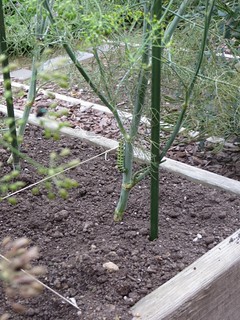
Here are two caterpillars on the dill, a big one about ready to drop, and a little one a couple inches in front of it.

Here is a caterpillar on the fennel. It was there yesterday morning, and had disappeared by mid afternoon.

I vaguely scouted around the yard this morning, not really expecting to see anything, but hah! There it is, attached to the new fence. It was looking much the same by dark, so I probably won't see it transform into a chrysalis.


The anise had been and gone, and the parsley wasn’t doing so well in pots, so I pulled out the anise and moved the parsley to the raised bed.

Here are two caterpillars on the dill, a big one about ready to drop, and a little one a couple inches in front of it.

Here is a caterpillar on the fennel. It was there yesterday morning, and had disappeared by mid afternoon.

I vaguely scouted around the yard this morning, not really expecting to see anything, but hah! There it is, attached to the new fence. It was looking much the same by dark, so I probably won't see it transform into a chrysalis.

121qebo
Seeing a buncha not-new butterflies...
I happened to catch this Eastern Tiger Swallowtail (male) at a good moment.

Quite a few Pearl Crescents have been hanging around the asters, where they belong. I have not yet seen any eggs or caterpillars.

This Wild Indigo Duskywing was laying eggs on the false indigo.

You can see two eggs on a leaf at center top, and another two on a leaf at right top.

I happened to catch this Eastern Tiger Swallowtail (male) at a good moment.

Quite a few Pearl Crescents have been hanging around the asters, where they belong. I have not yet seen any eggs or caterpillars.

This Wild Indigo Duskywing was laying eggs on the false indigo.

You can see two eggs on a leaf at center top, and another two on a leaf at right top.


124qebo
And other critters...
Grasshopper hanging out on the fennel.


I hear crickets in the clover but rarely see them.

Grasshopper hanging out on the fennel.


I hear crickets in the clover but rarely see them.

125qebo
Yup, missed it. I should’ve gone out there earlier this morning. It hasn’t solidified, and its skin is still attached, all crumpled up. I expect it to turn brown.


126qebo
The chrysalis has turned brown.

There are black swallowtail caterpillars all over the place. On the fennel, a large and five small ones that I noticed today.

Here are three all together.

On the parsley, the little parsley that I just transplanted from pots, more. I don’t see how the parsley will be able to support caterpillars as they grow, and I don’t know whether the caterpillars will switch to the ample fennel jungle inches away.
One in the parsley at the left corner of the raised bed...

Oh no, make that two.

Three in the parsley at the right corner of the raised bed...

Oh no, make that five.

Last year, one black swallowtail caterpillar that became a chrysalis on September 6 emerged as a butterfly on September 22. A half dozen others that were mere days behind went into diapause, and none of them made it through the winter.

There are black swallowtail caterpillars all over the place. On the fennel, a large and five small ones that I noticed today.

Here are three all together.

On the parsley, the little parsley that I just transplanted from pots, more. I don’t see how the parsley will be able to support caterpillars as they grow, and I don’t know whether the caterpillars will switch to the ample fennel jungle inches away.
One in the parsley at the left corner of the raised bed...

Oh no, make that two.

Three in the parsley at the right corner of the raised bed...

Oh no, make that five.

Last year, one black swallowtail caterpillar that became a chrysalis on September 6 emerged as a butterfly on September 22. A half dozen others that were mere days behind went into diapause, and none of them made it through the winter.
127qebo
While I was looking at the parsley and fennel, I noticed a cabbage white caterpillar moseying along the ground. Didn’t have time to watch where it went.


128qebo
Early this afternoon I noticed another batch of eggs on the false indigo.

Early this evening I noticed... more? Yes, I have photographic evidence.


Early this evening I noticed... more? Yes, I have photographic evidence.

129qebo
I was standing near the sunflowers, and happened to look up. I think these are Yellow Bear caterpillars, Virginia Tiger Moth.


130qebo
I went outside to check on the chrysalis, and also the large caterpillars that seem about ready to drop off, and... I happened to arrive at the right moment.
The large caterpillar on the dill was heading downward at a fairly rapid clip, which caught my attention because they generally don’t move around much.
It went all the way to the ground...

... and to the edge of the raised bed...

And my camera battery chose that moment to die. I had another battery upstairs, but I didn’t want to lose the caterpillar, so I watched it drop onto the ground, waited until it was crossing a longish bare stretch, ran upstairs to get the battery, and returned as it was still crossing the circle.
It went along the edge of a board...

... between plants...

... onto another board...

... along its edge...

... and out of the circle, heading toward the fence.

It met a vertical surface and tried to climb, but slipped off a few times and gave up.

It continued toward the fence...

... under the fence into the clover on the other side...

... through the clover onto the sidewalk (uh oh)...

... along the sidewalk toward the alley.

As it was about to hit the alley, I put my foot out to redirect it toward the the fence. It climbed onto my foot.

I moved my foot near the fence.

It climbed off my foot and onto the fence...

... went up the fence...

... over the top...

... down the inside...

... and decided this was OK. It turned right side up, swung its head back and forth...

... and settled into place. Three hours later it was still there.

I left and returned shortly before dark, and it was there but swinging back and forth. I couldn’t really see, but I’d guess it was constructing its harness. Hope it wasn’t reconsidering its location.
The large caterpillar on the dill was heading downward at a fairly rapid clip, which caught my attention because they generally don’t move around much.
It went all the way to the ground...

... and to the edge of the raised bed...

And my camera battery chose that moment to die. I had another battery upstairs, but I didn’t want to lose the caterpillar, so I watched it drop onto the ground, waited until it was crossing a longish bare stretch, ran upstairs to get the battery, and returned as it was still crossing the circle.
It went along the edge of a board...

... between plants...

... onto another board...

... along its edge...

... and out of the circle, heading toward the fence.

It met a vertical surface and tried to climb, but slipped off a few times and gave up.

It continued toward the fence...

... under the fence into the clover on the other side...

... through the clover onto the sidewalk (uh oh)...

... along the sidewalk toward the alley.

As it was about to hit the alley, I put my foot out to redirect it toward the the fence. It climbed onto my foot.

I moved my foot near the fence.

It climbed off my foot and onto the fence...

... went up the fence...

... over the top...

... down the inside...

... and decided this was OK. It turned right side up, swung its head back and forth...

... and settled into place. Three hours later it was still there.

I left and returned shortly before dark, and it was there but swinging back and forth. I couldn’t really see, but I’d guess it was constructing its harness. Hope it wasn’t reconsidering its location.

1332wonderY
I do think you should put a book together and submit this saga for publication. That was fun!
135qebo
Yesterday at 7pm, looking pretty much the same. I checked an hour later too, as night was imminent, didn't see anything happening.

Today at 8am, transformed overnight.


Today at 8am, transformed overnight.

136qebo
132,133,134: The journey took only 45 minutes. Short in comparison to last year’s adventures (http://www.librarything.com/topic/141676#3578828, http://www.librarything.com/topic/141676#3583337). I’m hoping the caterpillar got going early enough to emerge before fall arrives. Neither of last year’s made it through the winter.
137qebo
Yesterday I was tending the upper part of the yard, and happened upon this, a black swallowtail caterpillar on wild quinine (Parthenium integrifolium var. auriculatum). Oh? Because black swallowtail hosts are all in the parsley family (dill, fennel, anise, and even rattlesnake master). The rattlesnake master is next to the wild quinine, so close they’re entangled, so I guess this is what happened. The caterpillar seems perfectly happy. It was munching away yesterday and this morning, and it’s about an inch and a half long, so it’s presumably getting sufficient nourishment.

This is seriously ridculous. There are five caterpillars easily visible, and a sixth tucked in the back. As an experiment, I moved a caterpillar from the dill, where it was munching on brown leaves at the end of a brown stem, to the fennel, which is still green and bushy. After a few minutes, it began munching on the fennel. So that’s probably what I’ll do with the caterpillars on the parsley.


This is seriously ridculous. There are five caterpillars easily visible, and a sixth tucked in the back. As an experiment, I moved a caterpillar from the dill, where it was munching on brown leaves at the end of a brown stem, to the fennel, which is still green and bushy. After a few minutes, it began munching on the fennel. So that’s probably what I’ll do with the caterpillars on the parsley.

138qebo
Garden tending on Saturday:
Planted two little goldenrods to replace the one I killed a few months ago.

Planted two yellow echinaceas, which are past their prime.

Weeded the strip between fence and alley, and scattered clover seeds on the bare spots. The green is clover from seeds scattered months ago, and plantains, which I’m keeping. This photo distorts the lengths; the main bare stretch is about 6’ between the gate and the neighbor’s parking lot, and the 3’ of the gate. The planted stretch is 16’ with a bare patch at the corner. The vine coming through the fence is hops.


Planted two little goldenrods to replace the one I killed a few months ago.

Planted two yellow echinaceas, which are past their prime.

Weeded the strip between fence and alley, and scattered clover seeds on the bare spots. The green is clover from seeds scattered months ago, and plantains, which I’m keeping. This photo distorts the lengths; the main bare stretch is about 6’ between the gate and the neighbor’s parking lot, and the 3’ of the gate. The planted stretch is 16’ with a bare patch at the corner. The vine coming through the fence is hops.


139qebo
Garden tending on Sunday:
The American wisteria got seriously out of control while I was away or not paying attention. It reached the top of the trellis, and had nowhere to go, so it was just waving around in the air.

Last week I hacked it down to the size of the trellis, without planning what to do next.
Then I scouted around for a bigger (both higher and wider) trellis. I found nothing locally, and nothing online that approached what I really wanted: a trellis wall, about 8’ x 8’, until I considered the category of vegetable supports, and found an expandable pea trellis. It’s not intended for show, and it won’t last forever, but it should do the job for awhile. It’s two stackable layers, each 3’ high. I got two, and installed two bottom layers, so I can add a top layer eventually.

I managed to remove the old trellis and install the new trellis without disturbing the eggs on the false indigo.

The trumpet honeysuckle has been extending onto the sidewalk and getting tangled up with itself.

I gave it the trellis freed from the wisteria, a small trellis freed from the milkweed, and a small trellis that had been idle. It’s still tangled up with itself, but I’ve extended it upward and outward, loosely attached to it can twist around as it needs to.

The American wisteria got seriously out of control while I was away or not paying attention. It reached the top of the trellis, and had nowhere to go, so it was just waving around in the air.

Last week I hacked it down to the size of the trellis, without planning what to do next.
Then I scouted around for a bigger (both higher and wider) trellis. I found nothing locally, and nothing online that approached what I really wanted: a trellis wall, about 8’ x 8’, until I considered the category of vegetable supports, and found an expandable pea trellis. It’s not intended for show, and it won’t last forever, but it should do the job for awhile. It’s two stackable layers, each 3’ high. I got two, and installed two bottom layers, so I can add a top layer eventually.

I managed to remove the old trellis and install the new trellis without disturbing the eggs on the false indigo.

The trumpet honeysuckle has been extending onto the sidewalk and getting tangled up with itself.

I gave it the trellis freed from the wisteria, a small trellis freed from the milkweed, and a small trellis that had been idle. It’s still tangled up with itself, but I’ve extended it upward and outward, loosely attached to it can twist around as it needs to.

140qebo
I found two caterpillars in the honeysuckle, seem to be the same kind, perhaps different instars. Checked Caterpillars of Eastern North America and matched them visually to the Snowberry Clearwing moth (Hemaris diffinis), confirmed by the list of host plants, which include honeysuckle.


I moved the largest parsley swallowtail caterpillar onto the fennel, where it appears to be content. The swallowtail caterpillar count is 17 (1 wild quinine, 2 dill, 7 fennel, 7 parsley), plus the two chrysalides.


I moved the largest parsley swallowtail caterpillar onto the fennel, where it appears to be content. The swallowtail caterpillar count is 17 (1 wild quinine, 2 dill, 7 fennel, 7 parsley), plus the two chrysalides.
143ronincats
What a busy place your garden is! Lots of gulf fritillaries here, and I saw what I believe is a Giant Swallowtail, since it seems to like the citrus.
144qebo
Last year I had a bazillion variegated fritillary caterpillars in the violets. This year, I've seen not a single one. I thought I saw a variegated fritillary butterfly a couple weeks ago, but I didn't get a photo so I'm not sure.
145qebo
I wasn’t sure the poor little parsley could survive another night with all those caterpillars munching away, and then what would the caterpillars do, so I transferred them to the fennel. And discovered a 6th on the parsley. And noticed 2 more on the fennel while I was sitting on the ground looking up. The large caterpillar on the fennel seems to have dropped off this afternoon, but I haven't found it elsewhere.
Evening caterpillar count: 29 (1 wild quinine, 10 dill, 16 fennel, 2 parsley).
Evening caterpillar count: 29 (1 wild quinine, 10 dill, 16 fennel, 2 parsley).
146qebo
Saturday morning caterpillar count: 18 (1 wild quinine, 10 dill, 6 fennel, 1 parsley).
2 on the dill, 1 on the fennel, and the 1 on the wild quinine look about ready to drop off and chrysalize. I don't know what happened to the others on the fennel. Maybe a few of them dropped off, but the others were definitely too small. The 10 on the dill aren't exactly the same ones as a few days ago; I've counted 8 and 11 at various times, there have been sudden appearances of little ones, and the photo is an example of what happens to the ones that disappear. It was there for awhile, and then it was gone completely.

2 on the dill, 1 on the fennel, and the 1 on the wild quinine look about ready to drop off and chrysalize. I don't know what happened to the others on the fennel. Maybe a few of them dropped off, but the others were definitely too small. The 10 on the dill aren't exactly the same ones as a few days ago; I've counted 8 and 11 at various times, there have been sudden appearances of little ones, and the photo is an example of what happens to the ones that disappear. It was there for awhile, and then it was gone completely.

147qebo
Today I will be here: the first annual Lancaster County Master Gardener Pollinator-Friendly Garden Tour.
149qebo
Yesterday I was here: Brooklyn Botanic Garden. There's a native plant area that was expanded this year. It needs more labels and informational signs. The plants were mostly familiar. The butterflies were about what I'm seeing in my yard: lots of skippers, several black swallowtails, one monarch that got away before I got a photo. The milkweed is not as far into decay as mine but is covered with aphids.


150qebo
Monday morning caterpillar count: 24 (1 wild quinine, 15 dill, 8 fennel, 0 parsley).
It's getting crowded:


It's getting crowded:


151fuzzi
Any problems with whiteflies? We've had them outside for a couple weeks. This evening it looked like it was snowing, there were so many.
My poor plants!
My poor plants!
152qebo
At least two black swallowtails dropped off today. The first probably came from the fennel, but maybe from the dill. I didn't do an evening count.
I happened to see it on the ground when I went out for a break this afternoon.

It climbed up the raised bed, walked along the rim, dropped to the ground, climbed up again, and disappeared into the jungle of fennel and mistflower (wild ageratum).


I happened to see it on the ground when I went out for a break this afternoon.

It climbed up the raised bed, walked along the rim, dropped to the ground, climbed up again, and disappeared into the jungle of fennel and mistflower (wild ageratum).


154qebo
148: we'll be in Lancaster a week from Monday
Oh? What brings you here?
151: Any problems with whiteflies?
I had to look these up. I don't think so...
151: the Swallowtail Stalker
Well, I want to know where they end up, and they're hard to find after the fact.
The two chrysalises on the fence are still brown. We're heading into a few warm days, so maybe butterflies will emerge, but maybe not. I'm guessing that all the caterpillars still on the plants will go into diapause for the winter, so I shouldn't get too attached; none of last year's made it through.
The garden tour was well organized, and I hope successful enough that they'll go for another year and get more gardeners to participate. There were only five houses, scattered too far apart for a simple circuit. Each stop had a staffed booth with information about native plants or bees or butterflies or some such. One stop had a monarch caterpillar; turns out that I'm not the only one who coos. Most helpfully, each stop had a printed list of its plants.
Oh? What brings you here?
151: Any problems with whiteflies?
I had to look these up. I don't think so...
151: the Swallowtail Stalker
Well, I want to know where they end up, and they're hard to find after the fact.
The two chrysalises on the fence are still brown. We're heading into a few warm days, so maybe butterflies will emerge, but maybe not. I'm guessing that all the caterpillars still on the plants will go into diapause for the winter, so I shouldn't get too attached; none of last year's made it through.
The garden tour was well organized, and I hope successful enough that they'll go for another year and get more gardeners to participate. There were only five houses, scattered too far apart for a simple circuit. Each stop had a staffed booth with information about native plants or bees or butterflies or some such. One stop had a monarch caterpillar; turns out that I'm not the only one who coos. Most helpfully, each stop had a printed list of its plants.
155qebo
Several days ago, the caterpillar on the wild quinine was about the same size as a bunch of others on the dill and fennel. Since then, it has not grown as much as the others. The wild quinine was an error, and maybe not sufficient nourishment even though it was always eating. Today it wasn’t eating, and had moved to a leafless stem, where it stayed for hours. I thought it might be ready to drop off, so I kept checking.

Oh no, it’s gone and I missed it, I thought, but there it was on a paving stone. It stayed there for several minutes...

... walked across the paving stone, paused to poop, and stayed there for ten minutes looking none too perky.

Then it walked, slooowly, across a few more paving stones...

... into the clover.

I watched for awhile, but it didn’t go anywhere, just twisted around in the same spot. I left to take a walk, returned just before dark, and it was still there. This is not a good place to be a chrysalis, with nothing solid to hang onto, and vulnerable to getting stepped on. I hope it moves on overnight.


Oh no, it’s gone and I missed it, I thought, but there it was on a paving stone. It stayed there for several minutes...

... walked across the paving stone, paused to poop, and stayed there for ten minutes looking none too perky.

Then it walked, slooowly, across a few more paving stones...

... into the clover.

I watched for awhile, but it didn’t go anywhere, just twisted around in the same spot. I left to take a walk, returned just before dark, and it was still there. This is not a good place to be a chrysalis, with nothing solid to hang onto, and vulnerable to getting stepped on. I hope it moves on overnight.

156qebo
Butterfly #19
Variegated Fritillary
9 September 2013
Aster


Where have they been? Probably too late for caterpillars.
Variegated Fritillary
9 September 2013
Aster


Where have they been? Probably too late for caterpillars.
157qebo
The caterpillar is still in the clover. I should've moved it to the fennel or dill. The wild quinine was not good brain food.
158qebo
And now it's gone.
At last one dropped off the fennel since this morning, and I suspect a few on the dill but I haven't done a proper count. I'm not seeing any of them in the yard.
At last one dropped off the fennel since this morning, and I suspect a few on the dill but I haven't done a proper count. I'm not seeing any of them in the yard.
159qebo
Tuesday evening caterpillar count: 16 (11 dill, 5 fennel).
Approximately. Counting isn't easy.
Approximately. Counting isn't easy.
160fuzzi
We're going on vacation next week, and are stopping in Lancaster for our first night's rest.
161qebo
Wednesday morning caterpillar count: 24 (17 dill, 7 fennel).
Apparently I missed a few yesterday evening.
Still, several have dropped off and gone somewhere. I've checked around the fence, don't see anybody except the known two hanging there, but I can't get at it along some stretches, too many plants in the way. I've also scanned stems of sunflowers and milkweeds. Maybe I'll find them when I do cleanup this weekend. No real hurry.
Apparently I missed a few yesterday evening.
Still, several have dropped off and gone somewhere. I've checked around the fence, don't see anybody except the known two hanging there, but I can't get at it along some stretches, too many plants in the way. I've also scanned stems of sunflowers and milkweeds. Maybe I'll find them when I do cleanup this weekend. No real hurry.
162qebo
Skippers everywhere.
I thought this might be new, but it’s probably a female Zabulon.

I've photographed several others, but I'm pretty sure they're Peck's, already identified.
Yesterday was a good butterfly day though...
I thought this might be new, but it’s probably a female Zabulon.

I've photographed several others, but I'm pretty sure they're Peck's, already identified.
Yesterday was a good butterfly day though...
163qebo
Butterfly #20
Yellow Collard Scape Moth
September 10
Wild Quinine


A moth, not a butterfly, but I counted it last year.
Yellow Collard Scape Moth
September 10
Wild Quinine


A moth, not a butterfly, but I counted it last year.

165qebo
Butterfly #22
Eastern Comma
September 10
fence

Really, it's there in the shadow. I was on the other side of the fence and couldn't get at it for a decent photo, but the wing shape and comma mark are distinctive.
Eastern Comma
September 10
fence

Really, it's there in the shadow. I was on the other side of the fence and couldn't get at it for a decent photo, but the wing shape and comma mark are distinctive.
166qebo
Also, goldfinches have been showing up. In the second photo, it's in the middle, clustered with the sunflowers.


168qebo
Monarch sighting! Female, but I think too late for eggs. They're supposed to be migrating now.


169qebo
Butterfly #23
Question Mark
September 11
Violet

I expected this to be a better photo of yesterday's Comma, but the upper wing marks are definitely Question Mark. I didn't catch the underside except as a flash of purplish.
Question Mark
September 11
Violet

I expected this to be a better photo of yesterday's Comma, but the upper wing marks are definitely Question Mark. I didn't catch the underside except as a flash of purplish.
170qebo
Wednesday evening caterpillar count: 16 (12 dill, 4 fennel).
I saw two leave the dill. One went into the fennel / mistflower jungle. One went onto the deck and disappeared in a crack between boards.
I did another yard check, and found a 3rd chrysalis on the fence. Don't know how long it's been there.

No discernible change in the other two chrysalides.
I saw two leave the dill. One went into the fennel / mistflower jungle. One went onto the deck and disappeared in a crack between boards.
I did another yard check, and found a 3rd chrysalis on the fence. Don't know how long it's been there.

No discernible change in the other two chrysalides.
1722wonderY
Your asters appear to be in mid-bloom.
Mine haven't even put buds out yet.
They're also shorter than in other years.
Mine haven't even put buds out yet.
They're also shorter than in other years.
173qebo
And a 4th. This is presumably the caterpillar that disappeared on the deck yesterday afternoon. It is now hanging from the railing.

Thursday morning caterpillar count: 16 (10 dill, 6 fennel).

Thursday morning caterpillar count: 16 (10 dill, 6 fennel).
174qebo
The 4th (not-yet-)chrysalis looked pretty much the same as dark was imminent. I found a 5th during a vague survey after a brief storm this afternoon, presumably one of today's drops because it was constructing its harness in the early evening.


Thursday evening caterpillar count: 10 (6 dill, 4 fennel).


Thursday evening caterpillar count: 10 (6 dill, 4 fennel).
175qebo
Caterpillars progressed as expected overnight: 4th is a chrysalis, 5th is in a harness. Flickr is down, so no photos.
Friday morning caterpillar count: 11 (6 dill, 5 fennel).
Obviously many caterpillars are missing. I need to do yard cleanup this weekend, so maybe I'll find more, but there's no guarantee they stayed in the yard.
Friday morning caterpillar count: 11 (6 dill, 5 fennel).
Obviously many caterpillars are missing. I need to do yard cleanup this weekend, so maybe I'll find more, but there's no guarantee they stayed in the yard.
176qebo
Flickr is back up, so here they are:
On the deck railing, chrysalized overnight, a greenish brown that will become more brown.

On the high fence between my yard and the neighbors’, harnessed overnight.

And a 6th. Yesterday I watched it pass under the fence into the neighbors’ yard, go up the fence on their side and partway down the fence on my side, and scout around under the horizontal bar where they usually end up. I expected it to settle, but I went inside to work, waited through a storm, and when I returned outside a couple hours later it wasn’t there or anywhere around that I could see. Seems though that once they begin thinking about settling, they don’t go very far, so I looked a little harder today, and here it is, between the panels that separate the porches, in a harness so definitely from yesterday.


On the deck railing, chrysalized overnight, a greenish brown that will become more brown.

On the high fence between my yard and the neighbors’, harnessed overnight.

And a 6th. Yesterday I watched it pass under the fence into the neighbors’ yard, go up the fence on their side and partway down the fence on my side, and scout around under the horizontal bar where they usually end up. I expected it to settle, but I went inside to work, waited through a storm, and when I returned outside a couple hours later it wasn’t there or anywhere around that I could see. Seems though that once they begin thinking about settling, they don’t go very far, so I looked a little harder today, and here it is, between the panels that separate the porches, in a harness so definitely from yesterday.


177qebo
Friday evening caterpillar count: 5 (1 dill, 4 fennel).
Today was chilly and windy. I was too busy with work to watch for dropping caterpillars, and seems lots of them have been deciding it’s time.
A mystery: I checked the caterpillar of post 174 in the early afternoon, and nothing had happened, it was still just hanging there in its harness, which is normal. I checked again in the late afternoon, and it was gone. Gone. No remnants on the fence. No body on the ground below. Weird.
Today was chilly and windy. I was too busy with work to watch for dropping caterpillars, and seems lots of them have been deciding it’s time.
A mystery: I checked the caterpillar of post 174 in the early afternoon, and nothing had happened, it was still just hanging there in its harness, which is normal. I checked again in the late afternoon, and it was gone. Gone. No remnants on the fence. No body on the ground below. Weird.
178qebo
Saturday morning caterpillar count: 9 (5 dill, 4 fennel).
I cleared out the dill that was mostly brown. On a dill that was borderline I found two small caterpillars so I let it be. At the bottom of another I found a caterpillar huddled as if ready to form a chrysalis. The two others munching away are large and near ready to drop off.
I propped up the fennel and removed decaying branches, but didn't find any caterpillars that I didn't already know about.
I cleared out the dill that was mostly brown. On a dill that was borderline I found two small caterpillars so I let it be. At the bottom of another I found a caterpillar huddled as if ready to form a chrysalis. The two others munching away are large and near ready to drop off.
I propped up the fennel and removed decaying branches, but didn't find any caterpillars that I didn't already know about.
179qebo
Saturday evening caterpillar count: 8 (5 dill, 3 fennel).
The dill has been a straggly mess for awhile. With most of the caterpillars gone, and the rest concentrated in a few of the greener plants, I decided to clean up. This is before. I forgot to take a photo of after.

I had to disentangle stems and leaves, and apparently this was disturbing to some residents.

As I mentioned, I found one caterpillar huddled at the bottom of the dill, but it was gone an hour later.
I found this caterpillar on a volunteer dill that isn’t big enough to feed it, so I moved it to the dill in the raised bed.

The dill has been a straggly mess for awhile. With most of the caterpillars gone, and the rest concentrated in a few of the greener plants, I decided to clean up. This is before. I forgot to take a photo of after.

I had to disentangle stems and leaves, and apparently this was disturbing to some residents.

As I mentioned, I found one caterpillar huddled at the bottom of the dill, but it was gone an hour later.
I found this caterpillar on a volunteer dill that isn’t big enough to feed it, so I moved it to the dill in the raised bed.

180qebo
I was still bothered about the caterpillar who went missing yesterday, after it had harnessed itself to the fence, so I checked the spot again and... there was a caterpillar. Huh? But not in exactly the same spot, and not harnessed.

A little while later it had shifted position.

And then... it was on the ground. Something about the spot that nobody can stick to it?
I was worried that it would go under the fence, but instead it climbed.

Not very far.

Within minutes it had settled. Several hours later it was still there.


A little while later it had shifted position.

And then... it was on the ground. Something about the spot that nobody can stick to it?
I was worried that it would go under the fence, but instead it climbed.

Not very far.

Within minutes it had settled. Several hours later it was still there.

181qebo
As I was sprucing up the yard, I scouted around the fence and other plausible locations.
I found a chrysalis on the fence between my yard and the neighbors’ parking lot.

I found a chrysalis on the fence between my yard and the alley.

I found a caterpillar on the fence between my yard and the alley.

I was thinking maybe under the hose holder...

... but I found a chrysalis attached to the brick wall above. This really does not seem sensible.

I found a chrysalis on the fence between my yard and the neighbors’ parking lot.

I found a chrysalis on the fence between my yard and the alley.

I found a caterpillar on the fence between my yard and the alley.

I was thinking maybe under the hose holder...

... but I found a chrysalis attached to the brick wall above. This really does not seem sensible.

182qebo
I took the common milkweed off the stakes, because propping up dead leaves and seed pods was looking ridiculous. I didn’t pull it out, because there are still various critters hanging around.

For example, ladybugs.


I removed the mammoth sunflower, mostly. I had to saw off sections of its stem. The leaf is still there because a cluster of ants was on it.

I deadheaded the other sunflowers.


For example, ladybugs.


I removed the mammoth sunflower, mostly. I had to saw off sections of its stem. The leaf is still there because a cluster of ants was on it.

I deadheaded the other sunflowers.


185qebo
Tuesday afternoon caterpillar count: 2 (2 dill, 0 fennel).
There is an egg on the fennel though.
Two of the caterpillars on the fence haven't yet converted into chrysalides. Too chilly? Two of the chrysalides on the fence have been there for over two weeks. I was hoping they'd be butterflies by now.
There is an egg on the fennel though.
Two of the caterpillars on the fence haven't yet converted into chrysalides. Too chilly? Two of the chrysalides on the fence have been there for over two weeks. I was hoping they'd be butterflies by now.
186qebo
Monday morning caterpillar count: 0. :-(
10 chrysalides intact. About a half dozen caterpillars dropped off since the last thorough yard check, so I'll do another soonish, but I assume at this point they're in for the winter.
10 chrysalides intact. About a half dozen caterpillars dropped off since the last thorough yard check, so I'll do another soonish, but I assume at this point they're in for the winter.
187qebo
Monday afternoon caterpillar report: 1 on the dill that I missed this morning. 11 chrysalides; happened upon one on the fence when looking at the sunflowers. An egg on the parsley. The egg on the fennel is gone, but I don't see a caterpillar in its place.
188ronincats
Katherine, you have impacted my psyche so much that last night I had a dream about being able to take perfect pictures of two gorgeous butterflies--because they had settled inside my house!
189SqueakyChu
> 193
My three cats do that all the time!
My three cats do that all the time!
190qebo
Caterpillar status unchanged. I keep thinking I should move the one on the dill to a better location, because there's not much green to be found, but somehow it manages.
191qebo
The weekend before last I swung by a garden center while running errands... just looking... and saw a table of past-bloom flowers at a substantial discount, some of them native-ish. Well, there’s always room for just one more. I know where these can go, really. The pink ones go in the front yard, the orange ones go along the fence where the sunflowers are, the yellow ones go with the other yellows, the white ones can be stuffed around the edges of the white triangle.

See? A vast space between the ragwort and the goldenrod, a fine place for a sneezeweed (Helenium autumnale ‘Sombrero’).

The clover is a placeholder, to be removed if alternatives appear. It is quite well rooted, turns out. Ample space for a wild indigo (Baptisia sphaerocarpa ‘Screaming Yellow’).


Also, it’s time for the golden alexanders (Zizia aurea). I got seeds in the spring, but the instructions say to either plant in the fall or cold stratify for several months. A helpful-for-a-fee neighbor kid removed the mammoth sunflower stalk; I could’ve done it myself, but he wanted to earn money for a bicycle part and this was part of the deal. Golden alexanders are related to dill and fennel, and were swallowtail hosts before the non-native garden plants arrived.


See? A vast space between the ragwort and the goldenrod, a fine place for a sneezeweed (Helenium autumnale ‘Sombrero’).

The clover is a placeholder, to be removed if alternatives appear. It is quite well rooted, turns out. Ample space for a wild indigo (Baptisia sphaerocarpa ‘Screaming Yellow’).


Also, it’s time for the golden alexanders (Zizia aurea). I got seeds in the spring, but the instructions say to either plant in the fall or cold stratify for several months. A helpful-for-a-fee neighbor kid removed the mammoth sunflower stalk; I could’ve done it myself, but he wanted to earn money for a bicycle part and this was part of the deal. Golden alexanders are related to dill and fennel, and were swallowtail hosts before the non-native garden plants arrived.


192qebo
Still a fair amount of activity in the yard.
Aphids on the oxeye. They’ve been around for a month or two, and the flowers have been blooming nicely until quite recently, so I let them be. These aphids are not on any other plant. Googling “red aphids on oxeye” gets a lots of results, with suggestions for removing them, but not further identification.

Harlequin bugs on the mustard.

Mexican bean beetles on the scarlet emperor beans. They didn’t show up until the flowers and beans were pretty much done anyway.


Unidentified bugs on the scarlet emperor beans.

Grasshoppers.


Goldfinches on the sunflowers.

A caterpillar that actually did significant damage. On the romanesco cauliflower and nowhere else, chewed the leaves into lace and killed the plants. Did not help that plants were in pots with a generic potting soil that seems to have been too heavy or something; nothing else planted in it did well either. It is a cross-striped cabbageworm (Evergestis rimosalis), which becomes a moth of unremarkable appearance.

Fuzzy caterpillars.
Woolly Bear (Pyrrharctica Isabella), caterpillar of the Isabella Tiger Moth.

Yellow Bear (Spilosoma virginica) (?), caterpillar of the Virginian Tiger Moth. Already encountered in the yellow phase on the sunflowers. According to Caterpillars of Eastern North America, they get darker as they age, can become red-brown in late instars.

I don’t think this is a yellow bear; it has a more distinct pattern under the fuzz. Looks sorta like a bunch of things, but not exactly like anything.

Lots of bees on the goldenrod, but photos don’t show the numbers.
Still seeing cabbage white and sulphur butterflies, not much else. Skippers were all over for awhile, but I haven’t seen any in recent days.
Aphids on the oxeye. They’ve been around for a month or two, and the flowers have been blooming nicely until quite recently, so I let them be. These aphids are not on any other plant. Googling “red aphids on oxeye” gets a lots of results, with suggestions for removing them, but not further identification.

Harlequin bugs on the mustard.

Mexican bean beetles on the scarlet emperor beans. They didn’t show up until the flowers and beans were pretty much done anyway.


Unidentified bugs on the scarlet emperor beans.

Grasshoppers.


Goldfinches on the sunflowers.

A caterpillar that actually did significant damage. On the romanesco cauliflower and nowhere else, chewed the leaves into lace and killed the plants. Did not help that plants were in pots with a generic potting soil that seems to have been too heavy or something; nothing else planted in it did well either. It is a cross-striped cabbageworm (Evergestis rimosalis), which becomes a moth of unremarkable appearance.

Fuzzy caterpillars.
Woolly Bear (Pyrrharctica Isabella), caterpillar of the Isabella Tiger Moth.

Yellow Bear (Spilosoma virginica) (?), caterpillar of the Virginian Tiger Moth. Already encountered in the yellow phase on the sunflowers. According to Caterpillars of Eastern North America, they get darker as they age, can become red-brown in late instars.

I don’t think this is a yellow bear; it has a more distinct pattern under the fuzz. Looks sorta like a bunch of things, but not exactly like anything.

Lots of bees on the goldenrod, but photos don’t show the numbers.
Still seeing cabbage white and sulphur butterflies, not much else. Skippers were all over for awhile, but I haven’t seen any in recent days.
193qebo
Butterfly #24
Gray Hairstreak
September 17
Clover

Clover is a host, so exactly where it ought to be.
Gray Hairstreak
September 17
Clover

Clover is a host, so exactly where it ought to be.
194SqueakyChu
I love the pictures of the plants and insects in your garden.
Those Mexican bean beetles wreaked havoc with my squash/pumpkin plants. I pick them off, but more always seem to show up. All of my squash plants are cross-pollinated volunteers so I have no idea exactly what species (if any) they are!
All of the plants in the cauliflower/broccoli, cabbage, etc. family are hard to grow because of pests. I have 6 Brussels sprouts plants that are now being decimated by whiteflies. I've been spraying the plants with a soap solution, but that seems to bathe the whiteflies instead of repelling them! :)
Those Mexican bean beetles wreaked havoc with my squash/pumpkin plants. I pick them off, but more always seem to show up. All of my squash plants are cross-pollinated volunteers so I have no idea exactly what species (if any) they are!
All of the plants in the cauliflower/broccoli, cabbage, etc. family are hard to grow because of pests. I have 6 Brussels sprouts plants that are now being decimated by whiteflies. I've been spraying the plants with a soap solution, but that seems to bathe the whiteflies instead of repelling them! :)
195fuzzi
I saw a gray hairstreak today, but it would not stay still long enough for me to photograph it.
Love seeing your gardens, as usual!
Love seeing your gardens, as usual!
196qebo
The last swallowtail caterpillar on the dill has been growing steadily. I'd hoped it would stay put until the weekend when I'd have time to watch it venture forth, but it disappeared sometime yesterday afternoon. So that's that, caterpillar count is 0. We're getting a stretch of warm days, but I see no signs of activity in the chrysalides, and suppose they're in for the winter.
197SqueakyChu
I looked for the six in my garden but found none. :(
198qebo
194: Natural Insect Control by the Brooklyn Botanic Garden folks recommends not only a water spray but Encarsia formosa, which is available by mail order.
195: My butterflies are not cooperative either. I often have to sneak around at a distance. Fortunately my camera has a pretty good zoom.
195: My butterflies are not cooperative either. I often have to sneak around at a distance. Fortunately my camera has a pretty good zoom.
199qebo
Those plants sitting on the deck in post 191? Some of them belonged in the front yard, and, um, I got a few more from the past-bloom table while running errands on Saturday. Seemed time to do something with them, so I spent a couple hours in the front yard on Saturday afternoon. Doesn’t look like much now but it’s getting nativer. Everything is pink-ish. Non-native: Chrysanthemums in bloom, planted a few years ago. Behind them Hellebore / Lenten Rose, there when I moved in, kept because the flowers show up before the snow is gone. Chopped off stems are Peonies. The bush at the back is a Weigela. Next to it, Astilbe. On the far left, scrawny patches of Lamium. Native-ish (US, not necessarily this region): Steeplebush (Spiraea tomentosa) and three Wild Pinks (Silene caroliniana), planted back in post 12. Behind those, three Echinaceas, “Butterfly Kisses”. In middle front is Anise Hyssop (Agastache mexicana ‘Heatwave’). On the right front are three Phlox, don’t know where the tag is for exact identification. Behind them, three Beard-Tongue (Penstemon barbatus ‘Elfin Pink’). Behind them, one Bee Balm (Monarda didyma ‘Marshall’s Delight’). I dug out some of the pink tulips earlier this year, left some in the ground too, don’t remember which ones, so there may be conflicts next spring.


200qebo
Today, the side of the house.
10:30am, a mess. The flowers are White Wood Asters (Eurybia divaricata), which are going to seed and sprouting up all over. Front right is English Ivy, the sole survivor of an arrangement from the real estate agent when I bought the house, beginning to show its invasive nature. I should remove it... The rest is a mix of plantains, violets, and intentional plants that have become obscured.

A slug of impressive size.

11:45am, a start. Ivy cut back a little, plantains and violets removed, ground leveled.

2:45pm, time for a break. Weeds removed, rough arrangement of items to be relocated and planted. In the foreground, Partridge Berry (Mitchella repens), which was about to get lost among the weeds where it was.

4:30pm, done.

On the left, non-native Bleeding Heart (Dicentra spectabilis ‘Alba’). Next to it in the large clump, Alum Root (Heuchera americana ‘Dales Strain’) and Foam Flower (Tiarella cordifolia var. collina), which I cut back after the flowers faded. A bare area around the Whorled Stonecrop (Sedum ternatum) in hopes that it will spread. Behind it are two Jack in the Pulpit (Arisaema triphyllum), supposedly; hope they return next spring. On the right, a clump of volunteer violets, plus some that I moved from other locations.

In the middle, Black Cohash (Cimicifuga racemosa), which had one cluster of flowers this year. The nails are set 3” behind four Maidenhair Ferns (Adiantum pedatum), which came from boxes.

These nails are set 3” behind four Mayapples (Podophyllum peltatum), also from boxes.

Only thing missing from the previous photos is the Wild Ginger (Asarum canadense), which is between the Mayapples and Asters. It didn’t do much this year, but I can see it extending outward on the surface of the ground, so I cleared space around for encouragement.

So that was six hours of kneeling and squatting, with a brief break for coffee and food. Did not expect this to take so long. Now I ache all over.
10:30am, a mess. The flowers are White Wood Asters (Eurybia divaricata), which are going to seed and sprouting up all over. Front right is English Ivy, the sole survivor of an arrangement from the real estate agent when I bought the house, beginning to show its invasive nature. I should remove it... The rest is a mix of plantains, violets, and intentional plants that have become obscured.

A slug of impressive size.

11:45am, a start. Ivy cut back a little, plantains and violets removed, ground leveled.

2:45pm, time for a break. Weeds removed, rough arrangement of items to be relocated and planted. In the foreground, Partridge Berry (Mitchella repens), which was about to get lost among the weeds where it was.

4:30pm, done.

On the left, non-native Bleeding Heart (Dicentra spectabilis ‘Alba’). Next to it in the large clump, Alum Root (Heuchera americana ‘Dales Strain’) and Foam Flower (Tiarella cordifolia var. collina), which I cut back after the flowers faded. A bare area around the Whorled Stonecrop (Sedum ternatum) in hopes that it will spread. Behind it are two Jack in the Pulpit (Arisaema triphyllum), supposedly; hope they return next spring. On the right, a clump of volunteer violets, plus some that I moved from other locations.

In the middle, Black Cohash (Cimicifuga racemosa), which had one cluster of flowers this year. The nails are set 3” behind four Maidenhair Ferns (Adiantum pedatum), which came from boxes.

These nails are set 3” behind four Mayapples (Podophyllum peltatum), also from boxes.

Only thing missing from the previous photos is the Wild Ginger (Asarum canadense), which is between the Mayapples and Asters. It didn’t do much this year, but I can see it extending outward on the surface of the ground, so I cleared space around for encouragement.

So that was six hours of kneeling and squatting, with a brief break for coffee and food. Did not expect this to take so long. Now I ache all over.
202SqueakyChu
Well, I went out to pick a squash today. Then I came back inside. :)
By the way, where are you going to place your Little Free Library?
By the way, where are you going to place your Little Free Library?
204SqueakyChu
I can't wait 'til you get your LFL...and I can "like" it on Facebook. :)
Now I have to see what else I can get you into... Haha!
Now I have to see what else I can get you into... Haha!
207qebo
206: Nope, doesn't work for me. It's a fun idea, but not enough natural overlap, and too time consuming to either force fit or devise categories.
208SqueakyChu
Haha!
210qebo
209: No. I merely observed it. Slugs aren’t causing any serious damage in my garden, and even if they were, that method makes me queasy. Slugs are kind of interesting, snails that have lost their shells. Most of the slugs I see around here are fairly small, 1”-2” long, don’t know whether they are babies or a different species. Even the largish ones aren’t all that impressive. I lived for a few years near the Puget Sound, where the banana slugs are fantastic.
211varielle
I prefer to let them have a last drink. A little beer in a jar cap makes sure they die happy.
212qebo
Saturday in the yard:
Removed the sunflowers entirely. I’d been cutting off dead flowers and leaves and branches, and what remained was not thriving and not attractive.


In place of the sunflowers: four butterfly weeds that I started in pots this year, and two orange agastache and an orange and a red echinacea from the past-bloom table.

In the always space for one more department, agastache, planted in the circle between the mountain mints and the wild bergamot. Three of them: two ‘Summer Sky’ from the past-bloom table, and a ‘Black Adder’ given to participants in the native plant garden tour last month.

Also, not photographed because there’s not much to see, planted three white liatris in the white triangle, two red echinacea in the red rectangle, a Jacob’s ladder matching the other in with the violets. All from the past-bloom table. This leaves 0 plants in pots!
Bonus photo: A caterpillar! I thought they were all gone, but I noticed this one when I happened to pass by the fennel.

Bonus event, but no photo: While I was digging out the sunflowers, I saw a hawk with a squirrel hanging down from its talons! Heard a scuffle in the air and looked up. The hawk landed briefly on top of a telephone pole and I grabbed the camera, but it flew away before I was able to shoot.
Removed the sunflowers entirely. I’d been cutting off dead flowers and leaves and branches, and what remained was not thriving and not attractive.


In place of the sunflowers: four butterfly weeds that I started in pots this year, and two orange agastache and an orange and a red echinacea from the past-bloom table.

In the always space for one more department, agastache, planted in the circle between the mountain mints and the wild bergamot. Three of them: two ‘Summer Sky’ from the past-bloom table, and a ‘Black Adder’ given to participants in the native plant garden tour last month.

Also, not photographed because there’s not much to see, planted three white liatris in the white triangle, two red echinacea in the red rectangle, a Jacob’s ladder matching the other in with the violets. All from the past-bloom table. This leaves 0 plants in pots!
Bonus photo: A caterpillar! I thought they were all gone, but I noticed this one when I happened to pass by the fennel.

Bonus event, but no photo: While I was digging out the sunflowers, I saw a hawk with a squirrel hanging down from its talons! Heard a scuffle in the air and looked up. The hawk landed briefly on top of a telephone pole and I grabbed the camera, but it flew away before I was able to shoot.
213SqueakyChu
So that's where one of my caterpillars went! ;)
214qebo
213: Your caterpillars are beyond this stage. I bet they're hidden in your yard or neighborhood, as chrysalides by now. I want to search my neighbors' yard for chrysalides on the fence, but they claim they've seen none, and haven't invited me to check. I suspect they're just not all that interested. :-( I can peer over the fence between the yards, but I'd need to peer behind posts.
215SqueakyChu
I was just kidding (notice the winking emoticon!). I did check last week to see if I could find any chrysalides, but I could find none either.
216qebo
215: I was just kidding
Oh, I know. I'm missing about 2/3 of my caterpillars, who either set up camp in unexpected places in my yard (I've been checking as I dismantle plants for fall cleanup, but so far nothing), or wandered beyond the fence.
Oh, I know. I'm missing about 2/3 of my caterpillars, who either set up camp in unexpected places in my yard (I've been checking as I dismantle plants for fall cleanup, but so far nothing), or wandered beyond the fence.
217SqueakyChu
I guess you'll have to replace your fence with a slippery, non-penetrable fence (KIDDING!!!). :D
218qebo
217: Heh. Don't assume I haven't thought about this... Actually, I think all I need is a low barrier between the ground and the fence. The caterpillars seem happy with my fence if they find it. The problem is they trek along the ground and go under the fence without realizing it's there. Garden edging would do the job.
219SqueakyChu
I guess I wasn't kidding after all...
:)
:)
221qebo
Miscellaneous yard activity.
Bumblebees, eking out a living on the few remaining flowers.


A small milkweed bug hanging out in the ironweed. Last year there were clusters of babies on the milkweed seed pods. This year nowhere near as many, but they’re around and about in the yard. Apparently small milkweed bugs hibernate in the winter, and large milkweed bugs migrate south.

A grasshopper munching on the Joe Pye.
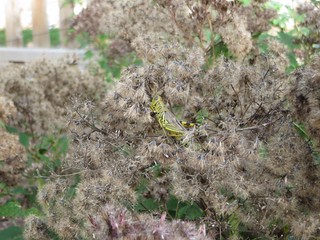
The last black swallowtail caterpillar shedding its skin.

A monarch! On October 15, which is quite late. A really beat up monarch, a long way from Mexico. It was on the ground resting or sunning its wings, flapping slowly. I watched it for a few minutes then went inside. When I returned outside several hours later, it was gone, or so I thought, and then I saw the wings scattered about. No body; maybe a bird got it?


Bumblebees, eking out a living on the few remaining flowers.


A small milkweed bug hanging out in the ironweed. Last year there were clusters of babies on the milkweed seed pods. This year nowhere near as many, but they’re around and about in the yard. Apparently small milkweed bugs hibernate in the winter, and large milkweed bugs migrate south.

A grasshopper munching on the Joe Pye.
The last black swallowtail caterpillar shedding its skin.

A monarch! On October 15, which is quite late. A really beat up monarch, a long way from Mexico. It was on the ground resting or sunning its wings, flapping slowly. I watched it for a few minutes then went inside. When I returned outside several hours later, it was gone, or so I thought, and then I saw the wings scattered about. No body; maybe a bird got it?


222SqueakyChu
That's a very sad ending to the monarch story... :(
223qebo
The last swallowtail caterpillar has been around all this time. I've been checking daily, worried that nights would be too cold, but it has seemed fine, munching the fennel and growing. I saw it on Friday evening, but not yesterday and not today. So I'm supposing it's gone. I scouted around the yard yesterday, but didn't find it.
224qebo
Not much more is likely to happen until spring. Gradually cleaning up, occasionally going around the yard to check that the swallowtail chrysalides are still there (so far yes). Began the official FeederWatch bird count today, in a new thread.
225qebo
Look who's going to be in Lancaster on Saturday: http://calendar.lancasteronline.com/lancaster_pa/events/show/368647668-the-green...
Except it may be cancelled because of snow. :-(
Except it may be cancelled because of snow. :-(
226fuzzi
Sounds interesting, but #1: too pricey and #2: too far away.
Are you going, weather permitting?
Are you going, weather permitting?
227qebo
Yes, planning to. I found out about it today, and official registration was closed, but I called and got on the list to pay at the door. The workshop includes lunch, and it's an opportunity for me to meet other people around here who are interested in this sort of thing.
228SqueakyChu
That sounds so cool. Be sure to give us a report!
2292wonderY
I hope you get to see and hear Douglas Tallamy. I would definitely be interested in hearing further from him. Of course it might just be another way to present what he's already given us in his invaluable book.
230qebo
229: He spoke here at a free event early this year, same gist as his book; he's an engaging speaker. (He lives about 50 miles from here, so it's relatively simple. He's supposed to be here again at the Millersville Native Plants Conference next spring.) The event tomorrow is a workshop, sponsored by an organization I'm not familiar with.
232SqueakyChu
:(
Too bad!
Too bad!
Join to post

