lycomayflower impersonates The Thing What Reads A Lot in 2014
Talk 75 Books Challenge for 2014
This group has been archived. Find out more.
Join LibraryThing to post.
1lycomayflower
Welcome to my 2014 reading thread! Click here to go to my introduction post.
This first post contains an on-going list of the books I've read this year, with the most recent reads at the top. Click on the book title to go to the book's post within the thread, where you will find a review. Numbers in parentheses are page counts for each book. You can also navigate from here to a list of my partial reads, to an on-going accounting of my goals for the year, and to my most recent previous challenge thread.
Completed Reads
Key: LB = Library Book; SB = Shelf Book; NB = New Book; RG = Recent Gift; BB = Borrowed Book; RR = Reread; NUB = Newly Purchased Used Book; AUD = Audiobook
Total Pages: 15,145
58.) NB: Saga, volume 4 (~100)
57.) SB: Regeneration (250)
56.) SB: The Snow Child (386)
55.) RR: A Christmas Carol (131)
54.) RG: How Harry Cast His Spell (270)
53.) SB, AUD: The Da Vinci Code
52.) LB: 4000 Years of Christmas (103)
51.) NB: Starry Night (239)
50.) LB: The Man Who Invented Christmas (237)
49.) BB: Midnight in the Garden of Good and Evil (388)
48.) LB: Night Passage (402)
47.) NUB, RR: Ramona the Pest and Ramona the Brave (~200)
46.) AUD: Tolkien Professor LotR lectures
45.) NB: A Rogue by Any Other Name (386)
44.) NB: The Cuckoo's Calling (456)
43.) SB, AUD: The Life and Times of the Thunderbolt Kid
42.) SB: Northanger Abbey (236)
41.) NB: Sex Criminals, volume 1 (~100)
40.) NB: Saga, volume 3 (~100)
39.) NB: Saga, volume 2 (~100)
38.) NB: Saga, volume 1 (~100)
37.) RR: Harry Potter and the Sorcerer's Stone (309)
36.) AUD: Harry Potter and the Half-Blood Prince
35.) NB: Where'd You Go, Bernadette (351)
34.) NB: Bad Feminist (320)
33.) SB: Plainsong (301)
32.) LB: Motel of the Mysteries (96)
31.) SB: The One-Way Bridge (289)
30.) NUB: Tam Lin (468)
29.) RR: Harry Potter and the Deathly Hallows (759)
28.) NB: The Deathly Hallows Lectures (276)
27.) LB: Harry, A History (334)
26.) LB: The Storied Life of A.J. Fikry (258)
25.) LB: Mapping the World of Harry Potter (194)
24.) LB: Aristotle and Dante Discover the Secrets of the Universe (359)
23.) LB: Eleanor & Park (325)
22.) RR: Starring Sally J. Freedman as Herself (298)
21.) NB: Bootlegger's Daughter (261)
20.) RR: A Solitary Blue (245)
19.) SB: Doomsday Book (578)
18.) RR: An Assembly Such as This (246)
17.) LB: The City and the Pillar (107)
16.) LB: That's Not What I Meant! (200)
15.) NUB: Swimming Studies (320)
14.) SB: The Penderwicks on Gardam Street (308)
13.) NB: The Virtu (499)
12.) NB: Her Royal Spyness (222)
11.) NB: Mr. Penumbra's 24-Hour Bookstore (288)
10.) NB: The Little Bookstore of Big Stone Gap (291)
9.) LB: Melusine (421)
8.) NB: Fangirl (435)
7.) NB: Coffee at Luke's (179)
6.) SB: Adventures of Sherlock Holmes (171)
5.) SB: The Hunger Games (374)
4.) NB: Dawn (248)
3.) NB: The Language of Flowers (330)
2.) BB: On the Overgrown Path (124)
1.) SB: Reading The Lord of the Rings (175)
This first post contains an on-going list of the books I've read this year, with the most recent reads at the top. Click on the book title to go to the book's post within the thread, where you will find a review. Numbers in parentheses are page counts for each book. You can also navigate from here to a list of my partial reads, to an on-going accounting of my goals for the year, and to my most recent previous challenge thread.
Completed Reads
Key: LB = Library Book; SB = Shelf Book; NB = New Book; RG = Recent Gift; BB = Borrowed Book; RR = Reread; NUB = Newly Purchased Used Book; AUD = Audiobook
Total Pages: 15,145
58.) NB: Saga, volume 4 (~100)
57.) SB: Regeneration (250)
56.) SB: The Snow Child (386)
55.) RR: A Christmas Carol (131)
54.) RG: How Harry Cast His Spell (270)
53.) SB, AUD: The Da Vinci Code
52.) LB: 4000 Years of Christmas (103)
51.) NB: Starry Night (239)
50.) LB: The Man Who Invented Christmas (237)
49.) BB: Midnight in the Garden of Good and Evil (388)
48.) LB: Night Passage (402)
47.) NUB, RR: Ramona the Pest and Ramona the Brave (~200)
46.) AUD: Tolkien Professor LotR lectures
45.) NB: A Rogue by Any Other Name (386)
44.) NB: The Cuckoo's Calling (456)
43.) SB, AUD: The Life and Times of the Thunderbolt Kid
42.) SB: Northanger Abbey (236)
41.) NB: Sex Criminals, volume 1 (~100)
40.) NB: Saga, volume 3 (~100)
39.) NB: Saga, volume 2 (~100)
38.) NB: Saga, volume 1 (~100)
37.) RR: Harry Potter and the Sorcerer's Stone (309)
36.) AUD: Harry Potter and the Half-Blood Prince
35.) NB: Where'd You Go, Bernadette (351)
34.) NB: Bad Feminist (320)
33.) SB: Plainsong (301)
32.) LB: Motel of the Mysteries (96)
31.) SB: The One-Way Bridge (289)
30.) NUB: Tam Lin (468)
29.) RR: Harry Potter and the Deathly Hallows (759)
28.) NB: The Deathly Hallows Lectures (276)
27.) LB: Harry, A History (334)
26.) LB: The Storied Life of A.J. Fikry (258)
25.) LB: Mapping the World of Harry Potter (194)
24.) LB: Aristotle and Dante Discover the Secrets of the Universe (359)
23.) LB: Eleanor & Park (325)
22.) RR: Starring Sally J. Freedman as Herself (298)
21.) NB: Bootlegger's Daughter (261)
20.) RR: A Solitary Blue (245)
19.) SB: Doomsday Book (578)
18.) RR: An Assembly Such as This (246)
17.) LB: The City and the Pillar (107)
16.) LB: That's Not What I Meant! (200)
15.) NUB: Swimming Studies (320)
14.) SB: The Penderwicks on Gardam Street (308)
13.) NB: The Virtu (499)
12.) NB: Her Royal Spyness (222)
11.) NB: Mr. Penumbra's 24-Hour Bookstore (288)
10.) NB: The Little Bookstore of Big Stone Gap (291)
9.) LB: Melusine (421)
8.) NB: Fangirl (435)
7.) NB: Coffee at Luke's (179)
6.) SB: Adventures of Sherlock Holmes (171)
5.) SB: The Hunger Games (374)
4.) NB: Dawn (248)
3.) NB: The Language of Flowers (330)
2.) BB: On the Overgrown Path (124)
1.) SB: Reading The Lord of the Rings (175)
2lycomayflower
This post contains a list of my partial reads for this year. Click on the book title to go to the book's post within the thread, where you will find my thoughts on each of these books I did not finish.
Partial Reads
Key: LB = Library Book; SB = Shelf Book; NB = New Book; RG = Recent Gift; BB = Borrowed Book; RR = Reread
Total Pages: 743
4.) SB Middlemarch (285/781)
3.) SB A Discovery of Witches (210/579)
2.) NB Admission (160/449)
1.) SB Beach Music (88/800)
Partial Reads
Key: LB = Library Book; SB = Shelf Book; NB = New Book; RG = Recent Gift; BB = Borrowed Book; RR = Reread
Total Pages: 743
4.) SB Middlemarch (285/781)
3.) SB A Discovery of Witches (210/579)
2.) NB Admission (160/449)
1.) SB Beach Music (88/800)
3lycomayflower
Welcome to my intro/goals post! (I put it down here to keep my Completed Reads post nice and neat and clean and tidy. I like nice and neat and clean and tidy. *straightens something*
This year is my seventh (whut!) year keeping a reading thread on LT. Over the years I've taken different approaches to my reading and keeping track of it. Some years I tried to complete personal reading challenges, others I had page goals, sometimes it was just a great big free-for-all. This year I'm going for a sweet middle ground, with a few goals designed to help curb a couple bad habits but without any real challenges so I can let my reading time feel free. Since I started working again last spring (and because that work consists of nothing but reading), I've felt increasingly constrained by "musts" attached to my leisure reading. So out they go! With that said, here's what I am working toward.
*Read 65 books/~20,000 pages
I'm always shooting for seventy-five, and would love to break eighty some year, but years of keeping track (I've been tracking my reading since I was eleven, just not always (obviously) on LT) have taught me that less than sixty-five in a year means I'm not spending as much time as usual actually reading, and I know that less reading than usual makes me petulant and cross. I'm thinking of on-track for 65 as a barometer this year. If I'm not hitting that ~5.5 books a month, it's time to stop faffing about on the internet so much and/or turn off the TV.
*Read from My Shelves
I own so many (so many) books that I want to read that I haven't yet. I wouldn't ever want to be in the position of having to acquire a book in order to read a book I hadn't read before, but I currently have enough books on my To Be Read pile to keep me reading for at least ten years. I'm hoping to reduce that number by at least twenty (either by reading the books or by reading enough to know I never actually want to read them) this year.
*Acquire Fewer New Books
I go mad in bookstores, mad, I tell you. I adore book browsing and find it nearly impossible to leave a book behind once I've decided I might like to read it. But I also get overwhelmed by choice when I have so many unread books on my shelves. Shooting for purchasing thirty or fewer new books for reading this year. (The husbeast and I both have this notion of Books for Reading and Books for Having. Books for Having include books that complete collections, beautiful editions of beloved books, first editions of beloved books, rarer books you can't believe you actually found in a shop, and important or extraordinarily nifty reference books. I don't include Books for Having in my "count" of new books bought, both because we buy them so rarely and because they do not contribute the the Overwhelming Choice effect I have with unread books. Because, while one might very well read them someday, they aren't For Reading.)
*Read the Books I Buy
I get excited about books in the shop, bring them home, put them on my nightstand to read "soon," and then don't get to them for years. As you do. But in a further attempt to lessen Overwhelming Choice, I'm shooting for reading at least 2/3 of the new Books for Reading that I acquire this year.
*Be Choosy about Cheap Books
I loves me a library book sale, and husbeast and I both love a good used book shop. But when books are "all you can stuff in a sack for $5," I tend to forget about Overwhelming Choice at home. So this year, I'm going to try to limit myself to five Books for Reading for each visit to a used book sale or a used book shop. Books purchased at such venues will not count toward Acquired New Books ('cause they're not new, see?).
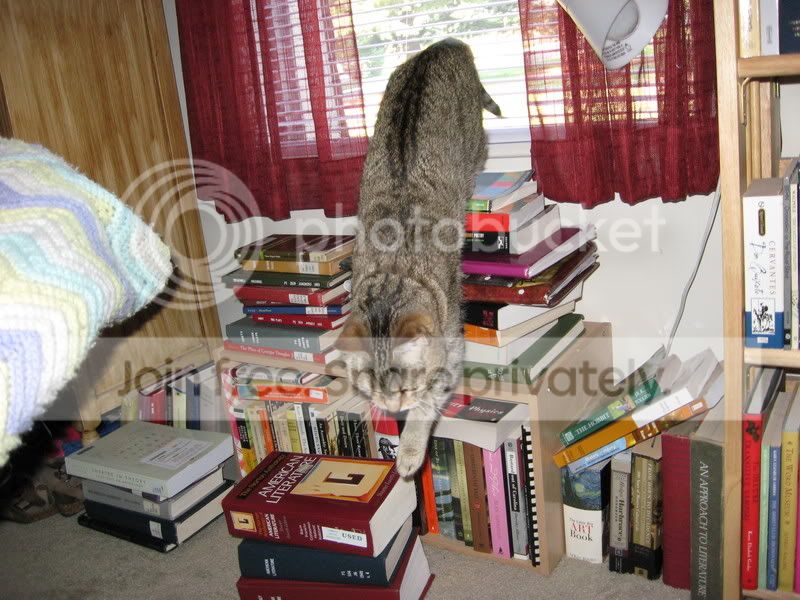
As a reward for getting through all that, I give you books and a cat. This is an old one: my Luthien making stairs out of some PhD research on her way down from the window ledge.
This year is my seventh (whut!) year keeping a reading thread on LT. Over the years I've taken different approaches to my reading and keeping track of it. Some years I tried to complete personal reading challenges, others I had page goals, sometimes it was just a great big free-for-all. This year I'm going for a sweet middle ground, with a few goals designed to help curb a couple bad habits but without any real challenges so I can let my reading time feel free. Since I started working again last spring (and because that work consists of nothing but reading), I've felt increasingly constrained by "musts" attached to my leisure reading. So out they go! With that said, here's what I am working toward.
*Read 65 books/~20,000 pages
I'm always shooting for seventy-five, and would love to break eighty some year, but years of keeping track (I've been tracking my reading since I was eleven, just not always (obviously) on LT) have taught me that less than sixty-five in a year means I'm not spending as much time as usual actually reading, and I know that less reading than usual makes me petulant and cross. I'm thinking of on-track for 65 as a barometer this year. If I'm not hitting that ~5.5 books a month, it's time to stop faffing about on the internet so much and/or turn off the TV.
*Read from My Shelves
I own so many (so many) books that I want to read that I haven't yet. I wouldn't ever want to be in the position of having to acquire a book in order to read a book I hadn't read before, but I currently have enough books on my To Be Read pile to keep me reading for at least ten years. I'm hoping to reduce that number by at least twenty (either by reading the books or by reading enough to know I never actually want to read them) this year.
*Acquire Fewer New Books
I go mad in bookstores, mad, I tell you. I adore book browsing and find it nearly impossible to leave a book behind once I've decided I might like to read it. But I also get overwhelmed by choice when I have so many unread books on my shelves. Shooting for purchasing thirty or fewer new books for reading this year. (The husbeast and I both have this notion of Books for Reading and Books for Having. Books for Having include books that complete collections, beautiful editions of beloved books, first editions of beloved books, rarer books you can't believe you actually found in a shop, and important or extraordinarily nifty reference books. I don't include Books for Having in my "count" of new books bought, both because we buy them so rarely and because they do not contribute the the Overwhelming Choice effect I have with unread books. Because, while one might very well read them someday, they aren't For Reading.)
*Read the Books I Buy
I get excited about books in the shop, bring them home, put them on my nightstand to read "soon," and then don't get to them for years. As you do. But in a further attempt to lessen Overwhelming Choice, I'm shooting for reading at least 2/3 of the new Books for Reading that I acquire this year.
*Be Choosy about Cheap Books
I loves me a library book sale, and husbeast and I both love a good used book shop. But when books are "all you can stuff in a sack for $5," I tend to forget about Overwhelming Choice at home. So this year, I'm going to try to limit myself to five Books for Reading for each visit to a used book sale or a used book shop. Books purchased at such venues will not count toward Acquired New Books ('cause they're not new, see?).
As a reward for getting through all that, I give you books and a cat. This is an old one: my Luthien making stairs out of some PhD research on her way down from the window ledge.

4lycomayflower
Tracking My Goals
Updated: 8 December
Goal: Read 65 Books
Progress: 50 read
Goal: Read (or Abandon) 20 Books from My Shelves
Progress: 8 read (and 3 abandoned)
Goal: Purchase 30 or Fewer New Books
Progress: 51 purchased
Goal: Read at Least 2/3 of the New Books I Buy
Progress: 50 Purchased; 15 Read; 14 abandoned
Goal: Limit Used Books to 5 per Event/Trip
1 Feb, AAUW booksale: 5 new to household/for me books (11 books altogether)
12 April, Library booksale: 4 new to household/for me books (9 book altogether)
16 April, Library booksale: half-price day: 6 new to household/for me books (7 altogether)
11 June, Friends of the Library sale self: 3 new to household/for me books (3 altogether)
25 June, used book store trawl with LW3: 5 new to household/for me books (5 altogether)
9 August, McKay in Knoxville: 37 new to household/for me books (45 altogether)
5 Sept, AAUW booksale: 11 new to household/for me books (20 books altogether)
15 Oct, Library booksale: 5 new to household/for me books
16 Oct, Library booksale, half-price day: 5 new to household/for me books
Updated: 8 December
Goal: Read 65 Books
Progress: 50 read
Goal: Read (or Abandon) 20 Books from My Shelves
Progress: 8 read (and 3 abandoned)
Goal: Purchase 30 or Fewer New Books
Progress: 51 purchased
Goal: Read at Least 2/3 of the New Books I Buy
Progress: 50 Purchased; 15 Read; 14 abandoned
Goal: Limit Used Books to 5 per Event/Trip
1 Feb, AAUW booksale: 5 new to household/for me books (11 books altogether)
12 April, Library booksale: 4 new to household/for me books (9 book altogether)
16 April, Library booksale: half-price day: 6 new to household/for me books (7 altogether)
11 June, Friends of the Library sale self: 3 new to household/for me books (3 altogether)
25 June, used book store trawl with LW3: 5 new to household/for me books (5 altogether)
9 August, McKay in Knoxville: 37 new to household/for me books (45 altogether)
5 Sept, AAUW booksale: 11 new to household/for me books (20 books altogether)
15 Oct, Library booksale: 5 new to household/for me books
16 Oct, Library booksale, half-price day: 5 new to household/for me books
5susanna.fraser
What a magnificent cat! I've starred your thread because we seem to have a fair amount of overlap in our libraries.
7laytonwoman3rd
That's not a magnificent cat...that's my grand-kitty, and she's a pill! (I luuuuuve you, Luthien!)
Your goals seem eminently achievable, except that last one...I dunno.
5 books per event..I'm sure your DNA is against you there.
Molly wishes to join the ranks of LT cats using books to get from here to there:

Your goals seem eminently achievable, except that last one...I dunno.
5 books per event..I'm sure your DNA is against you there.
Molly wishes to join the ranks of LT cats using books to get from here to there:

8sandykaypax
Books for Reading and Books for Having--I love that! My hubby and I share that philosophy, too, just didn't have such a succinct way of phrasing it.
Sandy K
Sandy K
9lycomayflower
@ 5
Welcome to my thread, Susanna! I hope you stick your head in from time to time.
@ 6
Thanks, Jim!
@ 7
All right, Mum, there's to be no picking on poor, innocent Luthien. And I shall rise above my genes. Rise above! (Shush. I do not protest too much.) Does Wee Molly know that she has a Victorian lady sitting at a spinning wheel on her back?
Welcome to my thread, Susanna! I hope you stick your head in from time to time.
@ 6
Thanks, Jim!
@ 7
All right, Mum, there's to be no picking on poor, innocent Luthien. And I shall rise above my genes. Rise above! (Shush. I do not protest too much.) Does Wee Molly know that she has a Victorian lady sitting at a spinning wheel on her back?
10lycomayflower
@ 8
It's an important distinction, I find. After all, we must be fair to ourselves when limiting book buying!
It's an important distinction, I find. After all, we must be fair to ourselves when limiting book buying!
11Ameise1
Hi Laura! What a wonderful cat. I've two of them at home and they join me when I'm reading.
Happy reading 😃
Happy reading 😃
12lycomayflower
@ 11
Yeah, I often get a Luthien in my lap when I'm reading, especially if there's a comfy blanket involved. Nothing better!
Yeah, I often get a Luthien in my lap when I'm reading, especially if there's a comfy blanket involved. Nothing better!
14laytonwoman3rd
Luthien herself is quite a reader. There is photographic evidence of this as well.


16lycomayflower
I can see right now that I'm going to have to keep Luthien away from this thread lest she get a swelled head.
17PaulCranswick
Sandy,
Wonderful organisation to kick off your thread. I don't know about cutting down on the buying although I suppose I ought to but definitely the read what you buy. At the last count and without switching on that pesky Kindle I have 24 years of physical book reading ahead of me according to the calculation of my reading speed on the excel spreadsheet.
I need to stay healthy or get a cat like yours or Linda's which is able to read to me. xx
Wonderful organisation to kick off your thread. I don't know about cutting down on the buying although I suppose I ought to but definitely the read what you buy. At the last count and without switching on that pesky Kindle I have 24 years of physical book reading ahead of me according to the calculation of my reading speed on the excel spreadsheet.
I need to stay healthy or get a cat like yours or Linda's which is able to read to me. xx
18laytonwoman3rd
>17 PaulCranswick: Pssst.....Sandy is a visitor here; this is Laura's thread.... (I know 'cause I named her.)
19scaifea
>18 laytonwoman3rd:: *snork!*
22lycomayflower
*waves at all the new people who have dropped by*
Welcome!
Welcome!
23dk_phoenix
If this thread continues to be filled with pictures of cats, you will see me around here far more often than anyone should... hahaha... KITTIES!!! *makes grabby hands*
24lycomayflower
Was that a request? I think it was! Our Callie, mistaking the coffee table for a lounge:


25lauralkeet
Books! And Cats! Yay!
The best thing I learned from this thread so far is that used books don't count as acquisitions. I'm golden.
Happy New Year!
The best thing I learned from this thread so far is that used books don't count as acquisitions. I'm golden.
Happy New Year!
26lycomayflower
@ 25
Fair warning! I make no guarantees as to how others who may have a stake in the number of books you acquire will take to that "rule."
Fair warning! I make no guarantees as to how others who may have a stake in the number of books you acquire will take to that "rule."

28PaulCranswick
Have a wonderful 2014, Sandy
29scaifea
Happy New Year, Laura! Your calico is just lovely - I've had one (Susie) for longer than I've had a husband (Tomm), and love her no end.
30lycomayflower
@ 27
How lovely. Thank you! Happy New Year!
@ 28
Don't know if you're just talking to a Sandy on my thread or if you have me confused with someone else (I'm Laura--Hi!), but "Welcome!" either way!
@ 29
Thanks, Amber! You, too! Callie was the husbeast's cat before we got married (and Luthien was mine). He swears he named her after the Hindu goddess and not because she is a calico (to which I say, "Hmmhmm"). She's a sweetheart. (Luthien has a streak of sweetheart in her, but mostly she's a wretch.)
How lovely. Thank you! Happy New Year!
@ 28
Don't know if you're just talking to a Sandy on my thread or if you have me confused with someone else (I'm Laura--Hi!), but "Welcome!" either way!
@ 29
Thanks, Amber! You, too! Callie was the husbeast's cat before we got married (and Luthien was mine). He swears he named her after the Hindu goddess and not because she is a calico (to which I say, "Hmmhmm"). She's a sweetheart. (Luthien has a streak of sweetheart in her, but mostly she's a wretch.)
31scaifea
I kinda like the mostly-wretch cats, myself. Seems more appropriate, somehow. And from previous photos, I know that Luthien is also quite a looker... I should post more photos of Tuppence and Susie on my thread, but somehow I never remember to.
32lycomayflower
Yeah, Luthien is very pretty. She's an absolute sweetie when she wants to be (like when she wants to snuggle on my lap), but she can be a right butt to Callie and she does that classic bit where she goes from a purring machine content to be petted to claws-out-attack-mode in a blink.
I'd love to see more pictures of Tuppence and Susie on your thread!
I'd love to see more pictures of Tuppence and Susie on your thread!
33laytonwoman3rd
Luthien has a streak of sweetheart in her, but mostly she's a wretch Here, now...she just needs a few days at "Grandma's house"...
34lycomayflower
I dunno. "Grandma's house" has a wee kitty she can be a wretch at now. The magic might not work as well as it used.
35PaulCranswick
Laura - so sorry....once is excusable twice is a little much even for a clod like me. My brain works better as the year progresses believe me.
36lycomayflower
@ 35
No worries! Do hope to see you around as the year progresses, whether your brain works better or not!
No worries! Do hope to see you around as the year progresses, whether your brain works better or not!
37laytonwoman3rd
>34 lycomayflower:. Yeah, you could be right. And this wee kitty is having a bit of a hell-day herself. Items have crashed to the floor...no breakage so far.
38lycomayflower
New post up at my blog today that some here might find enjoyable: Packing for a Reading Retreat, vol. VII
39PaulCranswick
Laura - I am on the look out for the Simon Armitage book. I enjoy his poetry immensely and read his collection Kid last year. Brain working better already. xx
40lkernagh
Love how Luthien and Molly make use of your books! Of course, the look on Callie's face is priceless! Happy New Year and looking forward to more fun (and books) here in 2014.
41lycomayflower
@ 39
I haven't actually read his poetry. I just stumbled across Walking Home somewhere and thought it looked like something I had to read. I shall have to seek out some of his poetry. Where's a good place to start?
@ 40
Hello! I promise there will be books (in addition to fun) eventually!
I haven't actually read his poetry. I just stumbled across Walking Home somewhere and thought it looked like something I had to read. I shall have to seek out some of his poetry. Where's a good place to start?
@ 40
Hello! I promise there will be books (in addition to fun) eventually!
44laytonwoman3rd
In honor of Laura on her birthday, a toast. *raises Joy mug of pumpkin spice coffee* The professor (ret.)!
45scaifea
Well, the tea's all gone, but I'll happily raise my bowl of Cinnamon Toast Crunch (I mean, it is a 'toast,' after all). Laura, on her birthday!
46lauralkeet
Happy birthday Laura! Raising my second cup of Starbucks Sumatra ...
47PaulCranswick
Laura start with Kid which was his mainstream breakthrough. Published by Faber in their Faber Firsts series it is reasonably easily to get hold of.
Have a nice weekend.
Have a nice weekend.
48porch_reader
Happy birthday, Laura! I'm toasting you from Iowa!
49lycomayflower
Thanks for all the birthday toasts!
@ 47
Thanks for the recommendation. I'll have to see if I can put my hands on that one.
@ 47
Thanks for the recommendation. I'll have to see if I can put my hands on that one.
50lycomayflower
Right, then. The meme what's going round where you describe yourself using book titles read in 2013.
Describe yourself: The Perks of Being a Wallflower
Describe what you feel like: American Wife
Describe where you currently live: On Fortune's Wheel
If you could go anywhere, where would you go: Christmas at High Rising
Your favorite form of transportation: The Spiral Staircase
Your best friend is: A Long Way Gone
You and your friends are: Weirdos from Another Planet!
What’s the weather like: Montana 1948
You fear: The God Delusion
What is the best advice you have to give: Consider the Oyster
Thought for the day: tiny beautiful things
How I would like to die: Fun Home
My soul’s present condition: Fledgling
Describe yourself: The Perks of Being a Wallflower
Describe what you feel like: American Wife
Describe where you currently live: On Fortune's Wheel
If you could go anywhere, where would you go: Christmas at High Rising
Your favorite form of transportation: The Spiral Staircase
Your best friend is: A Long Way Gone
You and your friends are: Weirdos from Another Planet!
What’s the weather like: Montana 1948
You fear: The God Delusion
What is the best advice you have to give: Consider the Oyster
Thought for the day: tiny beautiful things
How I would like to die: Fun Home
My soul’s present condition: Fledgling
52lycomayflower
Hello! Good to see you here. Was enjoying the OUAT discussion at your thread. Hope you enjoy S2 when you get to it. I think it picks up a bit.
54laytonwoman3rd
>53 scaifea: AND IT'S ALL TRUE!
57lycomayflower
A book! A book I read!
1.) Reading The Lord of the Rings: New Writings on Tolkien's Classic, edited by Robert Eaglestone ***1/2
This anthology of writings about The Lord of the Rings has an agenda: to bring literary criticism of LotR more in line with the kinds of criticism done on other twentieth century literature. I don't have a problem with that agenda; LotR has languished unjustly on the edges of the canon for far too long. (I once pitched a paper on LotR for a PhD seminar in literary modernism and was met with a kind of sneering dismissal from my professor (who was, in all other matters, as far as I could see, unfailingly brilliant and just).) And I'd agree that much LotR criticism fails to engage with the theory and literary lenses that scholars turn on other literature almost as a matter of course and that a good deal of it remains too entrenched in Middle Earth, failing to see past the end of its nose and make connections to the outside (literary and scholarly) world. So an anthology of this sort really seems just the thing.
While any anthology will be a mixed bag with some pieces standing out and others trying their best not to stink up the place, Reading LotR has more than its share of essays which demonstrate why even those of us who have been trained in this literary criticism stuff will back away slowly when anyone suggests applying Foucault (or Hegel or Butler or Marx or whomever) to our favorite stories. What is it that Gandalf says? "He that breaks a thing to find out what it is has left the path of wisdom"? It would be to betray a misunderstanding of literary criticism to define it with that quote, but this kind of breaking things sure seems to define a number of the essays in this volume. Some of these writers, in their (right-thinking) desire to bring LotR criticism into the scholarly mainstream, seem to have forgotten that theory is a lens through which one ought to see a literary text differently and more clearly. Many of the essays here either entirely miss out on illuminating the text of LotR or do manage to point up something new about the text but in a way which seems utterly divorced from the theory they purported to be using to do so. This kind of thing makes me more cross than people who ought to know better poo-pooing the relevance of Tolkien and his work. They may be missing out on something important and lovely, but at least they're leaving it unbroken on the shelf for others to find intact.
Tellingly, the best essays in this collection (and there are some quite good ones here), are those which spend (a little) less time on theory and more time with the text of LotR. Give me an entire anthology of LotR criticism like that found in Part III of this volume ("Gender, sexuality and class"), and both my inner Tolkien fan and my inner PhD-level trained literary scholar will be content. Reading LotR does puzzle me, though. There will always be the odd piece of literary criticism that just doesn't hit the mark, but with so many of the essays in this book missing the balance between theory and text that makes for an illuminating piece, one has to wonder what is going on here. Perhaps scholars interested in Tolkien now sometimes try too hard to bring LotR criticism into the litcrit fold? While Robert Eaglestone's introduction to the anthology and Michael D.C. Drout's first chapter ("Towards a better Tolkien criticism") are both quite good on where Tolkien criticism has stood in the past and what makes it stand apart (not stand out) from other literary criticism, it seems that maybe we still don't understand fully why it is often so difficult to write about Tolkien in the ways we write about his contemporaries. We needed Reading The Lord of the Rings, but we needed it to do better.
1.) Reading The Lord of the Rings: New Writings on Tolkien's Classic, edited by Robert Eaglestone ***1/2
This anthology of writings about The Lord of the Rings has an agenda: to bring literary criticism of LotR more in line with the kinds of criticism done on other twentieth century literature. I don't have a problem with that agenda; LotR has languished unjustly on the edges of the canon for far too long. (I once pitched a paper on LotR for a PhD seminar in literary modernism and was met with a kind of sneering dismissal from my professor (who was, in all other matters, as far as I could see, unfailingly brilliant and just).) And I'd agree that much LotR criticism fails to engage with the theory and literary lenses that scholars turn on other literature almost as a matter of course and that a good deal of it remains too entrenched in Middle Earth, failing to see past the end of its nose and make connections to the outside (literary and scholarly) world. So an anthology of this sort really seems just the thing.
While any anthology will be a mixed bag with some pieces standing out and others trying their best not to stink up the place, Reading LotR has more than its share of essays which demonstrate why even those of us who have been trained in this literary criticism stuff will back away slowly when anyone suggests applying Foucault (or Hegel or Butler or Marx or whomever) to our favorite stories. What is it that Gandalf says? "He that breaks a thing to find out what it is has left the path of wisdom"? It would be to betray a misunderstanding of literary criticism to define it with that quote, but this kind of breaking things sure seems to define a number of the essays in this volume. Some of these writers, in their (right-thinking) desire to bring LotR criticism into the scholarly mainstream, seem to have forgotten that theory is a lens through which one ought to see a literary text differently and more clearly. Many of the essays here either entirely miss out on illuminating the text of LotR or do manage to point up something new about the text but in a way which seems utterly divorced from the theory they purported to be using to do so. This kind of thing makes me more cross than people who ought to know better poo-pooing the relevance of Tolkien and his work. They may be missing out on something important and lovely, but at least they're leaving it unbroken on the shelf for others to find intact.
Tellingly, the best essays in this collection (and there are some quite good ones here), are those which spend (a little) less time on theory and more time with the text of LotR. Give me an entire anthology of LotR criticism like that found in Part III of this volume ("Gender, sexuality and class"), and both my inner Tolkien fan and my inner PhD-level trained literary scholar will be content. Reading LotR does puzzle me, though. There will always be the odd piece of literary criticism that just doesn't hit the mark, but with so many of the essays in this book missing the balance between theory and text that makes for an illuminating piece, one has to wonder what is going on here. Perhaps scholars interested in Tolkien now sometimes try too hard to bring LotR criticism into the litcrit fold? While Robert Eaglestone's introduction to the anthology and Michael D.C. Drout's first chapter ("Towards a better Tolkien criticism") are both quite good on where Tolkien criticism has stood in the past and what makes it stand apart (not stand out) from other literary criticism, it seems that maybe we still don't understand fully why it is often so difficult to write about Tolkien in the ways we write about his contemporaries. We needed Reading The Lord of the Rings, but we needed it to do better.
58laytonwoman3rd
>57 lycomayflower: The job, my dear, would seem to be crying out for you...
59lycomayflower
2.) On the Overgrown Path, David Herter ***
Wrrr. I just don't think I tapped in to what this book was doing, somehow. I was pretty intrigued by the setting and atmosphere for about the first quarter or so, but then I kind of lost any sense of really being in the book. I suspect I would have fared much better if I had read the whole thing in one sitting--I get the sense the book really should be experienced that way. Ah well.
Wrrr. I just don't think I tapped in to what this book was doing, somehow. I was pretty intrigued by the setting and atmosphere for about the first quarter or so, but then I kind of lost any sense of really being in the book. I suspect I would have fared much better if I had read the whole thing in one sitting--I get the sense the book really should be experienced that way. Ah well.
60laytonwoman3rd
>59 lycomayflower: Awww....foot!
61lycomayflower
Sorry!
62scaifea
>57 lycomayflower:: Lit Crit applied to classic texts is, well, uh, hard. Apparently. Since not very many people *at all* seem to be able to do it properly or well. All too often its, "Oooh, look at this shiny pretty theory - let's clonk it right down on top of this classic text and see if something magical happens." And, of course, nope, it doesn't. The best use of Lit Crit, as you well know I'm sure, is to approach the thing from pretty much the entirely opposite direction. Okay, so here's this Foucault business...let's look at it through Tolkien and see if the theory holds up. The real fireworks come when there are disconnects between the theory and the text - why is that, and what can we say about that and what can we learn about what Tolkien is trying to do from that?
Sorry. I'm pretty much done now, I think. It's just that theory can be so frustrating because it could be an amazing tool, but there are too few people out there who understand how to use that tool and instead just stand around saying, "Oooh, shiny pretty theory! Let's play with it!" and only manage to muck everything up for the rest of us.
*Garrumph*
Also, I think what I'm trying to say, so very awkwardly is that, yes, I agree with Ms. #58...
Sorry. I'm pretty much done now, I think. It's just that theory can be so frustrating because it could be an amazing tool, but there are too few people out there who understand how to use that tool and instead just stand around saying, "Oooh, shiny pretty theory! Let's play with it!" and only manage to muck everything up for the rest of us.
*Garrumph*
Also, I think what I'm trying to say, so very awkwardly is that, yes, I agree with Ms. #58...
63laytonwoman3rd
>57 lycomayflower:, 62...I mean it...the world needs you guys to put your brilliance OUT THERE. Further than this, I mean.
64lauralkeet
>63 laytonwoman3rd:: YES! Two amazingly smart women ... And formidable in combination.
65laytonwoman3rd
Yes! A collaboration. You could Dooooo eeeet!
67lycomayflower
*snork* You're not about being volunteered to write litcrit either, huh?
68scaifea
Well, I *did* say that it's hard... And just because I'm good at complaining about how poorly others do it does not mean that I could do it well myself. I'm also slightly uncomfortable with the "amazingly smart" bit - doesn't feel like an accurate description of myself. Ha! It would be a hoot to work with a cool lady like yourself, though.
69laytonwoman3rd
Oh, the back-pedaling....ALL the back-pedaling.
70lauralkeet
Cue crotchety older person: "What's wrong with young people these days?"
71scaifea
*ahem*
What's wrong with you two ladies, one might ask - it's not as if either of you are riding the slow-brain train...
What's wrong with you two ladies, one might ask - it's not as if either of you are riding the slow-brain train...
72lycomayflower
Yeah, anyway. LW3, let's see you crank out a paper or two on Faulkner, hmmmm?
73lycomayflower
Amber, how shall we two cool ladies (thank you, by the way) get them back for such teasing?
74laytonwoman3rd
>72 lycomayflower: AHhh...but THAT field has been plowed and planted with some success. It does not go begging as Tolkien's world seems to. Also, lauralkeet and I have both contributed brilliant young women to the world already... *struggles to keep a straight face*
75scaifea
Laura: I think we're out-matched all round in the argument business here. I suggest a bit of nod, nod, yes, yes, we'll get right on that, followed by a bit of convenient forgetfulness.
76lauralkeet
>74 laytonwoman3rd:: * also struggling to keep a straight face *
>75 scaifea:: I've seen that trick before.
>75 scaifea:: I've seen that trick before.
77PaulCranswick
Seems a weekend for suggested combinations. I saw RD and Mamie mentioned as a dream ticket on one of the threads last night and today I see a brains trust mooted here that would clearly be formidable.
Don't know which poor trooper would get lumbered with me in any platonic pairing off?
Have a great weekend, Laura.
Don't know which poor trooper would get lumbered with me in any platonic pairing off?
Have a great weekend, Laura.
78lycomayflower
Thanks, Paul!
79lycomayflower
3.) The Language of Flowers, Vanessa Diffenbaugh ***1/2
The Language of Flowers begins with Victoria Jones's emancipation from the foster care system. The story follows her as she tries to build some kind of life for herself. One of her foster mothers taught her the Victorian language of flowers, whereby people would send each other messages through flowers and the meanings they held. Victoria's knowledge of the language of flowers helps her find a job and learn to cope in the world.
Diffenbaugh's writing is very good, though it doesn't quite become beautiful or special. She tells her story well, but while I was happy to keep reading, I never grew fully invested in Victoria or the other characters in the book. My fears that the language of flowers stuff would get twee were completely unfounded, and I say well done, you, to Diffenbaugh for that, but I wonder if the rest of the book was just a little too careful, a little too polished. I never felt like things got messy and real, even when things got quite messy for Victoria. A good deal better than I expected but still not superfantastisch.
***For Book Club
The Language of Flowers begins with Victoria Jones's emancipation from the foster care system. The story follows her as she tries to build some kind of life for herself. One of her foster mothers taught her the Victorian language of flowers, whereby people would send each other messages through flowers and the meanings they held. Victoria's knowledge of the language of flowers helps her find a job and learn to cope in the world.
Diffenbaugh's writing is very good, though it doesn't quite become beautiful or special. She tells her story well, but while I was happy to keep reading, I never grew fully invested in Victoria or the other characters in the book. My fears that the language of flowers stuff would get twee were completely unfounded, and I say well done, you, to Diffenbaugh for that, but I wonder if the rest of the book was just a little too careful, a little too polished. I never felt like things got messy and real, even when things got quite messy for Victoria. A good deal better than I expected but still not superfantastisch.
***For Book Club
80lycomayflower
4.) Dawn, Octavia E. Butler ****
This is the first in Butler's Xenogenesis trilogy, in which humans destroy the Earth through nuclear war and are then descended upon by aliens (the Oankali) who "rescue" them by attempting to merge their two species, hoping to create offspring with the best traits of both humans and Oankali. The story is told from the point of view of Lilith, one of the first humans to be Awakened from the suspended animation the Oankali used to heal the remaining humans after the war and to keep them young while Earth, too, had a chance to heal. The Oankali plan to use Lilith as a kind of mother-figure and teacher for a group of humans she will Awaken (at Oankali direction) and who will then be sent back to Earth along with members of the Oankali to repopulate the planet with the resulting hybrid species.
Dawn follows Lilith as she learns about the Oankali and their plans and tries to find and understand a new life under these strange circumstances. Butler's prose is somehow both spare and rich, and her ability to draw an alien species which is truly alien is remarkable. Her insight into how humans of varying temperaments might react upon being awoken and told they've been rescued by aliens who now want to mate with them creates a believable, moving story. I'm looking forward to reading the second book in the trilogy soon.
This is the first in Butler's Xenogenesis trilogy, in which humans destroy the Earth through nuclear war and are then descended upon by aliens (the Oankali) who "rescue" them by attempting to merge their two species, hoping to create offspring with the best traits of both humans and Oankali. The story is told from the point of view of Lilith, one of the first humans to be Awakened from the suspended animation the Oankali used to heal the remaining humans after the war and to keep them young while Earth, too, had a chance to heal. The Oankali plan to use Lilith as a kind of mother-figure and teacher for a group of humans she will Awaken (at Oankali direction) and who will then be sent back to Earth along with members of the Oankali to repopulate the planet with the resulting hybrid species.
Dawn follows Lilith as she learns about the Oankali and their plans and tries to find and understand a new life under these strange circumstances. Butler's prose is somehow both spare and rich, and her ability to draw an alien species which is truly alien is remarkable. Her insight into how humans of varying temperaments might react upon being awoken and told they've been rescued by aliens who now want to mate with them creates a believable, moving story. I'm looking forward to reading the second book in the trilogy soon.
82lycomayflower

Callie's Nest. Don't even think about doing something silly like making the bed.
84FlamingRabbit
"Dawn" sounds interesting...on my wish list.
85lycomayflower
@ 81 and 84
I think you would both like it. Kept me fairly well riveted.
I think you would both like it. Kept me fairly well riveted.
86lycomayflower
5.) The Hunger Games, Suzane Collins ****
Somehow I managed to avoid any spoilers for The Hunger Games (aside from a basic understanding of what the Hunger Games themselves are), so I was pretty engrossed in the book and how it would all come out. The story kept me entertained (and horrified) and interested in the outcome throughout. My biggest quibble while reading (a plot point that felt like a cop-out) turned out not to be what I thought it was, so points for not being predictable there. A decently well done indictment of our fascination with reality television, I thought, and a story which ends with a lot of room for a sequel to go somewhere new. Will probably read the next one quite soon.
Somehow I managed to avoid any spoilers for The Hunger Games (aside from a basic understanding of what the Hunger Games themselves are), so I was pretty engrossed in the book and how it would all come out. The story kept me entertained (and horrified) and interested in the outcome throughout. My biggest quibble while reading (a plot point that felt like a cop-out) turned out not to be what I thought it was, so points for not being predictable there. A decently well done indictment of our fascination with reality television, I thought, and a story which ends with a lot of room for a sequel to go somewhere new. Will probably read the next one quite soon.
87lycomayflower
6.) Adventures of Sherlock Holmes, Arthur Conan Doyle ****
The first collection of short stories about the famous detective (and the third book about him). Most of these stories were new to me on this read--I think the only one I'd read before was "The Five Orange Pips," which I found both on this read and on my first read to be disappointing in that American audiences (especially modern day ones) will have half the mystery sorted before Holmes even points out the relevant points. As with any collection, some stories are stronger than others. I quite liked "Scandal in Bohemia" and "The Bascombe Valley Mystery." I was struck by how easy it often is to pick up on at least some of the answers to the cases (a function, surely, of having them presented to one in this form--real life would be another story, I suspect). I also had great fun identifying all the little points and bits of business that have shown up thus far in Moffat and Gatiss's Sherlock.
The first collection of short stories about the famous detective (and the third book about him). Most of these stories were new to me on this read--I think the only one I'd read before was "The Five Orange Pips," which I found both on this read and on my first read to be disappointing in that American audiences (especially modern day ones) will have half the mystery sorted before Holmes even points out the relevant points. As with any collection, some stories are stronger than others. I quite liked "Scandal in Bohemia" and "The Bascombe Valley Mystery." I was struck by how easy it often is to pick up on at least some of the answers to the cases (a function, surely, of having them presented to one in this form--real life would be another story, I suspect). I also had great fun identifying all the little points and bits of business that have shown up thus far in Moffat and Gatiss's Sherlock.
88scaifea
I was surprised at how much I liked The Hunger Games, really. Glad to see you liked it, too.
89Helenoel
You have given me more impetus to read the Hunger Games - I have also missed/avoided paying attention to most details about it. I think my son had a copy - if so it is still in his room- will need to explore. I know he read it- but maybe borrowed rather than bought.
90lycomayflower
Hit up a used book sale this morning. Got eleven books for $25--one for the husbeast, one For Having, four to replace books we already had but are in poor shape and/or books we had borrowed and wanted our own copy, and five for me that are new to the household. Which means *drumroll* that I stayed within my goal for limiting new books brought in through book sales and used book stores for the first such trip for the year. Woot!
For the Husbeast:
Test of the Twins
For Having:
A Little Princess in a hardcover edition what matched the one of The Secret Garden my great-aunt Jessie gave me for Christmas one year when I was wee.
Replacing Worn-out/Borrowed Books:
Underworld
Fire Upon the Deep
The Master
Whose Body?
For Me; New to the Household
Notes on a Scandal
Into the Wilderness
Oscar and Lucinda
Lady of Ashes
Admission
For the Husbeast:
Test of the Twins
For Having:
A Little Princess in a hardcover edition what matched the one of The Secret Garden my great-aunt Jessie gave me for Christmas one year when I was wee.
Replacing Worn-out/Borrowed Books:
Underworld
Fire Upon the Deep
The Master
Whose Body?
For Me; New to the Household
Notes on a Scandal
Into the Wilderness
Oscar and Lucinda
Lady of Ashes
Admission
93laytonwoman3rd
And I got 13 for about $20.00 yesterday, shopping at the Goodwill and Salvation Army thrift shops. The laytonwomen were hot yesterday!
94scaifea
>93 laytonwoman3rd:: That's excellent! I'm off to the thrift shops today myself...
95porch_reader
Wow! Nice haul, Laura! I love finding good deals at book sales!
96lycomayflower
DNF 1.) Beach Music, Pat Conroy; Quit at page 88.
I read a number of Pat Conroy's novels in high school and was utterly, utterly wrecked and depressed by The Prince of Tides. And that's kind of ruined any further books from Conroy for me. Despite feeling like Beach Music wasn't going to quite be that wreck-making, I couldn't shake that looming sense of anxiety that something really, really horrible was coming. Then the dialogue started irritating me (so plastic, so glib), and I was through.
I read a number of Pat Conroy's novels in high school and was utterly, utterly wrecked and depressed by The Prince of Tides. And that's kind of ruined any further books from Conroy for me. Despite feeling like Beach Music wasn't going to quite be that wreck-making, I couldn't shake that looming sense of anxiety that something really, really horrible was coming. Then the dialogue started irritating me (so plastic, so glib), and I was through.
97lycomayflower
DNF 2.) Admission, Jean Hanff Korelitz; Quit at page 160
I wanted to like this story of a Princeton admission officer and her professional and personal trials. Some of the bits that are actually about the admission process were pretty interesting, but the whole thing is lifeless, somehow, as if the author was utterly indifferent to her characters and expected us to be as well. And then an utterly preposterous thing happened between the main character and her boyfriend, and I decided life is too short.
I wanted to like this story of a Princeton admission officer and her professional and personal trials. Some of the bits that are actually about the admission process were pretty interesting, but the whole thing is lifeless, somehow, as if the author was utterly indifferent to her characters and expected us to be as well. And then an utterly preposterous thing happened between the main character and her boyfriend, and I decided life is too short.
98lauralkeet
2 DNFs in a row? That's awful. Hope you're reading something better now?
ETA: did Tina Fey star in a film version of that book?
ETA: did Tina Fey star in a film version of that book?
99lycomayflower
@ 98
Ug. Yep. I probably should have known I wouldn't be able to settle into Beach Music and not even tried, but Admission really annoyed me. I thought it was going to be a good read. And Tina Fey and Paul Rudd are on the cover of my copy of the book, so I assume there's a movie with them in. It looks like it should be a romantic comedy from the cover, but I really don't see how they could have managed that from the material. There's a slight element of the absurd in the book, I guess, but there's nothing like romance (or life) in it. Feh.
Ug. Yep. I probably should have known I wouldn't be able to settle into Beach Music and not even tried, but Admission really annoyed me. I thought it was going to be a good read. And Tina Fey and Paul Rudd are on the cover of my copy of the book, so I assume there's a movie with them in. It looks like it should be a romantic comedy from the cover, but I really don't see how they could have managed that from the material. There's a slight element of the absurd in the book, I guess, but there's nothing like romance (or life) in it. Feh.
100lauralkeet
>99 lycomayflower:: yeah, the movie trailer didn't grab me either -- looked fairly banal -- so I haven't seen it.
101laytonwoman3rd
SOoooo....Sartoris then? or The Unvanquished ?
102lycomayflower
7.) Coffee at Luke's: An Unauthorized Gilmore Girls Gabfest, edited by Jennifer Crusie ***1/2
This collection of essays on Gilmore Girls is hit and miss. Some of the essays provide some nice insight into the show (the one on the ways food often serves to foreshadow or comment on plot events was very cool) while others just spin their wheels (like the one that starts off with an interesting exploration of father figures for Rory but then ends by trying to use charts to quantitatively identify who fathered her the most--whut?). A few kind of miss the point but still manage to be sort of fun reading (the essay speculating on which Stars Hollow businesses would actually have survived in small-town Connecticut leaps to mind), and a few others flirt around with compelling revelations but lose points for ignoring elements of the show that don't support their arguments. An uneven read, but not an unpleasant way to spend a couple of hours.
This collection of essays on Gilmore Girls is hit and miss. Some of the essays provide some nice insight into the show (the one on the ways food often serves to foreshadow or comment on plot events was very cool) while others just spin their wheels (like the one that starts off with an interesting exploration of father figures for Rory but then ends by trying to use charts to quantitatively identify who fathered her the most--whut?). A few kind of miss the point but still manage to be sort of fun reading (the essay speculating on which Stars Hollow businesses would actually have survived in small-town Connecticut leaps to mind), and a few others flirt around with compelling revelations but lose points for ignoring elements of the show that don't support their arguments. An uneven read, but not an unpleasant way to spend a couple of hours.
103laytonwoman3rd
Look how she ignores me...
104lycomayflower
I never did. (And you ignored my text last night, so nyah.)
105laytonwoman3rd
I did not...my phone was off b'then. Didn't see it
til this morning.
til this morning.
106scaifea
>102 lycomayflower:: Gah. I don't cotton to that sort of book. I got enough of academia before my early retirement and don't like to mix lit crit with pleasure, so to speak. Gilmore Girls is sacrosanct and not to be touched by Humanatees out to theorize everything in sight. Ditto for shows like Buffy and Firefly.
107lycomayflower
@ 106
Sometimes I like that sort of thing and sometimes I really don't. So many of the pieces in this one were either useless or intent on pointing out "flaws" in the show. When I first got the book I was excited to see that there's a whole series of these on different TV shows (done right, this kind of thing can feel like talking to another fan about something you love), but after reading Coffee at Luke's, I think I'll steer clear of them.
Sometimes I like that sort of thing and sometimes I really don't. So many of the pieces in this one were either useless or intent on pointing out "flaws" in the show. When I first got the book I was excited to see that there's a whole series of these on different TV shows (done right, this kind of thing can feel like talking to another fan about something you love), but after reading Coffee at Luke's, I think I'll steer clear of them.
108lycomayflower
8.) Fangirl, Rainbow Rowell ****1/2
The fangirl of the title is Cather Avery, a Big Name Fan in the Simon Snow (think Harry Potter) fandom whose latest long-form fic (posted to the internet in installments) is generating thousands of hits every day. Cath's fanfic writing slows down a bit as she starts her freshmen year at college, deals with her twin sister's desires to separate herself from Cath socially, starts to fall in love with her roommate's sweet ex-boyfriend, and struggles with writing purely original work in a fiction writing class.
This is young adult fare of high caliber. The writing is superb (with the exception of a handful of wee issues with transitions from scene to scene, the presence of which is the only reason I'm not giving this a full five stars), the characterization is lovely, Cath's dilemmas are handled nicely, and the depiction of fandom is spot-on. This is a good story well-told, but it is the exploration of fandom and of writing that makes Fangirl wonderful. Rowell really captures what it is like to participate in fandom on the internet, how it feels to try to explain fandom to people not engaged in it, and how fanfic writing is both like and completely unlike other kinds of fiction writing. (And the ya fantasy book series Rowell makes up--Harry Potter-esque, but also all its own--and gives us little slices of in order to better understand the fandom Cath participates in is so intriguing that I would read all eight of the books in it if Rowell ever wanted to write them in full.)
Fangirl will probably resonate most strongly with readers who have ever participated in fandom (at whatever age), but I'd recommend it to anyone who enjoys young adult fiction or anyone who just likes a good story set in contemporary times.
The fangirl of the title is Cather Avery, a Big Name Fan in the Simon Snow (think Harry Potter) fandom whose latest long-form fic (posted to the internet in installments) is generating thousands of hits every day. Cath's fanfic writing slows down a bit as she starts her freshmen year at college, deals with her twin sister's desires to separate herself from Cath socially, starts to fall in love with her roommate's sweet ex-boyfriend, and struggles with writing purely original work in a fiction writing class.
This is young adult fare of high caliber. The writing is superb (with the exception of a handful of wee issues with transitions from scene to scene, the presence of which is the only reason I'm not giving this a full five stars), the characterization is lovely, Cath's dilemmas are handled nicely, and the depiction of fandom is spot-on. This is a good story well-told, but it is the exploration of fandom and of writing that makes Fangirl wonderful. Rowell really captures what it is like to participate in fandom on the internet, how it feels to try to explain fandom to people not engaged in it, and how fanfic writing is both like and completely unlike other kinds of fiction writing. (And the ya fantasy book series Rowell makes up--Harry Potter-esque, but also all its own--and gives us little slices of in order to better understand the fandom Cath participates in is so intriguing that I would read all eight of the books in it if Rowell ever wanted to write them in full.)
Fangirl will probably resonate most strongly with readers who have ever participated in fandom (at whatever age), but I'd recommend it to anyone who enjoys young adult fiction or anyone who just likes a good story set in contemporary times.
109porch_reader
Good review of Fangirl. I liked that one too. I've never participated in fandom, but I got a good sense of what it is like through this story. I also thought that Cath's struggles to find herself at college rang true.
111lycomayflower
@ 109
Aside from all the fandom stuff in Fangirl that I loved, I was really impressed with the way Rowell depicted late adolescence/early adulthood. Thought she captured it well.
@ 110
Thanks!
Aside from all the fandom stuff in Fangirl that I loved, I was really impressed with the way Rowell depicted late adolescence/early adulthood. Thought she captured it well.
@ 110
Thanks!
112evilmoose
Came for the books, stayed for the cats! (Just dropping by to say hello, and leave a star, because... cats!)
113lycomayflower
9.) Melusine, Sarah Monette ****1/2
The first book in Sarah Monette's Doctrine of Labyrinths series, Melusine drops the reader into the middle of a 17th-ish-century Europe-esque fantasy world where those who can wield magic hold political and social power. The story follows two denizens of the city of Melusine--Felix, a wizard with a secret past, and ex-street urchin and thief Mildmay--and switches between their points of view. Within the space of a few pages, both Felix and Mildmay become entangled in the political and magical struggles of the city through seemingly minor missteps of their own which end up utterly altering their lives.
The details of the world Monette has built are rich, fascinating, and immersive, and much of what makes this such a great read comes from her ability to wrap the reader up in those details. However, striking the balance between over- and under-explaining in world-building is tricksy, and Monette may have erred a bit on the side of under-explaining here. I really felt dropped into this world, and the lack of any sense of big picture for the world in which the story takes place made the read a little claustrophobic. That effect may have worked well in telling the story, but I think a little bit more catching the reader up wouldn't have gone amiss (the calendar and counting systems still elude me, even after I looked up the author's own explanation of them on her website). Most of the filling-in and figuring-out I had to do while reading added to the experience and helped form the layers of the fantasy world, but some of it was just distracting.
But I was completely caught up in the story throughout, and the novel manages to avoid dragging in the middle (a frequent failure, I find, of fantasy novels). I was also equally invested in both Felix's and Mildmay's stories and points of view, which attests to Monette's ability to create interesting characters and keep the overall story moving despite working with parallel narrative lines. Melusine deals with some dark, dark stuff (abusive mind-games, rape, murder, torture, violence--it hits the hurt/comfort trope hard, mostly on the hurt end of things, at least in this entry in the series), but does so compellingly and without becoming depressing or squicky (for me--YMMV, of course). While the book does not end on a cliff-hanger, it does leave all kinds of plot threads and emotional arcs tantalizingly dangling, and I'm looking forward to getting my paws on the next book.
The first book in Sarah Monette's Doctrine of Labyrinths series, Melusine drops the reader into the middle of a 17th-ish-century Europe-esque fantasy world where those who can wield magic hold political and social power. The story follows two denizens of the city of Melusine--Felix, a wizard with a secret past, and ex-street urchin and thief Mildmay--and switches between their points of view. Within the space of a few pages, both Felix and Mildmay become entangled in the political and magical struggles of the city through seemingly minor missteps of their own which end up utterly altering their lives.
The details of the world Monette has built are rich, fascinating, and immersive, and much of what makes this such a great read comes from her ability to wrap the reader up in those details. However, striking the balance between over- and under-explaining in world-building is tricksy, and Monette may have erred a bit on the side of under-explaining here. I really felt dropped into this world, and the lack of any sense of big picture for the world in which the story takes place made the read a little claustrophobic. That effect may have worked well in telling the story, but I think a little bit more catching the reader up wouldn't have gone amiss (the calendar and counting systems still elude me, even after I looked up the author's own explanation of them on her website). Most of the filling-in and figuring-out I had to do while reading added to the experience and helped form the layers of the fantasy world, but some of it was just distracting.
But I was completely caught up in the story throughout, and the novel manages to avoid dragging in the middle (a frequent failure, I find, of fantasy novels). I was also equally invested in both Felix's and Mildmay's stories and points of view, which attests to Monette's ability to create interesting characters and keep the overall story moving despite working with parallel narrative lines. Melusine deals with some dark, dark stuff (abusive mind-games, rape, murder, torture, violence--it hits the hurt/comfort trope hard, mostly on the hurt end of things, at least in this entry in the series), but does so compellingly and without becoming depressing or squicky (for me--YMMV, of course). While the book does not end on a cliff-hanger, it does leave all kinds of plot threads and emotional arcs tantalizingly dangling, and I'm looking forward to getting my paws on the next book.
114lycomayflower
@ 112
"Because . . . cats" sounds like excellent justification for just about anything, really. Welcome.
"Because . . . cats" sounds like excellent justification for just about anything, really. Welcome.
115lycomayflower
10.) The Little Bookstore of Big Stone Gap: A Memoir of Friendship, Community, and the Uncommon Pleasure of a Good Book, Wendy Welch ****
A pleasant memoir about starting a used bookstore during "the death of the book." Some nice anecdotes, a few head-nodding moments about reading and books, and a handful of laugh-out-loud passages. Enjoyable, but somehow I never settled into the book as much as I would have liked. In the best memoirs of this sort, I start to feel a real kinship with the narrator and become deeply invested in their story. I never did that here, though I'm not entirely sure why, as nothing about the narrator's voice is irritating or off-putting. Recommended (despite my wee reservation) to anyone who thinks bookstores are pretty darn neat and would like to see them stick around.
A pleasant memoir about starting a used bookstore during "the death of the book." Some nice anecdotes, a few head-nodding moments about reading and books, and a handful of laugh-out-loud passages. Enjoyable, but somehow I never settled into the book as much as I would have liked. In the best memoirs of this sort, I start to feel a real kinship with the narrator and become deeply invested in their story. I never did that here, though I'm not entirely sure why, as nothing about the narrator's voice is irritating or off-putting. Recommended (despite my wee reservation) to anyone who thinks bookstores are pretty darn neat and would like to see them stick around.
116porch_reader
#115 - I've had my hands on The Little Bookstore of Big Stone Gap several times, mainly because I think bookstores are pretty darn neat and have always thought it would be fun to own one. I'll have to give this book a try soon.
117lycomayflower
DNF 3.) A Discovery of Witches, Deborah Harkness; quit at p. 210
This is the second time I've given A Discovery of Witches a go, and I made it a good deal further in than the first time, when I think I stopped around page forty. I like the story well enough (I find these modern vampires and witches and whatnot premises kind of neat, provided they're handled well) and the characters seem to have potential, but I swear not one important plot point has happened in the 170 pages I've read beyond where I quit the first time. There's been a little development of the romance in that time (which is decent, but not enough to carry that much narrative), but beyond that it's pretty much "hey, that plot point from before, look, it's still important," "Lookie, the whole mystery deal, it's still mysterious," "you know that danger? It's still out there dangering." I was really hoping this was going to be a fun, intriguing, lightish read, but dash.
This is the second time I've given A Discovery of Witches a go, and I made it a good deal further in than the first time, when I think I stopped around page forty. I like the story well enough (I find these modern vampires and witches and whatnot premises kind of neat, provided they're handled well) and the characters seem to have potential, but I swear not one important plot point has happened in the 170 pages I've read beyond where I quit the first time. There's been a little development of the romance in that time (which is decent, but not enough to carry that much narrative), but beyond that it's pretty much "hey, that plot point from before, look, it's still important," "Lookie, the whole mystery deal, it's still mysterious," "you know that danger? It's still out there dangering." I was really hoping this was going to be a fun, intriguing, lightish read, but dash.
118lycomayflower
11.) Mr. Penumbra's 24-Hour Bookstore, Robin Sloan ***1/2
This story of a peculiar bookstore, a secret society, and the clash between today's hyper-wired world and the world of the book was gripping at first but became rather draggy after awhile. The hunt for the solution to the mystery became less interesting the further it went on (and I never felt immersed in the workings of specialist knowledge, which should have been one of the joys of a story like this). Some of Sloan's writing tics also annoyed me. His main character, Clay, would "wonder" something, and then the person with whom he was conversing would answer him as if he'd actually asked the question. Even though I could figure out that I was supposed to understand that Clay had actually spoken, it confused and then irritated me every time. Don't abuse summary dialogue that way, plox. He also repeatedly had Clay comment on the reaction he was about to have in dialogue. Thus:
So I asked So-and-so to tell me what was in his sack.
"Kumquats and calipers."
Wait, what: "What have you got? Why have you got those?"
Aaaauuuughh! Not clever! Overwritten! Annoying! Save me! *takes a soothing sip of something calming* Right. A decent book, written pretty well (except for those few tics), with a quite interesting premise, what sort of snags and goes anti-climactic in the end. Probably a better book than I am making it out to be, as I appear to be in somewhat of a snark, but a bit of a disappointment in any case, especially after a really strong start.
This story of a peculiar bookstore, a secret society, and the clash between today's hyper-wired world and the world of the book was gripping at first but became rather draggy after awhile. The hunt for the solution to the mystery became less interesting the further it went on (and I never felt immersed in the workings of specialist knowledge, which should have been one of the joys of a story like this). Some of Sloan's writing tics also annoyed me. His main character, Clay, would "wonder" something, and then the person with whom he was conversing would answer him as if he'd actually asked the question. Even though I could figure out that I was supposed to understand that Clay had actually spoken, it confused and then irritated me every time. Don't abuse summary dialogue that way, plox. He also repeatedly had Clay comment on the reaction he was about to have in dialogue. Thus:
So I asked So-and-so to tell me what was in his sack.
"Kumquats and calipers."
Wait, what: "What have you got? Why have you got those?"
Aaaauuuughh! Not clever! Overwritten! Annoying! Save me! *takes a soothing sip of something calming* Right. A decent book, written pretty well (except for those few tics), with a quite interesting premise, what sort of snags and goes anti-climactic in the end. Probably a better book than I am making it out to be, as I appear to be in somewhat of a snark, but a bit of a disappointment in any case, especially after a really strong start.
119laytonwoman3rd
An awful picky reader, you. Haina?
120lycomayflower
Discerning, mother. I'm a discerning reader.
121lauralkeet
>119 laytonwoman3rd:, >120 lycomayflower: Well the apple doesn't fall far from that particular tree ... :)
122scaifea
>199 lycomayflower:-121 *snork!*

124dk_phoenix
>117 lycomayflower:: *snort* Well, guess I won't be pulling that one off the shelf anytime soon...!
125lycomayflower
Don't anyone pass out from the shock of it or anything, but. A post! Thanks to those of you who have left "have a nice weekend" notes and commented on earlier posts. The husbeast and I are hip-deep in the process of buying a house (first time!), and, as I'm sure any of you who have done this know, it's a giant mire of paperwork and timesuck. So. I am hopelessly behind on everyone's threads and only have a tiny bit of reading to report since the last time I stuck my head in here. We think the firestorm of document procurement and endless phone calls should abate for a while as things just chug along more behind the scenes for a bit, so I may actually get in some reading and see to some of those backed-up threads. Hope so, anyway. A Laura what doesn't get in her reading and LTing is a less content, more neurotic Laura than the one what does!
126laytonwoman3rd
And the swimming...don't forget the swimming.
127lycomayflower
DNF 4.) Middlemarch, George Eliot; quit at p. 285
Middlemarch was my pick for April for my book club, and I totally crapped out on it a third of the way through. That was partly due to the whole house-buying thing-jobby, but I honestly probably wouldn't have finished anyway. I enjoyed Eliot's sentences and found the odd scene here and there at turns funny, enlightening, or just plain enjoyable, but on the whole I simply wasn't engaged. I couldn't find anything to latch on to and let it carry me through the book. I'm more disappointed in myself for not carrying on than I am in the book, though I'm fairly content to say I gave it a good-faith try and set it aside.
Middlemarch was my pick for April for my book club, and I totally crapped out on it a third of the way through. That was partly due to the whole house-buying thing-jobby, but I honestly probably wouldn't have finished anyway. I enjoyed Eliot's sentences and found the odd scene here and there at turns funny, enlightening, or just plain enjoyable, but on the whole I simply wasn't engaged. I couldn't find anything to latch on to and let it carry me through the book. I'm more disappointed in myself for not carrying on than I am in the book, though I'm fairly content to say I gave it a good-faith try and set it aside.
128lycomayflower
@126 One should never forget the swimming.
129lycomayflower
12.) Her Royal Spyness, Rhys Bowen ***1/2
Georgie is a minor royal in early 1930s Britain who struggles while funds are low to maintain an appearance and reputation in keeping with expectations for a cousin (even a distant one) of the monarch. She gets into a series of silly minor scrapes and a few larger life-threatening ones as she tries to get (and keep) a job while keeping the HRMs happy with her.
Her Royal Spyness is a cozy mystery which consists of almost nothing but atmosphere and light character development. The atmosphere is well done and Georgie is a delight to hang out with, but the plot is a little weak. The solution to the mystery is nothing more than a very simple process of elimination and even that is dashed over quickly. A tantalizing request from Queen Mary for Georgie to spy on her cousin David and his new infatuation, Mrs Simpson, comes to little.
But it was a pleasing read with enjoyable characters and a good sense of fun. I will probably carry on with at least the other two entries in the series which are included in the omnibus edition I picked up.
Georgie is a minor royal in early 1930s Britain who struggles while funds are low to maintain an appearance and reputation in keeping with expectations for a cousin (even a distant one) of the monarch. She gets into a series of silly minor scrapes and a few larger life-threatening ones as she tries to get (and keep) a job while keeping the HRMs happy with her.
Her Royal Spyness is a cozy mystery which consists of almost nothing but atmosphere and light character development. The atmosphere is well done and Georgie is a delight to hang out with, but the plot is a little weak. The solution to the mystery is nothing more than a very simple process of elimination and even that is dashed over quickly. A tantalizing request from Queen Mary for Georgie to spy on her cousin David and his new infatuation, Mrs Simpson, comes to little.
But it was a pleasing read with enjoyable characters and a good sense of fun. I will probably carry on with at least the other two entries in the series which are included in the omnibus edition I picked up.
 Laura, a house! That's so fantastic!
132lycomayflower
>130 scaifea:, >131 Ameise1: Exciting, terrifying. Fantastic, unbelievable. Yes, all of these things. ;-)
133lycomayflower
13.) The Virtu, Sarah Monette ****
This sequel to Melusine picks up right were that book left off. It is perhaps not quite as enthralling as the first book, but the characterization that made Melusine so great carries on and there's satisfying plot progression and developments for Felix and Mildmay. We meet a nifty new character named Mehitabel, too, and I really hope she sticks around for book three because she was both awesome and underused in The Virtu. Basically, more of the same and a must-read if you liked book one.
This sequel to Melusine picks up right were that book left off. It is perhaps not quite as enthralling as the first book, but the characterization that made Melusine so great carries on and there's satisfying plot progression and developments for Felix and Mildmay. We meet a nifty new character named Mehitabel, too, and I really hope she sticks around for book three because she was both awesome and underused in The Virtu. Basically, more of the same and a must-read if you liked book one.
134laytonwoman3rd
You know I mostly avoid fantasy, but you make me wonder about this series...
135lycomayflower
14.) The Penderwicks on Gardam Street, Jeanne Birdsall ****1/2
I can't be entirely sure if the Penderwicks series are only the kind of books I think, now, in my thirties, would have been the sort of thing I would have loved to bits and read over and over if it had been around when I was ten or if it really would have been the sort of thing I read over and over when I was ten. I'm leaning toward the later, but I'm not sure it matters. I love this series to bits now, and it's like a lovely breath of childhood to read them as an adult. The children characters are lovely and real, the world they inhabit is safe but never sterile, and the adventures they have are fun, touching, and important without ever being preachy. A beautiful second installment in this modern old-fashioned series.
I can't be entirely sure if the Penderwicks series are only the kind of books I think, now, in my thirties, would have been the sort of thing I would have loved to bits and read over and over if it had been around when I was ten or if it really would have been the sort of thing I read over and over when I was ten. I'm leaning toward the later, but I'm not sure it matters. I love this series to bits now, and it's like a lovely breath of childhood to read them as an adult. The children characters are lovely and real, the world they inhabit is safe but never sterile, and the adventures they have are fun, touching, and important without ever being preachy. A beautiful second installment in this modern old-fashioned series.
136foggidawn
>135 lycomayflower: I'm pretty sure I would have adored The Penderwicks as a child -- goodness knows I spent enough time reading my mother's old books, many of which had the same gentle temperament.
137lycomayflower
>136 foggidawn: Yep, I think I would have found the gentle temperament a delight and a comfort when I was a kid (I do now).
138lycomayflower
15.) Swimming Studies, Leanne Shapton ****
Leanne Shapton explores, through essays, paintings, and memories, her experiences with swimming, including her years as a high-level competitive swimmer with two trips to the Canadian Olympic trials; vacation swims in various hotel pools, seas, and lakes; and time swimming in Masters' swim programs in middle age. The result is a lovely, if uneven, study of swimming, just as the title suggests. Some of her recollections and evocations of swim practice put me right back to my own years as a (not-at-all-high-level) competitive swimmer in early adolescence, and I did so much "yes, that"ing at this whole book. Which is always a wonderful sensation in reading. The unevenness comes from the fact that some of the essays don't quite seem to come together and one wonders if they are really for the author alone rather than for an audience. That, of course, is the fine line you walk when you write this sort of thing, and I don't exactly begrudge putting a toe over it once and a while. Recommended to anyone who likes memoir, essay, or contemplation about sport, but most especially to swimmers.
Leanne Shapton explores, through essays, paintings, and memories, her experiences with swimming, including her years as a high-level competitive swimmer with two trips to the Canadian Olympic trials; vacation swims in various hotel pools, seas, and lakes; and time swimming in Masters' swim programs in middle age. The result is a lovely, if uneven, study of swimming, just as the title suggests. Some of her recollections and evocations of swim practice put me right back to my own years as a (not-at-all-high-level) competitive swimmer in early adolescence, and I did so much "yes, that"ing at this whole book. Which is always a wonderful sensation in reading. The unevenness comes from the fact that some of the essays don't quite seem to come together and one wonders if they are really for the author alone rather than for an audience. That, of course, is the fine line you walk when you write this sort of thing, and I don't exactly begrudge putting a toe over it once and a while. Recommended to anyone who likes memoir, essay, or contemplation about sport, but most especially to swimmers.
139lycomayflower
16.) That's Not What I Meant! How Conversational Style Makes or Breaks Your Relationships with Others, Deborah Tannen ***1/2
Does what it says on the tin. A somewhat interesting look at how individual ways of speaking can cause and exasperate misunderstandings in conversation. Only somewhat interesting because it reads like old news (it is, having been published almost thirty years ago--I'd guess that a much bigger section of the population has a passing knowledge of the information in this book today than did then--perhaps because of books like this) and comes off a bit bland and depressing. Despite the inclusion of some suggestions about how to overcome misunderstandings caused by conversational style, it's easy to come away feeling like you might as well not bother talking to anyone (which is not at all how I really feel about failures to communicate). I love linguistics and was hoping this would be a fascinating read, but it missed the mark.
***For Book Club.
Does what it says on the tin. A somewhat interesting look at how individual ways of speaking can cause and exasperate misunderstandings in conversation. Only somewhat interesting because it reads like old news (it is, having been published almost thirty years ago--I'd guess that a much bigger section of the population has a passing knowledge of the information in this book today than did then--perhaps because of books like this) and comes off a bit bland and depressing. Despite the inclusion of some suggestions about how to overcome misunderstandings caused by conversational style, it's easy to come away feeling like you might as well not bother talking to anyone (which is not at all how I really feel about failures to communicate). I love linguistics and was hoping this would be a fascinating read, but it missed the mark.
***For Book Club.
140scaifea
>139 lycomayflower: Are you familiar at all with Politeness Theory? If not, I'd humbly suggest that you check out some books on the topic, which go more in depth on this sort of thing. Fascinating stuff.
141lycomayflower
17.) The City and the Pillar, Gore Vidal ***/12
I'm honestly not entirely sure what I thought of this story of a young man navigating the homosexual subculture of New York and Hollywood in the forties. I didn't care much for the style, though Vidal does get character sketches across pretty adroitly. I didn't find any of the characters particularly interesting, but the story was still compelling somehow. The whole thing is quite bleak without being depressing exactly, and there seems to be this suggestion that no two human beings ever have any chance of connecting because they will never be honest enough with themselves to do so. Which, meh.
I'm honestly not entirely sure what I thought of this story of a young man navigating the homosexual subculture of New York and Hollywood in the forties. I didn't care much for the style, though Vidal does get character sketches across pretty adroitly. I didn't find any of the characters particularly interesting, but the story was still compelling somehow. The whole thing is quite bleak without being depressing exactly, and there seems to be this suggestion that no two human beings ever have any chance of connecting because they will never be honest enough with themselves to do so. Which, meh.
142laytonwoman3rd
Gore Vidal, meh. Generally speaking.

144lycomayflower
>140 scaifea: Ooo, cool. Any specific suggestions?
>142 laytonwoman3rd: Oh? This is the first of his I've read. Whyfore you say so?
>143 Ameise1: Thank you! Gosh, that sounds lovely.
>142 laytonwoman3rd: Oh? This is the first of his I've read. Whyfore you say so?
>143 Ameise1: Thank you! Gosh, that sounds lovely.
145scaifea
Well, the seminal work, I think, is Brown & Levinson, Politeness: Some Universals in Language Usage. It's academic language, but you're used to that. I can ask a friend of mine about more accessible stuff - he supplemented his Classics PhD with a Masters in linguistics and specialized in politeness theory. He's got some fascinating articles on interpreting Homer using politeness theory, too.

147lycomayflower
18.) An Assembly Such As This, Pamela Aidan ****
What a pleasure to reread a book and enjoy it more the second time around! This is a retelling of roughly the first third of Pride and Prejudice from Darcy's point of view. It's pretty well done and good fun. It was just the right thing just now as I wanted something light. I may reread the rest of the trilogy throughout the year too.
What a pleasure to reread a book and enjoy it more the second time around! This is a retelling of roughly the first third of Pride and Prejudice from Darcy's point of view. It's pretty well done and good fun. It was just the right thing just now as I wanted something light. I may reread the rest of the trilogy throughout the year too.
148lycomayflower
Perhaps relevant to the interests of some here: Michael D.C. Drout gives a lecture on Tolkien. Very good stuff.
149lycomayflower
19.) Doomsday Book, Connie Willis ***1/2
In th mid-21st century, historians can travel to the past to study history as it happens. Kivrin Engels makes the first trip to the Middle Ages (it had been deemed too dangerous a destination before), and things immediately go wrong, both for her and for the historians she leaves behind in the present. As Kivrin navigates a time that seems even less familiar than it should and her colleagues back home handle a sudden flu epidemic, their stories begin to parallel one another as we see crisises handled seven hundred years apart.
The book is written pretty well (with the glaring exception of an extreme repetitiveness, especially in the medieval sections, of events, character thoughts, and even words), and one does get sort of caught up in the book, but it doesn't really DO anything. I kept waiting for a reveal (about history, about time travel, about the characters, about anything), but it never comes. The parallels between the two stories were interesting (especially those to do with faith in an unseen savior), but they never rose to the level of theme, never became what the book was about. The book is supposed to be an excellent piece of science fiction, but as the only science fictional aspect (the time travel) is never explained or explored, I don't see where it gets the label "science fiction," never mind "excellent." Disappointing, perhaps most because it comes so close to being very good indeed.
***For Book Club
In th mid-21st century, historians can travel to the past to study history as it happens. Kivrin Engels makes the first trip to the Middle Ages (it had been deemed too dangerous a destination before), and things immediately go wrong, both for her and for the historians she leaves behind in the present. As Kivrin navigates a time that seems even less familiar than it should and her colleagues back home handle a sudden flu epidemic, their stories begin to parallel one another as we see crisises handled seven hundred years apart.
The book is written pretty well (with the glaring exception of an extreme repetitiveness, especially in the medieval sections, of events, character thoughts, and even words), and one does get sort of caught up in the book, but it doesn't really DO anything. I kept waiting for a reveal (about history, about time travel, about the characters, about anything), but it never comes. The parallels between the two stories were interesting (especially those to do with faith in an unseen savior), but they never rose to the level of theme, never became what the book was about. The book is supposed to be an excellent piece of science fiction, but as the only science fictional aspect (the time travel) is never explained or explored, I don't see where it gets the label "science fiction," never mind "excellent." Disappointing, perhaps most because it comes so close to being very good indeed.
***For Book Club
150scaifea
Well, dang. That one has been on my wishlist for ages and I was excited about it, but now, well...dang.
151lycomayflower
>150 scaifea: I was excited about it, too. It wasn't awful, and there were good bits, but. Feh.
152lycomayflower
20.) A Solitary Blue, Cynthia Voigt ****1/2
A favorite from childhood that I just have to reread every once in a while. The characterization is amazingly deft without ever bogging the reader down in navel-gazing. Great coming-of-age stuff, and particularly good at portraying an emotionally troubled childhood which works out okay. I especially love the way the novel gives space for each of its characters to become and be exactly who they are meant to be.
A favorite from childhood that I just have to reread every once in a while. The characterization is amazingly deft without ever bogging the reader down in navel-gazing. Great coming-of-age stuff, and particularly good at portraying an emotionally troubled childhood which works out okay. I especially love the way the novel gives space for each of its characters to become and be exactly who they are meant to be.
153lycomayflower
21.) Bootlegger's Daughter, Margaret Maron ****
A mystery set in North Carolina in the 1990s. Compelling narrator (a lawyer running for judge, and the daughter of the title), an interesting mystery, and a great setting. Some minor "genre-writing" tics (bad. dialogue. tags.), but not enough to be very bothersome and the story is enough fun that it almost doesn't matter anyway. A pleasant diversion precisely when I wanted just such a thing, and I will probably read some more of the series. I liked spending time in Colleton County and with Deborah Knott, and will almost surely feel pulled back there at some point.
A mystery set in North Carolina in the 1990s. Compelling narrator (a lawyer running for judge, and the daughter of the title), an interesting mystery, and a great setting. Some minor "genre-writing" tics (bad. dialogue. tags.), but not enough to be very bothersome and the story is enough fun that it almost doesn't matter anyway. A pleasant diversion precisely when I wanted just such a thing, and I will probably read some more of the series. I liked spending time in Colleton County and with Deborah Knott, and will almost surely feel pulled back there at some point.
154laytonwoman3rd
>153 lycomayflower: Yay! We owe this one to Charlie, btw. I may have forgotten to mention that.

156lycomayflower
>155 Ameise1: Thank you!
157lycomayflower
22.) Starring Sally J. Freedman as Herself, Judy Blume ****
A book I read three or four (or more?) times when I was a kid. Stumbled across it in a used book shop this past week and couldn't leave it there. A good exploration of early adolescence and the ways adults keep secrets from children as well as an interesting (remembered) snapshot of American childhood immediately post-WWII. I had remembered that Sally was Jewish and that that was important in some ways to the story, but I was surprised on this adult reread to see how many details of growing up Jewish at that time there are in the book. It really added another layer of interest for me this time.
A book I read three or four (or more?) times when I was a kid. Stumbled across it in a used book shop this past week and couldn't leave it there. A good exploration of early adolescence and the ways adults keep secrets from children as well as an interesting (remembered) snapshot of American childhood immediately post-WWII. I had remembered that Sally was Jewish and that that was important in some ways to the story, but I was surprised on this adult reread to see how many details of growing up Jewish at that time there are in the book. It really added another layer of interest for me this time.
158laytonwoman3rd
I just took a picture of all the books we acquired while visiting you, or getting there...YIKES. (I didn't include the ones you returned to me.) We walked through the pedestrian mall in Charlottesville with Larry, Carole, Bill and Dee....good thing we were just getting the quick tour on our way to dinner; I counted at least 4 books stores there, and passed them all by!


159lycomayflower
23.) Eleanor and Park, Rainbow Rowell ****
Eleanor's the new kid in town with a troubled home life, and Park is the sensitive, comic-book-reading, pop-music expert who lets her sit with him on the bus. They develop a friendship and then a romance through which they each help one another and themselves become more comfortable in their skins and negotiate their families (for her, an abusive step-father and passive mother, for him a Korean mother and veteran father neither of whom can he can quite figure out how to relate to). The story alternates between Eleanor's and Park's points of view and does so convincingly. The period (mid-eighties) detail is good, the high-school atmosphere (especially the dynamics of The Bus Ride) are pretty much as I remember them, Eleanor and Park are both neat individuals it's a treat to spend some time with, and their friendship/love is believable in all its intensity and bright-teenagerhood. I enjoyed the book a lot and was disappointed to have to leave its world when it was over, but I have to nitpick for a second because I had a hard time buying that Eleanor's family life would have gone on as it was written without intervention. (I get a wee bit spoilery below.)
The situation is this: Eleanor lives with her step-father, mother, and four younger siblings in a dilapidated house with an un-enclosed toilet and bathtub in the kitchen. She and her siblings (a twelve-year-old brother, an eight-year-old sister, a five-year-old brother, and a baby step-brother) all sleep in the same room, about half of them on the floor. Her mother rarely leaves the house. The children dress in clothes that do not fit and are often in serious disrepair. Her step-father grew up in the neighborhood and is known to be a drunk, unstable, and violent. Four of the five children attend school regularly. Eleanor has a guidance counselor who is portrayed as someone who cares (though not someone Eleanor is willing to talk to.) The police respond to a 911 call at one point and come to the house to find that Eleanor has climbed out a window to run to the neighbor's house to use the phone because she heard gunshots in the house. They cannot fail to observe the general state of things in the house (toilet and tub in the kitchen, five children of widely varying ages and both genders sleeping in one room). Park's parents know Eleanor's dad is bad news bears and give Eleanor a standing invitation to come over after school and for supper whenever she wants because they think it must be better at their house than hers (this is pretty much exactly how Park's dad puts it to her.) Under these circumstances, how is it that not one person calls Child Protective Services to report this family? Or at least asks if everything is okay? I know teachers and counselors can miss things, that neighbors sometimes look the other way, et cetera, but this just rose to the point of disbelief for me. I think I could have bought it if it weren't for the police visit where they pretty much just accepted the step-father's non-explanation that everything was just fine and made Eleanor climb back through her bedroom window to unlock the door for them and let them in. They had to be either the most incompetent policemen ever or good friends with the step-dad. Neither was suggested. It really only would have taken a little nudging, a little suggestion to make me believe that her family situation was invisible to people who should be looking for that kind of thing (and that could have been its own kind of awful way of shining a light on this kind of thing), but it just wasn't there. And that diminished an otherwise good book for me.
Eleanor's the new kid in town with a troubled home life, and Park is the sensitive, comic-book-reading, pop-music expert who lets her sit with him on the bus. They develop a friendship and then a romance through which they each help one another and themselves become more comfortable in their skins and negotiate their families (for her, an abusive step-father and passive mother, for him a Korean mother and veteran father neither of whom can he can quite figure out how to relate to). The story alternates between Eleanor's and Park's points of view and does so convincingly. The period (mid-eighties) detail is good, the high-school atmosphere (especially the dynamics of The Bus Ride) are pretty much as I remember them, Eleanor and Park are both neat individuals it's a treat to spend some time with, and their friendship/love is believable in all its intensity and bright-teenagerhood. I enjoyed the book a lot and was disappointed to have to leave its world when it was over, but I have to nitpick for a second because I had a hard time buying that Eleanor's family life would have gone on as it was written without intervention. (I get a wee bit spoilery below.)
The situation is this: Eleanor lives with her step-father, mother, and four younger siblings in a dilapidated house with an un-enclosed toilet and bathtub in the kitchen. She and her siblings (a twelve-year-old brother, an eight-year-old sister, a five-year-old brother, and a baby step-brother) all sleep in the same room, about half of them on the floor. Her mother rarely leaves the house. The children dress in clothes that do not fit and are often in serious disrepair. Her step-father grew up in the neighborhood and is known to be a drunk, unstable, and violent. Four of the five children attend school regularly. Eleanor has a guidance counselor who is portrayed as someone who cares (though not someone Eleanor is willing to talk to.) The police respond to a 911 call at one point and come to the house to find that Eleanor has climbed out a window to run to the neighbor's house to use the phone because she heard gunshots in the house. They cannot fail to observe the general state of things in the house (toilet and tub in the kitchen, five children of widely varying ages and both genders sleeping in one room). Park's parents know Eleanor's dad is bad news bears and give Eleanor a standing invitation to come over after school and for supper whenever she wants because they think it must be better at their house than hers (this is pretty much exactly how Park's dad puts it to her.) Under these circumstances, how is it that not one person calls Child Protective Services to report this family? Or at least asks if everything is okay? I know teachers and counselors can miss things, that neighbors sometimes look the other way, et cetera, but this just rose to the point of disbelief for me. I think I could have bought it if it weren't for the police visit where they pretty much just accepted the step-father's non-explanation that everything was just fine and made Eleanor climb back through her bedroom window to unlock the door for them and let them in. They had to be either the most incompetent policemen ever or good friends with the step-dad. Neither was suggested. It really only would have taken a little nudging, a little suggestion to make me believe that her family situation was invisible to people who should be looking for that kind of thing (and that could have been its own kind of awful way of shining a light on this kind of thing), but it just wasn't there. And that diminished an otherwise good book for me.
160lycomayflower
24.) Aristotle and Dante Discover the Secrets of the Universe, Benjamin Alire Sáenz ****1/2
Aristotle and Dante are enough dissimilar that their friendship is unlikely. But they do become friends and through their friendship they both learn about themselves, their families, love, and sexuality. I had a little trouble getting into this one (the style, with long sections of dialogue with no gesture or action supporting it, isn't my favorite), but I'm really glad I stuck with it. Just as important to the book as Ari's relationship with Dante is his relationship with his parents. Over the course of the book, Ari, his mom, and his dad begin to understand each other as people rather than as "parents" and "child," and the way they learn to be honest with each other about each other and themselves in the end is such a wonderful little bit of writing that I want to wrap myself up in it. May this book find every single teenaged kid who needs to read it.
Aristotle and Dante are enough dissimilar that their friendship is unlikely. But they do become friends and through their friendship they both learn about themselves, their families, love, and sexuality. I had a little trouble getting into this one (the style, with long sections of dialogue with no gesture or action supporting it, isn't my favorite), but I'm really glad I stuck with it. Just as important to the book as Ari's relationship with Dante is his relationship with his parents. Over the course of the book, Ari, his mom, and his dad begin to understand each other as people rather than as "parents" and "child," and the way they learn to be honest with each other about each other and themselves in the end is such a wonderful little bit of writing that I want to wrap myself up in it. May this book find every single teenaged kid who needs to read it.
161lycomayflower
>158 laytonwoman3rd: Hee, hee. That's a lotta books. You so blessed. ;-)
162lauralkeet
>161 lycomayflower: I have a feeling she'll be visiting you more often, Laura.
164laytonwoman3rd
>163 scaifea: You will be interested to know that I found a bookstore in Shepherdstown, WV, where there were drop cap editions aplenty right there on the shelves! I'd never seen them in the "flesh" before. And I left 2 Folio editions on the library sale shelf for some other lucky person to snarfle.
165scaifea
>164 laytonwoman3rd: *sigh* I want to go to there.
166laytonwoman3rd
>165 scaifea: Well, you should.

168laytonwoman3rd
>167 Ameise1: They're not hers...she may have designs on some of them, but they're not hers!! (But you find the most beautiful photos....)
169Ameise1
>168 laytonwoman3rd: Linda, I'm so sorry that I've messed up. In this case I have to congratulate you on this book haul.
170laytonwoman3rd
Not to worry, Barbara...we're a sort of a set, my daughter and me!
171lycomayflower
25.) Mapping the World of Harry Potter, edited by Mercedes Lackey ****
Fantasy writers talk about Harry Potter, with topics including social commentary, religion, sexism, the hero trope, and the boarding school novel. Entertaining reading with some interesting insights (and some ridiculously off-the-mark pieces which seem to specialize in Missing the Point), so basically par for the course for an anthology of this kind. The best essay in the collection is probably "Hermione Granger and the Charge of Sexism," with "Harry Potter and the Post-Traumatic Stress Disorder Counselor" and "The Proper Wizard's Guide to Good Manners" nicely filling the "Killjoy" and "WTF?" slots. Worth a flip-through if you like this sort of thing.
Fantasy writers talk about Harry Potter, with topics including social commentary, religion, sexism, the hero trope, and the boarding school novel. Entertaining reading with some interesting insights (and some ridiculously off-the-mark pieces which seem to specialize in Missing the Point), so basically par for the course for an anthology of this kind. The best essay in the collection is probably "Hermione Granger and the Charge of Sexism," with "Harry Potter and the Post-Traumatic Stress Disorder Counselor" and "The Proper Wizard's Guide to Good Manners" nicely filling the "Killjoy" and "WTF?" slots. Worth a flip-through if you like this sort of thing.
172laytonwoman3rd
Is there a chapter entitled "Harry Potter is a Brainless Git?" Because he's annoying the bejaysus out of me in No. 5. Again. JUST ONCE I'd like him to interpret a situation properly, and not assume all the adults are agin 'im.
173foggidawn
>172 laytonwoman3rd: Ah, I like to refer to that particular volume as Harry Potter and the Teenage Angst.
174laytonwoman3rd
>173 foggidawn: Yes, very good. A little of it would lend realism to the book; too much just gets in the way of the story.
175lycomayflower
>172 laytonwoman3rd: HP5 is my least favorite by far, mostly because Umbrage makes me want to climb out of my skin but also because of the Harry ALL CAPS HORMONE FEST. But, he is fifteen, and people he doesn't like are having a little swirly fest in his brainmeats, so I tend to give him a pass. (Doesn't mean I like the book any better.) And if you want "Harry gets it right," just wait for HP6, where Harry, who no one believes (or admits to believing, depending on character in question), is right about pretty much everything, in a neat little reversal of the usual formula.
176lauralkeet
>175 lycomayflower: *nods in agreement*
177laytonwoman3rd
Mmmm...I remember 15-year old boys. They were often a mess, but most of them could occasionally act appropriately and not set EVERYONE's teeth on edge all the time. Can't wait to get through this and on to 6. I find I'm not remembering this one very well, except for the Awfullness of Umbrage. I've read the first 4 more than once and seen some of those movies, but the last 3 I've only read once. Don't shame me, please.
179lycomayflower
26.) The Storied Life of A.J. Fikry, Gabrielle Zevin ***
I feel like The Storied Life of A.J. Fikry couldn't decide what story it wanted to tell. At least three, any one of which could have filled a book twice again as long as this slim novel, are jostling about trying to gain traction here. The heartbroken man who finds that he can't give up the precocious two-year-old a distraught mother has left in his shop and finds his way back to humanity through his love of her. The ways the small independent bookshop holds together so many lives on an isolated New England island were the internet and e-books might at first seem the more obvious way to get reading material. The tragedy and eventual emotional triumph of a man who connects best through and with the written word who has developed a brain tumor that will take all language away from him before killing him off. All of these stories are in there, none of them getting their fair due, and, as far as I can see, none of them successfully commenting on the others. That the heartbroken man, the bookstore owner, and the sufferer of the brain tumor are all the same person perhaps suggests on its own that too much is going on for a 258-page book, but I suppose it might have worked.
There are moments of delight in the novel, little sentences (mostly about books and reading, but sometimes about how we connect with the world) that are funny and true and just perfectly said. But they don't really hang on anything, they don't really come together. And that last story line, that brain tumor. It makes me kind of hate the book. This is (and I'm not being flip here) one of the worst nightmares of anyone who lives and breathes books, that something might happen to take your ability to do it away. And A.J.'s affliction comes on him almost as an afterthought, almost as a way to push the novel toward a a conclusion (it's the love that matters, that's all, and, oh, the bookstore will always survive as well), and the entire treatment of it spans only thirty (not even remotely dense) pages. Maybe this would bother me less if his love for his new wife (she who he finds as he reemerges into a fuller life after being heartbroken) and his adopted daughter (she whose existence pushed him into a fuller life after being heartbroken) were drawn better on the page. We get nice little scenes (and really, they are nice: nicely drawn, nicely done), but they don't add up to anything of substance. Or if A.J.'s (potentially fascinating) relationship with the chief of police, who ends up loving literary detective fiction and buys the store after A.J.'s death, had been explored and developed instead of largely summarized. Again, good little scenes, but no depth, no cumulative effect.
It could have been good. If it had been lyrical, perhaps, instead of spare. If it had tried to do less. Or if it had slowed down and tried to do more. Not a worthless read--it's quick and those lovely moments do make up for a lot--but I am heartily glad that I waited out the hold list at the library and didn't impulse-buy the hardcover at my own favorite bookstore. Heartily glad.
I feel like The Storied Life of A.J. Fikry couldn't decide what story it wanted to tell. At least three, any one of which could have filled a book twice again as long as this slim novel, are jostling about trying to gain traction here. The heartbroken man who finds that he can't give up the precocious two-year-old a distraught mother has left in his shop and finds his way back to humanity through his love of her. The ways the small independent bookshop holds together so many lives on an isolated New England island were the internet and e-books might at first seem the more obvious way to get reading material. The tragedy and eventual emotional triumph of a man who connects best through and with the written word who has developed a brain tumor that will take all language away from him before killing him off. All of these stories are in there, none of them getting their fair due, and, as far as I can see, none of them successfully commenting on the others. That the heartbroken man, the bookstore owner, and the sufferer of the brain tumor are all the same person perhaps suggests on its own that too much is going on for a 258-page book, but I suppose it might have worked.
There are moments of delight in the novel, little sentences (mostly about books and reading, but sometimes about how we connect with the world) that are funny and true and just perfectly said. But they don't really hang on anything, they don't really come together. And that last story line, that brain tumor. It makes me kind of hate the book. This is (and I'm not being flip here) one of the worst nightmares of anyone who lives and breathes books, that something might happen to take your ability to do it away. And A.J.'s affliction comes on him almost as an afterthought, almost as a way to push the novel toward a a conclusion (it's the love that matters, that's all, and, oh, the bookstore will always survive as well), and the entire treatment of it spans only thirty (not even remotely dense) pages. Maybe this would bother me less if his love for his new wife (she who he finds as he reemerges into a fuller life after being heartbroken) and his adopted daughter (she whose existence pushed him into a fuller life after being heartbroken) were drawn better on the page. We get nice little scenes (and really, they are nice: nicely drawn, nicely done), but they don't add up to anything of substance. Or if A.J.'s (potentially fascinating) relationship with the chief of police, who ends up loving literary detective fiction and buys the store after A.J.'s death, had been explored and developed instead of largely summarized. Again, good little scenes, but no depth, no cumulative effect.
It could have been good. If it had been lyrical, perhaps, instead of spare. If it had tried to do less. Or if it had slowed down and tried to do more. Not a worthless read--it's quick and those lovely moments do make up for a lot--but I am heartily glad that I waited out the hold list at the library and didn't impulse-buy the hardcover at my own favorite bookstore. Heartily glad.
180laytonwoman3rd
Sounds like a literary novel imposed on a "cosy"...or vice versa.

182lycomayflower
>181 Ameise1: Thank you!
183lycomayflower
27.) Harry, A History: The True Story of a Boy Wizard, His Fans, and Life Inside the Harry Potter Phenomenon, Melissa Anelli ****
Does what it says on the tin and does it well. Anelli ran the website The Leaky Cauldron for years (she might still do, I don't know), so is able to write from an inside perspective (she was given press access to aspects of the films and developed professional and sometimes personal relationships with members of the publishing team and Rowling herself) as well as from the perspective of a fan. Her writing is very engaging, and she does a great job exploring many different aspects of the HP phenomenon, including fan fiction, wizard rock, massive release day parties, and book burnings in protest of HP-ian witchcraft. The book uses the countdown to the release of Deathly Hallows as a kind of framework for the story of the whole phenomenon, and we get a really good sense of what the HP craze was all about. I have two quibbles--one is that chapters sometimes forget that they're in a book instead of standing on their own (events summarized again, sometimes in the same language as last time), though this was only a minor annoyance. The other is that Anelli doesn't do much to situate the HP craze within the context of what else was going on at the time. There's no doubt that as a publishing phenomenon Harry Potter did things no other books had ever done before (and in spades) and that Harry Potter fandom was (is) enormous and in many ways a new thing, but it didn't spring up out of nothing. Anelli doesn't suggest that it did, but a little context about how HP fandom fits into the greater picture (other things (Star Trek and Star Wars, just for instance) laid the foundations, and there was at least one other pretty significant fandom (The Lord of the Rings films) traipsing along during much of the HP years) might have been nice. But, the book was a joy, and I highly recommend it to HP fans and anyone interested in fandom.
Does what it says on the tin and does it well. Anelli ran the website The Leaky Cauldron for years (she might still do, I don't know), so is able to write from an inside perspective (she was given press access to aspects of the films and developed professional and sometimes personal relationships with members of the publishing team and Rowling herself) as well as from the perspective of a fan. Her writing is very engaging, and she does a great job exploring many different aspects of the HP phenomenon, including fan fiction, wizard rock, massive release day parties, and book burnings in protest of HP-ian witchcraft. The book uses the countdown to the release of Deathly Hallows as a kind of framework for the story of the whole phenomenon, and we get a really good sense of what the HP craze was all about. I have two quibbles--one is that chapters sometimes forget that they're in a book instead of standing on their own (events summarized again, sometimes in the same language as last time), though this was only a minor annoyance. The other is that Anelli doesn't do much to situate the HP craze within the context of what else was going on at the time. There's no doubt that as a publishing phenomenon Harry Potter did things no other books had ever done before (and in spades) and that Harry Potter fandom was (is) enormous and in many ways a new thing, but it didn't spring up out of nothing. Anelli doesn't suggest that it did, but a little context about how HP fandom fits into the greater picture (other things (Star Trek and Star Wars, just for instance) laid the foundations, and there was at least one other pretty significant fandom (The Lord of the Rings films) traipsing along during much of the HP years) might have been nice. But, the book was a joy, and I highly recommend it to HP fans and anyone interested in fandom.
184laytonwoman3rd
Seems there may be HP territory left for someone else (ahem) to explore...
185lycomayflower
28.) The Deathly Hallows Lectures, John Granger ***
Granger does some Harry Potter analysis (as he does) centered around Deathly Hallows. Some very good insight--the sum-up of the literary alchemy stuff (what he talks about in more detail in the pre-HP7 Unlocking Harry Potter) is the highlight here. The discussion of Christian themes is also good, as is the FAQ at the end where Granger answers (in some depth) questions he's often asked at lectures. The Dante chapter sort of fizzles (we're meant to think of Dante at Chapter 33 because The Divine Comedy has thirty-three cantos in each book? Really? We're supposed to think of Dante at Chapter 34 because it's called "The Forest Again" and there's been no other forest chapter in HP7? It couldn't be called that because of the direct parallels (which Granger himself points out later in his book) with Chapter 15 of HP1, "The Forbidden Forest"? I'm being a bit snotty to make a point here; suffice it to say, the Dante chapter didn't hold together as it should have). Like some of Granger's other books, this one is very badly edited, and it gets worse as the thing goes along: missing words, whole sentences repeated over again word for word, and missing explanations of important points--all of which is a shame, because (despite my little snot attack up there) much of the book is interesting and has compelling insights to offer. Definitely worth picking up if you've already read some of Granger's other work and you want to watch him do his stuff with Deathly Hallows.
Granger does some Harry Potter analysis (as he does) centered around Deathly Hallows. Some very good insight--the sum-up of the literary alchemy stuff (what he talks about in more detail in the pre-HP7 Unlocking Harry Potter) is the highlight here. The discussion of Christian themes is also good, as is the FAQ at the end where Granger answers (in some depth) questions he's often asked at lectures. The Dante chapter sort of fizzles (we're meant to think of Dante at Chapter 33 because The Divine Comedy has thirty-three cantos in each book? Really? We're supposed to think of Dante at Chapter 34 because it's called "The Forest Again" and there's been no other forest chapter in HP7? It couldn't be called that because of the direct parallels (which Granger himself points out later in his book) with Chapter 15 of HP1, "The Forbidden Forest"? I'm being a bit snotty to make a point here; suffice it to say, the Dante chapter didn't hold together as it should have). Like some of Granger's other books, this one is very badly edited, and it gets worse as the thing goes along: missing words, whole sentences repeated over again word for word, and missing explanations of important points--all of which is a shame, because (despite my little snot attack up there) much of the book is interesting and has compelling insights to offer. Definitely worth picking up if you've already read some of Granger's other work and you want to watch him do his stuff with Deathly Hallows.
187lycomayflower
>186 drneutron: He, he. It does seem like a bit of a conflict of interest.
188lycomayflower
29.) Harry Potter and the Deathly Hallows, J.K. Rowling ****1/2
I miss the magical fun and Hogwarts in HP7, but I love the book just the same. The mythology of the Hallows, the way all the elements come together, the echos of other literary traditions and mythologies, the "it is a far, far better thing" tone of the end--I love getting wrapped up in the whole thing. And I don't care what anyone else says, the epilogue is brilliant.
I miss the magical fun and Hogwarts in HP7, but I love the book just the same. The mythology of the Hallows, the way all the elements come together, the echos of other literary traditions and mythologies, the "it is a far, far better thing" tone of the end--I love getting wrapped up in the whole thing. And I don't care what anyone else says, the epilogue is brilliant.
189lycomayflower
30.) Tam Lin, Pamela Dean ****1/2
What a strange, wonderful book. Ostensibly a retelling of the Scottish ballad "Tam Lin," this is really a story about college. The "Tam Lin" stuff is only very subtly there (until it is not subtle at all), but the weird things going on because of the seepage of Elfland into the small liberal arts college of the story do not stand out as odd, and eventually everything comes together. I only know about Tam Lin because Jo Walton talked about it in her What Makes This Book So Great (and I might have made a quite undignified noise and a very greedy grab when I came across it in a used-bookstore trawl last week. Thankfully, only husbeast, who is sympathetic to such things, was within close earshot). Walton says Dean "is doing college as magic garden. The whole experience of going to university is magical, in a sense, is a time away from other time, a time that influences people's whole lives but is and isn't part of the real world."* Agreed, and I thought throughout reading Tam Lin that Dean had captured that time perfectly: the world of reading and learning and of the subjects you're studying can (and persistently do, especially for a particular brand of student) seem far, far more real than anything outside the sphere the college throws up, and you often live in your friends' pockets in ways that will never again be not unhealthy. It is a world I sometimes suspect the 21st century is killing; I was struck with the notion while reading that I might have been part of the last group of students who could experience college in quite this way, who would see their college experience in the book.
Tam Lin takes place in the early seventies: there were no computers and no internet, each dorm floor had one telephone in the hall, and each dorm building had one TV in the lounge. Signing up for classes involved a paper form and tramping around campus to gather signatures and hand in that form in person. If one wanted to stay completely isolated from the outside world, one hardly needed to try. When I attended college in the early aughts, technology had already made avoiding anything beyond the insular, scholarly world of campus much harder (nearly everyone brought a computer to campus; we had (wired, omg) internet connections in our dorm rooms; every room had a phone; you were hard-pressed to find a room without a dizzying array of other distracting, worldly technologies: televisions, VCRs, DVD players, stereos, game consoles). But hardly anyone had a cellphone (and if they did, they were cell phones, which did little your room phone couldn't do), and social media, for all intents and purposes, did not exist (Facebook had not yet hit the 'net and neither had Twitter, Tumblr, Flickr, or Instagram. Even Myspace hadn't popped up yet). The easiest way to contact someone on campus was still to go knock on their door (and leave them a handwritten note if they weren't in). The registrar's office was computerized, but we still signed up for classes by filling out a form and tramping around campus after signatures. Not everyone then lived primarily within the world of campus (even to the extent they could) because not everyone wanted to. I'm sure this has always been true (campuses which became hotbeds of political dissent surely had thousands of students doing everything they could to avoid succumbing to an insular "college as magic garden") and I imagine small liberal arts colleges (especially those is small, semi-rural towns) have always been "better"** at creating this sort of environment than large universities, especially those in big cities.
I wonder, though, if college students today, who all carry (by 1970's standards) unfathomably powerful computers in their pockets and need never be more than a finger-swipe away from any and every aspect of the "outside" world they care to see, can ever really get to the "magic garden" of college that Dean describes, even if they want to. I suspect they cannot, and that strikes me as a bit of a tragedy. Not that our new technologies can't and don't do for us many wonderful things, but they, of course, leave some old ways of being tattered in their wake. This particular experience of college may be one of them, and that makes me doubly, triply, thrilled that there's a book like Tam Lin out there that captures so nicely what that purposely, delightedly isolated four-year-long sojourn into a kind of other world felt like. The retelling of "Tam Lin" gives the story something to hang itself on, something for it to do, but the book is really a snapshot of a piece of 20th-century life I suspect is largely gone.
*Page 64, for those of you following along. :-p
**Scare quotes because I suspect that only a small number of students at any school at any time actually think this kind of world is better.
What a strange, wonderful book. Ostensibly a retelling of the Scottish ballad "Tam Lin," this is really a story about college. The "Tam Lin" stuff is only very subtly there (until it is not subtle at all), but the weird things going on because of the seepage of Elfland into the small liberal arts college of the story do not stand out as odd, and eventually everything comes together. I only know about Tam Lin because Jo Walton talked about it in her What Makes This Book So Great (and I might have made a quite undignified noise and a very greedy grab when I came across it in a used-bookstore trawl last week. Thankfully, only husbeast, who is sympathetic to such things, was within close earshot). Walton says Dean "is doing college as magic garden. The whole experience of going to university is magical, in a sense, is a time away from other time, a time that influences people's whole lives but is and isn't part of the real world."* Agreed, and I thought throughout reading Tam Lin that Dean had captured that time perfectly: the world of reading and learning and of the subjects you're studying can (and persistently do, especially for a particular brand of student) seem far, far more real than anything outside the sphere the college throws up, and you often live in your friends' pockets in ways that will never again be not unhealthy. It is a world I sometimes suspect the 21st century is killing; I was struck with the notion while reading that I might have been part of the last group of students who could experience college in quite this way, who would see their college experience in the book.
Tam Lin takes place in the early seventies: there were no computers and no internet, each dorm floor had one telephone in the hall, and each dorm building had one TV in the lounge. Signing up for classes involved a paper form and tramping around campus to gather signatures and hand in that form in person. If one wanted to stay completely isolated from the outside world, one hardly needed to try. When I attended college in the early aughts, technology had already made avoiding anything beyond the insular, scholarly world of campus much harder (nearly everyone brought a computer to campus; we had (wired, omg) internet connections in our dorm rooms; every room had a phone; you were hard-pressed to find a room without a dizzying array of other distracting, worldly technologies: televisions, VCRs, DVD players, stereos, game consoles). But hardly anyone had a cellphone (and if they did, they were cell phones, which did little your room phone couldn't do), and social media, for all intents and purposes, did not exist (Facebook had not yet hit the 'net and neither had Twitter, Tumblr, Flickr, or Instagram. Even Myspace hadn't popped up yet). The easiest way to contact someone on campus was still to go knock on their door (and leave them a handwritten note if they weren't in). The registrar's office was computerized, but we still signed up for classes by filling out a form and tramping around campus after signatures. Not everyone then lived primarily within the world of campus (even to the extent they could) because not everyone wanted to. I'm sure this has always been true (campuses which became hotbeds of political dissent surely had thousands of students doing everything they could to avoid succumbing to an insular "college as magic garden") and I imagine small liberal arts colleges (especially those is small, semi-rural towns) have always been "better"** at creating this sort of environment than large universities, especially those in big cities.
I wonder, though, if college students today, who all carry (by 1970's standards) unfathomably powerful computers in their pockets and need never be more than a finger-swipe away from any and every aspect of the "outside" world they care to see, can ever really get to the "magic garden" of college that Dean describes, even if they want to. I suspect they cannot, and that strikes me as a bit of a tragedy. Not that our new technologies can't and don't do for us many wonderful things, but they, of course, leave some old ways of being tattered in their wake. This particular experience of college may be one of them, and that makes me doubly, triply, thrilled that there's a book like Tam Lin out there that captures so nicely what that purposely, delightedly isolated four-year-long sojourn into a kind of other world felt like. The retelling of "Tam Lin" gives the story something to hang itself on, something for it to do, but the book is really a snapshot of a piece of 20th-century life I suspect is largely gone.
*Page 64, for those of you following along. :-p
**Scare quotes because I suspect that only a small number of students at any school at any time actually think this kind of world is better.
190laytonwoman3rd
You are old. I am older. I kind of think I grew up in a "magic garden"...
191lycomayflower
>190 laytonwoman3rd: No, no, no. The point isn't that I'm old or you're old; the point is how quickly our current batch of technology is changing things. It's the quickness of the change recently that I'm pondering; I'm not bemoaning the change itself, exactly--just observing the way some changes erode experiences that were once common across generations.
192laytonwoman3rd
You are old. I am older. Sorry, sprout. The minute you start talking about how things were in your day, for whatever point, you're old.
194lycomayflower
>192 laytonwoman3rd: Nonsense. The ability to observe how the world you live in changes and the ways you fit in it is what allows us to grow. The notion that pointing out any change and expressing any suspicions that we might sometimes lose something as we gain other things makes one old , with all the cultural baggage of derision that word implies in this context, is dismissive and born of a tired cliche.
>193 scaifea: I think you'd enjoy it, Amber.
>193 scaifea: I think you'd enjoy it, Amber.
195laytonwoman3rd
>194 lycomayflower: Well, then, thank you. I will attempt to memorize this response and use it next time I'm accused of being an old poop about something that doesn't work the way it used to! Not that anyone in present company would ever do that. *ahem*
196lycomayflower
>195 laytonwoman3rd: I am here to serve.
197foggidawn
>189 lycomayflower: You're describing my small-town liberal arts college experience so well that I almost wonder if we went to the same one! We were certainly in school at around the same time. And I'm adding Tam Lin to the list!
198lycomayflower
>197 foggidawn: I'm glad I made Tam Lin sound interesting. Small liberal arts collegers unite!
199lycomayflower
31.) The One-Way Bridge, Cathie Pelletier ****
Way up north in the Maine woods is a small lumberjack town on the river. In the middle of town stands a one-way bridge, the only way to get over the river and from one side of town to the other (sans canoe). Everybody in town knows everybody else's business (and half of them are related to boot), so no one is taken by any surprise as a disagreement between the mechanic and the mailman begins to escalate to nonsensical heights which reverberate through relationships in town. The One-Way Bridge is a perfect read-it-in-one day book, full of entertaining (but never over-the-top) characters and some nice insight into human nature. Things turn out maybe just a little too pat in the end, but the resolutions of the most pressing conflicts are satisfying. Well worth a read.
Way up north in the Maine woods is a small lumberjack town on the river. In the middle of town stands a one-way bridge, the only way to get over the river and from one side of town to the other (sans canoe). Everybody in town knows everybody else's business (and half of them are related to boot), so no one is taken by any surprise as a disagreement between the mechanic and the mailman begins to escalate to nonsensical heights which reverberate through relationships in town. The One-Way Bridge is a perfect read-it-in-one day book, full of entertaining (but never over-the-top) characters and some nice insight into human nature. Things turn out maybe just a little too pat in the end, but the resolutions of the most pressing conflicts are satisfying. Well worth a read.
200laytonwoman3rd
Sounds like the North-going Zax and the South-going Zax...
201lycomayflower
>200 laytonwoman3rd: LOL. Perhaps a bit, thought it's really not that kind of nonsense.
202lycomayflower
32.) Motel of the Mysteries, David Macaulay ***1/2
An illustrated novella telling the story of archaeologists in the far future excavating the North American country of Usa. Focuses on a "burial site" (a motel room) and illustrates and speculates about all the artifacts found within. The speculations are wildly off base. I think this is meant to be a commentary on modern life and the way we idolize things we shouldn't? Not sure. The commentary about archaeology itself was obvious but seemed more jokey than satirical. It kind of missed the mark for me (and felt a little dated--maybe because we idolize different things wrongly now or in different ways than we did in 1979 when the book was published?). It was mildly amusing, and the way the illustrations and the text played on one another was fun. But I have to say I'm somewhat bemused.
***For Book Club.
An illustrated novella telling the story of archaeologists in the far future excavating the North American country of Usa. Focuses on a "burial site" (a motel room) and illustrates and speculates about all the artifacts found within. The speculations are wildly off base. I think this is meant to be a commentary on modern life and the way we idolize things we shouldn't? Not sure. The commentary about archaeology itself was obvious but seemed more jokey than satirical. It kind of missed the mark for me (and felt a little dated--maybe because we idolize different things wrongly now or in different ways than we did in 1979 when the book was published?). It was mildly amusing, and the way the illustrations and the text played on one another was fun. But I have to say I'm somewhat bemused.
***For Book Club.
203laytonwoman3rd
And what are you reading now, hmmmmm?
204lycomayflower
33.) Plainsong, Kent Haruf ****
Despite enjoying this book very much, I find myself strangely without much to say about it. Haruf can sure write--his characters are alive and I can feel his descriptions, especially those of the land and the weather. Parts of the story are quite harsh and a little hard to get through, but boy, are they worth it. The lack of quotation marks annoyed me because it made me backtrack often to figure out if someone was still talking and because I couldn't figure out why they weren't there. I felt quite satisfied when I came to the end, in that way one should when one comes to the end of novel. I want to read more of (all of) Haruf's stuff.
Despite enjoying this book very much, I find myself strangely without much to say about it. Haruf can sure write--his characters are alive and I can feel his descriptions, especially those of the land and the weather. Parts of the story are quite harsh and a little hard to get through, but boy, are they worth it. The lack of quotation marks annoyed me because it made me backtrack often to figure out if someone was still talking and because I couldn't figure out why they weren't there. I felt quite satisfied when I came to the end, in that way one should when one comes to the end of novel. I want to read more of (all of) Haruf's stuff.
205laytonwoman3rd
AH! so.....
206lycomayflower
Post 204 is now updated with a review of Plainsong.
207lycomayflower
34.) Bad Feminist, Roxane Gay ****
This erudite and smart collection of essays focuses primarily on race, gender, and sexuality. Many of the essays revolve around or take as a starting point recent events in the news and/or trends in entertainment and discuss the ways they reveal underlying attitudes in our culture. Every one of the essays has something interesting to offer and some of them are downright excellent, especially those that get at things that may be difficult to hear about ourselves. I think what I like best about the collection is the way Gay examines and plays with the fact that she values tenets of feminism while sometimes enjoying entertainment that is decidedly not feminist. Hence comes the title and some of the most compelling discussion of the ways being human can be complicated I've read in while.
This erudite and smart collection of essays focuses primarily on race, gender, and sexuality. Many of the essays revolve around or take as a starting point recent events in the news and/or trends in entertainment and discuss the ways they reveal underlying attitudes in our culture. Every one of the essays has something interesting to offer and some of them are downright excellent, especially those that get at things that may be difficult to hear about ourselves. I think what I like best about the collection is the way Gay examines and plays with the fact that she values tenets of feminism while sometimes enjoying entertainment that is decidedly not feminist. Hence comes the title and some of the most compelling discussion of the ways being human can be complicated I've read in while.
208laytonwoman3rd
>204 lycomayflower: Well, then. You're welcome, I'm sure. *does that thing where you polish your fingernails on the front of your shirt and then blow on them...what's that CALLED?*
209lauralkeet
>208 laytonwoman3rd: Linda, you'll be able to do that thing on my thread in the coming weeks. You're responsible for me picking up Plainsong in a used bookshop last month, and I hope to get to it this month or next.
210lycomayflower
35.) Where'd You Go, Bernadette, Maria Semple ****
I enjoyed this more than I expected to. As is often true with "funny" books, I don't think I found it as funny as some people did, but the humor never grated or fell flat. I did find it amusing, and I was very invested in the characters and sad to the leave the world of the book at the end. I also sat up late to finish the last fifty pages or so, which is a rarity for me (because, no matter how into a book I am, I will fall asleep if I'm tired--I can't help it). An impulse buy that was well worth it.
I enjoyed this more than I expected to. As is often true with "funny" books, I don't think I found it as funny as some people did, but the humor never grated or fell flat. I did find it amusing, and I was very invested in the characters and sad to the leave the world of the book at the end. I also sat up late to finish the last fifty pages or so, which is a rarity for me (because, no matter how into a book I am, I will fall asleep if I'm tired--I can't help it). An impulse buy that was well worth it.
211laytonwoman3rd
Huh. Iiiiiinteresting. Was that last night? 'Cause I was up way too late last night finishing my current book too.
212lycomayflower
No, no. This was Sunday, actually. Dunno why I hadn't posted about it yet.
213lauralkeet
>210 lycomayflower: I enjoyed this more than I expected to. Yeah, me too.
214lycomayflower
36.) Harry Potter and the Half-Blood Prince audiobook, J.K. Rowling, read by Jim Dale ****1/2
Been listening to this in the car lately. Started about the same time I started reading HP7. (Yes, yes, out of order--I actively wanted to read HP7, but I just wanted an audiobook and HP6 seemed like a good choice and was available at the library.) I enjoyed listening to it and thought Dale did a pretty good job, though he did do a few things that really annoyed me (he gets Ginny all wrong and anytime Hermione says "Harry" it comes out something like "Haaarrrrry," regardless of the situation.) But an enjoyable way to pass the time in the car, especially since there's a lot more driving necessary to get places since we moved.
Been listening to this in the car lately. Started about the same time I started reading HP7. (Yes, yes, out of order--I actively wanted to read HP7, but I just wanted an audiobook and HP6 seemed like a good choice and was available at the library.) I enjoyed listening to it and thought Dale did a pretty good job, though he did do a few things that really annoyed me (he gets Ginny all wrong and anytime Hermione says "Harry" it comes out something like "Haaarrrrry," regardless of the situation.) But an enjoyable way to pass the time in the car, especially since there's a lot more driving necessary to get places since we moved.
215laytonwoman3rd
He gets both Ginny and Hermione all wrong, and I thought in late HP7 he lost his grip on McGonagle.
216lycomayflower
37.) Harry Potter and the Sorcerer's Stone, J.K. Rowling ****
Comfort read during Sick Times (TM). It came out the same as last time.
Comfort read during Sick Times (TM). It came out the same as last time.
217lycomayflower
38.) Saga, volume 1, Brian K. Vaughan and Fiona Staples *****
39.) Saga, volume 2, Brian K. Vaughan and Fiona Staples *****
40.) Saga, volume 3, Brian K. Vaughan and Fiona Staples *****
Each of these volumes collects about five issues of the comic book Saga, which follows two soldiers from opposite sides of a centuries' long war who have fallen in love, had a child, and are now on the run from a variety of baddies who are trying to track them down. The story is first rate, with action, humor, and truly touching moments in about equal measure. And the bad guys are just as interesting as the goodies (I want them all to be okay. This is not possible. And some of the baddies have done very bad things to the goodies. But they have their own reasons and lives and. And and and. Squee.) I'm about as invested in this story and these characters as I have been in any story I've ever read, and I can't wait until the next volume comes out (and I'm just OCD enough about editions that I'm making myself wait for the next collection rather than trying to hunt down the individual issues). The artwork is also gorgeous. Recommended. (Do take heed of that "mature" rating, though.)
39.) Saga, volume 2, Brian K. Vaughan and Fiona Staples *****
40.) Saga, volume 3, Brian K. Vaughan and Fiona Staples *****
Each of these volumes collects about five issues of the comic book Saga, which follows two soldiers from opposite sides of a centuries' long war who have fallen in love, had a child, and are now on the run from a variety of baddies who are trying to track them down. The story is first rate, with action, humor, and truly touching moments in about equal measure. And the bad guys are just as interesting as the goodies (I want them all to be okay. This is not possible. And some of the baddies have done very bad things to the goodies. But they have their own reasons and lives and. And and and. Squee.) I'm about as invested in this story and these characters as I have been in any story I've ever read, and I can't wait until the next volume comes out (and I'm just OCD enough about editions that I'm making myself wait for the next collection rather than trying to hunt down the individual issues). The artwork is also gorgeous. Recommended. (Do take heed of that "mature" rating, though.)
218lycomayflower
41.) Sex Criminals, volume 1, Matt Fraction and Chip Zdarsky ***1/2
Another collection of a number of issues of a comic book. In this one the hero and heroine both have an "affliction" whereby time stops for other people when they have sex. They decide to use this to their advantage by robbing a bank while the world is frozen and using the ill-gotten gains to pay off the mortgage of the heroine's cash-strapped library. But it turns out there are "sex police" who try to keep people with this affliction from doing just this kind of thing. Well written and drawn, with some compelling stuff to say about adult relationships and sex, but didn't grab me anything like Saga did. May or may not carry on with this one.
Another collection of a number of issues of a comic book. In this one the hero and heroine both have an "affliction" whereby time stops for other people when they have sex. They decide to use this to their advantage by robbing a bank while the world is frozen and using the ill-gotten gains to pay off the mortgage of the heroine's cash-strapped library. But it turns out there are "sex police" who try to keep people with this affliction from doing just this kind of thing. Well written and drawn, with some compelling stuff to say about adult relationships and sex, but didn't grab me anything like Saga did. May or may not carry on with this one.
219lycomayflower
42.) Northanger Abbey, Jane Austen ****
Decidedly not my favorite Austen but a good read nevertheless. The heroine is sweet and her youthful missteps are amusing, but the hero, though he does have his moments, is mostly pretty dull. Austen's characterizations of some of the minor characters seem more deft, and many of the most entertaining incidents spring from them. (That I wanted to maneuver John Thorpe under the hooves of his own stupid horse was a testament to Austen's ability to write a boarish oaf.) I was surprised to find the proper gothic-novel-satirey bits only lasted a few chapters. The point of view wasn't handled quite as well as in some of her other novels; one chapter, in which the reader is clued in to all the bits that make everything in the plot actually make sense, reminded me very strongly of the Dumbledore Explains It All chapters in Harry Potter--not super surprising, perhaps, as Rowling manipulates point of view in much the same ways Austen did, but it sort of stuck out with bells on here.
Decidedly not my favorite Austen but a good read nevertheless. The heroine is sweet and her youthful missteps are amusing, but the hero, though he does have his moments, is mostly pretty dull. Austen's characterizations of some of the minor characters seem more deft, and many of the most entertaining incidents spring from them. (That I wanted to maneuver John Thorpe under the hooves of his own stupid horse was a testament to Austen's ability to write a boarish oaf.) I was surprised to find the proper gothic-novel-satirey bits only lasted a few chapters. The point of view wasn't handled quite as well as in some of her other novels; one chapter, in which the reader is clued in to all the bits that make everything in the plot actually make sense, reminded me very strongly of the Dumbledore Explains It All chapters in Harry Potter--not super surprising, perhaps, as Rowling manipulates point of view in much the same ways Austen did, but it sort of stuck out with bells on here.
220laytonwoman3rd
I suppose I should read me some more Austen, but probably not that one just yet, eh?
221lycomayflower
>220 laytonwoman3rd: You've read only P&P, right? I would save NA for last, probably, as I think it's the least good. My only other advice is not to read Sense and Sensibility right after Pride and Prejudice because there's the danger of thinking they're the same story rehashed if you do (they're not, but it's an easy conclusion to reach if you read them back to back because some aspects of the stories are similar). (I mean back to back in your Austen reading; not literally back to back.)
224laytonwoman3rd
I've been thinking of Emma...it may be very late in the year, or even 2015, but I will get to it ere looooong.
225lycomayflower
43.) The Life and Times of the Thunderbolt Kid, Bill Bryson, read by Bill Bryson ***1/2
I listened to this on audio, and I didn't enjoy it nearly as much as I have most of Bryson's other books. I think this is partly because I didn't care much for the way Bryson read his own work. He seemed often to put the emphasis on the wrong part of a sentence, thereby sort of deflating some of his humor. It almost felt like he didn't get his own jokes sometimes. (Bryson also sounds nothing at all like I imagined, and while that certainly isn't a criticism, it was distracting.) But the bigger issue was that I got annoyed at the very kinds of hyperbole and exaggeration that usually help make Bryson's stuff so good. Something about the straight-up memoir format, I think, made me wish he had stuck a little bit more to the way things were rather than skewing them for comic effect. I don't know why this should be irritating in this book and not in, say, A Walk in the Woods, which is also at least partly memoir--maybe it was because Thunderbolt Kid tried to capture a time period (and one with which I have no direct experience) and it was hard to tell which things really were exaggerations. Or it may have been another effect of listening to the book rather than reading it. Perhaps if I could have controlled my own pace, I would have been less annoyed. Still, a lot of good stuff in there, and I did laugh out loud a number of times. I would just recommend reading this one instead of listening to it.
I listened to this on audio, and I didn't enjoy it nearly as much as I have most of Bryson's other books. I think this is partly because I didn't care much for the way Bryson read his own work. He seemed often to put the emphasis on the wrong part of a sentence, thereby sort of deflating some of his humor. It almost felt like he didn't get his own jokes sometimes. (Bryson also sounds nothing at all like I imagined, and while that certainly isn't a criticism, it was distracting.) But the bigger issue was that I got annoyed at the very kinds of hyperbole and exaggeration that usually help make Bryson's stuff so good. Something about the straight-up memoir format, I think, made me wish he had stuck a little bit more to the way things were rather than skewing them for comic effect. I don't know why this should be irritating in this book and not in, say, A Walk in the Woods, which is also at least partly memoir--maybe it was because Thunderbolt Kid tried to capture a time period (and one with which I have no direct experience) and it was hard to tell which things really were exaggerations. Or it may have been another effect of listening to the book rather than reading it. Perhaps if I could have controlled my own pace, I would have been less annoyed. Still, a lot of good stuff in there, and I did laugh out loud a number of times. I would just recommend reading this one instead of listening to it.
226lycomayflower
44.) The Cuckoo's Calling, Robert Galbraith ****
The first Cormoran Strike novel which, as everyone now knows, was actually written by J.K. Rowling. I very much enjoyed Strike as a character, and his temporary secretary, who has always found the idea of detective work fascinating, is a compelling, likable character. Galbraith's portrayal of the media is chilling and a deft continuation of that subject from the Harry Potter novels. Some of the sentences made me squint--I think Rowling may be a better storyteller than she is a sentence crafter (though she certainly has written some lovely sentences, too)--but the book is still eminently readable. Strike's parade of interviews with suspects grew a little tedious around the middle of the book, but Galbraith's ability to create character so quickly through these exchanges and his unerring sense of when to drop a new, startling piece of information into the story kept me wanting to carry on anyway. I could have done with a little less telegraphing of the fact that Strike had realized something but that we weren't going to be clued in to what. This practice started to feel a little coy at times, but a slightly subtler hand at indicating the P.I.'s sorted something would fix this and it wasn't enough off-putting to diminish my enjoyment of the book much. The solution is both satisfying and deceptively simple (once you know it), and the climax was great. I'm looking forward to reading the next in the series when it comes out in paperback in the summer.
The first Cormoran Strike novel which, as everyone now knows, was actually written by J.K. Rowling. I very much enjoyed Strike as a character, and his temporary secretary, who has always found the idea of detective work fascinating, is a compelling, likable character. Galbraith's portrayal of the media is chilling and a deft continuation of that subject from the Harry Potter novels. Some of the sentences made me squint--I think Rowling may be a better storyteller than she is a sentence crafter (though she certainly has written some lovely sentences, too)--but the book is still eminently readable. Strike's parade of interviews with suspects grew a little tedious around the middle of the book, but Galbraith's ability to create character so quickly through these exchanges and his unerring sense of when to drop a new, startling piece of information into the story kept me wanting to carry on anyway. I could have done with a little less telegraphing of the fact that Strike had realized something but that we weren't going to be clued in to what. This practice started to feel a little coy at times, but a slightly subtler hand at indicating the P.I.'s sorted something would fix this and it wasn't enough off-putting to diminish my enjoyment of the book much. The solution is both satisfying and deceptively simple (once you know it), and the climax was great. I'm looking forward to reading the next in the series when it comes out in paperback in the summer.
227laytonwoman3rd
Hmmmm...zatso? I should read dis? Oh, and " Rowling may be a better storyteller than she is a sentence crafter" Haven't I been saying that for years?
228lauralkeet
I enjoyed both books, although I agree with you about the "telegraphing". She's a pretty good setting and character crafter -- she doesn't create a complete "world" as in the HP books, but I had a great sense of Strike and the places and people he encountered.
229lycomayflower
>227 laytonwoman3rd: Yis, I think so.
>228 lauralkeet: Agreed that worldbuilding wasn't nearly as apparent (probably to be expected), but I still had a strong sense of being "in" the world of the book, which was cool.
>228 lauralkeet: Agreed that worldbuilding wasn't nearly as apparent (probably to be expected), but I still had a strong sense of being "in" the world of the book, which was cool.
230lycomayflower
In honor of Hallowe'en, I applied a little polyjuice potion action yesterday, and hey presto! Hermione:


231laytonwoman3rd
*bump* Was in danger of dropping you off my feed...read something!
232lycomayflower
I'd pop back up when I posted again, ya know. And don't pick on me--you know I'm working through two giant tomes and several novels at once. Put your sneakers on and get back in the pool, there's a good mom lady.
233laytonwoman3rd
*splash*
234lycomayflower
*blows whistle* NO DIVING IN THE SHALLOW END!
235lycomayflower
45.) A Rogue by Any Other Name, Sarah Maclean ****
Romance novels aren't usually my first choice for leisure reading, but I heard a recommendation for Maclean's Rules of Scoundrels series from a source which I have never yet found to be wrong about what books are worth one's time, so I decided to give the first one a go.
This was mostly a delight. It is a straight-up romance, so there are some predicable tropes and a fair helping of (just shy of porno-) graphic sex. But the tropes are played out in mostly believable (and sometimes subverted) ways, the sex writing is smart, and (and this is a near-requirement for me to sit still for sex scenes that last for more than a sentence or so) the sex (the way of it, not just the fact of it) is important to characterization and plot. The story has some emotional depth; the heroine is (eventually) determined, independently minded, and unapologetic; the "rogue's" motivations arise believably from his history without existing only to make him a villianous, bad-boy romance hero; and there are a number of simply fun, fun scenes in which it's a joy to watch these characters get into scrapes, snipe at one another, and dole out comeuppances. The sentence-level writing is pretty clean, and the plotting reasonably tight. My only real complaint was the repetition of certain phrases and images almost verbatim, and while that was quite annoying, it didn't happen often enough to seriously diminish my opinion of the book. It's not got the complexity or dexterity of prose to approach the literary, but A Rogue by Any Other Name is the best kind of bubblegum read: fun, quick, and sometimes snappy. I imagine I'll be on to book two in the near future.
Romance novels aren't usually my first choice for leisure reading, but I heard a recommendation for Maclean's Rules of Scoundrels series from a source which I have never yet found to be wrong about what books are worth one's time, so I decided to give the first one a go.
This was mostly a delight. It is a straight-up romance, so there are some predicable tropes and a fair helping of (just shy of porno-) graphic sex. But the tropes are played out in mostly believable (and sometimes subverted) ways, the sex writing is smart, and (and this is a near-requirement for me to sit still for sex scenes that last for more than a sentence or so) the sex (the way of it, not just the fact of it) is important to characterization and plot. The story has some emotional depth; the heroine is (eventually) determined, independently minded, and unapologetic; the "rogue's" motivations arise believably from his history without existing only to make him a villianous, bad-boy romance hero; and there are a number of simply fun, fun scenes in which it's a joy to watch these characters get into scrapes, snipe at one another, and dole out comeuppances. The sentence-level writing is pretty clean, and the plotting reasonably tight. My only real complaint was the repetition of certain phrases and images almost verbatim, and while that was quite annoying, it didn't happen often enough to seriously diminish my opinion of the book. It's not got the complexity or dexterity of prose to approach the literary, but A Rogue by Any Other Name is the best kind of bubblegum read: fun, quick, and sometimes snappy. I imagine I'll be on to book two in the near future.
236lycomayflower
46.) Series of lectures on The Lord of the Rings by The Tolkien Professor, Corey Olsen
Corey Olsen (who wrote Exploring J.R.R. Tolkien's The Hobbit) does a series of podcasts about all things Tolkien. Among them is a set of recordings of a class he taught on Tolkien. I've been listening to the Rings lectures in the car of late instead of an audiobook. As taken together they comprise easily as many hours of listening as many audiobooks, I'm counting them here. The lectures are very good and proved insightful even for me, who's read the books a million times.
Corey Olsen (who wrote Exploring J.R.R. Tolkien's The Hobbit) does a series of podcasts about all things Tolkien. Among them is a set of recordings of a class he taught on Tolkien. I've been listening to the Rings lectures in the car of late instead of an audiobook. As taken together they comprise easily as many hours of listening as many audiobooks, I'm counting them here. The lectures are very good and proved insightful even for me, who's read the books a million times.
237laytonwoman3rd
>235 lycomayflower: Not tempted. You know my tastes in bubblegum; this doesn't sound like the flavor for me.
>236 lycomayflower: Now THIS...you know who would love some of this. Too bad he's a luddite.
>236 lycomayflower: Now THIS...you know who would love some of this. Too bad he's a luddite.
238lycomayflower
47.) Ramona the Pest and Ramona the Brave, Beverly Cleary ****
Two childhood favorites I snagged at a used book shop and read straight off. Fun to reread and well remembered. I have strong memories of how much I related to Ramona and the ways she was misunderstood as a kid.
Two childhood favorites I snagged at a used book shop and read straight off. Fun to reread and well remembered. I have strong memories of how much I related to Ramona and the ways she was misunderstood as a kid.
239porch_reader
I loved Ramona as a kid. Those were some of my favorite books. My mom read them aloud to my brother and me, and then I read them myself. Great memories!
240lycomayflower
48.) Night Passage, Robert B. Parker ****
The first in the Jesse Stone series. A good, fast read introducing a character who I will be happy to read more about. There's really nothing for the reader to sort as Jesse figures out who's up to no good, but no matter because the point is to watch him do his thing. And that's mighty fine.
The first in the Jesse Stone series. A good, fast read introducing a character who I will be happy to read more about. There's really nothing for the reader to sort as Jesse figures out who's up to no good, but no matter because the point is to watch him do his thing. And that's mighty fine.
241lycomayflower
>239 porch_reader: There's nothing quite like visiting with a childhood favorite that still holds up when you're an adult!
242laytonwoman3rd
>240 lycomayflower: You got your father in a mood to watch Jesse movies...we watched Night Passage Friday night. It should be the first of the movies, but they made another one first, and then went back to the beginning, for some reason.
243lycomayflower
49.) Midnight in the Garden of Good and Evil, John Berendt ***1/2
A "non-fiction novel" (that term makes me itch) about a murder in Savannah, Georgia, in the early eighties. Focuses largely on the personalities the author met over the course of ~eight years living part time in Savannah and uses the circumstances surrounding a high-profile Savannah murder trial as a frame on which to hang this portrait of the people and the place. At turns fascinating and tedious, the book is most interesting when it gets plotty and focuses more heavily on the trials (there were a series of appeals and mistrials) than on the vignettes of the Savannahians. While some of the people Berendt portrays are intriguing, others didn't hold my interest (I'm sure that which bits were interesting would vary from reader to reader). I also couldn't quite dispel the unpleasant sensation that the book works as a window for non-Southerners to gawp at those peculiar Savannahians and their oddball, "old-South"y ways. It has been yonks since I saw the movie that was based on this book, but I don't remember feeling that way about it at all. I'm curious now to watch it again and see if it makes me feel the same way. Perhaps I am just too influenced by current racial and cultural divisions and upheaval to enjoy the book in the way it was intended.
***For Book Club
A "non-fiction novel" (that term makes me itch) about a murder in Savannah, Georgia, in the early eighties. Focuses largely on the personalities the author met over the course of ~eight years living part time in Savannah and uses the circumstances surrounding a high-profile Savannah murder trial as a frame on which to hang this portrait of the people and the place. At turns fascinating and tedious, the book is most interesting when it gets plotty and focuses more heavily on the trials (there were a series of appeals and mistrials) than on the vignettes of the Savannahians. While some of the people Berendt portrays are intriguing, others didn't hold my interest (I'm sure that which bits were interesting would vary from reader to reader). I also couldn't quite dispel the unpleasant sensation that the book works as a window for non-Southerners to gawp at those peculiar Savannahians and their oddball, "old-South"y ways. It has been yonks since I saw the movie that was based on this book, but I don't remember feeling that way about it at all. I'm curious now to watch it again and see if it makes me feel the same way. Perhaps I am just too influenced by current racial and cultural divisions and upheaval to enjoy the book in the way it was intended.
***For Book Club
244laytonwoman3rd
"Savannahians"---you had to look that up, didn't you? Or was it in the book? I don't remember how I felt about the book, having read it soooooo long ago...way before LT. Now, the movie....MMmmmmm. I don't think a re-watch will disappoint you. Canape?
245lycomayflower
>244 laytonwoman3rd: It was in the book. And I defy anyone to actually pronounce it. =p I think I will watch the movie again soon. I suspect that you're right that it will hold up just fine.
246lycomayflower
Oh! Today is my Thingaversary. I think I'm going to be in some kind of trouble if I go out and buy nine books, though.
247laytonwoman3rd
Mmm...Happy Thing! I think I bought my 9 (and then some) a couple weeks early.
249lycomayflower
50.) The Man Who Invented Christmas: How Charles Dickens's A Christmas Carol Rescued His Career and Revived Our Holiday Spirits, Les Standiford ***1/2
Does what it says on the tin. I won't say that it doesn't do it well, because I suppose it does. Guess I was just expecting the story to be more interesting. In a nutshell, Dickens was in the midst of financial trouble and experiencing decreased interest in his work, and Christmas was a minor holiday. He wrote A Christmas Carol hoping to bring some cheer to and inspire goodwill in his audience and generate some much needed cash for himself. The Carol became super popular, set Dickens on a path toward uber-success both popularly and financially, and its publication caused, coincided with, or influenced an increased interest in celebrating Christmas in a more grand style (trees, decorations, cards, presents etc) rather than a nice dinner and little other fanfare. Some interesting info here and serves as a wee biography of Dickens's middle years coupled with a taste of a history of the celebration of Christmas. Worth reading, but just not the delight I thought it would be.
Does what it says on the tin. I won't say that it doesn't do it well, because I suppose it does. Guess I was just expecting the story to be more interesting. In a nutshell, Dickens was in the midst of financial trouble and experiencing decreased interest in his work, and Christmas was a minor holiday. He wrote A Christmas Carol hoping to bring some cheer to and inspire goodwill in his audience and generate some much needed cash for himself. The Carol became super popular, set Dickens on a path toward uber-success both popularly and financially, and its publication caused, coincided with, or influenced an increased interest in celebrating Christmas in a more grand style (trees, decorations, cards, presents etc) rather than a nice dinner and little other fanfare. Some interesting info here and serves as a wee biography of Dickens's middle years coupled with a taste of a history of the celebration of Christmas. Worth reading, but just not the delight I thought it would be.
250lycomayflower
51.) Starry Night, Debbie Macomber **1/2
Meh. Thought this might be a light, fluffy confection, but there's not even that much to it. Two unlikely people meet, fall in love, encounter obstacles, and overcome them. Sure, fine. But there should be some meat on those incidents, and there just wasn't. I felt like I knew nothing more about the characters at the end than I did at the beginning, and I didn't even get to watch them do anything particularly interesting along the way. No sniping, no comedy, no character study, no sparks. Predictable without offering any spice to make it worth knowing what was coming. Heh. At least it did not require a big time investment.
Meh. Thought this might be a light, fluffy confection, but there's not even that much to it. Two unlikely people meet, fall in love, encounter obstacles, and overcome them. Sure, fine. But there should be some meat on those incidents, and there just wasn't. I felt like I knew nothing more about the characters at the end than I did at the beginning, and I didn't even get to watch them do anything particularly interesting along the way. No sniping, no comedy, no character study, no sparks. Predictable without offering any spice to make it worth knowing what was coming. Heh. At least it did not require a big time investment.
251lycomayflower
52.) 4000 Years of Christmas: A Gift from the Ages, Earl W. Count and Alice Lawson Count ***
A slim little volume which discusses briefly (and somewhat selectively) the history of Christmas traditions including Santa Claus/Saint Nicholas/Father Christmas, gift-giving, Christmas trees, and candles/light. Not particularly rigorous and the author's biases are plain, but a pleasant read which serves fairly nicely to introduce one to or remind one of the traditions behind some of our traditions. Lovely reproduced illustrations in red and white, too.
A slim little volume which discusses briefly (and somewhat selectively) the history of Christmas traditions including Santa Claus/Saint Nicholas/Father Christmas, gift-giving, Christmas trees, and candles/light. Not particularly rigorous and the author's biases are plain, but a pleasant read which serves fairly nicely to introduce one to or remind one of the traditions behind some of our traditions. Lovely reproduced illustrations in red and white, too.
252laytonwoman3rd
Still looking for that perfect Christmas read? The Irish stories were disappointing...I quit after the third one.
253lycomayflower
>252 laytonwoman3rd: I should give up. Nothing will ever be as good as A Christmas Carol, and it will be time to start that on Saturday anyway.
254laytonwoman3rd
Hmmm....saw this The Christmas Carol Murders mentioned elsewhere. Might be worth a try, if not too cutesy. Set in a town called Dickens Junction...
255scaifea
Wait, you two ladies, of all the ladies in the world, are looking for a good Christmas read?! The two ladies who gave me the gift of the movie version of a most excellent Christmas read last year...? Wha?!
I hope you both noticed that it's now officially part of the Scaife Family Christmas Movie Marathon...
I hope you both noticed that it's now officially part of the Scaife Family Christmas Movie Marathon...
256lycomayflower
>255 scaifea: Well, looking for a good Christmas read I haven't read before.
We noticed! I think there was a mutually self-congratulatory phone session where we praised each other for bringing such delight to the Scaifes. Hehehe.
We noticed! I think there was a mutually self-congratulatory phone session where we praised each other for bringing such delight to the Scaifes. Hehehe.
257scaifea
>256 lycomayflower: Ha! Well, I definitely appreciate it - I loved the book and the movie is just wonderful.
258lycomayflower
53.) The DaVinci Code, Dan Brown, read by Paul Michael ***1/2
Most recent car "read." Decently entertaining, though the pace drove me crazy. Much of the time I felt like Brown was just stringing the reader along, withholding info the characters knew, simply in order to keep the story going. And even though I expect a fair amount of "making stuff up" in a book like this, it's also a bit of a letdown when you realize that pretty much every really interesting "historical" fact in the story is completely untrue. The reader was good; his narration is a bit monotone, which was annoying at first but eventually was all right, and his performance of a range of accents for various characters was good.
Most recent car "read." Decently entertaining, though the pace drove me crazy. Much of the time I felt like Brown was just stringing the reader along, withholding info the characters knew, simply in order to keep the story going. And even though I expect a fair amount of "making stuff up" in a book like this, it's also a bit of a letdown when you realize that pretty much every really interesting "historical" fact in the story is completely untrue. The reader was good; his narration is a bit monotone, which was annoying at first but eventually was all right, and his performance of a range of accents for various characters was good.
259lycomayflower
54.) How Harry Cast His Spell: The Meaning Behind the Mania for J.K. Rowling's Bestselling Books, John Granger ****
An updated (post publication of HP7) edition of Looking for God in Harry Potter (probably a better title). Granger discusses the Christian symbolism and story points throughout the Harry Potter series and argues that the inclusion of these Christian motifs and themes is the reason Harry Potter is so popular, even among lapsed or non-Christians. He overreaches a bit sometimes with that argument (or rather, he couches it badly--he often comes across as saying "Christianity is the answer" when what I think his argument needs is "Christianity has answers." An important distinction he only half gets at and which is probably essential to making this argument fully fly.), but the discussion of the symbolism itself is convincing. Some repetitive material here if you've read other works by Granger (especially The Deathly Hallows Lectures), but How Harry Cast His Spell brings all the discussion of religion together in a well-organized package.
An updated (post publication of HP7) edition of Looking for God in Harry Potter (probably a better title). Granger discusses the Christian symbolism and story points throughout the Harry Potter series and argues that the inclusion of these Christian motifs and themes is the reason Harry Potter is so popular, even among lapsed or non-Christians. He overreaches a bit sometimes with that argument (or rather, he couches it badly--he often comes across as saying "Christianity is the answer" when what I think his argument needs is "Christianity has answers." An important distinction he only half gets at and which is probably essential to making this argument fully fly.), but the discussion of the symbolism itself is convincing. Some repetitive material here if you've read other works by Granger (especially The Deathly Hallows Lectures), but How Harry Cast His Spell brings all the discussion of religion together in a well-organized package.
260lycomayflower
We've been having a lovely low-key Christmas, just husbeast and me. We slept in, had presents, talked to family on the phone, went for a walk, then spent the afternoon lazing about with our presents and the basketball. I might have even had a Christmas afternoon nap. Then there was feasting this evening. Hope the day has been peaceful and quiet (or appropriately boisterous) for everyone!
The Christmas book haul (top three from my 75ers Christmas swap secret santa):
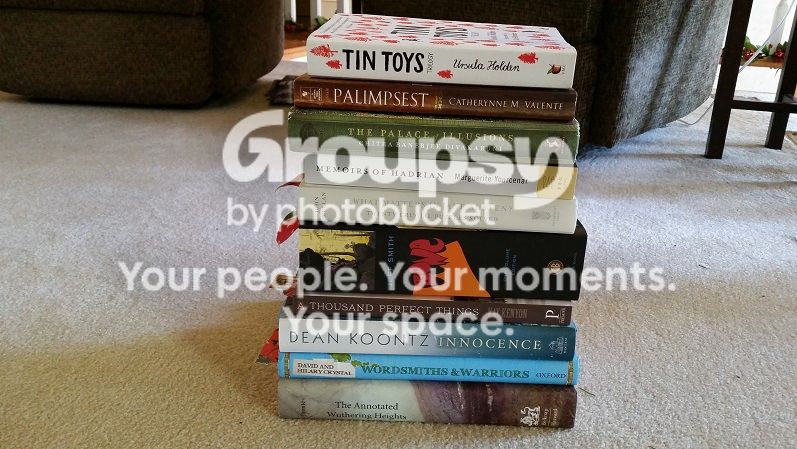
The Christmas book haul (top three from my 75ers Christmas swap secret santa):

261laytonwoman3rd
Most excellent haul, indeed.
263laytonwoman3rd
The new group for 2015 has formed. Better start thinking about setting up a new thread.
264lycomayflower
56.) The Snow Child, Eowyn Ivey ****
A retelling of sorts of the Russian fairy tale of the Snow Maiden. Mabel and Jack have moved to Alaska to make it "on their own" after their attempts to have a child end in a stillborn baby. They struggle to make a life there, with each of them mired in their own particular griefs. One night they build a snow child in fun, and the next day a real little girl appears in the trees at the edge of the homestead. The novel follows the couple as they approach the girl, befriend their neighbors, learn the Alaskan wilderness, and remember (or discover) how to live. The true origins of the child in the woods remains ambiguous even as years pass and they come to know her. Part of the magic of this story lies in that ambiguity. The novel is well told, and Ivey (how cool is the author's name?) brings the beauty and brutality of the Alaskan wilderness to life. The pacing is just slightly odd in that the first half of the novel deals with one winter and the second half spans eight years and I might have liked the end to be a tad more definitive, but all in all an excellent read.
A retelling of sorts of the Russian fairy tale of the Snow Maiden. Mabel and Jack have moved to Alaska to make it "on their own" after their attempts to have a child end in a stillborn baby. They struggle to make a life there, with each of them mired in their own particular griefs. One night they build a snow child in fun, and the next day a real little girl appears in the trees at the edge of the homestead. The novel follows the couple as they approach the girl, befriend their neighbors, learn the Alaskan wilderness, and remember (or discover) how to live. The true origins of the child in the woods remains ambiguous even as years pass and they come to know her. Part of the magic of this story lies in that ambiguity. The novel is well told, and Ivey (how cool is the author's name?) brings the beauty and brutality of the Alaskan wilderness to life. The pacing is just slightly odd in that the first half of the novel deals with one winter and the second half spans eight years and I might have liked the end to be a tad more definitive, but all in all an excellent read.
265lycomayflower
I'm not done with 2014 yet, but I've set up my 2015 thread here. Come say hi!
266lycomayflower
57.) Regeneration, Pat Barker ****1/2
I've been wanting to read something to do with WWI all year, and here I managed it, just under the wire.
The novel follows Siegfried Sassoon during his stay in Craiglockhart War Hospital after an ill-timed war protest labelled him "shell-shocked." A number of the other characters (his doctor, Rivers, and fellow patient Wilfred Owen, among others) are based on real people as well. We see a number of the patients, all suffering from some manner of neurasthenia, and get their stories, as well as Rivers's, from their own points of view. The shifting points of view coupled with a spare style when it comes to setting make the story feel a bit fragmented (though never difficult to follow), and this seems utterly appropriate for a novel about this subject. The exploration of the psychiatric and ethical issues facing the soldiers and their doctors is compelling and the descriptions of the conditions in the trenches harrowing. An excellent read. Recommended.
I've been wanting to read something to do with WWI all year, and here I managed it, just under the wire.
The novel follows Siegfried Sassoon during his stay in Craiglockhart War Hospital after an ill-timed war protest labelled him "shell-shocked." A number of the other characters (his doctor, Rivers, and fellow patient Wilfred Owen, among others) are based on real people as well. We see a number of the patients, all suffering from some manner of neurasthenia, and get their stories, as well as Rivers's, from their own points of view. The shifting points of view coupled with a spare style when it comes to setting make the story feel a bit fragmented (though never difficult to follow), and this seems utterly appropriate for a novel about this subject. The exploration of the psychiatric and ethical issues facing the soldiers and their doctors is compelling and the descriptions of the conditions in the trenches harrowing. An excellent read. Recommended.
267lycomayflower
58.) Saga, volume 4, Brian K. Vaughan and Fiona Staples ****1/2
Still gorgeous, compelling, brilliant, sexy, and violent. Leaves me wanting more, more, more.
Still gorgeous, compelling, brilliant, sexy, and violent. Leaves me wanting more, more, more.
268lycomayflower
Round-up post! as I think it unlikely that I will finish another book today (if I do, I'll just have to rejig).
(If you don't want to read all this, page down to the "TL;DR" for a quick summary and a link to my 2015 thread.)
Total Books Completed: 58 (2013: 68)
Total Books Started and Left Incomplete: I have no idea! HaHA!
Total Number of Pages Read (from complete reads): 15,145
Top Five First-Time Reads of 2014:
Fangirl
Saga
Melusine
Regeneration
Where'd You Go, Bernadette
Worst Reads of 2014 (chosen from completed reads only) :
Starry Night
The Storied Life of A.J. Fikry
Mr. Penumbra's 24-Hour Bookstore
Longest Read of 2014:
Harry Potter and the Deathly Hallows (759)
=/= HP: Doomsday Book (578)
Books Purchased New : 52
of those, read: 16 (31%); abandoned: 14
Books Acquired: 41
of those, number that were kinda cheats: 19
Shelf Reads 12, +3 abandonded forever (2013: 12)
Library Books 13 (2013: 17)
Average Number of Pages in Books Completed: 261 (2013: 278)
Reads Broken Down By Category:
Fiction: 43 (74%) (2013: 47 -- 69%)
Nonfiction: 15 (26%) (2013: 21 -- 31%)
Male Writers: 20 (34%) (2013: 28 -- 41%)
Female Writers: 34 (59%) (2013: 39 -- 57%)
British Writers: 9 (16%) (2013: 22 -- 32%)
American Writers: 43 (74%) (2013: 38 -- 56%)
Canadian Writers: 1 (2%) (2013: 2)
Writers =/= US, UK, Irish, Canadian: 0 (2013: 2)
Diverse Content: 15 (PoC: 7; LGBT: 7; Disabilities: 1)
Rereads: 8 (2013: 11)
Contemporary Literature: 8 (2013: 15)
Classics: 3 (2013: 2)
History/Biography: 1 (2013: 1)
Autobiography/Memoir: 3 (2013: 5)
Literary Criticism: 5 (2013: 5)
Young Adult: 9 (2013: 11)
Mystery/Thriller/Ghost: 5 (2013: 5)
Science Fiction: 4 (2013: 5)
Fantasy: 7 (2013: 8)
Historical Fiction: 2 (2013: 6)
Graphic Novels: 5 (2013: 3)
Accounting of Goals:
*Read 65 books/~20,000 pages: Missed, on both accounts. Too much life (house buying! moving! five months of craziness at work!) and too much meandering away from reads. I am super-pleased that I gave up tracking books I stopped reading, though. I'm working on quitting reads that I'm not into and not quitting reads just because something else attracts my attention (oo! shiny!), but I don't need numbers and obsessive listing of them.
*Acquire Fewer New Books, e.g. 30: Missed, spectacularly. *shrugs* Still working on this. It requires retooling an ingrained habit. It'll get there.
*Read the Books I Buy, e.g. 2/3 of books for reading: Missed, but better than in previous years. By my count I bought new 62 books for reading in 2014 (some were "acquired," but don't try to follow my logic. Promise.) and read (or gave a good faith go and quit forever) 33 of them. That's 53%, so shy of my goal of 66%. But an improvement. The fact that I abandoned 15 of the books I bought new this year tells me I need to be a little more choosey about which books I buy as well as just being careful about not buying so many.
*Be Choosy about Cheap (Used) Books, e.g. no more then 5 for reading per event/trip: Missed, in great glory! I did well for about six months, and then I just stopped keeping track and paying attention at all. If I accomplish none of my other goals in 2015 but curbing the Great Grab at used book sales and in used book stores, I will be happy. I ended the year with something like 100 used books bought, and I read less than five of them. Ug. Must. fix. this.
I'm not too down on myself about my 2014 reading year, though it was disappointing in many ways. It was a busy, hard year, so not getting in as much reading as I would like and doing a little more "book store therapy" than I would like is probably to be expected. I don't mind washing my hands of it though. Onward!
TL;DR
I read 58 books, which is low, but not unexpected given my year. My percentages were right about on target for the most part for genre, gender, and nationality breakdowns (though I read a lot of women and Americans). I missed most of my goals but made some progress. Next year I want to read more, seriously curb my buying of used books, and read more from my shelves. I'm excited to start over fresh for 2015! Come visit me at my 2015 thread here.
(If you don't want to read all this, page down to the "TL;DR" for a quick summary and a link to my 2015 thread.)
Total Books Completed: 58 (2013: 68)
Total Books Started and Left Incomplete: I have no idea! HaHA!
Total Number of Pages Read (from complete reads): 15,145
Top Five First-Time Reads of 2014:
Fangirl
Saga
Melusine
Regeneration
Where'd You Go, Bernadette
Worst Reads of 2014 (chosen from completed reads only) :
Starry Night
The Storied Life of A.J. Fikry
Mr. Penumbra's 24-Hour Bookstore
Longest Read of 2014:
Harry Potter and the Deathly Hallows (759)
=/= HP: Doomsday Book (578)
Books Purchased New : 52
of those, read: 16 (31%); abandoned: 14
Books Acquired: 41
of those, number that were kinda cheats: 19
Shelf Reads 12, +3 abandonded forever (2013: 12)
Library Books 13 (2013: 17)
Average Number of Pages in Books Completed: 261 (2013: 278)
Reads Broken Down By Category:
Fiction: 43 (74%) (2013: 47 -- 69%)
Nonfiction: 15 (26%) (2013: 21 -- 31%)
Male Writers: 20 (34%) (2013: 28 -- 41%)
Female Writers: 34 (59%) (2013: 39 -- 57%)
British Writers: 9 (16%) (2013: 22 -- 32%)
American Writers: 43 (74%) (2013: 38 -- 56%)
Canadian Writers: 1 (2%) (2013: 2)
Writers =/= US, UK, Irish, Canadian: 0 (2013: 2)
Diverse Content: 15 (PoC: 7; LGBT: 7; Disabilities: 1)
Rereads: 8 (2013: 11)
Contemporary Literature: 8 (2013: 15)
Classics: 3 (2013: 2)
History/Biography: 1 (2013: 1)
Autobiography/Memoir: 3 (2013: 5)
Literary Criticism: 5 (2013: 5)
Young Adult: 9 (2013: 11)
Mystery/Thriller/Ghost: 5 (2013: 5)
Science Fiction: 4 (2013: 5)
Fantasy: 7 (2013: 8)
Historical Fiction: 2 (2013: 6)
Graphic Novels: 5 (2013: 3)
Accounting of Goals:
*Read 65 books/~20,000 pages: Missed, on both accounts. Too much life (house buying! moving! five months of craziness at work!) and too much meandering away from reads. I am super-pleased that I gave up tracking books I stopped reading, though. I'm working on quitting reads that I'm not into and not quitting reads just because something else attracts my attention (oo! shiny!), but I don't need numbers and obsessive listing of them.
*Acquire Fewer New Books, e.g. 30: Missed, spectacularly. *shrugs* Still working on this. It requires retooling an ingrained habit. It'll get there.
*Read the Books I Buy, e.g. 2/3 of books for reading: Missed, but better than in previous years. By my count I bought new 62 books for reading in 2014 (some were "acquired," but don't try to follow my logic. Promise.) and read (or gave a good faith go and quit forever) 33 of them. That's 53%, so shy of my goal of 66%. But an improvement. The fact that I abandoned 15 of the books I bought new this year tells me I need to be a little more choosey about which books I buy as well as just being careful about not buying so many.
*Be Choosy about Cheap (Used) Books, e.g. no more then 5 for reading per event/trip: Missed, in great glory! I did well for about six months, and then I just stopped keeping track and paying attention at all. If I accomplish none of my other goals in 2015 but curbing the Great Grab at used book sales and in used book stores, I will be happy. I ended the year with something like 100 used books bought, and I read less than five of them. Ug. Must. fix. this.
I'm not too down on myself about my 2014 reading year, though it was disappointing in many ways. It was a busy, hard year, so not getting in as much reading as I would like and doing a little more "book store therapy" than I would like is probably to be expected. I don't mind washing my hands of it though. Onward!
TL;DR
I read 58 books, which is low, but not unexpected given my year. My percentages were right about on target for the most part for genre, gender, and nationality breakdowns (though I read a lot of women and Americans). I missed most of my goals but made some progress. Next year I want to read more, seriously curb my buying of used books, and read more from my shelves. I'm excited to start over fresh for 2015! Come visit me at my 2015 thread here.
269laytonwoman3rd
Really, you read nothing that did not originate outside the English-speaking world? I did...I did!!! One. We should maybe do something about this.


