This topic is currently marked as "dormant"—the last message is more than 90 days old. You can revive it by posting a reply.
2qebo
January
#01 The Hot Zone by Richard Preston -- (Jan 3)
#02: American Nations by Colin Woodard -- (Jan 25)
February
#03: Pilgrim at Tinker Creek by Annie Dillard -- (Feb 2)
March
#04: The Great Influenza by John M. Barry -- (Mar 4)
#05: The Thing with Feathers by Noah Strycker -- (Mar 11)
#06: Five Days at Memorial by Sheri Fink -- (Mar 19)
#07: My Family and Other Animals by Gerald Durrell -- (Mar 30)
April
#08: Animal Wise by Virginia Morell -- (Apr 23)
May
#09: Moving Violations by John Hockenberry -- (May 20)
#10: The Unlikely Disciple by Kevin Roose -- (May 25)
June
#11: Autobiography of a Face by Lucy Grealy -- (Jun 9)
#12: Truth and Beauty by Ann Patchett -- (Jun 12)
#13: Nabokov's Blues by Kurt Johnson and Steve Coates -- (Jun 12)
#14: Unfamiliar Fishes by Sarah Vowell -- (Jun 18)
#15: Pets in a Jar by Seymour Simon -- (Jun 29)
July
#16: Blue Latitudes by Tony Horwitz -- (Jul 20) - ROOT
#17: Rubber: An American Industrial History by Quentin R. Skrabec, Jr. -- (Jul 27) - ER
August
#18: Without You, There is No Us by Suki Kim -- (Aug 7) - ER
#19: The Map Thief by Michael Blanding -- (Aug 19) - ER
#20: In Code: A Mathematical Journey by Sarah Flannery -- (Aug 26) - ROOT
September
#21: A Long Way Gone by Ishmael Beah -- (Sep 6) - ROOT
#22: Farm City by Novella Carpenter -- (Sep 13) - ROOT
October
#23: Moonwalking With Einstein by Joshua Foer -- (Oct 2) - ROOT
#24: Finding Iris Chang by Paula Kamen -- (Oct 8) - ROOT
#25: The Secret World of a Monarch's Metamorphosis by Susan Langerock Schuldt -- (Oct 8) - new
#26: Who Needs a Prairie? by Karen Patkau -- (Oct 12) - ER
#27: The Selfish Gene by Richard Dawkins -- (Oct 31) - new
November
#28: The Aquariums of Pyongyang by Chol-hwan Kang -- (Nov 5) - ROOT
#29: Law of the Jungle by Paul M. Barrett -- (Nov 11) - ER
#30: The Evolution Wars by Michael Ruse -- (Nov 16) - new
December
#31: Animal Weapons by Douglas Emlen -- (Dec 4) - ER
#32: Dr. Mütter's Marvels by Cristin O'Keefe Aptowicz -- (Dec 7) - ER
#33: Conquering the Electron by Derek Cheung -- (Dec 28) - ER
#01 The Hot Zone by Richard Preston -- (Jan 3)
#02: American Nations by Colin Woodard -- (Jan 25)
February
#03: Pilgrim at Tinker Creek by Annie Dillard -- (Feb 2)
March
#04: The Great Influenza by John M. Barry -- (Mar 4)
#05: The Thing with Feathers by Noah Strycker -- (Mar 11)
#06: Five Days at Memorial by Sheri Fink -- (Mar 19)
#07: My Family and Other Animals by Gerald Durrell -- (Mar 30)
April
#08: Animal Wise by Virginia Morell -- (Apr 23)
May
#09: Moving Violations by John Hockenberry -- (May 20)
#10: The Unlikely Disciple by Kevin Roose -- (May 25)
June
#11: Autobiography of a Face by Lucy Grealy -- (Jun 9)
#12: Truth and Beauty by Ann Patchett -- (Jun 12)
#13: Nabokov's Blues by Kurt Johnson and Steve Coates -- (Jun 12)
#14: Unfamiliar Fishes by Sarah Vowell -- (Jun 18)
#15: Pets in a Jar by Seymour Simon -- (Jun 29)
July
#16: Blue Latitudes by Tony Horwitz -- (Jul 20) - ROOT
#17: Rubber: An American Industrial History by Quentin R. Skrabec, Jr. -- (Jul 27) - ER
August
#18: Without You, There is No Us by Suki Kim -- (Aug 7) - ER
#19: The Map Thief by Michael Blanding -- (Aug 19) - ER
#20: In Code: A Mathematical Journey by Sarah Flannery -- (Aug 26) - ROOT
September
#21: A Long Way Gone by Ishmael Beah -- (Sep 6) - ROOT
#22: Farm City by Novella Carpenter -- (Sep 13) - ROOT
October
#23: Moonwalking With Einstein by Joshua Foer -- (Oct 2) - ROOT
#24: Finding Iris Chang by Paula Kamen -- (Oct 8) - ROOT
#25: The Secret World of a Monarch's Metamorphosis by Susan Langerock Schuldt -- (Oct 8) - new
#26: Who Needs a Prairie? by Karen Patkau -- (Oct 12) - ER
#27: The Selfish Gene by Richard Dawkins -- (Oct 31) - new
November
#28: The Aquariums of Pyongyang by Chol-hwan Kang -- (Nov 5) - ROOT
#29: Law of the Jungle by Paul M. Barrett -- (Nov 11) - ER
#30: The Evolution Wars by Michael Ruse -- (Nov 16) - new
December
#31: Animal Weapons by Douglas Emlen -- (Dec 4) - ER
#32: Dr. Mütter's Marvels by Cristin O'Keefe Aptowicz -- (Dec 7) - ER
#33: Conquering the Electron by Derek Cheung -- (Dec 28) - ER
3qebo
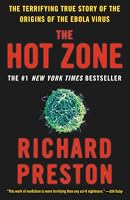
#1: The Hot Zone by Richard Preston -- (Jan 3)
why now: I’d had this around for awhile, residing among a bunch of books with a medical / disease theme, and then as a consequence of my data entry disorganization I received a duplicate which brought it to my attention.
The Ebola virus is one of the more frightening things you can imagine, an invisible pathogen that can jump between species and cause hemorrhagic fever with a fatality rate up to 90%, depending on the strain. Symptoms are initially similar to flu, with fever and aches and vomiting, and progress rapidly to internal and external bleeding; clots accumulate and stick to vessels, blood flows from every orifice including eyes, facial skin disconnects, intestinal membrane sloughs off, organs turn to mush as if in a decaying corpse, but the victim is alive and for some time aware.
The book is less about the Ebola virus itself, though a few incidents of its effects are described in extended detail, and more about a small set of people who study and track it, focusing on an outbreak in a monkey research facility in Reston VA, when the Army and the CDC were called to assist with containment. The style is thrilleresque, with terse sentences and step by step suspenseful action, as some very brave men and women don positive-pressure insulating space suits, pass through air locks into biohazard zones, dissect organs and tissue with extreme care to prevent cuts and punctures from tools, decontaminate in chemical showers, agonize when mistakes are made and exposure could mean death.
The period covered begins in 1980 and ends shortly before publication in 1994, so scientific specifics about virus strains are a bit outdated, but this is not central to the story. Recommended for its page-turner style and raising of awareness about what’s out (not far enough out) there.
4.Monkey.
I picked that one up at a library sale for €1, sounded potentially interesting; I haven't read it yet though, nice to see a positive review! :)
5qebo
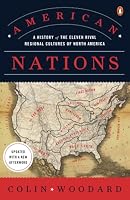
#2: American Nations by Colin Woodard -- (Jan 25)
why now: I begin each year aspiring to read more about American history, then fizzle out. I don’t necessarily expect this year to be different, but while organizing books in December I happened upon this one, acquired on the basis of several positive reviews on LT, and it seemed the perfect start.
This book is a schematic overview of US history from European colonization to the present. It is well organized, with few but sufficient maps. (Though it would benefit from a summarizing timeline.) It begins with the founding of each “nation” or cultural region in chronological order, continues through the expansion west, ends with current politics of Blue and Red and Purple. The sections about founding and expansion are strongest, with one chapter per nation. The sections about wars are sparse on facts, focused on representative positions of the various factions. The thesis is history as animosities, coalitions, compromises, between the nations. The style is not page-turner narrative, but is comfortably readable.
Two books cited as influential are The Nine Nations of North America by Joel Garreau (which I read some 25-30 years ago) about corresponding nations in the present, and Albion’s Seed by David Hackett Fischer (which I own but haven’t read because of its daunting size) about four cultural strands corresponding to four nations.
6qebo
#3: Pilgrim at Tinker Creek by Annie Dillard -- (Feb 2)
(group read)
why now: On the basis of a few recent LT mentions, I tossed this into an online order. No guarantee I’d’ve gotten around to it this year, but by coincidence a couple weeks later, I noticed the group read thread.
I’d advise reading the afterward before; there’s no plot to spoil, and the brief summary of why and how is a helpful scaffold. This is not a book of independent essays, but it didn’t read to me as a unified whole either. Annie Dillard describes it as a “theodicy”, split into via positiva and via negativa. Also it progresses through the calendar year. It entwines acute observations of nature with gleanings from scientific reading and cosmic consciousness with a dose of naval gazing. And somehow Eskimos got in there. The result is not entirely coherent, IMO, but then I don’t place a high value on “lyrical” (a frequent adjective of praise) unless it is about something, and lyrical morphs into flamboyant a bit too often for my taste. It is about something sometimes though (and the other times may be my failure to perceive), when she sticks to the task at hand for several paragraphs straight, and then the lyrical writing is impressive and inspirational, especially so since she was a mere 27 years old at the time.
And after writing the paragraph above, I revisited passages that stood out for others in a group read, and saw depth and complexity that I had passed by. I was, I think, expecting a different sort of book, and didn’t fully make the mental adjustment while I was reading. Maybe this is a book best read slowly with pauses.
She begins with an introductory “I am an explorer” and a chapter on seeing, heavily reliant on Marius von Senden (Space and Sight), about the formerly blind making sense of color patches. Anecdotes are extracted from (among others) R. R. Askew, Jean-Henri Fabre, Edwin Way Teal (The Strange Lives of Familiar Insects), Rutherford Platt (The Great American Forest). I note these authors because I (or you) may want to read the originals.
She observes muskrats, starlings, snakes, frogs, fish, praying mantises, caddisflies, caterpillars, sycamores... learning what to look for and how to watch undetected, fascinated by critterly behavior on its own merits, and for what it may say about a “creator”. Whether this is metaphor or abstraction or religion is not clear (and I can’t draw precise borders around the words anyway). It is language that I, an apatheist, was comfortable enough with, as an effort to get at an ineffable essence beyond nuts-and-bolts nature, but it infuses the text; this is not the sort of treatise that gets an index. Nature is “intricate”, “extravagant”, “exuberant”, “profligate”, “fecund”; decidedly not efficient. If you want science, if you want to know that a caterpillar’s head has 28 muscles, that a locust is not simply a type of grasshopper but rather a form that occurs under crowded conditions, that the molecules of chlorophyll and hemoglobin differ only by one atom at the center, grab the fact as it flits by because you may not find it again.
7qebo

#4: The Great Influenza by John M. Barry -- (Mar 4)
Science, Religion, & History group read
why now: This was one of the Science, Religion, & History group reads for 1st quarter 2014. I did in fact read it at the appropriate time.
A dense history of the 1918 flu pandemic that perhaps tries to pack in too much; what the author could remember and organize in his brain through seven years of writing was too much for my brain to keep track of in a few weeks of reading. The book begins with the development of modern medicine in the United States; the founders of emerging institutions and their proteges were involved in researching causes and cures. World War II was a crucial component. The flu spread from a probable origin in Kansas through military bases. Death was caused by immune system overreaction, disproportionate among young adults. Information was suppressed in the interest of morale; an especially gruesome section describes bodies piling up in the streets while newspapers uttered not a word. Well after the pandemic had subsided, the pathogen was unknown and the primary suspect, erroneously, was a bacterium. Personalities, politics, and science, entwined, expounded, and footnoted, with stretches of compelling story interspersed with tedious detail.
8qebo
#5: The Thing with Feathers by Noah Strycker -- (Mar 11)
why now: This was a January ER that arrived in February. With the best of intentions, I read it promptly, then somehow couldn’t produce 25 words for an official review. Not the fault of the book; I haven’t produced 25 words for any review in three months.
I’ve known about Boids (a computer simulation of flocking birds) for 25 years, and I saw the video of a starling murmuration when it went viral a couple years ago. I did not know that a similar video had been analyzed, tracking individual birds frame by frame over time to determine the accuracy of the parameters. A highlight, for me, in this book of intriguing anecdotes and connections. Each of 13 chapters, arranged into sections on body and mind and spirit, describes one bird’s representative behavior, and extrapolates. What might bird behavior suggest about human behavior? How might abstractions such as altruism and aesthetics apply to birds? I was more interested in bowerbirds than buzzards, but the variety offers something for everyone, and the author’s experience as a scientist combined with a comfortable conversational style is engaging regardless.
9qebo
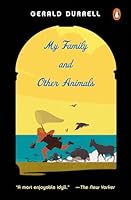
#7: My Family and Other Animals by Gerald Durrell -- (Mar 30)
Why now?: At some mention on the threads I set it out on a table, and at another mention I picked it up to read.
I have a theory that people happiest in their careers are doing whatever obsessed them at age 11. This book provides supporting evidence. The Durrell family (mother, three sons and one daughter) moved to the Greek island of Corfu when the future naturalist was 10, and while My Family is something of a caricature, Other Animals are many and varied, patiently and meticulously observed, and affectionately and humorously portrayed.
10qebo
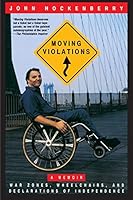
#9: Moving Violations by John Hockenberry -- (May 20)
Why now?: I was perusing my shelves for non-fiction that wouldn’t involve a learning curve, so the focus was on a shelf of memoirs.
On a continuum of woe is me to make lemonade, John Hockenberry is far on the lemonade end. A math major at the University of Chicago when a car accident (the driver fell asleep and was killed) paralyzed him from the chest down, he segued into a “crip job” training developmentally disabled adults (taking clients for jaunts to the beach in an orange pickup truck with a repurposed bicycle rack for the wheelchair), music major (inventing a mouth device to press the piano pedal before deciding the hands-only harpsichord was not an admission of defeat), newscaster for a local public radio station (on the radio, nobody knows you’re a paraplegic), foreign correspondent in such wheelchair-accessible locations as Iraq and Somalia (turns out pretty well when people treat a wheelchair as one of life’s many nuisances and simply carry it up the stairs; more difficult to see an opera in New York with a balcony ticket). His attitude is pragmatic and irreverent with a dose of overcompensation (“your mother and I think you use the wheelchair as a crutch” says his father), and then... pent-up anger bursts forth when a taxi driver tries to avoid him and refuses to put the wheelchair in the trunk, and empathy exudes in reflections about a grandfather who lost an arm in an electrocution accident and an uncle mentally and physically damaged by phenylketonuria.
I don’t even know why I have this book, and I read it somewhat at random, so it was a pleasant (if that’s quite the right word) surprise.
11qebo
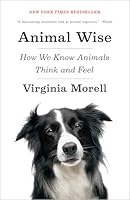
#8: Animal Wise by Virginia Morell -- (Apr 23)
why now: A February ER, read reasonably promptly.
Surely we all know by now that people aren’t uniquely equipped with intelligence and emotion, but exactly how and what other animals think and feel isn’t simple to tease out from behavior. This book presents research on various species, arranged in order of similarity to humans, beginning with ants, passing through chimpanzees, and ending oddly with dogs, on the hypothesis that domestication pushed wolves to be more mentally compatible with humans, whereas evolution has no such constraint. Two pairs of chapters were most interesting to me: parrots and dolphins in the lab vs the wild, and efforts to understand why they need to be so smart in their natural lives.
Nothing notably remarkable or profound if you’re generally familiar with this sort of thing, but the author is conversant with the science, and portrays -- more engaging than results of studies -- scientists at work / play with their chosen creatures.
12qebo
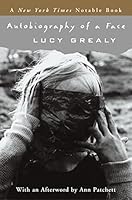
#11: Autobiography of a Face by Lucy Grealy -- (Jun 9)
why now: I happened upon Truth and Beauty in a display of miscellaneous notable authors at a used book store during the DC meetup, norabelle414 recommended that I read this book too, and there it was in the cancer section.
Lucy Grealy didn’t realize she’d had cancer until a casual comment in family conversation registered, and she linked the word to the diagnosis of Ewing’s sarcoma. The tumor removed from her jaw at age 9 drastically affected her life, in part because she spent the bulk of several years as hospital inpatient or outpatient, enduring painful ordeals of radiation and chemotherapy, and in part because along with significant physical effects (difficulty chewing and swallowing, for example), the cosmetic result was a deformed face, a target of pity and bullying. She grew her hair long so it would cover her face when she hung her head, characteristic posture. She felt free only at Halloween when she could wear a mask. Surgery after surgery carved flesh and bone from her body in efforts to reconstruct her jaw, and she imagined that her life would begin when her face was fixed. Her face was never fixed, but her life did begin, in teenage years through a job at a horse stable, and in college as a poet, an identity that allowed a defiance about appearance and a presentation of intellect and wit. The tone at the end is optimistic.
And then she died, at age 39, which these days you know from the cover blurb; at the time of original publication, the end was well in the future, and public readings attracted audiences of cancer survivors. Her death changes the perception of everything she wrote, from triumph over devastating illness to WTF happened? Of course she was far more than her face, but her face, physically and philosophically, is the focus of this book, which is simultaneously revealing and claustrophobic.
13qebo
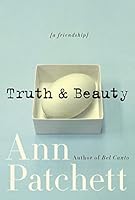
#12: Truth and Beauty by Anne Patchett -- (Jun 12)
why now: The obvious followup to Autobiography of a Face.
Anne Patchett knew who Lucy Grealy was when both were students at Sarah Lawrence, but the recognition was not reciprocated. Everybody knew who Lucy Grealy was; her appearance was distinctive, and her personality was magnetic. When both were accepted into the Iowa Writers Workshop, they met again, shared a stringent budget and a home, and became close friends. Autobiography of a Face tapers off after college. This book picks up from there, shows another side with vulnerability and insecurity prominent, emphasizes physical more than cosmetic consequences of the childhood cancer and neverending surgery, and answers the question of WTF happened. And fails, I think, to do full justice. I didn’t find Lucy Grealy especially appealing, in either her own or her friend’s memoir, but excerpts from letters give glimpses of the person she could be: charming, sharp, interested in the world outside her face. Of course friends got the crappy stuff, and there was a lot of it. I’m not convinced that it all needed to be displayed so disproportionately in a book.
14qebo

#15: Pets in a Jar by Seymour Simon -- (Jun 29)
why now: A neighbor donated elementary school castoffs to my LIttle Free Library, and I was attracted by the cover and illustrations. The book was published in 1975, the attached library card shows due dates in the late 1980s, and the condition is shabby, so I can see why the school didn’t want it, but I’m keeping it.
If you are age, say, 8-11, and have access to a pond or meadow, this book would be an excellent resource. It devotes a chapter to each critter (hydras, planarians, snails, various bugs, ... ): where to find them, how to collect them, what to feed them, interesting aspects of behavior to observe, with detailed illustrations of innards, notable features, and developmental stages. (It reminds me of a neighbor kid who had a room full of aquariums and terrariums and now works for the Smithsonian.) It was published nearly 40 years ago, so I wasn’t expecting much when I looked up the author, but turns out he is still actively engaged in science education, with a web site and speaking schedule.
15qebo
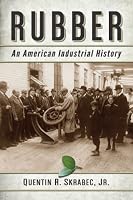
#17: Rubber: An American Industrial History by Quentin R. Skrabec, Jr. -- (Jul 27)
I requested this ER book because I enjoy history from a technological perspective; I was actively interested, not haphazardly clicking whatever. Alas, it demonstrates by negative example the skills involved in narrative non-fiction. I could never relax out of editor mode; I kept wanting to slash this or expand that or rearrange shifting themes and jiggly dates into coherent storylines. The style is business report, which doesn’t scale well to book length and complexity. It reads as though notes from various sources were collected without discrimination and strung together: a set of factoids in one paragraph, an overlapping set of factoids in the next paragraph, related paragraphs sequenced into chapters. So much potential here: the harvesting of rubber from its native jungle habitat in South America, the shift to plantations in Asia and experimental corporate colonies, the chemistry of making natural and synthetic rubber viable for mass manufacture, the transition from carriages to bicycles and automobiles and airplanes, the structure of tires (yes, really, illustrations would’ve been helpful), the intense personalities of prominent industrialists, the development of labor unions and application of management principles, the rise and fall of Akron OH. All there, sometimes mentioned in passing, sometimes occupying central place but obscured by clutter of extraneous and frequently duplicate details. Frustrating.
16qebo
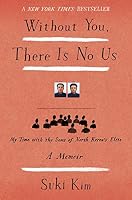
#18: Without You, There is No Us by Suki Kim -- (Aug 7)
why now: An effort to catch up with ERs. This, the most recent arrival, wasn’t yet buried by other books.
Suki Kim was born in South Korea, emigrated with her family to the US at age 13, and grew up in New York. She had already interviewed North Korean defectors and visited Pyongyang accompanied by a minder, when she was presented with an opportunity to see North Korea from the inside. She applied for, and was accepted to, a position teaching English at the Pyongyang University of Science and Technology (PUST), founded and funded by Christian missionaries. There she had to be secretive about two aspects of her identity: she was a journalist, and she was not Christian.
For reasons not fully explained, North Korea had shut down universities and sent students to construction sites, so PUST became a haven for sons of elite families. It wasn’t exactly luxurious, but far worse than the lack of material comforts such as nourishing food and heat, were the isolation and censorship. Though the students talked optimistically about going home for visits, in reality contact with families was restricted. Every student was paired with a buddy, ostensibly for support, but the effect was no privacy whatsoever. The teachers were occasionally escorted on scripted field trips. All lesson plans had to be approved by the “counterparts”. She devised a general strategy of assigning her students to write letters, a mystifying practice, but she successfully argued that future officials should become familiar with the format. Though the letters were amply infused with the “solicitude” of Kim Jong-il, and insistence that every feature of North Korea was the first or best of its kind, hopes and questions and personalities slipped in over time. She cautiously introduced glimpses of another world, where information could be found on the internet, where people could choose careers and travel without permission... though always with anxiety that she might cause distress for her students or provoke punishment from authorities. The constant vigilance was exhausting.
So this all should have been fascinating, and it came close; eerie routines of daily life combined with revealing incidents kept the pages turning (one culture clash all around involves Harry Potter). Somehow, though, it fell short, or didn’t dig deep enough. To an extent this was intentional; she had to avoid identifying students and teachers, so she held back details that might have added nuance or psychological insight. And she was writing from surreptitious notes and memory, could not discuss background or interpretation with anyone there. Still, the tone often tilts toward bewilderment rather than investigation, and doesn’t quite fit with the bravery of going and the persistence of staying.
I wonder what will happen to the school.
17qebo
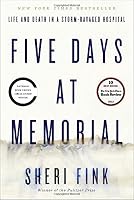
#6: Five Days at Memorial by Sheri Fink -- (Mar 19)
group read
why now: This was a Club Read group read already on my radar when I noticed it on the new books shelf at the public library. I read it a little too late to participate, and outdoor activity picked up just about the time I finished. So although I took a page of notes at the time, 7 months later I’m feeling unmotivated to organize them into paragraphs.
In August/September 2005 during Hurricane Katrina and its aftermath, a concerning number of patients died at Memorial Medical Center in New Orleans; nine died in the same place at the same time and contained high concentrations of the same drugs: morphine and midazolam. This book meticulously documents events at the hospital during the disaster, and the legal inquiry afterward, focusing on Dr. Anna Pau, with facts and anecdotes and alternate realities pieced together from interviews with dozens of doctors, nurses, administrators, patients, and rescue workers.
While the hurricane was obviously a major contributor to the disaster, it was also an overwhelming layer on a weak foundation. The hospital had an emergency plan as required by law, but it was a formality not supported by actual resources. The building had problems, such as an electrical system vulnerable to flooding, that had been known but left unaddressed over a period of years. There seems to have been an implicit assumption that in a hospital crisis, the outside world would be functioning normally. The loss of electricity was crucial: without air conditioning, the heat was dangerous; without life support equipment, patients needed vigilant attention; without computers, medical records were inaccessible. (All the while, electricity in a connected building stayed on.) A major factor was the absence of behavioral protocol. Everybody went into crisis mode, individually. Communication broke down. Decisions were made without the usual checks and balances. Contradictory orders were given. Rumors spread. Staff members were unclear about who was responsible for what, and patients were terrified of being abandoned. Almost in passing, a comparison was made to another hospital, similarly vulnerable and strapped for resources, where the staff kept to the usual schedule and the usual hierarchy as much as possible, with significantly better results. I wanted to see more.
This is a long book with lots of detail, perhaps more than strictly necessary to tell the story, but conveying in sheer volume how very many things went wrong, how very many people were involved, and how difficult it was for the legal system to figure out exactly what happened and who if anyone was to blame. It’s compelling but not always a page-turner; with chapters increasing in length – 60 pages, 100 pages, 130 pages – there are few clear points to pause and assess and mentally summarize before moving on, and after the shift from hospital events to legal process my interest was decreasing. Still, if the entire book is too much, even half of it is important and well worth reading.
18qebo
#28: The Aquariums of Pyongyang by Chol-hwan Kang and Pierre Rigoulot -- (Nov 5)
why now: North Korea on my mind w/ Without You, There is No Us recently read as an ER and floating around in the threads, I remembered this book languishing on a shelf.
Kang Chol-hwan was 9 years old in the late 1970s when his family was removed to Yodok, North Korean concentration camp #15. The reason was his grandfather.
In the 1930s, his grandparents had emigrated separately from Korea to Japan. They met and married and raised four sons. The grandfather became a wealthy businessman, the grandmother became a political activist, and after the Korean War she persuaded the family to return to North Korea to help build the country. The North Korean government placed the grandfather in a prominent position in Pyongyang (and took his money). But while the grandmother remained a true believer, the grandfather never had been; his criticism eventually went too far, and one day he disappeared forever. Soon afterward, the rest of the household was rounded up for reeducation. By this time, the household consisted of the grandparents and two sons, one with a wife and two children (Kang and his younger sister). The wife, deemed innocent, was left behind and forced to divorce, though she tried to join the others. The family was held in Yodok for ten years, then released suddenly without notice, probably because the grandfather died. Some years later, Kang escaped to South Korea.
Yodok has all the horrors you would expect of its ilk: brutality, starvation, disease, cold (the building devoted to Kim Il-sung’s portrait was heated; buildings occupied by prisoners were not). The story is told loosely chronologically, as Kang matured from child (half day of school, half day of labor) to young man (full day of labor). Family members were kept together in primitive huts. With savvy maneuvering, Kang and his uncle were able to scrounge food; the area near the huts was stripped bare, but labor further afield offered opportunities to collect plants, bugs, worms, and small animals. The grandmother, remorseful and weakened by pellagra, was the emotional glue, and encouraged resilience in the others with characteristic willfulness and creative cookery. (Another family enterprisingly rearranged the space and used one room to raise rats for food.)
The book was actually written by two people, the North Korean concentration camp survivor and a French journalist, then translated into English. I wondered sometimes whether a man in his 30s could remember events of his childhood in fully accurate detail, but as far as I’m aware the basic facts are not in doubt. Its purpose was to reveal the horrors of North Korea, so it is more about objective features of Yodok than about the psychological interior of Kang; though he mentions the necessity of numbing to sadistic treatment and gruesome death, and the difficulty of adjusting to civilian life in North Korea and to an unimaginably free life in South Korea, he does not dwell, and his personality is somewhat subsumed to documentary style. I’d consider it more a supplement to other books than a top recommendation.
19Bill_Masom
I read this book several years ago. I have a deep interest in North Korea, as I was stationed in South Korea from 1990-1993 while in the US Air Force. I took a Korean wife while there.
Anecdote: My wife and I were visiting her mother in Seoul, in a neighborhood far from any US base. I was sitting outside her apartment building smoking and reading a book. Older people, those of the Korean War generation passing by would stop and stare at me until I acknowledged their presence. After I greeted them, they would ask "you GI"? I would indicate that I was, and they would all bow and say "Thank you". Many would shake my hand, repeating "thank you" all the time. Probably happened 30+ times in a couple of hours. I felt that those people knew what horrors awaited them if we (the US primarily, the UN practically) had not of intervened during that conflict.
It fascinates me how in this day and age, anyone can be a communist. My mind is truly boggled.
Regards,
Bill
Anecdote: My wife and I were visiting her mother in Seoul, in a neighborhood far from any US base. I was sitting outside her apartment building smoking and reading a book. Older people, those of the Korean War generation passing by would stop and stare at me until I acknowledged their presence. After I greeted them, they would ask "you GI"? I would indicate that I was, and they would all bow and say "Thank you". Many would shake my hand, repeating "thank you" all the time. Probably happened 30+ times in a couple of hours. I felt that those people knew what horrors awaited them if we (the US primarily, the UN practically) had not of intervened during that conflict.
It fascinates me how in this day and age, anyone can be a communist. My mind is truly boggled.
Regards,
Bill
20qebo
>19 Bill_Masom: Thanks for the anecdote. My knowledge of Korean history is superficial. Any recommendations?
21Bill_Masom
I don't really have any recommendations. My knowledge of Korean history, scanty as it is, was picked up organically while over there. So I have not read a lot on the history, just learned it from the people and some light reading while there. As I recall, the Stars & Strips Pacific newspaper would run articles on the history and culture of the various countries where we had military bases in that region.
I was more interested in the culture, as I was married to a Korean. Understanding that was of more help than knowing the history, though the two do go hand in hand sometimes.
It is a fascinating place. I feel so bad for the people trapped in North Korea. I was there to "keep the peace" between the two nations, but never felt that the North Koreans were my enemy. Their leadership, yes, the people, no.
Sorry I can't be of more help.
Regards,
Bill
I was more interested in the culture, as I was married to a Korean. Understanding that was of more help than knowing the history, though the two do go hand in hand sometimes.
It is a fascinating place. I feel so bad for the people trapped in North Korea. I was there to "keep the peace" between the two nations, but never felt that the North Koreans were my enemy. Their leadership, yes, the people, no.
Sorry I can't be of more help.
Regards,
Bill
22qebo
#64: Law of the Jungle by Paul M. Barrett -- (Nov 11)
why now: Oldest of the ER backlog.
In 1964, Texaco arrived in Ecuador and began drilling for oil in the rainforest. By the early 1970s, the government had increased its cut of the profits, and demanded that Texaco give part ownership to the newly formed state oil company Petroecuador. In 1992, Texaco departed Ecuador, transferring its remaining operations to Petroecuador. Over three decades, the rainforest had become an environmental mess of contaminated water and oozing pits of sludge, a consequence of lax laws and the “prohibitive costs” of adhering to standards that would be expected in the US. Of course the people most affected were not the politicians and executives making decisions and deals, but the indigenous inhabitants of the rainforest. In 1993, Cristobal Bonifaz, native (from a prominent political family) of Ecuador and immigrant to the US, filed a class action law suit against Texaco in its New York City headquarters, assisted by Steven Donziger, formerly a journalist in Nicaragua and more recently a Harvard Law School classmate of his son. In a series of judgments from 1996-2001, the case was dismissed in New York. In 2000, Chevron acquired Texaco. In 2003, the case was resumed in Ecuador.
This book is about the ins and outs, ups and downs, twists and turns, of the Aguinda v. Texaco/Chevron case in its various manifestations. On its face straightforward: Texaco had polluted the rainforest, and Chevron had assumed legal responsibility. In reality complex: Texaco had coexisted with Petroecuador, and Petroecuador had continued dubious practices in overlapping locations, so how to determine which sites had been polluted when by whom? The rainforest inhabitants correlated illnesses and deaths with oil company activity, but how to link specific cases with certain causes? If only all the problems had been practical. The focus is on Steven Donziger, who may have begun with honorable intentions, but got caught up in winning the game and lost sight of his ostensible clients: dramatizing court appearances, inviting a promotional video documentary (“Crude”), discouraging cleanup because it would destroy evidence, composing a report supporting damages in the multiple billions and recruiting a puppet consultant to present it as objective and neutral. Chevron was far from pure and innocent, especially considering its wealth and the moral spirit of the case, but did have a point that the Ecuador legal system was corrupt, and the damages had been wildly exaggerated. In the end, two decades after the beginning, the rainforest could have been restored to pristine condition with the money that went to legal fees.
The book seems exhaustively reported. I don’t doubt its factual accuracy, and I appreciated the restrained and nuanced portrayal of environmentalists vs. international oil corporations. The style is a tad tedious; the 250+ page book is arranged as an extended magazine article, with legal/financial event after event, chronologically and monotonically. It is not as historically or culturally immersive as Toms River, for example. Still, definitely worth reading for its merits, but prepare to be demoralized.
23qebo
#13: Nabokov’s Blues by Kurt Johnson and Steve Coates -- (Jun 12)
why now (where “now” = 6 months ago): I’ve had it around for awhile, and pulled it off the shelf to read soonish when butterfly season was imminent.
Before he became an internationally famous novelist, Vladimir Nabokov was a lepidopterist, amateur and professional. Upon arrival in the US he volunteered at the American Museum of Natural History in New York, and while teaching literature at Wellesley he was also employed as curator of the lepidopterological collection of the Museum of Comparative Zoology at Harvard. He wrote a number of journal articles, and continued butterfly collecting expeditions well after his career shift. Although he was recognized as a competent taxonomist, he was not formally trained, he was nowhere near as prolific as would be expected of a career scientist, and his work tilted more toward sorting through details than grand theorizing. So his classification of South and Central American Blue butterflies, published as Notes on Neotropical Plebejinae in 1943, slipped into obscurity.
This book focuses on two tasks: resurrecting Nabokov’s reputation and legacy as a scientist, and picking up where he left off with the Blues. I was most engaged by the chapters about Nabokov, biographical with an emphasis on science in its journalistic and literary manifestations. Nabokov was embedded in the science of the times, and aware of the cutting edge; in Notes, he applied modern techniques of anatomical (not merely wing pattern) comparison, and speculated on evolutionary origins. With a mere 120 specimens from museum collections, he proposed a general classification scheme, anticipating that butterflies found in the future could be placed within it. And he was right in all essentials. Author Kurt Johnson is a lepidopterist whose attention was elsewhere in the 1980s when new discoveries of Blues prompted him to revisit Nabokov’s work. This component of the book is rather inside lepidoptery, as an international team of researchers is brought together and specimens from museum and field are studied. It is probably more compelling to people who are more familiar with the professional terminology than I, but with no qualms about skimming over esoteric passages I was informed and entertained by the difficulties of simply collecting a sufficient variety of butterflies for meaningful analysis, ranging from tedious examination of museum storage drawers packed with poorly labeled specimens, to adventures in barely accessible terrain with success dependent on cooperative weather. Highly recommended for the butterfly enthusiast with literary inclinations.
24qebo
#30: The Evolution Wars by Michael Ruse -- (Nov 16)
why now: For a RL discussion group.
An historical account of evolution as an idea, its reception outside the scientific community, and controversies within the scientific community. The gist is that scientists are people too, so pure objective facts and well grounded theory get entangled with cultural assumptions and ideologies. This thesis is somewhat sloppily presented, e.g. evolution in its formative era is characterized as “secular religion” but “religion” is never defined (it seems approximately equivalent to “worldview”), and the level is layman but background familiarity with salient details is implicitly expected. Still, the perspective is useful for making sense of modern controversies where the sideline observer might wonder what the argument’s about. The book was published in 2000 and it shows; e.g. there’s a somewhat vituperative chapter on Steven Jay Gould, and a chapter on Intelligent Design and its ilk that predates the Dover PA trial.
25qebo

#31: Animal Weapons by Douglas Emlen -- (Dec 4)
why now: Oldest of the remaining ERs.
What’s a product of Quaker heritage to do when he finds himself fascinated by the structural oddities that animals develop for defense and attack? Also arrowheads. This one had a biologist grandfather and a biologist father and a childhood of field expeditions to the tropics, so he took up the profession with a specialty in animal weapons as seen in dung beetles. I requested this ER because of the evolution aspect; I’m not exactly enthusiastic about weapons. This though is a nicely arranged and amply illustrated book, and its relatively narrow focus allows the author to stray into entertaining anecdotes without losing sight of the primary agenda. He begins with camouflage, passes through teeth and claws, then expounds on his topic of enthusiasm: the arms race of exotic protrusions ranging from subtle to ridiculous. The dung beetles are of interest because the bazillion (well, tens of thousands) species, some with disproportionate weapons and some without, can be studied with attention on the environmental and behavioral conditions that set body plan evolution along one path or another. Various other creatures make appearances too. Each chapter ends with a comparison to military weapons used for similar purposes, and the book ends with a section on fortresses, ships and airplanes, guns and bombs... I doubt that I would’ve stuck with a history of the AK-47 in any other context. Engaging and informative.
Interview with the author here: http://www.yourwildlife.org/2014/10/before-they-were-scientists-doug-emlen/ .
26qebo

#32: Dr. Mütter's Marvels by Cristin O'Keefe Aptowicz -- (Dec 7)
why now: Chipping away at the ERs.
I’ve been the the Mütter Museum in Philadelphia, and it’s certainly an intriguing place with all manner of medical deformities. I was unaware that Thomas Dent Mütter, the doctor behind it, was far more than a collector; he was a prominent and, um, cutting edge surgeon of the mid 19th century. Orphaned at an early age, he was taken in by a distant relative who funded his education (but balked at the excessive bills for fashionable clothing). In poor health for much of his life (with lungs chronically prone to infection, and gout that hindered manual dexterity), he encountered caring doctors at a crucial juncture, and directed attention to medicine as a way to make his mark in the world. Philadelphia was the obvious starting point, and Paris the obvious next step. Upon returning to Philadelphia (with an exotically umlauted name), he attracted patients by reputation of skill and personality, and when Jefferson Medical College was founded, he was invited to join the faculty. There he remained, influencing a generation of students, until his sadly premature death.
Mütter was an advocate of compassionate honesty in diagnosis and prognosis, preparation (before anesthesia, he massaged the relevant tissue to desensitize it to instruments), recovery (he insisted that patients be monitored after surgery, not sent home immediately), cleanliness (before the germ theory of disease, he recognized a correlation of unwashed and reused equipment with infection), and anesthesia (who wouldn’t be? well, it was considered by some to obscure feedback from the patient, and to be irresponsibly risky as the dosage could not be controlled precisely). Two especially fascinating chapters detail (with diagrams) repair of a cleft palate in a young man so born, and removal of crippling scar tissue from a young woman burned in childhood; both patients desperate for normal lives, both stoically enduring the painful cutting and sewing without anesthesia.
This 300 page book reads quickly, partly because carefully selected photographs abound, but mostly because the story is told so engagingly, Mütter central but entwined with the profession of medicine as it progressed from leeches and gruesome hacking off of appendages and tumors, to recognizably modern ideas and practices. Although familiarity with Philadelphia may enhance appreciation, this book is not of merely local interest; it is extremely well researched, organized, and presented.
27qebo

#24: Finding Iris Chang by Paul Kamen – (Oct 8)
why now: A semi-random book off the shelves.
Iris Chang became famous with The Rape of Nanking, and was researching a book about the Bataan Death March when she committed suicide at age 36. The suicide was planned in advance, and involved purchase of a gun and delivery of documents and photographs to libraries for posterity. Among the people she tried to contact by phone in the days preceding her death was Paula Kamen, who had been a friend since college. Unfortunately, a conversation with Iris was invariably intense and long, so Paula was not the only one who let the outreach go to voice mail, waiting for sufficient time. Iris Chang appeared to have it all: successful career, happy marriage, recent baby; she was immersed in harrowing subjects, but she had already been through one round, and emerged resilient and engaged in the political ramifications. So what happened? This book is Paula Kamen’s effort to piece together a complex person and the steps leading to suicide. It is arranged as a series of questions, an homage Iris and a reflection of the universal reaction to her suicide: what was going on behind the surface of competence and perfection? In a journalistic sense it covers the relevant information, collected from public sources, old letters, interviews with colleagues and friends and family (not, however, Iris Chang’s mother, who was also writing a book), evaluated with a filter of personal relationship (oh _that’s_ what it meant, oh _that’s_ what was going on). In an emotional sense, it can get a tad clinical, perhaps an intentional distancing for objectivity or protection or respect. Definitely recommended, but I want to read the book by Ying-Ying Chang for comparison.
28qebo
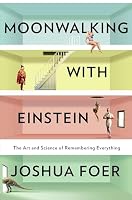
#23: Moonwalking With Einstein by Joshua Foer -- (Oct 2)
why now: Plucked off the shelves as something different. Describing his ordinary memory, the author remarks that awhile after reading a book, he might be able to remember the general theme and whether or not he liked it. Alas, that’s about what I tend to remember too, so let’s see what I can reconstruct two and a half months after the fact...
Joshua Foer got interested in memory when a chance visit to a museum dedicated to physical strength got him wondering about the mental equivalent, a bit of googling got him to feats of memory, and a comment by a memory champion that anyone can learn the techniques piqued his curiosity. He set out to interview the major players in world memory championships, and with their encouragement decided what better way to understand the process than to enter a competition himself. The US Memory Championship was regarded as within his reach; American “mental athletes” pale in comparison their European counterparts. He recruited a researcher to test his memory baseline (as expected: nothing special) and improvement over time, and went to work.
The fundamental technique is chunking. Instead of trying to remember digits individually, group them into pairs or triplets. Instead of trying to remember meaningless digits, convert them into meaningful items. The Major System associates each digit 0-9 with a consonant, so each pair of digits becomes a word by inserting a vowel between the consonants. The PAO system associates each pair of digits 00-99 with a person performing an action using an object, so each string of six digits combines the person of the first pair, the action of the second pair, the object of the third pair. (This is the origin of moonwalking with Einstein.) Instead of trying to remember an abstract sequence, convert it into tangible locations along a path. This is the gist of the memory palace (which has been around for 2000 years): place attention-grabbing scenarios in a familiar space, and step through it. The scenarios should have associations with multiple senses and emotions: e.g. ugly or beautiful, cacophonous or musical, bitter or sweet, fetid or fragrant, sharp or soft; funny, risque, bizarre. The space can be a building or a landscape, real or imaginary. Creativity helps. Creativity on the fly is difficult, but can be aided by practice with pre-memorized systems.
As you might suppose, people who devote careers to memorization can be a tad eccentric, and a survey of the field, along with the coaching sessions, yields an engaging cast of characters. Practice has its amusing moments, such as what happens when one of the people is your mother, and some of her actions are too disturbing to contemplate. The goal of winning the US Memory Championship keeps the many digressions more or less on track. In the end (not revealing the result of the competition), it turns out that developing skills for a championship doesn’t do much for life in general. While formal test results improved, recall of, say, the content of books did not. Memorization takes conscious effort; it’s not that you train your brain and from then on everything automatically settles into position for later retrieval. But if you have specific situations where the techniques can be usefully applied, apparently there is truth to the claim that anyone can do it.
29qebo
Hmm, I see I've failed to transfer several reviews over here. Winding up the year properly...
30qebo
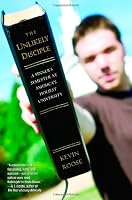
#10: The Unlikely Disciple by Kevin Roose -- (May 25)
why now: I don’t remember. It's been awhile.
Other Brown students spent semesters abroad in Europe, but Kevin Roose, after a stint as research assistant to A. J. Jacobs for The Year of Living Biblically thought that Jerry Falwell’s Liberty University would be a more challenging cultural stretch. He approached with as open a mind as he could manage, considering his liberal Quaker background, and after an awkward start (evasions when asked why he’d transferred, attempts at squeaky clean behavior that came across as inauthentic) settled in fairly comfortably, pursuing activities (e.g. choir and prayer) with genuine interest, raising concerns in his family that he might go native. He didn’t. He remained ideologically skeptical, but personally respectful; this is not a book of caricatures. All the more impressive because he was 19 at the time.
31qebo

#14: Unfamiliar Fishes by Sarah Vowell -- (Jun 18)
why now: I was perusing my shelves for shortish ROOTs, and this one caught my eye because I’d recently seen Sarah Vowell on TV.
Sarah Vowell, in her characteristic style of humorous and poignant anecdotes, recounts the history of Hawaii, focusing on native interactions with two conflicting strands from New England: whalers and missionaries. Can’t say I’ve ever had much interest in Hawaii, but suddenly some things made sense.
32qebo
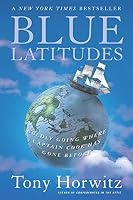
#16: Blue Latitudes by Tony Horwitz -- (Jul 20)
why now: After Unfamiliar Fishes I got interested in Hawaii and plucked this book off the shelf.
Tony Horwitz, in his characteristic style of boy adventures in history, follows the path of Captain James Cook in several jaunts across the Pacific Ocean, often joined by his irreverent pal Roger. Well researched and entertaining, with centuries of colorful characters.
33qebo

#19: The Map Thief by Michael Blanding -- (Aug 19)
why now: Chipping away at ERs.
Well, I can’t complain that there aren’t enough maps in this book. :-) Though some referred to in this ARC version weren’t there, and I suppose will be added for the published version.
In 2005, map dealer E. Forbes Smiley III was caught stealing a rare map from the Beinecke Library at Yale University. This key event begins and holds together the book, which traces the arc of his career: obsession with maps as history and art combined, first lucrative client and specialized collection, prominence in an esoteric field, financial trouble and downfall. Interwoven are the maps: why they matter historically and artistically, how a well considered collection can be more than the sum of its parts, the forensic difficulty of determining what had been stolen from where. And the people: librarians, curators, dealers. Lesson to all: know your inventory.
The story is absorbing and informative and yet... missing something. I was expecting perhaps more of a psychological profile? a morality tale? An honorable professional who hit a life obstacle and disintegrated, a respectable veneer with a dark side. And perhaps this is how he seemed to his friends, who were shocked when the criminal activity was exposed. But as described in the book, Smiley’s business practices were dubious from the start. For example, he had a reputation for bouncing checks to other dealers, taking calculated risks with money he didn’t have, anticipating sales that fell through, and this was serious money; some of these maps sold for the price of a car or a house. There is an aura of conspicuous consumption, with maps as entree into the 1%. One acquisition was a New England house, which expanded into a fantasy transformation of the surrounding town and met with resistance; many residents weren’t so keen to have a new arrival orchestrating the appearance of their buildings and the purpose of their businesses.
Recommended for the map aspect, somewhat less so for the biographical aspect. Smiley was initially accessible then refused further interviews, so the perspective is more exterior than interior, and the story is told in a chronological rather than gradually revelatory manner.
34qebo

#20: In Code: A Mathematical Journey by Sarah Flannery -- (Aug 26)
why now: Looking for ROOTs, nothing on one shelf appealed so I switched to the other side of the room and this popped out as useful without being too demanding.
Sarah Flannery was inspired by her mathematician father to enter the local (County Cork, Ireland, home of the Blarney Stone) science fair with a project on cryptography. She got rather obsessed, segued into a internship where her task was a computer program implementing a new algorithm, and developed the project to a sophisticated level that won a national award and generated lots of buzz for its potential in the real world. The book is nicely arranged with the story, infused with humor and fun family dynamics, separated from the math, chattily conveyed; so it’s possible to read without pause, and/or to take out a pad of paper and play with number theory. I did both, though my understanding of the math remains cursory.
35qebo
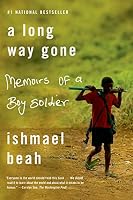
#21: A Long Way Gone by Ishmael Beah -- (Sep 6)
why now: I saw him speak at the National Book Festival, and was reminded that I had this book around.
Aware of surrounding war in Sierra Leone but not yet affected, Ishmael, along with his brother and several friends, walked to a nearby village carrying hip-hop tapes for a talent show, a bunch of kids anticipating fun. While they were gone, the RUF (Revolutionary United Front) attacked their village, killing some and dispersing others, and the boys were separated from their families. After wandering for months without clear direction, seeking shelter in abandoned villages, foraging for food, losing some companions and gaining others, the remaining boys were collected by the government military and trained as soldiers. Then UNICEF intervened, Ishmael and others were taken to a rehabilitation camp, and from there a combination of luck, charm, and skill got him to the UN and the US.
The events of the narrative are controversial. The attack on his village definitely happened, but apparently two years after he claims, which changes his age at the time and changes the duration of his stint as child soldier. An incident at the rehabilitation camp, when former child soldiers of the warring factions were naively put together and got into a murderous brawl, is unverified and suspect. A hopes-dashed-at-the-last-minute opportunity to reconnect with family seems, in this context, a tad too conveniently dramatic. There is still enough truth confirmed for compelling if gruesome reading: children who had to survive and couldn’t afford to grieve, compartmentalized brutality with random moments of compassion. The political turmoil behind the war is minimized (an appendix presents the chronology); these were children, not political sophisticates, who were plied with drugs and motivated by revenge: the Other Side killed your family.
36qebo
#22: Farm City by Novella Carpenter -- (Sep 13)
why now: It’s gardening season and I was perusing the shelf of gardening memoirs, saw this one that I hadn’t yet read.
A post-hippie couple rents an apartment overlooking a vacant lot in an Oakland CA ghetto, and converts it into an urban farm. They weren’t new to plants, but they were new to animals, so this is a tale of expanding responsibility: turkeys, rabbits, pigs. Rather too carnivorous for my taste; everybody dies at the end. Aside from that, an enjoyable cast of characters living at the fringes, and an urban twist on sustainability with animal chow foraged from restaurant dumpsters.
The book apparently grew out of a blog.
37qebo
#25: The Secret World of a Monarch’s Metamorphosis by Susan Langerock Schuldt -- (Oct 8)
why now: A local monarch expert told me about this book a couple of years ago, when it had not yet been published; the author had sent him photos of the chrysalis. I was reminded of the book when the author mentioned it in a post to a monarch forum a few weeks ago. Also it is short, and I need some of those.
This is a religious book for kids, inspired by a incompletely formed chrysalis with a window to the developing half-butterfly. I bought it for the photos, which are indeed interesting, if amateur (not a criticism, mine are too, just a caution not to expect macro detail). It is more about God’s plan and less about science.
38qebo

#26: Who Needs a Prairie? by Karen Patkau – (Oct 12)
why now: This September ER arrived promptly, I put it on my desk to post to the arrivals thread, then began to page through, and total reading time was maybe 15 minutes. I need more books like this.
This is an illustrated book for kids, one of a series. I don’t have kids available as a test case, but the illustrations are attractively realistic and detailed, each accompanied by a few sentences about who’s where or who’s doing what, and a section after the main text shows two dozen animals in alphabetical order with brief descriptions, so it’d seem an interesting activity to find and identify the animals in each habitat or context: ecosystem, seasons, food chain, life cycle. This book focuses on the North American prairie. A map at the end shows the locations of prairies and grasslands around the world. I’d think best to have other books in the series for comparison.
39qebo
#27: The Selfish Gene by Richard Dawkins -- (Oct 31)
why now: Science, Religion, & History group read for, um, 3rd quarter...
What does natural selection act on? Dawkins makes a case for the unit of replication: the gene. Or less succinctly, the sequence of DNA that remains together when chromosomes cross and divide. This is in contrast to E. O. Wilson (I was interested to see that they’ve been arguing about this for 30+ years), who proposes selection at multiple levels: individual – kin - group. The gist is that “life evolves by the differential survival of replicating entities”. Genes replicate; organisms do not. Genes cooperate in cells to keep chemical pathways together. Cells cooperate in organisms to allow specialization. It is not that genes intend anything; genes are the perpetual entities that improve the “survival machine” (organism) by influencing its features and behaviors, all other things held equal. An analogy is choosing crew members for a boat: If a boat is propelled by multiple rowers, then a single best rower can’t be determined; but if boats propelled by rowers in a variety of combinations compete in a series of races, then individuals can be correlated with winning.
Dawkins advocates a game theory model of assessing populations. Instead of assuming that a balance of characteristics is optimal for the population as a whole, investigate actions of individuals with costs and benefits to understand why the population has settled into a particular “evolutionary stable strategy”. A simple example is the ratio of male : female. This model is not a Dawkins original; he refers frequently to the work of John Maynard Smith and Robert Trivers. Which is not at all to discount the contribution of Dawkins; he makes an engaging and persuasive presentation, perhaps not flawless, but extremely useful as a general perspective. (Dawkins elaborates in The Extended Phenotype.) This book is a classic for a reason.
40qebo
#33: Conquering the Electron by Derek Cheung -- (Dec 28)
why now: October ER.
This history of science, technology, and industry is presented in three main sections: electromagnetism, electronics with vacuum tubes, electronics with semiconductors. Through the first section, I thought it was excellent. The scientists and inventors were familiar, the technology was relatively simple and coherently described, the events were nicely connected in a story from the initial glimmerings of possibility (electricity can be transmitted along a wire to a distant location, electricity can produce light, electricity can be converted to kinetic energy and vice versa) to ubiquitous infrastructure. Early in the second section, I hit an obstacle, and had to supplement with Wikipedia. I never got fully back on track; I continued to follow the story, but became increasingly resigned to superficial comprehension.
The author is an electrical engineer who entered the semiconductor business in the late 1960s, so he tells the story with insights from inside. This is both a good thing and a bad thing. It is a good thing in that he knew directly or by reputation the major players of recent decades; this is not a dry recounting of lockstep progress, but an often dramatic tale of egos, patent wars, corporate shenanigans, flawed decisions, fluke discoveries, with appreciation for careers devoted to the meticulous plodding research necessary to solve a specific problem or turn a intriguing result into a product. It is a bad thing in that he may be too familiar with the technology to realize what needs to be explained to the layperson; every so often he offers an extremely helpful diagram, but mostly he does not, and the buzzwords accumulate. Recommended for both reading and reference, but with caution.
41mabith
I lost track of your reading early in the year, somehow! Definitely sounds like an interesting and varied year for non-fiction.
With books like Conquering the Electron I'm never sure whether reading despite my lack of full comprehension is helpful or not. I certainly keep doing it, and maybe eventually repetition will make things click.
With books like Conquering the Electron I'm never sure whether reading despite my lack of full comprehension is helpful or not. I certainly keep doing it, and maybe eventually repetition will make things click.
42qebo
>41 mabith: I have pretty much the same attitude. I figure the next time around, I'll reinforce some vaguely remembered bits and fill in some blanks. I probably would not have taken on the electron book if it hadn't been an ER, didn't realize what I was getting into until it arrived, but actually I learned a fair amount even if I missed a lot too.
43mabith
It all evens out, I imagine. I only ever request non-fiction from the ER list, though I think the only science related book I've received is Toms River (still upset that it didn't immediately make the best seller's lists).
Having a niece and nephew around I feel even more like I *need* to understand more science. My dad was big with the jokey answers to questions (versus ever admitting he didn't know something) which I really disliked as a kid.
Having a niece and nephew around I feel even more like I *need* to understand more science. My dad was big with the jokey answers to questions (versus ever admitting he didn't know something) which I really disliked as a kid.

