This topic is currently marked as "dormant"—the last message is more than 90 days old. You can revive it by posting a reply.
1StevenTX
Locus Solus by Raymond Roussel
First published in French 1914
English translation by Rupert Copeland-Cunningham 1970

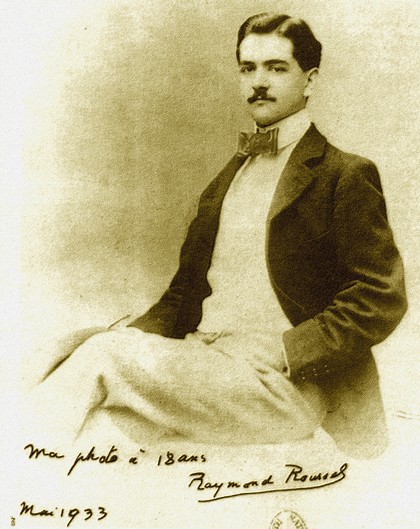
A brilliant scientist named Canterel takes a group of visiting dignitaries around the grounds of his estate named Locus Solus. They see a series of artifacts, presentations and demonstrations, each more amazing than the last.
--A mud sculpture of a naked child from the fabled city of Timbuctoo has been the making and breaking of great empires. --A mechanism made from a road mender's tool and a balloon is slowly constructing an elaborate mosaic entirely of human teeth. --Inside a giant aquarium in the shape of a diamond, a dancing woman produces enchanting music simply by waving her hair. She breathes the water itself without harm, as does a completely hairless cat that uses an electrical apparatus to stimulate the preserved but skinless severed head of Danton, making him speak. --Inside a glass cage a beautiful young woman accidentally pricks herself with a thorn and goes insane at the sight of her own blood. It turns out she is a reanimated corpse, as is the man in the next chamber who reenacts his own suicide. --A fortune-teller uses musical insects embedded in a Tarot card to extract gunpowder from the arm of a woman. --A chicken composes poetry and writes it to a canvas by coughing up its own blood in alphabetical shapes.
These are only a few of the dozens of marvels on display at Locus Solus. Each is described in minute detail, along with the scientific principals that explain them and the history of their discovery. Inevitably this leads to equally intricate background stories whose relationship to the items on exhibit are as bizarre and unexpected as the items themselves. Not infrequently there are stories within the stories invoking oddities of history, exotic faraway lands, myths and legends, and famous figures from the past.
What makes this a notable work is the way Roussel uses technical language and anecdote to make creations sound almost credible that, on the surface, are implausible at best, and often preposterous or silly. Yet all of his science, all of his legends, all of his historical anecdotes and quotations from ancient authors are entirely fabricated. Everything is the product of the author's imagination.
First published in French 1914
English translation by Rupert Copeland-Cunningham 1970

A brilliant scientist named Canterel takes a group of visiting dignitaries around the grounds of his estate named Locus Solus. They see a series of artifacts, presentations and demonstrations, each more amazing than the last.
--A mud sculpture of a naked child from the fabled city of Timbuctoo has been the making and breaking of great empires. --A mechanism made from a road mender's tool and a balloon is slowly constructing an elaborate mosaic entirely of human teeth. --Inside a giant aquarium in the shape of a diamond, a dancing woman produces enchanting music simply by waving her hair. She breathes the water itself without harm, as does a completely hairless cat that uses an electrical apparatus to stimulate the preserved but skinless severed head of Danton, making him speak. --Inside a glass cage a beautiful young woman accidentally pricks herself with a thorn and goes insane at the sight of her own blood. It turns out she is a reanimated corpse, as is the man in the next chamber who reenacts his own suicide. --A fortune-teller uses musical insects embedded in a Tarot card to extract gunpowder from the arm of a woman. --A chicken composes poetry and writes it to a canvas by coughing up its own blood in alphabetical shapes.
These are only a few of the dozens of marvels on display at Locus Solus. Each is described in minute detail, along with the scientific principals that explain them and the history of their discovery. Inevitably this leads to equally intricate background stories whose relationship to the items on exhibit are as bizarre and unexpected as the items themselves. Not infrequently there are stories within the stories invoking oddities of history, exotic faraway lands, myths and legends, and famous figures from the past.
What makes this a notable work is the way Roussel uses technical language and anecdote to make creations sound almost credible that, on the surface, are implausible at best, and often preposterous or silly. Yet all of his science, all of his legends, all of his historical anecdotes and quotations from ancient authors are entirely fabricated. Everything is the product of the author's imagination.
2baswood
Locus Solus by Raymond Roussel 25/01/2015
“Then Canterel, declaring that all the secrets of his park were now known to us, took the path back to the villa where all of us were soon united at a cheerful dinner.” I am not giving anything away by quoting the last paragraph in this book, because all that happens is a group of invited guests are escorted by M. Canterel around his park/estate where they observe his wonderful exhibitions and he then explains how they work and digresses with some background information. A word of warning however as these Tableau vivants could well be labelled atrocity exhibitions
As there is no plot, story, or character development then the reader has to look for something else to keep him/her amused during the 200 or so pages. In some ways the book is a little formulaic in that M Canterel guides his guests to all of his exhibits in turn and they stand in front of them and observe what is going on; he then provides an explanation and some details of the scientific inventions that have made it possible. it is at the second exhibit that one wonders what an earth is happening here: a machine that floats above an area full of discarded human teeth is selecting those that it will place in position to produce a mosaic showing a scene of: a warrior asleep in a dark crypt by a pool and dreaming some sort of nightmare. M Canterel then explains in some detail the technical details of the floating machine which make as much sense as why it should be employed to make a mosaic out of human teeth in the first place. No one asks any questions, but there is some admiration of the work of M Canterel and they move onto the next exhibit. While explaining the details of his inventions M Canterel digress into stories and myths from the past often including real historical figures and it is these stories within stories that I found most entertaining. I had difficulty in visualising some of the exhibits and soon gave up trying to understand the scientific explanations which are so fantastic that they would not be out of place in a science fiction novel.
Although the exhibits themselves are atrocious M Canterel is able to justify them on moral grounds, for example his series of tableau where reanimated dead people re-enact the most important event in their lives provides comfort for their surviving relatives and the tableau showing the madman Lucius with his dancing airborne dolls has the purpose of allowing him to come to terms with the events that caused his madness, but the underlying feeling is that the guests of M Cantered are voyeurs and this is unsettling for the reader as we are really one of those guests, we see what they see and we listen to the explanations.
How and why this book came to be written is more fascinating than the book itself. Here is an explanation from wiki:
Roussel's most famous works are Impressions of Africa and Locus Solus, both written according to formal constraints based on homonymic puns. Roussel kept this compositional method a secret until the publication of his posthumous text, How I Wrote Certain of My Books, where he describes it as follows: "I chose two similar words. For example billard (billiard) and pillard (looter). Then I added to it words similar but taken in two different directions, and I obtained two almost identical sentences thus. The two sentences found, it was a question of writing a tale which can start with the first and finish by the second. Amplifying the process then, I sought new words reporting itself to the word billiards, always to take them in a different direction than that which was presented first of all, and that provided me each time a creation moreover. The process evolved/moved and I was led to take an unspecified sentence, of which I drew from the images by dislocating it, a little as if it had been a question of extracting some from the drawings of rebus." For example, Les lettres du blanc sur les bandes du vieux billard/The white letters on the cushions of the old billiard table… must somehow reach the phrase, …les lettres du blanc sur les bandes du vieux pillard/letters written by a white man about the hordes of the old plunderer.
Published in 1914 the book reads like something from the era of surrealism but is a decade ahead of that movement. It is not Dada either because there is no political content and so the nearest movement that I can connect with is Futurism. Experimental it certainly is and in that respect in can be lumped in with the modernists, but I suppose the genre it most comfortably fits is science fiction and fantasy. A book that should probably be approached with caution, some of the “scientific” explanations were a little tedious, but for those that like a little weirdness it might fit the bill: 3 stars.
“Then Canterel, declaring that all the secrets of his park were now known to us, took the path back to the villa where all of us were soon united at a cheerful dinner.” I am not giving anything away by quoting the last paragraph in this book, because all that happens is a group of invited guests are escorted by M. Canterel around his park/estate where they observe his wonderful exhibitions and he then explains how they work and digresses with some background information. A word of warning however as these Tableau vivants could well be labelled atrocity exhibitions
As there is no plot, story, or character development then the reader has to look for something else to keep him/her amused during the 200 or so pages. In some ways the book is a little formulaic in that M Canterel guides his guests to all of his exhibits in turn and they stand in front of them and observe what is going on; he then provides an explanation and some details of the scientific inventions that have made it possible. it is at the second exhibit that one wonders what an earth is happening here: a machine that floats above an area full of discarded human teeth is selecting those that it will place in position to produce a mosaic showing a scene of: a warrior asleep in a dark crypt by a pool and dreaming some sort of nightmare. M Canterel then explains in some detail the technical details of the floating machine which make as much sense as why it should be employed to make a mosaic out of human teeth in the first place. No one asks any questions, but there is some admiration of the work of M Canterel and they move onto the next exhibit. While explaining the details of his inventions M Canterel digress into stories and myths from the past often including real historical figures and it is these stories within stories that I found most entertaining. I had difficulty in visualising some of the exhibits and soon gave up trying to understand the scientific explanations which are so fantastic that they would not be out of place in a science fiction novel.
Although the exhibits themselves are atrocious M Canterel is able to justify them on moral grounds, for example his series of tableau where reanimated dead people re-enact the most important event in their lives provides comfort for their surviving relatives and the tableau showing the madman Lucius with his dancing airborne dolls has the purpose of allowing him to come to terms with the events that caused his madness, but the underlying feeling is that the guests of M Cantered are voyeurs and this is unsettling for the reader as we are really one of those guests, we see what they see and we listen to the explanations.
How and why this book came to be written is more fascinating than the book itself. Here is an explanation from wiki:
Roussel's most famous works are Impressions of Africa and Locus Solus, both written according to formal constraints based on homonymic puns. Roussel kept this compositional method a secret until the publication of his posthumous text, How I Wrote Certain of My Books, where he describes it as follows: "I chose two similar words. For example billard (billiard) and pillard (looter). Then I added to it words similar but taken in two different directions, and I obtained two almost identical sentences thus. The two sentences found, it was a question of writing a tale which can start with the first and finish by the second. Amplifying the process then, I sought new words reporting itself to the word billiards, always to take them in a different direction than that which was presented first of all, and that provided me each time a creation moreover. The process evolved/moved and I was led to take an unspecified sentence, of which I drew from the images by dislocating it, a little as if it had been a question of extracting some from the drawings of rebus." For example, Les lettres du blanc sur les bandes du vieux billard/The white letters on the cushions of the old billiard table… must somehow reach the phrase, …les lettres du blanc sur les bandes du vieux pillard/letters written by a white man about the hordes of the old plunderer.
Published in 1914 the book reads like something from the era of surrealism but is a decade ahead of that movement. It is not Dada either because there is no political content and so the nearest movement that I can connect with is Futurism. Experimental it certainly is and in that respect in can be lumped in with the modernists, but I suppose the genre it most comfortably fits is science fiction and fantasy. A book that should probably be approached with caution, some of the “scientific” explanations were a little tedious, but for those that like a little weirdness it might fit the bill: 3 stars.
Join to post

