This topic is currently marked as "dormant"—the last message is more than 90 days old. You can revive it by posting a reply.
1lilisin
Hello again to all the familiar faces and hopefully some new ones! I just got back from a wonderful month in France spent with family and adventure (and shopping!) and so am now just setting up my thread. As always, I'm hoping for a wonderful reading year and am hopeful for some great finds.
So far in 2014:
JANUARY
1) Akira Yoshimura : La jeune fille suppliciee sur une etagere
2) Shizuko Natsuki : La promesse de l'ombre (The Third Lady)
3) Thomas Mann : La Mort a Venise (Death in Venice)
4) Kobo Abe : The Kangaroo Notebook
5) Elizabeth Eaves : Wanderlust
6) Seicho Matsumoto : Le vase de sable (Inspector Imanishi Investigates)
FEBRUARY
7) Takeshi Kaiko : Into a Black Sun
8) Ayako Miura : Lady Gracia: A Samurai Wife's Love, Strife and Faith
9) Jonathan D. Spence : The Death of Woman Wang
MARCH
10) Fyodor Dostoevsky : The Idiot
11) 乙一 : ZOO2
12) Osamu Dazai : Soleil couchant (The Setting Sun)
13) Michael Emmerich : Read Real Japanese Fiction
APRIL
14) Jeff Backhaus : Hikikomori and the Rental Sister
15) Emile Zola : Le ventre de Paris (The Belly of Paris)
16) Marguerite Duras : L'amant de la Chine du Nord (The North China Lover)
17) Nagai Kafu : Rivalry: A Geisha's Tale
MAY
18) Amelie Nothomb : Le voyage d'hiver (Winter Voyage)
JULY
19) Akira Yoshimura : On Parole
20) Donald Richie : The Inland Sea
21) Bi Feiyu : De la barbe à papa un jour de pluie (Cotton Candy on a Rainy Day)
22) Antoine de Saint-Exupery : Vol de Nuit (Night Flight)
23) Erich Maria Remarque : L'ile d'espérance (A Time to Love and a Time to Die)
24) Emile Zola : Therese Raquin
AUGUST
25) Natsuo Kirino : Out
SEPTEMBER
26) Iris Chang : The Rape of Nanking
DECEMBER
27) Ryu Murakami : From the Fatherland, with Love
So far in 2014:
JANUARY
1) Akira Yoshimura : La jeune fille suppliciee sur une etagere
2) Shizuko Natsuki : La promesse de l'ombre (The Third Lady)
3) Thomas Mann : La Mort a Venise (Death in Venice)
4) Kobo Abe : The Kangaroo Notebook
5) Elizabeth Eaves : Wanderlust
6) Seicho Matsumoto : Le vase de sable (Inspector Imanishi Investigates)
FEBRUARY
7) Takeshi Kaiko : Into a Black Sun
8) Ayako Miura : Lady Gracia: A Samurai Wife's Love, Strife and Faith
9) Jonathan D. Spence : The Death of Woman Wang
MARCH
10) Fyodor Dostoevsky : The Idiot
11) 乙一 : ZOO2
12) Osamu Dazai : Soleil couchant (The Setting Sun)
13) Michael Emmerich : Read Real Japanese Fiction
APRIL
14) Jeff Backhaus : Hikikomori and the Rental Sister
15) Emile Zola : Le ventre de Paris (The Belly of Paris)
16) Marguerite Duras : L'amant de la Chine du Nord (The North China Lover)
17) Nagai Kafu : Rivalry: A Geisha's Tale
MAY
18) Amelie Nothomb : Le voyage d'hiver (Winter Voyage)
JULY
19) Akira Yoshimura : On Parole
20) Donald Richie : The Inland Sea
21) Bi Feiyu : De la barbe à papa un jour de pluie (Cotton Candy on a Rainy Day)
22) Antoine de Saint-Exupery : Vol de Nuit (Night Flight)
23) Erich Maria Remarque : L'ile d'espérance (A Time to Love and a Time to Die)
24) Emile Zola : Therese Raquin
AUGUST
25) Natsuo Kirino : Out
SEPTEMBER
26) Iris Chang : The Rape of Nanking
DECEMBER
27) Ryu Murakami : From the Fatherland, with Love
2lilisin
Books read in 2013:
1) Amelie Nothomb : Peplum
2) Takashi Nagai : The Bells of Nagasaki
3) Colette : Chéri
4) Yukio Mishima : Sun and Steel
5) Kobo Abe : Secret Rendezvous
6) Haruki Murakami : 色彩を持たない多崎つくると、彼の巡礼の年 (Colorless Tsukuru Tazaki and His Years of Pilgrimage)
7) Banana Yoshimoto : アルゼンチンババア (Argentine Hag)
8) Alexandre Dumas : Le vicomte de Bragelonne Tome 1
9) Alexandre Dumas : Le vicomte de Bragelonne Tome 2
10) Alexandre Dumas : Le vicomte de Bragelonne Tome 3
11) Kenzaburo Oe : Hiroshima Notes
(Counting Dumas as one book although it was 3 separate volumes)
Countries visited:
Belgium
France x2
Japan x6
Languages read:
Japanese x2
French x3
English x4
1) Amelie Nothomb : Peplum
2) Takashi Nagai : The Bells of Nagasaki
3) Colette : Chéri
4) Yukio Mishima : Sun and Steel
5) Kobo Abe : Secret Rendezvous
6) Haruki Murakami : 色彩を持たない多崎つくると、彼の巡礼の年 (Colorless Tsukuru Tazaki and His Years of Pilgrimage)
7) Banana Yoshimoto : アルゼンチンババア (Argentine Hag)
8) Alexandre Dumas : Le vicomte de Bragelonne Tome 1
9) Alexandre Dumas : Le vicomte de Bragelonne Tome 2
10) Alexandre Dumas : Le vicomte de Bragelonne Tome 3
11) Kenzaburo Oe : Hiroshima Notes
(Counting Dumas as one book although it was 3 separate volumes)
Countries visited:
Belgium
France x2
Japan x6
Languages read:
Japanese x2
French x3
English x4
3lilisin
I'm saving this post for random assortments of data I'd like to keep throughout the year.
Books gifted to me:
1) Jean-Baptiste Evette : Tuer Napoléon III
2) 遠藤 周作 (Shusaku Endo) : 深い河
3) 河合隼雄 : こころの声を聴く
Books acquired:
4) Antoine de Saint-Exupery : Vol de Nuit (READ)
5) Erich Maria Remarque : L'ile d'espérance (READ)
6) Alexandre Dumas (fils) : La Dame aux Camélias
7) Marguerite Duras : Un barrage contre le Pacifique
8) Erich Maria Remarque : Arc de triomphe
9) Iris Chang : The Rape Of Nanking (READ)
10) 久美 沙織 (Kumi Saori) : いつか海に行ったね
11) Kenzaburo Oe : A Quiet Life
12) 村上 春樹 (Murakami Haruki): 女のいない男たち
13) Henri Troyat : La tête sur les épaules
14) Ryu Murakami : From the Fatherland, with Love (READ)
15) Shohei Ooka : Taken Captive
16) Hiroo Onoda : No Surrender
17) Akira Mizubayashi : Une langue venue dailleurs
18) René Fregni : Tu tomberas avec la nuit
19) Victor Hugo : Han d'Islande
LT age of books read:
2014 x4
2013 x10
2012 x2
2011 x5
2010 x2
2009 x2
2008
2007
Comics read in 2014:
In French -
Naruto 44-63
Detective Conan 71-77
(total=26)
In Japanese -
よつばと! 7-12
魔法先生ネギま!1-15
暗殺教室 1-3
ベイビィ★LOVE 1-9
進撃の巨人 1-4
探偵レボリューション 1-6
弱虫ペダル 1-2
自殺島 1
ふたりエッチ 41-42
Tomorrow―陽がのぼる街
片想いコレクション(前編)
片想いコレクション(後編)
(total=51)
Books gifted to me:
1) Jean-Baptiste Evette : Tuer Napoléon III
2) 遠藤 周作 (Shusaku Endo) : 深い河
3) 河合隼雄 : こころの声を聴く
Books acquired:
4) Antoine de Saint-Exupery : Vol de Nuit (READ)
5) Erich Maria Remarque : L'ile d'espérance (READ)
6) Alexandre Dumas (fils) : La Dame aux Camélias
7) Marguerite Duras : Un barrage contre le Pacifique
8) Erich Maria Remarque : Arc de triomphe
9) Iris Chang : The Rape Of Nanking (READ)
10) 久美 沙織 (Kumi Saori) : いつか海に行ったね
11) Kenzaburo Oe : A Quiet Life
12) 村上 春樹 (Murakami Haruki): 女のいない男たち
13) Henri Troyat : La tête sur les épaules
14) Ryu Murakami : From the Fatherland, with Love (READ)
15) Shohei Ooka : Taken Captive
16) Hiroo Onoda : No Surrender
17) Akira Mizubayashi : Une langue venue dailleurs
18) René Fregni : Tu tomberas avec la nuit
19) Victor Hugo : Han d'Islande
LT age of books read:
2014 x4
2013 x10
2012 x2
2011 x5
2010 x2
2009 x2
2008
2007
Comics read in 2014:
In French -
Naruto 44-63
Detective Conan 71-77
(total=26)
In Japanese -
よつばと! 7-12
魔法先生ネギま!1-15
暗殺教室 1-3
ベイビィ★LOVE 1-9
進撃の巨人 1-4
探偵レボリューション 1-6
弱虫ペダル 1-2
自殺島 1
ふたりエッチ 41-42
Tomorrow―陽がのぼる街
片想いコレクション(前編)
片想いコレクション(後編)
(total=51)
4lilisin
My group, Author Theme Reads, is taking a little break this year since I ran out of inspiration for new authors and I think it's good to give people a little break. Thus Thomas Mann is our year-long author and there are no mini-authors for the year as we will just catch up on the old (but wonderful) authors we had before.
Year-long Author: Thomas Mann
+ Catch-up on previous authors in general.
For those who have noticed my tendency towards Japanese literature, this is the thread where I go more in detail with my Japan reads. It's my attempt at conglomerating every Japan read together and comparing them so as to become wiser about my favorite lit.
In the second quarter of the year, April-June, I will be leading a theme read on travelogues and travel writing in the group Reading Globally.
Year-long Author: Thomas Mann
+ Catch-up on previous authors in general.
For those who have noticed my tendency towards Japanese literature, this is the thread where I go more in detail with my Japan reads. It's my attempt at conglomerating every Japan read together and comparing them so as to become wiser about my favorite lit.
In the second quarter of the year, April-June, I will be leading a theme read on travelogues and travel writing in the group Reading Globally.
6AnnieMod
I knew I was missing someone :) Welcome back -- France in the winter is not as much fun as France in spring but still... :)
8rebeccanyc
Welcome back! Bienvenue!
10lilisin
Thanks everyone for the kinds words! Annie, this winter was actually ridiculously nice and warm with lots of clear and sunny skies but I'd definitely still take spring over winter any day.
I do have three reviews I'll get to eventually but in the meantime I'm content with reading versus LT-ing.
In the meantime, this article that showed up today on CNN really intrigued me. If you have been a regular visitor on my threads you should know my love for the book Fires on the Plain about a Japanese soldier in the Philippines. It was a marvelous look on humanity and so this article about Hiroo Onoda, who is basically the complete opposite of Private Tamura from the book, is fascinating. I wonder if there are any books about this man.
ETA: There is, written by the man himself!: No Surrender. Definitely going on the wishlist.
I do have three reviews I'll get to eventually but in the meantime I'm content with reading versus LT-ing.
In the meantime, this article that showed up today on CNN really intrigued me. If you have been a regular visitor on my threads you should know my love for the book Fires on the Plain about a Japanese soldier in the Philippines. It was a marvelous look on humanity and so this article about Hiroo Onoda, who is basically the complete opposite of Private Tamura from the book, is fascinating. I wonder if there are any books about this man.
ETA: There is, written by the man himself!: No Surrender. Definitely going on the wishlist.
11Polaris-
The late Hiroo Onoda's experience is certainly a remarkable one. RIP.
12lilisin
1) Shizuko Natsuki : La promesse de l'ombre (The Third Lady)
4/5 stars
Japan
I found this book in a buy-six-for-a-euro bin outside of a dry cleaner in Paris. It was actually buy one book for a euro, but the person who wrote the sign made their "le" look like the number 6 so I got an even better bargain. In any case, I'm glad to have stumbled upon this little bin of surprises.
The story begins outside of Paris, in Fontainebleau, where Daigo meets a particular Fumiko in a hotel on a dark and stormy night. Entranced by this woman's profile, Daigo approaches her and they begin to talk but when the lights go out after a thunder clap, their conversation turns dark. Daigo ends up making a promise he's not sure he can keep to a woman whose face he never even saw. Then, a few months after returning to Japan, the man he wanted dead turns up murdered.
A great premise that follows Daigo as he wonders if Fumiko is the cause of this death and if he really is up to fulfilling his part of that dark secret. It was a great page turner and, although I was able to guess the twist, it was still a wonderful twist that kept me emotionally invested till the very end.
And Shizuko Natsuki -- although my French version was actually translated from the English version -- has such an ease in her writing that I really enjoyed. This is my first book by her but I also have her Hara-kiri, mon amour, purchased from the same bin.
I still don't know how to rate crime fiction as I don't read much of it but the sheer enjoyment I got out of this certainly deserves 4 stars, I would say.
4/5 stars
Japan
I found this book in a buy-six-for-a-euro bin outside of a dry cleaner in Paris. It was actually buy one book for a euro, but the person who wrote the sign made their "le" look like the number 6 so I got an even better bargain. In any case, I'm glad to have stumbled upon this little bin of surprises.
The story begins outside of Paris, in Fontainebleau, where Daigo meets a particular Fumiko in a hotel on a dark and stormy night. Entranced by this woman's profile, Daigo approaches her and they begin to talk but when the lights go out after a thunder clap, their conversation turns dark. Daigo ends up making a promise he's not sure he can keep to a woman whose face he never even saw. Then, a few months after returning to Japan, the man he wanted dead turns up murdered.
A great premise that follows Daigo as he wonders if Fumiko is the cause of this death and if he really is up to fulfilling his part of that dark secret. It was a great page turner and, although I was able to guess the twist, it was still a wonderful twist that kept me emotionally invested till the very end.
And Shizuko Natsuki -- although my French version was actually translated from the English version -- has such an ease in her writing that I really enjoyed. This is my first book by her but I also have her Hara-kiri, mon amour, purchased from the same bin.
I still don't know how to rate crime fiction as I don't read much of it but the sheer enjoyment I got out of this certainly deserves 4 stars, I would say.
13lilisin
Although not my usual genre, crime fiction, I've been reading more of it when Japanese authors are involved and find that I have quite enjoyed what I have been reading. An additional plus is that I have another point of interest to discuss with readers in Japan, and, I'm picking up on a lot of references to the books I've read which has bumped up my cultural aptitude.
So to see where I'm at in terms of dipping my toes into Japanese crime fiction, I found this little list of Japanese crime fiction authors (from Wikipedia):
Read:
Keigo Higashino (born 1958): The Devotion of Suspect X
Seicho Matsumoto (1909–1992): Tokyo Express, Vase de sable
Shizuko Natsuki (born 1938): La promesse de l'ombre
Otsuichi (born 1978): ZOO
Seishi Yokomizo (1902–1981): Village aux huit tombes, La hache, le koto et le chrysanthème
TBR:
Edogawa Rampo (1894–1965): La bete aveugle
Natsuo Kirino (born 1951): Out
Akimitsu Takagi (1920–1995): The Tattoo Murder Case
Know the authors but have no books from them yet:
Miyuki Miyabe (born 1960)
Hideo Okuda (born 1959)
Unknown to me:
Ryo Hara (born 1946)
Kotaro Isaka (born 1971)
Ira Ishida (born 1960)
Kenzo Kitakata (born 1947)
Natsuhiko Kyogoku (born 1963)
Kyotaro Nishimura (born 1930)
Asa Nonami (born 1960)
Kido Okamoto (1872–1939)
Go Osaka (born 1943)
Arimasa Osawa (born 1956)
Joh Sasaki (born 1950)
Soji Shimada (born 1948)
Tetsuo Takashima (born 1949)
Masako Togawa (born 1933)
Yasuo Uchida (born 1934)
Misa Yamamura (1931–1996)
Kyusaku Yumeno (1889–1936)
So to see where I'm at in terms of dipping my toes into Japanese crime fiction, I found this little list of Japanese crime fiction authors (from Wikipedia):
Read:
Keigo Higashino (born 1958): The Devotion of Suspect X
Seicho Matsumoto (1909–1992): Tokyo Express, Vase de sable
Shizuko Natsuki (born 1938): La promesse de l'ombre
Otsuichi (born 1978): ZOO
Seishi Yokomizo (1902–1981): Village aux huit tombes, La hache, le koto et le chrysanthème
TBR:
Edogawa Rampo (1894–1965): La bete aveugle
Natsuo Kirino (born 1951): Out
Akimitsu Takagi (1920–1995): The Tattoo Murder Case
Know the authors but have no books from them yet:
Miyuki Miyabe (born 1960)
Hideo Okuda (born 1959)
Unknown to me:
Ryo Hara (born 1946)
Kotaro Isaka (born 1971)
Ira Ishida (born 1960)
Kenzo Kitakata (born 1947)
Natsuhiko Kyogoku (born 1963)
Kyotaro Nishimura (born 1930)
Asa Nonami (born 1960)
Kido Okamoto (1872–1939)
Go Osaka (born 1943)
Arimasa Osawa (born 1956)
Joh Sasaki (born 1950)
Soji Shimada (born 1948)
Tetsuo Takashima (born 1949)
Masako Togawa (born 1933)
Yasuo Uchida (born 1934)
Misa Yamamura (1931–1996)
Kyusaku Yumeno (1889–1936)
14rebeccanyc
I read crime novels off and on, but I've never read any Japanese crime novels. Interesting.
15stretch
That is a fascinating human interest story. 30 years without surrender, it must have been such a shock when he finally returned to Japan.
Looks like I'm going to have to find a copy of The Third Lady, nice review.
Looks like I'm going to have to find a copy of The Third Lady, nice review.
17lilisin
Thanks for the kind words again. You guys give me so much credit; I can only hope that I don't mislead anyone with my reviews since I always feel that I tend to rate fairly kindly, particularly when I'm in a genre I don't typically associate with.
Otherwise, here's another review of one of the books I read while on vacation.
2) Akira Yoshimura : La jeune fille suppliciee sur une etagere
4/5 stars
Japan
I started off the new year with two stories (about 70 pages each) by Akira Yoshimura, the author who wowed me with his book, Shipwrecks and these two stories certainly caught my attention.
La jeune fille suppliciee sur une etagere (The young girl martyred on a shelf)
This was the first story in the book about a young girl who has died and whose body has been donated for science. The interesting part is that the story is told via the dead girl's perspective, allowing for a vivid account of the tribulations her body is going through. I was utterly fascinated with this story and thought it was excellent at presenting the stigma of death in Japan and hinting at the responsibilities of parents towards their children and vice versa. It reminded me of the Oscar winning Japanese movie, Departures, about a man taking a job as a mortician's assistant, who has to hide his job from his wife and their neighbors due to the stigma attached to the job. This way of making a social commentary about these Japanese customs while the girl tells you how samples of her skin are being sectioned off, little by little, is masterful. And the ending is quite beautiful.
Le sourire des pierres (The stones smile)
This second story was just as intriguing as the first; it tells of Eichi and Sone, neighbors in their youth who meet again many years later. Sone had moved away without any new word so when Eichi runs into him, he is very curious as to what has happened to Sone throughout the years. What he finds is a fascinating character who earns his living stealing the statues from cemeteries that represent dead children, but he soon starts to fear Sone's magnet towards death when Sone moves in with him and his sister. This was another mesmerizing look into the stigma of death in Japanese culture that really tugged at my heart strings.
Otherwise, here's another review of one of the books I read while on vacation.
2) Akira Yoshimura : La jeune fille suppliciee sur une etagere
4/5 stars
Japan
I started off the new year with two stories (about 70 pages each) by Akira Yoshimura, the author who wowed me with his book, Shipwrecks and these two stories certainly caught my attention.
La jeune fille suppliciee sur une etagere (The young girl martyred on a shelf)
This was the first story in the book about a young girl who has died and whose body has been donated for science. The interesting part is that the story is told via the dead girl's perspective, allowing for a vivid account of the tribulations her body is going through. I was utterly fascinated with this story and thought it was excellent at presenting the stigma of death in Japan and hinting at the responsibilities of parents towards their children and vice versa. It reminded me of the Oscar winning Japanese movie, Departures, about a man taking a job as a mortician's assistant, who has to hide his job from his wife and their neighbors due to the stigma attached to the job. This way of making a social commentary about these Japanese customs while the girl tells you how samples of her skin are being sectioned off, little by little, is masterful. And the ending is quite beautiful.
Le sourire des pierres (The stones smile)
This second story was just as intriguing as the first; it tells of Eichi and Sone, neighbors in their youth who meet again many years later. Sone had moved away without any new word so when Eichi runs into him, he is very curious as to what has happened to Sone throughout the years. What he finds is a fascinating character who earns his living stealing the statues from cemeteries that represent dead children, but he soon starts to fear Sone's magnet towards death when Sone moves in with him and his sister. This was another mesmerizing look into the stigma of death in Japanese culture that really tugged at my heart strings.
18AnnieMod
These stories sound fascinating... Now if only they were translated into a language I can read :)
19avaland
Popping in to see what you've been reading. I've read a couple of crime novels from Japan: Miyabe, Kirino and another that doesn't come to mind at the moment. I guess they didn't grab me enough to keep up with them or read any more than the one. Someday I'm going to read a bit more of Nothomb...
20fannyprice
The Yoshimura stories sound really excellent.
21lilisin
While visiting kidzdoc's thread, I noticed a conversation he was having with another member about Haruki Murakami . The other member had wondered if anything was lost in translation when reading in English. I wrote a response to this question in the thread, but since I get asked this question a lot, I thought I would copy and paste my reply here. I hope it proves to be of interest and/or becomes a good resource for others.
-----
Now to answer roundballnz question about whether there is anything possibly lost in translation. It is of my opinion that Murakami is such a simple writer that there is really nothing to fear in terms of the translation. By simple, I don't mean dumb or anything along the lines, but he does use very simple grammar and his quite repetitive with his styling and vocabulary. His dialogue, if it were literally translated word for word every time would be along the lines of:
"...." she said.
"...." he nodded.
"...." she replied.
"...." he nodded.
"...." she nodded.
"...." he replied.
So, quite simplistic and straightforward to translate.
Another note: Murakami is (near?) fluent in English and actually supervises the translations and is in constant contact with Jay Rubin and Philip Gabriel as they translate his works. (These two translators are the new official Murakami translators: before it was Birnbaum.)
Note number 2: Due to Murakami's fascination (not exactly the right word) with English, he has been known to edit what he has written in Japanese to make sure it is easily translatable into English.
Now, the final note: So, although there isn't any need to really fear a loss in translation due to Murakami's simple writing in Japanese, it is important to note that, when it comes time to the translation into English, Murakami has been known to edit his own works and thus the copy he gives to the translators might be slightly different from the Japanese published edition. Either a paragraph will be removed here and there or he'll change some sentence structuring, or he'll know exactly how he wants one part changed.
So that's one thing to keep note of.
If anyone is interested in any of this, there's a blog I like to read written by someone who is a great Murakami fan and has a tendency to compare the English and Japanese versions as he reads. He'll post a Japanese paragraph next to its English version and he'll note differences in sentence order, structure and if there are any edits. And you can read the blog without knowing any Japanese.
The blog is called How to Japonese (this spelling is inentional) and is found here: http://howtojaponese.com/.
I also like when the blogger compares Birnbaum's style to Rubin and Gabriel's. In any case, I hope that answers any questions as to Murakami in translation.
-----
Now to answer roundballnz question about whether there is anything possibly lost in translation. It is of my opinion that Murakami is such a simple writer that there is really nothing to fear in terms of the translation. By simple, I don't mean dumb or anything along the lines, but he does use very simple grammar and his quite repetitive with his styling and vocabulary. His dialogue, if it were literally translated word for word every time would be along the lines of:
"...." she said.
"...." he nodded.
"...." she replied.
"...." he nodded.
"...." she nodded.
"...." he replied.
So, quite simplistic and straightforward to translate.
Another note: Murakami is (near?) fluent in English and actually supervises the translations and is in constant contact with Jay Rubin and Philip Gabriel as they translate his works. (These two translators are the new official Murakami translators: before it was Birnbaum.)
Note number 2: Due to Murakami's fascination (not exactly the right word) with English, he has been known to edit what he has written in Japanese to make sure it is easily translatable into English.
Now, the final note: So, although there isn't any need to really fear a loss in translation due to Murakami's simple writing in Japanese, it is important to note that, when it comes time to the translation into English, Murakami has been known to edit his own works and thus the copy he gives to the translators might be slightly different from the Japanese published edition. Either a paragraph will be removed here and there or he'll change some sentence structuring, or he'll know exactly how he wants one part changed.
So that's one thing to keep note of.
If anyone is interested in any of this, there's a blog I like to read written by someone who is a great Murakami fan and has a tendency to compare the English and Japanese versions as he reads. He'll post a Japanese paragraph next to its English version and he'll note differences in sentence order, structure and if there are any edits. And you can read the blog without knowing any Japanese.
The blog is called How to Japonese (this spelling is inentional) and is found here: http://howtojaponese.com/.
I also like when the blogger compares Birnbaum's style to Rubin and Gabriel's. In any case, I hope that answers any questions as to Murakami in translation.
22rebeccanyc
Thanks to (I think) your review, I too read and loved Shipwrecks, and promptly bought another book by Yoshimura, Storm Rider, which I have yet to read. The stories sound intriguing too.
23RidgewayGirl
I like Japanese crime fiction. The Tattoo Murder Case was really interesting and I've liked another of Takagi's even more - Honeymoon to Nowhere, but Out was really fantastic, although unrelentingly grim.
24cabegley
>21 lilisin: Thanks so much for this. It's something I've wondered about, as well.
25rachbxl
>21 lilisin: interesting - thanks.
27kidzdoc
I enjoyed your comments about Murakami and translated literature on my thread. Thanks again!
28Linda92007
Very interesting notes on Murakami and translation of his works. I find the whole topic of translation fascinating. However, as you would expect, most of the discussion I have heard/read has been from the perspective of the translator. Thanks for the rare opportunity to know something from the author's side.
29Polaris-
Just catching up. Also appreciate the Murakami discussion.
In post 12 you said how you found the Shizuko Natsuki book in a bargain bin outside a dry cleaners. While it's obviously sad that so many independent bookshops (and indeed some major chains as well) have gone west in recent years, I can't help but be fascinated by where some of us find books for sale these days. As reading/shopping habits change we increasingly find them turning up in the most unimagined and unusual places.
The Cormac McCarthy book I'm reading at the moment I picked up just a few weeks ago while QUEUING IN THE BANK!! There was a small bookcase of donated books being sold for a local charity. Similarly, while carrying out my work I found myself looking at an alcove bookcase in a corridor at a special education needs centre (whose trees I'd been inspecting) - again for their charity box - some lovely hardback books in good condition! Your dry cleaners just adds to the list of weird book venues...
In post 12 you said how you found the Shizuko Natsuki book in a bargain bin outside a dry cleaners. While it's obviously sad that so many independent bookshops (and indeed some major chains as well) have gone west in recent years, I can't help but be fascinated by where some of us find books for sale these days. As reading/shopping habits change we increasingly find them turning up in the most unimagined and unusual places.
The Cormac McCarthy book I'm reading at the moment I picked up just a few weeks ago while QUEUING IN THE BANK!! There was a small bookcase of donated books being sold for a local charity. Similarly, while carrying out my work I found myself looking at an alcove bookcase in a corridor at a special education needs centre (whose trees I'd been inspecting) - again for their charity box - some lovely hardback books in good condition! Your dry cleaners just adds to the list of weird book venues...
30arubabookwoman
On your Japanese mystery TBR, I've read Out, and I loved it. It's so much more than a mystery (not to say there is anything wrong with a book that is "only" a mystery--I like those too). It's rather long, but I think you wouldn't regret getting to it this year.
31lilisin
Oh wow! Five books already in January. This is probably a reading record for me.
3) Elizabeth Eaves : Wanderlust: A Love Affair with Five Continents
Canada
4.5 stars
This book is everything I don't usually choose in a book: published in the last 5 years, travel memoir, written by a young woman, in a separate section in the bookstore, recommended in Vogue magazine, etc...
This makes me realize that I have snob tendencies and that I should be ashamed. Granted, I can't help that I like the writings of dead, white European men; maybe that's who I was in my past life. But when I looked at this book in the Vogue books section, I actually read the summary twice and found myself intrigued. I blame the emotional hardship I was going through and I found myself relating to this woman. So I took a gamble and decided to go with my gut and purchase this book. And I'm glad I did.
The book is about Elizabeth Eaves wanderlust; her desire for satiation in both travel and love. Now, if someone had described that book to me with that line, I would have said "no, thank you", so I feel bad that I'm using that as my plot line, but there is a reason that she has written a book and I have not. I was instantly hooked with her writing and her compelling storytelling, relating to us snippets of her life as she travels around the world: Egypt, Yemen, Papa New Guinea, Australia, France, England (not in this order).
I followed her journey as she talked about the satisfaction she gets from traveling, from escaping the norm and trite urban rituals like getting a career and getting married. But as the story progresses, she starts to question why she is how she is. Why the need for continuously escaping? Why the need to constantly find a man to be with, only to feel the need to escape when they express longing for her?
It was a great story because this isn't about a pathetic girl (as I feared it might be) who is doing everything against her nature just to try and prove a point. Instead it's a girl who is actually acting as she truly desires and the traveling is her creating her norm, her world.
So, again, I'm very happy to have read this. I did find myself relating of course, going through the same concerns that maybe we're ruining our own lives by always escaping and not choosing the same path as the others. That perhaps this is all a series of bad choices and we're just digging a deeper hole. Although I'm over it now, I also had a moment in my life where men were there for me to do as I pleased. I was honest with them about my intentions, thus there was no deception, and I think that's what I enjoyed about Eaves. there was no deception and no acting like someone else. It was a moment in her life that she needed to live and she knew there was no reason to make excuses for it.
The only part where I waned a bit was when she spent her time in Australia as that turned a bit too much into the stereotypical "boys and girls with dreads, in dirty hostels with no dreams whatsoever" idea I have of young people traveling.
In any case, a real pleasure to read this and it gave me lots of ideas for discussion once I host the travelogue theme read.
3) Elizabeth Eaves : Wanderlust: A Love Affair with Five Continents
Canada
4.5 stars
This book is everything I don't usually choose in a book: published in the last 5 years, travel memoir, written by a young woman, in a separate section in the bookstore, recommended in Vogue magazine, etc...
This makes me realize that I have snob tendencies and that I should be ashamed. Granted, I can't help that I like the writings of dead, white European men; maybe that's who I was in my past life. But when I looked at this book in the Vogue books section, I actually read the summary twice and found myself intrigued. I blame the emotional hardship I was going through and I found myself relating to this woman. So I took a gamble and decided to go with my gut and purchase this book. And I'm glad I did.
The book is about Elizabeth Eaves wanderlust; her desire for satiation in both travel and love. Now, if someone had described that book to me with that line, I would have said "no, thank you", so I feel bad that I'm using that as my plot line, but there is a reason that she has written a book and I have not. I was instantly hooked with her writing and her compelling storytelling, relating to us snippets of her life as she travels around the world: Egypt, Yemen, Papa New Guinea, Australia, France, England (not in this order).
I followed her journey as she talked about the satisfaction she gets from traveling, from escaping the norm and trite urban rituals like getting a career and getting married. But as the story progresses, she starts to question why she is how she is. Why the need for continuously escaping? Why the need to constantly find a man to be with, only to feel the need to escape when they express longing for her?
It was a great story because this isn't about a pathetic girl (as I feared it might be) who is doing everything against her nature just to try and prove a point. Instead it's a girl who is actually acting as she truly desires and the traveling is her creating her norm, her world.
So, again, I'm very happy to have read this. I did find myself relating of course, going through the same concerns that maybe we're ruining our own lives by always escaping and not choosing the same path as the others. That perhaps this is all a series of bad choices and we're just digging a deeper hole. Although I'm over it now, I also had a moment in my life where men were there for me to do as I pleased. I was honest with them about my intentions, thus there was no deception, and I think that's what I enjoyed about Eaves. there was no deception and no acting like someone else. It was a moment in her life that she needed to live and she knew there was no reason to make excuses for it.
The only part where I waned a bit was when she spent her time in Australia as that turned a bit too much into the stereotypical "boys and girls with dreads, in dirty hostels with no dreams whatsoever" idea I have of young people traveling.
In any case, a real pleasure to read this and it gave me lots of ideas for discussion once I host the travelogue theme read.
32lilisin
And this marks the 6th book for January! (Although granted I read most of this last year and only had about 50 pages left.) I still need to write reviews for three books as well.
4) Seicho Matsumoto : Le vase de sable
(The Sand Vase; English title: Inspector Imanishi Investigates)
Japan
3 stars
A man is found dead on train tracks and the Detective Imanishi has to find out who he is when his only clue is that a second man with a particular accent was seen with the man shortly before his death. This leads to the introduction of the great artists on the current Japanese scene as Imanishi tries to discover what the connection is between all the people in his dossier.
I've read one of Matsumoto's books before and really enjoyed it so I decided to make this one my second. I was originally very caught up in the book but then, admittedly, I started losing track of what was going on which made me lose my attention. Especially since when I lost my thirst for the book, it started to take longer and longer just to read a few pages. It took the detective's summary at the end for me to understand what I had just read.
Nevertheless the plot was still intriguing and I enjoy Matsumoto's pleasant, soothing, style. There is no fantasy in his work and no large conspiracies tied to underground mystical groups that I typically associate with crime fiction; his work is really like spending time with your father, the police detective, as you watch him struggle to find the right course of action.
4) Seicho Matsumoto : Le vase de sable
(The Sand Vase; English title: Inspector Imanishi Investigates)
Japan
3 stars
A man is found dead on train tracks and the Detective Imanishi has to find out who he is when his only clue is that a second man with a particular accent was seen with the man shortly before his death. This leads to the introduction of the great artists on the current Japanese scene as Imanishi tries to discover what the connection is between all the people in his dossier.
I've read one of Matsumoto's books before and really enjoyed it so I decided to make this one my second. I was originally very caught up in the book but then, admittedly, I started losing track of what was going on which made me lose my attention. Especially since when I lost my thirst for the book, it started to take longer and longer just to read a few pages. It took the detective's summary at the end for me to understand what I had just read.
Nevertheless the plot was still intriguing and I enjoy Matsumoto's pleasant, soothing, style. There is no fantasy in his work and no large conspiracies tied to underground mystical groups that I typically associate with crime fiction; his work is really like spending time with your father, the police detective, as you watch him struggle to find the right course of action.
33lilisin
A review of all the Japanese books I've read so far organized by author. Many, many more to be added with time.
Multiple books read by single author:
Kobo Abe : The Woman in the Dunes, The Box Man, The Face of Another, Secret Rendezvous, The Kangaroo Notebook
Yasushi Inoue : La Favorite, Shirobamba, Le paroi de glace, Le fusil de chasse
Yasunari Kawabata : Thousand Cranes, Kyoto
Junichiro Tanizaki : In Praise of Shadows, The Makioka Sisters, Le meurtre d'Otsuya
Kenzaburo Oe : Nip the buds, Shoot the kids, Gibier d'elevage, Hiroshima Notes
Shusaku Endo : La fille que j'ai abandonnee, The Sea and Poison, When I Whistle
Banana Yoshimoto : The Lake, Kitchen, アルゼンチンババア
Seishi Yokomizo : La hache, le koto et le chrysanthème, Le village aux huit tombes
Haruki Murakami : 1Q84, After the Quake, Underground: The Tokyo Gas Attack and the Japanese Psyche, 色彩を持たない多崎つくると、彼の巡礼の年
Seicho Matsumoto : Tokyo Express, Le vase de sable
Yukio Mishima : La mort en ete, Le marin rejete par la mer, Sun and Steel
Akira Yoshimura : Shipwrecks, La jeune fille suppliciee sur une etagere, On Parole
Ryu Murakami : Almost Transparent Blue, 限りなく透明に近いブルー, From the Fatherland, with Love
Only one book read by author:
Natsuo Kirino : Out
Nagai Kafu : Rivalry: A Geisha's Tale
Ayako Miura : Lady Gracia: A Samurai Wife's Love, Strife and Faith
Takeshi Kaiko : Into a Black Sun
Takashi Nagai : The Bells of Nagasaki
Shizuko Natsuki : La promesse de l'ombre
Yasutaka Tsutsui : Hell
Keigo Higashino : The Devotion of Suspect X
Hikaru Okuizumi : The Stones Cry Out
Michio Takeyama : Harp of Burma
Fumiko Enchi : The Waiting Years
Masuji Ibuse : Black Rain
Natsume Soseki : And Then: Natsume Soseki's Novel Sorekara
Akiyuki Nosaka : La tombe des lucioles
Shohei Ooka : Fires on the Plain
Murasaki Shikibu : The Tale of Genji
Hitonari Tsuji : La lumiere du detroit
Ryunosuke Akutagawa : Rashomon et autres contes
Nobuko Takagi : Translucent Tree
Eiji Yoshikawa : Taiko
Meisei Goto : Shot by Both Sides
Mitsuyo Kakuta : The Eighth Day
Shohei Ooka : Fires on the Plain
Nosaka Akiyuki : La tombe des lucioles
Otsuichi : ZOO2
Osamu Dazai : Soleil couchant
Nonfiction writers
Iris Chang : The Rape of Nanking
Donald Richie : The Inland Sea
Mineko Iwasaki : Geisha, a life
Komomo : A Geisha's Journey: My life as a Kyoto Apprentice
Alan Booth : The Roads to Sata
Didier du Castel : Les derniers samourais, Le crepuscule des geishas
Ian Reader : Religious Violence in Contemporary Japan: The Case of Aum Shinrikyo
TOTAL: 73 books
Multiple books read by single author:
Kobo Abe : The Woman in the Dunes, The Box Man, The Face of Another, Secret Rendezvous, The Kangaroo Notebook
Yasushi Inoue : La Favorite, Shirobamba, Le paroi de glace, Le fusil de chasse
Yasunari Kawabata : Thousand Cranes, Kyoto
Junichiro Tanizaki : In Praise of Shadows, The Makioka Sisters, Le meurtre d'Otsuya
Kenzaburo Oe : Nip the buds, Shoot the kids, Gibier d'elevage, Hiroshima Notes
Shusaku Endo : La fille que j'ai abandonnee, The Sea and Poison, When I Whistle
Banana Yoshimoto : The Lake, Kitchen, アルゼンチンババア
Seishi Yokomizo : La hache, le koto et le chrysanthème, Le village aux huit tombes
Haruki Murakami : 1Q84, After the Quake, Underground: The Tokyo Gas Attack and the Japanese Psyche, 色彩を持たない多崎つくると、彼の巡礼の年
Seicho Matsumoto : Tokyo Express, Le vase de sable
Yukio Mishima : La mort en ete, Le marin rejete par la mer, Sun and Steel
Akira Yoshimura : Shipwrecks, La jeune fille suppliciee sur une etagere, On Parole
Ryu Murakami : Almost Transparent Blue, 限りなく透明に近いブルー, From the Fatherland, with Love
Only one book read by author:
Natsuo Kirino : Out
Nagai Kafu : Rivalry: A Geisha's Tale
Ayako Miura : Lady Gracia: A Samurai Wife's Love, Strife and Faith
Takeshi Kaiko : Into a Black Sun
Takashi Nagai : The Bells of Nagasaki
Shizuko Natsuki : La promesse de l'ombre
Yasutaka Tsutsui : Hell
Keigo Higashino : The Devotion of Suspect X
Hikaru Okuizumi : The Stones Cry Out
Michio Takeyama : Harp of Burma
Fumiko Enchi : The Waiting Years
Masuji Ibuse : Black Rain
Natsume Soseki : And Then: Natsume Soseki's Novel Sorekara
Akiyuki Nosaka : La tombe des lucioles
Shohei Ooka : Fires on the Plain
Murasaki Shikibu : The Tale of Genji
Hitonari Tsuji : La lumiere du detroit
Ryunosuke Akutagawa : Rashomon et autres contes
Nobuko Takagi : Translucent Tree
Eiji Yoshikawa : Taiko
Meisei Goto : Shot by Both Sides
Mitsuyo Kakuta : The Eighth Day
Shohei Ooka : Fires on the Plain
Nosaka Akiyuki : La tombe des lucioles
Otsuichi : ZOO2
Osamu Dazai : Soleil couchant
Nonfiction writers
Iris Chang : The Rape of Nanking
Donald Richie : The Inland Sea
Mineko Iwasaki : Geisha, a life
Komomo : A Geisha's Journey: My life as a Kyoto Apprentice
Alan Booth : The Roads to Sata
Didier du Castel : Les derniers samourais, Le crepuscule des geishas
Ian Reader : Religious Violence in Contemporary Japan: The Case of Aum Shinrikyo
TOTAL: 73 books
35baswood
Great review of Wanderlust: A Love affair with Five continents, which seems to be a very personal travelogue, something I might like to read.
This makes me realize that I have snob tendencies and that I should be ashamed I worry about my snob tendencies, but I am not ashamed.
This makes me realize that I have snob tendencies and that I should be ashamed I worry about my snob tendencies, but I am not ashamed.
36rebeccanyc
Great list in 33. I've favorited it.
37lilisin
5) Takeshi Kaiko : Into a Black Sun
Japan
4 stars
It's a funny thing; all of this talk about WWI has made me want to read about the Vietnam War. I've always enjoyed reading war books but haven't read one in a while and I loved the idea of reading about the Vietnam War again especially from such an interesting perspective. I've read quite a bit from the American perspective having read Tim O'Brien's novels (which I really enjoyed) but this was new as it is written by a Japanese correspondent, a country neutral to the war.
Kaiko writes about his time as a correspondent from 1964 to 1965 where he worked both on the front line and away, in Saigon. The book seems to be labeled as historical fiction but with his experiences leading the story. I really enjoyed the neutrality of the book; there was no real perspective on whether the war was good or bad, necessary or not, and was really just Kaiko's observations on the world around him and how the war affects his companions.
In one instance he is asked about the Japanese opinion of the war in which he does share at how they find the war to be unfair due to the difference in power on the two fronts. But as a whole Kaiko is very careful to not insert his opinion as is demanded from a correspondent.
In whole a great book, incredibly well-written and really engaging. My leaving off a start comes from the fact that I wish he had spoken about his time when he was detained from the Viet Cong, a fact that was given in his biography.
------
I wanted to mention that I've been getting a little lazy with posting reviews. Although I want to share the great books I've been reading, I've been on such a good reading spree that I don't want to lose that time to LT and posting reviews. I fear though that my lackluster reviews will make the books sound lackluster. I truly hope you all will look into these books I've been reading despite my seeming nonchalance.
Also, I have added this book to my list of Japanese books in post 33.
ETA: As I was reading, this website helped for the few abbreviations and slang present specific to the Vietnam War.
Japan
4 stars
It's a funny thing; all of this talk about WWI has made me want to read about the Vietnam War. I've always enjoyed reading war books but haven't read one in a while and I loved the idea of reading about the Vietnam War again especially from such an interesting perspective. I've read quite a bit from the American perspective having read Tim O'Brien's novels (which I really enjoyed) but this was new as it is written by a Japanese correspondent, a country neutral to the war.
Kaiko writes about his time as a correspondent from 1964 to 1965 where he worked both on the front line and away, in Saigon. The book seems to be labeled as historical fiction but with his experiences leading the story. I really enjoyed the neutrality of the book; there was no real perspective on whether the war was good or bad, necessary or not, and was really just Kaiko's observations on the world around him and how the war affects his companions.
In one instance he is asked about the Japanese opinion of the war in which he does share at how they find the war to be unfair due to the difference in power on the two fronts. But as a whole Kaiko is very careful to not insert his opinion as is demanded from a correspondent.
In whole a great book, incredibly well-written and really engaging. My leaving off a start comes from the fact that I wish he had spoken about his time when he was detained from the Viet Cong, a fact that was given in his biography.
------
I wanted to mention that I've been getting a little lazy with posting reviews. Although I want to share the great books I've been reading, I've been on such a good reading spree that I don't want to lose that time to LT and posting reviews. I fear though that my lackluster reviews will make the books sound lackluster. I truly hope you all will look into these books I've been reading despite my seeming nonchalance.
Also, I have added this book to my list of Japanese books in post 33.
ETA: As I was reading, this website helped for the few abbreviations and slang present specific to the Vietnam War.
38lilisin
6) Ayako Miura : Lady Gracia: A Samurai Wife's Love, Strife and Faith
Japan
5 stars
I read the first half of this book January 2012 and I only put it down because at the time I was going through a I-only-want-to-read-half-of-a-book phase despite the fact that I was hooked on the book. Today though I came in at 8:30 for my substitute teaching job but because they had some weird test in the morning, I had nothing to do till 1:40pm so I used that time to read the remaining 200 pages left in the book. And boy, was it a great way to spend my day.
The book is a look at one of the most famous time periods in Japan: the 16th century where the three most famous generals -- Ieyasu, Hideyoshi and Nobunaga -- were all discovering their fate. I've read a book like this before -- Eiji Yoshikawa's Taiko which takes place in the exact same time period but focuses on the strategy that saw Hideyoshi become the great leader.
But this time the era is shown via the perspective of Tama Hosokawa, daughter of the great daimyo, Mitsuhide, who was allied with Nobunaga. Instead of the military strategy that dominated the great book, Taiko, we get the perspective of a woman as she learns what her role is in 16th century Japanese society. And not only do we get to see this but we also get to see her adaptation to the Christian faith that was being introduced at the time.
So overall, a fascinating look at the era via a great new perspective that is excellently crafted by the author, Ayako Miura. Definitely a must read.
----
And now I have no idea what book to grab next. Which is actually great. I'm liking just grabbing random books on the way out of the house with no time in the morning to really look at what book I just picked. Usually I spend too much time debating over what reading mood I'm in or not in and thinking too much about what subject matter is tempting me. By grabbing a random book and just heading out it forces me to read what is on hand which is a great way to discover new books, and to finally finish those great books I had started and put down for no coherent reason.
---
I've added this book to this list in post 33.
Japan
5 stars
I read the first half of this book January 2012 and I only put it down because at the time I was going through a I-only-want-to-read-half-of-a-book phase despite the fact that I was hooked on the book. Today though I came in at 8:30 for my substitute teaching job but because they had some weird test in the morning, I had nothing to do till 1:40pm so I used that time to read the remaining 200 pages left in the book. And boy, was it a great way to spend my day.
The book is a look at one of the most famous time periods in Japan: the 16th century where the three most famous generals -- Ieyasu, Hideyoshi and Nobunaga -- were all discovering their fate. I've read a book like this before -- Eiji Yoshikawa's Taiko which takes place in the exact same time period but focuses on the strategy that saw Hideyoshi become the great leader.
But this time the era is shown via the perspective of Tama Hosokawa, daughter of the great daimyo, Mitsuhide, who was allied with Nobunaga. Instead of the military strategy that dominated the great book, Taiko, we get the perspective of a woman as she learns what her role is in 16th century Japanese society. And not only do we get to see this but we also get to see her adaptation to the Christian faith that was being introduced at the time.
So overall, a fascinating look at the era via a great new perspective that is excellently crafted by the author, Ayako Miura. Definitely a must read.
----
And now I have no idea what book to grab next. Which is actually great. I'm liking just grabbing random books on the way out of the house with no time in the morning to really look at what book I just picked. Usually I spend too much time debating over what reading mood I'm in or not in and thinking too much about what subject matter is tempting me. By grabbing a random book and just heading out it forces me to read what is on hand which is a great way to discover new books, and to finally finish those great books I had started and put down for no coherent reason.
---
I've added this book to this list in post 33.
39Linda92007
Two intriguing reviews, lilisin. Unfortunately, even used copies of Lady Gracia are very pricey. Have you read and would you recommend any of Ayako Miura's other works?
40lilisin
Unfortunately I knew that the book would be hard to come by considering that my book was purchased more than ten years ago at a museum bookshop in Japan. And it's not exactly a big publisher. But it is worth picking up if one happens to stumble upon it. Yoshikawa's Taiko on the other hand is readily available if the subject is of interest to you. Also, this is my first time reading Miura's work although if I find a way to buy more, I certainly will.
41urania1
>38 lilisin: and 39,
The book sounds fascinating, but the used books cost around $100 dollars. I think I will write to a friend in Japan to see if an English translation is available there and is cheaper.
The book sounds fascinating, but the used books cost around $100 dollars. I think I will write to a friend in Japan to see if an English translation is available there and is cheaper.
42lilisin
Tell your Japanese friend they can get it here for you. It's about 22 American dollars if they buy it via Japanese Amazon.
44Polaris-
I liked your review of Takeshi Kaiko's Into a Black Sun. It sounds like a unique perspective on a conflict that also fascinates me too. I'm a keen reader of war correspondence when I'm in the right mood, so I've wishlisted it and thumbed your review.
45rebeccanyc
Enjoyed these reviews too.
46stretch
Great review of Into a Black Sun, Vietnam seems to bring up so many good and bad emotions, it must have been difficult remain that neutral especially in country.
Lady Garcia sounds fasinating. but for that price I think I stick to rereading Taiko for my fix of feudal Japan.
Lady Garcia sounds fasinating. but for that price I think I stick to rereading Taiko for my fix of feudal Japan.
47lilisin
7) Thomas Mann : La Mort a Venise (Death in Venice)
Germany
2.5 stars
I've been waiting to review this one because, simply put, I didn't have much of a reaction to this novella. This story about a man who decides to head to Venice for inspiration and who finds himself enamored with a little boy at his hotel while a disease starts to spread through the town, just didn't really impress me. I formed no real opinion on the main character, not even to his pedophilic tendencies nor did I really attach to Mann's writing.
There were two other stories included in my book. Tristan and Le chemin du cimetiere (Path to the Cemetery). Tristan was the more interesting of the three stories, I found, based on two patients in a sanitorium who form a relationship despite one patient being married.
Path to the Cemetery tells of a drunk, older man who is run over by a kid on his bicycle while on path. As he falls down and starts to shout about the indecency of the youth, a crowd forms around him as Mann makes his social commentary on life.
Overall, I preferred the two non-featured stories of the book rather than the more famous Death in Venice. Unfortunately, I doubt I'll remember anything about all three of these stories in a few years time.
Germany
2.5 stars
I've been waiting to review this one because, simply put, I didn't have much of a reaction to this novella. This story about a man who decides to head to Venice for inspiration and who finds himself enamored with a little boy at his hotel while a disease starts to spread through the town, just didn't really impress me. I formed no real opinion on the main character, not even to his pedophilic tendencies nor did I really attach to Mann's writing.
There were two other stories included in my book. Tristan and Le chemin du cimetiere (Path to the Cemetery). Tristan was the more interesting of the three stories, I found, based on two patients in a sanitorium who form a relationship despite one patient being married.
Path to the Cemetery tells of a drunk, older man who is run over by a kid on his bicycle while on path. As he falls down and starts to shout about the indecency of the youth, a crowd forms around him as Mann makes his social commentary on life.
Overall, I preferred the two non-featured stories of the book rather than the more famous Death in Venice. Unfortunately, I doubt I'll remember anything about all three of these stories in a few years time.
48Linda92007
I started but put aside Mann's Death in Venice. My reactions were similar, but I lacked your persistence. I hope that I will still find something by Mann that I can connect with. Buddenbrooks seems to get positive reactions.
49rebeccanyc
Well, I'm getting depressed about even trying Death in Venice, but at least it's short. Buddenbrooks is very readable, Linda.
50lilisin
8) Jonathan D. Spence : The Death of Woman Wang
China
3.5 stars
In college I had to read Spence's God's Chinese Son for a class about religion and rebellion in modern east Asia. I find myself really enjoying the book due to the way Spence intertwines primary sources with his narrative. It was a manner of writing that really made the more detailed historical details pop while not getting inundated in dates and minute specifics.
With this (much) shorter work, he manages to do the same. I picked the book up due to it's powerful title which I think ended up being a great marketing strategy since the primary title is merely an anecdote that comes at the end of the story. In fact, this book is actually about the small town of T'an-ch'eng, in the province of Shantung between the years 1668 and 1672. If I were to re-title the book, it'd be more appropriate to call it "The Tax Codes of T'an-ch'eng, followed by, The Death of Woman Wang and Other Citizens of T'an-ch'eng". I see now why that was not the selected title.
However, it is indeed how the book starts, a whole chapter devoted to how unfortunate the citizens of T'an-ch'eng are as they are cheated by tax codes, pillaging thieves and devastating natural disasters. But it's with this introductory chapter and the second chapter that we realize that T'an-ch'eng is the main character of this story and Spence manages to make it all quite fascinating. Then, interspersed with the tax codes and penal codes of China's 17th century, he inserts little anecdotes of various citizens of the town that are quite interesting.
Although maybe a slow start, the narrative does eventually build up until you're suddenly at the end. So all in all, a great introspective on this little village called T'an-ch'eng.
China
3.5 stars
In college I had to read Spence's God's Chinese Son for a class about religion and rebellion in modern east Asia. I find myself really enjoying the book due to the way Spence intertwines primary sources with his narrative. It was a manner of writing that really made the more detailed historical details pop while not getting inundated in dates and minute specifics.
With this (much) shorter work, he manages to do the same. I picked the book up due to it's powerful title which I think ended up being a great marketing strategy since the primary title is merely an anecdote that comes at the end of the story. In fact, this book is actually about the small town of T'an-ch'eng, in the province of Shantung between the years 1668 and 1672. If I were to re-title the book, it'd be more appropriate to call it "The Tax Codes of T'an-ch'eng, followed by, The Death of Woman Wang and Other Citizens of T'an-ch'eng". I see now why that was not the selected title.
However, it is indeed how the book starts, a whole chapter devoted to how unfortunate the citizens of T'an-ch'eng are as they are cheated by tax codes, pillaging thieves and devastating natural disasters. But it's with this introductory chapter and the second chapter that we realize that T'an-ch'eng is the main character of this story and Spence manages to make it all quite fascinating. Then, interspersed with the tax codes and penal codes of China's 17th century, he inserts little anecdotes of various citizens of the town that are quite interesting.
Although maybe a slow start, the narrative does eventually build up until you're suddenly at the end. So all in all, a great introspective on this little village called T'an-ch'eng.
51lilisin
I'm also less than 100 pages away from the end of Dostoevksy's The Idiot so my thoughts on that should be coming within a week or so.
As my desire to review titles has dwindled this year, I also have noted that stars are starting to mean nothing to me. It used to be easy to rate titles when I was primarily reading within the same genre. But as I'm starting to read across more genre's I've been feeling the need to adjust starts for that particular genre. Then, as I'm reading more and more works by a single author, I feel I need to adjust the stars to that author's body of work. In summary, my star rating system has gotten out of control and now I have no idea how to rate anything. At this point, it's really just a visual for my LT library so I can quickly see which books I've read (starred) versus which I haven't (non-starred).
Anyone else having trouble providing stars for books or do you not even include them?
As my desire to review titles has dwindled this year, I also have noted that stars are starting to mean nothing to me. It used to be easy to rate titles when I was primarily reading within the same genre. But as I'm starting to read across more genre's I've been feeling the need to adjust starts for that particular genre. Then, as I'm reading more and more works by a single author, I feel I need to adjust the stars to that author's body of work. In summary, my star rating system has gotten out of control and now I have no idea how to rate anything. At this point, it's really just a visual for my LT library so I can quickly see which books I've read (starred) versus which I haven't (non-starred).
Anyone else having trouble providing stars for books or do you not even include them?
52fannyprice
>51 lilisin:, It's easy for me to know when a book merits 5 stars, but I have noticed that 3 stars is sort of a default for me. Didn't hate it, didn't love it. I also have found myself going back and adjusting stars for certain books years later. Things I didn't think merited a lot of stars stand out in my mind and I have to revise my rating.
53baswood
Rating by stars is something I do, but I am aware that my own rating system can be horribly skewered by ratings within a genre. I still find it useful though for a quick reference system.
54kidzdoc
>51 lilisin: Anyone else having trouble providing stars for books or do you not even include them?
Definitely. Unless a book is magnificent (5 stars) or execrable (2 stars or less) I nearly always adjust my initial rating of it. And, there have been dozens of times when I've gone back months or years later and adjusted my rating of a particular book. However, these adjustments are rarely more than 1/2 to 1 star from the original one.
Definitely. Unless a book is magnificent (5 stars) or execrable (2 stars or less) I nearly always adjust my initial rating of it. And, there have been dozens of times when I've gone back months or years later and adjusted my rating of a particular book. However, these adjustments are rarely more than 1/2 to 1 star from the original one.
55rebeccanyc
I don't do stars, because I can't compare apples and oranges, and I only pay attention to stars other people give if they're people whose reviews I've been following so I have a sense of their interests and taste. I don't pay any attention at all to average star ratings because since everyone awards stars differently I consider them meaningless.
56lilisin
I enjoyed seeing my review of all the Japanese books I've read so far so I've done the same for French books organized by author. I'm actually surprised at how small this list is.
Multiple books read by single author:
Alexandre Dumas : Le Comte de Monte-Cristo, Les Trois Mousquetaires, Le Vicomte de Bragelonne, La Reine Margot
Victor Hugo : L'homme qui rit, Le dernier jour d'un condamne, Notre-Dame de Paris, Les Miserables
Emmanuel Carrere : La classe de neige, L'adversaire
Romain Gary : Les cerfs-volants, Les Racines du Ciel
Rene Fregni : Ou se perdent les hommes, On ne s'endort jamais seul, Elle danse dans le noir
Emile Zola : Au bonheur des dames, Le ventre de Paris
Marguerite Duras : L'amant, L'amant de la Chine du Nord
Only one book read by author:
Colette : Cheri
Celine Curiol : Voice Over
Guy de Maupassant : Une vie
Patrick Modiano : Rue des boutiques obscures
Jeanne Benameur : Les demeurees
Jean Meckert : Les coups
Tonino Benacquista : Quelqu'un d'autre
Sebastien Japrisot : Un long dimanche de fiancailles
Raymond Hesse : Vauriens, voleurs, assassins
Albert Camus : L'etranger
Jean-Marie le Clezio : L'africain
Jules Verne: The Mysterious Island
TOTAL: 31 books
Multiple books read by single author:
Alexandre Dumas : Le Comte de Monte-Cristo, Les Trois Mousquetaires, Le Vicomte de Bragelonne, La Reine Margot
Victor Hugo : L'homme qui rit, Le dernier jour d'un condamne, Notre-Dame de Paris, Les Miserables
Emmanuel Carrere : La classe de neige, L'adversaire
Romain Gary : Les cerfs-volants, Les Racines du Ciel
Rene Fregni : Ou se perdent les hommes, On ne s'endort jamais seul, Elle danse dans le noir
Emile Zola : Au bonheur des dames, Le ventre de Paris
Marguerite Duras : L'amant, L'amant de la Chine du Nord
Only one book read by author:
Colette : Cheri
Celine Curiol : Voice Over
Guy de Maupassant : Une vie
Patrick Modiano : Rue des boutiques obscures
Jeanne Benameur : Les demeurees
Jean Meckert : Les coups
Tonino Benacquista : Quelqu'un d'autre
Sebastien Japrisot : Un long dimanche de fiancailles
Raymond Hesse : Vauriens, voleurs, assassins
Albert Camus : L'etranger
Jean-Marie le Clezio : L'africain
Jules Verne: The Mysterious Island
TOTAL: 31 books
57lilisin
This is a Japanese book I read but there is an English translation available (called ZOO) with all the stories provided below and the ones included in ZOO1.
9) Otsuichi (乙一) : ZOO2
Japan
4 stars
I was first introduced to Otsuichi's story むかし夕日の公園で and was amazed that a 4 page story could be so intense. His imagination really shows through and his style, while quite simple (actually makes his books great for those learning Japanese who want to transition into reading novels), really helps the story shine through. Plus, the twists and turns in his stories are quite fun.
ZOO2 contains the following stories.
1)血液を探せ!(Find the Blood!)
2)冷たい森の白い家 (The White House in the Cold Forest)
3)Closet (Wardrobe)
4)神の言葉 (Words of God)
5)落ちる飛行機の中で (In a Falling Airplane)
6)むかし夕日の公園で (In a Park at Twilight, a Long Time Ago)
Each and everyone was enchanting in its own way and really had me turning the page.
1)血液を探せ!(Find the Blood!)
A man and his children go to a secluded mountain cottage as per tradition but when he suddenly wakes up and realizes he's been stabbed, he tries to figure out who has the greatest motive to kill him.
2)冷たい森の白い家 (The White House in the Cold Forest)
An aunt decides to kick out her sister's son, who now has to figure out how to survive in the forest. He starts to build himself a home but his use of material, human bodies, leads to a fascinating look at his mindset and leads us to quite the twist!
3)Closet (Wardrobe)
This is probably one of the weaker stories although still a fun twist. A woman and her husband go to the house of her husband's brother when the brother turns up dead, possibly at the hand of the woman. Did she really kill him?
4)神の言葉 (Words of God)
Two words: weird and creepy!
A boy discovers he has the power to command people's actions with a command. But as he seeks to separate himself from those around him, his commands become more and more frightening.
5)落ちる飛行機の中で (In a Falling Airplane)
This probably ended up being my favorite. A plane is hijacked but two passengers, instead of being scared, start haggling over the price of a drug that will let one passenger die peacefully instead of dying in a terrible plane crash. Quite an amount of dark humor in this one. Fun story.
6)むかし夕日の公園で (In a Park at Twilight, a Long Time Ago)
A young child plays in a park in Japan when he feels something frightening under the sand. This four page story packs quite the punch.
So I really enjoyed this. Page-turning, full of dark humor and fun twists. I compared the book to the English translation and while the translation leaves out a few sentences here and there, the translation is fluid. Otsuichi's style is straightforward making this a really easy read.
---
This book was added to my list in post 33.
9) Otsuichi (乙一) : ZOO2
Japan
4 stars
I was first introduced to Otsuichi's story むかし夕日の公園で and was amazed that a 4 page story could be so intense. His imagination really shows through and his style, while quite simple (actually makes his books great for those learning Japanese who want to transition into reading novels), really helps the story shine through. Plus, the twists and turns in his stories are quite fun.
ZOO2 contains the following stories.
1)血液を探せ!(Find the Blood!)
2)冷たい森の白い家 (The White House in the Cold Forest)
3)Closet (Wardrobe)
4)神の言葉 (Words of God)
5)落ちる飛行機の中で (In a Falling Airplane)
6)むかし夕日の公園で (In a Park at Twilight, a Long Time Ago)
Each and everyone was enchanting in its own way and really had me turning the page.
1)血液を探せ!(Find the Blood!)
A man and his children go to a secluded mountain cottage as per tradition but when he suddenly wakes up and realizes he's been stabbed, he tries to figure out who has the greatest motive to kill him.
2)冷たい森の白い家 (The White House in the Cold Forest)
An aunt decides to kick out her sister's son, who now has to figure out how to survive in the forest. He starts to build himself a home but his use of material, human bodies, leads to a fascinating look at his mindset and leads us to quite the twist!
3)Closet (Wardrobe)
This is probably one of the weaker stories although still a fun twist. A woman and her husband go to the house of her husband's brother when the brother turns up dead, possibly at the hand of the woman. Did she really kill him?
4)神の言葉 (Words of God)
Two words: weird and creepy!
A boy discovers he has the power to command people's actions with a command. But as he seeks to separate himself from those around him, his commands become more and more frightening.
5)落ちる飛行機の中で (In a Falling Airplane)
This probably ended up being my favorite. A plane is hijacked but two passengers, instead of being scared, start haggling over the price of a drug that will let one passenger die peacefully instead of dying in a terrible plane crash. Quite an amount of dark humor in this one. Fun story.
6)むかし夕日の公園で (In a Park at Twilight, a Long Time Ago)
A young child plays in a park in Japan when he feels something frightening under the sand. This four page story packs quite the punch.
So I really enjoyed this. Page-turning, full of dark humor and fun twists. I compared the book to the English translation and while the translation leaves out a few sentences here and there, the translation is fluid. Otsuichi's style is straightforward making this a really easy read.
---
This book was added to my list in post 33.
58lilisin
10) Fyodor Dostoevsky : The Idiot
Russia
3 stars
It must be the Russian Olympics and knowing that I had the time to read at my job, because I suddenly had the urge to read another Dostoevsky. I had read Crime and Punishment in 2008 and I enjoyed it more or less but I couldn't see it as the pivotal work that every other reader seems to have labeled it as. Plus, it was rather straightforward a story, at least to me, while others seem to beam over the "shock factor". But nevertheless, it was time to try another Dostoevsky.
I can say I enjoyed reading it as a whole, but there were some really aggravating parts. All the female characters were aggravating (and they were supposed to be) which made their scenes really difficult to read. There were also some side characters that could have been edited out, or at least, some of their story could have omitted. I did see where some of the characters told a story of society at the time but when there are that many aggravating characters, you start wishing there were less.
I liked the titular character and I enjoyed the concept of the story and so there were some really genius moments. But at the end of the day, I really just wanted to shove Stefan Zweig's Beware of Pity into their hands to tell them to read and learn and to get over it.
---
An aside: I am off this period from teaching so I'm in the school library where some students are letting some music play. What is it with students thinking that everybody wants to hear their music? That's what headphones are for!
---
I have one more review to write and then I'll be caught up with my reviews!
Russia
3 stars
It must be the Russian Olympics and knowing that I had the time to read at my job, because I suddenly had the urge to read another Dostoevsky. I had read Crime and Punishment in 2008 and I enjoyed it more or less but I couldn't see it as the pivotal work that every other reader seems to have labeled it as. Plus, it was rather straightforward a story, at least to me, while others seem to beam over the "shock factor". But nevertheless, it was time to try another Dostoevsky.
I can say I enjoyed reading it as a whole, but there were some really aggravating parts. All the female characters were aggravating (and they were supposed to be) which made their scenes really difficult to read. There were also some side characters that could have been edited out, or at least, some of their story could have omitted. I did see where some of the characters told a story of society at the time but when there are that many aggravating characters, you start wishing there were less.
I liked the titular character and I enjoyed the concept of the story and so there were some really genius moments. But at the end of the day, I really just wanted to shove Stefan Zweig's Beware of Pity into their hands to tell them to read and learn and to get over it.
---
An aside: I am off this period from teaching so I'm in the school library where some students are letting some music play. What is it with students thinking that everybody wants to hear their music? That's what headphones are for!
---
I have one more review to write and then I'll be caught up with my reviews!
59rebeccanyc
I must say I haven't been able to read Dostoyevsky since I was a teenager. I tried rereading Crime and Punishment a few years ago and was just not into it.
They're allowed to play music in a library?????? What happened to librarians who tell everyone to be quiet?????
They're allowed to play music in a library?????? What happened to librarians who tell everyone to be quiet?????
60lilisin
59 -
They're not necessarily allowed to listen to music but there are computers in the library so they watch music videos on youtube and turn the sound on the computer instead of using headphones. But it's one of those schools where you're just lucky if the kids gets jobs at McDonalds so there really isn't much you can do to stop them. And the "librarians" at this school are basically just student aides so they're not going to tell their fellow students to be quiet.
They're not necessarily allowed to listen to music but there are computers in the library so they watch music videos on youtube and turn the sound on the computer instead of using headphones. But it's one of those schools where you're just lucky if the kids gets jobs at McDonalds so there really isn't much you can do to stop them. And the "librarians" at this school are basically just student aides so they're not going to tell their fellow students to be quiet.
61lilisin
11) Michael Emmerich : Read Real Japanese Fiction
USA/Japan
5 stars
I read the majority of this in previous years but only just now read the very final story. If there was any delay it's because I first started this book to help me get back into reading Japanese and after a little bit I ended up quickly outgrowing the book. But it's so good that I had to finish the last story since the selections are fantastic.
1.) 神様 - Kawakami Hiromi
2.) むかし夕日の公園で - Otsuichi
3.) 肉屋おうむ - Ishii Shinji
4.) ミイラ - Yoshimoto Banana
5.) 百物語 - Kitamura Kaoru
6.) かける - Tawada Yoko
Michael Emmerich's stories mostly fall in the suspense genre but every story is fascinating. He starts off with a very simple story and as the collection progresses, the stories become more difficult. Included are rough side-by-side translations, a dictionary, a grammar explanation and an audio cd with a native speaker reading. A great book to have if you're trying to switch from classroom Japanese to real life Japanese.
And a real bonus as, because of this book, I've bought and read other stories/books by these authors since I had such a good time and I know that they are at a proper reading level for my Japanese.
USA/Japan
5 stars
I read the majority of this in previous years but only just now read the very final story. If there was any delay it's because I first started this book to help me get back into reading Japanese and after a little bit I ended up quickly outgrowing the book. But it's so good that I had to finish the last story since the selections are fantastic.
1.) 神様 - Kawakami Hiromi
2.) むかし夕日の公園で - Otsuichi
3.) 肉屋おうむ - Ishii Shinji
4.) ミイラ - Yoshimoto Banana
5.) 百物語 - Kitamura Kaoru
6.) かける - Tawada Yoko
Michael Emmerich's stories mostly fall in the suspense genre but every story is fascinating. He starts off with a very simple story and as the collection progresses, the stories become more difficult. Included are rough side-by-side translations, a dictionary, a grammar explanation and an audio cd with a native speaker reading. A great book to have if you're trying to switch from classroom Japanese to real life Japanese.
And a real bonus as, because of this book, I've bought and read other stories/books by these authors since I had such a good time and I know that they are at a proper reading level for my Japanese.
62lilisin
A simple review as I continue to care more about reading than reviewing (a good thing!).
12) Osamu Dazai : Soleil couchant (The Setting Sun)
Japan
4 stars
I have finally read Dazai! After so many years of this sitting on my shelf, asking to be read. After how many years of speaking to Japanese people telling me this is the only classic they've read. It's part of the Japanese repertoire, a must read, particularly when reading about post-war Japan.
It's about an aristocratic family who have to sell their home in Tokyo and move to the mountains to a less regal home. The son, deemed lost to the war and his drug abuse, comes home to wreak disorder on the life his sister and mother have created for the family. Upon the arrival, the family slowly falls as they find they cannot adapt to this new life.
A lovely, beautifully written book that gives you a great glimpse on the beginnings of post-war Japanese society. I particularly loved the images of the snakes in the garden.
12) Osamu Dazai : Soleil couchant (The Setting Sun)
Japan
4 stars
I have finally read Dazai! After so many years of this sitting on my shelf, asking to be read. After how many years of speaking to Japanese people telling me this is the only classic they've read. It's part of the Japanese repertoire, a must read, particularly when reading about post-war Japan.
It's about an aristocratic family who have to sell their home in Tokyo and move to the mountains to a less regal home. The son, deemed lost to the war and his drug abuse, comes home to wreak disorder on the life his sister and mother have created for the family. Upon the arrival, the family slowly falls as they find they cannot adapt to this new life.
A lovely, beautifully written book that gives you a great glimpse on the beginnings of post-war Japanese society. I particularly loved the images of the snakes in the garden.
63lilisin
13) Jeff Backhaus : Hikikomori and the Rental Sister
USA
4 stars
This is an Early Reviewer book that I should have read a long time ago. Not only because it's an ER book that needs reviewing, but because I ended up really enjoying it.
In a style mimicking Haruki Murakami's, Backhaus presents us with the story of Thomas, a man who has shut himself in his room, away from his wife, due to a tragic accident involving his son. After three years of not seeing her husband, his wife decides to hire Megumi as a rental sister. In her role, Megumi is to find a way to coax him out of his guilt-ridden world.
I had requested this book because of it's involvement with the Japanese phenomenon of hikikomori and was interested to see a non-Japanese person's take on the subject. And I was very pleased. The writing as simple as it get; not getting involved in descriptions; not worrying about smooth transitions in time; not trying to write verbose passages on what should be bare moments. I found myself enjoying all the characters and really believing that this could all truly happen.
Truly happy to have read this.
USA
4 stars
This is an Early Reviewer book that I should have read a long time ago. Not only because it's an ER book that needs reviewing, but because I ended up really enjoying it.
In a style mimicking Haruki Murakami's, Backhaus presents us with the story of Thomas, a man who has shut himself in his room, away from his wife, due to a tragic accident involving his son. After three years of not seeing her husband, his wife decides to hire Megumi as a rental sister. In her role, Megumi is to find a way to coax him out of his guilt-ridden world.
I had requested this book because of it's involvement with the Japanese phenomenon of hikikomori and was interested to see a non-Japanese person's take on the subject. And I was very pleased. The writing as simple as it get; not getting involved in descriptions; not worrying about smooth transitions in time; not trying to write verbose passages on what should be bare moments. I found myself enjoying all the characters and really believing that this could all truly happen.
Truly happy to have read this.
64rebeccanyc
Enjoying catching up with your reviews.
65Nickelini
I also have noted that stars are starting to mean nothing to me. and Anyone else having trouble providing stars for books or do you not even include them?
Sorry, I know this is a month old, but I just noticed it, and I want to say YES! I didn't used to have problems with this, but this year I have. I was thinking of following Rebeccanyc's example and just leave them out, but I'd prefer not to because in the past I've used the stars for sorting my library. But now I have problems assigning stars to almost every book I read. For example, the Orenda--I recognize it's fine literary merit, but when I finished reading it, the violence made me dislike it so much that I wanted to give it 2 stars. But I knew that 2 stars was silly, so I didn't bother with the stars. I think, for now anyway, I'm not going to use stars.
Sorry, I know this is a month old, but I just noticed it, and I want to say YES! I didn't used to have problems with this, but this year I have. I was thinking of following Rebeccanyc's example and just leave them out, but I'd prefer not to because in the past I've used the stars for sorting my library. But now I have problems assigning stars to almost every book I read. For example, the Orenda--I recognize it's fine literary merit, but when I finished reading it, the violence made me dislike it so much that I wanted to give it 2 stars. But I knew that 2 stars was silly, so I didn't bother with the stars. I think, for now anyway, I'm not going to use stars.
66lilisin
65 -
I know how you feel about giving a book 2 stars simply because the subject matter didn't agree with you. I had to do the same thing with the book Zeina. It was well done and beautifully written but the subject matter made me stop halfway through and not pick it up again. So, for my own personal tastes and the disgust it brought out, I had to rate it two stars. When I wrote my review, however, I made sure to explain that the two stars had nothing to do with the author's writing.
But it seems that stars aren't the only thing I'm getting weary of. My reviews are also suffering. However, if this is the sacrifice I have to make to read more books (I've already read more than last year and it's only the beginning of April!), then I'll take it.
I know how you feel about giving a book 2 stars simply because the subject matter didn't agree with you. I had to do the same thing with the book Zeina. It was well done and beautifully written but the subject matter made me stop halfway through and not pick it up again. So, for my own personal tastes and the disgust it brought out, I had to rate it two stars. When I wrote my review, however, I made sure to explain that the two stars had nothing to do with the author's writing.
But it seems that stars aren't the only thing I'm getting weary of. My reviews are also suffering. However, if this is the sacrifice I have to make to read more books (I've already read more than last year and it's only the beginning of April!), then I'll take it.
67lilisin
I might find myself tweaking this review as I keep finding tense errors and other grammatical nonsensical-ness. Also, potential spoilers depending on how sensitive you are to spoilers.
14) Kobo Abe : The Kangaroo Notebook
Japan
3 stars
Up to now Abe has been presenting stories about our sense of identity versus society's idea of identity while giving insight on certain aspects of Japanese society. In this story, Abe's last, he appears to demonstrate flaws in the Japanese medical system while examining Japan's perception of moral death. As is typical of Abe, the beginning of the story is highly relatable as its realism (despite certain fantastical elements) really puts you into the story. About halfway through though, although amazed by the storytelling and the imagery (very memorable!), you should start to get confused as to where Abe is going, as the fantasy and surrealism take over. But at the end, he ties it all together with his final reveal.
It's the story of a man who wakes up to find radish sprouts growing out of his legs. When he decides to go to a dermatology clinic to get his rash looked at, he finds himself strapped down to a hospital bed under heavy sedation. We find Abe's initial jabs at the health care industry in Japan what with it's initial first come-first serve approach (despite the degree of pain one might be in) and basic all-encompassing approach to your problem no matter what the problem might be. Then, as he is strapped to the bed we see the mocking again as we find his treatment to be much more severe than what is probably necessary.
As he comes in an out of sedation, Abe takes us on a wild ride somewhere between reality and fantasy until the absurdities take over. From here on out the characters are interesting, the descriptions comic while incredibly surreal, as the character is pursued by his hospital bed and he meets his dead mother and a blood-collection agent who is really a vampire.
But what is the character escaping? We see him trying to escape his hospital bed (escaping his illness), visiting sulfur spas (trying to treat his illness), encountering nurses and blood-collectors under different forms (perhaps another trip back to the hospital in real life), an encounter with his dead mother (is he on the brink of death?) followed by a final article published by a newspaper. Aha! Yes, indeed, very interesting (especially considering a particular club in the book).
Another good Abe read but not the book I would start off with and for me, not as inspiring or socially interesting as his other works although highly enjoyable and definitely an engrossing read.
Other books read by author:
The Woman in the Dunes
The Box Man
The Face of Another
Secret Rendezvous
14) Kobo Abe : The Kangaroo Notebook
Japan
3 stars
Up to now Abe has been presenting stories about our sense of identity versus society's idea of identity while giving insight on certain aspects of Japanese society. In this story, Abe's last, he appears to demonstrate flaws in the Japanese medical system while examining Japan's perception of moral death. As is typical of Abe, the beginning of the story is highly relatable as its realism (despite certain fantastical elements) really puts you into the story. About halfway through though, although amazed by the storytelling and the imagery (very memorable!), you should start to get confused as to where Abe is going, as the fantasy and surrealism take over. But at the end, he ties it all together with his final reveal.
It's the story of a man who wakes up to find radish sprouts growing out of his legs. When he decides to go to a dermatology clinic to get his rash looked at, he finds himself strapped down to a hospital bed under heavy sedation. We find Abe's initial jabs at the health care industry in Japan what with it's initial first come-first serve approach (despite the degree of pain one might be in) and basic all-encompassing approach to your problem no matter what the problem might be. Then, as he is strapped to the bed we see the mocking again as we find his treatment to be much more severe than what is probably necessary.
As he comes in an out of sedation, Abe takes us on a wild ride somewhere between reality and fantasy until the absurdities take over. From here on out the characters are interesting, the descriptions comic while incredibly surreal, as the character is pursued by his hospital bed and he meets his dead mother and a blood-collection agent who is really a vampire.
But what is the character escaping? We see him trying to escape his hospital bed (escaping his illness), visiting sulfur spas (trying to treat his illness), encountering nurses and blood-collectors under different forms (perhaps another trip back to the hospital in real life), an encounter with his dead mother (is he on the brink of death?) followed by a final article published by a newspaper. Aha! Yes, indeed, very interesting (especially considering a particular club in the book).
Another good Abe read but not the book I would start off with and for me, not as inspiring or socially interesting as his other works although highly enjoyable and definitely an engrossing read.
Other books read by author:
The Woman in the Dunes
The Box Man
The Face of Another
Secret Rendezvous
68rebeccanyc
Interesting review of the Abe. I do have Secret Rendezvous on the TBR (after the Japanese year on Author Theme Reads) and I'll definitely read that before I try Kangaroo Notebook!
As for stars, the main reason I don't use them is because I can't figure out how to compare books that seem like apples and oranges to me. And the other reason is that stars on LT don't mean much to me, whereas reviews by people whose reading I've been following do.
As for stars, the main reason I don't use them is because I can't figure out how to compare books that seem like apples and oranges to me. And the other reason is that stars on LT don't mean much to me, whereas reviews by people whose reading I've been following do.
69lilisin
15) Emile Zola : Le ventre de Paris (The Belly of Paris)
France
5 stars
What an enjoyable read! I was enamored from the first moment, what with all the beautiful descriptions of food and Les Halles. It reminds me of going to the market with my grandmother and walking through all the beautiful aisles of food. Always a beautiful moment.
Zola's portrayal of the bourgeois in 19th century Paris is stunning: The market ladies, the boutique ladies, the market gossipers with their men; men standing about as their wives control the world around them. Florent's introduction to this world is mesmerizing, as he represents the social stigma of being poor and "thin" versus the hard-working, honest bourgeois. As the ladies become wary of Florent's presence, the quaint world he has invaded slowly starts to crumble as they look for a way to force him out.
A particularly wonderful book to read what with the conditions in France these days where the government is pandering to the poor, giving them all these breaks, while disrespecting the people who actually poor money into the economy. A very poignant comparison to make.
And can I mention again how beautiful the writing is? I'm particularly fond of the scene where Zola starts to describe the scent of the cheeses in the room as the characters are discussing the new situation in the neighborhood. As it intensifies, so do the smells of cheese, and then Zola presents the final moment where all the smells mingle together, fighting for air space, presenting the "final bouquet", an allusion to the "final bouquet" of fireworks at the end of the show where you've been teased and teased with fireworks until that last moment where they all come in for the final presentation.
Highly recommended.
(And much preferred over Ladies' Paradise.)
France
5 stars
What an enjoyable read! I was enamored from the first moment, what with all the beautiful descriptions of food and Les Halles. It reminds me of going to the market with my grandmother and walking through all the beautiful aisles of food. Always a beautiful moment.
Zola's portrayal of the bourgeois in 19th century Paris is stunning: The market ladies, the boutique ladies, the market gossipers with their men; men standing about as their wives control the world around them. Florent's introduction to this world is mesmerizing, as he represents the social stigma of being poor and "thin" versus the hard-working, honest bourgeois. As the ladies become wary of Florent's presence, the quaint world he has invaded slowly starts to crumble as they look for a way to force him out.
A particularly wonderful book to read what with the conditions in France these days where the government is pandering to the poor, giving them all these breaks, while disrespecting the people who actually poor money into the economy. A very poignant comparison to make.
And can I mention again how beautiful the writing is? I'm particularly fond of the scene where Zola starts to describe the scent of the cheeses in the room as the characters are discussing the new situation in the neighborhood. As it intensifies, so do the smells of cheese, and then Zola presents the final moment where all the smells mingle together, fighting for air space, presenting the "final bouquet", an allusion to the "final bouquet" of fireworks at the end of the show where you've been teased and teased with fireworks until that last moment where they all come in for the final presentation.
Highly recommended.
(And much preferred over Ladies' Paradise.)
70rebeccanyc
I liked The Belly of Paris much better than Ladies Paradise, which I pretty much only finished because it was by Zola. The descriptions of the food are amazing in The Belly of Paris, and in fact I quoted from the cheese section in my review!
71baswood
lilisin, You might or might not like the new revamped Les Halles that is a feature in Paris today, but I am certain Zola would not recognise it.
72lilisin
71 -
This Christmas the structure was seriously still under construction. And I don't actually like Les Halles, nor do I like that area. Being surrounded by that many punk-ass kids is not my idea of fun (hence me hating being a substitute teacher). So the book didn't evoke fond memories of Les Halles, just memories of markets and marketplaces.
This Christmas the structure was seriously still under construction. And I don't actually like Les Halles, nor do I like that area. Being surrounded by that many punk-ass kids is not my idea of fun (hence me hating being a substitute teacher). So the book didn't evoke fond memories of Les Halles, just memories of markets and marketplaces.
73lilisin
16) Marguerite Duras : L'amant de la Chine du Nord (The North China Lover)
France
5 stars
What a wonderful way to finish the "series". Those who follow my thread will have seen my review of Duras' The Lover, which I also compared to the movie. L'amant de la Chine du Nord is the same story but was rewritten in a new format after the movie came out and it's such an intriguing concept. This was such a beautiful experiment and came out so successfully. Compared to The Lover this version takes more of a screenplay type format where the descriptions are simplified and the story of the lover and the girl takes center stage. I loved Duras voice in this version and love how she acknowledges the movie within her book. Such a genius move. In any case, loved this.
Having finished this little "trilogy" I think the following order is the best:
The Lover (book)
The Lover (movie)
The North China Lover
(I saw the movie first which also works but I know many prefer to read the book before seeing the movie.)
France
5 stars
What a wonderful way to finish the "series". Those who follow my thread will have seen my review of Duras' The Lover, which I also compared to the movie. L'amant de la Chine du Nord is the same story but was rewritten in a new format after the movie came out and it's such an intriguing concept. This was such a beautiful experiment and came out so successfully. Compared to The Lover this version takes more of a screenplay type format where the descriptions are simplified and the story of the lover and the girl takes center stage. I loved Duras voice in this version and love how she acknowledges the movie within her book. Such a genius move. In any case, loved this.
Having finished this little "trilogy" I think the following order is the best:
The Lover (book)
The Lover (movie)
The North China Lover
(I saw the movie first which also works but I know many prefer to read the book before seeing the movie.)
75lilisin
75, rebecca -
If that's the case, I'd read The North Chinese Lover before The Lover as it's a very different style of writing that her usual.
And now for another (not-very-good) review of a book I enjoyed. (book title added to my Jpn list in post 33)
----
17) Nagai Kafu : Rivalry: A Geisha's Tale
Japan
4/5 stars
It's been a while since I've read a geisha book so I thought I'd revisit the topic via a new point of view. This book is a fictionalized story about Komayo, a woman who has come out of retirement and returned to the world of geisha. She encounters an old acquaintance from her youth, Yoshioka, with whom she subsequently reunites. The tale is of Komayo and her attempt to regain fame and recognition in her world until she is suddenly met with competition who decides to tear her down.
The story is well-written and after the first two/three chapters, one becomes fully immersed in the story. This is one of the first geisha stories where there are no apologies made for the world nor is there a defensive point of view; the geisha do their jobs as the men also find manipulative means to outdo their own rank.
Apparently the edition I have was the newest translation of the work as the previous edition had been censored (sexual scenes were removed) and thus the new translation is of the unabridged work. The translation was fine although it felt at times that it could have been finessed a bit (although I'd have to look at the original Japanese edition to confirm that).
If that's the case, I'd read The North Chinese Lover before The Lover as it's a very different style of writing that her usual.
And now for another (not-very-good) review of a book I enjoyed. (book title added to my Jpn list in post 33)
----
17) Nagai Kafu : Rivalry: A Geisha's Tale
Japan
4/5 stars
It's been a while since I've read a geisha book so I thought I'd revisit the topic via a new point of view. This book is a fictionalized story about Komayo, a woman who has come out of retirement and returned to the world of geisha. She encounters an old acquaintance from her youth, Yoshioka, with whom she subsequently reunites. The tale is of Komayo and her attempt to regain fame and recognition in her world until she is suddenly met with competition who decides to tear her down.
The story is well-written and after the first two/three chapters, one becomes fully immersed in the story. This is one of the first geisha stories where there are no apologies made for the world nor is there a defensive point of view; the geisha do their jobs as the men also find manipulative means to outdo their own rank.
Apparently the edition I have was the newest translation of the work as the previous edition had been censored (sexual scenes were removed) and thus the new translation is of the unabridged work. The translation was fine although it felt at times that it could have been finessed a bit (although I'd have to look at the original Japanese edition to confirm that).
76edwinbcn
>73 lilisin: + 74
For a comprehensive understanding of the "small trilogy" around the theme of "the lover", I would recommend reading Un barrage contre le Pacifique ( Eng. The Sea Wall), which forms the basis for the development of that theme. Supposedly, or at least partially autobiographical, Un barrage contre le Pacifique should be considered as the original conception of the theme. It is also one of Duras earliest books, chronicling her earliest life experiences, on which her later oevre was built and expanded.
For a comprehensive understanding of the "small trilogy" around the theme of "the lover", I would recommend reading Un barrage contre le Pacifique ( Eng. The Sea Wall), which forms the basis for the development of that theme. Supposedly, or at least partially autobiographical, Un barrage contre le Pacifique should be considered as the original conception of the theme. It is also one of Duras earliest books, chronicling her earliest life experiences, on which her later oevre was built and expanded.
77lilisin
76 -
Thanks for the information. That book is actually already on my list of next Duras books to read as I want to read her auto- and semi-autobiographical works first.
Thanks for the information. That book is actually already on my list of next Duras books to read as I want to read her auto- and semi-autobiographical works first.
78rebeccanyc
>75 lilisin: Well, I already own The Lover so I'll probably try that before buying another Duras.
>76 edwinbcn: Thanks for the recommendation, Edwin.
>76 edwinbcn: Thanks for the recommendation, Edwin.
79lilisin
Here is a much better article/review about Rivalry: A Geisha's Tale, written by another LT member, dcozy. He covered all the points I would have covered if I weren't being lazy with reviews.
80lilisin
18) Amelie Nothomb : Le voyage d'hiver (Winter voyage)
Belgium
3.5/5 stars
In this book we encounter Nothomb's signature style from her Hygiene de l'assassin days. It is a story about a failed love which leads the main character to the terrorist act of hijacking an airplane. The story isn't a social commentary on terrorism nor is it a experiment in style or wit. It's a simple story as to a man's attempts at a relationship and how he has found himself on this fateful plane. An enjoyable, short read, that plunged me back into the Nothomb world but doesn't have as lasting an impression as her other works.
(My star ratings for Nothomb works are based on her body of work, and are separate of her ranking amongst other authors.)
Belgium
3.5/5 stars
In this book we encounter Nothomb's signature style from her Hygiene de l'assassin days. It is a story about a failed love which leads the main character to the terrorist act of hijacking an airplane. The story isn't a social commentary on terrorism nor is it a experiment in style or wit. It's a simple story as to a man's attempts at a relationship and how he has found himself on this fateful plane. An enjoyable, short read, that plunged me back into the Nothomb world but doesn't have as lasting an impression as her other works.
(My star ratings for Nothomb works are based on her body of work, and are separate of her ranking amongst other authors.)
81lilisin
So, as I expected, since the semester ended and I've entered summer break, my reading has dwindled to zero. Reading was a means for relaxation, procrastination, and escape from the stress and mind-numbing tasks associated with being a substitute teacher. Once the summer came, my mind was free from the nightmare of a school district I was teaching at and I no longer needed the escape I craved during the first five months of the year (where I already have read a record 18 books).
But, although I have not been reading any fiction books, I have still been reading. I got a huge desire to read in Japanese and found myself reading comic after comic. Since May I have read 20 volumes of manga.
魔法先生ネギま!4-15
暗殺教室 1-2
ベイビィ★LOVE 1-3
探偵レボリューション 1
片想いコレクション(前編)
片想いコレクション(後編)
Quite a bit of reading and it has been very fun.
Now, I'm leaving on Thursday for two and a half weeks in France. I'm not quite sure what I'm in the mood for so I'm bring 5 books just in case.
Zola : Therese Raquin
Bi Feiyu : De la barbe a papa un jour de pluie
Donald Richie : The Inland Sea
Akira Yoshimura : On Parole
Otsuichi : 暗いところで待ち合わせ
I'm excited to see how I do, whether I read and what I read. Especially considering that last time I went to France I ignored all the books I brought with me and ended up buying a big fat Dumas tome and just read that. In any case, that's my update as to what I've been up to.
But, although I have not been reading any fiction books, I have still been reading. I got a huge desire to read in Japanese and found myself reading comic after comic. Since May I have read 20 volumes of manga.
魔法先生ネギま!4-15
暗殺教室 1-2
ベイビィ★LOVE 1-3
探偵レボリューション 1
片想いコレクション(前編)
片想いコレクション(後編)
Quite a bit of reading and it has been very fun.
Now, I'm leaving on Thursday for two and a half weeks in France. I'm not quite sure what I'm in the mood for so I'm bring 5 books just in case.
Zola : Therese Raquin
Bi Feiyu : De la barbe a papa un jour de pluie
Donald Richie : The Inland Sea
Akira Yoshimura : On Parole
Otsuichi : 暗いところで待ち合わせ
I'm excited to see how I do, whether I read and what I read. Especially considering that last time I went to France I ignored all the books I brought with me and ended up buying a big fat Dumas tome and just read that. In any case, that's my update as to what I've been up to.
82rebeccanyc
That's a nice mixture of books, lilisin. You're sure to find something that appeals! What big fat Dumas tome did you read? I definitely want to read more Dumas after The Count of Monte Cristo and a big fat tome would make a great summer read!
83catarina1
I hope you continue to de-stress on your vacation in France (I can't imagine how you could not). Therese Raquin, Donald Richie and Yoshimura - some of my favorites. I have read all of Yoshimura's that have been translated into English and don't understand why he is not more well known. Enjoy!!
84lilisin
82, rebecca -
That's when I read Le Vicomte de Bragelonne, the last book of the d'Artagnan series. It was a fun ride but you should probably start from the beginning of the trilogy.
83, catarina -
Yes, I've been wanting to read another Yoshimura for awhile but I've been hoarding the one I have waiting for the right moment to savor it. I think the plane ride will be great for this one. Then, the Donald Richie will transport me back to Japan before I actually physically go there in August. (Where I'll look at Yoshimura in Japanese and see if I can read them in the original language.) The one book I'm not too sure about is the Therese Raquin. Although I want to read it, it's lower on my priority list within this pile of books.
That's when I read Le Vicomte de Bragelonne, the last book of the d'Artagnan series. It was a fun ride but you should probably start from the beginning of the trilogy.
83, catarina -
Yes, I've been wanting to read another Yoshimura for awhile but I've been hoarding the one I have waiting for the right moment to savor it. I think the plane ride will be great for this one. Then, the Donald Richie will transport me back to Japan before I actually physically go there in August. (Where I'll look at Yoshimura in Japanese and see if I can read them in the original language.) The one book I'm not too sure about is the Therese Raquin. Although I want to read it, it's lower on my priority list within this pile of books.
86lilisin
And just like that I have read three books already! And I've enjoyed each and every one. As another positive, they were all very different books which added for some great variety.
19) Akira Yoshimura : On Parole
Japan
4/5 stars
Kikutani is a man who has just spent 16 years in prison for the murder of his wife and who has now been released under a provisional parole. This story is of his adjusting to a life he has never experienced, yet needs to survive. Yoshimura, as expected, excels again at describing the main character and his interaction with his environment. Every page is remarkable and brings you along with the story. The steady pace is impeccably well-done to emulate the thoughtfulness and slowness that Kikutani must calculate to yield a successful immersion into society. Additionally, Kikutani's relationship with his two parole officers, Kiyoura and Takebayashi, is something to be envious of. Unfortunately, as is typical with Yoshimura's works, tragedy is afoot and we know how the story must end.
Other works read by Yoshimura:
Shipwrecks
La jeune fille suppliciee sur une etagere
19) Akira Yoshimura : On Parole
Japan
4/5 stars
Kikutani is a man who has just spent 16 years in prison for the murder of his wife and who has now been released under a provisional parole. This story is of his adjusting to a life he has never experienced, yet needs to survive. Yoshimura, as expected, excels again at describing the main character and his interaction with his environment. Every page is remarkable and brings you along with the story. The steady pace is impeccably well-done to emulate the thoughtfulness and slowness that Kikutani must calculate to yield a successful immersion into society. Additionally, Kikutani's relationship with his two parole officers, Kiyoura and Takebayashi, is something to be envious of. Unfortunately, as is typical with Yoshimura's works, tragedy is afoot and we know how the story must end.
Other works read by Yoshimura:
Shipwrecks
La jeune fille suppliciee sur une etagere
87lilisin
20) Donald Richie : The Inland Sea
America/Japan
4/5 stars
One cannot enter the world of Japanese studies without hearing the name of Donald Richie, considered an expert in Japanese film and culture. Many wish to emulate his success and many more try to surpass him. This is his tale of his explorations of the Inland Sea of Japan to try and find what has been forgotten in Japan. The Inland Sea is located within the main island of Honshu (Japan is composed of 5 main islands) and Shikoku and is comprised of a series of tiny little islands that Donald Richie visits via boat over the course of a few months in the 70s. Reading the book was eerily mesmerizing as we are both horrified by some of his opinions, viewpoints and stories, while also entranced by his lovely opinions, viewpoints and stories.
Yes, reading the book is both painfully cringe-worthy and beautiful in the sense that Donald Richie is one of those men you would love to invite to dinner to introduce to your friends but you're also afraid of his words offending the majority of your guests. I tried to keep in mind that this book was written in the 70s but Donald Richie is certainly a man carrying rose-colored glasses when it comes to certain aspects of Japan. Japan can do no harm even when it he admits that it does. He praises its xenophobia while also asking to be wanted by the Japanese. Donald Richie feels like the middle child craving attention from his stern father who can do no wrong in his eyes. Let's not forget his experience with the 15 year old girl whom he tries to seduce despite being well into his 40s. (Worse for me, I have only the face of the 77 year old Donald Richie in my mind so that made the scene extra-cringeworthy.) Now, I'm not entirely against sex tourism (not paying for sex, but involving yourself in sexual adventures with "the locals"); it's true what they say that you can learn a lot about a language and a culture when in the arms of a lover. But please leave the 15 year olds alone, Mr. Richie. And stop trying to seduce the female owners of the local bars. Now you just sound desperate. But Mr. Richie does address his own faults (he provides an incredibly personal look at his failing marriage) and you do see that he really is trying to understand himself.
And within that, the trip he takes is really beautiful and he describes it quite eloquently. I cannot fault him for that and I actually say thanks. His anecdotes are humorous, many of his encounters are delightful and he adds additional notes on the history of the islands that is fantastic. All in all, a book worthy of reading.
----
Both Japanese books today added to the list in post 33.
America/Japan
4/5 stars
One cannot enter the world of Japanese studies without hearing the name of Donald Richie, considered an expert in Japanese film and culture. Many wish to emulate his success and many more try to surpass him. This is his tale of his explorations of the Inland Sea of Japan to try and find what has been forgotten in Japan. The Inland Sea is located within the main island of Honshu (Japan is composed of 5 main islands) and Shikoku and is comprised of a series of tiny little islands that Donald Richie visits via boat over the course of a few months in the 70s. Reading the book was eerily mesmerizing as we are both horrified by some of his opinions, viewpoints and stories, while also entranced by his lovely opinions, viewpoints and stories.
Yes, reading the book is both painfully cringe-worthy and beautiful in the sense that Donald Richie is one of those men you would love to invite to dinner to introduce to your friends but you're also afraid of his words offending the majority of your guests. I tried to keep in mind that this book was written in the 70s but Donald Richie is certainly a man carrying rose-colored glasses when it comes to certain aspects of Japan. Japan can do no harm even when it he admits that it does. He praises its xenophobia while also asking to be wanted by the Japanese. Donald Richie feels like the middle child craving attention from his stern father who can do no wrong in his eyes. Let's not forget his experience with the 15 year old girl whom he tries to seduce despite being well into his 40s. (Worse for me, I have only the face of the 77 year old Donald Richie in my mind so that made the scene extra-cringeworthy.) Now, I'm not entirely against sex tourism (not paying for sex, but involving yourself in sexual adventures with "the locals"); it's true what they say that you can learn a lot about a language and a culture when in the arms of a lover. But please leave the 15 year olds alone, Mr. Richie. And stop trying to seduce the female owners of the local bars. Now you just sound desperate. But Mr. Richie does address his own faults (he provides an incredibly personal look at his failing marriage) and you do see that he really is trying to understand himself.
And within that, the trip he takes is really beautiful and he describes it quite eloquently. I cannot fault him for that and I actually say thanks. His anecdotes are humorous, many of his encounters are delightful and he adds additional notes on the history of the islands that is fantastic. All in all, a book worthy of reading.
----
Both Japanese books today added to the list in post 33.
88lilisin
21) Bi Feiyu : De la barbe a papa un jour de pluie
China
4/5 stars
I don't often read Chinese books but this beautiful title drew me in: Cotton candy on a rainy day. It immediately leaves an impression of youthful innocence quickly ruined by the imminent summer afternoon storm. The narrator of this story recounts the story of his friend Hongdou, a young man who should have been born as something else; should have been brought up as someone else; should have tried to become anything else. Instead he lets himself be taken into a world which is not his own and instead belongs to his father: war. Hongdou, son of a hero of the Korean war, enrolls himself in the Sino-Vietnamese conflict of 1979 and comes back broken. We are first introduced to the dead Hongdou and see quickly how the young man of 28 succumbed to the horrors of his destiny. As the summary on the back of the book so beautifully writes: "The deeply moving story, which we could interpret as anti-war, is foremost a tribute to those who don't have the force to live outside the paths created for them."
China
4/5 stars
I don't often read Chinese books but this beautiful title drew me in: Cotton candy on a rainy day. It immediately leaves an impression of youthful innocence quickly ruined by the imminent summer afternoon storm. The narrator of this story recounts the story of his friend Hongdou, a young man who should have been born as something else; should have been brought up as someone else; should have tried to become anything else. Instead he lets himself be taken into a world which is not his own and instead belongs to his father: war. Hongdou, son of a hero of the Korean war, enrolls himself in the Sino-Vietnamese conflict of 1979 and comes back broken. We are first introduced to the dead Hongdou and see quickly how the young man of 28 succumbed to the horrors of his destiny. As the summary on the back of the book so beautifully writes: "The deeply moving story, which we could interpret as anti-war, is foremost a tribute to those who don't have the force to live outside the paths created for them."
89lilisin
Can we discuss how beautiful older French mass paperback books were?
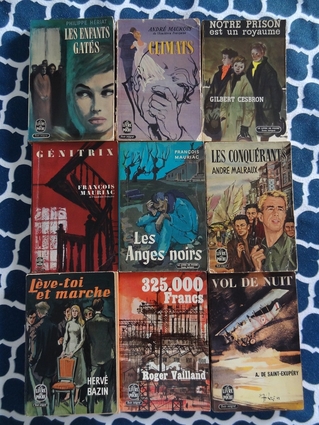

I mean, seriously. How amazing are these?


I mean, seriously. How amazing are these?

90rebeccanyc
Great to catch up with your reading, lilisin. I enjoyed Shipwrecks by Yoshimura and have another of his books, Storm Rider on the TBR, so it was good to read about On Parole. Not sure I'm up for the Richie, though. And I loved learning that "la barbe a papa" is cotton candy! Great covers too.
91baswood
Great review of The Inland Sea. Donald Ritchie sounds quite a character.
I regret that when I was 15 I was not seduced by a 40 year old Japanese woman.
Great covers of those French mass produced books. I am always tempted when let loose in Parisian second hand book shops.
I regret that when I was 15 I was not seduced by a 40 year old Japanese woman.
Great covers of those French mass produced books. I am always tempted when let loose in Parisian second hand book shops.
92lilisin
22) Antoine de Saint-Exupery : Vol de Nuit (Night Flight)
France
3.5/5 stars
I was wavering on whether or not I should read another Zola right now when I spotted the beautiful cover (see post 89) of Vol de Nuit on a bookshelf in our vacation home. The smell that comes with these older French mass paperback editions and the fact that it was also quite short added to my desire to read the book.
In Buenos Aires, a director awaits the arrival of three courier planes from various regions in Argentina. However, the planes are flying at night and storms are approaching, threatening the safety of the pilots. The book follows the director as he deals with the possibility that one of the planes might not be making it.
From the summary of the book I thought I'd love this book and boy did I try to love it. But like the descriptions of the pilot flying in between threatening clouds, my attention and fondness for the book wavered between superficial skimming and engrossed reading. Despite a beautiful start to the book, every time I thought I'd start to learn more about the characters I'd get pushed away again to read something a little less engrossing. I don't typically need to get attached to characters to enjoy a read but this time I really wanted it.
By the end of the book I did end up feeling a little hint of emotion as I understood the director and his motivations and his spirit of knowing that he needs to continue forward, but I thought the author stumbled in trying to describe the character at the beginning. In reality, I thought the author's strengths were in the description of the flights and the interaction between the characters so it was disappointing when he spent so much time writing not about these things.
Thus, although I wanted to love this book, and although I did feel for the book by the ending, -- despite the shortness of this little novel -- I did not get the experience I really wanted.
France
3.5/5 stars
I was wavering on whether or not I should read another Zola right now when I spotted the beautiful cover (see post 89) of Vol de Nuit on a bookshelf in our vacation home. The smell that comes with these older French mass paperback editions and the fact that it was also quite short added to my desire to read the book.
In Buenos Aires, a director awaits the arrival of three courier planes from various regions in Argentina. However, the planes are flying at night and storms are approaching, threatening the safety of the pilots. The book follows the director as he deals with the possibility that one of the planes might not be making it.
From the summary of the book I thought I'd love this book and boy did I try to love it. But like the descriptions of the pilot flying in between threatening clouds, my attention and fondness for the book wavered between superficial skimming and engrossed reading. Despite a beautiful start to the book, every time I thought I'd start to learn more about the characters I'd get pushed away again to read something a little less engrossing. I don't typically need to get attached to characters to enjoy a read but this time I really wanted it.
By the end of the book I did end up feeling a little hint of emotion as I understood the director and his motivations and his spirit of knowing that he needs to continue forward, but I thought the author stumbled in trying to describe the character at the beginning. In reality, I thought the author's strengths were in the description of the flights and the interaction between the characters so it was disappointing when he spent so much time writing not about these things.
Thus, although I wanted to love this book, and although I did feel for the book by the ending, -- despite the shortness of this little novel -- I did not get the experience I really wanted.
93lilisin
A very successful France trip in terms of reading!l In just under three weeks I managed to get 5 books read for a total of 1322 pages meaning that July is my second highest reading month this year. I'm really beating all sorts of records this year!
My original TBR:
Zola : Therese Raquin
Bi Feiyu : De la barbe a papa un jour de pluie
Donald Richie : The Inland Sea
Akira Yoshimura : On Parole
Otsuichi : 暗いところで待ち合わせ
I managed to read:
1) Akira Yoshimura : On Parole
2) Donald Richie : The Inland Sea
3) Bi Feiyu : De la barbe à papa un jour de pluie (Cotton Candy on a Rainy Day)
4) Antoine de Saint-Exupery : Vol de Nuit (Night Flight)
5) Erich Maria Remarque : L'ile d'espérance (A Time to Love and a Time to Die)
And since I always bring books home when I'm in France, these are the books I've acquired during this vacation:
1) Erich Maria Remarque : Arc de triomphe (Arc of Triumph)
2) Antoine de Saint-Exupery : Vol de Nuit (Night Flight)
3) Erich Maria Remarque : L'ile d'espérance (A time to live and a time to die)
4) Alexandre Dumas (fils) : La Dame aux Camélias (The Camelia Lady)
5) Marguerite Duras : Un barrage contre le Pacifique (The Sea Wall)
That means I read three books from my original TBR and two books from my pile of acquired books. I also dipped a bit into the Japanese book so I think I'll end up reading that soon. I'll probably post my review for the Remarque after I'm officially home.
My original TBR:
Zola : Therese Raquin
Bi Feiyu : De la barbe a papa un jour de pluie
Donald Richie : The Inland Sea
Akira Yoshimura : On Parole
Otsuichi : 暗いところで待ち合わせ
I managed to read:
1) Akira Yoshimura : On Parole
2) Donald Richie : The Inland Sea
3) Bi Feiyu : De la barbe à papa un jour de pluie (Cotton Candy on a Rainy Day)
4) Antoine de Saint-Exupery : Vol de Nuit (Night Flight)
5) Erich Maria Remarque : L'ile d'espérance (A Time to Love and a Time to Die)
And since I always bring books home when I'm in France, these are the books I've acquired during this vacation:
1) Erich Maria Remarque : Arc de triomphe (Arc of Triumph)
2) Antoine de Saint-Exupery : Vol de Nuit (Night Flight)
3) Erich Maria Remarque : L'ile d'espérance (A time to live and a time to die)
4) Alexandre Dumas (fils) : La Dame aux Camélias (The Camelia Lady)
5) Marguerite Duras : Un barrage contre le Pacifique (The Sea Wall)
That means I read three books from my original TBR and two books from my pile of acquired books. I also dipped a bit into the Japanese book so I think I'll end up reading that soon. I'll probably post my review for the Remarque after I'm officially home.
94rebeccanyc
Welcome back! Bienvenue! Congratulations on the reading and on the new books.
95lilisin
Managed to slip in one more book before the end of the month which I started and finished on the plane ride back from France: Zola's Therese Raquin. Which means that July is now my highest read month of the year and I managed to complete a total of 6 books. Reviews for the last two will hopefully be up sometime this week.
96lilisin
Here is an interesting article from a blog I enjoy reading that goes into the basics of how to translate Japanese into English. I know a lot of us are translation aficionados so I thought some might be interested to see what kind of rules are being applied to this particular translation.
In the meantime I'm preparing for my three month trip to Japan, leaving on Tuesday. I'm unsure as to what to do bookwise. I will be reading lots of comics there for sure but the question is whether or not I bring a few French books with me? I want to be fully immersed in Japan and ideally I would only read Japanese books but I'm also well aware how mentally exhausting that might become. Plus, I've been doing so well with working on my TBR pile this year and I've been reading so much that I've been really excited. I really don't want to lose that pace. Hmm... much to contemplate. Speaking of, I need to go do some more pulling of clothes I'm bringing.
In the meantime I'm preparing for my three month trip to Japan, leaving on Tuesday. I'm unsure as to what to do bookwise. I will be reading lots of comics there for sure but the question is whether or not I bring a few French books with me? I want to be fully immersed in Japan and ideally I would only read Japanese books but I'm also well aware how mentally exhausting that might become. Plus, I've been doing so well with working on my TBR pile this year and I've been reading so much that I've been really excited. I really don't want to lose that pace. Hmm... much to contemplate. Speaking of, I need to go do some more pulling of clothes I'm bringing.
97rebeccanyc
That was a fascinating article, lilisin. Not only did it interest me to see how Japanese writing styles differ from English, but it made me think about whether I agree with the idea of changing those styles so dramatically in translation, about whether that leads the English reader to miss a lot of what makes Japanese writing Japanese writing.
Have a wonderful trip! Unless you can buy other books in Japan, I would suggest bringing some books from your TBR with you so you can have a change of pace if you need or want one. Have fun!
Have a wonderful trip! Unless you can buy other books in Japan, I would suggest bringing some books from your TBR with you so you can have a change of pace if you need or want one. Have fun!
98lilisin
Once you get some experience with the Japanese language, you quickly see how those translation rules make a lot of sense and are much preferable to a more literal translation. For example, rule 5 about the negatives in Japanese. Some sentences if translated literally would sound like this:
"I really don't think I cannot not eat don't you think?"
Which when you add more complicated verbs and tenses and grammar patterns and throw in some of the issues from rule #2, it all gets a bit messy and fussy.
"I really don't think I cannot not eat don't you think, is what I was thinking but maybe I just should not not eat it, no?"
Too much for English translation where a sentence like that would sound like two high school girls talking to each other but in Japanese it's more than grammatically correct.
If you go back to my post 21 about translating Murakami you'll notice this bit again:
"...." she said.
"...." he nodded.
"...." she replied.
"...." he nodded.
"...." she nodded.
"...." he replied.
In English, there is just no reason to include those actions. Most sound editors, I feel, would just leave the dialogue and nix those "said" and "nodded" phrasings.
However, rule 1 about all the prepositional phrases, etc., are an example of why I think Japanese to French translations are the perfect match.
"I really don't think I cannot not eat don't you think?"
Which when you add more complicated verbs and tenses and grammar patterns and throw in some of the issues from rule #2, it all gets a bit messy and fussy.
"I really don't think I cannot not eat don't you think, is what I was thinking but maybe I just should not not eat it, no?"
Too much for English translation where a sentence like that would sound like two high school girls talking to each other but in Japanese it's more than grammatically correct.
If you go back to my post 21 about translating Murakami you'll notice this bit again:
"...." she said.
"...." he nodded.
"...." she replied.
"...." he nodded.
"...." she nodded.
"...." he replied.
In English, there is just no reason to include those actions. Most sound editors, I feel, would just leave the dialogue and nix those "said" and "nodded" phrasings.
However, rule 1 about all the prepositional phrases, etc., are an example of why I think Japanese to French translations are the perfect match.
99rebeccanyc
Thanks, lilisin. I see what you mean!
100lilisin
I should mention that in August I read one book, Natsuo Kirino's Out and really enjoyed it, ranking it at 4.5 out of 5 stars. Otherwise I've been in Japan since mid August and have been trying to limit my English so I haven't been on LT too much nor am I reading anything other than comics. I still would like to write my thoughts on Therese Raquin, L'ile d'esperance and now Out, but that might have to wait still.
I'm actually in the mood to read some nonfiction, particularly No Surrender: My Thirty-Year War or The Rape Of Nanking but unfortunately I own neither of those books. I also just recently heard of The Narrow Road to the Deep North by Richard Flanagan which sounds quite interesting, seemingly about an Australian man in a Japanese prisoner war camp. Since this is the same situation my grandfather was in when he lived in Vietnam, I'm curious to read the book.
I'm actually in the mood to read some nonfiction, particularly No Surrender: My Thirty-Year War or The Rape Of Nanking but unfortunately I own neither of those books. I also just recently heard of The Narrow Road to the Deep North by Richard Flanagan which sounds quite interesting, seemingly about an Australian man in a Japanese prisoner war camp. Since this is the same situation my grandfather was in when he lived in Vietnam, I'm curious to read the book.
101lilisin
Hello again!
26) Iris Chang : The Rape of Nanking
China/Japan
4/5 stars
Since the last we met I have only read one book, Iris Chang's The Rape of Nanking which I really enjoyed reading. I found it to be an interesting account of not only the Japanese occupation of Shanghai but an interesting tug of war between telling the truth and covering up facts.
The violence depicted in the book might render some people queasy as there are certainly some brutal scenes, as well a photos showing decapitated heads and raped women, so it might not be for everyone, but the subject material is fascinating.
For myself, the violence was basically a matter of fact of the war and having already been aware of it -- although I'm not trying to diminish the atrocities -- I was able to look at it without too much emotional distraction. What fascinating me instead were the chapters stating how the occupation started and what led it to be as gruesome as it was. Apparently the Chinese could have not have suffered the atrocity entirely if they had been better with their communication. Also, I though very interesting the fact that there was a change in Japanese generals that led to a change in intensity of the occupation. Fascinating.
I also really enjoyed the end were Iris Chang starts to discuss censorship amongst scholars and the Japanese government and even possible censorship from the Chinese government (to perhaps inflate the numbers of casualties). This tug of war is really fascinating and actually led me to having some really intense conversations while I was in Japan.
(My host parents (in their 70s) thought the atrocities were horrible and don't doubt it happened, but they wonder to what extent foreign press thinks the casualties go to. Another person I spoke to, a 24 year old man, actually believes that barely any of what is reported by the Chinese government to be true and thinks the events are massively exaggerated.)
My reading experience was furthermore enhanced by reading the circumstances behind Iris Chang's suicide. There is a very heartwrenching article one can find easily via Google.
In any case, although it's been a few months already since I read this so I can't go too much into the more specific details of the book, I'm very happy to have finally read this work.
26) Iris Chang : The Rape of Nanking
China/Japan
4/5 stars
Since the last we met I have only read one book, Iris Chang's The Rape of Nanking which I really enjoyed reading. I found it to be an interesting account of not only the Japanese occupation of Shanghai but an interesting tug of war between telling the truth and covering up facts.
The violence depicted in the book might render some people queasy as there are certainly some brutal scenes, as well a photos showing decapitated heads and raped women, so it might not be for everyone, but the subject material is fascinating.
For myself, the violence was basically a matter of fact of the war and having already been aware of it -- although I'm not trying to diminish the atrocities -- I was able to look at it without too much emotional distraction. What fascinating me instead were the chapters stating how the occupation started and what led it to be as gruesome as it was. Apparently the Chinese could have not have suffered the atrocity entirely if they had been better with their communication. Also, I though very interesting the fact that there was a change in Japanese generals that led to a change in intensity of the occupation. Fascinating.
I also really enjoyed the end were Iris Chang starts to discuss censorship amongst scholars and the Japanese government and even possible censorship from the Chinese government (to perhaps inflate the numbers of casualties). This tug of war is really fascinating and actually led me to having some really intense conversations while I was in Japan.
(My host parents (in their 70s) thought the atrocities were horrible and don't doubt it happened, but they wonder to what extent foreign press thinks the casualties go to. Another person I spoke to, a 24 year old man, actually believes that barely any of what is reported by the Chinese government to be true and thinks the events are massively exaggerated.)
My reading experience was furthermore enhanced by reading the circumstances behind Iris Chang's suicide. There is a very heartwrenching article one can find easily via Google.
In any case, although it's been a few months already since I read this so I can't go too much into the more specific details of the book, I'm very happy to have finally read this work.
102lilisin
An actual update now.
I was in Japan for three months then went to Seoul for a little while and so during that time I read nothing in English and only ended up reading comics in Japanese. And even then, I still didn't read that much as I was trying to use the opportunity to speak as much as possible so I was always going out instead of staying in and reading. Overall, a great experience.
And, the big news is that I was able to get a job while there so, assuming my visa goes through, I'm officially moving to Japan in late January! I'm the happiest I've been in a long time and I can't wait to start.
Now, this is a book website so now to discuss books!
I expect my reading will change significantly once I go there. At the beginning I don't think I'll be reading anything but the materials related to my new job (I have to learn a lot of chemistry terminology in Japanese) plus I won't have my TBR to pick from.
But I'm excited as that means I get to start a new TBR. I already have a few books there that I left behind while I was there and I'll be bringing a few more books in January but I get to basically start from scratch so this will be an interesting experiment in seeing if I can control my TBR now that I get to start from scratch. I hope so!
In any case, in the meantime, in the US I'm almost done reading Ryu Murakami's From the Fatherland, with Love which I'm really enjoying (he is just ripping apart the Japanese government) and am nearing the end of.
I've also ordered the following two books which I've been wanting to read and am hoping I'll finish them before I leave.
Shohei Ooka : Taken Captive: A Japanese POW's Story
Hiroo Onoda : No Surrender: My Thirty-Year War
I was in Japan for three months then went to Seoul for a little while and so during that time I read nothing in English and only ended up reading comics in Japanese. And even then, I still didn't read that much as I was trying to use the opportunity to speak as much as possible so I was always going out instead of staying in and reading. Overall, a great experience.
And, the big news is that I was able to get a job while there so, assuming my visa goes through, I'm officially moving to Japan in late January! I'm the happiest I've been in a long time and I can't wait to start.
Now, this is a book website so now to discuss books!
I expect my reading will change significantly once I go there. At the beginning I don't think I'll be reading anything but the materials related to my new job (I have to learn a lot of chemistry terminology in Japanese) plus I won't have my TBR to pick from.
But I'm excited as that means I get to start a new TBR. I already have a few books there that I left behind while I was there and I'll be bringing a few more books in January but I get to basically start from scratch so this will be an interesting experiment in seeing if I can control my TBR now that I get to start from scratch. I hope so!
In any case, in the meantime, in the US I'm almost done reading Ryu Murakami's From the Fatherland, with Love which I'm really enjoying (he is just ripping apart the Japanese government) and am nearing the end of.
I've also ordered the following two books which I've been wanting to read and am hoping I'll finish them before I leave.
Shohei Ooka : Taken Captive: A Japanese POW's Story
Hiroo Onoda : No Surrender: My Thirty-Year War
103RidgewayGirl
That's very exciting about the job in Japan!
104stretch
Great news about the opportunity in Japan. Look forward to your Japanese reviews. I haven't managed to read a single Japanese author this year, so sad.
105edwinbcn
the Chinese could have not have suffered the atrocity entirely if they had been better with their communication
It is a bit baffling to suggest that the Chinese victims were (partially) to blame for war crimes committed against them by the Japanese. Most foreigners know very little about Japanese aggression, atrocities and war crimes in China. The Rape of Nanking sheds light on the incredibly brutal massacre in Nanjing (= Nanking), but outside China very little is known about medical experiments, release of bubonic plague and poison gas attacks in North-East China during the Second World War.
While denazification, and punishement of Nazis was thorough, no such thorough cleansing took place in Japan, where the current political leadership still venerates "war heroes" and the spirit of the war. Generations of Germans have apologized for decades for the evil their country brought upon Jewish people in particular and the world at large. However, no such humility can be seen in the Japanese, who are unwilling and have never apologized, and, of late, even suggest that they were victims rather than aggressors.
The official Chinese viewpoint is that the Japanese should aplogize and stop honouring war criminals in the Yasukuni Shrine, where each year the Japanese prime-Minister pays hommage to all anyone who had died in service of Japan up until 1947 (!), including including 1,068 war criminals; 14 of whom are considered A-Class, and of course all those soldiers who raped and murdered civilians in Nanjing and subsequently died in the service of their country.
This Japanese attitude of pride rather than humility is gravely regretted by Chinese people. With the rise of nationalism in Japan in recent years, and Japan "blaming the United States for "forcing" Japan into World War II and claiming that Japan went to war to create a "co-prosperity sphere" for all Asians" Chinese people fear that Japan will once again extend its aggression to attack its Asian neighbours, as exemplified by its attempted annexation of the Diaoyu Islands (Senkaku Islands).
Another fearsome aspect is the Japanese censorship of Japanese schoolbooks, in which the truth about Japan's role in the Second World War is downplayed and distorted through "the same propaganda used by the wartime imperial Japanese regime."
It is a bit baffling to suggest that the Chinese victims were (partially) to blame for war crimes committed against them by the Japanese. Most foreigners know very little about Japanese aggression, atrocities and war crimes in China. The Rape of Nanking sheds light on the incredibly brutal massacre in Nanjing (= Nanking), but outside China very little is known about medical experiments, release of bubonic plague and poison gas attacks in North-East China during the Second World War.
While denazification, and punishement of Nazis was thorough, no such thorough cleansing took place in Japan, where the current political leadership still venerates "war heroes" and the spirit of the war. Generations of Germans have apologized for decades for the evil their country brought upon Jewish people in particular and the world at large. However, no such humility can be seen in the Japanese, who are unwilling and have never apologized, and, of late, even suggest that they were victims rather than aggressors.
The official Chinese viewpoint is that the Japanese should aplogize and stop honouring war criminals in the Yasukuni Shrine, where each year the Japanese prime-Minister pays hommage to all anyone who had died in service of Japan up until 1947 (!), including including 1,068 war criminals; 14 of whom are considered A-Class, and of course all those soldiers who raped and murdered civilians in Nanjing and subsequently died in the service of their country.
This Japanese attitude of pride rather than humility is gravely regretted by Chinese people. With the rise of nationalism in Japan in recent years, and Japan "blaming the United States for "forcing" Japan into World War II and claiming that Japan went to war to create a "co-prosperity sphere" for all Asians" Chinese people fear that Japan will once again extend its aggression to attack its Asian neighbours, as exemplified by its attempted annexation of the Diaoyu Islands (Senkaku Islands).
Another fearsome aspect is the Japanese censorship of Japanese schoolbooks, in which the truth about Japan's role in the Second World War is downplayed and distorted through "the same propaganda used by the wartime imperial Japanese regime."
106rebeccanyc
Congratulations on getting a job in Japan, and very exciting about your move there!
107lilisin
27) Ryu Murakami : From the Fatherland, with Love
Japan
4.5/5 stars
I really enjoyed this book; it was fun, engaging and full of page-turning moments that made me want to pick the book back up as soon as I put it down. It probably could have been edited down in a few instances (hence me dropping a star) as certain moments and even phrases were repeated, but overall I was taken on a fun ride with this book.
It's a story about North Korean trying to take over Kyushu, Japan by sending a handful of troops to take over the city of Fukuoka. They are able to do so by taking advantage of the inadequacy of the Japanese government and the inability to take charge that comes from the Japanese people. As the Korean troops, the Koryo Expeditionary Force, starts to settle in and implement their policies, we see the struggle of the Japanese government as they try and decide how to deal with this invasive force, and we get to see the people of Fukuoka as they try and figure out what their role is under this new state. In the meantime, a group of misfits determines what they want to do about this new situation.
Seeing the utter meltdown of the Japanese government as they it is lost in bureaucracy and paperwork is the true genius of this book and it's what really allowed me to enjoy Murakami's work. Although not a book many would appreciate if one wasn't familiar with Japanese policy, it's a fun one if you do.
Japan
4.5/5 stars
I really enjoyed this book; it was fun, engaging and full of page-turning moments that made me want to pick the book back up as soon as I put it down. It probably could have been edited down in a few instances (hence me dropping a star) as certain moments and even phrases were repeated, but overall I was taken on a fun ride with this book.
It's a story about North Korean trying to take over Kyushu, Japan by sending a handful of troops to take over the city of Fukuoka. They are able to do so by taking advantage of the inadequacy of the Japanese government and the inability to take charge that comes from the Japanese people. As the Korean troops, the Koryo Expeditionary Force, starts to settle in and implement their policies, we see the struggle of the Japanese government as they try and decide how to deal with this invasive force, and we get to see the people of Fukuoka as they try and figure out what their role is under this new state. In the meantime, a group of misfits determines what they want to do about this new situation.
Seeing the utter meltdown of the Japanese government as they it is lost in bureaucracy and paperwork is the true genius of this book and it's what really allowed me to enjoy Murakami's work. Although not a book many would appreciate if one wasn't familiar with Japanese policy, it's a fun one if you do.
108lilisin
End of the year report for 2014! This year I read a total of 27 books, my highest record ever! Having a lot of free time while substitute teaching helped a lot as I needed the mental stimulation. Reading slowed down when the semester was over and then once again while I was in Japan and focusing primarily on Japanese at that time.
Out of the 27 books I read:
Fiction: 23 / Nonfiction: 4
Male : 20 / Female: 7
Languages read: English x13 / French x12 / Japanese x2
Nationality of fiction authors:
Japan x13 / France x4 / Germany x2 / Belgium / USA / China / Russia
Books I read according to when I added them to the TBR pile:
2014 x4
2013 x10
2012 x2
2011 x5
2010 x2
2009 x2
2008
2007
Books I read according to publication date by decade:
2010 x3
2000 x3
1990 x5
1980 x2
1970 x3
1960 x3
1950
1940
1930
1910 x2
1870
1860 x2
Looks like I read primarily current books. (Forget if I'm supposed to say contemporary or modern.)
As for comics this year I read a total of 77 books! I read 26 in French to where I'm now up to date with both series Naruto and Detective Conan. I read 51 comics in Japanese, resulting in 11 series, 3 of which are completed and one is up to date, others unfinished, and then one stand alone. All in all very good!
In any case, my 2015 thread is here. See you there!
Out of the 27 books I read:
Fiction: 23 / Nonfiction: 4
Male : 20 / Female: 7
Languages read: English x13 / French x12 / Japanese x2
Nationality of fiction authors:
Japan x13 / France x4 / Germany x2 / Belgium / USA / China / Russia
Books I read according to when I added them to the TBR pile:
2014 x4
2013 x10
2012 x2
2011 x5
2010 x2
2009 x2
2008
2007
Books I read according to publication date by decade:
2010 x3
2000 x3
1990 x5
1980 x2
1970 x3
1960 x3
1950
1940
1930
1910 x2
1870
1860 x2
Looks like I read primarily current books. (Forget if I'm supposed to say contemporary or modern.)
As for comics this year I read a total of 77 books! I read 26 in French to where I'm now up to date with both series Naruto and Detective Conan. I read 51 comics in Japanese, resulting in 11 series, 3 of which are completed and one is up to date, others unfinished, and then one stand alone. All in all very good!
In any case, my 2015 thread is here. See you there!

