This topic is currently marked as "dormant"—the last message is more than 90 days old. You can revive it by posting a reply.
1Roro8
It is time to think about the final time period for 2014.
I would like to put forward Biblical times, mainly because of the Christmas season. Please suggest your preferences or suggestions for December.
I would like to put forward Biblical times, mainly because of the Christmas season. Please suggest your preferences or suggestions for December.
2lkernagh
I have been pretty much absent all year but I do like the idea of Biblical times for December. It might motivate me to read my copy of The Red Tent.
3Samantha_kathy
What time period would Biblical times be? Because I might have something not biblical still falling into that time period.
Other time period suggestions:
Prehistory (this depends on region of the world, but if someone want a definite cut-off date, 1 BC for Europe is the latest)
Regency period (1811-1820)
Other time period suggestions:
Prehistory (this depends on region of the world, but if someone want a definite cut-off date, 1 BC for Europe is the latest)
Regency period (1811-1820)
4CurrerBell
>3 Samantha_kathy: Herodotus might quarrel with the idea that he was pre-historical. ;->
5Samantha_kathy
Yep, but then, he'd be right. There's no real time period for cutting off prehistory because it differed per region. My part of Europe (the Netherlands) didn't exit prehistory until 1 BC, while Egyptian and Greek society did so much earlier. Prehistory is defined as the time period before the written word. So it differes greatly around the world. But the latest anyone in the world came out of prehistory is generally thought to be around 1 BC.
6christina_reads
I like the Regency suggestion, mostly because I'm already planning to read a Regency-era mystery in December. :)
7Samantha_kathy
I suggested it because I was looking at my bookshelf and saw a Regency-era romance that, should I read it in December, will finish up a series. Might be a nice ending to the year :D.
8DeltaQueen50
I like both Regency and the idea of Prehistory-1 BC, I have books that would fit either. I have wanted to read The Dovekeepers by Alice Hoffman about Masada which I believe happened around 35 BC - so that would fit as a Biblical read, I think.
9countrylife
Same here. I'm happy with either Regency or Biblical times.
11Samantha_kathy
To be honest, I think Biblical Times would be better as a theme, rather than a time period. Biblical times overlaps with other time periods and I think the spirit of it is reading fiction that connects to Bible stories, like The Red Tent, Gods and Kings, Ruth and Song of Abraham. Doing a theme of Biblical Fiction in a theme month (February, maybe?) would appeal to me more than a Biblical Times time period, which is not only very large but would not necessarily see people reading Biblical fiction.
Edited to add: The Bible covers (roughly) from 1500 BC to 100 AD in the Old Testament, and the New Testament stretches that to 110 AD. So, lots of time, but as a time period not so useful since people can read anything from that time period, even books not connected to Biblical stories. So, like I said, probably better as a theme than a time period.
Edited to add: The Bible covers (roughly) from 1500 BC to 100 AD in the Old Testament, and the New Testament stretches that to 110 AD. So, lots of time, but as a time period not so useful since people can read anything from that time period, even books not connected to Biblical stories. So, like I said, probably better as a theme than a time period.
12cbl_tn
So maybe the time period could be Classical Antiquity? That would encompass the time period of the New Testament.
13Roro8
>11 Samantha_kathy: I think that is a fair point. If others agree we can keep biblical times or biblical fiction in mind for a future theme.
So that means so far we have:
Regency period (1811-1820)
Pre-history (cut-off at 1BC but varies around the world)
Classical antiquity (actual years included to be clarified)
I just did a search for the actual years that are considered classical antiquity and there seemed to be a bit of variation so I wasn't sure of what years to put in.
Would anybody like to put forward another suggestion?
So that means so far we have:
Regency period (1811-1820)
Pre-history (cut-off at 1BC but varies around the world)
Classical antiquity (actual years included to be clarified)
I just did a search for the actual years that are considered classical antiquity and there seemed to be a bit of variation so I wasn't sure of what years to put in.
Would anybody like to put forward another suggestion?
15Roro8
Vote: The December time period should be Pre-History (cut off at 1BC, but varies depending on location)
Current tally: Yes 0, No 1, Undecided 2
18Samantha_kathy
Voted :D. I'm still going for Regency, although all three topics speak to me, simply because I really need to get that one Regency book off my TBR stack before the end of the year.
19DeltaQueen50
I like all three proposals but somehow Regency seems more "Christmas" - probably a memory of old Christmas Cards featuring horse-drawn sleighs or an old fashioned Christmas image.
20CurrerBell
I'm wondering, does "Regency" have to be English (or, more broadly, British, to include Sir Walter Scott)? Or does the time-period 1811-1820 suffice? The reason I ask is that Wikipedia shows Major writers of classic Regency fiction as including E.T.A. Hoffmann and Johann David Wyss.
And what about "Gothic" (as opposed to what we normally think of as "Regency") novels from the 1811-1820 period? For example, Melmoth the Wanderer?
And what about "Gothic" (as opposed to what we normally think of as "Regency") novels from the 1811-1820 period? For example, Melmoth the Wanderer?
21Roro8
As it is a time period month, the time period of 1811-1820 is the main criteria. So your suggestion would be fine.
22christina_reads
Agree with Roro8 -- it's a time period, so anything set in those years would work!
24Samantha_kathy
*cheers* I was hoping Regency would 'win'. I'll be reading Minx by Julia Quinn.
25christina_reads
I'm planning on The Devil in Music by Kate Ross.
26cbl_tn
I've been trying to get to Sanditon for months, and this will be just the push I need to finally read it.
27majkia
I'll try to get to Beauvallet and When Gods Die.
28CurrerBell
I'm doing some Austen reread. (Far from being one of my faves, but it's been an awful lot of years and I'm due for it.) ETA: Probably S&S and P&P for a start, anyway, and I've got them in the Harvard/Belknap annotateds as well as Norton Criticals.
29DeltaQueen50
I am going to be reading a Regency novel called The Frog Earl by Carola Dunn.
31majkia
I'll probably read Beauvallet by Georgette Heyer.
32Samantha_kathy
It's been a long time since I've done one of these 'introductions' to a month's theme (last one was May 2013), so it's high time I started doing this again. :D
The December 2014 Time Period is Regency Era (1811-1820)
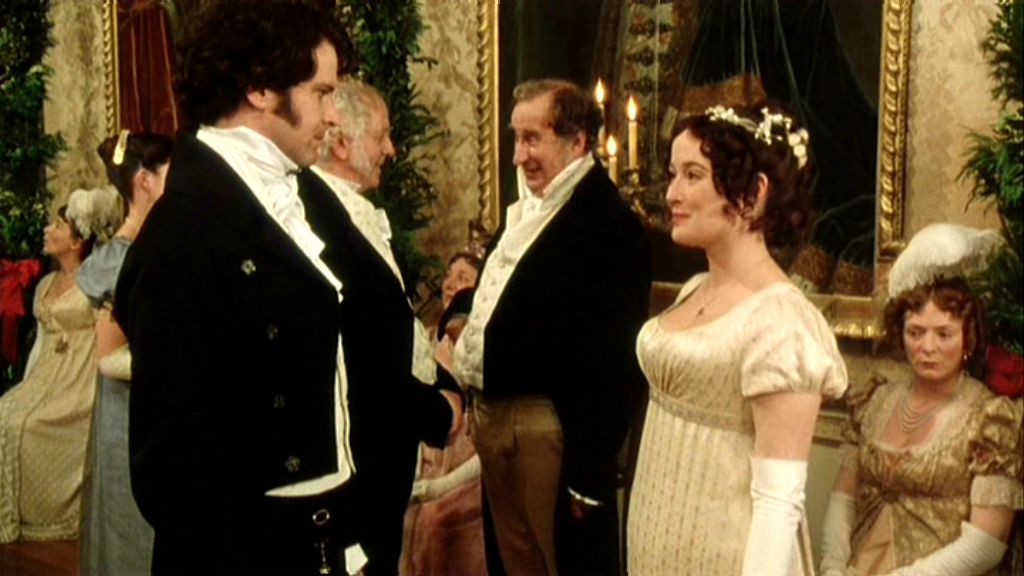
Mr. Darcy (Colin Firth) and Elizabeth Bennet (Jennifer Ehle) in Pride and Prejudice (1995)
Officially, the Regency Era in England lasted from 1811 to 1820. During this time period, King George III was deemed unfit to rule and his son, the Prince of Wales, ruled as Prince Regent. in 1820, King George III died and the Prince Regent became King George IV, ending the regency period. The term Regency Era sometimes extends beyond the official regency period, but for the purpose of this month's time period, we'll stick to 1811-1820.
This time period was known as a time of aristocratic excesses. The period is noted for its elegance and achievements in the fine arts and architecture. However, the time period was also one of great uncertaintly (which fuelled the excesses, in a Carpe Diem way of thinking), as there were the Napoleonic Wars, periodic riots, and the question as to whether the English people would emulate the French in their revolution. The stratification of society was extreme. But on the whole, this period was one of great refinement and cultural achievement.
The December 2014 Time Period is Regency Era (1811-1820)
Mr. Darcy (Colin Firth) and Elizabeth Bennet (Jennifer Ehle) in Pride and Prejudice (1995)
Officially, the Regency Era in England lasted from 1811 to 1820. During this time period, King George III was deemed unfit to rule and his son, the Prince of Wales, ruled as Prince Regent. in 1820, King George III died and the Prince Regent became King George IV, ending the regency period. The term Regency Era sometimes extends beyond the official regency period, but for the purpose of this month's time period, we'll stick to 1811-1820.
This time period was known as a time of aristocratic excesses. The period is noted for its elegance and achievements in the fine arts and architecture. However, the time period was also one of great uncertaintly (which fuelled the excesses, in a Carpe Diem way of thinking), as there were the Napoleonic Wars, periodic riots, and the question as to whether the English people would emulate the French in their revolution. The stratification of society was extreme. But on the whole, this period was one of great refinement and cultural achievement.
33Roro8
Thanks for the great intro Samantha. I was thinking of Reading Longbourn, but your mention of the Napoleonic Wars makes me wonder if The Generals, the second in Simon Scarrow's Napoleon series might work too. I'll check that option out today.
34majkia
I think I'll try to read When Gods Die by C.S. Harris
35Roro8
The Generals won't work. It stops at 1803.
36Samantha_kathy
35 > I'm guessing the third book in the series will actually fall into the time period for this month. So maybe that will be an option, depending on how fast you can read The Generals?
37Roro8
>36 Samantha_kathy: I'm not in a big hurry. It would have been nice if it did fit though. I'll see how I go.
38cbl_tn
I started Charlotte Bronte's Shirley last month for a group read but didn't finish it until today. Although it wasn't published until the mid-19th century, the novel is set during the economic depression of 1811-1812. It works better as a social novel than as a romance. It's not my favorite among her novels, but it's still well worth reading.
39cfk
I read "When Gods Die" by C.S. Harris for this theme. It was an easy read, but somewhat less satisfying than I prefer. I found it very difficult to feel empathy with anyone but the first victim, who was already dead on the first page. St. Cyr definitely qualifies as a high principled, swashbuckler hero.
Madness in the House of Hanover sets the stage for this odd tale. King George III, a raving maniac, is to be officially replaced by his son, George, as Prince Regent. Unfortunately, his son isn't all that much more competent than the King, but apparently a better choice than the younger son, Edward the Duke of York.
The real story which overshadows everything else lies in a planned insurrection to over throw the House of Hanover. It is led by a member of the Prince Regent's own cabinet and members of the upper crust in Society.
Madness in the House of Hanover sets the stage for this odd tale. King George III, a raving maniac, is to be officially replaced by his son, George, as Prince Regent. Unfortunately, his son isn't all that much more competent than the King, but apparently a better choice than the younger son, Edward the Duke of York.
The real story which overshadows everything else lies in a planned insurrection to over throw the House of Hanover. It is led by a member of the Prince Regent's own cabinet and members of the upper crust in Society.
40christina_reads
So I just finished The Devil in Music by Kate Ross, only to realize that it's set in 1821 and 1825 -- not during the Regency! Oops. :) I'm still glad I read the book, though...but also heartbroken that this is the last of the Julian Kestrel mysteries!
41DeltaQueen50
I didn't have very high expectations for The Frog Earl by Carola Dunn, but this light-hearted Regency Romance won me over and I enjoyed it a lot. It is a reworking of the fairy tale, "The Frog and the Princess".
42Roro8
I have finished my Regency read too. Longbourn by Jo Baker is the story of the servants in Jane Austen's Pride and Prejudice. I found it to be an enjoyable read.
43CurrerBell
I just finished my first Regency — a reread of Sense and Sensibility, using the annotated Harvard/Belknap edition edited by Patricia Meyer Spacks. Published in 1811, which just slips into the Regency timeline, though the novel's setting is some thirty years previous. But if Jane Austen ain't "Regency," then I don't know what is!
Generously, rating it a 3*** — in part because of the quality of these Harvard/Belknap annotated editions, coffee-table size and illustrations with annotations (though no supplementary materials) comparable to Norton Criticals — and I never have been and never will be a Janeite, though I do need to get around to a rereading and Harvard/Belknaps or Norton Criticals make the task less onerous.
Generously, rating it a 3*** — in part because of the quality of these Harvard/Belknap annotated editions, coffee-table size and illustrations with annotations (though no supplementary materials) comparable to Norton Criticals — and I never have been and never will be a Janeite, though I do need to get around to a rereading and Harvard/Belknaps or Norton Criticals make the task less onerous.
44majkia
Started When Gods Die. I read this a very long time ago, so don't remember much. I want to go further in the series so figured a re-read of the first two this year where necessary.
45countrylife
My December book : Time: Regency (1811-20):
The Unknown Ajax by Georgette Heyer
I know lots of folks rave over Ms. Heyer, but this is my third read of hers and I just don't get what the fuss is about. It was an ok read, though.
The Unknown Ajax by Georgette Heyer
I know lots of folks rave over Ms. Heyer, but this is my third read of hers and I just don't get what the fuss is about. It was an ok read, though.
46Miela
>45 countrylife: I agree with you on Georgette Heyer; I've read her in the past and she never has really appealed to me. (It's kind of odd, since I like Jane Austen, but what can I say? I'm weird like that.)
47Samantha_kathy
I won't be able to get to Minx before the end of the year. I'm trying to squeeze in one more book this year (to end up with a "whopping" 15 books total for 2014), but it won't be the book I'd planned for this time period. So, I'll see you all in the new year over in the January thread!

