This topic is currently marked as "dormant"—the last message is more than 90 days old. You can revive it by posting a reply.

2edwinbcn
This thread is the continuation of the same thread in Club Read 2014, 1914: Commemorating World War I: Book Discussions
In 2014, members read and reviewed the following books:
Falsifications of the Russian Orange Book: Actual exchange of telegrams between Paris and St. Petersburg at the outbreak of the war by Baron G. von Romberg
War Underground by Alexander Barrie
1914: A Novel by Jean Echenoz
William, An Englishman by Cicely Hamilton
A cup of tea. A novel of 1917 by Amy Ephron
The War That Ended Peace: The Road to 1914 by Margaret MacMillan
Kitchener's Last Volunteer : the life of Henry Allingham the oldest surviving veteran of the Great War by Henry Allingham
Birdsong by Sebastian Faulks
July 1914: Countdown to War by Sean McMeekin
Mr. Britling Sees It Through by H. G. Wells
Life Goes On by Hans Keilson
Maisie Dobbs by Jacqueline Winspear
Der Spaziergang by Robert Walser
Forgotten Voices of the Somme: The Most Devastating Battle of the Great War in the Words of Those Who Survived edited by Joshua Levine
Under Fire by Henri Barbusse
Fear: A Novel of World War I by Gabriel Chevallier
George, Nicholas and Wilhelm Three Royal Cousins and the Road to World War 1 by Miranda Carter
The Daughters of Mars by Thomas Keneally
Paris 1919: Six Months that Changed the World by Margaret MacMillan
The Sleepwalkers: How Europe Went to War in 1914 by Christopher Clark
The Burning of the World: A Memoir of 1914 by Béla Zombory-Moldován
Memoirs of a fox-hunting man by Siegfried Sassoon
Three Day Road by Joseph Boyden
Goodbye to all that by Robert Graves
In 2014, members read and reviewed the following books:
Falsifications of the Russian Orange Book: Actual exchange of telegrams between Paris and St. Petersburg at the outbreak of the war by Baron G. von Romberg
War Underground by Alexander Barrie
1914: A Novel by Jean Echenoz
William, An Englishman by Cicely Hamilton
A cup of tea. A novel of 1917 by Amy Ephron
The War That Ended Peace: The Road to 1914 by Margaret MacMillan
Kitchener's Last Volunteer : the life of Henry Allingham the oldest surviving veteran of the Great War by Henry Allingham
Birdsong by Sebastian Faulks
July 1914: Countdown to War by Sean McMeekin
Mr. Britling Sees It Through by H. G. Wells
Life Goes On by Hans Keilson
Maisie Dobbs by Jacqueline Winspear
Der Spaziergang by Robert Walser
Forgotten Voices of the Somme: The Most Devastating Battle of the Great War in the Words of Those Who Survived edited by Joshua Levine
Under Fire by Henri Barbusse
Fear: A Novel of World War I by Gabriel Chevallier
George, Nicholas and Wilhelm Three Royal Cousins and the Road to World War 1 by Miranda Carter
The Daughters of Mars by Thomas Keneally
Paris 1919: Six Months that Changed the World by Margaret MacMillan
The Sleepwalkers: How Europe Went to War in 1914 by Christopher Clark
The Burning of the World: A Memoir of 1914 by Béla Zombory-Moldován
Memoirs of a fox-hunting man by Siegfried Sassoon
Three Day Road by Joseph Boyden
Goodbye to all that by Robert Graves
3rebeccanyc
Thanks for continuing this thread for the 2015 group, Edwin.
ETA: I'll add a link to it on the group page.
ETA: I'll add a link to it on the group page.
4NanaCC
I am going to add a couple of reviews here that I forgot to post on this thread after posting on my own. These are books that I think are worth noting for any discussion.

45. Fighting France, from Dunkerque to Belfort by Edith Wharton
American novelist, Edith Wharton, settled permanently in Paris in 1907. She loved France, and had great admiration for its people. When war was threatening to break out at any minute, she and her good friend Walter Berry were traveling in Spain. They hurried back hardly able to believe that the stories were true, and through Berry's influence, they were able to begin their adventure that would take them to the front bringing supplies to the soldiers. They traveled in Wharton's car, which she had shipped from New York. During this time, Wharton wrote a series of essays that were published by Scribner's.
In Hermione Lee's biography Edith Wharton, she says that Wharton sent a telegram to:
"the Scribner office: "JUST RETURNED FROM FIGHTING LINE IN ARGONNE MAILING ARTICLE NEXT WEEK." She was very keen to let her publishers and friends know that she was being given special, unrivaled access. (Scribner was not entirely convinced: in reply to her asking whether he would not prefer her war articles to the fiction she had promised them, he cabled back: "PREFER SHORT STORY.")...............Her passion for cultured tourism was being translated into the the ambitious curiosity of that dauntless and idiosyncratic twentieth-century breed, the woman "special correspondent" at war. And her publishers were, in the end, duly impressed. Scribner wrote to Wharton in July 1915: "What tremendous experiences you have been through! And I did not realize until your last letter that you were attended with real danger --- that you had actually been under fire." Wharton made five journeys with Walter Berry into the war zone between February and August 1915, which were condensed into four articles published in Scribner's Magazine, and then in Fighting France in November."
In this little book of around 100 pages, Wharton's experiences are told with Wharton's typical beautiful descriptions. Throughout she describes the courage of the people. Her hope was that her words would spur the Americans back home to give up their isolationist attitude and come to the aid of this country that she loved. It is interesting to note that she really did get right up to the front line, and even writes of going through one of the trenches.
Her efforts during the war did get many of her very rich friends back home to send money to help with the relief efforts she was very involved in. In 1916, she was awarded the French Legion d'honneur for her work.
I enjoyed this interesting book, and while this won't rival any of her novels, would recommend it to anyone interested in Wharton's travels during the first year of the war, and her view of the people she met and the countryside she traveled through..

45. Fighting France, from Dunkerque to Belfort by Edith Wharton
American novelist, Edith Wharton, settled permanently in Paris in 1907. She loved France, and had great admiration for its people. When war was threatening to break out at any minute, she and her good friend Walter Berry were traveling in Spain. They hurried back hardly able to believe that the stories were true, and through Berry's influence, they were able to begin their adventure that would take them to the front bringing supplies to the soldiers. They traveled in Wharton's car, which she had shipped from New York. During this time, Wharton wrote a series of essays that were published by Scribner's.
In Hermione Lee's biography Edith Wharton, she says that Wharton sent a telegram to:
"the Scribner office: "JUST RETURNED FROM FIGHTING LINE IN ARGONNE MAILING ARTICLE NEXT WEEK." She was very keen to let her publishers and friends know that she was being given special, unrivaled access. (Scribner was not entirely convinced: in reply to her asking whether he would not prefer her war articles to the fiction she had promised them, he cabled back: "PREFER SHORT STORY.")...............Her passion for cultured tourism was being translated into the the ambitious curiosity of that dauntless and idiosyncratic twentieth-century breed, the woman "special correspondent" at war. And her publishers were, in the end, duly impressed. Scribner wrote to Wharton in July 1915: "What tremendous experiences you have been through! And I did not realize until your last letter that you were attended with real danger --- that you had actually been under fire." Wharton made five journeys with Walter Berry into the war zone between February and August 1915, which were condensed into four articles published in Scribner's Magazine, and then in Fighting France in November."
In this little book of around 100 pages, Wharton's experiences are told with Wharton's typical beautiful descriptions. Throughout she describes the courage of the people. Her hope was that her words would spur the Americans back home to give up their isolationist attitude and come to the aid of this country that she loved. It is interesting to note that she really did get right up to the front line, and even writes of going through one of the trenches.
Her efforts during the war did get many of her very rich friends back home to send money to help with the relief efforts she was very involved in. In 1916, she was awarded the French Legion d'honneur for her work.
I enjoyed this interesting book, and while this won't rival any of her novels, would recommend it to anyone interested in Wharton's travels during the first year of the war, and her view of the people she met and the countryside she traveled through..
5NanaCC

32. A Long Long Way by Sebastian Barry (Penguin Books (2005), Paperback, 292 pages, Booker Prize Shortlist 2005)
The time is 1914, and young Willie Dunne joins the Allied forces on the Western Front with the Royal Dublin Fusiliers. He wanted to join the Dublin police force just like his father, but Willie was unlucky enough to be five feet five inches tall. Too short to be a policeman, but not too short to fight for king and country. He was politically innocent, but followed his mates into the army because they felt it was a way to quicken the path to Home Rule. For Willie, it was a way of proving he was a man, and a way to earn his father's respect. He is granted home leave in April of 1916. When leave is over, as he is headed to transport back to the front, there is heavy gunfire in Dublin as the Easter Uprising begins. The officers want Willie and his fellow soldiers to fire at the rebels. Knowing that these could be friends and neighbors, Willie can't do it, and spends the rest of his time at the front trying to understand his feelings about home and his place at the front fighting with England. Above all, his love of family and his fellow soldiers shines through.
The Irish regiments were shunned by the folks at home, and not completely trusted by the English troops. The scenes of battle are vivid and disturbing, yet poignant and unforgettable. It is easy to become attached to Willie and many of the other characters. I liked this book and enjoyed Barry's prose.
6NanaCC

36. The Care and Management of Lies: A Novel of the Great War by Jacqueline Winspear, (Harper (2014), 336 pages)
Winspear planned the publication of this book to coincide with the 100 year anniversary of the beginning of WWI. For those who enjoy her Maisie Dobb's series, I think this stand-alone novel will be a treat, as well. In the author's note, Winspear says she found a book in a used bookstore called The Woman's Book. First published in London in 1911, it was subtitled "Everything a Woman Ought to Know". It covered things like household management, cookery, children, home doctor, dress, society, etc. It became her inspiration for this novel, as she pictured a young wife writing to her husband at the front. Each chapter begins with a quote from The Woman's Book.
"Many women find it difficult to begin their letters---others find equal difficulty concluding them. One sensible rule to observe in beginning a letter is to avoid starting off with the pronoun "I"."--- The Woman's Book
Kezia Marchant and Thea Brissenden have been close friends since meeting at a private girls' school. Their relationship has become strained as Kezia marries Thea's brother Tom, and Thea becomes involved in the suffrage movement. Thea gives Kezia a book for her wedding present, called The Woman's Book. It is meant as a snub because Thea believes Kezia is giving up herself by marrying into a life she doesn't know. War breaks out within a few months of their marriage, and Tom volunteers for the army, leaving Kezia with two of his men to run the farm. Kezia is a city girl, but takes on the task with relish wanting to prove that she can manage. Thea winds up enlisting as an ambulance driver at the front.
The lies alluded to in the title refer to the letters that go back and forth between Kezia at the farm and Tom fighting in France. Kezia cooks up imaginary dinners for Tom and describes them in her loving letters from home. He and his trench mates savor the letters as a comforting bit of home. Tom keeps his letters light and doesn't talk about the horrors that he and his men are facing. None of these horrors are meant to reach anyone back home.
The lies also are those told by the officers as they send letters to wives and mothers of the soldiers that have been slaughtered. Tom's officer contemplates the next battle..
"Would he soon be dead too? Would his luck hold? And if it did, how many letters would he begin to write, telling a wife, a mother, that the man had not suffered, that he had died instantly in the service of his country? Died instantly? Hawkes remembered studying classics at school, and it seemed Aeschylus had it down: "In war, truth is the first casualty." But what can you say when a man has been blown into a million pieces, a million pieces and his blood seeping down into a foreign field? He died instantly. Of course he bloody well died instantly --- no one can live without a head, a heart or a brain. Would he, too, die instantly within the next five minutes, or ten?"
Compared to a few of the WWI related books I've read lately, the battlefield scenes are not quite as gruesome, but war is not pretty no matter how you look at it.
I enjoyed this book and would recommend it to anyone who enjoys Winspear's Maisie Dobbs series.
7NanaCC

37. All Quiet on the Western Front by Erich Maria Remarque, (Original Publication 1929; Edition: Fawcett Crest 1958; 175 Pages)
This is a slight novel at just under 200 pages, however, there is nothing slight about the story. There is a lot crammed into this little book.
Remarque wrote the story from his own experiences at the front while fighting as a German soldier. And, as you can guess, it is no different than the stories told from the French and British and American side. Limbs are lost, intestines spill onto the ground, brains fly through the air, and yet the fighting continued for over 4 years. Remarque left Germany after the war and moved to Switzerland. From there he moved to America, and became a U.S. citizen in 1947. His books were banned by Nazi Germany.
All Quiet follows a group of young soldiers who have been goaded into signing up for the war by their professor. Told through the voice of Paul Baumer, it follows the young men as they fight on the front lines, have rest periods just behind the lines, forage for food, and even for clothing. The company with which they fight starts out with 150 soldiers, and by chapter 7 they are down to 32 men. Until replacements arrive, this means more rations - more food, more drink, more cigars, and more cigarettes. Replacements are sent in to fill in the gaps, and sent to the front lines as Paul says, "before they know what cover means". Paul goes home on leave, and finds he no longer wants to be home.
"I imagined leave would be different from this. Indeed, it was different a year ago. It is I of course that have changed in the interval. There lies a gulf between that time and today. At that time I still knew nothing about the war, we had only been in quiet sectors. But now I see that I have been crushed without knowing it. I find I do not belong here any more, it is a foreign world. Some of these people ask questions, some ask no questions, but one can see that they are quite confident they know all about it; they often say so with their air of comprehension, so there is no point discussing it. They make up a picture of it for themselves."
As the end of the war approaches those who are left feel that they have nothing to go home to. They have been trained for nothing other than killing. It comes down to one last push and then a day where few sounds are heard and the dispatch sent home reports "All quiet on the western front'.
Remarque's anti-war message seems clear, and reading this, it points out that regardless of which side the soldiers were fighting for, it was brutal, and needless, and so many young men died on both sides wondering what they were fighting for.
I highly recommend this book.
8NanaCC

26. The War Workers by E. M. Delafield. (Originally published 1918 by a. A. Knopf, Free Kindle version 2011, 152 pages)
I selected this book as part of the Virago Group "The Great War Theme Read: Fighting on the Frontline and on the Homefront". It is a very tongue-in-cheek social commentary about a group of women doing their bit at home while the boys are fighting in France. They live together in a Hostel and look up to their boss who is a privileged woman playing the martyr and letting her position go to her head, while working them into the ground. Another wealthy woman enters the picture and opens a Canteen for the soldiers. Between the two women, the war workers work very long hours and live in quite desperate conditions, making do with very little. The descriptions of some of the women are wonderful, and there are some funny scenes. As I first started reading it, the writing reminded me of an old black and white film with actresses like June Allison and Katherine Hepburn in the various roles.
The author states at the beginning that the story is fictional. That said, there were women who worked, volunteered, or were very involved in doing what they could to help with the war effort. They went to work in canteens, hospitals, and the munitions factories where their skin turned yellow from the poisonous materials they worked with.
Liz1564 in the Virago group said "Apparently, Delafield had to work under a real harridan in WWl and this book was her sweet revenge."
9edwinbcn
Wow, Colleen. These are some great books about WWI. I had meant to read A Long Long Way by Sebastian Barry, but did not, and will try for this year. I was not aware, but would certainly like to read The War Workers by E. M. Delafield and the book by Edith Wharton. I guess they might be available as free downloads, somewhere.
I read 6 books for the World War I commemoration:
Falsifications of the Russian Orange Book: Actual exchange of telegrams between Paris and St. Petersburg at the outbreak of the war by Baron G. von Romberg
A cup of tea. A novel of 1917 by Amy Ephron
Der Spaziergang by Robert Walser
Memoirs of a fox-hunting man by Siegfried Sassoon
Goodbye to all that by Robert Graves
Ashenden, or, The British agent by W. Somerset Maugham
I read 6 books for the World War I commemoration:
Falsifications of the Russian Orange Book: Actual exchange of telegrams between Paris and St. Petersburg at the outbreak of the war by Baron G. von Romberg
A cup of tea. A novel of 1917 by Amy Ephron
Der Spaziergang by Robert Walser
Memoirs of a fox-hunting man by Siegfried Sassoon
Goodbye to all that by Robert Graves
Ashenden, or, The British agent by W. Somerset Maugham
10NanaCC
Edwin, I read 13 books that touched on WWI, but I didn't think that all of them were really meant for this thread. I also didn't want to duplicate some of the other books that had been posted. Birdsong was my favorite, but Jennifer (japaul22) posted a great review on the WWI thread. If you haven't read that one, I think it must have one of the most realistic descriptions of being in the trenches, and I would recommend it.
I meant to add that I received Goodbye to All That for Christmas, so I am looking forward to that one. And as I plan on continuing to read books related to WWI, I will be checking out some of the others that had been posted on the thread.
I meant to add that I received Goodbye to All That for Christmas, so I am looking forward to that one. And as I plan on continuing to read books related to WWI, I will be checking out some of the others that had been posted on the thread.
11Oandthegang
Really interesting books. The Delafield sounds like a good break from the more weighty writing. With so many good books to get through I expect I shall need to include 2019 in the centenary read to give myself more time. A lot of the medals and other items of the time refer to the period 1914 to 1919 rather than 1918, so it would not be a cheat.
12edwinbcn
Read last year, but not then reviewed)
Ashenden, or, The British agent
Finished reading: 26 September 2014

“To drink a glass of sherry when you can get a dry Martini is like taking a stage-coach when you can travel by the Orient Express.” (p. 225-226)
Few literary sources are mentioned to explain Ian Fleming's creation of James Bond, although Eric Ambler's spy novels, published in the late-30s and onwards are sometimes mentioned. Another worthy contender would be Ashenden, or, The British agent by W. Somerset Maugham.
The truth behind the story is astonishing enough. In 1914, W. Somerset Maugham was recruited by the British Secret Service to stay in Switzerland, posing to work on a play, and in this disguise execute his work a a liaison and spy. The stories in Ashenden, or, The British agent are based on Somerset Maugham's own experience as an agent. The main character, modeled on the author, is an aristocratic, suave gentleman, ruthless enough to face blackmail, interrogation and murder, in the service of the Motherland.
Somerset Maugham cleverly borrowed Conan-Doyle's formula of a collection of loosely connected stories that each form an episode around the main character on an ongoing mission, similar to the The adventures of Sherlock Holmes.
John Ashenden might as well be the model for James Bond, perhaps a bit more aristocratic. Another similarity, is that, like in the James Bond novels, the chief of the secret service is never named other than merely by the use of an initial, thus Colonel R.
Ashenden, or, The British agent breathes the atmosphere of Conrad's Under Western eyes, in which foreign operatives, with long, foreign-sounding names meet in obscure hostels, plotting and conspiring to do mischief. The stories are not as exciting as later spy novels in the genre, but Maugham does bring an intriguing cast of characters together, Russian, Mexican and Indian, with characters such the hairless Mexican, The dark woman, or Giulia Lazzari.
Ashenden, or, The British agent was written and published in 1928, but based on Somerset Maugham experience during the Great War. It is a book that offers a different perspective of the First World War.

Other books I have read by W. Somerset Maugham:
The Gentleman in the Parlour
Of human bondage
The painted veil
Up at the villa
The moon and sixpence
Points of view
The vagrant mood
The narrow corner
Ashenden, or, The British agent
Finished reading: 26 September 2014

“To drink a glass of sherry when you can get a dry Martini is like taking a stage-coach when you can travel by the Orient Express.” (p. 225-226)
Few literary sources are mentioned to explain Ian Fleming's creation of James Bond, although Eric Ambler's spy novels, published in the late-30s and onwards are sometimes mentioned. Another worthy contender would be Ashenden, or, The British agent by W. Somerset Maugham.
The truth behind the story is astonishing enough. In 1914, W. Somerset Maugham was recruited by the British Secret Service to stay in Switzerland, posing to work on a play, and in this disguise execute his work a a liaison and spy. The stories in Ashenden, or, The British agent are based on Somerset Maugham's own experience as an agent. The main character, modeled on the author, is an aristocratic, suave gentleman, ruthless enough to face blackmail, interrogation and murder, in the service of the Motherland.
Somerset Maugham cleverly borrowed Conan-Doyle's formula of a collection of loosely connected stories that each form an episode around the main character on an ongoing mission, similar to the The adventures of Sherlock Holmes.
John Ashenden might as well be the model for James Bond, perhaps a bit more aristocratic. Another similarity, is that, like in the James Bond novels, the chief of the secret service is never named other than merely by the use of an initial, thus Colonel R.
Ashenden, or, The British agent breathes the atmosphere of Conrad's Under Western eyes, in which foreign operatives, with long, foreign-sounding names meet in obscure hostels, plotting and conspiring to do mischief. The stories are not as exciting as later spy novels in the genre, but Maugham does bring an intriguing cast of characters together, Russian, Mexican and Indian, with characters such the hairless Mexican, The dark woman, or Giulia Lazzari.
Ashenden, or, The British agent was written and published in 1928, but based on Somerset Maugham experience during the Great War. It is a book that offers a different perspective of the First World War.

Other books I have read by W. Somerset Maugham:
The Gentleman in the Parlour
Of human bondage
The painted veil
Up at the villa
The moon and sixpence
Points of view
The vagrant mood
The narrow corner
13NanaCC
>12 edwinbcn: Ashenden, or, The British agent sounds like one I would enjoy, Edwin. Thank you for posting about it. There were quite a few of these "secret agents" in the arts fields. Very interesting about Somerset Maugham.
14timjones
I wasn't "officially" engaged in reading World War 1 books, but I did post the following brief review of a book that doesn't seem to have been covered here:
12. Testament of Youth by Vera Brittain - memoir/social history (4.5/5)
The core of this book is Vera Brittain's account of her service as a nurse during the First World War, during which time she lost her lover, her brother and another close male friend in the fighting. It's an account that points up the horrible stupidity and futility of that war - men dying in their hundreds of thousands for the sake of a few miles of trench - and of war in general. Not an easy read, but highly recommended.
12. Testament of Youth by Vera Brittain - memoir/social history (4.5/5)
The core of this book is Vera Brittain's account of her service as a nurse during the First World War, during which time she lost her lover, her brother and another close male friend in the fighting. It's an account that points up the horrible stupidity and futility of that war - men dying in their hundreds of thousands for the sake of a few miles of trench - and of war in general. Not an easy read, but highly recommended.
15edwinbcn
Testament of Youth by Vera Brittain is a book I wishlisted a few weeks ago.
16Helenliz
Testament of youth is a book I've read twice with very different reactions each time. First time you read it I think you're so blown away by the horror of it that the rest of the book barely registers. Second time I found myself getting really annoyed with her attitudes, especially the post war impression that the world owed her something. Maybe that's just my reading of it, but I'm not sure I would recommend it having read it twice as I would have done after the first read.
17mabith
>16 Helenliz: In my first (and only) read I'd start to get annoyed with her about something but then usually she'd pull herself up with something like "of course I was being ridiculous."
18mabith
I read this last year, but it's not on the list so I guess I didn't post it here.
The Eastern Front: 1914-1917 by Norman Stone
This is a very dry book, originally published in 1975, and its age shows a bit (partly in the random French quotes which aren't translated, I am so glad that is no longer common, it's really difficult in an audiobook). It's full of figures and wanted me to keep track of a million names which I did with varying degrees of success.
However, I've read almost nothing about the eastern front, and that's a problem. I imagine/hope there are more recent books about it, and quite possibly Soviet archives were opened on this subject since the book's publication, but I think this gave me a good base for further reading.
Ultimate takeaway: bad leadership was responsible for Russian troubles, not material shortages or 'lack of will' on the parts of the men (artillery men hoarded shells, deciding the infantry would waste them or that they were a waste if used to help the infantry). The Russian generals were idiots, but luckily so were the German and Austro-Hungarian ones, so they cancel each other out a bit. The end of the book focuses on the economy and social situations in Russia just before the revolution.
Recommend for the WWI completest. There's a more recent book Battles East, which I'll probably try to get in the future. It was published in 2007 and the description still talks about only a handful of books being published about the eastern front!
The Eastern Front: 1914-1917 by Norman Stone
This is a very dry book, originally published in 1975, and its age shows a bit (partly in the random French quotes which aren't translated, I am so glad that is no longer common, it's really difficult in an audiobook). It's full of figures and wanted me to keep track of a million names which I did with varying degrees of success.
However, I've read almost nothing about the eastern front, and that's a problem. I imagine/hope there are more recent books about it, and quite possibly Soviet archives were opened on this subject since the book's publication, but I think this gave me a good base for further reading.
Ultimate takeaway: bad leadership was responsible for Russian troubles, not material shortages or 'lack of will' on the parts of the men (artillery men hoarded shells, deciding the infantry would waste them or that they were a waste if used to help the infantry). The Russian generals were idiots, but luckily so were the German and Austro-Hungarian ones, so they cancel each other out a bit. The end of the book focuses on the economy and social situations in Russia just before the revolution.
Recommend for the WWI completest. There's a more recent book Battles East, which I'll probably try to get in the future. It was published in 2007 and the description still talks about only a handful of books being published about the eastern front!
19janeajones
I've pulled my unread WWI books and have good intentions of reading some, if not all, of them this year:
The Happy Foreigner by Enid Bagnold
Lest We Forget: World War Stories by John Bigwood Thompson and Inez Bigwood
Trooper to the Southern Cross by Angela Thirkell
Return of the Soldier by Rebecca West.
One I would highly recommend that I read a few years ago if you dare brave poetic narrative is David Jones' In Parenthesis -- the best WWI book I've read. My review is on the book's page.
The Happy Foreigner by Enid Bagnold
Lest We Forget: World War Stories by John Bigwood Thompson and Inez Bigwood
Trooper to the Southern Cross by Angela Thirkell
Return of the Soldier by Rebecca West.
One I would highly recommend that I read a few years ago if you dare brave poetic narrative is David Jones' In Parenthesis -- the best WWI book I've read. My review is on the book's page.
20LGKerr
I just read All Quiet on the Western Front. Absolutely loved it, and I think it goes a long way in breaking the 'us' and 'them' barrier that is a fiction in itself.
My advice is definitely read it!
My advice is definitely read it!
21edwinbcn


In In other worlds. SF and the human imagination, Margaret Atwood explains that the brand name Bovril, the base for beef broth, that sustained troops at the World War I front, cf Not So Quiet... Stepdaughters of War (1930) by Helen Zenna Smith, invented in 1870, comes from Bovine + Vril, from "vril", an electromagnetic substance which was harnessed by the super human race populating Edward Bulwer-Lytton science fiction novel, The Coming Race (1870).
For my review of In other worlds. SF and the human imagination, see Club Read 2014.


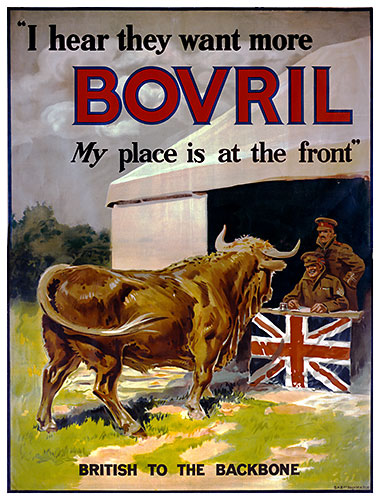


23SassyLassy
There was always Bovril (and Marmite) in the kitchen cupboard at home when I was a child. The closest it's allowed in my own house is the decoration on a mug. Great images and a good explanation of sapping.
24VivienneR
Great advertisements! My mother was a great admirer of Bovril. I hated it - but still use Marmite, similar, but a different product, and vegetarian.
25edwinbcn
In 2004, Unilever, the owner of the brand changed the formula. Now, Bovril is plant-based and essentially vegetarian.
26Helenliz
Whereas Marmite is yeast poo and banned in several countries...
Bovril has its place, but it has to be Marmite on toast.
Bovril has its place, but it has to be Marmite on toast.
27VivienneR
>25 edwinbcn: According to Wikipedia, the 2004 recipe change was reversed and they are back to using beef extract. Yeast poo or not, I'll stay with Marmite or the Australian Vegemite.
28mabith
1914: The Year the World Ended by Paul Ham
This is a very well done primer to how WWI started and the course of battle within 1914 (the war itself started in late July with the western front being formed in early August). The first third of the book covers the years prior to 1914, the various alliances and treaties, the stress points, and it gives a strong focus on what was actually going on between Austria-Hungary and Serbia.
Ham's writing is immensely readable, and while he may not evoke as emotional a response as say, Barbara Tuchman, that's not necessarily a bad thing. The information was clear and organized, and he covers various common perceptions of the war and whether or not they're accurate. He gives only overviews of the battles, rather than detailed coverage, so those with a military history phobia need not fear.
Highly recommended, certainly a good one for people who will only read a few books about the war. While this was largely a refresher for me, Ham put emphasis on slightly different events and relationships, viewing some events from a different angle than many books or going into deeper coverage of communications between the countries, so I recommend it to the WWI completest as well.
This is a very well done primer to how WWI started and the course of battle within 1914 (the war itself started in late July with the western front being formed in early August). The first third of the book covers the years prior to 1914, the various alliances and treaties, the stress points, and it gives a strong focus on what was actually going on between Austria-Hungary and Serbia.
Ham's writing is immensely readable, and while he may not evoke as emotional a response as say, Barbara Tuchman, that's not necessarily a bad thing. The information was clear and organized, and he covers various common perceptions of the war and whether or not they're accurate. He gives only overviews of the battles, rather than detailed coverage, so those with a military history phobia need not fear.
Highly recommended, certainly a good one for people who will only read a few books about the war. While this was largely a refresher for me, Ham put emphasis on slightly different events and relationships, viewing some events from a different angle than many books or going into deeper coverage of communications between the countries, so I recommend it to the WWI completest as well.
29timjones
>15 edwinbcn:, >16 Helenliz:, >17 mabith:: Her intermittent snobbery riled me too, but Testament of Youth is the first volume of a trilogy, the remaining volumes being Testament of Friendship and Testament of Experience - so I thought I wouldn't judge her on that until/unless I read the two succeeding books.
The review of 1914: The Year the World Ended reminds me that Solzhenitsyn's August 1914, which I read far too long ago to review now, is a vivid depiction of the early months of the war from a Russian perspective.
The review of 1914: The Year the World Ended reminds me that Solzhenitsyn's August 1914, which I read far too long ago to review now, is a vivid depiction of the early months of the war from a Russian perspective.
30AnnieMod
I was not planning to read anything about WWI this year - not as a goal anyway. Until I accidentally got my hands on this No Man's Land: Fiction from a World at War - which i had been dabbing at the last few days. The biggest problem of course is that I want to go and read most of the full works - and some of them are not fully translated into English... While the cover lists the most popular writers (well... it needs to be sold, right?), the table of contents tells a totally different story and the introduction is plainly describing what had been attempted - as many countries as possible covered, as much coverage as possible.

