This topic is currently marked as "dormant"—the last message is more than 90 days old. You can revive it by posting a reply.
1edwinbcn

Dangling Man published in 1944 was Saul Bellow literary debut novel. Relatively weak in way of plot, the novel forms a characterization of Bellow's generation of American writers and intellectuals coming of age during the era of the Great Depression.
2SassyLassy

Dangling Man by Saul Bellow
first published 1944
Joseph is the dangling man of the title. Caught in December 1942 between his initial 1A draft status and induction, he is neither in the civilian world nor the military world. His job is behind him, his service ahead, and so he waits.
An intelligent man, surrounded by unread books "guarantors of an extended life, far more precious and necessary than the one I was forced to live daily", he found himself unable to read. He was unable to continue with his essay writing either. Instead, he began a journal, a place where he could talk to himself in his demoralized state.
Joseph and his wife Iva lived in a rooming house; not a particularly unusual circumstance in 1940s Chicago, but one which circumscribed his world. Iva went out to work each day. Joseph went out three times a day for his meals. In between, he worked at not being idle, all the while becoming more solitary and isolated.
As a Canadian living in the US, and so at that time a British subject, Joseph was considered a "friendly alien" by the draft board. As he waited for the necessary investigation to be completed, as his friends moved on with their lives while he dangled, the description became more and more apt. Joseph started having angry outbursts, provoking puzzled and then angry reactions from his family and friends. As his inner turmoil deepened, he separated himself from his earlier incarnation, holding dialogues with him. His earlier self asks
If you're not alienated, why do you quarrel with so many people? I know you're not a misanthrope. Is it because they recognize that you belong to their world?
The book takes the form of Joseph's journal. As such, it is necessarily episodic. It also means that we only learn what Joseph is willing to reveal. Gradually the reader learns of earlier episodes of jealousy and betrayal. We never learn Joseph's last name, a device which maintains his insignificance. Even his bank manager addresses him as Joseph, "... as though I were an immigrant or a young boy or a Negro", denying him any validity.
Winter turned to spring. On a visit back to his parents' home and his old room, he reflected on the passage of time.
Recently I had begun to feel old, and it occurred to me that I might be concerned with age merely because I might never attain any great age, and that there might be a mechanism in us that tried to give us all of life when there was danger of being cut off. And while I knew it was absurd for me to think of my "age", I had apparently come to a point where the perspectives of time appeared far more contracted than they had a short while ago. I was beginning to grasp the meaning of "irretrievable".
Joseph realized he "...had not done well alone" Could anybody though? This was Bellow's question. Joseph had to leave his room. Leaving solitary rooms does put a person's fate in the hands of external forces, but does it cancel freedom, as Joseph believed?
3StevenTX
Dangling Man by Saul Bellow
First published 1944
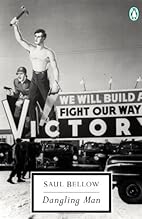

In Chicago in 1942 a young man named Joseph applies for induction into the Army. Anticipating a quick enlistment, he quits his job. But his Canadian birth proves to be a problem for the Army. His application is deferred and, month after month, he is left dangling. He can't get his job back--or any job--because of his imminent induction, so he starts keeping a diary as he lives precariously off his wife's meager income.
Joseph is an intellectual, a former communist, and an introspective man of strong feelings. He also has more than his share of personal pride, and being an able-bodied man unemployed during wartime puts an enormous chip on his shoulder. "I feel I am a sort of human grenade whose pin has been withdrawn," he writes. "I know I am going to explode and I am continually anticipating the time...." Joseph's diary alternates between accounts of his short-tempered run-ins with wife, family, friends and neighbors and calm ruminations on the purpose of life itself. In particular he muses on the contradictory expectations of our personal and social selves. "Great pressure is brought to bear to make us undervalue ourselves," he writes, "On the other hand civilization teaches that each of us is an inestimable prize."
Dangling Man was Saul Bellow's first novel, and the author himself has described it as an "apprentice work." Like many first novels it shows a lack of patience by the author as he launches straight into direct statements of his ideas without developing them through characters and plot. Plot, in fact, is minimal. What we see is largely Joseph's gradual emotional deterioration as he awaits his induction. His philosophical self-examination never provides him with the solace he seeks, only with questions he can't answer. On the plus side, Joseph, despite his short fuse, is one Bellow's more appealing protagonists. And the novel provides a vivid picture of life in the boarding houses that were home to many urban Americans before and during World War II. This was the life that so many veterans were eager to put behind them in the great suburban building boom that followed the war.
First published 1944

In Chicago in 1942 a young man named Joseph applies for induction into the Army. Anticipating a quick enlistment, he quits his job. But his Canadian birth proves to be a problem for the Army. His application is deferred and, month after month, he is left dangling. He can't get his job back--or any job--because of his imminent induction, so he starts keeping a diary as he lives precariously off his wife's meager income.
Joseph is an intellectual, a former communist, and an introspective man of strong feelings. He also has more than his share of personal pride, and being an able-bodied man unemployed during wartime puts an enormous chip on his shoulder. "I feel I am a sort of human grenade whose pin has been withdrawn," he writes. "I know I am going to explode and I am continually anticipating the time...." Joseph's diary alternates between accounts of his short-tempered run-ins with wife, family, friends and neighbors and calm ruminations on the purpose of life itself. In particular he muses on the contradictory expectations of our personal and social selves. "Great pressure is brought to bear to make us undervalue ourselves," he writes, "On the other hand civilization teaches that each of us is an inestimable prize."
Dangling Man was Saul Bellow's first novel, and the author himself has described it as an "apprentice work." Like many first novels it shows a lack of patience by the author as he launches straight into direct statements of his ideas without developing them through characters and plot. Plot, in fact, is minimal. What we see is largely Joseph's gradual emotional deterioration as he awaits his induction. His philosophical self-examination never provides him with the solace he seeks, only with questions he can't answer. On the plus side, Joseph, despite his short fuse, is one Bellow's more appealing protagonists. And the novel provides a vivid picture of life in the boarding houses that were home to many urban Americans before and during World War II. This was the life that so many veterans were eager to put behind them in the great suburban building boom that followed the war.
Join to post

