Swynn reads and runs in 2016: Lap 2
This is a continuation of the topic Swynn reads and runs in 2016.
This topic was continued by Swynn reads and runs in 2016: Lap 3.
Talk 75 Books Challenge for 2016
Join LibraryThing to post.
This topic is currently marked as "dormant"—the last message is more than 90 days old. You can revive it by posting a reply.
1swynn
Expect a mixture of the following, in decreasing density:
Science fiction and fantasy
Crime & mystery novels
Popular history (American, mostly)
Popular science
Library science/history of the book
Math
Also, I tend to read impulsively so there will also be not necessarily categorizable things that happen capture my attention.
I got about halfway through the 50-states challenge last year, and hope to finish the tour this year. That thread is here.
A few things to expect in this second thread:
Nearing the halfway mark, I note that I've read very few DAWs this year: this is mostly because the next one (#88) is a sequel of sorts to Jack Vance's "Dying Earth" series, which I haven't even started, and which keeps getting crowded off my reading list. I hope to get to that very soon, then back to the DAWs.
For the same reason I have stalled on John Norman's Gor series. "Hope" probably isn't the right term here, but I expect to pick that up again.
The Hugo ballot has been available for awhile and voting has opened. I'll report at least on the novels, and probably comment on the shorter works as well.
Regardless of plans, priority usually goes to things that must be returned to the library. This is a stack generated more by whim & hope than by plan, which I call "The Tower of Due." Here's what it looks like now:






Science fiction and fantasy
Crime & mystery novels
Popular history (American, mostly)
Popular science
Library science/history of the book
Math
Also, I tend to read impulsively so there will also be not necessarily categorizable things that happen capture my attention.
I got about halfway through the 50-states challenge last year, and hope to finish the tour this year. That thread is here.
A few things to expect in this second thread:
Nearing the halfway mark, I note that I've read very few DAWs this year: this is mostly because the next one (#88) is a sequel of sorts to Jack Vance's "Dying Earth" series, which I haven't even started, and which keeps getting crowded off my reading list. I hope to get to that very soon, then back to the DAWs.
For the same reason I have stalled on John Norman's Gor series. "Hope" probably isn't the right term here, but I expect to pick that up again.
The Hugo ballot has been available for awhile and voting has opened. I'll report at least on the novels, and probably comment on the shorter works as well.
Regardless of plans, priority usually goes to things that must be returned to the library. This is a stack generated more by whim & hope than by plan, which I call "The Tower of Due." Here's what it looks like now:


2swynn
This year's reads:
(1) A Net of Dawn and Bones / C. R. Chancy
(2) The Lady of the Decoration / Francis Little
(3) Killing Titan / Greg Bear
(4) The Remedy / Thomas Goetz
(5) The Bodelan Way / Louis Trimble
(6) Ink and Bone / Rachel Caine
(7) Gun Monkeys / Victor Gischler
(8) Our Only World / Wendell Berry
(9) The Hanged Man / P.N. Elrod
(10) Running With the Buffaloes / Chris Lear
(11) One Foot in Eden / Ron Rash
(12) The Providence of Fire / Brian Staveley
(13) Cycle of Nemesis / Kenneth Bulmer
(14) The Traitor Baru Cormorant / Seth Dickinson
(15) A Girl of the Limberlost / Gene Stratton-Porter
(16) Where / Kit Reed
(17) The Innovators / Walter Isaacson
(18) Indexing / Seanan McGuire
(19) Zeroes / Chuck Wendig
(20) Agent to the Stars / John Scalzi
(21) Pre / Tom Jordan
(22) Submission / Michel Houellebecq
(23) Mr. Crewe's Career / Winston Churchill
(24) Jani and the Greater Game / Eric Brown
(25) The Red : First Light / Linda Nagata
(26) Keeper / Greg Rucka
(27) Novelist to a Generation / Robert W. Schneider
(28) The Book of Fritz Leiber / Fritz Leiber
(29) Leviathan Wakes / James S. A. Corey
(30) The Barrier / Rex Beach
(31) The Fever / Megan Abbott
(32) The Long Way Home / David Laskin
(33) The Trials / Linda Nagata
(34) In the Heart of the Sea / Nathaniel Philbrick
(35) The Grendel Affair / Lisa Shearin
(36) Make It Stick / Peter C Brown et al.
(37) The Inner Shrine / Basil King
(38) Ancillary Mercy / Ann Leckie
(39) Zero World / Jason M. Hough
(40) Libricide / Rebecca Knuth
(41) Updraft / Fran Wilde
(42) Bury Me Deep / Megan Abbott
(43) The Burning Dark / Adam Christopher
(44) Graceland / Chris Abani
(45) A God That Could Be Real / Nancy Abrams
(46) Zombie Baseball Beatdown / Paolo Bacigalupi
(47) Going Dark / Linda Nagata
(48) The Water Knife / Paolo Bacigalupi
(49) Finder / Greg Rucka
(50) A Symphony of Echoes / Jodi Taylor
(51) Part of Our Lives / Wayne Wiegand
(52) Mr. Splitfoot / Samantha Hunt
(53) Indexing : Reflections / Seanan McGuire
(54) Stiff / Mary Roach
(55) Trail of the Lonesome Pine / John Fox, Jr.
(56) The Bone Clocks / David Mitchell
(57) Koningsmarke, the Long Finne / James Kirke Paulding
(58) A Great and Terrible Beauty / Libba Bray
(59) Hell at the Breech / Tom Franklin
(60) The Heart Healers / James Forrester
(61) The Rosary / Florence L. Barclay
(62) Anna Karenina / Leo Tolstoy
(63) Alan Turing : the Enigma / Andrew Hodges
(64) The 5th Wave / Rick Yancey
(65) Blood and Salt / Kim Liggett
(66) Days of Darkness / John Ed Pearce
(67) The Dragon Conspiracy / Lisa Shearin
(68) Life or Death / Michael Robotham
(69) Fergus Crane / Paul Stewart and Chris Riddell
(70) The Children's Blizzard / David Laskin
(71) This Census-Taker / China Miéville
(72) Becoming Abigail / Chris Abani
(73) Mortality / Christopher Hitchens
(74) The Broad Highway / Jefferey Farnol
(75) Seeker / Arwen Elys Dayton
(76) The Witches: Salem, 1692 / Stacy Schiff
(77) Pump Six / Paolo Bacigalupi
(78) City of Blades / Robert Jackson Bennett
(79) The New Year's Owl / Susan Hand Shetterly
(80) The Pagan Night / Tim Akers
(81) So You've Been Publicly Shamed / Jon Ronson
(82) A Modern Chronicle / Winston Churchill
(83) Caliban's War / James S.A. Corey
(84) Shots Fired / C.J. Box
(85) Razzle Dazzle / Michael Riedel
(86) The Immortal Irishman / Timothy Egan
(87) Disclaimer / Reneé Knight
(88) The Harvester / Gene Stratton Porter
(89) Wizards, Aliens, and Starships / Charles L. Adler
(90) Arabel's Raven / Joan Aiken
(91) The Fifth Season / N.K. Jemisin
(92) Keep Mars Weird / Neil Pollack
(93) The Fifth Gospel / Ian Caldwell
(94) Uprooted / Naomi Novik
(95) The Secret History of Las Vegas / Chris Abani
(96) The Aeronaut's Windlass / Jim Butcher
(97) The Heckler / Ed McBain
(98) Seveneves / Neal Stephenson
(99) Luke Skywalker Can't Read and Other Geeky Truths
(100) Corby Flood / Paul Stewart
(101) The Inside of the Cup / Winston Churchill
(102) The Catonsville Nine / Shawn Francis Peters
(103) Traveler / Arwen Elys Dayton
(104) The Geek Feminist Revolution / Kameron Hurley
(105) The Bath Massacre / Arnie Bernstein
(106) Bootlegger's Daughter / Margaret Maron
(107) Bold Spirit / Linda Lawrence Hunt
(108) The Eyes of the World / Harold Bell Wright
(109) Shotgun Arcana / R.S. Belcher
(110) Father and Son / Larry Brown
(111) The Deep Sea Diver's Syndrome / Serge Brussolo
(112) How to Bake π / Eugenia Cheng
(113) The Girl In Between / Laekan Zea Kemp
(114) Barefoot in Babylon / Robert Stephen Spitz
(115) Jani and the Great Pursuit / Eric Brown
(116) From Eve to Evolution / Kimberly A. Hamlin
(117) What Is Not Yours Is Not Yours / Helen Oyeyemi
(118) The Mathematician's Shiva / Stuart Rojstaczer
(119) Edge of Dark / Brenda Cooper
(120) Trailer Park Fae / Lilith Saintcrow
(121) The Turmoil / Booth Tarkington
(122) The Girl Who Circumnavigated Fairyland in a Ship of Her Own Making / Cathrynne M. Valente
(123) Engraved on the Eye / Saladin Ahmed
(124) Three Parts Dead / Max Gladstone
(125) NeuroTribes / Steve Silberman
(126) Dodgers / Bill Beverly
(127) A Far Country / Winston Churchill
(128) A Darker Shade of Magic / V.E. Schwab
(129) Quite Ugly One Morning / Christopher Brookmyre
(130) Nuclear Nebraska / Susan Cragin
(131) Shadow Child / Joseph Citro
(132) Seventeen / Booth Tarkington
(133) A Gathering of Shadows / V.E. Schwab
(134) 13 Drops of Blood / James Roy Daley
(1) A Net of Dawn and Bones / C. R. Chancy
(2) The Lady of the Decoration / Francis Little
(3) Killing Titan / Greg Bear
(4) The Remedy / Thomas Goetz
(5) The Bodelan Way / Louis Trimble
(6) Ink and Bone / Rachel Caine
(7) Gun Monkeys / Victor Gischler
(8) Our Only World / Wendell Berry
(9) The Hanged Man / P.N. Elrod
(10) Running With the Buffaloes / Chris Lear
(11) One Foot in Eden / Ron Rash
(12) The Providence of Fire / Brian Staveley
(13) Cycle of Nemesis / Kenneth Bulmer
(14) The Traitor Baru Cormorant / Seth Dickinson
(15) A Girl of the Limberlost / Gene Stratton-Porter
(16) Where / Kit Reed
(17) The Innovators / Walter Isaacson
(18) Indexing / Seanan McGuire
(19) Zeroes / Chuck Wendig
(20) Agent to the Stars / John Scalzi
(21) Pre / Tom Jordan
(22) Submission / Michel Houellebecq
(23) Mr. Crewe's Career / Winston Churchill
(24) Jani and the Greater Game / Eric Brown
(25) The Red : First Light / Linda Nagata
(26) Keeper / Greg Rucka
(27) Novelist to a Generation / Robert W. Schneider
(28) The Book of Fritz Leiber / Fritz Leiber
(29) Leviathan Wakes / James S. A. Corey
(30) The Barrier / Rex Beach
(31) The Fever / Megan Abbott
(32) The Long Way Home / David Laskin
(33) The Trials / Linda Nagata
(34) In the Heart of the Sea / Nathaniel Philbrick
(35) The Grendel Affair / Lisa Shearin
(36) Make It Stick / Peter C Brown et al.
(37) The Inner Shrine / Basil King
(38) Ancillary Mercy / Ann Leckie
(39) Zero World / Jason M. Hough
(40) Libricide / Rebecca Knuth
(41) Updraft / Fran Wilde
(42) Bury Me Deep / Megan Abbott
(43) The Burning Dark / Adam Christopher
(44) Graceland / Chris Abani
(45) A God That Could Be Real / Nancy Abrams
(46) Zombie Baseball Beatdown / Paolo Bacigalupi
(47) Going Dark / Linda Nagata
(48) The Water Knife / Paolo Bacigalupi
(49) Finder / Greg Rucka
(50) A Symphony of Echoes / Jodi Taylor
(51) Part of Our Lives / Wayne Wiegand
(52) Mr. Splitfoot / Samantha Hunt
(53) Indexing : Reflections / Seanan McGuire
(54) Stiff / Mary Roach
(55) Trail of the Lonesome Pine / John Fox, Jr.
(56) The Bone Clocks / David Mitchell
(57) Koningsmarke, the Long Finne / James Kirke Paulding
(58) A Great and Terrible Beauty / Libba Bray
(59) Hell at the Breech / Tom Franklin
(60) The Heart Healers / James Forrester
(61) The Rosary / Florence L. Barclay
(62) Anna Karenina / Leo Tolstoy
(63) Alan Turing : the Enigma / Andrew Hodges
(64) The 5th Wave / Rick Yancey
(65) Blood and Salt / Kim Liggett
(66) Days of Darkness / John Ed Pearce
(67) The Dragon Conspiracy / Lisa Shearin
(68) Life or Death / Michael Robotham
(69) Fergus Crane / Paul Stewart and Chris Riddell
(70) The Children's Blizzard / David Laskin
(71) This Census-Taker / China Miéville
(72) Becoming Abigail / Chris Abani
(73) Mortality / Christopher Hitchens
(74) The Broad Highway / Jefferey Farnol
(75) Seeker / Arwen Elys Dayton
(76) The Witches: Salem, 1692 / Stacy Schiff
(77) Pump Six / Paolo Bacigalupi
(78) City of Blades / Robert Jackson Bennett
(79) The New Year's Owl / Susan Hand Shetterly
(80) The Pagan Night / Tim Akers
(81) So You've Been Publicly Shamed / Jon Ronson
(82) A Modern Chronicle / Winston Churchill
(83) Caliban's War / James S.A. Corey
(84) Shots Fired / C.J. Box
(85) Razzle Dazzle / Michael Riedel
(86) The Immortal Irishman / Timothy Egan
(87) Disclaimer / Reneé Knight
(88) The Harvester / Gene Stratton Porter
(89) Wizards, Aliens, and Starships / Charles L. Adler
(90) Arabel's Raven / Joan Aiken
(91) The Fifth Season / N.K. Jemisin
(92) Keep Mars Weird / Neil Pollack
(93) The Fifth Gospel / Ian Caldwell
(94) Uprooted / Naomi Novik
(95) The Secret History of Las Vegas / Chris Abani
(96) The Aeronaut's Windlass / Jim Butcher
(97) The Heckler / Ed McBain
(98) Seveneves / Neal Stephenson
(99) Luke Skywalker Can't Read and Other Geeky Truths
(100) Corby Flood / Paul Stewart
(101) The Inside of the Cup / Winston Churchill
(102) The Catonsville Nine / Shawn Francis Peters
(103) Traveler / Arwen Elys Dayton
(104) The Geek Feminist Revolution / Kameron Hurley
(105) The Bath Massacre / Arnie Bernstein
(106) Bootlegger's Daughter / Margaret Maron
(107) Bold Spirit / Linda Lawrence Hunt
(108) The Eyes of the World / Harold Bell Wright
(109) Shotgun Arcana / R.S. Belcher
(110) Father and Son / Larry Brown
(111) The Deep Sea Diver's Syndrome / Serge Brussolo
(112) How to Bake π / Eugenia Cheng
(113) The Girl In Between / Laekan Zea Kemp
(114) Barefoot in Babylon / Robert Stephen Spitz
(115) Jani and the Great Pursuit / Eric Brown
(116) From Eve to Evolution / Kimberly A. Hamlin
(117) What Is Not Yours Is Not Yours / Helen Oyeyemi
(118) The Mathematician's Shiva / Stuart Rojstaczer
(119) Edge of Dark / Brenda Cooper
(120) Trailer Park Fae / Lilith Saintcrow
(121) The Turmoil / Booth Tarkington
(122) The Girl Who Circumnavigated Fairyland in a Ship of Her Own Making / Cathrynne M. Valente
(123) Engraved on the Eye / Saladin Ahmed
(124) Three Parts Dead / Max Gladstone
(125) NeuroTribes / Steve Silberman
(126) Dodgers / Bill Beverly
(127) A Far Country / Winston Churchill
(128) A Darker Shade of Magic / V.E. Schwab
(129) Quite Ugly One Morning / Christopher Brookmyre
(130) Nuclear Nebraska / Susan Cragin
(131) Shadow Child / Joseph Citro
(132) Seventeen / Booth Tarkington
(133) A Gathering of Shadows / V.E. Schwab
(134) 13 Drops of Blood / James Roy Daley
4swynn
Since Tuesday last week I've been on vacation in Colorado Springs to celebrate my nephew's high school graduation. So my reviews are about a half-dozen titles behind. I hope to catch up in the next few days, starting with this one:

73) Mortality / Christopher Hitchens
This is a collection of Hitchens's thoughts on the experience of being diagnosed with and undergoing treatment for terminal cancer. As you would expect from Hitchens it is eloquent, trenchant, witty, painful, and much too short.

73) Mortality / Christopher Hitchens
This is a collection of Hitchens's thoughts on the experience of being diagnosed with and undergoing treatment for terminal cancer. As you would expect from Hitchens it is eloquent, trenchant, witty, painful, and much too short.
5swynn
RUNNING POST
While in Colorado Springs I ran the Palmer Lake Trail Half Marathon. Finished in a disappointing 2:21, but all things considered I'm calling it probably about what I should have expected. By "all things considered" I mean that the day was unexpectedly warm; the terrain was hillier than I'd prepared for (duh, right?); and I failed to carry my own hydration, which brought on some cramping late in the race. All of which could have been addressed by preparing more wisely.
Gripes and self-admonitions aside, there's nowhere in Missouri that can beat the scenery along the front range of the Rockies. So if I walked some that's fine because it's a fine place to walk.
Target races now are a triathlon in September and the Tulsa Marathon in November.
While in Colorado Springs I ran the Palmer Lake Trail Half Marathon. Finished in a disappointing 2:21, but all things considered I'm calling it probably about what I should have expected. By "all things considered" I mean that the day was unexpectedly warm; the terrain was hillier than I'd prepared for (duh, right?); and I failed to carry my own hydration, which brought on some cramping late in the race. All of which could have been addressed by preparing more wisely.
Gripes and self-admonitions aside, there's nowhere in Missouri that can beat the scenery along the front range of the Rockies. So if I walked some that's fine because it's a fine place to walk.
Target races now are a triathlon in September and the Tulsa Marathon in November.
6ronincats
Happy New Thread, Steve!
I remember last year when you read all the short fiction as well as the novels. I am only aiming at reading the novels before the awards. Can't remember if I already said this. I've read Uprooted and The Aeronaut's Windlass and really liked both of them. The Fifth Season, Ancillary Mercy and Seveneves are here in my tbr pile.
I remember last year when you read all the short fiction as well as the novels. I am only aiming at reading the novels before the awards. Can't remember if I already said this. I've read Uprooted and The Aeronaut's Windlass and really liked both of them. The Fifth Season, Ancillary Mercy and Seveneves are here in my tbr pile.
8swynn
>3 qebo: Welcome the new, Katherine!
>6 ronincats: Of The novels I have only read Ancillary Mercy so far, so the others I'll get to soon. I look forward to your comments on them as well.
>7 Kassilem: Thanks Melissa!
>6 ronincats: Of The novels I have only read Ancillary Mercy so far, so the others I'll get to soon. I look forward to your comments on them as well.
>7 Kassilem: Thanks Melissa!
9ursula
>5 swynn: Are you also from somewhere with that sort of elevation? My friend's husband (they're British) went to Denver on a business trip and said he had "the worst run ever" - I asked if he'd been prepared for the elevation and he said "what?" He had never heard it was the mile-high city and all the flatness didn't give any visual clues. :)
10scaifea
Happy new thread, Steve! I'm demonstrably not a runner, but I do like the idea of that Rockies view...
11PaulCranswick
Happy new thread Steve; second thread and running of course.
12swynn
>9 ursula: Elevation was certainly a factor. For the first couple of miles you can't seem to take a breath quite deep enough, and even after you get used to that the effort required is higher for the same amount of work. (This could be partly psychological, but I did a couple of shorter runs while wearing a heart rate monitor, and am convinced my heart rate was 5-10 beats higher than it would have been at sea level.) The elevation probably also affected hydration. But these are things I knew about when I signed up, and could have managed better.
>10 scaifea: Thanks, Amber! The view was definitely fantastic. Here's Palmer Lake:

>11 PaulCranswick: Thanks Paul! And welcome to the new thread.
>10 scaifea: Thanks, Amber! The view was definitely fantastic. Here's Palmer Lake:

>11 PaulCranswick: Thanks Paul! And welcome to the new thread.
13scaifea
>12 swynn: Ooof, but that's lovely.
14ursula
>12 swynn: Oh, I totally know. I used to live in Denver. :) Which meant that going to sea level made it seem suddenly easy! I just wouldn't enjoy going the other direction.
16swynn
>14 ursula: Yeah, the standard advice is "Train high, race low" so I'm doing it backwards :)
>15 MickyFine: Thanks and welcome, Micky!
>15 MickyFine: Thanks and welcome, Micky!
17swynn
74) The Broad Highway / Jeffery Farnol
This is 1911's bestseller and a marked improvement over the previous two chart-toppers. It's another romance, sort of, but I'll cut it considerable slack for being so many other things besides, including fun.
We begin with the death of George Vibart, a wealthy old man who has among other things supported his nephew Peter Vibart in a life of leisure and the acquisition of a superfluous and impractical classical education. (Um, don't hit me Amber. That's the plot.) The old man's will leaves to Peter ten guineas, plus half a million pounds if Peter can convince the legendary beauty Lady Sophia Sefton to marry him. The same offer is extended to Peter's dangerous rascal of a cousin Maurice Vibart.
Peter knows he has no chance of wooing Lady Sophia, and accepts his narrowed circumstances with easy grace. He pockets the change, and takes off for an extended walking vacation. Over the next few chapters he loses the few guineas remaining, meets several colorful characters, and is repeatedly mistaken for some unidentified and dangerous rascal. Eventually he finds he must settle down and take up a trade if he wishes to eat regularly. Through luck Peter acquires a forest home which everyone else believes to be haunted; and through cleverness he secures an apprenticeship to a jovial and occasionally violent blacksmith.
The romantic interest shows up only halfway through: the lovely Charmian, fleeing for her virtue from a dangerous rascal who happens to be the spitting image of Peter Vibart. If you think you've figured out the rest of the plot, then you're right: it takes Peter a bit longer to sort out secret identities but let's not be too harsh -- after all, we have the advantage of knowing how Regency romances work. From here the story slows down and turns romancey but if it's occasionally syrupy it's also still surprisingly fun, as Peter's book-learned notions about femininity founder on the confident and capable reality that is "Charmian."
It's not going to turn me into a fan of Regency (or any other sort of) romance. But it's several stars better than the last couple of bestsellers and I'm calling it a pleasant surprise.
This is 1911's bestseller and a marked improvement over the previous two chart-toppers. It's another romance, sort of, but I'll cut it considerable slack for being so many other things besides, including fun.
We begin with the death of George Vibart, a wealthy old man who has among other things supported his nephew Peter Vibart in a life of leisure and the acquisition of a superfluous and impractical classical education. (Um, don't hit me Amber. That's the plot.) The old man's will leaves to Peter ten guineas, plus half a million pounds if Peter can convince the legendary beauty Lady Sophia Sefton to marry him. The same offer is extended to Peter's dangerous rascal of a cousin Maurice Vibart.
Peter knows he has no chance of wooing Lady Sophia, and accepts his narrowed circumstances with easy grace. He pockets the change, and takes off for an extended walking vacation. Over the next few chapters he loses the few guineas remaining, meets several colorful characters, and is repeatedly mistaken for some unidentified and dangerous rascal. Eventually he finds he must settle down and take up a trade if he wishes to eat regularly. Through luck Peter acquires a forest home which everyone else believes to be haunted; and through cleverness he secures an apprenticeship to a jovial and occasionally violent blacksmith.
The romantic interest shows up only halfway through: the lovely Charmian, fleeing for her virtue from a dangerous rascal who happens to be the spitting image of Peter Vibart. If you think you've figured out the rest of the plot, then you're right: it takes Peter a bit longer to sort out secret identities but let's not be too harsh -- after all, we have the advantage of knowing how Regency romances work. From here the story slows down and turns romancey but if it's occasionally syrupy it's also still surprisingly fun, as Peter's book-learned notions about femininity founder on the confident and capable reality that is "Charmian."
It's not going to turn me into a fan of Regency (or any other sort of) romance. But it's several stars better than the last couple of bestsellers and I'm calling it a pleasant surprise.
19swynn
... and here it is:
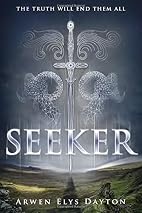
75) Seeker / Arwen Elys Dayton
Teenager Quinn has training all her life to join the "Seekers", a secret clan of super-commandos fighting for justice. But after her initiation she learns that the Seekers' original purpose had been corrupted: she has just sworn allegiance to a pack of killers for hire.
The writing isn't any better than it has to be, but the characters are interesting and the plot snaps right along. I will read the next.
75) Seeker / Arwen Elys Dayton
Teenager Quinn has training all her life to join the "Seekers", a secret clan of super-commandos fighting for justice. But after her initiation she learns that the Seekers' original purpose had been corrupted: she has just sworn allegiance to a pack of killers for hire.
The writing isn't any better than it has to be, but the characters are interesting and the plot snaps right along. I will read the next.
27swynn

76) The Witches : Salem, 1692 / Stacy Schiff
Sometimes unmet expectations can be a good thing. Katherine and Julia both read this new history of the Salem witch trials with unenthusiastic responses, which lowered my expectations to where I nearly let it die in the Someday Swamp. But I needed a Massachusetts read, and I had a long train ride last week, so I gave it a shot.
And darn it, I liked it.
It's far from perfect. I agree with Katherine's feeling that there were too many trees and not enough forest: Schiff throws so many colonial-Massachusetts anecdotes at you, sometimes relevant and sometimes maybe not, that it's hard to see the larger picture. For that matter it's sometimes hard to see whether Schiff has a larger picture in mind at all. I also agree partially with Julia's frustration with Schiff when she presents folktales -- like witches flying through the sky on poles for late-night meetings with dark devil-men -- as if they really happened. Schiff's habit of presenting superstition as history is indeed sometimes distracting. Also, Schiff's writing style is too self-indulgent and needs to be turned down a notch or ten; and she seems to have included every thought that occurred to her right down to footnotes citing similar situations from popular literature. With everything else Schiff stuffs in this book, Harry Potter quotes aren't needed even among the details that Aren't needed.
Oh and: she cites sources in the footnotes that she doesn't list in the bibliography. Bad form.
So it's not always easy going. But one thing I found Schiff did well, and that is to show the perspective of colonial Massachusetts. The mystery with the Salem witch trials, as Schiff points out, is not that some people claimed to have witch powers (or claimed to be victims of witch powers); but that so many others *believed* them. Schiff establishes seventeenth-century Salem as a paranoid, desperate, half-rational, litigious, God-soaked frontier; and she argues that in this context the hysteria over witchcraft almost makes sense. For me the argument was persuasive, and Schiff's voluminous detail helped make the argument, and even her technique of presenting supernatural rumors as fact -- because from the perspective of a hypervigilant Puritan such rumors might as well have been facts.
So: mixed feelings on this one, but I found it more interesting than annoying. But I don't think I'd have liked it as well had my expectations been higher.
28qebo
>27 swynn: Similar assessment with different weightings. I was reading it for a book group, so I had to force a pace to finish in time. The perspective could have been established with a more filtered selection of events. I did wonder about the history of the legal system, as people seem to have great difficulty separating facts from all the other stuff going on inside our heads.
29swynn
>28 qebo: The luxury of leisure certainly helped: I'd have liked it a lot less if I had felt pressure to finish. At any pace, though, finer filters would have helped too.
And yeah, the legal bits were very interesting as the process seemed to reinforce problems that it should have been correcting.
And yeah, the legal bits were very interesting as the process seemed to reinforce problems that it should have been correcting.
30rosylibrarian
>27 swynn: Hmmm. I had rather high hopes for that one.
Congrats on hitting 75 so early in the year! I am envious. According to Goodreads I am 3 books behind in my tempo.
Congrats on hitting 75 so early in the year! I am envious. According to Goodreads I am 3 books behind in my tempo.
31swynn
>30 rosylibrarian: Thanks Marie! If The Witches sounds intriguing, I'd recommend you go ahead & give it a try. We've certainly seen a range of reactions here among the 75ers!
32swynn

77) Pump Six and Other Stories / Paolo Bacigalupi
A collection of stories -- mostly strong ones -- by the author of The Windup Girl and The Water Knife. My favorites are the title story, The Calorie Man and The Yellow Card Man -- though The Fluted Girl sticks with me too.
Pocketful of Dharma. A homeless kid living on the streets of Chengdu, China, comes into possession of a portable storage device which turns out to house the downloaded personality (and trapped soul) of the Dalai Lama. I found this the weakest story in the book.
The Fluted Girl. Told from the perspective of a servant girl who has been surgically altered to become a musical instrument. Effectively disturbing, though I found the ending unsatisfying.
The People of Sand and Slag. A squad of soldiers finds something living in a post-apocalyptic wasteland where nothing can survive. The something turns out to be a dog, and they have to decide what to do with it.
The Pasho. A kid returns from university to his hometown, where his friends and family accuse him of forgetting his roots. But he has forgotten nothing.
The Calorie Man. Set in the world of The Windup Girl, where the world's food supply is controlled by agro-tech companies who have engineered pathogens that kill all crops other than their own. In this story, a crop thief masquerading as a junk man hunts down a missing researcher who may be able to break the companies' stranglehold.
The Tamarisk Hunter. This one seems to be set in the same world as The Windup Knife, and follows a man paid by the State of California to find and destroy water-sucking tamarisk plants along the Colorado River.
Pop Squad. Pharmaceutical advances have made most people practically immortal. To control population new births are outlawed, but some people find the lure of children irresistible. This story follows an enforcement officer charged with finding and eliminating illegal persons.
Yellow Card Man. Another set in the world of The Windup Girl. The hero of this one was once a successful businessman in China, but is now a refugee desperately seeking subsistence wages in Thailand.
Softer. Psychological thriller about a man who kills his wife for no particular reason and without any real plan for doing so, and with no plan for what to do afterward.
Pump Six. A sewage worker discovers that the pumps that keep the city's toilets working are overdue for maintenance. Problem is, nobody is available to service them: parts are not available, the manufacturer has been out of business for years, nobody knows how the pumps work anymore, and engineering is a dead profession.
33swynn

78) City of Blades / Robert Jackson Bennett
Follow-up to the terrific City of Stairs, set in a world turned upside down: once upon a time not that long ago, the Continent ruled Saypur with the help of supernatural beings they called gods. But a generation ago a Saypurian hero discovered how to kill the gods, without whose support the Continent was helpless. The ensuing war lay waste to the Continent; now it is Saypur who is the occupying power and the Continent practically its colony.
In this one, the Saypuri General Mulagesh, recently retired after events of the first book, is called back into service. She is sent to the remote continental city of Voortyashtan, to find a Saypuri agent who went missing while investigating a newly discovered ore that can be crafted into a perfect electrical conductor and just may have divine origin. Of course, the truth turns out to be worse than anybody fears.
This is a worthy follow-up and quite fun. Jim (drneutron) found it even better than City of Stairs but I'm going to have to disagree. There were a few style issues that bothered me: for example, Bennett frequently uses the word "vivisected" when he means "bisected" or "disected." (Or better yet, "cut in pieces.") Big deal? Nope. But City of Stairs was so damn near perfect that a book can fall short of that standard and still be very very good. City of Blades is just(?!?) very very good. Recommended.
34swynn
BTW, for those who were interested in the very fun science-fiction action romp Zero World: the ebook is currently available for two bucks!
35drneutron
>33 swynn: Nice review! Your critique is right on. I connected with Blades better than Stairs, though, so came away with more love for it.
36swynn
>35 drneutron: Thanks, Jim! We agree that they are both excellent reads. I wonder whether we can expect another one, and if so, how soon?
37drneutron
There's supposed to be a third with Sigrud as the main character, but I have no idea when it'll be out.
38rosalita
>27 swynn: I'm glad you didn't let my criticisms of The Witches stop you from reading it. I always worry a bit about turning people off of books they will actually enjoy.
39swynn
>37 drneutron: There's supposed to be a third with Sigrud as the main character, ...
Excellent! I predict that will end well for ... well, nobody but the reader. Must control my expectations.
>38 rosalita: I'm glad I didn't too. But I did appreciate your comments, and can see how you had that reaction. No worries!
Excellent! I predict that will end well for ... well, nobody but the reader. Must control my expectations.
>38 rosalita: I'm glad I didn't too. But I did appreciate your comments, and can see how you had that reaction. No worries!
40swynn

79) The New Year's Owl / Susan Hand Shetterly
Rob and I chose Maine. It is a serious place. Why farm a woodlot here if you can get an acre or two of black Pennsylvania loam or an easy tract of river valley along the Ohio? I suspect that even back in the 1700s some people came to Maine for the same reason we did: land was cheap. All it took, we told ourselves, was brute, young strength and a willingness to shed the trappings of a life we no longer trusted.
This is a collection of essays, mostly on themes of human connection to wildlife and the environment, by Susan Shetterly, a farmer, a wild bird rehabilitator, and a very good writer. Each of the essays is accompanied by at least one woodcut illustration by her husband Robert Shetterly. My favorite essays are the ones that describe her experiences with wildlife rehabilitation: the story of her daughter volunteering to raise three orphaned raccoon cubs; the story of the lame robin prancing about on a splinted leg; the title essay, in which Shetterly in her husband are on their way to a New Year's Eve party when a stranger presents them with an injured owl having a compound fracture of its wing. But other essays are also absorbing, like the one where Shetterly explores the ecology of a barrier island:
Coatue lies like an old bone against the island of Nantucket. Narrow and sharp, its sands shifting under the wind or with the water, it shields Nantucket Harbor from the northeast. The harbor water is gentled somewhat by its protection and, in turn, it protects plants and animals that could not survive the assault of the Sound. The waves that lap at Coatue's harbor flute its edges, carving a series of six points and six half-circle coves. Across the sand, Nantucket Sound never calms. That water has no time for scenic coves. It lifts huge piles of sand and drives them up in a hump on the shore or takes them away so that they seem to vanish. But suddenly, underwater, they appear elsewhere as a shoal.
The book is small, not so much short as compact. Shetterly chooses her phrases carefully and packs her sentences, inviting and rewarding slow reading. Recommended for others who like this sort of thing.
41swynn

80) The Pagan Night / Tim Akers
Horrible cover but the story's not bad. It involves a conflict between two cultures, one conquered by the other in an earlier war and incompletely assimilated. The dominant Suhdrin have all but eliminated the old Pagan religions, until bad actors among the Suhdrin discover a way to revive the old Pagan gods and bend them to their own purposes.
The first third of the book is spent in worldbuilding and laying the foundation for the conflict, but so much of this is done through hints and oblique references to past events that the pacing feels torpid. Once the action starts though, it comes furiously with backstabbing, blow-by-blow combat, and scary monsters. This will probably appeal mostly to those who enjoy the genre already (which includes me). I'll read the next, due early next year.
42swynn

81) So You've Been Publicly Shamed / Jon Ronson
Jon Ronson interviews people whose lives have been ruined by public shaming. The interviewees' offenses are various, ranging from breaches of professional ethics to lame attempts at edgy jokes -- and in one case an attempt to publicly shame a white guy who made a lame attempt at an edgy joke. I've enjoyed Ronson's other work for a light, snarky view of his subjects, and this one is similar: it rarely scratches the surface of it subject but it is entertaining.
The most intriguing news to me from Ronson's book is critique of the Stanford Prison Experiment-- the one where college students were placed in a simulated prison environment, some students playing prisoners and some playing guards. The standard narrative is that the "guards" became so cruelly authoritarian that the experiment had to be stopped for ethical concerns. Except that may not be exactly what happened: some participants recall that there was really only one "guard" who went over the top, and that "guard" claims to have deliberately provoked incidents in order to give the experimenters something to work with. It probably didn't make much difference to the "prisoners" he was abusing, but it may make a difference to the experimenter's conclusions about the psychological or sociological basis for what was happening. The Wikipedia article indicates that the experiment has been criticized on several points; I had no idea that the experimenters' conclusions were not universally accepted.
43ursula
>42 swynn: Oh yes, criticism for Zimbardo abounds. But I would believe that's more well-known when you live in the area.
44swynn
>43 ursula: Probably so. It's also not my field, so my understanding even of the standard narrative is probably more popular than accurate. Oh, the things one learns from books!
46swynn
>45 lyzard: It's a bad habit I'll try to avoid in the future. Now back to the Winston Churchill novel ...
47lyzard
Not Gene Stratton-Porter? Tsk!
BTW, I'll be listing The Harvester in #3. We have mushrooms, repeat, we have mushrooms...
BTW, I'll be listing The Harvester in #3. We have mushrooms, repeat, we have mushrooms...
48swynn
>47 lyzard: No free version of The Harvester online, so I had to request it from another library. It just arrived last week and I *will* read it before the month is out.
But must finish A Modern Chronicle. Imagine The Custom of the Country written by an author with no sense of humor, no ear for dialogue, and little talent for characterization, and who can't decide whether he wants to be a satirist or a moralist. If I don't finish it now while I have a little momentum, then I never will.
But must finish A Modern Chronicle. Imagine The Custom of the Country written by an author with no sense of humor, no ear for dialogue, and little talent for characterization, and who can't decide whether he wants to be a satirist or a moralist. If I don't finish it now while I have a little momentum, then I never will.
49lyzard
:D
I look forward to your review!
(And delighted to see you using The Custom Of The Country as a yardstick...)
I look forward to your review!
(And delighted to see you using The Custom Of The Country as a yardstick...)
51swynn
>49 lyzard: It struck me strongly as a response to The Custom of The Country, down to use of the phrase:
It was the Vicomte who, springing to his feet, replied nimbly: "Mademoiselle has been teaching me much of the customs of your country."
But, no. Since Churchill's book was completed in 1909, and Wharton's published in 1913 he could hardly have been responding to that. Though he and Wharton may have been having a literary conversation; the Bookman review of Churchill's book compared it unfavorably to The House of Mirth. But if one was a response to the other, it would have to have been Wharton showing Churchill how it's done.
(If you're reading this, Bill: that's correct, worse than The House of Mirth.)
>50 tymfos: Thanks, Terri
It was the Vicomte who, springing to his feet, replied nimbly: "Mademoiselle has been teaching me much of the customs of your country."
But, no. Since Churchill's book was completed in 1909, and Wharton's published in 1913 he could hardly have been responding to that. Though he and Wharton may have been having a literary conversation; the Bookman review of Churchill's book compared it unfavorably to The House of Mirth. But if one was a response to the other, it would have to have been Wharton showing Churchill how it's done.
(If you're reading this, Bill: that's correct, worse than The House of Mirth.)
>50 tymfos: Thanks, Terri
52swynn
82) A Modern Chronicle / Winston Churchill
Spoilers follow.
Honora Leffington is the orphaned daughter of an American diplomat, raised in St. Louis by her middle-class uncle and aunt. Honora dreams of a more extravagant life, and marries Howard Spence, a New York stockbroker whom she trusts to carry her to the lap of luxury. Hugh turns out to be less ambitious than she hoped, but by her own prompting and connections, she uses him to acquire the comforts and social position she desires. But alas! Howard is a neglectful husband and thinks only of finance. Slowly Honora begins to realize that wealth and society are not making her happy. Desperate for company, Honora flirts with playboy Trixton Brent, an even wealthier and infamous ladies' man who gives her attention and rides in his motor-car and arranges business opportunities for Howard. Brent is straightforward about his intentions toward Honora but she rebuffs his advances. Then one afternoon on one of their excursions Brent's car breaks down, putting Honora in a position where her yes or no will make no difference to her reputation. By quick thinking Honora manages to escape with her virtue intact, but her husband's indifferent reaction to the situation shows her that Howard cares nothing about Honora's risking a bad name if only it enhances his prospects. Honora flees New York, finished with Brent and Howard both.
Enter Hugh, an old-money man with an infamous reputation. Hugh's temperament is less flamboyant and more broody. Honora falls in love with him for reasons unclear to me -- unless it's the attraction of dangerous broody men who insist they've been changed forever by the power of love. Honora decides that her first marriage, for money, was a mistake; that she must get a divorce and marry this time for love. Unfortunately for Honora divorce not so easy to get. The best she can do is establish residence in "a Western state" with lenient divorce laws. After her exile in (one assumes) Nevada, Honora marries Hugh and settles in to wedded bliss. But her second marriage is stormy. Hugh's neighbors and family reject his marriage to a divorcee and treat Honora with contempt. This worsens Hugh's moody disposition, and though he claims still to love her he becomes increasingly withdrawn and his behavior erratic and dangerous. Eventually he is killed in a riding accident.
Honora retreats to Paris, where she resolves never to marry again until she meets up with a childhood friend who has loved her all his life; Honora has always thought of him as a friend but he was neither the rising financier she though she wanted the first time, nor the dramatic lover she wanted the second time. Yet the love they do have seems to be the stuff of happily ever after all.
Churchill's characters are rarely memorable, and this book is full of no exceptions. Honora herself is not remotely interesting enough to carry a novel, though every man she encounters either proposes marriage or wishes they could. She's spoiled for choice with respect to seeking happiness through marriage but consistently chooses poorly then frets about the fate she's suffering. And boy does she fret: the language of feelings and relationships is thick and fervent.
For those who have been following Churchill, there are some continuities with his previous works. Honora's first husband makes money off of shady speculation in railroads, as do the villains in Coniston; and her third husband is a lawyer in the office of "that most celebrated of St. Louis practictioners, Judge Stephen Brice," presumably the hero of The Crisis. And thematically, Churchill blames Honora's first marriage on industrial society and its obsession with material gain. These have been growing concerns through Coniston and Mr. Crewe's Career.
This is my least favorite of Churchill's works so far. There are a few nice descriptive passages, but it's mostly a bore. But I wasn't expecting much: from Schneider's biography I knew that this was the first of Churchill's social problem novels and marks the beginning of the decline in his popularity. With good reason, I say. Not recommended for pleasure reading.
Spoilers follow.
Honora Leffington is the orphaned daughter of an American diplomat, raised in St. Louis by her middle-class uncle and aunt. Honora dreams of a more extravagant life, and marries Howard Spence, a New York stockbroker whom she trusts to carry her to the lap of luxury. Hugh turns out to be less ambitious than she hoped, but by her own prompting and connections, she uses him to acquire the comforts and social position she desires. But alas! Howard is a neglectful husband and thinks only of finance. Slowly Honora begins to realize that wealth and society are not making her happy. Desperate for company, Honora flirts with playboy Trixton Brent, an even wealthier and infamous ladies' man who gives her attention and rides in his motor-car and arranges business opportunities for Howard. Brent is straightforward about his intentions toward Honora but she rebuffs his advances. Then one afternoon on one of their excursions Brent's car breaks down, putting Honora in a position where her yes or no will make no difference to her reputation. By quick thinking Honora manages to escape with her virtue intact, but her husband's indifferent reaction to the situation shows her that Howard cares nothing about Honora's risking a bad name if only it enhances his prospects. Honora flees New York, finished with Brent and Howard both.
Enter Hugh, an old-money man with an infamous reputation. Hugh's temperament is less flamboyant and more broody. Honora falls in love with him for reasons unclear to me -- unless it's the attraction of dangerous broody men who insist they've been changed forever by the power of love. Honora decides that her first marriage, for money, was a mistake; that she must get a divorce and marry this time for love. Unfortunately for Honora divorce not so easy to get. The best she can do is establish residence in "a Western state" with lenient divorce laws. After her exile in (one assumes) Nevada, Honora marries Hugh and settles in to wedded bliss. But her second marriage is stormy. Hugh's neighbors and family reject his marriage to a divorcee and treat Honora with contempt. This worsens Hugh's moody disposition, and though he claims still to love her he becomes increasingly withdrawn and his behavior erratic and dangerous. Eventually he is killed in a riding accident.
Honora retreats to Paris, where she resolves never to marry again until she meets up with a childhood friend who has loved her all his life; Honora has always thought of him as a friend but he was neither the rising financier she though she wanted the first time, nor the dramatic lover she wanted the second time. Yet the love they do have seems to be the stuff of happily ever after all.
Churchill's characters are rarely memorable, and this book is full of no exceptions. Honora herself is not remotely interesting enough to carry a novel, though every man she encounters either proposes marriage or wishes they could. She's spoiled for choice with respect to seeking happiness through marriage but consistently chooses poorly then frets about the fate she's suffering. And boy does she fret: the language of feelings and relationships is thick and fervent.
For those who have been following Churchill, there are some continuities with his previous works. Honora's first husband makes money off of shady speculation in railroads, as do the villains in Coniston; and her third husband is a lawyer in the office of "that most celebrated of St. Louis practictioners, Judge Stephen Brice," presumably the hero of The Crisis. And thematically, Churchill blames Honora's first marriage on industrial society and its obsession with material gain. These have been growing concerns through Coniston and Mr. Crewe's Career.
This is my least favorite of Churchill's works so far. There are a few nice descriptive passages, but it's mostly a bore. But I wasn't expecting much: from Schneider's biography I knew that this was the first of Churchill's social problem novels and marks the beginning of the decline in his popularity. With good reason, I say. Not recommended for pleasure reading.
53swynn

83) Caliban's War / James S.A. Corey
This is a fun follow-up to the fun fun Leviathan Wakes, a welcome change from the stuffy #82.
It's hard to describe without spoilers to the first book, so I'll just say: more of the same, which is mostly a good thing. Though the story's structure is a little too similar, so I'm hoping for a little more narrative variety in book 3. Which I will definitely read.
54weird_O
>51 swynn: Oh good! And thanks for striking a loser from my TBR list. I've got enough good books on hand to keep me happily reading for another decade.
See I was reading...
See I was reading...
55ronincats
I have Leviathan Wakes in the TBR pile--I keep meaning to get to it!
57swynn

84) Shots Fired / C. J. Box
This is a collection of short stories by the author of the "Joe Pickett" mystery/thriller series. These are mostly crime stories set mostly in Wyoming, some of them featuring characters from the Pickett series. They're not bad, but none of them stood out for me.
58swynn

85) Razzle Dazzle / Michael Riedel
A new history of Broadway focused on the Shubert Organization, which dominated Broadway production through the 20th century. Riedel argues that the Shubert Organization (and Shubert Foundation, the nonprofit that owns it if I understand the relationship correctly) have actually saved Broadway-- from financial scandals and downturns, from dwindling ticket sales, and from urban development projects. And by saving Broadway the Organization's leaders have helped New York recover from problems of crime and bankruptcy. (Riedel claims that the theater district accounts for 10% of the city's revenue. I find this nearly unbelievable, but assume that he has looked at the numbers while I haven't.)
My knowledge of Broadway is severely limited; what experience I have of musical theater is gained mostly from movies and local productions. Still, I found this account engaging and enlightening. Broadway buffs will probably find even more to like.
59swynn

86) The Immortal Irishman / Timothy Egan
Biography of Thomas Meagher (which I understand is pronounced "Mahr"), a revolutionary in Ireland during the potato famine, an exiled prisoner in Tasmania, and then a Civil War general and territorial governor in the United States. The fellow got around. Egan is up to the task of following Meagher's fascinating life, and uses it as a way to explore the Irish experience. He's prone to an occasional melodramatic flourish, but the material lends itself to that. Recommended.
60MickyFine
>59 swynn: Glad to hear that one is good as I've ordered it in a bunch of different formats for work. :)
61swynn
>60 MickyFine: Excellent! I hope a few of your patrons enjoy it as much as I did.
62swynn

87) Disclaimer / Renée Knight
The "disclaimer" of the title refers to the standard one you see in novels that any resemblence to persons living or dead is coincidental. In this thriller a woman finds a novel where the disclaimer is clearly false: the story is not only about her, but narrates events from years ago that she thought she had kept safely secret. In alternate chapters we also follow the thoughts of the novel's originator who is determined that the story be made public, especially if it ruins the woman's life.
I have mixed feelings. The story is okay, and the pacing is nice, and the characters are convincingly motivated. But the structure depends on a technique that I find annoying: withholding information known to a viewpoint character. It's not a whodunit or a howdunit or a willtheygitim but a whattheheckhappened; the protagonist knows exactly what happened, and though we're treated to her thoughts throughout, we're informed of the mystery only in measured tiny bits. This is just coyness on the author's part, and feels manipulative.
I picked this up for Donna's (dallenbaugh) TIOLI challenge to read a book nominated for the Old Peculier Crime Writing Award. This is a nominee for the 2016 award, so I assume others have enjoyed it more than I did.
63rosalita
>59 swynn: I really enjoy Egan's work. I'll have to look for this one.
64brodiew2
>59 swynn: I'll be looking for this one, too. It sounds interesting and could be even better in audio form.
65swynn
>64 brodiew2: I do think it would work well in audio form. Egan has done a good bit of research, but it doesn't feel especially academic, and he doesn't rely on footnotes, maps, or charts. Hope you like it when you find it!
66swynn

88) The Harvester / Gene Stratton-Porter
Back in February I read A Girl of the Limberlost. I enjoyed it for the setting, less for the characters and Pollyannish plot. I'm glad I to have Limberlost already read, because I felt that its enjoyable qualities outweighed its faults but after reading The Harvester I don't think I could have been persuaded to give it a try.
David Langston, the Harvester of the title, is an eccentric recluse (based, says the author, on H.D. Thoreau) living in the Limberlost region. The Harvester makes a living from the land by gathering medicinal roots and herbs from the forest and selling them to pharmaceutical companies. This trade has made him a fortune, for which he cares not a fig because it is his joy to live alone in the forest. On a lark The Harvester adopted a ritual of asking his dog Belshazzar once a year whether he should move to the city and whether he should seek a wife. The dog has faithfully answered both negatively year after year, until the opening of the book when Bel indicates that he should marry. The Harvester is first outraged at the suggestion, but then has a vision of a beautiful woman whose kiss convinces him that maybe the right woman wouldn't be so awful after all. The book follows The Harvester as he finds, woos, and wins the woman of his vision.
Frankly, I didn't care. The hero comes off as an obsessed eccentric tending toward creepy-stalkerish, while the heroine is empty of any personality other than physical beauty. Like Limberlost, the naturalistic exposition is excellent while the characters and setting are weak, but here the enjoyable qualities don't win out for me. The admittedly appealing setting is unfortunately dominated by the romance between a flaky hero and his insipid love interest.
So this one doesn't get an endorsement from me. But then romance is not an appealing genre to me in general, so my negative response to this romance may mean that in fact it's a pretty good one. Who am I to judge? (Well, I *have* read The Rosary, and am 99% confident this is better than that.)
I'll mention a couple of themes that were more interesting than the romance. The Harvester tries to express a few times his ideas about a natural religion which holds that a mysterious creative force generates the world by evolution. The specific ideas don't resonate with me, but I'm a little surprised that an American bestseller in 1912 could so explicitly endorse heterodox theology.
Another theme is "clean living," of which there is probably enough talk to feed a graduate thesis. I'm a little puzzled by the way the characters value dirt and outdoor work on one hand, and constantly talk about cleanliness, clean bodies, and clean living on the other.
67lyzard
S-E-X, my boy. "Clean living" means not being dirty, not not being dirty. :D
That aspect of the book is a rebuttal to the 19th century view that adult men had to have very regular sex, or they would develop all sorts of weird nervous afflictions and eventually collapse in a gibbering, twitching heap. This belief - or "belief" - underlay the refusal to do anything about prostitution, and conversely forced "nice" women to look the other way while their husbands screwed around (because a man had to have sex but no gentlemen would ask his wife to degrade herself so often, so...) Watching a female author trying to argue on a "forbidden" topic like that was the most interesting aspect of the book for me. :)
That aspect of the book is a rebuttal to the 19th century view that adult men had to have very regular sex, or they would develop all sorts of weird nervous afflictions and eventually collapse in a gibbering, twitching heap. This belief - or "belief" - underlay the refusal to do anything about prostitution, and conversely forced "nice" women to look the other way while their husbands screwed around (because a man had to have sex but no gentlemen would ask his wife to degrade herself so often, so...) Watching a female author trying to argue on a "forbidden" topic like that was the most interesting aspect of the book for me. :)
68swynn
Well, dang, that flew right over my head. I thought it was something about hygiene. Which I guess it was, but .... Never mind.
Now I'm puzzled about something brand new: valorizing evolution while demonizing sex. She does know how it works, right? I suppose there's some kind of eugenical argument buried there.
Now I'm puzzled about something brand new: valorizing evolution while demonizing sex. She does know how it works, right? I suppose there's some kind of eugenical argument buried there.
69lyzard
I don't think she's demonising sex per se, but rather the dangers of casual / bought sex---and the specious arguments in its favour. David's speech amounts to, "I'm a twenty-six year old virgin and I'm just fine." Presumably his mother made him promise to wait until he was married to a "good" girl, steering clear of the city and its venereal temptations---hence Ruth's "purity" is more important than her personality, sigh.
I was amused that GSP went so far, but didn't dare really tackle the female point of view. I cut her a teensy bit of slack for the inference of "women don't know what love really is until they're married", though---i.e. yes, good girls like sex too. :D
I was amused that GSP went so far, but didn't dare really tackle the female point of view. I cut her a teensy bit of slack for the inference of "women don't know what love really is until they're married", though---i.e. yes, good girls like sex too. :D
70swynn
> 69 Well, that doesn't add much to the book's appeal but it does make it more interesting. It would also have been interesting if the explanation had turned out to be some early twentieth century health fad like ritual handwashing or the water cure, but I expect yours is the right one. I look forward to your commnts.
71lyzard
Oh, the whole book's basically about sex, if you read it from a particular angle. Which no doubt contributed to its best-seller status. :D
Uh, yeah, I wouldn't hold my breath, if I were you: I'm just a tad behind with my reviews...
Uh, yeah, I wouldn't hold my breath, if I were you: I'm just a tad behind with my reviews...
72swynn

89) Wizards, Aliens, and Starships / Charles L. Adler
I knew I was in good hands from page 1, where the author reminisces about his youthful fondness for science fiction:
The worlds these stories portrayed, where space travel was common, human problems such as poverty were nearly eliminated, and conflicts centered on larger-than-life issues, always seemed to me more compelling than human dramas that revolved around why someone didn't love someone else.
With ya, man.
This is a "science behind the science fiction" book, written by a physics professor. There are other books like it but what makes this one stand out is its shameless enthusiasm about the math (equations abound) and a strong familiarity with the literature, both fiction and nonfiction. There's an excellent bibliography you can use to track down papers on Dyson spheres and nuclear pulse engines if you love this stuff enough to do so.
The news is not good for fans who'd like these dreams to be reality: you're probably not getting a flying car; manned missions to Mars are probably impractical; space colonies are prohibitively expensive; terraforming Mars is a pipe dream; and interstellar travel, well, bad news, it ain't happening. (Not with humans aboard anyway; unmanned interstellar travel is known to be feasible because the Voyager probes are already doing it.)
But for those readers who wonder just what it might take to get to the stars or to set up a space colony, Charles Adler is your geeky friend who steps you through back-of-the-envelope calculations then points you to where you can find more details.
He opens with a chapter about fantasy worlds, thinking how the Harry Potter and Harry Dresden series are more or less believable or internally consistent. This section strikes me as weak: sure, Peter Pettigrew's transformation into a rat violates conservation laws but it's not clear to me that they actually apply. Observing that Hogwarts would be awfully dark despite the light of thousands of magical candles only begs the definition of "magical." Adler acknowledges that fantasy stories aren't necessarily expected to follow natural laws, and for my taste that acknowledgement is all that needs saying.
Fortunately, Adler gets into the good stuff about 60 pages in: why computers get better and cars don't; economics of space tourism and space habitats; physics of space elevators and propulsion systems; likelihood of life on other planets; likelihood of advanced civilizations on other planets; how planets work; feasibility of large-scale construction projects like Dyson spheres or ringworlds. There are other books that go into more detail on any of these subjects, and many of them show up in the bibliography. But as an enthusiastic survey, I can't think of a book that beats this one.
Highly recommended for its audience. You know whether you're part of it.
73swynn

90) Arabel's Raven / Joan Aiken
My 10-year-old niece is visiting for a few weeks, and I'm enjoying reading bedtime stories again since my son has finally decided he's outgrown them. (Which: toss that. If someone offered to read *me* bedtime stories I'd accept approximately immediately. Anyway ...)
I love this book, about the terrifically sensible Arabel and her charmingly naughty stair- and streetlight-eating pet raven. Each time I read it, it seems more brilliant than the last. And my niece is especially dear to me for giving me an excuse to read it again. I'm happy to report that she also appreciates it. It had us both giggling uncontrollably.
And those Quentin Blake illustrations: brilliant.
74MickyFine
>73 swynn: That one sounds charming. I'll have to keep it in mind for when my niece gets older.
75rosalita
>72 swynn: Highly recommended for its audience. You know whether you're part of it.
Then I suspect I am not part of it. I mean, the concept sounds awesome but if most of the book is a lot of math that I wouldn't actually understand, it probably wouldn't be much fun to read for me. But I love the idea!
Then I suspect I am not part of it. I mean, the concept sounds awesome but if most of the book is a lot of math that I wouldn't actually understand, it probably wouldn't be much fun to read for me. But I love the idea!
76swynn
>74 MickyFine: Of course, it wouldn't hurt to practice .... :)
>75 rosalita: There is a lot of math, mostly algebra. The author says his target audience is "Science fiction enthusiasts who have a decent knowledge of algebra and know what calculus means." I'd say at least a semester of calculus would be very helpful, since differentials pop up a few times.
If it sounds interesting you might pick it up from the library anyway and give it a try. I'd call it "cautiously recommended." Skimming the math you'd probably still come away with some interesting insights. But I think you'd find yourself skimming a lot.
>75 rosalita: There is a lot of math, mostly algebra. The author says his target audience is "Science fiction enthusiasts who have a decent knowledge of algebra and know what calculus means." I'd say at least a semester of calculus would be very helpful, since differentials pop up a few times.
If it sounds interesting you might pick it up from the library anyway and give it a try. I'd call it "cautiously recommended." Skimming the math you'd probably still come away with some interesting insights. But I think you'd find yourself skimming a lot.
77rosalita
>76 swynn: Yeah, I probably would be skimming a lot. That's OK, not every book is for everyone. I still love the idea that someone wrote this for those of you who do love math and science fiction.
78scaifea
>73 swynn: Oh, I LOVE Quentin Blake! Must track this one down...
79swynn
>77 rosalita: Yeah, for that audience it's perfect.
>78 scaifea: Hope you like it when you do, Amber!
>78 scaifea: Hope you like it when you do, Amber!
80swynn

91) The Fifth Season / N.K. Jemisin
First in a fantasy trilogy, set in a geologically active world where some magic-users are able to draw power from and control faults in the earth And it's very good. This is the first I've read of Jemisin's work but I really want to read her next. Thank you Hugo ballot for making me pick this up.
81ronincats
Ah, glad you like it. I thought it quite good, although this is the first of her books where there was not a complete story within the book.
82swynn
>81 ronincats: I did like it very much. And no, it's not complete but it is a satisfying first act.
83swynn

92) Keep Mars Weird / Neal Pollack
Science fiction satire about a future in which Earth is globally socialized and Mars a capitalist utopia. Two slackers leave Earth for the Mars city of New Austin, only to discover that Mars is less a free-market paradise than an plutocracy built on slave labor. They end up on different sides of a revolution.
I found it just okay: fun but not as clever as it was trying to be. But that may just be my frame of reference. I suspect that there are many Austin in-jokes that flew over my head. Texans may find it more appealing.
84porch_reader
The Fifth Season sounds interesting, Steve. I've been in the mood for some fantasy lately. And the premise of Keep Mars Weird seems sound (plus, I love the title) - too bad it didn't quite come together.
85swynn
>84 porch_reader: The Fifth Season would be an excellent choice, Amy. My only caution is Roni's: if you liked it (and I'd hope you would), you'd find yourself committed to two more volumes. The second volume is out next month, but there'll be a wait for book 3.
And yeah, too bad about Keep Mars Weird but then humor is hard.
And yeah, too bad about Keep Mars Weird but then humor is hard.
86swynn

93) The Fifth Gospel / Ian Caldwell
Early in The Fifth Gospel our hero and a friend sneak into the Vatican's Secret Library. The friend explains that the Vatican has "embedded" radio-frequency chips "into the binding" of all their manuscripts, and he demonstrates this technology right there in the stacks. Now, as someone who thinks about RFID from time to time I have a few thoughts:
1. Hey, I read a news story a couple of years ago about the Vatican Library adopting RFID. Nice touch.
2. Oh no they didn't put those RFID stickers on irreplaceable manuscripts.
3. Wait a minute. This story is set in 2004. The Vatican only just adopted RFID. Looks like an anachronism.
So I went looking for stories about the Library's adoption of radio-frequency tags. (Seriously, it would have bothered me if I hadn't.) There are more stories about that than anyone not a librarian might expect. When it comes to details the stories are ... um ... surprisingly diverse, but they agree that the Vatican Library does use RFID on at least some manuscripts: in fact some stories mention that the Library chose RFID *because* it wouldn't damage their rare materials -- which has to mean that they're not using the stickers/labels of every other implementation I've seen. Pricey, no doubt, but then I suppose the Vatican can afford state-of-the-art. (If you're reading this Your Eminences I'd really love a tour.)
But here's the real takeaway: all the stories are circa 2004, not "a couple of years ago." Which means that I have reached an age where "a couple of years ago" sometimes means "twelve or more." Damn. Let's think about something else. Well, according to the reports, the Library began its tagging project with high-demand materials in its public collections, of which they had tagged 30,000-50,000 volumes by end 2004. Based on these stories, it seems unlikely that the Secret Library holdings would already be tagged for our story. [Smug harrumph.] So there's that. ... I mean, twelve years. Man. Youth gone and librarian senses still tingling, I carry on.
This is a thriller set in Vatican City near the end of John Paul II's papacy and was nominated this year for a Thriller Award. It involves secrecy, intrigue and violence surrounding the Shroud of Turin and a newly rediscovered manuscript of Tatian's Diatesseron, a second-century harmony of the gospels. It's not bad. There are a number of annoyances and plot holes, the denouement drags on too long, and I have a huge problem with the resolution. But I liked the historical speculation, the scholarly setting, and the Vatican politics. I also liked the relationship between the hero and his young son -- who comes across as neither too precocious nor too infantile. On balance I enjoyed it and call it cautiously recommended.
87MickyFine
>86 swynn: A+ for the librarian-ing around RFIDs. I love picking up books that involve libraries/librarians but half the time I end up nitpicking about the stuff that is wrong. :P
88swynn
>87 MickyFine: Me too, Micky. Stories with libraries -- what a mix of anticipation and dread.
89rosalita
>87 MickyFine: & >88 swynn: I know it's not really the same type of librarian story, but have either of you read Ink and Bone? I'd love to know what librarians think of the general concept.
90MickyFine
>89 rosalita: I haven't but it's on The List (which I've basically ignored this year but we won't talk about that).
91rosalita
>90 MickyFine: Lists are made to be ignored! Well, mine are, anyway. :-)
92swynn
>89 rosalita: I liked it. I'm fuzzy on details, but I remember rolling eyes over the cataloging process which was very fast and magical. But considering the context ... fantasy stories get some slack because I figure things that don't make immediate sense may have in-world explanations.
93rosalita
>92 swynn: I know exactly what you mean — I remember thinking "geez, I wish I could catalog my books on LT that quickly!" I liked it because it really made me think about what it means to own a book, and how we do or do not separate the physical object with the content. Every year I read more and more of my books as ebooks on my Kobo, so I found that aspect of it very interesting.
95scaifea
>86 swynn: Love this review. Love it!
>87 MickyFine: >88 swynn: And this is why I generally stay clear of books set in the ancient world. Gah.
>87 MickyFine: >88 swynn: And this is why I generally stay clear of books set in the ancient world. Gah.
96rosylibrarian
>86 swynn: Great review. I agree with the "couple of years" ago thing. I always think the 90s happened ten years ago instead of 20.
>87 MickyFine: What Micky said!
>89 rosalita: I read that one, and thought it a good read. I haven't heard great things about the sequel so I'm debating whether to pick it up or not.
>87 MickyFine: What Micky said!
>89 rosalita: I read that one, and thought it a good read. I haven't heard great things about the sequel so I'm debating whether to pick it up or not.
97rosalita
>96 rosylibrarian: Oh, that's too bad about the sequel. I was hoping it would be as good as Ink and Bone, but at the same time it's hard to picture a scenario that would be as compelling so perhaps it's understandable that it falls short.
98swynn
>93 rosalita: Yeah, the content v. carrier thing is huge, especially in our new environment where you can purchase content with hardly any carrier at all. Library catalogers have recently adopted new rules that attempt to address content and carrier in a more consistent way; the jury's still out on how successful they are.
>94 drneutron: Hope you like it Jim!
>95 scaifea: Thanks! And yeah ... we each have our geekdoms don't we?
>96 rosylibrarian: Well, rats about the sequel. Still, it'll probably show up here sometime after the Hugo list clears.
>94 drneutron: Hope you like it Jim!
>95 scaifea: Thanks! And yeah ... we each have our geekdoms don't we?
>96 rosylibrarian: Well, rats about the sequel. Still, it'll probably show up here sometime after the Hugo list clears.
99swynn
And speaking of the Hugo list, here's another nominee for best novel:
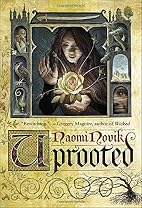
94) Uprooted / Naomi Novik
This is a fantasy inspired by Russian folktales. It involves a village girl who becomes a sort of indentured servant to a wizard, and finds she has some powerful magic of her own. Which is a good thing, because something in the woods is angry and dangerous.
This is my first Novik book, and I liked it. I did have a few issues: I'm not fond of the YA trope where an untrained hero does stuff purely by instinct and does it better than trained and seasoned professionals; there seem to be inconsistencies in how magic works; and the ending feels rushed. Still, the writing was excellent and I loved the antagonist. So it's recommended, but won't top my ballot, which so far is:
The Fifth Season / N.K. Jemisin
Ancillary Mercy / Anne Leckie
Uprooted / Naomi Novik
Two more to go.
94) Uprooted / Naomi Novik
This is a fantasy inspired by Russian folktales. It involves a village girl who becomes a sort of indentured servant to a wizard, and finds she has some powerful magic of her own. Which is a good thing, because something in the woods is angry and dangerous.
This is my first Novik book, and I liked it. I did have a few issues: I'm not fond of the YA trope where an untrained hero does stuff purely by instinct and does it better than trained and seasoned professionals; there seem to be inconsistencies in how magic works; and the ending feels rushed. Still, the writing was excellent and I loved the antagonist. So it's recommended, but won't top my ballot, which so far is:
The Fifth Season / N.K. Jemisin
Ancillary Mercy / Anne Leckie
Uprooted / Naomi Novik
Two more to go.
100ronincats
You might not find The Aeronaut's Windlass to be the best of the bunch, but I bet you have a lot of fun with its worldbuilding--very enjoyable. I'm struggling with Seveneves right now--interesting, hard sf, but with typical Stephenson dry digressions into the science.
101rosylibrarian
>97 rosalita: >98 swynn: Well, that's just word on the street. It may actually be a decent sequel.
102swynn
>100 ronincats: I'm a little wary of The Aeronaut's Windlass. I've only heard good about it, but after Skin Game -- which I thought was bloated and rambling, like the work of a successful author whose editor figures why waste time, it's gonna sell like hotcakes anyway -- my expectations are low. So it could be a nice surprise, I hope so.
On the other hand, I've heard mixed things about Seveneves but have higher expectations because my experience with Neal Stephenson has been positive. I hope it works for me better than it sounds for you.
>101 rosylibrarian: Well, there's only one way to find out. Fortunately it's also my preferred method.
On the other hand, I've heard mixed things about Seveneves but have higher expectations because my experience with Neal Stephenson has been positive. I hope it works for me better than it sounds for you.
>101 rosylibrarian: Well, there's only one way to find out. Fortunately it's also my preferred method.
103rosalita
>101 rosylibrarian: >102 swynn: Agree with Steve. You didn't deter me from reading the sequel but perhaps you've appropriately lowered my expectations to a manageable level, which is always useful.
104swynn

95) The Secret History of Las Vegas / Chris Abani
Gothic noir detective thriller by Nigerian author Chris Abani. A few years ago in Las Vegas, a series of body dumps mystified local police. The victims were all homeless men, the perpetrator never caught. The detective in the case, Lieutenant Salazar, is about to retire but wants to solve the mystery before he goes.
While the case was active Salazar was assisted in his investigation by Dr. Sunil Singh, a South African immigrant and research psychiatrist working for a government lab. Unknown to Salazar, but known to Singh -- and to the reader very early in the story, so I'm pretty sure this isn't a spoiler -- it is Singh's employer who who dumped the bodies, used test subjects for its R&D. Singh is no newcomer to complicity in government atrocities, having worked with the secret police in the Apartheid government.
What opens the case again is the arrest of two sideshow performers, whose connection to the case is the very slimmest of threads but who offer Salazar an opportunity for closure. Meanwhile, Singh's history is literally hunting him down for revenge.
It may seem odd for a Nigerian novelist to be writing an American setting with American literary tropes. But it doesn't seem odd for long. Abani draws surprising and rich parallels between American and African problems. For example:
Vegas is really an African city, Sunil thought. What other imagination would build such a grandiose tomb to itself? And just like in every major city across Africa, from Cairo to his hometown of Johannesburg, the palatial exteriors of the city architecture barely screened the seething poverty, the homelessness, and the despair that spread in townships and shantytowns as far as the eye could see. But just as there, here in Vegas the glamour beguiled and blinded all but those truly intent on seeing, and in this way the tinsel of it mocked the obsessive hope of those who flocked here.
It's not perfect. Most of the female characters are caricatures. As a thriller it doesn't always work since the pace suffers at the demands of Abani's social themes. (But then, why shouldn't it? A good deal of his material is chillingly real, and using it for thriller-feed runs the risk of trivializing it.) But the writing is sharp, the imagery is vivid, and the thing just feels different from every other thriller on the shelf. Recommended.
105swynn

96) The Aeronaut's Windlass / Jim Butcher
As I mentioned above, I had low expectations for this so I'm happy to report that I have some good things to say about it. The story won me over, the world was indeed intriguing, and I found the talking cats charming. In fact, I liked the book so well I wish someone else had written it. Because whatever the story's merits, Butcher's rambling and ramshackle prose needs a better editor the way a Yugo needs a mechanic.
Obviously that is a matter of taste. I think I understand the book's appeal, but not all parts work for me so considering the competition it's going to the bottom of my ballot.
106charl08
>104 swynn: Glad to hear this is worth reading. I'll try and get hold of a copy.
107swynn

97) The Heckler / Ed McBain
Date: 1960
Twelfth in McBain's "87th Precinct" series of police procedurals set in Isola, a fictional version of Manhattan. This one has various Isola businesses victimized by a practical joker prank caller who demands that the businesses vacate their premises or else. Meanwhile, a body turns up, of an unidentified man in his sixties, dead of a shotgun wound to the chest, naked but for a pair of socks and Navy-issue shoes.
Like most of the 87th Precinct novels (so far) it suffers a bit from age. There's a scene where one of the female characters wears high-heeled bedroom slippers. This strikes me as such a category error that I'm blaming it on 1960 and if I'm wrong I am not sure I even want to know. But I liked it. Reading it after the Butcher book makes McBain's brisk and effective prose especially welcome. Recommended.
108swynn
>106 charl08: Hope you like it, Charlotte!
109rosalita
Ah, you're one book ahead of me in the 87th Precinct series. I just read Give the Boys A Great Big Hand and will get to this one next month. I just love McBain's writing in all his many guises.
By the way, I have seen 1960s-era movies where the women were wearing high-heeled bedroom slippers. And yes, it's ridiculous like so many aspects of female fashion in those days.
By the way, I have seen 1960s-era movies where the women were wearing high-heeled bedroom slippers. And yes, it's ridiculous like so many aspects of female fashion in those days.
110ronincats
>105 swynn: Ha! Told you you'd like it. Too bad that Butcher's writing style cut into your enjoyment.
111swynn
>109 rosalita: I probably shouldn't have, but I googled "high heeled bedroom slippers." Slippers my eye. The images retrieved all look like pumps with pom-poms. Oh 1960 you kinky rascal you. Anyway, it's just a throwaway line in a pretty good book, I hope you like it too.
>110 ronincats: You were right, Roni! Goodness help me I'll probably even read the next.
>110 ronincats: You were right, Roni! Goodness help me I'll probably even read the next.
112rosalita
>111 swynn: I love the notion of your Googling that. And why DO they all have fluffy pom-poms? Is it for balance or aerodynamic purposes to offset the heel? Is it an FCC requirement (darn that big hand of gubmint)? 'Tis a puzzlement, for sure.
113swynn

98) Seveneves / Neal Stephenson
What a mix of awesome awesomeness, boredom, and oh no he didn't do that.
The moon blows up, maybe because of a collision with a microsingularity but nobody really knows. It's academic anyway since all those moon pieces are breaking up, and heading our way. When the pieces hit Earth the seas will boil and the atmosphere will burn, and Earth's surface will be uninhabitable for thousands of years.
This book is for those who respond to that scenario -- even a little, even unconsciously -- with: "Cool. What next?"
Because Stephenson's going to tell you what next. Humanity has two years to boost as many people as it can into space, and in Act 1 Stephenson's going to tell you how we might do that. Once the survivors get into space they'll need to avoid annihilation from all of the debris raining down on Earth boiling the seas and burning the atmosphere, and in Act 2 Stephenson's going to tell you how they might do that. Then the survivors' descendants will need to survive for the next 5,000 years until they can come back. Stephenson's going to wave his hands and then in Act 3 tell you what happens when they finally do return.
It's huge, it's ambitious, and a lot of the time it's exactly the reason this whole genre exists. And I'm sorry to report that its flaws are as huge as its merits.
First is that everything feels like an engineering problem, including and especially the humans. Characters feel like data points rather than human beings. But I'd have forgiven him that: if there is one character Stephenson really cares about it's the geewhiz *universe*, but his love for that is infectious.
I'm a little puzzled why Stephenson didn't just treat the whole thing as an imagined pop-tech-history of the great moon disaster. Throw out the characters, rewrite the wooden dialog into the exposition it wants to be anyway, stop trying to make it a story ... I think it would have flowed better and been shorter by maybe 50 pages or so.
Still, it was mostly fun until o my goodness act 3. Comic-book genetics, laughable linguistics, and a completely implausible information society, all explicated at an excruciating length. It is a slog with no payoff.
Specifically, WRT genetics (SPOILERS!): As the second part ends there are only eight survivors left, all women, seven of whom are premenopausal (hence "Seveneves"). They immediately embark on a bizarre and impossible eugenical plan to create new human races. Now, I am not a geneticist so maybe I'm way behind the curve, but it is my layman's understanding that (IIMLUT) genetics is hard. IIMLUT there isn't a single site on the genome, or even a single area, which controls something as simple as eye color, never mind complex behaviors like aggression or compliance with authority which IIMLUT are at least partly learned and at least partly socially constructed. But that's what they do, with one (1) geneticist and with a lab and supplies limited to what had been lifted into orbit at the end of the world. The geneticist is some kind of supergenius because she talks about establishing new racial strains with desired racial characteristics as if it were easy. Well, not easy exactly, but she does have that lab and the entire archive of ScienceDirect on hard disk so how hard can it really be? Not nearly as hard as synthesizing a Y chromosome (which to be fair has got to be pretty hard -- though it's puzzling why she has to create one from scratch when she has freeze-dried bodies of men who did not survive the adventure). And the races she establishes in the first generation continue without any significant change over 5000 years despite frequent contact between the populations. IIMLUT this is ridiculous. Oh, and any racism expressed is totally *not* racism because what do you think this is, the twentieth century?
Goodness I liked the first 550 pages. At the end of Act 2 I was leaning toward ranking it above Uplifted. But having finished I'm torn whether to rank it above or below The Aeronaut's Windlass. Frankly, Act 3 merits a ranking below No Award, but holding good thoughts about the good parts here's probably my ballot for Best Novel:
1. The Fifth Season / N.K. Jemisin
2. Ancillary Mercy / Ann Leckie
3. Uplifted / Naomi Novik
4. Seveneves / Neal Stephenson
5. The Aeronaut's Windlass / Jim Butcher
114ronincats
Oh, dear, I am just entering into Act 3 and that is not encouraging at all! Like you, despite the occasional tedium, the grand scope of the vision carried the story to this point.
115swynn
Speaking of "a few years ago" that turns out to be twelve --- LT notified me today that it's my tenth thingaversary. Ten years ain't what it used to be, I tell ya.
HUGO POST: novellas
Here are some thoughts on the nominees for "Best Novella" Hugo, in the order they'll appear on my ballot:
1. Slow Bullets / Alastair Reynolds
Scur is a soldier in a religious war. She is captured, tortured, rescued ... and then wakes up on a transport ship, somewhere in the middle of nowhere. Many others are on board, soldiers of both sides, including the sadistic officer who tortured her. Disturbingly, the ship's computers are incrementally losing memory. Scur and her new allies have to figure out what happened, where they are, what to do about data loss ... and of course revenge would be nice. This was the ballot's standout piece for me; of course problems of information preservation resonate strongly with me, but I was also taken with Scur's path from revenge to something a little more complicated.
2. Penric's Demon / Lois McMaster Bujold
Fantasy, set in Bujold's "World of the Five Gods," in which a fellow on his way to a wedding accidentally finds himself possessed of a demon. In this world, demon possession is a strategy for working magic, and Penric's new demon is an especially powerful one so he becomes the target of competing interests. I found this fun, occasionally funny, but very first-chaptery.
3. Binti / Nnedi Okorafor
Binti is a young adult chosen to go to an interplanetary university. Her culture is strongly tied to its geography, so her family strongly opposes her going -- in fact she had to apply, accept, and leave in secret. En route to her new life, the ship is invaded by creatures at war with the culture that runs the university. This is the most puzzling and disappointing piece on the ballot because there is so much to like: Binti's culture is richly imagined and the writing is top-notch (Binti won the 2015 Nebula for best novella). But the plot struck me as wildly implausible on a couple of points. A young person from a galactic backwater resolves a generations-old conflict by the power of Being Nice? Also, the story involves what amounts to the organized slaughter of a busload of schoolchildren. The story's resolution waves off this massacre as an unfortunate misunderstanding. From a certain perspective I suppose it is, but I can't imagine that perspective would be widely shared.
4. Perfect State / Brandon Sanderson
In the future most humans are brains in vats, where they spend their happy lives playing virtual reality games. In this story, the ruler of a fantasy realm is ordered by the gamemaster to meet another real player for purposes of reproduction. (How this works with brains in vats was not clear to me.) The narrator meets his date, but they are soon threatened by an old nemesis. This was a fun but forgettable diversion.
5. The Builders / Daniel Polansky
Spaghetti western with a cast of field animals (mice, salamanders, badgers, opossums ....) At its best it's a cute sendup of belligerent posturing in tough-guy films. But for me the novelty and cuteness wore off quickly and turned point-ambiguous and vaguely creepy. (This reminded my of my response to Bugsy Malone, which I haven't thought about in years and wouldn't have minded not thinking about some more.) I know Redwall is a thing, so maybe this was written for that audience. But whatever, not for me.
HUGO POST: novellas
Here are some thoughts on the nominees for "Best Novella" Hugo, in the order they'll appear on my ballot:
1. Slow Bullets / Alastair Reynolds
Scur is a soldier in a religious war. She is captured, tortured, rescued ... and then wakes up on a transport ship, somewhere in the middle of nowhere. Many others are on board, soldiers of both sides, including the sadistic officer who tortured her. Disturbingly, the ship's computers are incrementally losing memory. Scur and her new allies have to figure out what happened, where they are, what to do about data loss ... and of course revenge would be nice. This was the ballot's standout piece for me; of course problems of information preservation resonate strongly with me, but I was also taken with Scur's path from revenge to something a little more complicated.
2. Penric's Demon / Lois McMaster Bujold
Fantasy, set in Bujold's "World of the Five Gods," in which a fellow on his way to a wedding accidentally finds himself possessed of a demon. In this world, demon possession is a strategy for working magic, and Penric's new demon is an especially powerful one so he becomes the target of competing interests. I found this fun, occasionally funny, but very first-chaptery.
3. Binti / Nnedi Okorafor
Binti is a young adult chosen to go to an interplanetary university. Her culture is strongly tied to its geography, so her family strongly opposes her going -- in fact she had to apply, accept, and leave in secret. En route to her new life, the ship is invaded by creatures at war with the culture that runs the university. This is the most puzzling and disappointing piece on the ballot because there is so much to like: Binti's culture is richly imagined and the writing is top-notch (Binti won the 2015 Nebula for best novella). But the plot struck me as wildly implausible on a couple of points.
4. Perfect State / Brandon Sanderson
In the future most humans are brains in vats, where they spend their happy lives playing virtual reality games. In this story, the ruler of a fantasy realm is ordered by the gamemaster to meet another real player for purposes of reproduction. (How this works with brains in vats was not clear to me.) The narrator meets his date, but they are soon threatened by an old nemesis. This was a fun but forgettable diversion.
5. The Builders / Daniel Polansky
Spaghetti western with a cast of field animals (mice, salamanders, badgers, opossums ....) At its best it's a cute sendup of belligerent posturing in tough-guy films. But for me the novelty and cuteness wore off quickly and turned point-ambiguous and vaguely creepy. (This reminded my of my response to Bugsy Malone, which I haven't thought about in years and wouldn't have minded not thinking about some more.) I know Redwall is a thing, so maybe this was written for that audience. But whatever, not for me.
116swynn
>114 ronincats: Having looked now at several other reviews online, I see that Act 3 has provoked a wide range of responses. Some readers have even liked it best of all (presumably because of the lack of orbital mechanics?) I hope it works better for you than it did for me, Roni!
119ronincats
ANd I forgot to wish you a Happy Thingaversary. You do realize that means you get to buy 11 books to celebrate?
120swynn
>117 MickyFine: >118 rosalita: >119 ronincats: Thanks for the thingaversary wishes! I'm heading down Tulsa-way in a couple of weeks so I'll have to celebrate at Gardner's.
121swynn

99) Luke Skywalker Can't Read, and Other Geeky Truths / Ryan Britt
I loved this collection of essays on science fiction (mostly movies & television) and culture.
The title essay hits on something that I've been pondering for a long time. I was an English major, and have a masters in Information Studies, and I've thought it would be a curious marriage of the two interests to do literary criticism from an information-studies perspective: given a body of literature, think about what information resources are available to the characters, think about how they consume those resources, and think about what all that says about the author's ideas about things like cognition, communication, and society. (I've shared this ambition with Mrs. Swynn, who has assured me that it would be at least as interesting as most other literary criticism. This was not necessarily encouragement.)
Ryan Britt does just that sort of analysis on the Star Wars universe, and came to the conclusion that -- with the possible exception of Jedi Knights -- everyone in Star Wars is functionally illiterate. There are no books, not even any paper, and even though one of the films has a scene set in a "library," it contains no information in books. This means that Star Wars culture is oral culture, and may have implications for its susceptibility to the kind of authoritarian power-grab made by Senator Palpatine. I probably don't know the Star Wars universe well enough to say whether he's spot-on or off-base but I admire the argument so much that I'm a bit pissed that I didn't write it first.
Other than that, there are essays on Barbarella, a film whose appeal (beyond the obvious) has never been clear to me; on Doctor Who and Star Trek and Back to the Future and Sherlock Holmes. His insights are always interesting, even when they are WRONG.
For instance: in an essay on Tolkien ("Imagine There's No Frodo"), Britt goes on about how different the world would be if The Lord of the Rings had never been written. Look, terrific as Tolkien is, TLOTR was not written in a vacuum. High fantasy *already* existed: Lord Dunsany, Clark Ashton Smith, E.R. Eddison. Tolkien had read all these authors and more. Fritz Leiber's earliest Fafhrd/Gray Mouser stories predate The Hobbit, as do Robert Howard's early Conan stories. It's true that Tolkien's work is uniquely influential, probably true that Terry Brooks wouldn't have a career without it, also true that it's easy to overstate its importance.
(It's an interesting diversion to wonder: if Tokien hadn't written TLOTR, what might have taken its place as the genre's archetypal work? Peake's Gormenghast? White's The Once and Future King? Anderson's The Broken Sword? For that matter, why does the genre need an archetypal work?)
Wrong and right and just plain entertaining, the essays are terrific and I'd pick up a dozen more collections just like it. Recommended.
122MickyFine
>121 swynn: Yay! I'm glad it was a hit with you!
123charl08
>121 swynn: Mrs Swynn's comment made me laugh.
Happy 10 years. Hope the haul will be duly photographed.
Happy 10 years. Hope the haul will be duly photographed.
124swynn
>122 MickyFine: I think I saw it first on your thread, Micky, so thanks for the rec!
>123 charl08: Thanks for the wishes Charlotte! I may have to save a few of those 11 slots for Worldcon,where pics will definitely be taken...
>123 charl08: Thanks for the wishes Charlotte! I may have to save a few of those 11 slots for Worldcon,where pics will definitely be taken...
125qebo
>121 swynn: I've shared this ambition with Mrs. Swynn
Mrs. Swynn puts up with a lot, doesn't she?
Mrs. Swynn puts up with a lot, doesn't she?
126swynn
>125 qebo: She does indeed.
August came more quickly than expected, and caught me unfinished with July reading. The Hugos crowded out other things last month, and what catching up was pushed back farther this weekend by family visits.
I still have summaries to post for the Hugo-nominated short works; and I have 30% left of July's early American bestseller, which is Winston Churchill's very last chart-topper so I suppose I ought to savor it (and by "savor" I mean "muscle through"). I also have lots on the teetering tower of due.
But I also realized I missed this one, which I read earlier this month when my niece was visiting:
100) Corby Flood / Paul Stewart ; illustrated by Chris Riddell
This is the second in Paul Stewart & Chris Riddell's "Far-Flung Adventures" series, which began with Fergus Crane. This one isn't really a sequel so much as another story set in the same world: different hero(ine), different cast, different villains.
Corby Flood is an 8-year-old girl traveling by boat with her family to Harbor Heights, where her father has recently found employment as an umbrella engineer. (He used to design bridges, but that career is in ruins following a "great disappointment" involving a faulty ampersand escalating threading-bolt.) The S.S. Euphonia isn't exactly top-of-the-line -- more its opposite, rather -- but Corby delights in exploring the vessel, and investigating its crew. Her investigations bring her into great danger when she overhears the plots of a band of evil clowns ...
It's very fun, and the illustrations are delightful. Recommended.
(There's probably no such thing as an "ampersand escalating threading-bolt" but there really ought to be even if it had no purpose beyond the joy of saying its name.)
August came more quickly than expected, and caught me unfinished with July reading. The Hugos crowded out other things last month, and what catching up was pushed back farther this weekend by family visits.
I still have summaries to post for the Hugo-nominated short works; and I have 30% left of July's early American bestseller, which is Winston Churchill's very last chart-topper so I suppose I ought to savor it (and by "savor" I mean "muscle through"). I also have lots on the teetering tower of due.
But I also realized I missed this one, which I read earlier this month when my niece was visiting:
100) Corby Flood / Paul Stewart ; illustrated by Chris Riddell
This is the second in Paul Stewart & Chris Riddell's "Far-Flung Adventures" series, which began with Fergus Crane. This one isn't really a sequel so much as another story set in the same world: different hero(ine), different cast, different villains.
Corby Flood is an 8-year-old girl traveling by boat with her family to Harbor Heights, where her father has recently found employment as an umbrella engineer. (He used to design bridges, but that career is in ruins following a "great disappointment" involving a faulty ampersand escalating threading-bolt.) The S.S. Euphonia isn't exactly top-of-the-line -- more its opposite, rather -- but Corby delights in exploring the vessel, and investigating its crew. Her investigations bring her into great danger when she overhears the plots of a band of evil clowns ...
It's very fun, and the illustrations are delightful. Recommended.
(There's probably no such thing as an "ampersand escalating threading-bolt" but there really ought to be even if it had no purpose beyond the joy of saying its name.)
127ronincats
I finished Seveneves and you can see my comments on it (and the spoilered response to Peggy in the following post) on my thread.
128swynn
>127 ronincats: Thanks for the heads-up! Your description of my take on the last third is entirely fair. In the first two sections we get such attention to scientific detail that it sometimes feels like Stephenson is writing a primer in orbital mechanics; then in the last third he turns his attention to genetics, but gives it such a brisk and hand-wavey treatment that it feels naive even to me, who knows next to nothing about genetics. Throw in the fact that I've an almost visceral aversion to eugenics and no patience for its apologists it wasn't a good mix for me.
Also, you expressed some disappointment that two other groups of humans survived. This bothered me too -- it kind of cheapened the spacers' accomplishment to find out that every group who tried to survive the disaster, succeeded. (How hard can it be when everybody wins?) I suspect that in the event of a sequel we will learn that the Mars mission survived also; there may also be hidden pockets of survival around the globe.
Also,
129lyzard
so I suppose I ought to savor it (and by "savor" I mean "muscle through")
:D
Yeah, some parts require muscling, all right.
:D
Yeah, some parts require muscling, all right.
130scaifea
>126 swynn: Oh, I do love Chris Riddell's illustrations. I'll have to keep a lookout for this series.
131swynn
>129 lyzard: Yep.
>130 scaifea: I think you'll like the Far-Flung Adventures, Amber!
101) The Inside of the Cup / Winston Churchill
This is the July read for Liz's bestseller challenge. I'm a little late because of Hugos and because of .... well ... let's just say it's not the most compelling read. Explosions would have helped.
John Hodder is the new rector of St. John's, an Episcopal parish in an unidentified midwestern city (it's Winston Churchill, so let's say St. Louis). St. John's has several wealthy members on its board, notably financier Eldon Parr. When he arrives Hodder is properly orthodox in his theology, so much that he refuses to marry a parishioner's daughter on grounds that she had been divorced. (Would this really have been a thing? Wasn't the Anglican church an early advocate of remarriage after divorce? Wasn't that kind of the point?) But Hodder is also young and idealistic and wants to reach out to the poor, in hopes that some will join the church. His parishioners respond to his ambition in varying ways, from enthusiasm to "Well, charity's all well and good but let's not attract the wrong sort."
The most perplexing reaction comes from Eldon Parr's daughter Alison who asks just why the poor would be attracted to the church anyway. But then, Alison isn't much of a Christian -- she's more some sort of free thinker, a garden artist out east, only in town to visit her father. But then again, she's also pretty hot. In response to Alison's provocation Hodder ventures out to Dalton Street to meet the people he hopes to recruit. Conditions are appalling, but most distressing is the discovery that some of the flophouses are actually owned by St. John's parishioners.
This discovery brings Hodder to a crisis of faith. He meets with Josiah Bentley, a former member of St. John's who left the church when he fell on hard times. In conversations with Bentley and in struggling for his own understanding, Hodder develops a new understanding of Christianity which condemns the actions of financiers and elevates democracy and cooperation. His views no longer orthodox, Hodder nevertheless remains at his parish and preaches his new gospel. It is not well received in some circles, but those who really account -- among them Alison Parr -- flock to the new old faith.
There are good things here. I enjoyed the bits where Hodder established relationships with his parishioners, and the church politics was interesting. But really the novel is just a framework for Churchill to hang religious polemic. I'm broadly sympathetic with his criticism of organized religion and his please for a more liberal spirituality, but goodness me the presentation is deadly dull and ghastly earnest. The sermons do go on and on and just when I was thinking that at least it's not romantic schmaltz ... what should show up romantic schmaltz and I swear it was an improvement.
The popularity of this book baffles me. I'd be inclined to say that it sold well on the strength of Churchill's name, but the books old well into the next year: Publisher's Weekly had it as the country's third bestselling book of 1914, but Bookman called it the top-selling book two years in a row. There was even a film adaptation in 1921. Why? To be fair, I'm also baffled by the popularity of The Shack. Maybe things haven't changed much.
Next up is something by Harold Bell Wright, or as I think of it, a speed bump on the way toBooth Tarkington. Don't click that, Liz.
>130 scaifea: I think you'll like the Far-Flung Adventures, Amber!
101) The Inside of the Cup / Winston Churchill
This is the July read for Liz's bestseller challenge. I'm a little late because of Hugos and because of .... well ... let's just say it's not the most compelling read. Explosions would have helped.
John Hodder is the new rector of St. John's, an Episcopal parish in an unidentified midwestern city (it's Winston Churchill, so let's say St. Louis). St. John's has several wealthy members on its board, notably financier Eldon Parr. When he arrives Hodder is properly orthodox in his theology, so much that he refuses to marry a parishioner's daughter on grounds that she had been divorced. (Would this really have been a thing? Wasn't the Anglican church an early advocate of remarriage after divorce? Wasn't that kind of the point?) But Hodder is also young and idealistic and wants to reach out to the poor, in hopes that some will join the church. His parishioners respond to his ambition in varying ways, from enthusiasm to "Well, charity's all well and good but let's not attract the wrong sort."
The most perplexing reaction comes from Eldon Parr's daughter Alison who asks just why the poor would be attracted to the church anyway. But then, Alison isn't much of a Christian -- she's more some sort of free thinker, a garden artist out east, only in town to visit her father. But then again, she's also pretty hot. In response to Alison's provocation Hodder ventures out to Dalton Street to meet the people he hopes to recruit. Conditions are appalling, but most distressing is the discovery that some of the flophouses are actually owned by St. John's parishioners.
This discovery brings Hodder to a crisis of faith. He meets with Josiah Bentley, a former member of St. John's who left the church when he fell on hard times. In conversations with Bentley and in struggling for his own understanding, Hodder develops a new understanding of Christianity which condemns the actions of financiers and elevates democracy and cooperation. His views no longer orthodox, Hodder nevertheless remains at his parish and preaches his new gospel. It is not well received in some circles, but those who really account -- among them Alison Parr -- flock to the new old faith.
There are good things here. I enjoyed the bits where Hodder established relationships with his parishioners, and the church politics was interesting. But really the novel is just a framework for Churchill to hang religious polemic. I'm broadly sympathetic with his criticism of organized religion and his please for a more liberal spirituality, but goodness me the presentation is deadly dull and ghastly earnest. The sermons do go on and on and just when I was thinking that at least it's not romantic schmaltz ... what should show up romantic schmaltz and I swear it was an improvement.
The popularity of this book baffles me. I'd be inclined to say that it sold well on the strength of Churchill's name, but the books old well into the next year: Publisher's Weekly had it as the country's third bestselling book of 1914, but Bookman called it the top-selling book two years in a row. There was even a film adaptation in 1921. Why? To be fair, I'm also baffled by the popularity of The Shack. Maybe things haven't changed much.
Next up is something by Harold Bell Wright, or as I think of it, a speed bump on the way to
132lyzard
Explosions would have helped.
:D
I actually enjoyed the conflict sections of the book, but, my goodness, the Christianity info-dumps!
The main problem I had with it is its narrowness---not just the exclusion even in thought of other religions, but the exclusion of non-white people. But then I appreciate he was dealing with a big issue in a comparatively small space.
I was also amused to see that Americans misusing and abusing the term 'socialism' is no new thing.
:D
I actually enjoyed the conflict sections of the book, but, my goodness, the Christianity info-dumps!
The main problem I had with it is its narrowness---not just the exclusion even in thought of other religions, but the exclusion of non-white people. But then I appreciate he was dealing with a big issue in a comparatively small space.
I was also amused to see that Americans misusing and abusing the term 'socialism' is no new thing.
133swynn
>132 lyzard: Re: narrowness. Agreed. For all his talk about democracy and liberal religion, Hodder emerges from his epiphany more judgmental and dogmatic than ever before.
And I think you're being generous to attribute his parochialism to the constraints of the novel. I too read Hodder's new theology as a white-guys religion, though arguably an improvement since it addresses some of the abuses of the white-guys religion it wants to replace.
And I think you're being generous to attribute his parochialism to the constraints of the novel. I too read Hodder's new theology as a white-guys religion, though arguably an improvement since it addresses some of the abuses of the white-guys religion it wants to replace.
134swynn
I promise that religious reform will not become a guiding theme of this thread. Nevertheless:
102) The Catonsville Nine / Shawn Francis Peters
On May 17, 1968, a group of nine peace activists entered the offices of the Draft Board in Catonsville, a small community just west of Baltimore. They took some 400 draft files from the offices to the parking lot outside, doused the files in homemade napalm, and burned them. The Catonsville Nine were arrested at the demonstration (as they expected to be), and were eventually tried and convicted on federal and state charges. When the time came to report for their prison sentences, several chose to remain at large -- and a couple of them notoriously did for some time, to the the FBI's embarrassment.
The legacy of their action is controversial: it probably did very little to stop the war or even to impede the draft, but it certainly inspired other actions, notably a similar and larger-scale action on the Milwaukee Draft Boards, when over 10,000 draft records were destroyed. The story was dramatized into an Obie- and Tony-award winning play (and then a film which never got decent distribution).
The story lends itself to a narrative about brave activists selflessly facing down a corrupt system, but Peters's account is much more carefully nuanced. Clearly his political sympathies are with the Nine, but his story makes it clear that they were humans and not angels. Phil Berrigan for example comes across as earnest and well-intentioned but also frequently grandstanding and full of himself. Among the Nine there were disagreements, even over the message of the action: several of the activists were less interested in protesting the US's actions Vietnam than its actions in Latin America, which were at least as outrageous but less well publicized. Peters documents and justifies these minority voices, which I appreciated especially because they include the most sympathetic characters of the group.
All nine protesters were Catholics, and their numbers included two active priests Dan and Philip Berrigan. They saw their action as a religious act, and began their demonstration with The Lord's Prayer. Curiously, many of the actors who worked against the nine were also Catholics, from the Draft Board staff to FBI agents to prison officials. The Nine may have been motivated by religion, and some Catholics were inspired by their action, but others were appalled, uncomfortable, or simply curious.
Peters's account is terrifically researched and detail-rich. Readability probably suffers a bit for the level of detail, but I found it absorbing and thought-provoking. Recommended.
This is my Maryland read for my 50-states tour.
102) The Catonsville Nine / Shawn Francis Peters
On May 17, 1968, a group of nine peace activists entered the offices of the Draft Board in Catonsville, a small community just west of Baltimore. They took some 400 draft files from the offices to the parking lot outside, doused the files in homemade napalm, and burned them. The Catonsville Nine were arrested at the demonstration (as they expected to be), and were eventually tried and convicted on federal and state charges. When the time came to report for their prison sentences, several chose to remain at large -- and a couple of them notoriously did for some time, to the the FBI's embarrassment.
The legacy of their action is controversial: it probably did very little to stop the war or even to impede the draft, but it certainly inspired other actions, notably a similar and larger-scale action on the Milwaukee Draft Boards, when over 10,000 draft records were destroyed. The story was dramatized into an Obie- and Tony-award winning play (and then a film which never got decent distribution).
The story lends itself to a narrative about brave activists selflessly facing down a corrupt system, but Peters's account is much more carefully nuanced. Clearly his political sympathies are with the Nine, but his story makes it clear that they were humans and not angels. Phil Berrigan for example comes across as earnest and well-intentioned but also frequently grandstanding and full of himself. Among the Nine there were disagreements, even over the message of the action: several of the activists were less interested in protesting the US's actions Vietnam than its actions in Latin America, which were at least as outrageous but less well publicized. Peters documents and justifies these minority voices, which I appreciated especially because they include the most sympathetic characters of the group.
All nine protesters were Catholics, and their numbers included two active priests Dan and Philip Berrigan. They saw their action as a religious act, and began their demonstration with The Lord's Prayer. Curiously, many of the actors who worked against the nine were also Catholics, from the Draft Board staff to FBI agents to prison officials. The Nine may have been motivated by religion, and some Catholics were inspired by their action, but others were appalled, uncomfortable, or simply curious.
Peters's account is terrifically researched and detail-rich. Readability probably suffers a bit for the level of detail, but I found it absorbing and thought-provoking. Recommended.
This is my Maryland read for my 50-states tour.
135charl08
>134 swynn: I'd never heard of this protest but it sounds like an interesting read. The reasons people are motivated to protest (or not) can be so different (and as you note people from similar religious background come to very different decisions about which side of the fence to choose).
How did you come across the book?
How did you come across the book?
136drneutron
>134 swynn: Back when I started in the late 80s, the Berrigan brothers and a small group of followers used to protest at my workplace. They were always pretty tame about things, although they did break in once and climb on top of our water tower - on the coldest day of the year. Didn't spend long there...
Anyway, the weirdest part, the building where they protested and the people they were all talking to about nuclear war were all working on scientific deep space missions for NASA. Seemed kinda pointless.
Anyway, the weirdest part, the building where they protested and the people they were all talking to about nuclear war were all working on scientific deep space missions for NASA. Seemed kinda pointless.
137rosalita
I've spent a lot of time hanging out with Catholic Workers in my day, so I'm very interested in the book about the Catonsville Nine. Thanks for the recommendation.
138swynn
>135 charl08: I don't remember where I found out about it, except that I was looking for an interesting Maryland read. It may have just been a search for "Maryland history" in our library consortium's union catalog.
>136 drneutron: That's interesting. It sounds characteristic, though. Near the end of the book Peters notes that Dan Berrigan had a thing for Manhattan's Intrepid Sea, Air, and Space Museum (he calls it Berrigan's bête noir)-- which first struck me as odd, but checking out the museum's website provides some explanation: the museum is housed in a decommissioned aircraft carrier, and the exhibits appear to be heavy on military history and hardware. (Still, turning military vessels into museums is in a class with swords into plowshares, seems to me.) Going after deep space projects also seems weird, but there's probably some sort of symbolic reasoning.
>137 rosalita: Hope you like it, Julia! If you've hung out with Catholic Workers, you may even see names of some old friends!
>136 drneutron: That's interesting. It sounds characteristic, though. Near the end of the book Peters notes that Dan Berrigan had a thing for Manhattan's Intrepid Sea, Air, and Space Museum (he calls it Berrigan's bête noir)-- which first struck me as odd, but checking out the museum's website provides some explanation: the museum is housed in a decommissioned aircraft carrier, and the exhibits appear to be heavy on military history and hardware. (Still, turning military vessels into museums is in a class with swords into plowshares, seems to me.) Going after deep space projects also seems weird, but there's probably some sort of symbolic reasoning.
>137 rosalita: Hope you like it, Julia! If you've hung out with Catholic Workers, you may even see names of some old friends!
139swynn

103) Traveler / Arwen Elys Dayton
Second in a YA trilogy, following Seeker, which I read and liked last year. It's about a group of teenagers who have trained to become "Seekers," teleporting super-soldiers who fight for justice. Except that in the first book the students learn that the seekers have become corrupted; conflict ensues, ending in a spectacular battle in an airship above London. This one picks up shortly afterward, and has the young seekers investigating their family histories and the history of the seekers, whose numbers have dwindled in recent generations as more and more seekers turn up dead. I liked this one even better than the first: its plotting is tighter and its world, fleshed out with more detail, feels more substantial. Looking forward to the conclusion next spring.
140swynn
Rats. I've been out of town for a few days -- we went down to Oklahoma to help my niece move into her dorm at Oklahoma State University (Go Cowboys!) -- and returned home to find a summons for jury duty. Thursday morning, the second day of Worldcon. Grrrr.
141swynn

104) The Geek Feminist Revolution / Kameron Hurley
This is a collection of essays, mostly former blog posts, by the author of the "God's War" trilogy and the "Worldbreaker" series, neither of which I've read and both of which I now must. Hurley's essays include personal essays, genre criticism, and exhortations to question prevailing narratives. She talks about hostility she has faced as a queer woman with chronic illness. Her voice is direct, articulate, and captivating. I'm afraid I recognize myself in some of her criticisms -- in some behaviors and attitudes I hope I've already adjusted, and others that still need some work. Recommended.
142ronincats
>140 swynn: Call and tell them you already have tickets and hotel paid for, can you put it off for two weeks? In my area, that will be an adjustment they will make.
143swynn
>142 ronincats: Thanks for the tip, Roni. I do mean to call them first thing tomorrow morning and explain the situation. Hopefully they'll accommodate me, but this is my first summons ever and I'm weirdly bummed that I have conflicting plans.
144swynn

The Infinite Wait / Julia Wertz
This is a collection of memoirs in the form of comic book (Graphic novel? Graphic short stories? Comic book.). Wertz talks about her employment history, her battle with systemic lupus, alcoholism, libraries, and comics. It shouldn't be as absorbing as it is, but I love her sardonic perspective and -- okay, I'll admit it -- the scatological humor. (Although I gather her other works have more fart jokes.)
145scaifea
I received a jury summons earlier this summer - I called and told them that the only way I could do it during the summer is if they allowed 7-year-old boys in the jury box, too. So, they deferred my duty until September. I think if you're willing to re-schedule (instead of just saying you can't do it), they're more willing to work with you. Best of luck!
146ursula
I was summoned for jury duty in Denver once. There was a guy there who had tickets to Mexico for a bachelor party. Whether he had just not asked ahead of time (since the actual date wasn't the same as the jury date) or whether they had denied it for that reason, I'm not sure. But either way, he was there and really, really hoping they wouldn't pick him. I have to say though, he was a good sport and said he would do it if they did choose him. He was super relieved when they let him go and I think the lawyer felt very magnanimous about it too. Everyone in the courtroom laughed and clapped.
I was bummed I didn't get chosen, but I guess it was cool that I got to be one of the jurors that the defense used a peremptory challenge on.
I was bummed I didn't get chosen, but I guess it was cool that I got to be one of the jurors that the defense used a peremptory challenge on.
147swynn
>145 scaifea:
>146 ursula:
Excellent stories about jury service. I kind of like the idea of a seven-year-old in the jury box, and I expect that Charlie would be at least as well-behaved as some of the grownups. (Okay, kidding. You can stop looking that look at me now.) And I have to say that I worried "nerd convention" might sound like a frivolous excuse, but "Mexican bachelor party" not only beats it but ... well it sort of rocks, doesn't it?
My story has a happy ending: I called the court this morning. Per the clerk's instructions I sent an email containing an explanation and a copy of my hotel reservation. Later this afternoon I got a response that the judge has graciously excused me from jury service this week. So the con is back on!
>146 ursula:
Excellent stories about jury service. I kind of like the idea of a seven-year-old in the jury box, and I expect that Charlie would be at least as well-behaved as some of the grownups. (Okay, kidding. You can stop looking that look at me now.) And I have to say that I worried "nerd convention" might sound like a frivolous excuse, but "Mexican bachelor party" not only beats it but ... well it sort of rocks, doesn't it?
My story has a happy ending: I called the court this morning. Per the clerk's instructions I sent an email containing an explanation and a copy of my hotel reservation. Later this afternoon I got a response that the judge has graciously excused me from jury service this week. So the con is back on!
148swynn

105) Bath Massacre : America's First School Bombing / Arnie Bernstein
On May 18, 1927 the consolidated school building in Bath, Michigan was bombed. The building's structure had been extensively rigged with dynamite and pyrotol, a military explosive cheaply available through army surplus. About 100 pounds of explosives had destroyed the North wing of the school building; about 500 pounds more were recovered from the rest of the building after the disaster, unexploded through faulty wiring and sheer dumb luck.
The perpetrator was quickly identified as Andrew Kehoe, a local farmer and School Board member. Besides targeting the school he also blew up buildings on his own property, killing his wife, then drove to the school to kill himself and the school superintendent by exploding dynamite he had loaded in the bed of his Ford truck with a considerable amount of shrapnel.
About 40 people, mostly children, were killed in the series of explosions. About 60 more were injured.
This is grim stuff, and very hard to stomach. I would have appreciated some more exploring of how social trends might shed light on the disaster (or vice versa), or some kind of insight linking the event to other school-related tragedies, especially more recent ones. Here and there Bernstein acknowledges an intriguing historical avenue: he teases about the development of rural school districts, about resentment over taxation for public works, about the insanely easy availability of cheap explosives post-WWI. But he never goes very far down these paths; mostly his narrative is crazy-person-blows-up-kids, with graphic and gruesome detail.
Not recommended on my account, since it feels too much of the voyeurism that creeps me out in so much of the "true crime" genre. But I note that others have rated it highly, so if it sounds interesting YMMV.
This is my Michigan read for the 50 states challenge.
149scaifea
>147 swynn: Woot! Good news!
And yeah, I didn't mention that Charlie is weirdly well-behaved...
And yeah, I didn't mention that Charlie is weirdly well-behaved...
150swynn
One more wrinkle in jury-duty saga: Tuesday night I got a call from the Court Clerk's office to let me know that the jury trial had been canceled I wouldn't have to show up on Thursday.
"Thanks," I said, "but I'm puzzled. I thought I was already excused."
"You may have been," said the clerk. "The judge's office makes those decisions and they never tell us. We are just supposed to call everyone on the list, and you're still on it."
Apparently Mr. Right Hand and Mr. Left have a strained relationship.
Anyway: first day of WorldCon I attended a session with Gay Haldeman (Joe's wife) about how to enjoy your first con. I tried go to a panel on criminal investigation techniques featuring White Trash Zombie author Diana Rowland -- the room was packed and I couldn't hear anything from the SRO area at the back. So I wandered into the filking room and joined in a sing-along (of favorites like "Smaug the Magic Dragon"). Next was a session led by Robert J. Sawyer on the philosophy of consciousness and how it informed his latest novel Quantum Night which I now really must read.
Next were the opening ceremonies, which I then blew off because I ran into Brian, an old school friend whom I haven't seen for about twenty years. It turns out he now runs a science fiction convention in Cedar Rapids, Iowa which among other things he is here to promote. I had supper with Brian and his wife and a couple of other guys from Iowa and Minnesota.
By the time we got back to the convention center, things were winding down: I sat in on the beginning of an author reading, but when I realized she was reading from her how-to book on costuming I ducked quietly out. Not my thing. I also stopped briefly by the Steampunk Dance, which was also Not My Thing. More tomorrow ...
"Thanks," I said, "but I'm puzzled. I thought I was already excused."
"You may have been," said the clerk. "The judge's office makes those decisions and they never tell us. We are just supposed to call everyone on the list, and you're still on it."
Apparently Mr. Right Hand and Mr. Left have a strained relationship.
Anyway: first day of WorldCon I attended a session with Gay Haldeman (Joe's wife) about how to enjoy your first con. I tried go to a panel on criminal investigation techniques featuring White Trash Zombie author Diana Rowland -- the room was packed and I couldn't hear anything from the SRO area at the back. So I wandered into the filking room and joined in a sing-along (of favorites like "Smaug the Magic Dragon"). Next was a session led by Robert J. Sawyer on the philosophy of consciousness and how it informed his latest novel Quantum Night which I now really must read.
Next were the opening ceremonies, which I then blew off because I ran into Brian, an old school friend whom I haven't seen for about twenty years. It turns out he now runs a science fiction convention in Cedar Rapids, Iowa which among other things he is here to promote. I had supper with Brian and his wife and a couple of other guys from Iowa and Minnesota.
By the time we got back to the convention center, things were winding down: I sat in on the beginning of an author reading, but when I realized she was reading from her how-to book on costuming I ducked quietly out. Not my thing. I also stopped briefly by the Steampunk Dance, which was also Not My Thing. More tomorrow ...
152scaifea
I agree with Roni - it definitely sounds like you're having a blast! I've always been curious about these kinds of conventions, but I don't like big crowds (I get overly nervous), so I think it best that I just stay home. I love that other people love them, though!
154ronincats
*ahem* So what have you been doing the last two days? The video feed activated tonight with masquerade costumes.
155swynn
>151 ronincats: It certainly beats jury duty!
>152 scaifea: Yeah, there are a lot of people here, and the more popular sections fill up fast. But there's such a lot to see and do that you can also spend most of your time in rooms where there are not more than a dozen people.
>152 scaifea: Yeah, there are a lot of people here, and the more popular sections fill up fast. But there's such a lot to see and do that you can also spend most of your time in rooms where there are not more than a dozen people.
156swynn
>153 MickyFine: Costuming is quite terrific. There are quite a few fen who spend the entire con in costume, ranging from Star Trek uniforms to amazingly intricate faux-Victorian dress. (I'm told "fen" is the preferred plural of "fan.") The latter of course was the point of the Steampunk Dance and, yeah, pretty cool. I assume I was at the dance before it really got going well, because there were about half a dozen people on the dance floor, all of whom seemed to be having a good time, and about that many more in costume watching.
Again, costuming is not my thing. Still, I think it's just terrific that if it's *yours* then you can not only spend the entire con going to presentations (and readings!) about that, but also some time cursing because, say, you'd really like to go to "Steampunk Your Props" but that it conflicts with "Regency Dance."
Again, costuming is not my thing. Still, I think it's just terrific that if it's *yours* then you can not only spend the entire con going to presentations (and readings!) about that, but also some time cursing because, say, you'd really like to go to "Steampunk Your Props" but that it conflicts with "Regency Dance."
157swynn
>154 ronincats: Sorry about not updating the last couple of days-- both days I've gotten back to the hotel exhausted. Here's what I've been attending:
Readings.
I've been to quite a few readings, because (written) stories *are* my thing (who'd have guessed?) Mostly the readings have been lesser-known authors. Probably the most recognizable author was Seth Dickinson, author of The Traitor Baru Cormorant. Dickinson had a bit of a cold but soldiered through, reading from a work in progress, set in contemporary New York, about a girl who sees monsters. It's quite different from Baru Cormorant, and has a high concentration of the phrase, "What the fuck?" Someone asked about the Baru Cormorant sequel, and he said that it would appear later than scheduled, he didn't know when.
One of the most entertaining readings I've attended was Stefan Rudnicki's. Stefan is a narrator for Audible Books, and he read the first chapter of Robert Silverberg's "The Long Way Home." Very nice.
Sessions. Highlights:
The Works of Cixin Liu : Capitalism and the History of Science from a Chinese Perspective. A couple of academics did this one. The one I followed was a reading of The Three Body Problem and The Dark Forest in terms of the postmodern idea of Late Capitalism. Essentially, capitalism may well be a death spiral from which civilization can't pull out, and there's no reason to think alien civilizations would find it any easier.
What's New in the World of Dinosaurs? I love that a panel on dinosaur research features a paleontologist, an archaeologist, an author of a book about space pirate dinosaurs, and an artist who draws guitar-playing dinosaurs. Oh, and Michael Swanwick who is terrific doing whatever he puts his mind to.
Grand Master Chat. James Gunn, Connie Willis, Robert Silverberg, Joe Haldeman, and Larry Niven on stage talking about whatever comes to mind. Most of the back-and-forth was between Silverberg and Willis, both of whom are charming.
Being Michael Swanwick. Fran Wilde (Updraft) interviewed the convention's Guest of Honor, Michael Swanwick.
Making Print: How technological changes affect what we read This was a panel consisting of two editors and a typographer discussing the history of printing and the challenges of publishing for the electronic market. I most enjoyed their reminiscences about linotype machines.
What's on Page 118 Panelists read from page 118 of various books, and the audience was polled on whether they'd continue reading the book based on this excerpt. It was an interesting exercise, though I'm not sure any point was made, other than that page 118 of Old Man's War may just be the most fun page 118 ever.
There are a couple of other sessions I'm saving for a later post.
Readings.
I've been to quite a few readings, because (written) stories *are* my thing (who'd have guessed?) Mostly the readings have been lesser-known authors. Probably the most recognizable author was Seth Dickinson, author of The Traitor Baru Cormorant. Dickinson had a bit of a cold but soldiered through, reading from a work in progress, set in contemporary New York, about a girl who sees monsters. It's quite different from Baru Cormorant, and has a high concentration of the phrase, "What the fuck?" Someone asked about the Baru Cormorant sequel, and he said that it would appear later than scheduled, he didn't know when.
One of the most entertaining readings I've attended was Stefan Rudnicki's. Stefan is a narrator for Audible Books, and he read the first chapter of Robert Silverberg's "The Long Way Home." Very nice.
Sessions. Highlights:
The Works of Cixin Liu : Capitalism and the History of Science from a Chinese Perspective. A couple of academics did this one. The one I followed was a reading of The Three Body Problem and The Dark Forest in terms of the postmodern idea of Late Capitalism. Essentially, capitalism may well be a death spiral from which civilization can't pull out, and there's no reason to think alien civilizations would find it any easier.
What's New in the World of Dinosaurs? I love that a panel on dinosaur research features a paleontologist, an archaeologist, an author of a book about space pirate dinosaurs, and an artist who draws guitar-playing dinosaurs. Oh, and Michael Swanwick who is terrific doing whatever he puts his mind to.
Grand Master Chat. James Gunn, Connie Willis, Robert Silverberg, Joe Haldeman, and Larry Niven on stage talking about whatever comes to mind. Most of the back-and-forth was between Silverberg and Willis, both of whom are charming.
Being Michael Swanwick. Fran Wilde (Updraft) interviewed the convention's Guest of Honor, Michael Swanwick.
Making Print: How technological changes affect what we read This was a panel consisting of two editors and a typographer discussing the history of printing and the challenges of publishing for the electronic market. I most enjoyed their reminiscences about linotype machines.
What's on Page 118 Panelists read from page 118 of various books, and the audience was polled on whether they'd continue reading the book based on this excerpt. It was an interesting exercise, though I'm not sure any point was made, other than that page 118 of Old Man's War may just be the most fun page 118 ever.
There are a couple of other sessions I'm saving for a later post.
159swynn
>158 ronincats: Yes, I was there! Wouldn't have missed it. And I'm happy with how it went. If you watched the video then you know how it went, and that Pat Cadigan was a hoot.
For those who missed it:
The Fifth Season won best novel. It was also my favorite.
"Binti" won best novella. I had it ranked #3, but it's a solid story.
"Folding Beijing" won best novelette. It was also my favorite, easily the best story in its category.
"Cat Pictures Please" won best short story. I wasn't a fan of anything in this category, but at least "Cat Pictures Please" was fun. (Okay, "Space Raptor Butt Invasion" was fun too, in its own special way.)
In film, "The Martian" best dramatic presentation, long form. This was a surprise: I expected "Star Wars: The Force Awakens" to win. It's good surprise, though, since I thought "The Martian" was a better movie. I liked "Mad Max" even better, but hooray anyway.
Best dramatic presentation, short form went to an episode of Jessica Jones. I didn't even vote in this category because I'd never seen any of the nominees.
Cool guest stars included real, honest-to-goodness astronauts: Jeanette Epps accepted the award for "The Martian," and Stanley Love accepted the Campbell Award for best new author on behalf of Andy Weir, who couldn't make it.
It was fun, and extremely cool to be there.
For those who missed it:
The Fifth Season won best novel. It was also my favorite.
"Binti" won best novella. I had it ranked #3, but it's a solid story.
"Folding Beijing" won best novelette. It was also my favorite, easily the best story in its category.
"Cat Pictures Please" won best short story. I wasn't a fan of anything in this category, but at least "Cat Pictures Please" was fun. (Okay, "Space Raptor Butt Invasion" was fun too, in its own special way.)
In film, "The Martian" best dramatic presentation, long form. This was a surprise: I expected "Star Wars: The Force Awakens" to win. It's good surprise, though, since I thought "The Martian" was a better movie. I liked "Mad Max" even better, but hooray anyway.
Best dramatic presentation, short form went to an episode of Jessica Jones. I didn't even vote in this category because I'd never seen any of the nominees.
Cool guest stars included real, honest-to-goodness astronauts: Jeanette Epps accepted the award for "The Martian," and Stanley Love accepted the Campbell Award for best new author on behalf of Andy Weir, who couldn't make it.
It was fun, and extremely cool to be there.
160swynn
Today was another excellent day:
I started with a reading by Mary Robinette Kowal, who is a lot of fun. It may have helped that she passed out cookies and booze before she started reading. Seriously. She explained that her latest book Ghost Talkers is an alt-history WWI story, and she felt that a shot of rum was useful for historical accuracy. But she didn't read from the WWI book; instead, she read from a novel she's just wrapping, an alt-history disaster novel which is a prequel to her Hugo-winning novelette, "The Lady Astronaut of Mars." She's a terrific storyteller, and I'm looking forward to it. She's also a puppeteer, and as an encore told about a puppeteering mishap in which ... nah, if you ever meet her ask her to tell you about it.
Next up was a panel on introducing readers to science fiction and fantasy through library programs. The panelists were librarians from public libraries in the KC area. These guys are brilliant. My favorite of their ideas was a "storybus" program: the city metro lets them borrow a bus, which they drive out to the kids' neighborhoods and pick them up for an on-the-bus storytime. Then as the reader reads the bus makes additional stops, where volunteers in costume board the bus to act out the story and interact with the kids.
Then I went to astronaut Stanley Love shared about his experiences searching for meteorites in Antarctica. He had pictures. And jokes. And jeez, he's a damn astronaut. Twice as long would have been too short.
Then I went to a panel on bad science (okay), David Bowie (yes!), and then one on Greece and Rome in science fiction. Robert Cape, a classicist from the University of Austin, talked about Roger Zelazny's This Immortal and the emergence of classical images and themes in late-sixties science fiction. Then Timothy Phin, a classicist from the University of Maryland Baltimore County, talked about parallels between imperial Rome and Ann Leckie's Radch Empire. They apologized for another panelist, who was supposed to talk about classics and the rivalry between Londo and G'Kar on Babylon 5, but who couldn't make it. I don't know how they could have squeezed it in.
Then the Hugos, of course.
I don't know how much I'll get to take in tomorrow, since I've volunteered to help with program tech, tearing down and packing equipment. But this has just been an absolute blast which I must must must do again.
Not in Helsinki, though.
I started with a reading by Mary Robinette Kowal, who is a lot of fun. It may have helped that she passed out cookies and booze before she started reading. Seriously. She explained that her latest book Ghost Talkers is an alt-history WWI story, and she felt that a shot of rum was useful for historical accuracy. But she didn't read from the WWI book; instead, she read from a novel she's just wrapping, an alt-history disaster novel which is a prequel to her Hugo-winning novelette, "The Lady Astronaut of Mars." She's a terrific storyteller, and I'm looking forward to it. She's also a puppeteer, and as an encore told about a puppeteering mishap in which ... nah, if you ever meet her ask her to tell you about it.
Next up was a panel on introducing readers to science fiction and fantasy through library programs. The panelists were librarians from public libraries in the KC area. These guys are brilliant. My favorite of their ideas was a "storybus" program: the city metro lets them borrow a bus, which they drive out to the kids' neighborhoods and pick them up for an on-the-bus storytime. Then as the reader reads the bus makes additional stops, where volunteers in costume board the bus to act out the story and interact with the kids.
Then I went to astronaut Stanley Love shared about his experiences searching for meteorites in Antarctica. He had pictures. And jokes. And jeez, he's a damn astronaut. Twice as long would have been too short.
Then I went to a panel on bad science (okay), David Bowie (yes!), and then one on Greece and Rome in science fiction. Robert Cape, a classicist from the University of Austin, talked about Roger Zelazny's This Immortal and the emergence of classical images and themes in late-sixties science fiction. Then Timothy Phin, a classicist from the University of Maryland Baltimore County, talked about parallels between imperial Rome and Ann Leckie's Radch Empire. They apologized for another panelist, who was supposed to talk about classics and the rivalry between Londo and G'Kar on Babylon 5, but who couldn't make it. I don't know how they could have squeezed it in.
Then the Hugos, of course.
I don't know how much I'll get to take in tomorrow, since I've volunteered to help with program tech, tearing down and packing equipment. But this has just been an absolute blast which I must must must do again.
Not in Helsinki, though.
164swynn
>161 ronincats: We'll both be green next year at those lucky Finns.
>162 ursula: >163 MickyFine: It's on my list, I promise! First I have to finish Daredevil.
>162 ursula: >163 MickyFine: It's on my list, I promise! First I have to finish Daredevil.
165charl08
I'm another fan of JJ. Very tempting to just let the next episode roll. Two hours later...
166swynn
Back up in post 157 I said I was saving two sessions for another post. So about them:
Friday I attended a terrific session on short fiction of the 1980s. The panel consisted of John Kessel and Michael Swanwick as writers who built their careers in the 1980s with short fiction; Ellen Datlow as the fiction editor of Omni in the 1980s; and Jo Walton as a voracious reader of science fiction through the 1980s. Moderator was Gordon van Gelder, current editor of Fantasy and Science Fiction. For me, this was a deeply interesting perspective on the science fiction scene on whose fringes I grew up, and I could have spent the hour listening to any one of the panelists and not felt cheated.
One interesting point that Swanwick raised is that the publishing landscape has changed dramatically. In the 1980s there were the "big three" digest magazines: Asimov's, Fantasy & Science Fiction, and Analog. There were other venues (he acknowledged Omni in deference to Datlow), but those three were the main stage and an aspiring writer could read just those three magazines to watch his/her competitors and know what they were up to. More than once, Swanwick said, a story was inspired by professional jealousy.
That has all changed. All three of those digests still exist, but their prominence has diminished; other magazines have emerged; online publications have exploded, so it's harder to keep up with what your colleagues are doing. So the synergy created by a bottlenecked market seems to have disappeared. Kessel agreed.
The point was also raised that in the 1980s short fiction was the primary market for literary science fiction. Novel-length literary sf existed and was expanding, but it was harder then than now to sell a literary sf novel. Now, though, the situation is reversed: for the same effort as a short story or two, an author can write a novel and reap greater financial rewards.
They also talked about the market for anthologies, which was quite different then than now, but the relevant thing here is that there have been significant market changes that arguably and plausibly affect the quality of short fiction.
(Breaking this post up because of length.)
Friday I attended a terrific session on short fiction of the 1980s. The panel consisted of John Kessel and Michael Swanwick as writers who built their careers in the 1980s with short fiction; Ellen Datlow as the fiction editor of Omni in the 1980s; and Jo Walton as a voracious reader of science fiction through the 1980s. Moderator was Gordon van Gelder, current editor of Fantasy and Science Fiction. For me, this was a deeply interesting perspective on the science fiction scene on whose fringes I grew up, and I could have spent the hour listening to any one of the panelists and not felt cheated.
One interesting point that Swanwick raised is that the publishing landscape has changed dramatically. In the 1980s there were the "big three" digest magazines: Asimov's, Fantasy & Science Fiction, and Analog. There were other venues (he acknowledged Omni in deference to Datlow), but those three were the main stage and an aspiring writer could read just those three magazines to watch his/her competitors and know what they were up to. More than once, Swanwick said, a story was inspired by professional jealousy.
That has all changed. All three of those digests still exist, but their prominence has diminished; other magazines have emerged; online publications have exploded, so it's harder to keep up with what your colleagues are doing. So the synergy created by a bottlenecked market seems to have disappeared. Kessel agreed.
The point was also raised that in the 1980s short fiction was the primary market for literary science fiction. Novel-length literary sf existed and was expanding, but it was harder then than now to sell a literary sf novel. Now, though, the situation is reversed: for the same effort as a short story or two, an author can write a novel and reap greater financial rewards.
They also talked about the market for anthologies, which was quite different then than now, but the relevant thing here is that there have been significant market changes that arguably and plausibly affect the quality of short fiction.
(Breaking this post up because of length.)
167swynn
If the 80s-fiction session was enlightening, the next session was enheatening. Purportedly addressing the current state of short fiction today, the panel was this:
Sheila Williams (editor of Asimov's)
Neil Clarke (editor of Clarkesworld)
Gordon van Gelder (editor of F&SF)
Jonathan Strahan (editor of a series of "Best of the Year" anthologies)
Dave Truesdale (editor of the review blog Tangent Online)
Looks like a good crowd, but Truesdale was "moderator." I put "moderator" in scare quotes because he was anything but moderate. He opened the session by announcing that short fiction was in a sorry state. Short stories are bland and unchallenging. It's all because readers are an entitled bunch of college-educated special snowflakes who seek out opportunities to be offended. We whine about every little microaggression and respond with threats to perceived slights, which causes writers to fear taking risks.
Yeah, his argument was that it should not be risky to write risky fiction. One wonders ... well, one wonders a lot of things.
It didn't go over well with the crowd but Truesdale went on and on. Other panelists grew increasingly uncomfortable: Williams tried to interrupt; Clarke finally said, "Can I be the first to call Bullshit?" then turned his chair to face away from Truesdale's monologing. Eventually the other panelists convinced Truesdale to pause. Williams interrupted and tried to respond, but went off on an odd tangent about the Negro Leagues Baseball Museum which didn't seem to help. The audience was even less receptive than the panel -- I heard "I didn't come here for this" and other rumblings. People walked out. But Truesdale had supporters too: a guy next to me screamed at Clarke for turning his chair around. Truesdale kept trying to go on with his rant but eventually realized the commotion was getting out of hand. He called a halt to comments from the crowd while glaring at the screaming dude beside me.
It was weird.
Strahan had the best bit. After asking the crowd to settle down, Truesdale said all he was doing was trying to call attention to a problem in which ... well, there was a certain anthology editor ... who put together an anthology with equal representation from men and women ... but most of the women missed the deadline ... so he ended up with an anthology of mostly men writers ... and this poor editor .. the things he went through ...
Actually, said Jonathan Strahan, that happened to me. I thought the criticism was valid, and I think I've learned from it. And I'm okay.
Well, okay.
After that the discussion slowly wandered back toward the state of short fiction but never quite arrived. Van Gelder raised Swanwick's point from the earlier panel about how changing markets have changed writers' processes. Truesdale nodded vigorously, apparently agreement, apparently with no sense of contradiction.
With this exception (and some things at the Hugos), political discussion was pretty subdued, at least in the sessions and at least in my earshot.
Sheila Williams (editor of Asimov's)
Neil Clarke (editor of Clarkesworld)
Gordon van Gelder (editor of F&SF)
Jonathan Strahan (editor of a series of "Best of the Year" anthologies)
Dave Truesdale (editor of the review blog Tangent Online)
Looks like a good crowd, but Truesdale was "moderator." I put "moderator" in scare quotes because he was anything but moderate. He opened the session by announcing that short fiction was in a sorry state. Short stories are bland and unchallenging. It's all because readers are an entitled bunch of college-educated special snowflakes who seek out opportunities to be offended. We whine about every little microaggression and respond with threats to perceived slights, which causes writers to fear taking risks.
Yeah, his argument was that it should not be risky to write risky fiction. One wonders ... well, one wonders a lot of things.
It didn't go over well with the crowd but Truesdale went on and on. Other panelists grew increasingly uncomfortable: Williams tried to interrupt; Clarke finally said, "Can I be the first to call Bullshit?" then turned his chair to face away from Truesdale's monologing. Eventually the other panelists convinced Truesdale to pause. Williams interrupted and tried to respond, but went off on an odd tangent about the Negro Leagues Baseball Museum which didn't seem to help. The audience was even less receptive than the panel -- I heard "I didn't come here for this" and other rumblings. People walked out. But Truesdale had supporters too: a guy next to me screamed at Clarke for turning his chair around. Truesdale kept trying to go on with his rant but eventually realized the commotion was getting out of hand. He called a halt to comments from the crowd while glaring at the screaming dude beside me.
It was weird.
Strahan had the best bit. After asking the crowd to settle down, Truesdale said all he was doing was trying to call attention to a problem in which ... well, there was a certain anthology editor ... who put together an anthology with equal representation from men and women ... but most of the women missed the deadline ... so he ended up with an anthology of mostly men writers ... and this poor editor .. the things he went through ...
Actually, said Jonathan Strahan, that happened to me. I thought the criticism was valid, and I think I've learned from it. And I'm okay.
Well, okay.
After that the discussion slowly wandered back toward the state of short fiction but never quite arrived. Van Gelder raised Swanwick's point from the earlier panel about how changing markets have changed writers' processes. Truesdale nodded vigorously, apparently agreement, apparently with no sense of contradiction.
With this exception (and some things at the Hugos), political discussion was pretty subdued, at least in the sessions and at least in my earshot.
168swynn
>165 charl08: Okay, okay. I'll start back in on Daredevil tonight. Jennifer Jones here I come.
169swynn
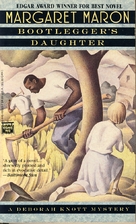
106) Bootlegger's Daughter / Margaret Maron
Attorney Deborah Knott, frustrated with bad decisions from the bench, decides to run for a judgeship. Simultaneously, an old friend asks her to help solve a murder case from twenty years ago. The victim was the friend's mother, and Knott feels she can't deny the request outright.
It's an okay mystery but a better drama, turning on the lives of gay characters living in rural North Carolina. It didn't bowl me over, but the lead is an interesting character and I'll read more in the series.
171swynn
Yeah, but mostly small-press things from the freebie table:
The Book of Thomas by Robert Boyczuk (no touchstone)
Head Full of Mountains by Brent Hayward
The Thief of Broken Toys by Tim Lebbon
Remember Why You fear me by Robert Shearman
Breathe by Douglas A. Van Belle
The Year's Best Military & Adventure SF 2015 (this is the biggest release of the lot, a Baen anthology)
I also got books signed by Diana Rowland (White Trash Zombie Gone Wild), Greg Bear (Killing Titan), and Fran Wilde (Updraft).
The Book of Thomas by Robert Boyczuk (no touchstone)
Head Full of Mountains by Brent Hayward
The Thief of Broken Toys by Tim Lebbon
Remember Why You fear me by Robert Shearman
Breathe by Douglas A. Van Belle
The Year's Best Military & Adventure SF 2015 (this is the biggest release of the lot, a Baen anthology)
I also got books signed by Diana Rowland (White Trash Zombie Gone Wild), Greg Bear (Killing Titan), and Fran Wilde (Updraft).
172rosalita
>169 swynn: I love the Deborah Knott series, Steve, but primarily for the characters and the setting. The mysteries tend to be almost superfluous to my enjoyment.
173tymfos
Hi, Steve. Glad you were able to go to the con instead of the court.
The book about the Catonsville 9 sounds interesting. The one about the Michigan bombing sounds like an interesting subject (one that I'd never heard of) that needed a better writer.
>172 rosalita: I feel the same way.
The book about the Catonsville 9 sounds interesting. The one about the Michigan bombing sounds like an interesting subject (one that I'd never heard of) that needed a better writer.
>172 rosalita: I feel the same way.
174swynn
>173 tymfos:: The con was certainly a lot more fun!
The Michigan bombing book was interesting -- and probably satisfying for readers interested primarily in gory details of the crime. I'd have preferred a little more context & reflection.
Speaking of context & reflection ...
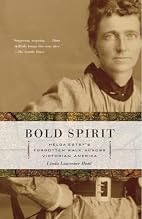
107) Bold Spirit : Helga Estby's Forgotten Walk Across Victorian American / Linda Lawrence Hunt
In 1896, Norwegian-American immigrant Helga Estby and her daughter Clara walked from Spokane to New York City. Estby's family had been hit hard by a series of misfortunes: a bank panic in 1893, then accidents leaving Estby's husband unable to work and unable to make mortgage payments. Somehow, Estby learned about a rich sponsor out East who offered $10,000 to a woman who would walk across the continent. Desperate, Estby took the bet and made the journey.
Restrictions were strict: the women were allowed to carry only $5 at the outset; any additional traveling expenses had to be raised on the journey. With very few exceptions, they were allowed no transportation other than their own feet. From Idaho on, the women had to wear a new style of "short dress" -- apparently the sponsor was connected to the fashion industry -- but setting out from Spokane they wore standard Victorian attire, hems dragging on the ground. The "short dress" was surely some relief, but not as much as you might expect: the hem rose 5-8 inches, daringly revealing the ... ankle. Still, the women pressed on. Unfortunately, upon arrival in New York the sponsor did not pay up, leaving the Estbys with the problem of finding the finances to return.
The subtitle calls the journey a "forgotten walk," which sounds like a publisher's hyperbole, but as Hunt represents it the story very nearly *was* forgotten. Helga wrote hundreds of pages of manuscript and at one time planned to publish a memoir. But the book never happened, and her children destroyed the manuscript after her death. By Hunt's account, the story came to modern attention when one of Estby's descendants made it the subject of a middle school history essay.
Without Estby's first-person account, it's impossible to know very many details beyond those dubiously reported in contemporary newspapers. Still, Hunt makes an engaging story out of it, bringing in a huge amount of contextual detail about the early women's movement, fin-de-siècle economic conditions, and 1896 politics (the women met both William Jennings Bryan and William McKinley). She also spends an afterword examining ways in which family stories are ignored, suppressed, and silenced. Though limited in information about Estby's life, Hunt's story is thoughtful and enlightening about her time. Recommended.
The Michigan bombing book was interesting -- and probably satisfying for readers interested primarily in gory details of the crime. I'd have preferred a little more context & reflection.
Speaking of context & reflection ...
107) Bold Spirit : Helga Estby's Forgotten Walk Across Victorian American / Linda Lawrence Hunt
In 1896, Norwegian-American immigrant Helga Estby and her daughter Clara walked from Spokane to New York City. Estby's family had been hit hard by a series of misfortunes: a bank panic in 1893, then accidents leaving Estby's husband unable to work and unable to make mortgage payments. Somehow, Estby learned about a rich sponsor out East who offered $10,000 to a woman who would walk across the continent. Desperate, Estby took the bet and made the journey.
Restrictions were strict: the women were allowed to carry only $5 at the outset; any additional traveling expenses had to be raised on the journey. With very few exceptions, they were allowed no transportation other than their own feet. From Idaho on, the women had to wear a new style of "short dress" -- apparently the sponsor was connected to the fashion industry -- but setting out from Spokane they wore standard Victorian attire, hems dragging on the ground. The "short dress" was surely some relief, but not as much as you might expect: the hem rose 5-8 inches, daringly revealing the ... ankle. Still, the women pressed on. Unfortunately, upon arrival in New York the sponsor did not pay up, leaving the Estbys with the problem of finding the finances to return.
The subtitle calls the journey a "forgotten walk," which sounds like a publisher's hyperbole, but as Hunt represents it the story very nearly *was* forgotten. Helga wrote hundreds of pages of manuscript and at one time planned to publish a memoir. But the book never happened, and her children destroyed the manuscript after her death. By Hunt's account, the story came to modern attention when one of Estby's descendants made it the subject of a middle school history essay.
Without Estby's first-person account, it's impossible to know very many details beyond those dubiously reported in contemporary newspapers. Still, Hunt makes an engaging story out of it, bringing in a huge amount of contextual detail about the early women's movement, fin-de-siècle economic conditions, and 1896 politics (the women met both William Jennings Bryan and William McKinley). She also spends an afterword examining ways in which family stories are ignored, suppressed, and silenced. Though limited in information about Estby's life, Hunt's story is thoughtful and enlightening about her time. Recommended.
175swynn
108) The Eyes of the World / Harold Bell Wright
This is the 1914 bestseller, about a talented young painter in California. Aaron King becomes acquainted with an art-world crowd who recognize his talent and tempt him to use his art to please them. He stands to earn their praise and a comfortable living. But what will it cost him? King also meets the wealthy novelist Conrad LaGrange, who long ago faced the same temptation. LaGrange chose to write for the eyes of the world and found success in doing so, but now loathes his own works for their pandering sordidness. LaGrange counsels King to choose the more difficult path and paint for truth and beauty.
Wright still has his fans, especially in the Ozarks on whose outskirts I've lived for awhile. This time through, I think I grasp the basis of his popularity: a straightforward and accessible presentation of familiar themes and high-minded rhetoric. I wasn't looking forward to this because years ago I remembered listening to an audiobook of Wright's that struck me as run-of-the-mill melodrama with sanctimonious digressions. About three chapters in, I realized that the audiobook was in fact *this* run-of-the-mill melodrama with sanctimonious digressions. I almost gave up then but thought, "It's not that bad just yet, let's keep going." Happily it never got quite as bad as I remembered it. In fact, in print it seemed to have stronger momentum, which LaGrange's monologing about Art didn't interrupt quite as severely; it certainly never rose to the polemical levels of The Inside of the Cup.
Not recommended but neither was it as awful as I feared. I'm looking forward to Booth Tarkington next month, whose work I've heard praised but only know through Orson Welles' adaptation of The Magnificent Ambersons.
This is the 1914 bestseller, about a talented young painter in California. Aaron King becomes acquainted with an art-world crowd who recognize his talent and tempt him to use his art to please them. He stands to earn their praise and a comfortable living. But what will it cost him? King also meets the wealthy novelist Conrad LaGrange, who long ago faced the same temptation. LaGrange chose to write for the eyes of the world and found success in doing so, but now loathes his own works for their pandering sordidness. LaGrange counsels King to choose the more difficult path and paint for truth and beauty.
Wright still has his fans, especially in the Ozarks on whose outskirts I've lived for awhile. This time through, I think I grasp the basis of his popularity: a straightforward and accessible presentation of familiar themes and high-minded rhetoric. I wasn't looking forward to this because years ago I remembered listening to an audiobook of Wright's that struck me as run-of-the-mill melodrama with sanctimonious digressions. About three chapters in, I realized that the audiobook was in fact *this* run-of-the-mill melodrama with sanctimonious digressions. I almost gave up then but thought, "It's not that bad just yet, let's keep going." Happily it never got quite as bad as I remembered it. In fact, in print it seemed to have stronger momentum, which LaGrange's monologing about Art didn't interrupt quite as severely; it certainly never rose to the polemical levels of The Inside of the Cup.
Not recommended but neither was it as awful as I feared. I'm looking forward to Booth Tarkington next month, whose work I've heard praised but only know through Orson Welles' adaptation of The Magnificent Ambersons.
176rosalita
I've been lurking without time to comment, but I wanted to uncloak myself to say I thoroughly enjoyed your reports from the Con. It sounds like you had a great time. Some of the discussions sounded highly entertaining.
177lyzard
About three chapters in, I realized that the audiobook was in fact *this* run-of-the-mill melodrama with sanctimonious digressions.
:D
If we've learned anything from this challenge, it's that audiobooks make bad worse!
Not terrible, but thunderously unsubtle. Still chuckling over Wright's depiction of critics as The Wickedest People In The World, though.
:D
If we've learned anything from this challenge, it's that audiobooks make bad worse!
Not terrible, but thunderously unsubtle. Still chuckling over Wright's depiction of critics as The Wickedest People In The World, though.
178swynn
>176 rosalita: Thanks, Julia! It was so much fun I think I may do another one. Not Helsinki, though: too darned expensive.
>177 lyzard: About audiobooks: I just don't think they work for me. Either my mind wanders and I miss important details; or it fixates on distractions. This happened to me too with The Virginian, which I found exasperating in audio, but perfectly satisfying in print. Audiobooks certainly make bad worse; but they can also make pretty good, unpleasant.
And yeah, master saboteurs of Western values: art critics? Really?
There's also something either deeply cynical or incredibly oblivious in a formulaic bestseller that condemns compromising one's art to the demands of popular taste.
>177 lyzard: About audiobooks: I just don't think they work for me. Either my mind wanders and I miss important details; or it fixates on distractions. This happened to me too with The Virginian, which I found exasperating in audio, but perfectly satisfying in print. Audiobooks certainly make bad worse; but they can also make pretty good, unpleasant.
And yeah, master saboteurs of Western values: art critics? Really?
There's also something either deeply cynical or incredibly oblivious in a formulaic bestseller that condemns compromising one's art to the demands of popular taste.
179rosalita
>178 swynn: I can only listen to audiobooks in the car, for some reason. If I try to listen at home my mind wanders or (if I'm just sitting and listening) I fall asleep. I have good luck listening to podcasts while knitting, so I may try listening to audiobooks while knitting if I ever get caught up on podcast episides (I subscribe to too many and am perpetually behind in my listening).
180qebo
I've been watching the post count on this thread and skipping over it... Worldcon sure beats jury duty for entertainment. Though maybe you'll manage to make jury duty entertaining too. Do you get a postponement date?
>174 swynn: Huh, I've read this. Apparently pre-LT though I have no memory of what inspired me.
>174 swynn: Huh, I've read this. Apparently pre-LT though I have no memory of what inspired me.
181lyzard
Yes, I remember your struggles with The Virginian.
something either deeply cynical or incredibly oblivious
My money's on "incredibly oblivious". :D
something either deeply cynical or incredibly oblivious
My money's on "incredibly oblivious". :D
182swynn
>179 rosalita: I also sometimes listen to audiobooks on long drives, but have to be selective. They have to be plot-heavy or I'll realize that I have no idea what happened for the last thirty miles. I've never gotten too involved in podcasts, since I figured they'd mostly work like audiobooks for me. I'm glad that there's an audience for them, though!
>180 qebo: Welcome back, Katherine! No, they didn't give me a postponement date-- maybe the trial's cancellation gets me off the hook? I guess I'll know when I get another summons, or not.
>181 lyzard: My money's on "incredibly oblivious". Probably. I know that Wright's fans can be very earnest about him. A little more self-awareness would have helped, though ...
>180 qebo: Welcome back, Katherine! No, they didn't give me a postponement date-- maybe the trial's cancellation gets me off the hook? I guess I'll know when I get another summons, or not.
>181 lyzard: My money's on "incredibly oblivious". Probably. I know that Wright's fans can be very earnest about him. A little more self-awareness would have helped, though ...
183swynn

109) The Shotgun Arcana / R.S. Belcher
Weird western, follow-up to The Six-Gun Tarot, which I read and remember enjoying back in 2013. This one returns to Golgotha, Nevada, shortly after the events of the first. Weirdness this time involves a fallen angel, a deadly artifact and an army of psychopaths.
Reviewing my notes on the first volume, I see that my feelings were more mixed than I remember. I had problems with multiple viewpoints, too many plot threads, and heavy-handed writing. I think I could point the same criticisms at this volume but I didn't mind as much, for whatever reasons. If you don't mind a little effort at suspending disbelief and can overlook a few anachronisms, you can lose yourself in a gun-totin' Götterdämmerung that's just plain fun. Recommended for its audience.
And that cover by Raymond Swanland is just terrific.
184MickyFine
>183 swynn: Not at all my thing but that is an impressive cover. :)
185swynn
>184 MickyFine: Isn't it though? I want another in the series, if only to see the next cover art!
186swynn

110) Father and Son / Larry Brown
Just a few years after killing a boy in a drunken driving accident, Glen Davis returns home from prison. He is not a better person for his time behind bars. If anything he is more dangerous than before, settling old grudges and alienating even those who want to help him like his girlfriend and his father.
My feelings on this one are mixed: it's terrifically well written in a lean direct style, and I don't mind the violence in principle. But it's a bit creepy in its fascination with violence against women. There are two vivid rape scenes, one of which serves no narrative purpose, since neither the crime nor the victim are mentioned again. On the other hand when he kills two men for a perceived wrong the violence happens offstage. Recommended for its style but with emphatic trigger warnings.
187swynn

111) The Deep Sea Diver's Syndrome / Serge Brussolo
Date: 2016 (French original "Le syndrome de scaphandrier" 1992)
Imagines a world in which art works are literally created from dream-stuff. Artists with a certain talent are able to manifest ectoplasm (in the manner of early twentieth-century mediums) during dreams. The manifestations have a curious, generally calming, effect on viewers and are widely collected. David is one such artist, but may not be for long: his last few works have not recouped the costs of support, quarantine, and testing. He desperately needs a new work that will reestablish his reputation, but a work of that size may involve a dangerous risk...
There's a lot to love in this book, and I loved it. The balance of worldbuilding against story tilts toward the former, and pacing drags in the middle. But the world is fresh, the language is rich, and the hero is sympathetic so I didn't mind much. In fact, I read it in a single sitting. Enthusiastically recommended.
According to an afterword, Serge Brussolo is a prolific and popular author in France, and writes in almost every genre there is, but that this is the first of his works to be available in English. Goodness me I hope there come more.
188rosalita
>186 swynn: I bought a bunch of Larry Brown books in an e-sale frenzy a few years ago, though I've yet to read any of them. It looks like Father and Son was one of them. I'm happy to hear about the well-written bit; not so much the violence against women.
189charl08
>187 swynn: Great review. I am intrigued by this - will have a look for it.
190mahsdad
>187 swynn: I just recently saw this book in the library and put it on the WL. I'm glad you liked it, gives me further evidence to keep it there!
191brodiew2
>187 swynn: This looks interesting, swynn. Your review encourages me to check it out. The cover is pretty cool too.
192swynn
>188 rosalita:: If you get to Father and Son I'll be interested in hearing your reaction to it, Julia.
>189 charl08:
>190 mahsdad:
>191 brodiew2:
I hope it lives up to my review! And I hope it gets enough readers to justify more translations!
>189 charl08:
>190 mahsdad:
>191 brodiew2:
I hope it lives up to my review! And I hope it gets enough readers to justify more translations!
193swynn

112) How to bake π / Eugenia Cheng
Date: 2015
Eugenia Cheng is a category theorist at the University of Sheffield, and if you responded to that with, "What the heck is a category theorist?" then she had you in mind when she wrote it.
Category theory is a notoriously abstract branch of mathematics which takes as its subject mathematics itself: it is a sort of mathematics of mathematics. I'm told it's particularly useful in helping to decide which strategies are likely to most fruitful in trying to solve a given difficult problem. But I don't know; most students don't encounter it until graduate school, well beyond my own experience. Now that you're properly intimidated: Cheng's book attempts to introduce category theory to readers who have never taken calculus. With recipes.
Does she succeed? Depends. I knew barely anything about category theory when I started and now I don't feel like I know any more. But then I think I'm not in her intended audience: by "introducing" the subject, she apparently means to describe where category theory fits in the spectrum of mathematical research. Thing is, her intended audience has only the vaguest notions -- some of them wrong -- about what mathematics is. Mathematics is presented in elementary and secondary school as the subject dealing with numbers, quantities and calculation. On the other hand, university mathematics (or at least, what we Yanks call "upper-division mathematics") is all about logic: rules-based abstract reasoning. This alone is a shift in perspective which sometimes comes as a painful shock to undergraduate mathematics majors.
So Cheng has her work cut out for her. She attacks the problem by spending the first half of the book answering, "What is mathematics?" That leaves only the last half to answer, "What is category theory?" which isn't much space at all really, especially when you still have talk about algebra, function theory and topology to get there.
To assist she invokes cooking and baking metaphors, which sometimes work and sometimes don't. She makes several points with these , but the main one (I think) is that cooking, like mathematics, can be regarded from different levels of abstraction. A beginning cook may need a long and detailed recipe to make a lasagna, for instance; while a more experienced cook may only need to be told that a lasagna is a sort of casserole with alternating layers of Bolognese sauce, noodles, and béchamel sauce. What's a Bolognese sauce? Well, it's a term an experienced cook uses; and though it seems awfully abstract to a beginner, eventually you get to where you can think about cooking in more abstract terms. Likewise mathematics.
Is it recommended? Sure: I don't think it's a particularly informative introduction to category theory but it is an accessible and needed argument for thinking about mathematics as something more than counting and computation. But if you're already convinced of this, then you may not find it especially insightful.
194qebo
>193 swynn: Do you read the Good Math, Bad Math blog? He's written posts on category theory, which I've merely skimmed, some time ago.
195swynn
>193 swynn: I used to read Good Math, Bad Math regularly, but haven't visited in ages. I missed the category theory posts, so will have to go check them out. Thanks for the tip!
196swynn

113) The Girl In Between / Laekan Zea Kemp
Date: 2014
Kindle freebie, a YA story about a girl with Kleine-Levin syndrome, a sleep disorder that causes her to fall asleep for days or weeks at a time. While sleeping she has vivid dreams that are remarkably consistent from one episode to the next. Recently she has dreamt about a boy who she suspects may be a real person sharing her dream-world. She has also started to notice something menacing in the shadows ...
The writing is not bad. My only complaint is that there are two first person narrators, either of whom sounds exactly like the other. The story too is okay, but heavier on romance than on fantasy, and not as dark as I'd hoped. Presumably it gets darker in subsequent volumes, but probably also romancier. I'm not likely to continue, but I liked it well enough to think it might appeal to others whose sort of thing this is.
197swynn

114) Barefoot in Babylon / Robert Stephen Spitz
Date: 1979
In Mike Wadleigh's documentary "Woodstock : Three Days of Peace and Music" there's an interview with two of the festival's producers Mike Lang and Artie Kornfeld. Kornfeld, clearly animated by something more than enthusiasm for the music, describes the festival as a "financial disaster"; he seems pretty happy about it. Disaster, it turns out, was an apt description and applied long before the festival's organizers gave up on selling tickets. The production history of Woodstock turns out to be an exasperating comedy of errors: a money man too trusting of the producers; producers whose slogan was "money is no object"; a parade of dopeheads, grifters, and opportunists as contractors; and a change of venue just thirty days before the gates opened. (A term of art, that: no effective gate was ever built of course.) For Barefoot in Babylon Robert Spitz interviewed everyone he could find involved with the production of Woodstock. He also mined newspaper archives and business records. The result is a terrific account of that production history, a story I found more entertaining than any I've read covering the festival itself.
I had a personal motive for checking this out. Earlier this year at my nephew's graduation my aunt and mother were reminiscing, and my aunt claimed that the Woodstock almost took place at my great-grandather's farm near Newburgh, New York. The festival's organizers, she said, had narrowed the choice down to Great-grandpa's farm or "the place they finally chose near Middletown," and decided for Middletown. She couldn't remember their reasoning, except that the Newburgh farm didn't have sufficient water supply -- or maybe it was worries about traffic, because the only access to the farm was by a two-lane country road.
Water or traffic, we laughed. Yeah, choosing the other place sure solved *those* problems, didn't it?
Anyway, I chose this book specifically because it is a production history, hoping for a mention of family. So how does my aunt's story hold up? Well, it's certainly plausible: it seems the producers checked out just about every farm in the area. My family's name doesn't get a mention, but there is this, just before the producers contract for a location in Wallkill, NY (near Middletown):
But the largest available plot of land was a manicured pasture, that, he realistically estimated, would hold not more than thirty thousand at tops and that would not do at all. In addition, access to the community was limited to one major thoroughfare, a two-lane macadam boulevard badly in need of repair, that ran through the center of the sleepy hamlet and, besides promising traffic congestion, was too narrow to handle heavy vehicles bringing construction supplies to a site.
So ... maybe. But if that's a reference to Great-grandpa's farm it sounds like a Woodstock there wouldn't have been Woodstock. (Nor would Wallkill have been, but that's another few stories.) And Spitz wouldn't have written this excellent book. So it worked out for the best. Recommended.
Also: what a great title, yeah?
198swynn

115) Jani and the Great Pursuit / Eric Brown
Date: 2016
Second in Brown's steampunk raj series that began with Jani and the Greater Game. In this one Jani and her friends travel to London, hoping to rescue an alien held captive by British intelligence. Hot on their trail are Russian spies and a priest of Kali.
My comments on the first volume are here, and this one offers more of the same: bold adventure, tense chases, breathless escapes. The Indian and Russian villains are still a bit creepy in ways that aren't intended, and if Brown is trying to score points about imperialism he's being quite coy about it. There are also a couple of iffy plot points. But darn it all: it's still fun, and I'll read the next.
199swynn

116) From Eve to Evolution / Kimberly A. Hamlin
Date: 2014
Hamlin looks at two major upheavals in late-19th-century American society: popular acceptance of evolutionary theories and the emergence of women's rights movements. It has generally been understood that proponents of evolution were not kindly disposed toward women's movements. (This was certainly true of Darwin, who had a rather conservative view respecting the family and women's place in it.) And yet: some of the most vocal advocates of women's rights -- Elizabeth Cady Stanton, Charlotte Perkins Gilman, and Margaret Sanger among others -- embraced evolution and used arguments from evolution to bolster their campaigns for women's rights. For many reformers Darwin's theory was a liberation. Prior to Darwin, discussions of gender were dominated by reference to Genesis, to an extent that is difficult now to comprehend. Darwin's theory displaced the Genesis myths, or at the very least offered an alternative, leaving questions about sex roles wide open.
But it was complicated. Many in the women's movement were only interested in suffrage, or wanted to reassure conservative audiences of their religious orthodoxy, so women who talked too much about evolution risked being pushed aside by their own allies. Scientists were not necessarily more receptive, since male scientists (Darwin included) tended to argue that evolution did not question women's inferiority to men but rather explained it. To make things worse, science was becoming increasingly professionalized, increasingly male, and decreasingly receptive to women's voices, even as these debates were fought. Professionalized scientists first excluded women and then used their absence to justify further exclusion. But despite these dismissals from reform movements and from professional science, some women persisted. They looked to nature for alternative domestic arrangements and asked why, if it works for the peacocks then why not for humans too? They saw patterns in nature where females controlled reproductive choices, and suggested that humans ought to give it a go.
Hamlin foregrounds the ways that women reformers read between the lines of evolutionary arguments, called Darwin and others on unfounded conclusions, and offered their own empowering interpretations. But the reformers too had blind spots and Hamlin calls attention to those also. The reformers typically argued for increased opportunities for white middle-class women, but too frequently shared the age's assumptions about minority groups and immigrants.
It's quite interesting: I was fascinated the variety of ways that ideas about evolution were deployed, some mutually contradictory. On the downside it's academic: the style tends to dry, and occasionally Hamlin assumes a greater knowledge of 19th-century women's movements than I possess. Still: recommended for those interested in the subject.
200qebo
>199 swynn: Oh that looks interesting. BB.
201ursula
>193 swynn: I asked my husband about category theory and he said it was mostly annoying because it's become somewhat popular with young students studying math - they want to study category theory even though they don't have any foundation on which to base it. So in the lasagna analogy, they're all going around saying "well, you need some flat things and another part that's sort of liquidy ..." Impossible to make a lasagna from that, obviously!
202swynn
>200 qebo: Hope you like it, Katherine!
>201 ursula: Now that's interesting ... I view category theory with intimidation, but then I have neither opportunity nor ambition for a mathematical career. But yeah, I can imagine the frustration of professionals explaining students that one must learn to make porridge before attempting a soufflé.
>201 ursula: Now that's interesting ... I view category theory with intimidation, but then I have neither opportunity nor ambition for a mathematical career. But yeah, I can imagine the frustration of professionals explaining students that one must learn to make porridge before attempting a soufflé.
203swynn

117) What Is Not Yours Is Not Yours / Helen Oyeyemi
Date: 2016
I'm not quite sure what to make of most of the stories in this collection. My impulsive response is quite positive: Oyeyemi's style is so playful that even when I wasn't sure what was happening I wanted to keep reading. And the raw material appeals to me: fairy tales, magic, alienation, and identity. But a story that starts out in one direction frequently turns a corner to proceed in another, and may or may not arrive at a destination in either direction. Still, despite the meandering a couple of the stories have a surprisingly strong impact. My favorite is "Is your blood as red as this," which involves power games and obsession at a puppetry school where one student says she is unsure whether she is puppet or human, another is in fact a puppet, and the title is taken from a line spoken by a chess piece. The story is odd, and I'm not sure what I read, except that its ending left me beat with admiration: what could I do but turn back the pages and read it again? I'm still not sure what I read, but whatever it is, it works. Recommended.
205swynn
>204 drneutron: Thanks, Jim! It's a tough one to describe.
206swynn

118) The Mathematician's Shiva / Stuart Rojstaczer
Date: 2014
Rachela Kornokovitch, a professor at the University of Wisconsin and the greatest mathematician of her time, is dead. Rumor is that she had been working on the Navier-Stokes problem, also that her brilliance and stubbornness were such that she would refuse to die until she finished. Ergo, a solution exists.
As Rachela's son, ex-husband, and extended family come to terms with her passing, her former colleagues, academic friends and enemies descend upon Madison to honor her memory and poke around her home and office to find the proof.
It's okay. There are a few moving moments and several funny ones. Much of the humor is based on the quirks of academic social life, and Rojstaczer gets that spot-on. There were also loose ends and missed opportunities, but the sum is positive.
207swynn

119) Edge of Dark / Brenda Cooper
Date: 2015
Long ago, a bunch of rebels tried to start a revolution advocating machine-human hybrids. The rest of humanity found them dangerous and kicked them out of the solar system, expecting they would die. They didn't, and for a long time now they've been a minor nuisance: hunting human ships that stray too far from the sun, occasionally conducting small raids inside the solar system. A few humans have even started trading with them, commerce as lucrative as it is illegal.
But while the humans have been mostly ignoring them, calling them "ice pirates" or "soulbots" in bedtime stories, the exiles have been gathering strength and numbers. Now they're back, they're too strong to fight, and they want a piece of their home planet. And they call themselves The Next. By way of saying hello again, The Next hijack a human space station and kill all its inhabitants except for a few whom they put in machine bodies to act as ambassadors.
It's a pretty good story, with appealing characters and posthuman themes. Downside is that the pace drags in spots, and the ending isn't so much a denouement as a caesura. But that last just means I'll have to read the next.
208swynn

120) Trailer Park Fae / Lilith Saintcrow
Date: 2015
Jeremiah Gallow is half-fairy, half human, once the Armormaster of the Queen of Summer, now working high-rise construction and living in a trailer park. Years ago Gallow left Summer's court for love of a human woman. The woman, later his wife, was killed in a freak automobile accident, but Gallow has no interest in going back to Faerie. It's not clear whether he even can.
Meanwhile, there's a plague among the fairies. Robin Ragged, another of Summer's minions, has been ordered to fetch the cure. But there are those who do not want the cure to be found and others who do not want Summer to find it. Running from enemies Ragged happens through a bar frequented by construction workers and she picks up an ally in a washed-up former Armormaster.
It's okay. I enjoyed the story, but the prose was too self-consciously mannered for me. Still, I'll probably read the next.
And how about that mesmerizing cover? It's by Daniel Dos Santos, the same artist who does Diana Rowland's White Trash Zombie series. (Also Gini Koch's "Touched by an Alien" series and Patricia Briggs's Mercy Thompson series, but that's about all I know about those series.)
209MickyFine
>208 swynn: When I read the title the first time my brain added a "c" to Fae and all I could think was "what exactly is trailer park face?" Thank goodness it's Friday. :)
210swynn
"Trailer park face" -- I think that's the official title for the Jeff Foxworthy/Lady Gaga tour ...
Don't quote me on that.
Don't quote me on that.
211lyzard
:D
I have added The Turmoil to #14, if you're up for it this month? (Alas, I see we're back in humourless social commentary mode...)
I have added The Turmoil to #14, if you're up for it this month? (Alas, I see we're back in humourless social commentary mode...)
212MickyFine
>210 swynn: Giggle. That would be one special tour. :D
213swynn
>211 lyzard: I'm in, and will finish sometime this weekend. Yes, it's familiar ground, but I'm enjoying it more than the last few WCs. The sermons are shorter, at least.
>212 MickyFine: I would buy a ticket just to watch the crowd dynamics.
>212 MickyFine: I would buy a ticket just to watch the crowd dynamics.
215swynn
>214 lyzard:: Oh yes the ending was very odd: abrupt, contrived, and not obviously consistent with everything that had gone on before.
121) The Turmoil / Booth Tarkington
Date: 1915
We may be rid of Winston Churchill, but Booth Tarkington is only too happy to jump on his hobby-horse, melodrama motivated by the social ills caused by industrialization. Tarkington's first chapter is a sort of rhapsody on this theme, imagining the madness for economic growth as a sort of monster whose breath is the coal-smoke that begrimes everything and everyone:
The smoke is like the bad breath of a giant panting for more and more riches. He gets them and pants the fiercer, smelling and swelling prodigiously. He has a voice, a hoarse voice, hot and rapacious trained to one tune: “Wealth! I will get Wealth! I will make Wealth! I will sell Wealth for more Wealth! My house shall be dirty, my garment shall be dirty, and I will foul my neighbor so that he cannot be clean—but I will get Wealth! There shall be no clean thing about me: my wife shall be dirty and my child shall be dirty, but I will get Wealth!” And yet it is not wealth that he is so greedy for: what the giant really wants is hasty riches. To get these he squanders wealth upon the four winds, for wealth is in the smoke.
The monster appears kinder to some than others. Consider for example the nouveau-riche Sheridans whose investments have grown so well that Sheridan Sr. insists that the omnipresent smoke is actually a good and healthy thing. At the center of the story is the youngest Sheridan son Bibbs, whose ambivalence toward riches makes him a disappointment. Bibbs shows no business promise; on the contrary his is rather lazy and inclined to habits like poetry and the writing of essays. In hopes of reforming the young slacker, Sheridan Sr. sent Bibbs to labor in a machine shop to toughen him up but the manual labor drove Bibbs to a nervous breakdown. As our story opens Bibbs is just returning from an extended stay in a sanitarium.
When Bibbs returns from hospital it is to a new home: the Sheridans have moved up the hill to a higher-class district next door to the Vertreeses, an old and influential family in the city. But the growth-monster that has been so kind to the Sheridans has nearly destroyed the Vertreeses, who have become victims of bad investments and ill-timed sales. They are, in a word, broke. Mr. and Mrs. Vertrees are in fact incapable of earning a living. Their daughter Mary lacks all marketable qualities save one, and she has the cold realization that her family's future depends upon her using it. And so she determines to marry one of the economically fortunate Sheridan boys. Mary's first choice is the oldest (and not-crazy) son Jim, but it's clear from the beginning that she will fall eventually in love with Bibbs. When she does, the question becomes how their friendship will change the idealistic dreamer.
The result is a bit puzzling.Through a series of calamities, the Sheridan sons are one by one broken by their father's mania for expansion. The eldest son is killed in an accident; the second drops out when he realizes that his driven business schedule has ruined his marriage; and Bibbs is finally convinced to give up his dreams and follow his father into business in order to rescue Mary and her family. But his relationship with Mary is ruined when it comes out that she was romancing the Sheridan boys for security's sake. The theme seems to be that one way or another, the growth-monster breaks us all. So it's especially odd when the ending wraps up with Mary standing in Bibbs's office-door. Is the point that the world may kill you but you can still get the girl? Or maybe that you can write what you like in your manuscript but your publisher will tell you your hero has to get the girl or nobody will buy it? Don't know.
On the downside are uncomfortable caricatures of Black characters, and female characters whose lives are all about men. In that I suppose Tarkington's no worse than many others and better than Churchill in that he shows at least one Black character with an interior life. But the work's age shows. Despite that I enjoyed the book and am ready for another Tarkington next month.
121) The Turmoil / Booth Tarkington
Date: 1915
We may be rid of Winston Churchill, but Booth Tarkington is only too happy to jump on his hobby-horse, melodrama motivated by the social ills caused by industrialization. Tarkington's first chapter is a sort of rhapsody on this theme, imagining the madness for economic growth as a sort of monster whose breath is the coal-smoke that begrimes everything and everyone:
The smoke is like the bad breath of a giant panting for more and more riches. He gets them and pants the fiercer, smelling and swelling prodigiously. He has a voice, a hoarse voice, hot and rapacious trained to one tune: “Wealth! I will get Wealth! I will make Wealth! I will sell Wealth for more Wealth! My house shall be dirty, my garment shall be dirty, and I will foul my neighbor so that he cannot be clean—but I will get Wealth! There shall be no clean thing about me: my wife shall be dirty and my child shall be dirty, but I will get Wealth!” And yet it is not wealth that he is so greedy for: what the giant really wants is hasty riches. To get these he squanders wealth upon the four winds, for wealth is in the smoke.
The monster appears kinder to some than others. Consider for example the nouveau-riche Sheridans whose investments have grown so well that Sheridan Sr. insists that the omnipresent smoke is actually a good and healthy thing. At the center of the story is the youngest Sheridan son Bibbs, whose ambivalence toward riches makes him a disappointment. Bibbs shows no business promise; on the contrary his is rather lazy and inclined to habits like poetry and the writing of essays. In hopes of reforming the young slacker, Sheridan Sr. sent Bibbs to labor in a machine shop to toughen him up but the manual labor drove Bibbs to a nervous breakdown. As our story opens Bibbs is just returning from an extended stay in a sanitarium.
When Bibbs returns from hospital it is to a new home: the Sheridans have moved up the hill to a higher-class district next door to the Vertreeses, an old and influential family in the city. But the growth-monster that has been so kind to the Sheridans has nearly destroyed the Vertreeses, who have become victims of bad investments and ill-timed sales. They are, in a word, broke. Mr. and Mrs. Vertrees are in fact incapable of earning a living. Their daughter Mary lacks all marketable qualities save one, and she has the cold realization that her family's future depends upon her using it. And so she determines to marry one of the economically fortunate Sheridan boys. Mary's first choice is the oldest (and not-crazy) son Jim, but it's clear from the beginning that she will fall eventually in love with Bibbs. When she does, the question becomes how their friendship will change the idealistic dreamer.
The result is a bit puzzling.
On the downside are uncomfortable caricatures of Black characters, and female characters whose lives are all about men. In that I suppose Tarkington's no worse than many others and better than Churchill in that he shows at least one Black character with an interior life. But the work's age shows. Despite that I enjoyed the book and am ready for another Tarkington next month.
216swynn

122) The Girl Who Circumnavigated Fairyland in a Ship of Her Own Making / Cathrynne M. Valente
Date: 2009
Oh my yes yes yes. How can I not fall in love with a story, one of whose main characters is the love-child of a wyvern and a library? "Wyverary." For that word alone Ms. Valente wins my eternal affection, but fortunately she delivers a whole book full of sly humor that both honors and lampoons the children's fantasy trope of a precocious girl exploring a surreal landscape. More, please.
217MickyFine
>216 swynn: I loved that whole series. Glad it found another fan.
218rosylibrarian
>216 swynn: On the TBR list it goes!
219lyzard
>215 swynn:
Yes, I think the best you can do is see it as compensation---but what are we supposed to take away from Bibbs' general fate? There's no suggestion of tragedy about it on any level, which makes the whole thing rather pointless (or maybe pragmatic to a degree out of step with the rest).
Anyway, I gather that our next Tarkington is from the other side of his writing coin.
And now I'm off to figure out what to say about Harold Bell Wright (who, heaven help me, has just turned up again on my shortlist TBR).
Yes, I think the best you can do is see it as compensation---but what are we supposed to take away from Bibbs' general fate? There's no suggestion of tragedy about it on any level, which makes the whole thing rather pointless (or maybe pragmatic to a degree out of step with the rest).
Anyway, I gather that our next Tarkington is from the other side of his writing coin.
And now I'm off to figure out what to say about Harold Bell Wright (who, heaven help me, has just turned up again on my shortlist TBR).
220swynn
>217 MickyFine:: It has, Micky! The next one is on its way via ILL.
>218 rosylibrarian:: Hope you like it, Marie.
>219 lyzard:: Yeah, the tone is more of resignation than despair. You can't beat 'em so you might as well join 'em. But considering the fates of his brothers, I can't help feeling that Bibbs's story needs at least one more act. Roscoe & Sibyl need another one, too.
Condolences on HBW. If it helps, I'm reading Winston Churchill again. :)
>218 rosylibrarian:: Hope you like it, Marie.
>219 lyzard:: Yeah, the tone is more of resignation than despair. You can't beat 'em so you might as well join 'em. But considering the fates of his brothers, I can't help feeling that Bibbs's story needs at least one more act. Roscoe & Sibyl need another one, too.
Condolences on HBW. If it helps, I'm reading Winston Churchill again. :)
221swynn

123) Engraved on the Eye / Saladin Ahmed
Date: 2012
This is a collection of stories, mostly fantasy, some taking place in the same world as the author's Throne of the Crescent Moon. Mostly good, only one story fell flat for me. I especially liked the idea of supervillains plotting a massive prison breakout by the ingenious strategem of destroying the *need* for prisons.
222swynn

124) Three Parts Dead / Max Gladstone
Date: 2012
This is the first in a series of fantasy novels. There has been a war between gods and humans, precipitated when humans figured out that magic wasn't just for gods.
Some gods are still around though, like Kos, fire deity and guardian of the city Aus Coulumb ... or like Kos until recently anway, because he is suddenly dead. With gods "dead" can be a temporary condition, so Kos's temple calls in investigators to find out what happened to him and hopefully restore him to some sort of life. Tara is a young magician and a rookie on this case. And though she has an experienced and talented mentor overseeing her work Tara knows that this case is a test, and she's under pressure to produce solid and independent results. It doesn't help when an older and more powerful enemy shows up as an antagonist ...
I liked this very much. It's a mashup of fantasy, mystery, and legal thriller that works well. I'll read more in the series.
And how about that cover by Chris McGrath? More, please!
223ronincats
I have the fifth and newest Craft book home from the library right now, and yes, they do have the neatest covers.
224swynn
>223 ronincats: I've just checked out the second from the library, though it will probably be a little while before I get to it.
225swynn

125) NeuroTribes / Steve Silberman
Date: 2015
Discusses the history of autism: our evolving understanding of it, and the emerging advocacy for people affected by it. It's terrifically readable, and questions assumptions about what should be considered normal.
While I liked it very much, I also question some of its editorial choices. The medical bits strike me as heavy on psychiatry but light on neurology and pharmacology, which I would have found at least as interesting. There's also a chapter on science fiction fandom, whose relevance I understand -- it was a community that welcomed autists even before autism was well defined -- but felt like too much of a tangent.
I can quarrel with Silberman about including one chapter or omitting some other, but his best bits are about advocacy groups like the Autistic Self Advocacy Network, and their message that neurological diversity is a good thing. It is indeed, and may the message spread.
226swynn

126) Dodgers / Bill Beverly
Date: 2016
East is a lookout for a crackhouse in L.A. When the house is raided and a young girl dies in the crossfire, East's boss sends him on a job out of state. Together with a small group of inexperienced friends, he is to drive cross-country to Wisconsin to kill a witness. East has never even left his L.A. neighborhood, so the journey introduces him to several new worlds ... and to the difficulty of leaving the old one behind.
This one was nominated for Crime Writers Association's Dagger Award, so I expected a fun violent romp. And it is occasionally violent, but it's more thoughtful character study than mayhem. It's a pleasant surprise, and recommended.
228swynn
>227 drneutron: I remember that you read it about the same time that I got it. Yeah, it's been in the pile that long.
Yay for Dodgers love!
Yay for Dodgers love!
229swynn
Here's one that could have used more mayhem:

127) A Far Country / Winston Churchill
Date: 1915
This was the second-best-selling book in the U.S. in 1915, behind Booth Tarkington's The Turmoil. The books have common social concerns, so the reading public must have been preoccupied by worries over industrialization and big business and their effects on family, marriage, and democracy. Spoilers follow.
This is a fictional autobiography of Hugh Paret, an orphan raised by his middle-class uncle. Hugh's early life shows little promise but when his uncle tries to set him on a business career rather than go to university, Hugh finds clerical work so horrifyingly dull that he decides to earn admission to Harvard no matter the cost. (Thus far the story strongly parallels Churchill's own biography.)
Hugh achieves Harvard and becomes a lawyer, and upon graduation joins the firm of Theodore Watling, a powerful attorney who counts railroads among his clients. Hugh's uncle had distrusted Watling but Hugh recognizes an opportunity when he sees it. Over the next few years, Hugh builds a reputation for himself as a young up-and-comer with a talent for shaping legal arguments to shady profit. These bits were the most entertaining to me: with Hugh pulling strings and making deals I was reminded of the political cleverness Churchill showed in Coniston and Mr. Crewe's Career.
Hugh's love life is complicated: he has loved the worldly-wise Nancy since grade school, but she decides to marry a rival (in order to pay off family debts, it turns out) so he turns to Maude, a demure and unsophisticated girl to whom he proposes on a whim one day. Maude turns him down, which makes her irresistible to him. He pursues Maude until she marries him, then turns his attention back to his career, and eventually back to Nancy.
So it's a story about a bright young man, corrupted by the world's evils. You expect Hugh will meet No Good End, but consequences are never faced: Hugh's dishonest legal maneuvers never catch up with him, though he does eventually see the errors of modern legal philosophy and gives it all up. He and Nancy have a brief fling, but Nancy decides that their moment has passed and that she will not seek a divorce; Hugh runs to Maude, who welcomes him back. They extemporize about Problems With The World Today, and decide to continue their marriage so that they can instruct their children to do better.
It's wordy, it's stiff and it's sometimes just silly. And yet it's better than The Inside of the Cup. The politics especially is very interesting, and there's a curious Christ-figure who seems to be patterned on a young Teddy Roosevelt. He's the most interesting character in the last three of Churchill's books, or he is until he's given room to speak near the end in which case he just won't shut up.

127) A Far Country / Winston Churchill
Date: 1915
This was the second-best-selling book in the U.S. in 1915, behind Booth Tarkington's The Turmoil. The books have common social concerns, so the reading public must have been preoccupied by worries over industrialization and big business and their effects on family, marriage, and democracy. Spoilers follow.
This is a fictional autobiography of Hugh Paret, an orphan raised by his middle-class uncle. Hugh's early life shows little promise but when his uncle tries to set him on a business career rather than go to university, Hugh finds clerical work so horrifyingly dull that he decides to earn admission to Harvard no matter the cost. (Thus far the story strongly parallels Churchill's own biography.)
Hugh achieves Harvard and becomes a lawyer, and upon graduation joins the firm of Theodore Watling, a powerful attorney who counts railroads among his clients. Hugh's uncle had distrusted Watling but Hugh recognizes an opportunity when he sees it. Over the next few years, Hugh builds a reputation for himself as a young up-and-comer with a talent for shaping legal arguments to shady profit. These bits were the most entertaining to me: with Hugh pulling strings and making deals I was reminded of the political cleverness Churchill showed in Coniston and Mr. Crewe's Career.
Hugh's love life is complicated: he has loved the worldly-wise Nancy since grade school, but she decides to marry a rival (in order to pay off family debts, it turns out) so he turns to Maude, a demure and unsophisticated girl to whom he proposes on a whim one day. Maude turns him down, which makes her irresistible to him. He pursues Maude until she marries him, then turns his attention back to his career, and eventually back to Nancy.
So it's a story about a bright young man, corrupted by the world's evils. You expect Hugh will meet No Good End, but consequences are never faced: Hugh's dishonest legal maneuvers never catch up with him, though he does eventually see the errors of modern legal philosophy and gives it all up. He and Nancy have a brief fling, but Nancy decides that their moment has passed and that she will not seek a divorce; Hugh runs to Maude, who welcomes him back. They extemporize about Problems With The World Today, and decide to continue their marriage so that they can instruct their children to do better.
It's wordy, it's stiff and it's sometimes just silly. And yet it's better than The Inside of the Cup. The politics especially is very interesting, and there's a curious Christ-figure who seems to be patterned on a young Teddy Roosevelt. He's the most interesting character in the last three of Churchill's books, or he is until he's given room to speak near the end in which case he just won't shut up.
231swynn
>230 lyzard: You've read The Inside of the Cup, you know how it is.
232swynn

128) A Darker Shade of Magic / V.E. Schwab
Date: 2015
Four different Londons, a dimension-hopping magician, a down-on-her luck sneak thief, and an artifact that just might bring down the Apocalypse. I liked it, and will read the next.
233MickyFine
>232 swynn: That's a great cover! It was enough to make me do a little more digging into the book and decide to add it to The List. :)
234swynn
>233 MickyFine: Isn't it sharp? It's by Will Staehle, who also did covers for All the Birds in the Sky and The Bullet-Catcher's Daughter. (Both of which I expect to get around to eventually.)
235MickyFine
>234 swynn: Ooh those covers are also gorgeous. Good books with pretty covers are so lovely.
236swynn

129) Quite Ugly One Morning / Christopher Brookmyre
First in a series of noir mystery/thrillers featuring Scottish journalist Jack Parlabane. The latest (7th) in the series is nominated for a Crime Writers' Association Golden Dagger Award, but I thought I'd start at the beginning. This one has Parlabane newly returned to Edinburgh, having escaped an assassination attempt in L.A., whence he had flown to escape a sticky situation of his own making back home. (People tend not to like him.) His intention to lie low is soon disappointed when he accidentally locks himself out of his flat. In an attempt to quietly reenter his own, he sneaks through the open window of a neighboring flat.
Both the "attempt" and the "quietly" bits fail when the flat turns out to be decorated with more varieties of excreta than Starbucks has sweet foamy coffee-flavored drinks, plus the mutilated body of the flat's resident, a surgeon from a prominent family of surgeons. Police are already on scene. They find the trespassing loony in pajama pants a wee bit suspicious.
Soon Parlabane is doing what he does: asking uncomfortable questions and uncovering sordid conspiracies. It's clear why Parlabane's personality attracts death threats, but the same abrasiveness makes him charming on the page. It's funny, twisty, and a bit gross -- just up my alley, and I'll read more.
Warnings: (1) The conspiracy involves mismanagement of Britain's National Health Service, and there's more than a teaspoon of political invective. It does help that Brookmyre is funny and probably right; (2) it's frequently squicky, sometimes very squicky; (3) it relies too heavily on fat-shaming to characterize its villain as villainous; (4)
"Politically correct" it ain't, but mostly lots of fun, and I will read more.
237swynn

130) Nuclear Nebraska / Susan Cragin
Date: 2007
In the late 1980s, states with nuclear power plants were scrambling to plan for disposal of nuclear waste. One does not want a dump in one's own neighborhood of course, but the stuff must go somewhere. But just about every place is someone's neighborhood. Politics being what it is, a dump site just may be chosen for reasons other than appropriate geology or sound planning. Take Boyd County, Nebraska for instance. From the late 1980s into the early twenty-first century, a small group of citizen-activists resisted efforts by state government and corporate engineering firms to build a low-level nuclear waste dump in their backyard.
Boyd County may not seem like the smartest place to store nuclear waste. It sits at the edge of the Ogallala Aquifer, with soil and weather patterns that make much of the county prone to flooding. But with a population sparse and dwindling, with limited economic resources, and limited political engagement, it was also a site of least resistance. Many Boyd County residents actually welcomed the prospect of a nuclear dumpsite for the much-needed economic boost it could offer the county. Anticipating no unmanageable resistance, Nebraska contracted with engineering firm US Ecology to build a "low-level" radioactive waste disposal site. ("Low-level," it turns out, is a technical term referring to any radioactive waste other than control rods. It implies nothing about the level of radioactivity.) To fight the state, the experts, and even their own neighbors, activists had to educate themselves on the issues, learn hard lessons about political maneuvering, and raise funds for a long-term effort. Their fight not only prevented the realization of a Really Bad Idea, but changed the face of Nebraska politics. Literally: their efforts were almost certainly a factor in Ben Nelson's defeat of five-term Governor Kay Orr in the 1990 gubernatorial election.
Cragin captures personalities well, and represents the activists' side convincingly. I would have preferred a little more technical detail. In particular, she gives very little space to US Ecology's responses to the activists' objections. It is only near the end that she concedes that the firm had plans that addressed criticisms. I'd have liked to read more about their engineering solutions. But Cragin's focus is the political one, and that story she tells well. Recommended.
This is my Nebraska book for the 50-states tour.
238swynn

131) Shadow Child / Joseph Citro
Date: 1998
Killer leprechauns in Vermont.
Citro has also written nonfiction collections of Vermont folklore and Forteana; the best bits here are short interludes on unexplained disappearances or sightings of of "little people" in Vermont history. The novel itself is okay, but I won't seek out the sequel.
This is my Vermont book for the 50-states tour.
239MickyFine
>237 swynn: Completely unrelated to the book but reading your review finally put "gubernatorial" into a context where I realized the definition for it. This is what happens when you grow up in country with no governors, I guess. Anyway, thanks for that bit of education, Steve.
240swynn
>240 swynn: You're welcome, Micky! (Plus, it's a fun word to say. ) (Yes, I am easily entertained. )
241MickyFine
>240 swynn: It is definitely fun to say. :)
242charl08
I love the juxtaposition of a real life campaign for the environment vs killer leprechauns. Genius reading plans there.
243swynn
>242 charl08: Yeah, one was certainly a palate-cleanser. (But which one?)
244ronincats
So I pulled DAW #482 (a 1982 reprint of a 1968 book) off the shelves to reread for my Halloween book this year, and here's what I had to say about it:
http://www.librarything.com/topic/230300#5771806
When are you getting back to your DAW reading?
http://www.librarything.com/topic/230300#5771806
When are you getting back to your DAW reading?
245swynn
>244 ronincats: Ooh, Simak! Glad you liked it!
I keep intending to get back to the DAWs, but I also keep getting more books from the library. The next DAW is a sort-of sequel to Jack Vance's Dying Earth series, so I want to read that first; and its reputation is such that I find it a little intimidating: I want to take the time to enjoy it, and with all those looming due dates ... I'll probably have to make the Return of the DAWs a special project next year.
I keep intending to get back to the DAWs, but I also keep getting more books from the library. The next DAW is a sort-of sequel to Jack Vance's Dying Earth series, so I want to read that first; and its reputation is such that I find it a little intimidating: I want to take the time to enjoy it, and with all those looming due dates ... I'll probably have to make the Return of the DAWs a special project next year.
246swynn
132) Seventeen / Booth Tarkington
William Baxter is seventeen and in love. The object of his affection is Lola Pratt, an out-of-town girl visiting local relatives. Lola is a lovely blond girl with a lap-dog and a voice like this:
Oo-oo! Mustn't touch! P'eshus Flopit all soap-water-wash clean. Ickle dirly all muddy-nassy! Ickle dirly must doe home, det all soap-water-wash clean like NICE ickle sissa. Evabody will love 'oor ickle sissa den.
... which to William is perfectly delightful. With all the grace of his seventeen years William attempts to catch the noble Lola's eye by affecting an experience and sophistication beyond all her other (somehow numerous) suitors. He consistently fails, though Lola rewards his attempts with baby-talk flattery. Nobody delights in his failures more than his younger sister Jane, who keeps their parents apprised of Williams antics. And nobody finds William and Lola more annoying than Lola's host Mr. Parcher, who cannot relax in his library to read Plutarch's Lives without overhearing Lola's baby-talk and William's fulminations. One sympathizes, but Tarkington tells us that Mr. Parcher suffers because he has forgotten what it is like to be seventeen; if only he would remember his own youth he would be so much more understanding. (I call baloney: I remember seventeen okay, and I'm even less tolerant.)
It a piece of fake nostalgia, and as such it's not bad. It's written well, not counting dialect and baby-talk, and is frequently funny. But it hasn't aged well: Lola's baby-talk shoots way past cute, and even past annoying, and lands in downright creepy. And the less said about wince-inducing racial stereoptypes the better. Still, I think it's a more successful (albeit less ambitious) book than The Turmoil.
William Baxter is seventeen and in love. The object of his affection is Lola Pratt, an out-of-town girl visiting local relatives. Lola is a lovely blond girl with a lap-dog and a voice like this:
Oo-oo! Mustn't touch! P'eshus Flopit all soap-water-wash clean. Ickle dirly all muddy-nassy! Ickle dirly must doe home, det all soap-water-wash clean like NICE ickle sissa. Evabody will love 'oor ickle sissa den.
... which to William is perfectly delightful. With all the grace of his seventeen years William attempts to catch the noble Lola's eye by affecting an experience and sophistication beyond all her other (somehow numerous) suitors. He consistently fails, though Lola rewards his attempts with baby-talk flattery. Nobody delights in his failures more than his younger sister Jane, who keeps their parents apprised of Williams antics. And nobody finds William and Lola more annoying than Lola's host Mr. Parcher, who cannot relax in his library to read Plutarch's Lives without overhearing Lola's baby-talk and William's fulminations. One sympathizes, but Tarkington tells us that Mr. Parcher suffers because he has forgotten what it is like to be seventeen; if only he would remember his own youth he would be so much more understanding. (I call baloney: I remember seventeen okay, and I'm even less tolerant.)
It a piece of fake nostalgia, and as such it's not bad. It's written well, not counting dialect and baby-talk, and is frequently funny. But it hasn't aged well: Lola's baby-talk shoots way past cute, and even past annoying, and lands in downright creepy. And the less said about wince-inducing racial stereoptypes the better. Still, I think it's a more successful (albeit less ambitious) book than The Turmoil.
247MickyFine
I'm impressed you finished it. Language like that sets my teeth on edge and has me chucking books at the wall very quickly.
248qebo
>246 swynn: Your touchstones need attention.
voice like this
That would be difficult to endure for an entire book.
voice like this
That would be difficult to endure for an entire book.
249swynn
>247 MickyFine: What saves the book is the perspective of other characters who can't stand it. William's younger sister Jane is sometimes herself a bit too precious, but she acts as a foil to the lovers' silliness; and poor Mr. Parcher ...
>248 qebo: Thanks for the warning about the touchstones. (The Three Musketeers? Really?) The voice does grate on one's nerves but I think that's the effect Tarkington intends, though probably to a lesser degree, so fortunately he limits Lola's dialogue. Still.
>248 qebo: Thanks for the warning about the touchstones. (The Three Musketeers? Really?) The voice does grate on one's nerves but I think that's the effect Tarkington intends, though probably to a lesser degree, so fortunately he limits Lola's dialogue. Still.
250lyzard
>246 swynn:, >249 swynn:
My sympathies were entirely with Mr Parcher.
Baby-talk must have been a thing because it turns up again and again in books from that era, but it's hard to conceive.
The racial aspects were horrible, yet it that context I was fascinated by the very equitable relationship between Jane and Genesis---the fact that the others couldn't imagine what they found to talk about seemed a criticism of those others, but perhaps it was just another fallacious example of "If you remembered your own childhood..."
My sympathies were entirely with Mr Parcher.
Baby-talk must have been a thing because it turns up again and again in books from that era, but it's hard to conceive.
The racial aspects were horrible, yet it that context I was fascinated by the very equitable relationship between Jane and Genesis---the fact that the others couldn't imagine what they found to talk about seemed a criticism of those others, but perhaps it was just another fallacious example of "If you remembered your own childhood..."
251swynn
>250 lyzard: it turns up again and again in books from that era
Really? I also find it hard to conceive. I have no insight into this.
I want to give Tarkington a point for at least conceiving of his Black characters as human beings, able to hold a conversation and having opinions of their own. In this sense he's already ahead of Churchill. But it's hard to give him much credit when he's so embarrassingly bad at it.
Really? I also find it hard to conceive. I have no insight into this.
I want to give Tarkington a point for at least conceiving of his Black characters as human beings, able to hold a conversation and having opinions of their own. In this sense he's already ahead of Churchill. But it's hard to give him much credit when he's so embarrassingly bad at it.
252swynn

133) A Gathering of Shadows / V.E. Schwab
This is a follow-up to Schwab's A Darker Shade of Magic, which I said nice things about above. It's a little disappointing, because the pace is slower, the stakes are lower, the characters spend too much time wondering Who They Are and What Have They Done, and about the time things start happening it all comes to a halt with a cliffhanger ending. For all the disappointment, though, I expect volume 3 to be very fun.
253swynn

134) 13 Drops of Blood / James Roy Daley
Collection of thirteen short horror stories. For an independently published book it's not bad, but there were no standouts for me.
This topic was continued by Swynn reads and runs in 2016: Lap 3.

