Folio Archives 7: The History of England by Jane Austen - 1993
Original topic subject: Folio Archives : Jane Austen's History of England
Talk Folio Society Devotees
Join LibraryThing to post.
1wcarter
The History of England by Jane Austen 1993
I may be a cad, but I have only one book by Jane Austen in my library, and it is one that most of you will not know, and has a most unlikely topic and title for an author known for her fiction.
“The History of England” was written by Jane Austen when she was 16, and was illustrated by her sister Cassandra.
In 1993 the Folio Society produced a beautiful facsimile of Jane Austen’s original manuscript. An introduction was written by Deidre Le Faye, and a typescript transcription was added to enable those who could not interpret Jane’s handwriting to read the book easily.
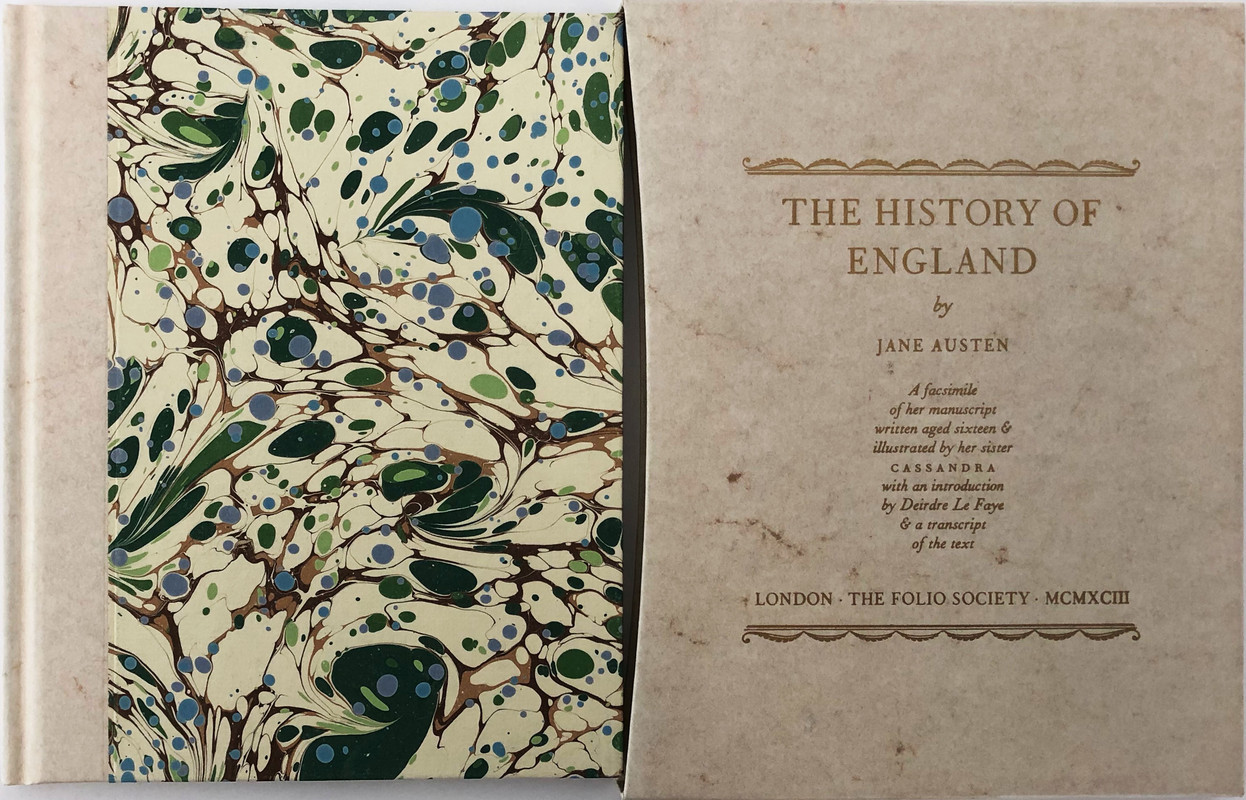
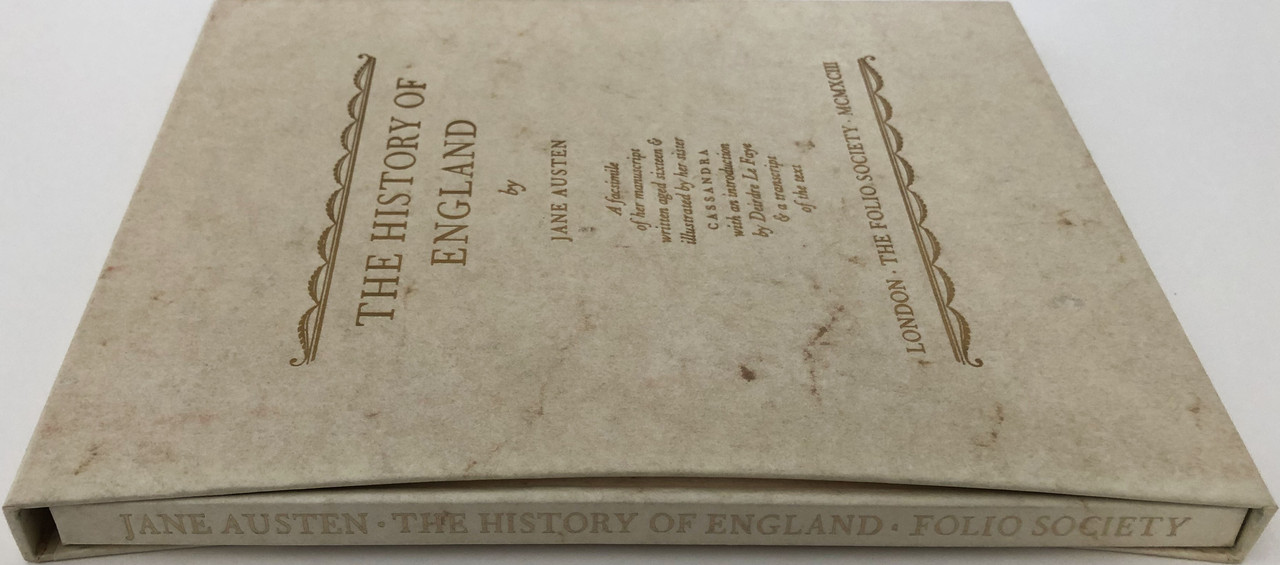
The slim volume is enclosed in a mock marble slipcase (22x17.5cm.) that has the title and description printed on it in gold (which shows poorly in the photos below).
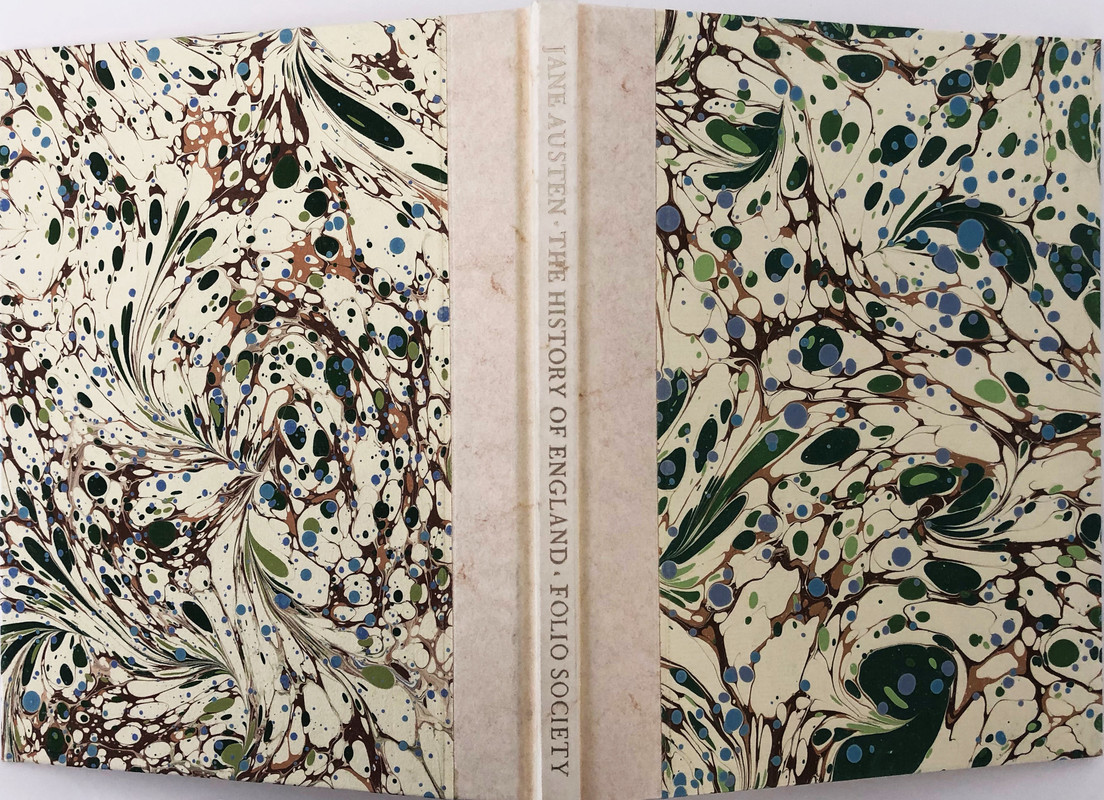
The book itself was printed on light cream Rivoli paper at the Bath Press, and it is bound in vegetable parchment with hand marbled front and back sides by the doyen of marblers, the late Ann Muir. The endpapers are a plain mid-cream colour
The facsimile is 34 pages long and is an exact reproduction, including smudges and corrections. The introduction is five pages, and the transcription 26 pages.
A truly delightful publication.


An index of the other illustrated reviews in the "Folio Archives" series can be viewed at : http://www.librarything.com/topic/266300
I may be a cad, but I have only one book by Jane Austen in my library, and it is one that most of you will not know, and has a most unlikely topic and title for an author known for her fiction.
“The History of England” was written by Jane Austen when she was 16, and was illustrated by her sister Cassandra.
In 1993 the Folio Society produced a beautiful facsimile of Jane Austen’s original manuscript. An introduction was written by Deidre Le Faye, and a typescript transcription was added to enable those who could not interpret Jane’s handwriting to read the book easily.
The slim volume is enclosed in a mock marble slipcase (22x17.5cm.) that has the title and description printed on it in gold (which shows poorly in the photos below).
The book itself was printed on light cream Rivoli paper at the Bath Press, and it is bound in vegetable parchment with hand marbled front and back sides by the doyen of marblers, the late Ann Muir. The endpapers are a plain mid-cream colour
The facsimile is 34 pages long and is an exact reproduction, including smudges and corrections. The introduction is five pages, and the transcription 26 pages.
A truly delightful publication.


An index of the other illustrated reviews in the "Folio Archives" series can be viewed at : http://www.librarything.com/topic/266300
2scratchpad
This is delightful. Brief and opinionated in a way entirely typical of a youthful starter and indicative of something more, much more, to come. Whatever she had in mind when she penned this little gem it comes across now as pure fun. FS should publish this again.
3HuxleyTheCat
>1 wcarter: I'll admit I part-exed my copy on a visit to Ardis. It's an attractive enough book physically, but the content did nothing for me and I knew I wouldn't ever bother opening it in the future; so, off it went along with various items which I had bought different (better) editions of and those Folios which I had bought as an early collector when I just had to snap up everything offered at a half decent price whether I was interested in the content or not, etc.
4sviswanathan
Lovely book! The binding is really wonderful, and it is nice to see Austen's early writing.
5LolaWalser
I've a British Library facsimile edition produced in the same year. The Folio binding and slipcase are of course much nicer.
It's worth getting for the pleasure of a vivid impression of the manuscript, the handwriting.
It's worth getting for the pleasure of a vivid impression of the manuscript, the handwriting.
6Chawton
The illustrations in the History are by Jane's sister Cassandra and are meant to show family members cast as important figures from English history.
I think there is little doubt that Mrs Austen is pictured as Elizabeth 1st (there is a family connection between the Leighs and this Queen).
Jane herself is meant to be the model for Mary Queen of Scots and championed her cause not just in the History but with friends and neighbours in the vicinity of Steventon.
I recommend Jane's Juvenilia as a wonderful and witty read.
I think there is little doubt that Mrs Austen is pictured as Elizabeth 1st (there is a family connection between the Leighs and this Queen).
Jane herself is meant to be the model for Mary Queen of Scots and championed her cause not just in the History but with friends and neighbours in the vicinity of Steventon.
I recommend Jane's Juvenilia as a wonderful and witty read.
7shelob
>1 wcarter: Thank you for bringing these treasures to our attention. Please continue!
Could not resist the temptation and ordered the book from Ardis. Being Jane Austen’s fan, I’d be interested to see what her writing style developed from. And the idea of facsimile sounds very attractive too.
BTW, there is a copy of The Raven on Ardis, one of FS miniature books, but with a very faded spine.
Could not resist the temptation and ordered the book from Ardis. Being Jane Austen’s fan, I’d be interested to see what her writing style developed from. And the idea of facsimile sounds very attractive too.
BTW, there is a copy of The Raven on Ardis, one of FS miniature books, but with a very faded spine.
8wcarter
>7 shelob:
You must be reading my mind!
I was in the process of preparing a new post about the miniature poetry books when you made your post.
See:- http://www.librarything.com/topic/266299
You must be reading my mind!
I was in the process of preparing a new post about the miniature poetry books when you made your post.
See:- http://www.librarything.com/topic/266299

