Ernest J. Gaines--American Authors Challenge August 2019
Talk 75 Books Challenge for 2019
Join LibraryThing to post.
This topic is currently marked as "dormant"—the last message is more than 90 days old. You can revive it by posting a reply.
1laytonwoman3rd

Ernest J. Gaines was born and raised on a Louisiana plantation where his ancestors were once slaves and later sharecroppers. As a child, he worked in those fields himself. He and his wife later purchased land that was once a part of that plantation, built their own home on it, and bought the old church building where he got his early schooling, both religious and secular. During World War II, Gaines’ parents moved to California looking for work, leaving him and his younger siblings in the care of his aunt, a woman so crippled she could neither walk nor stand, but managed much of the house and yard work by crawling from place to place.
At the age of 15, when no high school was available to him as a black youth in Louisiana, he went to California himself, where he spent much of his free time in the library. He has said that his stepfather, intending to keep him off the streets, told him he had three options for his leisure –the movies, the YMCA, or the library. As he had no money, the movies were out; as he did not know how to play basketball, swim, or play the piano, he didn’t find much to do at the Y; the library, however, showed him more books than he knew existed and he became especially engrossed in 19th century Russian literature, the characters and themes of which seemed to echo his own history and upbringing.
After high school and a tour in the Army, Gaines attended San Francisco State University where he tried his hand at writing his own stories, some of which were published in the school’s literary magazine and ultimately gained him admission to Wallace Stegner’s creative writing program at Stanford.
Gaines’ best known work is probably The Autobiography of Miss Jane Pitman, now often taught, along with his equally powerful later novels, A Lesson Before Dying and A Gathering of Old Men, in high schools and colleges throughout the country. Widely popular, critically acclaimed, and award-winning TV movies were made of these three novels, all of which are available on either Netflix or Amazon to rent, stream or buy.
Ernest Gaines is now 86 years old, and recent photos show him in a wheelchair. His latest published work is a 2017 novella titled The Tragedy of Brady Sims. Several years ago, when it had already been a long stretch since he had published anything, he confessed that it had gotten harder for him to write, given his popularity as a teacher and a speaker. He also attributed some of that gap to his attempts to write about something other than life in the South. He said he had tried to write about his Army experiences, but it came out sounding like he was re-working Mr. Roberts; he had tried to write a California ghost story, but it “was just bad”. He concluded that, while his body had lived in other places, his soul never left Louisiana. Like Faulkner, he did his best work when telling stories about his own personal postage stamp of soil.
Long associated with the University of Louisiana at Lafayette as Writer in Residence, Gaines donated his early manuscripts and other papers to UL, a collection which became the foundation for the Ernest J. Gaines Center for international scholarship. Gaines has won multiple literary awards, as well as a Guggenheim Fellowship and a MacArthur “genius grant”. In 2012 President Obama bestowed the National Medal of Arts on him in a White House ceremony. In 2007, the Ernest J. Gaines Award for Literary Excellence was established to recognize new fiction by African American authors.
I highly recommend a series of podcasts called “What it Takes”, including this one featuring Gaines, produced by The American Academy of Achievement.
The 2019 AAC General Discussion thread is here. It includes links to all the monthly threads.
3Caroline_McElwee
Well I failed with this months reads, but the Library does have a Gaines, I've just got to get myself over there in the next week or two!
4kac522
A Lesson Before Dying is one of the most powerful books I have ever read. I have The Autobiography of Miss Jane Pittman and A Gathering of Old Men on the shelf and will pick one of those.
5laytonwoman3rd
>2 m.belljackson: That one is my top recommendation of those I have read, Marianne. A Lesson Before Dying is great as well. I saw the movie version of Jane Pittman long ago, but have not read the book, so I intend to remedy that, and hopefully squeeze in his newest novella also. After doing the research for >1 laytonwoman3rd:, what I really want is to sit down at dinner with Mr. Gaines.
6lauralkeet
I've never read Gaines' work and had no idea he wrote *Jane Pittman*. Like you, Linda, I've only seen the movie. I bought A Lesson Before Dying five years ago in a Kindle deal, but something other than its low price made me notice it and buy it. Not sure what that was. Anyway, it's high time I read it so I'll do so this month.
7RBeffa
I couldn't get your podcasts links in >1 laytonwoman3rd: to work Linda. Maybe it is just my computer. Several years ago when I read one of Gaines's novels and was singing his praises I put this link in my thread: https://www.youtube.com/watch?v=H1dRr5-rw0w As I wrote then,
"Gaines is perhaps best known for writing "The Autobiography of Miss Jane Pittman" and "A Lesson Before Dying." Like most writers he has written a few more than "the famous ones." Gaines came of age in rural Louisiana and also the town I have lived in for the last 27+ years, moving here at 15. He became a reader and a writer here in Vallejo, California. This town once had a lovely Carnegie library and there Gaines, in his own words, has said he "started reading and reading and reading." A very interesting talk can be watched here: https://www.youtube.com/watch?v=H1dRr5-rw0w Just before the 3 minute mark he talks about first being allowed to go to the library in Vallejo. (In Louisiana libraries were for whites only). The entire piece is about 20 minutes and I found it wonderfully instructive. Gaines says, if I were a book, what would I be? Maybe Don Quixote.
His works however reflect the south and Louisiana where he also lived and which formed him and where he wants to make a difference. That is where he found what he needed to write about. Louisiana."
Our Carnegie Library was torn down in that wonderful era of urban renewal. However I found the plaque saved in our local museum by chance a few days after finishing my read. The library where Gaines learned to read and read and read was established in 1904. Here is my photo of it
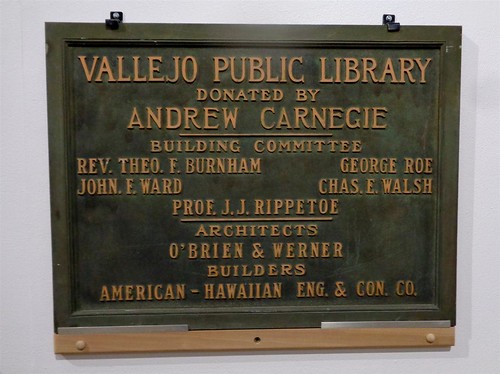 .
.
"Gaines is perhaps best known for writing "The Autobiography of Miss Jane Pittman" and "A Lesson Before Dying." Like most writers he has written a few more than "the famous ones." Gaines came of age in rural Louisiana and also the town I have lived in for the last 27+ years, moving here at 15. He became a reader and a writer here in Vallejo, California. This town once had a lovely Carnegie library and there Gaines, in his own words, has said he "started reading and reading and reading." A very interesting talk can be watched here: https://www.youtube.com/watch?v=H1dRr5-rw0w Just before the 3 minute mark he talks about first being allowed to go to the library in Vallejo. (In Louisiana libraries were for whites only). The entire piece is about 20 minutes and I found it wonderfully instructive. Gaines says, if I were a book, what would I be? Maybe Don Quixote.
His works however reflect the south and Louisiana where he also lived and which formed him and where he wants to make a difference. That is where he found what he needed to write about. Louisiana."
Our Carnegie Library was torn down in that wonderful era of urban renewal. However I found the plaque saved in our local museum by chance a few days after finishing my read. The library where Gaines learned to read and read and read was established in 1904. Here is my photo of it
 .
.8laytonwoman3rd
Thanks for pointing out that the links didn't work, Ron. I composed the post in a word processing program, and it puts funny quotation marks in that don't work with the HTML. Fixed 'em now.
How wonderful that the library plaque was saved....but it is sad that the original building is no more, especially since it served such a noble purpose for Gaines (and I'm sure for countless other young people who became readers because the library was there).
How wonderful that the library plaque was saved....but it is sad that the original building is no more, especially since it served such a noble purpose for Gaines (and I'm sure for countless other young people who became readers because the library was there).
9RBeffa
I forgot to mention that I plan to read A Lesson Before Dying
10kidzdoc
Count me in. I purchased the Kindle edition of A Lesson Before Dying a few minutes ago.
ETA: Great introductory post, Linda!
ETA: Great introductory post, Linda!
11jessibud2
I also have A Lesson Before Dying and will try to read it if I can locate it in among the mountains of TBRs.
12nittnut
I have read A Gathering of Old Men and it was a powerful book. I think I will read The Autobiography of Miss Jane Pittman.
13msf59
Sadly, I have never read Gaines either. Thanks to Linda and the AAC for helping me with that glaring oversight. I have nothing on shelf, but I will most likely read The Autobiography of Miss Jane Pittman and hopefully get to another one later in the year.
14laytonwoman3rd
>4 kac522:, >6 lauralkeet:, >9 RBeffa:, >10 kidzdoc:, >11 jessibud2:, >12 nittnut: Terrific!
>13 msf59: Glad to help you become a better American reader, Mark!
My introduction to Gaines's work was actually watching the TV movie of A Gathering of Old Men, which somehow I saw before I saw The Autobiography of Miss Jane Pittman. It got me started on collecting Gaines's books.
>13 msf59: Glad to help you become a better American reader, Mark!
My introduction to Gaines's work was actually watching the TV movie of A Gathering of Old Men, which somehow I saw before I saw The Autobiography of Miss Jane Pittman. It got me started on collecting Gaines's books.
15klobrien2
I'm looking forward to this month's read--I've got two books from the library (A Lesson Before Dying and The Autobiography of Miss Jane Pittman) and I think I'll be reading them both! (I am full of confidence and there's a whole month ahead of us :)).
Karen O.
Karen O.
16laytonwoman3rd
>15 klobrien2: And it's a looooong month!
17weird_O
I've a good start on A Lesson Before Dying. A Gathering of Old Men is also in the on-deck circle.
I collected these two novels after reading that Mr. Gaines was an alum of Wallace Stegner's creative writing program at Stanford.
I collected these two novels after reading that Mr. Gaines was an alum of Wallace Stegner's creative writing program at Stanford.
18katiekrug
I have a copy of Of Love and Dust on my shelf, so I will try to get that one read this month.
19laytonwoman3rd
In light of the passing of Toni Morrison, I'll probably be picking up one of her books that I haven't yet read. We read her for the AAC in 2014, and if anyone else wants to revisit that discussion, here's a link to the thread. I'm sure Mr. Gaines would not mind at all if anyone wanted to share current Morrison reading here on his thread.
20lauralkeet
I finished A Lesson Before Dying this week, and what a wonderful book it is. There is so much to like in Gaines' prose, his vivid depiction of the setting, the character development, and the deeper meaning to the title. If you're dithering about what to read this month, you can't go wrong with this one.
21weird_O
>20 lauralkeet: Ditto.
22laytonwoman3rd
I finished The Autobiography of Miss Jane Pittman earlier in the week. Highly recommended. I didn't do a full review, but said a bit about it on my own thread.
23fuzzi
I was a little hesitant to start this challenge, as it's out of my comfort zone, but went ahead and borrowed A Gathering of Old Men yesterday from the library. I started it before bed...and couldn't put it down until I fell asleep, halfway through. Definitely an engrossing read, and I plan to finish it tonight.
24RBeffa
I posted a version of these comments on my own thread earlier this month. I did a re-read of A Lesson before Dying. (I had forgotten that this was one of Gaines' novels that I had read many years ago but I immediately recognized it.) I gave it 4 stars
Ernest Gaines is always worth reading, but part of the premise and style of the story bothers me a little, and it is partly a stylistic choice of storytelling. A simple man commits a crime of opportunity but he is swept up in a much more serious crime, murder of a shopkeeper. He shouldn't have been sentenced to die, but in 1946 rural Louisiana he is. Lots of people get away with murder, but not this simple man, who didn't even commit murder. One of the bothers is that we don't meet Jefferson, the imprisoned man, before the moment of crime. We don't get any of his backstory until the end of the novel. (I've noticed this style in other works by Gaines, such as 'In My Father's House' when the dark/questionable past of the main character isn't revealed for most of the book). The withholding of info worked in 'In My Father's House' but I didn't like it being done in A Lesson before Dying.
Gaines gives the reader a lot to think about throughout the story, in technique as well as questions, questions both big and small. Questions such as the following which comes about a quarter ways in and is the thoughts of the teacher, Wiggins, who teaches children up to 6th grade in the local colored school and has been given the task of 'teaching' the condemned man Jefferson before his death. Some older men have dropped off a wagon load of timber at the school, and the older children have gone to work sawing and chopping up the wood needed for the school stove to keep them warm. Looking at his schoolchildren, Wiggins: "And I thought to myself, What am I doing? Am I reaching them at all? They are fifty years younger, maybe more, but doing the same thing those old men did who never attended school a day in their lives. Is it just a vicious circle? Am I doing anything?"
That's one of the small things to think about. There are bigger ones.
It is a tough trip getting through some of this, but the last 30 pages or so and powerful ending make the journey worth it.
Ernest Gaines is always worth reading, but part of the premise and style of the story bothers me a little, and it is partly a stylistic choice of storytelling. A simple man commits a crime of opportunity but he is swept up in a much more serious crime, murder of a shopkeeper. He shouldn't have been sentenced to die, but in 1946 rural Louisiana he is. Lots of people get away with murder, but not this simple man, who didn't even commit murder. One of the bothers is that we don't meet Jefferson, the imprisoned man, before the moment of crime. We don't get any of his backstory until the end of the novel. (I've noticed this style in other works by Gaines, such as 'In My Father's House' when the dark/questionable past of the main character isn't revealed for most of the book). The withholding of info worked in 'In My Father's House' but I didn't like it being done in A Lesson before Dying.
Gaines gives the reader a lot to think about throughout the story, in technique as well as questions, questions both big and small. Questions such as the following which comes about a quarter ways in and is the thoughts of the teacher, Wiggins, who teaches children up to 6th grade in the local colored school and has been given the task of 'teaching' the condemned man Jefferson before his death. Some older men have dropped off a wagon load of timber at the school, and the older children have gone to work sawing and chopping up the wood needed for the school stove to keep them warm. Looking at his schoolchildren, Wiggins: "And I thought to myself, What am I doing? Am I reaching them at all? They are fifty years younger, maybe more, but doing the same thing those old men did who never attended school a day in their lives. Is it just a vicious circle? Am I doing anything?"
That's one of the small things to think about. There are bigger ones.
It is a tough trip getting through some of this, but the last 30 pages or so and powerful ending make the journey worth it.
25laytonwoman3rd
It's been quite a long time since I read A Lesson Before Dying. Still, I had a quick response to what you're saying about the style of telling the story, but I'm going to save it until I've had a chance to do a re-read myself, with your comments in mind. I do remember it being a very powerful book.
26RBeffa
>25 laytonwoman3rd: I didn't want to be too specific. It is a common technique in storytelling to reveal secrets about a character's past late in a story, and it frequently seems to occur with a twist. Here I think the story suffers from it - and I have to assume that the author wrote the story this way with a purpose in mind. The reveal here isn't a big game changer in any way I can surmise. The reveal just lets us know some history of the character and his relation or lack thereof to other characters.
One of my several other bothers is that I don't know what Wiggins taught Jefferson.
I would love to hear some opinions about elements of the story. I had waited to comment hoping some things would be brought up as others read the book. I can see that Jefferson taught or rather showed others something. Maybe that is the only lesson.
One of my several other bothers is that I don't know what Wiggins taught Jefferson.
I would love to hear some opinions about elements of the story. I had waited to comment hoping some things would be brought up as others read the book. I can see that Jefferson taught or rather showed others something. Maybe that is the only lesson.
27laytonwoman3rd
>26 RBeffa: You're approaching what I thought might be the "point", Ron...was the lesson something Wiggins learned, rather than something he taught...
28RBeffa
>27 laytonwoman3rd: Yes, I think Wiggins learned the answer to the question I included up above in >24 RBeffa:, Is it just a vicious circle? Am I doing anything?
29lauralkeet
>27 laytonwoman3rd: that's what I meant by the deeper meaning to the title up in >20 lauralkeet:. Who taught whom? I think both men learned from their time together, although the "lessons" struck me as primarily internal and spiritual and not easily described. But I'll try. Wiggins experienced personal growth in multiple ways. He took on the task against his will and continued to protest his involvement. But at some point he seemed to find purpose in it. As for Jefferson, the chapter with his diary showed how his time with Wiggins affected him and was incredibly moving.
Just my two cents.
Just my two cents.
30fuzzi

A Gathering of Old Men by Ernest J. Gaines
A well-drawn and balanced tale of fundamental changes in a society and of the people who either choose to adapt or not, both suffering consequences of perceived progress. I found myself immersed in the story, as told in first-person by those present, and never felt that I was being manipulated emotionally by the author. Nicely written.

31Caroline_McElwee
A Lesson Before Dying (Ernest J Gaines) (16/08/19) ****

Young Jefferson gets caught up in a robbery that goes badly wrong, leaving the young men responsible dead beside their victim, and Jefferson with no witness to prove his innocence. Sentenced to death, and described as 'a hog' by the prosecution, his Aunt Emma wants the town teacher to ensure that he walks to his death as a man, not the hog he has been named.
Mr Wiggins, the teacher, wears this burden heavily. Desperate to leave the town and create a new life for himself, he is held back by the love of Vivian, unable to do anything until her marriage is dissolved.
Jefferson obstructs all attempts to help him from his aunt, the Reverend, and Wiggins, until finally Wiggins wins a breakthrough.
I had not heard of Gaines until he won a place on the American Author challenge list this year (thank you Linda).
I found this a fine novel with flaws. At the outset the reader knows that Jefferson is innocent, and yet there is never an attempt to protest his innocence. I presume that there was simply no purchase against the twelve good white men and true of the jury, but somehow I felt there needed to be some attempt or exploration of this
Ultimately though, it was hearing Jefferson's own voice at the end, that made me feel we needed to have heard it from the outset, that led me to withhold that extra half a star. I think it would have offered an even richer reading experience if we had done so.

Young Jefferson gets caught up in a robbery that goes badly wrong, leaving the young men responsible dead beside their victim, and Jefferson with no witness to prove his innocence. Sentenced to death, and described as 'a hog' by the prosecution, his Aunt Emma wants the town teacher to ensure that he walks to his death as a man, not the hog he has been named.
Mr Wiggins, the teacher, wears this burden heavily. Desperate to leave the town and create a new life for himself, he is held back by the love of Vivian, unable to do anything until her marriage is dissolved.
Jefferson obstructs all attempts to help him from his aunt, the Reverend, and Wiggins, until finally Wiggins wins a breakthrough.
I had not heard of Gaines until he won a place on the American Author challenge list this year (thank you Linda).
I found this a fine novel with flaws. At the outset the reader knows that Jefferson is innocent, and yet there is never an attempt to protest his innocence. I presume that there was simply no purchase against the twelve good white men and true of the jury, but somehow I felt there needed to be some attempt or exploration of this
Ultimately though, it was hearing Jefferson's own voice at the end, that made me feel we needed to have heard it from the outset, that led me to withhold that extra half a star. I think it would have offered an even richer reading experience if we had done so.
32Caroline_McElwee
>26 RBeffa: I think we are on the same page about the structure Ron. There are times when late disclosure is appropriate, but I felt we really missed out by not having more of Jeffersons voice.
Whether it was felt that Jefferson's uneducated writing might put off readers I don't know. But that then takes us to the complicated question of who the novel is written for, and the sticky subject of 'the white gaze'.
>29 lauralkeet: I agree with Laura that both Wiggins and Jefferson learn something from their journey, as do many other characters.
Whether it was felt that Jefferson's uneducated writing might put off readers I don't know. But that then takes us to the complicated question of who the novel is written for, and the sticky subject of 'the white gaze'.
>29 lauralkeet: I agree with Laura that both Wiggins and Jefferson learn something from their journey, as do many other characters.
33RBeffa
>32 Caroline_McElwee: I think we are on exactly the same page with this Caroline.
34lycomayflower
I finished The Autobiography of Miss Jane Pittman last week and am very glad I read it. I found that my engagement waxed and waned, but when I was in the story, I was *in*. Looking forward to reading some more of Gaines someday. My review is here.
35laytonwoman3rd
I have finished Gaines's The Tragedy of Brady Sims, which I think is his most recent fiction. It's short, but powerful. I had a few more things to say about it on my thread.
37msf59

The Autobiography of Miss Jane Pittman by Ernest J. Gaines 4.2 stars
Miss Jane Pittman was a child on a Louisiana plantation, as the Civil War was wrapping up. The rest of this sweeping novel follows Jane for the next hundred years, right into the Civil Rights era of the 1960s. This is my first book, by Mr. Gaines and I was not only impressed by his storytelling skills and use of dialect, but also by the fresh angles, he takes this tale. I will be reading more of his work.
**I just saw there is a new film adaptation of this, coming out this month. Sweet!!
38klobrien2
I'm a little late, but I will finish my read of The Autobiography of Miss Jane Pittman today. It has seemed so familiar to me that I'm almost positive that I read it in my youth (junior high school?) a LONG time ago. I really enjoyed the read, and I'd like to read more Ernest J. Gaines.
I love the AAC--it helps me to expand my usual reading patterns!
Karen O.
I love the AAC--it helps me to expand my usual reading patterns!
Karen O.
39laytonwoman3rd
>37 msf59: I must look into that movie...thanks, Mark!
>38 klobrien2: I'm really glad you're enjoying the AAC, Karen.
>38 klobrien2: I'm really glad you're enjoying the AAC, Karen.
40klobrien2
I watched the DVD of "The Autobiography of Miss Jane Pittman" and it was even better than I remembered. No captioning, and my hearing is not great, so I did miss some of the dialogue. Good thing I'd just read the book!
Just as great as the movie itself were the special features, including an interview with Gaines! John Lowe, who was one of the professors talking with Gaines is currently writing a biography of the author. I can't wait to see that!
Karen O.
Just as great as the movie itself were the special features, including an interview with Gaines! John Lowe, who was one of the professors talking with Gaines is currently writing a biography of the author. I can't wait to see that!
Karen O.
41laytonwoman3rd
>40 klobrien2: Oooh...extra features! I'm going to the library this afternoon, and I will check to see if the DVD is available. I've been wanting to watch it again since reading the book, but .. you know...real life.
42nittnut
I read the Un-put-downable life story of Miss Jane Pittman, starting with the end of the Civil War and ending in the thick of the Civil Rights movement. Jane is a heroine like no other. She is tough and sassy and persistent. I loved it. I had read A Gathering of Old Men previously, and I look forward to reading more by Mr. Gaines.
43RBeffa
Makes me sad, Ernest Gaines passed on today https://www.wafb.com/2019/11/05/famed-louisiana-author-ernest-gaines-dies/

