1John5918
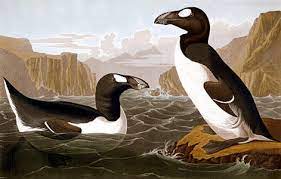
For the first Bird of the Month of the new year I choose another extinct bird, the great auk (Pinguinus impennis). Despite its Latin name, it is not closely related to the modern penguin, which were discovered later by Europeans and so named by sailors because of their physical resemblance to the great auk, which were called penguins. The razorbill is the closest living relative of the great auk, which was also related closely to the little auk or dovekie. The great auk was 75-85 cm tall and weighed about 5 kg. The wings were only 15 cm long, rendering the bird flightless, but the great auk was a powerful swimmer, a trait that it used in hunting. Its favourite prey were fish and crustaceans.
The great auk was an important part of many Native American cultures, both as a food source and as a symbolic item. Early European explorers to the Americas used the great auk as a convenient food source or as fishing bait, reducing its numbers. The bird's down was in high demand in Europe, a factor that largely eliminated the European populations by the mid-16th century. Scientists soon began to realise that the great auk was disappearing and it became the beneficiary of many early environmental laws, but these proved ineffectual. On 3rd June 1844, the last two confirmed specimens were killed on Eldey, off the coast of Iceland.
The great auk was found in the cold North Atlantic coastal waters along the coasts of Canada, the northeastern United States, Norway, Greenland, Iceland, the Faroe Islands, Ireland, Great Britain, France, and the Iberian Peninsula. Pleistocene fossils indicate the great auk also inhabited Southern France, Italy, and other coasts of the Mediterranean basin. It was common on the Grand Banks of Newfoundland. It left the North Atlantic waters for land only to breed, even roosting at sea when not breeding. The rookeries of the great auk were found from Baffin Bay to the Gulf of St. Lawrence, across the far northern Atlantic, including Iceland, and in Norway and the British Isles in Europe. For their nesting colonies the great auks required rocky islands with sloping shorelines that provided access to the sea. These were very limiting requirements and it is believed that the great auk never had more than 20 breeding colonies. The nesting sites also needed to be close to rich feeding areas and to be far enough from the mainland to discourage predators such as humans and polar bears. The localities of only seven former breeding colonies are known.
They had few natural predators, mainly large marine mammals, such as the orca, and white-tailed eagles, and of course polar bears. Reportedly, this species had no innate fear of human beings, and their flightlessness and awkwardness on land compounded their vulnerability. Great auks reacted to noises, but were rarely frightened by the sight of something. Their lifespan was 20 to 25 years.

Text from Wikipedia, images from Wikipedia and Audubon.
The great auk was an important part of many Native American cultures, both as a food source and as a symbolic item. Early European explorers to the Americas used the great auk as a convenient food source or as fishing bait, reducing its numbers. The bird's down was in high demand in Europe, a factor that largely eliminated the European populations by the mid-16th century. Scientists soon began to realise that the great auk was disappearing and it became the beneficiary of many early environmental laws, but these proved ineffectual. On 3rd June 1844, the last two confirmed specimens were killed on Eldey, off the coast of Iceland.
The great auk was found in the cold North Atlantic coastal waters along the coasts of Canada, the northeastern United States, Norway, Greenland, Iceland, the Faroe Islands, Ireland, Great Britain, France, and the Iberian Peninsula. Pleistocene fossils indicate the great auk also inhabited Southern France, Italy, and other coasts of the Mediterranean basin. It was common on the Grand Banks of Newfoundland. It left the North Atlantic waters for land only to breed, even roosting at sea when not breeding. The rookeries of the great auk were found from Baffin Bay to the Gulf of St. Lawrence, across the far northern Atlantic, including Iceland, and in Norway and the British Isles in Europe. For their nesting colonies the great auks required rocky islands with sloping shorelines that provided access to the sea. These were very limiting requirements and it is believed that the great auk never had more than 20 breeding colonies. The nesting sites also needed to be close to rich feeding areas and to be far enough from the mainland to discourage predators such as humans and polar bears. The localities of only seven former breeding colonies are known.
They had few natural predators, mainly large marine mammals, such as the orca, and white-tailed eagles, and of course polar bears. Reportedly, this species had no innate fear of human beings, and their flightlessness and awkwardness on land compounded their vulnerability. Great auks reacted to noises, but were rarely frightened by the sight of something. Their lifespan was 20 to 25 years.

Text from Wikipedia, images from Wikipedia and Audubon.
2John5918
And let me repeat my perennial invitation for members to do Bird of the Month from time to time - hopefully with more extant rather than extinct birds! Currently only myself, Tess and NorthernStar are doing it. It's not difficult and you don't have to be an expert, as all the information is available online. Remember that a favourite bird which you think is common and uninteresting in your area will probably seem rare and exotic to those of us from other areas, as this is a global group. If you're interested, contact me or Tess either in this thread or by private message. Let me wish you all a happy new year, with lots of interesting bird sightings!
3NorthernStar
>1 John5918: thanks for another interesting bird of the month. It makes me sad, though, to know that no one will ever see one of these alive again.
4TempleCat
>3 NorthernStar: Sad, yes. The Guardian newspaper ran an article today with the headline "'Grief is a rational response': the 21 US species declared extinct this year". This brings up so many emotions that go well beyond sadness.
5Tess_W
Here is the "list" and a picture of the Bachman Warbler
The extinct species include:
Eight Hawaiian honeycreeper birds (forest birds)
Bridled white-eye bird of Guam
Mariana fruit bat of Guam
San Marcos gambusia, a one-inch long fish from Texas
Scioto madtom, a small catfish found exclusively in the Big Darby Creek in Ohio
Bachman's warbler, a black and yellow songbird found in several Southern states and Cuba
Eight freshwater mussels: the flat pigtoe, green-blossom pearly mussel, southern acornshell, stirrupshell, tubercled-blossom pearly mussel, turgid-blossom pearly mussel, upland combshell and yellow-blossom pearly mussel

The extinct species include:
Eight Hawaiian honeycreeper birds (forest birds)
Bridled white-eye bird of Guam
Mariana fruit bat of Guam
San Marcos gambusia, a one-inch long fish from Texas
Scioto madtom, a small catfish found exclusively in the Big Darby Creek in Ohio
Bachman's warbler, a black and yellow songbird found in several Southern states and Cuba
Eight freshwater mussels: the flat pigtoe, green-blossom pearly mussel, southern acornshell, stirrupshell, tubercled-blossom pearly mussel, turgid-blossom pearly mussel, upland combshell and yellow-blossom pearly mussel
6varielle
>2 John5918: I would be willing to do a bird of the month if you need someone else. 🐦
7John5918
>6 varielle:
Thank you! After appealing for more than a year I now have two offers within the same day! Can I suggest that you, varielle, do a Bird of the Month in February 2024, and then new member JerBa, who has also volunteered, can do March? Then, if there are no other new offers, NorthernStar, Tess and myself can join the roster again in April, now with five of us contributing rather than just three.
Thank you! After appealing for more than a year I now have two offers within the same day! Can I suggest that you, varielle, do a Bird of the Month in February 2024, and then new member JerBa, who has also volunteered, can do March? Then, if there are no other new offers, NorthernStar, Tess and myself can join the roster again in April, now with five of us contributing rather than just three.
8JerBa
>7 John5918: Almost like buses... Yes, March is fine.
9varielle
>7 John5918: Perfect. I have my bird picked out. I will send you a pm.
10NorthernStar
Lovely to have new contributors!
12John5918
And we now have a third new volunteer, MeegsC! We'll slot them in later in the year - April maybe?
13varielle
ETA -Due to my inability to post the picture I finally got it to show up in a separate if you will scroll down a few posts.
The February bird of the month is the roseate spoonbill. Varielle lives near a rookery where they roost so they fly over the house all the time. It’s funny to watch them eat. They don’t have many feathers on their heads because they stick that spoony bill in the muck and shake it back and forth to get food. Their babies will be hatching in April. Funny looking babies have a round fuzzy body with long legs and neck sticking out. They look like tinker toys. Photo courtesy of LT member samthepaintman.
The following is Info from the Friends of the Crystal River State Park Facebook page:
What’s not to love about a big pink bird? With those gorgeous pastel feathers, you can almost overlook . . . that big, honkin’ beak!
Almost.
That spectacular spatulate bill comes in really handy for foraging in shallow, muddy water. The spoon-shaped tip of the bill lets it slice easily through the mud without catching on anything while bird sweeps it from side to side. When it senses a food item, it snaps it shut. Spoonbills eat small fish, worms, shrimp, crayfish, mollusks, and aquatic insects. They get their pink color from the crustaceans they eat that contain pigments called carotenoids that give their feathers a rosy hue.
Spoonbills usually nest in colonies, often in mangroves, about 5 to 15 feet above the water or ground.
But what about that unusual species name, Platalea ajaja? Platalea is Latin for “spatula” (think platypus…) and ajaja means “pink” in the Tupi language of Brazil.
Pink spatula! Perfect.
Watch for Roseate Spoonbills, Platelea ajaja, in shallow brackish or salt water throughout the Crystal River Preserve State Park, or maybe just flying by! ~Heather
#Pink #NativeBird #RoseateSpoonbill #FLStateParks #CrystalRiverPreserveStatePark #RealFlorida #NatureCoast
The February bird of the month is the roseate spoonbill. Varielle lives near a rookery where they roost so they fly over the house all the time. It’s funny to watch them eat. They don’t have many feathers on their heads because they stick that spoony bill in the muck and shake it back and forth to get food. Their babies will be hatching in April. Funny looking babies have a round fuzzy body with long legs and neck sticking out. They look like tinker toys. Photo courtesy of LT member samthepaintman.
The following is Info from the Friends of the Crystal River State Park Facebook page:
What’s not to love about a big pink bird? With those gorgeous pastel feathers, you can almost overlook . . . that big, honkin’ beak!
Almost.
That spectacular spatulate bill comes in really handy for foraging in shallow, muddy water. The spoon-shaped tip of the bill lets it slice easily through the mud without catching on anything while bird sweeps it from side to side. When it senses a food item, it snaps it shut. Spoonbills eat small fish, worms, shrimp, crayfish, mollusks, and aquatic insects. They get their pink color from the crustaceans they eat that contain pigments called carotenoids that give their feathers a rosy hue.
Spoonbills usually nest in colonies, often in mangroves, about 5 to 15 feet above the water or ground.
But what about that unusual species name, Platalea ajaja? Platalea is Latin for “spatula” (think platypus…) and ajaja means “pink” in the Tupi language of Brazil.
Pink spatula! Perfect.
Watch for Roseate Spoonbills, Platelea ajaja, in shallow brackish or salt water throughout the Crystal River Preserve State Park, or maybe just flying by! ~Heather
#Pink #NativeBird #RoseateSpoonbill #FLStateParks #CrystalRiverPreserveStatePark #RealFlorida #NatureCoast
14TempleCat
>13 varielle: It took me several attempts before I got a picture to display also! Here are the steps I follow:
1. load your image into your junk drawer
2. click on/select/open (whichever your operating system provides) the postage stamp rendering of your image in your junk drawer. The bigger, actual sized image should appear.
3. copy the address of this large image into your paste buffer. (On my iPad I press and hold on the image and a menu pops up from which I select 'copy'.)
4. Back in your entry here, type <img src="url">
where url is the address of the pic that you copied into your paste buffer. Simply paste it in the command between the quotes. Be sure to include the double quotes in your command as well.
Then check the preview of your post just to confirm that everything works the way you wanted. Good luck!
1. load your image into your junk drawer
2. click on/select/open (whichever your operating system provides) the postage stamp rendering of your image in your junk drawer. The bigger, actual sized image should appear.
3. copy the address of this large image into your paste buffer. (On my iPad I press and hold on the image and a menu pops up from which I select 'copy'.)
4. Back in your entry here, type <img src="url">
where url is the address of the pic that you copied into your paste buffer. Simply paste it in the command between the quotes. Be sure to include the double quotes in your command as well.
Then check the preview of your post just to confirm that everything works the way you wanted. Good luck!
15varielle
>14 TempleCat: Thanks. I've been trying to work from an iPhone 13 without luck but will try again when I can get to a full-sized computer.
16TempleCat
Interesting ... Using Safari, I just loaded a pic into my junk drawer, then loaded its address into the img src="..." command on my iPad, and those instructions worked fine. Then I deleted the image in my junk drawer and tried the whole process again using Safari on my iPhone SE with the same instructions and picture and it failed! I'm getting the same results as you - a tiny picture of a question mark. Both my phone and pad are using the same version of ios, too - 17.2.
Then, just to see if the image loaded into the junk drawer is the culprit, if there is something different about the address if it's loaded into the junk drawer by the iPhone as opposed to the iPad, I uploaded the pic into my junk drawer on my iPhone and then, on my iPad, copied that image's address into my paste buffer and pasted it into that img src="..." command. It worked fine and used the exact same address as my iPhone uses - the exact same string is pasted into the command. But on the iPad the command displays the image properly and on the iPhone it doesn't.
This is either a LibraryThing or a Safari bug. Do you want to report it to LibraryThing, since you uncovered it, or shall I?
Then, just to see if the image loaded into the junk drawer is the culprit, if there is something different about the address if it's loaded into the junk drawer by the iPhone as opposed to the iPad, I uploaded the pic into my junk drawer on my iPhone and then, on my iPad, copied that image's address into my paste buffer and pasted it into that img src="..." command. It worked fine and used the exact same address as my iPhone uses - the exact same string is pasted into the command. But on the iPad the command displays the image properly and on the iPhone it doesn't.
This is either a LibraryThing or a Safari bug. Do you want to report it to LibraryThing, since you uncovered it, or shall I?
17varielle
>16 TempleCat: Go ahead. I think this has been a longstanding problem with Safari. I will try using chrome. ETA chrome didn’t work. Tried from an iPad and that didn’t work either.
18TempleCat
>17 varielle: Again - interesting! Why does it work on my iPad and doesn't work on yours? Mine's an older model - a 10½" iPad Pro from 1917, running ios 17.2. What's yours? (I'll put all this in the bug report.)
19varielle
>18 TempleCat: mine is an iPad os 17.2 from 2019.
20varielle

Finally! There is our Spoonbill. Looking a bit pensive. Maybe there was too much text in the previous posting.???
21John5918
Interesting bird and wonderful picture! Thanks, varielle.
We have spoonbills in Africa but not as spectacularly hued. Ours are plain white with a red patch on the face.
We have spoonbills in Africa but not as spectacularly hued. Ours are plain white with a red patch on the face.
22TempleCat
>20 varielle: So what platform were you using to finally get the picture to display? Did you follow the process I outlined or did you do something different to get it to work?
23varielle
>22 TempleCat: I did it through Safari but on a full sized computer. Even though the code looked exactly the same I ended up pasting an unrelated picture previously used elsewhere which worked. Then inserted the image address for the spoonie and it took. Makes no sense but whatever works.
24perennialreader
I saw my first roseate spoonbill this past January in the Everglades in Florida. Just west of the Oasis Visitors Center in a swampy area beside the road (Hwy 41). I want to go back next year after I save up some money. :) Gorgeous birds!
25NorthernStar
Nice bird, thank you! Are you in Florida?
26varielle
>25 NorthernStar: I’m in Florida unless you were asking perennialreader.
28varielle
>22 TempleCat: TempleCat I think I figured out the problem. From my iPhone typing the quotes marks “” they appeared slanted. If I copy and paste straight ones (as in perpendicular) that were previously used it corrects the problem. Mystifying. 🧐
29John5918
As we approach the end of February, just a reminder that JerBa has volunteered to do March, and MeegsC is lined up for April. There's still plenty of opportunity for other new volunteers to follow them!
30TempleCat
>28 varielle: Wow, you've got good eyes! You're right, my iPhone also gives the slanted quotes and my iPad the straight vertical quotes. These have different ascii values and that's what the computer goes by, so it makes sense one set would work and the other wouldn't.
I haven't logged the problem as a bug - been too busy - life intervenes just when you've made other plans! Now, thanks to your fine detective work, I'd say it probably isn't actually a bug, but that the explanations of how to use html in LibraryThing posts should be updated to include your new info. Kudos!
--- Edit --
Actually, that explanation is already in this set of LibraryThing instructions on using HTML,
so I guess everything is copacetic, if definitely obscure!
I haven't logged the problem as a bug - been too busy - life intervenes just when you've made other plans! Now, thanks to your fine detective work, I'd say it probably isn't actually a bug, but that the explanations of how to use html in LibraryThing posts should be updated to include your new info. Kudos!
--- Edit --
Actually, that explanation is already in this set of LibraryThing instructions on using HTML,
so I guess everything is copacetic, if definitely obscure!
31JerBa
Here goes with a first attempt at a bird of the month.
A very quick introduction: I work as a biologist for a planning consultancy in southern Germany, am British born & bred and have been birding for almost all of my 46 years. I lead regular bird walks on a couple of local nature reserves throughout the year, where I try to help people identify the birds around them, and to appreciate a bit more about their ecology & biology.
I thought I'd start small, and here it doesn't really come smaller than this: the nose-to-tail 8cm of the Firecrest (Regulus ignicapilla). This is – along with the widespread and closely-related Goldcrest, and the much less widespread and even more closely-related Madeiran Firecrest – the smallest breeding bird we have in Europe. These birds are from a small family, the Kinglets (Regulidae) with a couple of cousin species found in North America and one in eastern Asia. With the small stature comes a light weight: between 4.5 and 5.5g in total: about the same as a 2p coin, or for a pretty fat Firecrest about the same as a US quarter.
The scientific name ignicapilla refers, like the English name, to the bright orange central crown feathers which are raised and fanned a little during excitement displays.

(Image by Markxmlx, Wikipedia)
They can be found through much of Europe in the summer, but retreat towards the west and south over winter to escape the coldest winter weather. As the bill suggests, they are insectivorous, so heading for warmer climes over winter makes a lot of sense. They breed in wooded habitats, often with a small conifer element among deciduous trees and appear to be profiting from increasingly warmer summers, spreading north and west (they colonised Great Britain a few decades back, took a long while to get a foothold and are now suddenly spreading rapidly there).
This is one of a handful of birds that people on my walks often struggle to find. They are small, they move rapidly and they aren't the loudest: a short, high-pitched see-see-see call only a semitone lower than a Goldcrest and a rather dry song best described as szee-szee-szee-szee-SZEE. Not the easiest for older ears to pick up! A key identification feature when you see one is the white supercilium (eyebrow), which the Goldcrest lacks.
You can have a look at the European Breeding Bird Atlas breeding distribution map here.
The song links point to xeno-canto.org, which began life as an online database of bird song and calls to which anyone can contribute, and now has a wider remit of wildlife sound recordings. I'm not affiliated with them in any way; just find the resource both fascinating and incredibly useful.
A very quick introduction: I work as a biologist for a planning consultancy in southern Germany, am British born & bred and have been birding for almost all of my 46 years. I lead regular bird walks on a couple of local nature reserves throughout the year, where I try to help people identify the birds around them, and to appreciate a bit more about their ecology & biology.
I thought I'd start small, and here it doesn't really come smaller than this: the nose-to-tail 8cm of the Firecrest (Regulus ignicapilla). This is – along with the widespread and closely-related Goldcrest, and the much less widespread and even more closely-related Madeiran Firecrest – the smallest breeding bird we have in Europe. These birds are from a small family, the Kinglets (Regulidae) with a couple of cousin species found in North America and one in eastern Asia. With the small stature comes a light weight: between 4.5 and 5.5g in total: about the same as a 2p coin, or for a pretty fat Firecrest about the same as a US quarter.
The scientific name ignicapilla refers, like the English name, to the bright orange central crown feathers which are raised and fanned a little during excitement displays.

(Image by Markxmlx, Wikipedia)
They can be found through much of Europe in the summer, but retreat towards the west and south over winter to escape the coldest winter weather. As the bill suggests, they are insectivorous, so heading for warmer climes over winter makes a lot of sense. They breed in wooded habitats, often with a small conifer element among deciduous trees and appear to be profiting from increasingly warmer summers, spreading north and west (they colonised Great Britain a few decades back, took a long while to get a foothold and are now suddenly spreading rapidly there).
This is one of a handful of birds that people on my walks often struggle to find. They are small, they move rapidly and they aren't the loudest: a short, high-pitched see-see-see call only a semitone lower than a Goldcrest and a rather dry song best described as szee-szee-szee-szee-SZEE. Not the easiest for older ears to pick up! A key identification feature when you see one is the white supercilium (eyebrow), which the Goldcrest lacks.
You can have a look at the European Breeding Bird Atlas breeding distribution map here.
The song links point to xeno-canto.org, which began life as an online database of bird song and calls to which anyone can contribute, and now has a wider remit of wildlife sound recordings. I'm not affiliated with them in any way; just find the resource both fascinating and incredibly useful.
32clamairy
>31 JerBa: What a gorgeous bird!
Thank you.
Thank you.
34JerBa
Very welcome - the singing firecrest on this morning's walk caused no difficulty for anyone present, fortunately. They are very fine little birds!
35perennialreader
Beautiful bird. Thanks for posting!
37birder4106
Goldcrest (Regulus regulus, ger. Wintergoldhähnchen) and Firecrest (Regulus ignicapilla, ger. Sommeregoldhähnchen) are the two smallest bird species in Europe.
They are very similar and often occur next to each other and in very similar habitats.
They are somewhat easier to distinguish in their songs.
The biggest difference is their migration behavior. The goldcrest often stays in its territory all year round and exhibits mostly shorter autumn and winter migrations. The summer goldcrest migrates to areas south of the Alps from September to February and is only found in exceptional cases in the northern Alpine region.
Since their singing consists of high tones, they can serve as a hearing test for those who know their voices. If you can still hear their voices in field conditions, your hearing is ok. If this is no longer possible, it is worth having your hearing examined by a doctor and asking yourself whether it might make sense to purchase a hearing aid.
They are very similar and often occur next to each other and in very similar habitats.
They are somewhat easier to distinguish in their songs.
The biggest difference is their migration behavior. The goldcrest often stays in its territory all year round and exhibits mostly shorter autumn and winter migrations. The summer goldcrest migrates to areas south of the Alps from September to February and is only found in exceptional cases in the northern Alpine region.
Since their singing consists of high tones, they can serve as a hearing test for those who know their voices. If you can still hear their voices in field conditions, your hearing is ok. If this is no longer possible, it is worth having your hearing examined by a doctor and asking yourself whether it might make sense to purchase a hearing aid.
39NorthernStar
>31 JerBa: Thank you - lovely bird! Resembles the kinglets we get here (northern Canada) in summer, and it sounds like they are related.
40JerBa
>39 NorthernStar: they are lovely birds! Close relatives of Golden-crowned Kinglet and almost as close to Ruby-crowned - that's apparently recently been separated off into a genus of its own, basal to the other species in Regulus.
>37 birder4106: thanks for the additions :)
I did a search for winter Firecrest records in Germany on ornitho.de, asking for all records between 01.11 and 31.01, 1958-2024. The older the record, the yellower the point (yes, the data is biased in all sorts of ways, but still) - a screenshot below:

It looks as though the migration strategy is gradually changing - hardly surprising in the face of milder winters. Nowhere near as abundant as in summer and with obvious concentrations of records in the mildest areas of the country over winter, but impressively widespread nonetheless.
I find that their habitat preferences are subtly different, at least here in the southern lowlands. Goldcrests are more tied to conifers, especially spruce, where Firecrests are more a species of mixed or broadleaf woodland. It's not a hard and fast rule by any means though.
>37 birder4106: thanks for the additions :)
I did a search for winter Firecrest records in Germany on ornitho.de, asking for all records between 01.11 and 31.01, 1958-2024. The older the record, the yellower the point (yes, the data is biased in all sorts of ways, but still) - a screenshot below:

It looks as though the migration strategy is gradually changing - hardly surprising in the face of milder winters. Nowhere near as abundant as in summer and with obvious concentrations of records in the mildest areas of the country over winter, but impressively widespread nonetheless.
I find that their habitat preferences are subtly different, at least here in the southern lowlands. Goldcrests are more tied to conifers, especially spruce, where Firecrests are more a species of mixed or broadleaf woodland. It's not a hard and fast rule by any means though.
41John5918
As we come towards the end of March, let me just remind everyone that MeegsC has offered to do April.
Any offers for May and beyond? I'll do it if nobody else pops up, but it would be nice to see more new volunteers.
Any offers for May and beyond? I'll do it if nobody else pops up, but it would be nice to see more new volunteers.
45John5918
As we come towards the end of April I'm not sure what has happened to MeegsC. They told me they were travelling but would be back in time for April. But in any case let me take the liberty of doing an impromptu Bird of the Month. If MeegsC reappears before the end of the month we can have two Birds of the Month for April; if not, we'll slot them in again after varielle for May and JerBa for June.
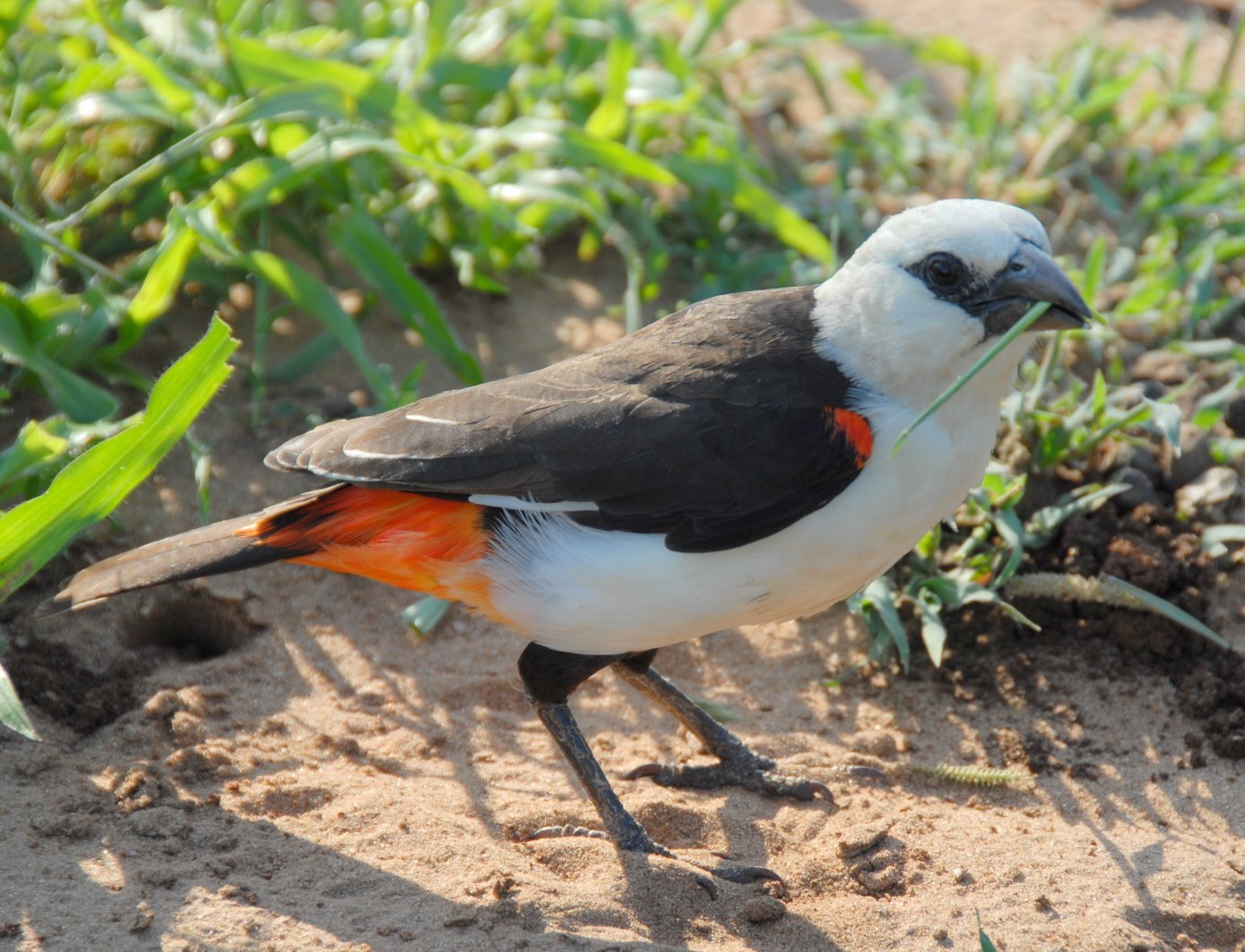
I would like to showcase the White-headed Buffalo-Weaver (Dinemellia dinemelli). They hang around in groups of up to a dozen or so in Ethiopia, Kenya, Somalia, South Sudan, Tanzania, and Uganda in a variety of open and savanna habitats and shrublands, but especially dry brush and acacia thickets. It forages on the ground for insects, especially beetles and butterflies, fruits, and seeds, and the buffalo part of its name derives from its habit of following the African buffalo, feeding on disturbed insects. It is 170 to 190 mm in length and 57 to 85 g in weight. In addition to its white head and underparts, it has a vivid orange-red rump and undertail coverts. The photos don't do it justice; when you see them in bright sunshine in the bush the red flash is really eye-catching.
We were in a wildlife conservancy in the Taita Hills in February, and we saw many of these birds there. Not the first time I've seen it, but it certainly made a greater impression on me this time. It's only found up to an altitude of 1,400 m so we don't see it at home (1,900 m) even though our vegetation here is similar to its habitat. There are northern and southern varieties with minor differences, but in Taita we were in the twilight zone between the two so I'm not sure which one we saw.
Talking of altitude, one of our neighbours recently spotted a one metre long Black-Throated Monitor (a reptile, not a bird!) in her garden (see photo below). On checking with the Florida Museum of Natural History, it turns out that this is a new altitude record (1,917.8 m) for this monitor in Kenya, where it has never before been spotted above 1,500 m. They speculate that this may be a result of global warming. If wildlife in Kenya is being driven higher, maybe one day we'll see White-headed Buffalo-Weavers in our garden!


Text from Wikipedia, eBird and various field guides. Photos from Wikipedia, observation.org and Deborah Thiele.
I would like to showcase the White-headed Buffalo-Weaver (Dinemellia dinemelli). They hang around in groups of up to a dozen or so in Ethiopia, Kenya, Somalia, South Sudan, Tanzania, and Uganda in a variety of open and savanna habitats and shrublands, but especially dry brush and acacia thickets. It forages on the ground for insects, especially beetles and butterflies, fruits, and seeds, and the buffalo part of its name derives from its habit of following the African buffalo, feeding on disturbed insects. It is 170 to 190 mm in length and 57 to 85 g in weight. In addition to its white head and underparts, it has a vivid orange-red rump and undertail coverts. The photos don't do it justice; when you see them in bright sunshine in the bush the red flash is really eye-catching.
We were in a wildlife conservancy in the Taita Hills in February, and we saw many of these birds there. Not the first time I've seen it, but it certainly made a greater impression on me this time. It's only found up to an altitude of 1,400 m so we don't see it at home (1,900 m) even though our vegetation here is similar to its habitat. There are northern and southern varieties with minor differences, but in Taita we were in the twilight zone between the two so I'm not sure which one we saw.
Talking of altitude, one of our neighbours recently spotted a one metre long Black-Throated Monitor (a reptile, not a bird!) in her garden (see photo below). On checking with the Florida Museum of Natural History, it turns out that this is a new altitude record (1,917.8 m) for this monitor in Kenya, where it has never before been spotted above 1,500 m. They speculate that this may be a result of global warming. If wildlife in Kenya is being driven higher, maybe one day we'll see White-headed Buffalo-Weavers in our garden!


Text from Wikipedia, eBird and various field guides. Photos from Wikipedia, observation.org and Deborah Thiele.
48clamairy
>45 John5918: What a beauty.
49varielle

Photo courtesy of LT member samthepaintman. It was taken on the Matanzas River.
The bird of the month is The American white ibis. They hang out in varielle’s yard frequently and leave a mess which is very tempting for little dogs to try and eat to their owner’s dismay.
The following is from Wikipedia
The American white ibis (Eudocimus albus) is a species of bird in the ibis family, Threskiornithidae. It is found from Virginia via the Gulf Coast of the United States south through most of the coastal New World tropics.2 This particular ibis is a medium-sized bird with an overall white plumage, bright red-orange down-curved bill and long legs, and black wing tips that are usually only visible in flight. Males are larger and have longer bills than females. The breeding range runs along the Gulf and Atlantic Coast, and the coasts of Mexico and Central America. Outside the breeding period, the range extends further inland in North America and also includes the Caribbean. It is also found along the northwestern South American coastline in Colombia and Venezuela. Populations in central Venezuela overlap and interbreed with the scarlet ibis. The two have been classified by some authorities as a single species.
American white ibis
Their diet consists primarily of small aquatic prey, such as insects and small fishes. Crayfish are its preferred food in most regions, but it can adjust its diet according to the habitat and prey abundance. Its main foraging behavior is probing with its beak at the bottom of shallow water to feel for and capture its prey. It does not see the prey.
During the breeding season, the American white ibis gathers in huge colonies near water. Pairs are predominantly monogamous and both parents care for the young, although males tend to engage in extra-pair copulation with other females to increase their reproductive success. Males have also been found to pirate food from unmated females and juveniles during the breeding season.
Human pollution has affected the behavior of the American white ibis via an increase in the concentrations of methylmercury, which is released into the environment from untreated waste. Exposure to methylmercury alters the hormone levels of American white ibis, affecting their mating and nesting behavior and leading to lower reproduction rates.
50John5918
>49 varielle:
Thanks! That's a spectacular bird. We have ibis - glossy, sacred and hadada - but they're all fairly nondescript compared to this. Does yours have a very loud and annoying call like ours?
Thanks! That's a spectacular bird. We have ibis - glossy, sacred and hadada - but they're all fairly nondescript compared to this. Does yours have a very loud and annoying call like ours?
51perennialreader
>49 varielle: Beautiful bird.
52varielle
>50 John5918: They are pretty squawky. It’s hard to describe.
56JerBa
So here we go with June's bird of the month... I've chosen a long-distance Palearctic migrant for this one, which is a contender for bird of the day any time it's seen - at least with my family: the European Bee-eater, Merops apiaster (locally Bienenfresser, which means - you guessed it - Bee-eater).
Here's the beast in all its finery.

My own picture, taken a few years ago in southern Spain.
Related to kingfishers and rollers, todies and motmots, there are about 31 species of the bee-eater family out there to be seen, mostly in Africa and Asia, one species each in Australia and Europe, and every one is a beauty. Despite the intense colours they can be the very devil to see when they fly overhead: that blue belly merges astonishingly well with a blue sky, so often all I get to note is 'Bee-eaters overhead, more than one calling'.
European Bee-eaters breed from northern Europe (anywhere below the 21 degree July isotherm) down through to the Mediterranean and North Africa, and eastwards into Russia (where they are apparently called 'Golden Bee-eater', a name I find most fine) roughly to China. There is also a small breeding population in South Africa and Namibia. The further south in Europe you are, the commoner they are, and the further east in Europe you are, the commoner they are too. They are one of the species currently profiting from climate change, with warmer summers allowing them to breed successfully further north, but they are also a species dependent on large flying insects - a group that is under immense pressure in Europe from wide-scale pesticide use, so Bee-eaters aren't perhaps quite as common around my part of the world as they could be.
Though they will catch and eat more or less any large insect in flight, they are famed for their ability to deal with bees: they avoid being stung by holding the bee in their bill, landing and then wiping the insect on a branch to remove the sting before they eat it. Not necessarily hugely popular with bee-keepers though, as you may imagine.
Over winter, Bee-eaters hang out in Africa, anywhere through Central and East Africa down to South Africa. They like open country with plenty of lookout posts; they're not particularly choosy what, so anything from trees to fenceposts and power lines will be used.
They breed - much like a number of kingfishers - in tunnels in earth banks. Unlike kingfishers they are colonial breeders where they have the chance, though generally in small groups of around eight pairs. A nice sunny sand-pit in a sand quarry is the ideal location in central and northern Europe; further south they particularly like riverbanks along seasonal streams.
Their call is as attractive as the plumage: a soft fluty 'prrup, prrup-prrup'. . If you're in southern Europe, keep your ears pinned!
Here's the beast in all its finery.

My own picture, taken a few years ago in southern Spain.
Related to kingfishers and rollers, todies and motmots, there are about 31 species of the bee-eater family out there to be seen, mostly in Africa and Asia, one species each in Australia and Europe, and every one is a beauty. Despite the intense colours they can be the very devil to see when they fly overhead: that blue belly merges astonishingly well with a blue sky, so often all I get to note is 'Bee-eaters overhead, more than one calling'.
European Bee-eaters breed from northern Europe (anywhere below the 21 degree July isotherm) down through to the Mediterranean and North Africa, and eastwards into Russia (where they are apparently called 'Golden Bee-eater', a name I find most fine) roughly to China. There is also a small breeding population in South Africa and Namibia. The further south in Europe you are, the commoner they are, and the further east in Europe you are, the commoner they are too. They are one of the species currently profiting from climate change, with warmer summers allowing them to breed successfully further north, but they are also a species dependent on large flying insects - a group that is under immense pressure in Europe from wide-scale pesticide use, so Bee-eaters aren't perhaps quite as common around my part of the world as they could be.
Though they will catch and eat more or less any large insect in flight, they are famed for their ability to deal with bees: they avoid being stung by holding the bee in their bill, landing and then wiping the insect on a branch to remove the sting before they eat it. Not necessarily hugely popular with bee-keepers though, as you may imagine.
Over winter, Bee-eaters hang out in Africa, anywhere through Central and East Africa down to South Africa. They like open country with plenty of lookout posts; they're not particularly choosy what, so anything from trees to fenceposts and power lines will be used.
They breed - much like a number of kingfishers - in tunnels in earth banks. Unlike kingfishers they are colonial breeders where they have the chance, though generally in small groups of around eight pairs. A nice sunny sand-pit in a sand quarry is the ideal location in central and northern Europe; further south they particularly like riverbanks along seasonal streams.
Their call is as attractive as the plumage: a soft fluty 'prrup, prrup-prrup'. . If you're in southern Europe, keep your ears pinned!
57Tess_W
>56 JerBa: So interesting! Thank you!
61varielle
A July bird for you. I just returned from a FABULOUS vacation in Switzerland. I rode the Glacier Express up to see the Matterhorn and met this fellow and his friends looking for handouts. He was very friendly. He is an Alpine Chough.
 Here is his story: The Alpine chough (/ˈtʃʌf/, pronounced /chúf/) or yellow-billed chough (Pyrrhocorax graculus) is a bird in the crow family, one of only two species in the genus Pyrrhocorax. Its two subspecies breed in high mountains from Spain eastwards through southern Europe and North Africa to Central Asia and Nepal, and it may nest at a higher altitude than any other bird. The eggs have adaptations to the thin atmosphere that improve oxygen take-up and reduce water loss.
This bird has glossy black plumage, a yellow beak, red legs, and distinctive calls. It has a buoyant acrobatic flight with widely spread flight feathers. The Alpine chough pairs for life and displays fidelity to its breeding site, which is usually a cave or crevice in a cliff face. It builds a lined stick nest and lays three to five brown-blotched whitish eggs. It feeds, usually in flocks, on short grazed grassland, taking mainly invertebrate prey in summer and fruit in winter; it will readily approach tourist sites to find supplementary food.
Although it is subject to predation and parasitism, and changes in agricultural practices have caused local population declines, this widespread and abundant species is not threatened globally. Climate change may present a long-term threat, by shifting the necessary Alpine habitat to higher altitudes.
 Here is his story: The Alpine chough (/ˈtʃʌf/, pronounced /chúf/) or yellow-billed chough (Pyrrhocorax graculus) is a bird in the crow family, one of only two species in the genus Pyrrhocorax. Its two subspecies breed in high mountains from Spain eastwards through southern Europe and North Africa to Central Asia and Nepal, and it may nest at a higher altitude than any other bird. The eggs have adaptations to the thin atmosphere that improve oxygen take-up and reduce water loss.
This bird has glossy black plumage, a yellow beak, red legs, and distinctive calls. It has a buoyant acrobatic flight with widely spread flight feathers. The Alpine chough pairs for life and displays fidelity to its breeding site, which is usually a cave or crevice in a cliff face. It builds a lined stick nest and lays three to five brown-blotched whitish eggs. It feeds, usually in flocks, on short grazed grassland, taking mainly invertebrate prey in summer and fruit in winter; it will readily approach tourist sites to find supplementary food.
Although it is subject to predation and parasitism, and changes in agricultural practices have caused local population declines, this widespread and abundant species is not threatened globally. Climate change may present a long-term threat, by shifting the necessary Alpine habitat to higher altitudes.
62John5918
Thanks, varielle. Can we have volunteers for August and September, please, before I forget?
63JerBa
Big fan of alpine choughs here: thanks varielle!
I'll happily do later in the year, but the next couple of months are a bit busy with juggling summer holidays and work.
I'll happily do later in the year, but the next couple of months are a bit busy with juggling summer holidays and work.
67varielle
>66 Tess_W: The pic is mine but the write up is Wikipedia. 🤗
68John5918
Just a reminder that Tess is doing Bird of the Month for August.
Can we have a volunteer for September, please?
Can we have a volunteer for September, please?
70John5918
Thanks, that's great. Doesn't have to be the first of the month, as long as we know that someone is doing it in September. So Tess for August and JerBa for September.
71Tess_W
The bird this month is the lark bunting, a type of sparrow. I first saw this bird when I was visiting my sister in Wyoming. I have not seen any in the Midwest. I found out while researching this bird that it is on the endangered list here in Ohio.
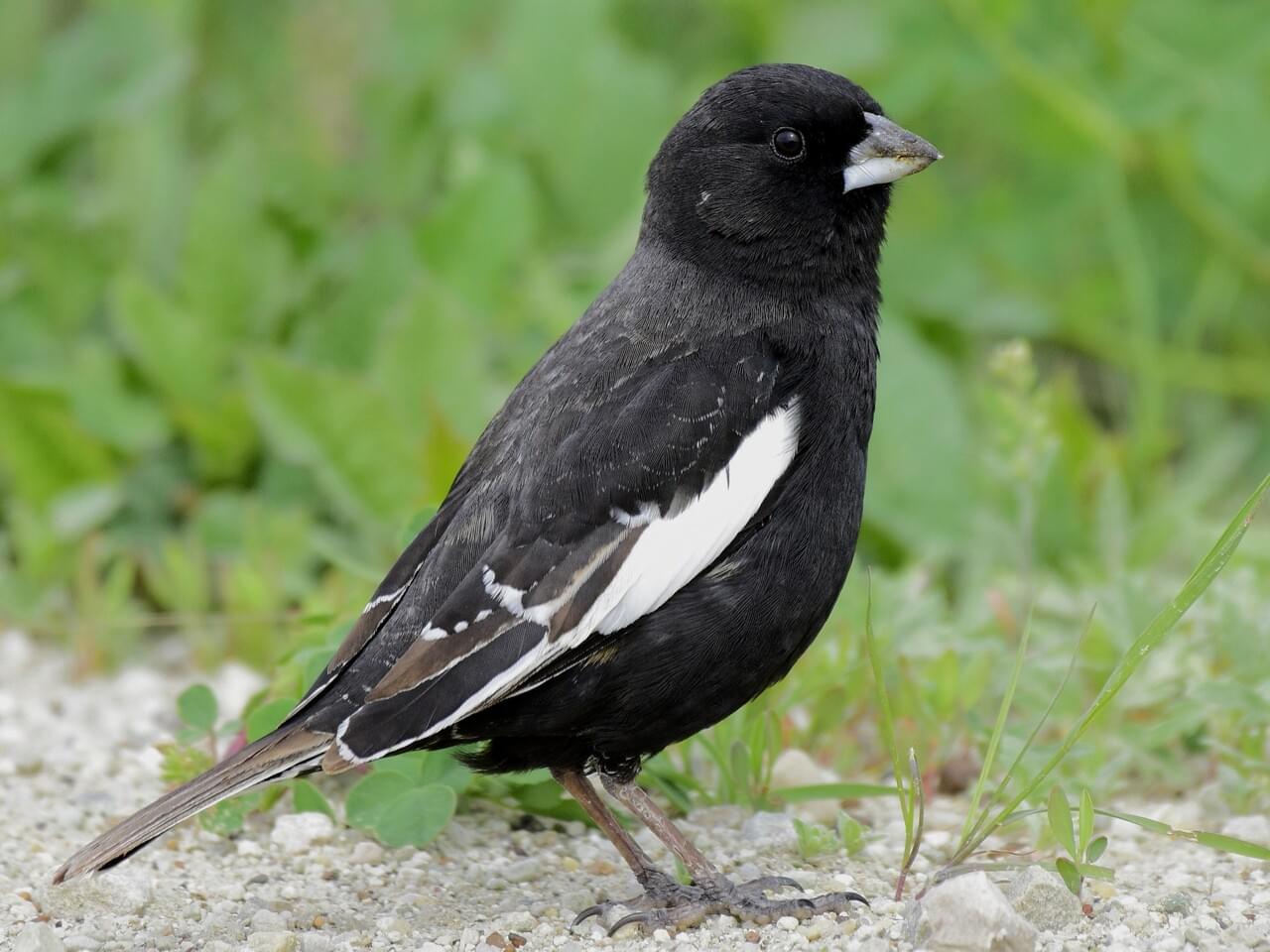
Picture from Allaboutbirds.com This is a picture of an adult breeding male. The female and juvenile males resemble the more common sparrow.
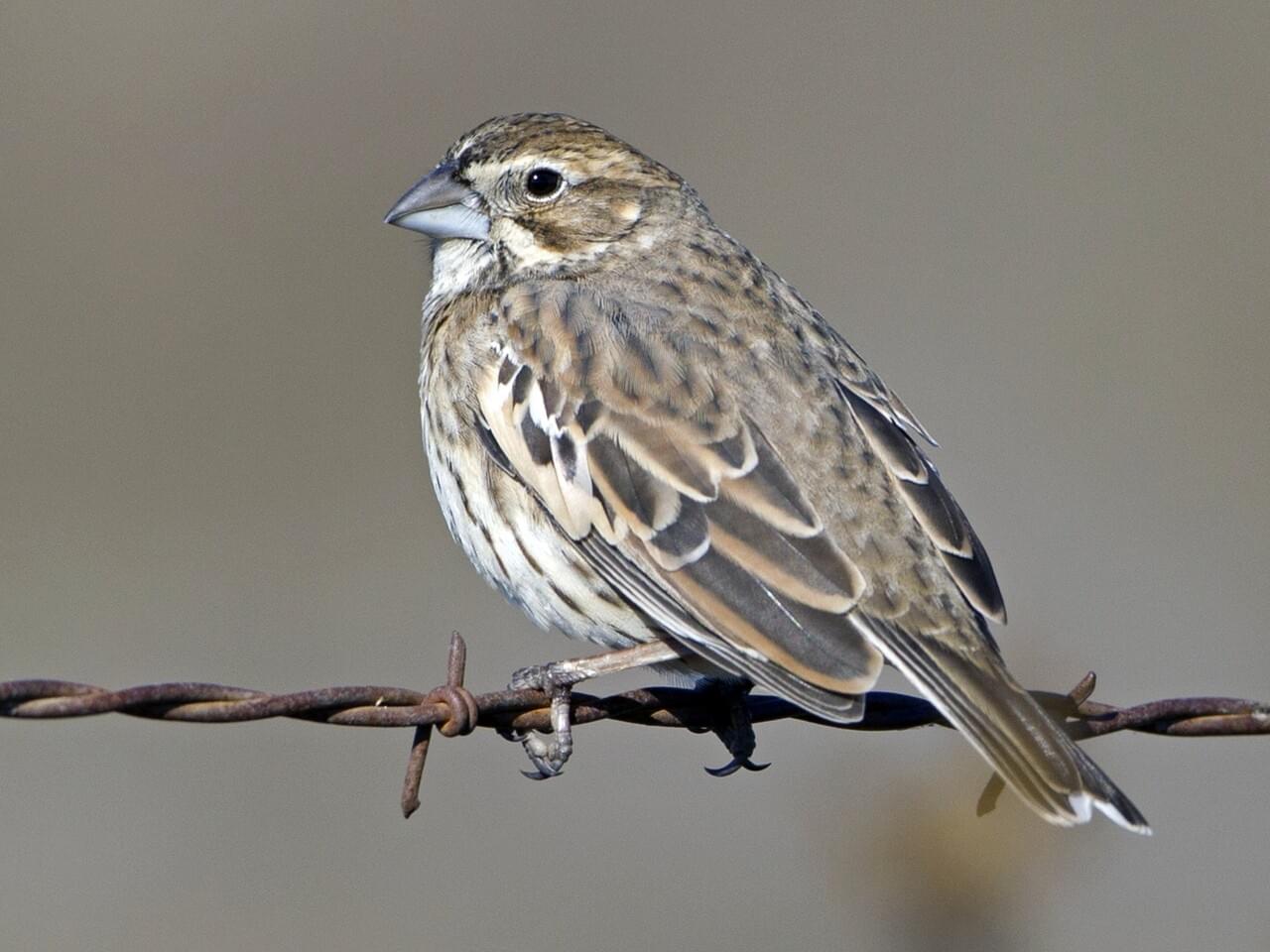
Bunting live in the grasslands and dry shrubs of North America and nowhere else. Those areas are quickly disappearing, hence why they are on the endangered list. They usually nest at the base of a small shrub or cactus, so pure grassland is usually not suitable for breeding habitat. They often flock (when migrating) with other sparrows. Lark buntings are nomadic in the winter months and can sometimes be seen near the weeds in barns and woody weeds in ditches and roadsides.
Their diet includes seeds of many grasses and forbs, cactus fruit, grains, and leaves, as well as spiders, ants, grasshoppers, flies, beetles, bees, wasps, caterpillars, moths, leafhoppers. They race through the grass to get the food instead of diving from the air. Studies have shown the the females are quicker than the males.
Their nests are on the ground usually as the foot of a cactus or shrub. The clutch is usually 2-5 eggs.

The lark bunting is the Colorado state bird.

pic from Denver public library
Nice story on how the lark bunting became Colorado's state bird. https://history.denverlibrary.org/news/western-history/how-lark-bunting-became-c...
Youtube video of both females and males: https://www.youtube.com/watch?v=jU4QxRg_LWs
Picture from Allaboutbirds.com This is a picture of an adult breeding male. The female and juvenile males resemble the more common sparrow.
Bunting live in the grasslands and dry shrubs of North America and nowhere else. Those areas are quickly disappearing, hence why they are on the endangered list. They usually nest at the base of a small shrub or cactus, so pure grassland is usually not suitable for breeding habitat. They often flock (when migrating) with other sparrows. Lark buntings are nomadic in the winter months and can sometimes be seen near the weeds in barns and woody weeds in ditches and roadsides.
Their diet includes seeds of many grasses and forbs, cactus fruit, grains, and leaves, as well as spiders, ants, grasshoppers, flies, beetles, bees, wasps, caterpillars, moths, leafhoppers. They race through the grass to get the food instead of diving from the air. Studies have shown the the females are quicker than the males.
Their nests are on the ground usually as the foot of a cactus or shrub. The clutch is usually 2-5 eggs.

The lark bunting is the Colorado state bird.
pic from Denver public library
Nice story on how the lark bunting became Colorado's state bird. https://history.denverlibrary.org/news/western-history/how-lark-bunting-became-c...
Youtube video of both females and males: https://www.youtube.com/watch?v=jU4QxRg_LWs
73JerBa
September is a month in which there is a lot going on, perhaps one of the most enjoyable months of the entire year for a northern-hemisphere birder (speaking as a European, at least!) Post-breeding migration is in full swing here and there are birds of all shapes and sizes heading south to warmer climes all the time, so in celebration of this mass movement I've chosen a long-distance migrant for September's bird of the month.
Like many really long-distance bird migrants, it's a species which breeds in the Arctic, high in the tundra zone: the Bar-tailed Godwit. This wader (shorebird) might be familiar to European readers: a mid-sized, slightly stocky bird with relatively long black legs and a rather longer pink-and-black upturned bill. In winter, when most of us get to see them, they are a rather nondescript sandy brown with a streaky pattern on the upper wings. In breeding plumage, however, they are a vibrant brick red all over. Western populations, breeding in the western Russian Arctic, travel down as far as western Africa for the winter, though plenty can be seen around the shores of the North Sea in winter, probing sandy mudflats for intertidal invertebrates (tellins, lugworms: yum!) They weigh in at just under half a kilo.
Some of the eastern populations, breeding across eastern Siberia and into western Alaska, undertake a phenomenal migration clear across the Pacific ocean. Starting at that half kilo body mass, they pack on another couple of hundred grams of fat as fuel, then head off south to New Zealand. Not only is this a long journey, but the godwits make their autumn journey in one, uninterrupted flight - approximately eight days non-stop flying across 11,000 km of open ocean. Hats off to them! Here are a couple of links to some stories about tracked individuals: an article from from Science Alert and a 2005 paper from Ornithological Applications. From the latter, if you scroll down far enough you can see the map of the tracks the birds took from Alaska, and an idea of just how high some of them fly during that journey - one bird recorded at something over 4,500 m above sea level.
Here's a picture of a bunch of Bar-tailed Godwits hanging out on an east Queensland beach a few years back, along with a couple of Grey-tailed Tattlers and Curlew Sandpipers:

Like many really long-distance bird migrants, it's a species which breeds in the Arctic, high in the tundra zone: the Bar-tailed Godwit. This wader (shorebird) might be familiar to European readers: a mid-sized, slightly stocky bird with relatively long black legs and a rather longer pink-and-black upturned bill. In winter, when most of us get to see them, they are a rather nondescript sandy brown with a streaky pattern on the upper wings. In breeding plumage, however, they are a vibrant brick red all over. Western populations, breeding in the western Russian Arctic, travel down as far as western Africa for the winter, though plenty can be seen around the shores of the North Sea in winter, probing sandy mudflats for intertidal invertebrates (tellins, lugworms: yum!) They weigh in at just under half a kilo.
Some of the eastern populations, breeding across eastern Siberia and into western Alaska, undertake a phenomenal migration clear across the Pacific ocean. Starting at that half kilo body mass, they pack on another couple of hundred grams of fat as fuel, then head off south to New Zealand. Not only is this a long journey, but the godwits make their autumn journey in one, uninterrupted flight - approximately eight days non-stop flying across 11,000 km of open ocean. Hats off to them! Here are a couple of links to some stories about tracked individuals: an article from from Science Alert and a 2005 paper from Ornithological Applications. From the latter, if you scroll down far enough you can see the map of the tracks the birds took from Alaska, and an idea of just how high some of them fly during that journey - one bird recorded at something over 4,500 m above sea level.
Here's a picture of a bunch of Bar-tailed Godwits hanging out on an east Queensland beach a few years back, along with a couple of Grey-tailed Tattlers and Curlew Sandpipers:

74varielle
>73 JerBa: Very nice bird. It sounds like it was named by Monty Python.
75JerBa
>74 varielle: It does somewhat, yes. There are some pretty whacky bird names out there :)
76NorthernStar
Thank you! Another very interesting bird of the month!
77John5918
Thanks, JerBa. I was in UK last month and we saw large flocks of the related black-tailed godwits in Topsham, Devon.
And on that happy note, do we have a volunteer for Bird of the Month in October?
And on that happy note, do we have a volunteer for Bird of the Month in October?
78JerBa
>77 John5918: Well, well... That's my old local patch :) Hope it was a good visit!
79John5918
>78 JerBa:
Yes. My brother-in-law in Exmouth is a keen birder. We spent a morning around Bowling Green Marsh RSPB Reserve, and also on the estuary. A couple of dozen species, including a purple heron, which I have seen often in Africa and my brother-in-law has seen in continental Europe but which is apparently rare in UK. It had been reported in Topsham on local birding websites the previous day. We were just sitting by the estuary in Topsham, about to go home, when it suddenly rose up out of a tree on the opposite bank. A very pleasant surprise.
Yes. My brother-in-law in Exmouth is a keen birder. We spent a morning around Bowling Green Marsh RSPB Reserve, and also on the estuary. A couple of dozen species, including a purple heron, which I have seen often in Africa and my brother-in-law has seen in continental Europe but which is apparently rare in UK. It had been reported in Topsham on local birding websites the previous day. We were just sitting by the estuary in Topsham, about to go home, when it suddenly rose up out of a tree on the opposite bank. A very pleasant surprise.
80JerBa
Nice! That's a species I never did catch up with in Devon. Bowling green marsh has a knack of turning up some nice rarities.
81NorthernStar
>77 John5918: I will volunteer for November, but early October looks like a bad time for me to volunteer for anything.
83GraceCollection
Hi there! I'm newer to the site but I have been following this thread since June; if it is open for a newcomer I would love to do bird of the month for October. Thank you.
84John5918
>83 GraceCollection:
Thank you. It is indeed open to newcomers. So that's you for October and NorthernStar for November.
Thank you. It is indeed open to newcomers. So that's you for October and NorthernStar for November.
86GraceCollection
Hello everyone! It is the morning of October 1st in Australia, but if you are in part of the world that is not yet in October, then you now have a unique opportunity to learn the bird of the month in advance!
I was very excited to get October, because I think this bird is very on-theme. I don't have the quality camera that I used to, so I'll share a creative commons image instead of one of my own blurry ones:

taken by Copeterson (www.coperterson.com)
The bird of the month for October is the raven! This spooky bird is the largest of the passerines, and is one of nature's most adaptable birds. They can be found from arid desert to freezing arctic, from untouched forest to noisy city. Part of this adaptability comes from their varied diet: ravens will eat nuts, berries, grains, grubs, insects, rodents, eggs, and even carrion, so wherever they are, you can count on a raven to find a nice meal.
Ravens are often considered in folklore to be very cunning animals, and the science supports this characterisation — ravens are real bird-brains! Ravens have an excellent memory, and they can not only remember where they have hidden caches of food, but also can remember people's faces — and whether those people have treated them well or not. They even communicate this information to each other! Scientists have observed tool use in ravens, which is considered to be a hallmark of intelligence, and they (along with their cousins, crows) are favoured subjects in cognitive research.
They also show a high emotional intelligence. Ravens tend to mate for life, and show strong family loyalty to one another. Mated pairs often build family units and defend their territory, while single ravens often roost together as a flock. When finding a carcass too large to eat alone, ravens tend to call to one another to 'share the wealth,' and have been observed in play behaviours, such as playing in the snow and using sticks as toys in shared play. But raven relationships cross species boundaries, as well. Ravens are sometimes known as wolf-birds, as they will lead wolf packs to good sources of prey, and then share in the resulting meal. They have even shown play behaviours with wolves and dogs, nipping on their tails and then flying just out of reach.
While wild ravens have shown bartering behaviour with humans, there is a long history of tamed ravens living with people and even mimicking human speech! Charles Dickens owned several pet ravens throughout his life, including Grip, who, after her death, was replaced by two other Grips in the Dickens household. The first Grip inspired the same-named character in Barnaby Rudge, and possibly Edgar Allen Poe's titular The Raven. Among her many learned phrases, her favourite was 'Halloa old girl!' In protected conditions, some ravens have lived over 40 years.
There is a lot to learn about these fascinating birds, and they are spectacular to see in real life. So keep your eyes peeled for this month's bird, because the adaptable raven is found nearly worldwide, from Australia to Europe and from Africa to the Americas!
I was very excited to get October, because I think this bird is very on-theme. I don't have the quality camera that I used to, so I'll share a creative commons image instead of one of my own blurry ones:

taken by Copeterson (www.coperterson.com)
The bird of the month for October is the raven! This spooky bird is the largest of the passerines, and is one of nature's most adaptable birds. They can be found from arid desert to freezing arctic, from untouched forest to noisy city. Part of this adaptability comes from their varied diet: ravens will eat nuts, berries, grains, grubs, insects, rodents, eggs, and even carrion, so wherever they are, you can count on a raven to find a nice meal.
Ravens are often considered in folklore to be very cunning animals, and the science supports this characterisation — ravens are real bird-brains! Ravens have an excellent memory, and they can not only remember where they have hidden caches of food, but also can remember people's faces — and whether those people have treated them well or not. They even communicate this information to each other! Scientists have observed tool use in ravens, which is considered to be a hallmark of intelligence, and they (along with their cousins, crows) are favoured subjects in cognitive research.
They also show a high emotional intelligence. Ravens tend to mate for life, and show strong family loyalty to one another. Mated pairs often build family units and defend their territory, while single ravens often roost together as a flock. When finding a carcass too large to eat alone, ravens tend to call to one another to 'share the wealth,' and have been observed in play behaviours, such as playing in the snow and using sticks as toys in shared play. But raven relationships cross species boundaries, as well. Ravens are sometimes known as wolf-birds, as they will lead wolf packs to good sources of prey, and then share in the resulting meal. They have even shown play behaviours with wolves and dogs, nipping on their tails and then flying just out of reach.
While wild ravens have shown bartering behaviour with humans, there is a long history of tamed ravens living with people and even mimicking human speech! Charles Dickens owned several pet ravens throughout his life, including Grip, who, after her death, was replaced by two other Grips in the Dickens household. The first Grip inspired the same-named character in Barnaby Rudge, and possibly Edgar Allen Poe's titular The Raven. Among her many learned phrases, her favourite was 'Halloa old girl!' In protected conditions, some ravens have lived over 40 years.
There is a lot to learn about these fascinating birds, and they are spectacular to see in real life. So keep your eyes peeled for this month's bird, because the adaptable raven is found nearly worldwide, from Australia to Europe and from Africa to the Americas!
87John5918
Thank you for highlighting this interesting bird, and it's a very impressive beginning for a new member. May we hear many more from you in the future!
There are ravens at the Tower of London, and there is a legend that the kingdom and the Tower of London will fall if the six resident ravens ever leave the fortress.
The collective noun for ravens is often said to be "unkindness" - an unkindness of ravens.
I believe NorthernStar will be giving us November's Bird of the Month. Any volunteers for December and beyond?
There are ravens at the Tower of London, and there is a legend that the kingdom and the Tower of London will fall if the six resident ravens ever leave the fortress.
The collective noun for ravens is often said to be "unkindness" - an unkindness of ravens.
I believe NorthernStar will be giving us November's Bird of the Month. Any volunteers for December and beyond?
88NorthernStar
>86 GraceCollection: - thanks for highlighting one of my favourite birds!
>87 John5918: - yes, I am planning to do November.
>87 John5918: - yes, I am planning to do November.
89NorthernStar
For November's Bird of the Month I have chosen the Bohemian Waxwing, Bombycilla garrulus. Last week I had huge flocks of these in my yard, this week - none. They are a beautiful bird found around the northern hemisphere in large, mobile flocks that follow their favourite food source of fruits and berries. They will descend on a tree or a neighbourhood, strip it of food, and move on. Years ago I planted a Mountain Ash tree hoping to enjoy the beautiful red berries through the winter months. I don't think the berries have ever lasted past the end of October, thanks to the waxwings and other berry eaters. Often my neighbours' trees and bushes have berries much longer, so I think my tree must be the tastiest in the area - it always loses its berries first. Waxwings have a high-pitched trill that is very distinctive. They are a soft, smooth-looking grey, with a black mask and chin, soft brown on the face, a distinctive crest, chestnut under the yellow-tipped tail, and black-tipped wings with accents of white and yellow and bright red sealing-wax like drops. Male and female are similar.


pictures and map from All About Birds https://www.allaboutbirds.org/guide/Bohemian_Waxwing/overview


pictures and map from All About Birds https://www.allaboutbirds.org/guide/Bohemian_Waxwing/overview
90John5918
>89 NorthernStar:
Thanks. That's a beautiful bird, and an interesting narrative.
Any volunteers for December's Bird of the Month?
Thanks. That's a beautiful bird, and an interesting narrative.
Any volunteers for December's Bird of the Month?
91Dilara86
>89 NorthernStar: Thank you for this post. Those are very cute birds (at least to look at - a high-pitched trill doesn't sound appealing :-D) and the photos are beautiful!
93JerBa
>92 John5918: I can jump in, if no-one else wants to.
95JerBa
The year is drawing rapidly to an end, and here in central Europe that means it's getting colder and darker: the perfect month to celebrate a bird intimately connected with thoughts of warmth, cosiness and comfort: the Common Eider. If you aren't familiar with the species, this is a chunky duck most at home on the northerly coasts of the northern hemisphere. They breed in coastal habitats around the north Atlantic and north Pacific, well up into arctic regions and often spend the winter on coasts somewhat further south of their breeding grounds.
They are an elegant-looking duck: the males neatly turned out in black-and-white breeding plumage with green side-whiskers, the females sensibly brown-plumaged with black flecks – an excellent camouflage while they incubate their eggs. They breed in colonies ranging from a few individuals to many hundreds or thousands of birds. Size-wise, they are somewhat bigger than a Mallard: about 70 cm long and weighing approximately 2 kg. They feed on crustaceans and shellfish – mussels are particularly favoured – which they obtain by diving a few metres underwater. Males have a rather attractive (to my ears anyway) cooing call when they display to the females in late winter (some examples here and here; some video here).
Eiders are of course the original providers of eiderdown – the down feathers which keep the adult bird insulated from the cold water and weather are used by the female to line her nest and help keep her eggs warm. The down has long been harvested from the nests by humans and used to keep us warm and, even if nowadays most down duvets and pillows are filled with feathers from domestic geese, there is still some eiderdown harvesting by humans. It doesn't have to be detrimental to the birds either, as the down can be harvested as soon as the ducklings have hatched – like all ducks they leave the nest immediately after hatching and don't return. Some potted history of Icelandic eiderdown farming here
Eiders are one of a few species of bird which creche their young. It's a common sight in summer to see a female, or a handful of females, in charge of several dozen, perhaps up to a hundred ducklings. There are advantages to this: your own offspring are far less likely to be predated if they are in a large group, and giving up your offspring so you can get on with a post-breeding moult is also more energy-efficient in a short northern summer. Post-breeding and wintering flocks can number many thousands in good feeding grounds.
Edit: here's a picture of a quartet of Eiders on the lake here (lake Constance) from a few years back - the males here were doing their level best to impress the female, who was having none of it. She was much more interested in filling her crop with zebra mussels...

They are an elegant-looking duck: the males neatly turned out in black-and-white breeding plumage with green side-whiskers, the females sensibly brown-plumaged with black flecks – an excellent camouflage while they incubate their eggs. They breed in colonies ranging from a few individuals to many hundreds or thousands of birds. Size-wise, they are somewhat bigger than a Mallard: about 70 cm long and weighing approximately 2 kg. They feed on crustaceans and shellfish – mussels are particularly favoured – which they obtain by diving a few metres underwater. Males have a rather attractive (to my ears anyway) cooing call when they display to the females in late winter (some examples here and here; some video here).
Eiders are of course the original providers of eiderdown – the down feathers which keep the adult bird insulated from the cold water and weather are used by the female to line her nest and help keep her eggs warm. The down has long been harvested from the nests by humans and used to keep us warm and, even if nowadays most down duvets and pillows are filled with feathers from domestic geese, there is still some eiderdown harvesting by humans. It doesn't have to be detrimental to the birds either, as the down can be harvested as soon as the ducklings have hatched – like all ducks they leave the nest immediately after hatching and don't return. Some potted history of Icelandic eiderdown farming here
Eiders are one of a few species of bird which creche their young. It's a common sight in summer to see a female, or a handful of females, in charge of several dozen, perhaps up to a hundred ducklings. There are advantages to this: your own offspring are far less likely to be predated if they are in a large group, and giving up your offspring so you can get on with a post-breeding moult is also more energy-efficient in a short northern summer. Post-breeding and wintering flocks can number many thousands in good feeding grounds.
Edit: here's a picture of a quartet of Eiders on the lake here (lake Constance) from a few years back - the males here were doing their level best to impress the female, who was having none of it. She was much more interested in filling her crop with zebra mussels...

96TempleCat
>95 JerBa:
Eiders are beautiful birds! I watched a flock them on the wing in October when I was at the Wellfleet Wildlife Sanctuary on Cape Cod in Massachusetts. Unfortunately, the birds were too far away to show much detail in the pic I took, but the colors were nice. I needed one of those howitzer-sized lenses!
Eiders are beautiful birds! I watched a flock them on the wing in October when I was at the Wellfleet Wildlife Sanctuary on Cape Cod in Massachusetts. Unfortunately, the birds were too far away to show much detail in the pic I took, but the colors were nice. I needed one of those howitzer-sized lenses!
98GraceCollection
>95 JerBa: Thank you for sharing. A cosy bird indeed. Loved learning about the duckling creche!
99JerBa
>98 GraceCollection: >97 John5918: >96 TempleCat: Thanks :) Sorry it took a while to get a nice photo in there.
100NorthernStar
>95 JerBa: thanks! A very cool bird.
101nvblue
Late to the punch, but I got to see my first Waxwings earlier this year. I got a video of one eating a berry that looks too big for his face, but he got it anyway.
https://photos.app.goo.gl/dnjkZSGSngwEjm1z7
https://photos.app.goo.gl/dnjkZSGSngwEjm1z7
102NorthernStar
>101 nvblue: Nice!

