
Folio Archives 438: A History of Chinese Civilisation by Jacques Gernet 2002
Talk Folio Society Devotees
Join LibraryThing to post.
1wcarter
A History of Chinese Civilisation by Jacques Gernet 2002
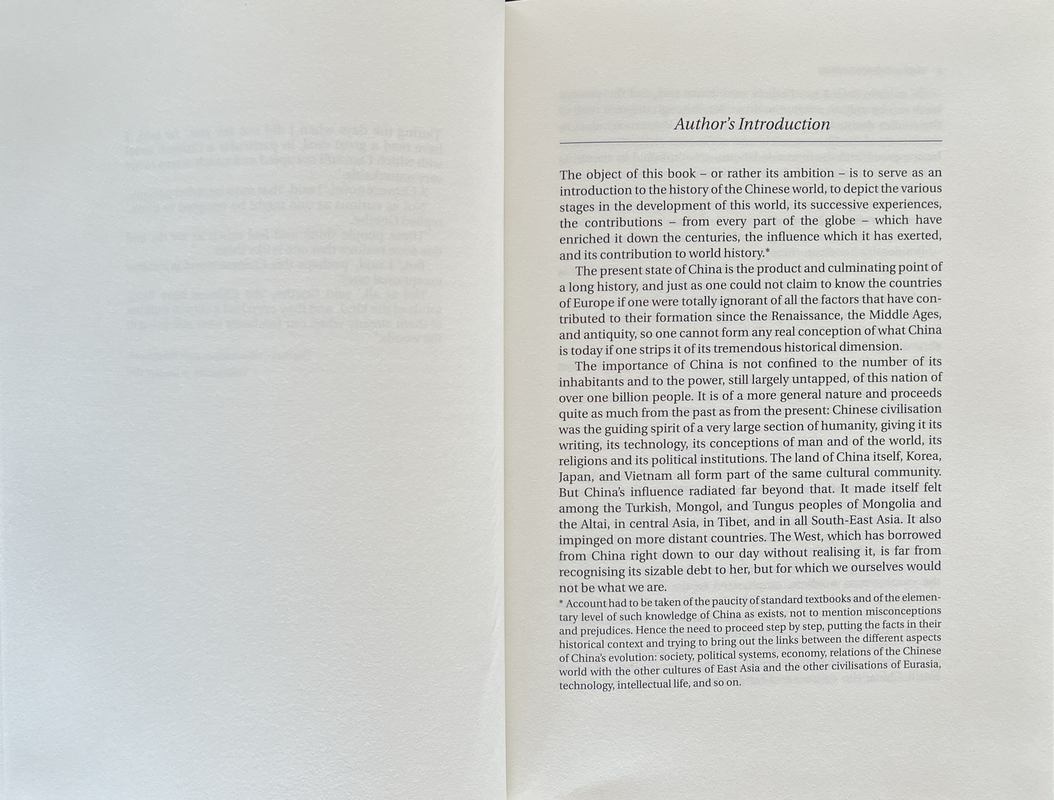
Considering the extraordinary complexities of Chinese history, it would be hard to find a more comprehensive and well written history of China from the dim ancient era of 10,000 years ago to the early 1990s in such a compact form.
China’s culture is amazingly diverse and interesting. The area we now know as China has previously been unified and disintegrated numerous times and its borders have expanded and shrunk with conquests and defeats. The culture has slowly emerged from the mists of time to become the well-ordered society we know today.
Jacques Gernet (1921–2018) was an eminent French sinologist. The vast majority of the book is unbiased, but he tends to dismiss Buddhism and his Marxist prejudices render his explanation for China's economic and technological stagnation in the late 19th Century unconvincing.
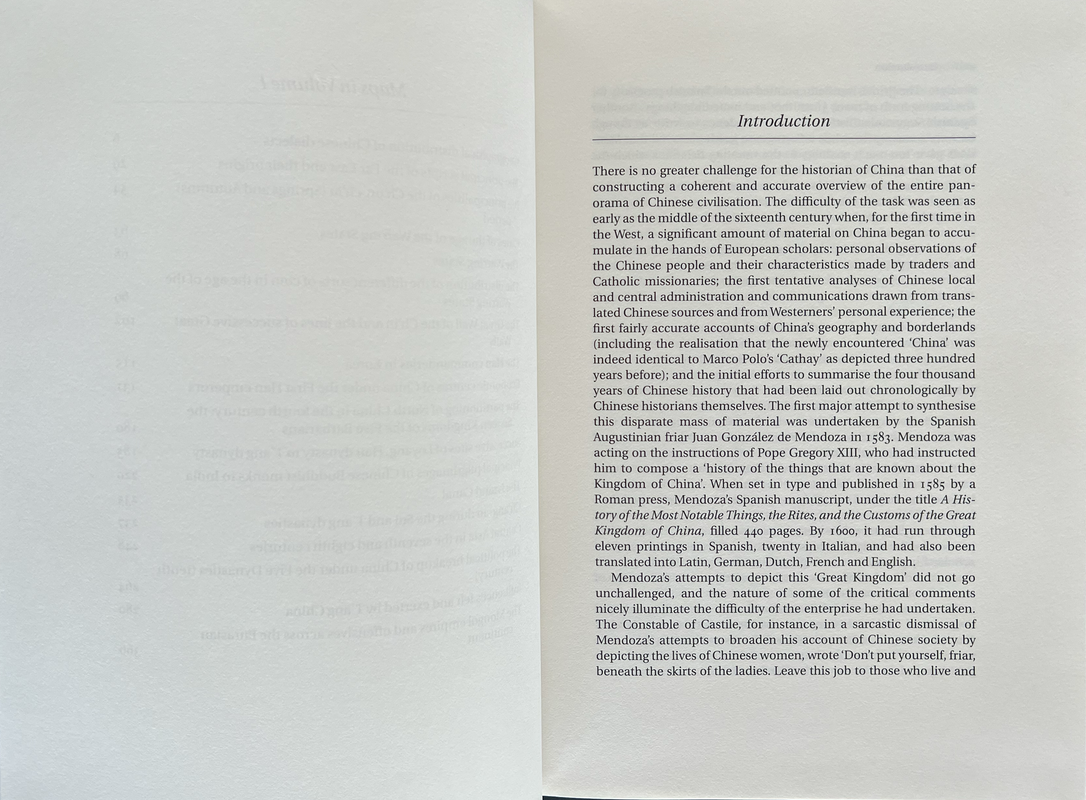
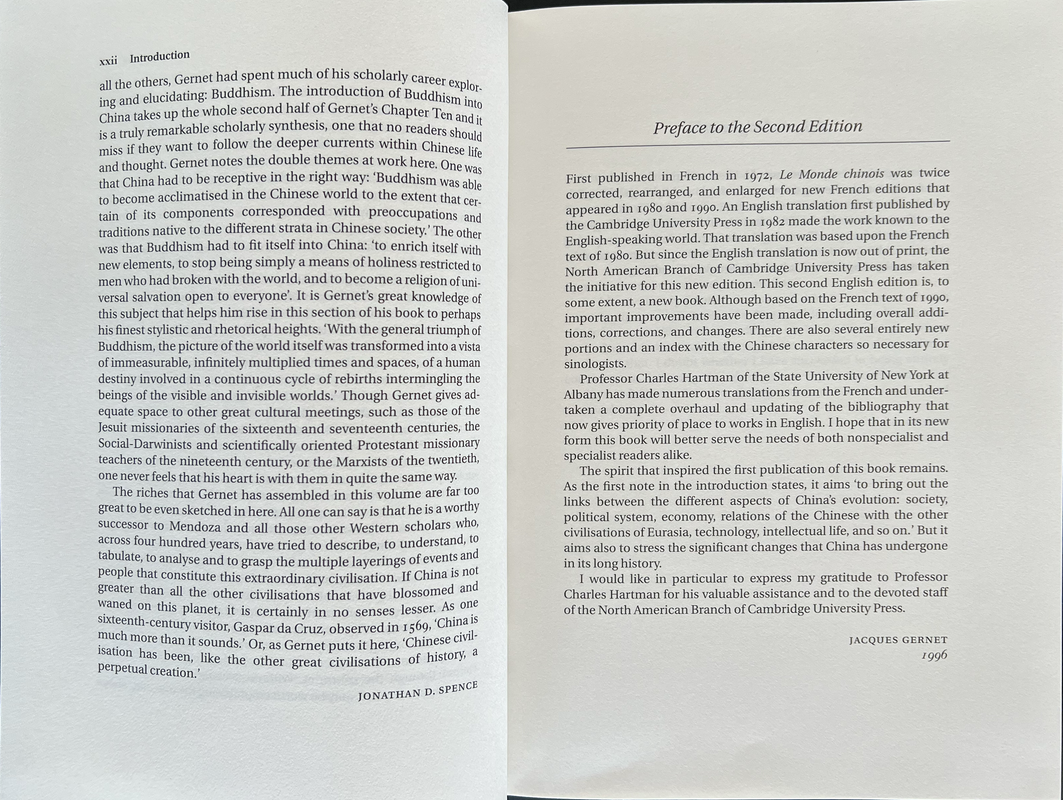
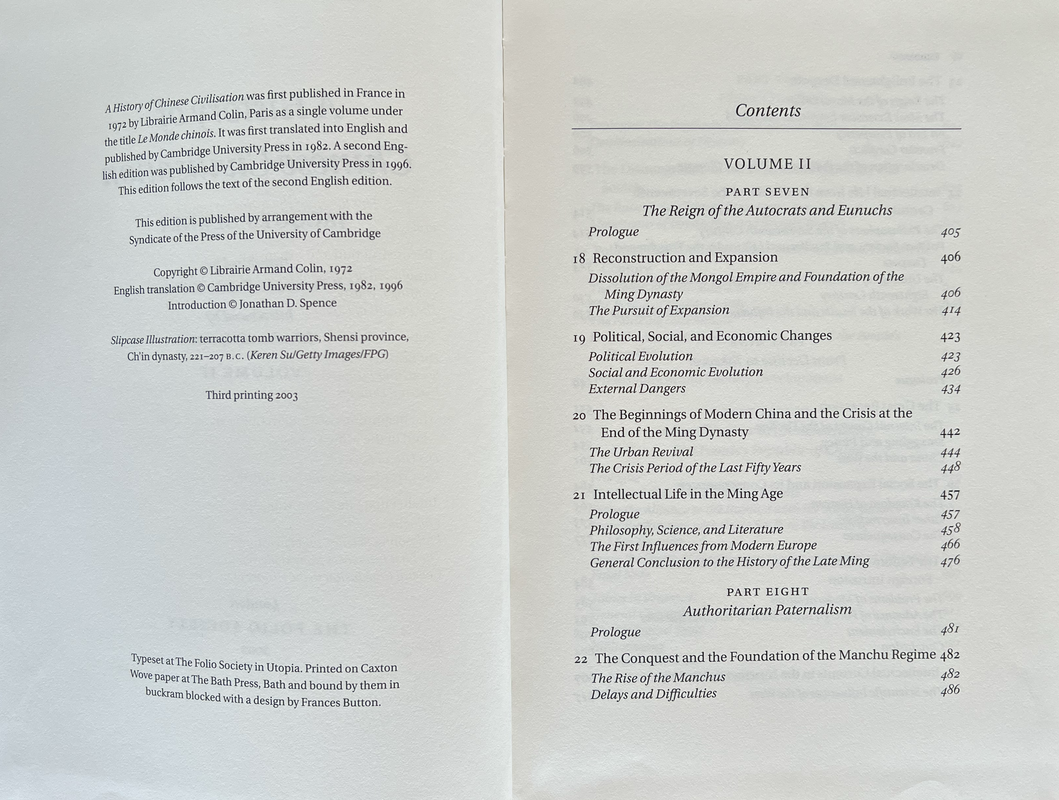
This two volume work has xxvii +851 pages. I found myself skimming sections, then catching an interesting chapter or paragraph when I would read for a few pages before skimming again. It was first published in French in 1972 and English in 1982 but was updated in 1993 and this edition uses the updated version in translation.
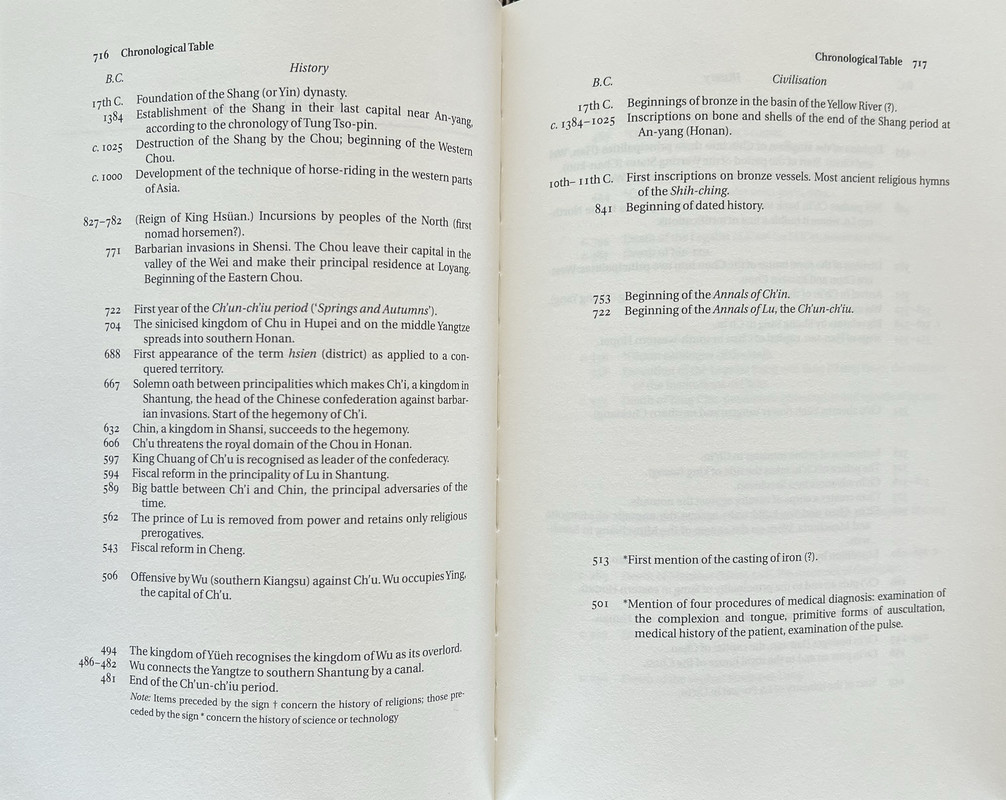
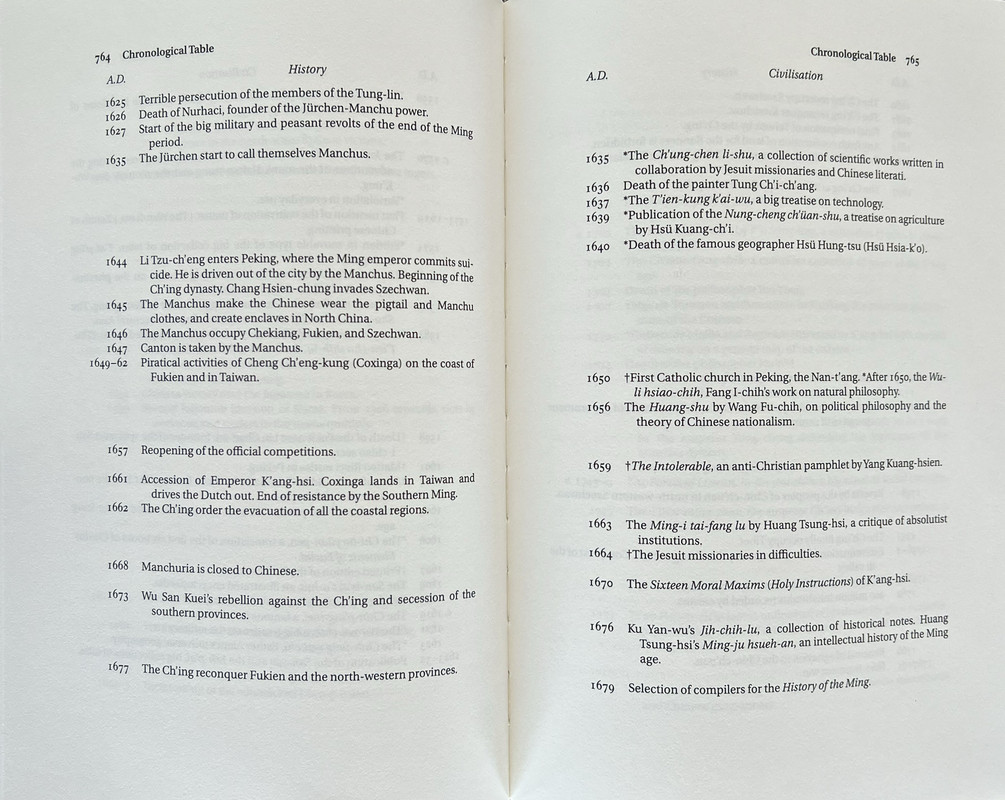
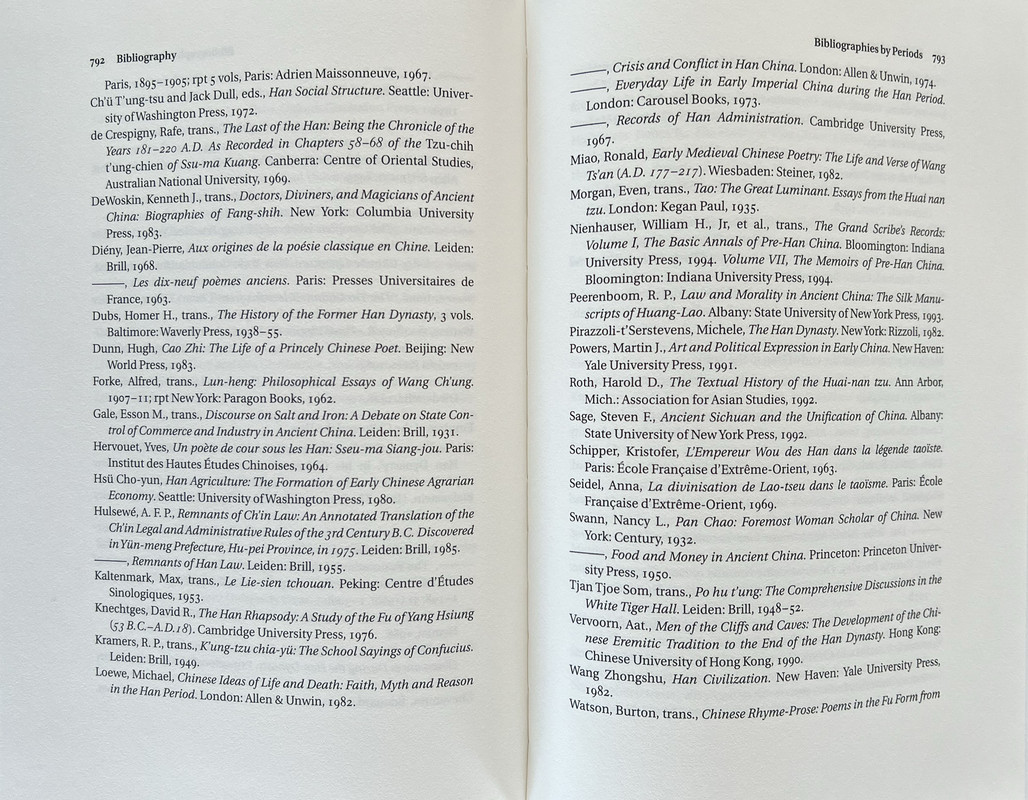
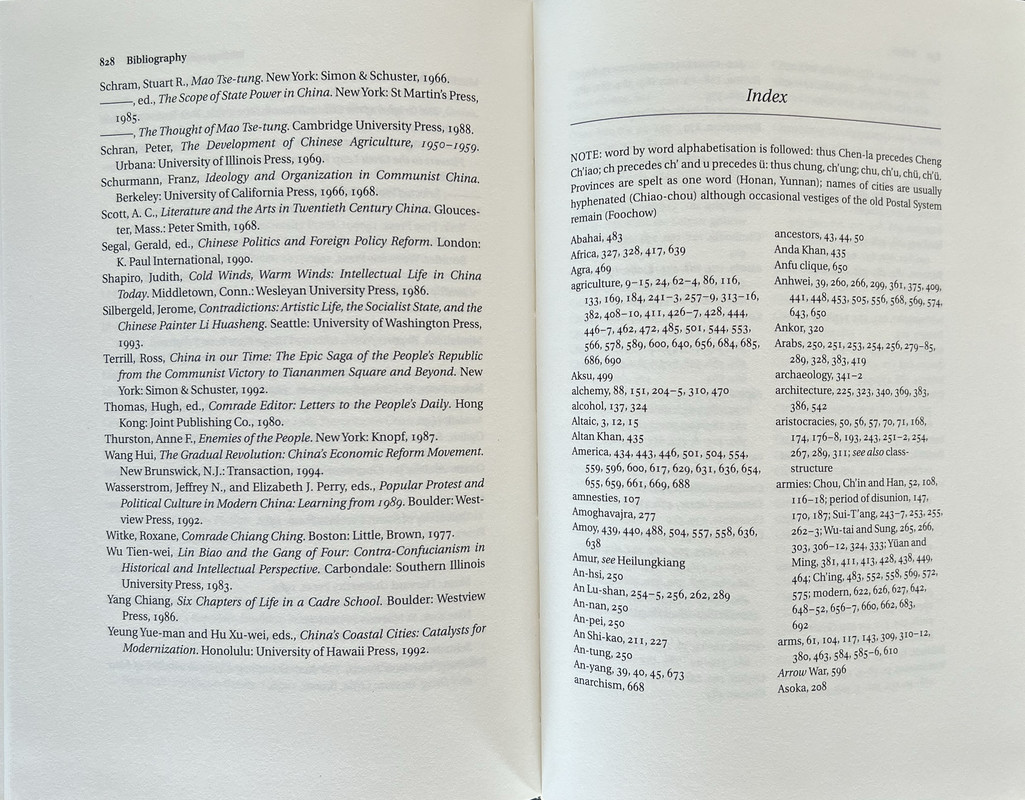
A comprehensive chronology, economic and historical tables, a bibliography and index can be found at the back of volume two.
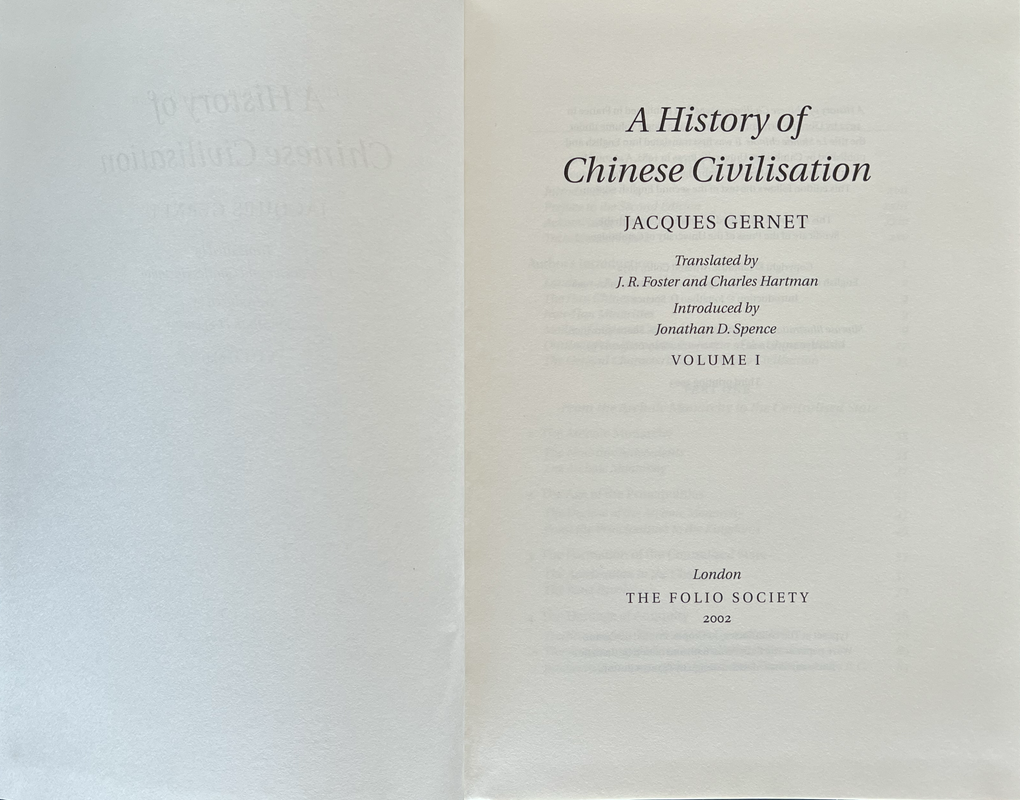
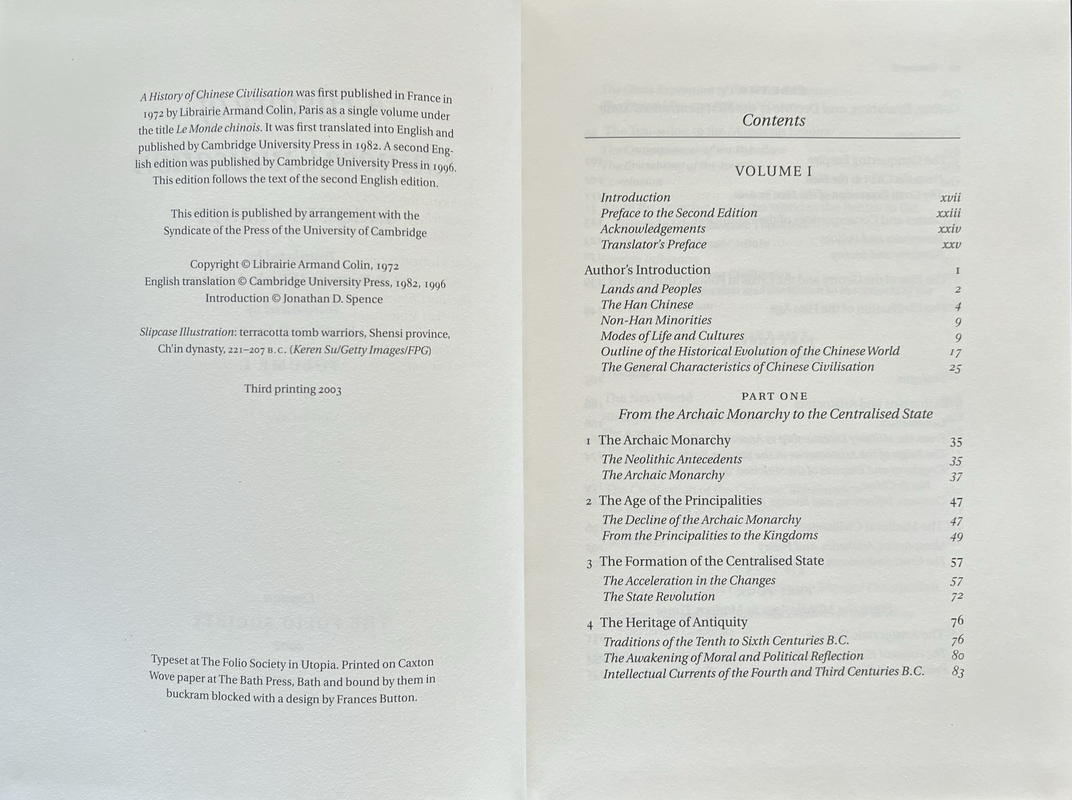
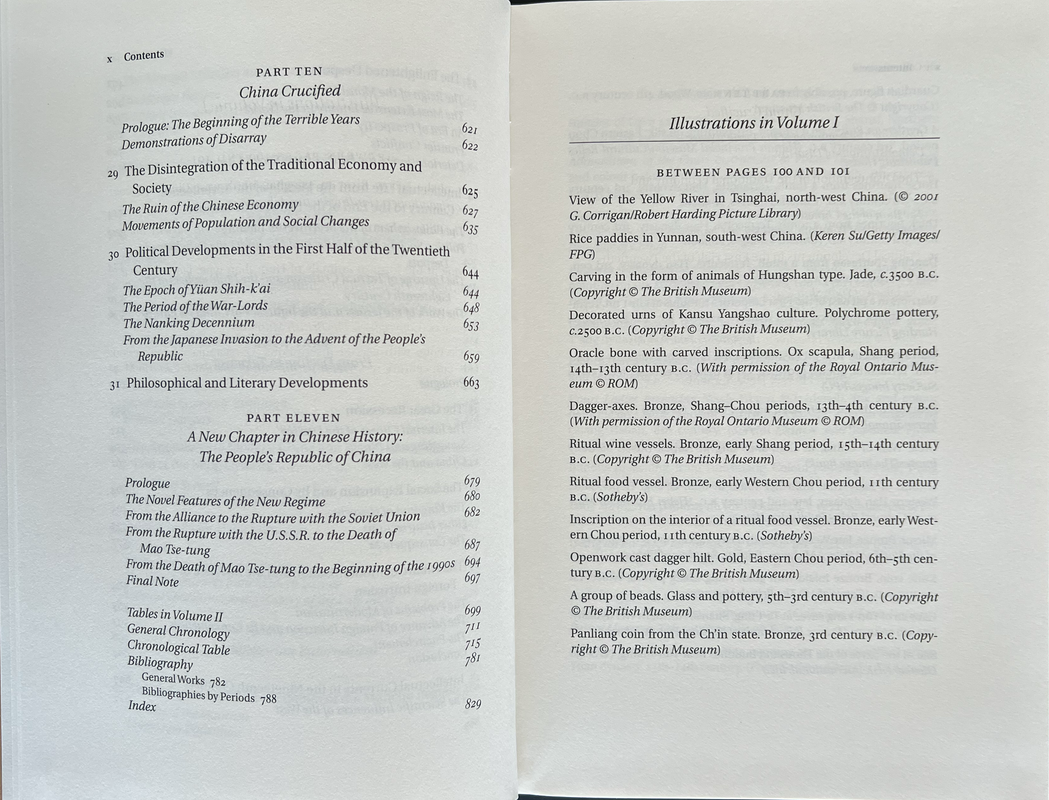
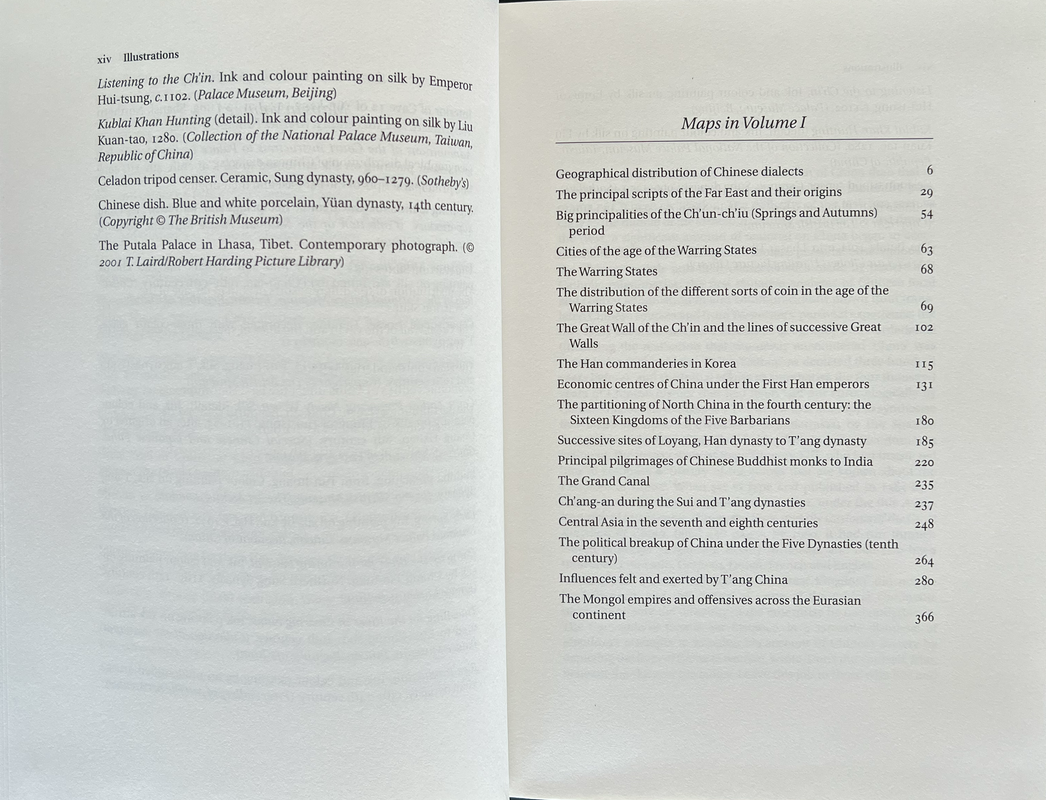
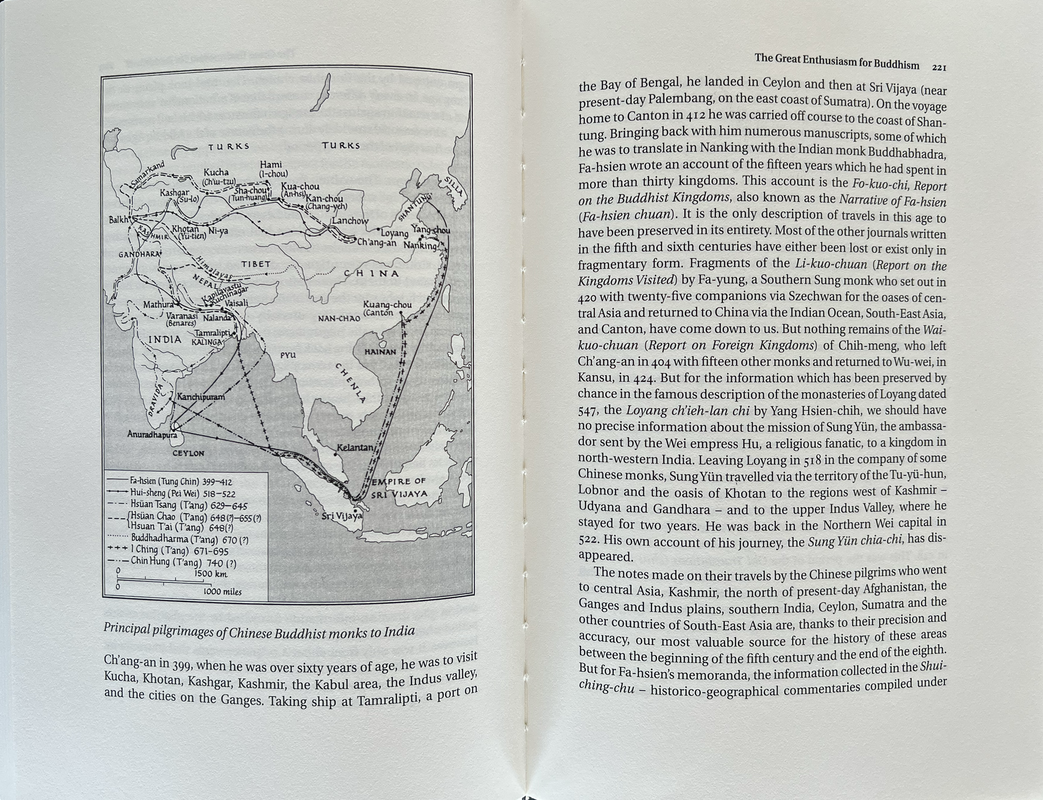
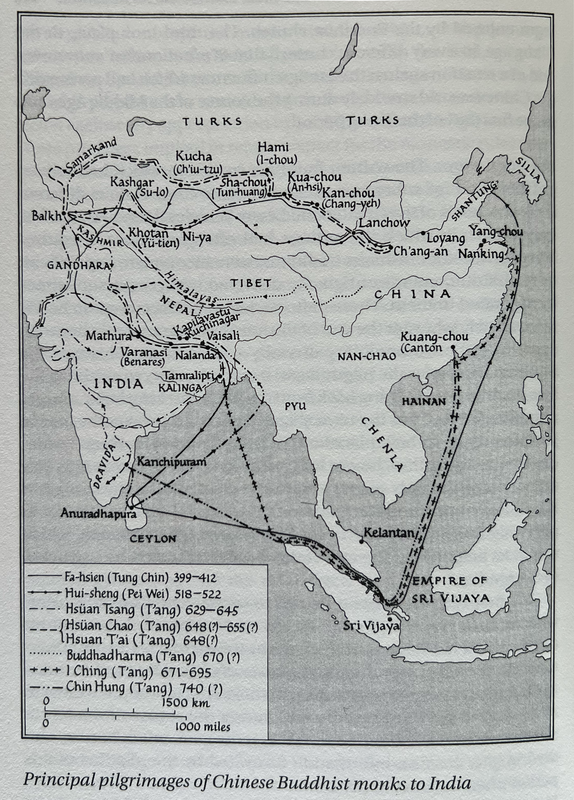
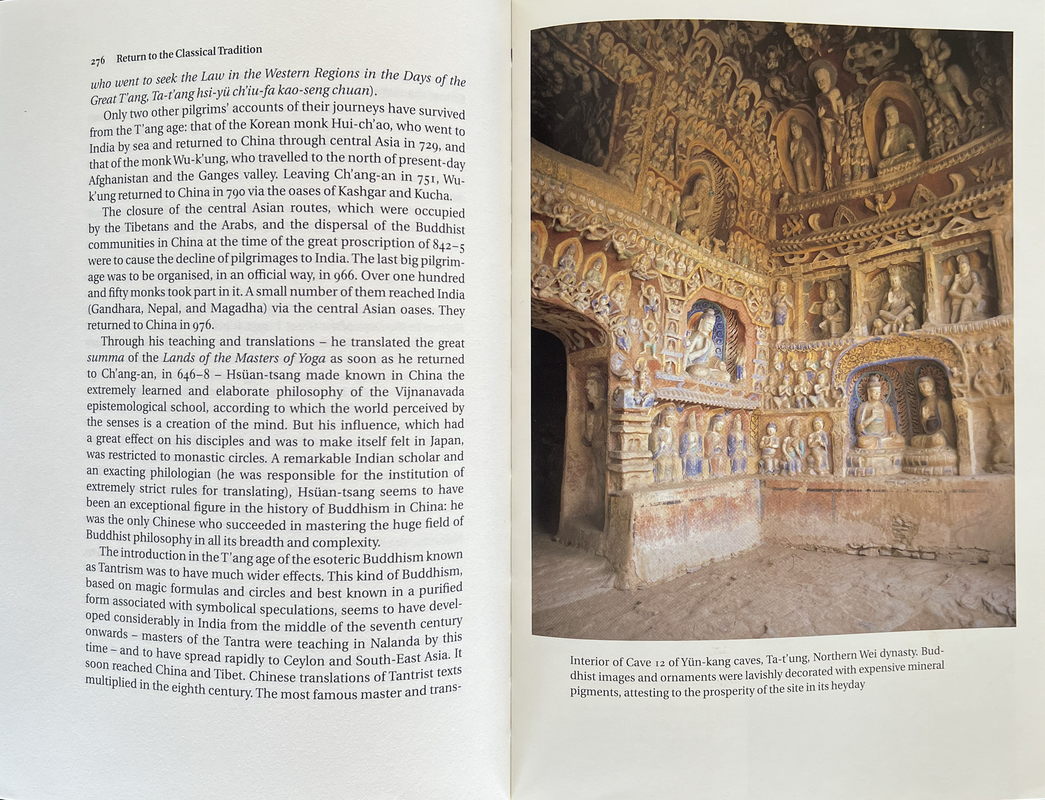
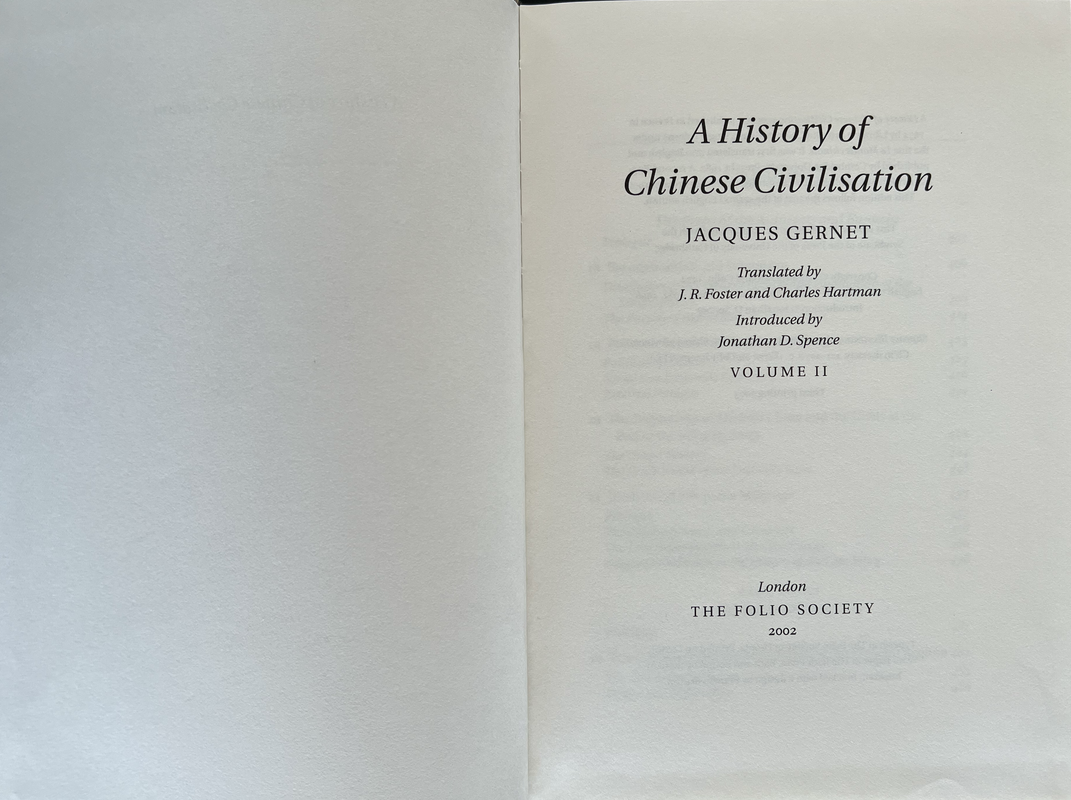
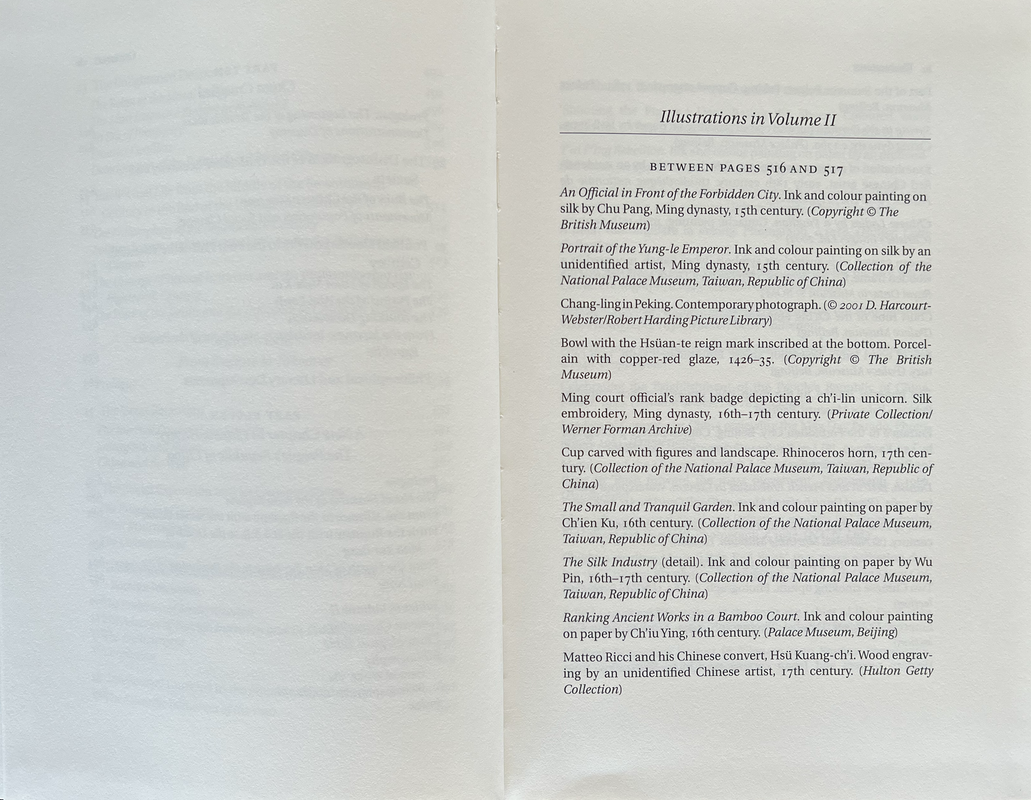
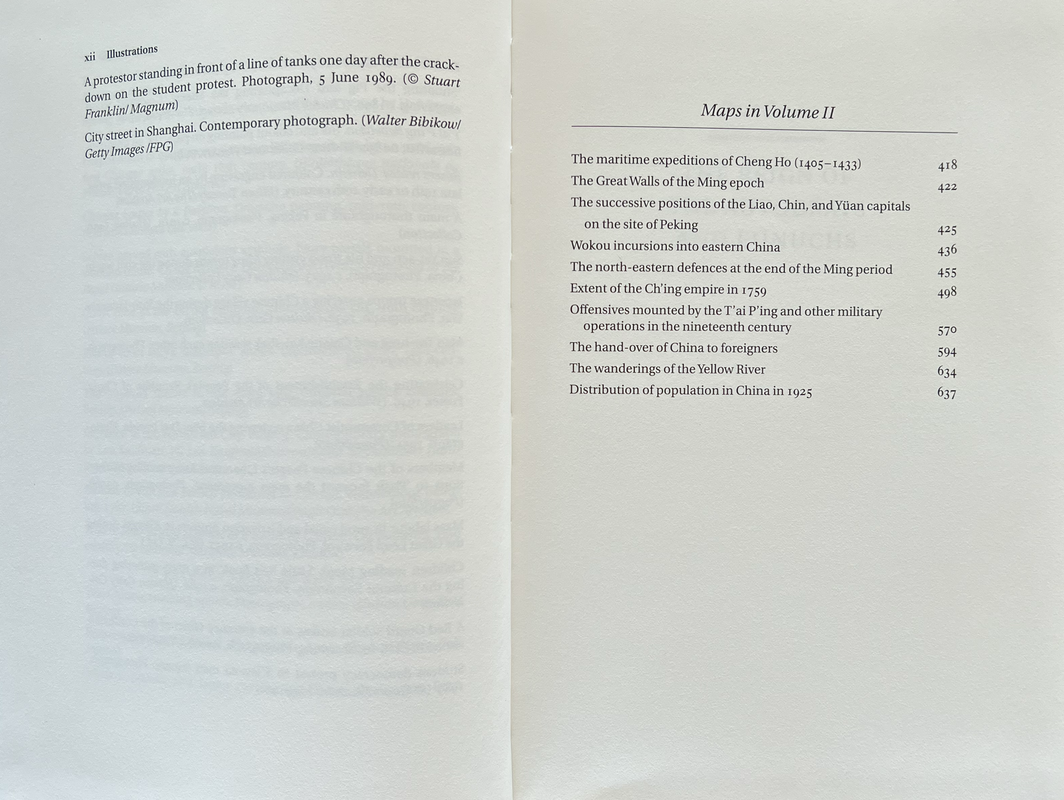
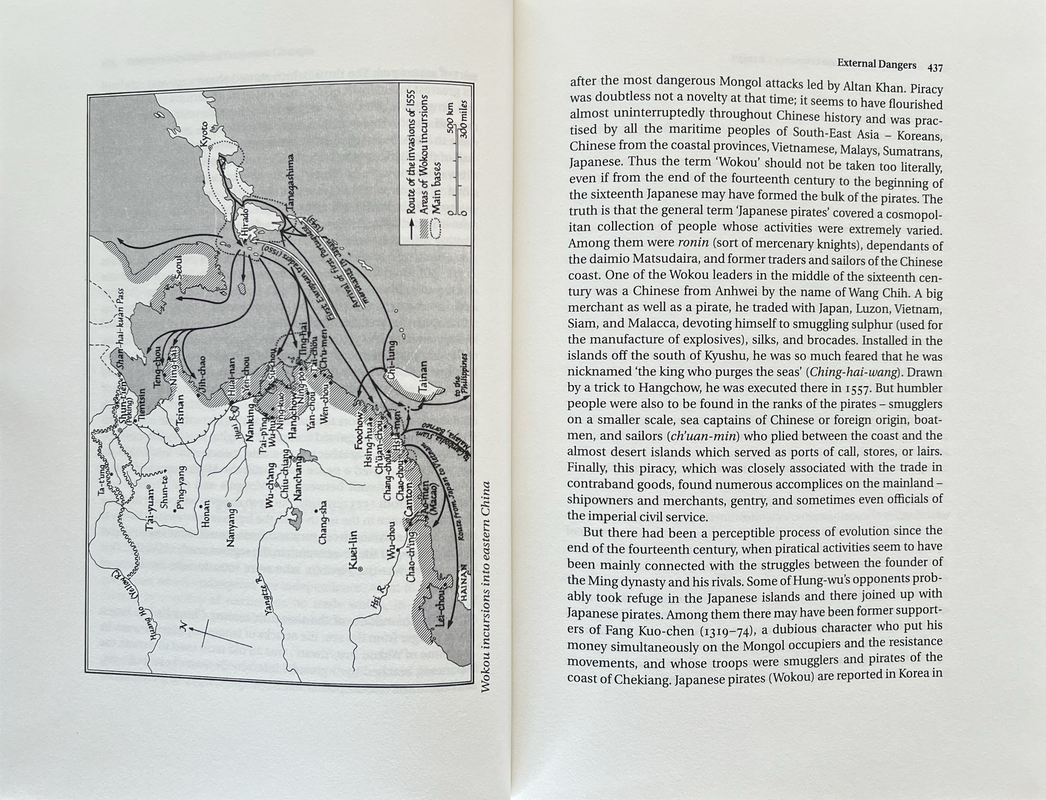
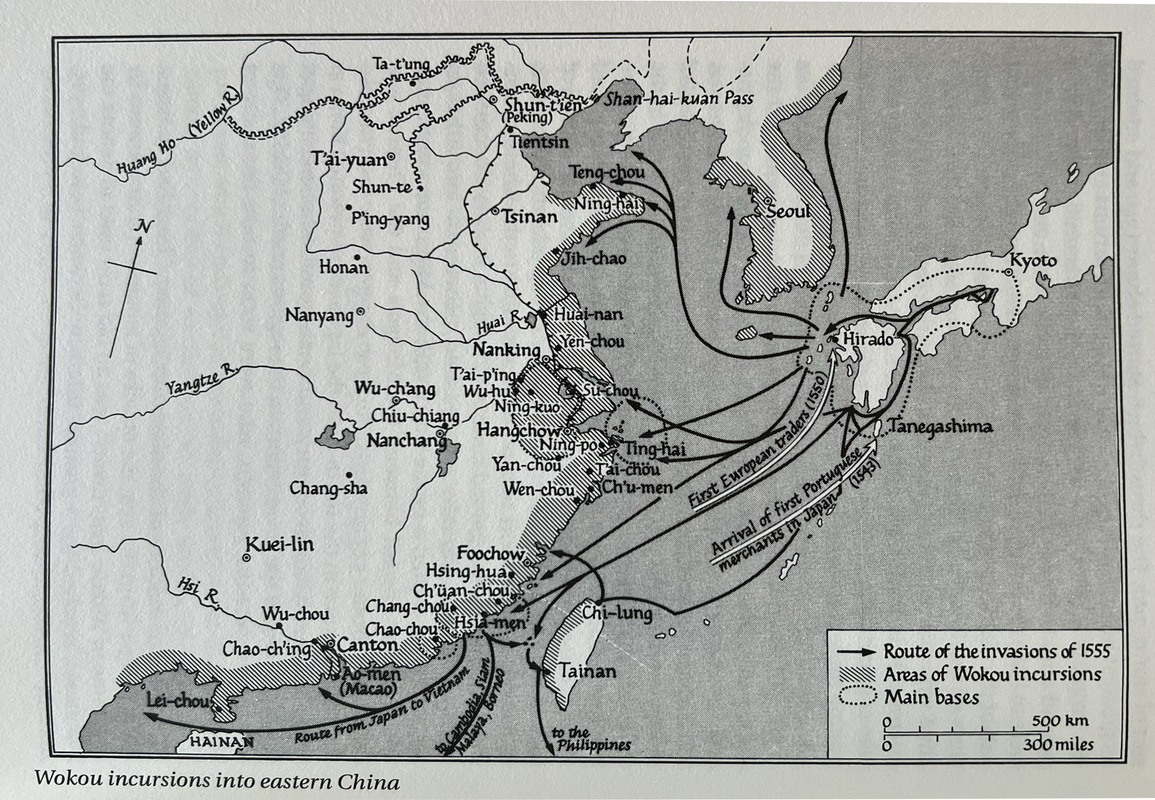
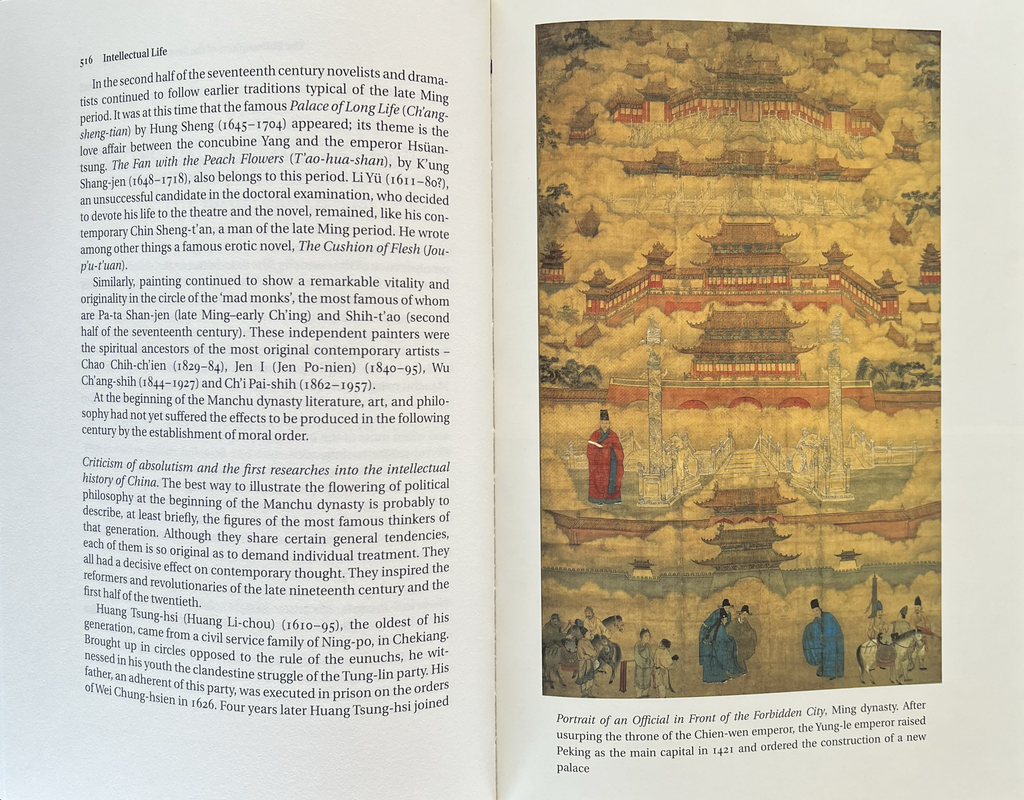
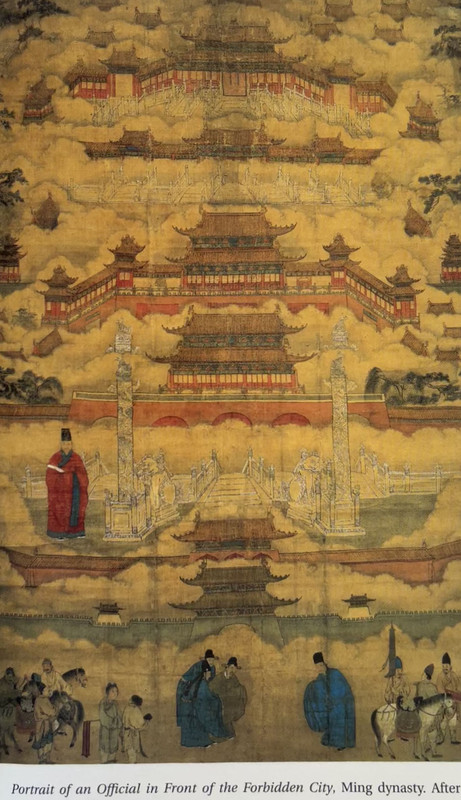
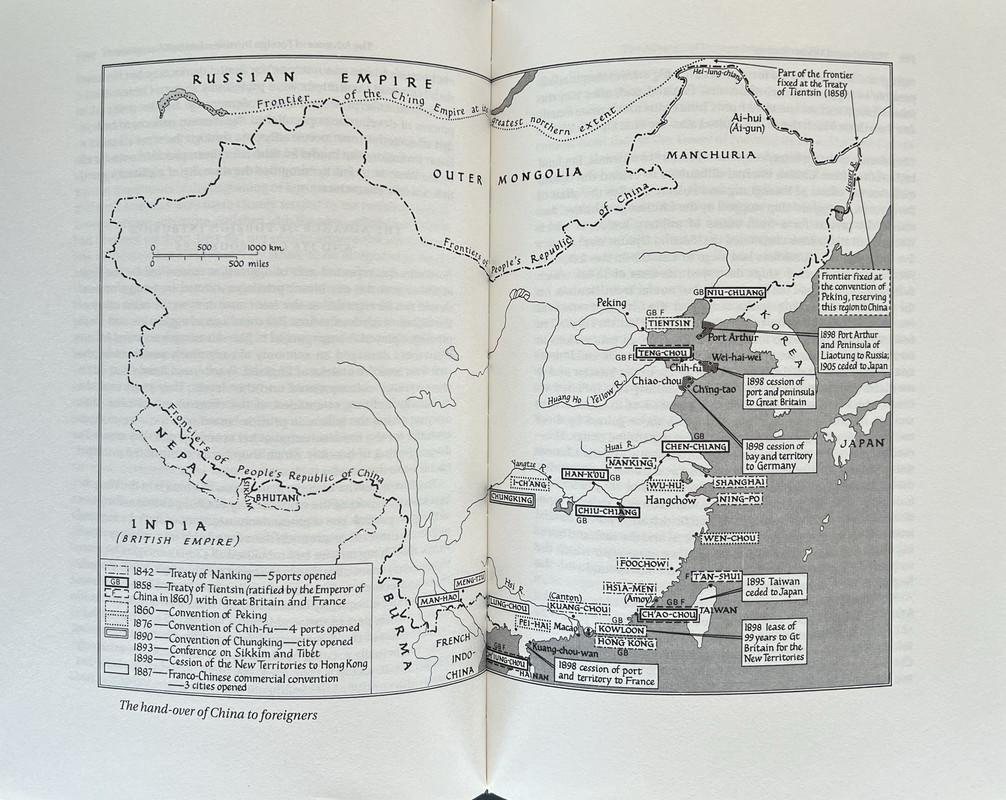
There is a very long Author’s Introduction. The book was translated from the French by J. R. Foster and Charles Hartman and is introduced by Jonathan D. Spence. There are numerous line-drawn maps scattered through the text that have been prepared by Reginald Piggott. There are two sections of twelve bound-in colour plates in each volume (48 pages in total). The endpapers are light brown and printed with Chinese characters in dark brown.
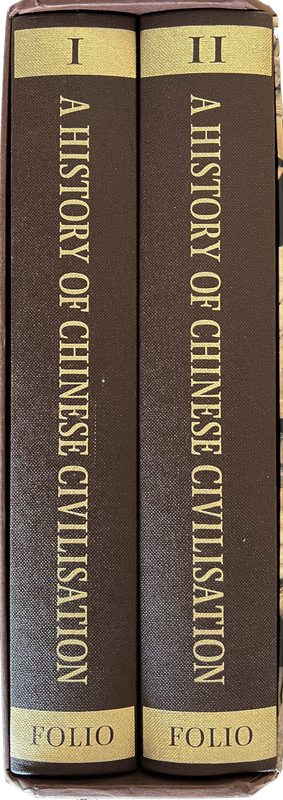
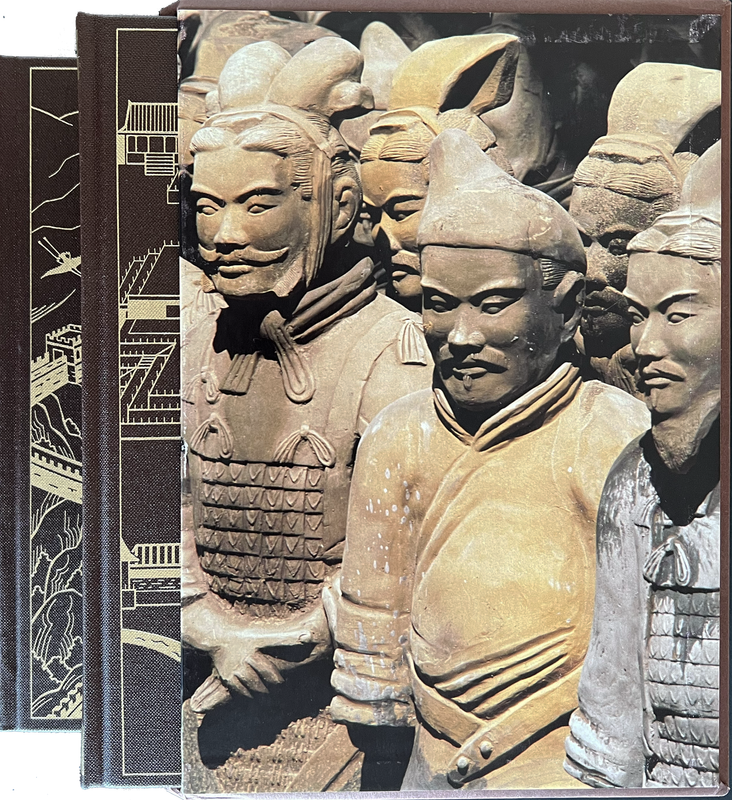
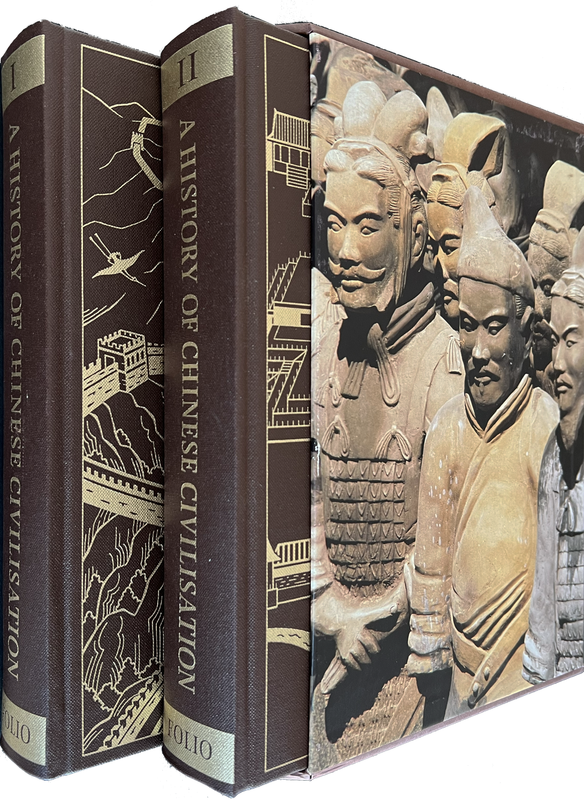
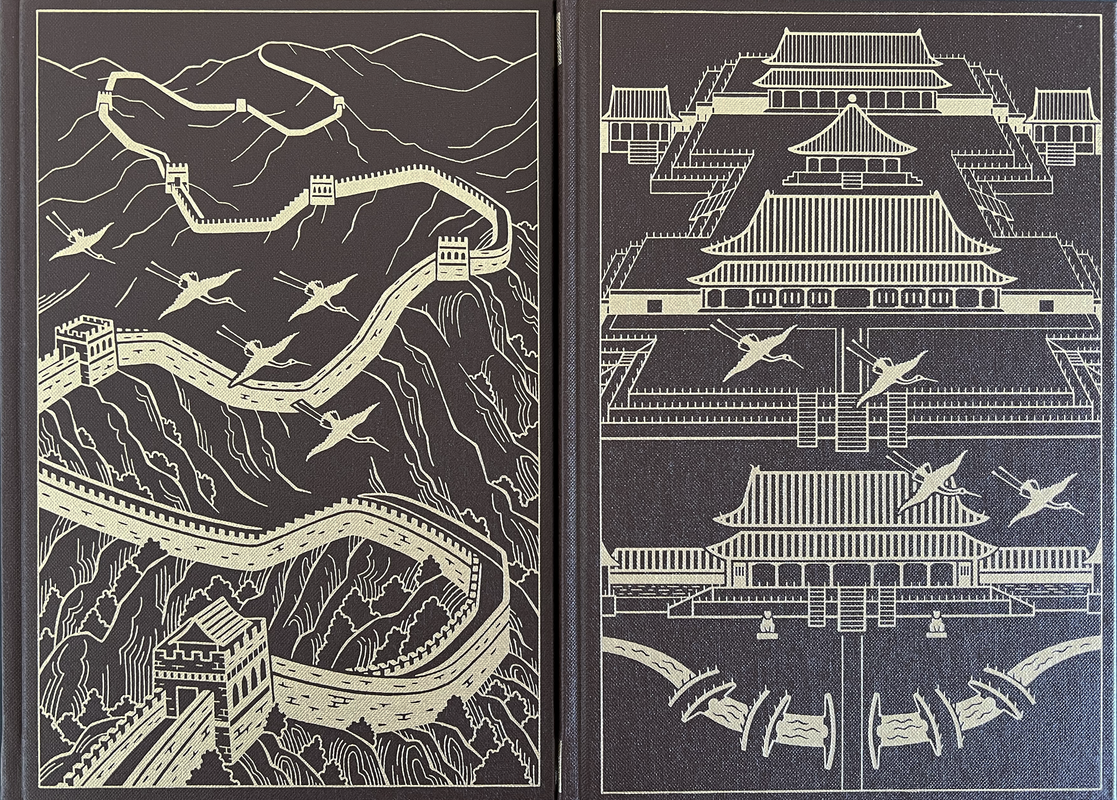
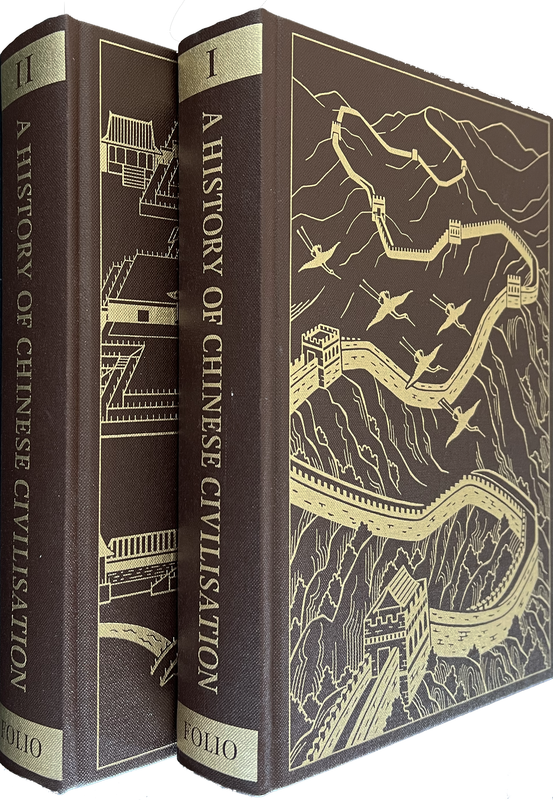
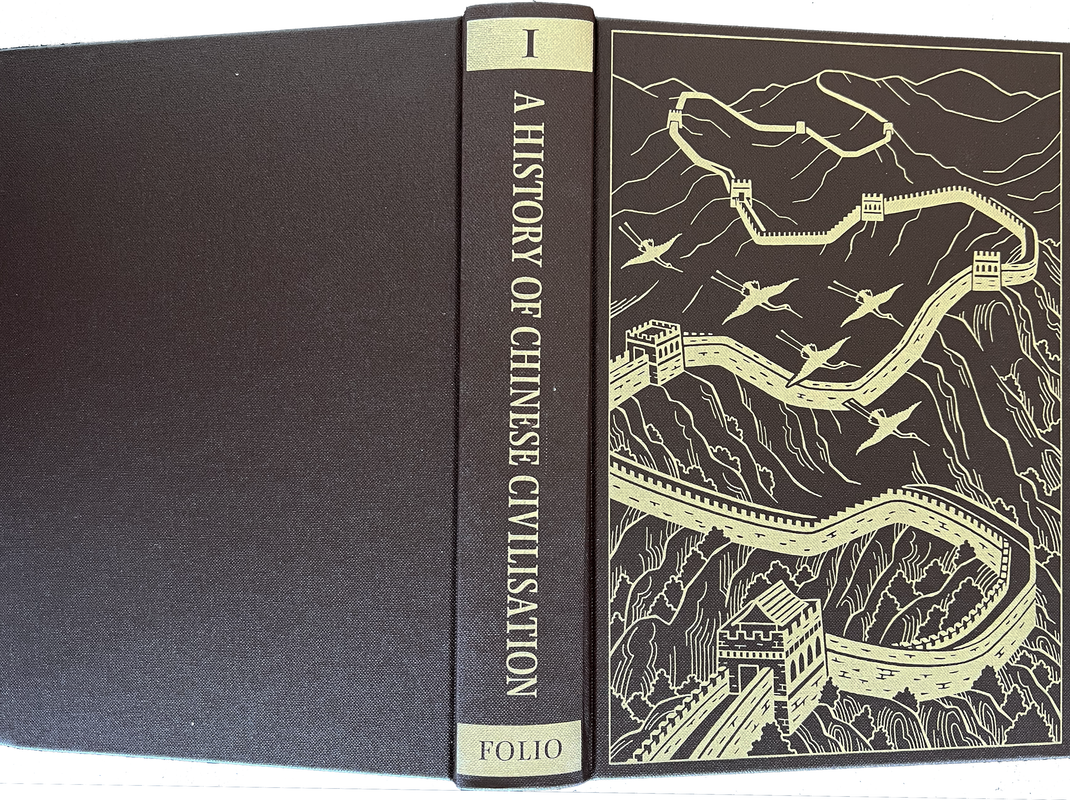
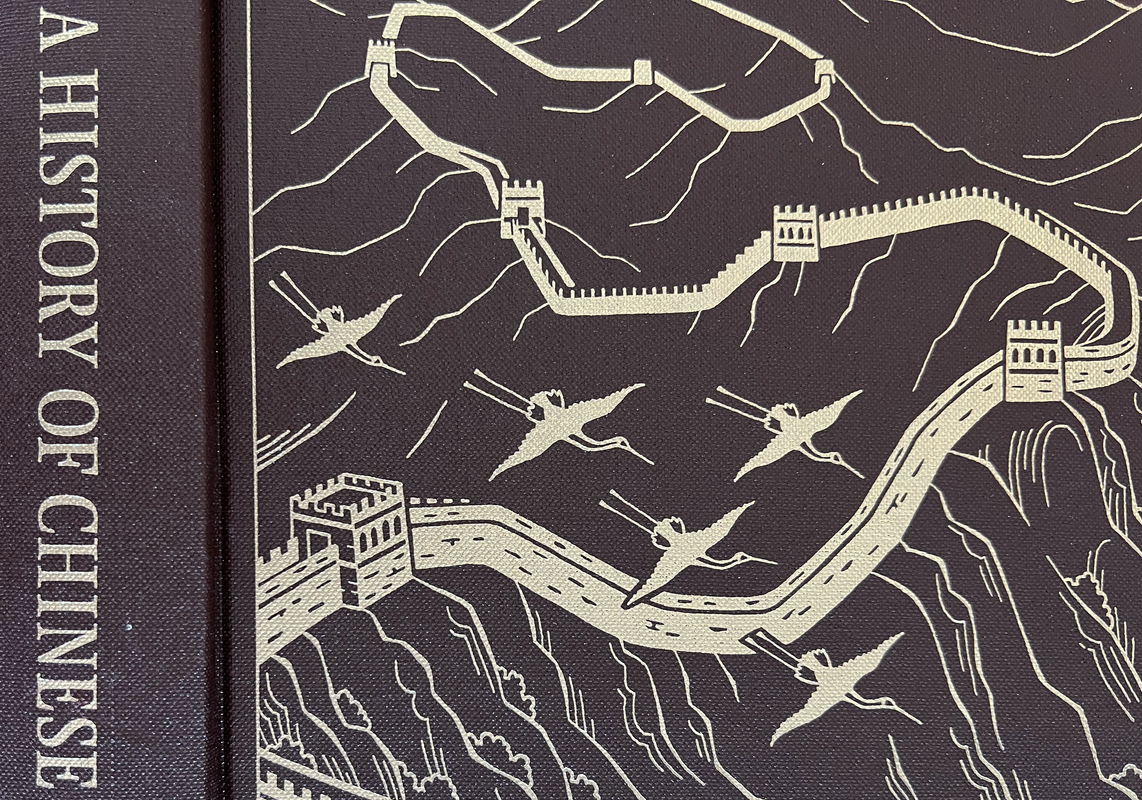
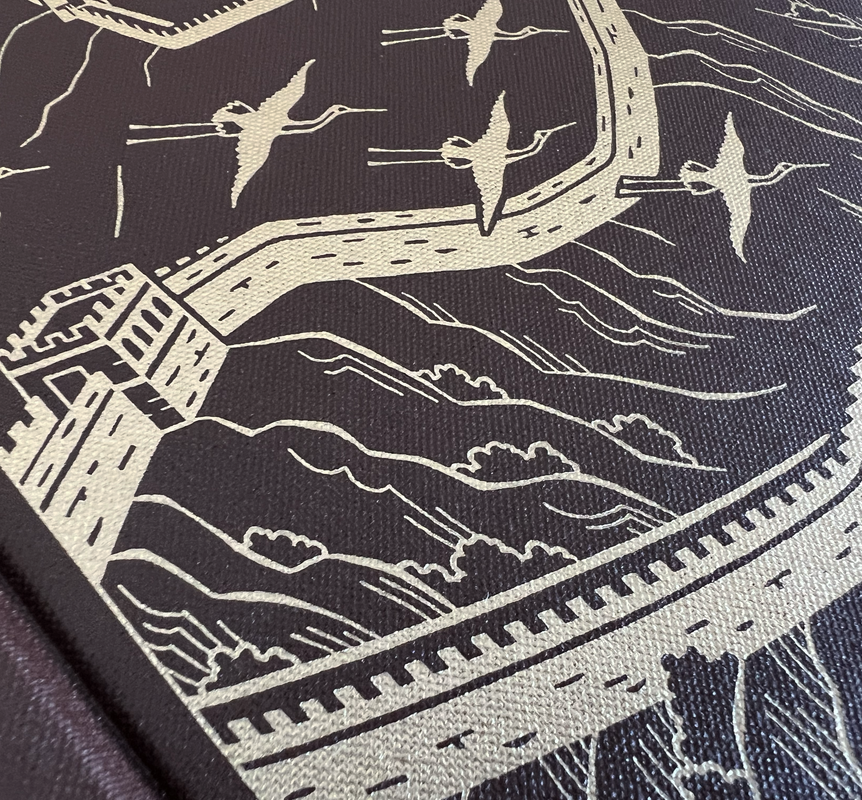
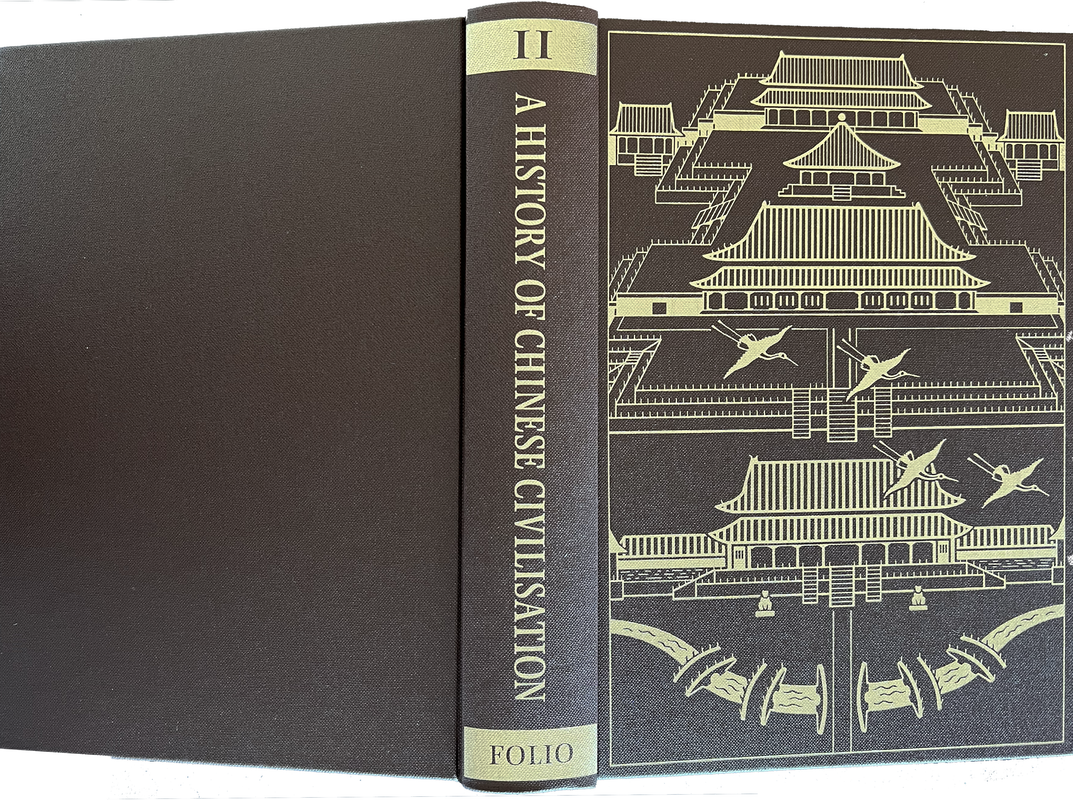
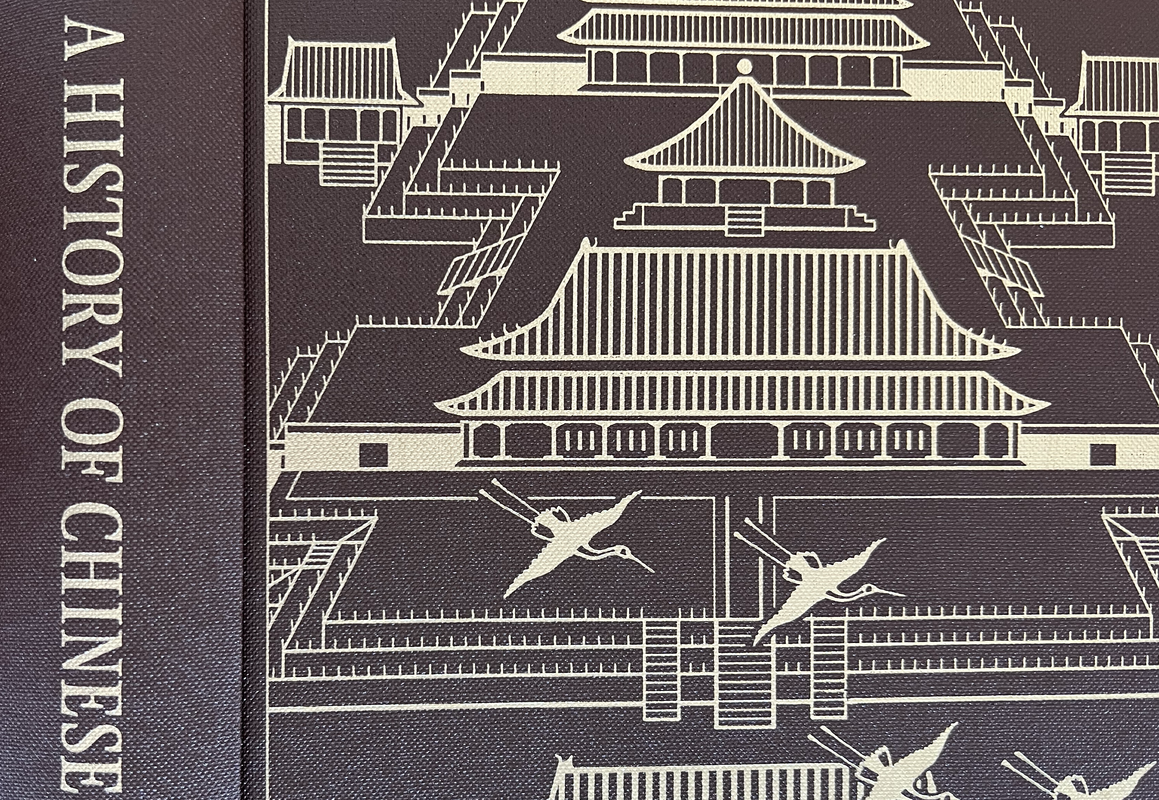
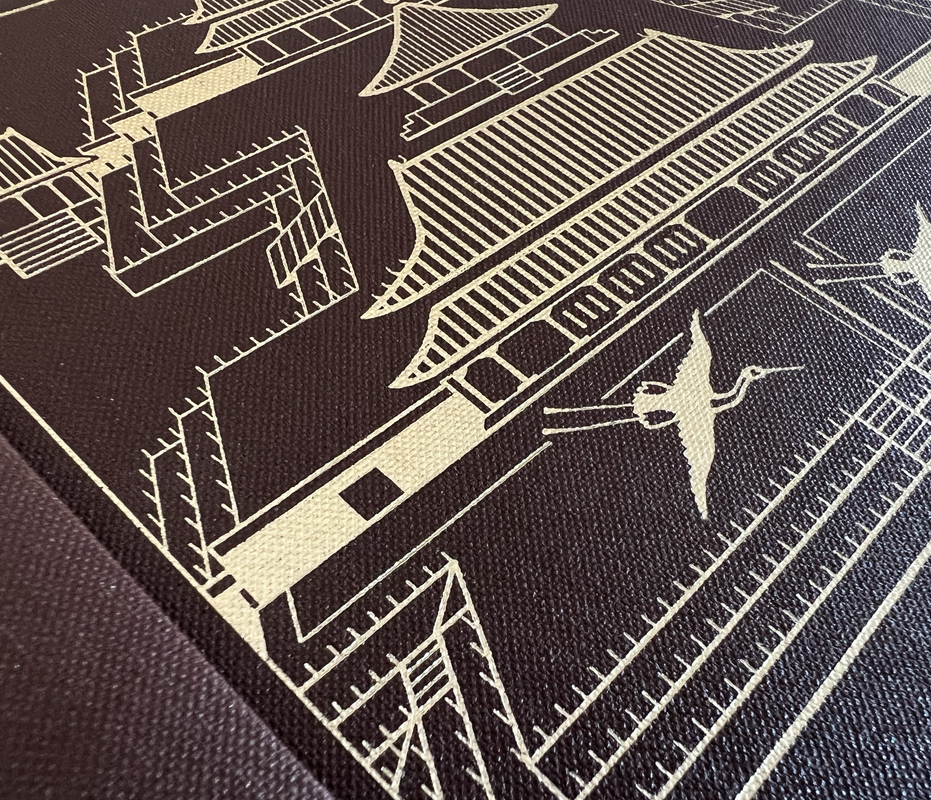
Both volumes are bound in dark brown buckram that is blocked with a gilt design on the cover and spine. There is a colour photo on the front of the dark brown two-volume slipcase which measures 26.2x18.7x8.9cm.
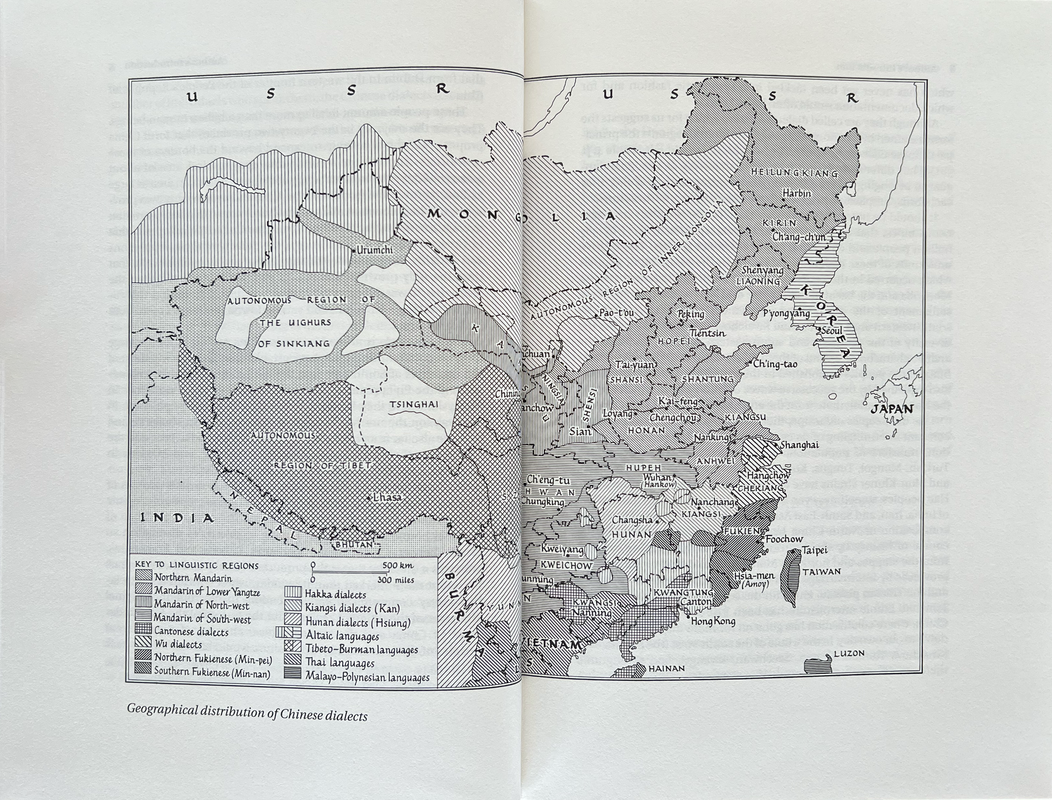
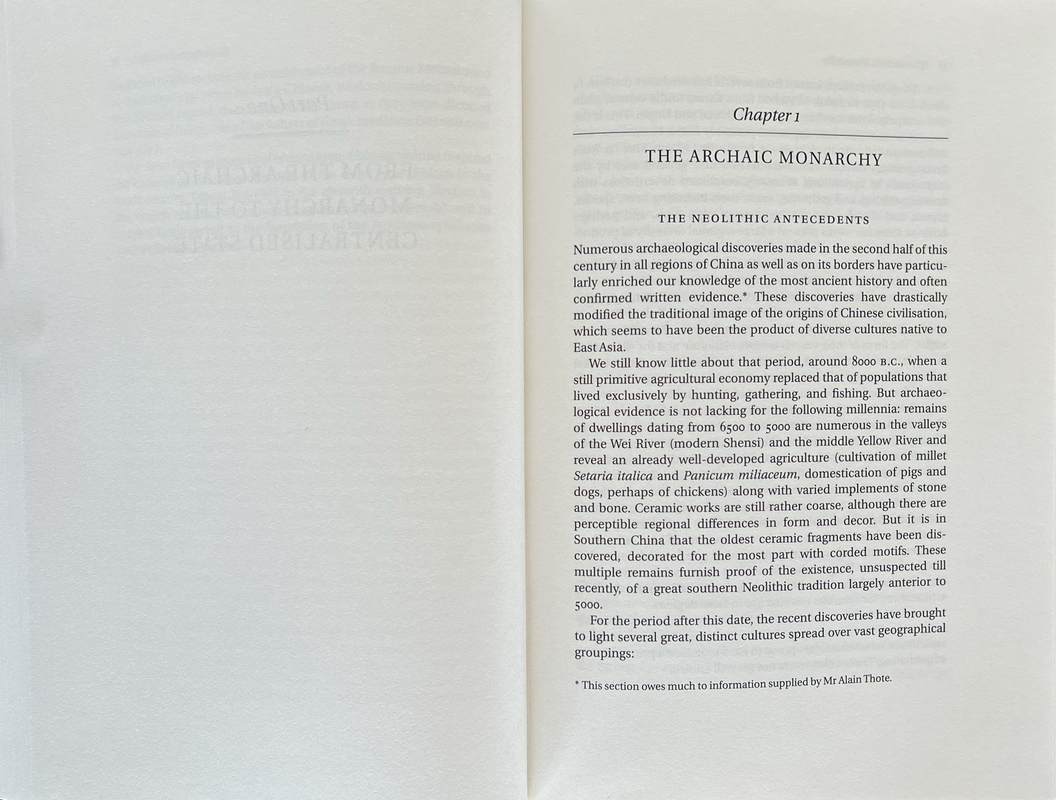
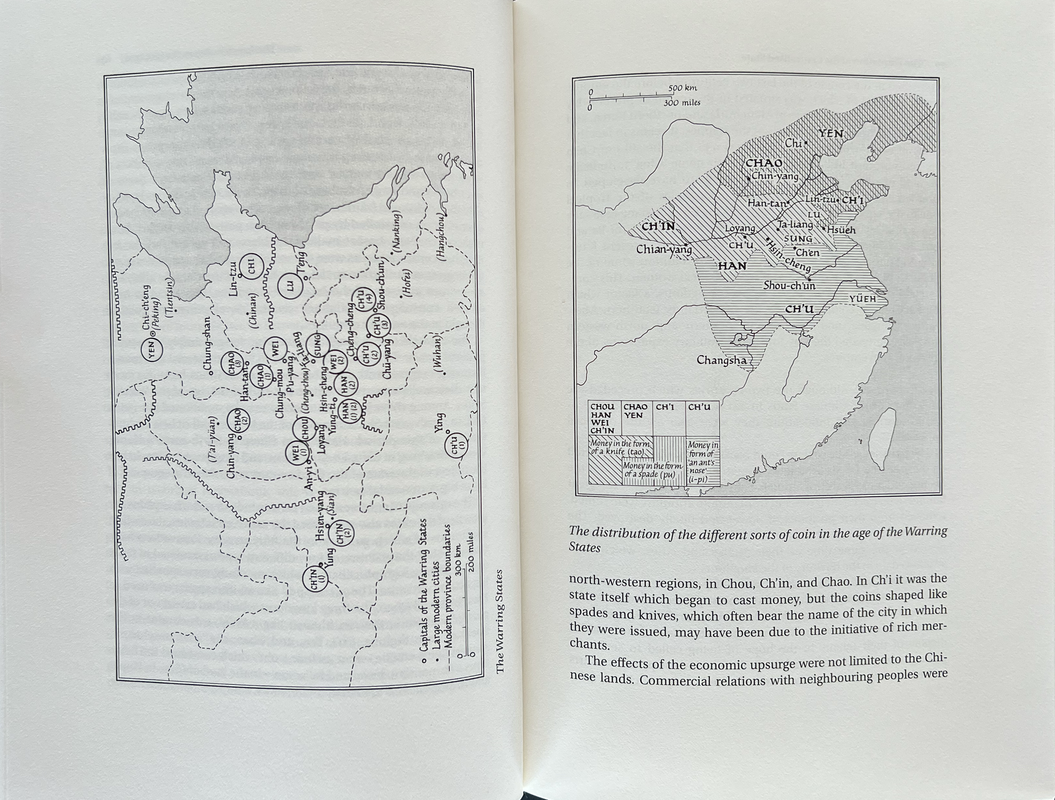
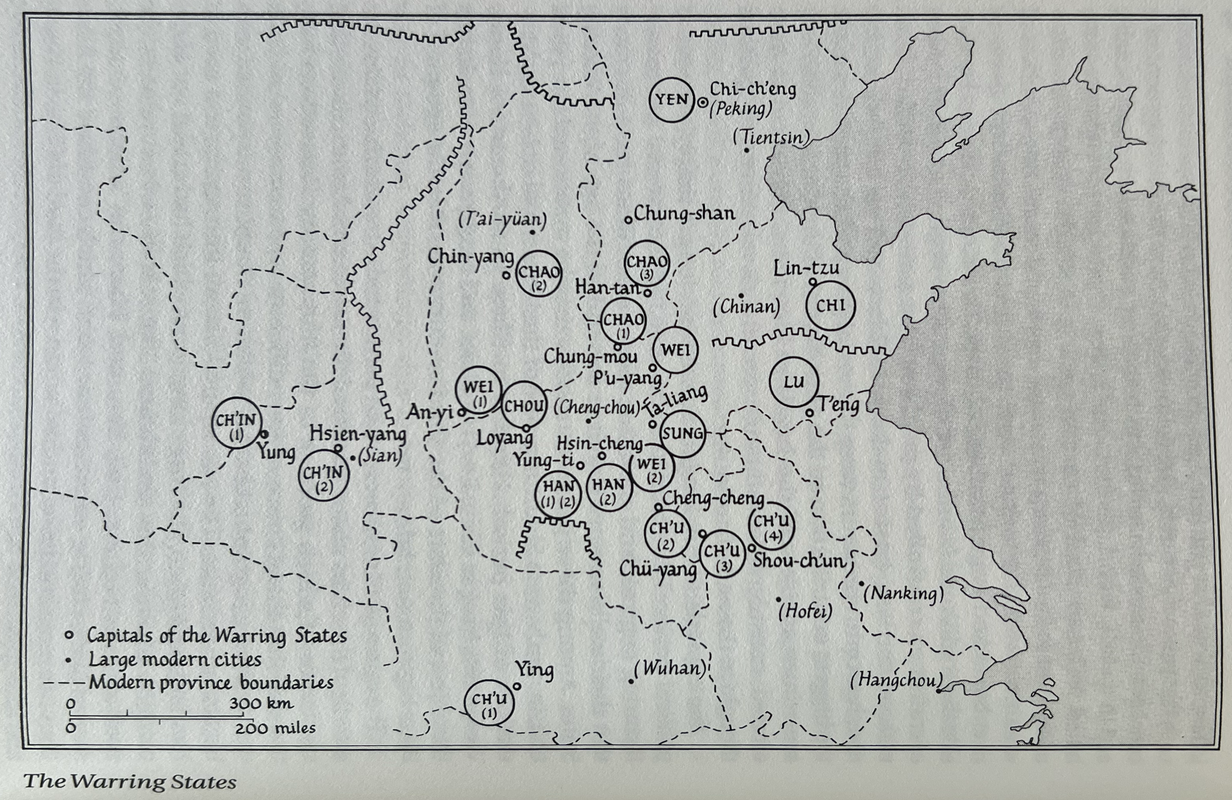
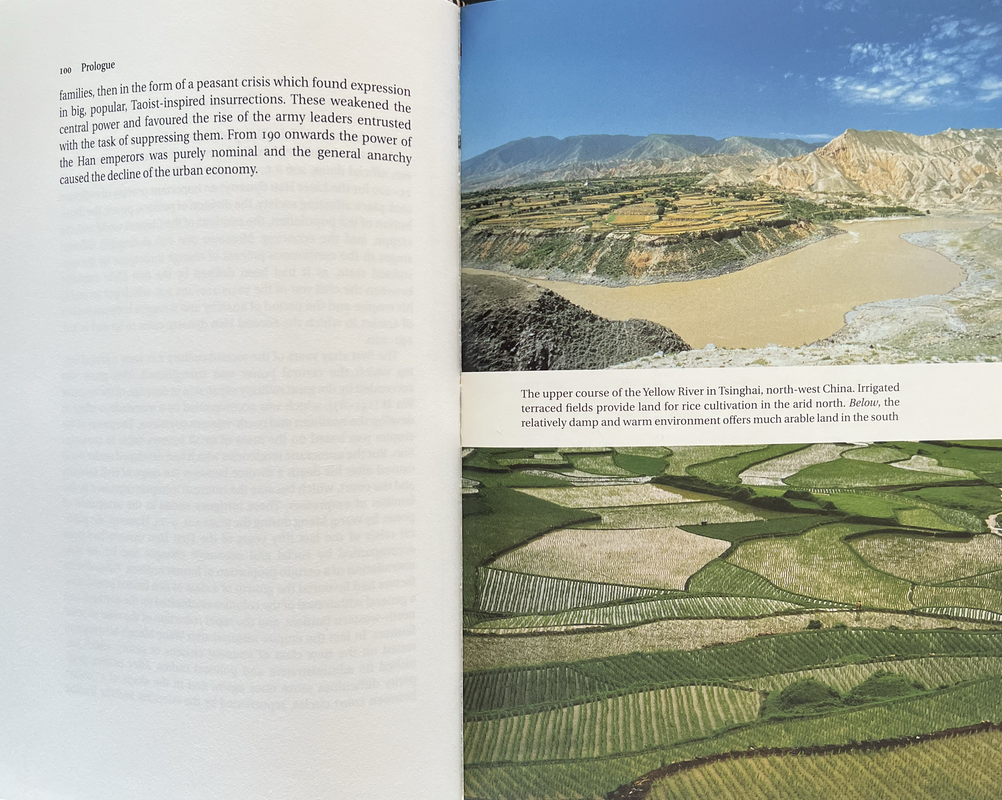
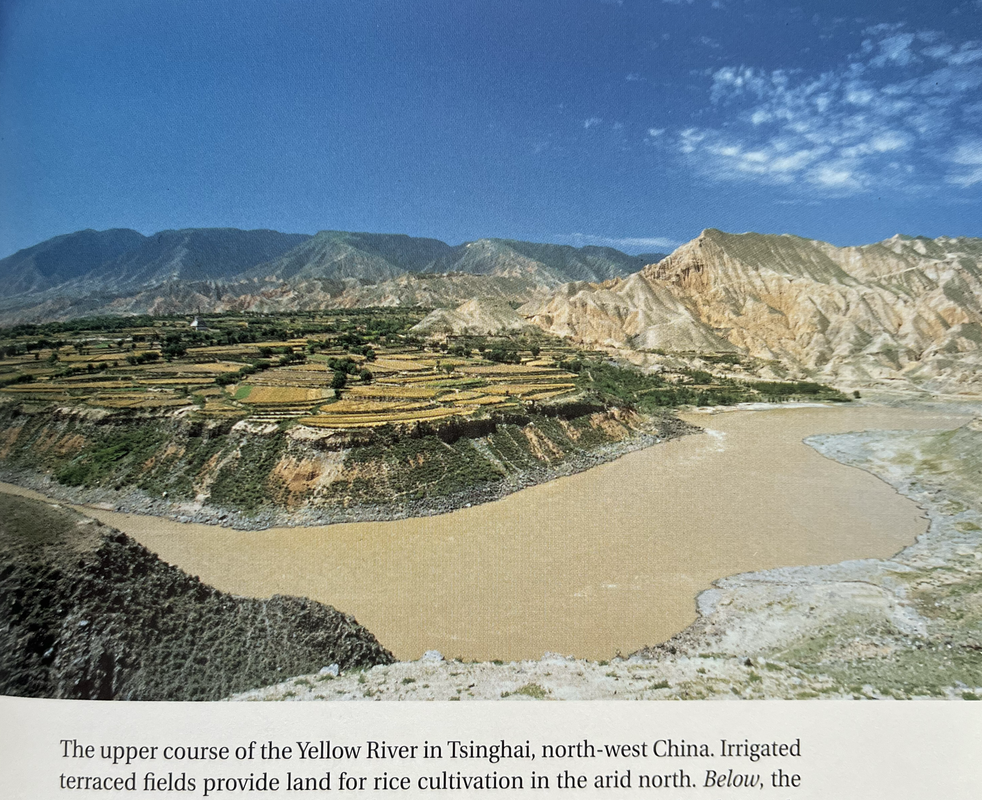
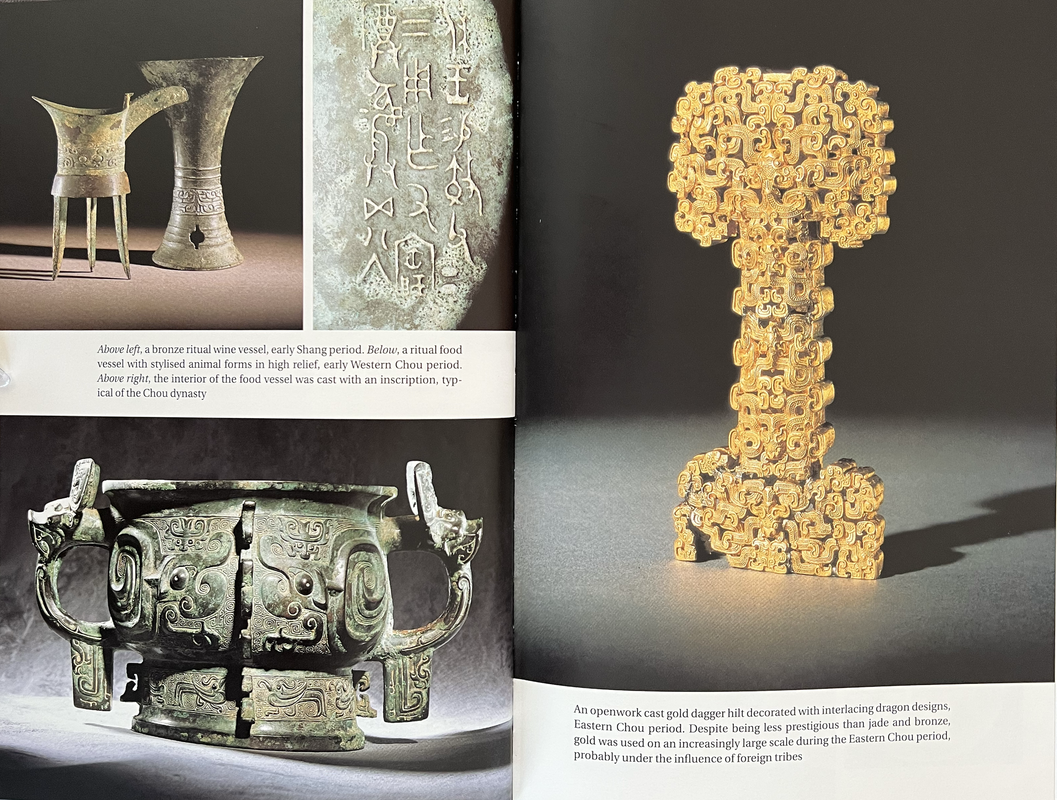
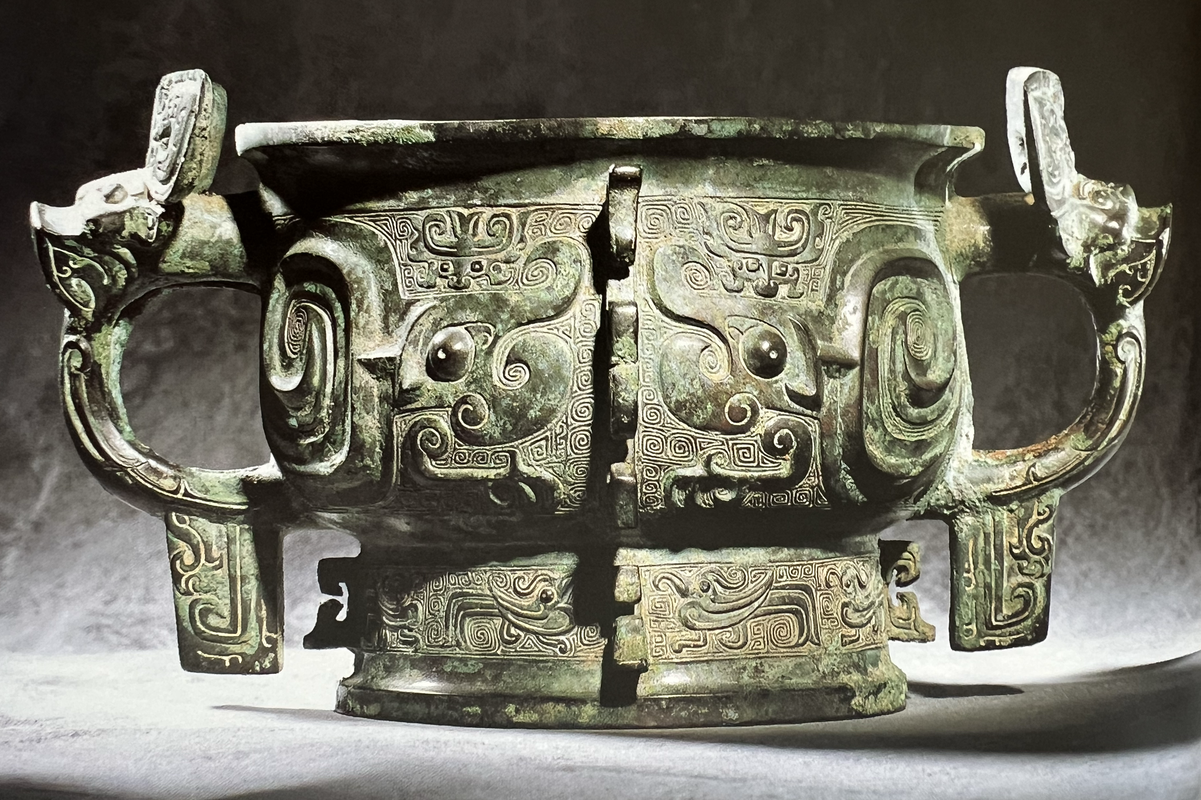
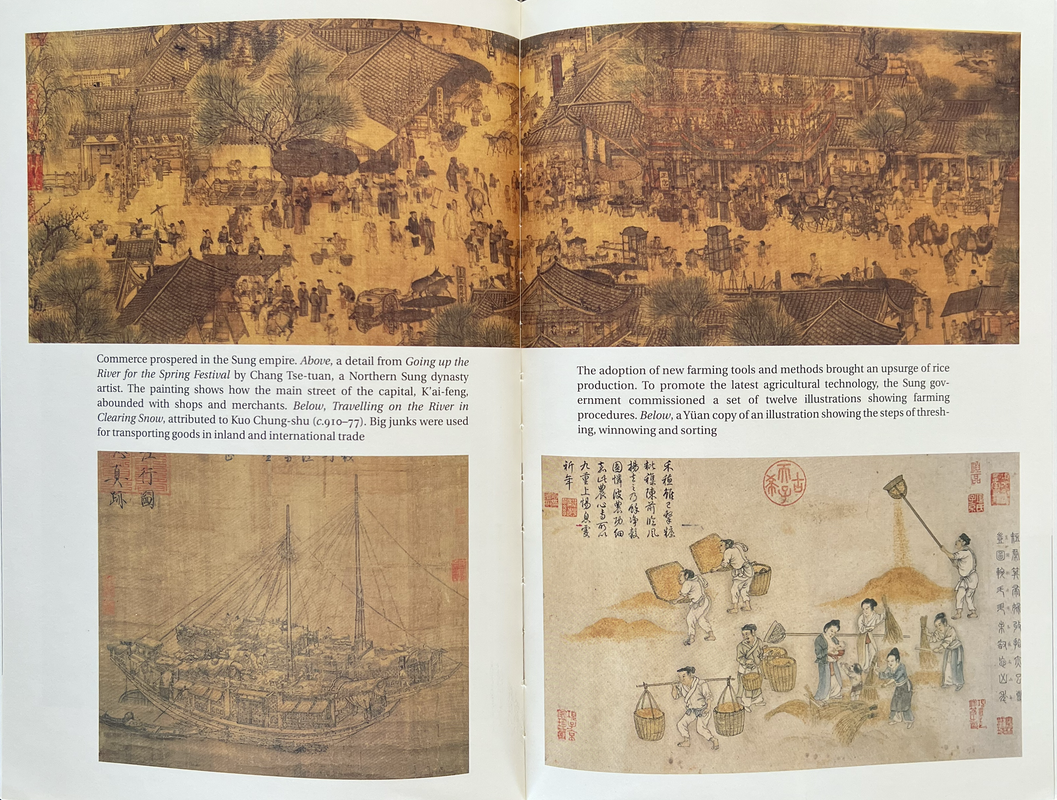
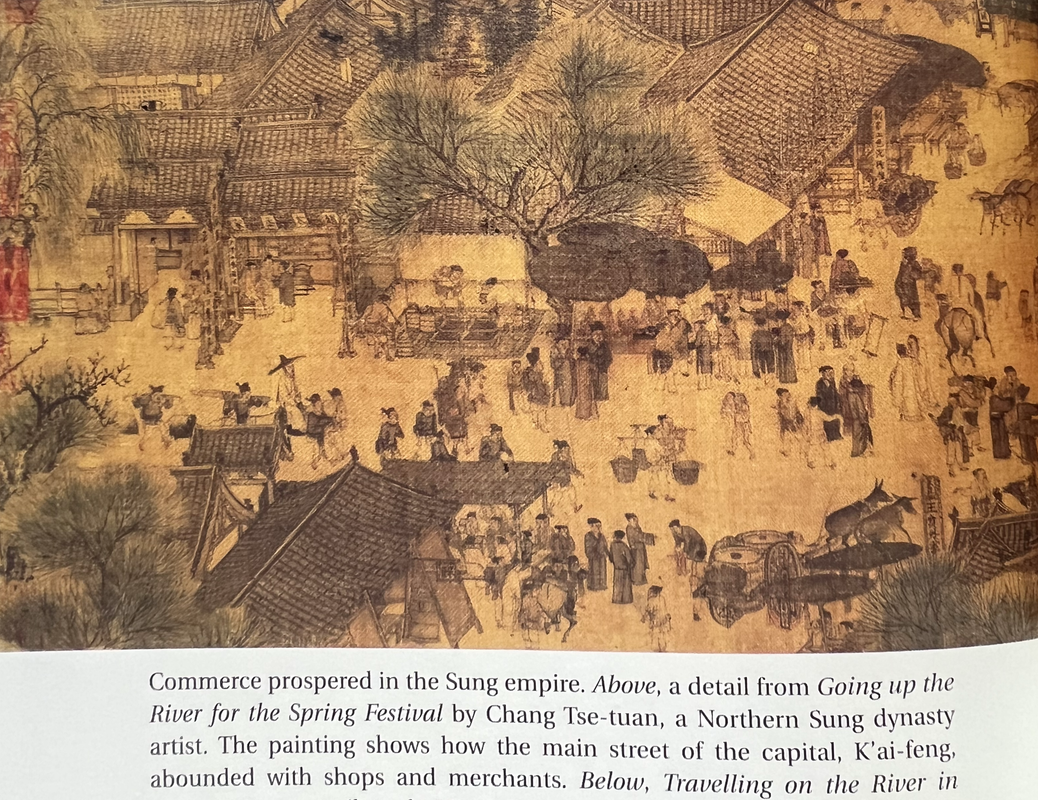
NB: A LT review of the scroll from which this image is taken can be seen here.
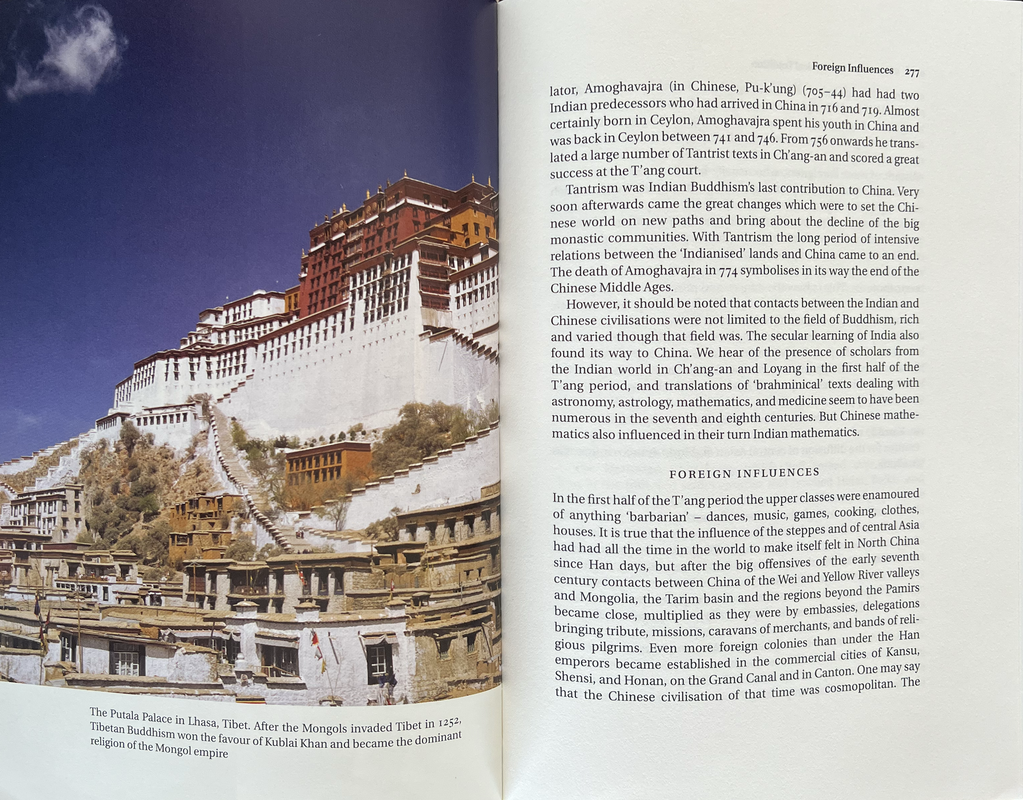
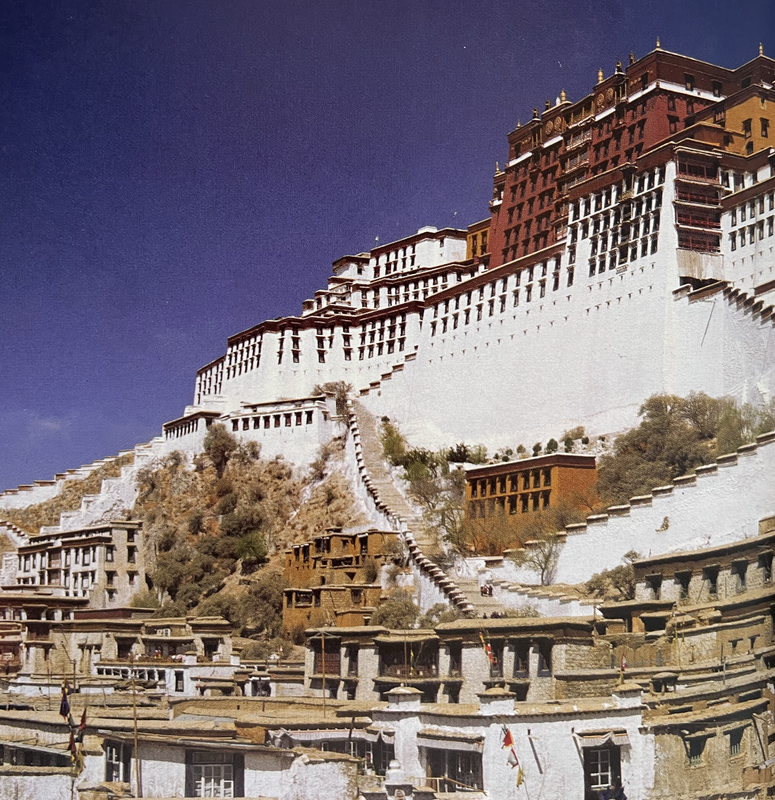
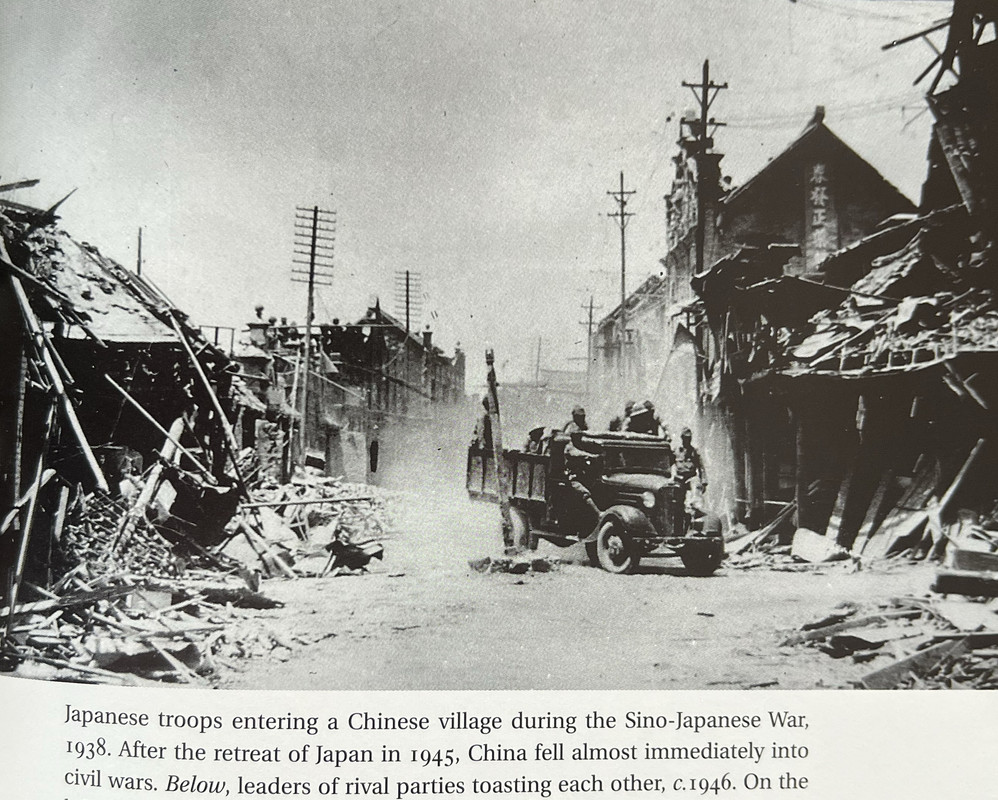
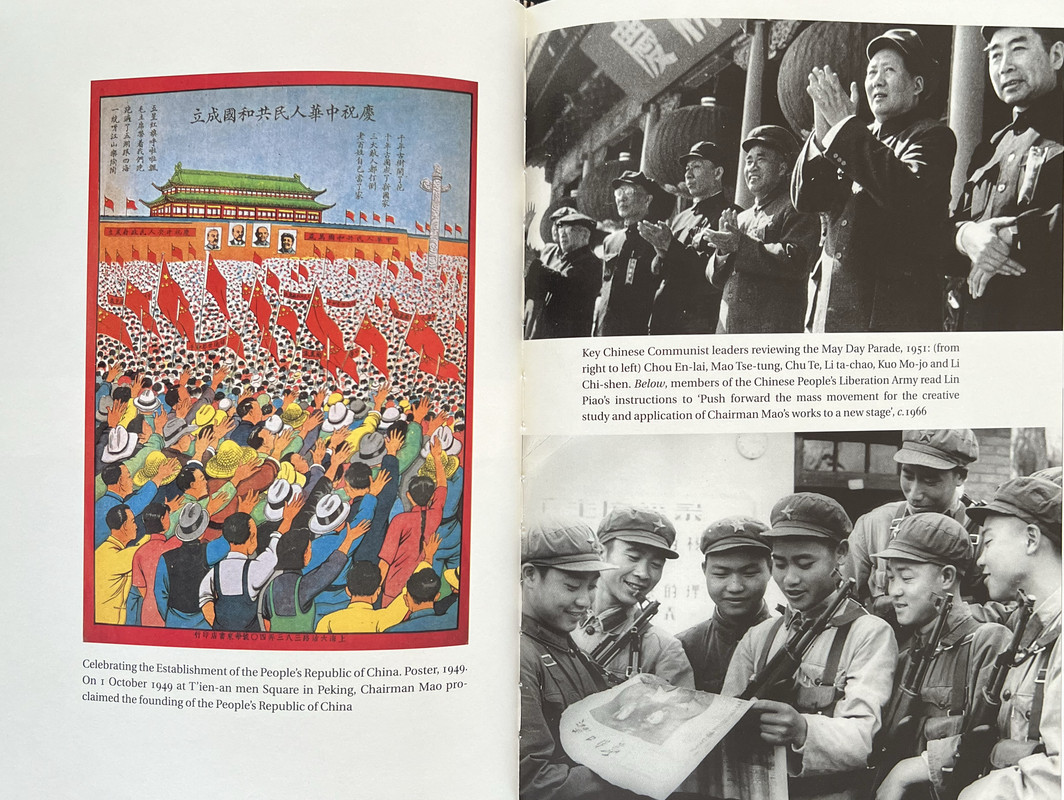
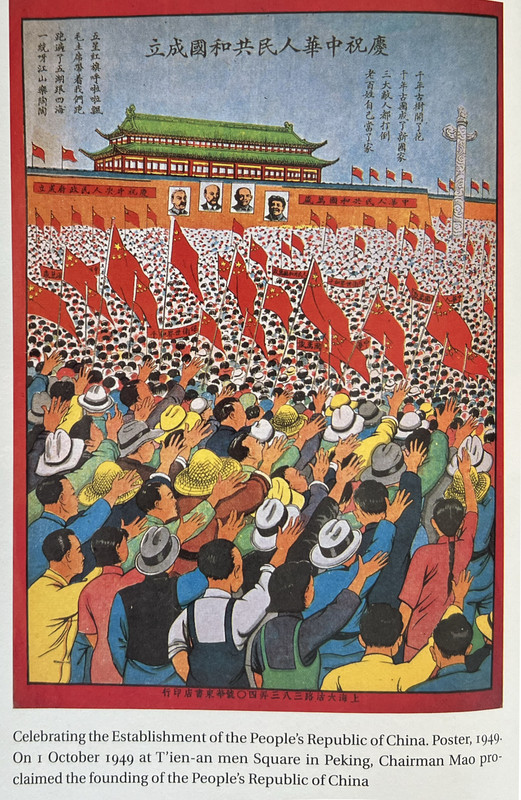
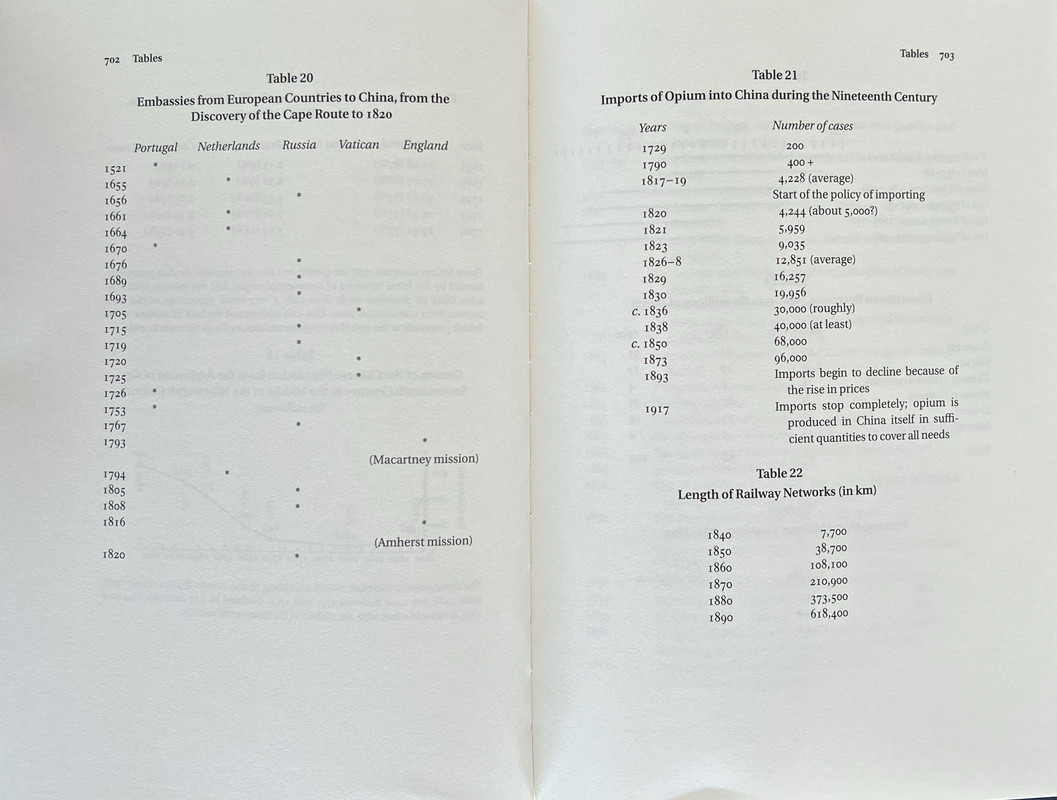
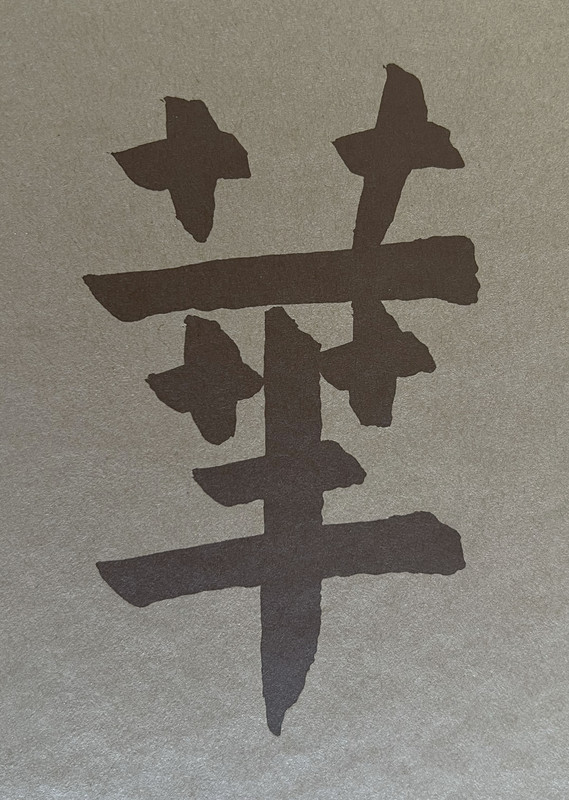
An index of the other illustrated reviews in the "Folio Archives" series can be viewed here.
Considering the extraordinary complexities of Chinese history, it would be hard to find a more comprehensive and well written history of China from the dim ancient era of 10,000 years ago to the early 1990s in such a compact form.
China’s culture is amazingly diverse and interesting. The area we now know as China has previously been unified and disintegrated numerous times and its borders have expanded and shrunk with conquests and defeats. The culture has slowly emerged from the mists of time to become the well-ordered society we know today.
Jacques Gernet (1921–2018) was an eminent French sinologist. The vast majority of the book is unbiased, but he tends to dismiss Buddhism and his Marxist prejudices render his explanation for China's economic and technological stagnation in the late 19th Century unconvincing.
This two volume work has xxvii +851 pages. I found myself skimming sections, then catching an interesting chapter or paragraph when I would read for a few pages before skimming again. It was first published in French in 1972 and English in 1982 but was updated in 1993 and this edition uses the updated version in translation.
A comprehensive chronology, economic and historical tables, a bibliography and index can be found at the back of volume two.
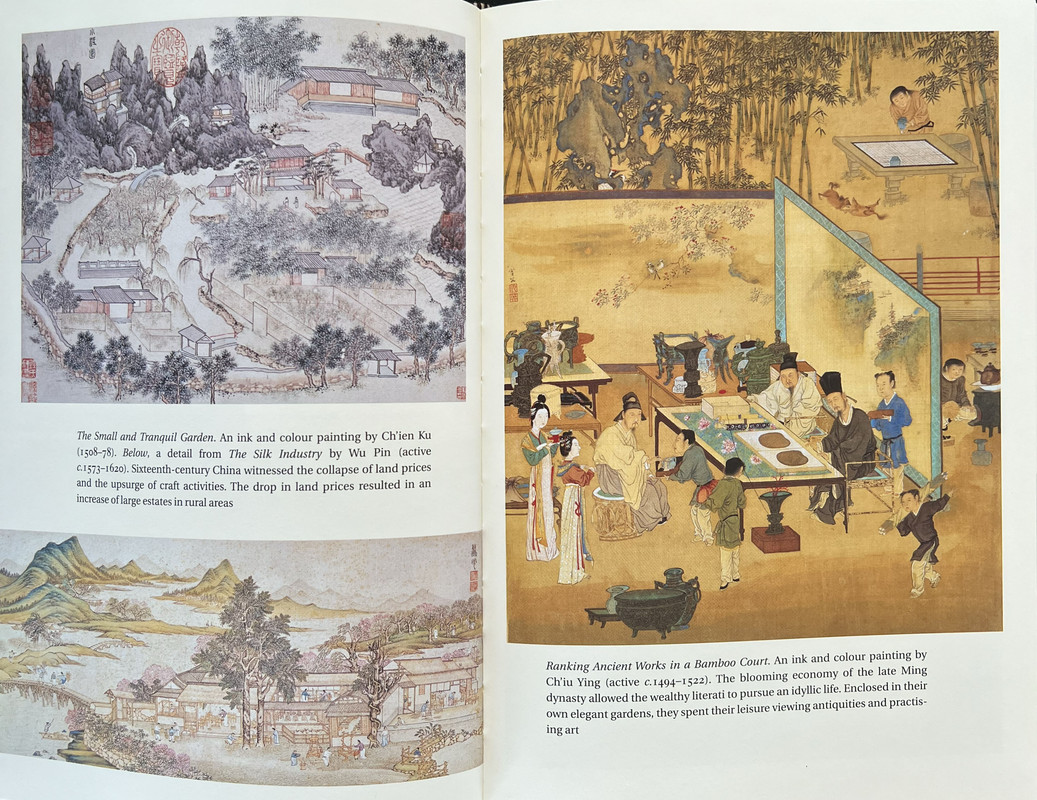
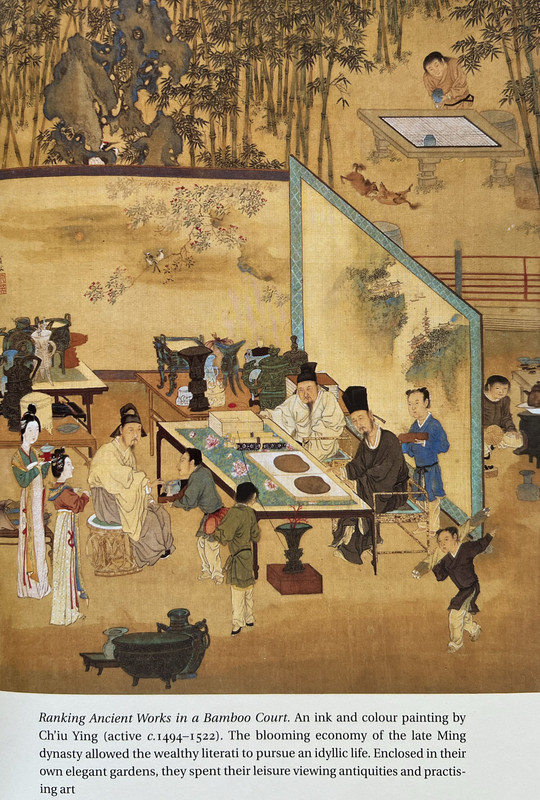
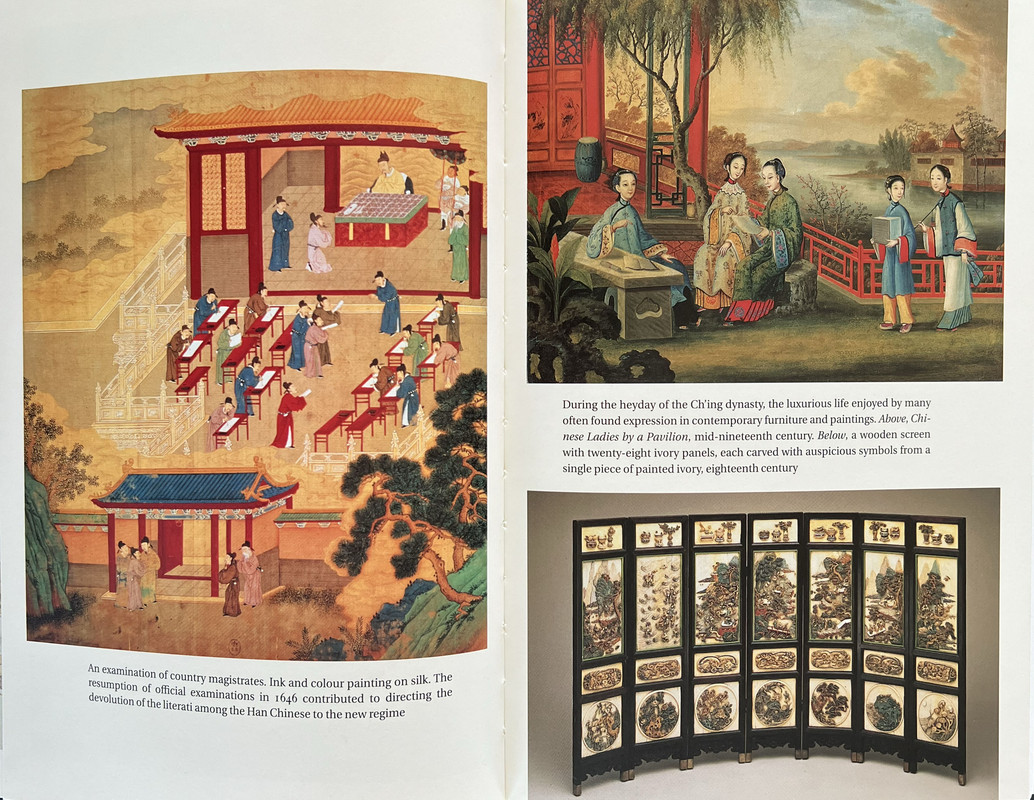
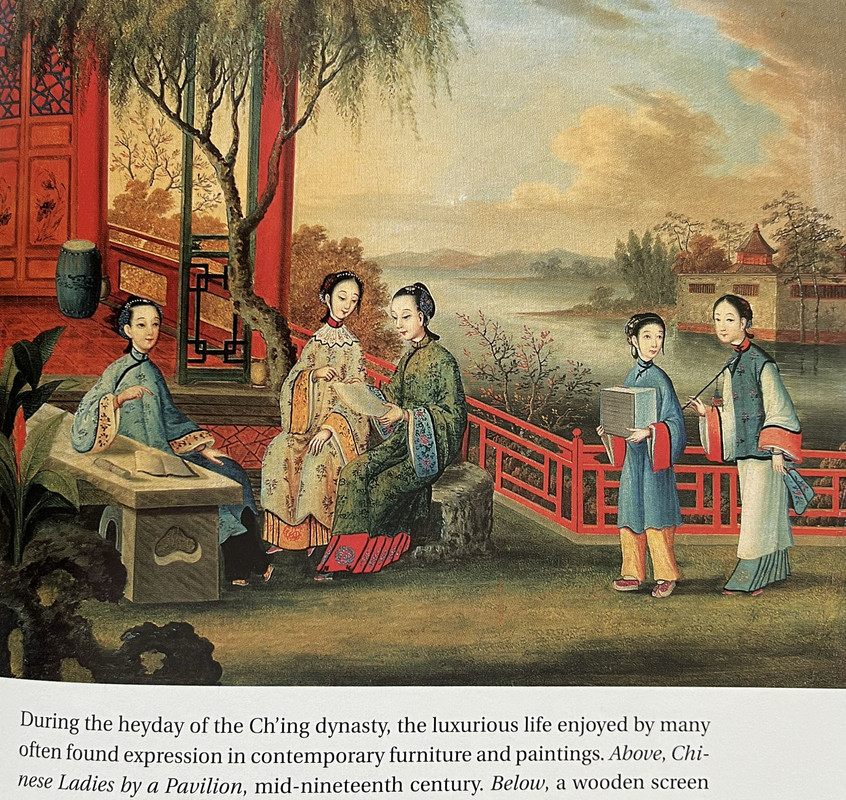
There is a very long Author’s Introduction. The book was translated from the French by J. R. Foster and Charles Hartman and is introduced by Jonathan D. Spence. There are numerous line-drawn maps scattered through the text that have been prepared by Reginald Piggott. There are two sections of twelve bound-in colour plates in each volume (48 pages in total). The endpapers are light brown and printed with Chinese characters in dark brown.
Both volumes are bound in dark brown buckram that is blocked with a gilt design on the cover and spine. There is a colour photo on the front of the dark brown two-volume slipcase which measures 26.2x18.7x8.9cm.
NB: A LT review of the scroll from which this image is taken can be seen here.
An index of the other illustrated reviews in the "Folio Archives" series can be viewed here.
2abysswalker
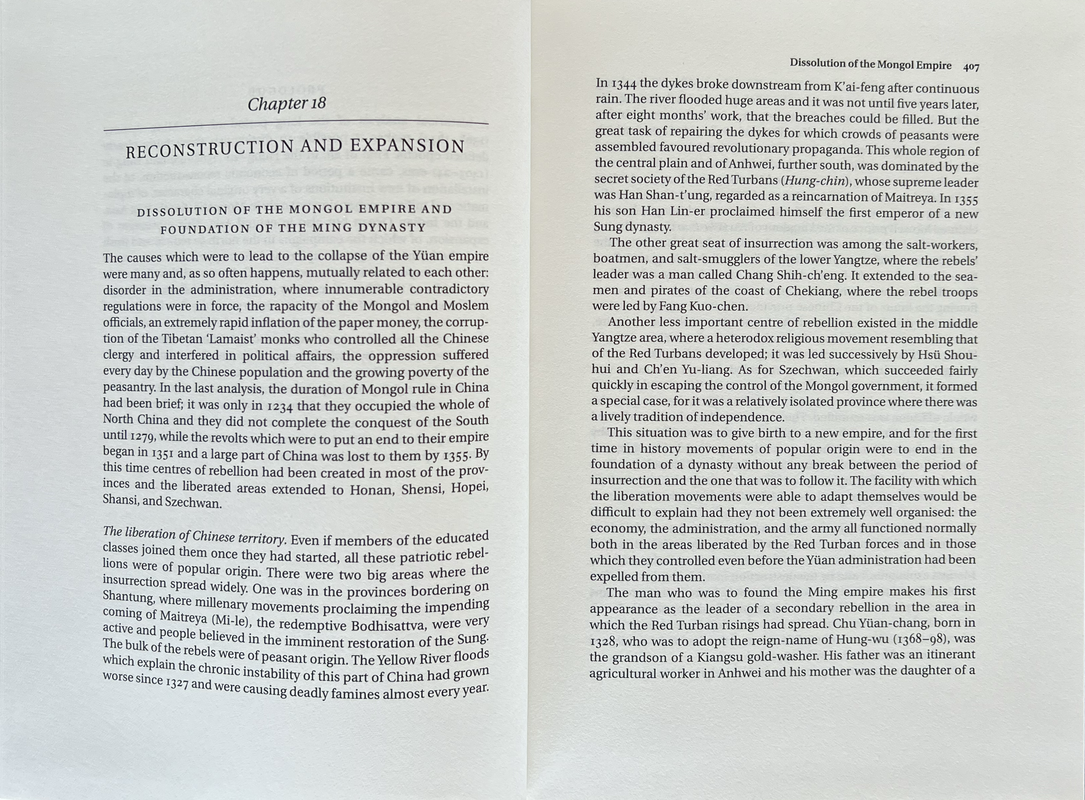
Unfortunately flawed, practically, by the use of the Wade-Giles romanization system (rather than the pinyin used by the PRC, which is now more common).
If one is not already familiar with Chinese history and language, this can make recognizing important figures quite challenging. For example, 曹操 is T'sao T'sao in Wade-Giles but Cao Cao in Pinyin.
If one is not already familiar with Chinese history and language, this can make recognizing important figures quite challenging. For example, 曹操 is T'sao T'sao in Wade-Giles but Cao Cao in Pinyin.
3InVitrio
>2 abysswalker: Indeed its use of Wade-Giles made it close to unreadable for me, I'm so used to pinyin. Plus I don't like Utopia as a typeface and the book design was uninspired. Compare with John Keay's India.
5elladan0891
>2 abysswalker: Flawed for some, blessing for others :)
Pinyin might be good for the Chinese or the students of Chinese, but I think it's... ahem, very questionable for everyone else. You have to actually learn pinyin, as often it's not intuitive in any sense of the word. Your example illustrates this well. "Ts'ao Ts'ao" is intuitive, and anyone reading it will produce something approximating 曹操 - more or less as good as you can get emulating the original in a foreign language with different sounds. But pick random 10 people not familiar with Pinyin/Chinese and ask them to read "Cao Cao", and you won't get a single answer that is even remotely close (you'll probably mostly get "Kao Kao").
A while ago I got into high-end Chinese and Taiwanese teas. They are absolutely amazing, and getting into them is akin to getting into high-end wine - you need to learn about varietals/cultivars, terroir, processing methods, etc. When I first started talking to native Chinese speakers - in English but using Chinese names and terms I newly learned, I was surprised to see that they have absolutely no clue which words I'm trying to say. That's when I discovered that this relatively new Pinyin transliteration is unusable for anyone not studying Pinyin/Chinese! How was I supposed to know that, say, "Qing Xin" should sound like "chin shin"? The letter Q, for example, is far from an obvious or logical choice to represent the "ch" sound. Pinyin might certainly have its uses, but if you want non-Chinese speakers to be able to read transliteration of Chinese names, Pinyin is not it.
>4 gmacaree: "I've read both and prefer Keay's China by miles."
I was thinking the other day about getting either this or Keay, so would really welcome some comparative feedback! Why do you like Keay so much more? Is it the language, the content, anything else?
Pinyin might be good for the Chinese or the students of Chinese, but I think it's... ahem, very questionable for everyone else. You have to actually learn pinyin, as often it's not intuitive in any sense of the word. Your example illustrates this well. "Ts'ao Ts'ao" is intuitive, and anyone reading it will produce something approximating 曹操 - more or less as good as you can get emulating the original in a foreign language with different sounds. But pick random 10 people not familiar with Pinyin/Chinese and ask them to read "Cao Cao", and you won't get a single answer that is even remotely close (you'll probably mostly get "Kao Kao").
A while ago I got into high-end Chinese and Taiwanese teas. They are absolutely amazing, and getting into them is akin to getting into high-end wine - you need to learn about varietals/cultivars, terroir, processing methods, etc. When I first started talking to native Chinese speakers - in English but using Chinese names and terms I newly learned, I was surprised to see that they have absolutely no clue which words I'm trying to say. That's when I discovered that this relatively new Pinyin transliteration is unusable for anyone not studying Pinyin/Chinese! How was I supposed to know that, say, "Qing Xin" should sound like "chin shin"? The letter Q, for example, is far from an obvious or logical choice to represent the "ch" sound. Pinyin might certainly have its uses, but if you want non-Chinese speakers to be able to read transliteration of Chinese names, Pinyin is not it.
>4 gmacaree: "I've read both and prefer Keay's China by miles."
I was thinking the other day about getting either this or Keay, so would really welcome some comparative feedback! Why do you like Keay so much more? Is it the language, the content, anything else?
6abysswalker
>5 elladan0891: honestly they are both bad and good by about equal measure if one didn't care about cultural trends. Neither will allow a Chinese speaker to understand your intended meaning if you try to sound it out. (For others without the tea experience, try it! It is a fun game.)
Both are arbitrary encodings of sounds that you need to learn and are no worse than all the strange silent consonants in French (froid, beaucoup, etc.) from the perspective of an English as a first language person. And neither does tones which is the real kicker for meaning in Chinese (the Cao and the Cao of Cao Cao are totally different sounds with totally different meanings, as might be suggested by the different characters you can see above for the actual Chinese name).
But Wade-Giles is considerably less useful if you want to cross reference info with just about anything else, which I have to imagine is one of the main uses of an historical survey for general readers.
Both are arbitrary encodings of sounds that you need to learn and are no worse than all the strange silent consonants in French (froid, beaucoup, etc.) from the perspective of an English as a first language person. And neither does tones which is the real kicker for meaning in Chinese (the Cao and the Cao of Cao Cao are totally different sounds with totally different meanings, as might be suggested by the different characters you can see above for the actual Chinese name).
But Wade-Giles is considerably less useful if you want to cross reference info with just about anything else, which I have to imagine is one of the main uses of an historical survey for general readers.
7abysswalker
>4 gmacaree: Keay's was written 30-40 years after the revised Gernet and was written for a popular audience with modern publisher marketing sensibilities, so it's not surprising it's readable (I haven't read it, so have no opinion on that), but I will note that Gernet is the far superior historian. Keay isn't even fluent in Chinese.
8lgreen666
If you can find it at a reasonable price on Abe 'The History of Chinese Civilisation 4 Volume Set (The Cambridge China Library)' is much better. Not aimed at generalists and written by key Chinese scholars (in Chinese universities) so you finally get a balanced Chinese view of their own history rather than always distorted western attempts at such...
Same way you should read Chinese historians about Mao - not whitewashing but better context, less intrinsic bias and don't start from the perspective that Mao was 'worse' than Stalin or Hitler because more people died during his time in power
Same way you should read Chinese historians about Mao - not whitewashing but better context, less intrinsic bias and don't start from the perspective that Mao was 'worse' than Stalin or Hitler because more people died during his time in power
9abysswalker
>8 lgreen666: of course it is a good idea to get multiple perspectives on any contested narrative, but mainland scholarship is often (though not always) quite jingoistic (and this is again becoming a bigger problem in the Xi era). I am not familiar with the particular set you reference, but the Cambridge brand is a good sign, though not a guarantee of impartiality of course. A Chinese view of their own history is no more intrinsically unbiased than an American (or any other nation/country) view of their own history and China has both a cultural history and current practice of extensive censorship which is even more restrictive regarding anything as sensitive as history of the nation.
Apart from attributions of the famine to Mao, and separate from any oppression Olympics comparison to other leaders or cultures, there is much to criticize in Mao with regard to his cult of personality and the cultural revolution more broadly. I personally know people that were forcibly relocated to the provinces (上山下乡) to learn from the peasants.
Apart from attributions of the famine to Mao, and separate from any oppression Olympics comparison to other leaders or cultures, there is much to criticize in Mao with regard to his cult of personality and the cultural revolution more broadly. I personally know people that were forcibly relocated to the provinces (上山下乡) to learn from the peasants.
10abysswalker
A few other works to mention for those interested:
Ancient China: A History (Major & Cook, 2016) which uses pinyin and covers a lot of ground well (though only up through the Three Kingdoms era). Has the benefit of being open access under a creative commons license (both pdf and epub available):
https://www.taylorfrancis.com/books/oa-mono/10.4324/9781315715322/ancient-china-...
Spence's Search for Modern China (1990) covers the Qing and after (around 1600 on) and he is a good, engaging writer who is respected academically. He also did a good treatment of the Taiping rebellion (1850-1864), which is sadly overlooked by many in the West, but is truly fascinating: a failed bureaucrat goes on to claim to be the younger son of Jesus and briefly rules a large part of China in a series of conflicts that (until the US Civil War) was by many metrics the largest military conflict in world history.
Finally, if you don't mind slightly more focused, and with a bit more academic theory (though not in a bad way), I highly recommend the works of Paul A. Cohen, especially History in Three Keys (which is about the Boxer Rebellion). This would make a wonderful Folio edition, though it is probably a bit too abstruse to fit into Folio's current marketing. Spence's works too, and those are probably a bit more in Folio's wheelhouse in terms of intended readership.
(I have no relation to or interest in any of these sources.)
Ancient China: A History (Major & Cook, 2016) which uses pinyin and covers a lot of ground well (though only up through the Three Kingdoms era). Has the benefit of being open access under a creative commons license (both pdf and epub available):
https://www.taylorfrancis.com/books/oa-mono/10.4324/9781315715322/ancient-china-...
Spence's Search for Modern China (1990) covers the Qing and after (around 1600 on) and he is a good, engaging writer who is respected academically. He also did a good treatment of the Taiping rebellion (1850-1864), which is sadly overlooked by many in the West, but is truly fascinating: a failed bureaucrat goes on to claim to be the younger son of Jesus and briefly rules a large part of China in a series of conflicts that (until the US Civil War) was by many metrics the largest military conflict in world history.
Finally, if you don't mind slightly more focused, and with a bit more academic theory (though not in a bad way), I highly recommend the works of Paul A. Cohen, especially History in Three Keys (which is about the Boxer Rebellion). This would make a wonderful Folio edition, though it is probably a bit too abstruse to fit into Folio's current marketing. Spence's works too, and those are probably a bit more in Folio's wheelhouse in terms of intended readership.
(I have no relation to or interest in any of these sources.)
11PartTimeBookAddict
>10 abysswalker: How do you rate Gascoigne's "The Dynasties of China"? I recently picked up the FS version. Seems like a quick read.
12gmacaree
>7 abysswalker: I'd buy that, but I don't think Gernet's book gains much from his superior historical abilities. I have a relatively close interest in Chinese history (think layman-plus, I suppose) but found his earlier book stodgy and disconcertinly orientalising. Keay's, on the other hand, was more what I was looking for in a general history for an interested audience — a refresher on what I already knew well and a readable introduction to what I didn't.
13abysswalker
>11 PartTimeBookAddict: not bad! Clear overview of imperial history, less coverage of any cultural history not related to the core official Confucian bureaucracy (Buddhism, Daoism, etc.). It doesn't claim to be a general survey beyond the dynasties, so that's not exactly a criticism, but it shouldn't be taken as representing the whole of Chinese civilization. Few references to primary sources and no citations IIRC.
14PartTimeBookAddict
>13 abysswalker: Thanks. Seems like a good entry point before tackling Gernet.
15RickartAllen
>6 abysswalker: It's certainly annoying that different Chinese translations into English conventionally use one of two systems of transliteration, but both systems can largely be summarized on a few sheets of paper, and I've never had difficulty switching from one to the other.
Pinyin seems much more common in contemporary translations, but enough is still published in Wade-Giles to make it worth your while (not to mention many now-classic translations). And knowing both keeps you from thinking that the Tao Te Ching and the Dao De Jing are different works, or Mao Tse-Tung and Mao Zedong different people.
I've read both Gernet's China and Keay's India. Both are good and, not surprisingly, Gernet writes like a historian and Keay like a very good journalist. I very much enjoyed Garnet's China and, for such a large subject, would probably prefer it to Keay's more anecdotal style. (But I just started Keay's Sowing the Wind, in a used Folio edition, and it's very good.)
Pinyin seems much more common in contemporary translations, but enough is still published in Wade-Giles to make it worth your while (not to mention many now-classic translations). And knowing both keeps you from thinking that the Tao Te Ching and the Dao De Jing are different works, or Mao Tse-Tung and Mao Zedong different people.
I've read both Gernet's China and Keay's India. Both are good and, not surprisingly, Gernet writes like a historian and Keay like a very good journalist. I very much enjoyed Garnet's China and, for such a large subject, would probably prefer it to Keay's more anecdotal style. (But I just started Keay's Sowing the Wind, in a used Folio edition, and it's very good.)

