1wandering_star
Breakage
- by Mary Oliver
I go down to the edge of the sea.
How everything shines in the morning light!
The cusp of the whelk,
the broken cupboard of the clam,
the opened, blue mussels,
moon snails, pale pink and barnacle scarred—
and nothing at all whole or shut, but tattered, split,
dropped by the gulls onto the gray rocks and all the moisture gone.
It's like a schoolhouse
of little words,
thousands of words.
First you figure out what each one means by itself,
the jingle, the periwinkle, the scallop
full of moonlight.
Then you begin, slowly, to read the whole story.
- by Mary Oliver
I go down to the edge of the sea.
How everything shines in the morning light!
The cusp of the whelk,
the broken cupboard of the clam,
the opened, blue mussels,
moon snails, pale pink and barnacle scarred—
and nothing at all whole or shut, but tattered, split,
dropped by the gulls onto the gray rocks and all the moisture gone.
It's like a schoolhouse
of little words,
thousands of words.
First you figure out what each one means by itself,
the jingle, the periwinkle, the scallop
full of moonlight.
Then you begin, slowly, to read the whole story.
2wandering_star
Unbelievably, this will be my 20th year using LibraryThing, so perhaps this should be called millions of words!
Reposting my 2025 wrap-up from last year's thread.
===
I feel like I've had a good reading year, in both quantity and quality. I don't think I've had any significant reading slumps this year, and a lot more books rated 4-5 stars than in recent years (although of course it's always interesting to look back at those ratings and think, hmm I liked it that much? or see gaps where books that have stayed with you weren't rated that highly at the time).
My reading goals for the year were to read more non-fiction, particularly history (achieved! although more so at the start of the year than the end) and to read all of Austen in her anniversary year (I only got to 2, in the end, but will carry on reading her novels in chronological order). I also enjoyed group reads of Middlemarch and Giovanni's Room, but didn't manage to get organised enough to join others (including Pnin, which I literally had a copy of on my bedside table while the group read was going on, and somehow just didn't get to).
New-to-me authors that I want to read more of:
Brigid Brophy (I own Hackenfeller's Ape and have asked for In Transit for Christmas)
Alba de Cespedes (I own Her Side of the Story, which I think is the only other one that has been translated into English)
Magda Szabo (I own Abigail)
...and I'm going to include Barbara Pym here because although not new to me, this year is the first time I felt that I 'got' her, so I'd like to try more
I'd also like to try one of Eliza Clark's novels (She's Always Hungry was my favourite book of short stories this year along with Reservoir Bitches), and The Ministry of Time and The Mountain in the Sea were interesting enough that I'd like to read what those authors do next. I didn't read a lot of poetry but enjoyed Hannah Lowe's Chick and I own her memoir Long Time No See and another poetry book Chan which I look forward to getting to. Nine Coaches Waiting was my favourite page-turner/genre read and although the other Mary Stewart I read was nowhere near as good, I will try another one or two to see which one of these was an outlier.
Top five books from this year:
Middlemarch by George Eliot
The Snow Ball by Brigid Brophy
There’s No Turning Back by Alba de Cespedes
The Glass Pearls by Emeric Pressburger
Forbidden Notebook by Alba de Cespedes
Best non-fiction:
The Anglo-Saxons: the making of England, 410-1066 by Marc Morris
Giving up the Gun: Japan's reversion to the sword, 1543-1879 by Noel Perrin
Stranger in the Shogun's City: a Japanese woman and her world by Amy Stanley
My reading goals for 2026 both come from the fact that I will be moving back to the UK (from Japan) at some point in the year - when exactly is a bit up in the air at the moment. So I would like to read the rest of my non-fiction books about Japan (because if I don't read them while I'm living here, when will I ever read them?!), and I would also like to read my largest physical books (to reduce the volume I have to move).
Reposting my 2025 wrap-up from last year's thread.
===
I feel like I've had a good reading year, in both quantity and quality. I don't think I've had any significant reading slumps this year, and a lot more books rated 4-5 stars than in recent years (although of course it's always interesting to look back at those ratings and think, hmm I liked it that much? or see gaps where books that have stayed with you weren't rated that highly at the time).
My reading goals for the year were to read more non-fiction, particularly history (achieved! although more so at the start of the year than the end) and to read all of Austen in her anniversary year (I only got to 2, in the end, but will carry on reading her novels in chronological order). I also enjoyed group reads of Middlemarch and Giovanni's Room, but didn't manage to get organised enough to join others (including Pnin, which I literally had a copy of on my bedside table while the group read was going on, and somehow just didn't get to).
New-to-me authors that I want to read more of:
Brigid Brophy (I own Hackenfeller's Ape and have asked for In Transit for Christmas)
Alba de Cespedes (I own Her Side of the Story, which I think is the only other one that has been translated into English)
Magda Szabo (I own Abigail)
...and I'm going to include Barbara Pym here because although not new to me, this year is the first time I felt that I 'got' her, so I'd like to try more
I'd also like to try one of Eliza Clark's novels (She's Always Hungry was my favourite book of short stories this year along with Reservoir Bitches), and The Ministry of Time and The Mountain in the Sea were interesting enough that I'd like to read what those authors do next. I didn't read a lot of poetry but enjoyed Hannah Lowe's Chick and I own her memoir Long Time No See and another poetry book Chan which I look forward to getting to. Nine Coaches Waiting was my favourite page-turner/genre read and although the other Mary Stewart I read was nowhere near as good, I will try another one or two to see which one of these was an outlier.
Top five books from this year:
Middlemarch by George Eliot
The Snow Ball by Brigid Brophy
There’s No Turning Back by Alba de Cespedes
The Glass Pearls by Emeric Pressburger
Forbidden Notebook by Alba de Cespedes
Best non-fiction:
The Anglo-Saxons: the making of England, 410-1066 by Marc Morris
Giving up the Gun: Japan's reversion to the sword, 1543-1879 by Noel Perrin
Stranger in the Shogun's City: a Japanese woman and her world by Amy Stanley
My reading goals for 2026 both come from the fact that I will be moving back to the UK (from Japan) at some point in the year - when exactly is a bit up in the air at the moment. So I would like to read the rest of my non-fiction books about Japan (because if I don't read them while I'm living here, when will I ever read them?!), and I would also like to read my largest physical books (to reduce the volume I have to move).
3wandering_star
(saving this to add a list of the Japan non-fiction and the thickest books for reference)
4dchaikin
How long have you lived in Japan? A couple years now? Love your summary. I’m still interested in The Anglo Saxons. (Malory calls them the Syssoynes). Wish a great year and a minimal stress move.
5rocketjk
Happy New Year, and good luck with the move. I hope it's something you're looking forward to. Cheers!
6edwinbcn
Happy New Year. Good luck with your repatriation / relocation from Japan. Depending on how long you were there, try to prepare well. Ever since my return from China in 2022, I am still bothered by reverse culture shock, after 22 years in China.
Incidentally, I like Japanese literature much more interesting than Chinese literature, and find Japanese very inspiring, as I can see its common roots with Chinese culture.
For me also 20 years on LT, I joined in February 2007.
Incidentally, I like Japanese literature much more interesting than Chinese literature, and find Japanese very inspiring, as I can see its common roots with Chinese culture.
For me also 20 years on LT, I joined in February 2007.
7Nickelini
Good luck with your move. Where in the UK will you be settling? Are you done with Asia, or is this just a break?
8wandering_star
>4 dchaikin:, >5 rocketjk:, >6 edwinbcn:, >7 Nickelini: Thank you for the good wishes! I am very sorry to be leaving Japan - it's been four years now and the longer I live here the more I like it. I definitely expect significant reverse culture shock! But I have been away from the UK for a long time and for various reasons it's time to go back. I hope to live in Asia again some time in the future but who can predict anything these days?!
9wandering_star
1. Twice Lost by Phyllis Paul
A blistering start to my reading year with this. I think I mainly bought it because it is one of the McNally Editions series of reissues, and I really liked the other one I've read of these, Ex-Wife.
Almost nothing is know about Phyllis Paul except her writing - the praise she received from other writers who remain well-known today (like Elizabeth Bowen and Rebecca West) and her 11 novels, all out of print except this one. It's actually incredible to think about someone who lived until 1973 leaving so little documentary evidence about their life. I hope that more of her books will be republished.
A blistering start to my reading year with this. I think I mainly bought it because it is one of the McNally Editions series of reissues, and I really liked the other one I've read of these, Ex-Wife.
Almost nothing is know about Phyllis Paul except her writing - the praise she received from other writers who remain well-known today (like Elizabeth Bowen and Rebecca West) and her 11 novels, all out of print except this one. It's actually incredible to think about someone who lived until 1973 leaving so little documentary evidence about their life. I hope that more of her books will be republished.
10wandering_star
That's the first time I have embedded a review into my thread. I'm not sure it works that well for how I use these threads, which is often for rambling thoughts about my responses rather than the books themselves. Still, where I have written things which feel like standalone reviews, I'll try posting them as reviews and see how it goes.
Two more things to add on Twice Lost. The opening sentence is "They had separated and were creeping about the grass, bowed over, with their eyes on the ground." This is a really weird and unsettling image. I almost thought of alien creatures. In fact it's describing a group of people who are looking for a trinket that someone has dropped. It wouldn't make any lists of best opening sentences, but it's a very effective opening to a book which keeps you perpetually off-balance.
Also, the cover is taken from this image, "Pink is a Touch, Red is a Stare" by fine art photographer Cig Harvey. I like the image, and I also think it's the perfect cover for this book - first you see flowers, then you realise that they are in water, and then you see what seems to be a human limb in the water under the flowers (more obvious from the full image than from the crop on the book cover). I hadn’t heard of Harvey before researching this but am now a fan - a lot of her images have this same beautiful but unsettling surreal edge.

(As you may be able to tell, Twice Lost is a book that I want to talk to people about!)
Two more things to add on Twice Lost. The opening sentence is "They had separated and were creeping about the grass, bowed over, with their eyes on the ground." This is a really weird and unsettling image. I almost thought of alien creatures. In fact it's describing a group of people who are looking for a trinket that someone has dropped. It wouldn't make any lists of best opening sentences, but it's a very effective opening to a book which keeps you perpetually off-balance.
Also, the cover is taken from this image, "Pink is a Touch, Red is a Stare" by fine art photographer Cig Harvey. I like the image, and I also think it's the perfect cover for this book - first you see flowers, then you realise that they are in water, and then you see what seems to be a human limb in the water under the flowers (more obvious from the full image than from the crop on the book cover). I hadn’t heard of Harvey before researching this but am now a fan - a lot of her images have this same beautiful but unsettling surreal edge.

(As you may be able to tell, Twice Lost is a book that I want to talk to people about!)
11wandering_star
2. Wild Dark Shore by Charlotte McConaghy
The setting is Shearwater, a remote, wild island near Antarctica. In normal times, as well as huge colonies of penguins and seals, there is a small colony of scientists, there to study the island’s ecology and to take care of the seed vault. But these are not normal times - the seas are rising and weather patterns are changing, the permafrost protecting the seed vault is starting to melt and the seeds stored within it are more needed than ever. In one of the ever more frequent storms, a boat founders and one of its passengers, a woman called Rowan, is washed up on the island. What she finds there is one family, widower Dom and his three children - the only ones left to close down the seed vault and take as many seeds as they can back to the mainland. All the communications equipment on the island has been smashed, and Dom and his children all seem to be troubled in different ways. Rowan has a secret from them as well - she is married to the scientist who was heading up the base, and has come to the island after emails from her husband saying he was in danger and needed her.
I really enjoyed the first half of this book. Then l happened to pick up Twice Lost, and when I came back to this one, it felt a bit obvious - the themes heavily signposted, the loose ends tied up neatly, and any moments of complex morality explained away. This last point undermines what I thought was going to be the book's major theme, about the lengths that someone will go to to protect someone or something that they love. In the end the theme turns out to be the importance of having things that you love enough to want to protect them, and the need to try and protect things of value even against terrible odds. Which are absolutely fine as themes, but a lot less morally ambiguous. (As an aside, I do wonder if these days we're a lot less tolerant of moral ambiguity. I heard a recentish cover of Johnny Cash which changed the lyric "But I shot a man in Reno just to watch him die" to "They say I shot a man in Reno but that was just a lie" - what a flattening change).
So I'm in a bit of a quandary about how to review this book really, as I don't think I'd have noticed these things but for the contrast with Twice Lost. I do think that anyway I'd have been annoyed bythe attraction between Rowan and Dom . I understand why it's there thematically but it's implausible and the book would be better without it. (In the afterword McConaghy says that she based all of Dom's good qualities on her husband which might explain this). But I think the book is a pretty good example of this sort of contemporary issue-based fiction (I'm thinking of things like Little Fires Everywhere) and I've already recommended it to my sister.
I felt better about being here, on the island that was protecting this last floundering hope, rather than back on a mainland that would need rescuing. And with every danger that came upon Shearwater, every struggle, I would think, at least we're not back there, dealing with fires and floods and food scarcity and all the rest of it.
At least we are here, in a place that seems hostile until you look more closely. Until you begin to see its beauty and its tenderness. Until you see the hidden abundance of it.
I never loved a place before we came here.
And now it's over. The seed vault is closing. It was meant to last forever, and now we are sorting and packing the seeds for transport, and in just under two months we, too, will be leaving, with all the lucky little specks important enough to be chosen for relocation.
The setting is Shearwater, a remote, wild island near Antarctica. In normal times, as well as huge colonies of penguins and seals, there is a small colony of scientists, there to study the island’s ecology and to take care of the seed vault. But these are not normal times - the seas are rising and weather patterns are changing, the permafrost protecting the seed vault is starting to melt and the seeds stored within it are more needed than ever. In one of the ever more frequent storms, a boat founders and one of its passengers, a woman called Rowan, is washed up on the island. What she finds there is one family, widower Dom and his three children - the only ones left to close down the seed vault and take as many seeds as they can back to the mainland. All the communications equipment on the island has been smashed, and Dom and his children all seem to be troubled in different ways. Rowan has a secret from them as well - she is married to the scientist who was heading up the base, and has come to the island after emails from her husband saying he was in danger and needed her.
I really enjoyed the first half of this book. Then l happened to pick up Twice Lost, and when I came back to this one, it felt a bit obvious - the themes heavily signposted, the loose ends tied up neatly, and any moments of complex morality explained away. This last point undermines what I thought was going to be the book's major theme, about the lengths that someone will go to to protect someone or something that they love. In the end the theme turns out to be the importance of having things that you love enough to want to protect them, and the need to try and protect things of value even against terrible odds. Which are absolutely fine as themes, but a lot less morally ambiguous. (As an aside, I do wonder if these days we're a lot less tolerant of moral ambiguity. I heard a recentish cover of Johnny Cash which changed the lyric "But I shot a man in Reno just to watch him die" to "They say I shot a man in Reno but that was just a lie" - what a flattening change).
So I'm in a bit of a quandary about how to review this book really, as I don't think I'd have noticed these things but for the contrast with Twice Lost. I do think that anyway I'd have been annoyed by
I felt better about being here, on the island that was protecting this last floundering hope, rather than back on a mainland that would need rescuing. And with every danger that came upon Shearwater, every struggle, I would think, at least we're not back there, dealing with fires and floods and food scarcity and all the rest of it.
At least we are here, in a place that seems hostile until you look more closely. Until you begin to see its beauty and its tenderness. Until you see the hidden abundance of it.
I never loved a place before we came here.
And now it's over. The seed vault is closing. It was meant to last forever, and now we are sorting and packing the seeds for transport, and in just under two months we, too, will be leaving, with all the lucky little specks important enough to be chosen for relocation.
12dchaikin
>11 wandering_star: i’ll start here.
“one, it felt a bit obvious - the themes heavily signposted, the loose ends tied up neatly, and any moments of complex morality explained away”
That is why i abandoned the book of hers i tried. I hate that. It’s essentially dishonest writing, or it feels that way. It’s not interesting to read.
>10 wandering_star: i like the attached reviews because I can “like” or thumb them. And sometimes that’s all i have time to do. The way i do my own is I get it ready on my thread, then when done, copy the text I want in the review. And attach
Other benefit: editing is easier and cleaner
One oddity: what to put in the review and what to restrict to your post here. Some users restrict fantastic commentary to their post.
Anyway, I’m fan of the attached reviews. Happy to encourage you.
And beautiful picture
“one, it felt a bit obvious - the themes heavily signposted, the loose ends tied up neatly, and any moments of complex morality explained away”
That is why i abandoned the book of hers i tried. I hate that. It’s essentially dishonest writing, or it feels that way. It’s not interesting to read.
>10 wandering_star: i like the attached reviews because I can “like” or thumb them. And sometimes that’s all i have time to do. The way i do my own is I get it ready on my thread, then when done, copy the text I want in the review. And attach
Other benefit: editing is easier and cleaner
One oddity: what to put in the review and what to restrict to your post here. Some users restrict fantastic commentary to their post.
Anyway, I’m fan of the attached reviews. Happy to encourage you.
And beautiful picture
13dchaikin
>9 wandering_star: how interesting about the author! Loved your review.
14baswood
>9 wandering_star: An author new to me who had a book published in 1951, but as you say difficult to find copies of her books. Enjoyed your review.
I did find a copy of An Invisible Darkness on the internet archive that is free to borrow.
I did find a copy of An Invisible Darkness on the internet archive that is free to borrow.
15Dilara86
Happy new year! I hope you like Abigail when you get to it. I loved it, but then I haven't found a Magda Szabó book I didn't like...
16wandering_star
>12 dchaikin: Thank you for the feedback on reviews! As for your comments on Wild Dark Shore, I have to say I think a lot of contemporary fiction is worse - I give up on a lot of books because that obviousness is annoying me, but I didn't spot it in this one at first.
>14 baswood: Thanks for finding that! I have not used the internet archive before but I think I can use the book viewer on my ipad.
>15 Dilara86: Thank you - what else of hers would you recommend?
>14 baswood: Thanks for finding that! I have not used the internet archive before but I think I can use the book viewer on my ipad.
>15 Dilara86: Thank you - what else of hers would you recommend?
17cindydavid4
>12 dchaikin: im thinking about mentioning my reaading in Whats that your reading, but write an actual review on my page Id lead readers to the thread then they can talk about it on the page. I think the reading thread is more for basic info. I may be wrong and it matters nothing if you do either way
18dchaikin
>17 cindydavid4: that sounds right to me. Headlines on the WAYR thread, details in your personal thead and/or review page
19cindydavid4
Details at 10
23wandering_star
Jewel Cobb had long been a legendary killer in his midnight reveries and now he'd come to the big town to prove that his upright version knew the same techniques and was just as cold. He sat on the lumpy green couch tapping his feet in time with a guitar he scratched at with sullen incompetence.
This is the start of 5. Under the Bright Lights, the first novel by Daniel Woodrell, most famous I think for Winter's Bone, which was made into an excellent film which gave Jennifer Lawrence her breakout role.
The story: Jewel Cobb is given a hit to carry out. His target is Crane, another small-time criminal who needs to be wiped out after he carried out a hit on city councilman Alvin Rankin. Jewel messes up his escape and ends up with everyone after him - the police, Crane's associates, and the people who sent him after Crane in the first place. Meanwhile, Detective Rene Shade has been called in on, and warned off, the Rankin case.
I have read most of Woodrell's books, but none for a long time. I remember most clearly the overall tone - a combination of hardboiled and Southern Gothic. This book definitely has that. But (and I suppose this is also true of the original hardboiled detective novels) the story is a distant second to the language. In fact the problem is that early on in Under the Bright Lights, there are a couple of hints at more interesting stories. It’s clear to Shade and every other detective that Rankin was killed by someone he knew - but because he was a rising Democratic politician, the Mayor leans on the police department to say it was a burglary gone wrong. This kicks off the detection part of the story but is then never referred to again. Also, Shade grew up on the wrong side of the tracks - and his elder brother still runs a very dubious drinking establishment - but Woodrell does very little with this dynamic. Perhaps these are acceptable first-novel flaws. I should dig out some of the later books to re-read.
This is the start of 5. Under the Bright Lights, the first novel by Daniel Woodrell, most famous I think for Winter's Bone, which was made into an excellent film which gave Jennifer Lawrence her breakout role.
The story: Jewel Cobb is given a hit to carry out. His target is Crane, another small-time criminal who needs to be wiped out after he carried out a hit on city councilman Alvin Rankin. Jewel messes up his escape and ends up with everyone after him - the police, Crane's associates, and the people who sent him after Crane in the first place. Meanwhile, Detective Rene Shade has been called in on, and warned off, the Rankin case.
I have read most of Woodrell's books, but none for a long time. I remember most clearly the overall tone - a combination of hardboiled and Southern Gothic. This book definitely has that. But (and I suppose this is also true of the original hardboiled detective novels) the story is a distant second to the language. In fact the problem is that early on in Under the Bright Lights, there are a couple of hints at more interesting stories. It’s clear to Shade and every other detective that Rankin was killed by someone he knew - but because he was a rising Democratic politician, the Mayor leans on the police department to say it was a burglary gone wrong. This kicks off the detection part of the story but is then never referred to again. Also, Shade grew up on the wrong side of the tracks - and his elder brother still runs a very dubious drinking establishment - but Woodrell does very little with this dynamic. Perhaps these are acceptable first-novel flaws. I should dig out some of the later books to re-read.
25Dilara86
>16 wandering_star: what else of hers would you recommend?
First of all, Abigail is a bit of an outlier in that uses the tropes of a girl's boarding-school whodunnit, whereas the other books I read were in the "general" fiction mould (give or take a possible ghost), so there is always the possibility that you like Abigail and not her other novels, or vice versa.
My absolute favourite is The Door, and I also loved Katalin Street and Iza's Ballad.
First of all, Abigail is a bit of an outlier in that uses the tropes of a girl's boarding-school whodunnit, whereas the other books I read were in the "general" fiction mould (give or take a possible ghost), so there is always the possibility that you like Abigail and not her other novels, or vice versa.
My absolute favourite is The Door, and I also loved Katalin Street and Iza's Ballad.
26dchaikin
>21 wandering_star: to >24 wandering_star: fun reading. Daisy Miller sounds like a good place to start with Henry James. Seascraper won me over this past fall, so i’m glad you enjoyed.
27cindydavid4
>21 wandering_star: I read her 1000 acres which I liked The one you're reading sounds interesting I may try it
28SassyLassy
>21 wandering_star: That sounds like a good book with which to get back to Jane Smiley. I used to read her, but seem to have wandered away. I like her style of writing, and the way you described it.
>23 wandering_star: >24 wandering_star: More books to consider.
>23 wandering_star: >24 wandering_star: More books to consider.
29kjuliff
>24 wandering_star: Great review of one of my favorites this year.
30labfs39
>25 Dilara86: The Door is the only Szabo I've read, but I thought it very well-written. I've been meaning to get to Katalin Street, which is on my shelf.
Seascraper is the 2025 Booker book I'm most looking forward to reading.
Seascraper is the 2025 Booker book I'm most looking forward to reading.
31wandering_star
>25 Dilara86: Interesting! I hope to get to Abigail soon, so will let you know.
>27 cindydavid4: I liked A Thousand Acres too and I think they probably have a similar feel. Also a fan of Moo and The Greenlanders but those are both quite different.
>27 cindydavid4: I liked A Thousand Acres too and I think they probably have a similar feel. Also a fan of Moo and The Greenlanders but those are both quite different.
33rasdhar
>32 wandering_star: I am so intrigued by this book and enjoyed reading your review. I'm sorry to hear it doesn't develop from the initial potential. Based on your description it sounds really atmospheric.
34SassyLassy
>32 wandering_star:. Sounds like a book which might be read more for the feeling than the tale, but often that's just fine. Not only that, your quote really appeals.
35kjuliff
>32 wandering_star: it’s so disappointing when a book that looks good on the surface doesn’t turn out to be what you expected. Still it sounds interesting.
36raton-liseur
>32 wandering_star: Interesting review. I did not know if I should read this book or not, now I know it's probably not for me.
>34 SassyLassy: The sentence There are three sorts of people: those who are alive, those who are dead, and those who are at sea is usually misattributed to Aristotle, Plato or Socrates.
There are some debates around where it actually come from, but it's clearly far older than this book. (I don't know if Mariette Navarro makes this clear or not though).
Edited to correct tags.
>34 SassyLassy: The sentence There are three sorts of people: those who are alive, those who are dead, and those who are at sea is usually misattributed to Aristotle, Plato or Socrates.
There are some debates around where it actually come from, but it's clearly far older than this book. (I don't know if Mariette Navarro makes this clear or not though).
Edited to correct tags.
37wandering_star
>36 raton-liseur: Thanks for that information about the quote - it has actually added to my appreciation for the book, as when I first read it, it seemed like a piece of eerieness specifically relevant to the story - but reading the wording you've put, I realise that it's much bigger than that, and about the high seas as a place where strange and unpredictable things happen.
>33 rasdhar:, >34 SassyLassy:, >35 kjuliff: I think if you are interested by the premise it is worth reading the book - it is very atmospheric (and you may well find more in it than I did)
>33 rasdhar:, >34 SassyLassy:, >35 kjuliff: I think if you are interested by the premise it is worth reading the book - it is very atmospheric (and you may well find more in it than I did)
39SassyLassy
>38 wandering_star: She really did capture that sense of upheaval, and the gradual recognition that it would be permanent.
Have you read Transit?
Have you read Transit?
40wandering_star
>39 SassyLassy: I haven't, but it looks really interesting
41cindydavid4
>38 wandering_star: oh i loved that book her journet to paris was filled with interesting thing like interving rasputin! curious what got you reading her I read it a couple of years back when paul did asian author challenge .; found about her and liked it. she has another book which is more journalistic tolstoy,rasputin others and me which i enjoued
42raton-liseur
>37 wandering_star: You're welcome! You summed up what this sentence means all too well!
Actually, I knew the sentence and recognised it from your quote, but I had to search who it was from, I was amazed to see it's probably from a philosopher from Ancient greece (but not the famous ones). Interesting to see this fascination for sea men is so deeply rooted in our culture!
>38 wandering_star: I did not know this author. Interesting!
I am not familiar with your starring system, but why "only" 3,5 stars, if I may ask. You seem to have enjoyed it quite a bit. What were the less positive aspects?
(Just asking to see if it's a book I would enjoy reading).
Actually, I knew the sentence and recognised it from your quote, but I had to search who it was from, I was amazed to see it's probably from a philosopher from Ancient greece (but not the famous ones). Interesting to see this fascination for sea men is so deeply rooted in our culture!
>38 wandering_star: I did not know this author. Interesting!
I am not familiar with your starring system, but why "only" 3,5 stars, if I may ask. You seem to have enjoyed it quite a bit. What were the less positive aspects?
(Just asking to see if it's a book I would enjoy reading).
43baswood
>38 wandering_star: interesting
44Dilara86
>32 wandering_star: I am slightly surprised that it was translated. I found it underwhelming too.
45labfs39
>38 wandering_star: I've had this one sitting on my shelves forever, or at least, since 2016. Your review made me pull it and put on my read-soon bookcase.
46wandering_star
>39 SassyLassy: I've now acquired a copy of Transit!
>41 cindydavid4: I read a book of her short stories ages ago - LT tells me it was 2015! Subtly Worded. Although fiction there was a lot that was drawn from her life including a story about Rasputin, which was extraordinary.
>42 raton-liseur: Thanks for asking about the star rating. I am not very systematic about how I use this, but I'd say 3.5* is for books which I find interesting but also have flaws - in this case, there are longish sections which are less interesting and the tone of brittle gaiety is effective in some ways, but it's possible to have too much of it. Or in other words, the good bits were really excellent but there were bits of the book that weren't good.
>41 cindydavid4: I read a book of her short stories ages ago - LT tells me it was 2015! Subtly Worded. Although fiction there was a lot that was drawn from her life including a story about Rasputin, which was extraordinary.
>42 raton-liseur: Thanks for asking about the star rating. I am not very systematic about how I use this, but I'd say 3.5* is for books which I find interesting but also have flaws - in this case, there are longish sections which are less interesting and the tone of brittle gaiety is effective in some ways, but it's possible to have too much of it. Or in other words, the good bits were really excellent but there were bits of the book that weren't good.
48labfs39
>47 wandering_star: I think I liked Love more than you. I need to seek out more of her works.
49cindydavid4
>46 wandering_star: oh thanks, Id love to read more of her
50kjuliff
>47 wandering_star: thank you for this enticing review. I’ve put it on my list. It sounds like a box that I would really enjoy.
51lilisin
This is the only time I've ever been practically neck and neck with you in terms of current reading pace. Feels nice! So this is what it is like to be you! lol Winter Olympics is coming up though meaning that I'll "fall behind" again.
52wandering_star
>51 lilisin: Hah! I'm afraid I'm travelling around with my sister this week so have lots of long train journeys to read on...
53raton-liseur
>46 wandering_star: Thanks for this. Maybe not a book for me, then. I am usually not into books with such a tone...
So not for me, but I did enjoy your review, and learning about a book and an author I did not know about!
So not for me, but I did enjoy your review, and learning about a book and an author I did not know about!
54wandering_star
Every so often I decide that I should read less contemporary fiction, and then that gets overturned by reading something excellent. This happened here - I had a bunch of library holds all come in at the same time, and after a few which I started and abandoned (thinking that was it for me and contemporary fiction for a while), two excellent reads followed.
10. The Boy From The Sea by Garrett Carr
10. The Boy From The Sea by Garrett Carr
56wandering_star
12. A House for Miss Pauline by Diana McCaulay
(I think this book was a recommendation from someone on LT, but I can't find the review or remember who it was).
(I think this book was a recommendation from someone on LT, but I can't find the review or remember who it was).
57raidergirl3
I lurk around your thread because you find the best reads that I haven't heard of! I hope i also like Eliza Clark because she has written a number of books. I can't remember know what the first book you raved about that I also liked, but we must have similar reading likes.
Thanks for your stellar reads and recs.
Thanks for your stellar reads and recs.
58kjuliff
>54 wandering_star: I need a break from On the Calculation of Volume (Book III) and luckily The Boy From the Sea is available from NYPL. Thank you!
59kjuliff
>55 wandering_star: Your review interests me greatly. I’ll just have to read this one as well..
60wandering_star
>57 raidergirl3: >59 kjuliff: Thank you both! Raidergirl, She’s Always Hungry is a book of short stories if that helps to jog your memory - I remember thinking it was a mixture of unsettling feminist takes on things and body horror!
61raidergirl3
>60 wandering_star: it was The Rachel Incident you read that was such a find. I hadn’t heard of it and I also loved it. It’s just the kind of British woman’s fiction I enjoy.
62wandering_star
>61 raidergirl3: Ah right. Yes that was a really good read. I think I have another of her books, I should get to that soon!
63raidergirl3
>62 wandering_star: And then in the thanks of Good Material by Dolly Alderton, Dolly thanked her writer friends - Monica Heisey, Lauren Bensted, and Caroline O'Donoghue. I also really liked Good Material so I made a point to write down the names as names to note, especially when O'Donoghue was listed.
65wandering_star
>64 labfs39: I suspect this might be another book you wouldn’t have happened across!
13. Butts: a backstory by Heather Radke
13. Butts: a backstory by Heather Radke
66wandering_star
14. The Unlikely Escape of Uriah Heep by HG Parry
A recommendation by bragan which I am delighted to second!
A recommendation by bragan which I am delighted to second!
67kidzdoc
>65 wandering_star: Nice review. Did the author mention Black women's posteriors, particularly in comparison to those of other races, particularly Asians and Europeans? I assume you're familiar with Sarah Baartman, who is better known as Hottentot Venus, the Black woman who was shamefully displaced in "freak shows" in Europe in the 19th century due to her very large butt.
68wandering_star
>67 kidzdoc: Yes - this was a very strong theme through the book (prejudicial descriptions and eg linkages between butt size and exoticisation, ideas of "primitivity" etc). I knew a bit about Baartman but had not realised the full horror of what was done to her before reading this, including the awful detail that she was often visibly distressed and angry during her "performances".
70bragan
>66 wandering_star: Glad to see you also enjoyed Uriah Heep!
72wandering_star
17. Pride & Prejudice by Jane Austen
I'm not sure how many times I have read P&P. I definitely read it for the first time as a teenager. But to my surprise I haven't read it since I started cataloguing my reading on LT (in 2006). I may or may not have read it in the interim. What I have definitely done is watch various adaptations and read retellings of the story (my favourite is Unmarriageable). So all the notes of the story are pretty familiar to me. What I had not realised/had forgotten was the pace at which the story gets through them - it's all killer no filler!
I enjoyed this a lot and should not leave it so long until the next reading.
(During this reading I referred to this tutored read thread from a few years back, which was a very interesting accompaniment).
“I certainly have not the talent which some people possess,” said Darcy, “of conversing easily with those I have never seen before. I cannot catch their tone of conversation, or appear interested in their concerns, as I often see done.” “My fingers,” said Elizabeth, “do not move over this instrument in the masterly manner which I see so many women’s do. They have not the same force or rapidity, and do not produce the same expression. But then I have always supposed it to be my own fault—because I would not take the trouble of practising.”
I'm not sure how many times I have read P&P. I definitely read it for the first time as a teenager. But to my surprise I haven't read it since I started cataloguing my reading on LT (in 2006). I may or may not have read it in the interim. What I have definitely done is watch various adaptations and read retellings of the story (my favourite is Unmarriageable). So all the notes of the story are pretty familiar to me. What I had not realised/had forgotten was the pace at which the story gets through them - it's all killer no filler!
I enjoyed this a lot and should not leave it so long until the next reading.
(During this reading I referred to this tutored read thread from a few years back, which was a very interesting accompaniment).
“I certainly have not the talent which some people possess,” said Darcy, “of conversing easily with those I have never seen before. I cannot catch their tone of conversation, or appear interested in their concerns, as I often see done.” “My fingers,” said Elizabeth, “do not move over this instrument in the masterly manner which I see so many women’s do. They have not the same force or rapidity, and do not produce the same expression. But then I have always supposed it to be my own fault—because I would not take the trouble of practising.”
73FlorenceArt
>72 wandering_star: I don’t know how many times I have read P&P either. I just remember the first time I read it and how the first lines made me laugh to tears. I’m not a fan of retellings, but Unmarriagable sounds interesting! It also sounds a lot like the movie Bride and Prejudice, except the movie was set in India I think, or maybe I just assumed.
74raton-liseur
>73 FlorenceArt: I love Bride and Prejudice! And strangely enough it's probably my daughter's favourite movie, or t least it was in her earlier teen years. She has never been to India but developed a fascination for this film and some Bollywood ones.
(And I have never read Pride and Prejudice, only watched a bunch of movie adaptations. How bad...).
(And I have never read Pride and Prejudice, only watched a bunch of movie adaptations. How bad...).
75cindydavid4
pride and Prometheus you like prefer your austen very dark
76Nickelini
>72 wandering_star: Pride and Prejudice is my favourite novel. That tutored read was lots of fun.
77Linda92007
>54 wandering_star: I was intrigued by your review of The Boy from the Sea. Not being familiar with Garrett Carr, I looked him up and found that he had also written a travel memoir, The Rule of the Land: Walking Ireland's Border, which in turn took me to Colm Toibin's Bad Blood: A Walk Along the Irish Border (1987) and Raja Shehadeh's Palestinian Walks: Forays into a Vanishing Landscape. I had to stop there because my wish-list is already towering!
78labfs39
>66 wandering_star: I read David Copperfield fairly recently, then Demon Copperhead. The Unlikely Escape of Uriah Heep would make an excellent book on which to conclude.
>69 wandering_star: Sorry to hear of Samurai: A Very Short Introduction's failings, as I have it on my read-sooner-rather-than-later shelves.
>72 wandering_star: I listened to all six of Jane Austen's novels on audio last year. P&P remains such an impressive novel no matter how many times I read it.
>69 wandering_star: Sorry to hear of Samurai: A Very Short Introduction's failings, as I have it on my read-sooner-rather-than-later shelves.
>72 wandering_star: I listened to all six of Jane Austen's novels on audio last year. P&P remains such an impressive novel no matter how many times I read it.
79wandering_star
>74 raton-liseur: The bit of Bride and Prejudice I remember best is the part where Aishwarya Rai's mother tells her that she just has to make sure that the Darcy character sees her in her bikini! I think because the friends that I was watching it with all fell about laughing at this point and said somehow that wouldn't work for us...
>77 Linda92007: That is a great book recommendation rabbit hole! I can definitely recommend Palestinian Walks.
>78 labfs39: My mum has just read Samurai: A Very Short Introduction and rated it, so there is no need to demote it from your shelves.
>77 Linda92007: That is a great book recommendation rabbit hole! I can definitely recommend Palestinian Walks.
>78 labfs39: My mum has just read Samurai: A Very Short Introduction and rated it, so there is no need to demote it from your shelves.
82wandering_star
20. Madame Choi and the Monsters by Patrick Spät and Sheree Domingo
A graphic novel about the true story of Choi Eun-hee, a South Korean actor, and her ex-husband, film director Shin Sang-ok, who were abducted by North Korea in 1978 and forced to make films for Kim Jong-Il until they managed to escape 8 years later. Their story is interwoven with a Korean folktale, which was the basis for a film they made that has never been seen outside North Korea.
In a way I am glad that this book exists because I think that everyone should know the stories of the North Korean abductions, which affected many civilians (South Korean and Japanese) as well as these two famous people. But I didn't think this went into their story particularly profoundly, and I didn't love the drawing style.
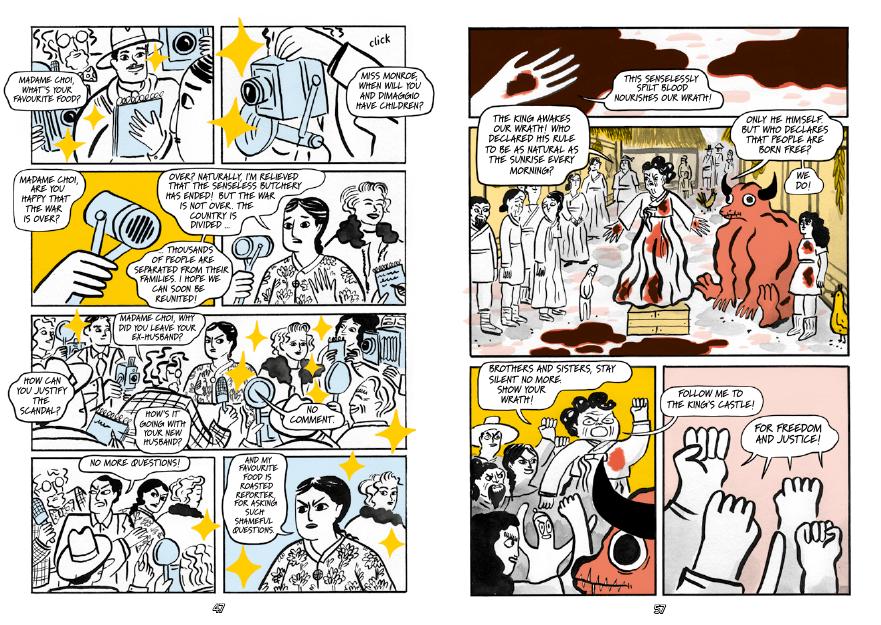
A graphic novel about the true story of Choi Eun-hee, a South Korean actor, and her ex-husband, film director Shin Sang-ok, who were abducted by North Korea in 1978 and forced to make films for Kim Jong-Il until they managed to escape 8 years later. Their story is interwoven with a Korean folktale, which was the basis for a film they made that has never been seen outside North Korea.
In a way I am glad that this book exists because I think that everyone should know the stories of the North Korean abductions, which affected many civilians (South Korean and Japanese) as well as these two famous people. But I didn't think this went into their story particularly profoundly, and I didn't love the drawing style.
84labfs39
>82 wandering_star: Although I like to read about North Korea and I enjoy the occasional graphic novel, I think I'll skip this one. Interesting topic though.
>83 wandering_star: I enjoyed this review. If only I read more and faster, I would look for this. As it is, I would have to dislodge something more pressing.
>83 wandering_star: I enjoyed this review. If only I read more and faster, I would look for this. As it is, I would have to dislodge something more pressing.
85wandering_star
22. The Many Deaths of Laila Starr by Ram V and Filipe Andrade
This graphic novel starts with Death being let go from her job, because a human child has been born who will discover the secret of immortality. People are still dying, but as Brahma tells her when he fires her, it's just prudent planning to restructure the department. Death, in a rage, persuades Agni to help her get reborn near to this child so that she can do away with him. But although as Death she ended lives without a thought, as a mortal she can't do it.
Like many comic books this story has a cyclical format, with Laila Starr dying and being brought back to life by Pranah at the end of each episode. In each of her lives she encounters Darius - the one who will discover immortality - and learns a bit more about humanity.
I really loved this graphic novel, with its swirling, sometimes surreal artwork, its portrait of a diverse and changing Mumbai, and its beautiful and often moving story.
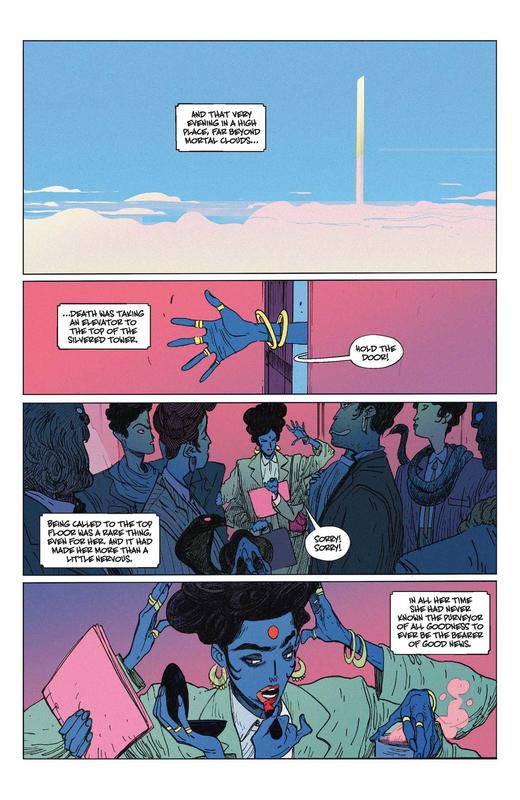
This graphic novel starts with Death being let go from her job, because a human child has been born who will discover the secret of immortality. People are still dying, but as Brahma tells her when he fires her, it's just prudent planning to restructure the department. Death, in a rage, persuades Agni to help her get reborn near to this child so that she can do away with him. But although as Death she ended lives without a thought, as a mortal she can't do it.
Like many comic books this story has a cyclical format, with Laila Starr dying and being brought back to life by Pranah at the end of each episode. In each of her lives she encounters Darius - the one who will discover immortality - and learns a bit more about humanity.
I really loved this graphic novel, with its swirling, sometimes surreal artwork, its portrait of a diverse and changing Mumbai, and its beautiful and often moving story.
86wandering_star
>84 labfs39: Definitely try this one over Madame Choi and the Monsters!
87RidgewayGirl
>83 wandering_star: I liked this book, too. Broccoli Mom was unhinged, that poor baby.
88wandering_star
>87 RidgewayGirl: I know!! I especially liked her reappearance during the pandemic
89raton-liseur
>79 wandering_star: Actually, she says that to the older sister, who is expected to get hold of Darcy's friend, but this is a detail.
I can't imagine my mother saying this to me... But what does it say on how she sees women and their role in society. Sigh...
>85 wandering_star: This is new to me. I'll need to find it and read it!
I can't imagine my mother saying this to me... But what does it say on how she sees women and their role in society. Sigh...
>85 wandering_star: This is new to me. I'll need to find it and read it!
90wandering_star
23. Ai Weiwei: Sunflower Seeds by Juliet Bingham
A library ebook - which consists of a bio (which seems to have been based on internet research), an article about Ai Weiwei, the text of an interview with him, and some of his tweets. You would learn much more about him going to one of his exhibitions, or even doing some internet research yourself.
A library ebook - which consists of a bio (which seems to have been based on internet research), an article about Ai Weiwei, the text of an interview with him, and some of his tweets. You would learn much more about him going to one of his exhibitions, or even doing some internet research yourself.
91wandering_star
24. A Woman in the Polar Night by Christiane Ritter
92wandering_star
25. Departure(s) by Julian Barnes (audiobook, read by the author)
93rasdhar
I really enjoyed catching up on your thread, noting in particular The Many Deaths of Laila Starr. The art looks lovely.
96wandering_star
28. Mrs Dalloway by Virginia Woolf
Some echoes here of what I said about Pride and Prejudice (>72 wandering_star:)! I wasn't actually sure if I'd read Mrs Dalloway before because I know the idea of the story pretty well - having seen the film adaptation, and both read and seen The Hours - not to mention how famous the first line is. I quickly realised, though, that I hadn't - in fact I'm not sure that I've ever read anything that manages stream-of-consciousness in the way it's done here, moving seamlessly from head to head and following someone's flickering thoughts and memories. I also loved how the movement from person to person was echoed by the movement around London - you always know where your characters are and you can visualise the streets or parks they are walking through.
I spent a certain amount of time wondering whether or not Clarissa Dalloway was a sympathetic character, before realising that that's not the point - this book is about observing, and seeing people as they are, with all the contradictions and inconsistencies. It's about a lot of other things too, of course. It's also about the way that people try and shape others, and how damaging this can be. Towards the end I thought about the two characters of Clarissa Dalloway and Septimus Smith as, perhaps, representing two sides of Woolf herself, coming together as she hears about his suicide and feels some sympathy or understanding for what brought him to do it.
And it was awfully strange, he thought, how she still had the power, as she came tinkling, rustling, still had the power as she came across the room, to make the moon, which he detested, rise at Bourton on the terrace in the summer sky.
“Tell me,” he said, seizing her by the shoulders. “Are you happy, Clarissa? Does Richard—”
The door opened.
Some echoes here of what I said about Pride and Prejudice (>72 wandering_star:)! I wasn't actually sure if I'd read Mrs Dalloway before because I know the idea of the story pretty well - having seen the film adaptation, and both read and seen The Hours - not to mention how famous the first line is. I quickly realised, though, that I hadn't - in fact I'm not sure that I've ever read anything that manages stream-of-consciousness in the way it's done here, moving seamlessly from head to head and following someone's flickering thoughts and memories. I also loved how the movement from person to person was echoed by the movement around London - you always know where your characters are and you can visualise the streets or parks they are walking through.
I spent a certain amount of time wondering whether or not Clarissa Dalloway was a sympathetic character, before realising that that's not the point - this book is about observing, and seeing people as they are, with all the contradictions and inconsistencies. It's about a lot of other things too, of course. It's also about the way that people try and shape others, and how damaging this can be. Towards the end I thought about the two characters of Clarissa Dalloway and Septimus Smith as, perhaps, representing two sides of Woolf herself, coming together as she hears about his suicide and feels some sympathy or understanding for what brought him to do it.
And it was awfully strange, he thought, how she still had the power, as she came tinkling, rustling, still had the power as she came across the room, to make the moon, which he detested, rise at Bourton on the terrace in the summer sky.
“Tell me,” he said, seizing her by the shoulders. “Are you happy, Clarissa? Does Richard—”
The door opened.
99wandering_star
31. The Age of Calamities by Senaa Ahmad, another offbeat take on history.
100Dilara86
>98 wandering_star: Wishlisted: it sounds fascinating, and I enjoyed The Employees.
101FlorenceArt
>98 wandering_star: I’ve seen a few reviews of The Wax Child, but yours is the first one that makes me want to read it. Unfortunately I don’t think it has been translated to French yet. I’d like to read The Employees too, but this one, though translated, is not available as an ebook apparently.
>99 wandering_star: This sounds so weird!
>99 wandering_star: This sounds so weird!
102raton-liseur
>99 wandering_star: Not the type of books I would usually pick, but your review makes me consider to read it. Sounds a light and clever read, and I like those to lift my spirit in the gloomy world we live in those days...
103cindydavid4
>99 wandering_star: wow! just sureal enough to be hesitant, the excellent reviews tell me yes!a great book to add to my list thanks for the BB
104wandering_star
It *is* really weird - but somehow it really worked for me. I hope that you all enjoy it!
107rocketjk
>105 wandering_star: I read this book a few years back and enjoyed it. It certainly gives the lie to what us kids in the U.S. were taught about the European explorers "discovering" trade routes and the like. I will say that I didn't feel that the author justified the "globalization began" part of the title, but I wondered whether that was added at the publisher's insistence in order to make the book more "timely." Anyway, yeah, an interesting history that I learned a lot from.
108wandering_star
>107 rocketjk: Yes, that's a good point - the author definitely wants to make the point that there was a lot of trade and exchange before Europeans arrived in different places. So there are some common threads.
110labfs39
>105 wandering_star: >107 rocketjk: It certainly gives the lie to what us kids in the U.S. were taught about the European explorers "discovering" trade routes and the like.
I am only beginning to understand how indoctrinated I was in school as I teach my nieces history now. Sounds like an interesting book, despite it's lack of a coherent theory.
>106 wandering_star: I thoroughly enjoyed reading Pnin several years ago. Since I had only read Lolita up to that point, reading Pnin changed my view of Nabokov too.
I am only beginning to understand how indoctrinated I was in school as I teach my nieces history now. Sounds like an interesting book, despite it's lack of a coherent theory.
>106 wandering_star: I thoroughly enjoyed reading Pnin several years ago. Since I had only read Lolita up to that point, reading Pnin changed my view of Nabokov too.
113FlorenceArt
>111 wandering_star: Sounds interesting! It also reminds me that the French YouTuber Benjamin Brillaud, whose channel Nota Bene I am loosely following, also has a book on the Vikings. Could be fun to compare both approaches.
114wandering_star
>113 FlorenceArt: That does sound interesting - although after the 500-odd pages of this book I don't think I will be reading about Vikings again for a little while!
117labfs39
A series of interesting reviews. Mother Tongue seems similar in construction to Dictionary of Maqiao: using an entry word format to tell a story. A General Theory of Oblivion has been on my radar for a while. I need to read it.
118FlorenceArt
>116 wandering_star: This sounds interesting, but « living on the food she grows on her balcony » might be further than I’m able to go in suspension of disbelief.
119wandering_star
>118 FlorenceArt: Actually this didn't seem to me the most implausible part of the story, not least because it's not painted as an easy existence - Ludo is clearly not well either psychologically or physically. The coincidences which build the network of relationships in the book are (even) more far-fetched, but I forgave them because they were the core of what the book was about - the sense of community from our interdependence on each other, and the diverse history of Angola.
120wandering_star
39. The End of Everything by Megan Abbott
121wandering_star
40. Devotions by Lucy Caldwell
I am certain that I read this because of an LT review. I've read one other book by Caldwell, the novella These Days, which I didn't love - so I would not have picked it up were it not for someone's glowing words. I can't for the life of me find the review though - which is a shame, as I would have liked to thank whoever it was that made the recommendation.
I am certain that I read this because of an LT review. I've read one other book by Caldwell, the novella These Days, which I didn't love - so I would not have picked it up were it not for someone's glowing words. I can't for the life of me find the review though - which is a shame, as I would have liked to thank whoever it was that made the recommendation.
122kidzdoc
>121 wandering_star: This sounds interesting. It isn't available in my local libraries, but I'll keep an eye out for it, as I downloaded a free sample of it onto my Kindle.
123wandering_star
>122 kidzdoc: Caldwell has written several other short story collections, so you might be able to find one of those - they are now very much on my wishlist.
129labfs39
>128 Nickelini: Agreed
130rasdhar
Just catching up on your thread and I've bookmarked several after reading your thoughtful reviews! Particularly noted Devotions by Lucy Caldwell.
131Dilara86
>127 wandering_star: What a shame that the book was disappointing. The premise sounded interesting.

