1lilisin
I think I can say that 2025 was a pretty good reading year. There were lots of good classics, both new to me and familiar. I actually reread some books for the first time which was a great experience and will allow me to continue with their corresponding series in 2026. I cleared out a lot of TBR books without purchasing too many new books leading to a TBR pile under 200 volumes. A huge part of the TBR cleanout was reading in French where thanks to reading 19 books I brought my French language TBR from 110 books to 96!
I also stopped a rule made long ago about how I only wanted to read one book by author per year as this way I could "savor" an author's works for longer. I came to realize this was ridiculous (could you imagine if I did that with manga series?!) and at this rate it could take me up to 40 years to read an author's body of work depending on their rate of writing. Savoring a book now means reading whatever I want when I want even if that means reading 10 books by an author in one year. There are no rules!
This year I want to keep devouring classics like I have been doing. I want to read mostly from my TBR pile as I have also been doing. I want to keep reading plays, and keep reading manga, and just read everything all the time everywhere. If I could cut out the idle weekend time and read a book like I want to that would just be fantastic. Two years ago I felt like I was constantly reading and thus was tired, but 2025 I felt like I always wanted to read more and I want to keep that energy up. There is too much to explore in this world and it's never enough. I want to explore more! Of course I also want to get back to reading more consistently in Japanese so I'm going to work on finding a way to make that happen.
Also I really need to buy a new bookcase.
In any case, I'm looking forward to reading more and interacting more with everyone here!
Let's go!
Books read in 2026:
1) Emile Zola : Une page d'amour (A Love Story)
2) Richard Lloyd Parry : In the Time of Madness: Indonesia on the Edge of Chaos
3) Le japon et ses morts: Ces voix qui nous viennent de la mer
4) Victor Hugo : Hernani
5) Leo Tolstoy : Resurrection
6) Henri Troyat : Le geste d'Eve
7) John Wyndham : The Kraken Wakes
8) Jules Verne : Le docteur Ox (A Fantasy of Dr. Ox)
9) Hideo Yokoyama : Six Four
10) Isabella Lucy Bird : The Golden Chersonese and The Way Thither
11) Jean Racine : Andromaque
12) Emile Zola : Le ventre de Paris (The Belly of Paris)
13) 三崎 亜記 : となり町戦争
14) Sandrine Collette : Six fourmis blanches
15) Gustave Flaubert : Madame Bovary
16) 坂本 湾 : BoxBoxBoxBox
17) Leonora Miano : L'intérieur de la nuit (Dark Heart of the Night)
18) Isabella Lucy Bird : Among the Tibetans
19) Edgar Allan Poe : The Fall of the House of Usher
20) Jean Reverzy : Le Passage
21) Jules Verne : Michel Strogoff
22) Emile Zola : La Joie de vivre (The Joy of Life)
23) E.M. Forster : A Room with a View
24) 松永K三蔵 : バリ山行
Manga read in 2026:
模型の町
よつばと! 16
さよならフットボール 1-2
Detective Conan 104-105
Books read in 2025 - 2024 - 2023 - 2022 - 2021 - 2020 - 2019 - 2018 - 2017 - 2016 - 2015 - 2014 - 2013 - 2012 - 2011 - 2010 - 2009
I also stopped a rule made long ago about how I only wanted to read one book by author per year as this way I could "savor" an author's works for longer. I came to realize this was ridiculous (could you imagine if I did that with manga series?!) and at this rate it could take me up to 40 years to read an author's body of work depending on their rate of writing. Savoring a book now means reading whatever I want when I want even if that means reading 10 books by an author in one year. There are no rules!
This year I want to keep devouring classics like I have been doing. I want to read mostly from my TBR pile as I have also been doing. I want to keep reading plays, and keep reading manga, and just read everything all the time everywhere. If I could cut out the idle weekend time and read a book like I want to that would just be fantastic. Two years ago I felt like I was constantly reading and thus was tired, but 2025 I felt like I always wanted to read more and I want to keep that energy up. There is too much to explore in this world and it's never enough. I want to explore more! Of course I also want to get back to reading more consistently in Japanese so I'm going to work on finding a way to make that happen.
Also I really need to buy a new bookcase.
In any case, I'm looking forward to reading more and interacting more with everyone here!
Let's go!
Books read in 2026:
1) Emile Zola : Une page d'amour (A Love Story)
2) Richard Lloyd Parry : In the Time of Madness: Indonesia on the Edge of Chaos
3) Le japon et ses morts: Ces voix qui nous viennent de la mer
4) Victor Hugo : Hernani
5) Leo Tolstoy : Resurrection
6) Henri Troyat : Le geste d'Eve
7) John Wyndham : The Kraken Wakes
8) Jules Verne : Le docteur Ox (A Fantasy of Dr. Ox)
9) Hideo Yokoyama : Six Four
10) Isabella Lucy Bird : The Golden Chersonese and The Way Thither
11) Jean Racine : Andromaque
12) Emile Zola : Le ventre de Paris (The Belly of Paris)
13) 三崎 亜記 : となり町戦争
14) Sandrine Collette : Six fourmis blanches
15) Gustave Flaubert : Madame Bovary
16) 坂本 湾 : BoxBoxBoxBox
17) Leonora Miano : L'intérieur de la nuit (Dark Heart of the Night)
18) Isabella Lucy Bird : Among the Tibetans
19) Edgar Allan Poe : The Fall of the House of Usher
20) Jean Reverzy : Le Passage
21) Jules Verne : Michel Strogoff
22) Emile Zola : La Joie de vivre (The Joy of Life)
23) E.M. Forster : A Room with a View
24) 松永K三蔵 : バリ山行
Manga read in 2026:
模型の町
よつばと! 16
さよならフットボール 1-2
Detective Conan 104-105
Books read in 2025 - 2024 - 2023 - 2022 - 2021 - 2020 - 2019 - 2018 - 2017 - 2016 - 2015 - 2014 - 2013 - 2012 - 2011 - 2010 - 2009
2lilisin
My purchasing was quite reasonable in 2025 and in fact, my restraint with purchasing manga was flat out amazing. I'm looking forward to clearing out more of the TBR before the annual big summer book sale.
TBR at beginning of year:
Spanish 3
Japanese 33
French 96
English 59
Total 191
Books acquired in 2026:
Brian P. Farrell : The Defence And Fall Of Singapore
Alexander V. Pantsov : Deng Xiaoping: A Revolutionary Life
Amanda Lee Koe : Sister Snake
坂本 湾 : BoxBoxBoxBox
駒沢 敏器 : 語るに足る、ささやかな人生
James A. Michener : Sayonara
H. Rider Haggard : Allan Quatermain
Isabella Lucy Bird : A Lady's Life in the Rocky Mountains
Mary Shelley : The Last Man
Iris Murdoch : The Bell
A. J. Cronin : Les vertes années
Antoine de Saint-Exupéry : Courrier du sud
Jean Cocteau : Thomas l'imposteur
Simone de Beauvoir : Les Mandarins, tome 1
Simone de Beauvoir : Les mandarins, tome 2
Roger Martin du Gard : Les Thibault, tome 1
Roger Martin du Gard : Les Thibault, tome 2
Roger Martin du Gard : Les Thibault, tome 3
C. S. Lewis : The Lion, the Witch and the Wardrobe
C. S. Lewis : Prince Caspian
C. S. Lewis : The Voyage of the Dawn Treader
C. S. Lewis : The Silver Chair
C. S. Lewis : The Horse and His Boy
C. S. Lewis : The Magician's Nephew
C. S. Lewis : The Last Battle
James Baldwin : Giovanni's Room
Upton Sinclair : The Jungle
Cormac McCarthy : Outer Dark
William Golding : The Inheritors
James Donovan : The Blood of Heroes: The 13-Day Struggle for the Alamo--and the Sacrifice That Forged a Nation
Tom Clavin : The First to Go West: American Ambition, Bloody Conquest, and the Fateful Journey of Jedediah Smith
Philip K. Dick : Time Out Of Joint
Philip K. Dick : Clans of the Alphane Moon
Manga acquired in 2026:
商店街のあゆみ
キャプテン翼 ワールドユース編 1-18
TBR at beginning of year:
Spanish 3
Japanese 33
French 96
English 59
Total 191
Books acquired in 2026:
Brian P. Farrell : The Defence And Fall Of Singapore
Alexander V. Pantsov : Deng Xiaoping: A Revolutionary Life
Amanda Lee Koe : Sister Snake
駒沢 敏器 : 語るに足る、ささやかな人生
James A. Michener : Sayonara
H. Rider Haggard : Allan Quatermain
Isabella Lucy Bird : A Lady's Life in the Rocky Mountains
Mary Shelley : The Last Man
Iris Murdoch : The Bell
A. J. Cronin : Les vertes années
Antoine de Saint-Exupéry : Courrier du sud
Jean Cocteau : Thomas l'imposteur
Simone de Beauvoir : Les Mandarins, tome 1
Simone de Beauvoir : Les mandarins, tome 2
Roger Martin du Gard : Les Thibault, tome 1
Roger Martin du Gard : Les Thibault, tome 2
Roger Martin du Gard : Les Thibault, tome 3
C. S. Lewis : The Lion, the Witch and the Wardrobe
C. S. Lewis : Prince Caspian
C. S. Lewis : The Voyage of the Dawn Treader
C. S. Lewis : The Silver Chair
C. S. Lewis : The Horse and His Boy
C. S. Lewis : The Magician's Nephew
C. S. Lewis : The Last Battle
James Baldwin : Giovanni's Room
Upton Sinclair : The Jungle
Cormac McCarthy : Outer Dark
William Golding : The Inheritors
James Donovan : The Blood of Heroes: The 13-Day Struggle for the Alamo--and the Sacrifice That Forged a Nation
Tom Clavin : The First to Go West: American Ambition, Bloody Conquest, and the Fateful Journey of Jedediah Smith
Philip K. Dick : Time Out Of Joint
Philip K. Dick : Clans of the Alphane Moon
Manga acquired in 2026:
商店街のあゆみ
キャプテン翼 ワールドユース編 1-18
3lilisin
Continuing with my French play reading journey, this post helps me keep track of what I've read and own to make sure I don't accidentally purchase duplicates.
Read:
Pierre Corneille : Le Cid
Victor Hugo : Lucrèce Borgia
Victor Hugo : Ruy Blas
Victor Hugo : Hernani
Eugène Ionesco : Le Roi se meurt
Molière : Dom Juan
Molière : Le Bourgeois Gentilhomme
Molière : Le Malade imaginaire
Jean Racine : Andromaque
Edmond Rostand : Cyrano de Bergerac
TBR:
Beaumarchais : Le Barbier de Séville
Beaumarchais : Mariage de Figaro
Beaumarchais : La Mère coupable
Read:
Pierre Corneille : Le Cid
Victor Hugo : Lucrèce Borgia
Victor Hugo : Ruy Blas
Victor Hugo : Hernani
Eugène Ionesco : Le Roi se meurt
Molière : Dom Juan
Molière : Le Bourgeois Gentilhomme
Molière : Le Malade imaginaire
Jean Racine : Andromaque
Edmond Rostand : Cyrano de Bergerac
TBR:
Beaumarchais : Le Barbier de Séville
Beaumarchais : Mariage de Figaro
Beaumarchais : La Mère coupable
4edwinbcn
>3 lilisin:
Wow. Reading all those plays. I can remember being very in to reading plays when I was a student, but these days I no longer do, and have even thrown out many books with plays I still had, including many of the French plays listed above. I wonder if I could ever get back into reading that.
Wow. Reading all those plays. I can remember being very in to reading plays when I was a student, but these days I no longer do, and have even thrown out many books with plays I still had, including many of the French plays listed above. I wonder if I could ever get back into reading that.
5Dilara86
>3 lilisin: So you'll be reading Beaumarchais's whole Figaro trilogy this year? This reminds me that I meant to reread Le mariage de Figaro. I studied it at school and hated it, but after listening to Juliette Arnaud's take on it on France Inter last year, I thought I'd try again. (She drew parallels between its plot and the #MeToo movement - spoilers abound, but surely, that is allowed when talking about a 18th-century play and famous opera).
6labfs39
>2 lilisin: Congrats on a good reading year and welcome back. I am making note of : Deng Xiaoping: A Revolutionary Life. I'll look forward to your comments when you get to it.
7rasdhar
Happy New Year! As someone who is very curious about manga but hasn't really gotten into it, I'm looking forward to seeing what you read this year. Will you be listening to/watching the operas for all the Beaumarchais plays as well?
8lilisin
>4 edwinbcn:
Thanks everyone for the well wishes. The plays listed are just what are on my physical TBR and are not a specific plan in terms of being read this year. However, I did pull out Hernani this morning to hopefully read over the weekend.
>5 Dilara86:
Although I'm not super sensitive to spoilers I do think it's best to avoid mentioning them no matter how old a work is. People are born every second and so there will always be new people being introduced to works of art. I surprisingly enough realize I have no idea what Le mariage de Figaro is about despite knowing some of its famous opera pieces so I look forward to discovering the piece with no previous influence.
>7 rasdhar:
Despite playing the violin and thus playing classical music myself, I must admit that there are three classical genres that put me to sleep: piano solos, ballet pieces, and operas. The virtuosity involved in all three of these is awe-inspiring, but I can never make it past the first act without falling asleep.
Thanks everyone for the well wishes. The plays listed are just what are on my physical TBR and are not a specific plan in terms of being read this year. However, I did pull out Hernani this morning to hopefully read over the weekend.
>5 Dilara86:
Although I'm not super sensitive to spoilers I do think it's best to avoid mentioning them no matter how old a work is. People are born every second and so there will always be new people being introduced to works of art. I surprisingly enough realize I have no idea what Le mariage de Figaro is about despite knowing some of its famous opera pieces so I look forward to discovering the piece with no previous influence.
>7 rasdhar:
Despite playing the violin and thus playing classical music myself, I must admit that there are three classical genres that put me to sleep: piano solos, ballet pieces, and operas. The virtuosity involved in all three of these is awe-inspiring, but I can never make it past the first act without falling asleep.
9lilisin
1) Emile Zola : Une page d'amour (A Love Story)
Continuing on my Zola journey, this is the 10th book of the Rougon-Macquart cycle in the recommended chronological order.
Zola starts the book with a preface giving "the people what they want", which is a family tree. He was initially going to publish it at the very end of the cycle, but he kept getting pressured to publish it, and he also wanted to shut up all who wouldn't believed that he had the whole cycle planned out. Good for him is all I can say, although that family tree is so out of focus I don't know who could actual read it.
Full spoilers ahead.
We are taken back to Paris and follow Helene Mouret, the daughter of Ursula Macquart and the hat-maker Mouret. Upon her return to Paris, her husband dies, leaving her as a widow at a young age with a young daughter who suffers of convulsions. The story begins with her young daughter Jeanne having a seizure fit, and Helene knocking on the doors of doctors to help where she ends up knocking on the door of a young doctor named le docteur Deberle.
In this book Zola is here to show us the hypocricy at every level of society, using Helene as the anchor. She is used by the wealthy and successful young doctor who has amorous ambitions unto her despite having a wife; she is used by a poor woman, la mere Fetu, who exagerates her poverty to gain the pity of Helene; she is used by her good friend the Abbe as he uses the opportunity to set up a marriage between her and his brother, Monsieur Rambaud; she is manipulated into staying home by her daughter's clinginess. Despite Helene's attempt to stay within the confines of her apartment, she is is attacked by all sides by a society that knows only how to tear others apart for personal gain. It's quite a tragic tale when you think about it.
However, the one part about this book that I hated was Jeanne, the daughter's character. I really couldn't stand her and her brattyness. It was obvious she was going to die and I couldn't help waiting for it to come.
Otherwise, another solid Zola.
---
Some quotes I picked up because just like his preface, it seems Zola was talking to the audience a few times within the book.
pg 18
— Laissez donc! c'est répugnant de réalisme.
Alors, on discuta. Réalisme était bien vite dit. Mais le jeune homme ne voulait pas du tout du réalisme.
pg 41
Comme ces romans mentaient! Elle avait bien raison de ne jamais en lire. C'étaient des fables bonnes pour les têtes vides, qui n'ont point le sentiment exact de la vie.
pg 142
Cependant, dans le groupe de femmes où trônait Malignon, on causait littérature: madame Tissot déclarait Balzac illisible; il ne disait pas non, seulement il faisait remarquer que Balzac avait, de loin en loin, une page bien écrite.
Continuing on my Zola journey, this is the 10th book of the Rougon-Macquart cycle in the recommended chronological order.
Zola starts the book with a preface giving "the people what they want", which is a family tree. He was initially going to publish it at the very end of the cycle, but he kept getting pressured to publish it, and he also wanted to shut up all who wouldn't believed that he had the whole cycle planned out. Good for him is all I can say, although that family tree is so out of focus I don't know who could actual read it.
Full spoilers ahead.
We are taken back to Paris and follow Helene Mouret, the daughter of Ursula Macquart and the hat-maker Mouret. Upon her return to Paris, her husband dies, leaving her as a widow at a young age with a young daughter who suffers of convulsions. The story begins with her young daughter Jeanne having a seizure fit, and Helene knocking on the doors of doctors to help where she ends up knocking on the door of a young doctor named le docteur Deberle.
In this book Zola is here to show us the hypocricy at every level of society, using Helene as the anchor. She is used by the wealthy and successful young doctor who has amorous ambitions unto her despite having a wife; she is used by a poor woman, la mere Fetu, who exagerates her poverty to gain the pity of Helene; she is used by her good friend the Abbe as he uses the opportunity to set up a marriage between her and his brother, Monsieur Rambaud; she is manipulated into staying home by her daughter's clinginess. Despite Helene's attempt to stay within the confines of her apartment, she is is attacked by all sides by a society that knows only how to tear others apart for personal gain. It's quite a tragic tale when you think about it.
However, the one part about this book that I hated was Jeanne, the daughter's character. I really couldn't stand her and her brattyness. It was obvious she was going to die and I couldn't help waiting for it to come.
Otherwise, another solid Zola.
---
Some quotes I picked up because just like his preface, it seems Zola was talking to the audience a few times within the book.
pg 18
— Laissez donc! c'est répugnant de réalisme.
Alors, on discuta. Réalisme était bien vite dit. Mais le jeune homme ne voulait pas du tout du réalisme.
pg 41
Comme ces romans mentaient! Elle avait bien raison de ne jamais en lire. C'étaient des fables bonnes pour les têtes vides, qui n'ont point le sentiment exact de la vie.
pg 142
Cependant, dans le groupe de femmes où trônait Malignon, on causait littérature: madame Tissot déclarait Balzac illisible; il ne disait pas non, seulement il faisait remarquer que Balzac avait, de loin en loin, une page bien écrite.
10lilisin
I am currently reading Resurrection by Tolstoy and need a place for all the quotes I'm pulling. Compared to the quotes I pulled from AK or WandP, the passages that I find interesting in this book are much longer so I have to refrain myself from marking everything down. So these are just a few pages that I find resume the book quite well. I'm pulling quotes from Project Gutenberg so page count will not match my physical book but I have marked the chapters for reference.
PART 1
Chp 8, pg 39
Then God’s world seemed a mystery which he tried enthusiastically and joyfully to solve; now everything in life seemed clear and simple, defined by the conditions of the life he was leading. Then he had felt the importance of, and had need of intercourse with, nature,and with those who had lived and thought and felt before him—philosophers and poets. What he now considered necessary and important were human institutions and intercourse with his comrades. Then women seemed mysterious and charming— charming by the very mystery that enveloped them; now the purpose of women, all women except those of his own family and the wives of his friends, was a very definite one: women were the best means towards an already experienced enjoyment.
Chp 37, pg 101-102
Beginning from that dreadful night, she ceased believing in God and in goodness. She had herself believed in God, and believed that other people also believed in Him; but after that night she became convinced that no one believed, and that all that was said about God and His laws was deception and untruth. He whom she loved, and who had loved her—yes, she knew that—had thrown her away; had abused her love. Yet he was the best of all the people she knew. All the rest were still worse. All that afterwards happened to her strengthened her in this belief at every step. His aunts, the pious old ladies, turned her out when she could no longer serve them as she used to. And of all those she met, the women used her as a means of getting money, the men, from the old police officer down to the warders of the prison, looked at her as on an object for pleasure. And no one in the world cared for aught but pleasure. In this belief the old author with whom she had come together in the second year of her life of independence had strengthened her. He had told her outright that it was this that constituted the happiness of life, and he called it poetical and aesthetic.
Everybody lived for himself only, for his pleasure, and all the talk concerning God and righteousness was deception. And if sometimes doubts arose in her mind and she wondered why everything was so ill-arranged in the world that all hurt each other, and made each other suffer, she thought it best not to dwell on it, and if she felt melancholy she could smoke, or, better still, drink, and it would pass.
Chp 40, pg 106-107
The priest did his part with a quiet conscience, because he was brought up from childhood to consider that the only true faith was the faith which had been held by all the holy men of olden times and was still held by the Church, and demanded by the State authorities. He did not believe that the bread turned into flesh, that it was useful for the soul to repeat so many words, or that he had actually swallowed a bit of God. No one could believe this, but he believed that one ought to hold this faith. What strengthened him most in this faith was the fact that, for fulfilling the demands of this faith, he had for the last 15 years been able to draw an income, which enabled him to keep his family, send his son to a gymnasium and his daughter to a school for the daughters of the clergy. The deacon believed in the same manner, and even more firmly than the priest, for he had forgotten the substance of the dogmas of this faith, and knew only that th eprayers for the dead, the masses, with and without the acathistus, all had a definite price, which real Christians readily paid, and, therefore, he called out his “have mercy, have mercy,” very willingly, and read and said what was appointed, with the same quiet certainty of its being necessary to do so with which other men sell faggots, flour, or potatoes. The prison inspector and the warders, though they had never understood or gone into the meaning of these dogmas and of all that went on in church, believed that they must believe, because the higher authorities and the Tsar himself believed in it. Besides, though faintly (and themselves unable to explain why), they felt that this faith defended their cruel occupations. If this faith did not exist it would have been more difficult, perhaps impossible, for them to use all their powers to torment people, as they were now doing, with a quiet conscience. The inspector was such a kind-hearted man that he could not have lived as he was now living unsupported by his faith. Therefore, he stood motionless, bowed and crossed himself zealously, tried to feel touched when the song about the cherubims was being sung, and when the children received communion he lifted one of them, and held him up to the priest with his own hands.
The great majority of the prisoners believed that there lay a mystic power in these gilt images, these vestments, candles, cups, crosses, and this repetition of incomprehensible words, “Jesu sweetest” and “have mercy”—a power through which might be obtained much convenience in this and in the future life. Only a few clearly saw the deception tha twas practised on the people who adhered to this faith, and laughed at it in their hearts; but the majority, having made several attempts to get the conveniences they desired, by means of prayers, masses, and candles, and not having got them (their prayers remaining unanswered), were each of them convinced that their want of success was accidental, and that this organisation, approved by the educated and by archbishops, is very important and necessary, if not for this, at any rate for the next life.
Chp 44, pg 116-117
What astonished him most was that Katusha was not ashamed of her position—not the position of a prisoner (she was ashamed of that), but her position as a prostitute. She seemed satisfied, even proud of it. And, yet, how could it be otherwise? Everybody, in order to be able to act, has to consider his occupation important and good. Therefore, in whatever position a person is, he is certain to form such a view of the life of men in general which will make his occupation seem important and good.
It is usually imagined that a thief, a murderer, a spy, a prostitute, acknowledging his or her profession as evil, is ashamed of it. But the contrary is true. People whom fate and their sin-mistakes have placed in a certain position, however false that position may be, form a view of life in general which makes their position seem good and admissible. In order to keep up their view of life, these people instinctively keep to the circle of those people who share their views of life and their own place in it. This surprises us, where the persons concerned are thieves, bragging about their dexterity, prostitutes vaunting their depravity, or murderers boasting of their cruelty. This surprises us only because the circle, the atmosphere in which these people live, is limited, and we are outside it. But can we not observe the same phenomenon when the rich boast of their wealth, i.e., robbery; the commanders in the army pride themselves on victories, i.e., murder; and those in high places vaunt their power, i.e., violence? We do not see the perversion in the views of life held by these people, only because the circle formed by them is more extensive, and we ourselves are moving inside of it.
PART 1
Chp 8, pg 39
Then God’s world seemed a mystery which he tried enthusiastically and joyfully to solve; now everything in life seemed clear and simple, defined by the conditions of the life he was leading. Then he had felt the importance of, and had need of intercourse with, nature,and with those who had lived and thought and felt before him—philosophers and poets. What he now considered necessary and important were human institutions and intercourse with his comrades. Then women seemed mysterious and charming— charming by the very mystery that enveloped them; now the purpose of women, all women except those of his own family and the wives of his friends, was a very definite one: women were the best means towards an already experienced enjoyment.
Chp 37, pg 101-102
Beginning from that dreadful night, she ceased believing in God and in goodness. She had herself believed in God, and believed that other people also believed in Him; but after that night she became convinced that no one believed, and that all that was said about God and His laws was deception and untruth. He whom she loved, and who had loved her—yes, she knew that—had thrown her away; had abused her love. Yet he was the best of all the people she knew. All the rest were still worse. All that afterwards happened to her strengthened her in this belief at every step. His aunts, the pious old ladies, turned her out when she could no longer serve them as she used to. And of all those she met, the women used her as a means of getting money, the men, from the old police officer down to the warders of the prison, looked at her as on an object for pleasure. And no one in the world cared for aught but pleasure. In this belief the old author with whom she had come together in the second year of her life of independence had strengthened her. He had told her outright that it was this that constituted the happiness of life, and he called it poetical and aesthetic.
Everybody lived for himself only, for his pleasure, and all the talk concerning God and righteousness was deception. And if sometimes doubts arose in her mind and she wondered why everything was so ill-arranged in the world that all hurt each other, and made each other suffer, she thought it best not to dwell on it, and if she felt melancholy she could smoke, or, better still, drink, and it would pass.
Chp 40, pg 106-107
The priest did his part with a quiet conscience, because he was brought up from childhood to consider that the only true faith was the faith which had been held by all the holy men of olden times and was still held by the Church, and demanded by the State authorities. He did not believe that the bread turned into flesh, that it was useful for the soul to repeat so many words, or that he had actually swallowed a bit of God. No one could believe this, but he believed that one ought to hold this faith. What strengthened him most in this faith was the fact that, for fulfilling the demands of this faith, he had for the last 15 years been able to draw an income, which enabled him to keep his family, send his son to a gymnasium and his daughter to a school for the daughters of the clergy. The deacon believed in the same manner, and even more firmly than the priest, for he had forgotten the substance of the dogmas of this faith, and knew only that th eprayers for the dead, the masses, with and without the acathistus, all had a definite price, which real Christians readily paid, and, therefore, he called out his “have mercy, have mercy,” very willingly, and read and said what was appointed, with the same quiet certainty of its being necessary to do so with which other men sell faggots, flour, or potatoes. The prison inspector and the warders, though they had never understood or gone into the meaning of these dogmas and of all that went on in church, believed that they must believe, because the higher authorities and the Tsar himself believed in it. Besides, though faintly (and themselves unable to explain why), they felt that this faith defended their cruel occupations. If this faith did not exist it would have been more difficult, perhaps impossible, for them to use all their powers to torment people, as they were now doing, with a quiet conscience. The inspector was such a kind-hearted man that he could not have lived as he was now living unsupported by his faith. Therefore, he stood motionless, bowed and crossed himself zealously, tried to feel touched when the song about the cherubims was being sung, and when the children received communion he lifted one of them, and held him up to the priest with his own hands.
The great majority of the prisoners believed that there lay a mystic power in these gilt images, these vestments, candles, cups, crosses, and this repetition of incomprehensible words, “Jesu sweetest” and “have mercy”—a power through which might be obtained much convenience in this and in the future life. Only a few clearly saw the deception tha twas practised on the people who adhered to this faith, and laughed at it in their hearts; but the majority, having made several attempts to get the conveniences they desired, by means of prayers, masses, and candles, and not having got them (their prayers remaining unanswered), were each of them convinced that their want of success was accidental, and that this organisation, approved by the educated and by archbishops, is very important and necessary, if not for this, at any rate for the next life.
Chp 44, pg 116-117
What astonished him most was that Katusha was not ashamed of her position—not the position of a prisoner (she was ashamed of that), but her position as a prostitute. She seemed satisfied, even proud of it. And, yet, how could it be otherwise? Everybody, in order to be able to act, has to consider his occupation important and good. Therefore, in whatever position a person is, he is certain to form such a view of the life of men in general which will make his occupation seem important and good.
It is usually imagined that a thief, a murderer, a spy, a prostitute, acknowledging his or her profession as evil, is ashamed of it. But the contrary is true. People whom fate and their sin-mistakes have placed in a certain position, however false that position may be, form a view of life in general which makes their position seem good and admissible. In order to keep up their view of life, these people instinctively keep to the circle of those people who share their views of life and their own place in it. This surprises us, where the persons concerned are thieves, bragging about their dexterity, prostitutes vaunting their depravity, or murderers boasting of their cruelty. This surprises us only because the circle, the atmosphere in which these people live, is limited, and we are outside it. But can we not observe the same phenomenon when the rich boast of their wealth, i.e., robbery; the commanders in the army pride themselves on victories, i.e., murder; and those in high places vaunt their power, i.e., violence? We do not see the perversion in the views of life held by these people, only because the circle formed by them is more extensive, and we ourselves are moving inside of it.
11dchaikin
>9 lilisin: more Zola. I got scared off by your spoiler warning, and i can’t read the quotes, but interesting about his feeling the need to prove he has a cycle worked out
>10 lilisin: enjoy Tolstoy
>10 lilisin: enjoy Tolstoy
12lilisin
4) Victor Hugo : Hernani
First play of the year and I went with this love adventure story: a five act play where three men fight for one woman, Dona Sol, but her love belongs to Hernani, a bandit. The two remaining suitors, King Carlos, the future emperor, and Don Ruy Gomez are determined to steal her away but gentleman honor and codes makes things difficult.
A fun play but I can't imagine it being performed what with the incredibly long monologues. It makes sense that many were shortened for actual production.
In any case, I really do like a good rhyme.
First play of the year and I went with this love adventure story: a five act play where three men fight for one woman, Dona Sol, but her love belongs to Hernani, a bandit. The two remaining suitors, King Carlos, the future emperor, and Don Ruy Gomez are determined to steal her away but gentleman honor and codes makes things difficult.
A fun play but I can't imagine it being performed what with the incredibly long monologues. It makes sense that many were shortened for actual production.
In any case, I really do like a good rhyme.
13SassyLassy
>9 lilisin: >10 lilisin: >12 lilisin: Loving your nineteenth century reading.
>9 lilisin: I thought A Love Story worked really well too. How difficult it was to maintain that facade of respectability, and Zola works through the pitfalls of trying to accommodate everyone except yourself beautifully. I definitely have to agree with you about Jeanne!
>9 lilisin: I thought A Love Story worked really well too. How difficult it was to maintain that facade of respectability, and Zola works through the pitfalls of trying to accommodate everyone except yourself beautifully. I definitely have to agree with you about Jeanne!
14baswood
My LibraryThing library tells me that I read Resurrection some 12 years ago. I thought it was very interesting and eminently quotable.
15lilisin
Continuing my reading of Tolstoy's Resurrection, here are the quotes and passages I've pulled from Part 2.
PART 2
Chp 6, pg 168
It was quite evident that all the misery of the people or, at least by far the greater part of it, was caused by the fact that the land which should feed them was not in their hands, but in the hands of those who, profiting by their rights to the land, live by the work of these people. The land so much needed by men was tilled by these people, who were on the verge of starvation, so that the corn might be sold abroad and the owners of the land might buy themselves hats and canes, and carriages and bronzes.
Chp 15, pg 193-194
Count Ivan Michaelovitch lived and acted according to these lights for 40 years, and at the end of 40 years reached the position of a Minister of State. The chief qualities that enabled Count Ivan Michaelovitch to reach this position were his capacity of understanding the meaning of documents and laws and of drawing up, though clumsily, intelligible State papers, and of spelling them correctly; secondly, his very stately appearance, which enabled him, when necessary, to seem not only extremely proud, but unapproachable and majestic, while at other times he could be abjectly and almost passionately servile; thirdly, the absence of any general principles or rules, either of personal or administrative morality, which made it possible for him either to agree or disagree with anybody according towhat was wanted at the time. When acting thus his only endeavour was to sustain the appearance of good breeding and not to seem too plainly inconsistent. As for his actions being moral or not, in themselves, or whether they were going to result in the highest welfare or greatest evil for the whole of the Russian Empire, or even the entire world, that was quite indiff erentto him. When he became minister, not only those dependent on him (and there were great many of them) and people connected with him, but many strangers and even he himself were convinced that he was a very clever statesman. But after some time had elapsed and he had done nothing and had nothing to show, and when in accordance with the law of the struggle for existence others, like himself, who had learnt to write and understand documents, stately and unprincipled officials, had displaced him, he turned out to be not only far from clever but very limited and badly educated. Though self-assured, his views hardly reaching the level of those in the leading articles of the Conservative papers, it became apparent that there was nothing in him to distinguish him from those other badly-educated and self-assured officials who had pushed him out, and he himself saw it. But this did not shake his conviction that he had to receive a great deal of money out of the Treasury every year, and new decorations for his dress clothes. This conviction was so firm that no one had the pluck to refuse these things to him, and he received yearly, partly in form of a pension, partly as a salary for being a member in a Government institution and chairman of all sorts of committees and councils, several tens of thousands of roubles, besides the right—highly prized by him—of sewing all sorts of new cords to his shoulders and trousers, and ribbons to wear under and enamel stars to fix on to his dress coat.
Chp 19, pg 207
"All these people are most immoral. We know them,” he said, in a tone that admitted no possibility of doubt. And he did not doubt, not because the thing was so, but because if it was not so, he would have to admit himself to be not a noble hero living out the last days of a good life, but a scoundrel, who sold, and still continued in his old age to sell, his conscience."
Chp 24, pg 217
The advocate began another story about a swindle, and all sorts of crimes committed by persons in high places, who, instead of being in prison, sat on presidential chairs in all sorts of Government institutions.
Chp 27, pg 229-230
Nekhludoff clearly saw that all these people were arrested, locked up, exiled, not really because they transgressed against justice or behaved unlawfully, but only because they were an obstacle hindering the officials and the rich from enjoying the property they had taken away from the people.
....
Gentlemen who sat at the tables in the Ministry Office, were not at all troubled by the fact that that in such a state of things the innocent had to suffer, but were only concerned how to get rid of the really dangerous, so that the rule that ten guilty should escape rather than that one innocent should be condemned was not observed, but, on the contrary, for the sake of getting rid of one really dangerous person, ten who seemed dangerous were punished, as, when cutting a rotten piece out of anything, one has to cut away some that is good.
Chp 30, pg 238
The fifth class consisted of persons who had been far more sinned against by society than they had sinned against it. These were castaways, stupefied by continual oppression and temptation, such as the boy who had stolen the rugs, and hundreds of others whom Nekhludoff had seen in the prison and out of it. The conditions under which they lived seemed to lead on systematically to those actions which are termed crimes.
Chp 33, pg 247
“As if justice were the aim of the law,” said Nekhludoff.
“What else?”
“The upholding of class interests! I think the law is only an instrument for upholding the existing order of things beneficial to our class.”
Chp 40, pg 268
No one is guilty, and yet the men have been murdered by these people who are not guilty of their murder.
“All this comes,” Nekhludoff thought, “from the fact that all these people, governors, inspectors, police officers, and men, consider that there are circumstances in which human relations are not necessary between human beings. All these men, Maslennikoff, and the inspector, and the convoy officer, if they were not governor, inspector, officer, would have considered twenty times before sending people in such heat in such a mass— would have stopped twenty times on the way, and, seeing that a man was growing weak, gasping for breath, would have led him into the shade, would have given him water and let him rest, and if an accident had still occurred they would have expressed pity. But they not only did not do it, but hindered others from doing it, because they considered not men and their duty towards them but only the office they themselves filled, and held what that office demanded of them to be above human relations. That’s what it is,” Nekhludoff went on in his thoughts. “If one acknowledges but for a single hour that anything can be more important than love for one’s fellowmen, even in some one exceptional case, any crime can be committed without a feeling of guilt.”
PART 2
Chp 6, pg 168
It was quite evident that all the misery of the people or, at least by far the greater part of it, was caused by the fact that the land which should feed them was not in their hands, but in the hands of those who, profiting by their rights to the land, live by the work of these people. The land so much needed by men was tilled by these people, who were on the verge of starvation, so that the corn might be sold abroad and the owners of the land might buy themselves hats and canes, and carriages and bronzes.
Chp 15, pg 193-194
Count Ivan Michaelovitch lived and acted according to these lights for 40 years, and at the end of 40 years reached the position of a Minister of State. The chief qualities that enabled Count Ivan Michaelovitch to reach this position were his capacity of understanding the meaning of documents and laws and of drawing up, though clumsily, intelligible State papers, and of spelling them correctly; secondly, his very stately appearance, which enabled him, when necessary, to seem not only extremely proud, but unapproachable and majestic, while at other times he could be abjectly and almost passionately servile; thirdly, the absence of any general principles or rules, either of personal or administrative morality, which made it possible for him either to agree or disagree with anybody according towhat was wanted at the time. When acting thus his only endeavour was to sustain the appearance of good breeding and not to seem too plainly inconsistent. As for his actions being moral or not, in themselves, or whether they were going to result in the highest welfare or greatest evil for the whole of the Russian Empire, or even the entire world, that was quite indiff erentto him. When he became minister, not only those dependent on him (and there were great many of them) and people connected with him, but many strangers and even he himself were convinced that he was a very clever statesman. But after some time had elapsed and he had done nothing and had nothing to show, and when in accordance with the law of the struggle for existence others, like himself, who had learnt to write and understand documents, stately and unprincipled officials, had displaced him, he turned out to be not only far from clever but very limited and badly educated. Though self-assured, his views hardly reaching the level of those in the leading articles of the Conservative papers, it became apparent that there was nothing in him to distinguish him from those other badly-educated and self-assured officials who had pushed him out, and he himself saw it. But this did not shake his conviction that he had to receive a great deal of money out of the Treasury every year, and new decorations for his dress clothes. This conviction was so firm that no one had the pluck to refuse these things to him, and he received yearly, partly in form of a pension, partly as a salary for being a member in a Government institution and chairman of all sorts of committees and councils, several tens of thousands of roubles, besides the right—highly prized by him—of sewing all sorts of new cords to his shoulders and trousers, and ribbons to wear under and enamel stars to fix on to his dress coat.
Chp 19, pg 207
"All these people are most immoral. We know them,” he said, in a tone that admitted no possibility of doubt. And he did not doubt, not because the thing was so, but because if it was not so, he would have to admit himself to be not a noble hero living out the last days of a good life, but a scoundrel, who sold, and still continued in his old age to sell, his conscience."
Chp 24, pg 217
The advocate began another story about a swindle, and all sorts of crimes committed by persons in high places, who, instead of being in prison, sat on presidential chairs in all sorts of Government institutions.
Chp 27, pg 229-230
Nekhludoff clearly saw that all these people were arrested, locked up, exiled, not really because they transgressed against justice or behaved unlawfully, but only because they were an obstacle hindering the officials and the rich from enjoying the property they had taken away from the people.
....
Gentlemen who sat at the tables in the Ministry Office, were not at all troubled by the fact that that in such a state of things the innocent had to suffer, but were only concerned how to get rid of the really dangerous, so that the rule that ten guilty should escape rather than that one innocent should be condemned was not observed, but, on the contrary, for the sake of getting rid of one really dangerous person, ten who seemed dangerous were punished, as, when cutting a rotten piece out of anything, one has to cut away some that is good.
Chp 30, pg 238
The fifth class consisted of persons who had been far more sinned against by society than they had sinned against it. These were castaways, stupefied by continual oppression and temptation, such as the boy who had stolen the rugs, and hundreds of others whom Nekhludoff had seen in the prison and out of it. The conditions under which they lived seemed to lead on systematically to those actions which are termed crimes.
Chp 33, pg 247
“As if justice were the aim of the law,” said Nekhludoff.
“What else?”
“The upholding of class interests! I think the law is only an instrument for upholding the existing order of things beneficial to our class.”
Chp 40, pg 268
No one is guilty, and yet the men have been murdered by these people who are not guilty of their murder.
“All this comes,” Nekhludoff thought, “from the fact that all these people, governors, inspectors, police officers, and men, consider that there are circumstances in which human relations are not necessary between human beings. All these men, Maslennikoff, and the inspector, and the convoy officer, if they were not governor, inspector, officer, would have considered twenty times before sending people in such heat in such a mass— would have stopped twenty times on the way, and, seeing that a man was growing weak, gasping for breath, would have led him into the shade, would have given him water and let him rest, and if an accident had still occurred they would have expressed pity. But they not only did not do it, but hindered others from doing it, because they considered not men and their duty towards them but only the office they themselves filled, and held what that office demanded of them to be above human relations. That’s what it is,” Nekhludoff went on in his thoughts. “If one acknowledges but for a single hour that anything can be more important than love for one’s fellowmen, even in some one exceptional case, any crime can be committed without a feeling of guilt.”
16lilisin
Finished Tolstoy's Resurrection so here are some quotes from the finale, Part 3.
PART 3
Chp 19, pg 315
“Just as if a problem had been set to find the best, the surest means of depraving the greatest number of persons,” thought Nekhludoff.
Ordinary, simple men with a conception of the demands of the social and Christian Russian peasant morality lost this conception, and found a new one, founded chiefly on the idea that any outrage or violence was justifiable if it seemed profitable. After living in a prison those people became conscious with the whole of their being that, judging by what was happening to themselves, all the moral laws, the respect and the sympathy for others which church and the moral teachers preach, was really set aside, and that, therefore, they, too, need not keep the laws.
Chp 21, pg 321
“I wonder you should care to talk to him, sir,” said the driver, when Nekhludoff , having tipped the bowing ferryman, got into the cart again. “He is just a worthless tramp.”
Chp 28, pg 337
It became clear to him that all the dreadful evil he had been witnessing in prisons and jails and the quiet self-satisfaction of the perpetrators of this evil were the consequences of men trying to do what was impossible; trying to correct evil while being evil themselves; vicious men were trying to correct other vicious men, and thought they could do it by using mechanical means, and the only consequence of all this was that the needs and the cupidity of some men induced them to take up this so-called punishment and correction as a profession, and have themselves become utterly corrupt, and go on unceasingly depraving those whom they torment. Now he saw clearly what all the terrors he had seen came from, and what ought to be done to put a stop to them. The answer he could not find was the same that Christ gave to Peter. It was that we should forgive always an infinite number of times because there are no men who have not sinned themselves, and therefore none can punish or correct others.
PART 3
Chp 19, pg 315
“Just as if a problem had been set to find the best, the surest means of depraving the greatest number of persons,” thought Nekhludoff.
Ordinary, simple men with a conception of the demands of the social and Christian Russian peasant morality lost this conception, and found a new one, founded chiefly on the idea that any outrage or violence was justifiable if it seemed profitable. After living in a prison those people became conscious with the whole of their being that, judging by what was happening to themselves, all the moral laws, the respect and the sympathy for others which church and the moral teachers preach, was really set aside, and that, therefore, they, too, need not keep the laws.
Chp 21, pg 321
“I wonder you should care to talk to him, sir,” said the driver, when Nekhludoff , having tipped the bowing ferryman, got into the cart again. “He is just a worthless tramp.”
Chp 28, pg 337
It became clear to him that all the dreadful evil he had been witnessing in prisons and jails and the quiet self-satisfaction of the perpetrators of this evil were the consequences of men trying to do what was impossible; trying to correct evil while being evil themselves; vicious men were trying to correct other vicious men, and thought they could do it by using mechanical means, and the only consequence of all this was that the needs and the cupidity of some men induced them to take up this so-called punishment and correction as a profession, and have themselves become utterly corrupt, and go on unceasingly depraving those whom they torment. Now he saw clearly what all the terrors he had seen came from, and what ought to be done to put a stop to them. The answer he could not find was the same that Christ gave to Peter. It was that we should forgive always an infinite number of times because there are no men who have not sinned themselves, and therefore none can punish or correct others.
17lilisin
5) Leo Tolstoy : Resurrection
Another fascinating Tolstoy; this time with Tolstoy exploring the results of class disparity and systematic poverty on the punishment of criminals, therefore, the prison system.
The story starts when our main character, the well-off Prince Nekhludoff has been called for jury duty. The criminal being processed in his case is a prostitute named Katerina Maslova, accused, along with two others, of the poisoning and murder of a man who had used her services. She is deemed innocent by the jury of murder but they fumble their job, accidently leaving out a part of their declaration, and as a result, the innocent Maslova is punished to hard labor and exile in Siberia. Nekhludoff, declares himself responsible for her fate, not just as a member of the failed jury, but also because he feels he is at fault for her being in her situation (as a prostitute). For she used to be a servant for his family and when they were young they had fallen for each other. But upon forcing himself upon her, he panics, gives her 100 roubles 'for her troubles' and leaves. She is left pregnant, is forced out of her job and home and this is what causes the beginning of her path into prostitution. To repent for his sins, Nekludoff takes it upon himself to get her sentence repealed. With his new task, he discovers a new purpose in life as he witnesses the shortcomings of the judicial system and the depravity of the prison system firsthand.
There are two aspects to this story, the injustice of the judicial system and class disparity, but these are very much interlinked with one another. Nekhludoff finds that the only thing that separates criminals from regular men (which in his case, are the 'respectable gentlemen' in his class) is that the upper class are the law makers while the criminals are those that are required to follow that law, thus when a law is broken the upper class is called on to punish those who broke the law. But when the upper class breaks the law, they just rename it something else and are forgiven punishment. Instead they are even praised for breaking the law. As Tolstoy states in chapter 44, part 1:
It is usually imagined that a thief, a murderer, a spy, a prostitute, acknowledging his or her profession as evil, is ashamed of it. But the contrary is true. People whom fate and their sin-mistakes have placed in a certain position, however false that position may be, form a view of life in general which makes their position seem good and admissible. In order to keep up their view of life, these people instinctively keep to the circle of those people who share their views of life and their own place in it. This surprises us, where the persons concerned are thieves, bragging about their dexterity, prostitutes vaunting their depravity, or murderers boasting of their cruelty. This surprises us only because the circle, the atmosphere in which these people live, is limited, and we are outside it. But can we not observe the same phenomenon when the rich boast of their wealth, i.e., robbery; the commanders in the army pride themselves on victories, i.e., murder; and those in high places vaunt their power, i.e., violence? We do not see the perversion in the views of life held by these people, only because the circle formed by them is more extensive, and we ourselves are moving inside of it.
There is a quite famous discussion that often occurs on social media; the discussion is based off the question 'What is considered tacky if you're poor, but classy if you are rich?' Common answers are as such:
Living in a hotel (can't afford/kicked out of a home vs. can afford traveling the world in hotels)
Day drinking alcohol (5 mimosas during Sunday brunch? Classy, definitely not veiled alcoholism)
Getting money from the government
Owning an old car
Having a lawyer on speed dial
And my personal favorite: speaking another language.
It's exactly what Tolstoy is writing about. Then you combine all of this with this class disparity causing systematic poverty and as a result causing crime. When a rich man owns all the land, collects all the rent, and is in a position to elect himself on every board and gain a substantial salary, he can finely dine with his wife and children, upholster the salon chairs with the finest fabric, feed his mistress bonbons and chocolates, while wearing the finest costumes for himself. In the meantime, all those that serve him are paid the bare minimum, eat potatoes and porridge, and must fix the holes in the clothes to push them through another year of wear. So it is of no surprise that someone in such poverty might need to take extra wood from the forest on their landlord's property, or put a potato or two in their pockets. Then the rich can accuse them of theft, put them through the prison system, and pat themselves on the back for being upright citizens of the law.
All of this is explored by Tolstoy via Nekhludoff and it makes for a fantastic read. While it doesn't explore the type of emotions as found in Anna Karenina, it's a great look at the absurdities of man. Really enjoyed this one.
Another fascinating Tolstoy; this time with Tolstoy exploring the results of class disparity and systematic poverty on the punishment of criminals, therefore, the prison system.
The story starts when our main character, the well-off Prince Nekhludoff has been called for jury duty. The criminal being processed in his case is a prostitute named Katerina Maslova, accused, along with two others, of the poisoning and murder of a man who had used her services. She is deemed innocent by the jury of murder but they fumble their job, accidently leaving out a part of their declaration, and as a result, the innocent Maslova is punished to hard labor and exile in Siberia. Nekhludoff, declares himself responsible for her fate, not just as a member of the failed jury, but also because he feels he is at fault for her being in her situation (as a prostitute). For she used to be a servant for his family and when they were young they had fallen for each other. But upon forcing himself upon her, he panics, gives her 100 roubles 'for her troubles' and leaves. She is left pregnant, is forced out of her job and home and this is what causes the beginning of her path into prostitution. To repent for his sins, Nekludoff takes it upon himself to get her sentence repealed. With his new task, he discovers a new purpose in life as he witnesses the shortcomings of the judicial system and the depravity of the prison system firsthand.
There are two aspects to this story, the injustice of the judicial system and class disparity, but these are very much interlinked with one another. Nekhludoff finds that the only thing that separates criminals from regular men (which in his case, are the 'respectable gentlemen' in his class) is that the upper class are the law makers while the criminals are those that are required to follow that law, thus when a law is broken the upper class is called on to punish those who broke the law. But when the upper class breaks the law, they just rename it something else and are forgiven punishment. Instead they are even praised for breaking the law. As Tolstoy states in chapter 44, part 1:
It is usually imagined that a thief, a murderer, a spy, a prostitute, acknowledging his or her profession as evil, is ashamed of it. But the contrary is true. People whom fate and their sin-mistakes have placed in a certain position, however false that position may be, form a view of life in general which makes their position seem good and admissible. In order to keep up their view of life, these people instinctively keep to the circle of those people who share their views of life and their own place in it. This surprises us, where the persons concerned are thieves, bragging about their dexterity, prostitutes vaunting their depravity, or murderers boasting of their cruelty. This surprises us only because the circle, the atmosphere in which these people live, is limited, and we are outside it. But can we not observe the same phenomenon when the rich boast of their wealth, i.e., robbery; the commanders in the army pride themselves on victories, i.e., murder; and those in high places vaunt their power, i.e., violence? We do not see the perversion in the views of life held by these people, only because the circle formed by them is more extensive, and we ourselves are moving inside of it.
There is a quite famous discussion that often occurs on social media; the discussion is based off the question 'What is considered tacky if you're poor, but classy if you are rich?' Common answers are as such:
Living in a hotel (can't afford/kicked out of a home vs. can afford traveling the world in hotels)
Day drinking alcohol (5 mimosas during Sunday brunch? Classy, definitely not veiled alcoholism)
Getting money from the government
Owning an old car
Having a lawyer on speed dial
And my personal favorite: speaking another language.
It's exactly what Tolstoy is writing about. Then you combine all of this with this class disparity causing systematic poverty and as a result causing crime. When a rich man owns all the land, collects all the rent, and is in a position to elect himself on every board and gain a substantial salary, he can finely dine with his wife and children, upholster the salon chairs with the finest fabric, feed his mistress bonbons and chocolates, while wearing the finest costumes for himself. In the meantime, all those that serve him are paid the bare minimum, eat potatoes and porridge, and must fix the holes in the clothes to push them through another year of wear. So it is of no surprise that someone in such poverty might need to take extra wood from the forest on their landlord's property, or put a potato or two in their pockets. Then the rich can accuse them of theft, put them through the prison system, and pat themselves on the back for being upright citizens of the law.
All of this is explored by Tolstoy via Nekhludoff and it makes for a fantastic read. While it doesn't explore the type of emotions as found in Anna Karenina, it's a great look at the absurdities of man. Really enjoyed this one.
18lilisin
People often ask me about the manga I read and also what manga I'd recommend to someone trying to get into the genre. Now manga itself isn't a genre, it's a medium upon which there are many genres: sports manga, fantasy manga, alternate universe manga, girls romance manga, gay manga, etc. So it's hard to recommend something without knowing someone's preferences. But I do know of one manga artist I would recommend to any and all and I've discovered that despite what I thought, there are actually a few English translations of their work available so I wanted to recommend it here.
That artist is called panpanya and they are the most amazing artist and storyteller. You can think of their manga like a collection of short stories. The stories are not interconnected but they share the same characters. The main character is a young girl who is exploring her world as a child amongst the adult world. Each story she goes on a new adventure, or ponders a situation she has come up with, or explores the answer to a question she has.
Panpanya takes us into a world of fantasty and nostalgia and whimsy with an exquisite mastery of art. The scenery around our young protagonist is painstakingly drawn yet she is drawn with just a light flick of a pencil to separate her viewpoint of the world from the real world. To further separate her world as child from that world which belongs to adults, all adult characters are drawn with amphibious, amorphous characteristics, adding to the whimsy of the work.
It leads to the most charming, humorous, whimsical work ever and thus it is panpanya I would recommend to all.
I have read two that haven't been translated yet: 模型の町 (Model Town) and 二匹目の金魚 (The Second Goldfish).
The works that have been translated into English are: An Invitation from a Crab, Ashizuri Aquarium, and Guyabano Holiday.
Panpanya has also been translated into French, Italian, and Korean. And by now there are probably more languages that I'm not aware of.
Examples of panpanya's exquisite art and storytelling from 'An Invitation from a Crab' is as below:

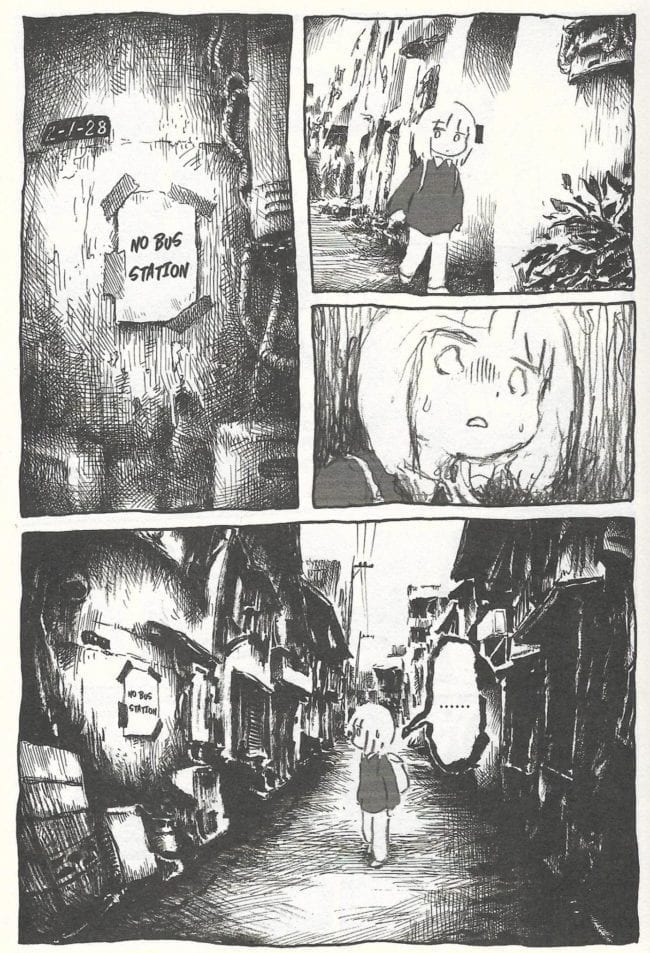

That artist is called panpanya and they are the most amazing artist and storyteller. You can think of their manga like a collection of short stories. The stories are not interconnected but they share the same characters. The main character is a young girl who is exploring her world as a child amongst the adult world. Each story she goes on a new adventure, or ponders a situation she has come up with, or explores the answer to a question she has.
Panpanya takes us into a world of fantasty and nostalgia and whimsy with an exquisite mastery of art. The scenery around our young protagonist is painstakingly drawn yet she is drawn with just a light flick of a pencil to separate her viewpoint of the world from the real world. To further separate her world as child from that world which belongs to adults, all adult characters are drawn with amphibious, amorphous characteristics, adding to the whimsy of the work.
It leads to the most charming, humorous, whimsical work ever and thus it is panpanya I would recommend to all.
I have read two that haven't been translated yet: 模型の町 (Model Town) and 二匹目の金魚 (The Second Goldfish).
The works that have been translated into English are: An Invitation from a Crab, Ashizuri Aquarium, and Guyabano Holiday.
Panpanya has also been translated into French, Italian, and Korean. And by now there are probably more languages that I'm not aware of.
Examples of panpanya's exquisite art and storytelling from 'An Invitation from a Crab' is as below:


19stretch
>18 lilisin: That is beautiful art work and sounds perfect to digest more of the whimsical side of Japanese storytelling.
20raton-liseur
>17 lilisin: Great review, about a book I had not noticed before!
I makes me think about Crime and Punishment. Am I right to make such a connection?
I makes me think about Crime and Punishment. Am I right to make such a connection?
21baswood
You have certainly nailed Resurrection
There is also some wonderful descriptive writing of his journey. I am a succour for train journey's even the desperate one that Nekhludoff made.
There is also some wonderful descriptive writing of his journey. I am a succour for train journey's even the desperate one that Nekhludoff made.
22lilisin
>19 stretch:
Panpanya is also great to pick up when wanting to read something calm and beautiful in troubling times.
>20 raton-liseur:
I read CandP too long ago to be able to say confidently but upon refreshing my memory via wikipedia, although exploring the same environment, I would say the themes aren't exactly the same, or rather, aren't tackled the same. But I think they'd make for amazing comparative reads.
Panpanya is also great to pick up when wanting to read something calm and beautiful in troubling times.
>20 raton-liseur:
I read CandP too long ago to be able to say confidently but upon refreshing my memory via wikipedia, although exploring the same environment, I would say the themes aren't exactly the same, or rather, aren't tackled the same. But I think they'd make for amazing comparative reads.
23lilisin
6) Henri Troyat : Le geste d'Eve
Needing some smooth, buttery reading to calm me I chose to pick up this collection of short stories by an author I very much enjoy. He was incredibly prolific, having written about 100 fiction novels at about a book per year publishing rate, but strangely enough is known more for his nonfiction which I have never read. In any case, I also had never read any of his short stories so this was an interesting new adventure.
The books I've read so far by Troyat usually focus on a problematic relationship with a melancholy feel: brothers, father-son, professor-student. We continue the theme of melancholy and characters with real problems. This time we have for example a woman looking for a husband, a man who doesn't understand the difference between solitude and loneliness, a woman who prioritizes relationships with animals over men. Troyat then has put a magical realism twist to each: nothing too fantastical but just enough absurdity to add a folk-tale esque spin to all the stories.
I really enjoyed myself with all of the stories but the last one, which ironically gives its title to the collection and of which I found forgettable.
To summarize all the stories:
1) Les mains
- an ordinary woman found a job in a manicurist's shop with a goal to finding a husband amongst the rich and classy clientele and stumbles on a man out of the ordinary
2) Le carnet vert
- a man finds a green address book with 4000 francs and decides to keep the money. Spending the money on a vacation with his family he reads the classifieds and discovers the owner is offering 6000 francs for the return of the book. With this conundrum and as each day passes the owner increases the reward for the return of the book, our narrator obsesses over the idea that there must be a way to extort more money but now suddenly the owner is taking away the rewards bit by bit
3) Le meilleur client
- a man enters a shop to purchase a funerary crown dedicated to every male relation possible (husband, son, grandfather, cousin, etc); the shopowner suspects something terrible and decides to take it upon herself to figure out what is up his sleeve
4) Le retour de Versailles
- a couple go to an auction with the intent of buying a wardrobe and a painting; the husband is caught in a bidding frenzy with an old couple and must now live with his choice
5) Bouboule
- a woman obsessed with the welfare of animals gets called upon when her neighbor's dog gets is injured in an accident
6) Vue imprenable
- a man who hates people decides to spends his weekend in a house in the middle of the Fontainebleu woods but a mysterious intruder is threatening his peace
7) Faux marbre
- a man forced by his father to stop painting and instead inherit the family business, but when he later rediscovers painting he discovers that his spirit has turned to stone
8) Le diable emporte Pierre
- a group of villagers pull a prank on a local man, snatching him and covering his face while chanting that the devil has come to get him, but when the next day the local man doesn't show up, the villagers start to wonder what could have happened to him
9) Le geste d'Eve
- due to a strike a CEO is forced to take to metro to work instead of his usual chauffered car; there he meets Eve, a ticket puncher, whom he becomes infatuated with
Needing some smooth, buttery reading to calm me I chose to pick up this collection of short stories by an author I very much enjoy. He was incredibly prolific, having written about 100 fiction novels at about a book per year publishing rate, but strangely enough is known more for his nonfiction which I have never read. In any case, I also had never read any of his short stories so this was an interesting new adventure.
The books I've read so far by Troyat usually focus on a problematic relationship with a melancholy feel: brothers, father-son, professor-student. We continue the theme of melancholy and characters with real problems. This time we have for example a woman looking for a husband, a man who doesn't understand the difference between solitude and loneliness, a woman who prioritizes relationships with animals over men. Troyat then has put a magical realism twist to each: nothing too fantastical but just enough absurdity to add a folk-tale esque spin to all the stories.
I really enjoyed myself with all of the stories but the last one, which ironically gives its title to the collection and of which I found forgettable.
To summarize all the stories:
1) Les mains
- an ordinary woman found a job in a manicurist's shop with a goal to finding a husband amongst the rich and classy clientele and stumbles on a man out of the ordinary
2) Le carnet vert
- a man finds a green address book with 4000 francs and decides to keep the money. Spending the money on a vacation with his family he reads the classifieds and discovers the owner is offering 6000 francs for the return of the book. With this conundrum and as each day passes the owner increases the reward for the return of the book, our narrator obsesses over the idea that there must be a way to extort more money but now suddenly the owner is taking away the rewards bit by bit
3) Le meilleur client
- a man enters a shop to purchase a funerary crown dedicated to every male relation possible (husband, son, grandfather, cousin, etc); the shopowner suspects something terrible and decides to take it upon herself to figure out what is up his sleeve
4) Le retour de Versailles
- a couple go to an auction with the intent of buying a wardrobe and a painting; the husband is caught in a bidding frenzy with an old couple and must now live with his choice
5) Bouboule
- a woman obsessed with the welfare of animals gets called upon when her neighbor's dog gets is injured in an accident
6) Vue imprenable
- a man who hates people decides to spends his weekend in a house in the middle of the Fontainebleu woods but a mysterious intruder is threatening his peace
7) Faux marbre
- a man forced by his father to stop painting and instead inherit the family business, but when he later rediscovers painting he discovers that his spirit has turned to stone
8) Le diable emporte Pierre
- a group of villagers pull a prank on a local man, snatching him and covering his face while chanting that the devil has come to get him, but when the next day the local man doesn't show up, the villagers start to wonder what could have happened to him
9) Le geste d'Eve
- due to a strike a CEO is forced to take to metro to work instead of his usual chauffered car; there he meets Eve, a ticket puncher, whom he becomes infatuated with
24VladysKovsky
>17 lilisin: That's a great analysis of the book! I will read it at some point. Tolstoy himself called War and Peace and Anna Karenina as good novels but not true to life. He would have preferred to be known by his later works.
25raton-liseur
>22 lilisin: Thanks for that. I've read Crime and Punishment quite a long time ago as well, so I would not be able to make comparative reads... This book by Tolstoy seems really interesting, despite not being as famous as some of his other works. I think I'll try to find it in a second hand bookshop!
26lilisin
8) Jules Verne : Le docteur Ox (A Fantasy of Dr. Ox)
My 18th Verne work read but my first collection of his short stories. My particular mass market paperback had the following stories included:
Une fantaisie du Docteur Ox
- this story was absolutely hilarious, I loved it so much. A small Flemish village called Quiquendone is known for its lackadaisical nature: the scene opens on the mayor and his conselor discussing terminating the role of the commisary stating that taxes are wasted on his salary, however we discover this conversation has been going on for 10 years already and finally they decide only to decide on deciding at a later date; three hour operas take two weeks to perform as everything must be slowed down for the pace of the people; couples take ten years before getting married. It's truly a tranquil life until Dr Ox comes into town to 'fix things'. The experiment he's running leads to chaos as suddenly the villagers come to life at a frenetic pace leading to the funniest Verne work yet.
Maître Zacharius
- about a famous watch maker whose watches suddently stop working; this story was written way before Verne started his adventure series and you can tell; lacks strong characters but you can see early attempts at story development
Un drame dans les airs
- much of the story you will see fragments that were used in his ballooning tales later on but the story itself lacks structure and personality.
Un hivernage dans les glaces
- a dramatic sea rescue that takes place in the harsh climate of Greenland, this book has Verne experimenting with plot and adventure and it leads to a well paced story although still not as polished as his later works.
Reading this collection on Project Gutenberg also includes this nonfiction work written by his brother Paul Verne about his ascent of Mont Blanc.
Quarantième Ascension française au mont Blanc
- Paul Verne describes his ascent of Mont Blanc and we discover that Jules is not the only one with a writing talent; lovely descriptions and perfect retelling that allows for a great imagining of his adventure. As someone who also is very familiar with that area and the mountains that surround having spent every summer there growing up, and still goes now, there was an extra layer of entertainment
My 18th Verne work read but my first collection of his short stories. My particular mass market paperback had the following stories included:
Une fantaisie du Docteur Ox
- this story was absolutely hilarious, I loved it so much. A small Flemish village called Quiquendone is known for its lackadaisical nature: the scene opens on the mayor and his conselor discussing terminating the role of the commisary stating that taxes are wasted on his salary, however we discover this conversation has been going on for 10 years already and finally they decide only to decide on deciding at a later date; three hour operas take two weeks to perform as everything must be slowed down for the pace of the people; couples take ten years before getting married. It's truly a tranquil life until Dr Ox comes into town to 'fix things'. The experiment he's running leads to chaos as suddenly the villagers come to life at a frenetic pace leading to the funniest Verne work yet.
Maître Zacharius
- about a famous watch maker whose watches suddently stop working; this story was written way before Verne started his adventure series and you can tell; lacks strong characters but you can see early attempts at story development
Un drame dans les airs
- much of the story you will see fragments that were used in his ballooning tales later on but the story itself lacks structure and personality.
Un hivernage dans les glaces
- a dramatic sea rescue that takes place in the harsh climate of Greenland, this book has Verne experimenting with plot and adventure and it leads to a well paced story although still not as polished as his later works.
Reading this collection on Project Gutenberg also includes this nonfiction work written by his brother Paul Verne about his ascent of Mont Blanc.
Quarantième Ascension française au mont Blanc
- Paul Verne describes his ascent of Mont Blanc and we discover that Jules is not the only one with a writing talent; lovely descriptions and perfect retelling that allows for a great imagining of his adventure. As someone who also is very familiar with that area and the mountains that surround having spent every summer there growing up, and still goes now, there was an extra layer of entertainment
27baswood
>26 lilisin: yes that is a good collection
28lilisin
With my grandmother's passing I stopped reading entirely and when I was ready to ease in, I decided that instead of picking up the books I had left off, I'd pick up something new but still with an author I'm familiar with and know will make me want to turn the page. And that worked.
14) Sandrine Collette : Six fourmis blanches
Told from two perspectives: Lou, and Mathias.
Lou is on an amateur hikers trip with her boyfriend and another trio, led by their guide, Vigan, when a snowstorm hits and chaos ensues.
Mathias is a well respected member of a town that still believes in the spirits and superstitions of the mountain. He is a goat sacrificer, hired when good fortune is needed at weddings, baptisms, births, etc. However, the local mafia-esque man forces his nephew onto Mathias to take as a protege and now Mathias is on the run.
The story is quite simple as we follow these two perspectives, waiting for them to converge. Unlike her previous books I've read, this time the author is not making any particular social statement nor is the plot as daring as her previous works, but her writing is stable and strong enough, and it was just what I needed at the moment, although I don't think anyone needs to rush to get this one.
14) Sandrine Collette : Six fourmis blanches
Told from two perspectives: Lou, and Mathias.
Lou is on an amateur hikers trip with her boyfriend and another trio, led by their guide, Vigan, when a snowstorm hits and chaos ensues.
Mathias is a well respected member of a town that still believes in the spirits and superstitions of the mountain. He is a goat sacrificer, hired when good fortune is needed at weddings, baptisms, births, etc. However, the local mafia-esque man forces his nephew onto Mathias to take as a protege and now Mathias is on the run.
The story is quite simple as we follow these two perspectives, waiting for them to converge. Unlike her previous books I've read, this time the author is not making any particular social statement nor is the plot as daring as her previous works, but her writing is stable and strong enough, and it was just what I needed at the moment, although I don't think anyone needs to rush to get this one.
29labfs39
My condolences on your grandmother's passing, Lilisin. I'm glad you have found something to read that worked for you. Take care
30lilisin
19) Edgar Allan Poe : The Fall of the House of Usher
I read this story as it is on the list for 1001 Books to Read Before you Die list and I thought it'd be a perfect palate cleanser -- and I was right! I haven't read Poe since middle school when every American student (well, maybe not these days) reads The Raven.
This particular short story, at 26 pages, has our narrator meeting a childhood friend, Usher, who is concerned about his sister's health. Upon entering Usher's mansion, the atmosphere is thick and grim, and full of foreboding. Indeed, Usher's sister dies and our narrator helps burying her, but Usher is now haunted by her presence.
The gothic vibes were immaculate and Poe's writing is phenomenal and I am now eager to read him more deliberately now.
I read this story as it is on the list for 1001 Books to Read Before you Die list and I thought it'd be a perfect palate cleanser -- and I was right! I haven't read Poe since middle school when every American student (well, maybe not these days) reads The Raven.
This particular short story, at 26 pages, has our narrator meeting a childhood friend, Usher, who is concerned about his sister's health. Upon entering Usher's mansion, the atmosphere is thick and grim, and full of foreboding. Indeed, Usher's sister dies and our narrator helps burying her, but Usher is now haunted by her presence.
The gothic vibes were immaculate and Poe's writing is phenomenal and I am now eager to read him more deliberately now.
31lilisin
15) Gustave Flaubert : Madame Bovary
I have finally scratched off this major French classic and I must admit that I was not enamored by it. Although a lot happens, at the base of it all, Madame Bovary is about a woman who marries too young, before having experienced any life, and thus lives a life of listlessness, ennui, and regret. While she tries at first to play the dutiful wife and subdue her whims, she eventually caves into them with affairs and little prudence towards spending her husband's money.
While the plot is excellent, and the impact of the book, historically, is undeniable, I found that my personal issue was with Flaubert's writing style. I found he lacks the ability of scene setting as mastered by Zola, is not as capable at writing Madame Bovary's character as he is with his male characters, and I found his transition between scenes and characters choppy.
Madame Bovary in some ways reminded me of Anna Karenina but Tolstoy was in full control of his work.
The idea of the novel ended up being stronger than the novel itself.
So while I'm glad to have read this work, and I could see myself even rereading it one day to see if my experience changes, I just don't find it as memorable as the other French masters and I will not be rushing to pick up another Flaubert.
I have finally scratched off this major French classic and I must admit that I was not enamored by it. Although a lot happens, at the base of it all, Madame Bovary is about a woman who marries too young, before having experienced any life, and thus lives a life of listlessness, ennui, and regret. While she tries at first to play the dutiful wife and subdue her whims, she eventually caves into them with affairs and little prudence towards spending her husband's money.
While the plot is excellent, and the impact of the book, historically, is undeniable, I found that my personal issue was with Flaubert's writing style. I found he lacks the ability of scene setting as mastered by Zola, is not as capable at writing Madame Bovary's character as he is with his male characters, and I found his transition between scenes and characters choppy.
Madame Bovary in some ways reminded me of Anna Karenina but Tolstoy was in full control of his work.
The idea of the novel ended up being stronger than the novel itself.
So while I'm glad to have read this work, and I could see myself even rereading it one day to see if my experience changes, I just don't find it as memorable as the other French masters and I will not be rushing to pick up another Flaubert.
32labfs39
>31 lilisin: I enjoyed your thoughts on Madame Bovary. I read it thirty years ago, so my impressions are dated, but I remember thinking it didn't hold up to Anna Karenina either. I've been intending to read Père Goriot for decades, but it remains unread.
33SassyLassy
>31 lilisin: Interesting comments. You make me think I should reread Madame Bovary to see what I think of it now, years after my initial read, which was in French for a translation course. Having read the Rougon Macquart series now, and with a fairly recent reread of Anna Karenina, it may be a good time, and as an added bonus, there won't be any course anxiety.
>32 labfs39: I did like Père Griot. rebeccanyc didn't like it as much. I wonder where you would fall.
>32 labfs39: I did like Père Griot. rebeccanyc didn't like it as much. I wonder where you would fall.
34lilisin
I'm back from my trip to Texas and NYC and am ready to report my haul. I was actually hoping to buy more but my wishlist contained too many obscure titles and so I couldn't find them in used or new stores. Also didn't discover any gems this time around, my haul containing mostly authors I'm already familiar with or had always had plans to acquire.
I actually ended up doing a lot of "shopping" from my mom's shelves. I picked up the following books in French.
A. J. Cronin : Les vertes années
Antoine de Saint-Exupéry : Courrier du sud
- I was very pleased by the Cronin I read last year and had told myself I'd read more of his works; I should read him in the original English but this one we have in French so I went with it; Saint-Exupery I like to visit every once in a while so thought I'd read another of his semi-autobiographical works.
Jean Cocteau : Thomas l'imposteur
Simone de Beauvoir : Les Mandarins, tome 1
Simone de Beauvoir : Les mandarins, tome 2
Roger Martin du Gard : Les Thibault, tome 1
Roger Martin du Gard : Les Thibault, tome 3
Roger Martin du Gard : Les Thibault, tome 2
- Two major works that my mom has been trying to get me to read for ages, and a book by Jean Cocteau, a name every French person knows but this will be my first time reading one of his works
C. S. Lewis : The Lion, the Witch and the Wardrobe
C. S. Lewis : Prince Caspian
C. S. Lewis : The Voyage of the Dawn Treader
C. S. Lewis : The Silver Chair
C. S. Lewis : The Horse and His Boy
C. S. Lewis : The Magician's Nephew
C. S. Lewis : The Last Battle
- I've had this idea for a while that I'd like to read the entire Narnia series as I've only actually read the Wardrobe, so I finally grabbed this off the shelf in my childhood bedroom
James Baldwin : Giovanni's Room
Upton Sinclair : The Jungle
Cormac McCarthy : Outer Dark
William Golding : The Inheritors
Mary Shelley : The Last Man
H. Rider Haggard : Allan Quatermain
- authors I've read from before and am exploring more of their works; the Haggard I was fortunate to get my hands on; it's a rough copy but I'm so in love with it and need more of his works.
Iris Murdoch : The Bell
- I've been wanting to introduce myself to Murdoch for a while and the blurb on this one was exactly what I wanted
James Donovan : The Blood of Heroes: The 13-Day Struggle for the Alamo--and the Sacrifice That Forged a Nation
Tom Clavin : The First to Go West: American Ambition, Bloody Conquest, and the Fateful Journey of Jedediah Smith
- the only nonfiction I purchased; I really expected to buy so much nonfiction this around but again, all the titles I wanted I couldn't find but nevertheless I'm very excited about these two
Isabella Lucy Bird : A Lady's Life in the Rocky Mountains
- I lied; this is also nonfiction but I knew I had to have at least one physical copy of an Isabella Bird memoir; I love her so much
Philip K. Dick : Time Out Of Joint
Philip K. Dick : Clans of the Alphane Moon
- adding on some more scifi; I really wanted some John Wyndham but the stores only had the works I already had read
James A. Michener : Sayonara
- my mom has been trying to get me to read Michener for a long time and we have his major works at home (first edition copies even) but when I saw this at the used book store I snatched it up immediately; the front cover catch phrase and the quote on the second page made me roll my eyes so hard I just knew I had to get it.
In this challenging novel, Michener probes unflinchingly into the question of why so many American men prefer the tender and submissive women of the exotic East.
The Japanese woman -- patient accepter, tender companion, wellspring of love... the most feminine woman in the world.
As someone who has known many Japanese women, this particular quote made me cackle! Can't wait to read this book.
I actually ended up doing a lot of "shopping" from my mom's shelves. I picked up the following books in French.
A. J. Cronin : Les vertes années
Antoine de Saint-Exupéry : Courrier du sud
- I was very pleased by the Cronin I read last year and had told myself I'd read more of his works; I should read him in the original English but this one we have in French so I went with it; Saint-Exupery I like to visit every once in a while so thought I'd read another of his semi-autobiographical works.
Jean Cocteau : Thomas l'imposteur
Simone de Beauvoir : Les Mandarins, tome 1
Simone de Beauvoir : Les mandarins, tome 2
Roger Martin du Gard : Les Thibault, tome 1
Roger Martin du Gard : Les Thibault, tome 3
Roger Martin du Gard : Les Thibault, tome 2
- Two major works that my mom has been trying to get me to read for ages, and a book by Jean Cocteau, a name every French person knows but this will be my first time reading one of his works
C. S. Lewis : The Lion, the Witch and the Wardrobe
C. S. Lewis : Prince Caspian
C. S. Lewis : The Voyage of the Dawn Treader
C. S. Lewis : The Silver Chair
C. S. Lewis : The Horse and His Boy
C. S. Lewis : The Magician's Nephew
C. S. Lewis : The Last Battle
- I've had this idea for a while that I'd like to read the entire Narnia series as I've only actually read the Wardrobe, so I finally grabbed this off the shelf in my childhood bedroom
James Baldwin : Giovanni's Room
Upton Sinclair : The Jungle
Cormac McCarthy : Outer Dark
William Golding : The Inheritors
Mary Shelley : The Last Man
H. Rider Haggard : Allan Quatermain
- authors I've read from before and am exploring more of their works; the Haggard I was fortunate to get my hands on; it's a rough copy but I'm so in love with it and need more of his works.
Iris Murdoch : The Bell
- I've been wanting to introduce myself to Murdoch for a while and the blurb on this one was exactly what I wanted
James Donovan : The Blood of Heroes: The 13-Day Struggle for the Alamo--and the Sacrifice That Forged a Nation
Tom Clavin : The First to Go West: American Ambition, Bloody Conquest, and the Fateful Journey of Jedediah Smith
- the only nonfiction I purchased; I really expected to buy so much nonfiction this around but again, all the titles I wanted I couldn't find but nevertheless I'm very excited about these two
Isabella Lucy Bird : A Lady's Life in the Rocky Mountains
- I lied; this is also nonfiction but I knew I had to have at least one physical copy of an Isabella Bird memoir; I love her so much
Philip K. Dick : Time Out Of Joint
Philip K. Dick : Clans of the Alphane Moon
- adding on some more scifi; I really wanted some John Wyndham but the stores only had the works I already had read
James A. Michener : Sayonara
- my mom has been trying to get me to read Michener for a long time and we have his major works at home (first edition copies even) but when I saw this at the used book store I snatched it up immediately; the front cover catch phrase and the quote on the second page made me roll my eyes so hard I just knew I had to get it.
In this challenging novel, Michener probes unflinchingly into the question of why so many American men prefer the tender and submissive women of the exotic East.
The Japanese woman -- patient accepter, tender companion, wellspring of love... the most feminine woman in the world.
As someone who has known many Japanese women, this particular quote made me cackle! Can't wait to read this book.
35labfs39
Great haul, Lilisin. I recently picked up The Inheritors as well. I've heard mixed things about it and am looking forward to reading it for myself.
36lilisin
>35 labfs39:
It's a really strange premise that could go in any direction so I can understand there being mixed feelings about it. I'm excited to tackle it as I loved The Spire and am looking forward to experiencing that impending dread that Golding is so good at.
It's a really strange premise that could go in any direction so I can understand there being mixed feelings about it. I'm excited to tackle it as I loved The Spire and am looking forward to experiencing that impending dread that Golding is so good at.
37lilisin
17) Leonora Miano : L'intérieur de la nuit (Dark Heart of the Night)
Our main character Ayane returns to her mother's village in French-speaking West Africa (although the author is Cameroonian, the country and all village names are fictional) to spend her last moments as her mother lays dying. As Ayane toils with the emotions from her mother's death, one night a group of rebels take over the village and Ayane is witness to a slaughter. But it's the villagers reaction to their situation that most takes Ayane aback.
The book ends up looking at the "outside and in" of Africa that is hard to explain to a foreigner. Ayane, who has been studying abroad in Paris can't understand why the villagers acted how they act during the slaughter. Why didn't they resist? Why didn't they fight back? Why were they so accepting of their situation? It is explained to her that it's a simple question of survival. Either you survive, or you die, and their is no time to have any moral superiority or to wonder why. Africa just is, and always will be and it is resistance to change and most likely can't change as survival is the only thing those in small villages can think of.
Ayane's mother herself was also considered foreign as married into the village and her and her husband did not adapt the traditional ways of the village. Her husband never had more than one wife after her and they lived like outsiders.
The rebels themselves are just another test of survival, just like access to food and water is. Everyone knows that a new rebel group will form with grand ideas of bringing Africa back to its traditions and roots. So there is no need to do anything but accept as another likewise troop will come in again later.
And this is a life that Ayane is not yet ready to accept and cannot accept as the will always be a foreigner and thus can never understand what it is to be truly African.
A lovely book with a lot to think of. Definitely recommend to those interested.
Our main character Ayane returns to her mother's village in French-speaking West Africa (although the author is Cameroonian, the country and all village names are fictional) to spend her last moments as her mother lays dying. As Ayane toils with the emotions from her mother's death, one night a group of rebels take over the village and Ayane is witness to a slaughter. But it's the villagers reaction to their situation that most takes Ayane aback.
The book ends up looking at the "outside and in" of Africa that is hard to explain to a foreigner. Ayane, who has been studying abroad in Paris can't understand why the villagers acted how they act during the slaughter. Why didn't they resist? Why didn't they fight back? Why were they so accepting of their situation? It is explained to her that it's a simple question of survival. Either you survive, or you die, and their is no time to have any moral superiority or to wonder why. Africa just is, and always will be and it is resistance to change and most likely can't change as survival is the only thing those in small villages can think of.
Ayane's mother herself was also considered foreign as married into the village and her and her husband did not adapt the traditional ways of the village. Her husband never had more than one wife after her and they lived like outsiders.
The rebels themselves are just another test of survival, just like access to food and water is. Everyone knows that a new rebel group will form with grand ideas of bringing Africa back to its traditions and roots. So there is no need to do anything but accept as another likewise troop will come in again later.
And this is a life that Ayane is not yet ready to accept and cannot accept as the will always be a foreigner and thus can never understand what it is to be truly African.
A lovely book with a lot to think of. Definitely recommend to those interested.
38kidzdoc
>37 lilisin: This book sounded very familiar, so I wasn't surprised that I had read and reviewed it in 2013. I share your opinion of it, as I also found it to be a harrowing but well written and thought provoking novel.
39labfs39
>37 lilisin: Noting. I don't think I've read anything from Cameroon yet.
40lilisin
>38 kidzdoc:
Yes! I noticed your review and wasn't surprised that you had already read the book.
>39 labfs39:
It's also my first book from Cameroon. Although I'd like to read more of course, I've read very little from Africa as my current reading niches already contain so much reading material to get through.
Yes! I noticed your review and wasn't surprised that you had already read the book.
>39 labfs39:
It's also my first book from Cameroon. Although I'd like to read more of course, I've read very little from Africa as my current reading niches already contain so much reading material to get through.
41lilisin
20) Jean Reverzy : Le Passage
Diagnosed with end-stage cirrhosis of the liver, Palabaud leaves his life in Tahiti to die back in his hometown of Lyon. The story is narrated by a childhood friend but with whom he hadn't had contact in many years. The story looks over Palabaud's life, not with regret but with simple longing for the ocean. The title is the perfect reflection on the book's themes: passage from life to death, passage from Lyon to Haiti, passage from one partner to another, passage of a man's life. A death that was decided from the moment he decided to leave for the ocean.
We get a beautiful look at real life: in Lyon, in Tahiti, in life, in death, in people.
I regret only that while I could recognize that the book was excellent, I wasn't very involved with the text. I could feel my eyes read the words but not really take it in: like reading the script to a movie with the inability to imagine the actors and scenes and progression of time. Perhaps right book, wrong time type situation.
So this is a book I will recommend 100% but will envy those who will find themselves more immersed into the text than I.
Diagnosed with end-stage cirrhosis of the liver, Palabaud leaves his life in Tahiti to die back in his hometown of Lyon. The story is narrated by a childhood friend but with whom he hadn't had contact in many years. The story looks over Palabaud's life, not with regret but with simple longing for the ocean. The title is the perfect reflection on the book's themes: passage from life to death, passage from Lyon to Haiti, passage from one partner to another, passage of a man's life. A death that was decided from the moment he decided to leave for the ocean.
We get a beautiful look at real life: in Lyon, in Tahiti, in life, in death, in people.
I regret only that while I could recognize that the book was excellent, I wasn't very involved with the text. I could feel my eyes read the words but not really take it in: like reading the script to a movie with the inability to imagine the actors and scenes and progression of time. Perhaps right book, wrong time type situation.
So this is a book I will recommend 100% but will envy those who will find themselves more immersed into the text than I.
42lilisin
10) Isabella Lucy Bird : The Golden Chersonese and The Way Thither
I absolutely must review this book as I have become absolutely obsessed with the author. I encountered her in Singapore, where her book was in a display case at the history museum, open to the page where she describes the city in its heat. Reading her comparing the 5 senses that open up when visiting a new city to Jules Verne's romances just sealed the deal. I knew I had to read the book! Unfortunately her books are very much out of print and while buying an actual first edition at 800 dollars was awfully tempting (I mean, why shouldn't I spend as much money on a book as I do on a designer bag?), instead I had the joy of discovering all her works on Project Gutenberg! I immediately downloaded them all but of course had to start with the book that first caught my eye.
Isabella Bird was born in 1831, and was raised with the education of a proper Victorian English woman but her parents added extra topics like botany which led to a very curious mind. When a doctor prescribed travel overseas to help her chronic illnesses, it changed Bird's life as she ended up traveling all of East Asian, Southeast Asia, North America, the Hawaiian islands, and many other countries and regions in between.
As she traveled she wrote letters to her sister and these were collected into the books we know. When her sister died she continued to write as if to her and the books are dedicated to her memory. With this all we have gorgeous rich accounts of an Englishwoman traveling in countries that few foreign women traveled. Her keen interest in every matter leads to rich settings with a meticulous look at the plant life as much as she looks at the people of each region. Her curiosity and sense of adventure means she never says no and is always willing to immerse herself in something new.
Now of course we can't forget that this is a well-off foreign white woman traveling to these new lands so of course she is in full praise of the British colonies, and she certainly does not refrain from saying when she thinks a particular race of people is "ugly", but I do believe she looks at the soul of things and truly tries to see the reason in all things as is capable in her time. So while she visits a hospital and properly admonishes the problems of hygiene and overreliance on "oriental medicines" such as powdered rhinoceros' horns and sun-dried tiger's blood" us modern readers know that "western medicines" such as bleeding via leeches is also poor medicine and can have fun seeing the irony in her statement.
It just all allows for a fascinating read that I was hooked on at every moment and just never wanted it to end. I will be greedily reading everything she published and hopefully rereading them again at some point.
I absolutely must review this book as I have become absolutely obsessed with the author. I encountered her in Singapore, where her book was in a display case at the history museum, open to the page where she describes the city in its heat. Reading her comparing the 5 senses that open up when visiting a new city to Jules Verne's romances just sealed the deal. I knew I had to read the book! Unfortunately her books are very much out of print and while buying an actual first edition at 800 dollars was awfully tempting (I mean, why shouldn't I spend as much money on a book as I do on a designer bag?), instead I had the joy of discovering all her works on Project Gutenberg! I immediately downloaded them all but of course had to start with the book that first caught my eye.
Isabella Bird was born in 1831, and was raised with the education of a proper Victorian English woman but her parents added extra topics like botany which led to a very curious mind. When a doctor prescribed travel overseas to help her chronic illnesses, it changed Bird's life as she ended up traveling all of East Asian, Southeast Asia, North America, the Hawaiian islands, and many other countries and regions in between.
As she traveled she wrote letters to her sister and these were collected into the books we know. When her sister died she continued to write as if to her and the books are dedicated to her memory. With this all we have gorgeous rich accounts of an Englishwoman traveling in countries that few foreign women traveled. Her keen interest in every matter leads to rich settings with a meticulous look at the plant life as much as she looks at the people of each region. Her curiosity and sense of adventure means she never says no and is always willing to immerse herself in something new.
Now of course we can't forget that this is a well-off foreign white woman traveling to these new lands so of course she is in full praise of the British colonies, and she certainly does not refrain from saying when she thinks a particular race of people is "ugly", but I do believe she looks at the soul of things and truly tries to see the reason in all things as is capable in her time. So while she visits a hospital and properly admonishes the problems of hygiene and overreliance on "oriental medicines" such as powdered rhinoceros' horns and sun-dried tiger's blood" us modern readers know that "western medicines" such as bleeding via leeches is also poor medicine and can have fun seeing the irony in her statement.
It just all allows for a fascinating read that I was hooked on at every moment and just never wanted it to end. I will be greedily reading everything she published and hopefully rereading them again at some point.
43lilisin
Passages I pulled from The Golden Chersonese and The Way Thither and this is me restraining myself as it was all so fascinating and good!
pg 55
If civilization were to my taste, I should linger in Victoria for the sake of its beauty, its stirring life, its costume and color, its perfect winter climate, its hospitalities, its many charming residents, and for various other reasons, and know nothing of its feuds in state, church, and society. But I am a savage at heart,and weary for the wilds first, and then for the beloved little home on the wooded edge of the moorland above the Northern Sea, which gleams like a guiding star, even through the maze of sunshine and color of this fascinating Eastern world. To-day I lunched at (acting) Chief Justice Snowden's, and he urges me to go to Malacca on my way home. I had never dreamed of the "Golden Chersonese;" but I am much inspired by his descriptions of the neighborhood of the Equator, and as he has lent me Newbold's Malacca for the voyage, and has given me letters to the Governor and Colonial Secretary of the Straits Settlements, you will next hear from me from Singapore!
pg 64 -- this is the page the book was open to at the museum
It is hot—so hot!—but not stifling, and all the rich-flavored, colored fruits of the tropics are here—fruits whose generous juices are drawn from the moist and heated earth, and whose flavors are the imprisoned rays of the fierce sun of the tropics. Such cartloads and piles of bananas and pine-apples, such heaps of custard-apples and "bullocks' hearts," such a wealth of gold and green giving off fragrance! Here, too, are treasures of the heated, crystal seas—things that one has dreamed of after reading Jules Verne's romances. Big canoes, manned by dark-skinned men in white turbans and loin-cloths, floated round our ship, or lay poised on the clear depths of aquamarine water, with fairy freights—forests of coral white as snow, or red, pink, violet, in massive branches or fern-like sprays, fresh from their warm homes beneath the clear warm waves, where fish as bright-tinted as themselves flash through them like "living light." There were displays of wonderful shells, too, of pale rose-pink, and others with rainbow tints which, like rainbows, came and went—nothing scanty, feeble, or pale!
pg 103
Bad as it was, I was often amused by the thought of the unusual feast which the jungle mosquitoes were having on the blood of four white people.
pg 106
I have not yet come across a region in which men, weary in body or spirit, are not seeking to stimulate or stupefy themselves.
pg 191
I am painfully aware of the danger here, as everywhere, of forming hasty and inaccurate judgments, and of drawing general conclusions from partial premises, and on my present tour there is the added risk of seeing things through official spectacles; but still certain things lie on the surface, and a traveler must be very stupid indeed if he does not come to an approximately just conclusion concerning them.
pg 204
Mr. Low kindly expresses regret at my going, and says he has got quite used to my being here, and added: "You never speak at the wrong time. When men are visiting me they never know when to be quiet, but bother one in the middle of business." This is most amusing, for it would be usually said: "Women never know when to be quiet." Mr. Maxwell one day said, that when men were with him he could "get nothing done for their clatter."
pg 209 - origins of term 'running amok'
Considering how punctilious and courteous the Malays are, how rough many of the best of us are, how brutal in manner many of us are, and how inconsiderate our sailors are of the customs of foreign peoples, especially in regard to the seclusion of their women, it is wonderful that bloody revenge i snot more common than it is.
"Amok" means a furious and reckless onset. When Mr. Birch was murdered, the cry "amok! amok!" was raised, and the passion of murder seized on all present. Only about a year ago one of the sons of the Rajah Muda Yusuf, a youth of twenty, was suddenly seized with this monomania, drew his kris, and rushing at people killed six, wounded two, and then escaped into the jungle. Major M'Nair says that a Malay, in speaking of amok, says: "My eyes got dark, and I ran on."
In Malacca Captain Shaw told me that "running amuck" was formerly very common, and that on an expedition he made, one of his own attendants was suddenly seized with the "amok" frenzy. He mentioned that he had known of as many as forty people being injured by a single "amok" runner. When the cry "amok! amok!" is raised, people fly to the right and left for shelter, for after the blinded madman's kris has once "drank blood," his fury becomes ungovernable, his sole desire is to kill; he strikes here and there; men fall along his course; he stabs fugitives in the back, his kris drips blood, he rushes on yet more wildly, blood and murder in his course; there are shrieks and groans, his bloodshot eyes start from their sockets, his frenzy gives him unnatural strength; then all of a sudden he drops, shot through the heart, or from sudden exhaustion, clutching his bloody kris even in the act of rendering up his life.
pg 55
If civilization were to my taste, I should linger in Victoria for the sake of its beauty, its stirring life, its costume and color, its perfect winter climate, its hospitalities, its many charming residents, and for various other reasons, and know nothing of its feuds in state, church, and society. But I am a savage at heart,and weary for the wilds first, and then for the beloved little home on the wooded edge of the moorland above the Northern Sea, which gleams like a guiding star, even through the maze of sunshine and color of this fascinating Eastern world. To-day I lunched at (acting) Chief Justice Snowden's, and he urges me to go to Malacca on my way home. I had never dreamed of the "Golden Chersonese;" but I am much inspired by his descriptions of the neighborhood of the Equator, and as he has lent me Newbold's Malacca for the voyage, and has given me letters to the Governor and Colonial Secretary of the Straits Settlements, you will next hear from me from Singapore!
pg 64 -- this is the page the book was open to at the museum
It is hot—so hot!—but not stifling, and all the rich-flavored, colored fruits of the tropics are here—fruits whose generous juices are drawn from the moist and heated earth, and whose flavors are the imprisoned rays of the fierce sun of the tropics. Such cartloads and piles of bananas and pine-apples, such heaps of custard-apples and "bullocks' hearts," such a wealth of gold and green giving off fragrance! Here, too, are treasures of the heated, crystal seas—things that one has dreamed of after reading Jules Verne's romances. Big canoes, manned by dark-skinned men in white turbans and loin-cloths, floated round our ship, or lay poised on the clear depths of aquamarine water, with fairy freights—forests of coral white as snow, or red, pink, violet, in massive branches or fern-like sprays, fresh from their warm homes beneath the clear warm waves, where fish as bright-tinted as themselves flash through them like "living light." There were displays of wonderful shells, too, of pale rose-pink, and others with rainbow tints which, like rainbows, came and went—nothing scanty, feeble, or pale!
pg 103
Bad as it was, I was often amused by the thought of the unusual feast which the jungle mosquitoes were having on the blood of four white people.
pg 106
I have not yet come across a region in which men, weary in body or spirit, are not seeking to stimulate or stupefy themselves.
pg 191
I am painfully aware of the danger here, as everywhere, of forming hasty and inaccurate judgments, and of drawing general conclusions from partial premises, and on my present tour there is the added risk of seeing things through official spectacles; but still certain things lie on the surface, and a traveler must be very stupid indeed if he does not come to an approximately just conclusion concerning them.
pg 204
Mr. Low kindly expresses regret at my going, and says he has got quite used to my being here, and added: "You never speak at the wrong time. When men are visiting me they never know when to be quiet, but bother one in the middle of business." This is most amusing, for it would be usually said: "Women never know when to be quiet." Mr. Maxwell one day said, that when men were with him he could "get nothing done for their clatter."
pg 209 - origins of term 'running amok'
Considering how punctilious and courteous the Malays are, how rough many of the best of us are, how brutal in manner many of us are, and how inconsiderate our sailors are of the customs of foreign peoples, especially in regard to the seclusion of their women, it is wonderful that bloody revenge i snot more common than it is.
"Amok" means a furious and reckless onset. When Mr. Birch was murdered, the cry "amok! amok!" was raised, and the passion of murder seized on all present. Only about a year ago one of the sons of the Rajah Muda Yusuf, a youth of twenty, was suddenly seized with this monomania, drew his kris, and rushing at people killed six, wounded two, and then escaped into the jungle. Major M'Nair says that a Malay, in speaking of amok, says: "My eyes got dark, and I ran on."
In Malacca Captain Shaw told me that "running amuck" was formerly very common, and that on an expedition he made, one of his own attendants was suddenly seized with the "amok" frenzy. He mentioned that he had known of as many as forty people being injured by a single "amok" runner. When the cry "amok! amok!" is raised, people fly to the right and left for shelter, for after the blinded madman's kris has once "drank blood," his fury becomes ungovernable, his sole desire is to kill; he strikes here and there; men fall along his course; he stabs fugitives in the back, his kris drips blood, he rushes on yet more wildly, blood and murder in his course; there are shrieks and groans, his bloodshot eyes start from their sockets, his frenzy gives him unnatural strength; then all of a sudden he drops, shot through the heart, or from sudden exhaustion, clutching his bloody kris even in the act of rendering up his life.
44lilisin
11) Jean Racine : Andromaque
While I haven't written a review on many of the books I have been reading, I definitely avoided writing a review for this one because this play didn't really do much for me. I think I much prefer comedies while this is very much a tragedy.
Based on the original Greek play by Euripides, the play takes place in the aftermath of the Trojan War, during which Andromache's husband Hector, son of Priam, has been slain by Achilles and their young son Astyanax has narrowly escaped a similar fate at the hands of Ulysses, who has unknowingly been tricked into killing another child in his place. Andromache has been taken prisoner in Epirus by Pyrrhus, son of Achilles, who is due to be married to Hermione, the only daughter of the Spartan king Menelaus and Helen of Troy. Orestes, son of Agamemnon and Clytemnestra, brother to Electra and Iphigenia, and by now absolved of the crime of matricide prophesied by the Delphic oracle, has come to the court of Pyrrhus to plead on behalf of the Greeks for the return of Astyanax.
Racine's play is a story of human passion, with the structure of an unrequited love chain: Orestes is in love with Hermione, who only wishes to please Pyrrhus, who is in love with Andromaque, who is determined to honour the memory of her murdered husband Hector and to protect the future of their son Astyanax. Orestes' presence at the court of Pyrrhus unleashes a violent undoing of the chain.At the climax, provoked by Hermione's desperation, Pyrrhus is murdered by Orestes' men in a mad rage; this only serves to deepen Hermione's despair. She takes her own life by the side of Pyrrhus and Orestes goes mad. (synopsis from Wikipedia)
In any case, it leads to a back and forth full of tragedy as all the characters are doomed within their own situation. While beautifully written I missed the witty repartee and fun with language that the comedies have and thus couldn't find myself much interested in this play more than just the satisfaction of having read it.
My copy also had the original play by Euripides in it and I got about halfway through that one before decided to quit.
While I haven't written a review on many of the books I have been reading, I definitely avoided writing a review for this one because this play didn't really do much for me. I think I much prefer comedies while this is very much a tragedy.
Based on the original Greek play by Euripides, the play takes place in the aftermath of the Trojan War, during which Andromache's husband Hector, son of Priam, has been slain by Achilles and their young son Astyanax has narrowly escaped a similar fate at the hands of Ulysses, who has unknowingly been tricked into killing another child in his place. Andromache has been taken prisoner in Epirus by Pyrrhus, son of Achilles, who is due to be married to Hermione, the only daughter of the Spartan king Menelaus and Helen of Troy. Orestes, son of Agamemnon and Clytemnestra, brother to Electra and Iphigenia, and by now absolved of the crime of matricide prophesied by the Delphic oracle, has come to the court of Pyrrhus to plead on behalf of the Greeks for the return of Astyanax.
Racine's play is a story of human passion, with the structure of an unrequited love chain: Orestes is in love with Hermione, who only wishes to please Pyrrhus, who is in love with Andromaque, who is determined to honour the memory of her murdered husband Hector and to protect the future of their son Astyanax. Orestes' presence at the court of Pyrrhus unleashes a violent undoing of the chain.
In any case, it leads to a back and forth full of tragedy as all the characters are doomed within their own situation. While beautifully written I missed the witty repartee and fun with language that the comedies have and thus couldn't find myself much interested in this play more than just the satisfaction of having read it.
My copy also had the original play by Euripides in it and I got about halfway through that one before decided to quit.
45lilisin
21) Jules Verne : Michel Strogoff
chp 7
Dans ces paysages monotones, le crayon d'un dessinateur, en quête de quelque site pittoresque, n'eût rien trouvé à reproduire.
Plot adapted from wikipedia:
Michael Strogoff is a courier for Tsar Alexander II of Russia. The Tartar khan, Feofar Khan, incites a rebellion and separates the Russian Far East from the mainland, severing telegraph lines. Strogoff is sent to Irkutsk to warn the governor about the traitor Ivan Ogareff, a Russian now fighting for the tartars. However Strogoff lands finds himself in many precarious situations along the way and it's a question of whether he'll make it there for Ogareff does.
What an adventure! I finished the last 70 pages and kept my hand at my chest as if I were catching my breath. Out of all the books I've read so far by Verne, this was his darkest. Typically with Verne despite his characters getting in sticky situations there is always a sense of whimsy to them so we never doubt that they'll find themselves through the issue. But with this book! Where the consequences actually have consequences! Where danger actually feels dangerous! I actually wondered if the characters would ever actually reach their destination andthat plot twist actually took me be surprise! I had so much fun with this one and it has definitely made it as one of my favorites.
I have now read 18 out of 55 (61 if including posthumous novels) of his books from the Voyages extraordinaires and a short story collection of adventures.
chp 7
Dans ces paysages monotones, le crayon d'un dessinateur, en quête de quelque site pittoresque, n'eût rien trouvé à reproduire.
Plot adapted from wikipedia:
Michael Strogoff is a courier for Tsar Alexander II of Russia. The Tartar khan, Feofar Khan, incites a rebellion and separates the Russian Far East from the mainland, severing telegraph lines. Strogoff is sent to Irkutsk to warn the governor about the traitor Ivan Ogareff, a Russian now fighting for the tartars. However Strogoff lands finds himself in many precarious situations along the way and it's a question of whether he'll make it there for Ogareff does.
What an adventure! I finished the last 70 pages and kept my hand at my chest as if I were catching my breath. Out of all the books I've read so far by Verne, this was his darkest. Typically with Verne despite his characters getting in sticky situations there is always a sense of whimsy to them so we never doubt that they'll find themselves through the issue. But with this book! Where the consequences actually have consequences! Where danger actually feels dangerous! I actually wondered if the characters would ever actually reach their destination and
I have now read 18 out of 55 (61 if including posthumous novels) of his books from the Voyages extraordinaires and a short story collection of adventures.
46lilisin
The list of the books I've now read in his Voyages extraordinaires.
1 Cinq semaines en ballon
3 Voyage au centre de la terre
4 De la Terre à la Lune
6 Vingt mille lieues sous les mers
7 Autour de la lune
12 L'ile mysterieuse
14 Michel Strogoff
16 Les Indes noires
18 Les Cinq cent Millions de la Bégum
19 Les Tribulations d'un Chinois en Chine
25 L'étoile du Sud
29 Robur Le Conquérant
32 Deux ans de vacances
37 Le château des Carpathes
42 Face au drapeau
52 Un drame en Livonie
55 Le phare du bout du monde
58 La Chasse au météore
Short story collection: Le docteur Ox
1 Cinq semaines en ballon
3 Voyage au centre de la terre
4 De la Terre à la Lune
6 Vingt mille lieues sous les mers
7 Autour de la lune
12 L'ile mysterieuse
14 Michel Strogoff
16 Les Indes noires
18 Les Cinq cent Millions de la Bégum
19 Les Tribulations d'un Chinois en Chine
25 L'étoile du Sud
29 Robur Le Conquérant
32 Deux ans de vacances
37 Le château des Carpathes
42 Face au drapeau
52 Un drame en Livonie
55 Le phare du bout du monde
58 La Chasse au météore
Short story collection: Le docteur Ox
47baswood
Always interested in your Jules Verne reads. I am also working my way slowly through the series. After recently finishing the L'Ile mysterieuse I am taking a bit of a break before I read the much shorter Le Rayon vert. I enjoy reading le livre de Poche editions.
Isabella Lucy Bird sounds a bit of a find- always interesting to read books by intrepid Victorian female authors.
Isabella Lucy Bird sounds a bit of a find- always interesting to read books by intrepid Victorian female authors.
48lilisin
>47 baswood:
She's such a find I realize that I basically just reviewed her and not so much the book I actually read! Which by the way is about her travels in Malaysia.
She's such a find I realize that I basically just reviewed her and not so much the book I actually read! Which by the way is about her travels in Malaysia.
49FlorenceArt
>46 lilisin: Michel Strogoff is my favorite Jules Verne, though I haven’t read that many. I also loved the TV series from the 80s (I think?).
ETA: 1975 according to Wikipedia!
ETA: 1975 according to Wikipedia!

