This topic is currently marked as "dormant"—the last message is more than 90 days old. You can revive it by posting a reply.
1fuzzy_patters
I came up with a subject line that sounds like a cat food, and I don't even particularly like cats. However, I do like reading, and this will be my reading list for 2010. I will be beginning with three books that I just received for Christmas as well as whatever I purchase with the $100 worth of book store gift certificates I received today. The book shopping spree and the reading should be fun, and I am looking forward to it. Hopefully, you will be looking forward to reading about it or will be able to at least feign interest.
Correction: I will be beginning with two books that I received for Christmas. I finished the first one, The World According to Garp in 2009.
Correction: I will be beginning with two books that I received for Christmas. I finished the first one, The World According to Garp in 2009.
2fuzzy_patters
Read in 2010
9032355::The Original Curse: Did the Cubs Throw the 1918 World Series to Babe Ruth's Red Sox and Incite the Black Sox Scandal?by Sean Deveney
Gravity's Rainbow by Thomas Pynchon
Jane Eyre by Charlotte Bronte
Child of God by Cormac McCarthy
The Passage by Justin Cronin
Heart of Lies by M.L. Malcolm
Chess Story by Stefan Zweig
The Sunset Limited by Cormac McCarthy
The Garden of Eden by Ernest Hemingway
Olive Kitteridge by Elizabeth Strout
The Bridge of San Luis Rey by Thornton Wilder
Hocus Pocus by Kurt Vonnegut
Crime and Punishment by Fyodor Dostoevsky
Across the River and into the Trees by Ernest Hemingway
The Post Office Girl by Stefan Zweig
O! Pioneers by Willa Cather
Salvation City by Sigrid Nunez
The Good War by Studs Terkel
Crooked Letter, Crooked Letter by Tom Franklin
The Storyteller of Marrakesh by Joydeep Roy-Battacharya
Papa Hemingway: A Personal Memoir by A.E. Hotchner
3nobooksnolife
*starred* and looking forward to following your comments in 2010!
4fuzzy_patters

The Original Curse: Did the Cubs Throw the 1918 World Series to Babe Ruth's Red Sox and Incite the Black Sox Scandal? by Sean Deveney (3/5 stars)
Deveney's book put me in the mood for baseball, and it is only January. You can never have too much baseball in January as it eases the winter depression with thoughts of summer afternoons and glasses of iced tea.
Deveney starts out looking at the possibility that the 1918 Chicago Cubs may have thrown the World Series to the Boston Red Sox. His main hook is that this is the beginning of a curse against both franchises and not the selling of Babe Ruth by the Red Sox or the Cubs' billy-goat curse. This is one of the main flaws of the book in that Deveney begins the book by stating that there is no such thing as curses and that the bad luck of the two franchises was caused largely by poor management. Then, he argues that the two franchises are cursed for the rest of the book. Deveney does not appear to be real consistent in his thoughts.
The other main problem that I had with the book was that it spent too much time looking at the 1918 Cubs and Red Sox. A book about pre-1919 gambling and fixed games in general would have been much more interesting. Deveney lists several rumored scandals in the first chapter of the book, which only serves to create interest from the reader that is never fulfilled by the author. Perhaps this would be a better idea for a future book by Deveney rather than an entire book about this one isolated incident.
5fuzzy_patters

Gravity's Rainbow by Thomas Pynchon (3.5 stars)
I'm really not sure what to think of Gravity's Rainbow. There were times when I could not put the book down. There were other times when I just could not pick it up. At times Pynchon's writing carried me away into his world that is almost our world- but not quite. At other times, I felt like I was reading the same thing over and over until I became bored with it. Then, there were the times when the book just sailed over my head. I think I liked it, but I'm not really sure. Maybe that's just what They want me to think.
6fuzzy_patters

Janey Eyre by Charlotte Bronte (5 stars)
I won this book as a Member Giveaway, and I wasn't really sure if it was right for me. I don't have a problem with nineteenth century literature, In fact, I love Dostoevsky and Dickens. However, I wasn't sure if Victorian era romance was right for me.
I'm still not sure if it is right for me, but this novel is so much more than simple romance. Jane Eyre tackles the relations between social and economic classes in nineteenth century England as well as the role of women in Victorian society. All of this is wrapped around the ideas that one must be true to themselves and be true to God. It is very well done and very enjoyable and was much better than I expected.
7janemarieprice
6 - One of my favorites...always glad to see someone reading it.
8fuzzy_patters
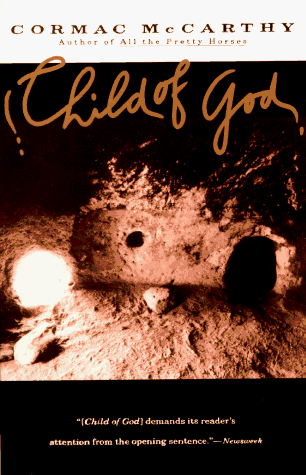
Child of God by Cormac McCarthy (4 stars)
I happened to be reading this when I came across Nicholas Sparks comments that McCarthy's writing is "pulpy" and "overwrought." I can only assume that Sparks is clueless. After all, this was the same interview in which Sparks compared himself to Hemingway saying, "That's what I write."
For those unfamiliar with McCarthy's writing, the comparisons to Faulkner are obvious. Both eschew standard punctuation to create a feeling of oral story telling, and both treat their story's settings almost as another character that affects the characters in the story. In Faulkner's novels, this character is rural Mississippi, while in McCarthy's it is rural Tennessee in his earlier novels and the American southwest in his later novels. Child of God is from his earlier period and takes place in Appalachian Tennessee, where McCarthy grew up.
Child of God centers around Lester Ballard, a deranged, degraded human being who, although created by God like the rest of us, commits some of the worst crimes imaginable and completely loses all human dignity. Yet, McCarthy makes Ballard the protagonist in his story and one gets a sense of a poor man who has lived a hard life that has all culminated in eventual insanity. Ballard goes through everything from watching his father hang himself as a child to being falsely accused of rape. All of which serve to propel him to become the monster that he becomes.
As is typical with McCarthy, the imagery of the book jumps off the page. You can not only picture rural Appalachia in your mind's eye, but you can smell it and feel it, too. This is one of McCarthy's great strengths as a writer, and he is a writer deserving of our admiration for his brilliant skill.
I would not recommend this book to anyone who is squeamish or easily turned off by morally degrading subject matter. The book includes descriptions of things like hanged human bodies and necrophilia. However, it is a remarkable book and nearly as good as some of McCarthy's best works like The Border Trilogy, Blood Meridian, or The Road.
9RidgewayGirl
Wow. Comparing one's writing to Hemingway strikes me as the equivalent of saying, "I'm like Jesus, only nicer." I hadn't realized Sparks was The Modern Hemingway, having thought of him mainly as the author of soppy, made into a movie-type of books. Of course, I haven't read Sparks; maybe he is that good.
But I will run right out and add Child of God to my wishlist, with the intention of saving it for the proper reading mood.
But I will run right out and add Child of God to my wishlist, with the intention of saving it for the proper reading mood.
10fuzzy_patters
My wife has read him. She says that he basically writes soppy romance novels with the difference being that someone always dies in his. My wife stopped reading his books after she read three in which he followed the same formula in each book. She assures me that he is no Hemingway.
11fuzzy_patters

The Passage by Justin Cronin (4 stars)
The biggest disappointment that I have with The Passage is that it is going to be the first book in a trilogy, which means that I'll have to wait to find out what happens next. I'm not sure how long I can wait. It's a really engaging story.
The book is really three stories in one. It starts out in a near future in which a deadly virus is wreaking havoc on the human race. Then, we move into a future in which the remaining humans live in a colony where they try to stay alive amidst a planet infested with blood-thirsty "virals." Finally, we have the final third of the novel, which could best be described as a journey to save humanity.
As a post-apocolyptic adventure, this story works really well. It has been compared to Stephen King's The Stand and Cormac McCarthy's The Road. I found The Stand to be a much better comparison as this novel is not as well-written or as poignant as The Road. However, it is till a very entertaining novel in its own right that keeps the reader turning pages and breathlessly anticipating the next dramatic turn-of-events. This is the second novel that I have won in the Early Reviewer program, and it is much better than the first novel I won. This is a very good novel.
12fuzzy_patters

Heart Lies by ML Malcom (2 stars)
I won this this book as an Early Reviewer.
The author did a very nice job of researching historical events such as the Hungarian counterfeiting scam of the 1920s and the 1937 bombing of Shanghai. According to the author's interview at the library, she did most of her research in the library using primary sources on microfiche, which I enjoyed as a history major in college. It is refreshing to see someone do their own work rather than relying on internet information that is not always accurate.
She uses this historical research to drive a plot in which Leo Hoffman, a Hungarian national who speaks five languages, is used in several nefarious international plots that lead to love, heartbreak, and final redemption. The history serves to make the plot more interesting, which it needs. Malcolm's characters get to be wooden and it is difficult to make a connection with them as a reader. This novel would not stand by itself without the historical research, which was the most interesting part of it.
Additionally, the novel seems to be very shallow. Other then a general theme of forgiveness, there is little that a reader can take away from this novel except for escape from real life for a few hours. In this regard, it is not much better than most of the escapist television that is on during prime time television on the major television networks. Malcolm is planning a sequel, but I doubt that I will read it because I was not particularly impressed with Heart of Lies outside of the interesting slice of history.
13fuzzy_patters

Chess Story by Stefan Zweig (5 stars)
How good is Chess Story? I sat down a little while ago intending to read the first few pages before putting the kids to bed. Instead, I read the whole book and the kids are still up. It is phenomenal.
I would rather not go into too many details about the book because I would hate to ruin it for someone else. I will merely say that it is a meandering psychological story, reminiscent of Dostoevsky, that pits two brilliant foes against each other in a game of chess.
Zweig uses the back stories of these two foes as a metaphor for his overall theme that the infinite can best be discovered by one who limits himself. This theme is also carried out through the chess board itself, which has just sixty-four squares and sixteen pieces, but has infinite permutations.
I am not sure what else to say at this point as I am sure that I will up half of the night reanalyzing this book when I should be asleep. Perhaps I will have more to add tomorrow.
14fuzzy_patters
The Sunset Limited by Cormac McCarthy (4 stars)
This is the second published play by Cormac McCarthy, one of my favorite authors. The play centers around two men, named simply the white and the black, who discuss whether the white man should kill himself. They met earlier that morning when the black man prevented the white man's first attempt at suicide, but he would like to have a chance to try again. Their conversation soon turns to a theological and philosophical look at the meaning of God and the meaning of life. The white man, a college professor, looks at the world from the cynical perspective of an educated man who believes that he understands the futility of existence at a far deeper level than his fellow man. Meanwhile, the black man, believes that the meaning of life lies in love for your fellow man and putting faith in God. McCarthy does an outstanding job or portraying these two versions of mankind in an honest and non-judgmental manner that leaves the reader questioning just where he falls on this philosophical spectrum.
15lilisin
Glad to hear you loved the Zweig!
It's been amazing seeing everyone through Club Read read him and get hooked. I'm going to give myself a pat on the back for making him the Author Theme Read author of the year. :)
Hope you take the time to read more of his works!
By the way, we will be reading Cormac McCarthy as mini-author 3 later in the year. You should stop by.
It's been amazing seeing everyone through Club Read read him and get hooked. I'm going to give myself a pat on the back for making him the Author Theme Read author of the year. :)
Hope you take the time to read more of his works!
By the way, we will be reading Cormac McCarthy as mini-author 3 later in the year. You should stop by.
16fuzzy_patters

Garden of Eden by Ernest Hemingway (4.5 stars)
This story is pretty modern for Hemingway. It deals with sexual exploration, madness, and even lesbianism. Yet, the old mastery of story-telling is still here. David Bourne is the typical scarred hero of all of Hemingway's novels, and his wife, Catherine, is equally scarred. Catherine is the character who makes this story really interesting despite being grossly unlikeable. It's a beautiful novel, and I couldn't help but make a connection with the characters. He really was a great story teller.
17theaelizabet
I remember all of the hoopla when this was first published, back in the '80s, I think? Did Hemingway ever intend for this to see the light of day? I have a copy, but have yet to read it, though your take makes me want to move it up the list. That it might actually be good, and not just a historical oddity, is something I hadn't considered!
18fuzzy_patters
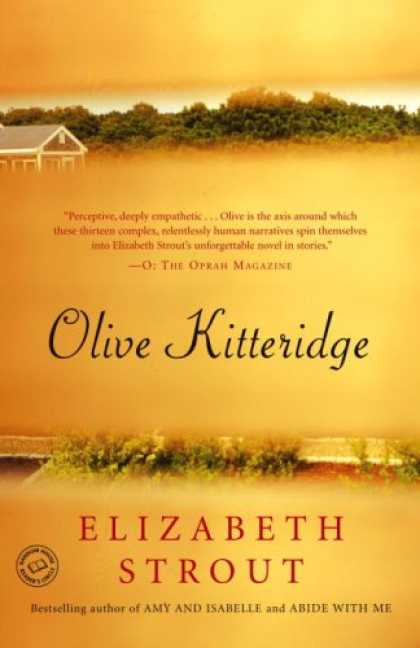
Olive Kitteridge by Elizabeth Strout (3)
Olive Kitteridge won the Pulitzer Prize, so I assumed it would be a great novel. It is an interesting character study, but I wasn't as impressed with it as I thought I would be. It is broken into short stories in order to allow you to see the main character from the point of view of many different characters in many different situations. My problem with it was that I found this character, Olive Kitteridge, to be wholly unlikeable, and I found the other characters in the book to be largely based on stereotypes of how people like them would be. They seemed almost like cardboard cutouts to me rather than being real people that I could make connections with.
Having said all that, Strout isn't a horrible author. She leaves a lot open to interpretation and doesn't insult the readers intelligence like so many authors do. I did appreciate that, and some of her characters in her fictional world were as complex as people in the real world. The problem I had was with the characters who were not as complex. The book seemed to be an interpretation of what small town life is like from someone who either has not lived in a small town or, perhaps, left one long ago.
19fuzzy_patters
The Bridge of San Luis Rey by Thornton Wilder (5 of 5 stars)
I really liked this book. I waffled for a few minutes about whether it deserves 4 or 5 stars, and I finally settled on 5 stars. The only reason why I hesitated was that some of the characters had some inconsistencies that were jarring at times, but I think that was intentional on the authors part. The essence of the book was the complexities of man that makes it difficult to judge their worth and salvation, and these sudden inconsistencies portray this complexity.
For those unfamiliar with the book, Wilder has invented a character, Brother Juniper, who wants to prove the existence of God scientifically. His method is to study the lives of five characters who plunged to their deaths when the Bridge of San Luis Rey (fictional) collapsed in Lima, Peru in the late eighteenth century. He hopes that through studying these five characters, he will be able to ascertain why their lives were suddenly ended by God, whether it be due to punishment for their sins or salvation due to their piety.
What follows is a brilliant study of the complexities of man and what makes us who we are as well as the difficulties of determining the existence of God and, if he exists, his nature. Wilder does a wonderful job of presenting the important questions about the meaning of our existence and the worth of individual lives without ever answering his questions. The end result is that book stays with the reader for hours after reading it as you try an unravel some of these philosophical questions on your own. I found it to be a thought-provoking book for the modern reader, just as I'm sure it was when it was first published in the 1920s, and I highly recommend it.
I really liked this book. I waffled for a few minutes about whether it deserves 4 or 5 stars, and I finally settled on 5 stars. The only reason why I hesitated was that some of the characters had some inconsistencies that were jarring at times, but I think that was intentional on the authors part. The essence of the book was the complexities of man that makes it difficult to judge their worth and salvation, and these sudden inconsistencies portray this complexity.
For those unfamiliar with the book, Wilder has invented a character, Brother Juniper, who wants to prove the existence of God scientifically. His method is to study the lives of five characters who plunged to their deaths when the Bridge of San Luis Rey (fictional) collapsed in Lima, Peru in the late eighteenth century. He hopes that through studying these five characters, he will be able to ascertain why their lives were suddenly ended by God, whether it be due to punishment for their sins or salvation due to their piety.
What follows is a brilliant study of the complexities of man and what makes us who we are as well as the difficulties of determining the existence of God and, if he exists, his nature. Wilder does a wonderful job of presenting the important questions about the meaning of our existence and the worth of individual lives without ever answering his questions. The end result is that book stays with the reader for hours after reading it as you try an unravel some of these philosophical questions on your own. I found it to be a thought-provoking book for the modern reader, just as I'm sure it was when it was first published in the 1920s, and I highly recommend it.
20fuzzy_patters

Hocus Pocus by Kurt Vonnegut (4 of 5 stars)
I have read a lot of Vonnegut, and Hocus Pocus is pretty typical in its anti-war, social satire of the world we live in. However, I found it to be atypical in that it is much more cynical than the other Vonnegut novels that I have read. That isn't to say that all of his novels aren't cynical, but Hocus Pocus finds a Vonnegut that has almost written off the world.
Through his protagonist, Eugene Debs Hartke, he pokes fun at the idea that we are somehow intelligent creatures, "the ruling class," and the idea that there is a god. Then, he turns around and has his character make decisions out of fear that their might actually be a Judgment Day and portrays certain members of "the ruling class" in a positive light. He even has one of his characters point out towards the end that a particularly pointed characterizations of Yale and other ruling class universities "might have been a little harsh."
Basically, Vonnegut is cynical but inconsistent in the viewpoints expressed in this book. He comes across as the satirical muckraker who has suddenly realized that he might not have all the answers. He is an atheist, but we should be careful just in case there is a god. The ruling class is made up of plantation owners forcing the rest of us into slavery, but that might be a little harsh. It's these frequent contradictions that make this such a fascinating read. No one has all fo the answers. Not even someone who has as spent as many years observing all of the things that make us what we are as Vonnegut had.
21fuzzy_patters
Three summers ago, I received Fyodor Dostoevsky's The Idiot as a Christmas gift. I read it the following summer and loved it. I then read The Brother's Karamazov the following summer, which I also loved. It was then that I decided that I would read another Dostoevsky every summer until I had read them all, or, at least, until I no longer found joy in them. I really don't see myself ever losing joy in them, though, after finishing the brilliant Crime and Punishment. My review follows.

Crime and Punishment by Fyodor Dostoevsky (5 of 5 stars)
On the surface, Crime and Punishment is a story about crime and punishment in the form of a guilty conscience. On another level, it is a story about the psychology of love and rationalization. On yet a deeper level, it is a coming of age story about a man who goes from cold, cynical rationality, to a deeper appreciation for life itself. Somehow, Dostoevsky managed to weave all of this together brilliantly and created a masterpiece.
Perhaps Dostoevsky's greatest strength as a writer was his ability to create characters who were very realistic in thought and feeling and his ability to convey their attitudes to us. The reader feels as if he is reading about old friends that he knows very well rather than characters in a novel. As such, one begins to feel sympathy for them in all of their trials and worry about them between readings. Crime and Punishment is no different in this regard. The reader is left feeling great sympathy for all involved and is emotionally affected by their lives.
Dostoevsky also provides the modern reader with the opportunity to experience the sights, sounds, and mostly the attitudes of nineteenth century Russia. To read Dostoevsky is to take a time machine of sorts into another era in a foreign land, and yet, we can see the universalities of the human condition that transcend time an place. In this way, his novels become relevant to us, and we begin to understand ourselves better because of him.

Crime and Punishment by Fyodor Dostoevsky (5 of 5 stars)
On the surface, Crime and Punishment is a story about crime and punishment in the form of a guilty conscience. On another level, it is a story about the psychology of love and rationalization. On yet a deeper level, it is a coming of age story about a man who goes from cold, cynical rationality, to a deeper appreciation for life itself. Somehow, Dostoevsky managed to weave all of this together brilliantly and created a masterpiece.
Perhaps Dostoevsky's greatest strength as a writer was his ability to create characters who were very realistic in thought and feeling and his ability to convey their attitudes to us. The reader feels as if he is reading about old friends that he knows very well rather than characters in a novel. As such, one begins to feel sympathy for them in all of their trials and worry about them between readings. Crime and Punishment is no different in this regard. The reader is left feeling great sympathy for all involved and is emotionally affected by their lives.
Dostoevsky also provides the modern reader with the opportunity to experience the sights, sounds, and mostly the attitudes of nineteenth century Russia. To read Dostoevsky is to take a time machine of sorts into another era in a foreign land, and yet, we can see the universalities of the human condition that transcend time an place. In this way, his novels become relevant to us, and we begin to understand ourselves better because of him.
22fuzzy_patters

Across the River and into the Trees by Ernest Hemingway (3 of 5 stars)
This is a good book, but it isn't great by Hemingway standards. Hemingway's greatest strengths lie in writing honestly and in portraying tragedies. The writing here is very open and honest, but the tragedy is mitigated by the fact that there is only one way for the story to end. It lacks the punch at the end that some of his other novels had.
23fuzzy_patters

The Post Office Girl by Stefan Zweig (4 of 5 stars)
The Post-Office Girl is about a woman who works in a small town Post Office in Austria who becomes frustrated with her social status and is led to consider extreme measures to get out of her situation. The story takes place just after World War I, with the effects of the war on the Austrian people and economy playing a large role in the story. Fiercely anti-capitalist in sentiment, The Post Office Girl contrasts the postal employee, Christl, with the posh extravagances expended by the aristocracy of the countries who benefited from the war, notably British and American citizens. The freedom of the aristocrats to live life as they choose leads Christl to her final dilemma and the novel's thrilling finish.
While well written and engaging, I found The Post-Office Girl to be frustrating. Christl was completely incapable of seeing any value in her lower middle class background, even when confronted with people poorer then herself or when she had weekends in Vienna to look forward to. She came off as rather maudlin in her belief that her life was so terrible. She had a job, a pension, and a lover in another city while thousands of her countrymen were living in abject poverty due to hyperinflation after the war. I found it difficult to sympathize with her, which took away some of the joy of reading the book.
Despite all of its flaws, I can't really say that I didn't like the book. I was merely frustrated with it. I actually found it to be very well written and difficult to put down. The characters seemed very real and I truly cared what happened to them, and the book did help the reader to understand how the Austrian citizens felt about themselves and their government after the war. If not for the frustrating attitudes of the characters, it would be a really great novel. Instead, it is merely good but is definitely worth reading.
24fuzzy_patters
My reading has definitely slowed down since school started. I was reading O Pioneers!, but I haven't picked it up in a week. If I get a chance to finish it, I will post my thoughts here, but I'm not sure when that will be.
25fuzzy_patters

O! Pioneers by Willa Cather (5 of 5 stars)
It took me a very long time to finish this book since I tend to have less time for reading after school starts, but I loved it. Cather's characters are so sympathetic and real that you feel for them, and this includes the land as well, which should probably be considered a character in this novel. After all, this novel is as much a story about Alexandra's relationship with her land as it is about anything. When you think about it, a story about a farmer and her land sounds completely banal, which is the brilliance of this novel. It is not banal at all but is in fact a great work of art that brings pleasure upon those who view it.
26fuzzy_patters
Salvation City by Sigrid Nunez (3.5/5 stars)
Salvation City is about an adolescent boy, Cole, who survives a world wide pandemic. Unfortunately for him, his atheist, left-wing, ethnically Jewish parents do not, and he ends up living with a right-wing, Christian fundamentalist preacher, Pastor Wyatt, and his wife Tracy. The novel centers around Cole's struggle to find his own identity despite his two sets of parents, whom he both loves. A healthy dose of adolescent hormones and a desire to be a comic book artist are thrown in for good measure.
The biggest issue that I had with the book was that the author, Singrid Nunez, appears to live in a black and white world in which there are no shades of gray. Many characters are introduced in the book, but they all fit within the left-wing, city dwelling, atheistic liberal versus right-wing, rural, fundamentalist Christian paradigm. I cannot recall one character in the entire book, outside of Cole himself, who falls anywhere the middle of this cultural spectrum. Everyone is at the extremes. If Nunez's point was to show people from both backgrounds how the other half lives, she completely misses the boat. Her characters read like cardboard cut-out stereotypes of the way the media presents red and blue states. There is no purple in this book.
On the other hand, Salvation City does make for a nice, quick, engaging read. It won't challenge you or make you think too hard, but Nunez does do a good job of portraying the protagonist, Cole, realistically enough that you do care what happens to him, which keeps you turning the pages. Several of the other characters are also well developed, and it is easy to become immersed in Nunez's world. If only Nunez had spent a little bit of time adding some people with healthy skepticism of their respective cultures, this might have been a better book.
27fuzzy_patters
"The Good War" by Studs Terkel (5 stars)
Oral histories can be very flawed histories in that it is difficult for those living through an event to see it objectively; yet, they also provide those who did not live through an event to see it through the eyes of those who did and to see how it has changed their perceptions of the world around them. In "The Good War," Stud's Terkel does an excellent job of this by interviewing a variety of people from different ages, backgrounds, and nationalities to show us how the war affected them. The book brings the war to life for those of us who did not live it and allows us to question whether any war can ever truly be a "good war."
Terkel's methodology of presenting this to us enhances the reader's understanding of the stark reality of the horrors of war, the camaraderie of the soldiers, the pros and cons of dropping the atomic bomb, and the way that the war affected the people of the post-war generation. He does this through the topical sequence of the individual histories and through rarely interjecting his own thoughts but instead allowing those who lived it to tell their own stories without the interference of a biased editor.
In order to fully appreciate this book, the modern reader should already have some knowledge of world war history and some knowledge of the conflicting viewpoints of Americans about the Cold War and the war in Vietnam. However, anyone with a working knowledge about these topics should find this book very enlightening, and it will definitely enhance their appreciation of what these men and women went through. As far as oral histories go, "The Good War" is one of the best I have read.
Oral histories can be very flawed histories in that it is difficult for those living through an event to see it objectively; yet, they also provide those who did not live through an event to see it through the eyes of those who did and to see how it has changed their perceptions of the world around them. In "The Good War," Stud's Terkel does an excellent job of this by interviewing a variety of people from different ages, backgrounds, and nationalities to show us how the war affected them. The book brings the war to life for those of us who did not live it and allows us to question whether any war can ever truly be a "good war."
Terkel's methodology of presenting this to us enhances the reader's understanding of the stark reality of the horrors of war, the camaraderie of the soldiers, the pros and cons of dropping the atomic bomb, and the way that the war affected the people of the post-war generation. He does this through the topical sequence of the individual histories and through rarely interjecting his own thoughts but instead allowing those who lived it to tell their own stories without the interference of a biased editor.
In order to fully appreciate this book, the modern reader should already have some knowledge of world war history and some knowledge of the conflicting viewpoints of Americans about the Cold War and the war in Vietnam. However, anyone with a working knowledge about these topics should find this book very enlightening, and it will definitely enhance their appreciation of what these men and women went through. As far as oral histories go, "The Good War" is one of the best I have read.
28fuzzy_patters
Crooked Letter, Crooked Letter by Tom Franklin (5 stars)
Larry Ott is a 41 year old white man who has long been suspected of raping and murdering teenager Cindy Walker when he was a teenager. Meanwhile, his childhood friend, Silas Jones, is a black police constable helping investigator Roy French look for clues in the disappearance of teenager Tina Rutherford. Naturally, Ott becomes a suspect in her disappearance as well.
One of the things that struck me the most about this novel was how well Franklin weaves a consistent narrative through jumps in time and place while playing out his mystery against the themes of racism, guilt, and misplaced judgment. Franklin's characters seem real to the reader, and their ultimate well-being becomes supremely important. Through these qualities Franklin has crafted a novel that is thoroughly engaging to the reader and very difficult to put down.
Another thing that struck me about this novel was that it was a much deeper novel than the typical rape and murder detective novel. Franklin's novel is much more than an action packed romp akin to prime time network cop shows. Instead, it is a very human novel with characters who express real human emotions and act in ways that allow us to see a little of ourselves in each of them. It is this humanity that makes it a much more literary novel than is typically seen in a crime novel.
Larry Ott is a 41 year old white man who has long been suspected of raping and murdering teenager Cindy Walker when he was a teenager. Meanwhile, his childhood friend, Silas Jones, is a black police constable helping investigator Roy French look for clues in the disappearance of teenager Tina Rutherford. Naturally, Ott becomes a suspect in her disappearance as well.
One of the things that struck me the most about this novel was how well Franklin weaves a consistent narrative through jumps in time and place while playing out his mystery against the themes of racism, guilt, and misplaced judgment. Franklin's characters seem real to the reader, and their ultimate well-being becomes supremely important. Through these qualities Franklin has crafted a novel that is thoroughly engaging to the reader and very difficult to put down.
Another thing that struck me about this novel was that it was a much deeper novel than the typical rape and murder detective novel. Franklin's novel is much more than an action packed romp akin to prime time network cop shows. Instead, it is a very human novel with characters who express real human emotions and act in ways that allow us to see a little of ourselves in each of them. It is this humanity that makes it a much more literary novel than is typically seen in a crime novel.
29RidgewayGirl
Excellent review. I've added Crooked Letter, Crooked Letter to my wishlist.
30fuzzy_patters
The Storyteller of Marrakesh by Joydeep Roy-Battacharya (4 stars)
The Storyteller of Marakesh centers around a man who tells stories each night in the Jemaa in Marrakesh, Morocco. Specifically, the book is his telling of a certain story that he only tells once per year, every year, about his brother, Mustafa, and a young foreign couple who disappeared years earlier. Rather than merely telling the story, the storyteller also invites listeners who may have witnessed the young couple before their disappearances to share their remember of the couple and what happened that evening. Through the differences in how different people remember the same event, the storyteller manages to create a mythology and an ambiguity around the event that makes it seem magical and hints that he may have something to hide in the stories final ending.
I found this book to be very engaging and a very interesting read. The author, Joydeep Roy-Battacharya, is very good at evoking the sights and sounds of the Jemaa, which allows the reader to relate to the story on a more personal level. His characters are also realistic and well-developed, as is his dialogue. All of these add to the mystery and suspense that pulsates throughout the book and pushes the reader on to the final climax.
My main problem with the novel came from this climax. The ending seemed a tad bit rushed and was a bit of a letdown after such a good book until that point. The book seemed to point towards deeper meaning and hidden truths in every event and all of the dialogue throughout the book. Then, this deeper meaning seemed to be lacking in the ending, and it seemed somewhat faked and predictable. This was unfortunate because it was really a great book before that point.
Overall, I felt that this was a good book despite my disappointment with the last few pages, and I am glad that I read it. The author definitely has an innate ability to see hidden truths and has an adept ability to use language to convey those truths to us. While I was a bit disappointed with the ending, this book has made me want to read more book's written by this author.
The Storyteller of Marakesh centers around a man who tells stories each night in the Jemaa in Marrakesh, Morocco. Specifically, the book is his telling of a certain story that he only tells once per year, every year, about his brother, Mustafa, and a young foreign couple who disappeared years earlier. Rather than merely telling the story, the storyteller also invites listeners who may have witnessed the young couple before their disappearances to share their remember of the couple and what happened that evening. Through the differences in how different people remember the same event, the storyteller manages to create a mythology and an ambiguity around the event that makes it seem magical and hints that he may have something to hide in the stories final ending.
I found this book to be very engaging and a very interesting read. The author, Joydeep Roy-Battacharya, is very good at evoking the sights and sounds of the Jemaa, which allows the reader to relate to the story on a more personal level. His characters are also realistic and well-developed, as is his dialogue. All of these add to the mystery and suspense that pulsates throughout the book and pushes the reader on to the final climax.
My main problem with the novel came from this climax. The ending seemed a tad bit rushed and was a bit of a letdown after such a good book until that point. The book seemed to point towards deeper meaning and hidden truths in every event and all of the dialogue throughout the book. Then, this deeper meaning seemed to be lacking in the ending, and it seemed somewhat faked and predictable. This was unfortunate because it was really a great book before that point.
Overall, I felt that this was a good book despite my disappointment with the last few pages, and I am glad that I read it. The author definitely has an innate ability to see hidden truths and has an adept ability to use language to convey those truths to us. While I was a bit disappointed with the ending, this book has made me want to read more book's written by this author.
31fuzzy_patters
Papa Hemingway: A Personal Memoir by A. E. Hotchner (4/5 stars)
This is a personal memoir by Hotchner, who was a close friend of Hemingway's throughout the last 14 years of his life. Many of the stories told here are not surprising. Most who are familiar with Hemingway and his work will not be surprised to learn that he liked to fish, drink, make love, and go to bull fights. On the other hand, the Hemingway fan will get a better insight into what made Papa tick and just what led to his ultimate destruction.
The biggest drawback that I found to the memoir was that Hotchner sometimes introduces people without explaining who they are to the reader. That is fine with more famous people, like Ava Gardner and Gary Cooper, but there are other people who have a close relationship with Hemingway who just appear in the book without any introduction. I found this to be off-putting and frustrating.
Despite this major flaw, I found the book to be helpful in allowing me to know who Hemingway really was as his friends saw him, and I found Hotchner's ending to be poignant, touching, and even a tad motivational. I was also impressed with the obvious influence Papa had on Hotchner's writing style. He used the same short sentences as Hemingway, and he got right to the action and wasted little time beating around the bush. The best accolade that I can give this book is that it made me want to read more Hemingway. I really liked it.
This is a personal memoir by Hotchner, who was a close friend of Hemingway's throughout the last 14 years of his life. Many of the stories told here are not surprising. Most who are familiar with Hemingway and his work will not be surprised to learn that he liked to fish, drink, make love, and go to bull fights. On the other hand, the Hemingway fan will get a better insight into what made Papa tick and just what led to his ultimate destruction.
The biggest drawback that I found to the memoir was that Hotchner sometimes introduces people without explaining who they are to the reader. That is fine with more famous people, like Ava Gardner and Gary Cooper, but there are other people who have a close relationship with Hemingway who just appear in the book without any introduction. I found this to be off-putting and frustrating.
Despite this major flaw, I found the book to be helpful in allowing me to know who Hemingway really was as his friends saw him, and I found Hotchner's ending to be poignant, touching, and even a tad motivational. I was also impressed with the obvious influence Papa had on Hotchner's writing style. He used the same short sentences as Hemingway, and he got right to the action and wasted little time beating around the bush. The best accolade that I can give this book is that it made me want to read more Hemingway. I really liked it.
32RidgewayGirl
I'm sticking resolutely to Hemingway's early years. I'm keeping him firmly in Paris, reporting and scrambling for jobs.
33fuzzy_patters
I have begun reading James Joyce's The Dubliners on my new ereader that my Mom gave me as a Christmas gift. The first short story, The Sisters, was very good, and I was most surprised at how easy it is to read than other works of Joyce. The writing style here is very straight-forward, and somewhat sparse, leaving it up to the reader to provide meaning to the events that unfold. I probably won't get the book finished until 2011 because I am also reading another book at the same time, but will definitely post my final thoughts on the collection in my club read 2011 thread.
