This topic is currently marked as "dormant"—the last message is more than 90 days old. You can revive it by posting a reply.
1labwriter
I would be surprised if I get through 75 in 2010; I read a lot, but I don't think I read 75 in a year, mainly because I tend to like very long reads--either that or series fiction, which is essentially the same thing broken up into manageable bits that the publisher can sell.
I'm hoping that being a member of this group will help me do two things: 1) keep track of my reading, which I've never really done before; and 2) encourage me to read more. If those two things happen, then 75 or not 75 isn't the most important thing.
I'm new to LT and here's my introduction to the group: here
I'm not a plan-aheader, so I don't have a list of the first 10 or 20 or whatever books that I will read, although I might be able to come up with ideas for the first 10 or so. But don't hold me to the list.

Ideas for Books 1-10
1. Alice Hamilton: A Life in Letters (finished)
2. William James: In the Maelstrom of American Modernism (finished)
3. House of Wits: An Intimate Portrait of the James Family (finished)
4. Appetite for Life: The Biography of Julia Child (finished)
5. Moonflower Vine The selection for January in the Missouri Readers group. (finished)
After that I haven't a clue, except I know that I'll definitely need some fiction--something along the lines of a Daniel Silva novel.
6. Because of LT, I've been looking at books that I've ignored on my shelf. One I definitely need to finish (I can't believe I didn't finish this one) is American Cassandra The Life of Dorothy Thompson by Peter Kurth. I didn't finish it because I got off on a tangent with some other book and forgot about it. It's an excellent biog about a very complex woman.
7. I can't believe I forgot this one, Master of the Senate by Robert Caro. This is my second time through this one (I read it when it first came out in 2002. Caro is a master of the biographer's art. This is the 3rd volume in Caro's series about Lyndon Johnson. He's working on Vol. 4 which ought to be great.
8. I just found this one. Although long (1000+ pages), it looks quite readable: John Steinbeck, Writer.
I guess I'll just keep adding books here as they come up. Then when I'm flailing around for a book to read, maybe the list will come in handy.
9. This one has been on my shelf for a long time: Republic of Dreams Greenwich Village: The American Bohemia, 1910-1960.
Books Read in 2010 from Thread One
January
1) Alice Hamilton, a Life in Letters. Ed. by Barbara Sicherman.
2) William James: In the Maelstrom of American Modernism. Robert D. Richardson.
3) House of Wits: An Intimate Portrait of the James Family. Paul Fisher.
4) Game Change: Obama and the Clintons, McCain and Palin, and the Race of a Lifetime. John Heilemann.
5) 102 Minutes: The Untold Story of the Fight to Survive Inside the Twin Towers. Jim Dwyer.
6) Mockingbird: A Portrait of Harper Lee. Charles J. Shields.
7) Eugene O'Neill: Beyond Mourning and Tragedy. Stephen Black.
8) Prince of Fire. Daniel Silva.
9) The Ruins. Scott Smith.
February
10) George S. Kaufman: His Life, His Theater. Malcolm Goldstein.
11) Rebecca West: A Life. Victoria Glendinning.
12) H.G. Wells: A Biography. Norman and Jeanne MacKenzie.
13) The Clock Winder. Anne Tyler.
14) First Family. David Baldacci. (Abandoned--lousy book)
15) The Bookseller of Kabul. Asne Seierstad.
15a) The Moonflower Vine (group read)
March
16) A Child of the Century. Ben Hecht.
17) Courage and Consequence: My Life as a Conservative in the Fight. Karl Rove.
18) Hidden Lives. Margaret Forster.
19) Rebecca West: A Life. Carl Rollyson. (Abandoned)
20) Into Thin Air: A Personal Account of the Mt. Everest Disaster. Jon Krakauer.
21) Appetite for Life: The Biography of Julia Child. Noel Riley Fitch. (Continued reading this one into April--finished April 17.)
22) Darkness Visible: A Memoir of Madness. William Styron.
23) Born to Run: A Hidden Tribe, Superathletes, and the Greatest Race the World Has Never Seen. Christopher McDougall.
April
24) The Education of Henry Adams (group read)
25) Empire
26) In My Blood: Six Generations of Madness and Desire in an American Family. John Sedgwick.
27) Sometimes the Magic Works: Lessons from a Writing Life. Terry Brooks.
28) The Blooding. Joseph Wambaugh.
29) Hawk. Brian Neary.
30) Act of Treason. Vince Flynn.
I'm hoping that being a member of this group will help me do two things: 1) keep track of my reading, which I've never really done before; and 2) encourage me to read more. If those two things happen, then 75 or not 75 isn't the most important thing.
I'm new to LT and here's my introduction to the group: here
I'm not a plan-aheader, so I don't have a list of the first 10 or 20 or whatever books that I will read, although I might be able to come up with ideas for the first 10 or so. But don't hold me to the list.

Ideas for Books 1-10
1. Alice Hamilton: A Life in Letters (finished)
2. William James: In the Maelstrom of American Modernism (finished)
3. House of Wits: An Intimate Portrait of the James Family (finished)
4. Appetite for Life: The Biography of Julia Child (finished)
5. Moonflower Vine The selection for January in the Missouri Readers group. (finished)
After that I haven't a clue, except I know that I'll definitely need some fiction--something along the lines of a Daniel Silva novel.
6. Because of LT, I've been looking at books that I've ignored on my shelf. One I definitely need to finish (I can't believe I didn't finish this one) is American Cassandra The Life of Dorothy Thompson by Peter Kurth. I didn't finish it because I got off on a tangent with some other book and forgot about it. It's an excellent biog about a very complex woman.
7. I can't believe I forgot this one, Master of the Senate by Robert Caro. This is my second time through this one (I read it when it first came out in 2002. Caro is a master of the biographer's art. This is the 3rd volume in Caro's series about Lyndon Johnson. He's working on Vol. 4 which ought to be great.
8. I just found this one. Although long (1000+ pages), it looks quite readable: John Steinbeck, Writer.
I guess I'll just keep adding books here as they come up. Then when I'm flailing around for a book to read, maybe the list will come in handy.
9. This one has been on my shelf for a long time: Republic of Dreams Greenwich Village: The American Bohemia, 1910-1960.
Books Read in 2010 from Thread One
January
1) Alice Hamilton, a Life in Letters. Ed. by Barbara Sicherman.
2) William James: In the Maelstrom of American Modernism. Robert D. Richardson.
3) House of Wits: An Intimate Portrait of the James Family. Paul Fisher.
4) Game Change: Obama and the Clintons, McCain and Palin, and the Race of a Lifetime. John Heilemann.
5) 102 Minutes: The Untold Story of the Fight to Survive Inside the Twin Towers. Jim Dwyer.
6) Mockingbird: A Portrait of Harper Lee. Charles J. Shields.
7) Eugene O'Neill: Beyond Mourning and Tragedy. Stephen Black.
8) Prince of Fire. Daniel Silva.
9) The Ruins. Scott Smith.
February
10) George S. Kaufman: His Life, His Theater. Malcolm Goldstein.
11) Rebecca West: A Life. Victoria Glendinning.
12) H.G. Wells: A Biography. Norman and Jeanne MacKenzie.
13) The Clock Winder. Anne Tyler.
14) First Family. David Baldacci. (Abandoned--lousy book)
15) The Bookseller of Kabul. Asne Seierstad.
15a) The Moonflower Vine (group read)
March
16) A Child of the Century. Ben Hecht.
17) Courage and Consequence: My Life as a Conservative in the Fight. Karl Rove.
18) Hidden Lives. Margaret Forster.
19) Rebecca West: A Life. Carl Rollyson. (Abandoned)
20) Into Thin Air: A Personal Account of the Mt. Everest Disaster. Jon Krakauer.
21) Appetite for Life: The Biography of Julia Child. Noel Riley Fitch. (Continued reading this one into April--finished April 17.)
22) Darkness Visible: A Memoir of Madness. William Styron.
23) Born to Run: A Hidden Tribe, Superathletes, and the Greatest Race the World Has Never Seen. Christopher McDougall.
April
24) The Education of Henry Adams (group read)
25) Empire
26) In My Blood: Six Generations of Madness and Desire in an American Family. John Sedgwick.
27) Sometimes the Magic Works: Lessons from a Writing Life. Terry Brooks.
28) The Blooding. Joseph Wambaugh.
29) Hawk. Brian Neary.
30) Act of Treason. Vince Flynn.
2Donna828
Oh goodie, I am the first one of your new followers. I'd say that is fitting since we live in the same state. Not a lot of us here on LT. I don't plan ahead either, Becky. I told someone my reading goal for the year is to "Read what I want when I want." Works for me.
3nancyewhite
Welcome to the 75ers! I didn't hit 75 last year. No one is keeping track anyway.
I'm interested in hearing what you think of the Julia Child biography. A lot of folks on here have been reading My Life In France, but I haven't seen anyone review this one yet.
I'm interested in hearing what you think of the Julia Child biography. A lot of folks on here have been reading My Life In France, but I haven't seen anyone review this one yet.
5labwriter
>#4. drneutron, thanks for the welcome. You started this group? What made you pick "75"? It seems like a doable number; was there any other reason?
>#2. Hey, Donna! I'm looking forward to the Missouri Readers group. I think you've made a good choice with Moonflower Vine. I bought a used copy from amazon.com. It should be coming soon. That should be #4 on the list above.
>#3. Hi Nancy. I bought the Julia Child biog for someone for Christmas and then decided I needed one for myself. It looks very good, just thumbing through the thing. Child allowed the biographer (Fitch) full access to her papers. It's hard to know then how much Fitch felt Child looking over her shoulder while she was writing. I didn't realize it, but Fitch also wrote Sylvia Beach and the Lost Generation, another book I enjoyed. So I have high hopes for this one.
Stay warm, everyone!
>#2. Hey, Donna! I'm looking forward to the Missouri Readers group. I think you've made a good choice with Moonflower Vine. I bought a used copy from amazon.com. It should be coming soon. That should be #4 on the list above.
>#3. Hi Nancy. I bought the Julia Child biog for someone for Christmas and then decided I needed one for myself. It looks very good, just thumbing through the thing. Child allowed the biographer (Fitch) full access to her papers. It's hard to know then how much Fitch felt Child looking over her shoulder while she was writing. I didn't realize it, but Fitch also wrote Sylvia Beach and the Lost Generation, another book I enjoyed. So I have high hopes for this one.
Stay warm, everyone!
6PamFamilyLibrary
Howdy! Glad you are here.
7tloeffler
Welcome, Becky! Not only a fellow Missourian, but one from my side of the state! I'm glad to see you here, and glad to see you on the Missouri Readers. I am also looking forward to Moonflower Vine. We have a pretty bad habit of reading books about the seedier side of the state, so we really hope this one will be a little more uplifting!
8drneutron
Actually, the first 75 book challenge was started by Cariola as an outgrowth of the 50 Books Challenge group. I took over the responsibility in 2009. In 2010, Stasia (alcottacre) and I worked together to get things going.
9alcottacre
Welcome to the group, Becky!
10labwriter
I finished Alice Hamilton, a Life in Letters. I probably cheated a little with that because I started it in late December--but oh well. Sicherman did a great job with not only Alice Hamilton, but the other Hamilton women in the family as well (Alice's sister was Edith Hamilton, the one who wrote about myths). If I can figure out how to do it, I'll link to my review. I gave the book 5 stars, but with the caveat that my reviews tend towards being on the high side.
One of my favorite genres is literary correspondence, which goes well with biography, another favorite. I often find that a good collection of someone's letters can be just as good or better than biography. One of the reasons I think memoirs are so popular these days is because the immediacy of the first-person voice is very appealing--at least that's a big reason why I like memoirs. You find the same thing with letters.
I have a large collection of volumes of literary correspondence (I've only started putting them into LT). For whatever reason, this genre tends to be very cheap at places like amazon.com used books. I would say that most of the volumes of literary correspondence I've bought there have been less than $5.00 (sometimes far less, like 1 cent) plus shipping. I'm not trying to sell anything or push a particular site, like amazon--I'm only relating my own experience. Unfortunately, I've largely given up on the used book shops. We don't have any particularly good ones in my area anymore, and unless I'm on vacation or something and just happen across an interesting store, I just don't take the time to go in them anymore. I've talked to a lot of used bookstore owners and most have said that they sell more books online these days than in the shop.
Oh, and P.S. I stopped frequenting the used book shops even before I found the amazon used books site because I was dismayed that (it seemed like) almost overnight the prices of used books in the shops doubled. The books went from being a good deal to--are you kidding, you want $8 bucks for this? I wish I could remember about what time that happened--anybody?
One of my favorite genres is literary correspondence, which goes well with biography, another favorite. I often find that a good collection of someone's letters can be just as good or better than biography. One of the reasons I think memoirs are so popular these days is because the immediacy of the first-person voice is very appealing--at least that's a big reason why I like memoirs. You find the same thing with letters.
I have a large collection of volumes of literary correspondence (I've only started putting them into LT). For whatever reason, this genre tends to be very cheap at places like amazon.com used books. I would say that most of the volumes of literary correspondence I've bought there have been less than $5.00 (sometimes far less, like 1 cent) plus shipping. I'm not trying to sell anything or push a particular site, like amazon--I'm only relating my own experience. Unfortunately, I've largely given up on the used book shops. We don't have any particularly good ones in my area anymore, and unless I'm on vacation or something and just happen across an interesting store, I just don't take the time to go in them anymore. I've talked to a lot of used bookstore owners and most have said that they sell more books online these days than in the shop.
Oh, and P.S. I stopped frequenting the used book shops even before I found the amazon used books site because I was dismayed that (it seemed like) almost overnight the prices of used books in the shops doubled. The books went from being a good deal to--are you kidding, you want $8 bucks for this? I wish I could remember about what time that happened--anybody?
11alcottacre
#10: My daughter Catey (fantasia655) is also a fan of literary correspondence, so I will mention the Hamilton book to her. Thanks for the recommendation!
12Donna828
Becky, I agree that prices in used bookstores (at least around here) are not huge bargains compared to some online sites BUT I do love holding and, yes, even smelling the books. (Won't buy one with a smoky smell)! Plus, I like being surprised by the mixture of newer books and those oldies that I didn't even know I wanted until I see it on the shelf.
My all-time favorite place to book shop is the semi-annual library sales. A vertibable book feast and the main source of my tottering book stash.
My all-time favorite place to book shop is the semi-annual library sales. A vertibable book feast and the main source of my tottering book stash.
13labwriter
>12 Donna828:. Donna. Heh, but you see, that's my problem, getting into one of those places and finding "stacks" of books I didn't know I wanted until I saw them. I'm so out of room, plus I never want to let go of a book once I've bought it. But yeah, the library sales can be great bargains.
14tloeffler
I'm with you, Donna. I rarely buy from used bookstores, but heaven save me from the library sales! Our library takes over the convention center for 3 days in May, and it's Katie, Bar the Door!
15labwriter
What I'm finding out since I joined LT and started keeping close track of what I'm reading is that FOR SURE I'm not reading as much as I thought I was or as much as I'd like to. I read a lot of long books--biographies, especially. If I'm going to get as much reading done as I want to, then I need to read a minimum of 150-200 pages a day. No way am I doing that now, yet I remember a time when that would have seemed like nothing. Sigh. So something has to give somewhere. Maybe I'll quit cleaning my house. --Oops, I already did that. Then I guess I'm going to have to back off on the blog. I enjoy posting there, but doing that is eating into my reading time. Sheesh. Well, I know one easy timewaster that is definitely going to go--facebook.
16labwriter
I just finished a second longish book about the James family (is there any other kind?); this one is House of Wits: An Intimate Portrait of the James Family, by Paul Fisher; the first was William James: In the Maelstrom of American Modernism, by Robert D. Richardson.
I might as well review the two of these together, since they both are about the James family. Richardson's book I gave a 5-star review; Fisher's I'll give 4 stars, but it perhaps deserves more like 3.5--although maybe he suffers in comparison to Richardson and had I read only Fisher's, I would have rated it more highly.
The Fisher book certainly fits the title: An Intimate Portrait of the James Family. This is a gossipy book, where he delves into the complicated family dynamics as well as thier relationships with those others who peopled the James family world. I suppose if you came to this book knowing NOTHING about Henry James and his brother William plus their sister Alice James, then this book might seem like a remarkable tour de force. For me, having read Leon Edel's 5-volume biography of Henry James, R.W.B. Lewis's The Jameses A Family Narrative, and Jean Strouse's Alice James A Biography, a lot of what Fisher covered was old ground. However, his narrative style was enjoyable, for the most part, and I enjoyed the James' family stories told from a somewhat different perspective.
However, I do want to say a couple of things about young Paul Fisher's style. Paul, here's a tip: For the rest of your entire career, you may never again use the word "eponymous," which you used FOUR TIMES in 500 pages of this book. Also, please consider your audience. Probably people who are willing to go with you for 600 pages about the James family are not exactly dolts--and they don't need every French or Latin word you use TRANSLATED for them. For example: "Roman tourists like Harry didn't dare open their windows at night, as mal aria (bad air) was thought to cause the eponymous disease of malaria." However, I'm willing to overlook this as a young writer's zeal in wishing to be understood by his readers (I'll overlook it, even though my nickname for this book was The James Family Book for Dummies).
Richardson, on the other hand, the author of the book about William James, is not a young writer. He's an old hand at intellectual biography, having written about Thoreau, Emerson, and now James. I haven't read any of William James's writings, so I found Richardson's book to be an excellent introduction to his work. I was prepared for this book to be heavy going, which it was, for me, in places; I wasn't prepared for it to be so comprehensive, empathetic to his subject, and readable.
One of the things I found most interesting about William James was the fact that he was such a late-bloomer. He agonized until well into his 30s until he found his way in the world. Many people bemoan or openly deride our generation of 20-somethings who continue to live in their parents' basements, blogging in their PJ's. This book shows "there's nothing new under the sun."
I enjoyed both of these books, and now I'm ready to move onto something not-James.
I might as well review the two of these together, since they both are about the James family. Richardson's book I gave a 5-star review; Fisher's I'll give 4 stars, but it perhaps deserves more like 3.5--although maybe he suffers in comparison to Richardson and had I read only Fisher's, I would have rated it more highly.
The Fisher book certainly fits the title: An Intimate Portrait of the James Family. This is a gossipy book, where he delves into the complicated family dynamics as well as thier relationships with those others who peopled the James family world. I suppose if you came to this book knowing NOTHING about Henry James and his brother William plus their sister Alice James, then this book might seem like a remarkable tour de force. For me, having read Leon Edel's 5-volume biography of Henry James, R.W.B. Lewis's The Jameses A Family Narrative, and Jean Strouse's Alice James A Biography, a lot of what Fisher covered was old ground. However, his narrative style was enjoyable, for the most part, and I enjoyed the James' family stories told from a somewhat different perspective.
However, I do want to say a couple of things about young Paul Fisher's style. Paul, here's a tip: For the rest of your entire career, you may never again use the word "eponymous," which you used FOUR TIMES in 500 pages of this book. Also, please consider your audience. Probably people who are willing to go with you for 600 pages about the James family are not exactly dolts--and they don't need every French or Latin word you use TRANSLATED for them. For example: "Roman tourists like Harry didn't dare open their windows at night, as mal aria (bad air) was thought to cause the eponymous disease of malaria." However, I'm willing to overlook this as a young writer's zeal in wishing to be understood by his readers (I'll overlook it, even though my nickname for this book was The James Family Book for Dummies).
Richardson, on the other hand, the author of the book about William James, is not a young writer. He's an old hand at intellectual biography, having written about Thoreau, Emerson, and now James. I haven't read any of William James's writings, so I found Richardson's book to be an excellent introduction to his work. I was prepared for this book to be heavy going, which it was, for me, in places; I wasn't prepared for it to be so comprehensive, empathetic to his subject, and readable.
One of the things I found most interesting about William James was the fact that he was such a late-bloomer. He agonized until well into his 30s until he found his way in the world. Many people bemoan or openly deride our generation of 20-somethings who continue to live in their parents' basements, blogging in their PJ's. This book shows "there's nothing new under the sun."
I enjoyed both of these books, and now I'm ready to move onto something not-James.
17mamzel
I think the phenomenon of boomerang kids (returning home after college) is an unfortunate side effect of our economy. It is really epidemic in Japan, too. I have one at home who is finishing up a 2-year program about welding. Hopefully he will be able to find work with his certificate.
19Donna828
>16 labwriter:: Oh Becky, you made me laugh with your advice to Paul Fisher to give up his overuse of the word "eponymous." I, too, am annoyed when I find a word like that appearing over and over. Don't authors think to use a thesaurus? Oops, I just checked and the "e" word does not appear in my Roget's. My apologies to Mr. Fisher.
Maybe I should read The James Family Book for Dummies. My knowledge of Henry and his siblings comes from The Master by Colm Toibin.
Maybe I should read The James Family Book for Dummies. My knowledge of Henry and his siblings comes from The Master by Colm Toibin.
20labwriter
I finished Game Change: Obama and the Clintons, McCain and Palin, and the Race of a Lifetime. I'm embarrassed to have chosen so poorly and I'm not sure why I finished the book. Far from being any sort of even-handed study of the campaign of 2008, the book was a valentine to Obama, making everyone else out to be candidates for the back ward of an asylum.
There's not a single note or reference; the reader is simply supposed to trust the veracity of the writers' sources and research. The book was a waste of money and a waste of time. It will quickly be forgotten. Anyone looking for a Theodore White-type of behind-the-scenes look at the campaign should look elsewhere. This book isn't it. Don't waste your time.
There's not a single note or reference; the reader is simply supposed to trust the veracity of the writers' sources and research. The book was a waste of money and a waste of time. It will quickly be forgotten. Anyone looking for a Theodore White-type of behind-the-scenes look at the campaign should look elsewhere. This book isn't it. Don't waste your time.
21alcottacre
#20: Yikes! That book sounds terrible. I certainly hope your next one is better for you (although I fail to see how it could be any worse.)
22labwriter
I just finished 102 Minutes: The Untold Story of the Fight to Survive Inside the Twin Towers. The stories of people who survived or didn't survive in those buildings on that day made me think of two other books I read a few months ago--Blink: The Power of Thinking Without Thinking, and also The Survivors Club: The Secrets and Science that Could Save Your Life. In Blink, Gladwell writes about making snap judgments. The second book, by Sherwood, discusses what it takes to survive a catastrophic event.
Sherwood asserts that survival is a way of perceiving the world, and some of the stories in the 102 Minutes book support his thesis. I found the 102 Minutes book fascinating reading. Why did some people who were terribly injured able to make it down 86 flights of stairs and others--who should have gotten out or could have gotten out--but instead they stayed put waiting for someone else to tell them what to do? I couldn't help but wonder, as I read the book, what would I have done that day?
Sherwood asserts that survival is a way of perceiving the world, and some of the stories in the 102 Minutes book support his thesis. I found the 102 Minutes book fascinating reading. Why did some people who were terribly injured able to make it down 86 flights of stairs and others--who should have gotten out or could have gotten out--but instead they stayed put waiting for someone else to tell them what to do? I couldn't help but wonder, as I read the book, what would I have done that day?
23tymfos
102 minutes is on my must-read list. You've made me even more eager to read it.
About the "know your audience" thing in msg. 16: Maybe I'm an oddball and a dummy, but I'm interested in subjects like the James family, and I have very little knowledge of Latin or French (though I could manage to translate mal aria.
About the "know your audience" thing in msg. 16: Maybe I'm an oddball and a dummy, but I'm interested in subjects like the James family, and I have very little knowledge of Latin or French (though I could manage to translate mal aria.
24labwriter
>23 tymfos:. Don't misunderstand, I'm terrible at languages; however, I'm pretty good with a foreign language dictionary. What bothered me about the House of Wits book by Fisher was his way of injecting himself into the text. I don't remember ever seeing it done quite this way before, where an author will translate a foreign word in parentheses within the text. So Fisher gives us, "Even eighteen years later, the Russian could address Henry James as "Mon bien cher ami!" (my very dear friend). I find such parenthetical translation within the text to be intrusive. Put it in a note, if you must, but not within the text.
My fear is that this sort of authorial (or maybe it's editorial) intrusiveness may be a trend, with editors thinking their audience is just too dumb or lazy to look these things up for themselves. So what's next--if a writer uses an unfamiliar English word, are they then going to put the definition right after the word in parentheses?
When I read, I want the least intrusion and interruption from the writer possible. The goal of a writer (or at least, as a reader, this is how I see it) is to create a dream for the reader--I read that somewhere, and I don't remember who said it, but I think it's exactly right. You don't want to disturb the reader from the dream you've spun for them--and parenthetical translations disturb me almost as if someone had yelled at me, "Hey! Hey!" Leave me alone, let me read, if I want a translation I'll spin up Babelfish.
My fear is that this sort of authorial (or maybe it's editorial) intrusiveness may be a trend, with editors thinking their audience is just too dumb or lazy to look these things up for themselves. So what's next--if a writer uses an unfamiliar English word, are they then going to put the definition right after the word in parentheses?
When I read, I want the least intrusion and interruption from the writer possible. The goal of a writer (or at least, as a reader, this is how I see it) is to create a dream for the reader--I read that somewhere, and I don't remember who said it, but I think it's exactly right. You don't want to disturb the reader from the dream you've spun for them--and parenthetical translations disturb me almost as if someone had yelled at me, "Hey! Hey!" Leave me alone, let me read, if I want a translation I'll spin up Babelfish.
25labwriter
Finished Mockingbird A Portrait of Harper Lee. Shields' biography lacks proportion and also information about critical points in Harper Lee's life. He spent 40% of the book getting her from childhood through college, and then had almost nothing to say about the seven years she spent in Manhattan when she was trying to become a published author.
His best two chapters are about the time Harper Lee spent in Kansas with Truman Capote helping him to research In Cold Blood and then the chapter about the making of her book into a movie.
Shields is a children's or young adult book author; this is his first adult book, and it shows. To write a good biography is more difficult than a lot of writers-of-biography think. I get the impression that Shields probably hasn't read all that many biographies. How hard can it be, right? I'd be interested to know what made him take on this project.
His best two chapters are about the time Harper Lee spent in Kansas with Truman Capote helping him to research In Cold Blood and then the chapter about the making of her book into a movie.
Shields is a children's or young adult book author; this is his first adult book, and it shows. To write a good biography is more difficult than a lot of writers-of-biography think. I get the impression that Shields probably hasn't read all that many biographies. How hard can it be, right? I'd be interested to know what made him take on this project.
26labwriter
Library Thing has made me realize how many unread (and really excellent) books I have on my shelf. The other group I really like here (I would like a lot of them, but I force myself to limit the number of groups so that I actually get some books read) is the Books Off the Shelf Challenge. Originally I thought I might read 10 or so OTS books this year, but after posting so many of them in LT (157 with no end in sight), I decided to challenge myself to reading mostly OTS books this year.
LT has also made me more intentional in other ways about my reading. Being 50-something (another group I belong to--"50-Something Library Thingers"), I'm starting to realize that I don't have forever to read the things I both need and also want to read.
So after really thinking about what I want my next book to be instead of just grabbing one off the shelf that looks good, I've decided on Eugene O'Neill Beyond Mourning and Tragedy, something of a psychological study of Eugene O'Neill. There are no LT reviews, but some of the reviews at Amazon give this one high marks.
My goal: to read it in 3 or 4 days (and at worst, in under a week). Since I'm reading a couple of other things, one of which needs to be finished by Feb 1, I need to be intentional and focused and spend more time reading.
LT has also made me more intentional in other ways about my reading. Being 50-something (another group I belong to--"50-Something Library Thingers"), I'm starting to realize that I don't have forever to read the things I both need and also want to read.
So after really thinking about what I want my next book to be instead of just grabbing one off the shelf that looks good, I've decided on Eugene O'Neill Beyond Mourning and Tragedy, something of a psychological study of Eugene O'Neill. There are no LT reviews, but some of the reviews at Amazon give this one high marks.
My goal: to read it in 3 or 4 days (and at worst, in under a week). Since I'm reading a couple of other things, one of which needs to be finished by Feb 1, I need to be intentional and focused and spend more time reading.
27labwriter
Update on the Eugene O'Neill Beyond Mourning and Tragedy biog. Oh.my.God. This is one of the most depressing books I've ever read, both the subject and the presentation. What is wrong with me? Why would I choose this book--now--after the other terrible choices I've made this month? Well, I had my reasons for reading this thing, but it sure didn't have to be NOW.
This book is an excellent test of my reading system for "challenging" books that I want to finish. It's the same system I used to get through my lit degrees when I was at the university. How many pages? How soon do you want to have it read? Read "X" number of pages per day. It's just that simple. Right now I'm 15 pages behind, meaning that I have 15 pages of "yesterday's" reading before I start on today's pages. But considering what a miserably depressing read this one is, I think I'm doing great.
This book is an excellent test of my reading system for "challenging" books that I want to finish. It's the same system I used to get through my lit degrees when I was at the university. How many pages? How soon do you want to have it read? Read "X" number of pages per day. It's just that simple. Right now I'm 15 pages behind, meaning that I have 15 pages of "yesterday's" reading before I start on today's pages. But considering what a miserably depressing read this one is, I think I'm doing great.
28tloeffler
Wow, you're really on a roll. I can FEEL the dread, all the way over here across the river. Put it down and get something short and funny. Fast.
29sibylline
I'm remembering that it took me three or four months to get through INDEPENDENT PEOPLE, and I loved it, but it was just so..... bleak, so real, so cold. A dose of funny here and there helps. I would put it down and read something else..... the x pages a day brings back old memories. When I was on a Kafka binge my husband ordered me to stop for awhile. I was so grateful!
(I wrote you a hello on your profile page too!)
(I wrote you a hello on your profile page too!)
30mamzel
labwriter - Have you read any of the children's books by Lemony Snicket? While I applaud the effort to educate kids on the origin for many (read as MANY!) expressions, it does become a bit tedious for more mature readers. I read the whole series but ended up skipping the distracting digressions.
31labwriter
>30 mamzel:. I have no idea who Lemony Snicket is. I don't read YA books, but I love to have them on my shelf--the ones that mattered to me when I was a kid. I just went to the Lemony Snicket website--very intriguing.
>29 sibylline:. "Icelandic epic novel"--those words strung together would scare me off that book, no question. It looks kinda interesting, though. Is it 1500 pages long or something?
>28 tloeffler:. Sigh. I know. I still need to read The Moonflower Vine, so that's what I'm gonna read tonight. That should help a lot. I don't care if I'm 2 days behind on Eugene Depressing O'Neill.
>29 sibylline:. "Icelandic epic novel"--those words strung together would scare me off that book, no question. It looks kinda interesting, though. Is it 1500 pages long or something?
>28 tloeffler:. Sigh. I know. I still need to read The Moonflower Vine, so that's what I'm gonna read tonight. That should help a lot. I don't care if I'm 2 days behind on Eugene Depressing O'Neill.
32goneagain
#24: Hello. I'm currently bothered by the same thing in a book I'm reading, but with my book it's the translator rather than the author. (It's an American book, translated into Swedish.) He keeps sticking bracketed (Translator's comment)s in everywhere. For example, when the book compares the time after 9/11 to the reactions after the attack on Pearl Harbor, it says something like: "but this time there was no man in a wheel chair in the White House", and the translator has to comment (American president F D Roosevelt). As I reader, it makes me feel my intelligence is being insulted. If he thinks it's that difficult for Swedes to figure out, he should have just put the name in there in the first place.
Luckily, this is non-fiction, so the style and the illusion is, in a way, less important than in a novel, but it still irritates me enough that I might stop reading (or find me a copy in English).
Sorry to come in here and rant like this. I wish you better luck in future reading choices.
Luckily, this is non-fiction, so the style and the illusion is, in a way, less important than in a novel, but it still irritates me enough that I might stop reading (or find me a copy in English).
Sorry to come in here and rant like this. I wish you better luck in future reading choices.
33sibylline
#29,31 INDEPENDENT PEOPLE is set in Iceland just beforeWWI when things were desperate--beyond desperate, even, in that country. Most of the novel takes place inside this one family's 'house' -- animals (mainly sheep) below, people above, who lie in bed (only way to keep warm) hungry all the dark cold winter reciting epic poetry, bickering, the only bright spot being when someone shows up they all bring out the hoarded coffee and exchange news and gossip and recite epic poetry..... but it WAS LIKE THAT -- you are transported into this strange and compelling world where talk is like food and thought and dreaming are all mixed up with reality. an amazing book, but tough and also long -- I can't remember how long but certainly over 500 maybe around 700. I like long books fine. It was a content/intensity thing.
I think you are very noble to take on Eugene. The only play of his I've read was "Mourning Becomes Electra" and I've never seen one performed I don't think. What got you interested in the topic anyhow?
I think you are very noble to take on Eugene. The only play of his I've read was "Mourning Becomes Electra" and I've never seen one performed I don't think. What got you interested in the topic anyhow?
34labwriter
>33 sibylline:. Independent People sounds like a fascinating book; I put it on my wish list, but I'm going to be very careful about when I read it--like not right after reading a biog of Eugene O'Neill.
I guess my interest in O'Neill (it's sort of hard to remember now) was sparked because of a biography I read of Susan Glaspell: Susan Glaspell Her Life and Times. Glaspell was involved with the Provincetown Players; she was also part of the Washington Square Players in Greenwich Village. I've sort of made it a hobby to read about Manhattan in the 1920s and 30s and the fascinating people who lived and worked there at the time--which is why so many of my biographies concentrate on that period. Also, I'm interested in genealogy, and one of my mother's grandmothers was "black Irish"--like O'Neill. I was hoping the biography would look at O'Neill from that perspective, but the author is totally focused on O'Neill's psychopathology--I don't think he even knows he's Irish. Oh well.
I guess my interest in O'Neill (it's sort of hard to remember now) was sparked because of a biography I read of Susan Glaspell: Susan Glaspell Her Life and Times. Glaspell was involved with the Provincetown Players; she was also part of the Washington Square Players in Greenwich Village. I've sort of made it a hobby to read about Manhattan in the 1920s and 30s and the fascinating people who lived and worked there at the time--which is why so many of my biographies concentrate on that period. Also, I'm interested in genealogy, and one of my mother's grandmothers was "black Irish"--like O'Neill. I was hoping the biography would look at O'Neill from that perspective, but the author is totally focused on O'Neill's psychopathology--I don't think he even knows he's Irish. Oh well.
35sibylline
This is fascinating! What led you to Susan Glaspell? I am only so-so educated when it comes to theatre..... I lived in Wellfleet for years and am still connected there and I still haven't heard of her..... are you a drama fiend or is it part of the 20-30's interest?
I am so envious of folks who experienced NY then -- One of my reading festishes is all those NYer people -- and omg I haven't put ANY of those books in yet, Thurber and EB White et al - A HUGE vein to mine. If I don't get any work done today .....
I am so envious of folks who experienced NY then -- One of my reading festishes is all those NYer people -- and omg I haven't put ANY of those books in yet, Thurber and EB White et al - A HUGE vein to mine. If I don't get any work done today .....
36labwriter
Lucy,
If you like Thurber and E.B. White and those people, you ought to check out Andy White's wife (if you haven't already), Katharine Angell White. She was fiction editor at The New Yorker from the time the magazine started--a real formidable character. Her biography, Onward and Upward A Biography of Katharine S. White is pretty good--not perfect, since I think Andy White was hanging over the biographer's shoulder--but still, quite an interesting read. I love all these women, born around the late 1890s, early 1900s, who worked in Manhattan at interesting jobs, many in magazine or book publishing.
The theater was so much a part of the whole Manhattan scene back then (the "golden era" of American theater), and it was another area where women held interesting jobs. I think I got started reading about the New York theater because of Edna Ferber (whotta girl!) and my interest sort of grew from there. Glaspell (and now, certainly, O'Neill) wasn't a particular favorite, but she was part of the scene. I really like biogs I've read of George S. Kaufman, George S. Kaufman and His Friends and also one about Moss Hart, Dazzler The Life and Times of Moss Hart.
If you like Thurber and E.B. White and those people, you ought to check out Andy White's wife (if you haven't already), Katharine Angell White. She was fiction editor at The New Yorker from the time the magazine started--a real formidable character. Her biography, Onward and Upward A Biography of Katharine S. White is pretty good--not perfect, since I think Andy White was hanging over the biographer's shoulder--but still, quite an interesting read. I love all these women, born around the late 1890s, early 1900s, who worked in Manhattan at interesting jobs, many in magazine or book publishing.
The theater was so much a part of the whole Manhattan scene back then (the "golden era" of American theater), and it was another area where women held interesting jobs. I think I got started reading about the New York theater because of Edna Ferber (whotta girl!) and my interest sort of grew from there. Glaspell (and now, certainly, O'Neill) wasn't a particular favorite, but she was part of the scene. I really like biogs I've read of George S. Kaufman, George S. Kaufman and His Friends and also one about Moss Hart, Dazzler The Life and Times of Moss Hart.
37sibylline
I forced myself to GET SOME WORK DONE before answering..... I think maybe i did read the White -- I have this cover in my head -- white with something sort of floral on it. And I even sort of remember thinking it was a bit too restrained. - But also I seem to remember SHE was known as being quite serious and restrained herself. I haven't listed it, I won't until I look at a copy and see if I can remember anything!!!!
38alcottacre
If you are interested in Glaspell, I highly recommend Midnight Assassin by Patricia L. Bryan, a book about Glaspell's coverage (while a journalist) of a murder case. The case incidentally which inspired Glaspell to write her famous short story A Jury of Her Peers, which I also highly recommend if you have not already read it.
39labwriter
>38 alcottacre:. Thanks for the tip. I'll give them a look.
40labwriter
I just finished the biography I was reading, Eugene O'Neill Beyond Mourning and Tragedy. Stephen Black has a background in literature and he's also trained as a psychoanalytic thereapist. The book looks at O'Neill and his work from a psychoanalytic perspective--period. My husband often repeats a saying he learned when studying Eastern religions when he was a young man in college, something that applies here: "When a pickpocket meets a saint, all he sees are his pockets." This is an interesting biography of O'Neill, but I don't feel after reading it that have a good idea of the man or his times.
I found O'Neill's life and personality to be incredibly depressing; on the other hand, I was amazed and heartened at the way he continued to work and grow as an artist to the end of his life, and only gave up his work because of health issues.
I give this biography a 3-star rating.
I found O'Neill's life and personality to be incredibly depressing; on the other hand, I was amazed and heartened at the way he continued to work and grow as an artist to the end of his life, and only gave up his work because of health issues.
I give this biography a 3-star rating.
41sibylline
I should be reading..... but I've met my work goal for the day and saw that you just posted. Whatisasybix? is way way way back there somewhere .... I think maybe LT is going to bounce me out of my fantasy jag which I've been on for awhile. Once I fall into being interested in something I tend to read heavily in that area for years, sometimes! Hope you had a great week. I love Friday evening!
42alcottacre
#40: Too bad the book was not as revealing of the man Eugene O'Neill was. It sounded interesting.
I hope the next book is better for you!
I hope the next book is better for you!
43sibylline
Second message (this is my M.O. I always have to come back inside for something; no one even says good-bye to me until I've left at least twice.)
It is amazing how some artists who have severe emotional problems keep on working -- there is an interesting thread in the bloomsbury group about VW and her suicide and her relationship to her work. Also I see you've read Kaye Redfield Jamison anyhow -- I've heard her lecture at Penn. Working is, for many folks with major disturbances, the only thing that keeps them going at all -- some folks romanticize mental illness as 'necessary' to creativity but she was pretty harsh about that -- although she did say laughingly that on her upswings she sure got a lot done!!!
I'm babbling! I'll stop!
It is amazing how some artists who have severe emotional problems keep on working -- there is an interesting thread in the bloomsbury group about VW and her suicide and her relationship to her work. Also I see you've read Kaye Redfield Jamison anyhow -- I've heard her lecture at Penn. Working is, for many folks with major disturbances, the only thing that keeps them going at all -- some folks romanticize mental illness as 'necessary' to creativity but she was pretty harsh about that -- although she did say laughingly that on her upswings she sure got a lot done!!!
I'm babbling! I'll stop!
44alcottacre
#43: It's Kay Redfield Jamison, Lucy.
45sibylline
That's what I put first -- of course! Then I started fooling with it. I should know better by now.
46alcottacre
#45: It's like one of those spelling words that looks wrong when you write it, but turns out to be right!
47labwriter
>41 sibylline:-46.Yes, I sure have read Jamison's work--Touched With Fire: Manic-Depressive Illness and the Artistic Temperament. As a matter of fact, I have a blog (it's mainly political ranting) that I call "Touched With Fire." People who write me there refer to me as "Touched"--which is appropriate. Heh.
I so love Virginia Woolf. After reading her diaries and letters, I felt like I knew her. For awhile, whenever I would get pi$$ed off, I would stomp around saying that I was going to put rocks in my pockets and walk into the river. I see that as such an amazingly brave thing to do, since she knew she was going crazy again, she didn't want to put people through it again, so she took things into her own hands. Wow. The pain she suffered from her illness--with no drugs like we have today to make it manageable--must have been extreme.
Both of you--have a great weekend!
I so love Virginia Woolf. After reading her diaries and letters, I felt like I knew her. For awhile, whenever I would get pi$$ed off, I would stomp around saying that I was going to put rocks in my pockets and walk into the river. I see that as such an amazingly brave thing to do, since she knew she was going crazy again, she didn't want to put people through it again, so she took things into her own hands. Wow. The pain she suffered from her illness--with no drugs like we have today to make it manageable--must have been extreme.
Both of you--have a great weekend!
48labwriter
Whoo-hoo, it feels like Christmas. I just found a Daniel Silva (Gabriel Allon) book I haven't read, Prince of Fire. Don't know how I missed this one. I need a break from the heavy biographies, and this is just the thing. I call this kind of fiction my "potato chip novels," although Silva is more like Wheat Thins--or maybe Triscuits. Wow, to find this on a Friday night. Unreal.
49Donna828
Enjoy your potato chips over the week end, Becky. Did you get snow up your way? I've been having a fine reading day with a gentle snowfall to gaze upon during my breaks here in Springfield.
Daniel Silva is my husband's current favorite author. We listened to A Death in Vienna on our road trip. I liked the Gabriel Allon character. I can understand how this type of book is comfort food. You call them "potato chip novels," I call it brain candy. Either way, it is good.
Daniel Silva is my husband's current favorite author. We listened to A Death in Vienna on our road trip. I liked the Gabriel Allon character. I can understand how this type of book is comfort food. You call them "potato chip novels," I call it brain candy. Either way, it is good.
50labwriter
Welcome home, Donna. We're having only a little bit of snow tonight--not enough to even count--but it sure is cold. Have a good weekend.
51alcottacre
I like Silva's book too. I still have the last couple of the Allon books yet to read, but I have read all of his others.
52labwriter
Finished Silva's Prince of Fire. If you know the Gabriel Allon series, then you know what to expect when you read one. I find these books entertaining; I like the characters, especially Isherwood, the art dealer character. He gives the books some much needed comic relief. I also like the settings for the books--Rome, Vienna, Israel, etc. I've never been to any of those countries, so I don't have any way of evaluating whether or not he does a good job on the settings. Whatever--I enjoy them.
Now on to the next weekend break book: The Ruins, by Scott Smith. I sent this book to my son when he was in the Army in Iraq, just for something to read. It was intrigued by it; I'm not sure what my son thought of it, but since it somehow made its way back home (most of the books I sent him didn't--I think the guys set up a library, which is exactly what I was hoping they would do with the books I sent), I thought I'd see if I like it. Anyway, it's short.
Now on to the next weekend break book: The Ruins, by Scott Smith. I sent this book to my son when he was in the Army in Iraq, just for something to read. It was intrigued by it; I'm not sure what my son thought of it, but since it somehow made its way back home (most of the books I sent him didn't--I think the guys set up a library, which is exactly what I was hoping they would do with the books I sent), I thought I'd see if I like it. Anyway, it's short.
53labwriter
The Ruins, good for a Saturday night "creepy read." I can't imagine having a book like that in my head long enough to write it.
Next is a huge biog, John Steinbeck, Writer. I've checked this one out pretty carefully, since it's over 1,000 pages long. It seems quite readable, at the very least. Some biographers know how to write and how to tell a story and some don't.
Next is a huge biog, John Steinbeck, Writer. I've checked this one out pretty carefully, since it's over 1,000 pages long. It seems quite readable, at the very least. Some biographers know how to write and how to tell a story and some don't.
54sibylline
Well, about time something slowed you down!! I had to go out and be sociable last night. It was even my idea! What was I thinking?
Somewhere, I think Diane Johnson has some essays on writing biography -- she wrote several very good ones herself, including one on Dashiel Hammett. Changed my perspective on what the biographer goes through....
Somewhere, I think Diane Johnson has some essays on writing biography -- she wrote several very good ones herself, including one on Dashiel Hammett. Changed my perspective on what the biographer goes through....
55labwriter
Heh. You know, Lucy, I love LT and here's why. Several weeks ago, before I found LT, I posted something on facebook: "Anybody reading anything good?" Pretty non-threatening, I thought, and I was interested to see what sort of response I would get. NOTHING. Not one response.
Now here on LT I post something about biography and the first person responding writes about Dashiel Hammett and the biographer's perspective. How absolutely cool is that?
I'll have to look up the Johnson biog of Hammett. I have one of him by Richard Layman that is one of those BOTS that I keep meaning to get to.
Now here on LT I post something about biography and the first person responding writes about Dashiel Hammett and the biographer's perspective. How absolutely cool is that?
I'll have to look up the Johnson biog of Hammett. I have one of him by Richard Layman that is one of those BOTS that I keep meaning to get to.
56labwriter
Nine books finished in January. Not bad. I probably normally read 5 or 6 in a month.
I've also been an LT member for one month now. I can see where this site could be a time sink if I let it--not good. But mostly I'm happy to have found other people who read and who care about books. I'm also finding that the site is a place where I'm pushed to be accountable for my reading, which causes me to read more--and "more reading" is one of my most important resolutions for 2010.
I've also been an LT member for one month now. I can see where this site could be a time sink if I let it--not good. But mostly I'm happy to have found other people who read and who care about books. I'm also finding that the site is a place where I'm pushed to be accountable for my reading, which causes me to read more--and "more reading" is one of my most important resolutions for 2010.
57alcottacre
Happy 1 month Thingaversary!
58FAMeulstee
> 55/56
I think most people in this group feel the same Becky.
For me it took a bit longer before I discovered the groups, I first just entered most of our books and found the 75 group a few months later. Hooked ever since ;-)
Anita
I think most people in this group feel the same Becky.
For me it took a bit longer before I discovered the groups, I first just entered most of our books and found the 75 group a few months later. Hooked ever since ;-)
Anita
59elkiedee
Hermione Lee has written a book about writing biographies - I bought it at the end of last year or start of this year. She's an English academic who has written biographies of various English and American writers including Willa Cather, Edith Wharton and Virginia Woolf. I'd quite like to read all four of these books.
60alcottacre
Another book written about writing biographies is Catherine Drinker Bowen's book, Adventures of a Biographer.
61labwriter
>59 elkiedee:. Hermione Lee is one of my favorite biographers. Thanks for reminding me about her. The Virginia Woolf book is a monster (long) but it's excellent.
Here's a short YouTube clip of Lee talking about her book, *Biography*:
http://www.youtube.com/watch?v=7W3GuxUkIyQ
I didn't know she'd written a book about biography. That one will definitely go on my wishlist. Thanks for the tip.
>60 alcottacre:. Bowen is another of my favorites. If you like memoirs, she's written a really excellent one about her very interesting family: *Family Portrait* published in 1970.
Biography and memoir-writing are two of my favorite genres; I read a lot of them, which is probably why I'm hypercritical of the ones I don't like. There are too many people writing biographies who don't know the first thing about what they're doing. Beats me how they get them published.
Here's a short YouTube clip of Lee talking about her book, *Biography*:
http://www.youtube.com/watch?v=7W3GuxUkIyQ
I didn't know she'd written a book about biography. That one will definitely go on my wishlist. Thanks for the tip.
>60 alcottacre:. Bowen is another of my favorites. If you like memoirs, she's written a really excellent one about her very interesting family: *Family Portrait* published in 1970.
Biography and memoir-writing are two of my favorite genres; I read a lot of them, which is probably why I'm hypercritical of the ones I don't like. There are too many people writing biographies who don't know the first thing about what they're doing. Beats me how they get them published.
62labwriter
I was just looking up Lee's book about biography on Amazon, and I found a book of her essays on biography-writing that was published a couple of years before the biography book: Virginia Woolf's Nose. I love titles like that. Definitely another book for the wish-list.
63alcottacre
#61: I will look for Family Portrait. Thanks for the mention, Becky.
64elkiedee
The book I bought is called Body Parts- £2 in a remainder shop near work where I also found Edith Wharton for £3! - but I think it's quite likely that it's an alternative title to Virginia Woolf's Nose.
65labwriter
>64 elkiedee:. Looking around a bit, the reviews for the book tend to indicate that it's "slight." But I'll keep it in the wish list anyway to remind me to look at it further. If you read it, I'd like to know what you think.
66labwriter
I just finished George S. Kaufman His Life, His Theater by Malcolm Goldstein. It took me longer to get through this book, by about 3 days, than I thought it should have. The focus of the biography was Kaufman's work in the theater, of course; however, I would also have liked for Goldstein to concentrate a little more on putting Kaufman into the context of his times--mainly 1930s, 1940s Manhattan.
My favorite Kaufman play, of those I've read (since I haven't seen any performed), is "The Man Who Came to Dinner," a play he collaborated on with Moss Hart. Kaufman always needed a collaborator, and Hart was probably the one he did his best work with. The biographer doesn't really explain why the collaboration broke up, except to say that after years of psychoanalysis, Hart was able to write plays on his own. Maybe that's all there was to it.
I give the book 4 stars.
My next read is Rebecca West A Life by Victoria Glendinning. I found this little blurb about the book somewhere: "Glendinning did a fine job of bringing out West's genius, but does not shy away from her paranoia, vindictiveness, self-absorption, and multiple other self-inflicted miseries." Oh dear, she sounds like another genius nutcase. I've heard that West's correspondence is really something to read--she had a very biting wit, evidently--but I thought I'd read the biog before I tackle her correspondence: Selected Letters of Rebecca West.
My favorite Kaufman play, of those I've read (since I haven't seen any performed), is "The Man Who Came to Dinner," a play he collaborated on with Moss Hart. Kaufman always needed a collaborator, and Hart was probably the one he did his best work with. The biographer doesn't really explain why the collaboration broke up, except to say that after years of psychoanalysis, Hart was able to write plays on his own. Maybe that's all there was to it.
I give the book 4 stars.
My next read is Rebecca West A Life by Victoria Glendinning. I found this little blurb about the book somewhere: "Glendinning did a fine job of bringing out West's genius, but does not shy away from her paranoia, vindictiveness, self-absorption, and multiple other self-inflicted miseries." Oh dear, she sounds like another genius nutcase. I've heard that West's correspondence is really something to read--she had a very biting wit, evidently--but I thought I'd read the biog before I tackle her correspondence: Selected Letters of Rebecca West.
67sibylline
I'm sure you're happy to be done with it! Rebecca West was a character and a half, by all accounts. I started the one about the Balkans, and...... baulked.
68labwriter
Oh, you mean the one that I once used as a doorstop--"that" Balkans book. Yeah, I started that one too, maybe about 30 years ago or so. Hey--another title for my "Abandoned Books" collection. Not that I'm proud of abandoning books, but sometimes, as in the case of the one you refer to, it shows more fortitude to stop reading than to continue. Heh.
Black Lamb and Grey Falcon. The Penguin edition is 1150 pages and the font is about a 6.
I'm guessing I bought this in 1970. I was quite poor and I figured this monster would be good reading value for my money. Ha. Yes, I got most of my books from a public library. I had access to a good one--the main Denver Public Library, the one downtown. I probably figured that I would have to renew this one about 7 times, so I bought it instead. Actually, maybe I bought this to read because I was head over heels crazy about a guy whose family was from Yugoslavia. That sounds like something I would have done--ha. Since I ended up marrying the guy 37 years ago, maybe I really ought to read it some time.
Oh no, this was back in the time when I used a yellow highlighter (I can't believe I ever did that to books). My highlighting stops at page 170, so I'm assuming that's as far as I got.
Black Lamb and Grey Falcon. The Penguin edition is 1150 pages and the font is about a 6.
I'm guessing I bought this in 1970. I was quite poor and I figured this monster would be good reading value for my money. Ha. Yes, I got most of my books from a public library. I had access to a good one--the main Denver Public Library, the one downtown. I probably figured that I would have to renew this one about 7 times, so I bought it instead. Actually, maybe I bought this to read because I was head over heels crazy about a guy whose family was from Yugoslavia. That sounds like something I would have done--ha. Since I ended up marrying the guy 37 years ago, maybe I really ought to read it some time.
Oh no, this was back in the time when I used a yellow highlighter (I can't believe I ever did that to books). My highlighting stops at page 170, so I'm assuming that's as far as I got.
69labwriter
Rebecca West A Life by Victoria Glendinning. Two pages into the introduction: thank you God, this book is beautifully written by someone who knows what she's doing. It's the sort of narrative prose you hope for in biography but too seldom find.
70sibylline
Besides books that make good doorstops, I'm thinking a thread of the half-read could be amusing sometime, let's see, and books you regret loaning,
71labwriter
Lucy, you're great--"thread of the half-read." I love it.
Books I regret loaning--I would probably be horrified to know what books are out there still that I've loaned out and forgotten. But that's another great thread.
Books I regret loaning--I would probably be horrified to know what books are out there still that I've loaned out and forgotten. But that's another great thread.
72sibylline
I get very clever when I get up at 4:30 -- dangerously so--
Now I'm off to stagger through the drifts to CVS.
Now I'm off to stagger through the drifts to CVS.
73labwriter
It must be Christmas--or my birthday. I was posting books in my LT library this morning and ran across one that I thoroughly enjoyed: The Devil's Hearth, 2004. Just for the fun of it, I looked him up on Amazon to see if he's written anything since. I now have a new series to read.
The Witch's Grave
A Minister's Ghost
A Widow's Curse
The Drifter's Wheel
And a new direction for Depoy: The King James Conspiracy
Thank God I found these books. I've been slogging through some pretty wretched biographies lately, more for the information contained in them than for the "joy" of reading them. As my skinny sister-in-law insists on saying whenever she sticks to her perpetual diet, "I've been good." And I have been "good," reading a lot of books off the shelf that I've been wanting to get to. These Depoy books seem like a gift. I'm going to read the first one again while I'm waiting for The Witch's Grave to Arrive.
The Witch's Grave
A Minister's Ghost
A Widow's Curse
The Drifter's Wheel
And a new direction for Depoy: The King James Conspiracy
Thank God I found these books. I've been slogging through some pretty wretched biographies lately, more for the information contained in them than for the "joy" of reading them. As my skinny sister-in-law insists on saying whenever she sticks to her perpetual diet, "I've been good." And I have been "good," reading a lot of books off the shelf that I've been wanting to get to. These Depoy books seem like a gift. I'm going to read the first one again while I'm waiting for The Witch's Grave to Arrive.
74labwriter
Finished with Rebecca West A Life. West gave the OK at the end of her life for two biographies: one by Glendinning and another by someone else. West wanted Glendinning to write the "short" biography of her life, so Glendinning focused much of the detail in this biog on West's early life.
Although I will probably HATE myself for doing this, my next book is going to be H.G. Wells A Biography. Wells and West had an affair that went on for years, and they also had a son. Getting pregnant and keeping the child was probably the biggest disaster, not only for her but also for the boy, of West's life. I'm interested to view the affair from the point of view of Wells' biographers.
I'm giving myself 5 days for the Wells biog. It's a regular-sized hardbound book with 450 pages printed in a small font, so the writing looks dense. I'm hoping for 75-100 pages a day.
Before I start the Wells, however, I'll probably pick up some light fiction to relax my brain.
Although I will probably HATE myself for doing this, my next book is going to be H.G. Wells A Biography. Wells and West had an affair that went on for years, and they also had a son. Getting pregnant and keeping the child was probably the biggest disaster, not only for her but also for the boy, of West's life. I'm interested to view the affair from the point of view of Wells' biographers.
I'm giving myself 5 days for the Wells biog. It's a regular-sized hardbound book with 450 pages printed in a small font, so the writing looks dense. I'm hoping for 75-100 pages a day.
Before I start the Wells, however, I'll probably pick up some light fiction to relax my brain.
75sibylline
Oh -- I can see in this case a reason to keep up the pace -- while the first bio is really fresh in your mind since the two people in question are so intertwined. AFTER maybe you can read two Depoys in a row??? Thanks for visiting my thread, too.
76labwriter
Oh my. Started the Wells thing and made it through 20 pages. OK, it's slower than I thought. I'll give it a week. Without LT pushing me along, though, it would probably take 3 weeks or more.
Hi Lucy. Except for you, I'm pretty much talking to myself here--heh. But that's fine. I've been doing that all my life. I think a lot of real readers are like that. I really wonder about some of the people on this site who seem to read every post on every thread--when do they read books? But it's certainly better than facebook, where you can be banned for life for even mentioning that you read. I'd love to have a thread on facebook: "Things I've Learned about My Friends on Facebook that I'd Rather Not Have Known." Mostly what I've learned is that they drink a lot--and then post the pictures that they take of themselves while crawling from one bar to the next. And I'm not talking about young kids--I'm talking, unfortunately, about people my age. Why does my husband's boss's wife think it's a good idea to post 50 drunken pics of herself on facebook? Oh well, I think we're talking Danielle Steele material there--not that there's anything wrong with that. Heh.
Consider the source, though--criticism from someone reading a biog of H.G. Wells. The older I get, the book-nerdier I get and the more socially inept. But if "socially ept" is crawling from bar to bar, then I'm just not gonna make it. You can see that my reputation of "Crabby Lucy" is well-earned.
Hi Lucy. Except for you, I'm pretty much talking to myself here--heh. But that's fine. I've been doing that all my life. I think a lot of real readers are like that. I really wonder about some of the people on this site who seem to read every post on every thread--when do they read books? But it's certainly better than facebook, where you can be banned for life for even mentioning that you read. I'd love to have a thread on facebook: "Things I've Learned about My Friends on Facebook that I'd Rather Not Have Known." Mostly what I've learned is that they drink a lot--and then post the pictures that they take of themselves while crawling from one bar to the next. And I'm not talking about young kids--I'm talking, unfortunately, about people my age. Why does my husband's boss's wife think it's a good idea to post 50 drunken pics of herself on facebook? Oh well, I think we're talking Danielle Steele material there--not that there's anything wrong with that. Heh.
Consider the source, though--criticism from someone reading a biog of H.G. Wells. The older I get, the book-nerdier I get and the more socially inept. But if "socially ept" is crawling from bar to bar, then I'm just not gonna make it. You can see that my reputation of "Crabby Lucy" is well-earned.
77sibylline
Well, I should post this privately, but I reprimanded my husband today for asking me to be less 'crabby' (substitute a stronger word) - and I said, "But thee married me for my 'crabbiness,' thee knows, thee just doesn't like it when it's aimed at thee."
Now you don't have to talk to yourself!! And that's a good thing.
The facebook rant: Just the other day a step-sister with some issues loaded some vitriol at 3 am over some family pics she wasn't in..... wow.....then she sobbingly retracted it all. Ow. Not even Danielle Steele. Not even Oprah worthy. I stayed out of it except to remind her that all the kids are on the family facebook network....most of them don't even know her.... I tried to be.... niceish about it and I think she's removed all of it by now.
Now you don't have to talk to yourself!! And that's a good thing.
The facebook rant: Just the other day a step-sister with some issues loaded some vitriol at 3 am over some family pics she wasn't in..... wow.....then she sobbingly retracted it all. Ow. Not even Danielle Steele. Not even Oprah worthy. I stayed out of it except to remind her that all the kids are on the family facebook network....most of them don't even know her.... I tried to be.... niceish about it and I think she's removed all of it by now.
78labwriter
So funny--"not even Danielle Steele."
Facebook bothers me. My husband's cousin's daughter posts a profile picture of herself wearing a bikini that is smaller than a hankie--bending over with her tush hanging out. What is she thinking? And she's not 16 or 18 years old--she's 26!
Back to H.G. Wells. He was a terrible, terrible man. More on him later.
Facebook bothers me. My husband's cousin's daughter posts a profile picture of herself wearing a bikini that is smaller than a hankie--bending over with her tush hanging out. What is she thinking? And she's not 16 or 18 years old--she's 26!
Back to H.G. Wells. He was a terrible, terrible man. More on him later.
79FAMeulstee
> 76
I am one that still keeps up with all the threads and reads books ;-)
But I used to be one some large volume e-mail lists that produced 200+ e-mails a day. As most e-mail lists are dying out, I have time to follow all in this group. It will fall apart as soon as I take a vacation and won't be able to catch up for a week or more....
I am one that still keeps up with all the threads and reads books ;-)
But I used to be one some large volume e-mail lists that produced 200+ e-mails a day. As most e-mail lists are dying out, I have time to follow all in this group. It will fall apart as soon as I take a vacation and won't be able to catch up for a week or more....
80sibylline
I think I was aware that Wells was a bad boy -- West was no picnic either..... must have been quite the explosive pair.
81tloeffler
You're not alone, Becky. I read your posts. I just don't always write on them. I started off trying to read everyone's, but alas, I must work and eat and read, and that takes up much time.
And Facebook--well, I'm on it but I don't post to it much. I use it to see what my Nashville son is doing, and to keep an eye on my nieces & nephews (I think knowing that Aunt Terri will read whatever you write keeps them honest!).
And I think you've hit on one of my biggest reading "problems." I'll read a book that references another book, or another person, and I'll want to read that book while the information is still fresh, which leads me to another book....
I just surrender.
And Facebook--well, I'm on it but I don't post to it much. I use it to see what my Nashville son is doing, and to keep an eye on my nieces & nephews (I think knowing that Aunt Terri will read whatever you write keeps them honest!).
And I think you've hit on one of my biggest reading "problems." I'll read a book that references another book, or another person, and I'll want to read that book while the information is still fresh, which leads me to another book....
I just surrender.
82marise
I don't always post either, but I am really enjoying your thread!
Haven't read the Kaufmann bio you mention above, but I did read George S. Kaufman and his friends a few years ago and liked it. I've also read Act One by Moss Hart, which you might enjoy, and Dazzler: the life and times of Moss Hart, which was more probing into Hart's personal life.
I love The Man who Came to Dinner also - have you seen the film? Monty Wooley who played the part on Broadway reprises his role in the film. It also has a rather subdued Bette Davis as his secretary. Ann Sheridan has the more flamboyant part of the actress.
Also read the Rebecca West bio by Glendinning a while back. I love to read West, but I was glad to finish reading about her.
Haven't read the Kaufmann bio you mention above, but I did read George S. Kaufman and his friends a few years ago and liked it. I've also read Act One by Moss Hart, which you might enjoy, and Dazzler: the life and times of Moss Hart, which was more probing into Hart's personal life.
I love The Man who Came to Dinner also - have you seen the film? Monty Wooley who played the part on Broadway reprises his role in the film. It also has a rather subdued Bette Davis as his secretary. Ann Sheridan has the more flamboyant part of the actress.
Also read the Rebecca West bio by Glendinning a while back. I love to read West, but I was glad to finish reading about her.
83labwriter
Thanks for the posts, everyone. I appreciate the points of view. This H.G. Wells biog is a killer. The best thing about it is that it's not well written and I don't care very much about him, so skimming the book in places doesn't bother me all that much. Normally that's something I simply cannot do. I hope to finish the thing tomorrow.
84labwriter
>82 marise:. Thanks, marise. I have all of the books you mention. I've read Moss Hart's memoir--liked it very much. The other two are books I mean to get to "sometime." The thing that put me off about the "and his friends" Kaufman book was--no notes. So if there's an interesting anecdote, you just sort of have to take the guy's word for it. But it looks a lot "chattier" than the other Kaufman.
I haven't seen the man who came to dinner (movie). I need to put that on my list.
>81 tloeffler:. Terri, yes, ach, facebook. I'm alternately encouraged and horrified at some of the 20-somethings coming up in the family--kids of cousins, so I don't have much sway with them. The drunken photos really get me.
I call the reading problem you refer to "going down a rabbit hole." When that happens and I order a book only because of a crazy lead I started following, I try to make a note of it, since it drives me crazy to get a book in the mail and have NO IDEA why I ordered it. :)
I haven't seen the man who came to dinner (movie). I need to put that on my list.
>81 tloeffler:. Terri, yes, ach, facebook. I'm alternately encouraged and horrified at some of the 20-somethings coming up in the family--kids of cousins, so I don't have much sway with them. The drunken photos really get me.
I call the reading problem you refer to "going down a rabbit hole." When that happens and I order a book only because of a crazy lead I started following, I try to make a note of it, since it drives me crazy to get a book in the mail and have NO IDEA why I ordered it. :)
85alcottacre
I keep track of all the threads, too, even when not posting :)
86labwriter
I made it past page 200 in the H.G. Wells biog, so I'm giving myself a brain break with some fiction. I don't like Wells, not one bit, but I have my reasons for continuing to plow through the book.
I'm reading Anne Tyler's The Clock Winder, a book I read years ago, sometime in the 1970s when it came out. I haven't read too much of Tyler. My favorite book of hers is Back When We Were Grownups, 2001. I see she has a new one out: Noah's Compass, Jan. 2010.
Some people are put off by her quirky characters. I like them and I find it interesting to dissect how she creates "quirky." Others are put off by the idea that she writes the same thing over and over. Since I haven't read all that much of her stuff, I'm not bothered by that either.
I'm reading Anne Tyler's The Clock Winder, a book I read years ago, sometime in the 1970s when it came out. I haven't read too much of Tyler. My favorite book of hers is Back When We Were Grownups, 2001. I see she has a new one out: Noah's Compass, Jan. 2010.
Some people are put off by her quirky characters. I like them and I find it interesting to dissect how she creates "quirky." Others are put off by the idea that she writes the same thing over and over. Since I haven't read all that much of her stuff, I'm not bothered by that either.
87Donna828
The Clock Winder!!! I thought I had read all of Tyler's earlier works. There has been discussion on somebody's thread about Tyler going downhill in recent years. Maybe she is getting redundant, but I do enjoy her early stuff and will look for this new-to-me book. Thanks for the heads up, Becky.
88labwriter
Hi Donna. I'm enjoying the Tyler book. The character of Elizabeth is very good. I'm only about half way through--I'm interested to see where she's going with this.
89labwriter
This is for Donna--or anybody else. Do you have a favorite Anne Tyler book? How did you like Saint Maybe? I know Breathing Lessons won the Pulit-Suprise, but that doesn't often mean anything about a particular book, since it's sometimes given to an author who should have won it for an earlier book but didn't.
Anywho, just curious what a Tyler fan would recommend.
Anywho, just curious what a Tyler fan would recommend.
90labwriter
I finished The Clock Winder. If you like Tyler at all, if you stay with it to the end, you'll probably feel like it's worth finishing. I liked parts of the book and didn't like other parts, but overall, it was a worthwhile read. Probably any family as twisted up as the Emersons hopes for an Elizabeth to save them.
91tloeffler
What I find about Anne Tyler is that I get so irritated with some of her characters, before I realize that they are behaving exactly as I would behave under the circumstances: not very well, but probably as well as we can given what we're dealing with. Back When We Were Grownups was probably my favorite. I hear a lot of positive things about Dinner at the Homesick Restaurant but I've not read it yet.
92labwriter
Terri--I haven't read Dinner at the Homesick Restaurant either, but the title intrigues me. Agree about *Grownups* being my favorite, too, although I haven't read too much of Tyler. But I think she's worth reading more. She's on my list, at any rate.
I just started #2 of Phillip DePoy's Fever Devlin series--The Witch's Grave. Either this kind of thing grabs you or it doesn't. The guy knows what he knows. This is from the first page:
"I knew Mrs. Nichols had taken the barbecue grill into her corn patch, started a hickory fire. She always bent the stalks over until the ears were touching the grill, snapped them off, let them roast for twenty minutes before peeling back the husks. Then she cut off the kernals with a butcher knife into a pan on top of the grill, milked the cob within an inch of its life, added sugar water and cumin. The corn was fried until it had absorbed all the water, covered, and left in the field to rest. The result is why God invented corn."
Oh Lord, please let me live long enough to have my own corn patch.
I just started #2 of Phillip DePoy's Fever Devlin series--The Witch's Grave. Either this kind of thing grabs you or it doesn't. The guy knows what he knows. This is from the first page:
"I knew Mrs. Nichols had taken the barbecue grill into her corn patch, started a hickory fire. She always bent the stalks over until the ears were touching the grill, snapped them off, let them roast for twenty minutes before peeling back the husks. Then she cut off the kernals with a butcher knife into a pan on top of the grill, milked the cob within an inch of its life, added sugar water and cumin. The corn was fried until it had absorbed all the water, covered, and left in the field to rest. The result is why God invented corn."
Oh Lord, please let me live long enough to have my own corn patch.
93tloeffler
I just recently put the Fever Devlin books on my list (was that your fault?). That is a yummy sounding quote. Are they going to make me start gaining weight?
My ex-husband had a small corn patch in our yard many years ago. It was a blessing...
My ex-husband had a small corn patch in our yard many years ago. It was a blessing...
94Donna828
>89 labwriter:: Becky, according to my ratings on LT, I liked Celestial Navigation and Saint Maybe the best as I gave them 4 stars. The others (I've read 10 in all) got either 3 or 3.5 stars. I remember really liking Saint Maybe (I've read it twice now), but C.T. is just a distant memory about an obese man with social issues. The books I read several decades ago were very difficult for me to rate. I kept a reading journal, but the only rating was a star if I loved a book.
95labwriter
>94 Donna828:. Donna, I know what you mean--I can't rate books that I read years ago unless it's a very unusual book. I only wish I'd kept a reading journal all these years. Why oh why did I not?
>93 tloeffler:. Terri, I guess the Fever Devlin books are my fault. I've only read the first one. DePoy obviously knows the area and the people. I would sure love to try out that corn recipe--ha.
>93 tloeffler:. Terri, I guess the Fever Devlin books are my fault. I've only read the first one. DePoy obviously knows the area and the people. I would sure love to try out that corn recipe--ha.
96labwriter
I do this all the time, and I honestly don't know why. I grab "popular" novels from the grocery store rack, thinking I'll read the thing as a break from some of my other reading. Some of these are OK--like the early Scarpetta novels, which I really liked. Some are really bad, like the one I'm reading now: First Family by David Baldacci.
Here's my "review" so far, after 50 or so pages: Wooden, artificial, tedious, amateurish dialogue, not integrated into the narrative in any way. Baldacci has NO EAR for dialogue--people simply don't talk the way he writes. How could he have published so many novels and write such lousy dialogue?
"He was also a U.S. senator before that."
"But what's the connection with the Service? Or did it have anything to do with that?"
"It did. And it didn't."
"Great, thanks for clearing that up."
"Sean, come on!"
"This can go no further, Michelle."
"Yeah, I'm a real blabbermouth."
I've never told anyone this. No one."
"Okay."
Just shoot me now. Please, someone STOP me from reading any further.
Here's my "review" so far, after 50 or so pages: Wooden, artificial, tedious, amateurish dialogue, not integrated into the narrative in any way. Baldacci has NO EAR for dialogue--people simply don't talk the way he writes. How could he have published so many novels and write such lousy dialogue?
"He was also a U.S. senator before that."
"But what's the connection with the Service? Or did it have anything to do with that?"
"It did. And it didn't."
"Great, thanks for clearing that up."
"Sean, come on!"
"This can go no further, Michelle."
"Yeah, I'm a real blabbermouth."
I've never told anyone this. No one."
"Okay."
Just shoot me now. Please, someone STOP me from reading any further.
97alcottacre
Bookmooch? Paperback Swap? Burning? The dustbin? All viable options, Becky.
98tloeffler
STOP!!!
I'd rather be bit by a snake than read a David Baldacci book. I tried it twice and simply wanted to scream.
I'd rather be bit by a snake than read a David Baldacci book. I tried it twice and simply wanted to scream.
99Donna828
I'm so glad my husband is over his Baldacci phase and on to Daniel Silva. We listened to The Collectors on our 15-hour road trip back home from a family reunion in northern Michigan last summer. I wanted to jump out of the car, but I settled for a long snooze instead.
101sibylline
guess who? I was (am?) an Anne Tyler devotee. The Clockwinder was my first find. I like a Patchwork Planet (the protagonist works at a great job, Rent-a-Back, The Accidental Tourist (they made a movie of that one) a couple have lost their only child and split up, it's painful. The guy writes these ridiculous travel books. The other one I loved is this woman who just walks out on her family one day. You veer between sympathy for her, and feeling like she has abandoned them unfairly. I thought it was very good, not perfect, but very thought-provoking. It's kind of playing out a 'what-if' fantasy that I think many women who are the central figure in a household entertain. I'm trying to think of the name of that one..... Ladder of Years maybe? I love the jobs people have in her books. I don't require full-blown reality. Plus, it is a way of looking at people, an angle. From a certain angle every single person is quirky like that. I like it too that her characters can be bone-headed and mean and spiteful as well as loveable and quirky. In one book there is a moment when a couple leave someone's house after tea or lunch and they have the thank-you notes and stamps right in the car and they write the note and mail on their way home. That killed me. I've never forgotten it. It's in one of the early ones, Searching for Caleb maybe. Oh somebody pull the plug on me and turn me off.
102sibylline
me again, because I read something else about Baldacci and feel compelled to say that after picking up one of his books -- I can't think why or where -- I was truly flabbergasted at how bad it was and I consider myself to be tolerant. -- Forster is excoriating in his opinion of 'story' as being the tapeworm of the novel, parasitical but unavoidable.... I don't agree with that at all, and I think Forster was a snob, and that our curiousity is, in a way, our most essential characteristic, but he was focussed of course, on the high-brow end of things and maybe didn't, like us, have to hang around in airports, doctor's offices, kids' soccer games and fencing classes etc. where a book that is mainly story is about all you can manage to absorb..... I don't want to offend anybody but gosh. Okay , rant over. Forgive me any Baldacci lover out there who might read this.
103labwriter
"where a book that is mainly story is about all you can manage to absorb"--yes, exactly. I have very screwed up sleep patterns from working 20 years of nights as a nurse, and sometimes all I want to do is read a braindead novel. Yeah, Forster may be a snob. Although I'm willing to admit that I may be a snob, too (OK--I know I'm a snob, at least sometimes; I only hope that maybe I'm not be a snob all the time).
I've been trying to think if there's been a Baldacci novel I've liked. I have SEVERAL of them on my shelf. Did I just forget, every time, that I hated the guy? My problem is, these grocery store books all sound alike on the shelf, and some authors I like and some I can't stand. Which is which? I dunno, she thinks, as she throws another one that looks pretty good into her cart. For someone who considers herself a discriminating reader, it's downright embarrassing.
OK, Lucy, so now I'm gonna have to go re-read E.M. Forster Aspects of the Novel.
I don't mean to offend anyone here with my comments either. If I've learned anything here at LT it's that there are all sorts of reasons to love (or hate) a book and it's author.
I've been trying to think if there's been a Baldacci novel I've liked. I have SEVERAL of them on my shelf. Did I just forget, every time, that I hated the guy? My problem is, these grocery store books all sound alike on the shelf, and some authors I like and some I can't stand. Which is which? I dunno, she thinks, as she throws another one that looks pretty good into her cart. For someone who considers herself a discriminating reader, it's downright embarrassing.
OK, Lucy, so now I'm gonna have to go re-read E.M. Forster Aspects of the Novel.
I don't mean to offend anyone here with my comments either. If I've learned anything here at LT it's that there are all sorts of reasons to love (or hate) a book and it's author.
104labwriter
Send me your Baldacci's!
How about a Baldacci bonfire in my back yard? Send me your Baldacci's and I'll set them all on fire, film the book burning, and then post the video on YouTube. Sound good?
How about a Baldacci bonfire in my back yard? Send me your Baldacci's and I'll set them all on fire, film the book burning, and then post the video on YouTube. Sound good?
106sibylline
>103 labwriter: snort, funny funny 2nd paragraph. I think I've swept them all out of the house -- amazingly there are some used bookstores that will PAY to have them. Woweee!
107labwriter
They'll pay? Seriously?
But on the other hand, can I really pass up the chance for 10,000+ youtube views of my Baldacci burning? With marshmallows?
But on the other hand, can I really pass up the chance for 10,000+ youtube views of my Baldacci burning? With marshmallows?
108labwriter
Done. And done. The Wells biog is history.
From the ridiculous to the sublime, my next read is going to be Ben Hecht's autobiography, A Child of the Century, 1894-1964. This book has received outstandingly positive reviews, along the lines of, "the best autobiography ever written." Hecht was above all a storyteller, a prolific writer of Hollywood screen plays, among other things. He seems to have lived about 5 different lives.
From the ridiculous to the sublime, my next read is going to be Ben Hecht's autobiography, A Child of the Century, 1894-1964. This book has received outstandingly positive reviews, along the lines of, "the best autobiography ever written." Hecht was above all a storyteller, a prolific writer of Hollywood screen plays, among other things. He seems to have lived about 5 different lives.
109alcottacre
#108: I will be interested in seeing what you think of that one, Becky.
110labwriter
Well, I went off on a tangent and decided to put the Ben Hecht book on hold and read instead a book that's been sitting on my shelf for a couple of years: The Bookseller of Kabul. I want to tell you, half way into the thing I am seriously depressed. I didn't really know what to expect, since I tend not to read the kinds of reviews that are simply a rehash of the book. It's depressing, yet also very interesting, the story a Norwegian journalist tells about living with a family in Kabul in about 2001. Oof--it's like a punch in the gut.
111alcottacre
#110: I have The Bookseller of Kabul sitting on my shelf waiting for me to get to it. Sounds like I had better be happy before beginning it, since I will probably be completely depressed by the end.
112sibylline
Maybe I'll get it out of the library when the time comes, I don't mind not finishing library books....... or maybe I'll just sit in a corner of the library and kind of skim it......
Was there anything at all about their lives with some sunshine in it?
I know a person who is a journalist and was over in that neck of the woods reporting and had to wear a burka sometimes and she let me put on her burka. It just had this little panel to look out of with you know a sort of grill pattern. She said women are always getting run over since they can't see anything. Oh that's cheerful, innit?
I'm waiting to hear you are done and get back to the Hecht which should be a treat.
Was there anything at all about their lives with some sunshine in it?
I know a person who is a journalist and was over in that neck of the woods reporting and had to wear a burka sometimes and she let me put on her burka. It just had this little panel to look out of with you know a sort of grill pattern. She said women are always getting run over since they can't see anything. Oh that's cheerful, innit?
I'm waiting to hear you are done and get back to the Hecht which should be a treat.
113sibylline
I'm back with a book about Afghanistan that was right on my TBR shelf -- Rory Stewart The Places Between. I'm going to try it since I have an opening in my current reading for some non-fiction.
114sibylline
whoops -- make that The Places In Between
115labwriter
Finished The Bookseller of Kabul. I had considered giving up on it about halfway through, but I stuck with it. I the information in the book is pretty much what you would imagine the life of a village in Afghanistan to be like--or if you've read anything about it, it's probably very simililar to what you've read. It was a depressing read, all the way through. Quite frankly, the young boys in the family don't seem to have much better lives than the young girls, and maybe in some ways worse. Seierstad had a chapter about one of the young boys of the family who was required to spend 12 hours a day alone working at one of his father's book shops. The description reminded me of reading about Charles Dickens, who as a young boy spent 10-hour days working in a blacking warehouse when his father was in debtor's prison. The youngest daughter had the saddest life, virtually enslaved, working for the family, up long before and long after everyone else.
The book reads as an obvious translation. I didn't find anything particularly uplifting or interesting about the prose. I think the best thing about the book is the cover--the picture of the two women wearing sky blue burkas, facing away from the camera, looking into what appears to be a book shop. Chances are, however, they didn't enter the shop, they couldn't read, and they wouldn't have been able to buy anything if they had been allowed to enter.
Lucy--what's the burka material like? All I could imagine while I was reading the book was how badly they must smell.
Well, on to better things, hopefully--Ben Hecht's autobiography, A Child of the Century. His dates: 1894-1964.
Quote from Ben Hecht: "The actual facts are so simple. I love you. You love me. You love Otto. I love Otto. Otto loves you. Otto loves me. There now! Start to unravel from there." Design for Living (1933)
The book reads as an obvious translation. I didn't find anything particularly uplifting or interesting about the prose. I think the best thing about the book is the cover--the picture of the two women wearing sky blue burkas, facing away from the camera, looking into what appears to be a book shop. Chances are, however, they didn't enter the shop, they couldn't read, and they wouldn't have been able to buy anything if they had been allowed to enter.
Lucy--what's the burka material like? All I could imagine while I was reading the book was how badly they must smell.
Well, on to better things, hopefully--Ben Hecht's autobiography, A Child of the Century. His dates: 1894-1964.
Quote from Ben Hecht: "The actual facts are so simple. I love you. You love me. You love Otto. I love Otto. Otto loves you. Otto loves me. There now! Start to unravel from there." Design for Living (1933)
116sibylline
The burka I tried on was some kind of blue rayon -- it felt synthetic at any rate -- wrinkle-proof and pretty lightweight, actually. The main thing is how hot it must be in there in the hot sun on a hot day. And really it was like walking around inside a cave. The reporter may have bought a 'nicer' one than other people have? But it looked like the blue ones you see in other photos....
117labwriter
Ben Hecht's autobiography, A Child of the Century. I've read many positive things about this book, written by people who believe this is one of the best autobiographies ever written. Hmmm. Again, I have my reasons for reading this thing, but from what I've read so far, I sure wouldn't recommend it to anyone.
Here's just a couple of notes at 1/3 of the way through the book.
1. The book lacks a sense of proportion, and that's an understatement. I'm on page 200 of 600-something. Hecht is still 17 years old (as he's been for about the past 150 pages). Evidently he decided to write every blooming thing he could remember about life as a cub reporter on a Chicago newspaper at the turn of the 20th century. I'm at the point where either I give it up and go on to something else or start skimming, something I really don't like to do. But I simply am not interested in one more cub reporter story.
2. I don't think this guy likes women much. Another understatement. I don't want to dwell on it here too much. I think what he's writing here is partly an ironic pose and bluster to cover up the naivete and ignorance of a 17-year-old boy. We'll see.
3. The emotional tone of this thing is something of a mocking, snarky, Johnnie-one-note. By page 200, what was at first sort of fun and refreshing is now just tedious.
Here's just a couple of notes at 1/3 of the way through the book.
1. The book lacks a sense of proportion, and that's an understatement. I'm on page 200 of 600-something. Hecht is still 17 years old (as he's been for about the past 150 pages). Evidently he decided to write every blooming thing he could remember about life as a cub reporter on a Chicago newspaper at the turn of the 20th century. I'm at the point where either I give it up and go on to something else or start skimming, something I really don't like to do. But I simply am not interested in one more cub reporter story.
2. I don't think this guy likes women much. Another understatement. I don't want to dwell on it here too much. I think what he's writing here is partly an ironic pose and bluster to cover up the naivete and ignorance of a 17-year-old boy. We'll see.
3. The emotional tone of this thing is something of a mocking, snarky, Johnnie-one-note. By page 200, what was at first sort of fun and refreshing is now just tedious.
118alcottacre
#117: Hmm, looks like I may be skipping that one.
120labwriter
Today I got the Ben Hecht biog by MacAdams: Ben Hecht The Man Behind the Legend. I'm hoping that by reading the memoir and the biography together, something of who this man really was will come through. I'm very curious about the guy at this point and can't leave it alone. That's me--like a dog with a bone.
121labwriter
I posted this on another group site, a biography/memoir site. I'll double-post it here: I just started reading Ben Hecht The Man Behind the Legend. I've been ploughing through Hecht's autobiography A Child of the Century and HATING it. Hecht spent about 60 pages or something telling about learning to be a trapeze artist when he was 10 years old. MacAdams puts it into perspective within a paragraph. Oh thank God. I'm on page 200 of the 600-page autobiography, and Hecht is still 17 years old. The biographer says that Hecht fictionalized everything he ever wrote about himself. I'm so glad to have someone validate that, since while reading the autobiography, I've done nothing but repeat to myself, "This guy is full of &%$#." Yet you read the reviews of the autobiography, and some call it the best autobiography they've ever read. NO IT ISN'T. Trust me. However, thankfully, so far the biography seems to be very good. So far.
122alcottacre
#121: I think I will skip Hecht's autobiography and head right to the biography. Thanks for the heads up, Becky!
123sibylline
It takes 'spine' to drop a book -- so congratulations!!! I've left movies too from time to time. It's very exhilarating!
124tloeffler
I always wonder if it's better to read someone's biography or autobiography first. I guess it depends on how good the authors are!
125labwriter
Hi Terri,
I know what you mean. I tend to gravitate first towards the autobiog these days. But I'm finding the best memoirs are written by people who aren't famous enough (or maybe dead enough--ha) to have a biography written about them yet. The well-known memoir-writers often seem to be writing for posterity.
My main reason for reading memoirs these days is that someday I'd like to write one--not to publish, but just to leave for my family. I'm an amateur genealogist, and I would give anything for something written by a great-grandmother. So I read the memoirs to see who has a nice style, who has good ideas for presenting the material, what do I myself like reading in a memoir. Plus I'm just plain nosy--ha.
I know what you mean. I tend to gravitate first towards the autobiog these days. But I'm finding the best memoirs are written by people who aren't famous enough (or maybe dead enough--ha) to have a biography written about them yet. The well-known memoir-writers often seem to be writing for posterity.
My main reason for reading memoirs these days is that someday I'd like to write one--not to publish, but just to leave for my family. I'm an amateur genealogist, and I would give anything for something written by a great-grandmother. So I read the memoirs to see who has a nice style, who has good ideas for presenting the material, what do I myself like reading in a memoir. Plus I'm just plain nosy--ha.
126labwriter
As much as I've been disappointed by "the greatest autobiography evah"--the Ben Hecht thing--still, he has some great stuff in it, and I want to finish reading it. I'm 2/3 the way through it; I'm almost 2/3 the way through the Karl Rove memoir; and I'm through the horrible first beginnings of the Ben Hecht biography. So I have a lot started, and I my focus is on finishing these 3 things.
127labwriter
Finished the Karl Rove memoir. He's probably too nice a person for Washington. It's no wonder that the lamestream media doesn't get him--he's an earnest, nice person who has probably never in his life used a four-letter word. This Rove book was not a gossipy tell-all; rather, it was a corrective for some of the lies repeatedly told about George Bush by the media.
Now back to Ben Hecht. I've decided that when I am able to get over the fact that this book IS NOT an autobiography, but instead is a collection of Hechtian recollections about people he knew, then I find myself enjoying the book again. Another couple hundred pages and I'll be finished, and then I will probably read the Hecht biog.
I just got a copy of a book that I will SAVE for a rainy day: Margaret Forster's Hidden Lives. I have two of her other books, a biography of Elizabeth Barrett Browning The Life and Loves of a Poet and also a novel about Browning's maid. The Hidden Lives book is a family memoir, largely about her mother and grandmother.
Now back to Ben Hecht. I've decided that when I am able to get over the fact that this book IS NOT an autobiography, but instead is a collection of Hechtian recollections about people he knew, then I find myself enjoying the book again. Another couple hundred pages and I'll be finished, and then I will probably read the Hecht biog.
I just got a copy of a book that I will SAVE for a rainy day: Margaret Forster's Hidden Lives. I have two of her other books, a biography of Elizabeth Barrett Browning The Life and Loves of a Poet and also a novel about Browning's maid. The Hidden Lives book is a family memoir, largely about her mother and grandmother.
128alcottacre
#127: Hidden Lives looks very good. I will have to see if I can find a copy of that one.
129sibylline
Hello there, I've started Born to Run by Christopher McDougall (some fellow name Michael Morpugo is coming up on the touchstones and all I can say is: who he?) and it has the feel of a wonderful read -- if I'm not doing any running myself the least I can do is read about it, eh? Actually, with the weather on the mend I'm going to have to find my sneakers soon.....
130JanetinLondon
Michael Morpurgo is a prolific British kids' writer and ex-Children's Laureate. I don't know who Christopher McDougall is, so don't know what the link is.
131sibylline
Maybe he also has written a book called Born to Run? Although sometimes there are just oddball glitches on LT. They seem to come and go.....
132labwriter
>129 sibylline:. I'll be very interested to hear what you think of Born to Run.
"Sneakers" is one of those words, like "market." Heh.
"Sneakers" is one of those words, like "market." Heh.
133labwriter
I just finished a wonderful memoir by Margaret Forster, Hidden Lives. Forster is an English biographer and novelist. The two other books I've read by her, both very readable, are a biography about Elizabeth Barrett Browning and a novel about Browning's maid called Lady's Maid. The memoir is about the lives of the women in her family: maternal grandmother, mother, aunts.
Forster was unable to unearth the secret of her grandmother's first 23 years--a secret that had something to do with the daughter she had, apparently out of wedlock: "Twenty-three years old. . . If I suppressed the first twenty-three years of my own life it could never properly be understood by me or anyone else. If I knew nothing of the first twenty-three years of my mother's life I could not possibly understand her. . . ." How frustrating, particularly for a biographer, to have such a gap in her own family history.
If you enjoy memoirs or you're a genealogy buff, you'll probably like this one. Forster is a good writer. Something I didn't know about her: one of her earliest novels was made into the movie Georgie Girl.
The next one I'm reading is a long biography about Rebecca West: Rebecca West A Life. I read an incomplete one by Victoria Glendinning which was mostly about West's younger life and her relationship with H.G. Wells. West is a very outsized personality. Her letters are hilarious--she handles her pen brilliantly and savagely. I want to know how life went for her as she got older. Also, she and her sister Letitia had a contentious relationship, all through their lives: they were still carping at each other when they were octogenarians. I want to know more about Letitia, and I hope West's biographer doesn't disappoint.
Forster was unable to unearth the secret of her grandmother's first 23 years--a secret that had something to do with the daughter she had, apparently out of wedlock: "Twenty-three years old. . . If I suppressed the first twenty-three years of my own life it could never properly be understood by me or anyone else. If I knew nothing of the first twenty-three years of my mother's life I could not possibly understand her. . . ." How frustrating, particularly for a biographer, to have such a gap in her own family history.
If you enjoy memoirs or you're a genealogy buff, you'll probably like this one. Forster is a good writer. Something I didn't know about her: one of her earliest novels was made into the movie Georgie Girl.
The next one I'm reading is a long biography about Rebecca West: Rebecca West A Life. I read an incomplete one by Victoria Glendinning which was mostly about West's younger life and her relationship with H.G. Wells. West is a very outsized personality. Her letters are hilarious--she handles her pen brilliantly and savagely. I want to know how life went for her as she got older. Also, she and her sister Letitia had a contentious relationship, all through their lives: they were still carping at each other when they were octogenarians. I want to know more about Letitia, and I hope West's biographer doesn't disappoint.
134sibylline
That rang a bell -- about Forster and Georgy Girl (great movie!)-- I'll put it on the list, it sounds very worth it. Hidden Lives, I mean. I am always happy to hear my friends are reading books they are loving. Born to Run is fun fun fun -- which sounds like an oxymoron. Great timing as well as I slacked off pretty badly this winter and it is inspiring.
135labwriter
>134 sibylline:. I've had that song in my head this morning. The Seekers, 1966. It's just a little bit too "peppy"--heh. Glad the born to run book is good. I need to find a copy.
Oh no, the LT stargazers have given the long West biog only 2 and 2.5 stars. Yet no reviews. I hate that--it's like a drive-by shooting. If the book was so bad, then tell us why, please. Is it the writing? The information? The personality of the biographee? Come on.
Oh no, the LT stargazers have given the long West biog only 2 and 2.5 stars. Yet no reviews. I hate that--it's like a drive-by shooting. If the book was so bad, then tell us why, please. Is it the writing? The information? The personality of the biographee? Come on.
136labwriter
I just did something that I don't often do--I abandoned the Rebecca West biog that I was reading, Rebecca West A Life, the one by Rollyson. I think I gave it a good try--150 pages, which was about 100 pages more than I should have. I kept thinking that if I could get past West's early life and her affair with H.G. Wells (I loathe Wells--if he were doing today what he did then with young women he would be considered a sexual predator if not a pedofile). I'm not going to star-rate the thing nor am I going to review it; unfair, I think, if the book is abandoned. It reads like a first draft that needs a lot of work, almost like he was writing straight from note cards. Transition? You can't buy a transition from one thought to the next in this book. Plus, he doesn't seem to care a fig about one of West's most important relationships, her sister Letitia. Plus I found far too many "echos" from the Glendinning biog (plaigiarism is a strong word).
So to get that out of my head I needed to read something that had nothing to do with anything else. I have a whole shelf of books like that. I'm reading Into Thin Air by Jon Krakauer, an account of the 1996 climbing disaster on Mt. Everest where something like 19 people died. The book is an intense, honest account and is keeping me up nights reading it.
So to get that out of my head I needed to read something that had nothing to do with anything else. I have a whole shelf of books like that. I'm reading Into Thin Air by Jon Krakauer, an account of the 1996 climbing disaster on Mt. Everest where something like 19 people died. The book is an intense, honest account and is keeping me up nights reading it.
137alcottacre
#136: I can recommend a couple of others on the 1996 Mount Everest disaster if you want some further reading from other points of view, Becky.
Sorry to hear about the Rebecca West bio. Oh, well, one more for me not to put into the BlackHole.
Sorry to hear about the Rebecca West bio. Oh, well, one more for me not to put into the BlackHole.
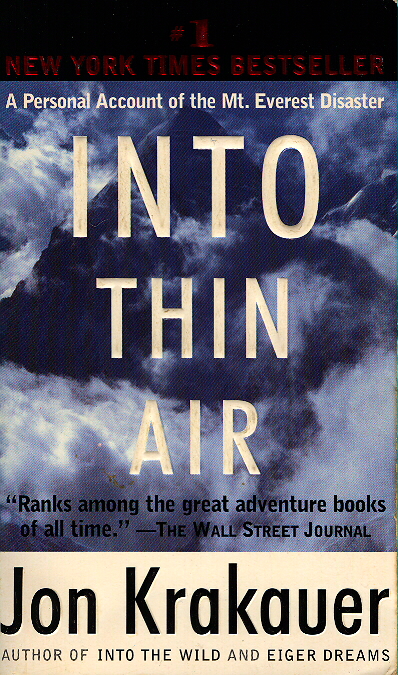
140labwriter
Into Thin Air Make no mistake, this is a very intense book, from first to last. Krakauer,a journalist, went to Mt. Everest prepared to write about one group's 1996 assault on the mountain and the issues surrounding amateur climbers being guided up the mountain. He certainly got more story than he bargained for.
One of the things I really enjoyed about this book was Krakauer's discussion of why people are compelled to climb mountains, far beyond the cliche "because it's there."
Krakauer writes a compelling, readable narrative; I knew what the outcome was going to be, of course, yet I literally couldn't put the book down.
Krakauer doesn't shy away from the controversies that surround that day; others in the group have written or sponsored books with different points of view of the events of that day. Krakauer's book was the first, and it is only one man's point of view. Additionally, he is quite open about what he believes to be his share of the blame for the deaths of his fellow climbers.
One of the things I really enjoyed about this book was Krakauer's discussion of why people are compelled to climb mountains, far beyond the cliche "because it's there."
Krakauer writes a compelling, readable narrative; I knew what the outcome was going to be, of course, yet I literally couldn't put the book down.
Krakauer doesn't shy away from the controversies that surround that day; others in the group have written or sponsored books with different points of view of the events of that day. Krakauer's book was the first, and it is only one man's point of view. Additionally, he is quite open about what he believes to be his share of the blame for the deaths of his fellow climbers.
141Donna828
I was riveted by Into Thin Air and every other book by Jon Krakauer that I've read. My favorite was Into the Wild, but then I love all things Alasaka.
142labwriter
Good point, Donna. I really want to read Into the Wild--Krakauer is such an excellent writer. I'm glad to hear you recommend it.
>137 alcottacre:. Which other books did you read? I would imagine the book by Beck Weathers, Left for Dead, would be a very difficult read, although one review says that it was very unfortuately padded into 300 pages. What in the world makes people with "mediocre" mountaineering skills take on a mountain like Everest? Beck Weathers really paid for his climb--lost his nose, had all his fingers and thumb on one hand amputated, had the other arm amputated at the elbow. Oof.
If I continue with this, I think I might be interested in reading Doctor on Everest.
>137 alcottacre:. Which other books did you read? I would imagine the book by Beck Weathers, Left for Dead, would be a very difficult read, although one review says that it was very unfortuately padded into 300 pages. What in the world makes people with "mediocre" mountaineering skills take on a mountain like Everest? Beck Weathers really paid for his climb--lost his nose, had all his fingers and thumb on one hand amputated, had the other arm amputated at the elbow. Oof.
If I continue with this, I think I might be interested in reading Doctor on Everest.
143labwriter
OK, I'm starting to think I might be just some sort of crank: I've managed to find yet another biography that is basically unreadable, Appetite for Life The Biography of Julia Child. Oh my goodness, I've been SAVING this one on my shelf, ever since I found it at the bookstore at Christmas. I even paid FULL PRICE for the thing, something I never, ever do. Is it me? Am I simply tired of biographies? Have I run out of steam with this genre? Good grief, I LOVE biographies. I have 187 of them in LT with tons of them in my library still to enter.
I started this thing last night and read the first 40 pages. It is SO BAD. The writing is so bad I would actually be pulled up short and SNORT out loud, one time waking up my husband. So I thought, OK, it's late, I'm tired, maybe I'm even a little bit depressed. I'll put this thing away and try later. The problem I was having with it is that Fitch inserts entire sentences in places where they don't fit--not even in a worst first draft. For the love of God, do publishing houses no longer employ editors? I even looked up Fitch to see if English is her first language, thinking that it might be a language issue. Nope, she graduated from the University of Washington (uh, so did the daughter of my husband's cousin who can't spell "cat," but I digress).
Seriously, being honestly concerned that maybe I've just lost my mind and can no longer discern good from bad when I'm reading--anything--I went to Amazon.com and looked up some of the "citizen" reviews for this thing. Well, thank the Lord, and I mean that, it would appear that maybe I'm not just completely nuts.
This is from one review I found, although this person gave the book 3 out of 5 stars, which seems generous if the reviewer really feels this way:
"Although the book provides a lot of interesting detail, the author often fails to thread them into any cohesive fashion, and page after page is factoid upon factoid with no apparent organizing principle."
Here's another one. Bless this person. Two-stars.
"There is no reason to read this book. As others have noted, it's chock-full of minutia, based very obviously on letters and diaries. The trouble is that there has been no selection process. Any detail, no matter how slight, is used to pad out this difficult to read book. I'm not talking about the interesting details (such as Julia's facelifts), I'm talking about what so-and-so's husband's uncle majored in at Yale." This reviewer is not kidding--it's that absurd.
This person actually wrote, "I wish I were a better writer so that I could adequately describe the badness of this biography." Hahaha. He suggests taking notes on the "howlers" and solecisms that are in this thing. (He also says that someone should teach Fitch that parentheses are an excuse for bad writing.)
OK, so what to do. Maybe I will actually take notes on the awefulness of this thing. I used to tell my students that recognizing bad writing can teach you something about good writing. If I limit myself to 10 pages a day, then I can get through it in 6 weeks. That also means that I need to find an AMAZING book--quick.
I started this thing last night and read the first 40 pages. It is SO BAD. The writing is so bad I would actually be pulled up short and SNORT out loud, one time waking up my husband. So I thought, OK, it's late, I'm tired, maybe I'm even a little bit depressed. I'll put this thing away and try later. The problem I was having with it is that Fitch inserts entire sentences in places where they don't fit--not even in a worst first draft. For the love of God, do publishing houses no longer employ editors? I even looked up Fitch to see if English is her first language, thinking that it might be a language issue. Nope, she graduated from the University of Washington (uh, so did the daughter of my husband's cousin who can't spell "cat," but I digress).
Seriously, being honestly concerned that maybe I've just lost my mind and can no longer discern good from bad when I'm reading--anything--I went to Amazon.com and looked up some of the "citizen" reviews for this thing. Well, thank the Lord, and I mean that, it would appear that maybe I'm not just completely nuts.
This is from one review I found, although this person gave the book 3 out of 5 stars, which seems generous if the reviewer really feels this way:
"Although the book provides a lot of interesting detail, the author often fails to thread them into any cohesive fashion, and page after page is factoid upon factoid with no apparent organizing principle."
Here's another one. Bless this person. Two-stars.
"There is no reason to read this book. As others have noted, it's chock-full of minutia, based very obviously on letters and diaries. The trouble is that there has been no selection process. Any detail, no matter how slight, is used to pad out this difficult to read book. I'm not talking about the interesting details (such as Julia's facelifts), I'm talking about what so-and-so's husband's uncle majored in at Yale." This reviewer is not kidding--it's that absurd.
This person actually wrote, "I wish I were a better writer so that I could adequately describe the badness of this biography." Hahaha. He suggests taking notes on the "howlers" and solecisms that are in this thing. (He also says that someone should teach Fitch that parentheses are an excuse for bad writing.)
OK, so what to do. Maybe I will actually take notes on the awefulness of this thing. I used to tell my students that recognizing bad writing can teach you something about good writing. If I limit myself to 10 pages a day, then I can get through it in 6 weeks. That also means that I need to find an AMAZING book--quick.
146labwriter
"Jilted"--perfect. Lucy, you have my permission from now 'till the end of time to post any darned thing of mine you want. Staying cheerful. :)
148alcottacre
#142: I have read both The Climb by Anatoli Boukreev and The Other Side of Everest by Matt Dickinson.
149labwriter
New book: Darkness Visible A Memoir of Madness by William Styron. It fits my mood. Haven't read "the daily 10" yet from the Child biog. Must get to that.
150sibylline
Hi friend, Styron came at Kay R. Jamison's invite, I think, to give a talk at Penn around when this book came out -- and I went with my mother to hear him --it was great to listen to in person. But I hope your aren't feeling that bad! I think you need to get into training for an ultra run, that'll snap you right out of any doldrums.....ha ha
151labwriter
Hi Lucy. That is 'way cool about hearing Styron talk. I'm not too far into this very short book of Styron's yet, but it's obvious that the guy understands serious clinical depression.
Well, let me just say that yesterday was a bad day and today is a day of adjustment. You're right about the exercise, but an ultra run? Dunno. Spinning today was so bad the woman leading the class even asked me if I was sick. I just told her it was a "recovery spin" day. She bought it. Heh.
Well, let me just say that yesterday was a bad day and today is a day of adjustment. You're right about the exercise, but an ultra run? Dunno. Spinning today was so bad the woman leading the class even asked me if I was sick. I just told her it was a "recovery spin" day. She bought it. Heh.
152sibylline
You'll understand after you read Born to Run I am going to be a total pain about that book I can tell, urging it on everyone.....
I am sorry you had a bad day, you know I really am.
I am sorry you had a bad day, you know I really am.
154elkiedee
I have Margaret Forster's new novel Isa and May on my library shelf and need to read it quite soon as it can't be renewed. It looks really good, about a young woman finding out about her two grandmothers (mothers/daughters/grandmothers seem to be something of a theme in her books).
155labwriter
>Oh, I'd love to hear what you think of Forster's new novel. I really love it that she's still writing--she's about 77 years old. I think it's really interesting how some writers are able to just keep going well into old age. I hope when I'm 77 years old, I'm doing something I love and being productive.
157labwriter
I'm reading a sibyx-recommended book, Born to Run. It's a funny and fascinating read.
158labwriter
And I'm also still plowing my way through the Noel Riley Fitch biography, Appetite for Life The Biography of Julia Child. I've promised myself I will read 10 pages a day (see post 143). Let's just say that I'm averaging 10 pages a day. This woman is driving me crazy with her parenthetical statements. If I were advising my students, I would tell them that overuse of parentheses is a sign of lazy writing. Why? If a writer uses lots of parenthetical statements, then it's probably because she needed to write another draft and, for whatever reason, didn't get around to it.
Here's a particularly egregious example from Fitch just from today's first 5 pages:
"Ella had dark, curly hair and was practical (she would always decorate the women's quarters)." Huh? Believe me, that poor sentence makes no more sense within the context of the rest of the page than it does all by its lonesome on this one. "Good writers work hard so that readers don't have to." What Fitch is doing there is expecting her readers to fill in the blanks, rather than writing a couple of sentences or a paragraph about "Ella" so the reader can understand who she is and why she's appearing in the book.
I would bet 1,000 bucks that Fitch never reads her stuff out loud when she's writing.
Gad. Five more pages and I can stop for today.
Here's a particularly egregious example from Fitch just from today's first 5 pages:
"Ella had dark, curly hair and was practical (she would always decorate the women's quarters)." Huh? Believe me, that poor sentence makes no more sense within the context of the rest of the page than it does all by its lonesome on this one. "Good writers work hard so that readers don't have to." What Fitch is doing there is expecting her readers to fill in the blanks, rather than writing a couple of sentences or a paragraph about "Ella" so the reader can understand who she is and why she's appearing in the book.
I would bet 1,000 bucks that Fitch never reads her stuff out loud when she's writing.
Gad. Five more pages and I can stop for today.
159tloeffler
Becky, you crack me up! I'm not sure I would be that good about reading something that awful. That is a horrible sentence. I'm with you about reading biographies--I love 'em, but mostly because I am nosy. You've given me some great suggestions. I hope I can get to them someday!
161alcottacre
#158: I am trying to figure out what being practical has to do with decorating the women's quarters. Am I missing something here? What does one have to do with the other?
OK, things like that would drive me crazy in a book. I think I will be passing on that one, too. I am not sure why you are continuing to read it to be honest, Becky.
OK, things like that would drive me crazy in a book. I think I will be passing on that one, too. I am not sure why you are continuing to read it to be honest, Becky.
162labwriter
159, 161. Hi Ladies. Thanks for stopping by. Terri, there are so many books I want to get to "someday," but that's OK. A life with no "next book" to look forward to is one I wouldn't want.
And alcottacre (sorry, I don't know your name), I guess I just have a peculiar fascination with BAD writing. I like being able to figure it out--why is this so bad? Not all bad writing is worth working on, but I guess I can at least say for Fitch that her stuff is worth it. What a shame for Julia Child, though. Fitch spends part of every chapter telling how much fun and what a great personality Julia had. It's just too bad that Julia doesn't have a better biography. The shame of it is, I think Fitch is capable of writing that good biography. I would love to know the story of what happened to this one.
Bye for now!
And alcottacre (sorry, I don't know your name), I guess I just have a peculiar fascination with BAD writing. I like being able to figure it out--why is this so bad? Not all bad writing is worth working on, but I guess I can at least say for Fitch that her stuff is worth it. What a shame for Julia Child, though. Fitch spends part of every chapter telling how much fun and what a great personality Julia had. It's just too bad that Julia doesn't have a better biography. The shame of it is, I think Fitch is capable of writing that good biography. I would love to know the story of what happened to this one.
Bye for now!
163alcottacre
#162: The name is Stasia. Please use it - everyone else does :)
165alcottacre
Hello, Becky.
166labwriter
I'm still working on my "bad writing" biography of Julia Child. I got a little bogged down in it because of a couple of other books I was reading that are now finished. I can only put so much of this horrible stuff in my head at once without having blood shoot from my eyes, so I have to be careful and read only about 10 pages a day. I'm also terribly afraid that if I read too much of this I will end up WRITING like this woman.
This sentence from Julia Child Appetite for Life by Noel Riley Fitch gets my vote for the most hilariously bad sentence yet. I swear, it's as if the publisher accidently published her ragged first draft instead of her finished fifth.
"Just after a visit by General Donovan, and a great cocktail party and dinner with Chinese and American generals, Heppner was promoted to full colonel at the same time the October monsoon rains drenched the compound, occasionally dampening Julia's papers."
I feel like I've been transported to the Bulwer-Lytton bad writing contest.
This sentence from Julia Child Appetite for Life by Noel Riley Fitch gets my vote for the most hilariously bad sentence yet. I swear, it's as if the publisher accidently published her ragged first draft instead of her finished fifth.
"Just after a visit by General Donovan, and a great cocktail party and dinner with Chinese and American generals, Heppner was promoted to full colonel at the same time the October monsoon rains drenched the compound, occasionally dampening Julia's papers."
I feel like I've been transported to the Bulwer-Lytton bad writing contest.
167alcottacre
I think I am pretty much safe in saying that I will not be reading that book any time soon - if ever.
168PamFamilyLibrary
@148,
Stasia, do you recommend The Climb and The Other Side of Everest?
(I've already added the Beck Weathers book to the hole.)
Stasia, do you recommend The Climb and The Other Side of Everest?
(I've already added the Beck Weathers book to the hole.)
169labwriter
Just finished a fine first novel, Hawk, by Brian Neary. I'm a spy thriller fan, and this one was enjoyable. So many of these disappoint with a weak ending, but Neary's book gets stronger as the story unfolds. Great characters. I'm thinking the book world will be hearing more from Neary.
170alcottacre
#168: Yes - although not really for their writing styles, more for getting the other side of Krakauer's story.
171alcottacre
#169: I will look for that one. Thanks for the recommendation, Becky.
173labwriter
>172 sibylline:. Hi Lucy. I just posted on your thread--if you're up for The Education of Henry Adams, then so am I. Only problem is that it's on my Kindle and my son is reading something there. I'd never thought about that before, but if you lend your Kindle like you lend someone a book, then you're doing yourself out of everything that's on there until you get it back. Well, Don has one as well, so I can put the H.A. book on his and read it that way. Have you started it yet?
174sibylline
This is so entirely cool. I was just wishing that I could read a book at the same time as someone else .... so yes indeedy. In fact, I have not actually opened it up because packing took over my life today, plus a revision. So let's do it. Tell me when you get your kindle set up and how many pages a day would make sense for you. I am so pleased!!
175labwriter
I've crabbed and whined here a lot about Noel Riley Fitch's Appetite for Life The Biography of Julia Child. Well, it is my thread, so I figure I can post what I want to post. Anyway, I'm now about halfway through the thing, and I'm about to throw a big fat curveball:
The outsized, outgoing, amazing personality and life of Julia Child transcends the bad writing of this biography. That's right. This book has been one of the most difficult biographies, because of the writing style, yet one of them most enjoyable, because of the personality of the subject, I have ever read. Not only can I say what I want here, I can also write sentences like that last one if I want to--heh. I'm so glad I persevered. I absolutely love Julia Child, even though I'm sure if I met her, her extroversion would wear out my introversion within an hour. I'm so impressed with the work she did on that cookbook, Mastering the Art of French Cooking. She and her coauthor labored on it for years. At one point, about five or seven years into it, she and her husband Paul Child are transferred to Germany with his government job. "Thank heavens for the book," she says. I'm ordering a copy of the book tout de suite, not necessarily because I want to cook from it (although I might), but because I want to read it.
The outsized, outgoing, amazing personality and life of Julia Child transcends the bad writing of this biography. That's right. This book has been one of the most difficult biographies, because of the writing style, yet one of them most enjoyable, because of the personality of the subject, I have ever read. Not only can I say what I want here, I can also write sentences like that last one if I want to--heh. I'm so glad I persevered. I absolutely love Julia Child, even though I'm sure if I met her, her extroversion would wear out my introversion within an hour. I'm so impressed with the work she did on that cookbook, Mastering the Art of French Cooking. She and her coauthor labored on it for years. At one point, about five or seven years into it, she and her husband Paul Child are transferred to Germany with his government job. "Thank heavens for the book," she says. I'm ordering a copy of the book tout de suite, not necessarily because I want to cook from it (although I might), but because I want to read it.
176sibylline
So there you are, that's the second time recently that your persistence has been rewarded!
177labwriter
>174 sibylline:. Oh great! I can't do "pages" on the Kindle. Does the book have chapters? About how many do you want to do a day? I can do anywhere up to about 50. Would that be enough? If not, I can push.
178sibylline
I know I can do two chapters a day, sometimes maybe three. Tomorrow, for example, I'm fairly sure I can do three. Not so sure about Sunday..... I suppose we can let each other know as we go, if the day is just too crazy for three? I would like to keep things moving along. Wolf Solent is a slow read, unavoidably, so I don't want to be get too bogged. I'll probably finish them at the same time!
180TadAD
>177 labwriter:: I can't do "pages" on the Kindle.
In my mind, that is one of the greatest flaws of the Kindle. Not only is there no page numbering, but the calculation is only approximate because of font changes, spacing, etc.
I do wish Mr. Bezos would have decided to put page number corresponding to one of the editions (probably hard cover) into the "margin" of the Kindle so that one could meaningfully discuss locations with non-Kindle readers.
I saw an article the other day by some academics upset about this. The Kindle has a lot of advantages for academia because so much can be carried so easily, but the inability to cite properly is a problem.
In my mind, that is one of the greatest flaws of the Kindle. Not only is there no page numbering, but the calculation is only approximate because of font changes, spacing, etc.
I do wish Mr. Bezos would have decided to put page number corresponding to one of the editions (probably hard cover) into the "margin" of the Kindle so that one could meaningfully discuss locations with non-Kindle readers.
I saw an article the other day by some academics upset about this. The Kindle has a lot of advantages for academia because so much can be carried so easily, but the inability to cite properly is a problem.
181labwriter
>180 TadAD:. I absolutely agree. They somehow have to come up with a fix for this. And you bring up an issue I hadn't thought of--how do you cite pages for an academic paper from the Kindle? An online APA styleguide suggests paraphrasing, which is absurd and not a solution. I can't find an even halfway reasonable suggestion from an MLA styleguide. One place suggests you cite the chapter and paragraph. Not good.
182TadAD
>181 labwriter:: The article I read said that:
1) Don't cite from Kindle because of this problem. Look it up in a "real" book.
2) If you must cite from the Kindle, specify the the location number.
3) See #1.
They were quite hot about the topic...really wanting to use the Kindle but quite frustrated. I guess it makes sense. Academic books have become so expensive and are so unwieldy in size and weight that having them in a nicely portable format would really be a boon.
The problem with Kindle location number in my mind is that it's only good for the Kindle. If you put that same book on a different ereader, what do you do?
I think the answer is for the electronic formats for books to steal a page from other electronic documents...number the words. It's trivial for software to do it and they could simply put a little number at the bottom that corresponds to the word number of your cursor location. This would be neutral across ereaders, font sizes, etc. Stick your cursor on the citation location and then you could just write something like:
Homer, The Odyssey (Penguin Classics Kindle Edition, 1 September 2006), words 398-410
1) Don't cite from Kindle because of this problem. Look it up in a "real" book.
2) If you must cite from the Kindle, specify the the location number.
3) See #1.
They were quite hot about the topic...really wanting to use the Kindle but quite frustrated. I guess it makes sense. Academic books have become so expensive and are so unwieldy in size and weight that having them in a nicely portable format would really be a boon.
The problem with Kindle location number in my mind is that it's only good for the Kindle. If you put that same book on a different ereader, what do you do?
I think the answer is for the electronic formats for books to steal a page from other electronic documents...number the words. It's trivial for software to do it and they could simply put a little number at the bottom that corresponds to the word number of your cursor location. This would be neutral across ereaders, font sizes, etc. Stick your cursor on the citation location and then you could just write something like:
Homer, The Odyssey (Penguin Classics Kindle Edition, 1 September 2006), words 398-410
183labwriter
Numbering words--I like that idea. It makes absolutely no sense to make a rule about not citing from a Kindle but instead from a "real" book. That wouldn't fly, especially since it's not just the issue of quoting from academic books. Anyone writing a paper who has to cite a source--any source--is stuck with this problem if their book source is a Kindle or other electronic reader. MLA and APA have to do better than that, and I think the idea of numbering the words makes probably more sense than most other solutions.
I can't believe they don't already have this figured out yet. --Oh wait a minute, yes I can, since out of 150-some English professors, instructors, adjuncts, TA's, etc., only four of us in the department used the university-wide online course software when it was first put into place. In my experience, academics (some--and perhaps English departments are worse than most) are notoriously averse to using technology or changing the way they do things. Quite pitiful, really.
I can't believe they don't already have this figured out yet. --Oh wait a minute, yes I can, since out of 150-some English professors, instructors, adjuncts, TA's, etc., only four of us in the department used the university-wide online course software when it was first put into place. In my experience, academics (some--and perhaps English departments are worse than most) are notoriously averse to using technology or changing the way they do things. Quite pitiful, really.
184labwriter
Appropos to my post at 183, I was just reading an article comparing the Kindle to the iPad, with the prediction that the iPad will be the death of the Kindle. Maybe, except that the iPad costs about 2.5 times as much as the Kindle, so maybe "death of the Kindle" is a bit of an exaggeration just yet.
What the iPad does that the Kindle doesn't (among other things) is to keep track of however many pages remain in the chapter on the screen. I haven't seen the iPad in action myself, so I don't know if that means that the reader also knows how many pages are included in the book and what page they are reading. The article in the L.A. Times said this: What this acknowledges is that there is a rhythm to reading: The first page of a heavy Harry Potter book promises 600 more; the thinning final pages of an Agatha Christie novel clue us in to the mystery getting sorted out. The iPad builds that into the e-reading experience.
And for me, that's HUGE. I hate having only a rough estimate of where I am in whatever I'm reading on the Kindle. Is it enough to pay 2.5 times the price? No. And yes, I recognize that the iPad does much more than simply act as a e-reader. But I don't need the portablility that the iPad offers at that price.
What the iPad does that the Kindle doesn't (among other things) is to keep track of however many pages remain in the chapter on the screen. I haven't seen the iPad in action myself, so I don't know if that means that the reader also knows how many pages are included in the book and what page they are reading. The article in the L.A. Times said this: What this acknowledges is that there is a rhythm to reading: The first page of a heavy Harry Potter book promises 600 more; the thinning final pages of an Agatha Christie novel clue us in to the mystery getting sorted out. The iPad builds that into the e-reading experience.
And for me, that's HUGE. I hate having only a rough estimate of where I am in whatever I'm reading on the Kindle. Is it enough to pay 2.5 times the price? No. And yes, I recognize that the iPad does much more than simply act as a e-reader. But I don't need the portablility that the iPad offers at that price.
185jasmyn9
This is one of the the things I like about the Nook....it has page numbers. I've tried to see if they line up exactly with the pages from the corresponding release of the book, and the couple that I had available to do that with, did correspond with the paper book's pages.
Where problems will arise is once books are released exclusively in ereader format with no actual book to reference. Then what?
>#184 The nook has the page slide bar as well. It shows the page you are on, the total pages and a progress bar. The Nook can also read Adobe files...and I can convert just about any document I have into an adobe.
Where problems will arise is once books are released exclusively in ereader format with no actual book to reference. Then what?
>#184 The nook has the page slide bar as well. It shows the page you are on, the total pages and a progress bar. The Nook can also read Adobe files...and I can convert just about any document I have into an adobe.
186labwriter
One of the great things about reading broadly--books outside your main interest or that maybe don't have any relation to anything else in your library--is the idea that you never know when you're going to learn something that relates to your own life in an unexpected way.
I never thought I would be using my Julia Child biography (Appetite for Life The Biography of Julia Child) for my family genealogy project.
Julia and her biographer have helped me to understand why in heck my mother was such a bad cook. Genealogy? Yes, since I've been trying to understand why a full-time homemaker in the 1950s would put something on the table like frozen chicken pot pies and call it dinner. Seriously, I was a teenager before I ever ate a vegetable that didn't come out of a can. What was with that? Julia has helped me to understand.
When Julia Child was in France writing her "French Cooking for Dummies" cookbook (that's not to disparage either Julia or her fabulous cookbook--it's just a joke), "women in the United States were learning to cook chicken pot pies, corned beef hash, confetti Jell-O, carrot-raisin slaw, and macaroni annd cheese." Open a can or a box--use a mix rather than whip up something using fresh ingredients. Like other women of the 1950s, my mother was the Queen of the can opener and the boxed cake, encouraged by the women's magazines. Now I get it. Thanks, Julia.
I never thought I would be using my Julia Child biography (Appetite for Life The Biography of Julia Child) for my family genealogy project.
Julia and her biographer have helped me to understand why in heck my mother was such a bad cook. Genealogy? Yes, since I've been trying to understand why a full-time homemaker in the 1950s would put something on the table like frozen chicken pot pies and call it dinner. Seriously, I was a teenager before I ever ate a vegetable that didn't come out of a can. What was with that? Julia has helped me to understand.
When Julia Child was in France writing her "French Cooking for Dummies" cookbook (that's not to disparage either Julia or her fabulous cookbook--it's just a joke), "women in the United States were learning to cook chicken pot pies, corned beef hash, confetti Jell-O, carrot-raisin slaw, and macaroni annd cheese." Open a can or a box--use a mix rather than whip up something using fresh ingredients. Like other women of the 1950s, my mother was the Queen of the can opener and the boxed cake, encouraged by the women's magazines. Now I get it. Thanks, Julia.
187sibylline
In some Mary McCarthy novel (or was it autobiographical?) there is a long diatribe about the horrible cooking of the fifties and the impossibility of buying fresh good ingredients for ANYTHING -- I'm thinking maybe she had come back from Europe or something and was eager to cook some good meals and there was NOTHING. You couldn't buy a decent vegetable. It was quite funny and has stuck in my mind for decades. I have no idea which of her books it was in......
I was very very lucky that way. My mother fell in love with Italian cooking when my father was on Sabbatical in 1961 and even more fortunately she liked, in general, to cook, not having known, literally how to boil an egg when she married at 19 -- vegetables were not her strongest suit, but they never came out of a can. We did eat a lot of frozen peas, succotash and the like and she made creamed spinach from frozen spinach those were our primary vegetables --- I was stunned the first time I made it from fresh spinach --
I was very very lucky that way. My mother fell in love with Italian cooking when my father was on Sabbatical in 1961 and even more fortunately she liked, in general, to cook, not having known, literally how to boil an egg when she married at 19 -- vegetables were not her strongest suit, but they never came out of a can. We did eat a lot of frozen peas, succotash and the like and she made creamed spinach from frozen spinach those were our primary vegetables --- I was stunned the first time I made it from fresh spinach --
189labwriter
My dad was the cook in our family--he ran a restaurant until Alta told him either the restaurant had to go or she would go. It was a totally empty threat, and in any case, it should have been her. Everything I learned about cooking, I learned from my dad. He tolerated her cooking because he was able to go out for lunch every day--"us kids" weren't that lucky. I loved his Saturday morning breakfasts. I will never, ever forget them. Oh, the stuff she cooked! Ugh.
If you can recall which McCarthy book that was in, I would love to know. I really like her stuff.
If you can recall which McCarthy book that was in, I would love to know. I really like her stuff.
190sibylline
Another anecdote along those lines was in a Margaret Mead memoir , her daughter wrote about growing up in that household.-- someone told Mead that no one would think she was a bad wife/mother if the house always smelled of chicken soup, so she kept a pot bubbling on the stove...... and went off to do her thing!
191sibylline
I just browsed around and it has to be A Charmed Life which I read when I was working in Wellfleet -- land of Edmund Wilson -- I think someone told me to read it because it was a thinly disguised lambasting and pretty dishy. Which it was. And the protagonist is just coming back from many years in Italy or somewhere, that would be it. I have to add it to my library.
192labwriter
>191 sibylline:. Thanks, Lucy.
I just spent somewhere between 2 and 3 hours reading another 100 pages of the Julia Child biography. This thing is interminable. I'm finally, finally 2/3 of the way through the book. The chapters of the book are well-enough organized; however, Noel Riley Fitch jumps from paragraph to paragraph and thought to thought with zero transition. It's as if she wrote paragraphs onto note cards, piled them up chronologically, and then just typed the cards into her manuscript one after another. Fact after fact with no analysis and no sense of proportion to the life.
Julia Child deserves a great biography, and it's because of her wonderful personality that I stick with this frustrating, disappointing book. She and her husband Paul, who worked with the State Department, lived for extended periods of time in France, Germany, and Norway. Whenever they were posted to a new country, like everything else she did, she would throw herself into becoming a part of the new culture. Here's Julia in a nutshell: "Julia, always curious about German cuisine and history (she was always curious about everything), decided she would learn more about its literature by taking a course on Goethe. . . . She took a three week course at the University of Bonn, wrote a paper ('though it is a bit over my head'), and passed the examination. She also had the entire university class over for a party." It wouldn't be Julia without the party.
She worked for 10 years on her masterpiece cookbook, Mastering the Art of French Cooking. It's a mind-boggling story, the work she put into it and the care that she and her collaborators took to make the book perfect and useful and something unique. The way she wrote her recipes has been copied by cookbook writers ever since.
I just spent somewhere between 2 and 3 hours reading another 100 pages of the Julia Child biography. This thing is interminable. I'm finally, finally 2/3 of the way through the book. The chapters of the book are well-enough organized; however, Noel Riley Fitch jumps from paragraph to paragraph and thought to thought with zero transition. It's as if she wrote paragraphs onto note cards, piled them up chronologically, and then just typed the cards into her manuscript one after another. Fact after fact with no analysis and no sense of proportion to the life.
Julia Child deserves a great biography, and it's because of her wonderful personality that I stick with this frustrating, disappointing book. She and her husband Paul, who worked with the State Department, lived for extended periods of time in France, Germany, and Norway. Whenever they were posted to a new country, like everything else she did, she would throw herself into becoming a part of the new culture. Here's Julia in a nutshell: "Julia, always curious about German cuisine and history (she was always curious about everything), decided she would learn more about its literature by taking a course on Goethe. . . . She took a three week course at the University of Bonn, wrote a paper ('though it is a bit over my head'), and passed the examination. She also had the entire university class over for a party." It wouldn't be Julia without the party.
She worked for 10 years on her masterpiece cookbook, Mastering the Art of French Cooking. It's a mind-boggling story, the work she put into it and the care that she and her collaborators took to make the book perfect and useful and something unique. The way she wrote her recipes has been copied by cookbook writers ever since.
193sibylline
I would read a good biography about Julia -- have to get somebody working on one! This often happens -- the first bio is often just a laundry list of the person's accomplishments -- the biographer gets overwhelmed just trying to gather all the information and then is too exhausted or demoralized (or on a wicked time pressure having taken the advance) to take the time to finish properly..... This bio will be useful to the next one..... but maybe no one else!
194labwriter
>193 sibylline:. What you say is true much of the time, but it shouldn't have been the case with Noel Riley Fitch. She's an experienced biographer who wrote a wonderful book about Sylvia Beach and her Paris bookshop, Shakespeare and Company--Sylvia Beach and the Lost Generation: A History of Literary Paris in the Twenties and Thirties. I really loved that book, and therefore it's a complete mystery to me why this Julia Child biography is so poorly written. Fitch was born in 1937, making her 73 years old (the photo of her on her website makes her look like she's half that age). The website says she's now working on another biography, the mistress of Louis XV, so maybe she just felt the march of time and decided to declare the Julia Child book "good enough." My guess (and it's only a guess) is that Fitch wanted to get the book published and move on.
The Julia Child book also suffers from being an authorized biography, so there's no telling who was hanging over Fitch's shoulder as she wrote the book. Julia died in 2004 and the book was published in 1997, so I guess Julia could have been a rather heavy presence while Fitch was writing this thing.
"Authorized biography." That's another problem with this book--the hagiographic haze through which Fitch insists her readers must view her central character. No one is a saint, yet Fitch doesn't find a single detail in Julia's life or personality that even touches on the negative. I don't demand "dirt" on a biographical subject; however, I would like to feel the biographer has at least some fidelity with reality. Not so much here.
I whacked out another 100 pages yesterday, so I'm on the home stretch--the last 90 pages. I hope to finish the thing today and MOVE ON.
The Julia Child book also suffers from being an authorized biography, so there's no telling who was hanging over Fitch's shoulder as she wrote the book. Julia died in 2004 and the book was published in 1997, so I guess Julia could have been a rather heavy presence while Fitch was writing this thing.
"Authorized biography." That's another problem with this book--the hagiographic haze through which Fitch insists her readers must view her central character. No one is a saint, yet Fitch doesn't find a single detail in Julia's life or personality that even touches on the negative. I don't demand "dirt" on a biographical subject; however, I would like to feel the biographer has at least some fidelity with reality. Not so much here.
I whacked out another 100 pages yesterday, so I'm on the home stretch--the last 90 pages. I hope to finish the thing today and MOVE ON.
195labwriter
Oh my, 60 more pages to go--have I really only read 30 since last night? At some point when writing this biography of Julia Child, Fitch decided to go for breadth rather than depth. Couple that with what seems to be Julia's frenetic pace during the last couple of decades of her life (what was she running from?), and what you have for the last quarter of the book are the names of the 5,000 or so people that Julia had a meal with, including the details of what they ate, almost down to the spoonful, every one of her filming sessions, including the names of wardrobe ranglers, secretaries to the script writer, buyers of her size-12 shoes--you name it, Fitch has included it.
I would have found more interesting an in-depth treatment of Julia's life. She evidently had a close and meaningful friendship for years with James Beard, yet all we get is "James was there" about 1,000 times and very little else. I know the name James Beard, I can picture him in my mind, but I don't know any details of his life. Surely if these two people were as close as Fitch indicates, then they must have influenced each other's work. That's the sort of background and analysis that's missing from Julia Child Appetite for Life.
There's also the issue of her schedule--taping shows, writing books, promoting books, doing other promotional work as well as volunteer work and fund-raising--most of which involved bi-coastal travel (or tri-coastal, which was Julia's joke), since by this time in their lives they owned three homes--one in Cambridge, Mass, one in California, and one in France. Her husband Paul had a phobia about flying, but to save time they flew--and he did his best to overcome his fear of flying. Also, for about the last 10+ years of his life, Paul, who was 10 years older than his wife, was infirm and struggled with aphasia caused by strokes he suffered during heart surgery. He was a linguist with aphasia--no frustration there /sarcasm/. He hated being alone, so Julia's solution was to drag him with her everywhere she went. They would sit him at the table when she did her book signings, his answers to questions "inappropriate" when a fan asked Julia a question. Fitch construes that to be "love and concern," evidently because he was with Julia rather than left alone. Fitch shows how Julia continued to work at a pace that would have struck down someone half her age because they "needed the money." Yet they would fly to and from Europe on the Concord because their financial advisor told them they needed to "spend more." My point with this is that Julia Child perhaps was not the saint that Fitch makes her out to be--none of us are perfect, including Julia Child. An analysis of what was going on with Julia at this point in her life would have been far more interesting than yet another another 1,000 names of dinner companions.
Sixty pages more . . .
I would have found more interesting an in-depth treatment of Julia's life. She evidently had a close and meaningful friendship for years with James Beard, yet all we get is "James was there" about 1,000 times and very little else. I know the name James Beard, I can picture him in my mind, but I don't know any details of his life. Surely if these two people were as close as Fitch indicates, then they must have influenced each other's work. That's the sort of background and analysis that's missing from Julia Child Appetite for Life.
There's also the issue of her schedule--taping shows, writing books, promoting books, doing other promotional work as well as volunteer work and fund-raising--most of which involved bi-coastal travel (or tri-coastal, which was Julia's joke), since by this time in their lives they owned three homes--one in Cambridge, Mass, one in California, and one in France. Her husband Paul had a phobia about flying, but to save time they flew--and he did his best to overcome his fear of flying. Also, for about the last 10+ years of his life, Paul, who was 10 years older than his wife, was infirm and struggled with aphasia caused by strokes he suffered during heart surgery. He was a linguist with aphasia--no frustration there /sarcasm/. He hated being alone, so Julia's solution was to drag him with her everywhere she went. They would sit him at the table when she did her book signings, his answers to questions "inappropriate" when a fan asked Julia a question. Fitch construes that to be "love and concern," evidently because he was with Julia rather than left alone. Fitch shows how Julia continued to work at a pace that would have struck down someone half her age because they "needed the money." Yet they would fly to and from Europe on the Concord because their financial advisor told them they needed to "spend more." My point with this is that Julia Child perhaps was not the saint that Fitch makes her out to be--none of us are perfect, including Julia Child. An analysis of what was going on with Julia at this point in her life would have been far more interesting than yet another another 1,000 names of dinner companions.
Sixty pages more . . .
196sibylline
I am getting a lot out of your Julia posts --- and laughing sometimes at the inanities -- the one saying she 'has to do it for the money' and their advisor telling them they should be spending more...... both are probably true! There is a dog chasing its tail aspect to being rich and spending richly and living richly...... to keep it up you have to keep moving all the time and you have to keep doing things you can DEDUCT from your taxes -- taking the Concorde was probably a terrific way to get a whopping tax benefit since of course it was always for work..... you get the idea????
198labwriter
OK, so now having read another 20 pages or so, I'm going to back off my previous rant about Julia's crazy schedule and her husband Paul. This was one tough woman who did what had to be done without whining. She finished the manuscript of her last book, The Way to Cook and put husband Paul in a nursing home in Boston almost the very same week.
One of her lifelong friends is quoted in the book: "Yankees do not indulge themselves. No keening or verbal analysis. Yes, Julia can weep, but she will not beat her breast. She is open, but she never spills." Another friend said, "She has a certain moral toughness that is very well illustrated by her competence and devotion in taking care of Paul." Almost a decade before, she had written a letter to a young friend whose mother had dementia and was living with them: "You must get her into a senior citizen place . . . so that she can be taken care of, and so that you can be at peace and lead some kind of normal life. I am sure she herself would be horrified if she knew your suffering. . . . You will feel guilty, as everyone does, but you have, Fanny, been a generous, loving, and caring daughter." Then she added a few words about "the agony of being tough about it."
She had taken care of her husband for 15 years, and at the end she did the hard thing that needed to be done--and somehow she also managed to finish her last book. This at the age of 77. I guess I wish this sort of analysis had been more front-and-center throughout the biography. Where has it been? These last chapters are excellent, but I have to believe that not many people stayed with the book long enough to get to them.
Her last book was published in 1989: "She informed the press that her book was written for 'someone who wants to learn to cook but already knows the basics . . . a lot like learning backhand in tennis.'" I really could have used this book 20 or so years ago, and I can't figure out why in heck I never bought a copy--perhaps it was because I was working nights as a nurse and barely had time to boil water for pasta. I bought the book just now--it feels like a reward to myself for making it through this biography. Somehow I think Julia would agree--and laugh. One of Julia's favorite expressions: bouter en avant (barrel on through).
Forty pages to go.
One of her lifelong friends is quoted in the book: "Yankees do not indulge themselves. No keening or verbal analysis. Yes, Julia can weep, but she will not beat her breast. She is open, but she never spills." Another friend said, "She has a certain moral toughness that is very well illustrated by her competence and devotion in taking care of Paul." Almost a decade before, she had written a letter to a young friend whose mother had dementia and was living with them: "You must get her into a senior citizen place . . . so that she can be taken care of, and so that you can be at peace and lead some kind of normal life. I am sure she herself would be horrified if she knew your suffering. . . . You will feel guilty, as everyone does, but you have, Fanny, been a generous, loving, and caring daughter." Then she added a few words about "the agony of being tough about it."
She had taken care of her husband for 15 years, and at the end she did the hard thing that needed to be done--and somehow she also managed to finish her last book. This at the age of 77. I guess I wish this sort of analysis had been more front-and-center throughout the biography. Where has it been? These last chapters are excellent, but I have to believe that not many people stayed with the book long enough to get to them.
Her last book was published in 1989: "She informed the press that her book was written for 'someone who wants to learn to cook but already knows the basics . . . a lot like learning backhand in tennis.'" I really could have used this book 20 or so years ago, and I can't figure out why in heck I never bought a copy--perhaps it was because I was working nights as a nurse and barely had time to boil water for pasta. I bought the book just now--it feels like a reward to myself for making it through this biography. Somehow I think Julia would agree--and laugh. One of Julia's favorite expressions: bouter en avant (barrel on through).
Forty pages to go.
199alcottacre
#198: Forty pages to go.
You can do it, Becky! I admire you for sticking with it. I think I probably would have pitched the book by now.
You can do it, Becky! I admire you for sticking with it. I think I probably would have pitched the book by now.
201labwriter
Last night I finished the Julia Child, and while Fitch did seem more engaged with the later chapters, she stayed true to form with her lazy organization that drove me nuts throughout the book.
I'm giving this book a 4-star rating, the reason being that, while on the one hand it is deeply flawed, on the other hand the subject is so fascinating that it's worth the tough slog getting through the bad writing. This is such a shame, because with comparatively very little more effort, Fitch could have made this an outstanding biography.
Julia Child is an amazing role model for living, but particularly, I think, for aging well. She was forward thinking, particularly about the deaths of people close to her. She would grieve for them, but then she moved on. She also included young people in her large circile of friends and working partners, so that she was very much tuned into the fads and philosophies of the younger set. Additionally, she never lost her curiosity--about anything and everything. For example, when she was 80 years old and telling everyone that she had written her final book (because the writing process was too confining), she joined a Food Writers workshop in San Francisco to study writing techniques. Amazing!
When she was in her late 70s, she had a couple of minor accidents with her car which involved backing into the neighbor's station wagon when pulling out of her driveway (twice--ouch!). Someone told her she was a bad driver, so she responded, "Okay, then, I will get a Volvo," and she purchased a fire-engine red Volvo. Now hopefully people around her were able to get the car keys out of her hands before she became a real danger--I'm not advocating for scary old-people driving. However, I think the red Volvo solution speaks volumes to her philosophy and approach to life.
Frankly, being around Julia Child probably would have frazzled and exhausted me. I'm not sure I've ever known of anyone with such a high energy level. However, it's been fascinating to learn about her. It's a shame, though, that she didn't have a better biographer.
I'm giving this book a 4-star rating, the reason being that, while on the one hand it is deeply flawed, on the other hand the subject is so fascinating that it's worth the tough slog getting through the bad writing. This is such a shame, because with comparatively very little more effort, Fitch could have made this an outstanding biography.
Julia Child is an amazing role model for living, but particularly, I think, for aging well. She was forward thinking, particularly about the deaths of people close to her. She would grieve for them, but then she moved on. She also included young people in her large circile of friends and working partners, so that she was very much tuned into the fads and philosophies of the younger set. Additionally, she never lost her curiosity--about anything and everything. For example, when she was 80 years old and telling everyone that she had written her final book (because the writing process was too confining), she joined a Food Writers workshop in San Francisco to study writing techniques. Amazing!
When she was in her late 70s, she had a couple of minor accidents with her car which involved backing into the neighbor's station wagon when pulling out of her driveway (twice--ouch!). Someone told her she was a bad driver, so she responded, "Okay, then, I will get a Volvo," and she purchased a fire-engine red Volvo. Now hopefully people around her were able to get the car keys out of her hands before she became a real danger--I'm not advocating for scary old-people driving. However, I think the red Volvo solution speaks volumes to her philosophy and approach to life.
Frankly, being around Julia Child probably would have frazzled and exhausted me. I'm not sure I've ever known of anyone with such a high energy level. However, it's been fascinating to learn about her. It's a shame, though, that she didn't have a better biographer.
202alcottacre
#201: Congratulations on finally finishing it, Becky!
203labwriter
Thanks much, Stasia.
I've started reading Empire by Gore Vidal, a nice segue from the Henry Adams group read, Education of Henry Adams, which a few of us are reading now. I'd like to figure out from Vidal how much "real history" is too much in writing an historical novel. The answer may be that it's not possible to push the issue of facts in fiction too far. I would say that for me a book like Joyce Carol Oates' Blonde, the fictionalized life of Marilyn Monroe, goes too far, perhaps because the book focuses on one person. I think Vidal's focus is more the period rather than the people, although the people make it fun.
I'm 50 pages into it, and so far I'm finding it pretty readable and also amusing. He appears to be having fun making Henry James "talk." It's also fun to encounter a "living, breathing" Henry Adams after reading 15 chapters of his Education.
I've started reading Empire by Gore Vidal, a nice segue from the Henry Adams group read, Education of Henry Adams, which a few of us are reading now. I'd like to figure out from Vidal how much "real history" is too much in writing an historical novel. The answer may be that it's not possible to push the issue of facts in fiction too far. I would say that for me a book like Joyce Carol Oates' Blonde, the fictionalized life of Marilyn Monroe, goes too far, perhaps because the book focuses on one person. I think Vidal's focus is more the period rather than the people, although the people make it fun.
I'm 50 pages into it, and so far I'm finding it pretty readable and also amusing. He appears to be having fun making Henry James "talk." It's also fun to encounter a "living, breathing" Henry Adams after reading 15 chapters of his Education.
204alcottacre
#203: I will be watching for your review of the Vidal book once you have it finished. It sounds like one I might try.
205labwriter
I'm trying to blast through Vidal's Empire as quickly as I can. His writing is engaging, his research seems solid. Vidal is at his most amusing when he has a group together discussing the issues of the day--like John Hay, Henry Adams, and Henry Cabot Lodge. I find myself somewhat less amused with his "created" characters like Caroline Sanford and her "half brother," Blaise Sanford.
The book is set in 1898 in New York and Washington, D.C. during the McKinley administration. I know next to nothing about McKinley, so I'm at the mercy of Vidal's interpretation for what was going on in Washington at that time.
The book is set in 1898 in New York and Washington, D.C. during the McKinley administration. I know next to nothing about McKinley, so I'm at the mercy of Vidal's interpretation for what was going on in Washington at that time.
206Donna828
Whew! Congratulations on making it to the end of the Julia Child bio. Thanks for taking that bullet for us! I'm glad you ended up liking it well enough to rate it 4 stars, but it sounds like an agonizing read. Too bad, because she really is a fascinating woman.
I've noticed the flurry of activity in your spontaneous read of The Education of Henry Adams. The time for reading that one isn't right for me, but I like the way you and Lucy are taking your time with it and doing a thorough discussion. So many group reads are just that. Reading the book at the same time, but little in-depth discussion about it.
I've noticed the flurry of activity in your spontaneous read of The Education of Henry Adams. The time for reading that one isn't right for me, but I like the way you and Lucy are taking your time with it and doing a thorough discussion. So many group reads are just that. Reading the book at the same time, but little in-depth discussion about it.
207labwriter
Hi Donna! Thanks for your nice words. I would say that the Julia Child book was one of the hardest books I've ever stayed with, and I think the reason I kept at it was because of LT. Being able to "vent," whether anyone was reading it or not, really helped me get through it.
And Henry Adams is no walk in the park, that's for sure. It's not that his writing is difficult--it's very clear and concise--he writes so well. The problem is just having so little context for what he's writing about.
I've been reading your thread about The Moonstone. I read that book eons ago, probably before I was old enough to appreciate it--like when I was 12 or so. I have to admit I don't remember anything about it, but I must have been intrigued by the title, is my guess.
And Henry Adams is no walk in the park, that's for sure. It's not that his writing is difficult--it's very clear and concise--he writes so well. The problem is just having so little context for what he's writing about.
I've been reading your thread about The Moonstone. I read that book eons ago, probably before I was old enough to appreciate it--like when I was 12 or so. I have to admit I don't remember anything about it, but I must have been intrigued by the title, is my guess.
208sibylline
I agree about that -- without the discussions I would barely be getting anything out of the Adams!
209labwriter
I'm just going to put this here so that I remember what I was thinking as I read through Vidal's Empire. His character of Caroline Sanford, a major if not the major character in the novel, must be based, either loosely or maybe not so loosely, on Eleanor Medill (Cissy) Patterson. She dominated Washington and revolutionized journalism. She was the granddaughter of the owner of the Chicago Tribune and the sister of the founder of the New York Daily News, plus a great friend of William Randolph Hearst.
Everything I read about Empire calls Caroline Sanford Vidal's "creation," but I think what he's done is more adaptation than creation--which is fine. Although I could be wrong, since Caroline's character is (so far--but she's still young) dishwater compared to Cissy's. No way that Vidal didn't know this woman, however. I enjoyed her biography, and if you like biographies or like the Golden Age period or like journalism history, then you'll probably enjoy Cissy The Extraordinary Life of Eleanor Medill Patterson by Ralph G. Martin. Granted, I only gave it a 3-star rating because of the writing and lousy references, but Cissy is such a wonderful character that it doesn't matter all that much.
Everything I read about Empire calls Caroline Sanford Vidal's "creation," but I think what he's done is more adaptation than creation--which is fine. Although I could be wrong, since Caroline's character is (so far--but she's still young) dishwater compared to Cissy's. No way that Vidal didn't know this woman, however. I enjoyed her biography, and if you like biographies or like the Golden Age period or like journalism history, then you'll probably enjoy Cissy The Extraordinary Life of Eleanor Medill Patterson by Ralph G. Martin. Granted, I only gave it a 3-star rating because of the writing and lousy references, but Cissy is such a wonderful character that it doesn't matter all that much.
210alcottacre
#209: I will look for the Martin book. Thanks for the recommendation, Becky.
Have you read any of the other books in the Vidal series or is Empire the first for you?
Have you read any of the other books in the Vidal series or is Empire the first for you?
211labwriter
>209 labwriter:. Empire is the first Vidal book I've read. I'm looking forward to picking up some of his other books. How about you, have you read him?
212alcottacre
#211: No, I have not. I was hoping you had :)
213labwriter
I like to read a fiction and a non-fiction at the same time; I find I get more reading done if I have a couple of books going. My fiction book is Gore Vidal's Empire. For my non-fiction book I decided to read a family memoir about an old Boston family, the Sedgwicks, In My Blood Six Generations of Madness & Desire in an American Family. In doing the reading for a writing project I'm working on, I've run into these Sedgwicks over and over, particularly Ellery Sedgwick (1899-1942), editor of The Atlantic, Christina Sedgwick Marquand (1898-1951), first wife of the novelist John Marquand, Catherine Sedgwick (1789-1867), "lady bountiful" and novelist, and last but not least (maybe), Edie Sedgwick (1943-1971), the "It" girl of the 1960s and Andy Warhol's pal. What a family.
The guy who wrote this book, John Sedgwick, says that the family papers, many of which are housed at the Massachusetts Historical Society, run second in volume only to the vast collection of the Adams family papers, which, he writes, have kept a team of researchers busy cataloging for the past forty years; as of 2007 they are only about halfway done. So the Sedgwicks make an interesting contrast and comparison to the Adams family (which is connected to my third book, The Education of Henry Adams, my current group read.
Unfortunately for the Sedgwicks, there seems to be something of a family disease; John S. the writer of this book says that you can put the accent on either one of those words. Serious depression, often to the point of suicide, runs in the family, and seems to turn up in every generation.
Anyway, this book fits my interest in the Sedgwicks, memoir writing, particularly family memoirs, genealogy, and also how manic-depressive disease relates to creativity. Sedgwick is an experienced, literate writer, and unlike my pal Henry Adams (affectionately known as HA), this guy pulls no punches.
The guy who wrote this book, John Sedgwick, says that the family papers, many of which are housed at the Massachusetts Historical Society, run second in volume only to the vast collection of the Adams family papers, which, he writes, have kept a team of researchers busy cataloging for the past forty years; as of 2007 they are only about halfway done. So the Sedgwicks make an interesting contrast and comparison to the Adams family (which is connected to my third book, The Education of Henry Adams, my current group read.
Unfortunately for the Sedgwicks, there seems to be something of a family disease; John S. the writer of this book says that you can put the accent on either one of those words. Serious depression, often to the point of suicide, runs in the family, and seems to turn up in every generation.
Anyway, this book fits my interest in the Sedgwicks, memoir writing, particularly family memoirs, genealogy, and also how manic-depressive disease relates to creativity. Sedgwick is an experienced, literate writer, and unlike my pal Henry Adams (affectionately known as HA), this guy pulls no punches.
214LizzieD
Becky, it's such a pleasure to have you to lean on in the HA marathon. Thank you for your interest that sends you on research missions and your charity that compels you to share with the lazy following behind!
And, Stasia, I've read Lincoln in the Vidal series and liked it very much. My comment elsewhere is that it reads pretty much like a transcript. If the real people didn't say what he has them saying, they should have!
And, Stasia, I've read Lincoln in the Vidal series and liked it very much. My comment elsewhere is that it reads pretty much like a transcript. If the real people didn't say what he has them saying, they should have!
215sibylline
I've read Burr and 1876. Lincoln was my favorite.....
I'm sitting down, one ankle with a cool-pak on it -- after 30 or so trips up and down the stairs, it said "No more!"
The funniest thing about the Sedgwicks is the 'Sedgwick pie' out in Stockbridge. The not-so funny is the serious depression. Some of the depression could be caused by the terminal anxiety about who gets to be buried in the pie.
I'm trying to get to Ch 19! The movers are gone and I am a dishrag, lying around reading sounds really nice except that there is a painter in our bathroom so I can't even do that! They come back for a little load next Friday, china and pictures which are a different cup of tea.....and then that is it until the house gets sold. There's not that much left -- big pieces of our nicer furniture and otherwise just what we need until June! We pretty much have to wash our cups plates and bowls after every meal! Sorry to post this here except I would have to write you the identical note on your home pages, which would be silly!
I'm sitting down, one ankle with a cool-pak on it -- after 30 or so trips up and down the stairs, it said "No more!"
The funniest thing about the Sedgwicks is the 'Sedgwick pie' out in Stockbridge. The not-so funny is the serious depression. Some of the depression could be caused by the terminal anxiety about who gets to be buried in the pie.
I'm trying to get to Ch 19! The movers are gone and I am a dishrag, lying around reading sounds really nice except that there is a painter in our bathroom so I can't even do that! They come back for a little load next Friday, china and pictures which are a different cup of tea.....and then that is it until the house gets sold. There's not that much left -- big pieces of our nicer furniture and otherwise just what we need until June! We pretty much have to wash our cups plates and bowls after every meal! Sorry to post this here except I would have to write you the identical note on your home pages, which would be silly!
216labwriter
>215 sibylline:. I hope you're not feeling pressure coming from me to read Henry Adams. I don't mean to make you feel such in any way. I was reading at a pace of about a chapter a day, and since I seemed to be getting ahead of the group, I slowed down a bit. I'll wait a day or so and then I will go back to a chapter a day, but you shouldn't take from that that I'm trying to push you along. Actually, I'm trying to keep myself going. I'm afraid if I stop for too long, then I will stop for good. What's keeping me going right now is "DeadFred's" encouragement and implied challenge about the last 3 chapters.
To be clear, then, this post is simply meant to say, "Make yourself happy," as a doctor I once worked for used to tell us whenever we would ask him how he wanted us to manage a labor. Make yourself happy. Read at your own pace. Moving is incredibly stressful. Feel free to vent here at any time.
To be clear, then, this post is simply meant to say, "Make yourself happy," as a doctor I once worked for used to tell us whenever we would ask him how he wanted us to manage a labor. Make yourself happy. Read at your own pace. Moving is incredibly stressful. Feel free to vent here at any time.
217LizzieD
Amen to that. And I'm delighted to have you across one hurdle, Lu, with nothing more serious than a tired ankle. You have my continuing respect, by the way. I'm into 18 but still playing catch-up. I think I'll be better oriented when I've read your research above. Many thanks!
ETA - I really want to push. If I don't, I will follow my more ordinary pattern and not finish before October. Bad!
ETA - I really want to push. If I don't, I will follow my more ordinary pattern and not finish before October. Bad!
218sibylline
Oh heavens no --it is nice to have something that engages my intellect - and I agree that slowing down to less than a chapter a day could be fatal. Plus I feel like I've gotten 'the hang' of Hal's style and don't want to lose that. Anyhow, I have finished 19.
Edited to remove text that belongs on the Hal thread!
Edited to remove text that belongs on the Hal thread!
219alcottacre
I think I will give the entire Gore Vidal series a shot.
220sibylline
What a great story and image -- you crawling in and out of your office!
Things are a bit quieter today - I plan to do my Hal and then on to a little of my own stuff! Hope you have a great day too.
Things are a bit quieter today - I plan to do my Hal and then on to a little of my own stuff! Hope you have a great day too.
221labwriter
One of the aspects of his writing that I'm really enjoying about Vidal's Empire is that, while he encourages his readers to laugh at his characters, he's not at all mean or snide about it. Vidal clearly likes these people, even though he finds humor in them. It's a refreshing change from writers who write about people they clearly don't like. Why do that?
For example, I love what Vidal is doing with the character of Mrs. Delacroix, "the nearest thing" Caroline has to a grandmother. Caroline has gone to stay with Mrs. Delacroix during the summer at Newport. "A footman in livery appeared from behind a hedge of lilac, and placed a chair behind Mrs. Delacroix, who sat in it without once looking to see if the chair was in place."
For example, I love what Vidal is doing with the character of Mrs. Delacroix, "the nearest thing" Caroline has to a grandmother. Caroline has gone to stay with Mrs. Delacroix during the summer at Newport. "A footman in livery appeared from behind a hedge of lilac, and placed a chair behind Mrs. Delacroix, who sat in it without once looking to see if the chair was in place."
223labwriter
Accordion Crimes How did I miss that one? I don't know Annie myself, but VT is so tiny that I know many who know her...... if that makes any sense. I knew from one friend that the move was traumatic, but I didn't know about the book.
Lucy, I moved one of your comments from Peggy's thread over here, just so I would be able to find it.
So I would imagine that in Vermont, small and rural, that everyone knows everyone else, which I guess is what would terrify me about Vermont. So do you know why Annie Proulx really moved to Wyoming? Her answer about needing a long sight-line sounds like one of those made-up answers for questions she might have prepared in an advance of an interview.
I've been meaning to ask you, have you ever read the biography of Shirley Jackson, Private Demons The Life of Shirley Jackson by Judy Oppenheimer. It's an absolute treasure--one of my favorite biographies ever, both for the subject and the writing. Oh rare! If you're going to pick a subject for biography, pick one who dies young, is what I say. And also pick one who is as "colorful" as Shirley Jackson.
OK, now I really am going to hit Chapt. 20.
Lucy, I moved one of your comments from Peggy's thread over here, just so I would be able to find it.
So I would imagine that in Vermont, small and rural, that everyone knows everyone else, which I guess is what would terrify me about Vermont. So do you know why Annie Proulx really moved to Wyoming? Her answer about needing a long sight-line sounds like one of those made-up answers for questions she might have prepared in an advance of an interview.
I've been meaning to ask you, have you ever read the biography of Shirley Jackson, Private Demons The Life of Shirley Jackson by Judy Oppenheimer. It's an absolute treasure--one of my favorite biographies ever, both for the subject and the writing. Oh rare! If you're going to pick a subject for biography, pick one who dies young, is what I say. And also pick one who is as "colorful" as Shirley Jackson.
OK, now I really am going to hit Chapt. 20.
224LizzieD
Becky, you are a dear!
I have always loved Shirley Jackson, so I'll put *Private Demons* on my look-for-someday list.
I think that Vermont and my corner of N.C. have a lot in common as far as being ingrown, small, and rural. Otherwise, how far apart can they be? We're poor, one of the poorest in one of the poorest states, and have everything bad that is surveyed as well as being the place where a couple of locals killed Michael Jordan's father.
I have always loved Shirley Jackson, so I'll put *Private Demons* on my look-for-someday list.
I think that Vermont and my corner of N.C. have a lot in common as far as being ingrown, small, and rural. Otherwise, how far apart can they be? We're poor, one of the poorest in one of the poorest states, and have everything bad that is surveyed as well as being the place where a couple of locals killed Michael Jordan's father.
225labwriter
Peggy, you are as well!
One of my favorite places on the planet is northeast Tennessee--Carter County, to be exact. I have countless relatives buried in the Watauga area, going back to before the Revolutionary War (Campbells, mostly). My husband Don and I have visited there many summers, where we usually stay at Roan Mountain. He loves to fish and I usually go ancestor-hunting in the graveyards. I think NC is beautiful. When we cross the state line going into North Carolina from Tennessee, we always feel like we are doing an upgrade--ha. I've never met so many incredibly nice, good, decent people in one place.
One of my favorite places on the planet is northeast Tennessee--Carter County, to be exact. I have countless relatives buried in the Watauga area, going back to before the Revolutionary War (Campbells, mostly). My husband Don and I have visited there many summers, where we usually stay at Roan Mountain. He loves to fish and I usually go ancestor-hunting in the graveyards. I think NC is beautiful. When we cross the state line going into North Carolina from Tennessee, we always feel like we are doing an upgrade--ha. I've never met so many incredibly nice, good, decent people in one place.
226sibylline
hello there Becky -- I wrote a bunch of stuff then decided to post on our profile page.....
I haven't read the Shirley jackson bio, and yet I know I've read something lengthy about her, but a long time ago. But I am making a note of it.
I haven't read the Shirley jackson bio, and yet I know I've read something lengthy about her, but a long time ago. But I am making a note of it.
227labwriter
I finished with my current fiction read, Empire, a novel by Gore Vidal. I had planned to finish it sooner, but my group read of Henry Adams The Education of Henry Adams is pressing on, thus giving me less time to read my other books.
This novel was a good choice to read along with the Adams "autobiography," since many of the same people appear in both. Vidal's book helps some with context for the labyrinth of sources required in order to tease any meaning out of Education.
Vidal's book begins in 1898 and continues through to sometime in 1905, encompassing parts of the McKinley and Theodore Roosevelt administrations. Politics vs. the power of the press: a subject that is certainly apropos to what the country is experiencing during the Obama administration; of course what passes for journalism in 2010 is a very different animal than it was in 1900. The side story of the novel, which complements although continually threatens to boot the main story off center stage, is Vidal's hilarious version of a novel of manners set in the Gilded Age.
Vidal has written six novels that make up his "American Chronicle": Burr, Lincoln, 1876, Empire, Hollywood, and The Golden Age. I will probably read at least the last two of those, but certainly not right away.
This novel was a good choice to read along with the Adams "autobiography," since many of the same people appear in both. Vidal's book helps some with context for the labyrinth of sources required in order to tease any meaning out of Education.
Vidal's book begins in 1898 and continues through to sometime in 1905, encompassing parts of the McKinley and Theodore Roosevelt administrations. Politics vs. the power of the press: a subject that is certainly apropos to what the country is experiencing during the Obama administration; of course what passes for journalism in 2010 is a very different animal than it was in 1900. The side story of the novel, which complements although continually threatens to boot the main story off center stage, is Vidal's hilarious version of a novel of manners set in the Gilded Age.
Vidal has written six novels that make up his "American Chronicle": Burr, Lincoln, 1876, Empire, Hollywood, and The Golden Age. I will probably read at least the last two of those, but certainly not right away.
229labwriter
re: >213 labwriter:. So having finished Vidal's Empire, I'm now moving ahead on the other book I'm reading, the John Sedgwick family memoir, In My Blood.
Sedgwick not only has the family disease of depression "in his blood," he also has the family "disease" of writing. He's an excellent writer. It's a pleasure to read someone who actually uses smooth TRANSITIONS and other esoteric style points (that's sarcasm--heh) which lend clarity and grace to his prose.
Having said that, and being now about one-third of the way through the book, I would say that so far I'm somewhat disappointed with the content. What he's done so far is write a whole lot of public history about the patriarch of Generation One, Theodore Sedgwick (1746-1813). Do I suspect he's trying to keep up with the Adams's? He might just be.
What he needs is more stories of what they were like as husbands or brothers, daughters, sisters or wives. The model for that sort of memoir is Catherine Drinker Bowen's Family Portait. Almost everyone in her family was famous for something, but that wasn't her focus; instead, she wanted to tell what only she could tell, what they were like as people and as family members.
Despite some disappointments, the book is keeping me interested, and it's a pretty fast read.
Sedgwick not only has the family disease of depression "in his blood," he also has the family "disease" of writing. He's an excellent writer. It's a pleasure to read someone who actually uses smooth TRANSITIONS and other esoteric style points (that's sarcasm--heh) which lend clarity and grace to his prose.
Having said that, and being now about one-third of the way through the book, I would say that so far I'm somewhat disappointed with the content. What he's done so far is write a whole lot of public history about the patriarch of Generation One, Theodore Sedgwick (1746-1813). Do I suspect he's trying to keep up with the Adams's? He might just be.
What he needs is more stories of what they were like as husbands or brothers, daughters, sisters or wives. The model for that sort of memoir is Catherine Drinker Bowen's Family Portait. Almost everyone in her family was famous for something, but that wasn't her focus; instead, she wanted to tell what only she could tell, what they were like as people and as family members.
Despite some disappointments, the book is keeping me interested, and it's a pretty fast read.
230alcottacre
I like Catherine Drinker Bowen's books. I have not read Family Portrait yet though. I will have to look for that one. Thanks for the mention, Becky.
231labwriter
Oh hooray. You gotta love summer reading, and it's just around the corner. Both Scott Turow and Nelson DeMille have new books coming out. The new Turow book is called Innocent and it's a sequel to his first book, 20-some years ago, Presumed Innocent. I'm sure the critics will pan this one, since that's what they love to do. I don't care. I enjoy Turow--it's a summer read, for heaven's sake, it's not classic literature.
The other one is another of my favorite authors, Nelson DeMille, The Lion. This is a follow-up to The Lion's Game. I've read everything that DeMille ever wrote. Like almost every other author, his stuff is up and down, but at his best he's great! So I guess I know what my bedside reading is going to be for awhile. Turow's book is due out in May and DeMille's in June.
And P.S. Why oh why am I reading about the madness of the Sedgwicks? Well, I'm almost finished, so I will push on with that.
I need a new novel to read since finishing Empire. I've challenged myself that half of what I read will be books off the shelf, or "BOTS" as some in that thread call them. My next novel needs to be a BOT, so I'm thinking about reading I Thought of Daisy by Edmund Wilson, originally published in 1929. It's been on my shelf for a long time.
The other one is another of my favorite authors, Nelson DeMille, The Lion. This is a follow-up to The Lion's Game. I've read everything that DeMille ever wrote. Like almost every other author, his stuff is up and down, but at his best he's great! So I guess I know what my bedside reading is going to be for awhile. Turow's book is due out in May and DeMille's in June.
And P.S. Why oh why am I reading about the madness of the Sedgwicks? Well, I'm almost finished, so I will push on with that.
I need a new novel to read since finishing Empire. I've challenged myself that half of what I read will be books off the shelf, or "BOTS" as some in that thread call them. My next novel needs to be a BOT, so I'm thinking about reading I Thought of Daisy by Edmund Wilson, originally published in 1929. It's been on my shelf for a long time.
232sibylline
What a great choice for your next book! I've read bits and pieces of Finland Station and also of Memoirs of Hecate Country which you would like a lot if you haven't read it already. He lived in Wellfleet, where I worked for awhile as the library director (he was long gone when I got there). A lot of the library regulars, of course, knew him quite well. -- One ritual thing intellectual types do is pilgrimage to the spot where he always liked to sit on the Atlantic beach -- the first time I went, to have my job interview, one of the trustees took me there. Funny. Anyhow -- I have never read any of his novels, never even thought of doing so, although I read the McCarthy ABOUT him and partly set in Wellfleet, supposedly. I'll be very interested.
233labwriter
>232 sibylline:. Lucy, you are an embarrassment of riches when it comes to connections. It's simply fascinating, all the things you've been exposed to. Yes, I do have Memoirs of Hecate County on my shelf. I could read them both together, two BOTS for the price of one--or not, since Hecate County is another 500-page book with small font. Sigh. From the New York Court of Appeals, 1947: "An obscene book in violation of subdivision 1 of section 1141 of the Penal Law . . . would tend to deprave or corrupt those whose minds were open to such immoral influences." Heh. EW calls it his favorite among his books.
234sibylline
Landing that job was one of the most serendipitous accidents of my life -- I knew nothing at all about that far end of the Cape, not a single thing! -- But from Wellfleet to Provinceton under every seashell lurks a writer or painter, or some kind of serious intellectual person.
235LizzieD
Just to say ---- I'm an old Turow fan too and will be happy to see *Innocent* eventually. And I too have, but have not read Memoirs of Hecate County and have no plans to do so anytime soon. (But let me know if you decide to. No don't. Yes, do.....)
(Sounds idyllic, Lucy.)
(And, Becky, don't you need to start a second thread???}
(Sounds idyllic, Lucy.)
(And, Becky, don't you need to start a second thread???}
238sibylline
The good thing is that the current library director has been there since I left and we were already good friends..... so I have felt so welcome there all these years whenever I stop by!
239labwriter
>235 LizzieD:. A second thread? I don't know, what's the rule?
240alcottacre
#239: Generally around the 250 post mark, Becky, a new thread is in order.
242alcottacre
No problem. People gang up on me when I do not start another one and I get to that point.
243labwriter
So continuing on with In My Blood Six Generations of Madness and Desire in an American Family.
John Sedgwick, the author of the book, is the same age as I am, just about, so that helps me to put these succeeding generations into context. Not that his has any comparison to my own family--which in the main is a good thing, I'm pretty sure.
One thing you learn is that everyone has a nickname. John's grandfather is Babbo; his great-uncle, Babbo's brother, is the Ellery Sedgwick who eventually became editor and president of the Atlantic Monthly. I guess Ellery is the exception that proves the rule; he has no nickname. At least not here.
Babbo is, well, he's an embarrassment. He's one of those guys who you find when searching your family tree that you pretty much wish had stayed lost. He was "no crusader. He was too private, too self-contained, and too uncomfortable with power. He preferred to be an observer only, a recipient of impressions, preferably cheering ones. He'd become, as he put it, an 'epicurean,' one interested primarily in his own pleasure. 'The social whole and I are disparate,' he concluded. 'It is my nerves that suffer or rejoice, it is I,I,I that find life joyful or damnable, and I realized that . . . the welfare of the rest of the world meant nothing to me in comparison to my own happiness.' Put so baldly, the statement is hardly commendable, but it is a mark of his sense of removal from the world that he found so little point in any broader engagement with it."
Babbo also concluded, when he was working as a lawyer in Manhattan and was quite put off by the "cans, barrels, refuse in the street, and enormous numbers of progeny" the farther west he went from the social heights of Fifth Avenue: "It was hard to understand," he wrote, "why people preferred life--life, composite of bitter cold, of sweltering heat, of all kinds of dirt and all sorts of unpleasantness in every sense--why people preferred this to nothingness."
John Sedgwick goes on to say of his great-uncle Ellery that he was "unburdened by any of the self-awareness that so hampered his older brother." Brilliant line!
John Sedgwick, the author of the book, is the same age as I am, just about, so that helps me to put these succeeding generations into context. Not that his has any comparison to my own family--which in the main is a good thing, I'm pretty sure.
One thing you learn is that everyone has a nickname. John's grandfather is Babbo; his great-uncle, Babbo's brother, is the Ellery Sedgwick who eventually became editor and president of the Atlantic Monthly. I guess Ellery is the exception that proves the rule; he has no nickname. At least not here.
Babbo is, well, he's an embarrassment. He's one of those guys who you find when searching your family tree that you pretty much wish had stayed lost. He was "no crusader. He was too private, too self-contained, and too uncomfortable with power. He preferred to be an observer only, a recipient of impressions, preferably cheering ones. He'd become, as he put it, an 'epicurean,' one interested primarily in his own pleasure. 'The social whole and I are disparate,' he concluded. 'It is my nerves that suffer or rejoice, it is I,I,I that find life joyful or damnable, and I realized that . . . the welfare of the rest of the world meant nothing to me in comparison to my own happiness.' Put so baldly, the statement is hardly commendable, but it is a mark of his sense of removal from the world that he found so little point in any broader engagement with it."
Babbo also concluded, when he was working as a lawyer in Manhattan and was quite put off by the "cans, barrels, refuse in the street, and enormous numbers of progeny" the farther west he went from the social heights of Fifth Avenue: "It was hard to understand," he wrote, "why people preferred life--life, composite of bitter cold, of sweltering heat, of all kinds of dirt and all sorts of unpleasantness in every sense--why people preferred this to nothingness."
John Sedgwick goes on to say of his great-uncle Ellery that he was "unburdened by any of the self-awareness that so hampered his older brother." Brilliant line!
244labwriter
This Sedgwick family is a trip, and I don't know that John has done them any favors with his book. If my family graveyard was the laughingstock of the Eastern seaboard, I think I would consider hiring a public relations expert or something. Good grief.
245sibylline
Yes -- I was referring to that in >215 sibylline:. The Sedgwick pie!
