This topic is currently marked as "dormant"—the last message is more than 90 days old. You can revive it by posting a reply.
1Cariola

The original thread went over 200 posts, so I thought I should start a second thread. Here's a link to Part 1.
3alcottacre
Welcome to the multi-thread club, Deborah!
5cushlareads
Found you!
6porch_reader
Hi Deborah! Can't wait to see what you are reading.
7Cariola
Sorry to start off the new thread with a stinker . . .
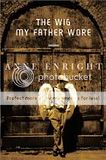
37. The Wig My Father Wore by Anne Enright.
Don't ask me what this book was about. I have no idea, really, but it's something like this: A horny angel moves in with a young woman who works for a TV show similar to The Dating Game. He keeps dying again. Her father has always worn a ratty wig. He has Alzheimer's. Pretty soon all the hair falls off the woman's body, and when the angel touches her breast, her nipple disappears. He becomes a contestant on the game show and gets blown into the airways. The end.
Either the author was trying to be weird for the sake of being weird, or she thought she was writing something smart and avant garde. Whatever. At least it was short.
1/3 star out of 5.

37. The Wig My Father Wore by Anne Enright.
Don't ask me what this book was about. I have no idea, really, but it's something like this: A horny angel moves in with a young woman who works for a TV show similar to The Dating Game. He keeps dying again. Her father has always worn a ratty wig. He has Alzheimer's. Pretty soon all the hair falls off the woman's body, and when the angel touches her breast, her nipple disappears. He becomes a contestant on the game show and gets blown into the airways. The end.
Either the author was trying to be weird for the sake of being weird, or she thought she was writing something smart and avant garde. Whatever. At least it was short.
1/3 star out of 5.
8mrstreme
Ha. Only a 1/3 of a star - not even 1/2! This book must be dreadful. You probably did us all a public service by reading it and letting us know to stay away!
11alcottacre
OK, if you had no idea what the book was about, I would not have a clue, so even if it sounded like something I wanted to read (which I decidedly do not), that alone would put me off the book.
On the bright side, Deborah, your next read cannot help but be better than that one was!
On the bright side, Deborah, your next read cannot help but be better than that one was!
12cushlareads
Thank you very, very much! The chances of me picking up a book with an angel on the cover were low to start with (call it a failure of imagination or something) but they just hit zero. Ugh, hope you're reading something stupendously good now.
13JanetinLondon
This book really does sound bad. I read The Gathering when it was a big book, last year (or maybe the year before?) and I really didn't like it, although it did at least have something resembling a plot. I felt bad that I didn't like it, because it was so popular, but now I think this is an author I can give up on. Thanks for helping that decision!
14Cariola
13> I'm skim-reading Taking Pictures, a collection of Enright's stories. It's nowhere near as dreadful as The Wig My Father Wore, but it's not one to which I'd give a big thumbs up.
In case anyone is wondering why I've chosen these books, I'm trying to whittle down my TBR stacks by giving a quick read to things that I suspect can be passed on.
In case anyone is wondering why I've chosen these books, I'm trying to whittle down my TBR stacks by giving a quick read to things that I suspect can be passed on.
15lauralkeet
>37 Cariola:: egads, Deborah. Thanks for warning me off of that one. Not that I'd heard of it but I certainly will run in the other direction if I ever come across it.
16Cariola
15> I forgot to mention that once her nipple disappears, she worries extensively that her navel will go, too. She likes her navel. She likes the way it smells.
17Cariola

38. The Blind Contessa's New Machine by Carey Wallace.
While this isn't a novel that I can rave about, I did enjoy it and recommend it as a quick and light summer read. One of its strong points is Wallace's fine development of atmosphere. There's a dreamy, sensual quality about her descriptions that perfectly fits the story of a young contessa adapting to losing her eyesight and dreaming her way back to beloved familiar places and exciting new places that she will never see in person. The reader can see the beauty of the contessa's lake and and smell her lush gardens, hear the sad music of the cello and the joyful song of her caged bird, feel the heat of the candle wax and the thick velvet of her robe. The romance is satisfying without going over the top. I did, however, feel a bit sorry for the contessa's husband, whose worst crime seemed to be that he wasn't the other man; although he made a few thoughtless statements, he did seem to be trying to do the right thing. If I could change one thing about this book, it would be the title, which probably won't catch the attention of readers who would potentially enjoy the novel. "The Blind Contessa" suggests an older woman, not a vibrant young bride; and "the new machine" plays only a secondary (yet important) role and doesn't appear until the last third of the book. (This is not really the story of the invention of the typewriter, as the cover blurb suggests!)
3.5 out of 5 stars.
18Fourpawz2
#16 - "She likes the way it (her navel) smells" - which indicates to me that this chick is really, really limber or she must really reek.
19mrstreme
#18 - LOL! There are just some places that we don't need to sniff. A navel is one of them.
Deborah, I like your synopsis of the Typewriter story. It has a charm to it, based on your review.
Deborah, I like your synopsis of the Typewriter story. It has a charm to it, based on your review.
20lauralkeet
>16 Cariola:,18: *snort* that's hilarious!
21Whisper1
Hi Deborah
I like your description of your latest read.
I hope your summer is going well. I plan to visit the Delaware Art Museum in a few weeks. They have the largest collection of Pre-Raphaelite art in the United States. I know you like Pre-Raphelite art.
I like your description of your latest read.
I hope your summer is going well. I plan to visit the Delaware Art Museum in a few weeks. They have the largest collection of Pre-Raphaelite art in the United States. I know you like Pre-Raphelite art.
22kidzdoc
Linda, is the Delaware Art Museum in Wilmington? I'd like to hear more about it, especially if you've been there before.
23Whisper1
http://www.preraph.org/
Yes, the museum is in Wilmington. I haven't been there. I'm looking forward to visiting, hopefully by the end of June.
Yes, the museum is in Wilmington. I haven't been there. I'm looking forward to visiting, hopefully by the end of June.
24lauralkeet
>21 Whisper1:: Linda, I hope you enjoy your visit! My husband and I visited last year, after a several-year hiatus. They did a significant renovation in the meantime, and the Pre-Raphaelite exhibit is especially fine.
>22 kidzdoc:: you haven't been there? OMG! I know Wilmington is podunk compared to Philly, but you really must see the Pre-Raphaelite exhibit. Linda's link is a good one; here's the main Delaware Art Museum site.
While visiting the area, may I also recommend:
Brandywine River Museum - Wyeths galore
Longwood Gardens
Winterthur Museum & Gardens
>22 kidzdoc:: you haven't been there? OMG! I know Wilmington is podunk compared to Philly, but you really must see the Pre-Raphaelite exhibit. Linda's link is a good one; here's the main Delaware Art Museum site.
While visiting the area, may I also recommend:
Brandywine River Museum - Wyeths galore
Longwood Gardens
Winterthur Museum & Gardens
25kidzdoc
Thanks Linda and Laura; I'll share this with my mother, as she would like to go. I don't know if she's been to the Delaware Art Museum, but I'm positive that she's been to the Brandywine River Museum and Longwood Gardens.
BTW, when is the Barnes moving to Philadelphia? Or has it already happened?
BTW, when is the Barnes moving to Philadelphia? Or has it already happened?
26lauralkeet
>25 kidzdoc:: Darryl, the Barnes website's FAQs say they expect to complete construction in 2011 ... it's been quite a long saga so I'd say it's anybody's guess!
27Whisper1
Regarding the saga, I'm surprised they were able to push the move through. I thought the will was very air-tight in stipulating that the art had to stay in that building at that location.
28Cariola

39. No Time to Wave Goodbye by Jacqueline Mitchard.
I remembered reading and enjoying Mitchard's first novel, The Deep End of the Ocean, when it came out many years ago. My reading tastes have changed considerably since then, but I was tempted to pick up this sequel about what had happened to the Cappadora family.
Big mistake. This was a truly dreadful piece of drek. It begins at the premiere of a documentary made by Vincent, the eldest and up to now loser son. The film is about missing children and focuses on several families; it also retells the story of Ben/Sam, the brother who was kidnapped but restored in the first novel. It's so good it ends up getting nominated for an Oscar.
At this point, the novel wallows in several nauseating chapters about the mother and other family members getting glammed up for the ceremony, stashing away gift items, ogling Kate Winslet's butt (yes, poor Kate has her butt dragged into this mess!), and ostentaciously name-dropping (Kate gets joined by Morgan Freeman, Ellen De Generis, Sissy Spacek, Michael Moore and others; even Angelina Jolie gets mentioned as NOT staying at their hotel).
Just as Vincent accepts his award, a hysterical phone call comes in: Ben's baby daughter has been kidnapped. Yes, she actually makes another kidnapping--the kidnapping of the kidnapped kid's kid--the central plot. Of course, the police are too useless to figure out the culprit, so Vincent, motivated by guilt because he's convinced that his movie provoked someone to take revenge on his family, has to do it. We have to go through all the tear-jerking scenes we saw in the first novel. And then he hires a female tracker with a big dog to find the baby. And of course, against her better judgement, she allows the two greenhorns, Vincent and Ben, to accompany her into the icy wilderness mountains because they won't take no for an answer. And yes, one of them faces a life-threatening situation and is saved by the other. And as soon as they recover the baby, there is a big snowstorm during which communications get cut off, food and fuel and almost gone, and they have to separate to be saved--as of course they are. Happy, happy ending. And even happier, another missing kid is about to be found because of Vincent's movie.
I can't recommend this poorly conceived and not very well written book to anyone with a brain and a sense of what makes a good novel. Was The Deep End of the Ocean this bad, too? I'll never know, because I sure don't want to reread it after this one.
1/2 out of 5 stars. (Don't feel too bad for me--I'm whizzing through books in my TBR stacks that I'm pretty sure won't really appeal to me. I'll get to something good soon.)
29alcottacre
#28: OK, I feel no need to read that one.
I hope the whizzing through the books in the TBR stack ends soon, Deborah. You are due for something good!
I hope the whizzing through the books in the TBR stack ends soon, Deborah. You are due for something good!
30Cariola

40. In the City by Joan Silber.
One of my all-time favorite books is Joan Silber's Ideas of Heaven: A Ring of Stories. I've been reading other works by this author, but none of them matches that one. In the City is a rather conventional coming-of-age novel set in 1920s New York. The main character gets swept up in a bohemian lifestyle but later comes to see that it may be more seedy than glamorous. Not a bad book, but nothing to write home about.
3 stars out of 5. Edited b/c I forgot the stars. Also, there is no touchstone for this book; the one here is wrong.
31Cariola

41. Taking Pictures by Anne Enright.
I'm beginning to think that I'm just not a fan of Anne Enright and that I should probably give up on her at this point. I thought the writing was fine in her most successful book, The Gathering, but I wasn't exactly enamoured with the overall story. This one, a collection of short stories, was a mixed bag, but I really only enjoyed two of them. A lot of unlikeable characters (many of them drunk) in unrealistic situations.
A generous 1.5 stars out of 5, simply because it wasn't as bad as The Wig My Father Wore.
33alcottacre
#32: That one is a dandy! (well, at least I think so)
34souloftherose
Caught up! I really hope your next read is better after all these duds. I really enjoyed Wolf Hall, hopefully you will too!
35lauralkeet
>28 Cariola:: I read The Deep End of the Ocean, also years ago, and have only vague memories of more or less liking it. But like you Deborah, my reading tastes have changed considerably and I am no longer tempted by the latest tear-jerking melodramatic story of family in crisis. I did enjoy your description of No Time to Wave Goodbye, though -- sounds like Mitchard was trying to turn one success into a formula, and then crank out one formulaic novel after another. And that's another thing that drives me nuts -- Anita Shreve and Jodi Picoult are two examples.
36mrstreme
Good for you for cleaning off some of your books, and I think Wolf Hall will be more to your liking!
37Cariola
35> Exactly what I suspected about Shreve and Picoult. It's also why I've never been tempted by mystery series, especially like that one who is going through the alphabet with her titles.
38sibylline
>25 kidzdoc: I live (for one more week!!!!!) five minutes from the site of the new Barnes which is at present a great big hole in the ground with about half of the cement footings filled in and the rest forms and rebar and churned up dirt! I am going to go over to your page to ramble on about it as many here might not be interested!
39arubabookwoman
Totally agree about Shreve Picoult and the alphabet lady (which I did read quite a few of). Your description of the Mitchard book makes it sound like she should be embarrased for writing it.
I think you deserve a break from your TBR pile of books you suspect you won't like, to read a book you're pretty sure you will like.
I think you deserve a break from your TBR pile of books you suspect you won't like, to read a book you're pretty sure you will like.
40bonniebooks
yes, poor Kate has her butt dragged into this mess!
*Still laughing* Well, at least your review was entertaining!
*Still laughing* Well, at least your review was entertaining!
41Cariola
39> She SHOULD be embarrassed!
40> I have to admit that I sometimes have fun writing the ones for really bad books. Thankfully, there aren't that many . . . I just happened to run into two of them in the past week!
40> I have to admit that I sometimes have fun writing the ones for really bad books. Thankfully, there aren't that many . . . I just happened to run into two of them in the past week!
42Cariola

42. Like Life by Lorrie Moore. (Touchstone doesn't seem to be working.)
Lorrie Moore is a unique and wonderful writer. I was absolutely blown away by the first of her short stories that I read about 10 years ago, "How to Talk to Your Mother." It's so different from anything else written that I always include it in my Intro to Fiction courses. I also enjoyed her collection Birds of America, so I was eager to read Like Life. It didn't disappoint.
The eight stories in the collection feature characters that are at the same time ordinary and distinctive. Many of them are lonely and/or somewhat desperate to find romance. One of Moore's finest techniques is the way she uses small details in the setting or secondary events to create a mood that suits her main character's emotional state. In "Two Boys," for example, Mary has moved to a new and very dull town following the breakup of a bad romance. We know by this description that that the move was probably not her best choice:
"She lived in a small room above a meat company--Alexander Hamilton Pork--and in front, daily, they wheeled in the pale, fatty carcasses, hooked and naked, uncut, unhooved. She tried not to let the refrigerated smell follow her in the door, up the stairs, the vague shame and hamburger death of it, though sometimes it did. Every day she tried not to step in the blood that ran off the sidewalk and collected in the gutter, dark and alive. At five-thirty she approached her own building in a halting tiptoe and held her breath. The trucks out front pulled away to go home, and the Hamilton Pork butchers, in their red-stained doctor's coats and badges printed from ten-dollar bills, hosed down the sidewalk, leaving the block glistening like a canal. The squeegee kid at the corner would smile at Mary and then, low on water, rush to dip into the puddles and smear their squeegees, watery pink, across the windshields of cars stopped for the light."
The little details say it all. Mary has been sending post cards to friends bragging that, for the first time in her life, she is dating two men at the same time--but neither one is the man of her dreams. The description above parallels the reader's perception that something isn't quite right in her life, no matter how hard she smiles, no matter how fast she tried to run upstairs, no matter how much water pours over the sidewalk. It's an image that recurs throughout the story.
Small but odd events take on significant meaning in the lives of Moore's characters. "Joy" revolves around a woman taking her cat to the vet for a flea bath; in "You're Ugly, Too," Zoe attends a Halloween party dressed as a bonehead and is set up with a man dressed as a naked woman. Mary ("Two Boys"), sitting in a park, is spat upon by a llittle girl dressed way beyond her years.
This may all sound rather depressing, but the amazing thing is that it isn't. Moore writes with humor and with affection for her characters, most of whom just pick up and keep on trying.
Moore's first novel, A Gate to the Stairs, has gotten mixed reviews, but it was a finalist for the 2010 Orange Prize. It's sitting on my TBR shelf, and I look forward to reading it soon. She is an extraordinary short story writer; hopefully I will be able to say that she is an extraordnanry novelist as well.
4.5 out of 5 stars.
43alcottacre
I enjoyed Moore's Birds of America too, so I am definitely going to have to look for that one.
Finally! A book you really liked!
Finally! A book you really liked!
44lauralkeet
>42 Cariola:: interesting. I read a review of her Orange Prize book somewhere, where they lauded her short story writing. I'm not familiar with her at all ... will have to check her out.
45bonniebooks
I loved those excerpts! Especially that first one. I'm going to have to request that one from the library, maybe even buy it and offer it up as a suggestion to my book group for our summer reading.
46Cariola

43. Wideacre by Philippa Gregory.
I probably shouldn't count this as a whole book read, because I stopped about 100 pages in. While I enjoyed the first few books by Gregory that I read, I pretty much gave up on her after Earthly Joys and The Constant Princess: too much history spinning for my taste, and too many anachronisms. But I've been going through stacks of TBRs and found that I had all three volumes of her Wideacre series, so I gave the first one a try. Well, the LT reviewers were right. The main character is wholly unlikeable, bent on gaining and retaining control of the family estate, even if it means relying on an incestuous relationship with the heir--her brother. I guess she is supposed to be some kind of feminist for bucking the system, which didn't allow women to own/inherit property; but she just came off as selfish, obsessed, and rotten to the core.
I sent off all three volumes to a happy Book Moocher yesterday.
1 out of 5 stars. (I'm giving her a little credit for some good descriptive writing.)
47alcottacre
#46: All I can say to that one is "Ick." I have vowed never to read another one of Gregory's again (one was enough) and nothing in your description of the book makes me change my mind.
48Cariola

44. All the World's a Grave: A New Play by William Shakespeare by John Reed.
Reid had an interesting idea, even if the end result is a bit silly. He has composed a "new" play made up entirely of passages from Shakespeare's originals. The "All-Star Cast" will give you an inkling of what is to come:
HAMLET as the Prince of Bohemia
JULIET as the Princess of Aquitaine
IAGO as lieutenant to the prince
ROMEO as general to the prince
MACBETH as lover to the queen (and soon to be king)
THE QUEEN as wife to Old Hamlet, king of Bohemia
KING LEAR as king of Aquitaine and father to Juliet
With special appearances by:
Old Hamlet and his Ghost
Three weird sisters
Rosencrantz and Guildenstern
The senators of Bohemia
Polonius, speaker for the senate
A local pastor
Two armies of soldiers
The herald of Aquitaine
A troups of actors
King Lear's cook
The queen's doctor
Well, you get the drift. Hamlet, with a lot of lines lifted from Henry V, wages war on Aquitaine in hopes of marrying the princess, Juliet. Upon his return, he finds that his mother has murdered his father and married . . . Macbeth! Iago is there to spur Hamlet's jealousy (a la Othello) to the brink of madness. It's all in good fun, even if it is touted as a tragedy. But you'd better know your Shakespeare, since half the fun is in identifying the lines and plotlines lifted directly from the original plays.
4 out of 5 stars.
49alcottacre
I love that Rosencrantz and Guildenstern get to put in an appearance, but where is the nurse from Romeo and Juliet?
50Eat_Read_Knit
I love the sound of that.
*Adds to wishlist*
*Adds to wishlist*
51jmaloney17
>46 Cariola: The reason I liked Wideacre was because the character is so horrible. No she has no redeeming values, but the story was intriguing to me. In fact, I was surprised that there were no redeeming characteristics so it kept me involved. I think that is why I liked The Custom of the Country by Edith Wharton as well. The main character was just plain mean and nasty.
52Cariola

45. Field Study by Rachel Seiffert.
Seiffert's beautiful novel Afterwards was one of my top reads a few years ago, and I have gradually been catching up on her earlier books. This short story collection relies heavily on her cool, understated style--but it often comes off more as disengaged than objective. The best was "The Late Spring," the story of an elderly beekeeper, isolated from the village, who finds an ailing child on his doorstep. I also enjoyed "The Crossing," the story of a mother and her three children fleeing the Nazis who must trust a stranger in order to cross a river; and "Dog-Leg Lane," in which a little boy becomes hysterical at the prospect of moving house.
This was just an OK read for me. It says something that only a few days after finishing the book, I had to look back at most of the stories to remember what they were about. They just didn't leave much of an impression upon me.
3.5 out of 5 stars.
53Cariola

46. Amandine by Marlena De Blasi.
It's 1931, and the 17-year old daughter of a Polish countess has given birth to a daughter, the result of an affair with her cousin's schoolmate. What is worse, her mother discovers that the boy is the brother of the mistress that her husband murdered, in whose arms he shot himself. In addition, the baby has a heart defect and is not expected to live long. The countess decides that the best thing to do is to tell her daughter that she is taking the baby to Switzerland for surgery, then report that the baby has died. Instead, she arranges to leave the child and a devoted nursemaid at a convent, paying for her to stay until her anticipated death.
All this happens in the first few pages, so there aren't any spoilers here; and it sets up what began as a very intriguing novel. But about 150 pages in, I started to get bored. It was just too precious, the plot just too pat. The baby, named Amandine by her nanny, is adored by the sisters--except for the stereotypical 'bad nun,' the cruel Mater Paul. And of course, she is beautiful, loving, insightful, and intelligent. Other stereotypes abound: the lustful bishop, the kindly priest, the tormented mother, etc. I stuck it out to the end, but I have to admit that I found myself skimming the last 100 pages.
3 out of five stars.
54Cariola
51> Well, she wasn't my mosted hated 'heroine'; that would be Kathy from The House of Sand and Fog, who, unlike this one, was a real wimp who seemed to expect the rest of the world to roll over for her. I just thought the writing was melodramatic and the characters rather sterotypical. As I said, I've pretty much given up on Gregory at this point, and not just because of Wideacre. But to each her/his own!
55Cariola

47. Every Man Dies Alone by Hans Fallada.
Written in 1947, this novel is based on the true story of a working class couple who left anonymous post cards in and around Berlin during the Nazi regime. The subversive cards encouraged people to sabotage the Nazi war effort by slowing down work in any way possible. The real-life couple, as well as the novel's main characters, Otto and Anna Krungl, were eventually captured and executed. There are also several subplots involving neighbors and relatives of the Krungls, including an elderly Jewish woman whose husband was taken away by the Nazis, an SS officer, a young thug making his way up the ranks of the Hitler youth, a female postal worker and her long-philandering husband, and others. Like most stories about Nazi Germany, this is the story of common people struggling just to survive and, sometimes, taking extraordinary risks along the way.
I found Every Man Dies Alone difficult to read because of its relentless tension and the relentless cruelty and manipulations of the Nazis and their sympathizers. I'm sure that is exactly the effect that the author had hoped for, but: 1) I felt that I had suffered through similar books before, so there were few surprises; and 2) I just kept wishing that it would be over, since the unhappy ending was inevitable. These comments aren't meant to be disparaging; they just express the emotional impact that the book had on me personally. Would I recommend it? Yes, with the caution that it is far from a light summer read. If you appreciated (I can't say enjoyed) books like Night or Schindler's List, you might want to put Every Man Dies Alone on your wish list--but don't expect heroism, suffering, and endurance to be rewarded here, nor the evil to be punished.
4 out of 5 stars.
56mrstreme
A great review and I think your words of caution are important ones. I will have to think about adding to my TBR. After finishing another Holocaust book (The Invisible Bridge), I think I need a break.
57alcottacre
I have had Every Man Dies Alone in the BlackHole for at least 2 years now. One of these days, I will get my hands on a copy.
58Cariola

48. Cheerful Weather for the Wedding by Julia Strachey.
Over the past two years, I've collected about a dozen Persephone Classics, but this is the first one I've gotten around to reading. I can't say that I was very impressed. The novel, written in 1932, takes place on Dolly's wedding day--but we don't get to see the actual wedding. Dolly suspects that she may be marrying the wrong man and that she might even run off with Joseph if he confessed his love--but he doesn't, and she doesn't. This short book is mostly descriptions of the wedding preparations and the guests. While there are some amusing moments, I have to say that I was more bored than charmed.
2 out of 5 stars.
59alcottacre
#58: Too bad about that one - I have it around here somewhere to read.
I started Music and Silence yesterday and want to thank you for your recommendation of it last year. I am really enjoying the book.
I started Music and Silence yesterday and want to thank you for your recommendation of it last year. I am really enjoying the book.
60Eat_Read_Knit
Sorry to hear you didn't enjoy Cheerful Weather, Deborah. I quite liked it when I read it last month, but I can certainly see why opinions about it are so varied.
61bonniebooks
I'm not sure I want to read Everyman Dies Alone either, but I was intrigued enough to go read some more reviews--which were, themselves, very interesting. I ended up 'thumbing' two reviews. I just read another book in which the author states on the first page that he murdered someone, so I've been thinking about how I, as a reader, often sympathize and accept behavior in a narrator that I wouldn't in real life. I've developed the habit of being on the narrator's side, so when an author uses my expectations to create tension/unease, that can be very engaging--in an uncomfortable way. The author of Property used that same technique.
62cushlareads
I bought Every Man Dies Alone last month but haven't read it yet - I really want to go to Berlin before we leave Switzerland, and I'll try to get to it in plenty of time before that trip. I'll need to be in the right mood and have more than 2 minutes of uninterrupted reading time...
63BookAngel_a
It's a shame about the Persephone book. The only one I've read is Miss Pettigrew Lives for a Day and it was delightful!
64Cariola
63> Well, that was just my opinion. Others seem to have loved this one. I won't give up on Persephones yet--and the cover is lovely, too.
65LizzieD
Every Man Dies Alone conjures up one of my last year's reads, The Very Rich Hours of Count von Stauffenberg. Talk about depressing - or not exactly that, but unrelievedly grim! The Count was the man who got a bomb into the meeting with Hitler. After they killed him, his body continued the narration with what they did to it and what happened to his family. I'm glad to have read it, but I don't think I'll be reaching for *EveryMan* anytime soon.
66Whisper1
I'm adding Every Man Dies Alone to the list of books to read this summer
I hope you are having a great summer!
I hope you are having a great summer!
67Cariola

49. The Lunatic, the Lover, and the Poet by Myrlin A. Hermes.
This novel starts with an intriguing premise: the main narrator is Hamlet's loyal friend, Horatio, and the reader expects a retelling of Shakespeare's famous tragedy. But that's not quite what Myrlin Hermes offers. Instead, it begins as the story of their blossoming friendship/love in Wittenburg, its highs and lows, interspersed with the question of who was Will Shake-speare (in addition to who wrote the plays and sonnets). A mysterious dark lady, Adriane, plays a significant role as Horatio's patron and part of the famous Shakespearean love triangle, rendered here among Adriane, Horatio, and Hamlet. There are plenty of twists and turns to a story and a sonnet sequence that you thought you knew.
For a number of reasons, I almost gave up on this book about 40 pages in. Every page is dotted with quotes and near-quotes from Shakespeare's work, a strategy that I initially found irritating but eventually decided to treat as a game. (Thankfully, I didn't start counting the references, but in addition to Hamlet and the sonnets, Hermes draws on As You Like It, Henry V, A Midsummer Night's Dream, Henry IV (Parts 1 & 2), King Lear, Othello, Twelfth Night, etc.--even Macbeth's drunken Porter makes a brief appearance.) And then there is the scene of Horatio's first meeting with Hamlet. Walking alone by his favorite riverside retreat, Horatio comes across a beautiful, naked, weeping maiden--only it isn't a maiden, it's Hamlet, and he isn't weeping, he's masturbating. So--if that sort of thing bothers you, be forewarned that there are a lot of graphic sex scenes in this novel, both straight and gay. I read on a bit further, and the interesting development of the characters kept me involved (despite an occasion "ick!").
In the end, my reservations and the entertainment factor balanced out, and while I can't recommend The Lunatic, the Lover, and the Poet to everyone without reservations, overall, it's a jolly good read for those who like Shakespearean spin-offs.
3.5 out of 5 stars.
68Cariola

50. The Anthologist by Nicholson Baker.
My response to The Anthologist is a mixed one. Baker effectively replicates through his protagonist, Paul Chowder, the way the mind--or at least my mind--tends to work, fixating on one subject--poetry here--for long stretches of time, but fairly easily distracted by other, more personal, less philosophical, and more mundane things, like 'what is the meaning behind the fact that I now have three Band-aids on the same finger? there must be a meaning in this.' As a scholar and poet myself, one who tends to put off deadlines by finding infinite distractions, I recognized my own process of "head writing": letting things circulate until they seem to fall into place.
Well, it's rather charming for awhile, but I'm afraid that eventually I found all this a bit affected and tedious. And I found myself arguing back against many of Paul Chowder's claims about poetry, even as I agreed with others. It's true that the character's passion for poetry--preferably rhymed poetry with four beats per line--shines through; but I also felt that his views were rather narrow. There's some real junk being published as poetry today--but also some very fine unrhymed free verse. The kind that irks me most is poetry that just plays with sound for its own sake and to show off the poet's cleverness, poetry that has no meaning behind it and creates no images to stir the imagination or the senses. And, oddly, that is the same way that Baker's prose began to affect me. By page 160, I started to skim because I just wanted to be done with it.
So I'm giving The Anthologist 3.5 stars for its originality and some moments of brilliance, as well as for making me laugh a bit, but I can't recommend it more highly than that.
69alcottacre
Congratulations on hitting the 50 book point, Deborah!
70Cariola

Enter Jeeves by P. G. Wodehouse.
Having heard a lot of my fellow LTers rave about P. G. Wodehouse, I was eager to get to this collection of early Bertie and Jeeves stories. Maybe I was expecting too much. Like another reviewer, I found the stories to be very repetitive. Wodehouse creates two memorable characters who, by now, have become archetypes: the rather easily flustered but always conscious that he needs to keep his cool young British man of the upper class, and the wise, all-knowing "man" (butler) who solves his dilemmas. Apparently young artistocrats falling for vaudeville ingenues was a popular trope of the time, since it appears in more than half of the stories.
In short, this was a quick, light read with some clever insights into the facade of the British upper class, but I probably won't be seeking out more books by Wodehouse.
3 out of 5 stars.
74sibylline
Popping up to say the Baker review had me chuckling. In our family we have a 'bandaid index' that we use as a sign of being stressed out......
75Cariola
Here is a link to my Belletrista review of #35, Don't Cry: Stories by Mary Gaitskill.
This is one of my top books so far this year. I didn't say much about it in Part I of my book list because I had committed to review it for Belletrista. While you're there, take a look at some of the other wonderful reviews, many of them by LT friends.
This is one of my top books so far this year. I didn't say much about it in Part I of my book list because I had committed to review it for Belletrista. While you're there, take a look at some of the other wonderful reviews, many of them by LT friends.
76Cariola

52. Oonagh by Mary Tilberg.
This book was a real disappointment. I generally love historical fiction, Irish stories, and immigration stories, so this novel about a young Irish girl who emigrates to Canada in the 1830s and falls in love with a runaway slave sounded right up my alley. Unfortunately, I felt overwhelmed by its preachy-teachy approach to slavery. Now, don't get me wrong: I've read some fine novels about the evils of slavery, The Color Purple, and Beloved, among them. And I certainly think that slavery and racism are marks of the worst that is in us. But here, the author, who is Canadian, seems to want to hit us over the head with facts that we already know. This made me wonder if perhaps Canadians were less informed about the situation of slaves than Americans, but one of my Canadian LT friends confirmed that the history of slavery is indeed taught in schools. What could have been a good story about young Oonagh falling in love with Chauncey Taylor, a barber and runaway slave, gets bogged down in didacticism. Here's an example of their conversation, which rings like a catechism:
"I was born on a wagon on the move."
"A wagon! Oh, surely not on the move! They would have stopped for her sake, surely."
"Maybe . . . maybe not." He smiled at my indignation.
"Where was your poor mam travelling to?"
"She was being moved from a plantation down in North Carolina to the place in Virginia where they claim I was born. Place in the Carolinas been sold, so slaves was sold away. Lucky sold to Virginia instead of farther south."
"So close to her time?"
"All that bumping of the cart. See, she was lucky to get a wagon ride. Mostly the others walked. That was what the owners thought of my mama, they liked her that well. Let her have the wagon ride."
. . . "They made her work in the field three weeks after her confinement?"
"Three weeks after I was born. She made a little basket and hung me up in a tree so's the snakes wouldn't get me while she was hoeing."
"Did you cry for her?"
"I expect I did, sure. But slave babies learn early ain't much use to cry."
And another similar conversation:
"Ma'am, I was king of the egg theives when I wasn't more'n five years old . . . This was in Virginia. See, they's always some hens fly out of the coop, and I was supposed to follow, see where they laid their eggs. Collect them up for the kitchen. I followed alright, but I didn't collect all the eggs, just most of 'em. Then after dark I'd sneak out and collect the three or four I'd left for us . . . "
"You had to steal eggs? Didn't they keep enough eggs to provide for everyone?"
"Well, they sold a lot of eggs to town, as a matter of fact. But corn was what they provided for us, a measure of corn on Sunday to last all week.
"Corn? Cornmeal?"
"Dry corn on the ear, Miss Oonagh. Folks would have to grind it with a handmill after the workday for their supper and for next day's breakfast."
"What else did you eat with that?"
"Corn. That's it. Sometimes they'd throw in a bit of pork fat."
"What about vegetables? Didn't you have gardens?
"Gardens. Oh yes. Some of the older slaves, including my mama, work the vegetable patch. But none of that's for us."
"None of it?" I had a lump in my throat. "Couldn't you just take what you needed?"
He sighed deeply. "Naw, they always found out. They have someone watching that patchl like a hawk. And someone always has to pay. It's the old folks, too worn out for fieldwork, who work the vegetables. So it's them gets the floggings. No, it's an awful risk to steal even a carrot or a pea pod. You never know who's watching you or who would tell on you just for a bit of favour themselves, you know."
Oonagh sounds so naive that I wondered if this might be a YA book (the main character is 18), but the detailed sex and violence scenes probably rule that out. At one point, Oonagh worries that her family will be upset to learn of her engagement, not because Chauncey is a black runaway slave who might be grabbed any day by American bounty hunters, but because he isn't Catholic. Could she have really been that clueless?
In a note at the book's end, Tilberg reveals that the story is based on a brief reference in Susannah Moodie's Roughing it in the Bush, when a neighbor mentions a local barber, a runaway slave, who had the "presumption" to marry a young Irish girl and was dragged out of bed and killed by a mob on his wedding night. Tilberg couldn't find any facts about the pair in her research, so she decided to turn it into fiction. She really missed an opportunity to write a great story, even one that better conveys a message about the evils of slavery and racism. It might have been even more interesting NOT to include the wedding night death scene. She could have followed what happens to Oonagh and Chauncey and their future children and made more subtle points about prejudice and violence. As it was, she ended by tacking on a short chapter set 18 years later, in which Oonagh and her niece attend an abolitionist meeting in Toronto (Frederick Douglass is the speaker), and Oonagh speaks out against the clergy for not taking a stronger stand. That's followed by Oonagh's two-page summary of the anti-slavery laws enacted in the US and Canada. And more didacticism:
"And although it it grieves me deeply to acknowledge the race hatred that still exists among certain elements of Canadian society, the hatred that killed my own Chauncey, it is also abundantly clear that with our firm anti-slavery laws Canada stands as a beacon of hope to those so terribly oppressed south of our borders . . . "
"We cannot rest content in Canada knowing that we have enacted anti-slavery legislation yet not admit there are those in out own country who would treat persons of African origin as lesser citizens . . . Such racism diminishes us all."
Another problem is that the plot is rather bipolar, half conventional immigration narrative and half anti-slavery diatribe. Tilberg tries to depict Oonagh as a bit of a rebel in Ireland (probably to prepare us for her romance with a runaway slave): she doesn't believe in God, so some people call her a witch, and she spends a lot of time leaning against a curious ancient stone. But it never quite works, either to convince us that Oonagh is a rebel or to tie the two parts of the novel together. Although she says she never wants to marry, Oonagh spends a lot of time mooning over a past love, a young man who has gone to sea and who returns from time to time to renew the gossip about the two of them and to bring letters from her brother Michael, who emigrated to Canada. So much for the unconventional.
I simply never engaged with the overly naive Oonagh or the too-perfect-to-be-true Chauncey, probably because of Tilberg's heavy-handed and awkwardly managed didacticism.
I'm giving Oonagh two stars for the concept, even though poorly executed, and for some fine descriptions of the Canadian forest and newly settled town.
77Cariola

53. East of the Sun by Julia Gregson.
Let me start by saying that it has taken me a long time to get around to writing this review because, although it was a May 2009 Early Review book, it didn't arrive in my mailbox until the end of April 2010. At that point, I put a number of other books ahead of it.
Overall, I enjoyed East of the Sun, although it was a bit romancey for my taste, and I've read a number of much better books about the British in India ca. the 1920s--one of them being, of course, A Passage to India. The young women here seem to echo Adela Quested in their ignorance of Indian culture and society, their hopes of marrying promising young men whom they barely know, and even their lack of self-knowlege. The characters are fairly well developed and the story generally engaging, if a bit longwinded.
If you are truly interested in life in the British Raj, you might be better off reading Forster's classic novel. Another recommendation is The Impressionist by Hari Kunzru, which still remains perhaps my all-time favorite contemporary novel; its study of race, class, gender, nationalism, and identity is brilliant. Still, East of the Sun made good escapist reading for the summer.
3.5 stars out of 5.
78LizzieD
Deborah, did you like *The Raj Quartet*? I'm busily trying to decide what kind of reader you are --- you like Music & Silence but not Gilead. (I loved both.) I will check out The Impressionist which is ringing a faint bell in what passes for my memory.
79Cariola
I've posted a much expended review of #52 Oonagh by Mary Tilberg a few posts above.
80Cariola
78> Sorry, I posted a reply yesterday but for some reason it isn't showing up. I have to admit that I've not yet read The Raj Quartet, but I did see the dramatization of The Jewel in the Crown years ago and quite liked it.
Hmm, I don't know how I would peg myself as a reader, aside from 'eclectic.' I read a lot of historical novels, but I don't much care for the 'romancey' ones. I also read a lot of contemporary novels, mostly 'serious' or 'literary' ones and mostly British; Ian McEwan is a favorite. And I read a lot of classics.
While I'm not into big action novels, Gilead was way too slow for me and I didn't connect with the main character. From other reviews I've read, it seemed to click best with folks who have a strong spiritual (most often Christian) belief system, and that's just not me.
Hmm, I don't know how I would peg myself as a reader, aside from 'eclectic.' I read a lot of historical novels, but I don't much care for the 'romancey' ones. I also read a lot of contemporary novels, mostly 'serious' or 'literary' ones and mostly British; Ian McEwan is a favorite. And I read a lot of classics.
While I'm not into big action novels, Gilead was way too slow for me and I didn't connect with the main character. From other reviews I've read, it seemed to click best with folks who have a strong spiritual (most often Christian) belief system, and that's just not me.
81LizzieD
Thank you, ma'am. That was just what I wanted to know. I was hopeful of seeing a review of Gilead from a non-Christian or non-spiritual viewpoint just to understand how well Ames's humanity and spirituality translated. From a reader of your thoughtfulness, I guess the answer is "not too well."
When you have time, I do encourage you to try *Raj*. Our friend Barbara can't or won't abide the books because Scott abused his wife horribly, but I have read them twice and hope to do that again. The Granada series was wonderful, but it couldn't reproduce, for instance, Scott's playing with pov in *Jewel*.
When you have time, I do encourage you to try *Raj*. Our friend Barbara can't or won't abide the books because Scott abused his wife horribly, but I have read them twice and hope to do that again. The Granada series was wonderful, but it couldn't reproduce, for instance, Scott's playing with pov in *Jewel*.
82Cariola

54. The Swallows of Kabul by Yasmina Khadra.
Yasmina Khadra creates a detailed, grim, and unfortunately realistic picture of life in Afghanistan under the Taliban and of how their fanatic rule affected both society and individuals. At the story's center are two men and their wives. Atiq, a jailer devoted to the tenets of fundamentalist Islam, begins to feel uneasy when he can't find help--medical or domestic--for his terminally ill wife. The best advice he can get is to divorce her and free himself from any responsibility. Mohsen, a former intellectual whose wife once campaigned for women's rights, becomes swept up in a frenzied crowd and, much to his later horror, takes part in stoning a condemned prostitute. Both men begin to question the society in which they have blindly participated.
I previously read Khadra's The Attack and can say that while The Swallows of Kabul is a much better book, I don't find Khadra to be a particularly compelling writer. Still, he (Khadra is a man who writes under a female pseudonym) conveys well the tension of life in this brutal and unfamiliar world.
84tiffin
I'm still laughing about the navel thing, with Fourpawz' rebuttal. Didn't mind Cheerful Weather for the Wedding at all but was glad it was short as Mrs. Whatshername would have driven me mad if I had had to read more of her. *whew* finally caught up
85dk_phoenix
The Swallows of Kabul sounds interesting, but not entirely compelling enough to seek out. If I see it somewhere I might pick it up... it can go on a TBR "b" list... haha.
86Cariola

Goldengrove by Francine Prose.
In Judith Guest's Ordinary People, two siblings go out on the water but only one returns: the more promising, handsome, and popular brother drowns in a storm, and the rest of the book explores the family dealing with guilt and grief. In Francine Prose's Goldengrove, two siblings go out on the water but only one returns: the more promising, beautiful, and popular sister drowns, and the rest of the book explores the family dealing with guilt and grief.
So, am I saying been there, done that? Yes, but Goldengrove isn't a bad read, if you're in the mood for this sort of novel. For one thing, it has been over 20 years since Guest's book was first published, and society has changed quite a bit since then. For another, the focus is primarily on 13-year old Nico and her developing relationship with Aaron, her dead sister's boyfriend, who seems to be the only person who really understand how she feels. As in Ordinary People, Nico's parents prefer not to talk about Margaret's death, but instead of being upscale suburbia types, they are more along the hippie line; Dad runs a used book store called Goldengrove. People start to remark on how much Nico, who has lost considerable weight while grieving, is starting to look like Margaret--which gives an edge to Aaron's interest in her. The book is well written overall, and Prose gives believable voice to the fears and ponderings of a young girl going through the grieiving process at a critical point in her own development.
3.5 out of 5 stars.
87Cariola
56. Mr. Darcy Takes a Wife by Linda Berdoll.
As mentioned earlier, I'm trying to get rid of some books that have been in my TBR stacks for awhile, books that I suspect I won't like if I ever got around to them. I skim-read this one tonight. It's truly awful. Had I known it was initially self-published, I never would have gotten it. Who knew that Mr. Darcy was such a randy lad and that Elizabeth Bennett had the makings of a soft-porn queen? Or that Bingley had an illegitimate child because Jane couldn't satisfy his needs? Ick. Just ick.
No stars. And I'm not gonna post that cover photo on my thread!
As mentioned earlier, I'm trying to get rid of some books that have been in my TBR stacks for awhile, books that I suspect I won't like if I ever got around to them. I skim-read this one tonight. It's truly awful. Had I known it was initially self-published, I never would have gotten it. Who knew that Mr. Darcy was such a randy lad and that Elizabeth Bennett had the makings of a soft-porn queen? Or that Bingley had an illegitimate child because Jane couldn't satisfy his needs? Ick. Just ick.
No stars. And I'm not gonna post that cover photo on my thread!
88alcottacre
#87: I read about 25 pages of that one and I think it was 24 pages too many. I agree - no stars!
89digifish_books
>87 Cariola: Ick. Just ick
haha!!! :D I hope you threw it in the bin!
Only problem with 'no stars' is that it doesn't bring the average rating down.
haha!!! :D I hope you threw it in the bin!
Only problem with 'no stars' is that it doesn't bring the average rating down.
90TadAD
>87 Cariola: & ff: LOL! Well, that's one to avoid. Somehow, Elizabeth as a soft-porn queen is an image that just won't resolve for me.
I always think half-star ratings are appropriate. Especially with the grade inflation in ratings, how can seeing fail to damn something? *grin*
I always think half-star ratings are appropriate. Especially with the grade inflation in ratings, how can seeing
 fail to damn something? *grin*
91Cariola
89, 90> You're right--this book's score is something like 3.35 because some readers actually gave it five stars! I'll adjust it to 1/2 star. Thanks!
92blackdogbooks
On the Francine Prose above, I read and loved Reading Like a Writer by the author and also Bigfoot Dreams, which was a fun romp. But then I read Primitive People and was quite put off by the unlikable characters and extremely bitter writing. I almost felt like somehting awful had happened to Prose and she needed to exorcise it by writing that one. From your review above, it sounds like Primitive People might just have been a rotten apple and not the tip of an iceberg.
93Cariola
92> This one wasn't bad--a little creepy at times (the sister's boyfriend is 18), but the characters were well written, and although there was a lot of sadness, I didn't detect any bitterness. So maybe she is on the road to redemption!
94Cariola

57. The Pregnant Widow by Martin Amis.
Through his protagonist/narrator Keith Nearing, Amis explores the sexual revolution of the late 1960s/early 1970s. Ensconced for the summer in an Italian castle with his girlfriend, Lily, her friend, ridiculously named Scheherezade, and visited by a dwarf count; Gloria, a Scottish tease of a dominatrix with a religious bent; a gay couple; and various other characters, Keith learns what it means when the rules of the game are in flux.
Truthfully, after a short while, I got tired of hearing about Keith's maneuvering to get into Scheherezade's pants, his Victorian novel fantasies about Gloria, his boredom with the loving but obsessive Lily, and his concerns that someone else would get into Scheherezade's pants before he did. I lived through this period (although, admittedly, I didn't run in a similar crowd), yet I found the novel awfully tedious. There were moments of humor, but I suspect that The Pregnant Widow will most appeal to die-hard Amis fans.
2.5 out of 5 stars.
97alcottacre
Whew! I am glad you have Wolf Hall to get the taste of your last couple of books out of your mouth.
98lauralkeet
I admire your ability to read the books on your TBR stack that you don't think you're going to like. I read something by Kingsley Amis earlier this year which was simply dreadful in a similar way to The Pregnant Widow. Sounds like the apple doesn't fall far from the tree. I can skip that one!
99JanetinLondon
#94 - good review. Just confirms me in my determination never to read anything by Martin Amis ever again - I have read London Fields and another one I can't remember, and I think it's a case of "read one read 'em all".
100Cariola
98, 99> The only other Martin Amis novel I've read was Time's Arrow--but that was probably more than 20 years ago. The only thing I remember is the bathroom scene (in the novel, everything goes backwards . . . . )
As to Kingsley Amis, I've only read his great comic novel, Lucky Jim.
As to Kingsley Amis, I've only read his great comic novel, Lucky Jim.
101sibylline
I loved Lucky Jim and tried several others, but they get worse...... Martin I have liked better overall, but this one sounds 'off' somehow -- plus I keep thinking I've read something like this? Excerpted somewhere? Like the NYer? Is that possible?
102Cariola
101> The New York Review of Books had a very, very long review with quite a few very long excerpts. (They liked it.)
I have a feeling that a certain type of reader will like it because--like the narrator, who tells the story from the present day--it allows him/her to relive his/her youth in the freewheeling '60s. I'd be surprised if anyone under, say, 50 found it very interesting.
I have a feeling that a certain type of reader will like it because--like the narrator, who tells the story from the present day--it allows him/her to relive his/her youth in the freewheeling '60s. I'd be surprised if anyone under, say, 50 found it very interesting.
103wandering_star
I stopped reading Martin Amis after the double whammy of The Information and Night Train, although I did like both Time's Arrow and London Fields.
104Cariola

58. Sixpence House by Paul Collins.
Maybe I was expecting too much, having heard high praise for Sixpence House from a number of fellow readers that I generally trust. I imagined a sort of booklover's 'Doc Martin,' a charming town of quirky characters. But I found the book to be more of a rambling, rather disjointed personal essay. I'm not a regular reader of memoirs, so perhaps I'm just not used to the style and tone. I didn't feel that I got a very good picture of Hay or the locals or why, exactly, Paul had decided to move his family there in the first place. Because the residents seem to care more about books than Americans? (A rather lame reason, even for a book lover.)
3 out of 5 stars.
105alcottacre
#104: I just read that one recently and was completely disappointed in it. I did not even give it 3 stars - only 2.5. Oh, well, it is done now.
106Cariola

59. Small Wars by Sadie Jones
Sadie Jones uses a forgotten guerilla uprising, the Cypriot revolt against British rule, as a means to make a rather heavy-handed statement about war, the military machine, and colonialism that resounds in the "small wars" being fought today in Iraq, Afghanistan, and other hot spots. Jones focuses on the isolation of and between a young couple, Clara and Hal Traherne, to make her points about the dehumanization wrought by the struggle for world power. Clara, a bit pampered yet willing to play the military wife and follow her husband first to Germany, then to Cyprus, seems completely unprepared for life in a war zone. Hal, on the other hand, acts around Clara as if everything is perfectly fine, unable or unwilling to share his experiences and discounting her fears. By the time a personal tragedy hits, their lives have already been changed and their marriage may be beyond repair (although Jones does hint at a reconciliation in the end).
While I enjoyed Small Wars, the characters here lacked the depth of those in her first novel, The Outcast. Several secondary characters, like the literature-loving translator with an inconvenient moral streak but not much backbone, and the shopaholic officer's wife who befriends Clara in Nicosia, are never fully realized, and even Hal and Clara are a bit flat. Perhaps Jones's obvious desire to send us an antiwar message overwhelmed some of the finer elements of plot and character here. Still, I'd recommend the book to anyone wanting to know more about life in the 1950s, particularly for a young military family in a "small war" zone.
3.5 out of 5 stars.
108Cariola
Hi, Linda. Did you make a decision about 'Desperate Romantics'?
Summer has been a mixed bag, especially the last 10 days or so. First I tripped and fell face-first on my concrete front porch. I was sure I had broken my cheekbone and perhaps my jaw, and I drove myself to the ER where a CAT scan showed no breaks. I just look awfully beaten up (black eye, bruises, cuts and scrapes, swelling, etc.). A few days later I flew to Texas to help my newly-retired brother and SIL move to New Hampshire. I am still recovering from the packing, cleaning, days and nights of driving 10 hours at a stretch, and an overload of McDonalds. But at least I've been able to put work aside and just enjoy my reading, gardening, and housecleaning. Last year was a bad one, and I just needed to escape for awhile. I'm not looking forward to fall semester, what with the caps on enrollment raised, some programs being closed down, threats of retrenchment, and a new contract to be negotiated. There are already rumors that admin will be demanding faculty pay cuts.
But, hey, I've been reading some great books and have watched some good movies! And my cat is thrilled to have me here so much of the time.
Summer has been a mixed bag, especially the last 10 days or so. First I tripped and fell face-first on my concrete front porch. I was sure I had broken my cheekbone and perhaps my jaw, and I drove myself to the ER where a CAT scan showed no breaks. I just look awfully beaten up (black eye, bruises, cuts and scrapes, swelling, etc.). A few days later I flew to Texas to help my newly-retired brother and SIL move to New Hampshire. I am still recovering from the packing, cleaning, days and nights of driving 10 hours at a stretch, and an overload of McDonalds. But at least I've been able to put work aside and just enjoy my reading, gardening, and housecleaning. Last year was a bad one, and I just needed to escape for awhile. I'm not looking forward to fall semester, what with the caps on enrollment raised, some programs being closed down, threats of retrenchment, and a new contract to be negotiated. There are already rumors that admin will be demanding faculty pay cuts.
But, hey, I've been reading some great books and have watched some good movies! And my cat is thrilled to have me here so much of the time.
109Whisper1
ouch, ouch, ouch....I'm happy you did not break any bones, but sorry that you hurt yourself so badly.
Good luck with a new academic year...They can be brutal. I'm not looking forward to the onslaught that will arrive on campus in the next few weeks.
How nice of you to help your brother move. Oh how I hate the moving process.
I haven't made a decision re. Desperate Romantics, other than I want to join net flix because it seems that have many movies I would like.
Good luck with a new academic year...They can be brutal. I'm not looking forward to the onslaught that will arrive on campus in the next few weeks.
How nice of you to help your brother move. Oh how I hate the moving process.
I haven't made a decision re. Desperate Romantics, other than I want to join net flix because it seems that have many movies I would like.
110Cariola
Netflix rocks. I cancelled HBO and Showtime and put part of the cash I saved into Netflix. There, I can choose what I want to watch and when, and the few things on the premium channels that I might like end up available on Netflix in a few weeks. I missed 'Pillars of the Earth,' but the whole thing is already up for instant viewing. I have been enjoying old BBC/Masterpiece Theatre shows all summer long! (Never saw 'Poldark' before, for one thing . . . am watching Jeremy Irons in 'Longitude' tonight.)
112LizzieD
(Did I mention that I adore Poldark and am watching it again? I adore the books more, but I can't read them again for another year or two.)
I'm so very sorry about your fall. Even when it turns out as well as it possibly can, it is a real shaker. I know because I fell in January, and I'll never walk carelessly again - which is not to say that I won't fall again (I wish I could say that), but I won't beg for a fall, and it's one more reminder that I'm no longer young or even middle-aged.
I wish you both courage for the new school year. Maybe you'll both have good kids.
I'm so very sorry about your fall. Even when it turns out as well as it possibly can, it is a real shaker. I know because I fell in January, and I'll never walk carelessly again - which is not to say that I won't fall again (I wish I could say that), but I won't beg for a fall, and it's one more reminder that I'm no longer young or even middle-aged.
I wish you both courage for the new school year. Maybe you'll both have good kids.
113alcottacre
Deborah, I am sorry to hear about your fall but very glad that the results were not as bad as you feared. I hope you heal very quickly!
114Cariola
Thanks, everyone, for your kind words. I'm considering a trip to my doctor today, since I still have a knot on my cheekbone that alternately hurts and feels numb, and it has been more than 10 days since the fall. Maybe that is typical if the bone was bruised, but I'm still worried about a break. I guess I'm a bit distrustful: when my daughter was little, I took her to the ER for a possible broken arm. They said it was just a sprain and sent her home, but they called the next day after another radiologist saw a break.
112> Yes, sadly, it made me feel really old as well as klutzy. It scared me that I missed hitting my head on a brick wall by about an inch. Had I been knocked out, I probably would have lain there until the mailman came the next day, since I live alone. I'm thinking I might take a Tai Chi class. I always scoffed at it, but my sense of balance seems to be way off these days. I tripped again on a small stump while putting up screens at my brother's house and cut my leg.
112> Yes, sadly, it made me feel really old as well as klutzy. It scared me that I missed hitting my head on a brick wall by about an inch. Had I been knocked out, I probably would have lain there until the mailman came the next day, since I live alone. I'm thinking I might take a Tai Chi class. I always scoffed at it, but my sense of balance seems to be way off these days. I tripped again on a small stump while putting up screens at my brother's house and cut my leg.
115LizzieD
Hmmph. I've always been a klutz, and there are worse things than being old (I can think of one that's a lot worse), so we'll both take heart. My knee injury was a bone bruise, and while it's better than I ever thought it would be again, I still have a lump and my foot puffs up in the heat. I hope different bones respond in different ways. Let us know what the doctor says, and I hope it's, "Be patient."
116blackdogbooks
Just picked up a copy of The Outcast at my favorite trade/second hand shop.....largely on your recommendation. I don't know when I'll get to reading it but it's on the shelves now. So many books!
117bonniebooks
That fall sounds scary! So glad you missed that wall. Your experience makes me want to take Tai Chi.
118sibylline
Deborah -- I took up Tai Chi for exactly this reason! My goal is to develop a constant awareness of where I am stepping and a habit of being 'in balance' on my feet. Has it helped me yet? I dunno, but at least I am trying. And I haven't fallen down anytime recently and once or twice I think I 'recovered' much more nimbly than I would have pre-Tai Chi.
119Cariola
118> Well, that's good enough for me! I need to get back to the gym--I'm really feeling stiff, tired, and old not having worked out for about three weeks. Plus the pressure of school starting up again is around the corner, and working out helps me with stress and to sleep better. I think the gym offers a Tai Chi class, but it's probably in the middle of the day when the senior members tend to visit.
I've been trying to get in to see my doctor for three days now. They no longer make appointments ahead; you have to call on the day and see if there are any openings left. It may be time to find a new doctor. I like this one but almost left about a year ago for the same reason.
I've been trying to get in to see my doctor for three days now. They no longer make appointments ahead; you have to call on the day and see if there are any openings left. It may be time to find a new doctor. I like this one but almost left about a year ago for the same reason.
121Cariola
Jilll, I'm still working on it. Got sidetracked by a book I needed to review, and it was too big to haul with me to Texas.
122Cariola

60. The News Where You Are by Catherine O'Flynn.
O'Flynn's latest novel, set in her native Birmingham, revolves around the themes of aging, memories, regrets, and forgiveness, particularly in the life of her main character, Frank Allcroft, co-anchor of a popular local TV chat/news show. Frank is questioning his decision to move his wife and daughter to a home in a small country town that has turned out to be rather bleak; and he is haunted by the hit-and-run death of his predecessor and mentor, Phil Smethway. Distressed by the planned demolition of the last of his architect father's buildings, Frank reminisces about their rather distant relationship. Even though he visits his mother three times weekly in her senior citizen residence, he can't shake the memories of her emotional withdrawal--a withdrawal she still maintains. And why is it that he feels such a responsibility to lonely people like Mike Church who end up in the news solely because they died alone and without being missed by anyone? Frank, in his late 40s, seems to be reassessing his own life as he hears the clock ticking behind his ear.
It's a little hard to pin this novel down. In part, it's a mystery about learning the truth of Phil's death (and the mystery of Mike Church as well). In part, it's a family drama. And in part, it's a book about a midlife crisis and a man coming to terms with his past. O'Flynn has structured the novel into short chapters, most of them about Frank but others focused on the other characters, and the chapters also shift in terms of their time frames. Overall, it's a solid but not outstanding book. I almost gave it four stars but cut back to 3.5, mainly because I felt that O'Flynn may have been trying to cover too much territory and as result sometimes lost focus.
123Cariola

61. The Captive Queen by Alison Weir.
A few years ago, historian Alison Weir decided to move out of the nonfiction genre to write a novel imagining the life of the young Elizabeth Tudor. On the whole, The Lady Elizabeth was a delightful read, as was her second historical novel, Innocent Traitor.
Now, it seems, Weir has decided to move from the realm of the serious historical novel to that of romance. While The Captive Queen does indeed deal with two grand historical figures, Eleanor of Aquitaine and Henry II, it was a great disappointment to me, as a reader who has enjoyed both her many nonfiction works and her earlier novels. In fact, I would almost call it trashy. Don't believe me? Here's an example of the cheesey, clichéed Harlequin prose she subjects us to:
" . . . there could be no neat conclusion to Eleanor's inner turmoil. For this was to be the first time she had set eyes on Geoffrey since that blissful, sinful autumn in Poitou, five years before.
It had not been love, and it had not lasted. But she had never been able to erase from her mind the erotic memory of herself and Geoffrey coupling gloriously between silken sheets, the candlelight a golden glow on their entwined bodies. Their coming together had been a revelation after the fumbling embarrassment of the marriage bed and the crude awakening afforded her by Marcabru: she had never dreamed that a man could give her such prolonged pleasure. It had surged again and again until she cried out with the joy of it . . . "
I really snorted my way through this one (when I wasn't dozing). Now, don't get me wrong: I'm not a prude who has a problem with sex in novels, especially when it is an essential part of the characters and their story. But LOTS of sex combined with really, REALLY bad writing--that's something else. And, worst of all, Eleanor deserved so much better. She was a fascinating woman who, yes, had a rather colorful sex life--but her talents went far beyond the bedroom.
Add to all this a faulty sense of pacing and a mixed prose style. How strange that Weir, who has written so many historical texts, finds herself struggling so hard to find her voice as a fiction writer. Maybe part of the problem is that she has churned out three novels (plus several non-fiction histories) in only the past three years. Sounds like she has a bad case of Harold Bloom syndrome!
I think I'll go watch The Lion in Winter to get the sound and memory of The Captive Queen out of my head.
One measley star out of five.
124LizzieD
Whooo. You really didn't like it, and I'll take your warning to heart. That quotation reeks! Thanky, ma'am.
125alcottacre
#123: I have not the slightest bit of interest in Weir's fiction, so I can pass that one by easily.
126lauralkeet
Wow. I read Weir's Eleanor of Aquitaine (non-fiction) earlier this year and it was very well-researched. My only disappointment was that so little information is available about Eleanor herself, that her story was always in context of her husbands and sons. The fictionalized account sounds just plain icky.
I watched The Lion in Winter after reading the biography and while you can't ask for better actors, the film felt dated to me.
I watched The Lion in Winter after reading the biography and while you can't ask for better actors, the film felt dated to me.
127Cariola
126> Well, the film IS from the 1960s. I think there's a later version with Charlton Heston (talk about icky). Also, it was a stage play first, and they tend not to adapt as well to the screen, at least not without substantial additions. The Hepburn/O'Toole version is pretty true to the text. But it's fun to see the very young Anthony Hopkins, who plays the whiny son. I think Timothy Dalton may also play one of the sons.
125> Actually, her first two novels were pretty good. That's why, in part, I found this one so surprisingly dreadful.
125> Actually, her first two novels were pretty good. That's why, in part, I found this one so surprisingly dreadful.
128sibylline
Two great reviews in a row -- although I was sorry that both disappointed.... the Weir sounds almost strange in its badness, like an experiment gone wrong, but nobody dared tell her??
129Cariola
128> I wouldn't discourage anyone from reading The News Where You Are and hope my rating and review didn't discourage you, if it sounds interesting to you. Quite a few LT reviewers loved it. I'm a pretty tough rater; I rarely give 5 stars and am fairly stingy with 4s, so a 3.5 from me doesn't mean a book was bad but that it had a mix of good and bad points. The extra .5 weighs in on the "good" side.
It's kind of the way I grade. Students expect Bs, and a lot of my colleagues hand them out like candy just for coming to class and turning in the work. I stick to the old scale: A = excellent, B = good, C = average, D = poor, F = failing. I think not distinguishing amongst anything below an obvious A and everything else is really unfair to the students who have worked hard AND done very good (but not quite A) work. I put novelists to the same standard. Only a book that I enjoyed, that moved me, that had something important and/or unique to say, and that will stay with me rates a 5. One that rates a 3 may have been enjoyable or interesting, but I probably won't remember a lot about it in six months.
The Weir, on the other hand, I can't recommend to my worst enemy. The consensus of LT reviewers generally agrees, although a few really liked it.
It's kind of the way I grade. Students expect Bs, and a lot of my colleagues hand them out like candy just for coming to class and turning in the work. I stick to the old scale: A = excellent, B = good, C = average, D = poor, F = failing. I think not distinguishing amongst anything below an obvious A and everything else is really unfair to the students who have worked hard AND done very good (but not quite A) work. I put novelists to the same standard. Only a book that I enjoyed, that moved me, that had something important and/or unique to say, and that will stay with me rates a 5. One that rates a 3 may have been enjoyable or interesting, but I probably won't remember a lot about it in six months.
The Weir, on the other hand, I can't recommend to my worst enemy. The consensus of LT reviewers generally agrees, although a few really liked it.
130mrstreme
I know if Deborah gives a book 3.5 or more stars, it must go on my TBR pile. It's like a Pavlovian response.
131Cariola

62. Zeitoun by Dave Eggers.
I picked this one up after reading a number of glowing reviews from LT readers I trust and seeing it's high rating. I had tried to read Eggers before but found his writing just too consciously clever (or attempting to be clever/avant garde) for my taste, but this book is a very straightforward, linear, nonfiction account of a family dealing with Hurricane Katrina and its aftermath. I decided to use it in two of my classes, and I hope that it will appeal to the students. My freshman writers will be asked to come up with a research topic based on the book; I expect these to include government mismanagement of disasters, pollution, rebuilding a community, the Patriot Act, post-9/11 profiling, immigration, the American Dream, global warming, etc.--which should give you some idea of the scope of the book.
I finished Zeitoun the same night that I watched the film 'My Name Is Khan,' and there are a lot of similarities between them. Both are set in post-9/11 America, and the protagonists of both are good Muslim men who are trying to raise a family and help their fellow citizens in a crisis, and both become the victims of anti-Islamic prejudice. (I recommend the movie, BTW.) By letting us know Zeitoun's history, Eggers makes it clear that he has realized the immigrant's dream, a dream common to all immigrants: that hard work results in success. But the martial law in place as a result of the mismanaged evacuation of New Orleans, added to the suspicion of anyone of Middle Eastern origin, helps us to understand how a man with identification on him could be arrested in his own house for burglarizing himself and held in a high security prison without knowing the charges against him, not allowed to consult an attorney or even being allowed a phone call to his wife, who would have no idea where he was.
I listened to the book on audio, and it is hard to tell if the writing was rather flat or if this was due to the reader. I'm hoping it was the latter and that the story--definitely a good one--will appeal to my students. I'll be rereading the book in print along with them.
4 out of 5 stars.
P.S. I just found out that the university is sponsoring a Fall Break Service Learning project; the students will be participating in the gulf clean-up. If any of my students go, they should find some links between their experiences and Zeitoun, and I'll be letting them use their experiences in their research papers.
132alcottacre
#131: I had that one home from the library but had to return it before I got a chance to read it. I will have to get it out again.

134LizzieD
Isn't it great when several things come together to make the opportunity for a remarkable experience for students!?! I'll bet you're even a little eager to get the whole thing started. (I'm even a little envious.)
135Whisper1
ditto what Peggy said!
I very much liked Zeitoun.
A few years ago I took students to a publication conference in New Orleans, LA. When I returned I read many books about New Orleans and hurrican Katrina.
We took a bus tour of the areas most impacted by hurricane Katrina. It was an eye opener. Overall, and I'm ducking my head in anticipation of tomatoes thrown at me after saying this, I found New Orleans, post Katrina to be dirty, unsafe and unsavory.
From my perspective, it was not the safest place to take four college age students. The mom in me worried. In fact, my assistant and I got in what we thought was a taxi cab, the driver locked the doors, sped away, told us he did not have any "chang", and demanded $40 to take us three blocks. We gladly paid the money simply to get out.
When I returned I watched a tv show on the lawlessness of New Orleans that goes way, way back. High crime rate, high murder rate, high rate of corrupt officials, many of whom are in jail...
Ok, getting down from the soap box now.
I very much liked Zeitoun.
A few years ago I took students to a publication conference in New Orleans, LA. When I returned I read many books about New Orleans and hurrican Katrina.
We took a bus tour of the areas most impacted by hurricane Katrina. It was an eye opener. Overall, and I'm ducking my head in anticipation of tomatoes thrown at me after saying this, I found New Orleans, post Katrina to be dirty, unsafe and unsavory.
From my perspective, it was not the safest place to take four college age students. The mom in me worried. In fact, my assistant and I got in what we thought was a taxi cab, the driver locked the doors, sped away, told us he did not have any "chang", and demanded $40 to take us three blocks. We gladly paid the money simply to get out.
When I returned I watched a tv show on the lawlessness of New Orleans that goes way, way back. High crime rate, high murder rate, high rate of corrupt officials, many of whom are in jail...
Ok, getting down from the soap box now.
136Cariola
Let's hope they clean up more than the sludge.
The group going to the gulf in October will most likely be working on the oil spill cleanup--unless there is a another hurricane hit before then. I don't plan to go as I'm sure I will be knee deep in papers to grade by then.
The group going to the gulf in October will most likely be working on the oil spill cleanup--unless there is a another hurricane hit before then. I don't plan to go as I'm sure I will be knee deep in papers to grade by then.
137LizzieD
My church's youth group (about 15 kids, I think) just reported on their mission trip to N.O. earlier in the summer. They had only one half-day "free", so they didn't have anything like Linda's non-taxi experience. They were very well supervised by locals as they worked in teams with other kids from around the country in the 9th ward. Their photos (taken from outside through windows) of interiors of houses still untouched since Katrina were heart-breaking. They also had a tale about the city fining former residents who have let their grass grow (because they are somewhere else) $100 a day. At some point, the city simply appropriates the lot. Can this be true? What a continuing sadness!
138Cariola

62. All Is Forgotten, Nothing Is Lost by Lan Samantha Chang.
All Is Forgotten, Nothing Is Lost got off to a slow start. Having been through an English grad program in the 1980s and being quite familiar with the MFA/creative writer types, I was reminded of the more unpleasant aspects of the program, the students, and the professors: the competitiveness, the posturing, the cruelty, the affectations, the favoritism (call it "mentoring," if you will), the idolization of the instructor, and the penchant for creating a dramatic persona--supposedly an artistic mystique--that usually manifested itself in student/professor affairs and/or excessive drinking (in some cases, pot smoking). Frankly, it bored me then, and it bored me at the beginning of the book.
But then something happened. Miranda's little circle broke up as everyone graduated and went out into the real world. Roman Morris, the novel's focal character, has become a successful, prize-winning poet and writing professor, married to one of his former workshop colleagues. Even so, he is filled with paralyzing self-doubts about his talent and his manuscript-in-progress. As the facade fades at last, we learn that Roman is haunted by Miranda's comment that has no soul and puts nothing of himself into his work. The extended visit of his former classmate Bernard, who has been working on the same narrative poem for years while barely scraping by, spurs Roman to reassess his own work, his life, and his perhaps-missing soul.
Through Roman and Bernard, Chang explores the creative process and what defines a truly successful poet. Towards the end of the novel, Chang suggests a similar dichotomy between the main characters in Bernard's epic poem, the explorer Marquette and Father Joliet, both sent on missions by the King of France. I found myself thinking more and more about these comparisons (i.e., Roman being a renowned public figure like Marquette, Bernard not a failure but content in the knowledge that he has done good work, not needing the public accolades) and wishing that Chang had developed them further throughout the novel.
Overall, I found All Is Forgotten, Nothing Is Lost to be thought-provoking, original, and finely written, if a little flawed.
3.5 out of 5 stars (almost 4 stars).
139alcottacre
#138: I have absolutely no experience with the MFA/creative writer types, so the book will be completely out of my sphere. I will give it a try. Thanks for the recommendation, Deborah.
140blackdogbooks
Re: Zeitoun above, I happened on Spike Lee's newest "documentary" on New Orleans in the wee hours of a sleepless night in a hotel. He focuses on the aftermath of Katrina as well as the new environmental disaster. What I saw was pretty well done.
141Cariola
140> I'm using Lee's first documentary, "When the Levees Broke," in my class. Haven't seen the new one yet but may try to find it. The reviews have been less good than for the first one.
142Cariola

63. Thus Was Adonis Murdered by Sarah Caudwell.
Let me start by saying that I am not a big fan of mysteries, which probably counts for my giving this book a rating lower than did most other LT readers. I just don't care for formulaic plots. Caudwell's Hilary Tamer series had been recommended to me by a number of LT friends, so I decided to give the first one a try. Oxford don Hilary Tamar and a group of his/her former students, now solicitors, are stunned to learn that their colleague, the lovely and intelligent but charmingly spacey Julia, has been arrested for murder in Venice. Julia's vacation letters to Selena describe her fellow tour group members, helping to set the scene for the murder and prompting her colleagues towards unravelling the mystery.
The witty, often barbed conversation of the young solicitors was delightful, and Julia's letters even moreso (I'm a sucker for epistolary novels). Caudwell also creates an amusing, if stereotypical, cast of characters. But I have to admit that about 2/3 of the way through, I started to get rather bored with it all, and I was happy to reach the conclusion and move on to something more to my liking. I have the other three novels in the series on my shelf, but it may be awhile before I get around to them (if ever; I may just gift them to my brother, who likes mysteries). Since I'm not a regular reader of this genre, I can't compare Thus Was Adonis Murdered to anything else. I certainly wouldn't want to steer any mystery fans away from Caudwell.
3 out of 5 stars.
143alcottacre
#142: I do like mysteries and own all of the Caudwell books, which I will get around to some century or other :)
I hope you find your next read more to your taste, Deborah!
I hope you find your next read more to your taste, Deborah!
144LizzieD
I also am a mystery reader and found the Caudwell novels charming, quirky, and entertaining. I still have the last one unread, saving it for a rainy day, I guess. (I don't read as many mysteries as I used to - no more pressing need for escape.)
145Cariola

64. The Thousand Autumns of Jacob de Zoet by David Mitchell.
If you've been tempted by this book, my best advice is: Jump in and go for the ride. Don't read the reviews in advance; they tend to give too much away and spoil the excitement and surprises that await you.
That said, what can I say that will intrigue you without violating my own warning. Maybe just the briefest sketch of a few characters and events.
Setting: the early 19th century, on the island of Dejima off the coast of Japan, which is rich with copper coveted by the Dutch traders.
Jacob de Zoet: young red-haired second officer, known for his honesty (which is at times an advantage, at other times, not so much). If he makes sufficient money in five years, he hopes to return to Domberger and marry his beloved Anna.
Orito Aibagawa: the brilliant, beautiful, but scarred daughter of a respected samurai doctor. Her indulgent father has allowed Orita to pursue the occupation of midwife and to train alongside the students of the local Dutch physician, the cynical Dr. Marinus.
Uzaemon Ogawa: friendly but humble interpreter. He keeps a lot to himself, and his gradual revelations will evoke your admiration.
Enomoto: sinister and powerful abott in charge of a secretive order of monks and nuns
Well, the novel really has a huge cast of characters, too many to detail here, but each of them unique and believable. Suffice it to say that Mitchell provides everything you'd want in a sweeping historical novel: adventure, intrigue, betrayal, sacrifice, a colorful setting and exotic culture, romance, the unexpected, a monkey named William Pitt, and more. (In my opinion, the Booker Prize judges made a huge mistake in NOT moving The Thousand Autumns of Jacob de Zoet on to its long list; it did make the short list.)
Go ahead, take a chance! You won't regret the time you spend on this one.
4.5 out of 5 stars.
146LizzieD
But I have to read Cloud Atlas first before I can afford to put something else on Kindle! (It's a rule.) It's definitely on my list though. Thanks, Deborah!
147Cariola
146> I have Cloud Atlas on the shelf, haven't read it yet, but everyone who has read both says that the two books are VERY different. Some people didn't care for The Thousand Autumns of Jacob de Zoet because they were expecting something more experiemental from Mitchell.
148lauralkeet
Great review, Deborah. I've been quite intrigued by this book and was disappointed it didn't make the Booker shortlist.
149Eat_Read_Knit
#145 I'm part way through that one at the moment: so far, it's wonderful.
150blackdogbooks
Great review, and I have been tempted several times to buy this one. High praise from you, so I'm on the hunt for a used copy!
151alcottacre
I bought The Thousand Autumns. I just have to find the time to read it! I am glad you enjoyed it, Deborah.
152Ygraine
It looks like you read a really interesting selection of books. I've already found a few to add to my wishlist from your reviews, and I'm sure there will be more to follow.
153Donna828
I read and loved The Thousand Autumns of Jacob de Zoet recently. Great review with some accurate character sketches. I was shocked that it didn't make the Man Booker shortlist. What are they looking for???
154Cariola
153> I think it got hurt by the fact that Wolf Hall, another sweeping historical novel, took the Booker last year. Silly, isn't it?
155Cariola

65. Miss Buncle's Book by D. E. Stevenson.
I got tired of waiting to find a reasonably priced Persephone edition of Miss Buncle's Book, about which I had heard so many raves, so I downloaded an audio version. Wonderfully read by Patricia Gallimore, it was a true delight!
As other LT reviewers have noted, Miss Buncle writes and publishes under the pseudonym of John Smith a book based on observations of her fellow villagers, and quite a hoopla erupts as they recognize themselves in 'Distruber of the Peace,' which soon becomes a best-seller. I'm not going to spoil the fun by adding any further details (and I strongly advise that you skip the longer LT reviews, which contain far too many spoilers). Suffice it to say that I'm on the prowl for more books by D. E. Stevenson; she was a real find for me!
I do want to comment on the cover illustration I've posted, which gives the impression that Miss Buncle is in her 50s (or even her 60s). Details in the novel reveal that she is still in her 20s. Of course, this illustration could be one of Stevenson's older characters--but one would expect the person featured on the cover of Miss Buncle's Book would be Miss Buncle herself! The same illustrator has done the cover for the sequel audiobook, and this time it is age-appropriate.
5 out of 5 stars (and this from a reader who doesn't normally care for humorous novels!).
156alcottacre
#155: I am glad you enjoyed that one, Deborah. I did as well.
157digifish_books
I read Miss Buncle's Book and loved it. When I couldn't track down the sequel (Miss Buncle Married) in book form I downloaded the audiobook narrated by Patricia Gallimore. It took me a little while to get used to her voice but by the end I can say it was very enjoyable! The story is not quite as good as MBM but still made for a worthwhile, light-weight bit of entertainment. I have since purchased and downloaded The Two Mrs Abbotts, alsot read by Patricia Gallimore :)
158Cariola
157> Yes, I will be working my way through whatever other Stevenson novels audible-dot-com carries. I started Miss Buncle Married yesterday.
159Eat_Read_Knit
I really enjoyed Miss Buncle's Book - definitely a keeper, and one to re-read - but so far I haven't managed to track down Miss Buncle Married.
That certainly is an odd cover illustration, though.
That certainly is an odd cover illustration, though.
160alcottacre
I guess I was lucky - my local library has an omnibus of both books together.
162LizzieD
I've loved DES for years but have never come across Miss Buncle. *sigh* - a good one - more to read!
163tiffin
Cario, so glad you enjoyed Miss Buncle to the point of 5 starring it. I haven't tracked down Miss Buncle Married yet either. Wonder if the Bloomsbury reprints will bring it out?
164Cariola
I'm about halfway through the audiobook. So far, it's nowhere near as entertaining as the first Miss Buncle book--but I'm still enjoying it.
165tloeffler
>161 Cariola: ROFL! Deborah, I thought the same thing when I saw the cover, but decided that maybe I wasn't seeing it right because it was small.
Body-builder indeed. *chuckle*
Body-builder indeed. *chuckle*
166Cariola

66. Miss Buncle Married by D. E. Stevenson
Miss Buncle and her new husband, publisher Arthur Abbott, decide to move away from London and look for a home in the countryside. After a long search, Barbara fall in love with the Archway Cottage in the little town of Wandersby. As they settle in, whole new set of characters are introduced, and Barbara gets involved in all sorts of village and domestic affairs, from matchmaking to keeping secrets. And considering the title, you can imagine how it ends!
While I enjoyed this book, it wasn't nearly as fine as its predecessor, Miss Buncle's Book.
3.5 out of 5 stars.
167alcottacre
#166: I agree with you that the second book is not as good as the first.
168Cariola

67. Radiant Daughter by Patricia Grossman.
I don't want to say too much as I will be writing a review of this book for the next issue of Belletrista. The general story is about a Czech immigrant couple whose daughter suffers from bipolar disorder. I thought it was quite good.
4 out of 5 stars.
169alcottacre
#168: I look forward to your review in Belletrista, Deborah!
170Cariola

67. Lives Like Loaded Guns: Emily Dickinson and Her Family's Feuds by Lyndall Gordon.
If you're looking for a book about Emily Dickinson's life, this probably isn't it: she dies about halfway through, and the rest of the book focuses on the bickering over who should edit her works and letters, who owns the copyrights, who should get the royalties, who knew her best and is therefore entitled to do lecture tours about her, where the archives should be housed, etc. Some of this is very interesting, some not so much.
Most of the quarrels and lawsuits involve Mabel Loomis Todd, who edited the first selection of Emily's work. This is not surprising, since Mabel was also the mistress of Emily's married brother, Austin Dickinson, and had never met or even seen Emily, although they did correspond. After Austin's death, Mabel and his widow, Susan Gilbert Dickinson, engaged in a series of legal and social battles. Susan had been a true friend to Emily, who had written many of her poems specifically for Sue's perusal and comments, and she contested Todd's right to edit (and profit from) the collected poems and letters. After Sue's death, Emily's sister Lavinia, who initially sided with Mabel, picked up the fight.
The feuds continued until the 1940s, eventually involving Emily's niece and great nephew and Mabel's legitimate daughter, Millicent Todd (who had a breakdown of sorts when she found letters that revealed the true nature of her mother's "friendship" with Austin Dickinson).
If you know nothing about Emily Dickinson's life, you might find the first half of the book interesting--although much of it sets up the 'characters' in the family's feuds over her work. If you've read a good biography and are a Dickinson afficiando or scholar, you may find some intriguing information about the history of the promotion and publication of her work and letters and the creation of the image of the ethereal recluse in a white dress. I fall somehere in between.
3.5 out of 5 stars.
171alcottacre
#170: Although Dickinson is probably my favorite poet, I think I will give that book a pass.
172bonniebooks
I like reading about author's lives, but this one doesn't sound like one for me. Thanks for reviewing it, though. Sometimes, a review is just enough information for me. Yours was perfect! :-)
174Cariola

68. The Vicar of Wakefield by Oliver Goldsmith
This is one of those classics that I probably should have read years ago. It's the story of Mr. Primrose, a proud but good man, who suffers at the hands of both ill fortune and human malice. As the novel begins, Mr. Primrose seems to be the man who has everything: a good post in a friendly and peaceful town, a small but sufficient invested fortune, a loving wife whom he equally adores, two beautiful and refined daughters, two honest and hardworking elder sons, and two adorable little ones. But as one would expect from a sentimental novel, trials and tribulations soon begin, bringing him to debtor's prison and to the point of despair. But never fear: through a series of miraculous coincidences, all ends well.
Had The Vicar of Wakefield been written within the last 50 years, I would have dismissed it as little more than cliché and melodrama; but since it was written in 1761, I recognized it as the source of many clichés to follow and forgive it the excesses and improbabilities of its happy ending. Goldsmith presents a charming portrait of the Primrose family, full of the little details of life in the eighteenth century English countryside. The character of Deborah Primrose, the vicar's adored wife, is particularly well-drawn as a woman devoted to her husband but even more devoted to her ambitions for her daughters--with near-tragic results. While I enjoyed this brief, fast-paced novel, it wasn't exactly a stunner. But I'd recommend it especially to anyone with an interest in the history and development of the English novel.
3 out of 5 stars.
175alcottacre
I need to re-read the Vicar. It has probably been 20+ years since my initial read. Thanks for the reminder, Deborah.

178alcottacre
BTW, Deborah, I am reading Mary Wesley's The Camomile Lawn and there is a brief reference to Stella Gibbons' Cold Comfort Farm that I would not have caught three years ago, since I had not read the Gibbons book back then. Thank you for the recommendation of CCF back in 2008 that allowed me to catch this reference here in 2010.
179Cariola
Cold Comfort Farm is still my favorite humorous novel. Did you see the dramatization? It's quite well done.
180alcottacre
#179: Yes, I did, and I enjoyed it very much - as did my husband, to my surprise.
181Cariola

69. Serious Men by Manu Joseph
Serious Men is a hard book to categorize--and that's just fine with me. It's a comment on the caste system; it's a humorous novel; it's a family story; it's a modern-day Indian take on the trickster motif; it's a jab at the world of science, the business of science, and the competitive corporate mentality.
The novel's pacing, as others have mentioned, is initially slow, but it picks up at the midpoint, where the plot takes off. And Joseph's characters are wonderfully drawn individuals. There's Ayyan Mani, whose job at the Institute can best be described as office boy-cum-gatekeeper to the Director of the Institute of Theory and Research. A dalit who resents his Brahmin superiors, Ayyan uses his 'invisibility' to his best advantage, keeping his eyes and ears open, and he's clever enough to come up with (and continually revise as necessary) a scheme to promote his 11-year old son as a genius. The Director, Arvind Acharya, at first appears to be a one-note caricature of the arrogant boss, but the more I learned about him, the more I warmed to him. Oparna Goshmaulik, the Institute's first female scientist, is the perfect picture of the beautiful, ruthless woman who, having made it almost to the top, suddenly realizes that all she really wants is a man of her own, and when she can't have the one she wants, . . . well, I won't spoil it by telling you more. Even the lesser figures are sharply delineated ones-of-a-kind.
Best of all is Joseph's keen observations of human nature, added to his wry sense of humor. In the end, I was glad that I stuck with Serious Men, and I look forward to the author's second novel.
4 out of 5 stars.
182alcottacre
#181: Thanks for the recommendation of that one. I will see if I can find it.
183Cariola
I posted the book on PBS yesterday, and it's on hold. If the member decides he or she doesn't want it, I'd be happy to take it off my bookshelf and send it to you.
184alcottacre
#183: Thanks, Deborah.
185LizzieD
I have had my eye on that one too. If I can ever get out from under my birthday glut, I'll seek it out. Thanks for the fine review, Deborah.
186Cariola
RE: 168> The new Belletrista is out; you can read my review of Radiant Daughter by Patricia Grossman here.
187alcottacre
#186: Thanks for the link to your excellent review, Deborah.
188Cariola

70. Trespass by Rose Tremain.
I have long been a fan of Rose Tremain's historical novels, my favorites being Music and Silence and Restoration In her last two books, she has moved forward in time to the present. While Trespass certainly captured my interest, in my opinion, it can't hold a candle to her earlier novels.
Other reviewers have sketched the four main characters and outlined the basic plot, so I'll add my thoughts without covering the same ground once again. We're all familiar with the dysfunctional family novel. In Trespass, Tremain takes it a step further by showing us that the effects of neglect and abuse persist even into the later years of her two pairs of siblings, the Vereys and the Lunels, who are all in their 60s. Not one of them has been able to form an enduring, loving relationship with another human being. The closest thing to love might be Veronica's feelings for her brother Anthony, but these border on obsession and involve a history of trying to make up for her mother's extreme distnterest in her children. In short, each of these people has been trespassed against, and, in return, they trespass against others.
Tremain's usual fine writing is evident here, particularly in Audrun's descriptions of the natural world surrounding the mas Lunel, and she plays cleverly with the multiple meanings of the word "trespass" (as a sin, a violation, a crossing of private boundaries, etc.). Her sympathies clearly lie with the two sisters, who come across as more rounded, if still flawed, characters; their brothers, Anthony and Aramon, are depicted as one-dimensional (Anthony as selfish, Aramon as cruel). If you're a fan of Tremain's work, Trespass is definitely worth your time. It's always intersting to see a writer "trespassing" (if you will)--stretching beyond his or her usual boundaries. If you're new to her novels, I'd recommend starting with one of my favorites mentioned above.
3.5 out of 5 stars.
191lauralkeet
Nice job Deborah ... couldn't agree with you more!
193sibylline
Serious Men looks good enough to wishlist!
194Cariola

71. Before Lunch by Angela Thirkell.
Before Lunch is another of Thirkell's charming novels set in the pre-war English countryside--Barsetshire, to be exact. Although the publisher's review states that Lilian Stoner is the novel's heroine, I didn't quite read it that way; in fact, I'm not sure I would say that any one character takes more focus than the others, but if one does, it's probably Katherine Middleton. She reminded me a lot of Miss Buncle in D. E. Stevenson's Miss Buncle Married. Katherine, too, is happily married to an older man who is finally fulfilling his dream of becoming a farmer of sorts--at least one who keeps a few cows and loves to putter around in the farm cart. The plot kicks off when her husband's sister, the aforementioned widowed Lilian Stoner, sends a letter announcing that she and her adult stepchildren, Dennis and Daphne, plan to come for a visit. As characters and relationships develop, Katherine, like Miss Buncle, tends to sit back and observe while keeping everything in good order.
The novel brims with the characters you'd expect to find in a Thirkell Barsetshire novel: the snooty Lady Bond, whose husband has a soft spot for Gilbert & Sullivan; the frail Dennis Stoner, who dreams of seeing the ballet he has written produced; the vivacious Daphne, who draws more than one admirer; Cyrel "CW" Bond, a charming young man about town; and many, many more.
Overall, I enjoyed Before Lunch, which presents an engaging and lighthearted look at pre-World War II England and the foibles of its various social classes.
3.5 out of 5 stars.
195Whisper1
Hello to you.
I'm so sorry to be far behind on your thread. I enjoy your excellent recommendations.
Congratulations on the near completion of the 75 goal.
I'm so sorry to be far behind on your thread. I enjoy your excellent recommendations.
Congratulations on the near completion of the 75 goal.
196alcottacre
You remind me I need to get back to the Thirkell books, Deborah. I have read the first couple in the series.
197lauralkeet
Thirkell sounds like an author I need to discover ...
198Cariola
195> Four more books to goal. I hope I make it, but the end of semester crazies are upon us.
196> This was my first Thirkell (but it won't be my last).
197> Yes, yes, YES!
196> This was my first Thirkell (but it won't be my last).
197> Yes, yes, YES!
200Cariola

72. Let the Northern Lights Erase Your Name by Vendela Vida.
Initially, it was the book's astonishing title that caught my attention. Although I think it was a bit of a cheat for Vida to borrow it from a Sami poet, it fit the novel perfectly. Let the Northern Lights Erase Your Name tracks Clarissa Iverton's search for her unknown biological father, the mother who abandoned her when she was 14, and, in the end, her own identity. Her quest takes her to the northermost parts of Lapland, where she encounters Sami culture, an elderly woman healer, and even a snow hotel.
In an interview in the back of the book, Vida says she was surprised that many readers disliked her main character. While I have to agree that her actions were impulsive, reckless, and selfish (and that I didn't find her funny, as Vida intended), Clarissa needed to be all of those things to make the necessary connection between her self and her parents. We are what we inherit, and we are what we experience--at least until we make a conscious decision to change.
I started the book while waiting for a flight and had almost finished it by the time I arrived at my destination about four hours later. (Having to wait to get to those last 25 pages was a killer!) It's fast-paced and engaging, and the structure (it's broken into short segments) pulls the reader along. While some readers have complained that they wanted more details, I felt that Vida's crisp, stark style perfectly reflected the strangeness of the landscape, which was bitterly cold, relentlessly dark despite the brilliance of the snow, and often threatening. It wouldn't have been the same book had it been filled with descriptive details; it was meant to focus on Clarissa's personal and emotional journey, and it did. My star rating was held down a bit by some illogical leaps in the plot, a few too many coincidences, and an ending that was a bit too neatly tied up. Still, I'd definitely recommend Let the Northern Lights Erase Your Name.
4 out of 5 stars.
202Eat_Read_Knit
#200 I really enjoyed that one, Deborah: I'm glad you liked it too. (I didn't find Clarissa funny, either.)
203alcottacre
I know I already have that one in the BlackHole. It is just a matter of time as to when I will get to it. Great review, Deborah!
204blackdogbooks
Thanks for another great review. the subject matter reminded me a bit of another great novel on identity that I read a few years ago and loved The Love Wife by Gish Jen. I'm on the lookout for the Vida book now.
205Cariola

73. Incendiary by Chris Cleave.
What would you expect from a book begins with the words "Dear Osama"? The narrator of Incendiary, a woman who lost her husband and four-year old son in a terrorist bombing of a new London soccer stadium, tells her story in a long letter to bin Laden, hoping to convince him to stop the madness. This is much more than a weepy sob story, however, and the narrator is much more than a sad victim. While her grief and despair are never far from the surface, she also experiences guilt, rage, recklessness, madness, and even moments of empathy for the terrorists. Her fate seems to be inextricably interwoven with that of Jasper Black, a journalist with whom she had a one-night (well, maybe two or three night in the end) stand and his posh fiancée, fashion columnist Petra Sutherland. The novel even comes close to being a whodunnit, but its real heart is the emotional journey of the unnamed narrator.
If you've seen the film version of Incendiary, you really don't know the book, because, aside from the basic plot and the two men with whom the widow gets involved, Jasper and Detective Butcher, there aren't a lot of similarities. The film excludes a lot and adds a lot more, and the endings are completely different.
I was impressed with Cleave's second novel, Little Bee, and wanted to experience his first book, Incendiary as well. I was not disappointed. Cleave is particularly skilled in creating interesting characters in pain who are on the way to being healed.
4 out of 5 stars.
206Cariola
74. The True Story of Hansel and Gretel by Louise Murphy.
I previously reviewed this book, which I just reread with my students. Good the second time around!
I previously reviewed this book, which I just reread with my students. Good the second time around!
207arubabookwoman
I had Incendiary on my list of books to read for a long time. Then I saw the movie, and decided not to read it. I think I want to add the book back to my list.
208alcottacre
#205: Adding that one to the BlackHole. Thanks for the recommendation, Deborah.
#206: I own that one. Looks like I really need to get it read.
Your next book will be #75. I hope you have a great one picked out!
#206: I own that one. Looks like I really need to get it read.
Your next book will be #75. I hope you have a great one picked out!
210alcottacre
#209: Your audiobook must be a good one!
212Whisper1
Deb
I'm simply stopping by to thank you for starting the 75 challenge group back in 2008. What a wonderful group!
All good wishes for a great holiday to you and yours!
I'm simply stopping by to thank you for starting the 75 challenge group back in 2008. What a wonderful group!
All good wishes for a great holiday to you and yours!
213Smiler69
Just thought I'd chime in to say hi. I've been reading some of your reviews and really enjoy them, even (especially?) when it comes to the stinkers. Thinking here of The Captive Queen in #123 with that truly awful quote you've so kindly shared with us... almost want to pick it up so I too can snort myself to sleep. Or then again, maybe not. :-)
214Cariola
212> Who could have guessed back then that this would be one of the most popular, active, and largest groups on LT? Drneutron kind of absconded with it the second year, but that's OK, he seems to have more time to manage it than I do these days, and he's doing a great job.
213> NOT!
213> NOT!
215Cariola
Well, I just hit #75, and I'm very glad that it was such a lovely book.

75. All Passions Spent by Vita Sackville-West.
Maybe it's because I'm getting older, but I really loved this book. After the death of her husband, 84-year old Lady Slane shocks her children by announcing that she plans to leave the family estate and rent a house in Hampstead Heath--a house that holds many fond memories of her younger days. Even more shocking, she dictates that none of her children, grandchildren, or great-grandchildren may visit without an express appointment (and those are given infrequently). As a woman who has spent her entire life pleasing others and doing what they expected of her, she finally decides to live as pleases herself. She recalls her early dreams of becoming a painter, and how those dreams were squelched by a proposal that everyone else thought was a brilliant triumph--even though the 18-year old Deborah was not convinced that she was really in love or that she was ready to give up her own independence and aspirations. Looking back on her life, she recalls moments of happiness, moments when she did indeed love (or at least appreciate) her husband and felt fleeting moments of affection for the children who, for the most part, turned out to be disappointments. But as she moves towards death, Lady Slane decides that, while there is still a little time left, she need please no one but herself.
Lately, I've been thinking more and more about the time wasted in the past and the time that I have remaining to make something of my life, and, in that regard, this novel really touched home. I listened to it on audio, brilliantly read by Wendy Hiller, who played Lady Slane in the TV adaptation. It's a quiet, contemplative book, but one well worth one's time. Vita Sackville-West gives us a portrait of aging that goes far beyond the mourning the loss of youth and beauty to ask significant questions about selfhood and the meaning of life itself.
4.5 out of 5 stars.

75. All Passions Spent by Vita Sackville-West.
Maybe it's because I'm getting older, but I really loved this book. After the death of her husband, 84-year old Lady Slane shocks her children by announcing that she plans to leave the family estate and rent a house in Hampstead Heath--a house that holds many fond memories of her younger days. Even more shocking, she dictates that none of her children, grandchildren, or great-grandchildren may visit without an express appointment (and those are given infrequently). As a woman who has spent her entire life pleasing others and doing what they expected of her, she finally decides to live as pleases herself. She recalls her early dreams of becoming a painter, and how those dreams were squelched by a proposal that everyone else thought was a brilliant triumph--even though the 18-year old Deborah was not convinced that she was really in love or that she was ready to give up her own independence and aspirations. Looking back on her life, she recalls moments of happiness, moments when she did indeed love (or at least appreciate) her husband and felt fleeting moments of affection for the children who, for the most part, turned out to be disappointments. But as she moves towards death, Lady Slane decides that, while there is still a little time left, she need please no one but herself.
Lately, I've been thinking more and more about the time wasted in the past and the time that I have remaining to make something of my life, and, in that regard, this novel really touched home. I listened to it on audio, brilliantly read by Wendy Hiller, who played Lady Slane in the TV adaptation. It's a quiet, contemplative book, but one well worth one's time. Vita Sackville-West gives us a portrait of aging that goes far beyond the mourning the loss of youth and beauty to ask significant questions about selfhood and the meaning of life itself.
4.5 out of 5 stars.
216LizzieD
Congratulations on your 75! I appreciate your review of the S-W and have it in my sights for next year.

218Eat_Read_Knit
Adding the Vita Sackville-West to the wishlist. Thanks for that review.
Congratulations on reaching 75!
Congratulations on reaching 75!
221Whisper1
Congratulations to you!!!!
Book #75 is a keeper and is now on my list.
I loved your review!
Book #75 is a keeper and is now on my list.
I loved your review!
224lauralkeet
Oh, that was your 75th! What a great way to reach your goal. Congratulations!
225sibylline
All Passion Spent hit me so hard when I read it, I was constantly recommending it to all and sundry, but few responded to it as I did and as you have. What a fabulous book to read for #75!!!
Another book that surprised me utterly about the intensity of the emotional lives of the elderly (forgive me - as I read this in my thirties originally, callow youth, as it seems now) and kind of woke me up, was Muriel Spark's Memento Mori.
Another book that surprised me utterly about the intensity of the emotional lives of the elderly (forgive me - as I read this in my thirties originally, callow youth, as it seems now) and kind of woke me up, was Muriel Spark's Memento Mori.
227alcottacre
Congratulations on your 'Hot Review,' Deborah!
228blackdogbooks
Nice review, as always.
230bonniebooks
I probably wouldn't consider reading All Passion Spent but your review sent me thinking in all directions, so will add it to my wish list and/or iPad (if free). Congrats on reaching your goal!
232klobrien2
I just requested All Passion Spent from my library. Thanks for the recommendation!
Karen O.
Karen O.
233Cariola

Gifted: A Novel by Nikita Lalwani.
Rumika Vasi is a bright child and seems especially gifted at math--her father's academic specialty. But in the course of reading Gifted, I began to question whether Rumi was truly gifted or just pushed to extremes by her ambitious parents. Her father, Mahesh, determined that she would be the youngest child ever (at 15) to pass her A and O levels and enter university, schedules her every waking moment around studying for the exams. Rumi makes the grade, but neither she nor her family lives happily ever after.
While Gifted had its moments of originality, I think perhaps I have read one too many novels about the generational and cultural conflicts of Indian-born parents and their "modern" children, born after their immigration to the UK, the US, and Canada. Inevitably, the parents come off as rigid, isolated, overly ambitious, and judgmental, while the kids just want to be like the kids next door. After awhile, it becomes formulaic.
That's not to say that I wouldn't recommend Gifted to someone who hasn't overloaded on this type of story or who has a special interest in coming-of-age or immigrant stories. Lalwani's characters--particularly Shreene, the mother--are well drawn, and the novel takes some unexpected turns towards the end.
3.5 out of 5 stars.
234lauralkeet
>233 Cariola:: thanks for that review. I received a passed-along ARC of this book and it sat on my shelf for a very long time. I finally put it in a bag to take to the library (don't ask me if I've followed through on that yet ...) I had a gut feel it would be formulaic and I've read a few books with these themes before. You've now absolved me of any guilt I've been feeling about not reading this book!
235alcottacre
#233: I will give that one a try if I run across a copy. I have not read a lot of immigrant stories, so it will probably not be old hat for me.
I do hope you are planning on joining us again for 2011, Deborah!
I do hope you are planning on joining us again for 2011, Deborah!
236Cariola
235> I'll be there! Just haven't signed on yet as I've been swamped with end-of-semester exams and grading. Grades are due tomorrow, after which I will be able to participate a bit more.
237alcottacre
#236: I am glad to know you will be back! I hope you get out from under the end-of-semester stuff soon.
239Cariola

77. Behind My Eyes by Li-Young Lee.
Spare but nonetheless moving, Lee's collection of poems draw on his background as the child of immigrant parents, his curiosity about the past, the conflict between a desire to assilimlate and a struggle against it.
240alcottacre
Merry Christmas, Deborah!
241Cariola
Thank you, Stasia, and the same to you! I'm sure Santa left some excellent books under your tree this year, since you've been such a good girl.
242alcottacre
#241: Santa brought me a B&N gift card despite the fact that I am rarely a good girl :)
I hope you got some excellent books!
I hope you got some excellent books!

244Cariola

78. The Girls of Slender Means by Muriel Spark
I'm not quite sure yet what to think of The Girls of Slender Means. It's definitely the kind of book that stays with you for awhile after you've finished it. Spark starts us out in the May of Teck Club, a roooming house for young women of slender means under the age of thirty who have come to London seeking work. The war in Europe is over, but the effects--rationing, bombed-out buildings, the presence of American servicemen--remain. Spark creates a realistic portrait of what it must have been like to be young and vibrant in those days, and the characters of the young women are individualized and believable. Much of the story is told in flashbacks as Jane White, who works for a publisher, intercepts a news service wire announcing that Nicholas Farringdon, who had frequently visited the May of Teck Club and was in love with one of the residents, was killed in Haiti, where he was conducting missionary work. Her efforts to spread the word to others and to remember Nicholas shift the story from 'present day' back to 1945. Overall, the story is light-hearted and humorous, despite the rigors of post-war London life, but the tone shifts in a moving and surprising conclusion.
3.5 out of 5 stars.
245alcottacre
#244: I will add that one to the BlackHole. I have not read any of Spark's work other than Curriculum Vitae.
246Cariola

79. George Eliot in Love by Brenda Maddox.
Considering that George Eliot was the brilliant author of so many brilliant novels, added to the fact that she defied social conventions to pursue life and love as she desired, I expected this biography to be . . . well, not quite so dull. In many ways, Maddox's efforts read like an annotated timeline of where "Marian" lodged, visited, and traveled. True to her title, Maddox speculates at regular intervals about her subject's crushes and presumed affairs, and she does a reasonably good job of depicting her quite conventional relationship with Gerge Henry Lewes. Although he was unable to divorce his adulterous first wife because he had assumed paternity for her lover's three children, he and Marian, who indeed seem to have been soulmates, settled comfortably into a conservative Victorian "marriage" that lasted for more than 25 years. Maddox also gives a brief account of Eliot's short-lived marriage to a much younger man after Lewes's death. Whether it is Maddox's style, her strict focus on Eliot's love life and domesticity, or some other unknown factor, the result is a rather flat and disappointing biography completely devoid of the vibrance and engagement one would expect in a book about the author of Middlemarch, Silas Marner, The Mill on the Floss, and many other novels that are so full of life that they continue to fascinate readers today.
3 out of 5 stars.
247LizzieD
Thanks for the review, Deborah. I was wondering whether to try this one rather than the GE bio that I own, and now I know!
AND I had started *Girls/Means* last year and put it aside. I will definitely get back to it.
Happy New Year!
AND I had started *Girls/Means* last year and put it aside. I will definitely get back to it.
Happy New Year!
248Smiler69
I read Muriel Spark's The Prime of Miss Jean Brodie recently and didn't quite know what to make of it... not sure I'll hurrying to read another of her books, although this one seems like the kind of story that would be of interest to me.
Great reviews, thanks!
Great reviews, thanks!
