Mini-Group Read: Family Portrait/Catherine Drinker Bowen
Talk 75 Books Challenge for 2010
Join LibraryThing to post.
This topic is currently marked as "dormant"—the last message is more than 90 days old. You can revive it by posting a reply.
1sibylline
Here Pat and I are once again! We're reading this together, but we would like to post our comments in one place and offer the hope and invitation that anyone interested please chime in!
3alcottacre
I hope you enjoy the book, Lucy and Pat. I have found Becky's suggestions to be very good.
4yolana
wow, I just got this book, what great timing. I've read her friends and fiddlers which is also about her family.
5sibylline
Care to join us?
I just sat and read the introduction. I know the Haverford College campus upside-down and backwards -- as a child the pond Bowen mentions that she ice-skated on was a place we (my sibs and myself) sometimes were brought to 'feed the ducks' when we were little. I brought my own daughter there too when she was small. And later, rather poignantly, I came there sometimes with my mother on outings from the place she was living after she had her strokes and was suffering from dementia. She loved to sit there and watch the ducks and eat a sandwich with me. I don't know if they ice-skate there any more but the little warming hut is still there. As an adult I used the 'nature trail' as my x-country running track -- it's about two miles to go all the way around it. When I was in college I used to, when visiting an aunt who lived nearby, use the library to study in. I've been to a couple of Quaker weddings as well, in the Meeting House.
I just sat and read the introduction. I know the Haverford College campus upside-down and backwards -- as a child the pond Bowen mentions that she ice-skated on was a place we (my sibs and myself) sometimes were brought to 'feed the ducks' when we were little. I brought my own daughter there too when she was small. And later, rather poignantly, I came there sometimes with my mother on outings from the place she was living after she had her strokes and was suffering from dementia. She loved to sit there and watch the ducks and eat a sandwich with me. I don't know if they ice-skate there any more but the little warming hut is still there. As an adult I used the 'nature trail' as my x-country running track -- it's about two miles to go all the way around it. When I was in college I used to, when visiting an aunt who lived nearby, use the library to study in. I've been to a couple of Quaker weddings as well, in the Meeting House.

8labwriter
#6 is spam and has been flagged as abuse and should be ignored.
yolana: I love your profile picture!
yolana: I love your profile picture!
10sibylline
This is indeed annoying! I just spent several minutes writing a post that somehow got eaten up between being posted and appearing.
I'm up to the end of Chapter 3 -- My main point is to say that 'Kitty', as the youngest (Harry the oldest brother is 16 years her senior) and not a raving beauty like her sister Ernesta, seemed to have had a kind of freedom from expectation that none of the others had the luxury of. Her aunt Cecilia Beaux' rather blunt comment (paraphrased) that with her looks she was more likely to be going to Bryn Mawr and writing books, rather than being a subject for a portrait (interesting too, that CB was requiring physical beauty as a requisite for being a worthy subject).
I have more to say, but I must run.
I'm up to the end of Chapter 3 -- My main point is to say that 'Kitty', as the youngest (Harry the oldest brother is 16 years her senior) and not a raving beauty like her sister Ernesta, seemed to have had a kind of freedom from expectation that none of the others had the luxury of. Her aunt Cecilia Beaux' rather blunt comment (paraphrased) that with her looks she was more likely to be going to Bryn Mawr and writing books, rather than being a subject for a portrait (interesting too, that CB was requiring physical beauty as a requisite for being a worthy subject).
I have more to say, but I must run.
11phebj
I just finished the third chapter so hopefully I've caught up with you Lucy.
My mother grew up in Merion and my grandmother and uncle continued to live in the area throughout my childhood so I'm familiar with the some of the names mentioned (although my memory of the actual places is pretty dim). Haverford, Paoli, Bryn Mawr--all ring bells.
So far, I'm not finding as much to comment on as I did with Hall's memoir. Some of the things I flagged:
Before one can know that the elders too have been young and vulnerable one must be old oneself. This was from the Foreword. If I'm calculating her age right she must have been 73 when the book was published, although who knows how long she was thinking about writing it.
By now it must be apparent that the condition known as sibling rivalry raged rampant in our family. p. 16
"Oh Harry, these people are all border ruffians!" p. 25 Her mother's comment to her father about General Doster putting his wife's Steinway grand out on the lawn in Bethlehem.
One of the neighbors, Mrs. Skeer, who ordered her underwear from Paris--handmade and so fragile it had to be sent to the cleaners.
On p. 29--do you know what a French walk is?
I loved how they learned to spell--by syllables, rhythmically, like a chant.
I'm enjoying the pictures in the book. Her aunt was obviously a very talented artist.
My mother grew up in Merion and my grandmother and uncle continued to live in the area throughout my childhood so I'm familiar with the some of the names mentioned (although my memory of the actual places is pretty dim). Haverford, Paoli, Bryn Mawr--all ring bells.
So far, I'm not finding as much to comment on as I did with Hall's memoir. Some of the things I flagged:
Before one can know that the elders too have been young and vulnerable one must be old oneself. This was from the Foreword. If I'm calculating her age right she must have been 73 when the book was published, although who knows how long she was thinking about writing it.
By now it must be apparent that the condition known as sibling rivalry raged rampant in our family. p. 16
"Oh Harry, these people are all border ruffians!" p. 25 Her mother's comment to her father about General Doster putting his wife's Steinway grand out on the lawn in Bethlehem.
One of the neighbors, Mrs. Skeer, who ordered her underwear from Paris--handmade and so fragile it had to be sent to the cleaners.
On p. 29--do you know what a French walk is?
I loved how they learned to spell--by syllables, rhythmically, like a chant.
I'm enjoying the pictures in the book. Her aunt was obviously a very talented artist.
12Whisper1
Stasia sent this book to me. Catherine Drinker Bowen's father was a previous Lehigh University President. Now when I walk past the building named "Drinker" hall, I know where the name originated.
13phebj
The other thing I forgot to mention is that these first three chapters, which basically take place in the early 1900s, reminded me of some of Donald Hall's comments about women's roles at that time.
From Life Work (pgs 106-107): Beginning as early as the late eighteenth century, growing widespread in Victorian times and increasing through much of the twentieth century, husbands and fathers demanded that wives and daughters be idle and decorative, proof of male power and economic success. . . . women were denied not only the vote but the dignity of utility.
On p 6 of Family Portrait, Drinker says It was a man's world; women were to be loved and tolerated. She seems to take this in stride, even saying (I think) that it was just the way it was. It's a little hard to relate to for me since I was the oldest child. It's hard to imagine what it must have been like to be the youngest of six when the family universe revolves around your four brothers and your sister is so beautiful that your father was uncomfortable in her presence. Such beauty confers a power and a status not quite suitable; a woman's career should be keyed to a lower register.
(I think I'll take back my comment above that I'm not finding as much to talk about with this book.)
Anyway, that's all for now. Hope your trip home tomorrow isn't too bad.
From Life Work (pgs 106-107): Beginning as early as the late eighteenth century, growing widespread in Victorian times and increasing through much of the twentieth century, husbands and fathers demanded that wives and daughters be idle and decorative, proof of male power and economic success. . . . women were denied not only the vote but the dignity of utility.
On p 6 of Family Portrait, Drinker says It was a man's world; women were to be loved and tolerated. She seems to take this in stride, even saying (I think) that it was just the way it was. It's a little hard to relate to for me since I was the oldest child. It's hard to imagine what it must have been like to be the youngest of six when the family universe revolves around your four brothers and your sister is so beautiful that your father was uncomfortable in her presence. Such beauty confers a power and a status not quite suitable; a woman's career should be keyed to a lower register.
(I think I'll take back my comment above that I'm not finding as much to talk about with this book.)
Anyway, that's all for now. Hope your trip home tomorrow isn't too bad.
14phebj
Hi, Linda!
The book starts at the time the Drinkers are moving from Haverford to Bethlehem so H.S. Drinker can take the job as President of Lehigh University. There are descriptions of the college, the nearby towns and the prominent citizens (including General Doster and his wife--any relation to Stasia?). You'll probably recognize alot in this book.
The book starts at the time the Drinkers are moving from Haverford to Bethlehem so H.S. Drinker can take the job as President of Lehigh University. There are descriptions of the college, the nearby towns and the prominent citizens (including General Doster and his wife--any relation to Stasia?). You'll probably recognize alot in this book.
15Whisper1
I have so darn many books out of the library right now....I'm very tempted to take some back and start the Drinker book.
16phebj
I'm finding it kind of a leisurely book--not too taxing. We'd love to have you join us and share your knowledge of the places mentioned. But if you don't get to it until later, just post any comments you might have on this thread. I'll keep it starred so any future comments you might have will pop up!
17yolana
#8 and #9 Thank you so much, it's my favorite room in the house.
I'm enjoying the book so far though I'm torn between a nostalgia for a world I never knew, the education the family received, the idea that Aunt's painted portraits of nieces, even theold fashioned masculinity of the older brothers, and a sense of wonder that anyone can so casually accept such blatant sexism. Her father being so blatantly all about the boys was just strange to me. I do like that it was just expected that she make good grades I also like the fact that they seem so rooted in pennsylvania. She doesn't really go into it much but it seems like such a difference from today when families are spread out over the continent, sometimes the world, and they have no sense of a place they call home. Of course I'm a southerner and we still hang on to this rootedness somewhat maybe that's why it jumps out at me.
I'm enjoying the book so far though I'm torn between a nostalgia for a world I never knew, the education the family received, the idea that Aunt's painted portraits of nieces, even theold fashioned masculinity of the older brothers, and a sense of wonder that anyone can so casually accept such blatant sexism. Her father being so blatantly all about the boys was just strange to me. I do like that it was just expected that she make good grades I also like the fact that they seem so rooted in pennsylvania. She doesn't really go into it much but it seems like such a difference from today when families are spread out over the continent, sometimes the world, and they have no sense of a place they call home. Of course I'm a southerner and we still hang on to this rootedness somewhat maybe that's why it jumps out at me.
18phebj
Hi Yolana. Glad you're enjoying the book and are joining us. I also checked out your library picture. Great sunny room to read in!
I got through the Beach Haven chapter last nite but will have to come back later and comment--it's a busy morning.
I got through the Beach Haven chapter last nite but will have to come back later and comment--it's a busy morning.
19sibylline
A 'French' walk means a bit of 'formal' gardening, gravel pathways--neatly clipped hedge or boxwood -- perhaps a little circle planted with something all one color. English gardens are meant to look natural, french to look tidy and obedient!
I'm not a gardening freak but I've absorbed things here and there.
Pat -- exquisite commenting and perfect quotes -- maybe being on the road is affecting my ability to settle down and think straight so I am grateful to you!
I read a lot yesterday, though I don't know how much I absorbed....
Noteworthy that Harry and Kitty connect over music, despite the vast gap in age.
Favorite moment so far: "Oh no, dear, we can't have the porch painted now as you suggest. The cherries are ripe and we'll be going to Beach Haven." (This is mother to new d-in-law).
Sophie, Harry's new wife is interesting indeed. "To Sophie, sentimental was a bad word, one of the worst in the language." -- And yet she married into a very volatile and demonstrative family.
About the Drinker name, when Bowen's son wanted to add it to his (after expressing astonishment, as he didn't like it himself). What is it that drives men, propels them along their path? People think the goad is glory, ambition -called emulation by the eighteenth century. And then half the time it turns out to be a clubfoot or bad eyesight or a name that rhymes with stinker."
I started the next chapter but I'm not done, so this is it for now!
I'm not a gardening freak but I've absorbed things here and there.
Pat -- exquisite commenting and perfect quotes -- maybe being on the road is affecting my ability to settle down and think straight so I am grateful to you!
I read a lot yesterday, though I don't know how much I absorbed....
Noteworthy that Harry and Kitty connect over music, despite the vast gap in age.
Favorite moment so far: "Oh no, dear, we can't have the porch painted now as you suggest. The cherries are ripe and we'll be going to Beach Haven." (This is mother to new d-in-law).
Sophie, Harry's new wife is interesting indeed. "To Sophie, sentimental was a bad word, one of the worst in the language." -- And yet she married into a very volatile and demonstrative family.
About the Drinker name, when Bowen's son wanted to add it to his (after expressing astonishment, as he didn't like it himself). What is it that drives men, propels them along their path? People think the goad is glory, ambition -called emulation by the eighteenth century. And then half the time it turns out to be a clubfoot or bad eyesight or a name that rhymes with stinker."
I started the next chapter but I'm not done, so this is it for now!
20sibylline
I'm back -- Cecilia Beaux was one of three remarkable American women painters who emerged from Philadelphia (added for emphasis -- there was nothing like it from any other city, and I think it was because in the Quaker environment an unusual number of upper-middle women were encouraged to develop themselves) in the late 19th century -- Mary Cassatt and Emily Sartain being the other two -- Sartain founded what is now the Moore College of Art and Design -- I think Cassatt has ended up the most famous because she took on 'the big boys' in her own way -- Beaux could have, I think, but was more old-fashioned in her outlook, more of a lady (they were all of 'good' family). Anyhow. All of them are fascinating -- and Becky -- your interest in Beaux is what brought you to Family Portrait, no? Also -- Beaux and Cassatt are models for characters in at least one James novel -- one with a painter living on her own in Florence.... can't think! I don't think I'm making that up, but you never know!
21phebj
I have to say this is one amazing family. I had never heard of Cecilia Beaux.
I finished chapters 4,5 and 6. Some things I flagged:
On page 56 I loved the descriptions of skating on the canal in Bethlehem. On winter afternoons when the weather was right we went skating, down the canal and back by the river, flying along for miles, the boys ahead to test the ice for safety. . . . Coming home at dusk we would pass the steel works, row upon row of black sheds and chimneys, and skating towards the open hearth we saw the furnace glowing fiery red. . . . Long afterward when I saw the Gustave Dore Illustrations of Dante's Inferno they seemed tame compared to what I knew as hell.
Harry and Sophie were deeply in love when they married, and remained so for more than fifty years. My brother's feeling for his wife was overwhelming, and ruled him all his life. At eighty he wrote that when during business hours he saw Sophie accidentally on Chestnut Street he still went weak at the knees, and that she had never ceased to interest him.
I also noted the section about Harry suffering because of the name Drinker. "At college I told myself I was going to do something to make Drinker a name to be proud of instead of embarrassed about."
Interesting that her father was a founder of the national conservation movement, working with Gifford Pinchot. In talking about her brothers and guns: To no one of our acquaintance did it occur that we were in a way ruining and rifling our domain, nor that America's pioneer days were gone forever and with them the philosophy of natural abundance.
I loved that her father was moved to write a poem about the time they spent in Beach Haven (to read it is for me like a hand clutching at the heart) where "days drift on with those I love". In general I loved the descriptions of those summer days with the surf always pounding in the background and "bathing suits hung eternally on the line."
My mother's family had summer houses on the Jersey and CT shores and loved to sail. I got some of that experience as a child but again it's a dim memory.
The chapter on Cecil seems to be foreshadowing danger ahead. There was a latent violence here, and though as a child I never saw it erupt, I knew of it, we all knew. One day this trait would break him and ruin him.
This book started out kind of slow for me but now I'm really into it. Thanks for another great recommendation, Becky!
I finished chapters 4,5 and 6. Some things I flagged:
On page 56 I loved the descriptions of skating on the canal in Bethlehem. On winter afternoons when the weather was right we went skating, down the canal and back by the river, flying along for miles, the boys ahead to test the ice for safety. . . . Coming home at dusk we would pass the steel works, row upon row of black sheds and chimneys, and skating towards the open hearth we saw the furnace glowing fiery red. . . . Long afterward when I saw the Gustave Dore Illustrations of Dante's Inferno they seemed tame compared to what I knew as hell.
Harry and Sophie were deeply in love when they married, and remained so for more than fifty years. My brother's feeling for his wife was overwhelming, and ruled him all his life. At eighty he wrote that when during business hours he saw Sophie accidentally on Chestnut Street he still went weak at the knees, and that she had never ceased to interest him.
I also noted the section about Harry suffering because of the name Drinker. "At college I told myself I was going to do something to make Drinker a name to be proud of instead of embarrassed about."
Interesting that her father was a founder of the national conservation movement, working with Gifford Pinchot. In talking about her brothers and guns: To no one of our acquaintance did it occur that we were in a way ruining and rifling our domain, nor that America's pioneer days were gone forever and with them the philosophy of natural abundance.
I loved that her father was moved to write a poem about the time they spent in Beach Haven (to read it is for me like a hand clutching at the heart) where "days drift on with those I love". In general I loved the descriptions of those summer days with the surf always pounding in the background and "bathing suits hung eternally on the line."
My mother's family had summer houses on the Jersey and CT shores and loved to sail. I got some of that experience as a child but again it's a dim memory.
The chapter on Cecil seems to be foreshadowing danger ahead. There was a latent violence here, and though as a child I never saw it erupt, I knew of it, we all knew. One day this trait would break him and ruin him.
This book started out kind of slow for me but now I'm really into it. Thanks for another great recommendation, Becky!
22labwriter
I think one of the reasons I like CDB's book so much is because of the brothers: she had four, I have three. I love the photo on the frontispiece of the four brothers. My brothers are so far apart in age (16 years from the oldest to the youngest), plus they had no common interests, like sailing for her brothers, that bound them. What amazes me about my brothers is how they can all be so different. They're not close--they hardly speak, using me as the connector, which as the years pass I do less and less well.
I love the chapter on Cecilia Beaux. Those two sisters, Catherine's mother and her aunt, are an interesting contrast. I found this article about them some time back.
Lucy mentions Mary Cassatt. The two women were contemporaries, Beaux following Cassatt at the Pennsylvania Academy. There's a pretty good biog about Cassatt--I found it fascinating--Mary Cassatt: A Life by Nancy Mowll Mathews. (I don't remember writing a review of the biog, but I guess I did. Cassatt was quite a crabby woman at times--I loved her for that.) Mathews indicates that Cassatt didn't have much use for Beaux as an artist: "To Cassatt she represented the slick, accommodating approach to art that Cassatt had always disdained." A book I like even more, although you have to enjoy reading correspondence, is Cassatt and Her Circle: Selected Letters, also by Mathews. One of Cassatt's most poignant issues, to my mind, was the way she took care of her elderly parents, particularly her mother. She was often distracted and exhausted from taking care of her mother, to the point that she couldn't paint. She wrote this to her brother:
On the other hand, Cecilia Beaux seems to have been very good at protecting her time--maybe even bloodless, if you remember the story of the niece who knew interrupting her aunt at her painting was completely unacceptable, even for a broken arm. This is an issue that fascinates me. I don't put myself in the category of "artist," but I'm a writer, although unpublished, and people around me, both friends and family, seemingly think nothing of breaking into my time. Is it because I'm not "at the office," earning a paycheck? I'm sure others find the same thing to be true. My mother was particularly bad about this, seeming to think I should be on call 24x7. I often thought that she would have respected my time more if I'd been flipping burgers at McDonald's for minimum wage.
If women artists of this period interest you, there's a wonderful book, A Studio of Her Own: Women Artists in Boston 1870-1940, by Erica E. Hirschler. Cecilia Beaux appears briefly in this book. I haven't found much else written about her.
So in the category of "My Ironic Life," RIGHT THIS MINUTE DH is yammering at me to come help him with something--right now, please. Can't wait. Sigh.
I love the chapter on Cecilia Beaux. Those two sisters, Catherine's mother and her aunt, are an interesting contrast. I found this article about them some time back.
Lucy mentions Mary Cassatt. The two women were contemporaries, Beaux following Cassatt at the Pennsylvania Academy. There's a pretty good biog about Cassatt--I found it fascinating--Mary Cassatt: A Life by Nancy Mowll Mathews. (I don't remember writing a review of the biog, but I guess I did. Cassatt was quite a crabby woman at times--I loved her for that.) Mathews indicates that Cassatt didn't have much use for Beaux as an artist: "To Cassatt she represented the slick, accommodating approach to art that Cassatt had always disdained." A book I like even more, although you have to enjoy reading correspondence, is Cassatt and Her Circle: Selected Letters, also by Mathews. One of Cassatt's most poignant issues, to my mind, was the way she took care of her elderly parents, particularly her mother. She was often distracted and exhausted from taking care of her mother, to the point that she couldn't paint. She wrote this to her brother:
My poor painting is sadly interrupted, I have no time now for anything & the constant anxiety takes all heart out of me; my only hope is that this change will set Mother right for a time.Imagine a Whistler or a Monet ever being torn from their work by "duty" to a family member in that way.
On the other hand, Cecilia Beaux seems to have been very good at protecting her time--maybe even bloodless, if you remember the story of the niece who knew interrupting her aunt at her painting was completely unacceptable, even for a broken arm. This is an issue that fascinates me. I don't put myself in the category of "artist," but I'm a writer, although unpublished, and people around me, both friends and family, seemingly think nothing of breaking into my time. Is it because I'm not "at the office," earning a paycheck? I'm sure others find the same thing to be true. My mother was particularly bad about this, seeming to think I should be on call 24x7. I often thought that she would have respected my time more if I'd been flipping burgers at McDonald's for minimum wage.
If women artists of this period interest you, there's a wonderful book, A Studio of Her Own: Women Artists in Boston 1870-1940, by Erica E. Hirschler. Cecilia Beaux appears briefly in this book. I haven't found much else written about her.
So in the category of "My Ironic Life," RIGHT THIS MINUTE DH is yammering at me to come help him with something--right now, please. Can't wait. Sigh.
23phebj
Just passing quickly through the threads this morning but thanks for all this information about Beaux and Cassatt, Becky. I will definitely go back and read the article you linked to later today.
So in the category of "My Ironic Life," RIGHT THIS MINUTE DH is yammering at me to come help him with something--right now, please. Can't wait. Sigh. Had to laugh at this. Love your posts and so glad you're a writer. You seem like a natural.
So in the category of "My Ironic Life," RIGHT THIS MINUTE DH is yammering at me to come help him with something--right now, please. Can't wait. Sigh. Had to laugh at this. Love your posts and so glad you're a writer. You seem like a natural.
24phebj
Becky, I just read the article about Catherine's mother and aunt. Long but so worth it. Wonderfully written and informative. I still need to go back and read the notes. Those seemed worthwhile too but my eyes need a break from reading so much online. Anyway, thanks again for posting it. I don't think I ever would have tripped over it on my own.
25sibylline
Yes, a long but eminently worth it article. -- I find too, that I am almost racing 'to see what happens' to each sibling -- undoubtedly part of CDB's skill as a biographer. I'll be back maybe later today or tomorrow to write more on what I've read.
I'm not sure, but I think maybe someone (mother, aunt?) took me to see Green Alley in Gloucester as a child. As I read the description I had this eerie sense of having seen it.....I don't know for sure, obviously, but I do remember a solemn occasion when we went to the house of Someone in Gloucester and we were supposed to behave and it had a somewhat Italianate feel and there was an art studio. I would have been 9 or 10. (1963 or 4). In a complicated Philadelphian way I am connected to the family - so slight and distant it hardly should count -- but it may have been that connection or some other friendship (I had an aunt who had many many friends and was greatly loved) that got us there on a state visit. I'm going to go and google it now to see if there are any pictures.
She, obviously, had died some time earlier -- whoever was still living there was obviously the person who extended the invitation. There's no one left alive for me to ask, sadly. I did find some pictures and they somewhat fit my memory -- the loggia especially. It could, of course, have been the house of someone else -- I think there was quite a large artistic community there at one time.
I'm not sure, but I think maybe someone (mother, aunt?) took me to see Green Alley in Gloucester as a child. As I read the description I had this eerie sense of having seen it.....I don't know for sure, obviously, but I do remember a solemn occasion when we went to the house of Someone in Gloucester and we were supposed to behave and it had a somewhat Italianate feel and there was an art studio. I would have been 9 or 10. (1963 or 4). In a complicated Philadelphian way I am connected to the family - so slight and distant it hardly should count -- but it may have been that connection or some other friendship (I had an aunt who had many many friends and was greatly loved) that got us there on a state visit. I'm going to go and google it now to see if there are any pictures.
She, obviously, had died some time earlier -- whoever was still living there was obviously the person who extended the invitation. There's no one left alive for me to ask, sadly. I did find some pictures and they somewhat fit my memory -- the loggia especially. It could, of course, have been the house of someone else -- I think there was quite a large artistic community there at one time.
27sibylline
I can only think of one person who might know anything -- a cousin my age, the daughter of the aunt -- but she is the type who never remembers anything.... a cheerful in the moment sort of person. I wouldn't be surprised if the house is still in private hands, and that finding out more about it will be difficult.
We spent that summer in a rented house in Manchester Mass -- my mother and aunt were always thinking up things to do and people to visit and I often went along on expeditions like that because my mother knew I was genuinely interested in meeting older people and looking at art and what-have-you. (My older bro and sis. most distinctly were NOT interested.)
So. I have waited for too long to report in -- I have Ch. V through VIII which covers a lot of ground. First, Beach Haven, then Cecil, the Grand Tour, and the divine Ernesta.
Beach Haven sounds like paradise. She evokes the summer smells and sounds and feeling that children experience at the shore -- of hot scratchiness of sunburn and sand everywhere, the wild appetite, the wind blowing through everything all the time..... I loved the description of the two Irish women wading at the end of the day. I was moved by CDB's frank assessment of their obliviousness to conservation issues.
On to Cecil. This is one of the most writerly chapters yet -- it was all I could do not to race through it, and, then I was (still am) sorely tempted to race ahead to find out what happened to this most interesting and tormented brother. There was an intensity about him that seldom let go. and that in later life would serve him both well and ill. She describes his genius and determination for building things -- merry-go-rounds and slides.... his rudeness to Ernesta about her distinctly Upper crust accent, acquired in Maine (think Katherine Hepburn, dahling). All through this chapter she describes his talent and energy, and hints at the darker aspects of his personality, a lack of ability to slow himself down and be sympathetic to others. It does sound as if the father had some of these characteristics too -- a huge appetite for work and a sort of single-mindedness. It sounds as if in Cecil it was ratcheted up a few more notches.
The Grand Tour chapter is very funny -- from the excerpts from her artless journals to the descriptions of her father's ghastly purchases (cat mummies!) and some descriptions of encounters with clueless Americans, Bowen is very entertaining while also limning out the manners and mores of the time without apology. In this and more in the next chapter too, there are always Ernesta's lovesick suitors to contend with as well. In retrospect Bowen is frank in her dismay at her father's narrow attitudes towards other ethnic groups and cultures: "How can one put this down as 'quaint?'" (A somewhat insensitive and condescending description of Hindu bathers in the sacred Ganges). "It was what a man thought and said and felt in his time; whether we laugh or cry we are heirs to it."
Ernesta. Bowen's love and admiration for her sister is genuine and quite inspiring -- Ernesta is simply too lovely to envy, and is clearly a smart and interesting person in her own right. One can't help but think that Henry James had young women like Ernesta in mind when writing his novels -- she really must have been something refreshing and utterly different from your average English, French or Italian beauty -- not too dignified to run around or climb a tree, smart enough to want a year of study at Radcliffe. I have several sisters and I have always felt that fortunately we are all different enough that there was never any reason to be envious of each other, so CDB's uncluttered admiration of her sister rings true to me -- her mother too, sounds as if she was wise in her ability to nurture, in each child, what needed nurturing and to put the brakes on also where necessary (telling Ernesta not to be a fool and mistake an accident of nature for something she could take credit for).
I have certainly babbled on! But I am caught up!
We spent that summer in a rented house in Manchester Mass -- my mother and aunt were always thinking up things to do and people to visit and I often went along on expeditions like that because my mother knew I was genuinely interested in meeting older people and looking at art and what-have-you. (My older bro and sis. most distinctly were NOT interested.)
So. I have waited for too long to report in -- I have Ch. V through VIII which covers a lot of ground. First, Beach Haven, then Cecil, the Grand Tour, and the divine Ernesta.
Beach Haven sounds like paradise. She evokes the summer smells and sounds and feeling that children experience at the shore -- of hot scratchiness of sunburn and sand everywhere, the wild appetite, the wind blowing through everything all the time..... I loved the description of the two Irish women wading at the end of the day. I was moved by CDB's frank assessment of their obliviousness to conservation issues.
On to Cecil. This is one of the most writerly chapters yet -- it was all I could do not to race through it, and, then I was (still am) sorely tempted to race ahead to find out what happened to this most interesting and tormented brother. There was an intensity about him that seldom let go. and that in later life would serve him both well and ill. She describes his genius and determination for building things -- merry-go-rounds and slides.... his rudeness to Ernesta about her distinctly Upper crust accent, acquired in Maine (think Katherine Hepburn, dahling). All through this chapter she describes his talent and energy, and hints at the darker aspects of his personality, a lack of ability to slow himself down and be sympathetic to others. It does sound as if the father had some of these characteristics too -- a huge appetite for work and a sort of single-mindedness. It sounds as if in Cecil it was ratcheted up a few more notches.
The Grand Tour chapter is very funny -- from the excerpts from her artless journals to the descriptions of her father's ghastly purchases (cat mummies!) and some descriptions of encounters with clueless Americans, Bowen is very entertaining while also limning out the manners and mores of the time without apology. In this and more in the next chapter too, there are always Ernesta's lovesick suitors to contend with as well. In retrospect Bowen is frank in her dismay at her father's narrow attitudes towards other ethnic groups and cultures: "How can one put this down as 'quaint?'" (A somewhat insensitive and condescending description of Hindu bathers in the sacred Ganges). "It was what a man thought and said and felt in his time; whether we laugh or cry we are heirs to it."
Ernesta. Bowen's love and admiration for her sister is genuine and quite inspiring -- Ernesta is simply too lovely to envy, and is clearly a smart and interesting person in her own right. One can't help but think that Henry James had young women like Ernesta in mind when writing his novels -- she really must have been something refreshing and utterly different from your average English, French or Italian beauty -- not too dignified to run around or climb a tree, smart enough to want a year of study at Radcliffe. I have several sisters and I have always felt that fortunately we are all different enough that there was never any reason to be envious of each other, so CDB's uncluttered admiration of her sister rings true to me -- her mother too, sounds as if she was wise in her ability to nurture, in each child, what needed nurturing and to put the brakes on also where necessary (telling Ernesta not to be a fool and mistake an accident of nature for something she could take credit for).
I have certainly babbled on! But I am caught up!
28labwriter
I don't know how I missed this book. Like a lot of art books, it's expensive, and that may be why I decided not to get it when I was reading about Cecilia Beaux. It's Cecilia Beaux: A Modern painter in the Gilded Age by Alice A Carter, published 2005.
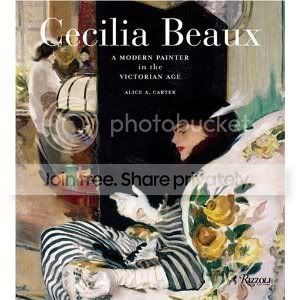
Well, jeeze, there's another one, too: Cecilia Beaux: American Figure Painter by Sylvia Yount, published 2007.
OK, life is short. I just bought this second book by Yount. This woman fascinates me, as does the entire family.
Well, jeeze, there's another one, too: Cecilia Beaux: American Figure Painter by Sylvia Yount, published 2007.
OK, life is short. I just bought this second book by Yount. This woman fascinates me, as does the entire family.
29sibylline
Ooooo -- I wonder if it has good pix of Green Alley? Another thing came into my head from that day -- of drinking tea with two rather old people (one man and one woman) The older man was rather dapper and more animated .... then walking out into some kind of gardeny place with them.... very very slowly. And my mother saying later that I had behaved very well. Weird, what floats up! Oh how I miss my mother right now.
30labwriter
Wonderful stuff, Sib.
I'm sure you must be familiar with the Pennsylvania Academy of the Fine Arts. Beaux's nephew Henry Drinker and Drinker's daughter donated art and photographs relating to their Cecilia Beaux. The collection includes photographs taken at Gloucester.
See the articlehere.
I'm sure you must be familiar with the Pennsylvania Academy of the Fine Arts. Beaux's nephew Henry Drinker and Drinker's daughter donated art and photographs relating to their Cecilia Beaux. The collection includes photographs taken at Gloucester.
See the articlehere.
31yolana
ooh, I really want to read that book about Cecilia Beaux. I really need to catch up with y'all as I'm only on chapter 5.
#5 I only had one younger brother but I had lots of male cousins that we spent our summers with so the brothers really appeal to me also. Also Katz plays violin and viola like me including a lot of the same pieces growing up so that really appeals to me as well.
It's early in the book so maybe she'll grow on me but I find that Sophie really doesn't appeal with me. Also does anyone know what she means by breakdown, is it a nervous breakdown or is it more like a depression. There seems to be a family predisposition whatever it is.
#5 I only had one younger brother but I had lots of male cousins that we spent our summers with so the brothers really appeal to me also. Also Katz plays violin and viola like me including a lot of the same pieces growing up so that really appeals to me as well.
It's early in the book so maybe she'll grow on me but I find that Sophie really doesn't appeal with me. Also does anyone know what she means by breakdown, is it a nervous breakdown or is it more like a depression. There seems to be a family predisposition whatever it is.
32labwriter
Addendum to #30.
That article about the photographs at the Pennsylvania Academy is from The Pennsylvania Magazine of History and Biography; it's a reprint of the article but it doesn't include the photographs that go with it--darn. Anyway, that might be a good place to find some pics of Green Alley, Sib.
That article about the photographs at the Pennsylvania Academy is from The Pennsylvania Magazine of History and Biography; it's a reprint of the article but it doesn't include the photographs that go with it--darn. Anyway, that might be a good place to find some pics of Green Alley, Sib.
33phebj
#31 Hi Yolana. I'm not sure what she means exactly by nervous breakdown. I tend to think of it as some kind of sudden inability to deal with things--maybe more high anxiety than depression. I realize you don't really hear that phrase anymore--nervous breakdown--and I was wondering if it was like a panic attack. Sorry I can't be more helpful.
I'm not musical at all (in fact, I have officially been tested and told I was tone deaf) but I'm enjoying reading about all the things the Drinkers excel in.
I just finished Chapter 12 and will come back and comment more later.
I'm not musical at all (in fact, I have officially been tested and told I was tone deaf) but I'm enjoying reading about all the things the Drinkers excel in.
I just finished Chapter 12 and will come back and comment more later.
34phebj
Some more comments:
VII--Grand Tour
My father never suffered a nervous breakdown or anything near it, though my mother did. Pa loved work, he reveled in it. Hard work kept him on his feet, hale and vigorous till the age of eighty. This reminded me of Donald Hall and his love of work and also Hall's comments about the effect of not working on women. It made me wonder if Hall would think her mother's nervous breakdowns were related to not having work of her own.
Papa's view of all "foreigners" was parochial in the extreme; today he would be put down as a Wasp of the worst order. CDB seems to both accept and be embarrassed by this aspect of her father.
All over the East . . . we were met and feted by American members of Standard Oil which CDB's father thought was a great and efficient agent of civilization and good business. I just finished a book about Henry Ford and his efforts to grow rubber in Brazil (Fordlandia) and Ford felt the same way about his company.
VIII--Ernesta
CDB talking about her mother: It has taken me half a century to realize it, but I think my mother possessed an inspired eye for the essence, the nature, of each of her six children and that she fostered what she saw. Mamma did not urge. Rather, it was as if she opened a door and said, Now, child, walk through if you wish. Your world is there before you. She says this in connection with Ernesta's beauty and how her mother made sure she wasn't destroyed by it.
IX--The house on west Spruce Street. Cecelia Beaux.
Mamma never kept a diary, being one of those rare souls whose thoughts are on other people. . . . But Cecelia Beaux kept a diary. She was an artist and her thoughts were on herself. I appreciated this chapter on the two sisters so much more after reading the article Becky gave us the link to.
I'm actually getting tired of going through everything I flagged from here on so will continue with some more comments tomorrow. I'm going to be sorry when this book is over.
VII--Grand Tour
My father never suffered a nervous breakdown or anything near it, though my mother did. Pa loved work, he reveled in it. Hard work kept him on his feet, hale and vigorous till the age of eighty. This reminded me of Donald Hall and his love of work and also Hall's comments about the effect of not working on women. It made me wonder if Hall would think her mother's nervous breakdowns were related to not having work of her own.
Papa's view of all "foreigners" was parochial in the extreme; today he would be put down as a Wasp of the worst order. CDB seems to both accept and be embarrassed by this aspect of her father.
All over the East . . . we were met and feted by American members of Standard Oil which CDB's father thought was a great and efficient agent of civilization and good business. I just finished a book about Henry Ford and his efforts to grow rubber in Brazil (Fordlandia) and Ford felt the same way about his company.
VIII--Ernesta
CDB talking about her mother: It has taken me half a century to realize it, but I think my mother possessed an inspired eye for the essence, the nature, of each of her six children and that she fostered what she saw. Mamma did not urge. Rather, it was as if she opened a door and said, Now, child, walk through if you wish. Your world is there before you. She says this in connection with Ernesta's beauty and how her mother made sure she wasn't destroyed by it.
IX--The house on west Spruce Street. Cecelia Beaux.
Mamma never kept a diary, being one of those rare souls whose thoughts are on other people. . . . But Cecelia Beaux kept a diary. She was an artist and her thoughts were on herself. I appreciated this chapter on the two sisters so much more after reading the article Becky gave us the link to.
I'm actually getting tired of going through everything I flagged from here on so will continue with some more comments tomorrow. I'm going to be sorry when this book is over.
35sibylline
Lovely choices -- I know what you mean about getting tired and also about regretting reaching the end. It is a beguiling book. One thing that continually impresses me is the way she unapologetically describes the prejudices and attitudes of the previous generation - they were what they were -. I think we are more judgmental retrospectively now and when you think about it, it is pointless.
The next two chapters I read are about Cecilia Beaux mainly. I also read the article Becky posted so there was some deja vu, with slight differences. Oddly, I didn't mark anything in the "House on Spruce St." chapter but I did mark a little more on the Kate Drinker one. (Which starts out being about Kate and then returns to Cecilia). At last though there is more biographical info about the Drinkers -- both families are full of talented and energetic people -- and it is not so surprising that these children, all six, had a high degree of ability and the drive needed to do something with it.
Funny: Aunt Kate in her old age wrote a novel called "Captain Dionysos" about a sea captain in the time of Herodotus....... and so excrutiatingly dull it proved once for all that she simply could not have invented the tales about Grandpa and the voyage home.
In this chapter she speculates on the masculine drive of her brothers contrasted with the previous several generations of matriarchal dominance -- I would say it was as much an accident as anything. Four boys and two girls, had it been reversed, perhaps the girls would have dominated once again? Certainly both Cecilia and Bowen held their own and then some.
The rest of this chapter describes in detail Cecilia's steady rise through the ranks of respected artists, although lamenting the 'woman' artist that always appears before her name. But Bowen is philosophical about it.
I'm part way through the next ch. about Harry, but not ready to comment.
The next two chapters I read are about Cecilia Beaux mainly. I also read the article Becky posted so there was some deja vu, with slight differences. Oddly, I didn't mark anything in the "House on Spruce St." chapter but I did mark a little more on the Kate Drinker one. (Which starts out being about Kate and then returns to Cecilia). At last though there is more biographical info about the Drinkers -- both families are full of talented and energetic people -- and it is not so surprising that these children, all six, had a high degree of ability and the drive needed to do something with it.
Funny: Aunt Kate in her old age wrote a novel called "Captain Dionysos" about a sea captain in the time of Herodotus....... and so excrutiatingly dull it proved once for all that she simply could not have invented the tales about Grandpa and the voyage home.
In this chapter she speculates on the masculine drive of her brothers contrasted with the previous several generations of matriarchal dominance -- I would say it was as much an accident as anything. Four boys and two girls, had it been reversed, perhaps the girls would have dominated once again? Certainly both Cecilia and Bowen held their own and then some.
The rest of this chapter describes in detail Cecilia's steady rise through the ranks of respected artists, although lamenting the 'woman' artist that always appears before her name. But Bowen is philosophical about it.
I'm part way through the next ch. about Harry, but not ready to comment.
36yolana
I love that line about Aunt Kate. I found the chapter on Ernesta a little disappointing in that she seems not to have accomplished much except being very beautiful and very often proposed to. I admit I expected more since the book is dedicated to her. I feel like Harry and the boys and I are old friends.
37phebj
XI--Harry
Lucy, I think you're probably right about the numbers being in favor of the men and therefore they dominated the conversations. I can't imagine listening to nothing but hunting and fishing stories though.
I loved the picture of Harry conducting one of the singing parties. I looked at all the pictures before starting the book and didn't realize this picture was taken in his house. I also noted one of Cecilia's paintings on the wall.
This family is so interesting. Even Sophie wrote a book, called "Music and Women," which took her six years, was translated into German and published here and abroad.
I keep on seeing similarities to Donald Hall's comments about loving the process of working. On p. 185, CDB talks about how much Harry loved his legal work and had such a good time . . . cutting down and simplifying the language in a corporate mortgage. She also talks about his "hobby" of translating Bach's choral texts into English and then going on to compile a thematic index to the Bach chorales, so that on hearing a chorale, a person could, after a measure or two, identify the cantata from which it came. This sounds a little insane to me but the main point is Harry loved this stuff.
XII--Aunt Cecilia refuses to die
I think you may have already mentioned this Lucy but I noted that CDB did not love Cecelia. It has been remarked that all genius has in it something montrous, and in truth Aunt Cecelia possessed a self-absorption which at the same time attracted and repelled.
This chapter also has that great discussion between the sisters as to whose life was more admirable (on pages 206-7) that is discussed so well in the article Becky linked us to.
Well, that brings me up to date. I'm about to start Chapter XIII on Philip, Cecil and Katherine. (What I keep on forgetting to do is look up the definitions of the following words--animadvert and metempsychosis.)
Lucy, I think you're probably right about the numbers being in favor of the men and therefore they dominated the conversations. I can't imagine listening to nothing but hunting and fishing stories though.
I loved the picture of Harry conducting one of the singing parties. I looked at all the pictures before starting the book and didn't realize this picture was taken in his house. I also noted one of Cecilia's paintings on the wall.
This family is so interesting. Even Sophie wrote a book, called "Music and Women," which took her six years, was translated into German and published here and abroad.
I keep on seeing similarities to Donald Hall's comments about loving the process of working. On p. 185, CDB talks about how much Harry loved his legal work and had such a good time . . . cutting down and simplifying the language in a corporate mortgage. She also talks about his "hobby" of translating Bach's choral texts into English and then going on to compile a thematic index to the Bach chorales, so that on hearing a chorale, a person could, after a measure or two, identify the cantata from which it came. This sounds a little insane to me but the main point is Harry loved this stuff.
XII--Aunt Cecilia refuses to die
I think you may have already mentioned this Lucy but I noted that CDB did not love Cecelia. It has been remarked that all genius has in it something montrous, and in truth Aunt Cecelia possessed a self-absorption which at the same time attracted and repelled.
This chapter also has that great discussion between the sisters as to whose life was more admirable (on pages 206-7) that is discussed so well in the article Becky linked us to.
Well, that brings me up to date. I'm about to start Chapter XIII on Philip, Cecil and Katherine. (What I keep on forgetting to do is look up the definitions of the following words--animadvert and metempsychosis.)
38phebj
#36 Yolana, that's an interesting comment about Ernesta. I didn't notice that the book had been dedicated to her. I wonder if the reason we don't hear more about her in the book was that she went off to Europe and wasn't as much a part of the daily lives of the family as the other siblings were.
The other thing that occurred to me was that we don't hear too much about her brother Jim as an adult the way we do about Harry, Cecil and Phil.
The other thing that occurred to me was that we don't hear too much about her brother Jim as an adult the way we do about Harry, Cecil and Phil.
39labwriter
I was at the Library of Congress recently and read through Catherine Drinker Bowen's work journal which included the time she was working on this book. I think the reason she has less to say about Ernesta is because her sister was still alive when this book was published, and Catherine didn't want to say too much about her because of privacy issues. She had Ernesta read the chapters as she wrote them, and she always seemed very relieved that her sister approved of what she was writing. She was concerned that Ernesta wouldn't want her to write about the family, but instead her sister was very supportive and wanted her to complete the project. That may be one reason why the book was dedicated to her.
41sibylline
Here is something fun for you all. here This is the obit for Ernesta Drinker Ballard, one of the children of Harry and Sophie -- she was an ardent feminist and the head of the PA Hort Society for a long time -- a great person and a strong character. I knew her a little tiny bit, one of my PH friends who was very into gardening was a sort of acolyte of hers for awhile..... I went to some garden party thing at her house once with my mother and you can bet it was the most amazing place, the garden was astonishingly beautiful.
Now as for reading, I am just where you are Pat. I wasn't exactly disappointed by Ernesta -- she didn't make the choice to pursue a 'career' or a passion, so there wasn't as much to say.
I was struck by Bowen's inability to speak up for herself at her divorce hearing -- the only solution being to lose her voice altogether so that Harry could speak for her. In our 'tell all' culture, Bowen's reticence about her failed marriage is something I've struggled with a little. But she was thinking, no doubt, of her children and rightly so.
I love Etta saying to Bowen about Harry and his activities: "With Harry I think its muscular and "The bigger the tree stump, the happier Harry looked."
The "Aunt Cecilia Refuses to Die" chapter paints such an interesting portrait of the time -- how little could be done for a person who had an infection, how it affected the household, -- today a person so ill would be in hospital --.
I loved the pan under the bed, 'to draw the sweat' -- and the illness itself seems to have softened Cecilia enough for at least one moment of kindness to Bowen, which was very nice to see.
"all genius has in it something monstrous" that is indeed certainly a pithy and worthy insight -- Bowen at her best.
I love too the description of the normally super-busy father retreating into his version of a trashy novel: "Captain Fracasse" -- and all of them retreating into strange nooks and corners of the house -- Bowen working in the maid's bathroom!
Onward!
Now as for reading, I am just where you are Pat. I wasn't exactly disappointed by Ernesta -- she didn't make the choice to pursue a 'career' or a passion, so there wasn't as much to say.
I was struck by Bowen's inability to speak up for herself at her divorce hearing -- the only solution being to lose her voice altogether so that Harry could speak for her. In our 'tell all' culture, Bowen's reticence about her failed marriage is something I've struggled with a little. But she was thinking, no doubt, of her children and rightly so.
I love Etta saying to Bowen about Harry and his activities: "With Harry I think its muscular and "The bigger the tree stump, the happier Harry looked."
The "Aunt Cecilia Refuses to Die" chapter paints such an interesting portrait of the time -- how little could be done for a person who had an infection, how it affected the household, -- today a person so ill would be in hospital --.
I loved the pan under the bed, 'to draw the sweat' -- and the illness itself seems to have softened Cecilia enough for at least one moment of kindness to Bowen, which was very nice to see.
"all genius has in it something monstrous" that is indeed certainly a pithy and worthy insight -- Bowen at her best.
I love too the description of the normally super-busy father retreating into his version of a trashy novel: "Captain Fracasse" -- and all of them retreating into strange nooks and corners of the house -- Bowen working in the maid's bathroom!
Onward!
42phebj
Thanks for that link to Ernesta's obituary, Lucy. Sounds like she was a powerhouse in her own right. I always heard great things about the Philadelphia Flower Show but have never been.
One thing that confused me. Among Ernesta's survivors was "a sister, Cecilia D. Saltonstall of Exeter, N.H." Is this CDB???
One thing that confused me. Among Ernesta's survivors was "a sister, Cecilia D. Saltonstall of Exeter, N.H." Is this CDB???
43sibylline
Wouldn't that be another of Harry and Sophie's children?
I haven't missed a PH Flower Show since 1986 (well, maybe one or two) and it has always been THE harbinger of true spring. It is one of the things I will really really really miss. About every fourth or fifth one just knocks your socks off. My favorite stuff are the entries from private gardeners, small things -- but the big displays can be breathtaking too. Philadelphia has a very deep devotion to gardeners and gardening -- all those ladies! One of my great-aunts (probably with friends) helped introduce the noxious multiflora rose (imported from China) that has become such an unbelievable pest in the mid-atlantic region..... a dubious honor, but she was a passionate gardener, always looking for The Next Big Thing!
I haven't missed a PH Flower Show since 1986 (well, maybe one or two) and it has always been THE harbinger of true spring. It is one of the things I will really really really miss. About every fourth or fifth one just knocks your socks off. My favorite stuff are the entries from private gardeners, small things -- but the big displays can be breathtaking too. Philadelphia has a very deep devotion to gardeners and gardening -- all those ladies! One of my great-aunts (probably with friends) helped introduce the noxious multiflora rose (imported from China) that has become such an unbelievable pest in the mid-atlantic region..... a dubious honor, but she was a passionate gardener, always looking for The Next Big Thing!
44phebj
Oops! My mistake. I'm rushing around the threads this morning (need to get out the door to my Qigong class) and I was reading the obituary as if it were CDB's sister not her neice. Probably need to slow down a bit.
45yolana
Easy mistake to make since they were constantly recycling the names. She dedicated friends and Fiddlers to Ernesta and Cecilia Beaux but she changed all the other names. Harry became John and Ernesta (her sister) became Victoria among others.
46phebj
XIII--Philip, Cecil and Katherine
Cecil was the star by which my compass swung, the hero whom I worshipped from the unbridgeable distance of his ten years' seniority. For some reason (I guess the contrast in the sisters relationship with Cecil), this reminded me of how much Cecil seemed to dislike Ernesta (that whole thing with the accents).
Talking about Cecil and Katherine: Cecil knew how to build up a person; in his company one felt at one's best and better. But Cecil could also destroy. He was a people-eater, devouring those he loved--and in the end, Katherine let it happen.
Cecil's ambition was insatiable; and the demands he put upon others were to be matched and over-matched by his demands upon himself. I thought it was interesting that none of his work colleagues seemed to hold Cecil's drinking against him. They loved working with him so much.
XIV--The Iron Lung. "Industrial Dust."
It seems I didn't mark anything in this chapter. I have these scary memories of seeing the Iron Lung on television shows when I was a child (black and white shows so probably in the late 50s/early 60s). I don't know why, but it really made an impression on me. The pictures in this chapter brought that back.
XV--Cecil. "The hardest living asks its price."
The intensity we had felt and feared in Cecil's youth, in middle age became overmastering. . . . He would take no advice, no comfort anywhere. . . . Alcoholics Anonymous? That was for fools and simpletons who groveled on their knees. "God is not interested," Cecil said.
Cecil went through life--I know it now--entirely conscious of his alcoholism, yet never, it would seem, ready for what might have proved painful inquiry into its underlying causes.
In my youth, Cecil had told me, in one way or another, that ideas were cheap unless implemented. "You have to work things out, Katz. That's the fun of it." Most of her family members seem to love their work (Donald Hall connection again for me).
I liked her comment about her brother Jim on p. 269: After one particularly feverish rash of family medals and honorary degrees, he wrote to Philip, "It's a good thing I'm here to bring the family reputation down to normal." On this page she talks about Harry being a truly happy person, Philip being hardworking and healthy, and Jim being the "best balanced of all six siblings."
At the end of the chapter, when both Cecil and Katherine are dying (Katherine literally bleeding to death from untreated leukemia), CDB says: I could not help thinking--and with all my love for my brother I think it still--that Katherine's bloodletting began years ago, the day she met and fell in love with Cecil. I'm assuming she could delve into the darkness of Cecil's life so much because he and Katherine had already passed away when she was writing the book. I'm also assuming that they had no children--as far as I remember she never mentioned anything about this.
Two more chapters to go!
Cecil was the star by which my compass swung, the hero whom I worshipped from the unbridgeable distance of his ten years' seniority. For some reason (I guess the contrast in the sisters relationship with Cecil), this reminded me of how much Cecil seemed to dislike Ernesta (that whole thing with the accents).
Talking about Cecil and Katherine: Cecil knew how to build up a person; in his company one felt at one's best and better. But Cecil could also destroy. He was a people-eater, devouring those he loved--and in the end, Katherine let it happen.
Cecil's ambition was insatiable; and the demands he put upon others were to be matched and over-matched by his demands upon himself. I thought it was interesting that none of his work colleagues seemed to hold Cecil's drinking against him. They loved working with him so much.
XIV--The Iron Lung. "Industrial Dust."
It seems I didn't mark anything in this chapter. I have these scary memories of seeing the Iron Lung on television shows when I was a child (black and white shows so probably in the late 50s/early 60s). I don't know why, but it really made an impression on me. The pictures in this chapter brought that back.
XV--Cecil. "The hardest living asks its price."
The intensity we had felt and feared in Cecil's youth, in middle age became overmastering. . . . He would take no advice, no comfort anywhere. . . . Alcoholics Anonymous? That was for fools and simpletons who groveled on their knees. "God is not interested," Cecil said.
Cecil went through life--I know it now--entirely conscious of his alcoholism, yet never, it would seem, ready for what might have proved painful inquiry into its underlying causes.
In my youth, Cecil had told me, in one way or another, that ideas were cheap unless implemented. "You have to work things out, Katz. That's the fun of it." Most of her family members seem to love their work (Donald Hall connection again for me).
I liked her comment about her brother Jim on p. 269: After one particularly feverish rash of family medals and honorary degrees, he wrote to Philip, "It's a good thing I'm here to bring the family reputation down to normal." On this page she talks about Harry being a truly happy person, Philip being hardworking and healthy, and Jim being the "best balanced of all six siblings."
At the end of the chapter, when both Cecil and Katherine are dying (Katherine literally bleeding to death from untreated leukemia), CDB says: I could not help thinking--and with all my love for my brother I think it still--that Katherine's bloodletting began years ago, the day she met and fell in love with Cecil. I'm assuming she could delve into the darkness of Cecil's life so much because he and Katherine had already passed away when she was writing the book. I'm also assuming that they had no children--as far as I remember she never mentioned anything about this.
Two more chapters to go!
47yolana
I don't think Ernesta had any surviving children either. poor Cecil and Katherine though, it seems as though they were deeply in love despite all their problems.
48sibylline
The story of the marriage of Cecil and Katherine is tantalizing too -- not quite enough information to be able to grasp what happened to them and why Katherine fell apart. Was it over childlessness? Was it over some hidden forces in the marriage that actually worked against her having a meaningful career (like, say, having a serious alcoholic as a husband)? What? Clearly, despite the love and affection, there was some terrible and unaddressed misery for both of them. And Cecil's ruthlessness combined with his charisma -- although maybe he was temperamentally the most like Cecilia B. and thus really not suited to being in a long-term relationship, just too much. I know that Bowen was treading a fine line here, but I found too many questions raised about them to feel comfortable. There is just so much she isn't saying.
Reading about the iron lung I am maddened by remembering a book I read when I was ten or so about a girl who spent a year or two in an iron lung, it's the story of her recovery -- it made a huge impression on me -- and now I can't remember the title. I looked around on Amazon, but it appears to be one of those books that has entirely submerged, however, I feel that at the time it was quite well known. Ring any bells?
Reading about the iron lung I am maddened by remembering a book I read when I was ten or so about a girl who spent a year or two in an iron lung, it's the story of her recovery -- it made a huge impression on me -- and now I can't remember the title. I looked around on Amazon, but it appears to be one of those books that has entirely submerged, however, I feel that at the time it was quite well known. Ring any bells?
50yolana
Well I tried to add this to the last message but it didn't take. You're right about the unanswered questions, several times earlier in the book she refers to Cecil's future violence but I really didn't see any indication of that. Was he violent towards Katherine? It doesn't seem to fit though that may be wishful thinking on my part.
51labwriter
I think there were aspects of the family members that CDB wasn't able to write about; that's my take on it, anyway.
Remember the Montaigne quotation, on the dustcover and on the title page: "I speak truth, not so much as I would, but as much as I dare; and I dare a little the more, as I grow older."
Remember the Montaigne quotation, on the dustcover and on the title page: "I speak truth, not so much as I would, but as much as I dare; and I dare a little the more, as I grow older."
52sibylline
Exactly. Exactly. Now I'm going to go look for that book. It had a sort of weirdly jolly title if I remember at all rightly.
53sibylline
I have finished Family Portrait and am eager to finish up here, but I have to cede wifi time (we can only go on one at a time in our rustic set-up) to my daughter so she can do her homework, for heaven's sake! I have some things to say about Bowen herself that seem to emerge in the final chapters. So I'll be back!
54sibylline
Ha! I'm back because the LD is in the shower! So. Cecil clearly was a true alcoholic, drinking to numb something, and utterly, despite great effort, unable to do it on his own, which must have been in itself a gargantuan problem for someone so independent....
It is this next Chapter, Green Alley, that captivates me. The peace that descends on these three siblings in later life, the obvious joy in being together in the summer at this lovely and simple place -- I just loved it.
I also loved Sophie and her hysterectomy and "all my life I have had a bad temper. I used it to get my way. When I was forty-six, I decided to change all that." -- I have to say, my lads and lassies, that except for the other problems that come with menopause, I love love love being more emotionally stable and I KNOW exactly what Sophie was talking about, 'as if the waves of her being began to move and she became herself.' It made me love Sophie.
For me the most heartfelt book, the part that speaks directly to me comes toward the end of this chapter as she describes her growing unease watching her brother Harry fade and fail -- I want to quote the whole paragraph but it is too long -- but she describes exactly something that I underwent at the time of my mother's long fade and death..... I'll quote bits: "Now suddenly the years put me in first place, giving me strength and my brother weakness. I did not like it, and as time went on the reversal threatened me with panic. I still wrote books, still played string quartets.... Yet to what end?..... under me the footing slipped..... Surely the books I wrote, the music I played had been their own spur and their own reward. Yet even more surely I knew that with Harry's fading some bright bitter taste had gone from the air, some pungent, acrid nourishment was lacking......" This long passage moved me greatly.
The final chapter, rather cleverly, after this emotional crescendo, reaches back into the past, into exploring an early forbear, the Quaker Drinker who was expelled from the city for refusing to participate in the Continental Army and uprising against the British. She leaves us thinking about stubborness and determination certainly a huge piece of the Drinker personality -- very adroitly done, to shift the mood into a positive place as she lets us go.
BTW - my Quaker forbears were kicked out of meeting, did not fight, but joined the cause as quarter-masters and such; they found a way to participate that worked for them and did not compromise their beliefs..... and were promptly re-instated in Meeting at the conclusion of the hostilities. That is the difference between my family and the Drinkers. Not pigheaded stubborn and probably (along with many other reasons, of course, one of them humility) why we ain't famous!!!!
It is this next Chapter, Green Alley, that captivates me. The peace that descends on these three siblings in later life, the obvious joy in being together in the summer at this lovely and simple place -- I just loved it.
I also loved Sophie and her hysterectomy and "all my life I have had a bad temper. I used it to get my way. When I was forty-six, I decided to change all that." -- I have to say, my lads and lassies, that except for the other problems that come with menopause, I love love love being more emotionally stable and I KNOW exactly what Sophie was talking about, 'as if the waves of her being began to move and she became herself.' It made me love Sophie.
For me the most heartfelt book, the part that speaks directly to me comes toward the end of this chapter as she describes her growing unease watching her brother Harry fade and fail -- I want to quote the whole paragraph but it is too long -- but she describes exactly something that I underwent at the time of my mother's long fade and death..... I'll quote bits: "Now suddenly the years put me in first place, giving me strength and my brother weakness. I did not like it, and as time went on the reversal threatened me with panic. I still wrote books, still played string quartets.... Yet to what end?..... under me the footing slipped..... Surely the books I wrote, the music I played had been their own spur and their own reward. Yet even more surely I knew that with Harry's fading some bright bitter taste had gone from the air, some pungent, acrid nourishment was lacking......" This long passage moved me greatly.
The final chapter, rather cleverly, after this emotional crescendo, reaches back into the past, into exploring an early forbear, the Quaker Drinker who was expelled from the city for refusing to participate in the Continental Army and uprising against the British. She leaves us thinking about stubborness and determination certainly a huge piece of the Drinker personality -- very adroitly done, to shift the mood into a positive place as she lets us go.
BTW - my Quaker forbears were kicked out of meeting, did not fight, but joined the cause as quarter-masters and such; they found a way to participate that worked for them and did not compromise their beliefs..... and were promptly re-instated in Meeting at the conclusion of the hostilities. That is the difference between my family and the Drinkers. Not pigheaded stubborn and probably (along with many other reasons, of course, one of them humility) why we ain't famous!!!!
56phebj
Great comments, Lucy.
I too related to her reactions to Harry's decline and her comments about her parents' deaths. The realization of old age in those near us comes always as a shock. My father had a hard death (from lung disease) that I thought of when she was describing her mother's passing. And my mother has Alzheimer's disease and that has been a long, mostly slow, decline.
I was reminded of any earlier quote ("By now it must be apparent that the condition known as sibling rivalry raged rampant in our family." p. 16) when she said: I was aware that my brothers had spurred themselves--and me--to competition. But was it, then, this rivalry that had urged me so passionately, all these years?
When she's looking at all the pictures of her ancestors at the end and the certificates of membership in the American Philosophical Soceity (for herself, Harry and her great-great-grandfather signed by Benjamin Franklin), I loved this quote:
When I saw the three together I wondered if, for Harry, this triple evidence took the sting out of our last name--or did it still rhyme with stinker?
I really enjoyed this book but it did make me realize how different current day memoirs are, where authors often wallow in the miseries they've suffered. This book, along with Donald Hall's and even Wallace Stegner's, are much more controlled where the disclosure of emotions are concerned and maybe more dignified because of it. But, on the other hand, I often had questions that I never got the answer to (such as what went wrong in her first marriage, what became of her children--she had two but only seems to refer to her son, and just more in general about her life rather than her siblings).
I think on your thread you referred to CDB as modest. That almost seems like an understatement to me. I googled "Family Portrait book review" and it took me to some site that had a biography of CDB which listed all her books and awards. You got almost none of that from this book. It also had a great quote from her son, Ezra. Something to the effect CDB grew up in a loving but competitive family for whom "excellence was the starting point."
This was another great GR. Looking forward to Middlemarch!
I too related to her reactions to Harry's decline and her comments about her parents' deaths. The realization of old age in those near us comes always as a shock. My father had a hard death (from lung disease) that I thought of when she was describing her mother's passing. And my mother has Alzheimer's disease and that has been a long, mostly slow, decline.
I was reminded of any earlier quote ("By now it must be apparent that the condition known as sibling rivalry raged rampant in our family." p. 16) when she said: I was aware that my brothers had spurred themselves--and me--to competition. But was it, then, this rivalry that had urged me so passionately, all these years?
When she's looking at all the pictures of her ancestors at the end and the certificates of membership in the American Philosophical Soceity (for herself, Harry and her great-great-grandfather signed by Benjamin Franklin), I loved this quote:
When I saw the three together I wondered if, for Harry, this triple evidence took the sting out of our last name--or did it still rhyme with stinker?
I really enjoyed this book but it did make me realize how different current day memoirs are, where authors often wallow in the miseries they've suffered. This book, along with Donald Hall's and even Wallace Stegner's, are much more controlled where the disclosure of emotions are concerned and maybe more dignified because of it. But, on the other hand, I often had questions that I never got the answer to (such as what went wrong in her first marriage, what became of her children--she had two but only seems to refer to her son, and just more in general about her life rather than her siblings).
I think on your thread you referred to CDB as modest. That almost seems like an understatement to me. I googled "Family Portrait book review" and it took me to some site that had a biography of CDB which listed all her books and awards. You got almost none of that from this book. It also had a great quote from her son, Ezra. Something to the effect CDB grew up in a loving but competitive family for whom "excellence was the starting point."
This was another great GR. Looking forward to Middlemarch!
57sibylline
Our thoughts are running parallel.
The question of being driven, being competitive. In Bowen's time that was seen as a virtue complete, no question, although I feel her questioning it albeit cautiously, towards the end. Since my mother's decline and death (many mini-strokes, chf, dementia, awful awful awful) I'm simply not as ambitious or driven as I used to be for better or worse -- I'm much more inclined to emulate Ferdinand and sniff the fresh air and roses.
The question of being driven, being competitive. In Bowen's time that was seen as a virtue complete, no question, although I feel her questioning it albeit cautiously, towards the end. Since my mother's decline and death (many mini-strokes, chf, dementia, awful awful awful) I'm simply not as ambitious or driven as I used to be for better or worse -- I'm much more inclined to emulate Ferdinand and sniff the fresh air and roses.
58phebj
My husband and I have been retired for awhile (which he was planning on and I was not) and it has been much easier than I thought it would be. I don't miss the frenetic pace of work life at all. I've also really enjoyed our move to Idaho and being more in touch with the land. So I'm with you on sniffing the fresh air and roses!
But for me, I've been noticing a theme in Life Work and Family Portrait about the joys of work that I probably have been missing in retirement. I'm not particulary self-motivated (I tend to procrastinate) so my days sometimes lack structure which sometimes I like and sometimes I don't. Anyway, I found my old copy of Flow: The Psychology of Optimal Experience and have started to re-read it. I do think it's interesting, and something to watch for, about the line between absorption and obsession (which it seemed that Harry might have at times, and Cecil definitely, crossed).
But for me, I've been noticing a theme in Life Work and Family Portrait about the joys of work that I probably have been missing in retirement. I'm not particulary self-motivated (I tend to procrastinate) so my days sometimes lack structure which sometimes I like and sometimes I don't. Anyway, I found my old copy of Flow: The Psychology of Optimal Experience and have started to re-read it. I do think it's interesting, and something to watch for, about the line between absorption and obsession (which it seemed that Harry might have at times, and Cecil definitely, crossed).
59yolana
I finished the book last night. I really almost cried reading about Harry's death. And Cecil saying he could have gotten more done had it not been for alcohol was just incredible, I'm not an alcoholic and I will never accomplish a fraction of what he did. I now need to find a copy of Cecil's book somewhere. I liked the whole family but it's Cecil that interests me the most, even at the distance of decades it's easy to see the pull he had on his family, friends and colleagues.
60sibylline
Pats on the back all around! Another great read! I'm so glad you found us yolana.
Good points Pat about work -- I end up liking the structure that gets imposed when my daughter is in school and wonder what will happen when it is always 'summer' -- whether I will be able to break up the day in sensible ways when I don't have to. Flow sounds interesting, I'll have to put in on the list..... groan (floorboards creaking....)
Good points Pat about work -- I end up liking the structure that gets imposed when my daughter is in school and wonder what will happen when it is always 'summer' -- whether I will be able to break up the day in sensible ways when I don't have to. Flow sounds interesting, I'll have to put in on the list..... groan (floorboards creaking....)
