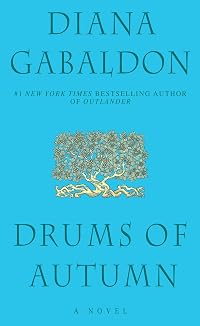
On This Page
Description
Scottish soldier Jamie Fraser and his wife, Claire Randall--a twentieth century doctor who has traveled two centuries back in time--find themselves in South Carolina on the eve of the American Revolution, where they must fight to save a young girl.Tags
Recommendations



Member Reviews
As this is the fourth novel in the series, there will most likely be spoilers for those who have not yet gotten this far in the story. Consider yourself warned.
I do love Jamie and Claire Fraser. They continue to be the couple that gets the entire idea of marriage - the give and take, the intimate knowledge of each other, the partnership of the entire relationship. Their banter and genuine support of one another is strikingly authentic and realistic. Any time the action revolves around them, the reader is in for a treat. If Drums of Autumn had been all about Claire and Jamie's struggles to forge a new life in the frontiers of America, I personally would have been okay with that.
Unfortunately, Drums of Autumn also brings Brianna Fraser to show more the forefront, and this is its biggest, most distracting flaw. While Jamie and Claire are pragmatic, careful, thoughtful, and intelligent, Brianna is the exact opposite. She's rash, impetuous, stubborn and frankly, childish. One could use her age as an excuse, and yet, she is not all that much younger than Jamie was when readers were first introduced to him. Any time the story revolved around Brianna, the story ground to a halt. The reader gets the distinct impression that even Ms. Gabaldon does not enjoy writing Brianna as much as she does Jamie and Claire, or even Roger and Ian, and the novel does suffer as a result.
This inertia in Brianna's story makes for a very long novel. If I had been reading it, I personally would have skipped over or at least skimmed through those pages where she was the main character. In addition, in this novel more so than in the others, the switch in narrators was jarring and obvious. Too often, it was quite a difference between one sentence; the reader would be seeing the story unfold in the first person through Claire's eyes and in the next sentence would switch to either another character's or an omniscient observer in third person. While this technique may have been employed in the previous novels, I do not remember it resulting in quite as jagged a story as it does in Drums of Autumn.
While there has always been a sense of the fantastic in the Outlander series, I feel that in Drums of Autumn, Ms. Gabaldon truly does stretch the reader's ability to accept the action. While it was one thing for Claire to be able to adjust to life 200 years into the past, Ms. Gabaldon does a sufficient job explaining why Claire is able to do so with relative ease. Yet, the reader is now expected to believe that both Brianna and Roger can also transition to life 200 years earlier without any problems, and this time, Ms. Gabaldon offers no explanations as to how this is possible. As a reader, I personally do not buy into this part of the story and find it a bit too far-fetched to stomach with ease. From Brianna's ability to accept service from slaves to Roger's ability to steal from a pirate back to Brianna's ability to cross Scotland, an entire ocean and most of the Carolinas without harm or assault - it was all just a bit too convenient, too pat and too easy. For the first time, the story stopped being possible and moved into the highly improbable.
Davina Porter, as always, is delightful as the narrator. Her ability to encompass the gruff Scottish temper, the coquettish maid, and the pragmatic doctor continues to impress and improve the story. Unfortunately, the story itself was so weak that no amount of oratory skill was enough to overcome its weaknesses. I truly struggled with listening to the entire novel and even found myself forwarding through scenes with Brianna in them, as I personally did not care what happened to her. She is not the force or the magic behind the stories, and I found I did not miss much when I did skip through those scenes.
In expressing my displeasure at this fourth novel, others assured me that it was their least favorite of the entire series. To this I can say I am not surprised. It truly is a weak storyline with very little in the way of danger and forward progress for Claire and Jamie, and ultimately my love for them is the only reason why I continue with the series. My hope is that the fifth novel moves away from Brianna and back to Claire and Jamie, where the main story deservedly belongs. Otherwise, I am not certain I want to invest more time in slogging through these novels. Even on audio, the novels are too long to continue if the main feeling while reading is a desire to skip to the end. Even with Jamie and Claire, Drums of Autumn left me with that particular desire one too many times for me to be able to say that it was a novel I enjoyed, unfortunately. It also left me in no particular hurry to get to the fifth novel as I do not want to continue to be disappointed. show less
I do love Jamie and Claire Fraser. They continue to be the couple that gets the entire idea of marriage - the give and take, the intimate knowledge of each other, the partnership of the entire relationship. Their banter and genuine support of one another is strikingly authentic and realistic. Any time the action revolves around them, the reader is in for a treat. If Drums of Autumn had been all about Claire and Jamie's struggles to forge a new life in the frontiers of America, I personally would have been okay with that.
Unfortunately, Drums of Autumn also brings Brianna Fraser to show more the forefront, and this is its biggest, most distracting flaw. While Jamie and Claire are pragmatic, careful, thoughtful, and intelligent, Brianna is the exact opposite. She's rash, impetuous, stubborn and frankly, childish. One could use her age as an excuse, and yet, she is not all that much younger than Jamie was when readers were first introduced to him. Any time the story revolved around Brianna, the story ground to a halt. The reader gets the distinct impression that even Ms. Gabaldon does not enjoy writing Brianna as much as she does Jamie and Claire, or even Roger and Ian, and the novel does suffer as a result.
This inertia in Brianna's story makes for a very long novel. If I had been reading it, I personally would have skipped over or at least skimmed through those pages where she was the main character. In addition, in this novel more so than in the others, the switch in narrators was jarring and obvious. Too often, it was quite a difference between one sentence; the reader would be seeing the story unfold in the first person through Claire's eyes and in the next sentence would switch to either another character's or an omniscient observer in third person. While this technique may have been employed in the previous novels, I do not remember it resulting in quite as jagged a story as it does in Drums of Autumn.
While there has always been a sense of the fantastic in the Outlander series, I feel that in Drums of Autumn, Ms. Gabaldon truly does stretch the reader's ability to accept the action. While it was one thing for Claire to be able to adjust to life 200 years into the past, Ms. Gabaldon does a sufficient job explaining why Claire is able to do so with relative ease. Yet, the reader is now expected to believe that both Brianna and Roger can also transition to life 200 years earlier without any problems, and this time, Ms. Gabaldon offers no explanations as to how this is possible. As a reader, I personally do not buy into this part of the story and find it a bit too far-fetched to stomach with ease. From Brianna's ability to accept service from slaves to Roger's ability to steal from a pirate back to Brianna's ability to cross Scotland, an entire ocean and most of the Carolinas without harm or assault - it was all just a bit too convenient, too pat and too easy. For the first time, the story stopped being possible and moved into the highly improbable.
Davina Porter, as always, is delightful as the narrator. Her ability to encompass the gruff Scottish temper, the coquettish maid, and the pragmatic doctor continues to impress and improve the story. Unfortunately, the story itself was so weak that no amount of oratory skill was enough to overcome its weaknesses. I truly struggled with listening to the entire novel and even found myself forwarding through scenes with Brianna in them, as I personally did not care what happened to her. She is not the force or the magic behind the stories, and I found I did not miss much when I did skip through those scenes.
In expressing my displeasure at this fourth novel, others assured me that it was their least favorite of the entire series. To this I can say I am not surprised. It truly is a weak storyline with very little in the way of danger and forward progress for Claire and Jamie, and ultimately my love for them is the only reason why I continue with the series. My hope is that the fifth novel moves away from Brianna and back to Claire and Jamie, where the main story deservedly belongs. Otherwise, I am not certain I want to invest more time in slogging through these novels. Even on audio, the novels are too long to continue if the main feeling while reading is a desire to skip to the end. Even with Jamie and Claire, Drums of Autumn left me with that particular desire one too many times for me to be able to say that it was a novel I enjoyed, unfortunately. It also left me in no particular hurry to get to the fifth novel as I do not want to continue to be disappointed. show less
This book was my last straw with outlander. I have only kept reading thus far because of Brianna, Roger, and Ian. This book totally ruined everything for me. The character assassination of Roger is criminal. He goes from being this sweet, nerdy, adorable guy to being a misogynistic, lust-crazed idiot. The way he acts when he proposes to her is horrible. What is it with this author and the rape-y vibes? “I could have had you on your back several times this summer”. Ew. She did the same with LJG to Jamie and it’s gross. Things just keep going downhill from there. Brianna doesn’t tell Roger what she has planned, so he doesn’t know that she wants him to stay in the present for her. The whole entire plot could have been solved with show more a simple conversation instead of them acting like idiots. Then she goes into the past. Roger shows up. They get handfasted and have sex a bunch of times. Then immediately get into another fight. She goes off and gets raped. Finds Jamie. He immediately welcomes her in like it’s nothing major. Brings her back to the homestead. She ends up pregnant and doesn’t know if it’s Roger’s or the rapist. So she’s stuck in the past now and can’t go back so she has to be content being a pioneer woman and popping out babies. Meanwhile they think Roger is her rapist because they don’t bother to even ask his first name and sell him to Indians where he is tormented and enslaved. They eventually get him back at the cost of trading him for Young Ian. I’m sorry but Ian deserved so much better than what he got and I’m so mad about it. When they eventually get Roger back, all he cares about is having sex with Brianna and jealous that the baby may not be his. The things he thinks and says about the baby are disgusting. His whole personality revolves around being mad that Brianna isn’t having sex with him and wanting to get her pregnant with his baby because somehow that will make their situation better?? He’s completely horrible and I’m sad that I kept reading for him. Brianna is also so stupid because she goes to hunt down her rapist and wants him to know that he’s having a baby because they’re supposed to kill him and she wants him to know there’s something left of him. What rape victim does that?? I’ll tell you: nobody. That’s who. That was the stupidest plot I’ve ever seen in my life. Jamie is awful in this book as well. I know he thought Roger raped Brianna but to sell someone to a life of slavery and torment without even clearing things up when he himself has been in prison and lived as a slave?? I had lost what little respect I had for him after that. This whole series has just went to crap and I can’t read anymore. I have no interest in reading about frontier life and washing baby diapers in the creek and stuff. show less
Note: Drums of Autumn is the fourth novel in the "Outlander Series." There will necessarily be spoilers for the first three books.
This series tells the ongoing saga of English nurse Claire who travels back in time from the 20th Century to the 18th, and takes up with hot Highland hunk Jamie. After a number of adventures in Scotland, and a hiatus in which Claire goes back to the future, now she and Jamie are together again, and they are in America.
Drums of Autumn begins some two months after the events in Voyager in 1767. Jamie is offered some land in North Carolina, and their little group begins to build a settlement. There is a lot of interaction with the Indians with an emphasis on their superstitions and savagery.
Meanwhile, back in show more 1969 Boston, Jamie and Claire's daughter Bree uncovers evidence that her parents are in danger. She travels to Scotland so she can go through the portal to the past and warn them. In 1767, she stops at Jamie's former home at Lallybroch, meets the family, and heads to America. Her boyfriend, the historian Roger, figures out what she has done and follows her into the past, hiring on as a ship hand for none other than a villain of the previous book, Stephen Bonnet.
In North Carolina, Bree finds her parents, but there is a glitch in the otherwise happy reunion: the unmarried Bree is pregnant. Furthermore, it may not be Roger’s baby; Bree was raped after she transitioned to the past. Jamie is led to believe the man who is actually Roger (but who is now using a different name), was the rapist, and when Roger gets there, Jamie beats him up and sells him to the Mohawks. Bree tells Jamie she hates him (even though neither she nor Claire had bothered to clarify matters for Jamie). To win Bree back, Jamie heads off with Claire, aided by nephew Ian, to the Mohawks to try to get Roger back.
Staying with her Aunt Jocasta while they are gone, Bree meets Lord John Grey, who offers to marry Bree so that the child will not be a bastard.
Discussion: In this book, Bree is an unreasonable screeching brat, and Roger disappoints as well. Furthermore, their sex scenes are bizarre - if you read them and cover up the names, you could swear it is Claire and Jamie, since both couples are turned on by the exact same things. The one who acquits himself best in this book is Lord John, who tries to help Bree in spite of her appalling treatment of him.
This book seems in some ways like “a middle book,” introducing characters and situations that we can almost surely rely on seeing later. This would be most welcome, since it is some of the more likable and/or interesting characters that get removed from the story.
Reader beware: Once again, Gabaldon is not what you would call “politically correct” in her attitudes toward those who are non-white, non-Christian, and non-heterosexual. Although the 20th Century characters have the grace to be opposed to slavery, that is often the best that can be said for them. show less
This series tells the ongoing saga of English nurse Claire who travels back in time from the 20th Century to the 18th, and takes up with hot Highland hunk Jamie. After a number of adventures in Scotland, and a hiatus in which Claire goes back to the future, now she and Jamie are together again, and they are in America.
Drums of Autumn begins some two months after the events in Voyager in 1767. Jamie is offered some land in North Carolina, and their little group begins to build a settlement. There is a lot of interaction with the Indians with an emphasis on their superstitions and savagery.
Meanwhile, back in show more 1969 Boston, Jamie and Claire's daughter Bree uncovers evidence that her parents are in danger. She travels to Scotland so she can go through the portal to the past and warn them. In 1767, she stops at Jamie's former home at Lallybroch, meets the family, and heads to America. Her boyfriend, the historian Roger, figures out what she has done and follows her into the past, hiring on as a ship hand for none other than a villain of the previous book, Stephen Bonnet.
In North Carolina, Bree finds her parents, but there is a glitch in the otherwise happy reunion: the unmarried Bree is pregnant. Furthermore, it may not be Roger’s baby; Bree was raped after she transitioned to the past. Jamie is led to believe the man who is actually Roger (but who is now using a different name), was the rapist, and when Roger gets there, Jamie beats him up and sells him to the Mohawks. Bree tells Jamie she hates him (even though neither she nor Claire had bothered to clarify matters for Jamie). To win Bree back, Jamie heads off with Claire, aided by nephew Ian, to the Mohawks to try to get Roger back.
Staying with her Aunt Jocasta while they are gone, Bree meets Lord John Grey, who offers to marry Bree so that the child will not be a bastard.
Discussion: In this book, Bree is an unreasonable screeching brat, and Roger disappoints as well. Furthermore, their sex scenes are bizarre - if you read them and cover up the names, you could swear it is Claire and Jamie, since both couples are turned on by the exact same things. The one who acquits himself best in this book is Lord John, who tries to help Bree in spite of her appalling treatment of him.
This book seems in some ways like “a middle book,” introducing characters and situations that we can almost surely rely on seeing later. This would be most welcome, since it is some of the more likable and/or interesting characters that get removed from the story.
Reader beware: Once again, Gabaldon is not what you would call “politically correct” in her attitudes toward those who are non-white, non-Christian, and non-heterosexual. Although the 20th Century characters have the grace to be opposed to slavery, that is often the best that can be said for them. show less
These books drive me CRAZY and yet I CAN'T STOP READING THEM. I have friends who have read the entire Twilight series, and while let's give Gabaldon credit for being a much better writer than Meyer, it's in a lot of ways the same hypnotic trainwreck: an impossibly perfect author proxy heroine with no personality save the smugness that comes with knowing she is impossibly perfect, a universally desired hero whose preference for the heroine over everyone else he has ever met, male or female, all of whom want him, is yet more proof of her impossible perfection, and a large amount of page space devoted to said hero and heroine discussing her perfection and calling these discussions love. AND I CAN'T LOOK AWAY.
Anyhoo, so in this book our show more scene has moved to 1767 America. Remember how incredibly (and inexplicably, given her 1960's origin) racist our heroine is? Well, let's put her among Native Americans! What could possibly go wrong? Nothing, unless you have a problem with the word "savages", used an awful lot. Interestingly, the eighteenth-century characters tend to call them "Indians"; it is our heroine who pulls out the "red savages" tag. Also she makes fun of how they smell. In return, they recognize her as a more magical shaman than any of their own race (no, seriously, she somehow develops mystical Native American-based powers; this is not a reference to her medical training) and respect her enormously, and in one case a Native American spirit comes to rescue her. When she needs rescue because she decided to shelter from a lightning storm under a tree. Hoo boy.
Meanwhile, in the twentieth century, our heroine's daughter has fallen in love with a dude who subscribes to the same idea of love as her father, i.e., This Love is Fated Therefore I Get to Yell at You a Lot. When we first met this guy a couple books back he was kind of nerdy and sweet and I liked him, but the second he fell in love Gabaldon turned him into her standard romantic lead and now he's bossy and sex-crazed. And boring. The daughter is no prize herself: her version of gaydar consists of, "This guy doesn't want to sleep with me, and there is no possible explanation for that beyond homosexuality." Apparently self-satisfaction is hereditary.
At least the enormous wolf-like dog makes it through, which I feared would not be the case. And given that I read with my own enormous wolf-like dog curled up at my feet, there would have been hell to pay if Rollo had not made it. show less
Anyhoo, so in this book our show more scene has moved to 1767 America. Remember how incredibly (and inexplicably, given her 1960's origin) racist our heroine is? Well, let's put her among Native Americans! What could possibly go wrong? Nothing, unless you have a problem with the word "savages", used an awful lot. Interestingly, the eighteenth-century characters tend to call them "Indians"; it is our heroine who pulls out the "red savages" tag. Also she makes fun of how they smell. In return, they recognize her as a more magical shaman than any of their own race (no, seriously, she somehow develops mystical Native American-based powers; this is not a reference to her medical training) and respect her enormously, and in one case a Native American spirit comes to rescue her. When she needs rescue because she decided to shelter from a lightning storm under a tree. Hoo boy.
Meanwhile, in the twentieth century, our heroine's daughter has fallen in love with a dude who subscribes to the same idea of love as her father, i.e., This Love is Fated Therefore I Get to Yell at You a Lot. When we first met this guy a couple books back he was kind of nerdy and sweet and I liked him, but the second he fell in love Gabaldon turned him into her standard romantic lead and now he's bossy and sex-crazed. And boring. The daughter is no prize herself: her version of gaydar consists of, "This guy doesn't want to sleep with me, and there is no possible explanation for that beyond homosexuality." Apparently self-satisfaction is hereditary.
At least the enormous wolf-like dog makes it through, which I feared would not be the case. And given that I read with my own enormous wolf-like dog curled up at my feet, there would have been hell to pay if Rollo had not made it. show less
“But a man is not forgotten, as long as there are two people left under the sky. One, to tell the story; the other, to hear it.”
At the end of each of the previous books I thought there is no way this story can continue to have this much depth. Future books have got to start becoming repetitive, but no. This book was amazing. I was not disappointed at all. The plot was new and exciting. My feelings were super involved: sadness, love, attraction, joy, sorrow, warmth. I love these people. From the beginning, JAMMF soared right into my top BBF slot, but now I am so invested in all of the characters. I feel as if I am part of their family, a silent member standing beside them always.
I also want to add that the author does an excellent show more job of using all the senses in each book. The reader sees, hears, smells, fells and tastes everything, the good and the bad. Every part feels like a personal experience.
“This is our time. Until that time stops - for one of us, for both – it is our time. Now. Will you waste it, because you are afraid?”
toni
FangirlMoments and My Two Cents
show less
"Drums of Autumn" is the 4th book of the "Outlander" 8-book series… and the best so far.
Covering 3 years from 1767 to 1770- or in real time from 1968 through 1970- Jamie and Claire find themselves in their usual dramatic adventures while Brianna and Roger have their own calamities and issues to deal with. There’s more time travel, Indian scenes, ocean voyages, life on the plantation, and primitive living in the wilds of North Carolina. This book takes the reader into the unsettled untamed land outside the colonies- essentially Mohawk controlled territory. But even when Claire and Jamie are at home doing domestic chores and are settled into their everyday routine, life it is never dull. At one point they were at a loss of what to do show more about “the snake in the privy, the pig (a mean old sow) in the pantry, and the Indian (convalescing with contagious measles) in the corncrib.” Claire’s reputation as a healer draws people from near and far to deal with cuts and bruises, broken bones, baby births, malaria and measles.... everything from herbal healing to major surgery.
Scottish superstition becomes intermingled with Indian myths, ghosts and visions, dreams, and the magic of gems. Amongst the friendly Indians, Claire becomes known as the “White Raven”.
A few new characters enter the stage and a few older ones depart. The plot is exciting, interesting and unpredictable. More than once I gasped in surprise and said aloud, “No way!” Some times in horror, sometimes in joy. There are laugh-out-loud moments and several sentimental, tear-jerking scenes.
Sadly, I have also come to the realization that our hero Jamie is human after all... not the perfect super-hero, do no wrong, macho- but sensitive- ideal man of every woman’s dreams. He has a ferocious temper, makes mistakes, and is stubborn as hell. And that definitely has severe consequences for everyone close to him.
Gabaldon has several strong points in her story telling. She obviously did an immense amount of research into Scottish and Indian lore and she has exceptional knowledge of biology and ecology. She is a wonderful storyteller with a boundless imagination, strong character development, and her ability to write natural dialogue brings the characters to life and lends a sense of reality to even the most absurd scenes. The plot line is still intriguing enough to inspire me to start Book 5 of the series- "The Fiery Cross". show less
Covering 3 years from 1767 to 1770- or in real time from 1968 through 1970- Jamie and Claire find themselves in their usual dramatic adventures while Brianna and Roger have their own calamities and issues to deal with. There’s more time travel, Indian scenes, ocean voyages, life on the plantation, and primitive living in the wilds of North Carolina. This book takes the reader into the unsettled untamed land outside the colonies- essentially Mohawk controlled territory. But even when Claire and Jamie are at home doing domestic chores and are settled into their everyday routine, life it is never dull. At one point they were at a loss of what to do show more about “the snake in the privy, the pig (a mean old sow) in the pantry, and the Indian (convalescing with contagious measles) in the corncrib.” Claire’s reputation as a healer draws people from near and far to deal with cuts and bruises, broken bones, baby births, malaria and measles.... everything from herbal healing to major surgery.
Scottish superstition becomes intermingled with Indian myths, ghosts and visions, dreams, and the magic of gems. Amongst the friendly Indians, Claire becomes known as the “White Raven”.
A few new characters enter the stage and a few older ones depart. The plot is exciting, interesting and unpredictable. More than once I gasped in surprise and said aloud, “No way!” Some times in horror, sometimes in joy. There are laugh-out-loud moments and several sentimental, tear-jerking scenes.
Sadly, I have also come to the realization that our hero Jamie is human after all... not the perfect super-hero, do no wrong, macho- but sensitive- ideal man of every woman’s dreams. He has a ferocious temper, makes mistakes, and is stubborn as hell. And that definitely has severe consequences for everyone close to him.
Gabaldon has several strong points in her story telling. She obviously did an immense amount of research into Scottish and Indian lore and she has exceptional knowledge of biology and ecology. She is a wonderful storyteller with a boundless imagination, strong character development, and her ability to write natural dialogue brings the characters to life and lends a sense of reality to even the most absurd scenes. The plot line is still intriguing enough to inspire me to start Book 5 of the series- "The Fiery Cross". show less
There are those books that you read once, enjoy, are glad for the distraction provided from one’s everyday life, and then put on your shelf to gather dust, or donate to the “give one take one” shelf at work. Then there are those books that you read, sneak moments to read whenever you can, put on your shelf, take off your shelf to read again, and again. These are the books that you guiltily refuse to loan to friends for fear of not having access to them when you want to crack the cover next. Yet, you emphatically encourage anyone you meet to quickly read this marvelous, epic tale. The books from Diana Gabaldon’s “Outlander” series fall into this latter category.
Drums of Autumn finally brings the Fraser’s into the American show more Colonies. As someone who lives in North Carolina, and is married to a red-haired descendant of those European Immigrants to the North Carolina “highlands,” I love how these novels, from “Drums of Autumn” on, provide a glimpse of what life was like for my husband’s ancestors. At the same time, I find the characters to be intensely relatable with their motivations, fears, hopes, frustrations, and moments of pure joy. Gabaldon has a gift for imparting true family dynamics into her story, and making the reader feel as though she or he is member of that family, or at least a fly on the wall.
This installment has the same level of adventure and angst as its predecessors with less of the supernatural found in “Voyager.” However, adding two additional “travelers” from the 20th century allows the reader to more deeply explore the differences and similarities between the two times. Also, in the relationship between Bree and Roger Gabaldon explores some of the layers of love and brokenness that can enter into a relationship in a way that allows the reader to connect deeply to the characters.
You will not regret joining the Fraser family on their journey into the new world. show less
Drums of Autumn finally brings the Fraser’s into the American show more Colonies. As someone who lives in North Carolina, and is married to a red-haired descendant of those European Immigrants to the North Carolina “highlands,” I love how these novels, from “Drums of Autumn” on, provide a glimpse of what life was like for my husband’s ancestors. At the same time, I find the characters to be intensely relatable with their motivations, fears, hopes, frustrations, and moments of pure joy. Gabaldon has a gift for imparting true family dynamics into her story, and making the reader feel as though she or he is member of that family, or at least a fly on the wall.
This installment has the same level of adventure and angst as its predecessors with less of the supernatural found in “Voyager.” However, adding two additional “travelers” from the 20th century allows the reader to more deeply explore the differences and similarities between the two times. Also, in the relationship between Bree and Roger Gabaldon explores some of the layers of love and brokenness that can enter into a relationship in a way that allows the reader to connect deeply to the characters.
You will not regret joining the Fraser family on their journey into the new world. show less
Members
- Recently Added By
Lists

Best Time Travel Novels
165 works; 123 members

Historical Fiction
889 works; 91 members

NPRs your picks: top 100 Sci-Fi/Fantasy books
297 works; 80 members

Female Author
1,235 works; 67 members
Female Protagonist
1,056 works; 57 members

Huxley's Reading Log 2019
24 works; 1 member

Most Popular Books Tagged Scotland
35 works; 2 members

Read in 2014
334 works; 11 members

Books Read in 2021
5,361 works; 113 members

The Re-Reads
12 works; 1 member

Elaina's
183 works; 1 member

Bookshelf from Interstellar
62 works; 1 member

Books - Gabaldon, Diana: Outlander
22 works; 1 member
Author Information

95+ Works 125,944 Members
Diana Gabaldon was born in Flagstaff, Arizona on January 11, 1952. She has a B.S. in zoology, a M.S. in marine biology, and a Ph.D. in quantitative behavioral ecology. She has worked as a university professor and has written freelance for various magazines and companies such as Walt Disney. She writes the Outlander series, which was adapted into a show more television series. (Bowker Author Biography) show less

Diana Gabaldon is a LibraryThing Author, an author who lists their personal library on LibraryThing.
Some Editions
Awards and Honors
Distinctions
Notable Lists
Series

Belongs to Publisher Series
blanvalet (35272)
Work Relationships
Is contained in
Has as a reference guide/companion
Has as a student's study guide
Common Knowledge
- Canonical title
- Drums of Autumn
- Original title
- Drums of autumn
- Original publication date
- 1996-12-30
- People/Characters
- James "Jamie" Alexander Malcolm MacKenzie Fraser; Claire Beauchamp Randall Fraser; Roger MacKenzie Wakefield; Ian Murray "Young Ian"; Jocasta MacKenzie Cameron; Fergus Claudel Fraser (show all 8); Lord John Grey; Brianna Randall MacKenzie
- Important places
- Fraser's Ridge, North Carolina, USA; Cross Creek, North Carolina, USA
- Important events*
- 1767, de vooravond van de Amerikaans burgeroorlog
- Epigraph*
- Er verdwijnen altijd wel ergens mensen. De meeste vermisten worden uiteindelijk teruggevonden, dood of levend. Voor verdwijningen bestaan nu eenmaal verklaringen. Meestal
- Dedication
- This book turned out to have a lot to do with fathers, and so it's for my own father, Tony Gabaldon, who also tells stories.
- First words
- I've never been afraid of ghosts.
- Last words
- (Click to show. Warning: May contain spoilers.)"Go down," she said, "and tell them the MacKenzies are here."
- Publisher's editor
- Kuttny, Silvia
- Original language*
- Anglais
*Some information comes from Common Knowledge in other languages. Click "Edit" for more information.
Classifications
- Genres
- Romance, Fiction and Literature, Science Fiction, Historical Fiction, Fantasy
- DDC/MDS
- 813.54 — Literature & rhetoric American literature in English American fiction in English 1900-1999 1945-1999
- LCC
- PS3557 .A22 .D78 — Language and Literature American literature American literature Individual authors 1961-
- BISAC
Statistics
- Members
- 12,358
- Popularity
- 684
- Reviews
- 179
- Rating
- (4.21)
- Languages
- 12 — Czech, Dutch, English, Finnish, French, German, Japanese, Norwegian (Bokmål), Polish, Spanish, Swedish, Portuguese (Portugal)
- Media
- Paper, Audiobook, Ebook
- ISBNs
- 107
- UPCs
- 1
- ASINs
- 62