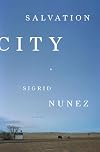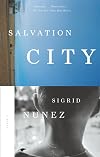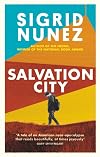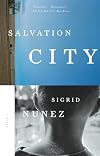
Salvation City
by Sigrid Nunez
On This Page
Description
After losing both parents to a flu pandemic that seriously threatens his own life as well, thirteen-year-old Cole Vining is sent to live with an evangelical pastor and his wife in Salvation City, a small town in southern Indiana. There, Cole feels sheltered and loved but never as if he truly belongs. Everything about his new home is vastly different from the secular world in which he was raised. As he tries to adjust, he struggles also with memories of the past, a struggle made more show more difficult by the fact that he had lost his parents at a time when family relations were at their most fraught and unhappy. How is he to remember them now? Are they still his parents if they are no longer there? Must he accept what those around him believe, that because his parents did not know Jesus they are condemned to hell? During this time, Cole finds solace in drawing comics, for which he has a remarkable gift, and in fantasies about being a superhero. Salvation City is a story of love, betrayal, and forgiveness. It is about spiritual and moral growth, and the consolation of art. It is about belief-belief in God and belief in self. As others around him grow increasingly fixated on the hope of salvation and a new life to come through an imminent rapture, Cole imagines a different future, one in which his own dreams of happiness and heroism begin to seem within reach. show lessTags
Recommendations



























Member Recommendations

Member Reviews
In her latest book, Sigrid Nunez uses the aftermath of a flu pandemic as the setting for a book that is really more of a classic coming of age story than it is a work of post-apocalyptic literature. (Those looking for another Justin Cronin book should beware, therefore...) That said, Nunez has a beautiful, spare but evocative writing style, and she does a great job with this book, which manages to view all its characters through a sympathetic prism.
The flu pandemic has left 13-year-old Cole Vining in an unexpected place -- living with a fundamentalist Christian pastor and his wife, a childless couple eager to care for Cole and to save his soul. It's a different world for Cole -- but with both his "secular" (atheist) parents dead in the show more pandemic, where else is he to go? He grapples with issues of loyalty -- to his foster parents and his memories of his all-too-human birth parents -- on the way to trying to make hard decisions about his own future.
One of the strongest elements in this book is Nunez's ability to make all off her characters sympathetic -- from Cole's mother, who, despite her failings, emerges as a strong and devoted mother and someone willing to sacrifice herself for others, to the "rapture-ready" inhabitants of Salvation City, eager to embrace Cole as one of their number. The story is told through Cole's eyes, albeit in the third person, so the reader can almost feel the disconnect that he is experiencing emotionally.
Nunez's writing is spare but elegant, and her ability to communicate in the voice of a 13/14 year old boy is impressive. I'd recommend this to anyone looking for a literary novel that deals with issues like identity and personal responsibility, rather than a dystopian/post-apocalyptic novel. If the publishers push that angle, they'll do the author a disservice. Also, while this is a relatively short book, with deceptively simple and straightforward plot developments and language, the themes it addresses are ones that are likely to resonate for a while -- it will stay on my shelf and I expect to pick it up and re-read it. A worthy addition to Nunez's works. show less
The flu pandemic has left 13-year-old Cole Vining in an unexpected place -- living with a fundamentalist Christian pastor and his wife, a childless couple eager to care for Cole and to save his soul. It's a different world for Cole -- but with both his "secular" (atheist) parents dead in the show more pandemic, where else is he to go? He grapples with issues of loyalty -- to his foster parents and his memories of his all-too-human birth parents -- on the way to trying to make hard decisions about his own future.
One of the strongest elements in this book is Nunez's ability to make all off her characters sympathetic -- from Cole's mother, who, despite her failings, emerges as a strong and devoted mother and someone willing to sacrifice herself for others, to the "rapture-ready" inhabitants of Salvation City, eager to embrace Cole as one of their number. The story is told through Cole's eyes, albeit in the third person, so the reader can almost feel the disconnect that he is experiencing emotionally.
Nunez's writing is spare but elegant, and her ability to communicate in the voice of a 13/14 year old boy is impressive. I'd recommend this to anyone looking for a literary novel that deals with issues like identity and personal responsibility, rather than a dystopian/post-apocalyptic novel. If the publishers push that angle, they'll do the author a disservice. Also, while this is a relatively short book, with deceptively simple and straightforward plot developments and language, the themes it addresses are ones that are likely to resonate for a while -- it will stay on my shelf and I expect to pick it up and re-read it. A worthy addition to Nunez's works. show less
 This review was written for LibraryThing Early Reviewers.
Amazing that Nunez wrote this pandemic novel in 2010, predicting so much of what would happen ten years later. Her predictions are much grimmer than what came to pass, but it makes you think, America has got to be better prepared next time. Her predictions about climate change are also insightful, but I think we were thinking about climate change much more in the 2010s than we were thinking about a possible pandemic. The story of Cole--the harrowing survival tale of a young boy--is compelling, and effectively and sympathetically examines the cultural split (educated urbanites vs. evangelical Kentuckians) that would become all too clear in 2016. Nunez predicts a female president for her near-future world. Even she couldn't have show more anticipated Trump. show less
Both of Cole's parents died in the flu pandemic that caused havoc all over the world, but especially in the US. He recovers and is rescued from an orphanage by a childless minister and his wife and taken to live in the small town of Salvation City. The book moves between Cole learning to live in this new environment and his memories of life with his atheistic parents.
What makes this book so interesting is less the new, dystopic world Nunez creates, but in her examination of religious belief. She manages to look critically at both fundamentalist belief and liberal atheism without making either out as good or bad. It's a nuanced performance and very honest. The story itself is fairly simple and while the ideas are complex, they're ones show more that anyone who has seriously considered their religious beliefs (or lack of same) has already considered. The book does read like a YA novel in language and presentation. The story itself is very easy to read, even as it made me think and think and think.
My one criticism of this book is that, at the end, Nunez drastically changed the behaviors of a few of her main characters, giving Cole an easy out to the dilemma he faced. It just didn't fit and felt like she was trying to get the book somewhere it didn't want to go. Despite that, [Salvation City] is a book well worth reading, and enjoyable too. show less
What makes this book so interesting is less the new, dystopic world Nunez creates, but in her examination of religious belief. She manages to look critically at both fundamentalist belief and liberal atheism without making either out as good or bad. It's a nuanced performance and very honest. The story itself is fairly simple and while the ideas are complex, they're ones show more that anyone who has seriously considered their religious beliefs (or lack of same) has already considered. The book does read like a YA novel in language and presentation. The story itself is very easy to read, even as it made me think and think and think.
My one criticism of this book is that, at the end, Nunez drastically changed the behaviors of a few of her main characters, giving Cole an easy out to the dilemma he faced. It just didn't fit and felt like she was trying to get the book somewhere it didn't want to go. Despite that, [Salvation City] is a book well worth reading, and enjoyable too. show less
Maturing During a Pandemic
In Salvation City, National Book Award winner Sigrid Nunez imagines a global flu epidemic, the toll it takes on a 13 year-old boy left alone after the death of his parents, and his adjustment to and lessons taken from an evangelical pastor and community he comes to live with. Published in 2010, Nunez most probably wrote the novel during the 2009 H1/N1 flu pandemic that ultimately killed nearly 300,000 people worldwide. While this event stays mostly in the background of her coming of age novel, early on she vividly describes enough so we see, looking back, that it portends the problems we currently face addressing the coronavirus pandemic, which as of this writing is approaching 1,000,000 dead worldwide, 200,000 show more of which are in the U.S.A. (likely, these figures are on an order higher, as will probably be shown a few years from now). Often we hear people, especially those in the present U.S. government, claim that nobody could have known such a pandemic could occur as justification for the massive death toll. But past events and numerous novelists, including Nunez, put a lie to this claim. About the only consolation we can take is that it is not nearly as devastating as the one in the novel.
Cole is a quiet kid, without many friends, with a love and skill at drawing, and with parents who most will consider a bit iconoclastic, particularly with the American penchant for religion. Which adds irony to the novel, when, after they succumb to the flu, and Cole wins his battle against it and also survives life in a mismanaged orphanage for displaced children, of which there are many, he finds himself in the home of a fundamentalist pastor who prefers to be called PW and his younger child-like and subservient wife Tracy. Nunez gives evenhanded treatment to PW and others in the religious community of Salvation City, using their beliefs about morality and condemnation to enhance the maturation trials of young Cole. As you might expect, Cole has lots of problems with his parents, added to a sense of abandonment, which he has to resolve. Awkward at first in PW and Tracy’s home and the community, he comes to adopt them as his surrogate family. He does suffer some disillusioning episodes, such as that with the “it” girl of the community, Starlyn, but also some inspiring encounters with strength of character and second chances, which he learns from PW, who in many ways functions as a better father than his own had been. As you would expect, he progresses from a confused, tormented, and rudderless boy to one who finally begins to come to terms with his parents, events, and the direction he wants to head in.
Nunez writes with clarity and compassion for Cole and his new family so that you will care both for the boy and a community often dismissed or caricatured in contemporary literature. With regard to coming of age novels and family sagas, especially those set against particularly trying backdrops, you’ll find this among the best. And the pandemic adds relevancy for today’s readers, another plus. show less
In Salvation City, National Book Award winner Sigrid Nunez imagines a global flu epidemic, the toll it takes on a 13 year-old boy left alone after the death of his parents, and his adjustment to and lessons taken from an evangelical pastor and community he comes to live with. Published in 2010, Nunez most probably wrote the novel during the 2009 H1/N1 flu pandemic that ultimately killed nearly 300,000 people worldwide. While this event stays mostly in the background of her coming of age novel, early on she vividly describes enough so we see, looking back, that it portends the problems we currently face addressing the coronavirus pandemic, which as of this writing is approaching 1,000,000 dead worldwide, 200,000 show more of which are in the U.S.A. (likely, these figures are on an order higher, as will probably be shown a few years from now). Often we hear people, especially those in the present U.S. government, claim that nobody could have known such a pandemic could occur as justification for the massive death toll. But past events and numerous novelists, including Nunez, put a lie to this claim. About the only consolation we can take is that it is not nearly as devastating as the one in the novel.
Cole is a quiet kid, without many friends, with a love and skill at drawing, and with parents who most will consider a bit iconoclastic, particularly with the American penchant for religion. Which adds irony to the novel, when, after they succumb to the flu, and Cole wins his battle against it and also survives life in a mismanaged orphanage for displaced children, of which there are many, he finds himself in the home of a fundamentalist pastor who prefers to be called PW and his younger child-like and subservient wife Tracy. Nunez gives evenhanded treatment to PW and others in the religious community of Salvation City, using their beliefs about morality and condemnation to enhance the maturation trials of young Cole. As you might expect, Cole has lots of problems with his parents, added to a sense of abandonment, which he has to resolve. Awkward at first in PW and Tracy’s home and the community, he comes to adopt them as his surrogate family. He does suffer some disillusioning episodes, such as that with the “it” girl of the community, Starlyn, but also some inspiring encounters with strength of character and second chances, which he learns from PW, who in many ways functions as a better father than his own had been. As you would expect, he progresses from a confused, tormented, and rudderless boy to one who finally begins to come to terms with his parents, events, and the direction he wants to head in.
Nunez writes with clarity and compassion for Cole and his new family so that you will care both for the boy and a community often dismissed or caricatured in contemporary literature. With regard to coming of age novels and family sagas, especially those set against particularly trying backdrops, you’ll find this among the best. And the pandemic adds relevancy for today’s readers, another plus. show less
Salvation City by Sigrid Nunez is a coming of age novel set in a changing world. Young teen Cole Vining is the narrator. He has lost his parents, Miles and Serena, in a global flu pandemic and, after a brief stay in an orphanage, is currently living with Pastor Wyatt (PW) and his wife Tracy, who hope to adopt him.
As Cole remembers his past with his parents, both academics and atheists, he clearly recalls the tension and their arguments. He knew their marriage was on the verge of divorce. This past contrasts sharply with life in the Christian community of Salvation City with PW and Tracy, where home life is calm and secure, based on their Christian faith. Nunez handles equally deftly the characterizations of both Cole's atheist parents show more and the Christian Wyatt's.
This is not a dystopian novel intent on showing the collapse of civilization. Because the story is told through Cole's perspective and his memory is imperfect, we don't have a clear global view of what the pandemic has wrought. Instead, we have glimpses of the horrors, as recalled by Cole. While the flu pandemic does influence all aspects of the story, it is truly more of a coming of age story set during hard times and a character study.
Nunez does an excellent job in developing her characters using a deceptively simple style of writing. I really felt that the story was being told by a young adolescent boy, with all of his insecurities and conflicted emotions. He struggles with change just as we all would. (In fact, she actually did such a good job that some reviewers incorrectly labeled Salvation City as a YA novel. It isn't.) She never falters from telling the story through Cole's perspective and in the end we are hopeful he will find the right direction for him in his changed world.
Even though I was expecting Salvation City to be more of a dystopian thriller, I actually quite enjoyed this thoughtful novel based on Nunez's writing alone.
Highly Recommended; http://shetreadssoftly.blogspot.com/ show less
As Cole remembers his past with his parents, both academics and atheists, he clearly recalls the tension and their arguments. He knew their marriage was on the verge of divorce. This past contrasts sharply with life in the Christian community of Salvation City with PW and Tracy, where home life is calm and secure, based on their Christian faith. Nunez handles equally deftly the characterizations of both Cole's atheist parents show more and the Christian Wyatt's.
This is not a dystopian novel intent on showing the collapse of civilization. Because the story is told through Cole's perspective and his memory is imperfect, we don't have a clear global view of what the pandemic has wrought. Instead, we have glimpses of the horrors, as recalled by Cole. While the flu pandemic does influence all aspects of the story, it is truly more of a coming of age story set during hard times and a character study.
Nunez does an excellent job in developing her characters using a deceptively simple style of writing. I really felt that the story was being told by a young adolescent boy, with all of his insecurities and conflicted emotions. He struggles with change just as we all would. (In fact, she actually did such a good job that some reviewers incorrectly labeled Salvation City as a YA novel. It isn't.) She never falters from telling the story through Cole's perspective and in the end we are hopeful he will find the right direction for him in his changed world.
Even though I was expecting Salvation City to be more of a dystopian thriller, I actually quite enjoyed this thoughtful novel based on Nunez's writing alone.
Highly Recommended; http://shetreadssoftly.blogspot.com/ show less
Maturing During a Pandemic
In Salvation City, National Book Award winner Sigrid Nunez imagines a global flu epidemic, the toll it takes on a 13 year-old boy left alone after the death of his parents, and his adjustment to and lessons taken from an evangelical pastor and community he comes to live with. Published in 2010, Nunez most probably wrote the novel during the 2009 H1/N1 flu pandemic that ultimately killed nearly 300,000 people worldwide. While this event stays mostly in the background of her coming of age novel, early on she vividly describes enough so we see, looking back, that it portends the problems we currently face addressing the coronavirus pandemic, which as of this writing is approaching 1,000,000 dead worldwide, 200,000 show more of which are in the U.S.A. (likely, these figures are on an order higher, as will probably be shown a few years from now). Often we hear people, especially those in the present U.S. government, claim that nobody could have known such a pandemic could occur as justification for the massive death toll. But past events and numerous novelists, including Nunez, put a lie to this claim. About the only consolation we can take is that it is not nearly as devastating as the one in the novel.
Cole is a quiet kid, without many friends, with a love and skill at drawing, and with parents who most will consider a bit iconoclastic, particularly with the American penchant for religion. Which adds irony to the novel, when, after they succumb to the flu, and Cole wins his battle against it and also survives life in a mismanaged orphanage for displaced children, of which there are many, he finds himself in the home of a fundamentalist pastor who prefers to be called PW and his younger child-like and subservient wife Tracy. Nunez gives evenhanded treatment to PW and others in the religious community of Salvation City, using their beliefs about morality and condemnation to enhance the maturation trials of young Cole. As you might expect, Cole has lots of problems with his parents, added to a sense of abandonment, which he has to resolve. Awkward at first in PW and Tracy’s home and the community, he comes to adopt them as his surrogate family. He does suffer some disillusioning episodes, such as that with the “it” girl of the community, Starlyn, but also some inspiring encounters with strength of character and second chances, which he learns from PW, who in many ways functions as a better father than his own had been. As you would expect, he progresses from a confused, tormented, and rudderless boy to one who finally begins to come to terms with his parents, events, and the direction he wants to head in.
Nunez writes with clarity and compassion for Cole and his new family so that you will care both for the boy and a community often dismissed or caricatured in contemporary literature. With regard to coming of age novels and family sagas, especially those set against particularly trying backdrops, you’ll find this among the best. And the pandemic adds relevancy for today’s readers, another plus. show less
In Salvation City, National Book Award winner Sigrid Nunez imagines a global flu epidemic, the toll it takes on a 13 year-old boy left alone after the death of his parents, and his adjustment to and lessons taken from an evangelical pastor and community he comes to live with. Published in 2010, Nunez most probably wrote the novel during the 2009 H1/N1 flu pandemic that ultimately killed nearly 300,000 people worldwide. While this event stays mostly in the background of her coming of age novel, early on she vividly describes enough so we see, looking back, that it portends the problems we currently face addressing the coronavirus pandemic, which as of this writing is approaching 1,000,000 dead worldwide, 200,000 show more of which are in the U.S.A. (likely, these figures are on an order higher, as will probably be shown a few years from now). Often we hear people, especially those in the present U.S. government, claim that nobody could have known such a pandemic could occur as justification for the massive death toll. But past events and numerous novelists, including Nunez, put a lie to this claim. About the only consolation we can take is that it is not nearly as devastating as the one in the novel.
Cole is a quiet kid, without many friends, with a love and skill at drawing, and with parents who most will consider a bit iconoclastic, particularly with the American penchant for religion. Which adds irony to the novel, when, after they succumb to the flu, and Cole wins his battle against it and also survives life in a mismanaged orphanage for displaced children, of which there are many, he finds himself in the home of a fundamentalist pastor who prefers to be called PW and his younger child-like and subservient wife Tracy. Nunez gives evenhanded treatment to PW and others in the religious community of Salvation City, using their beliefs about morality and condemnation to enhance the maturation trials of young Cole. As you might expect, Cole has lots of problems with his parents, added to a sense of abandonment, which he has to resolve. Awkward at first in PW and Tracy’s home and the community, he comes to adopt them as his surrogate family. He does suffer some disillusioning episodes, such as that with the “it” girl of the community, Starlyn, but also some inspiring encounters with strength of character and second chances, which he learns from PW, who in many ways functions as a better father than his own had been. As you would expect, he progresses from a confused, tormented, and rudderless boy to one who finally begins to come to terms with his parents, events, and the direction he wants to head in.
Nunez writes with clarity and compassion for Cole and his new family so that you will care both for the boy and a community often dismissed or caricatured in contemporary literature. With regard to coming of age novels and family sagas, especially those set against particularly trying backdrops, you’ll find this among the best. And the pandemic adds relevancy for today’s readers, another plus. show less
After losing both parents to a flu pandemic that seriously threatens his own life as well, thirteen-year-old Cole Vining is sent to live with an evangelical pastor and his wife in Salvation City, a small town in southern Indiana. There, Cole feels sheltered and loved but never as if he truly belongs. Everything about his new home is vastly different from the secular world in which he was raised. As he tries to adjust, he struggles also with memories of the past, a struggle made more difficult by the fact that he had lost his parents at a time when family relations were at their most fraught and unhappy. During this time, Cole finds solace in drawing comics, for which he has a remarkable gift, and in fantasies about being a superhero. show more Publisher summary
More coming of age than post-apocalyptic. Everything is filtered through Cole's heightened self-awareness and social paralysis. It's not so much that a flu pandemic is decimating world population but that it deprives Cole of his parents at a particularly low point in their relationship. Later, living with his adoptive parents in the all Christian Salvation City, Cole obsesses over his relationship with Pastor Wyatt. Later he obsesses over the lovely Starlyn whom he loves from afar. When the reader does hear about the world beyond Salvation City, it is through panicked statements like "It's not safe to go outside in Chicago"made by his aunt who wants him to live with her in Germany where, she says, health care and education are far more advanced.
Cole is a well-drawn character; I found it easy to connect with him. But why set his story in a post-apocalyptic landscape? He could have been orphaned and adopted by a fundamental Christian couple in a contemporary setting.
7 out of 10 Recommended to readers who enjoy coming of age stories and psychological fiction. show less
More coming of age than post-apocalyptic. Everything is filtered through Cole's heightened self-awareness and social paralysis. It's not so much that a flu pandemic is decimating world population but that it deprives Cole of his parents at a particularly low point in their relationship. Later, living with his adoptive parents in the all Christian Salvation City, Cole obsesses over his relationship with Pastor Wyatt. Later he obsesses over the lovely Starlyn whom he loves from afar. When the reader does hear about the world beyond Salvation City, it is through panicked statements like "It's not safe to go outside in Chicago"made by his aunt who wants him to live with her in Germany where, she says, health care and education are far more advanced.
Cole is a well-drawn character; I found it easy to connect with him. But why set his story in a post-apocalyptic landscape? He could have been orphaned and adopted by a fundamental Christian couple in a contemporary setting.
7 out of 10 Recommended to readers who enjoy coming of age stories and psychological fiction. show less
Members
- Recently Added By
Lists

Religious Fiction
58 works; 13 members

Books Read in 2023
5,547 works; 145 members

Religious Science Fiction
70 works; 20 members

Post-Apocalyptic Fiction
57 works; 3 members

Viral Outbreaks and Pandemics
82 works; 8 members
Author Information

13+ Works 4,637 Members
Awards and Honors
Awards
Distinctions
Common Knowledge
- Original title
- Salvation City
- Original publication date
- 2010
- Important places
- Indiana, USA
- Important events
- flu pandemic
Classifications
Statistics
- Members
- 291
- Popularity
- 110,465
- Reviews
- 37
- Rating
- (3.21)
- Languages
- English
- Media
- Paper, Audiobook, Ebook
- ISBNs
- 9
- ASINs
- 4