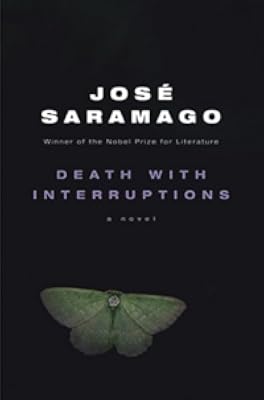
Death with Interruptions
by José Saramago
On This Page
Description
Nobel Prize-winner Jose Saramago's brilliant new novel poses the question -- what happens when the grim reaper decides there will be no more death? On the first day of the new year, no one dies. This of course causes consternation among politicians, religious leaders, morticians, and doctors. Among the general public, on the other hand, there is initially celebration-flags are hung out on balconies, people dance in the streets. They have achieved the great goal of humanity: eternal life. show more Then reality hits home-families are left to care for the permanently dying, life-insurance policies become meaningless, and funeral parlors are reduced to arranging burials for pet dogs, cats, hamsters, and parrots. Death sits in her chilly apartment, where she lives alone with scythe and filing cabinets, and contemplates her experiment: What if no one ever died again? What if she, death with a small d, became human and were to fall in love? show lessTags
Recommendations





Member Recommendations
Member Reviews
As the New Year begins, Death decides to take a holiday. It takes a while before people notice that no one is dying--those on their death beds remain suspended in a near death state, those in accidents which should have killed them, remain alive maimed or horribly injured.
After brief rejoicing, people begin to realize that it might not be such a good thing if nobody ever dies: What happens to the funeral and life insurance businesses? What happens to religion without a heavenly afterlife to look forward to?
Fortunately, Death is not on holiday in surrounding countries, and people begin to take their near-dead across the border, where they die instantly. Neighboring countries don't like this, however, and a whole industry of smuggling show more people across the border to die develops.
Like many of Saramago's books, this book raises a "What if?" question about something that is not possible, and follows it through a winding path to consider issues important to the world today. It is written in Saramago's characteristic style. For the most part it is not plot driven, and initially there are no "main characters". But who could resist reading a book that begins:
"The following day no one died. This fact, being absolutely contrary to life's rules provoked enormous, and, in the circumstances, perfectly justifiable anxiety in people's minds, for we have only to consider that in the entire forty volumes of universal history there is no mention, not even one exemplary case, of such a phenomenon ever having occurred, for a whole day to go by , with its generous allowance of twenty-four hours, diurnal and nocturnal, matutinal and vespertine, without one death from an illness, a fatal fall, a successful suicide, not one, not a single one."
Recommended. show less
After brief rejoicing, people begin to realize that it might not be such a good thing if nobody ever dies: What happens to the funeral and life insurance businesses? What happens to religion without a heavenly afterlife to look forward to?
Fortunately, Death is not on holiday in surrounding countries, and people begin to take their near-dead across the border, where they die instantly. Neighboring countries don't like this, however, and a whole industry of smuggling show more people across the border to die develops.
Like many of Saramago's books, this book raises a "What if?" question about something that is not possible, and follows it through a winding path to consider issues important to the world today. It is written in Saramago's characteristic style. For the most part it is not plot driven, and initially there are no "main characters". But who could resist reading a book that begins:
"The following day no one died. This fact, being absolutely contrary to life's rules provoked enormous, and, in the circumstances, perfectly justifiable anxiety in people's minds, for we have only to consider that in the entire forty volumes of universal history there is no mention, not even one exemplary case, of such a phenomenon ever having occurred, for a whole day to go by , with its generous allowance of twenty-four hours, diurnal and nocturnal, matutinal and vespertine, without one death from an illness, a fatal fall, a successful suicide, not one, not a single one."
Recommended. show less
This book deserves two reviews really. The first has to be about the story: Death has decided not to take anybody due to die from the stroke of midnight on New Years Eve. However badly you are injured, however serious your illness, you will not die. That of course leads to all sorts of problems - nursing homes fill up with the near dead, funeral parlours run out of work (and turn to bury pets), hospitals are bursting at the seams and still, every day there are more of the should-be-dying. A maphia (yes, ph) appears who takes the near dead over the border to the next country where death is still working, for a lot of money of course. After seven months, death sends a letter to the television director explaining her actions and announcing show more that from now on she'll give everybody one weeks notice with a purple letter, so one can make arrangements for one's own death.
So far so good, but then a letter comes back to her (death), and after resending it, comes back even quicker. And again. And death has to go amongst the humans and find out why this particular person does not receive this letter. It is a funny, fantastic, slightly dark tale and so very fascinating - our dealing with death and the terminally ill. It the little twist at the end is so very moving and clever. So, I liked the story.
The second review goes to the way the author tells the story. The book has chapters but no paragraphs, no punctuation to separate speech and the sentences are sometimes half a page long, with lots of commas to divide them. Si it is not easy to read. But reading is not just about the story, reading is about the pleasure found in somebody elses use of words, turn of phrase. And pleasure it is. As soon as you get used to the long sentences (after about 20 pages) their beauty becomes apparent. Like a winding path through a maze bordered by buildings and trees, with dark corners and lit squares it takes you to the other side. Now and then I had to stop and reread, not because of a difficulty but because of the sheer joy a sentence would trigger in me. It is a perfect little book. show less
So far so good, but then a letter comes back to her (death), and after resending it, comes back even quicker. And again. And death has to go amongst the humans and find out why this particular person does not receive this letter. It is a funny, fantastic, slightly dark tale and so very fascinating - our dealing with death and the terminally ill. It the little twist at the end is so very moving and clever. So, I liked the story.
The second review goes to the way the author tells the story. The book has chapters but no paragraphs, no punctuation to separate speech and the sentences are sometimes half a page long, with lots of commas to divide them. Si it is not easy to read. But reading is not just about the story, reading is about the pleasure found in somebody elses use of words, turn of phrase. And pleasure it is. As soon as you get used to the long sentences (after about 20 pages) their beauty becomes apparent. Like a winding path through a maze bordered by buildings and trees, with dark corners and lit squares it takes you to the other side. Now and then I had to stop and reread, not because of a difficulty but because of the sheer joy a sentence would trigger in me. It is a perfect little book. show less
The inevitable force of death has decided to desert one unnamed country. Naturally, at first its citizens are euphoric, imagining themselves specially singled out, given the hope of eternal life in a new millennium. But as the novel plays itself out, the logistics and ramifications of a society without death become quickly apparent. Medical resources are strained to their limit - people don't stop aging or decaying, just stop dying at a proper time - and religions have lost a cornerstone of their function without either death or the presumed afterlife. This is the first half of the novel: the prose goes through the impact upon this society in an interesting mental exercise. As it progresses I felt more and more aware about how we have show more in some ways created a culture of death for ourselves - a fact only made apparent when death is taken away.
The second half of the novel gets to know death in a more personal way. An unusual incarnation, death (with a small d) lives as a young woman alone in her apartment, occupying most of her day talking to her scythe and writing out letters informing people of their imminent deaths - now given a week in advance, as a compromise and improvement upon the old way of an unexpected death. Yet, when she tracks down a cellist whose fatal letter returns to her unopened, humanity encounters death in a new way. A dialogue and two-way relationship, wherein death learns simple pleasures of life and gets to know human existence better. So yes, it's kind of the inverse of the Christian Incarnation. Death is not a terrifying force to be feared and defeated, but something small and very human herself, a part of life rather than its antagonist. show less
The second half of the novel gets to know death in a more personal way. An unusual incarnation, death (with a small d) lives as a young woman alone in her apartment, occupying most of her day talking to her scythe and writing out letters informing people of their imminent deaths - now given a week in advance, as a compromise and improvement upon the old way of an unexpected death. Yet, when she tracks down a cellist whose fatal letter returns to her unopened, humanity encounters death in a new way. A dialogue and two-way relationship, wherein death learns simple pleasures of life and gets to know human existence better. So yes, it's kind of the inverse of the Christian Incarnation. Death is not a terrifying force to be feared and defeated, but something small and very human herself, a part of life rather than its antagonist. show less
I love the premise of this book. One day, in a particular country, people stop dying. They still get old, get sick, get mangled in car accidents, etc., but they can’t die.
At first this news is greeted with elation. It’s the end of Death’s age-old tyranny, the greatest fear suddenly removed. But then the complications begin. People still suffer, old people lie in bed on the verge of death but unable to cross over. Retirement homes go into crisis, as people continue to arrive but nobody leaves. Funeral homes and life insurance companies are also distraught, although the insurance people manage to land on their feet as always. Bishops and philosophers meet to discuss the implications of death’s disappearance. The fear of death has show more long been the basis of morality and religion, after all.
Meanwhile, some people take matters into their own hands. A family decides to put its terminally ill father out of his misery by taking him across the border into the neighbouring country where death is still operating as usual. This becomes a trend and then starts a whole industry, which is soon taken over by the mafia. Then, after a while, death reappears…
It’s an incredibly imaginative story, and well told. The style is very wordy, with some sentences stretching over pages, and multiple sub-clauses. The dialogue is also not separated by paragraphs or inverted commas, so it can be quite hard to follow sometimes. In general the wordiness works, simply because it is so well-written, but at times I wished he would just get on with it. I do have to put in a mention for the translator, Margaret Jull Costa, as well. This must have been a tough book to translate, and the fact that those long sentences are at all intelligible is a tribute to her ability.
This is the second book I’ve read by 1998 Nobel Prize winner Jose Saramago, the other one being The Year of the Death of Ricardo Reis. I enjoyed this one more, perhaps because of the fascinating premise and the deft way in which it was handled, or perhaps simply because his style takes some getting used to. I’d definitely like to read more of his work now. show less
At first this news is greeted with elation. It’s the end of Death’s age-old tyranny, the greatest fear suddenly removed. But then the complications begin. People still suffer, old people lie in bed on the verge of death but unable to cross over. Retirement homes go into crisis, as people continue to arrive but nobody leaves. Funeral homes and life insurance companies are also distraught, although the insurance people manage to land on their feet as always. Bishops and philosophers meet to discuss the implications of death’s disappearance. The fear of death has show more long been the basis of morality and religion, after all.
Meanwhile, some people take matters into their own hands. A family decides to put its terminally ill father out of his misery by taking him across the border into the neighbouring country where death is still operating as usual. This becomes a trend and then starts a whole industry, which is soon taken over by the mafia. Then, after a while, death reappears…
It’s an incredibly imaginative story, and well told. The style is very wordy, with some sentences stretching over pages, and multiple sub-clauses. The dialogue is also not separated by paragraphs or inverted commas, so it can be quite hard to follow sometimes. In general the wordiness works, simply because it is so well-written, but at times I wished he would just get on with it. I do have to put in a mention for the translator, Margaret Jull Costa, as well. This must have been a tough book to translate, and the fact that those long sentences are at all intelligible is a tribute to her ability.
This is the second book I’ve read by 1998 Nobel Prize winner Jose Saramago, the other one being The Year of the Death of Ricardo Reis. I enjoyed this one more, perhaps because of the fascinating premise and the deft way in which it was handled, or perhaps simply because his style takes some getting used to. I’d definitely like to read more of his work now. show less
This book left me wanting more, and perhaps not in a good way. Because of the distance between the reader and the events of the first section -- we see a series of vignettes around events related to the dearth of death, but all we really do is see them; we aren't immersed -- this feels like it should be a sociology text about the events a bureaucracy would have to deal with in the event of stoppage of death.** As a result, that is what I wanted. I wanted to see a by-sector breakdown of the economic impact or demographic calculations by month. When there's no emotional impact to the story, I don't want to read this as a novel. I wanted to read this as a social scientist.
(**There is a bit of a cottage industry in political science and show more related fields around this, dominated by government agency authors, actually: assessments and contingency plans around seemingly impossible events. Did you think FEMA doesn't have a plan for a zombie invasion? Or the political economy literature hasn't calculated what would happen if the birth rate dropped to zero? Oh, friends, these all exist. I have read many of them. A good speculative paper in a peer-reviewed academic journal by an EPA deputy director comes out and I am all in.)
Death with Interruptions could have been more compelling if it had taken its distance to a logical conclusion and included some semblance of accuracy in terms of numbers or complexity or completeness. We get a tiny glimpse. But we don't get a tiny glimpse in a family of characters we love, where macrocosm is shown through microcosm. We get an attempt at a variety of sectors but with no context or completeness. Did you know what the magnitude of this was? I didn't. I wanted to see a report.
You might think that because I am a social scientist by training, I want this always. Not so. I read Children of Men and never thought that the second half of the book should include regressions. Children of Men packs an emotional punch. I have thought to myself, in the years since I read the book and saw the movie, I wonder what a Western government would do about this as a public policy issue, but I never wondered it during the book or movie. (By the way, there are journal articles by economists, sociologists, and others taking this issue from different viewpoints, and they are all excellent-slash-horrifying.) I was immersed in that tale as a reader and my statistical mind was dormant. This one didn't immerse me the same way. Each time a new group of people popped up -- for instance, the "maphia" or the undertakers -- I just wanted to see some numbers about mortality rates so I could estimate timeframes for policy impact. How much could the "maphia" actually be expected to make? How many public servant FTEs was the "maphia" actually taking over? What is the density of undertaking compared to population in urban versus rural areas? How many bodies would we even be expecting, in the first place? The NIH has a fantastic epidemiological model for pandemics where you can insert your own estimates around mortality, time period, population density, and other factors, and I wanted Saramago to have presented some charts at the end of the book so I could understand the magnitude of the issue.
Instead it all felt distant, incomplete, and hard to quantify. But not hard to quantify in the way that emotional, character-driven books like these can be where you don't care that you don't know any numbers.
I guess what I'm saying is, if you're going distant, go full robot. If you're going novel, give me something to hold on to. show less
(**There is a bit of a cottage industry in political science and show more related fields around this, dominated by government agency authors, actually: assessments and contingency plans around seemingly impossible events. Did you think FEMA doesn't have a plan for a zombie invasion? Or the political economy literature hasn't calculated what would happen if the birth rate dropped to zero? Oh, friends, these all exist. I have read many of them. A good speculative paper in a peer-reviewed academic journal by an EPA deputy director comes out and I am all in.)
Death with Interruptions could have been more compelling if it had taken its distance to a logical conclusion and included some semblance of accuracy in terms of numbers or complexity or completeness. We get a tiny glimpse. But we don't get a tiny glimpse in a family of characters we love, where macrocosm is shown through microcosm. We get an attempt at a variety of sectors but with no context or completeness. Did you know what the magnitude of this was? I didn't. I wanted to see a report.
You might think that because I am a social scientist by training, I want this always. Not so. I read Children of Men and never thought that the second half of the book should include regressions. Children of Men packs an emotional punch. I have thought to myself, in the years since I read the book and saw the movie, I wonder what a Western government would do about this as a public policy issue, but I never wondered it during the book or movie. (By the way, there are journal articles by economists, sociologists, and others taking this issue from different viewpoints, and they are all excellent-slash-horrifying.) I was immersed in that tale as a reader and my statistical mind was dormant. This one didn't immerse me the same way. Each time a new group of people popped up -- for instance, the "maphia" or the undertakers -- I just wanted to see some numbers about mortality rates so I could estimate timeframes for policy impact. How much could the "maphia" actually be expected to make? How many public servant FTEs was the "maphia" actually taking over? What is the density of undertaking compared to population in urban versus rural areas? How many bodies would we even be expecting, in the first place? The NIH has a fantastic epidemiological model for pandemics where you can insert your own estimates around mortality, time period, population density, and other factors, and I wanted Saramago to have presented some charts at the end of the book so I could understand the magnitude of the issue.
Instead it all felt distant, incomplete, and hard to quantify. But not hard to quantify in the way that emotional, character-driven books like these can be where you don't care that you don't know any numbers.
I guess what I'm saying is, if you're going distant, go full robot. If you're going novel, give me something to hold on to. show less
Near perfect. This was a challenging and sophisticated novel that I might normally have found pretentious except Saramago blends just the right amount of humor and poignancy to keep it grounded and engaging.
The story is split into two parts. In the first, death (yes, with a small "d") takes a holiday. In a small, unnamed European country, no one dies for several months. The narrator tells us what this means - for ordinary people, for the government, for the undertakers and insurance companies, etc. It's a kind of meta-narrative, where the few "characters" are unnamed - the prime minister, the king, the head of state television. It's very theoretical and cerebral.
And then Saramago changes gear, focuses in on death herself as a character show more and her relationship with one individual who is supposed to die. It's a beautiful and bittersweet second part of the novel that raised the book to a near 5-star read for me. For all of the focus on death as the main driver in the novel, it is really about life and what it means to live and to live well and meaningfully.
I am so pleased I stuck with this one. It was a rewarding read. show less
The story is split into two parts. In the first, death (yes, with a small "d") takes a holiday. In a small, unnamed European country, no one dies for several months. The narrator tells us what this means - for ordinary people, for the government, for the undertakers and insurance companies, etc. It's a kind of meta-narrative, where the few "characters" are unnamed - the prime minister, the king, the head of state television. It's very theoretical and cerebral.
And then Saramago changes gear, focuses in on death herself as a character show more and her relationship with one individual who is supposed to die. It's a beautiful and bittersweet second part of the novel that raised the book to a near 5-star read for me. For all of the focus on death as the main driver in the novel, it is really about life and what it means to live and to live well and meaningfully.
I am so pleased I stuck with this one. It was a rewarding read. show less
There are some books that defy description, that have to be experienced. Saramago’s Death with Interruptions is one such book.
The thesis is intriguing. One day, people stop dying. At this time of pandemic gyrations, the convulsions of the government and churches forced to deal with the fallout from this lack of dying are both wickedly wise and so funny I laughed out loud. The Church is sent for a spin- if no eternity, then what do they have to use to persuade people to follow them? The government has no idea what to do with all the undying, including the Queen Mother- because, though people don’t die, they don’t exactly live, either. They hang, fixed in time, unable to do either.
There are those who immediately find ways to make show more money out of such a situation- undertakers plead financial ruin and are reduced to government-insisted buryings of pets; organized crime dips in in a variety of ways; governments cut deals; and one family figures out a solution that destabilizes life even more.
It’s odd to read this at the same time that some States in the US are hinting that old people should get Covid-19 and just die, take one for the team as it were. The context seems so parallel...
Saramago’s prose is written in tremendously long twisting sentences, but each is like a garden path, with pleasing asides popping up throughout. Every phrase is a gem. Many sentences turn around and snap a funny vision at the end that took me by enough surprise I burst out laughing.
How does the situation work itself out? Ah, that I can’t reveal, except to warn you to avoid and lavender coloured envelopes in the mail. show less
The thesis is intriguing. One day, people stop dying. At this time of pandemic gyrations, the convulsions of the government and churches forced to deal with the fallout from this lack of dying are both wickedly wise and so funny I laughed out loud. The Church is sent for a spin- if no eternity, then what do they have to use to persuade people to follow them? The government has no idea what to do with all the undying, including the Queen Mother- because, though people don’t die, they don’t exactly live, either. They hang, fixed in time, unable to do either.
There are those who immediately find ways to make show more money out of such a situation- undertakers plead financial ruin and are reduced to government-insisted buryings of pets; organized crime dips in in a variety of ways; governments cut deals; and one family figures out a solution that destabilizes life even more.
It’s odd to read this at the same time that some States in the US are hinting that old people should get Covid-19 and just die, take one for the team as it were. The context seems so parallel...
Saramago’s prose is written in tremendously long twisting sentences, but each is like a garden path, with pleasing asides popping up throughout. Every phrase is a gem. Many sentences turn around and snap a funny vision at the end that took me by enough surprise I burst out laughing.
How does the situation work itself out? Ah, that I can’t reveal, except to warn you to avoid and lavender coloured envelopes in the mail. show less
Members
- Recently Added By
Published Reviews
ThingScore 100
Elke roman van José Saramago opent met een paukenslag.Op de eerste bladzijden introduceert hij een hoogst ongewone toestand, die vaak door een even abrupte als absurde ingreep van hogerhand wordt geforceerd.
Zo'n openingszet, die alles op scherp zet en de lezer elektrocuteert, is een geraffineerde variant op het 'er was eens' van het sprookje. Dan is de moraal vaak niet ver weg meer. Dat is show more soms even slikken, juist bij zo'n geharnast moralist als Saramago. Hier is het dat niet: daarvoor is het verhaal te goed verteld, te geestig ook - en het verlangen dat erdoor gefileerd wordt, het anti-doodsverlangen, te vitaal. show less
Zo'n openingszet, die alles op scherp zet en de lezer elektrocuteert, is een geraffineerde variant op het 'er was eens' van het sprookje. Dan is de moraal vaak niet ver weg meer. Dat is show more soms even slikken, juist bij zo'n geharnast moralist als Saramago. Hier is het dat niet: daarvoor is het verhaal te goed verteld, te geestig ook - en het verlangen dat erdoor gefileerd wordt, het anti-doodsverlangen, te vitaal. show less
added by sneuper
Lists

1001 Books You Must Read Before You Die
1,448 works; 1,134 members

magic realism novels
44 works; 10 members

Existentialism
90 works; 11 members

Five star books
1,767 works; 110 members

Literature in Translation
113 works; 5 members

SHOULD Read Books!
354 works; 9 members

Grim Reaper
15 works; 8 members

recalling favorites...
105 works; 2 members

Books I Own But Haven't Read
144 works; 2 members
Author Information

José Saramago was born on November 16, 1922. He spent most of his childhood on his parent's farm, except while attending school in Lisbon. Before devoting himself exclusively to writing novels in 1976, he worked as a draftsman, a publisher's reader, an editor, translator, and political commentator for Diario de Lisboa. He is indisputably show more Portugal's best-known literary figure and his books have been translated into more than 25 languages. Although he wrote his first novel in 1947, he waited some 35 years before winning critical acclaim for work such as the Memorial do Convento. His works include The Year of the Death of Ricardo Reis, The Stone Raft, Baltasar and Blimunda, The History of the Siege of Lisbon, The Gospel According to Jesus Christ, and Blindness. At age 75, he was awarded the Nobel Prize for Literature in 1998 for his work in which "parables sustained by imagination, compassion and irony, continually enables us to apprehend an elusory reality." He died from a prolonged illness that caused multiple organ failure on June 18, 2010 at the age of 87. (Bowker Author Biography) show less
Some Editions
Awards and Honors
Series
Belongs to Publisher Series
Keltainen kirjasto (390)
Work Relationships
Is contained in
Common Knowledge
- Canonical title*
- As Intermitências da Morte
- Original title
- As Intermitências da Morte
- Alternate titles
- Death at Intervals
- Original publication date
- 2005
- People/Characters
- Death; the queen mother; the prime minister; the cardinal; the interior minister; the king (show all 9); the director-general of television; The cellist; death
- Epigraph
- We will know less and less what it means to be human.
- Book of Predictions
If, for example, you were to think more deeply about death, then it would be truly strange if, in so doing, you did not encounter new images, new linguistic fields.
- Wittgenstein
Saberemos cada vez menos o que é um ser humano. - Dedication
- For Pilar, my home.
- First words
- The following day, no one died.
No dia seguinte ninguém morreu. - Quotations
- This fact, being absolutely contrary to life's rules, provoked enormous, and in the circumstances, perfectly justifiable anxiety in people's minds, for we have only to consider that in the entire forty volumes of universal hi... (show all)story there is no mention, not even one exemplary case, of such a phenomenon ever having occurred, for a whole day to go by, with its generous allowance of twenty-four hours, diurnal and nocturnal, matutinal and vespertine, without one death from an illness, a fatal fall, or a successful suicide, not one, not a single one.
At most, it might push them toward the place where death presumably was, but it would be pointless, futile, because at that precise moment, as unreachable as ever, she would take a step back and keep her distance.
One cannot be too careful with words, they change their minds just as people do.
By the way, we feel we must mention that death, by herself and alone, with no external help, has always killed far less than mankind has.
it makes no difference because everything will have but one ending, the ending that a part of yourself will always have to think about and which is the black stain on your hopeless humanity.
This is what insomniacs say when they have not slept a wink all night, thinking, poor things, that they can fool sleep by asking for a little more, just a little more, when they have not yet been granted one minute or repose.
The man stirred again, it seems as if he's about to wake, but no, his breathing returns to its normal rhythm, the same thirteen breaths a minute, his left hand rests on his heart as if he were listening to the beats, an open ... (show all)note for diastole, a closed note for systole, while the right hand, palm uppermost and fingers slightly curved, seems to be waiting for another hand to clasp it.
Que dirá a vizinhança, perguntou, quando der por que já não estão aqui aqueles que, sem morrer, à morte estavam. - Last words
- (Click to show. Warning: May contain spoilers.)The following day, no one died.
(Click to show. Warning: May contain spoilers.)No dia seguinte ninguém morreu. - Original language
- Portuguese
*Some information comes from Common Knowledge in other languages. Click "Edit" for more information.
Classifications
- Genres
- General Fiction, Fiction and Literature, Fantasy
- DDC/MDS
- 869.342 — Literature & rhetoric Spanish Literature Literatures of Portuguese and Galician languages Portuguese fiction 20th Century 1945-1999
- LCC
- PQ9281 .A66 .I6813 — Language and Literature French, Italian, Spanish and Portuguese literatures Portuguese literature Individual authors, 1961-2000
- BISAC
Statistics
- Members
- 3,620
- Popularity
- 4,509
- Reviews
- 121
- Rating
- (3.73)
- Languages
- 22 — Catalan, Danish, Dutch, English, Estonian, Finnish, French, German, Greek, Hebrew, Hungarian, Italian, Lithuanian, Malayalam, Norwegian (Bokmål), Romanian, Russian, Spanish, Swedish, Turkish, Portuguese (Portugal), Portuguese (Brazil)
- Media
- Paper, Audiobook, Ebook
- ISBNs
- 79
- ASINs
- 23