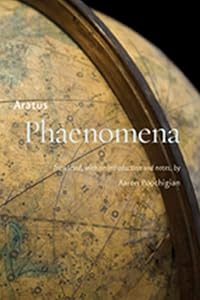
Phaenomena (Johns Hopkins New Translations from Antiquity)
by Aratus
On This Page
Description
After the Iliad and the Odyssey, the Phaenomena was the most widely read poem in the ancient world. Its fame was immediate. It was translated into Latin by Ovid and Cicero and quoted by St. Paul in the New Testament, and it was one of the few Greek poems translated into Arabic. Aratus' Phaenomena is a didactic poem--a practical manual in verse that teaches the reader to identify constellations and predict weather. The poem also explains the relationship between celestial phenomena and such show more human affairs as agriculture and navigation. Despite the historical and pedagogical importance of the poem, no English edition suitable for students and general readers has been available for decades. Aaron Poochigian's lively translation makes accessible one of the most influential poets of antiquity. Poochigian's interpretation of the Phaenomena reestablishes the ancient link between poetry and science and demonstrates that verse is an effective medium for instruction. Featuring references to Classical mythology and science, star charts of the northern and southern skies, extensive notes, and an introduction to the work's stylistic features and literary reception, this dynamic work will appeal to students of Ancient Greece who want to deepen their understanding of the Classical world. show lessTags
Recommendations














Member Reviews
Supposedly the most popular ancient work after the Iliad and the Odyssey, Phaenomena is a “didactic” (instructive) poem explaining the constellations and providing weather prediction advice; sort of a cross between a star atlas and The Old Farmer’s Almanac. It was apparently a popular exercise for Romans to translate this from Greek to Latin; versions are attributed to Cicero, Ovid, Germanicus and Tiberius. It would be interesting to take Aratus’ “weather signs” – for example, “Halos around the Sun mean trouble. The more tightly wound and dark they are the worse the storm will be” and compare them to actual weather at, say, Athens. A project for a classicist meteorologist. An extensive introduction and endnotes; show more illustrated with woodcuts from a 15th century star atlas. show less
Members
- Recently Added By
Author Information
24 Works 216 Members
Classifications
Statistics
- Members
- 23
- Popularity
- 1,143,668
- Reviews
- 1
- Rating
- (3.00)
- Languages
- English
- Media
- Paper, Ebook
- ISBNs
- 3