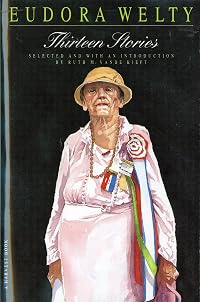
Thirteen Stories
by Eudora Welty
On This Page
Description
A strong sense of place-in this case Mississippi-along with often larger-than-life characterizations of ordinary folk with all their glorious eccentricities and foibles, and above all a completely distinctive voice, come together in Eudora Welty's fiction to offer us a world that is sometimes sad, sometimes comic, often petty, and always compassionate. Here is a baker's dozen of Welty's very best, including: "The Wide Net," in which a pregnant wife threatens to drown herself, despite fear of show more the water, and a communal dragging of the river turns into a celebratory fish-fry; "Petrified Man," revealing the savagery of small-town gossip; "Powerhouse," Welty's prose answer to jazz improvisation and the emotional heart of the blues; and "Why I Live at the P.O.", the hilariously one-sided testimony of a postmistress who believes herself wronged by her family. With her highly tuned ear and sharp insight into human behavior, Eudora Welty has crafted stories as vital and unpredictable as they are artful and enduring. show lessTags
Recommendations





Member Reviews
These are well-written and sweet southern stories for the most part--but when I read Welty, I never seem to get enough to really care about the characters, except in those few classics we've all ready a dozen times anyway. Here, it just feels as if the characters, themes, and ideas are being repeated, and sometimes as if there's just not much to say. I needed more for this collection to reach me or make me care. As is, it was simply slow, and forgettable.
JUST SOME THOUGHTS I'M JOTTING DOWN WHILE I GO ALONG. They're not very coherent, or a real "review", just talking about things that stood out to me that I found interesting
The Wide Net: Good story, although I feel I lacked the proper context to fully understand the interactions and what they were doing. Theme of thinking you understand what you don't at all - William believes for certain Hazel has jumped in the river, despite not even reading the entire letter. The boys that take a baby alligator just because they can - also somewhat related to William's relationship with Hazel, where she's described as very pretty but otherwise he seems to have no real interest in her. Doc is a sort of "voice of reason" in both cases.
Old Mr Marblehall: show more I liked the idea of a double life almost just for the sake of it. Both his families are described negatively and he seems to find fulfilment only in the having of a double life at all. It reminds me of a sort of childish thing to do - children always try and hide things from their parents, even the most mundane stuff - which links both with his having children exactly at the time when he started a double life and with his obsession - and apparently his only real interest, Weird Tales and similar magazines. This also relates to the story as a story - the premise is somewhat absurd, that nobody has noticed or cared, which makes it almost fit for that kind of magazine.
A Worn Path: Pretty stark portrait of desperation. The old woman's path reminded me of a sort of shortened down fairy story of someone's quest to save the princess or whatever, which I guess in a way is kind of what it is
A Still Moment: Some dudes want to kill him for his horse but despite outnumbering him let him go because he can't be shot easily? And then in the next paragraph this is implied to be a bad thing??? What. Whole story absolutely mystified me, I couldn't pin down characters or what was going on or get any kind of feeling out of it, and the tortured syntax was especially noticeable here. Definitely didn't enjoy it
Powerhouse: Opens with several paragraphs of racial stereotypes and racism. Blecchhh. Going to excuse myself from that
complaint: occasional weird syntax? a few sentences were ordered counter to my expectations, confusing me a bit.
-The racial descriptions bother me a bit sometimes, more than usual. Black people seem to be *actually* stupid and bad, even outside of the perceptions of the viewpoint characters.
In general I've enjoyed it. Most of the stories are good/great/amazing but there are a couple I disliked and the racism was a bit grating show less
The Wide Net: Good story, although I feel I lacked the proper context to fully understand the interactions and what they were doing. Theme of thinking you understand what you don't at all - William believes for certain Hazel has jumped in the river, despite not even reading the entire letter. The boys that take a baby alligator just because they can - also somewhat related to William's relationship with Hazel, where she's described as very pretty but otherwise he seems to have no real interest in her. Doc is a sort of "voice of reason" in both cases.
Old Mr Marblehall: show more I liked the idea of a double life almost just for the sake of it. Both his families are described negatively and he seems to find fulfilment only in the having of a double life at all. It reminds me of a sort of childish thing to do - children always try and hide things from their parents, even the most mundane stuff - which links both with his having children exactly at the time when he started a double life and with his obsession - and apparently his only real interest, Weird Tales and similar magazines. This also relates to the story as a story - the premise is somewhat absurd, that nobody has noticed or cared, which makes it almost fit for that kind of magazine.
A Worn Path: Pretty stark portrait of desperation. The old woman's path reminded me of a sort of shortened down fairy story of someone's quest to save the princess or whatever, which I guess in a way is kind of what it is
A Still Moment: Some dudes want to kill him for his horse but despite outnumbering him let him go because he can't be shot easily? And then in the next paragraph this is implied to be a bad thing??? What. Whole story absolutely mystified me, I couldn't pin down characters or what was going on or get any kind of feeling out of it, and the tortured syntax was especially noticeable here. Definitely didn't enjoy it
Powerhouse: Opens with several paragraphs of racial stereotypes and racism. Blecchhh. Going to excuse myself from that
complaint: occasional weird syntax? a few sentences were ordered counter to my expectations, confusing me a bit.
-The racial descriptions bother me a bit sometimes, more than usual. Black people seem to be *actually* stupid and bad, even outside of the perceptions of the viewpoint characters.
In general I've enjoyed it. Most of the stories are good/great/amazing but there are a couple I disliked and the racism was a bit grating show less
I sense that Eudora was quite a character, if her writing is anything like her life. I enjoyed some of the stories, although not all of them. The one called 'Why I Live at the P.O.' was my favorite. I would have liked to hear her read her writings.I first became aware of Eudora Welty when I learned that the mail server called Eudora was named after her.
Another collection of American classic short stories.
Also, I should work some Welty into next year. Thanks for the reminder, Kaion.
Ratings
Members
- Recently Added By
Lists

100 Most Recommended Works
100 works; 11 members

bound
100 works; 1 member
Author Information

99+ Works 15,319 Members
Eudora Welty was born in Jackson, Mississippi on April 13, 1909. She was educated at the Mississippi State College for Women in Columbus, Mississippi, and at the University of Wisconsin. She moved to New York in 1930 to study advertising at the Columbia University business school. After her father's death, she moved back to Jackson in 1931. She show more held various jobs on local newspapers and at a radio station before becoming a publicity agent for the Works Progress Administration (WPA), part of Franklin Roosevelt's New Deal program. Travelling through the state of Mississippi opened her eyes to the misery of the great depression and resulted in a series of photographs, which were exhibited in a one-women show in New York in 1936 and were eventually published as One Time, One Place: Mississippi in the Depression in 1971. She stopped working for the WPA in 1936. Her first stories, Magic and Death of a Travelling Salesman, were published in small magazines in 1936. Some of her better-known short stories are Why I Live at the P.O., Petrified Man, and A Worn Path. Her short story collections include A Curtain of Green, The Golden Apples, The Wide Net and Other Stories, and The Bride of Innisfallen and Other Stories. Her first novel, The Robber Bridegroom, was published in 1942. Her other novels include Delta Wedding, The Ponder Heart, Losing Battles, and The Optimist's Daughter, which won the Pulitzer Prize in 1972. She received the gold medal for fiction from the National Institute of Arts and Letters in 1972. Her nonfiction works include A Snapshot Album, The Eye of the Storm: Selected Essays and Reviews, and One Writer's Beginnings. She died from complications following pneumonia on July 23, 2001 at the age of 92. (Bowker Author Biography) show less
Common Knowledge
- Original publication date
- 1965
- First words
- William Wallace Jamieson's wife Hazel was going to have a baby.
- Last words
- (Click to show. Warning: May contain spoilers.)The girl let her message go into the stream of the street, and opening the door walked into the lovely room full of strangers.
Classifications
Statistics
- Members
- 463
- Popularity
- 65,990
- Reviews
- 5
- Rating
- (3.81)
- Languages
- English
- Media
- Paper, Ebook
- ISBNs
- 2
- ASINs
- 10